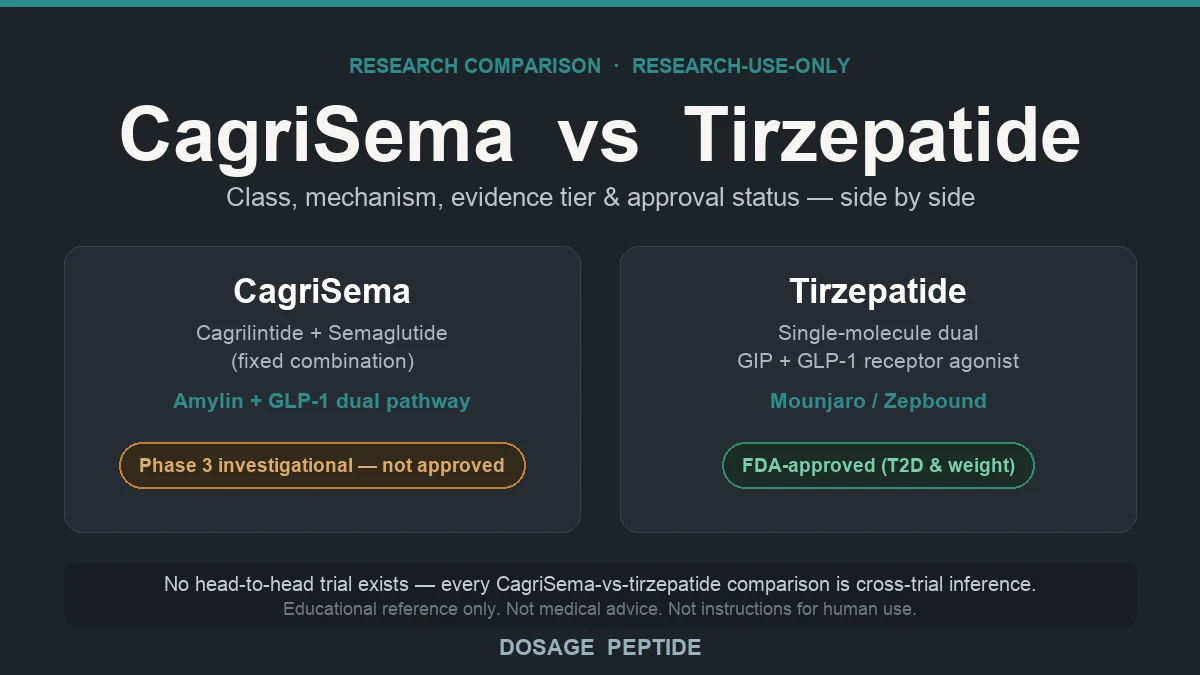
Search the weight-management and metabolic-research forums for “CagriSema vs Tirzepatide” and you will find them ranked against each other like two entries in the same race — a Novo Nordisk challenger versus Eli Lilly’s established dual-incretin drug, usually reduced to a single number: which one drops more body weight. This article compares the two the way the published evidence actually supports, which is more careful than the leaderboards suggest. The first fact to state plainly is that no head-to-head trial — in any population — has ever compared CagriSema against tirzepatide. The CagriSema trials measured it against semaglutide, cagrilintide, and placebo; the tirzepatide obesity trials measured it against placebo. Every CagriSema-versus-tirzepatide statement, including the ones below, is cross-trial inference.[1][5]
The second fact reframes the whole comparison, because these are not the same kind of drug at two different companies. CagriSema is a two-peptide fixed combination — the amylin analogue cagrilintide co-administered with the GLP-1 receptor agonist semaglutide — whereas tirzepatide is a single engineered molecule that activates two receptors (GIP and GLP-1) at once. And their regulatory footprints could hardly be more different: as of mid-2026 tirzepatide is an approved medicine on two continents, while CagriSema has completed its pivotal Phase 3a program but is not approved by any regulator. Getting those asymmetries right is the main job of this page.
This is educational reference material that summarizes published research and regulatory status. It is not medical advice, not a therapeutic recommendation, and not instructions for human use. Any dosing figures below describe clinical-trial protocols and approved labels for context only; nothing here is a personal protocol, and neither compound should be treated as a research-chemical you can self-administer.
CagriSema vs Tirzepatide: The Honest Bottom Line
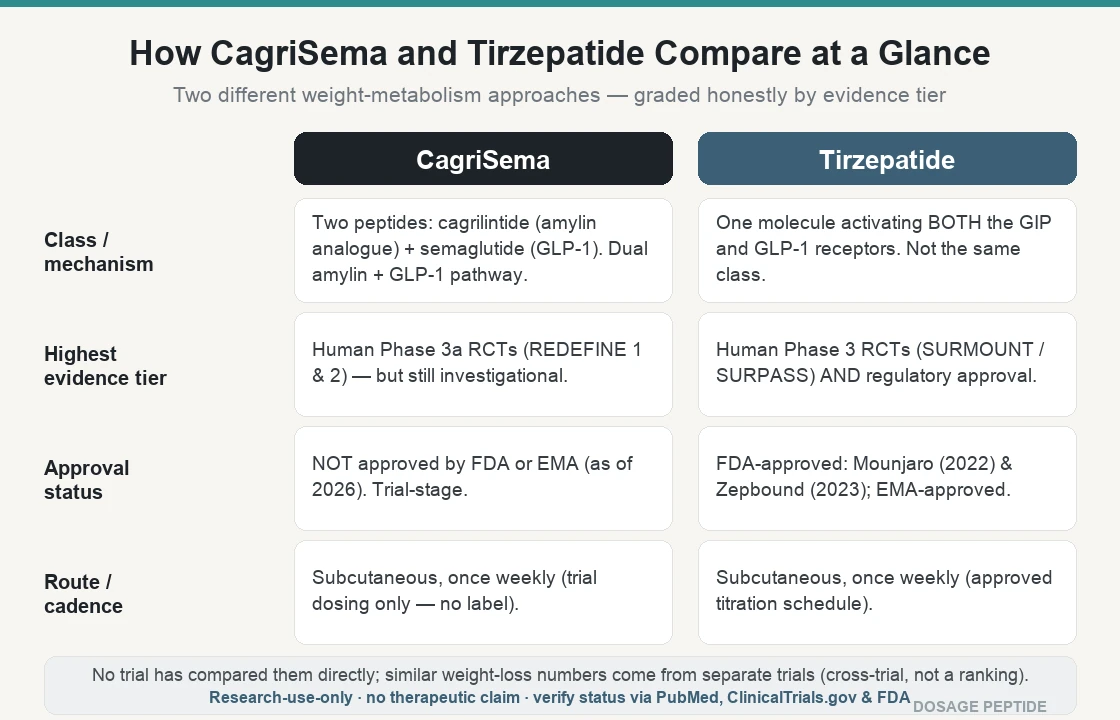
If you read only one section, read this one. Both compounds produce large body-weight reductions in obesity trials, and both are once-weekly subcutaneous injections dominated by gastrointestinal side effects. Where they diverge is what they are and where they sit on the regulatory ladder. Tirzepatide is a single approved molecule with a mature label; CagriSema is an investigational combination whose benefit–risk profile is still under regulatory review. The orientation table below is unpacked, with citations, in the sections that follow. For newcomers to this drug class, our primer on what a GLP-1 is and how these peptides are described in research gives the vocabulary used throughout.
| Attribute | CagriSema | Tirzepatide |
|---|---|---|
| Class / mechanism | Two-peptide fixed combination: cagrilintide (long-acting amylin analogue, acts at amylin/calcitonin receptors to suppress appetite) plus semaglutide (GLP-1 receptor agonist). Dual amylin + GLP-1 pathway — not a single molecule | Single-molecule dual incretin agonist: one fatty-acid-modified peptide that activates both the GIP and the GLP-1 receptors[7] |
| Molecular identity | Two distinct peptides co-formulated / co-administered; behaves as a combination product | One defined engineered peptide (LY3298176) |
| Primary research use | Body-weight reduction in overweight/obesity (REDEFINE 1) and in overweight/obesity with type 2 diabetes (REDEFINE 2)[1][2] | Type 2 diabetes glycemic control (SURPASS) and chronic weight management (SURMOUNT)[5] |
| Highest human evidence tier | Human Phase 3a RCTs (REDEFINE 1, n=3417; REDEFINE 2, n=1206) plus Phase 1b PK/PD — but investigational-stage[1][2][4] | Human Phase 3 RCTs plus regulatory approval — the highest tier in this pair[5] |
| Route / cadence | Subcutaneous injection, once weekly (both components) | Subcutaneous injection, once weekly |
| Approval status | Not approved by the FDA or EMA as of mid-2026. Phase 3a REDEFINE program complete; investigational | FDA-approved — Mounjaro (type 2 diabetes, 2022) and Zepbound (chronic weight management, 2023); also EMA-approved |
What Is CagriSema?
CagriSema is not one drug but a fixed combination of two peptides designed to hit appetite and metabolic control through two complementary hormonal pathways at the same time. The first component, cagrilintide, is a long-acting analogue of amylin — a hormone co-secreted with insulin that acts at amylin and calcitonin receptors to promote satiety and slow gastric emptying. The second, semaglutide at the 2.4 mg dose, is the GLP-1 receptor agonist already established for weight management. Combining them is meant to recruit the amylin pathway on top of the GLP-1 pathway, and the two were formally co-administered and tested together as “CagriSema.”[4] For the amylin side of that equation, our references on how cagrilintide affects gastric emptying and post-prandial metabolism and how cagrilintide influences brain satiety circuits go deeper into the mechanism; the GLP-1 side is covered in how semaglutide stimulates GLP-1 receptor activity.
The critical framing point is that CagriSema is investigational. Its evidence base is genuinely strong for a trial-stage product — two large Phase 3a randomized controlled trials plus a Phase 1b pharmacology study — but it has not received marketing approval from any regulator, and its complete benefit–risk profile is still being evaluated. That distinguishes it sharply from tirzepatide, and it means every figure quoted for CagriSema comes from a clinical trial rather than an approved label. The broader question of whether stacking an amylin analogue onto a GLP-1 drug earns its place is exactly what the REDEFINE program was built to answer, and it is discussed further in whether research validates cagrilintide’s role in appetite regulation.
What Is Tirzepatide?
Tirzepatide (development code LY3298176) is a single engineered peptide — a fatty-acid-modified 39-amino-acid molecule — that acts as a dual agonist at two incretin receptors: the glucose-dependent insulinotropic polypeptide (GIP) receptor and the glucagon-like peptide-1 (GLP-1) receptor. In its discovery-to-proof-of-concept work, it activated both receptors in vitro, improved glucose-dependent insulin secretion and glucose tolerance in animals, and in early human studies lowered fasting glucose and body weight; the fatty-acid modification supports once-weekly dosing.[7] Because it engages GIP and GLP-1 within one molecule, it is mechanistically distinct from CagriSema, which recruits amylin rather than GIP. Our explainer on how tirzepatide influences incretin pathways and the overview at what tirzepatide (Mounjaro/Zepbound) is and how it works walk through the receptor pharmacology.
Unlike CagriSema, tirzepatide is an approved medicine. The U.S. Food and Drug Administration approved it as Mounjaro for type 2 diabetes in 2022 and as Zepbound for chronic weight management in 2023, and it is authorized by the European Medicines Agency as well. That approval status is a hard regulatory fact, and it is the single biggest reason a CagriSema-versus-tirzepatide comparison is not a comparison of equals: one product has cleared a full regulatory efficacy-and-safety review, and the other has not yet. For how tirzepatide sits alongside newer candidates, see retatrutide vs tirzepatide and orforglipron vs semaglutide vs tirzepatide.
Do They Work the Same Way? Shared Goal, Different Machinery
Because both compounds are studied for the same outcome — substantial weight loss — it is tempting to treat them as interchangeable. They are not. The overlap is a single shared receptor: the GLP-1 receptor. Semaglutide (the GLP-1 half of CagriSema) and tirzepatide both agonize it, which is why both suppress appetite, slow gastric emptying, and improve glycemic measures. Below that shared point, the two diverge completely.
CagriSema adds the amylin pathway on top of GLP-1: cagrilintide engages amylin/calcitonin receptors, a mechanism entirely absent from tirzepatide. Tirzepatide, by contrast, adds the GIP pathway within the same molecule: it co-activates the GIP receptor, a mechanism entirely absent from CagriSema.[7] So the honest one-line summary is that both build on GLP-1 but recruit a different second pathway — amylin for CagriSema, GIP for tirzepatide — and there is a further structural difference underneath that: CagriSema achieves its dual action with two separate peptides, while tirzepatide achieves its dual action with one. Two drugs reaching a similar destination by different roads is precisely the situation in which cross-trial “which is better” claims are least reliable.
How We Got Here: Two Different Development Stories
The two programs arrived from opposite directions. Tirzepatide is the older, fully matured story: a single-molecule dual incretin agonist taken from discovery through Phase 1 proof-of-concept,[7] then through the large SURPASS (diabetes) and SURMOUNT (obesity) Phase 3 programs, and finally to FDA and EMA approval. By mid-2026 it has an established label, a defined titration schedule, and years of post-approval use behind it.
CagriSema is the newer story and a deliberately combinatorial one. Rather than engineer a new single molecule, Novo Nordisk paired an existing approved GLP-1 drug (semaglutide 2.4 mg) with a novel long-acting amylin analogue (cagrilintide). The combination was first characterized for safety and pharmacokinetics in a Phase 1b trial,[4] then advanced into the Phase 3a REDEFINE program.[1] That program is complete, but a completed Phase 3 program is not an approval — and that gap is where most of the confusion in this comparison lives.
Regulatory and Approval Reality
Stated plainly: tirzepatide is approved; CagriSema is not. Tirzepatide is FDA-approved as Mounjaro (type 2 diabetes, 2022) and Zepbound (chronic weight management, 2023), and is EMA-approved. CagriSema, as of mid-2026, has no marketing approval from the FDA, the EMA, or any other regulator; its pivotal REDEFINE 1 and REDEFINE 2 trials are published and complete, but the product remains investigational while regulators evaluate it.[1][2]
Two honest caveats sit on top of that. First, “investigational” is not a criticism of the data — CagriSema’s evidence is large-scale, randomized, and controlled — but it does mean there is no approved indication, no approved dose, and no completed regulatory safety determination behind it yet. Second, tirzepatide’s approval is specific: it is authorized for type 2 diabetes and for chronic weight management under defined conditions, not as a general-purpose research chemical. Neither of these compounds is a “peptide you experiment with”; both are prescription-grade or trial-grade agents, and any material bought outside those channels is of unverified identity and purity regardless of what the trials showed.
CagriSema: What the Human Evidence Actually Shows
CagriSema’s human record is unusually robust for an unapproved product. In REDEFINE 1, a 68-week, Phase 3a, multicenter, double-blind, placebo- and active-controlled trial, 3,417 adults with overweight or obesity but without diabetes were randomized to CagriSema (cagrilintide 2.4 mg + semaglutide 2.4 mg), semaglutide 2.4 mg, cagrilintide 2.4 mg, or placebo. The estimated mean change in body weight at week 68 was −20.4% with CagriSema versus −3.0% with placebo (a difference of about 17 percentage points), and more CagriSema participants reached weight-loss thresholds of 5%, 20%, 25%, and 30% than placebo.[1] A secondary and post-hoc analysis of the same trial also reported clinically relevant reductions in blood pressure.[3]
In REDEFINE 2, a parallel 68-week Phase 3a trial in 1,206 adults who had overweight or obesity and type 2 diabetes, once-weekly CagriSema produced an estimated mean weight change of −13.7% versus −3.4% with placebo, alongside marked improvements in glycemic control.[2] The lower headline number in REDEFINE 2 than in REDEFINE 1 is the expected pattern — weight loss is typically smaller in populations with type 2 diabetes — and is a good reminder that a trial’s population matters as much as its drug. The combination’s role in the metabolic complications of obesity is explored further in the potential role of the cagrilintide–semaglutide combo in obesity-related liver disease. The honest framing of the entire CagriSema record: strong, randomized, and consistent — but measured against semaglutide, cagrilintide, and placebo, never against tirzepatide, and not yet backed by a regulatory approval.
Tirzepatide: What the Human Evidence Actually Shows
Tirzepatide’s evidence is both extensive and regulator-endorsed. In SURMOUNT-1, a 72-week Phase 3 double-blind trial in 2,539 adults with obesity (or overweight with a complication) but without diabetes, once-weekly tirzepatide produced mean weight changes of −15.0% (5 mg), −19.5% (10 mg), and −20.9% (15 mg) versus −3.1% with placebo, with 50–57% of participants on the higher doses losing at least 20% of body weight.[5] A separate Phase 3 trial, SURMOUNT-CN, tested tirzepatide in Chinese adults with obesity and reported mean weight changes of −13.6% (10 mg) and −17.5% (15 mg) versus −2.3% with placebo over 52 weeks.[6] Its wider cardiometabolic effects are reviewed in how tirzepatide impacts cardiometabolic outcomes.
Two things make tirzepatide’s tier the highest in this pair. First, the effect is reproduced across multiple large Phase 3 trials in different populations, not a single program. Second — and decisively — those trials underpin an approved product with a defined label, which no CagriSema trial does. That does not make tirzepatide “better” than CagriSema in a head-to-head sense, because there has been no head-to-head trial; it makes tirzepatide the more established option, which is a different claim and the only one the evidence supports.
Head-to-Head vs. Cross-Trial: The Only Fair Comparisons
This is the section that keeps the rest honest. There is no trial in which CagriSema and tirzepatide were given to comparable participants and measured against each other. When a source says one is “stronger” than the other, it is lining up REDEFINE 1’s roughly −20.4% at 68 weeks against SURMOUNT-1’s roughly −20.9% at 72 weeks — two numbers from two different trials, in different populations, over different durations, against different comparators. That is cross-trial inference, and it cannot establish superiority: the near-identical headline figures are a coincidence of separate experiments, not the result of a race. The evidence-grading table makes each reported role explicit.
| Reported research role | Strongest evidence tier | Honest interpretation |
|---|---|---|
| CagriSema for weight loss in overweight/obesity (no diabetes) | Phase 3a RCT, 68 wk, n=3417 (REDEFINE 1)[1] | Large randomized effect vs placebo; investigational, not yet approved |
| CagriSema for weight + glycemia in type 2 diabetes | Phase 3a RCT, 68 wk, n=1206 (REDEFINE 2)[2] | Supported for that population; still trial-stage |
| Tirzepatide for weight loss in obesity (no diabetes) | Phase 3 RCT, 72 wk, n=2539 (SURMOUNT-1)[5] | Large randomized effect vs placebo; underpins an approved label |
| Tirzepatide for weight loss in another population | Phase 3 RCT, 52 wk, n=210 (SURMOUNT-CN)[6] | Reproduces the effect; approval-backed |
| CagriSema “beats” tirzepatide (or vice versa) | No head-to-head trial | Cannot be claimed from the evidence; cross-trial only |
| Either compound as a personal dosing protocol | No such evidence | Not established; both are prescription/trial agents, not self-experiment material |
Notice that the two strongest cells — REDEFINE 1 and SURMOUNT-1 — are equally well-designed but structurally uncomparable: different sponsors, sites, durations, and comparator arms. That is the recurring trap of this pairing: the best evidence on each side was never meant to be read against the other. For a sense of how quickly this field is moving, our comparisons of cagrilintide vs retatrutide and other next-generation candidates show how many overlapping agents are now in play.
Reading the Numbers Honestly: Half-Life, Route, and Exposure
With the evidence framed, here is the detailed side-by-side. The half-life row deserves care: both are long-acting once-weekly agents, but they get there differently — CagriSema combines two separately long-acting peptides, while tirzepatide is one molecule engineered for slow clearance.
| Property | CagriSema | Tirzepatide |
|---|---|---|
| Molecular identity | Combination of two peptides (cagrilintide + semaglutide 2.4 mg) | Single peptide (LY3298176) |
| Receptor targets | Amylin/calcitonin receptors (cagrilintide) + GLP-1 receptor (semaglutide) | GIP receptor + GLP-1 receptor (one molecule)[7] |
| Route / cadence | Subcutaneous, once weekly | Subcutaneous, once weekly |
| Half-life | Long-acting components: in the Phase 1b study cagrilintide half-life ≈159–195 h and semaglutide 2.4 mg ≈145–165 h; the combination did not alter semaglutide exposure or elimination[4] | ≈5 days (≈120 h), supporting once-weekly dosing[7][8] |
| Headline weight change (cross-trial — NOT comparable) | −20.4% at 68 wk, no diabetes (REDEFINE 1); −13.7% at 68 wk, type 2 diabetes (REDEFINE 2)[1][2] | −20.9% at 72 wk (15 mg), no diabetes (SURMOUNT-1); −17.5% at 52 wk (15 mg), SURMOUNT-CN[5][6] |
| Highest evidence tier | Phase 3a RCTs (investigational) | Phase 3 RCTs + FDA/EMA approval |
| Approval status | Not approved (mid-2026) | Approved (Mounjaro/Zepbound) |
Two figures in that table — the −20.4% and the −20.9% — are the ones most often stripped of context to declare a winner. They belong to different trials and are not a ranking. Anyone translating trial doses into vial concentrations for study purposes should treat the numbers strictly as reference points; our peptide reconstitution guide and dosage calculator explain that arithmetic without implying any human protocol.
Research-Use Dosing Conventions (Not Clinical Guidance)
The figures below are reported from published trials and the approved tirzepatide label. They are provided to help interpret the literature, not as a protocol for human use. CagriSema has no approved dose at all, and tirzepatide’s dose is a prescribing decision, not a self-directed regimen.
- CagriSema — trial dosing only, with no approved label. The REDEFINE trials co-escalated gradually to a target of cagrilintide 2.4 mg + semaglutide 2.4 mg once weekly.[1] The CagriSema combination research dosage reference frames these figures as research-use-only; the co-titration is why the combination is not something to improvise.
- Tirzepatide — the approved label starts at 2.5 mg once weekly and escalates in 2.5 mg steps at intervals of at least four weeks, to a maintenance dose of up to 15 mg once weekly.[5] In any research context it should still be framed research-use-only. See the tirzepatide 10 mg vial research dosage reference and the term definitions in our peptide research glossary.
Safety and Tolerability
Both compounds share a dominant, mostly mild-to-moderate gastrointestinal adverse-event profile — nausea, vomiting, diarrhea, constipation, abdominal pain — concentrated during dose escalation. What differs is the maturity of the safety record.
| Safety dimension | CagriSema | Tirzepatide |
|---|---|---|
| Dominant adverse events | Gastrointestinal (nausea, vomiting, diarrhea, constipation, abdominal pain), mostly transient and mild-to-moderate[1] | Gastrointestinal, dose-dependent, mostly mild-to-moderate, mainly during escalation[5] |
| Reported magnitude | GI adverse events in 79.6% (CagriSema) vs 39.9% (placebo) in REDEFINE 1[1] | Treatment discontinuation for adverse events ≈4–7% across doses in SURMOUNT-1[5] |
| Regulatory safety maturity | Benefit–risk still under regulatory review (investigational) | Established approved label with post-marketing surveillance |
| Label warnings | None issued yet — no approved label exists | Boxed warning for thyroid C-cell tumors (rodent finding); pancreatitis and gallbladder cautions on the label |
| Long-term human safety data | Trial-duration only (to 68 weeks in REDEFINE) | Trial data plus accumulating real-world post-approval experience |
The boxed-warning row is important and asymmetric: because tirzepatide is approved, its rodent thyroid C-cell finding is formally carried on the label as a warning, whereas CagriSema simply has no label yet. That is not evidence that CagriSema is safer — only that it has not been through the labeling process. A longer, dose-dependent safety picture for this whole drug family is discussed in our review of GLP-1-class side-effect and safety research.
Which Compound Is Studied for What?
Mapping each compound to its actual research context prevents the most common error — treating them as two brands of the same thing. The table below shows where each has evidence and which side holds the stronger tier in this pair.
| Research context | CagriSema | Tirzepatide | Strongest tier in this pair |
|---|---|---|---|
| Weight loss in obesity without diabetes | Phase 3a RCT (REDEFINE 1)[1] | Phase 3 RCT (SURMOUNT-1)[5] | Both RCT; tirzepatide also approved |
| Weight + glycemia in type 2 diabetes | Phase 3a RCT (REDEFINE 2)[2] | Approved diabetes indication (Mounjaro) + SURPASS program | Tirzepatide (approved indication) |
| Cardiometabolic secondary outcomes (e.g. blood pressure) | REDEFINE 1 secondary/post-hoc analysis[3] | Reported across SURMOUNT/SURPASS[5] | Both RCT-level, different endpoints |
| Pharmacokinetics / half-life | Phase 1b PK/PD (Enebo)[4] | Discovery-to-POC + PK review[7][8] | Characterized for both |
| Head-to-head vs each other | No trial exists | Cross-trial inference only | |
What the Evidence Does NOT Show
Being explicit about the gaps is part of reading this pair honestly. The published evidence does not show any of the following:
- That CagriSema is superior or inferior to tirzepatide — no head-to-head trial exists, so the near-identical weight numbers cannot be turned into a ranking.
- That the −20.4% (REDEFINE 1) and −20.9% (SURMOUNT-1) figures are comparable — they come from separate trials with different populations, durations, and comparators.
- That CagriSema is approved, or approvable, anywhere — as of mid-2026 it is investigational, with its benefit–risk profile still under regulatory review.
- That the two are the same drug class — CagriSema is a two-peptide amylin + GLP-1 combination; tirzepatide is a single GIP + GLP-1 molecule.
- That either has a validated self-administered “research” dose — CagriSema has no approved label at all, and tirzepatide’s dose is a prescribing decision.
- That trial results transfer to research-market material — trial data describe a characterized study drug, not the contents of an arbitrary vial.
Limitations of This Comparison
Several structural limitations constrain everything above, and honest readers should keep them in view:
- No head-to-head data. Comparing the two requires stitching together separate trials that differ in sponsor, population, duration, and comparator — a chain with several weak links.
- Population mismatch. REDEFINE and SURMOUNT enrolled different cohorts (including with-diabetes vs without-diabetes arms), and diabetes status alone shifts expected weight loss.
- Different maturity. One product is approved with post-marketing data; the other is investigational with trial-duration data only. That asymmetry colors any “safety” or “durability” comparison.
- Combination vs single molecule. CagriSema’s two-peptide design makes its pharmacology and dosing inherently different from a single-molecule agent, so “equivalent” numbers do not mean equivalent products.
- Evolving regulatory status. Approval status can change after any writing date; the investigational-versus-approved framing here should be reverified against primary regulatory sources.
- Not product data. Both are prescription/trial-grade agents; any research-market material is of unverified identity and purity and is not what the trials tested.
Practical and Research Context
For readers using this material to interpret the literature rather than to guide any human use, a few practical anchors help. The reconstitution and concentration arithmetic for injectable peptides is covered generically in our reconstitution guide and dosage calculator, and the underlying vocabulary — amylin analogue, incretin, GIP, GLP-1, half-life — is defined in our peptide research glossary. None of those tools implies a human protocol; they exist to make the published numbers legible.
Product identity is the one practical point worth emphasizing, because it is where the biggest gap between “the trial” and “a vial” opens up. Trial data describe a characterized study drug manufactured to pharmaceutical standards; research-market material is not, so its identity and purity are unverified, and confirmation by mass spectrometry and HPLC with a batch certificate of analysis is the minimum a rigorous setting would require. Reference vials in this category are catalogued by research-grade peptide suppliers such as Prime Lab; sourcing a tested material, however, does not change the evidence picture described above — trial data still do not transfer to any specific product, CagriSema remains investigational, and nothing here is a therapeutic recommendation or a protocol for use.
Common Misconceptions
“CagriSema and tirzepatide are basically the same drug.”
No. They share only the GLP-1 receptor. CagriSema is a two-peptide combination that adds the amylin pathway (cagrilintide); tirzepatide is a single molecule that adds the GIP pathway. Different second mechanism, different molecular design, not interchangeable.
“CagriSema is proven to beat tirzepatide because the weight loss is higher.”
It is not proven to beat anything relative to tirzepatide. The two have never been tested against each other, and the headline figures (roughly −20.4% vs −20.9%) come from different trials in different populations. That is a coincidence of separate experiments, not a measured result.
“Both are FDA-approved weight-loss drugs.”
Only tirzepatide is approved (Mounjaro and Zepbound). CagriSema, as of mid-2026, has completed its Phase 3a REDEFINE program but is not approved by the FDA, the EMA, or any other regulator, and its benefit–risk profile is still under review.
“You can just buy either one as a research peptide and dose it yourself.”
Neither is a self-experiment compound. Tirzepatide is a prescription medicine with a physician-managed titration; CagriSema is an investigational combination with no approved dose. Research-market material of unverified identity and purity is not what the trials studied, and nothing here is instructions for human use.
Key Takeaways
- No head-to-head trial exists. CagriSema was tested against semaglutide, cagrilintide, and placebo; tirzepatide against placebo — never against each other. Every direct comparison is cross-trial inference.
- Different classes. CagriSema is a two-peptide amylin + GLP-1 combination; tirzepatide is a single GIP + GLP-1 molecule. They are not interchangeable.
- Approval is asymmetric. Tirzepatide is FDA- and EMA-approved (Mounjaro/Zepbound); CagriSema is investigational and not approved anywhere as of mid-2026.
- The weight numbers look similar but are not comparable. −20.4% (REDEFINE 1) and −20.9% (SURMOUNT-1) are from different trials, populations, and durations.
- Both are GI-dominant. Nausea, vomiting, and related effects during escalation are the shared, mostly mild-to-moderate safety story; tirzepatide additionally carries a labeled boxed warning, while CagriSema has no label yet.
- Everything here is research-use-only. No therapeutic or human-use claim is made; verify current trial and regulatory status through primary sources.
Frequently Asked Questions
Is CagriSema or tirzepatide better for weight loss?
There is no head-to-head trial, so “better” cannot be established from evidence. Their headline weight-loss figures are similar (about −20.4% for CagriSema in REDEFINE 1 and about −20.9% for tirzepatide 15 mg in SURMOUNT-1), but those come from separate trials in different populations over different durations. Any ranking is cross-trial inference, not a measured result.
Are CagriSema and tirzepatide the same type of drug?
No. CagriSema is a fixed combination of two peptides — cagrilintide, an amylin analogue, plus semaglutide, a GLP-1 receptor agonist. Tirzepatide is a single molecule that activates both the GIP and GLP-1 receptors. They overlap only at the GLP-1 receptor and add different second pathways, so they are not the same class and not interchangeable.
Is CagriSema FDA-approved?
No. As of mid-2026 CagriSema is not approved by the FDA, the EMA, or any other regulator. Its Phase 3a REDEFINE 1 and REDEFINE 2 trials are published and complete, but the product remains investigational while its benefit–risk profile is evaluated.
Is tirzepatide FDA-approved?
Yes. Tirzepatide is FDA-approved as Mounjaro for type 2 diabetes (2022) and as Zepbound for chronic weight management (2023), and it is also approved by the EMA. That approval status is the single biggest difference from CagriSema in this comparison.
How much weight did each one produce in trials?
In REDEFINE 1 (no diabetes), CagriSema produced an estimated mean weight change of about −20.4% at 68 weeks; in REDEFINE 2 (type 2 diabetes), about −13.7%. In SURMOUNT-1 (no diabetes), tirzepatide 15 mg produced about −20.9% at 72 weeks; SURMOUNT-CN reported about −17.5% at 52 weeks. These are not directly comparable across trials.
Do they have the same side effects?
Both are dominated by gastrointestinal adverse events — nausea, vomiting, diarrhea, constipation, and abdominal pain — that are mostly mild to moderate and concentrate during dose escalation. Tirzepatide, being approved, additionally carries a labeled boxed warning for thyroid C-cell tumors based on rodent studies; CagriSema has no label yet because it is not approved.
How are they dosed?
Tirzepatide has an approved schedule starting at 2.5 mg once weekly, escalating in 2.5 mg steps at least four weeks apart, up to 15 mg once weekly. CagriSema has no approved dose; its trials co-escalated to a target of cagrilintide 2.4 mg plus semaglutide 2.4 mg once weekly. All dosing here is research-use context only, not guidance for human use.
Why does CagriSema use two peptides instead of one molecule like tirzepatide?
They are two different design strategies. CagriSema combines an existing GLP-1 drug (semaglutide) with a new amylin analogue (cagrilintide) to recruit two hormone pathways. Tirzepatide instead engineers a single peptide to activate two incretin receptors (GIP and GLP-1) at once. Both aim for dual pathway action; they simply achieve it differently.
Is any of this a recommendation for human use?
No. This article is educational reference material summarizing published research and regulatory status. It is not medical advice, not a therapeutic recommendation, and not instructions for human use. Any doses cited describe clinical-trial protocols or approved labels for context only, and research-market material is of unverified identity and purity.
References
- Garvey WT, Blüher M, Osorto Contreras CK, et al. Coadministered cagrilintide and semaglutide in adults with overweight or obesity (REDEFINE 1). N Engl J Med. 2025;393(7):635–647. doi:10.1056/NEJMoa2502081. PMID 40544433.
- Davies MJ, Bajaj HS, Broholm C, et al. Cagrilintide–semaglutide in adults with overweight or obesity and type 2 diabetes (REDEFINE 2). N Engl J Med. 2025;393(7):648–659. doi:10.1056/NEJMoa2502082. PMID 40544432.
- Verma S, Böttcher M, Brown P, et al. CagriSema reduces blood pressure in adults with overweight or obesity: REDEFINE 1. Hypertension. 2025;83(2):e26055. doi:10.1161/HYPERTENSIONAHA.125.26055. PMID 41328546.
- Enebo LB, Berthelsen KK, Kankam M, et al. Safety, tolerability, pharmacokinetics, and pharmacodynamics of concomitant administration of multiple doses of cagrilintide with semaglutide 2.4 mg for weight management: a randomised, controlled, phase 1b trial. Lancet. 2021;397(10286):1736–1748. doi:10.1016/S0140-6736(21)00845-X. PMID 33894838.
- Jastreboff AM, Aronne LJ, Ahmad NN, et al. Tirzepatide once weekly for the treatment of obesity (SURMOUNT-1). N Engl J Med. 2022;387(3):205–216. doi:10.1056/NEJMoa2206038. PMID 35658024.
- Zhao L, Cheng Z, Lu Y, et al. Tirzepatide for weight reduction in Chinese adults with obesity: the SURMOUNT-CN randomized clinical trial. JAMA. 2024;332(7):551–560. doi:10.1001/jama.2024.9217. PMID 38819983.
- Coskun T, Sloop KW, Loghin C, et al. LY3298176, a novel dual GIP and GLP-1 receptor agonist for the treatment of type 2 diabetes mellitus: from discovery to clinical proof of concept. Mol Metab. 2018;18:3–14. doi:10.1016/j.molmet.2018.09.009. PMID 30473097.
- Min JS, Jo SJ, Lee S, et al. A comprehensive review on the pharmacokinetics and drug–drug interactions of approved GLP-1 receptor agonists and a dual GLP-1/GIP receptor agonist. Drug Des Devel Ther. 2025;19:3509–3537. doi:10.2147/DDDT.S506957. PMID 40330819.
Research-use disclaimer: This article is educational reference material summarizing published research and regulatory context. It is not medical advice, not a therapeutic recommendation, and not instructions for human use. CagriSema (cagrilintide + semaglutide) is investigational and not approved by any regulator as of mid-2026; tirzepatide is FDA- and EMA-approved (Mounjaro/Zepbound). No head-to-head trial has compared the two, so every direct comparison here is cross-trial inference. Any dosing figures describe clinical-trial protocols or approved labels only. Always verify current clinical-trial and regulatory status through primary sources such as PubMed, ClinicalTrials.gov, and the FDA.