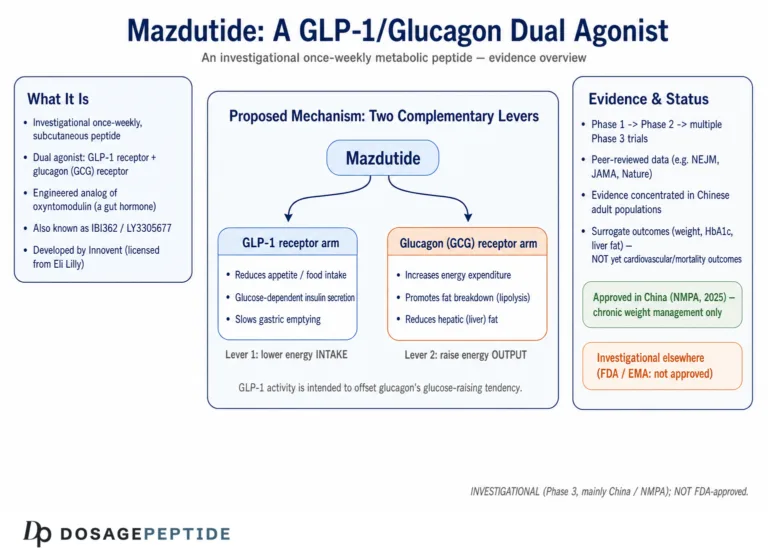
The short answer: mazdutide and tirzepatide are both once-weekly, single-molecule dual receptor agonists, but they hit different second receptors — mazdutide (IBI362 / LY3305677) pairs GLP-1 receptor agonism with glucagon receptor agonism, while tirzepatide pairs GLP-1 receptor agonism with GIP receptor agonism. The bigger practical difference is regulatory, not pharmacological: tirzepatide is FDA-approved under two brand names covering three labelled indications, whereas mazdutide is approved by China’s NMPA and is not approved by the FDA in any indication.345 And for anyone trying to rank them: no randomised head-to-head trial of mazdutide against tirzepatide has reported results. One registered study carries a tirzepatide comparator arm, but it is a phase 1/2 safety and pharmacokinetics study and has not reported.12
Mazdutide vs tirzepatide at a glance
| Attribute | Mazdutide (IBI362 / LY3305677) | Tirzepatide (Mounjaro / Zepbound) |
|---|---|---|
| Receptor targets | GLP-1 receptor + glucagon (GCG) receptor dual agonist | GIP receptor + GLP-1 receptor dual agonist |
| Developer | Eli Lilly and Company with Innovent Biologics; Innovent runs the China programme3 | Eli Lilly and Company |
| Approval status | Not FDA-approved in any indication. Approved by China’s NMPA in June 2025 (long-term weight management) and September 2025 (glycaemic control in T2D).3 Investigational in the US; a US phase 2 obesity trial completed July 202511 | FDA-approved under two brand names, Mounjaro and Zepbound45 |
| Exact US indications | None | Mounjaro: glycaemic control in T2D, adults and paediatric patients ≥10 y. Zepbound: chronic weight management; moderate-to-severe OSA in adults with obesity45 |
| Evidence tier | Approved in China on a phase 3 dataset generated in Chinese participants. Development is not finished: further phase 3 work in fatty liver disease, obstructive sleep apnoea and other indications was under way at the time of first approval3 | FDA-approved; large multinational phase 3 programme including a published randomised comparison against semaglutide7 |
| Largest weight reduction in a published phase 3 obesity trial | GLORY-2: 9 mg, 60 weeks, Chinese adults with BMI ≥30, −16.65% body weight vs −1.50% placebo2 | SURMOUNT-1: 5/10/15 mg, 72 weeks, multinational, −15.0% / −19.5% / −20.9% vs −3.1% placebo6 |
| Dosing cadence | Once weekly subcutaneous, with stepwise titration | Once weekly subcutaneous; the US label starts at 2.5 mg and escalates in 2.5 mg increments5 |
| Key trial names | GLORY-1 (NCT05607680), GLORY-2 (NCT06164873), DREAMS-2 (NCT05606913), DREAMS-3 (NCT06184568) | SURMOUNT-1, SURMOUNT-CN, SURMOUNT-OSA, SURPASS-2 |
| Direct head-to-head vs the other | None published. One registered phase 1/2 safety and pharmacokinetics study (NCT07000955) includes a tirzepatide arm; no results posted as of August 202612 | |
The distinction that actually matters
Most comparisons of these two molecules get stuck on the receptor question, which is interesting but not what separates them in practice. The separation is regulatory. Tirzepatide has a US prescribing label with defined indications, a titration schedule, a boxed warning and post-marketing surveillance.45 Mazdutide has none of that in the US — it has a Chinese marketing authorisation and a phase 3 dataset generated entirely in Chinese participants.3
The two are therefore not at the same evidentiary maturity, and the honest framing is not “which is stronger” but “one is approved in a single jurisdiction on a geographically narrow evidence base, the other in many on a broader one.” For the pharmacology on its own terms, we cover each compound separately in what mazdutide is as a GLP-1 and glucagon dual agonist and in how tirzepatide works as Mounjaro and Zepbound.
How the two mechanisms differ

Both molecules share the GLP-1 receptor arm: glucose-dependent insulin secretion, glucagon suppression in the fed state, slowed gastric emptying and central appetite suppression, a baseline set out in our complete guide to GLP-1 receptor agonists. The divergence is entirely in the second receptor.
Tirzepatide’s second arm: GIP
Glucose-dependent insulinotropic polypeptide is the other major incretin hormone, and GIP receptor agonism is primarily insulinotropic — it amplifies glucose-dependent insulin release. Why adding GIP to GLP-1 should produce more weight loss than GLP-1 alone is still an open mechanistic question rather than a settled one; a 2025 review devoted to that question surveys the candidate explanations for GLP-1/GIP, GLP-1/glucagon and triple agonists rather than settling on one.14
Mazdutide’s second arm: glucagon
Glucagon receptor agonism is a different, on the surface counterintuitive proposition — glucagon raises blood glucose. The rationale is that at appropriate ratios of GLP-1 to glucagon activity the GLP-1 arm largely offsets the glycaemic liability, while the glucagon arm contributes what GIP does not: a proposed role in appetite and energy expenditure, and reductions in hepatic fat content measured in randomised trials of GLP-1/glucagon co-agonists. A review of 26 randomised trials across seven GLP-1/glucagon co-agonists describes exactly this trade-off, reports a higher incidence of adverse effects than with GLP-1 agonism alone or placebo, and is explicit that the balance is delicate and that the optimal receptor ratio, dose and titration regimen are not yet established.15
The summary, then: tirzepatide’s second receptor is an incretin that mainly potentiates insulin secretion; mazdutide’s is a catabolic hormone receptor with proposed effects on energy expenditure and the liver. Different biology, and their side-effect profiles should be expected to differ. The same logic applies to survodutide, another GLP-1/glucagon dual agonist covered in our survodutide overview, and to triple agonists, the subject of our retatrutide vs tirzepatide comparison.
What the published human data actually shows
Tirzepatide
SURMOUNT-1 randomised 2,539 adults with a BMI of 30 or more, or 27 or more with at least one weight-related complication, excluding diabetes, to once-weekly tirzepatide 5 mg, 10 mg, 15 mg or placebo for 72 weeks including a 20-week escalation. Mean percentage weight change at week 72 was −15.0% (95% CI −15.9 to −14.2) at 5 mg, −19.5% (−20.4 to −18.5) at 10 mg, −20.9% (−21.8 to −19.9) at 15 mg, and −3.1% (−4.3 to −1.9) with placebo, all P < 0.001 versus placebo. Baseline mean weight was 104.8 kg and mean BMI 38.0.6
In type 2 diabetes, SURPASS-2 compared tirzepatide 5/10/15 mg against semaglutide 1 mg once weekly in 1,879 participants over 40 weeks. HbA1c reductions were −2.01, −2.24 and −2.30 percentage points with tirzepatide versus −1.86 with semaglutide, and body weight reductions were greater with tirzepatide by 1.9 kg, 3.6 kg and 5.5 kg across the three doses (P < 0.001).7 It is cited only as an example of a genuine randomised head-to-head; mazdutide has none against tirzepatide.
Zepbound’s label also carries an indication for moderate-to-severe obstructive sleep apnoea in adults with obesity; that is the third of the three US indications the two brands hold between them.4 More relevant to this comparison, SURMOUNT-CN studied tirzepatide 10 mg and 15 mg in 210 Chinese adults with obesity or overweight plus comorbidity, excluding diabetes, over 52 weeks. Mean weight change at week 52 was −13.6% (95% CI −15.8 to −11.4) at 10 mg and −17.5% (−19.7 to −15.3) at 15 mg versus −2.3% with placebo; baseline mean weight was 91.8 kg and mean BMI 32.3.8 That is the closest population-matched reference point available — and still not a head-to-head.
Mazdutide
GLORY-1 was the larger of the two published phase 3 obesity trials: 610 Chinese adults with BMI ≥28, or BMI 24 to <28 plus at least one weight-related coexisting condition, randomised 1:1:1 to mazdutide 4 mg, 6 mg or placebo for 48 weeks. Baseline mean weight was 87.2 kg and mean BMI 31.1 — meaningfully lighter and lower-BMI than SURMOUNT-1’s population. At the week-32 primary endpoint, mean percentage weight change was −10.09% (95% CI −11.15 to −9.04) at 4 mg, −12.55% (−13.64 to −11.45) at 6 mg, and +0.45% (−0.61 to 1.52) with placebo; 73.9%, 82.0% and 10.5% respectively achieved at least 5% weight reduction (P < 0.001 for all comparisons). At the secondary week-48 timepoint the figures were −11.00%, −14.01% and +0.30%, with 35.7%, 49.5% and 2.0% achieving at least 15% reduction.1
GLORY-2 tested the higher 9 mg dose across 27 hospitals in Chinese adults with obesity defined as BMI ≥30, randomised 2:1 against placebo for 60 weeks; 461 participants received treatment and were analysed (mean BMI 34.3, mean weight 94.0 kg, mean age 33.9 years, 16.1% with type 2 diabetes). At week 60, mean percentage weight change was −16.65% (95% CI −18.19 to −15.12) versus −1.50% (−3.43 to 0.43) with placebo, a between-group difference of −15.15% (−17.22 to −13.09), P < .001; 84.3% versus 33.1% achieved at least 5% reduction.2
On the diabetes side, DREAMS-2 randomised 731 Chinese adults with type 2 diabetes to mazdutide 4 mg, 6 mg or dulaglutide 1.5 mg for 28 weeks, on background oral antidiabetic therapy. Mazdutide was superior on HbA1c by −0.24 percentage points at 4 mg (P = 0.0032) and −0.30 at 6 mg (P = 0.0003), with body weight differences of −3.78% and −5.76% versus dulaglutide (both P < 0.0001).9 A second head-to-head, DREAMS-3, compared mazdutide 6 mg against semaglutide 1 mg in 349 Chinese adults with early type 2 diabetes and obesity. Only its rationale, design and baseline data are published; the trial completed in February 2026 and no outcome results had been posted to the registry or published as of August 2026.10
Reconstitution arithmetic for laboratory handling of research vials is covered separately in our reference pages for the mazdutide 5 mg vial and mazdutide 10 mg vial, and in our tirzepatide titration reference. Those pages record what was administered in published studies; they are not protocols for human use.
Is there a head-to-head trial?
Not one that has reported. As of August 2026 no randomised trial comparing mazdutide with tirzepatide on weight or glycaemic outcomes has been published — though the registry picture needs stating precisely, because one registered study does include both molecules. NCT07000955 is a randomised, partially blinded phase 1/2 study of mazdutide 15 mg against placebo and against tirzepatide in 98 Chinese adults with BMI ≥32.5. Its primary endpoints are tolerability and safety measures; change in body weight is a secondary endpoint, primary completion is scheduled for September 2026 and no results are posted.12 Mazdutide’s registered efficacy comparators remain dulaglutide (DREAMS-2) and semaglutide (DREAMS-3, plus a fatty-liver comparison), not tirzepatide.910
What does exist is indirect comparison. A 2026 network meta-analysis of 262 randomised trials and 99,791 participants placed tirzepatide at −14.9% (95% CI −16.0 to −13.9) versus lifestyle modification at one year on moderate-to-high certainty evidence, and grouped mazdutide with other emerging agents that “may produce similar or greater reductions” in the 13.1–14.6% range — but rated that mazdutide estimate very low to low certainty.13 That certainty gap is the finding. It does not say mazdutide is weaker; it says the evidence supporting any number attached to it is much thinner. Until a randomised comparison of the two is run and reported, any claim that one produces more weight reduction is an inference, not a finding.
Why cross-trial comparison misleads here specifically
Lining up −16.65% from GLORY-2 against −20.9% from SURMOUNT-1 and concluding tirzepatide “wins” is the error to avoid, for four reasons visible in the trial records themselves.
Different populations. SURMOUNT-1’s multinational cohort started at 104.8 kg and BMI 38.0; GLORY-2’s Chinese cohort at 94.0 kg and BMI 34.3, mean age 33.9 years; GLORY-1’s at 87.2 kg and BMI 31.1.126 Percentage weight loss is not population-independent.
Different durations. 72 weeks in SURMOUNT-1, 60 in GLORY-2, 52 in SURMOUNT-CN, 48 in GLORY-1. A 48-week number and a 72-week number are not the same measurement.
Different placebo behaviour. Placebo arms ran −3.1% in SURMOUNT-1, −2.3% in SURMOUNT-CN, −1.50% in GLORY-2 and +0.30% at week 48 in GLORY-1.1268 Because placebo-adjusted effect is what a regulator evaluates, a raw active-arm percentage taken out of context can flatter or penalise a drug by several percentage points before any pharmacology is involved.
Different estimands and endpoint timing. GLORY-1’s primary endpoint sat at week 32 under a treatment-policy estimand — effects regardless of early discontinuation or initiation of new anti-obesity therapy — with week 48 secondary.1 SURMOUNT-1 reported a treatment-regimen estimand at week 72.6 Two trials reporting “percentage weight change” can be answering different statistical questions.
If a fairer indirect comparison is wanted, the least unfair pairing is GLORY-2 against SURMOUNT-CN, since both studied Chinese adults over roughly a year: mazdutide 9 mg gave −16.65% at week 60, tirzepatide 15 mg gave −17.5% at week 52 and 10 mg gave −13.6%.28 Even that pairing differs in BMI entry criteria, baseline BMI, diabetes inclusion, sample size and estimand. It narrows the confounding; it does not remove it.
Safety and tolerability as reported
Both compounds report gastrointestinal adverse events as the dominant category, mostly mild to moderate, at rates that differ substantially between non-comparable trials. In GLORY-2, mazdutide 9 mg reported vomiting in 53.1% versus 1.3% on placebo, nausea in 46.9% versus 3.2%, and diarrhoea in 39.4% versus 6.5%, with discontinuation due to adverse events in 2.9% versus 0%.2 In GLORY-1 at the lower 4 mg and 6 mg doses, discontinuation for adverse events was 1.5%, 0.5% and 1.0% for 4 mg, 6 mg and placebo respectively.1 In SURMOUNT-1, adverse events caused discontinuation in 4.3%, 7.1% and 6.2% of the 5, 10 and 15 mg groups versus 2.6% on placebo.6
Beyond gastrointestinal effects, the two raise different questions. The tirzepatide labels carry a boxed warning for thyroid C-cell tumours seen in rats at clinically relevant exposures, with human relevance stated as unknown, and list acute pancreatitis, acute gallbladder disease and hypoglycaemia among warnings and precautions — documented in the FDA prescribing information rather than inferred.45 For glucagon receptor agonism, the co-agonist review discusses possible additional risks attaching to glucagon agonism itself and is explicit that the GLP-1-to-glucagon balance is delicate and that the optimal ratio, dose and titration regimen still need defining.15 Mazdutide’s long-term safety record is necessarily shorter, its first approval being in 2025.3
Open questions
Several things are genuinely unknown rather than merely undecided. Whether mazdutide’s efficacy and tolerability transfer to non-Chinese populations is untested at phase 3 — Lilly completed a 179-participant US phase 2 obesity trial of LY3305677 in July 2025, but the phase 3 evidence base remains Chinese.11 Whether glucagon receptor agonism delivers an advantage on hepatic fat or energy expenditure that GIP agonism does not, in a way that changes outcomes, has not been shown in a comparative trial. Whether either compound reduces hard cardiovascular endpoints in obesity without diabetes is a question none of the trials cited above was designed to answer. And whether the 9 mg dose carries an acceptable long-term tolerability profile, given the vomiting and nausea rates in GLORY-2, needs longer follow-up.2
Frequently Asked Questions
Is mazdutide FDA-approved?
No — not for any indication. Its first approval came from China’s NMPA in June 2025, for long-term weight management in adults with a BMI ≥28, or BMI ≥24 with at least one weight-related comorbidity; a second NMPA approval followed in September 2025 for glycaemic control in adults with type 2 diabetes.3
What exactly is tirzepatide approved for in the US?
Two brands, three indications. Mounjaro is indicated as an adjunct to diet and exercise to improve glycaemic control in adults and paediatric patients 10 years of age and older with type 2 diabetes.5 Zepbound is indicated, with a reduced-calorie diet and increased physical activity, to reduce excess body weight and maintain weight reduction long term in adults with obesity or with overweight plus at least one weight-related comorbid condition, and to treat moderate to severe obstructive sleep apnoea in adults with obesity.4
Which one causes more weight loss?
No randomised head-to-head trial has reported, so this cannot be answered directly. The best indirect evidence is a 2026 network meta-analysis putting tirzepatide at −14.9% versus lifestyle modification at one year on moderate-to-high certainty evidence, and grouping mazdutide among emerging agents estimated at 13.1–14.6% but rated very low to low certainty.13 The certainty rating, not the point estimate, is the honest headline.
Is there any registered trial that puts them side by side?
One. NCT07000955 is a randomised phase 1/2 study of mazdutide 15 mg against placebo and against tirzepatide in 98 Chinese adults with BMI ≥32.5. Its primary endpoints are safety and tolerability, with body weight change secondary, and no results are posted as of August 2026.12 It is not designed as an efficacy comparison.
What is the difference between a GLP-1/glucagon dual agonist and a GIP/GLP-1 dual agonist?
Both share GLP-1 receptor agonism. The GIP arm in tirzepatide is a second incretin receptor, principally amplifying glucose-dependent insulin secretion; why that adds to weight loss remains a live mechanistic question.14 The glucagon arm in mazdutide targets a catabolic hormone receptor with proposed effects on energy expenditure and the liver, with the GLP-1 arm counterbalancing glucagon’s glycaemic liability.15
Are IBI362 and LY3305677 the same thing as mazdutide?
Yes. IBI362 is Innovent’s development code and LY3305677 is Eli Lilly’s; both refer to mazdutide. Registry entries appear under all three names, so a search under one code alone will miss part of the trial record.
Has mazdutide been compared against semaglutide?
Yes. DREAMS-3 is a phase 3 open-label comparison of mazdutide 6 mg against semaglutide 1 mg in 349 Chinese adults with early type 2 diabetes and obesity; only its rationale, design and baseline data are published, with no outcome results posted or published as of August 2026.10 Mazdutide was also superior to dulaglutide on HbA1c and body weight over 28 weeks in DREAMS-2.9 Neither is a comparison against tirzepatide.
Do the gastrointestinal side-effect rates mean mazdutide is worse tolerated?
Not a conclusion the data support. The high vomiting and nausea rates in GLORY-2 come from a 9 mg arm against placebo in one population; GLORY-1 at 4 mg and 6 mg reported discontinuation rates of 1.5% and 0.5%.12 Tolerability in this class is strongly dose- and titration-dependent, and cross-trial adverse event rates reflect reporting conventions as well as the drug.
References
- Ji L, Jiang H, Bi Y, et al; GLORY-1 Investigators. Once-Weekly Mazdutide in Chinese Adults with Obesity or Overweight. N Engl J Med. 2025;392(22):2215-2225. PubMed 40421736
- Gao L, Jiang H, Cai H, et al; GLORY-2 Trial Investigators. Treatment With 9-mg Mazdutide for Weight Reduction in Chinese Adults With Obesity: The GLORY-2 Randomized Clinical Trial. JAMA. Published online June 7, 2026. doi:10.1001/jama.2026.8142. PubMed 42251595
- Shirley M. Mazdutide: First Approval. Drugs. 2025;85(12):1621-1627. PubMed 41028652
- ZEPBOUND (tirzepatide) injection, prescribing information. Eli Lilly and Company. DailyMed, US National Library of Medicine. DailyMed label
- MOUNJARO (tirzepatide) injection, prescribing information. Eli Lilly and Company. DailyMed, US National Library of Medicine. DailyMed label
- Jastreboff AM, Aronne LJ, Ahmad NN, et al; SURMOUNT-1 Investigators. Tirzepatide Once Weekly for the Treatment of Obesity. N Engl J Med. 2022;387(3):205-216. PubMed 35658024
- Frías JP, Davies MJ, Rosenstock J, et al; SURPASS-2 Investigators. Tirzepatide versus Semaglutide Once Weekly in Patients with Type 2 Diabetes. N Engl J Med. 2021;385(6):503-515. PubMed 34170647
- Zhao L, Cheng Z, Lu Y, et al. Tirzepatide for Weight Reduction in Chinese Adults With Obesity: The SURMOUNT-CN Randomized Clinical Trial. JAMA. 2024;332(7):551-560. PubMed 38819983
- Guo L, Zhang B, Xue X, et al. Mazdutide versus dulaglutide in Chinese adults with type 2 diabetes. Nature. 2026;652(8108):181-188. PubMed 41407860
- Luo Y, Jiang H, Shi B, et al. Mazdutide versus Semaglutide for the treatment of type 2 diabetes and obesity: Rationale, design and baseline data of DREAMS-3 phase 3 trial. Contemp Clin Trials. 2026;160:108150. PubMed 41260459
- A Study of LY3305677 Compared With Placebo in Adult Participants With Obesity or Overweight. ClinicalTrials.gov NCT06124807. Registry record
- Tolerance and Pharmacokinetic/Pharmacodynamic Study of IBI362 15 mg Administered Multiple Times in Chinese Patients With Moderate to Severe Obesity. ClinicalTrials.gov NCT07000955. Registry record
- Nong K, Shi Q, Xie X, et al. Comparative effects of drugs for adults with overweight or obesity: systematic review and network meta-analysis. BMJ. 2026;394:e372161. PubMed 42419792
- Jiang Y, Zhu H, Gong F. Why does GLP-1 agonist combined with GIP and/or GCG agonist have greater weight loss effect than GLP-1 agonist alone in obese adults without type 2 diabetes? Diabetes Obes Metab. 2025;27(3):1079-1095. PubMed 39592891
- Winther JB, Holst JJ. Glucagon agonism in the treatment of metabolic diseases including type 2 diabetes mellitus and obesity. Diabetes Obes Metab. 2024;26(9):3501-3512. PubMed 38853300
Research use only. Dosage Peptide is an independent reference library and is not a seller, pharmacy or clinic. Nothing here is medical advice, a treatment recommendation, or a dosing protocol for human use. Mazdutide is not approved by the FDA for any indication; tirzepatide is a prescription medicine whose use should be directed by a licensed clinician working from the approved labelling. Figures quoted are those reported in the cited publications and registry records, and apply only to the populations, doses and durations studied.