A Tesamorelin + Ipamorelin 10 mg blend vial holds 5 mg of each peptide. The documented research dose is 330 mcg of total blend once daily — about 10 units on a U-100 insulin syringe once the vial is reconstituted with 3 mL of bacteriostatic water. Because the ratio is fixed inside the vial, that 330 mcg splits into roughly 165 mcg of each peptide, injected subcutaneously into the abdomen, fasted, most often before bed.
Below you get the whole protocol in the order you actually need it: the reconstitution math for your vial size, a sample week, how long each phase runs, what changes and roughly when, the side effects reported, and what the evidence does — and does not — support. One reason the two are paired: Tesamorelin is a growth-hormone-releasing hormone (GHRH) analog and Ipamorelin is a selective GH secretagogue, so they push two independent levers on the same pituitary pulse. Everything here is research-use-only reference material, not medical advice or human-use directions.
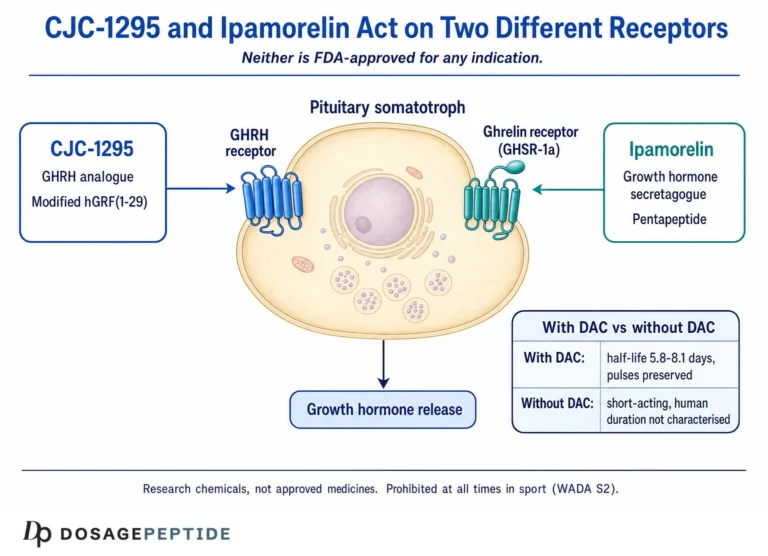
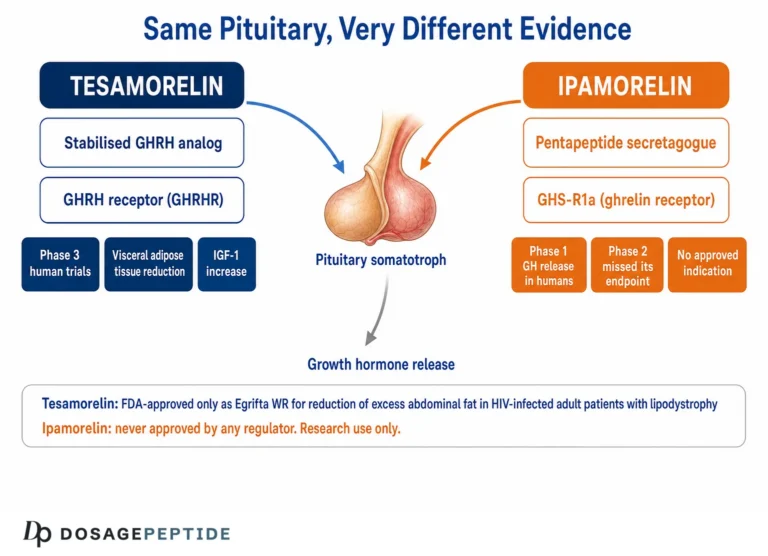
The rationale for combining them is mechanistic. The pituitary gland releases GH in pulses, and that release is gated by two independent controls: a “go” signal from GHRH and a separate “go” signal from the ghrelin/GH-secretagogue receptor. Tesamorelin pushes the first lever; Ipamorelin pushes the second. Acting on two complementary points of the same axis, the two compounds are studied together for a larger, cleaner GH pulse than either produces alone — with Ipamorelin chosen specifically because it raises GH with minimal spillover onto cortisol (the stress hormone) or prolactin.
Here is the honest evidence status up front: the individual compounds have real human data — Tesamorelin is an FDA-approved prescription drug (EGRIFTA) for HIV-associated lipodystrophy, and Ipamorelin has been characterized in human GH-release studies — but the fixed Tesamorelin + Ipamorelin blend as sold for research has no completed human randomized controlled trial of its own. Everything below is the documented research protocol, framed for research use only. It is not a prescription and not medical advice.
Two ideas run through this entire guide, and it is worth naming them before the numbers begin. The first is the anchor-and-amplifier structure: Tesamorelin carries the real body-composition data and sets the size of the GH pulse, while Ipamorelin cleanly widens the channel that pulse flows through. The second is the evidence gap: because the blend has never been trialed as a fixed product, every dose, schedule and timeline here is inference from the two component literatures, not a proven blend outcome. Keeping both ideas in view is what separates a responsible research protocol from a marketing claim — and it is the reason the language throughout stays hedged.

At a Glance
| Attribute | Detail (research protocol) |
|---|---|
| Use (research context) | GH-axis stimulation studied for visceral fat reduction, body composition, sleep and recovery |
| Typical vial | 10 mg blend = Tesamorelin 5 mg + Ipamorelin 5 mg |
| Reconstitution | 3 mL bacteriostatic water → 3.33 mg/mL (3,333 mcg/mL) |
| Per-dose (documented) | 330 mcg total blend ≈ 0.099 mL ≈ 10 units on a U-100 syringe |
| Schedule | Once daily; commonly fasted (empty stomach) — pre-bed and/or fasted morning |
| Onset / timeline | Sleep/recovery signals studied earliest; body-composition changes framed over weeks to months |
| Common side effects (from component data) | Injection-site reactions, transient fluid retention, joint stiffness, elevated IGF-1/glucose (Tesamorelin data) |
| Best stacked with | Studied as a self-contained GHRH + secretagogue pair; the two compounds are the stack |
| Regulatory status | Research-use-only blend. Tesamorelin is a prescription drug (EGRIFTA); Ipamorelin is not FDA-approved. The blend is not approved for human use. |
What It Is / Composition
The blend is a single vial holding two distinct GH-axis peptides at a 1:1 mass ratio. Each acts on a different receptor, and the pairing is the whole point.
| Component | Amount | Role |
|---|---|---|
| Tesamorelin | 5 mg | A stabilized GHRH analog (a lab-modified copy of the body’s own growth-hormone-releasing hormone). It binds the GHRH receptor on the pituitary and amplifies the natural, pulsatile GH signal. This is the compound with the strongest human visceral-fat data — it is the anchor of the stack. |
| Ipamorelin | 5 mg | A selective GH secretagogue that works through the ghrelin/GHS receptor — a second, independent GH “go” switch. Its defining feature is selectivity: in the foundational research it raised GH with little to no rise in cortisol or prolactin, unlike older secretagogues. It complements, rather than duplicates, Tesamorelin. |
Because the two peptides hit two separate receptors that both feed the same GH pulse, they are described in research as synergistic rather than additive: GHRH-driven and secretagogue-driven signals combine at the pituitary. For a plain-English primer on why Tesamorelin specifically is studied for deep abdominal fat, see our overview of Tesamorelin’s visceral-fat benefits and safety. To place this blend among the other GH-axis and recovery protocols, browse the full peptide dosage catalog.
Why a GHRH analog and a secretagogue behave differently
It helps to be precise about what “two gates” means physiologically, because it is the single fact that justifies the whole blend. Natural GH release is not a steady drip; the pituitary fires it in pulses, and the size of each pulse is set by a push–pull balance. GHRH is the push. Somatostatin is the brake. Ghrelin — and the synthetic secretagogues that mimic it — does something subtler: it both adds a second push and briefly lifts the somatostatin brake, so the same GHRH signal produces a taller pulse.
Tesamorelin occupies the GHRH lane. As a stabilized analog it resists the enzyme (dipeptidyl peptidase-4) that rapidly chews up native GHRH, so its push lasts longer and the resulting pulse is larger and more durable than the body’s own. Ipamorelin occupies the secretagogue lane. Its distinguishing trait is a narrow, clean action on the GH-secretagogue receptor with little activity elsewhere — which in the founding pharmacology meant GH went up while cortisol and prolactin stayed near baseline. Put a longer, stronger push together with a lifted brake and a second push, and the combined pulse is meaningfully bigger than either lever moving alone. That is the mechanistic case for the blend in one paragraph — and it is exactly why the two are described as complementary rather than redundant.
How to Dose (The Research Protocol)
Below is the documented per-dose protocol for this specific blend, using the exact numbers from our Ipamorelin 5 mg + Tesamorelin 5 mg blend protocol page. These figures describe how the compound is used in research. They are not a prescription, and no dose here should be read as a personal recommendation.
| Compound | Research dose (per administration) | Frequency | Route |
|---|---|---|---|
| Tesamorelin + Ipamorelin blend (total) | 330 mcg (~0.33 mg) total blend | Once daily | Subcutaneous |
| — of which Tesamorelin | ~165 mcg | Once daily | Subcutaneous |
| — of which Ipamorelin | ~165 mcg | Once daily | Subcutaneous |
Anchor-compound logic. Tesamorelin is the anchor — it carries the documented human body-composition signal, and its GHRH mechanism sets the ceiling of the GH pulse. Ipamorelin is the amplifier: it opens a second gate so the same GHRH drive translates into a bigger release, while its selectivity keeps cortisol and prolactin largely out of the picture. In a fixed 1:1 blend the two move together, so the whole protocol is expressed as one 330 mcg total dose rather than two separate injections. Because the ratio is fixed inside the vial, the 330 mcg total splits evenly into roughly 165 mcg of each peptide — you cannot tune one without the other, which is exactly why the blend is described as a single, self-contained stack. For any dose or water volume other than the documented one, do the math with our dosage calculator rather than eyeballing it.
Why 330 mcg and not more. A reasonable question is why the documented figure sits where it does rather than higher. The logic is that GH-axis compounds are not dose-linear in a helpful way past a point: once the pulse is being driven hard, adding drug mostly buys more IGF-1 exposure, more fluid retention and more glucose disturbance rather than proportionally more benefit. The documented protocol reflects a modest, once-daily research dose chosen to sit inside a tolerable window while still recruiting both gates. In the research framing, the lever that matters is consistency and duration, not size — a point the timeline and troubleshooting sections return to repeatedly. Escalating the dose to chase a faster result is explicitly not the studied approach.
Route. The documented route is subcutaneous — a shallow injection into the fat layer just under the skin (abdomen, flank or thigh), using a fine insulin needle. Subcutaneous delivery suits both peptides: it gives a smooth absorption curve that fits the once-daily, pulse-timed design, and it keeps the injection itself low-volume at roughly a tenth of a millilitre. There is no oral form of this blend that survives digestion, which is another reason the protocol is framed entirely around a small subcutaneous dose.
Reconstitution & Draw (With the Real Math)
Reconstitution means dissolving the freeze-dried peptide powder with bacteriostatic water (sterile water with a preservative) so it can be drawn into a syringe. The full walkthrough lives in our peptide reconstitution guide, and if you are unsure how much diluent to add, see our note on how much bacteriostatic water to use. Here is the arithmetic for this exact vial.
Step 1 — Concentration. Divide the vial’s total mass by the volume of bacteriostatic water added.
10 mg ÷ 3 mL = 3.33 mg/mL — the same as 3,333 mcg/mL.
Step 2 — Draw volume for the documented 330 mcg dose. Divide the dose by the concentration.
330 mcg ÷ 3,333 mcg/mL = 0.099 mL (essentially one-tenth of a millilitre).
Step 3 — Convert to insulin-syringe units. A U-100 insulin syringe reads 100 units per mL, so multiply the millilitres by 100.
0.099 mL × 100 = 9.9 ≈ 10 units on a U-100 syringe.
So the documented 330 mcg dose is drawn to the 10-unit line. If your syringe markings or preferred water volume differ, see our guide to reading insulin-syringe units for peptides — the unit line changes whenever the concentration changes, so the “10 units” figure is only valid for this exact 10 mg-in-3 mL preparation.
A note on why 3 mL is a sensible diluent volume for this vial: it lands the dose at a clean, readable 10 units. Too little water and the dose falls to a sliver of a unit that is easy to misread; too much and the injection volume grows uncomfortably. Three millilitres puts the documented dose squarely on a round number a U-100 syringe can hit precisely, which is a practical reason it is the reference preparation throughout this guide.
Supply math. A 10 mg vial holds 10,000 mcg. At 330 mcg per dose:
10,000 mcg ÷ 330 mcg ≈ 30 doses per vial.
Once-daily, that is roughly a one-month supply per vial — convenient for planning a monthly research cycle around a single reconstituted vial’s beyond-use window.
A worked recap and the two ways the math shifts
To keep the whole calculation in one place: 10 mg powder + 3 mL water = 3,333 mcg/mL; a 330 mcg dose = 0.099 mL = ~10 units; the vial yields ~30 once-daily doses. Every one of those numbers is downstream of a single choice — how much water you add — so it is worth understanding what happens if that choice changes.
- Add less water (more concentrated). If you reconstituted the same 10 mg in only 2 mL, the concentration climbs to 5,000 mcg/mL, and the same 330 mcg dose now draws to just 0.066 mL, or about 6.6 units. Smaller volume, same dose.
- Add more water (more dilute). Reconstitute in 5 mL and the concentration falls to 2,000 mcg/mL; the 330 mcg dose becomes 0.165 mL, or about 16.5 units. Larger, easier-to-read volume, same dose.
The dose in micrograms never changed in either case — only the volume you pull to the line. This is the most common source of dosing error in the research setting: reading “10 units” as a fixed truth when it is really a property of the 3 mL preparation. Whenever the water volume differs from 3 mL, recompute — the dosage calculator does it instantly, and the syringe-unit guide explains why the line moves.
Weekly Schedule (Example Week)
The documented pattern is once daily, taken fasted. The grid below shows a continuous seven-day example week with a single evening (pre-bed) administration — the most common timing in the research framing because it aligns the dose with the body’s largest natural overnight GH pulse. It is an illustration of the schedule, not a dosing instruction.
| Day | Time | Dose | Units (U-100) |
|---|---|---|---|
| Monday | Pre-bed, fasted | 330 mcg | 10 |
| Tuesday | Pre-bed, fasted | 330 mcg | 10 |
| Wednesday | Pre-bed, fasted | 330 mcg | 10 |
| Thursday | Pre-bed, fasted | 330 mcg | 10 |
| Friday | Pre-bed, fasted | 330 mcg | 10 |
| Saturday | Pre-bed, fasted | 330 mcg | 10 |
| Sunday | Pre-bed, fasted | 330 mcg | 10 |
A 5-days-on / 2-off variant (dosing Monday–Friday, resting the weekend) also appears in the research framing for those studying receptor-sensitivity preservation. Both are schedules described in research, not prescriptions.
Timing: why fasted, and why evening
GH secretagogues and GHRH analogs are studied on an empty stomach for a specific reason: dietary fat and the insulin/glucose rise that follows a meal blunt the GH pulse. Injecting fasted — with no food for roughly two hours before and staying fasted for ~30–60 minutes after — lets the pituitary pulse without that interference. Two windows fit that requirement in the research framing:
- Pre-bed: stacks the induced pulse onto the body’s largest natural overnight GH release, and GH’s role in sleep architecture is one reason sleep quality is an early research signal.
- Fasted morning: for those who train early or dislike an evening injection, a first-thing dose before breakfast is the alternative fasted window.
The single most important timing rule for this stack is the fasted window itself; the choice between pre-bed and fasted morning is secondary and is treated in the research framing as a matter of fit with the rest of the day.
There is a useful way to think about the “two hours before, thirty to sixty minutes after” rule. GH pulses are exquisitely sensitive to insulin: a carbohydrate or high-fat meal drives insulin up, and elevated insulin suppresses GH release almost immediately, so a dose taken on top of a recent meal is partly wasted. The fasted window is not about ritual — it is about not spending an injection into a headwind. For the pre-bed option, the last meal of the evening should be finished well before the dose; for the fasted-morning option, the dose goes in before the first food of the day, with breakfast held until the post-dose window has passed. Consistency of timing, day to day, also matters more than the exact clock hour, because the axis responds to a regular rhythm.
Dosing Phases & Cycling
The research protocol is typically staged rather than started at full pace, and it is cycled — the compound is not framed for indefinite continuous use. The following is a research schedule, not a prescription.
- Activation (weeks 1–2): begin at the documented once-daily 330 mcg dose to establish tolerance and observe fluid-balance and injection-site response before committing to a full cycle.
- Core cycle (weeks 3–12): continue once daily. The bulk of the studied body-composition signal for the anchor compound accrues over sustained weeks, not days.
- Maintenance / taper: after a defined cycle, the research pattern is to pause. GHRH-analog and secretagogue schedules commonly run 8–12 weeks on, followed by 4 weeks off, allowing receptor sensitivity and the IGF-1 axis to reset before another cycle.
The 5-on/2-off weekly variant sits inside this longer arc for those who prefer a built-in weekly pause. None of these windows is a clinical dosing instruction — they describe how the compound is scheduled in research.
Why cycle at all? The reasoning is receptor biology. Any receptor that is stimulated continuously tends to become less responsive over time — it down-regulates. The GH-secretagogue and GHRH receptors are no exception, and a run that never pauses risks a slow fade in response that no amount of extra dose recovers. A defined off-period lets receptor density and sensitivity recover so the next cycle starts from a fresh baseline rather than a blunted one. The IGF-1 axis benefits from the same pause: it drifts back toward baseline instead of sitting chronically elevated, which is the safer position given GH/IGF-1’s growth-promoting signaling. The pause is therefore framed in research as protective and restorative, not as lost ground.
A practical way to read the two cadences together: the weekly 5-on/2-off rhythm is a fine-grained pause aimed at short-term receptor sensitivity, while the 8–12-on / 4-off macro-cycle is the coarse-grained pause aimed at the whole axis. They are not mutually exclusive — a researcher can run 5-on/2-off within an 8–12 week block and still take the 4-week macro-break afterward. All of it remains a research schedule.
Timeline: What to Expect
The table below maps the biology to what is observed in research. These are research-framed observations, not promises of personal results.
| Week / Phase | What’s happening (biology) | What is observed in research |
|---|---|---|
| Week 1–2 (activation) | GH pulses are amplified nightly; the axis begins responding; fluid balance shifts as GH’s sodium/water handling engages. | Earliest signals reported around sleep depth and recovery; transient water retention or mild joint stiffness can appear as GH activity rises. |
| Week 3–6 (early cycle) | Sustained nightly pulses raise circulating IGF-1 (the liver-derived mediator of many GH effects); lipolytic (fat-releasing) signaling in visceral adipose tissue is ongoing. | In Tesamorelin’s human trials, visceral-fat reduction became measurable over this window; recovery and sleep signals continue. |
| Week 6–12 (core cycle) | Cumulative IGF-1 exposure and sustained lipolysis in deep abdominal fat; body-composition shifts are gradual and dose-duration dependent. | The largest visceral-fat and liver-fat changes in the anchor-compound literature accrued across this multi-week span — a slow curve, not a switch. |
| Off-cycle (weeks 13+) | GH/IGF-1 axis returns toward baseline; receptor sensitivity resets. | Research framing treats the pause as protective of long-term axis responsiveness rather than a period of loss. |
One nuance is worth stating plainly: the sleep and recovery signals arrive early, the body-composition signal arrives late. That mismatch is the source of most misplaced expectations. Feeling better sleep in week two is not evidence that fat is melting in week two; it simply reflects GH’s role in sleep architecture responding quickly, while adipose-tissue change is a slow, cumulative process measured over the multi-week core cycle. In the research framing, judging the protocol by the fast signal is a mistake — the endpoint that carries the human data is the slow one.
Stacking / Combinations
This blend is, in effect, its own stack — the entire design is a bottleneck-pairing. GH release is gated by two independent switches, and a single compound only clears one of them:
- Bottleneck 1 — the GHRH gate. Tesamorelin clears it, providing the primary “release GH” drive and setting the pulse ceiling.
- Bottleneck 2 — the secretagogue gate. Ipamorelin clears it, opening a second independent channel so the GHRH drive translates into a larger release. Its selectivity means it does this without dragging cortisol or prolactin up with it.
Because both switches are addressed inside one vial, the blend is generally studied on its own rather than layered onto further GH compounds — adding a third secretagogue would target an already-cleared bottleneck with diminishing return and rising IGF-1/glucose risk. If you want to understand the standalone compounds behind the blend, see the single-vial protocols for Tesamorelin (10 mg vial) and Ipamorelin (10 mg vial).
The single-vial alternative. There is one legitimate reason to reach for the standalone vials instead of the blend: ratio control. The blend locks Tesamorelin and Ipamorelin at 1:1. A research design that wants a heavier GHRH drive with only a light secretagogue nudge — or the reverse — can only be built from the two separate vials, dosed independently. The blend trades that flexibility for the convenience of a single injection at a documented, pre-set ratio. Neither is “better”; they answer different research questions, and the choice is a design decision rather than a dosing one.
What it is generally not combined with. In the research framing this stack is kept clear of anything that pushes GH or IGF-1 from a third direction at the same time — exogenous GH itself, additional GHRPs, or high-dose insulin protocols — because the compounding effect on IGF-1 and glucose is precisely the risk the monitoring caveats exist to catch. The blend is designed to be complete on its own, and treating it that way is the conservative, research-consistent default.
When Progress Stalls
A short troubleshooting ladder for the research setting — identify the bottleneck, its likely cause, and the studied adjustment.
| Bottleneck | Likely cause | Adjustment (research-framed) |
|---|---|---|
| No sleep/recovery signal in early weeks | Dose taken too close to food; GH pulse blunted by insulin/glucose | Move the dose to a strictly fasted window (≥2 h after food, pre-bed); confirm the empty-stomach rule is being met. |
| Body-composition plateau mid-cycle | Expectation of speed; GH-axis effects are cumulative, not acute | Hold the documented dose and duration — the anchor-compound signal accrues over weeks; escalating dose is not the studied lever. |
| Rising fluid retention / joint stiffness | GH activity too high for current tolerance; IGF-1 climbing | Return to activation-phase pacing; in research, monitoring IGF-1/glucose guides whether to pause. |
| Diminishing response late in a long run | Receptor down-regulation from continuous dosing | Apply the off-cycle (8–12 on / 4 off) to reset sensitivity before resuming. |
Side Effects & Mitigation
The side-effect profile below is drawn from the component data — chiefly Tesamorelin’s prescribing information and GH-secretagogue research — since the fixed blend has no trial of its own.
| Issue | Why | Mitigation |
|---|---|---|
| Injection-site redness, itching or swelling | Subcutaneous administration; local irritation is the most common Tesamorelin complaint | Rotate sites; use proper technique per the reconstitution guide; keep the reconstituted vial clean and cold. |
| Fluid retention / puffiness | GH promotes sodium and water retention as the axis activates | Often transient in the activation phase; return to slower pacing if persistent. |
| Joint stiffness or aches | A recognized dose-related GH effect | Stay at the documented dose; do not escalate to chase results. |
| Elevated IGF-1 | The expected downstream marker of sustained GH stimulation; excessive elevation is undesirable | IGF-1 monitoring is part of the research/clinical framing for Tesamorelin; a pause is warranted if it climbs out of range. |
| Impaired glucose tolerance / higher blood sugar | GH is counter-regulatory to insulin; Tesamorelin’s label flags glucose effects | Glucose monitoring is explicitly part of Tesamorelin’s prescribing information — caution for anyone with impaired glucose tolerance. |
Two patterns are worth calling out because they are predictable rather than alarming. First, most of the milder effects — fluid retention, a puffy feeling, minor joint stiffness — cluster in the activation phase as the axis wakes up, and in the research framing they commonly settle as the body adapts; if they don’t settle, the studied response is to slow the pace, not to push through. Second, the two effects that actually warrant hard limits — rising IGF-1 and impaired glucose tolerance — are the ones tied to Tesamorelin’s real prescribing label, which is why they are framed as monitored parameters rather than nuisances. The rule of thumb from the component data is simple: comfort issues are managed by pacing; lab-marker issues are managed by monitoring and, if needed, a pause.
Safety & Contraindications
- Regulatory status: the Tesamorelin + Ipamorelin blend is research-use-only and not approved for human use. Tesamorelin alone is FDA-approved as EGRIFTA for a narrow indication (HIV-associated lipodystrophy); Ipamorelin is not FDA-approved for any use.
- Active or history of malignancy: GH/IGF-1 stimulation is contraindicated where there is active cancer, per Tesamorelin’s prescribing information — GH signaling can be growth-promoting.
- Diabetes / impaired glucose tolerance: GH is counter-regulatory to insulin; glucose monitoring is mandated in Tesamorelin’s label and this population warrants particular caution.
- Pregnancy and breastfeeding: avoid — no safety data.
- Pituitary/hypothalamic disease or prior GH-axis disorders: avoid without specialist oversight.
- IGF-1 monitoring: the research/clinical framing tracks IGF-1 to avoid excessive elevation.
- None of the above is a substitute for evaluation by a licensed clinician. This compound is not for human consumption.
Storage & Handling
- Before reconstitution: the lyophilized (freeze-dried) powder is stable refrigerated; many research vials tolerate short room-temperature transit but are best kept cold and dark.
- After reconstitution: store at 2–8 °C (standard refrigerator), and protect from light.
- Beyond-use window: a reconstituted peptide is generally used within a few weeks — conveniently aligned with the ~30-dose (roughly one-month) supply from a single 10 mg vial.
- Freeze rules: do not freeze a reconstituted (already-mixed) vial — freeze-thaw degrades peptides. Freezing applies only to long-term storage of the dry powder, never the liquid.
- Full detail is in our guide to storing peptides before and after reconstitution.
Storage matters more here than it does for a robust small molecule, because peptides are fragile: heat, light, agitation and freeze-thaw cycles all degrade them, and a degraded peptide simply under-delivers with no visible warning. Two habits carry most of the protection. First, reconstitute gently — aim the bacteriostatic water down the inside wall of the vial and let it dissolve rather than shaking it, since vigorous agitation can shear peptide chains. Second, keep it cold and dark between doses and return it to the refrigerator promptly after each draw rather than leaving it on a counter. The roughly one-month beyond-use window and the roughly 30-dose supply line up neatly, so a single vial can be planned as one clean monthly cycle without any of the liquid sitting past its useful life.
What the Evidence Actually Shows
Honesty about study type is what keeps this guide trustworthy. Here is the real state of the evidence:
- Tesamorelin has genuine human RCT data. In a randomized clinical trial, tesamorelin reduced visceral adipose tissue and liver fat in HIV-infected patients (Stanley et al., JAMA, 2014), and its Phase 3 program (Falutz et al.) established the visceral-fat effect that underpins its FDA approval. This is the strongest, most human-relevant evidence in the stack — and it is why Tesamorelin is the anchor.
- Ipamorelin is characterized in foundational pharmacology. Raun et al. (1998) described Ipamorelin as the first selective GH secretagogue — raising GH with minimal cortisol or prolactin effect. That selectivity is the reason it is paired with Tesamorelin rather than an older, dirtier secretagogue.
- The fixed blend has no trial of its own. There is no completed human randomized controlled trial of the combined Tesamorelin + Ipamorelin product. The synergy argument is mechanistically sound — two independent GH gates — but it has not been tested as a fixed-ratio blend in humans. Treat blend-specific claims as inference from the component data, not proven blend outcomes.
- Regulatory reality: Tesamorelin’s approved-drug status (EGRIFTA) brings a real prescribing label with IGF-1 and glucose monitoring requirements and clear contraindications — which is why those safety rules carry over to the research framing here.
The takeaway: strong human data on the anchor, solid pharmacology on the amplifier, and a genuine gap where the blend itself would need its own trial. That gap is why every figure in this guide is presented as a documented research protocol rather than clinical guidance.
How to read the evidence honestly
Not all evidence is the same weight, and a good research reader grades it. Tesamorelin’s visceral-fat effect rests on randomized, controlled human trials — the top of the evidence hierarchy — which is why it earned an FDA approval and a real prescribing label. Ipamorelin’s selectivity rests on foundational pharmacology: mechanism-defining work that is robust for what it claims (a clean GH-secretagogue profile) but is not an efficacy trial for any body-composition endpoint. The blend sits a step below both: its case is a mechanistic argument built by combining those two literatures, and it has not been tested as a product.
The practical consequence is that claims should be attributed to the right tier. A statement like “tesamorelin reduces visceral fat over weeks” is supported by human RCT data. A statement like “Ipamorelin adds GH without much cortisol” is supported by pharmacology. But a statement like “this blend produces outcome X in humans” has no direct support and should be read as inference. Holding those three tiers apart is what keeps the guide accurate — and it is the honest answer to anyone asking how much is actually proven.
FAQ
Choosing
Why stack Tesamorelin with Ipamorelin instead of using one alone? Because GH release has two independent gates. Tesamorelin (a GHRH analog) opens one; Ipamorelin (a selective secretagogue) opens the other. Studied together they combine into a larger, cleaner GH pulse than either produces on its own, with Ipamorelin’s selectivity keeping cortisol and prolactin largely out of the picture.
What makes Ipamorelin “selective” and why does that matter? In the founding research, Ipamorelin raised GH with little to no rise in cortisol or prolactin — unlike older GH secretagogues. That selectivity is precisely why it is chosen as the amplifier in this blend rather than a messier alternative.
Is Tesamorelin or Ipamorelin the “main” ingredient? Tesamorelin is the anchor — it carries the documented human visceral-fat data and sets the ceiling of the GH pulse. Ipamorelin amplifies that drive. The 1:1 blend is expressed as one combined dose because the two move together.
Should I use the blend or the single-peptide vials? That depends on the research question. The fixed blend gives a set 1:1 ratio in one injection; the standalone Tesamorelin and Ipamorelin vials let you vary each independently.
Is this the same thing as CJC-1295 + Ipamorelin? No — and the distinction matters. CJC-1295 and Tesamorelin are both GHRH-side compounds, but they are different molecules with different profiles, so a Tesamorelin + Ipamorelin blend is not interchangeable with a CJC-1295 + Ipamorelin blend. This guide is specific to the Tesamorelin pairing, whose anchor carries the human visceral-fat RCT data described in the evidence section. Do not carry these exact dose figures over to a different GHRH partner.
Using It
What is the Tesamorelin + Ipamorelin blend dosage per day? The documented research protocol is 330 mcg of total blend once daily — drawn to about 10 units on a U-100 syringe from a 10 mg vial reconstituted with 3 mL of bacteriostatic water. That is a research figure, not a personal recommendation.
When should I inject Tesamorelin + Ipamorelin? On an empty stomach, because dietary fat and the insulin/glucose rise after a meal blunt the GH pulse. The two research-favored windows are pre-bed (stacking onto the natural overnight GH surge) and fasted morning. Keep it fasted for roughly 30–60 minutes after the dose.
How do I calculate the dose in syringe units? Concentration = 10 mg ÷ 3 mL = 3.33 mg/mL (3,333 mcg/mL). Draw volume = 330 mcg ÷ 3,333 mcg/mL = 0.099 mL. Units = 0.099 × 100 = ≈10 units. For any other dose or water volume, use the dosage calculator.
How many doses are in one vial? A 10 mg vial holds 10,000 mcg; at 330 mcg per dose that is ≈30 doses — roughly a one-month supply at once-daily.
Is it once daily, or 5-days-on / 2-off? Both patterns appear in the research framing. The default is once daily, continuous; a 5-on/2-off weekly variant builds in a pause for those studying receptor-sensitivity preservation. Neither is a prescription.
How long is a cycle? The common research schedule is 8–12 weeks on, then about 4 weeks off, letting the GH/IGF-1 axis and receptor sensitivity reset before another cycle.
Practical & Safety
How long until anything is observed? Sleep and recovery signals are reported earliest, within the first weeks. Visceral-fat and body-composition changes in the anchor-compound literature accrued gradually across many weeks — this is a slow curve, not an overnight effect, and results are research observations, not personal guarantees.
What monitoring does this need? Because Tesamorelin is a GHRH analog, the research/clinical framing tracks IGF-1 (to avoid excessive elevation) and blood glucose (GH is counter-regulatory to insulin). Tesamorelin’s own prescribing label mandates glucose monitoring.
Who should avoid it? Anyone with active or prior malignancy, uncontrolled or impaired glucose tolerance/diabetes without oversight, pregnancy or breastfeeding, or pituitary/hypothalamic disease. This is a research compound, not for human consumption — consult a licensed clinician. The malignancy caution is not incidental: because GH and its downstream mediator IGF-1 can promote cell growth, any setting where cancer may be present is a firm contraindication in Tesamorelin’s own label, and that logic carries directly to the blend.
Is Tesamorelin + Ipamorelin FDA-approved, and how do I store it after mixing? The blend is not approved for human use — Tesamorelin alone is FDA-approved as EGRIFTA for HIV-associated lipodystrophy, while Ipamorelin is not FDA-approved for any indication. After reconstitution, refrigerate the vial at 2–8 °C, protect it from light, use it within a few weeks, and never freeze a mixed vial — the full detail is in the storage guide.
References
- Stanley TL, et al. Effect of tesamorelin on visceral fat and liver fat in HIV-infected patients: a randomized clinical trial. JAMA, 2014. PMID 25038357.
- Falutz J, et al. Effects of tesamorelin (a GHRH analog) on visceral adipose tissue (Phase 3 program).
- Raun K, et al. Ipamorelin, the first selective growth hormone secretagogue. European Journal of Endocrinology, 1998.
- FDA EGRIFTA (tesamorelin) prescribing information — approved indication, IGF-1/glucose monitoring, contraindications.
Disclaimer: This article is provided for research and educational purposes only. It is not medical advice, and nothing here is a prescription or a personal recommendation. The compounds discussed are research-use-only, are not approved for human use, and are not for human consumption. All dosing figures describe a documented research protocol, not clinical guidance. Always consult a licensed clinician before making any health decision.