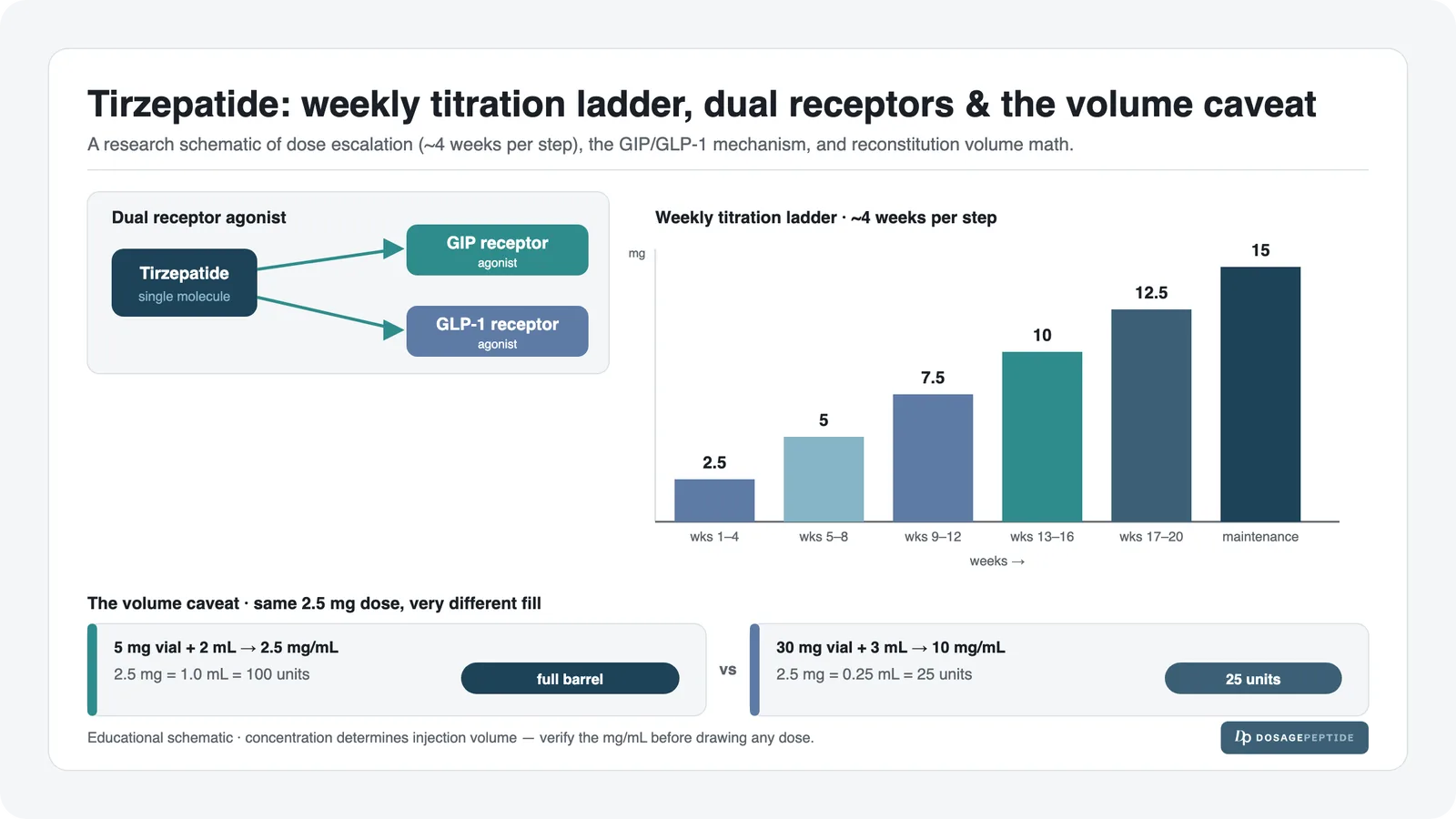
Tirzepatide is a once-weekly, dual-incretin peptide — it activates both the GIP and the GLP-1 receptor from a single molecule — and in published obesity trials it has produced some of the largest average weight reductions of any incretin agent studied to date. That potency is exactly why the dose is not started high: the entire point of a titration protocol is to introduce the compound at a low, well-tolerated level and raise it in slow, roughly four-week steps so the gastrointestinal system can adapt.
The mechanism is elegant. GLP-1 signalling slows gastric emptying and blunts appetite centrally; GIP signalling appears to modulate how nutrients are handled metabolically and may soften the nausea that pure GLP-1 agonism can provoke. Together they suppress appetite and improve glycemic control more strongly than either arm alone — but that combined pull on the gut is also the reason someone who starts at a maintenance dose typically feels wretched. Escalation is the safety valve.
An honest word on evidence and status: tirzepatide is a prescription drug (marketed as Mounjaro for type 2 diabetes and Zepbound for weight management), approved by the FDA and carrying a boxed warning. Everything on this page describes the documented label and clinical-trial protocol as reference information for research use only. It is not a prescription, not medical advice, and not a personal recommendation. The efficacy figures come from controlled trials in supervised patients; individual research contexts differ, and results are never guaranteed.

At a Glance
| Attribute | Documented detail (research reference) |
|---|---|
| Use | Dual GIP + GLP-1 receptor agonist studied for weight reduction and glycemic control |
| Typical vial | Research vials of 5, 10, 15, and 30 mg lyophilized powder |
| Reconstitution | 5 mg + 2 mL BAC → 2.5 mg/mL; 30 mg + 3 mL → 10 mg/mL (see math below) |
| Per-dose (start) | 2.5 mg once weekly documented starting dose |
| Schedule | Once weekly, same day each week; titrated up roughly every 4 weeks |
| Onset / timeline | Appetite effects often reported within the first weeks; weight change accrues over months in trials |
| Common side effects | Nausea, diarrhea, constipation, reduced appetite, transient fatigue — mostly early and dose-dependent |
| Best stacked with | Generally studied as monotherapy; adequate protein and hydration are the practical companions |
| Regulatory status | FDA-approved prescription drug with a boxed warning; presented here as research-use-only reference |
What It Is & Composition
Tirzepatide is a single 39-amino-acid synthetic peptide engineered as a dual agonist: one molecule that binds and activates both the glucose-dependent insulinotropic polypeptide (GIP) receptor and the glucagon-like peptide-1 (GLP-1) receptor. It is not a blend of two separate peptides — the dual activity is built into one chain, with a fatty-acid modification that extends its half-life to support once-weekly administration.
Because it is a single molecule rather than a multi-component blend, the composition is straightforward: the vial contains one active peptide. The distinction that matters for dosing is not composition but vial strength — the same 2.5 mg dose is drawn very differently from a 5 mg vial than from a 30 mg vial, as the reconstitution section makes explicit.
| Component | Amount | Role |
|---|---|---|
| Tirzepatide (active peptide) | 5, 10, 15, or 30 mg per vial | Dual GIP + GLP-1 receptor agonist — the entire therapeutic actor |
| Bacteriostatic water (added at reconstitution) | 2–3 mL depending on vial | Diluent that dissolves the lyophilized powder into an injectable solution |
The half-life engineering is worth understanding because it explains the whole dosing rhythm. Native GLP-1 is degraded within minutes; tirzepatide’s fatty-acid tail lets it bind albumin and circulate for roughly five days, which is why a single weekly injection maintains steady receptor engagement. That long half-life is also why titration steps are held for about four weeks rather than a few days: it takes several weekly doses for blood levels to plateau at each new rung of the ladder before the next increase makes sense.
How tirzepatide sits relative to the other incretins in this class — single-receptor semaglutide and triple-receptor retatrutide — is covered in the comparison guide, Retatrutide vs Semaglutide vs Tirzepatide. The full index of documented protocols by compound and vial size lives in the dosage catalog.
How to Dose (Research Protocol)
The defining feature of tirzepatide dosing is the titration ladder. The documented label and trial protocol does not use a single fixed dose; it starts at 2.5 mg once weekly and steps upward at approximately four-week intervals toward a maintenance target. The 2.5 mg starting dose is explicitly a tolerability dose — in trials it was not intended to drive weight loss on its own, but to let the gut acclimate before therapeutic doses begin.
| Step | Weekly dose | Typical duration | Purpose |
|---|---|---|---|
| 1 (initiation) | 2.5 mg | Weeks 1–4 | Tolerability / acclimation — not a therapeutic target |
| 2 | 5 mg | ~4 weeks | First therapeutic maintenance option |
| 3 | 7.5 mg | ~4 weeks | Escalation as tolerated |
| 4 | 10 mg | ~4 weeks | Maintenance option |
| 5 | 12.5 mg | ~4 weeks | Escalation as tolerated |
| 6 (max) | 15 mg | Maintenance | Highest documented maintenance dose |
Three principles are baked into this ladder. First, administration is once weekly — the same day every week — never daily. Second, each step is held for about four weeks before considering the next, which is what gives the GI system time to adapt. Third, 5, 10, and 15 mg are all valid maintenance doses; the ladder is a menu of stopping points, not a mandate to climb to 15 mg. In the documented protocol, someone tolerating the compound well and progressing at 7.5 or 10 mg has no requirement to escalate further.
It is worth naming what the ladder is not. It is not a schedule you can compress by taking two doses close together to “catch up,” and it is not a set of interchangeable rungs you can skip. Each named dose — 2.5, 5, 7.5, 10, 12.5, 15 mg — corresponds to a documented step; there is no documented protocol for intermediate values like 3.75 mg or 11 mg, and there is nothing documented above 15 mg. Staying on the named rungs is what keeps the reconstitution math and the tolerability logic aligned with the reference protocol.
Reconstitution & Draw (with the real math)
Reconstitution converts the dry powder into a measurable liquid. The governing arithmetic is always the same three steps: vial mg ÷ BAC mL = concentration (mg/mL); then dose mg ÷ concentration = volume (mL); then mL × 100 = units on a U-100 insulin syringe. For the mechanics of adding water without foaming the peptide, see the peptide reconstitution guide and how much bacteriostatic water to use.
One conceptual point removes most confusion before it starts: the vial strength and the water volume together set the concentration, and the concentration is what turns milligrams into a volume you can actually measure. The dose in milligrams never changes with vial size — a 2.5 mg dose is 2.5 mg whether it comes from a 5 mg or a 30 mg vial — but the number of units you draw changes dramatically, because a more concentrated solution packs the same milligrams into far less liquid.
The 5 mg vial — and its volume caveat
Reconstitute a 5 mg vial with 2 mL of bacteriostatic water:
- Concentration: 5 mg ÷ 2 mL = 2.5 mg/mL
- Volume for a 2.5 mg dose: 2.5 mg ÷ 2.5 mg/mL = 1.0 mL
- Units: 1.0 mL × 100 = 100 units — an entire U-100 barrel
Flag this clearly: at this dilution the 2.5 mg starting dose fills a full 100-unit insulin syringe. That is an unwieldy draw and leaves no room for a slightly larger dose in the same barrel. This is the single most important practical point about the low-strength vial: a higher-strength vial reconstituted appropriately shrinks the injection volume dramatically. The vial-size-specific walkthroughs are in the 5 mg vial protocol and 10 mg vial protocol. For syringe-reading fundamentals, see the insulin syringe units guide.
The 30 mg vial — the low-volume alternative
Reconstitute a 30 mg vial with 3 mL of bacteriostatic water:
- Concentration: 30 mg ÷ 3 mL = 10 mg/mL
- Volume for a 2.5 mg dose: 2.5 mg ÷ 10 mg/mL = 0.25 mL
- Units: 0.25 mL × 100 = 25 units
The identical 2.5 mg dose that was a full 100-unit barrel from the 5 mg vial is a tidy 25 units from the 30 mg vial — a quarter of the volume, and it leaves headroom in the syringe to draw larger doses as the ladder climbs. This is why vial strength, not just dose, drives the draw.
Draw volume by vial strength — the 2.5 mg starting dose
| Vial | BAC water | Concentration | 2.5 mg dose volume | Units (U-100) |
|---|---|---|---|---|
| 5 mg | 2 mL | 5 ÷ 2 = 2.5 mg/mL | 2.5 ÷ 2.5 = 1.00 mL | 100 units (full barrel) |
| 10 mg | 2 mL | 10 ÷ 2 = 5 mg/mL | 2.5 ÷ 5 = 0.50 mL | 50 units |
| 15 mg | 2 mL | 15 ÷ 2 = 7.5 mg/mL | 2.5 ÷ 7.5 = 0.33 mL | 33 units |
| 30 mg | 3 mL | 30 ÷ 3 = 10 mg/mL | 2.5 ÷ 10 = 0.25 mL | 25 units |
To pull the numbers for any dose on the ladder against your own vial size, use the dosage calculator rather than doing it by hand. As a worked climb on the 10 mg vial (5 mg/mL): 2.5 mg = 0.25 mL = 25 units; 5 mg = 0.50 mL = 50 units; 7.5 mg = 0.75 mL = 75 units; 10 mg = 1.00 mL = 100 units. Notice the 10 mg vial reaches its own full-barrel limit at the 10 mg dose — beyond which a higher-strength vial is needed to keep the volume manageable.
The full ladder drawn from a 30 mg vial (10 mg/mL)
Because the 30 mg vial reconstituted with 3 mL gives the most manageable volumes, it is the cleanest illustration of how every rung of the ladder converts to units. At 10 mg/mL:
| Ladder dose | Volume (dose ÷ 10 mg/mL) | Units (U-100) |
|---|---|---|
| 2.5 mg | 0.25 mL | 25 units |
| 5 mg | 0.50 mL | 50 units |
| 7.5 mg | 0.75 mL | 75 units |
| 10 mg | 1.00 mL | 100 units (full barrel) |
| 12.5 mg | 1.25 mL | 125 units (two draws) |
| 15 mg | 1.50 mL | 150 units (two draws) |
The top two rungs exceed a single 100-unit barrel, so at 12.5 and 15 mg the volume must be split across two injections or the vial reconstituted at a higher concentration with less water. This is the same trade-off in reverse: less water raises concentration and shrinks the volume, but also concentrates any measurement error, so the documented volumes in the tables above are the reference point. Always confirm your own arithmetic against the dosage calculator before drawing.
Weekly Schedule (example week)
Tirzepatide is a once-weekly compound, so a “schedule” is really a single fixed injection day repeated. Anchoring it to the same weekday makes adherence and tracking trivial. An example week at the 2.5 mg initiation step:
| Mon | Tue | Wed | Thu | Fri | Sat | Sun |
|---|---|---|---|---|---|---|
| 2.5 mg injection (chosen anchor day) | — | — | — | — | — | — |
| Log dose, site, any GI notes | Hydrate; protein-forward meals | Peak-week window — eat lightly if nausea appears | — | — | — | Prep next dose; check 4-week step timing |
The documented protocol allows the injection day to be moved if needed as long as doses stay at least several days apart, but for research clarity a fixed weekday is cleanest. The blank days are deliberate — there is no daily dosing here. A four-week initiation block therefore contains just four injections, all on the same weekday, and the whole block sits at 2.5 mg before the first escalation is even considered.
Dosing Phases, Titration & Cycling
Tirzepatide is not run in the discrete on/off “cycles” used for some recovery peptides. Its structure is a continuous escalation-then-maintenance arc:
- Initiation phase (weeks 1–4): 2.5 mg weekly. Tolerability only.
- Escalation phase (roughly weeks 5–20): step up about every four weeks — 5 → 7.5 → 10 → 12.5 → 15 mg — but only as tolerated. If a step provokes strong GI symptoms, the documented approach is to hold at the current dose (or step back down) rather than push forward on the calendar.
- Maintenance phase: settle at the lowest dose that delivers the desired effect. That is frequently 5, 10, or 15 mg — escalation stops when the target is met, not automatically at 15 mg.
The cardinal rule is the calendar bends to the gut, not the other way around. Four weeks per step is a guide, not a deadline; someone who needs six weeks at a given step before advancing is following the protocol correctly. Abrupt jumps skip the tolerability buffer and are the most common cause of severe nausea.
Two edge cases deserve explicit framing. First, a missed dose: the documented handling is to take it as soon as reasonably possible if several days remain before the next scheduled dose, otherwise skip it — never double up to compensate, because two doses close together stacks the incretin effect and reliably provokes GI symptoms. Second, a long lapse: if weeks pass without a dose, the tolerability that was built up erodes, and the documented conservative approach is to re-initiate lower rather than resume at the last dose reached. Both cases reduce to the same principle — the gut’s tolerance is built gradually and is not permanent.
Timeline: What to Expect
The framing below reflects what was observed in controlled trials and the label, not a promise. Individual research contexts vary, and nothing here should be read as a prediction of any specific outcome.
| Week / Phase | What’s happening | What is observed in research |
|---|---|---|
| Weeks 1–4 (2.5 mg) | Drug reaches steady state; gut adapting | Early appetite suppression commonly reported; GI side effects most likely here; minimal weight change expected at this tolerability dose |
| Weeks 5–12 (5–7.5 mg) | First therapeutic doses; escalation underway | Appetite reduction more pronounced; measurable weight change begins to accrue in trials |
| Weeks 13–20 (10–15 mg) | Approaching maintenance | Weight reduction continues to build; higher doses associated with larger average reductions in trials |
| Months 4–12 (maintenance) | Steady maintenance dose | In SURMOUNT-1, mean weight reductions continued to accrue over the ~72-week trial, with the largest changes at the highest doses |
The pattern across the timeline is that tolerability improves as effect accrues — the roughest GI window is early, precisely when weight change is smallest, and by the time therapeutic doses are driving measurable change the gut has usually adapted to each step. That inversion is the entire justification for a slow ladder: it front-loads the adaptation so the maintenance phase is comparatively smooth.
Stacking / Combinations
In the pivotal trials tirzepatide was studied as monotherapy, and the honest position is that there is no controlled evidence supporting “stacking” it with other peptides for additive benefit. The meaningful companions are behavioral rather than pharmacological:
- Adequate protein intake — because appetite drops sharply, protecting lean mass through deliberate protein consumption is the practical priority.
- Hydration and electrolytes — reduced food and fluid intake plus GI symptoms make dehydration a real risk.
- Resistance activity — not a stack, but the documented way to bias weight change toward fat rather than lean mass during a period of reduced intake.
Combining tirzepatide with insulin or sulfonylureas is a distinct clinical scenario that raises hypoglycemia risk (see Safety) and is not a “stack” in the enhancement sense — it is a drug interaction requiring clinical supervision. The same caution applies to combining it with any other GLP-1 or incretin agent: doing so compounds the class effects and the class risks, and there is no documented protocol for it.
When Progress Stalls
A documented troubleshooting ladder, in order of least to most aggressive change:
- Confirm the fundamentals first. Is the injection genuinely once weekly on schedule? Is the reconstitution math correct (a dilution error can silently under- or over-dose)? Recheck concentration and units before changing anything.
- Hold, don’t leap. If a plateau coincides with being early in the ladder, the answer is usually to complete the next scheduled step as tolerated rather than jumping doses.
- Escalate by one step. The documented response to a genuine plateau is to advance to the next rung (e.g., 7.5 → 10 mg) after the four-week hold — not to double the dose.
- Reassess behavioral inputs. Protein, activity, and sleep drive body-composition outcomes independent of the compound.
- Recognize the ceiling. 15 mg is the highest documented maintenance dose; there is no documented protocol above it. A stall at 15 mg is a signal to reassess the overall approach, not to exceed the label.
A note on interpretation: a plateau is not automatically a failure of dose. Weight change in trials was never linear — it accrued in fits and starts and slowed as it approached each individual’s new equilibrium. Reading every flat week as a cue to escalate is how people climb past the dose they actually needed, importing side effects without adding benefit.
Side Effects & Mitigation
| Issue | Why it happens | Mitigation |
|---|---|---|
| Nausea | Slowed gastric emptying and central appetite signalling; worst early and after dose increases | Slow the titration; smaller, lower-fat meals; don’t push the next step until symptoms settle |
| Diarrhea / constipation | Altered GI motility | Hydration, fiber, electrolytes; usually eases as the body adapts to a given step |
| Reduced appetite / early satiety | Intended pharmacology, sometimes excessive | Prioritize protein and fluids so intake stays adequate despite low hunger |
| Fatigue | Often secondary to reduced caloric and fluid intake | Ensure adequate intake and electrolytes; typically transient |
| Injection-site reaction | Local response to subcutaneous injection | Rotate sites; correct sterile technique |
| Gallbladder symptoms | Rapid weight change and GLP-1-class effects raise gallstone risk | Report right-upper-quadrant pain, fever, or jaundice for clinical evaluation |
| Signs of pancreatitis | Class-associated risk | Severe, persistent abdominal pain radiating to the back warrants immediate clinical attention and stopping the compound |
The consistent pattern: GI effects are dose-dependent and front-loaded. The slow titration ladder exists precisely to keep them tolerable. Most of the mild effects — nausea, altered motility, early satiety — track with dose increases and settle within a given step; the serious ones — gallbladder and pancreatitis signals — are not dose-titration issues and warrant clinical attention whenever they appear, at any dose.
Safety & Contraindications
Regulatory status. Tirzepatide is an FDA-approved prescription drug (Mounjaro; Zepbound) that carries a boxed warning. It is not an over-the-counter or lifestyle compound. Everything here is documented reference information under a research-use-only frame — not a prescription and not a directive to use it.
Boxed warning — thyroid C-cell tumors. In rodent studies, tirzepatide caused thyroid C-cell tumors; the human relevance is undetermined. It is contraindicated in anyone with a personal or family history of medullary thyroid carcinoma (MTC) or with Multiple Endocrine Neoplasia syndrome type 2 (MEN 2).
Other key class risks:
- Pancreatitis — discontinue and seek evaluation if severe, persistent abdominal pain develops.
- Gallbladder disease — cholelithiasis and cholecystitis have been reported, associated with the drug and with rapid weight loss.
- Hypoglycemia — the risk rises meaningfully when combined with insulin or sulfonylureas; those regimens require clinical dose adjustment and monitoring.
- Serious hypersensitivity, acute kidney injury from dehydration, and diabetic retinopathy considerations are also documented in the label.
Tirzepatide should be avoided by anyone pregnant or planning pregnancy, and its use always belongs under a qualified clinician’s supervision. Nothing on this page substitutes for that. Because it slows gastric emptying, it can also affect the absorption of oral medications, which is a further reason clinical oversight matters when it is combined with anything else.
Storage & Handling
- Before reconstitution: keep the lyophilized vial refrigerated and protected from light per product guidance.
- After reconstitution: the peptide is dissolved in bacteriostatic water and must be refrigerated; use within the timeframe the bacteriostatic preservative supports and discard if the solution becomes cloudy or discolored.
- Handling: add the diluent slowly down the vial wall, never inject water forcefully onto the powder, and do not shake — swirl gently to dissolve.
- Sterility: single-use syringes, alcohol-swab the stopper, rotate injection sites.
Detailed cold-chain and shelf-life guidance is in how to store peptides before and after reconstitution.
What the Evidence Actually Shows
Tirzepatide has a genuinely strong evidence base by peptide standards — large, randomized, controlled trials rather than anecdote. In SURMOUNT-1, once-weekly tirzepatide in adults with obesity produced substantial, dose-dependent mean weight reductions over roughly 72 weeks versus placebo. In the head-to-head SURMOUNT-5 trial, tirzepatide was compared directly with semaglutide for weight management. The FDA prescribing information for Zepbound and Mounjaro documents the titration schedule, boxed warning, and contraindications summarized above.
The honest boundaries: these trials studied specific, supervised patient populations with clinical monitoring; the escalation schedule and safety monitoring were integral to those results. Efficacy figures are averages, not individual guarantees, and long-term data continue to mature. Just as important, the trial results were produced under a prescription drug used as directed — a research-use-only context is not the same setting, and the trial numbers cannot be assumed to transfer to it. Presented here, the numbers are a documented reference protocol under research-use-only framing — not a claim about what any individual will experience.
Frequently Asked Questions
Choosing
What is the standard tirzepatide dosage? The documented protocol starts at 2.5 mg once weekly as a tolerability dose, then titrates up roughly every four weeks — 5, 7.5, 10, 12.5, up to a 15 mg maximum maintenance dose. The 2.5 mg starting dose is not meant to be therapeutic on its own.
How much tirzepatide per week? Once weekly, always. The weekly amount depends on where you are in the ladder: 2.5 mg to start, with 5, 10, and 15 mg being documented maintenance options. It is never dosed daily.
Which vial size should I reconstitute? Vial strength changes the draw volume, not the dose. A 5 mg vial makes even the 2.5 mg starting dose a full 100-unit barrel; a 30 mg vial makes that same dose just 25 units and leaves room to climb the ladder. Higher-strength vials keep injection volumes practical.
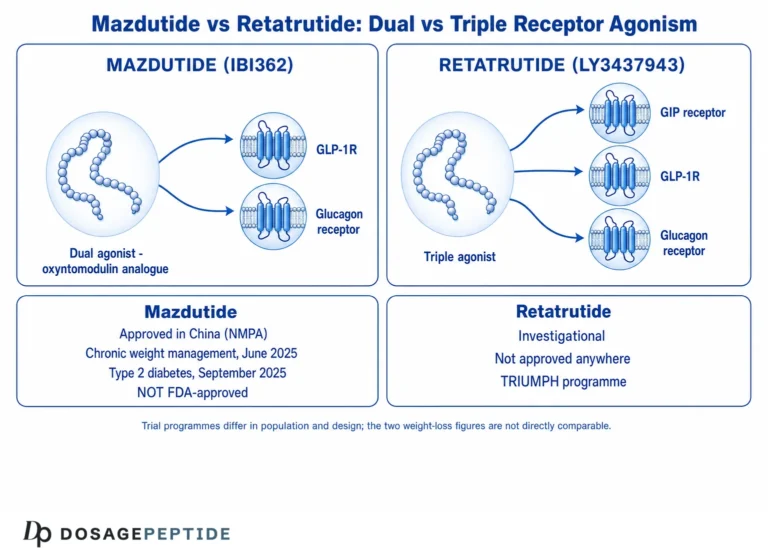
How does tirzepatide compare to semaglutide and retatrutide? Tirzepatide is a dual GIP + GLP-1 agonist; semaglutide is single-receptor GLP-1; retatrutide adds a glucagon arm as a triple agonist. The trade-offs are detailed in Retatrutide vs Semaglutide vs Tirzepatide.
Do I have to reach 15 mg? No. 5, 10, and 15 mg are all documented maintenance doses. The ladder is a set of stopping points; escalation stops once the effect target is met and tolerated.
Using it
How do I reconstitute a 5 mg tirzepatide vial? Add 2 mL of bacteriostatic water: 5 mg ÷ 2 mL = 2.5 mg/mL. A 2.5 mg dose is then 2.5 ÷ 2.5 = 1.0 mL = 100 units — a full syringe. This full-barrel volume is the reason many prefer a higher-strength vial. The step-by-step is in the 5 mg vial protocol.
How do I reconstitute a 30 mg vial? Add 3 mL: 30 ÷ 3 = 10 mg/mL. A 2.5 mg dose is 2.5 ÷ 10 = 0.25 mL = 25 units. The dosage calculator handles every dose-and-vial combination for you.
How is the 2.5 mg starting dose drawn on a U-100 syringe? Convert to units: dose volume in mL × 100. From a 10 mg vial (5 mg/mL) that is 0.5 mL = 50 units; from a 15 mg vial (7.5 mg/mL), 0.33 mL = 33 units. See the insulin syringe units guide.
How much bacteriostatic water do I use? The brief’s documented volumes are 2 mL for the 5, 10, and 15 mg vials and 3 mL for the 30 mg vial. More water lowers concentration and raises draw volume; less does the reverse. Details are in the bacteriostatic water guide.
What day should I inject? Any fixed weekday works; consistency matters more than which day. Keep doses at least several days apart if the day is ever shifted.
What if I miss a dose? The documented handling is to take it soon if several days remain before the next scheduled dose, or skip it otherwise — never double up, because two doses close together stacks the incretin effect and reliably provokes GI symptoms.
Why titrate so slowly instead of starting at an effective dose? Because the GI system needs to adapt. The dual incretin pull that makes tirzepatide effective also drives nausea; four-week steps are the tolerability buffer, and skipping them is the top cause of severe side effects.
Practical & safety
What are the most common side effects? Nausea, diarrhea, constipation, and reduced appetite — dose-dependent and concentrated early and just after dose increases. They typically ease as the body adapts to each step.
Who must not use tirzepatide? Anyone with a personal or family history of medullary thyroid carcinoma or MEN 2 (boxed warning), and it should be avoided in pregnancy. A history of pancreatitis or gallbladder disease demands caution and clinical oversight.
Is tirzepatide FDA-approved? Yes — as a prescription drug (Mounjaro, Zepbound) with a boxed warning. This page presents its documented protocol as research-use-only reference information, not a prescription.
Can I combine it with insulin or other diabetes drugs? That raises hypoglycemia risk and is a clinical interaction requiring supervised dose adjustment — not a peptide “stack.”
How should reconstituted tirzepatide be stored? Refrigerated, protected from light, used within the window the bacteriostatic preservative supports; discard if cloudy or discolored. See storage guidance.
References
- Jastreboff AM, et al. Tirzepatide Once Weekly for the Treatment of Obesity (SURMOUNT-1). N Engl J Med, 2022.
- Tirzepatide vs Semaglutide head-to-head (SURMOUNT-5). N Engl J Med, 2025. doi:10.1056/NEJMoa2410819; PubMed 40353578.
- FDA Zepbound / Mounjaro (tirzepatide) prescribing information — titration schedule, boxed warning, contraindications.
Disclaimer: This article is provided for research and informational purposes only. It is not medical advice, not a prescription, and not a recommendation for personal use. The compounds discussed are for research use only and are not for human consumption. Dosing figures describe the documented label and clinical-trial protocol as reference information, not instructions. Tirzepatide is a prescription drug; always consult a licensed clinician before making any medical decision.