Cagrilintide and retatrutide are different kinds of molecule with different evidence behind them, and neither is approved anywhere. Cagrilintide is a long-acting amylin analogue that mimics a natural satiety hormone. Retatrutide is a single molecule that activates three receptors at once — GIP, GLP-1 and glucagon. In their separate trials retatrutide produced the larger weight reduction, but no head-to-head trial has ever compared the two, so that is a cross-trial inference rather than a proven margin.
Two facts frame everything below. As of mid-2026, neither compound is approved by the FDA or the EMA for any indication, so no established or approved human dose exists for either, and anything sold under those names outside a monitored trial is a research-use-only chemical of unverified identity. And the pairing people search for most often — cagrilintide dosed together with retatrutide — has no published trial data at all. The stacking section below sets out exactly what is documented and what is not.
Nothing here is medical advice, a therapeutic claim, or a dosing recommendation for human use. It is educational reference material describing how these compounds are characterized in research.
Two Different Answers to the Same Question
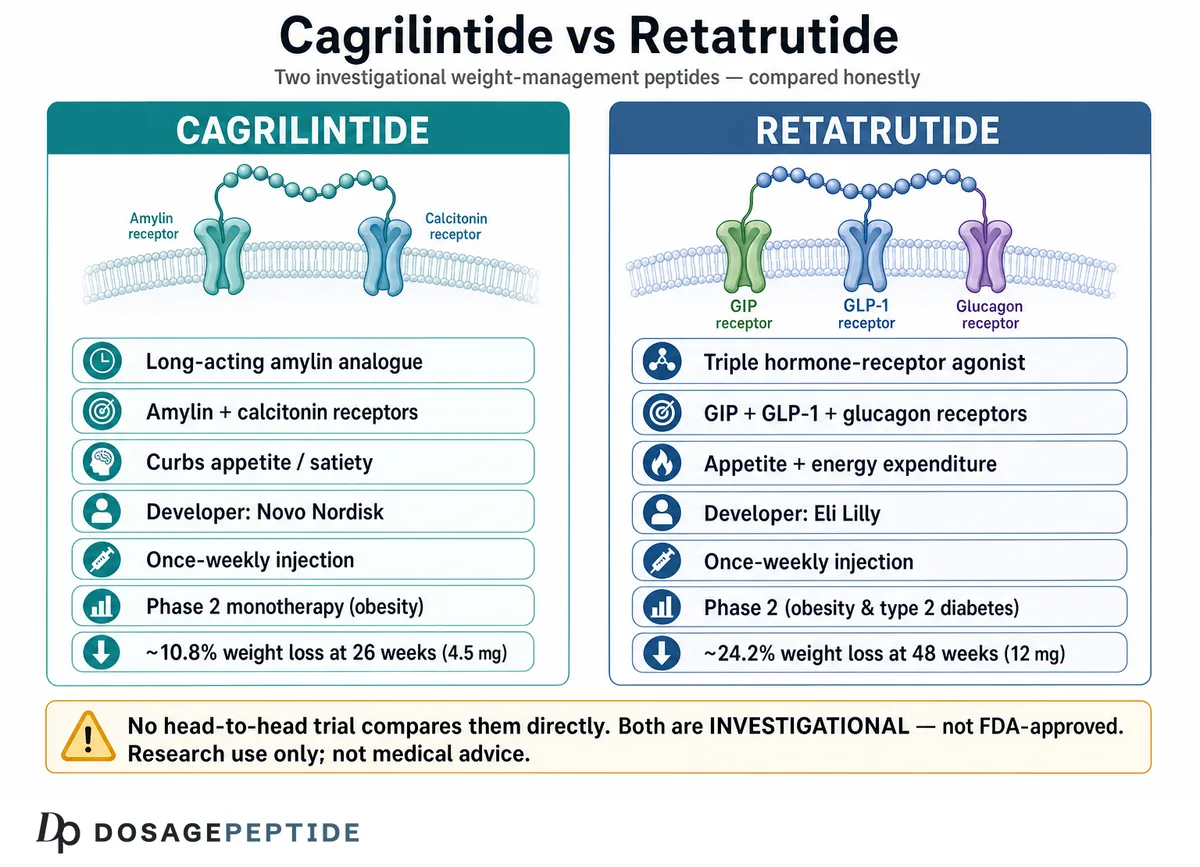
The obesity-pharmacology field is converging on a simple idea from two directions. One direction — retatrutide’s — is to stack more incretin-and-metabolic signals into a single peptide. The other direction — cagrilintide’s — is to add an entirely different hormonal axis, amylin, alongside the incretin drugs the field already has. Understanding the comparison means understanding that these are complementary strategies, not two versions of the same drug. Cagrilintide’s most advanced data actually come from combining it with an incretin (semaglutide), while retatrutide’s come from packing three receptor activities into one molecule. Keeping that distinction in view prevents the most common error in this comparison: treating a standalone-monotherapy number for one and a combination number for the other as if they were measured the same way.
What Is Cagrilintide?
Cagrilintide is a synthetic, long-acting amylin analogue developed by Novo Nordisk. Amylin is a peptide hormone co-secreted with insulin by the pancreatic beta cells after a meal; it slows gastric emptying and signals satiety to the brainstem and hypothalamus, reducing food intake.[10] Native amylin is chemically unstable and short-lived, which makes it impractical as a once-weekly drug. Cagrilintide is engineered around that problem: it is a modified, lipidated peptide that acts as a dual amylin and calcitonin receptor agonist and is stable enough for once-weekly subcutaneous dosing.[9]
Mechanistically, cagrilintide is thought to reduce body weight primarily by acting on both homeostatic appetite centers (the physiological hunger/fullness system) and hedonic ones (the reward-driven side of eating), lowering food intake without directly forcing energy expenditure up.[10] Because amylin signaling is a different pathway from the incretin (GLP-1) pathway, cagrilintide is attractive as a partner drug: the two mechanisms can be additive. That logic is why its single most advanced research program is not cagrilintide alone but the fixed-dose combination with semaglutide, developed under the name CagriSema. Readers who want the handling parameters used for the compound in laboratory research can consult our cagrilintide 5 mg vial research dosage reference, which describes reconstitution and measurement in a research context only, not human use.
What Is Retatrutide?
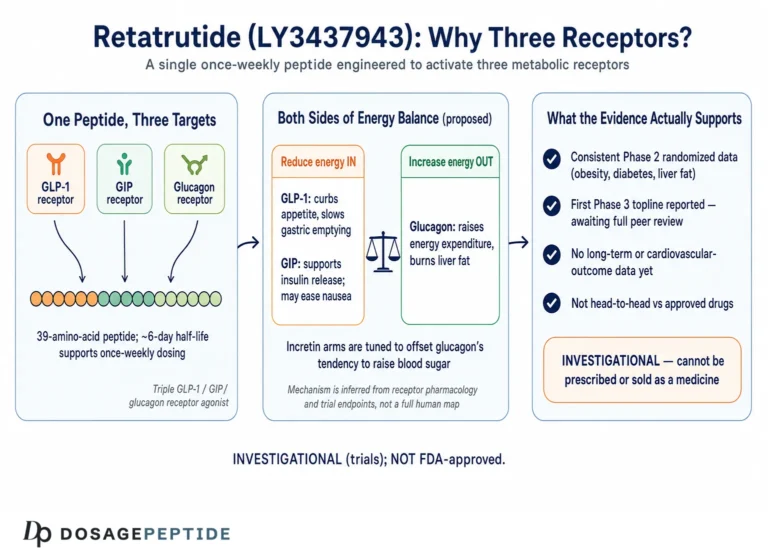
Retatrutide (development code LY3437943) is a single synthetic peptide developed by Eli Lilly that acts as a triple agonist at three receptors simultaneously: the glucose-dependent insulinotropic polypeptide (GIP) receptor, the glucagon-like peptide-1 (GLP-1) receptor, and the glucagon receptor.[3] The GLP-1 and GIP arms deliver the incretin effects now familiar from drugs like semaglutide and tirzepatide — appetite suppression, slowed gastric emptying, and improved glucose handling. The third arm is what sets retatrutide apart from every approved incretin drug: glucagon-receptor agonism.
Adding glucagon activity is counter-intuitive, because glucagon raises blood sugar. The rationale is that glucagon also increases energy expenditure and promotes hepatic fat mobilization, so a molecule that combines glucagon’s metabolic-rate effect with GLP-1/GIP’s appetite-and-glucose control can, in principle, drive weight loss from both sides of the energy-balance equation at once.[8] That is the design thesis behind retatrutide’s unusually large weight-loss figures — and also behind its distinctive side-effect signal, discussed below. The laboratory-research handling reference for the compound is our retatrutide 10 mg vial research dosage and reconstitution reference, again a research-context description rather than a use recommendation.
How Do the Two Mechanisms Actually Differ?
The cleanest way to hold the difference in mind is to count hormonal axes and ask what each does to the energy-balance equation.
- Cagrilintide = one added axis (amylin), appetite-side only. It recruits the amylin/calcitonin receptor system to suppress appetite and slow gastric emptying. It does not add a mechanism that raises metabolic rate. Its effect is essentially “eat less,” delivered through a satiety pathway distinct from GLP-1.
- Retatrutide = three axes in one molecule (GIP + GLP-1 + glucagon), both sides of energy balance. The incretin arms suppress appetite and improve glucose control; the glucagon arm additionally nudges energy expenditure and hepatic fat handling upward. Its effect is “eat less and spend a bit more.”
This is why the two are natural complements rather than substitutes. Cagrilintide was built to be layered on top of an incretin backbone; retatrutide already contains its incretin backbone plus a metabolic-rate lever. The comparison is therefore partly apples-to-oranges: retatrutide is a finished multi-mechanism molecule, whereas cagrilintide’s headline performance depends on the partner it is combined with. The glossary of terms used here — agonist, incretin, amylin, energy expenditure — is spelled out in our peptide research glossary.
How the Field Arrived at These Two Molecules
Neither compound appeared in a vacuum. Each is the latest step in a distinct multi-decade research lineage, and understanding those lineages explains why the two look so different despite chasing the same endpoint.
The amylin lineage (cagrilintide’s side). Amylin was identified in the 1980s as a peptide co-secreted with insulin by the pancreatic beta cells, and researchers recognized early that it contributes to satiety and glucose regulation.[10] The first amylin analogue to reach the clinic, pramlintide, demonstrated that the pathway could be drugged, but native-style amylin analogues are short-acting and were used as multiple-daily injections, which limited their appeal for weight management. Cagrilintide represents the modern re-engineering of that idea: a lipidated, structurally modified amylin analogue stable enough for once-weekly dosing and active at both the amylin and calcitonin receptors.[9] In other words, cagrilintide revived a decades-old hormonal axis in a once-weekly, combination-ready form.
The incretin lineage (retatrutide’s side). Retatrutide sits at the end of a very different chain: the progressive stacking of incretin-and-metabolic receptor activities into single molecules. The field moved from single GLP-1 receptor agonism, to dual GIP/GLP-1 agonism, and then to adding a third receptor — glucagon — to capture an energy-expenditure lever on top of appetite and glucose control.[8] Retatrutide is the triple-agonist expression of that trajectory, engineered as one peptide that hits GIP, GLP-1, and glucagon receptors simultaneously.[3]
So the two molecules embody two strategies that converged on the same goal from opposite engineering philosophies: cagrilintide adds a separate hormone (amylin) intended to be combined with an incretin, while retatrutide packs an additional receptor activity (glucagon) into the incretin molecule itself. Both approaches are actively documented in the obesity-pharmacology pipeline literature that tracks these emerging agents side by side.[7]
The Approval Reality: Neither Is on the Market
This is the section that matters most for anyone encountering these names online, so it is stated without hedging.
Retatrutide is investigational. It completed Phase 2 trials in obesity[3] and type 2 diabetes[4] and moved into a Phase 3 program (TRIUMPH). Company-reported Phase 3 topline results have circulated in 2025–2026, and a regulatory filing has been anticipated, but retatrutide is not FDA- or EMA-approved and is not available as a prescription product.
Cagrilintide as a standalone compound is even earlier in the pipeline — it remains at the Phase 2 stage.[1] The more advanced regulatory activity belongs to the combination product CagriSema (cagrilintide plus semaglutide), which reached Phase 3 and for which a New Drug Application was reported to have been filed with the FDA in late 2025. Crucially, that filing is for CagriSema, not for standalone cagrilintide, and no version is approved yet. A drug under FDA review is not an approved drug.
Neither compound, in any formulation, can be legally dispensed as a pharmacy medicine as of this writing. Both are prescription-pipeline assets in active development. Everything that follows about doses and effects is trial data generated in monitored research settings, not evidence that any product sold to the public is the same material or behaves the same way.
Cagrilintide: What the Evidence Actually Shows
The pivotal standalone human dataset for cagrilintide is a multicentre, randomised, double-blind, placebo- and active-controlled, dose-finding Phase 2 trial in people with overweight or obesity.[1] It tested once-weekly cagrilintide across a dose range and compared it with both placebo and an active comparator (liraglutide 3.0 mg). At the top studied dose of 4.5 mg, cagrilintide produced a mean weight reduction of roughly 10.8% at 26 weeks, versus about 3.0% with placebo. That is a substantial monotherapy effect for an appetite-axis-only agent, and it established cagrilintide as a credible weight-management candidate on its own.
The pharmacokinetic groundwork came from a Phase 1b trial studying cagrilintide alongside semaglutide 2.4 mg.[2] That work reported a long half-life — on the order of 159–195 hours (about 7–8 days) — consistent with once-weekly dosing, and it provided the first human safety and tolerability read on the cagrilintide-plus-incretin concept that later became CagriSema.
Here the honesty caveat has to be explicit. The much larger, headline-grabbing numbers associated with “cagrilintide” in the press — figures in the low-to-mid 20% range — come from Phase 3 trials of CagriSema, the combination with semaglutide, and are company-reported topline results, not standalone-cagrilintide data and not the peer-reviewed Phase 2 result cited above. Attributing CagriSema’s combination performance to cagrilintide alone would overstate what the monotherapy evidence supports. The defensible, peer-reviewed statement is: standalone cagrilintide produced about 10.8% at 26 weeks at 4.5 mg in Phase 2.[1]
Retatrutide: What the Evidence Actually Shows
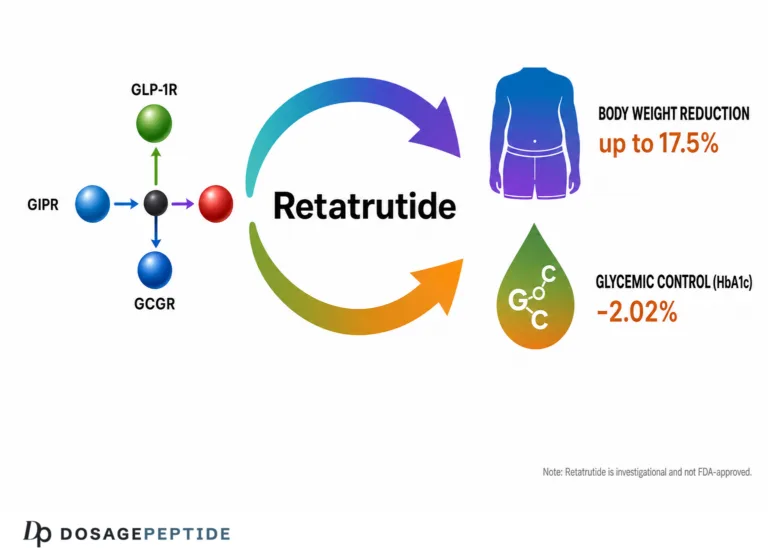
Retatrutide’s pivotal obesity dataset is a Phase 2, double-blind, randomised, placebo-controlled trial in adults with obesity (or overweight plus a weight-related condition), testing once-weekly doses up to 12 mg over 48 weeks.[3] At the 12 mg dose, the mean weight reduction was about 17.5% at 24 weeks (the primary endpoint) rising to roughly 24.2% at 48 weeks, compared with about 2.1% for placebo. At 48 weeks, a large majority of participants on the higher doses achieved reductions of 10% or more. These are among the largest weight-loss figures reported for any pharmacological agent in a Phase 2 obesity trial.
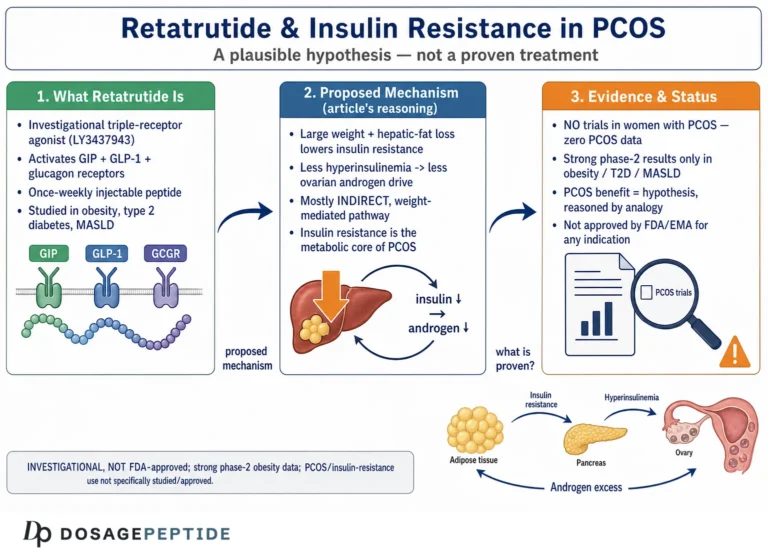
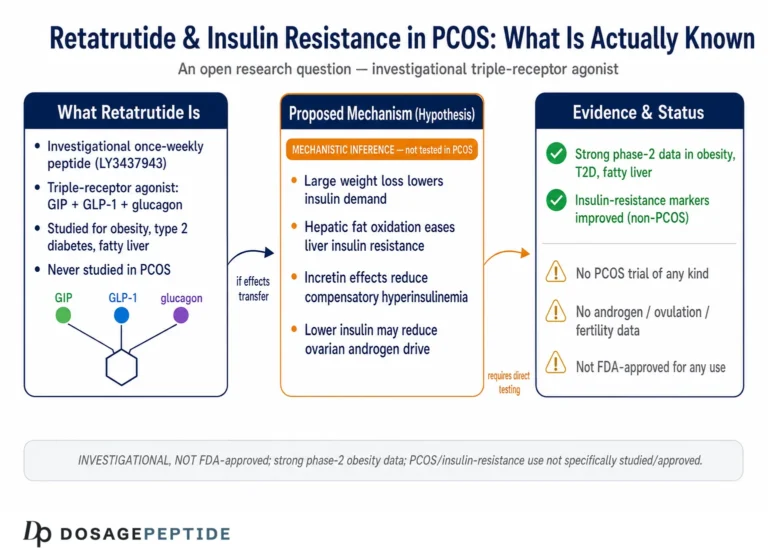
A separate Phase 2 trial in type 2 diabetes evaluated retatrutide against placebo and an active comparator, reporting clinically meaningful reductions in HbA1c together with weight loss across the dose range.[4] Together, the obesity and diabetes trials give retatrutide the broadest Phase 2 metabolic dataset of the two compounds, and the program has extended into hepatic (liver-fat / MASLD) and cardiometabolic questions that reflect the glucagon arm’s biology.[7]
As with cagrilintide, the honesty caveat applies to the newest numbers. Phase 3 TRIUMPH topline figures (often cited around the high-20% range at 68–80 weeks) are company-reported and, at the time of writing, are not the peer-reviewed Phase 2 dataset cited above. The evidence tier that is fully published and verifiable is Phase 2; the Phase 3 confirmatory publications are what would elevate that tier.
Head-to-Head vs. Cross-Trial: The Only Fair Comparisons
This is the single most important section of the comparison, and it is where most online “cagrilintide vs retatrutide” content quietly cheats. There is no published randomised controlled trial that administered cagrilintide and retatrutide to comparable participants under one protocol. No head-to-head data exist. That means you cannot legitimately place “10.8% for cagrilintide” next to “24.2% for retatrutide” and declare a winner, because those numbers come from different trials, different populations, different durations (26 vs 48 weeks), different doses, and — critically — a monotherapy figure for one versus a monotherapy figure for the other, while cagrilintide’s strongest data are actually as a combination.
The only cross-compound evidence that exists is indirect: network meta-analyses that statistically connect drugs through their shared comparators (usually placebo) rather than through direct comparison. An updated systematic review and network meta-analysis of GLP-1 receptor agonists and polyagonists ranked retatrutide at or near the top for weight loss among the modern agents, while also flagging that the strongest-effect agents tend to carry the highest adverse-event burden.[5] A separate Bayesian network meta-analysis reached broadly consistent conclusions about retatrutide’s high placement for weight loss among incretin-based agents.[6] These analyses are useful, but they are the weakest tier for a two-drug verdict: indirect comparisons inherit every difference between the underlying trials and cannot substitute for a randomised head-to-head.
| Comparison | Study design | Evidence strength | What it can and cannot tell you |
|---|---|---|---|
| Cagrilintide monotherapy vs placebo | Phase 2 RCT, 26 weeks[1] | Strong (direct, within-trial) | Establishes cagrilintide’s standalone effect (~10.8% at 4.5 mg); says nothing about retatrutide |
| Retatrutide vs placebo | Phase 2 RCT, 48 weeks[3] | Strong (direct, within-trial) | Establishes retatrutide’s standalone effect (~24.2% at 12 mg); says nothing about cagrilintide |
| Cagrilintide vs retatrutide (direct) | Does not exist | None | No randomised head-to-head trial has ever been run |
| Retatrutide ranked among incretin agents | Network meta-analysis (indirect)[5] | Weak (cross-trial inference) | Suggests retatrutide ranks high for weight loss (and adverse events); does not directly measure it against cagrilintide |
The takeaway from that table is the whole point of an honest comparison: the two rows with real strength each describe only one drug, the direct cagrilintide-vs-retatrutide row is empty, and the only cross-drug row is explicitly weak. Any confident “X beats Y by so many points” claim is manufacturing certainty the evidence does not contain.
Reading the Numbers Honestly: The Full Comparison Table
With the cross-trial caveat firmly established, the attribute-by-attribute comparison below summarises what is documented for each compound. Read every efficacy figure as a within-trial result under the conditions of that specific study — not as a direct duel, and not as a therapeutic claim.
| Attribute | Cagrilintide | Retatrutide |
|---|---|---|
| Class / mechanism | Long-acting amylin analogue (dual amylin + calcitonin receptor agonist) | Single-peptide triple agonist (GIP + GLP-1 + glucagon receptors) |
| Developer | Novo Nordisk | Eli Lilly |
| Primary research use | Investigational weight management; most advanced as the CagriSema combination | Investigational obesity, type 2 diabetes, and metabolic (liver-fat) research |
| Route & frequency | Subcutaneous, once weekly | Subcutaneous, once weekly |
| Half-life | ~159–195 h (~7–8 days)[2] | Long-acting; consistent with once-weekly dosing (exact figure less firmly published) |
| Representative trial efficacy | ~10.8% mean weight reduction at 26 weeks (4.5 mg monotherapy, Phase 2)[1] | ~24.2% mean weight reduction at 48 weeks (12 mg, Phase 2)[3] |
| Highest evidence tier (standalone) | Phase 2 (monotherapy); combination CagriSema in Phase 3 | Phase 2 complete; Phase 3 (TRIUMPH) topline reported, not yet fully published |
| Distinct pharmacology | Adds a non-incretin appetite axis (amylin); no direct energy-expenditure effect | Adds glucagon-driven energy expenditure on top of incretin effects |
| Approval status (mid-2026) | Not FDA/EMA-approved; standalone Phase 2; CagriSema NDA under review | Not FDA/EMA-approved; Phase 3 stage; filing anticipated |
| Direct head-to-head data | None — no trial has compared the two directly | |
Safety and Tolerability: Where They Diverge
Both compounds share the tolerability profile typical of appetite-suppressing metabolic peptides, but retatrutide carries additional signals that trace directly to its glucagon arm. As always, these are trial-reported observations in monitored settings, not a safety guarantee for any product sold outside trials.
| Safety dimension | Cagrilintide | Retatrutide |
|---|---|---|
| Dominant adverse events | Gastrointestinal — nausea, constipation, diarrhea (dose-related)[1] | Gastrointestinal — nausea, vomiting, diarrhea, constipation (dose-related)[3] |
| Injection-site reactions | Reported | Reported |
| Heart rate | No characteristic heart-rate signal reported | Dose-dependent increase in heart rate (attributed to glucagon agonism)[3] |
| Body-composition note | Appetite-axis mechanism; standard incretin-class lean-mass considerations less emphasized | Incretin-class lean-mass loss accompanies large total weight loss |
| Comparative adverse-event burden | Amylin-class tolerability generally described as acceptable in trials | Network meta-analyses flag the highest adverse-event risk among the modern agents[5] |
| Overall evidence tier | Phase 1b/2 safety data[2] | Phase 2 safety data; Phase 3 safety not yet fully published |
The pattern is that both are GI-forward drugs, but retatrutide’s glucagon activity adds a cardiovascular consideration (heart rate) that cagrilintide’s amylin mechanism does not, and the same potency that produces retatrutide’s larger weight loss is associated, in indirect analyses, with a heavier adverse-event load.[6] “More weight loss” and “better tolerated” are not the same axis.
Beyond Weight: Cardiometabolic and Organ Effects
Weight is the headline endpoint, but both programs have explored effects that matter metabolically. Retatrutide’s type 2 diabetes trial documented meaningful glycemic (HbA1c) improvement alongside weight loss,[4] and its glucagon-driven biology has made hepatic fat (MASLD) a natural research question for the compound.[7] Cagrilintide’s cardiometabolic story is, at the standalone level, less developed; the broader metabolic case is being built through the CagriSema combination rather than cagrilintide alone.[8]
The honest framing for both is that these are surrogate endpoints — body weight, HbA1c, liver fat — measured over trial-length horizons. Neither compound has published the kind of long-term hard-outcome data (cardiovascular events, mortality) that ultimately defines a metabolic drug’s value, because both are too early in development for that. Improving a surrogate is promising; it is not the same as proving it changes the outcomes patients actually care about.
| Reported effect | Strongest evidence tier | Honest interpretation |
|---|---|---|
| Weight reduction (cagrilintide) | Phase 2 RCT, standalone[1] | Well demonstrated at ~10.8% (4.5 mg, 26 wk); larger numbers belong to the CagriSema combination |
| Weight reduction (retatrutide) | Phase 2 RCT[3] | Well demonstrated at ~24.2% (12 mg, 48 wk); Phase 3 confirmation reported but not yet fully published |
| Glycemic control (retatrutide) | Phase 2 T2D RCT[4] | Meaningful HbA1c reduction shown; surrogate endpoint, not a hard-outcome result |
| Liver fat / MASLD (retatrutide) | Emerging program / review level[7] | Biologically plausible via glucagon arm; still developing, not established therapy |
| Cagrilintide vs retatrutide superiority | None (no head-to-head) | Not established; cross-trial inference only |
Research-Use Dosing Conventions (Not a Recommendation)
This section describes the dose ranges used inside clinical trials and laboratory research settings only. It is not a protocol, not medical guidance, and not a suggestion that anyone administer these compounds. No FDA-approved human dose exists for either peptide, so there is no “correct” dose to state — only what investigators used under monitoring.
- Cagrilintide (trials): once-weekly subcutaneous administration, escalated gradually over roughly six weeks to limit gastrointestinal effects; monotherapy doses in the Phase 2 dose-finding trial spanned 0.3 mg to 4.5 mg, with 2.4 mg used in the CagriSema combination.[1]
- Retatrutide (trials): once-weekly subcutaneous administration, starting low (e.g., 2 mg) and escalating to 4, 8, or 12 mg maintenance, with slower titration used to improve tolerability.[3]
Two research-context points follow from this. First, both used slow dose escalation specifically because the gastrointestinal effects are dose-related; the titration is part of the design, not an afterthought. Second, converting any milligram figure into a reconstituted concentration is an arithmetic step that researchers handle deliberately — our peptide reconstitution guide and dosage calculator explain how those conversions are performed in a laboratory context. Again: these tools describe research methodology, not human-use instructions.
Cagrilintide With Retatrutide: What Is Documented, and What Is Not
This is the most-searched question about the pair, so it deserves a direct answer: no clinical trial has tested cagrilintide together with retatrutide. The peer-reviewed record contains no dose pair, no titration schedule, no tolerability data and no efficacy figure for the combination. Any “cagri-reta blend” dose chart in circulation is built by taking each compound’s separate trial doses and setting them side by side — that is arithmetic, not evidence.
What is documented is each compound on its own, plus one adjacent combination. Here is the whole picture in one chart:
| Regimen | Documented dose | Route & frequency | Escalation used |
|---|---|---|---|
| Cagrilintide alone (Phase 2 monotherapy) | 0.3 mg – 4.5 mg [1] | Subcutaneous, once weekly | Gradual, over roughly six weeks |
| Cagrilintide in CagriSema | 2.4 mg [1] | Subcutaneous, once weekly | Paired with semaglutide, not retatrutide |
| Retatrutide alone | 2 mg start, to 4, 8 or 12 mg maintenance [3] | Subcutaneous, once weekly | Slow titration, for tolerability |
| Cagrilintide with retatrutide | No published dose exists | — | — never studied together |
Read the last row carefully, because it is the answer to the question most people arrive with. Semaglutide is a GLP-1 agonist, not a triple agonist, so the CagriSema programme tells you nothing about retatrutide as a partner for cagrilintide. The two upper rows cannot be added together to produce the fourth.
The reason the gap matters is tolerability as much as efficacy. Both compounds’ gastrointestinal effects are dose-related, which is exactly why both trial programmes escalate slowly by design. Combining two agents that each need their own titration stacks those dose-related effects, and no monitored study has characterised where the resulting ceiling sits. So the combination is not simply “more of the same”: it is an untested regimen whose principal documented risk is the one nobody has measured.
Research-use context only. Nothing in this section is a protocol, a dose recommendation, or a suggestion that anyone administer either compound, alone or in combination.
What the Evidence Does NOT Show
An honest comparison is defined as much by what it refuses to claim as by what it reports. For cagrilintide vs retatrutide, the following are not established:
- No direct superiority. Because no head-to-head trial exists, no one can validly claim that retatrutide “beats” cagrilintide (or vice versa) by any specific margin. Cross-trial numbers are not a duel.
- No approval for either. Neither compound is FDA- or EMA-approved. A pending CagriSema NDA and reported retatrutide Phase 3 toplines are not approvals.
- No long-term hard-outcome data. Neither has published cardiovascular-event or mortality outcomes; the endpoints are weight, HbA1c, and other surrogates over trial-length follow-up.
- No standalone-vs-combination equivalence. Cagrilintide’s biggest numbers are combination (CagriSema) results; they are not evidence about cagrilintide by itself, and it is misleading to compare them to retatrutide monotherapy.
- No product-identity guarantee. Trial data describe pharmaceutical-grade material under monitoring. Research-chemical vials sold as “cagrilintide” or “retatrutide” are of unverified identity and purity; trial results do not transfer to unverified product.
- No safety clearance for self-experimentation. Absence of approval means no regulator has judged either compound’s benefit–risk balance for human use outside trials.
Practical and Research Context
For researchers and readers using this page as reference material, the compounds sit at similar but not identical points: both are injectable, once-weekly, investigational metabolic peptides with genuine human RCT data — a status that already sets them apart from the many research peptides supported only by animal or in-vitro work — but neither is an approved medicine, and the two have never been compared directly. The most defensible reading is to treat each compound’s own within-trial data as its evidence and to treat any cross-compound ranking as a hypothesis, not a result.
The laboratory-handling references for each compound live on their respective pages — the cagrilintide research dosage reference and the retatrutide research dosage reference — and the shared methodology of reconstitution and measurement is covered in the reconstitution guide. All of these describe research-use handling only. None is a recommendation for human administration, and neither compound should be understood as available or approved for therapeutic use.
Because research-market material is sold outside any approved supply chain, its identity and purity are unverified: trial data describe a characterized study drug, not the contents of an arbitrary vial, so a batch certificate of analysis is the minimum a research setting should require. Reference vials of these metabolic peptides are catalogued by research-grade peptide suppliers such as Prime Lab; the dosing figures on this page nonetheless describe published laboratory studies and investigational clinical trials only, not a protocol for use.
How to Read a Weight-Loss Study Before Trusting a Comparison
The reason “cagrilintide vs retatrutide” headlines mislead so easily is that most readers compare the loudest numbers without checking whether they are comparable. Five habits fix that:
- Match the duration. A 26-week result and a 48-week result are not the same measurement; weight-loss curves keep descending, so longer trials report bigger numbers partly because they ran longer.
- Match the dose. Top-dose figures are the ceiling, not the typical result. Compare like doses, and note the titration.
- Match monotherapy to monotherapy. A combination result (CagriSema) is not a standalone result (cagrilintide). Mixing them inflates one side.
- Check the trial phase. Phase 2 is hypothesis-generating; Phase 3 is confirmatory. A peer-reviewed Phase 2 result outranks an unpublished topline press figure for reliability.
- Ask whether the comparison is direct. If two drugs weren’t in the same trial, any ranking is an indirect inference — useful, but the weakest tier.
Apply these five checks to the popular claim “retatrutide is far better than cagrilintide” and it quickly reduces to: a 48-week top-dose monotherapy number for one, next to a 26-week monotherapy number for the other whose real strength is a combination — with no head-to-head trial anywhere in the chain.
Common Misconceptions
“Retatrutide is proven to beat cagrilintide”
No head-to-head trial exists, so “proven to beat” is not a statement the evidence can support. Retatrutide’s Phase 2 monotherapy weight loss (~24.2% at 48 weeks) is numerically larger than cagrilintide’s (~10.8% at 26 weeks), but those come from different trials, durations, and doses, and cagrilintide’s strongest data are as the CagriSema combination. Indirect network meta-analyses rank retatrutide highly, but that is cross-trial inference, not a direct win.
“They’re basically the same class of drug”
They are not. Cagrilintide is an amylin analogue that works through the amylin/calcitonin receptor system; retatrutide is an incretin-based triple agonist adding GIP, GLP-1, and glucagon activity. They target different receptors and were designed to be complementary — which is exactly why cagrilintide is studied in combination with an incretin (semaglutide) rather than against one.
“Cagrilintide gets you 20%+ weight loss”
The 20%-plus figures belong to CagriSema, the fixed-dose combination of cagrilintide plus semaglutide, and are company-reported Phase 3 topline results. Standalone cagrilintide’s peer-reviewed Phase 2 monotherapy result is about 10.8% at 26 weeks at 4.5 mg. Crediting the combination’s performance to cagrilintide alone overstates the monotherapy evidence.
“You can buy either one and expect the trial results”
Neither compound is FDA- or EMA-approved, so there is no legitimate pharmacy product for either. Material sold in the research-chemical channel is labeled for laboratory use, is not manufactured to pharmaceutical identity or purity standards, and cannot be assumed to match the trial material. Trial efficacy and safety data do not transfer to an unverified product.
Key Takeaways
- Different mechanisms. Cagrilintide is an amylin analogue (appetite axis); retatrutide is a GIP/GLP-1/glucagon triple agonist (appetite plus energy expenditure).
- Both are investigational. As of mid-2026, neither is FDA- or EMA-approved; the CagriSema combination NDA is under review and retatrutide is at the Phase 3 stage.
- No head-to-head trial exists. Every cagrilintide-vs-retatrutide number is a cross-trial comparison; the only cross-drug data are weak indirect network meta-analyses.
- The efficacy figures aren’t apples-to-apples. Retatrutide’s ~24.2% (48 wk, 12 mg monotherapy) and cagrilintide’s ~10.8% (26 wk, 4.5 mg monotherapy) differ in duration and dose, and cagrilintide’s strongest data are combination (CagriSema) data.
- Safety diverges at the glucagon arm. Both are GI-forward; retatrutide adds a dose-dependent heart-rate signal and the highest adverse-event burden in indirect analyses.
- Evidence tier is everything. Verifiable Phase 2 data beat unpublished Phase 3 toplines; surrogate endpoints (weight, HbA1c) are not hard outcomes; and both remain research-use-only outside trials.
Frequently Asked Questions
Can cagrilintide and retatrutide be dosed together?
No published clinical trial has tested them together, so there is no documented dose pair, titration schedule or safety profile for the combination. The dose charts circulating for a “cagri-reta blend” are assembled by placing each compound’s separate trial doses side by side. Both compounds’ gastrointestinal effects are dose-related and both trial programmes titrate slowly for that reason, so pairing them stacks an effect that no monitored study has characterised.
Is cagrilintide or retatrutide better for weight loss?
No head-to-head trial has compared them, so “better” cannot be answered directly. In their separate Phase 2 trials, retatrutide monotherapy showed larger weight loss (~24.2% at 48 weeks, 12 mg) than standalone cagrilintide (~10.8% at 26 weeks, 4.5 mg), and indirect network meta-analyses rank retatrutide highly. But those are different trials with different durations and doses, and cagrilintide’s strongest data are as the CagriSema combination, so any ranking is a cross-trial inference rather than a proven result.
Are cagrilintide and retatrutide FDA-approved?
No. As of mid-2026, neither cagrilintide nor retatrutide is approved by the FDA or EMA for any indication. Retatrutide is at the Phase 3 stage, and the cagrilintide-plus-semaglutide combination CagriSema was reported to have a New Drug Application under FDA review, but a filing under review is not an approval. There is no legitimate prescription product for either compound.
What is the main difference between cagrilintide and retatrutide?
Cagrilintide is a long-acting amylin analogue that reduces appetite through the amylin and calcitonin receptors. Retatrutide is a single peptide that activates three receptors at once — GIP, GLP-1, and glucagon — combining incretin appetite and glucose effects with glucagon-driven energy expenditure. In short, cagrilintide adds one non-incretin appetite axis, while retatrutide stacks three metabolic signals into one molecule.
Why can’t I just compare their weight-loss percentages?
Because the percentages come from different trials. Cagrilintide’s ~10.8% was measured at 26 weeks at 4.5 mg; retatrutide’s ~24.2% was measured at 48 weeks at 12 mg. The durations, doses, and populations differ, and cagrilintide’s largest figures are combination (CagriSema) results, not standalone data. Comparing the raw numbers as if they were a head-to-head duel manufactures a certainty the evidence does not support.
Is CagriSema the same as cagrilintide?
No. CagriSema is a fixed-dose combination of cagrilintide plus semaglutide. Its Phase 3 weight-loss figures (in the low-to-mid 20% range) and its late-2025 FDA filing belong to the combination product, not to standalone cagrilintide, which remains at the Phase 2 stage with a peer-reviewed monotherapy result of about 10.8% at 26 weeks.
Which one has more side effects?
Both are dominated by dose-related gastrointestinal effects (nausea, diarrhea, constipation). Retatrutide additionally shows a dose-dependent increase in heart rate, attributed to its glucagon-receptor activity, and indirect network meta-analyses flag the highest adverse-event burden among the modern agents for the most potent drugs. Cagrilintide’s amylin-class tolerability has generally been described as acceptable in trials. All of this is trial data, not a safety guarantee.
Do either of these have long-term outcome data?
Not yet. Both are early enough in development that the published endpoints are surrogates — body weight, HbA1c, liver fat — measured over trial-length follow-up. Neither has published long-term hard-outcome data such as cardiovascular events or mortality, which is the kind of evidence that ultimately defines a metabolic drug’s value.
Is the research-chemical version the same as the trial drug?
No. Trial data describe pharmaceutical-grade material administered under medical monitoring. Peptides sold in the research-chemical channel are labeled for laboratory use, are not manufactured to pharmaceutical identity or purity standards, and cannot be assumed to match the trial material in content, dose, or purity. Trial efficacy and safety findings do not transfer to an unverified product.
Can cagrilintide and retatrutide be used together?
There is no clinical-trial program combining cagrilintide with retatrutide, and no data on such a pairing. Cagrilintide has been studied in combination with semaglutide (as CagriSema), not with retatrutide. Because retatrutide already contains three receptor activities, combining it with an amylin analogue is a research hypothesis without supporting evidence, and nothing here should be read as a suggestion to combine them.
Is there a cagrilintide and retatrutide dosage chart?
Not one built on data, no. No published study has dosed the two together, so there is no tested pair, no titration schedule and no tolerability ceiling for the combination. The charts circulating online are made by placing each molecule’s solo trial doses side by side — cagrilintide 0.3 to 4.5 mg weekly in its Phase 2 dose-finding programme, retatrutide starting near 2 mg and escalating to 4, 8 or 12 mg weekly — and presenting the result as though someone had studied the pair. Nobody has. A chart assembled that way is arithmetic, not evidence, and it hides the specific unknown that matters: both molecules require slow escalation because their gastrointestinal effects are dose-related, and no monitored study has characterised where the combined ceiling sits.
What do people mean by “cagri reta”?
It is shorthand for cagrilintide plus retatrutide, in the same way “reta” means retatrutide and “cagrisema” means cagrilintide plus semaglutide. The difference between those two shorthands is worth holding on to: CagriSema is an actual co-formulated product with published trial data behind the pairing, whereas “cagri reta” names a combination that exists in vendor listings and forum posts, not in the trial record.
References
- Lau DCW, Erichsen L, Francisco AM, et al. Once-weekly cagrilintide for weight management in people with overweight and obesity: a multicentre, randomised, double-blind, placebo-controlled and active-controlled, dose-finding phase 2 trial. Lancet. 2021;398(10317):2160-2172.
- Enebo LB, Berthelsen KK, Kankam M, et al. Safety, tolerability, pharmacokinetics, and pharmacodynamics of concomitant administration of multiple doses of cagrilintide with semaglutide 2.4 mg for weight management: a randomised, controlled, phase 1b trial. Lancet. 2021;397(10286):1736-1748.
- Jastreboff AM, Kaplan LM, Frias JP, et al. Triple-Hormone-Receptor Agonist Retatrutide for Obesity — A Phase 2 Trial. N Engl J Med. 2023;389(6):514-526.
- Rosenstock J, Frias J, Jastreboff AM, et al. Retatrutide, a GIP, GLP-1 and glucagon receptor agonist, for people with type 2 diabetes: a randomised, double-blind, placebo and active-controlled, parallel-group, phase 2 trial. Lancet. 2023;402(10401):529-544.
- Xie Z, Zheng G, Liang Z, et al. Seven glucagon-like peptide-1 receptor agonists and polyagonists for weight loss in patients with obesity or overweight: an updated systematic review and network meta-analysis of randomized controlled trials. Metabolism. 2024;161:156038.
- Sinha B, Ghosal S. Efficacy and Safety of GLP-1 Receptor Agonists, Dual Agonists, and Retatrutide for Weight Loss in Adults With Overweight or Obesity: A Bayesian NMA. Obesity (Silver Spring). 2025;33(11):2046-2054.
- Kokkorakis M, Chakhtoura M, Rhayem C, et al. Emerging pharmacotherapies for obesity: A systematic review. Pharmacol Rev. 2024;77(1):100002.
- Melson E, Ashraf U, Papamargaritis D, Davies MJ. What is the pipeline for future medications for obesity? Int J Obes (Lond). 2024;49(3):433-451.
- D’Ascanio AM, Mullally JA, Frishman WH. Cagrilintide: A Long-Acting Amylin Analog for the Treatment of Obesity. Cardiol Rev. 2024;32(1):83-90.
- Erzen S, Tonin G, Jurisic Erzen D, Klen J. Amylin, Another Important Neuroendocrine Hormone for the Treatment of Diabesity. Int J Mol Sci. 2024;25(3):1517.
Research-use disclaimer: This article is educational reference material summarizing published research and regulatory context. It is not medical advice, not a therapeutic recommendation, and not instructions for human use. As of mid-2026, neither cagrilintide nor retatrutide is FDA- or EMA-approved for any indication, and no legitimate prescription product exists for either. Descriptions of doses refer to clinical-trial and laboratory research settings only. Always verify current clinical-trial and regulatory status through primary sources such as ClinicalTrials.gov, PubMed, and the FDA.