Semaglutide is the GLP-1 receptor agonist that reset expectations for what pharmacology can do to appetite and body weight. In the landmark 68-week STEP-1 trial, adults with overweight or obesity who reached the 2.4 mg maintenance dose lost roughly 15% of their body weight on average — a magnitude that had previously belonged to bariatric surgery, not an injection. That result is why “semaglutide dosage” is one of the most-searched questions in metabolic health, and why getting the titration right matters more than any single number.
The mechanism is the reason the dose cannot simply be started high. Semaglutide mimics glucagon-like peptide-1 (GLP-1), a gut hormone that slows gastric emptying, amplifies glucose-dependent insulin release, and acts on hypothalamic appetite centers to reduce hunger and food-seeking. Those same actions — especially the slowed stomach emptying — are what drive nausea, and the gut adapts to them only gradually. That is the entire logic behind the slow, roughly four-week-per-step escalation ladder documented in the label and the trials: it trades a few extra weeks for dramatically better gastrointestinal tolerability.
An honest word on evidence and framing before we go further: semaglutide is a prescription, FDA-approved drug (marketed as Wegovy for weight management and Ozempic for type 2 diabetes). The material sold as research “semaglutide” in multi-dose vials for reconstitution is not an approved product, is not sterility-tested for human use, and is sold strictly for laboratory research. This guide reproduces the documented label and clinical-trial protocol as reference information under a research-use-only framing. Nothing here is a prescription, a personal recommendation, or medical advice.

At a Glance
| Attribute | Documented reference detail |
|---|---|
| Class / use | Long-acting GLP-1 receptor agonist; studied for chronic weight management and glycemic control in type 2 diabetes |
| Typical research vial | 5 mg, 10 mg, or 20 mg lyophilized powder |
| Reconstitution (example) | 5 mg vial + 2 mL bacteriostatic water = 2.5 mg/mL |
| Per-dose (starting) | 0.25 mg/week = 0.10 mL = 10 units on a U-100 syringe (from a 5 mg/2 mL vial) |
| Schedule | Once weekly, same day each week (subcutaneous in the trials) |
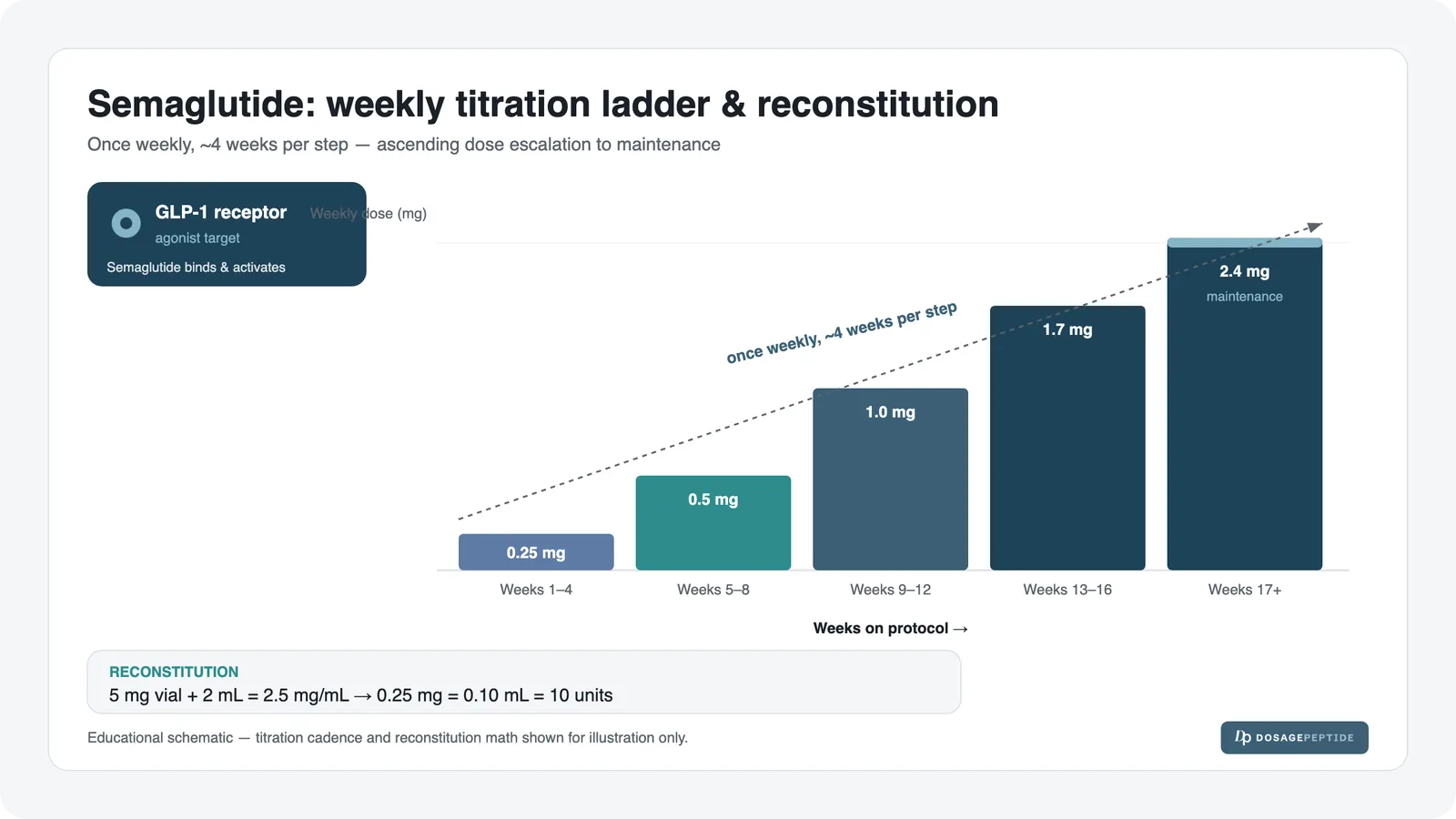
| Titration | 0.25 → 0.5 → 1.0 → 1.7 → 2.4 mg, roughly 4 weeks per step |
| Onset / timeline | Appetite suppression often within days to weeks; measurable weight change over weeks to months; trial endpoints at ~68 weeks |
| Common side effects | Nausea, diarrhea, vomiting, constipation, abdominal pain (mostly early and dose-dependent) |
| Best stacked with | Adequate protein intake and resistance training to preserve lean mass (lifestyle, not another injectable) |
| Regulatory status | Prescription, FDA-approved drug; research-vial material is research-use-only, not for human consumption |
What It Is & Composition
Semaglutide is a single-molecule GLP-1 receptor agonist — an analogue of human GLP-1 engineered for a long half-life (about a week), which is what allows once-weekly rather than daily dosing. Structurally it is the GLP-1 backbone with substitutions that resist enzymatic breakdown plus a fatty-acid chain that binds albumin, slowing clearance. Functionally, it is one active ingredient, not a blend.
Research material is supplied as a lyophilized (freeze-dried) powder that must be reconstituted with bacteriostatic water before it can be measured and drawn. Because it is a single peptide, there is no component breakdown to compute — the entire vial weight is semaglutide. Research vials most commonly ship in 5 mg, 10 mg, and 20 mg strengths, and you can browse documented per-vial references in our dosage protocol catalog.
| Component | Amount (per vial strength) | Role |
|---|---|---|
| Semaglutide (lyophilized) | 5 mg / 10 mg / 20 mg | GLP-1 receptor agonist — the sole active peptide |
| Bacteriostatic water (added) | 2–3 mL, chosen by vial size | Diluent for reconstitution; benzyl alcohol allows multi-week multi-dose use |
For the diluent side of this equation — how much bacteriostatic water to add and why benzyl alcohol matters for a multi-dose vial — see our dedicated bacteriostatic water reconstitution guide.
How to Dose: The Documented Titration Ladder
Semaglutide is not dosed as a fixed number; it is dosed as a schedule. The defining feature of the protocol is a stepwise weekly escalation, holding each step for roughly four weeks before moving up. This is the ladder documented in the Wegovy prescribing information and mirrored in the STEP trial program. Below, every draw volume is computed from a 5 mg vial reconstituted with 2 mL of bacteriostatic water (2.5 mg/mL) — the most common starting configuration — with 10 mg equivalents shown for comparison.
| Step | Weekly dose | Typical duration | Draw from 5 mg/2 mL (2.5 mg/mL) |
U-100 units | Draw from 10 mg/3 mL (3.33 mg/mL) |
|---|---|---|---|---|---|
| 1 (initiation) | 0.25 mg | Weeks 1–4 | 0.10 mL | 10 units | ~0.075 mL (~7.5 units) |
| 2 | 0.5 mg | Weeks 5–8 | 0.20 mL | 20 units | 0.15 mL (15 units) |
| 3 | 1.0 mg | Weeks 9–12 | 0.40 mL | 40 units | 0.30 mL (30 units) |
| 4 | 1.7 mg | Weeks 13–16 | 0.68 mL | 68 units | 0.51 mL (51 units) |
| 5 (maintenance) | 2.4 mg | Week 17 onward | 0.96 mL | 96 units | 0.72 mL (72 units) |
Two structural points fall straight out of this table. First, administration is once weekly, not daily — semaglutide’s long half-life is the whole reason the label uses a weekly cadence. Second, the 0.25 mg initiation step is deliberately sub-therapeutic for weight loss; its job is tolerability, not efficacy. Weight-loss benefit builds as the dose climbs toward the 2.4 mg maintenance target. You can model any of these steps for your specific vial with our peptide dosage calculator, and the documented per-vial references live on the semaglutide 5 mg vial protocol and semaglutide 10 mg vial protocol pages.
Reconstitution & Draw: The Real Math
Every dose above depends on one thing being right: the concentration you created when you added water. Get that wrong and every draw is wrong. Here is the arithmetic, shown step by step, for the two most common vial configurations.
5 mg vial + 2 mL bacteriostatic water
Step 1 — concentration. Divide the vial’s total mass by the water volume:
5 mg ÷ 2 mL = 2.5 mg/mL
Step 2 — draw volume for the starting dose. Divide the target dose by the concentration:
0.25 mg ÷ 2.5 mg/mL = 0.10 mL
Step 3 — convert to insulin-syringe units. On a U-100 syringe, 1 mL = 100 units, so multiply mL by 100:
0.10 mL × 100 = 10 units
So the documented 0.25 mg starting dose is a 10-unit draw — a small, easy-to-read mark near the bottom of the barrel. If you are unsure how those unit marks map to volume, our insulin syringe units guide walks through it.
10 mg vial + 3 mL bacteriostatic water
10 mg ÷ 3 mL = 3.33 mg/mL
At this concentration the same 0.25 mg starting dose becomes 0.25 ÷ 3.33 = 0.075 mL ≈ 7.5 units, and the 2.4 mg maintenance dose becomes 2.4 ÷ 3.33 = 0.72 mL = 72 units. A higher-strength vial at a similar water volume gives a more concentrated solution and therefore a smaller draw for the same dose.
20 mg vial + 3 mL bacteriostatic water
20 mg ÷ 3 mL = 6.67 mg/mL
Here the maintenance 2.4 mg dose is only 2.4 ÷ 6.67 = 0.36 mL = 36 units. The 20 mg vial is the most economical for someone modeling the full ladder, because the higher concentration means the maintenance dose still fits comfortably in the barrel. For a full walkthrough of the mixing technique — swirling rather than shaking, angling the water down the vial wall, avoiding foaming — see the peptide reconstitution guide.
A quick supply sanity-check: a 5 mg vial reconstituted to 2.5 mg/mL holds 20 × 0.25 mg doses, but because the dose climbs each month, one 5 mg vial does not cover a full titration. Most documented research schedules pair the smaller vial for the low steps with a 10 mg or 20 mg vial for the higher steps to avoid frequent re-mixing.
Weekly Schedule
Because semaglutide is dosed once weekly, the “schedule” is really about consistency: same day, roughly same time, every week. Here is an example week during the week 9–12 step (1.0 mg, drawn as 40 units from a 5 mg/2 mL vial), showing that only one day carries an injection while the rest is routine.
| Day | Action | Dose / note |
|---|---|---|
| Monday | Weekly dose | 1.0 mg = 0.40 mL = 40 units, subcutaneous |
| Tuesday | None | Observe tolerability; hydrate |
| Wednesday | None | Prioritize protein; resistance training |
| Thursday | None | Routine |
| Friday | None | Routine |
| Saturday | None | Resistance training |
| Sunday | Prep next dose | Confirm draw volume for the coming week; check vial storage |
The label allows shifting the injection day if needed, provided at least 48 hours separate two doses. Picking a low-stress day — many schedules use the weekend — makes it easier to keep the weekly rhythm.
Dosing Phases, Titration & Cycling
Unlike short recovery peptides, semaglutide is not run in on/off “cycles.” The documented protocol is a single continuous escalation to a maintenance dose that is then held, because the metabolic effect depends on sustained receptor engagement — weight tends to return when the drug is stopped. The phases are therefore about climbing, not cycling:
- Initiation (weeks 1–4, 0.25 mg): tolerability-only step. Little to no weight effect expected; the point is to let the gut adapt.
- Early escalation (weeks 5–12, 0.5 → 1.0 mg): appetite suppression becomes more noticeable; the first meaningful weight change typically appears here.
- Late escalation (weeks 13–16, 1.7 mg): approaching the therapeutic window used in the weight-management trials.
- Maintenance (week 17 onward, 2.4 mg): the dose carried through the 68-week trial endpoint. If 2.4 mg is not tolerated, the documented fallback is to hold at the highest tolerated step (commonly 1.7 mg) rather than push through severe GI effects.
The four-week hold per step is not arbitrary — it matches the interval at which GI adverse events subside as the gut adapts. Moving up faster is the single most common cause of avoidable nausea and dropout in the trial data.
Timeline: What to Expect
The following reflects what is observed in the trial and label data, framed as research reference — not a promise of individual results, which vary widely.
| Week / phase | What’s happening | What is observed in research |
|---|---|---|
| Weeks 1–4 (0.25 mg) | Receptor engagement begins; gut adapting to slowed emptying | Reduced appetite for some; mild transient nausea common; minimal weight change |
| Weeks 5–8 (0.5 mg) | Stronger appetite modulation as dose doubles | Earlier satiety, smaller portions; early weight trend downward |
| Weeks 9–12 (1.0 mg) | Approaching therapeutic range | More consistent appetite suppression; steadier weight decline |
| Weeks 13–16 (1.7 mg) | Near-maximal titration | Continued weight reduction; GI effects usually milder than at each step’s start |
| Maintenance (2.4 mg, to ~week 68) | Sustained receptor agonism | In STEP-1, mean ~15% body-weight reduction at 68 weeks vs ~2.4% placebo |
Stacking & Combinations
The most evidence-supported “stack” for semaglutide is not another compound — it is lifestyle scaffolding that protects against the drug’s main downside. Because rapid weight loss on GLP-1 agonists includes lean-mass loss, the documented supportive measures are:
- Adequate dietary protein to help preserve muscle during a caloric deficit.
- Resistance training to signal muscle retention.
- Hydration and fiber to blunt constipation and nausea.
Combining semaglutide with other glucose-lowering agents (insulin, sulfonylureas) is a documented hypoglycemia risk and belongs strictly under clinical supervision. If you are weighing semaglutide against the newer dual- and triple-agonists, our comparison of retatrutide vs semaglutide vs tirzepatide lays out the mechanistic and titration differences side by side.
When Progress Stalls
Weight-loss plateaus are expected, not a failure. The documented troubleshooting ladder, in order of what to check first:
- Confirm the intended dose is actually being delivered. Re-check the concentration and draw volume against the math above — an under-mixed or mis-drawn dose is the most common “stall.”
- Verify the four-week hold is complete before expecting the next step’s effect. Effects lag the dose increase.
- Reassess the lifestyle scaffold. Protein intake, resistance training, and sleep drive a large share of variance.
- Consider a response ceiling for the current step; the documented move is to advance to the next titration rung only if tolerability allows.
- Recognize the maintenance plateau. At 2.4 mg, weight typically stabilizes at a new set-point rather than declining indefinitely — that is the expected, documented behavior, not a stall to “fix” by exceeding the labeled maximum.
Side Effects & Mitigation
| Issue | Why it happens | Documented mitigation |
|---|---|---|
| Nausea | Slowed gastric emptying; most intense at each dose step-up | Slow titration (hold each step ~4 weeks), smaller meals, avoid high-fat/greasy foods |
| Vomiting | Same GI mechanism, more pronounced | Reduce meal size, hydrate; do not advance the dose until it settles |
| Diarrhea | Altered GI motility | Hydration, electrolytes, bland foods; usually transient |
| Constipation | Delayed transit | Fiber, fluids, physical activity |
| Abdominal pain | GI adaptation; also a pancreatitis red flag if severe/persistent | Mild: dietary adjustment. Severe or radiating to the back: stop and seek medical evaluation |
| Injection-site reaction | Local subcutaneous response | Rotate sites; proper technique |
| Hypoglycemia | Additive with insulin/sulfonylureas | Only under clinical supervision when combined with other glucose-lowering agents |
Safety & Contraindications
Regulatory reality first: semaglutide is a prescription-only, FDA-approved medication. Research-vial material is not an approved drug, is not manufactured to sterile-injectable standards, and is sold research-use-only. The safety information below is the documented drug-label class information, reproduced as reference.
Boxed warning — thyroid C-cell tumors. In rodent studies, GLP-1 receptor agonists caused thyroid C-cell tumors, including medullary thyroid carcinoma (MTC). The label contraindicates semaglutide in anyone with a personal or family history of MTC or with Multiple Endocrine Neoplasia syndrome type 2 (MEN 2). This is a hard contraindication, not a caution.
Other documented contraindications and warnings:
- Pancreatitis: reported with GLP-1 agonists; persistent severe abdominal pain is a stop-and-evaluate signal.
- Gallbladder disease: increased incidence of cholelithiasis and cholecystitis with rapid weight loss.
- Hypoglycemia: significant risk when combined with insulin or sulfonylureas.
- Diabetic retinopathy complications in patients with diabetes, especially with rapid glucose improvement.
- Pregnancy: not recommended; weight loss offers no benefit and may harm a developing fetus.
- Prior serious hypersensitivity to semaglutide.
These warnings are the reason semaglutide is a supervised prescription drug and not an over-the-counter product.
Storage & Handling
Before reconstitution, the lyophilized powder is stable refrigerated and tolerates ambient shipping temperatures for the short term. After reconstitution, the solution should be refrigerated (roughly 2–8 °C) and protected from light, and the benzyl alcohol in bacteriostatic water allows multi-week multi-dose use within that window. Do not freeze reconstituted solution, do not shake (swirl gently), and discard if the solution becomes cloudy or shows particulates. See our full peptide storage guide for handling before and after mixing, and the bacteriostatic water guide for why the diluent choice governs how long a reconstituted vial stays usable.
What the Evidence Actually Shows
The efficacy signal for semaglutide in weight management is unusually strong for pharmacology, and it is worth being precise about what kind of evidence it is. The pivotal data come from randomized, placebo-controlled Phase 3 trials in the STEP program. In STEP-1 (Wilding et al., NEJM 2021), 68 weeks of once-weekly 2.4 mg semaglutide plus lifestyle intervention produced a mean body-weight reduction of about 15%, versus about 2.4% with placebo — a large, clinically meaningful, well-replicated effect.
The titration schedule itself (0.25 → 0.5 → 1.0 → 1.7 → 2.4 mg at ~4-week steps) is not a research artifact; it is the schedule specified in the FDA Wegovy prescribing information, chosen precisely to manage GI tolerability. That is the schedule reproduced in this guide.
The honest gap: this high-quality evidence applies to the approved, pharmaceutical-grade product used under medical supervision. It does not validate research-vial material, unsupervised use, or any dose above the labeled 2.4 mg maximum. Efficacy should be hedged accordingly — the trials tell us what the drug does in a controlled trial population, not what any individual using research material will experience.
FAQ
Choosing
What is the standard semaglutide dosage? The documented weekly ladder is 0.25 mg (weeks 1–4) → 0.5 mg (weeks 5–8) → 1.0 mg (weeks 9–12) → 1.7 mg (weeks 13–16) → 2.4 mg maintenance, roughly four weeks per step. 2.4 mg once weekly is the labeled maximum for weight management.
How much semaglutide per week is typical? It changes by phase: the documented schedule begins at 0.25 mg/week and climbs, roughly monthly, toward the 2.4 mg/week maintenance dose. The starting and maintenance doses are nearly a tenfold difference — which is why “how much per week” only makes sense relative to where a schedule sits on the ladder.
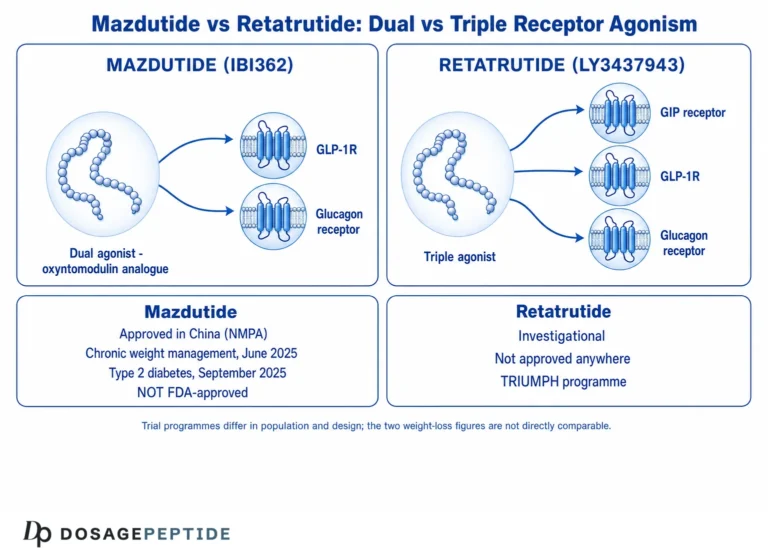
How does semaglutide compare to tirzepatide and retatrutide? Semaglutide is a single GLP-1 agonist; tirzepatide adds GIP (dual agonist) and retatrutide adds glucagon (triple agonist), with generally larger weight effects in trials but different tolerability profiles. See our head-to-head comparison.
Which research vial size maps to which steps — 5, 10, or 20 mg? The 5 mg vial suits the low initiation steps; the 10 mg and especially the 20 mg vial are more economical once the schedule reaches the higher maintenance doses, because their higher concentration keeps the draw volume small. Many documented schedules combine sizes across the ladder.
Using it
What is the semaglutide reconstitution math? Divide vial mg by water mL to get mg/mL. For a 5 mg vial + 2 mL: 5 ÷ 2 = 2.5 mg/mL. Then divide the dose by concentration for the draw: 0.25 mg ÷ 2.5 = 0.10 mL. Multiply by 100 for units: 0.10 × 100 = 10 units.
What is the 0.25 mg starting dose in syringe units? From a 5 mg vial reconstituted with 2 mL (2.5 mg/mL), 0.25 mg is 0.10 mL, which reads as 10 units on a U-100 insulin syringe.
What does the 2.4 mg maintenance dose draw out to? From a 5 mg/2 mL vial (2.5 mg/mL): 2.4 ÷ 2.5 = 0.96 mL = 96 units. From a 10 mg/3 mL vial (3.33 mg/mL): 0.72 mL = 72 units. From a 20 mg/3 mL vial (6.67 mg/mL): 0.36 mL = 36 units.
How often is semaglutide administered? Once weekly. Its ~1-week half-life is the reason weekly dosing works; the label allows shifting the day as long as doses are at least 48 hours apart.
Can the titration be sped up to lose weight faster? The documented schedule holds each step for about four weeks specifically because faster escalation sharply increases nausea and vomiting and drives dropout. Faster is not better here — tolerability, not speed, governs the ladder.
How long until appetite or weight changes appear? Appetite suppression is often noticed within days to a few weeks; measurable weight change builds over weeks to months, with the trial endpoint measured at 68 weeks.
Practical & safety
What are the most common side effects? Nausea, diarrhea, vomiting, constipation, and abdominal pain — mostly early, mostly at each dose step-up, and mostly transient as the gut adapts. Slow titration is the primary mitigation.
Who must avoid semaglutide entirely? Anyone with a personal or family history of medullary thyroid carcinoma or MEN 2 (a boxed-warning contraindication), a history of pancreatitis, or serious hypersensitivity to semaglutide. It is also not recommended in pregnancy.
Why the thyroid boxed warning? GLP-1 receptor agonists caused thyroid C-cell tumors, including medullary thyroid carcinoma, in rodent studies. Whether this translates to humans is unresolved, so the label contraindicates it in the highest-risk groups as a precaution.
How is a reconstituted vial stored? Refrigerate at roughly 2–8 °C, protect from light, do not freeze, and swirl rather than shake. Discard if cloudy or if particulates appear. See our peptide storage guide.
Is research semaglutide the same as Wegovy or Ozempic? No. Wegovy and Ozempic are FDA-approved, pharmaceutical-grade prescription products used under medical supervision. Research-vial semaglutide is not approved, not sterility-tested for human use, and is sold research-use-only.
References
- Wilding JPH, et al. Once-Weekly Semaglutide in Adults with Overweight or Obesity (STEP-1). N Engl J Med, 2021. doi:10.1056/NEJMoa2032183.
- FDA Wegovy (semaglutide) Prescribing Information, NDA 215256, U.S. Food & Drug Administration, 2021 — titration schedule, boxed thyroid C-cell tumor warning, contraindications.
- STEP 1: Effect and Safety of Semaglutide 2.4 mg Once-Weekly in Subjects With Overweight or Obesity. ClinicalTrials.gov Identifier NCT03548935.
Disclaimer: This article is provided for research and educational purposes only. It is not medical advice, not a prescription, and not a recommendation for personal use. Research-vial semaglutide is sold research-use-only, is not manufactured to sterile-injectable standards, and is not for human consumption. The dosing information reproduces the documented drug-label and clinical-trial protocol as reference material under a research-use-only framing. Semaglutide is a prescription drug carrying a boxed warning; any decision about its use must be made with a licensed, qualified clinician.