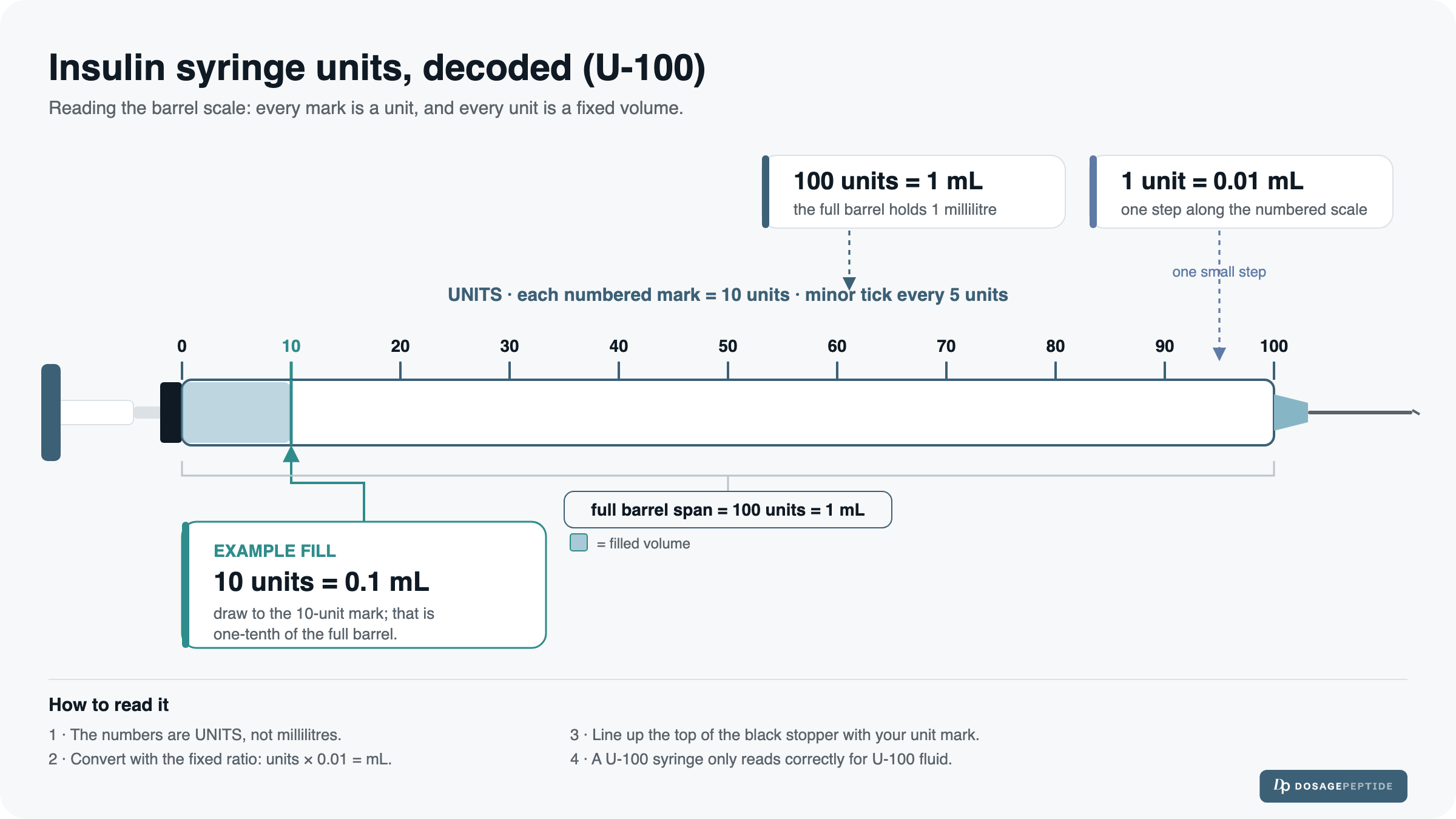
Here is the mistake that trips up almost everyone the first time: the numbers on an insulin syringe — 10, 20, 30 — are not milligrams, and they are not your dose. They are units of volume. On a standard U-100 syringe, 1 unit = 0.01 mL. That is the whole conversion. So 50 units is half a milliliter, and 100 units is a full mL. The syringe does not know or care what peptide is inside it — it only measures how much liquid you pull. Once that clicks, reading the barrel takes about 60 seconds. Let’s do it.
This is a research-use-only measurement explainer. It teaches you how to read a syringe barrel — it does not tell you how much of any peptide to measure. The actual numbers live on each protocol page, and every product referenced here is for laboratory and research use only, not for human consumption.

The 60-second version (read this first)
Units are volume, not dose — 1 unit = 0.01 mL on a U-100 syringe
A syringe measures liquid volume, full stop. The “units” printed on an insulin syringe are simply a fine-grained volume scale. They tell you nothing about how many milligrams or micrograms of peptide you have drawn — that depends entirely on how concentrated your solution is, which was set when the vial was mixed. Keep those two ideas separate and you have already avoided the single biggest beginner error: units ≠ dose, units ≠ mg, units ≠ mcg.
The three conversions to memorize
- 10 units = 0.1 mL
- 50 units = 0.5 mL
- 100 units = 1 mL
That is the entire cheat sheet. “U-100” means the syringe is scaled to 100 units per milliliter, so every 1 unit is one-hundredth of a milliliter (0.01 mL, or 10 microliters). Everything below is just detail around those three numbers.
Why “U-100” matters (and how to check yours)
U-100 = 100 units per mL
U-100 is the near-universal insulin syringe standard: 100 units per milliliter. Look at your syringe wrapper or the printing on the barrel — it should read “U-100” or “100 units.” That label is what makes the conversion above valid. If your syringe says anything else, the numbers on the barrel mean something different (see the U-40 warning below).
The three barrel sizes: 0.3 mL, 0.5 mL, and 1 mL
U-100 syringes come in three common capacities, each often named by its unit count:
- 0.3 mL barrel = 30-unit syringe
- 0.5 mL barrel = 50-unit syringe
- 1 mL barrel = 100-unit syringe
They all share the same U-100 scale (1 unit = 0.01 mL). The only difference is total capacity and how finely the ticks are spaced. A smaller barrel spreads a small volume across more physical space on the plunger, which makes tiny amounts easier to read — a point that ties straight back to how much bacteriostatic water to use: more water means bigger, easier-to-measure volumes.
How to actually read the barrel
Major lines vs minor lines — what each tick is worth
Every insulin syringe has numbered major lines (often 10, 20, 30…) and smaller unnumbered minor lines between them. The catch: the value of each minor tick depends on the barrel. On many 100-unit syringes each small line is 2 units; on a 30-unit or 50-unit syringe each small line is often 1 unit. Do not assume — count the ticks between two numbered lines on your own syringe and divide. If there are 10 minor gaps between “0” and “10,” each tick is 1 unit. If there are 5, each tick is 2 units.
Read to the correct edge of the plunger
Line up your reading with the flat front edge of the plunger’s rubber stopper — the edge nearest the needle, where the rubber first meets the liquid. Reading from the trailing, angled tip of the stopper is a common source of small but consistent errors. Pick the flat front edge every time.
Units, mL, and microliters in one reference table
This is the part worth bookmarking. All values assume a U-100 syringe.
| Units (U-100) | Milliliters (mL) | Microliters (µL) |
|---|---|---|
| 5 units | 0.05 mL | 50 µL |
| 10 units | 0.1 mL | 100 µL |
| 20 units | 0.2 mL | 200 µL |
| 25 units | 0.25 mL | 250 µL |
| 50 units | 0.5 mL | 500 µL |
| 100 units | 1 mL | 1000 µL |
Prefer not to do the arithmetic yourself? Let our calculator do the unit conversion for you.
Where the peptide amount (mcg) comes in
Units measure volume; concentration turns that volume into an amount
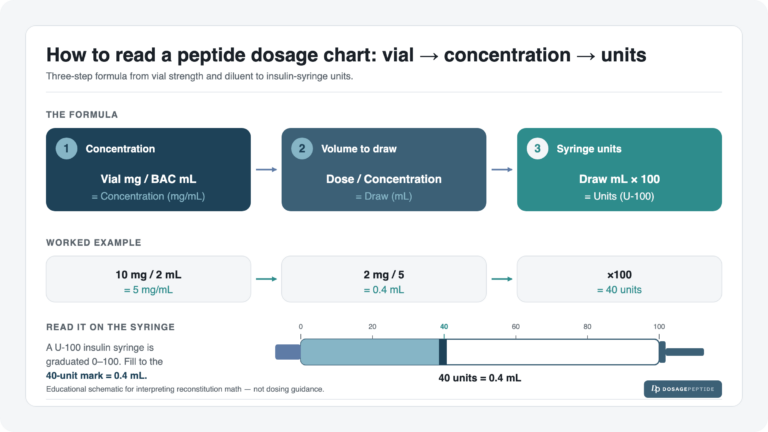
The syringe gives you a volume. To know how much peptide that volume contains, you need the concentration of your solution — the mg (or mcg) per mL, which was fixed the moment the vial was reconstituted. Amount = volume × concentration. The syringe handles the volume half; reconstitution handles the concentration half. For the mixing side of that equation, see the full reconstitution guide.
One illustrative example so it clicks
Example only — illustrative numbers, not a recommendation for any peptide. Suppose a solution is concentrated at 2 mg/mL. Drawing to 25 units means drawing 0.25 mL, and 0.25 mL × 2 mg/mL = 0.5 mg (500 mcg) of peptide in the syringe. Change the concentration and the same 25 units would contain a different amount — which is exactly why a syringe number on its own can never be a “dose.” The actual number of units to draw for a specific compound belongs on your peptide’s protocol page, or on the relevant blend protocol pages for multi-peptide vials.
The 5 most common syringe mistakes
1. Reading units as milligrams (the big one)
Units are volume, never mass. “Draw 20” means 20 units of liquid, not 20 mg of anything.
2. Air bubbles inflating your volume
A bubble in the barrel takes up space the liquid should occupy, so your real volume is less than the line suggests. Tap the barrel, let bubbles rise to the needle, and gently push them out before you read.
3. Assuming every syringe is U-100
Check the label. The 1 unit = 0.01 mL rule only holds on a U-100 syringe.
4. Pulling to the wrong plunger edge
Read to the flat front edge of the stopper, consistently, on every draw.
5. Using a huge syringe for a tiny volume
A 100-unit barrel makes a 4-unit measurement imprecise because the marks are cramped. For small volumes, a 30-unit or 50-unit barrel spreads the scale out and improves precision.
Let the calculator convert for you
If you would rather not eyeball the math, plug in your concentration and target amount and let our calculator do the unit conversion. Before you draw, it also helps to have mixed correctly — walk through the full reconstitution guide first, and keep storing your reconstituted vial in mind so your solution stays sound between draws.
FAQ
Is 1 unit the same as 1 mg?
No. A unit is a volume measure (0.01 mL on U-100). Milligrams are mass. How many mg sit in a given number of units depends entirely on your solution’s concentration.
How many units are in 1 mL?
100 units, on a U-100 syringe. That is what “U-100” means: 100 units per milliliter.
Can I use a U-40 syringe?
You can, but be careful — a U-40 syringe is scaled to 40 units per mL, a completely different scale from U-100. On a U-40 syringe, 1 unit = 0.025 mL, not 0.01 mL. Mixing up U-40 and U-100 barrels is a well-documented source of measurement errors, so match your syringe scale to the numbers you are working from and do not swap between the two mid-task. For definitions of U-100 and insulin syringe, see the glossary.
Key takeaways
- Units are volume, not dose. On a U-100 syringe, 1 unit = 0.01 mL = 10 µL, and 100 units = 1 mL.
- Count the ticks on your own barrel — minor lines can be worth 1 or 2 units depending on the syringe size.
- Read to the flat front edge of the plunger, and clear air bubbles first.
- Concentration turns volume into amount — the syringe alone never gives you a dose.
- Check for U-100 vs U-40, and use a smaller barrel for better precision on small volumes.
- The actual numbers to draw live on your peptide’s protocol page, not on the syringe.
References
- Manufacturer and clinical diabetes-education references on the U-100 insulin syringe standard (100 units per mL; 1 unit = 0.01 mL), including guidance from the American Diabetes Association and major insulin-syringe device manufacturers.
- Clinical references on U-40 versus U-100 insulin syringe scale differences and the dosing errors that arise from confusing the two scales.
- General injection-technique references on removing air bubbles and reading to the correct edge of the plunger stopper.
- DosagePeptide internal references: the reconstitution and dosage calculator and the peptide reconstitution guide.
Research-use-only disclaimer: This article is for informational and educational purposes only and describes how to read a syringe as a measuring instrument. It is not medical advice, not a recommendation to use any peptide, and not a prescription of any dose. All illustrative numbers are examples only. Peptides referenced on this site are intended for laboratory and research use only and are not for human consumption. Consult a qualified professional before making any health-related decision.