The question of how safe retatrutide is deserves a careful, evidence-anchored answer — not the breathless “most powerful weight-loss drug ever” framing that has followed it since its phase 2 data landed, and not the dismissive “it’s just another GLP-1” shrug either. Retatrutide is an investigational, once-weekly injectable that activates three receptors at once: the glucose-dependent insulinotropic polypeptide (GIP) receptor, the glucagon-like peptide-1 (GLP-1) receptor, and, distinctively, the glucagon receptor.1 That third arm is what sets it apart from semaglutide and tirzepatide, and it is also part of why its side-effect and safety story is worth reading closely rather than assuming it maps cleanly onto drugs already on the market.
The honest headline is this: as of mid-2026, retatrutide is not approved by the U.S. Food and Drug Administration, the European Medicines Agency, or any comparable regulator for any indication. There is no approved safety label, no black-box warning, no official prescribing information — because the drug has not completed the regulatory review that produces those documents. What we do have is an unusually rich body of trial data: several phase 1 and phase 2 studies published in leading journals, and, as of 2026, the first phase 3 read-outs from the TRIUMPH (obesity) and TRANSCEND (type 2 diabetes) programs.2310 This article walks through what those trials actually reported about side effects and safety — the dominant gastrointestinal signal, the heart-rate question, the peculiar skin-sensation events, the glucagon-specific considerations, discontinuations and serious events — and, just as importantly, what the data do not yet establish. Throughout, the guiding principle is precision: naming the evidence level for each claim and resisting the temptation to overstate either the promise or the peril.
What Retatrutide Is, and Why Its Mechanism Shapes Its Side Effects
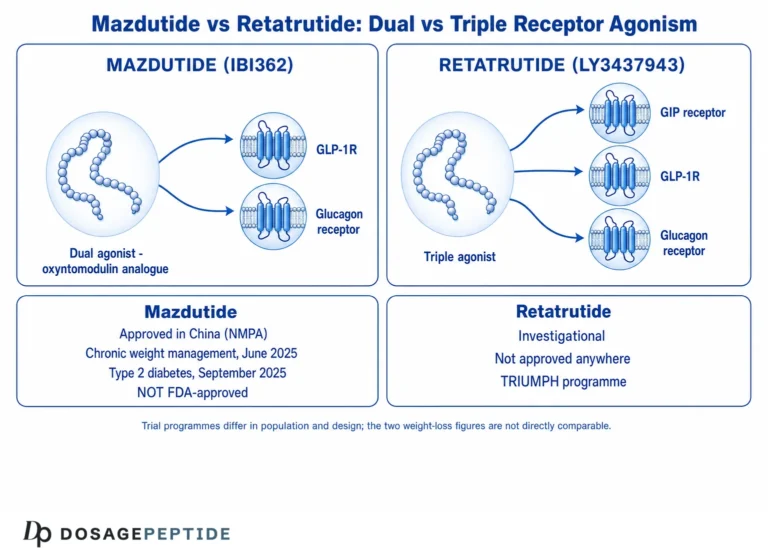
Retatrutide (development code LY3437943) is a single synthetic peptide engineered to engage three metabolic receptors simultaneously. Two of those — GIP and GLP-1 — are incretin receptors already exploited by approved drugs; tirzepatide is a dual GIP/GLP-1 agonist, and semaglutide is a pure GLP-1 agonist. The novelty of retatrutide is the addition of glucagon-receptor agonism to that mix.1 Understanding why the drug produces the side effects it does starts with understanding what each arm contributes.
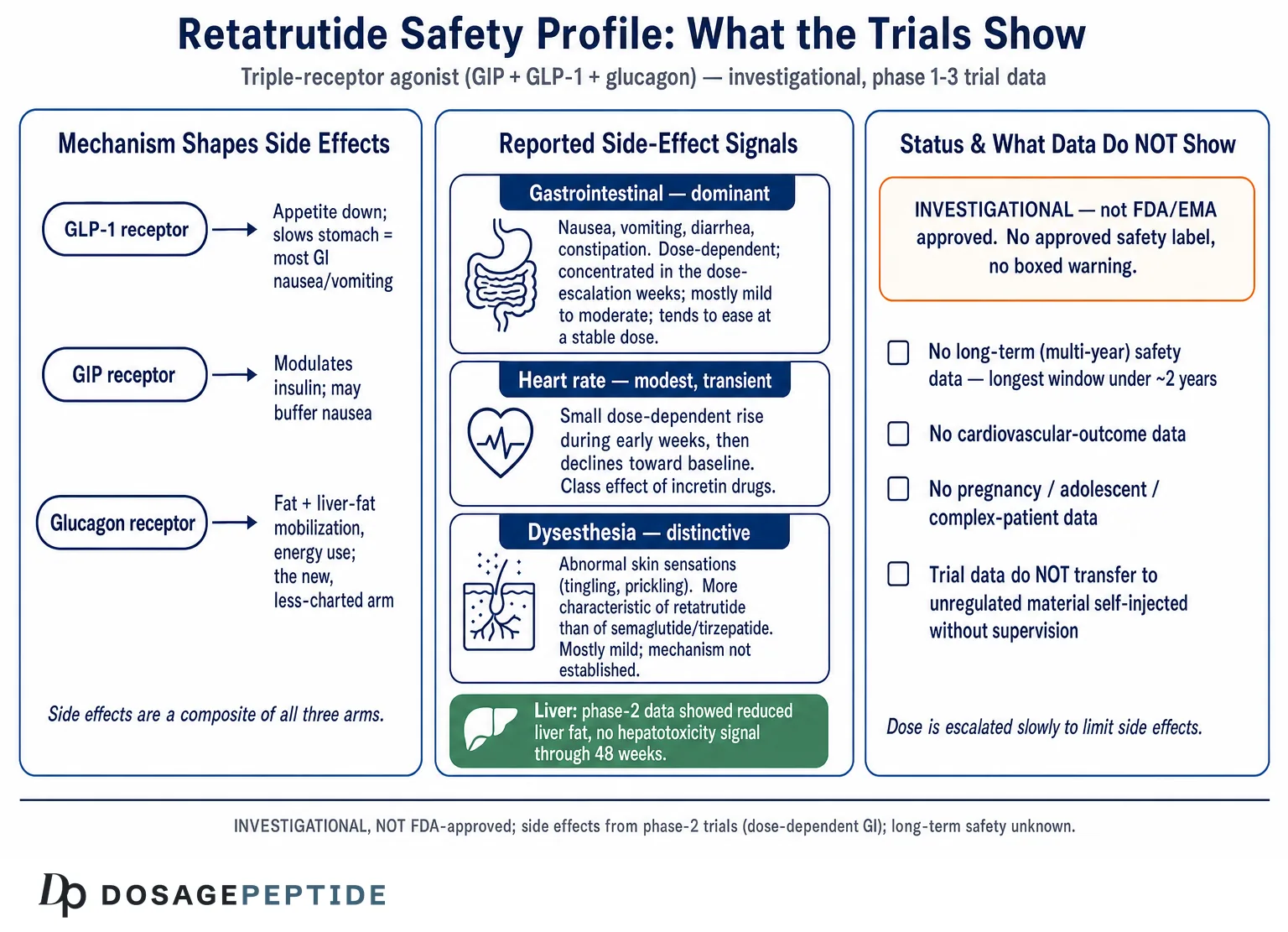
The GLP-1 component slows gastric emptying, enhances glucose-dependent insulin secretion, and acts centrally to reduce appetite. It is also the arm most responsible for the nausea, vomiting, and other gastrointestinal effects that define the entire incretin drug class; the same signaling that suppresses hunger and delays stomach emptying is what makes people feel queasy, particularly early in treatment. The GIP component modulates insulin secretion and may, somewhat counterintuitively, help buffer nausea relative to GLP-1 alone, which is one hypothesis for why dual and triple agonists can be pushed to strong metabolic effects. The glucagon arm is the wild card. Glucagon-receptor agonism increases energy expenditure and promotes hepatic fat mobilization — effects thought to underlie retatrutide’s exceptional impact on liver fat and its steep weight-loss curve — but glucagon also raises hepatic glucose output and can nudge heart rate and certain metabolic markers.16 For a fuller treatment of how these three signals interlock, the pillar explainer on what retatrutide is and how the triple-receptor agonist works lays out the pharmacology in more depth.
This matters for safety interpretation because retatrutide’s side-effect profile is a composite. Much of it — the gastrointestinal burden and the heart-rate uptick — is broadly a class effect shared with other incretin drugs, and can be read against the substantial safety record those drugs have accumulated. But the glucagon-driven elements are less familiar, because no glucagon-receptor agonist has yet reached the market at scale. When we look at, say, retatrutide’s effect on fasting glucose in people without diabetes, or its heart-rate signal, or any effect on liver enzymes and uric acid, part of what we are watching is the net result of a glucagon signal partially opposed by the two incretin signals in the same molecule. That is genuinely new territory, and it is a reason to treat long-term glucagon-related safety as an open question rather than a solved one, even as the incretin-shared effects look reassuringly familiar.
One practical implication follows immediately. Because the gastrointestinal and cardiac signals are dose-dependent and tied to the intensity of receptor activation, retatrutide’s tolerability is inseparable from how it is dosed and escalated. A large share of the drug’s adverse events cluster in the first weeks, during the titration from a low starting dose upward — a pattern that shapes everything from trial design to how the side-effect numbers should be read. We return to this repeatedly, because “X percent of participants had nausea” means something quite different depending on whether that nausea was a transient escalation-phase event or a persistent one.
Where the Safety Data Come From: The Trial Landscape
Any statement about retatrutide’s safety is only as good as the trial it rests on, so it is worth being explicit about the evidence base. The safety and side-effect data for retatrutide come from a connected sequence of studies, each larger and longer than the last.
The earliest human data came from a phase 1b, multiple-ascending-dose trial in people with type 2 diabetes, reported by Urva and colleagues in The Lancet in 2022. It enrolled 72 participants over 12 weeks and established that the drug was tolerable enough, and its pharmacokinetics suitable, for once-weekly dosing; gastrointestinal events and decreased appetite were the most common adverse effects even at this early stage, and they were dose-dependent.4 Two pivotal phase 2 trials followed in 2023. Jastreboff and colleagues published the phase 2 obesity trial in the New England Journal of Medicine: 338 adults with obesity (or overweight with a weight-related condition), randomized to placebo or retatrutide across doses up to 12 mg, over 48 weeks.2 Rosenstock and colleagues published the phase 2 type 2 diabetes trial in The Lancet the same year, a placebo- and active-controlled study over 36 weeks.3 A dedicated phase 2 substudy in metabolic dysfunction-associated steatotic liver disease (MASLD), reported by Sanyal and colleagues in Nature Medicine in 2024, added liver-specific safety and efficacy data.5
By 2026, the first phase 3 results arrived, materially strengthening the safety picture by moving it into larger, longer, more definitive trials. TRANSCEND-T2D-1, a 40-week phase 3 trial in type 2 diabetes, was published in The Lancet and presented at the American Diabetes Association’s 2026 Scientific Sessions.10 The obesity counterpart, TRIUMPH-1, reported weight-loss and safety results over 80 weeks — long enough to begin addressing the durability questions that phase 2 could not.11 Much of the earliest signal-setting for this program, it is worth noting, came through late-breaking symposia at the American Diabetes Association’s annual Scientific Sessions, where the phase 2 and later phase 3 data were first presented before or alongside peer-reviewed publication — a reminder that some widely circulated figures originated as conference presentations, which is a slightly different evidentiary weight than a fully peer-reviewed paper.12 The table below summarizes the studies that anchor the safety claims in this article.
| Trial (lead author / program) | Population | Phase / duration | Key safety relevance |
|---|---|---|---|
| Urva et al., 20224 | Type 2 diabetes (n=72) | Phase 1b / 12 wk | First-in-patient tolerability; dose-dependent GI events |
| Jastreboff et al., 2023 (NEJM)2 | Obesity (n=338) | Phase 2 / 48 wk | Core GI, heart-rate, cutaneous, arrhythmia data |
| Rosenstock et al., 2023 (Lancet)3 | Type 2 diabetes | Phase 2 / 36 wk | GI events, discontinuations, glycemic safety |
| Sanyal et al., 2024 (Nat Med)5 | MASLD substudy (n=98) | Phase 2 / 48 wk | Hepatic safety; no hepatotoxicity signal |
| TRANSCEND-T2D-1, 202610 | Type 2 diabetes (n=537) | Phase 3 / 40 wk | Dysesthesia, discontinuations at scale |
| TRIUMPH-1, 202611 | Obesity | Phase 3 / 80 wk | Longest-duration safety; deaths adjudicated unrelated |
Two caveats travel with this evidence base. First, these are trials in relatively well-selected populations under close medical supervision; they do not capture what happens with unsupervised use of unregulated material, which is a separate and larger risk discussed later. Second, even the phase 3 read-outs, at 40 to 80 weeks, are short relative to the years or decades a chronic obesity or diabetes medication is taken. The safety data are strong for what they measure and silent on much of what a lifetime of use would reveal. Readers tracking how this drug slots into the broader arc of metabolic therapeutics may find the overview of how retatrutide fits into the evolution of peptide therapeutics a useful companion.
Gastrointestinal Side Effects: The Dominant Signal
If you remember only one thing about retatrutide’s tolerability, make it this: the side effects are overwhelmingly gastrointestinal, overwhelmingly dose-dependent, and overwhelmingly concentrated in the dose-escalation phase. This is the single most consistent finding across every trial, and it is the same fundamental pattern seen with semaglutide and tirzepatide — retatrutide is not exempt from the class signature, and at its highest doses it sits at the more intense end of it.
In the phase 2 obesity trial, overall adverse events during treatment were reported in 70% of the placebo group and in 73% to 94% of the retatrutide groups, with the highest incidence at the 8 mg and 12 mg doses.2 The gastrointestinal events driving that gradient were nausea, vomiting, diarrhea, and constipation, and they rose cleanly with dose. Nausea, the most common single event, was reported in roughly 9% of placebo participants versus about 36% at 1 mg, 43% at 4 mg, 50% at 8 mg, and 59% at 12 mg. Vomiting followed the same staircase, from around 2% on placebo to roughly 8% at 1 mg, 24% at 4 mg, 20% at 8 mg, and 39% at 12 mg.2 These are not trivial numbers — at the top dose, more than half of participants experienced nausea and nearly two in five vomited at some point — but the qualitative descriptors matter as much as the percentages. Investigators characterized these events as predominantly mild to moderate in severity, transient, and clustered during the weeks of dose escalation, with a tendency to subside as the body adapted to a stable dose.2
The type 2 diabetes trials reproduced the pattern at generally lower absolute rates. In the phase 2 diabetes study, mild-to-moderate gastrointestinal events (nausea, diarrhea, vomiting, constipation) were reported in about 35% of retatrutide-treated participants overall, rising with dose from roughly 13% in the lowest-dose arm to about 50% in a high-dose fast-escalation arm.3 That last detail is instructive: the “fast escalation” arm had more gastrointestinal trouble than slower-titrated arms at comparable maintenance doses, direct evidence that how quickly the dose is raised, not just how high it goes, governs tolerability. The phase 3 obesity and diabetes programs confirmed the same overall picture — gastrointestinal events as the most frequent treatment-emergent adverse effects, generally mild to moderate, easing over time, and consistent with other agents that carry GLP-1 activity.1011
| Event (phase 2 obesity trial) | Placebo | 1 mg | 4 mg | 8 mg | 12 mg |
|---|---|---|---|---|---|
| Nausea | ~9% | ~36% | ~43% | ~50% | ~59% |
| Vomiting | ~2% | ~8% | ~24% | ~20% | ~39% |
| Any treatment-emergent AE | 70% | 73–94% across retatrutide arms (highest at 8–12 mg) | |||
Two honest interpretive points close this section. First, the dose-dependence is a double-edged fact: the same escalation that drives the strongest weight loss drives the strongest gastrointestinal burden, so the top-line efficacy figures and the top-line side-effect figures are inseparable — you generally cannot claim the 24% weight loss without also owning the 59% nausea rate that came with it in the same arm. Second, because these events concentrate during escalation and are largely mild-to-moderate and self-limiting, the lived tolerability for many participants improved over the course of the trials even as the cumulative “ever experienced” percentages looked high. A meta-analysis pooling the randomized data quantified the relative risk of nausea at roughly 2.7 to 4.3-fold over placebo depending on dose, and vomiting at roughly 4.6 to 9-fold — real and dose-graded elevations, but built almost entirely on mild-to-moderate, transient events rather than dangerous ones.7
Heart Rate and Cardiovascular Signals
The most closely watched non-gastrointestinal signal is heart rate, both because increased heart rate is a known class effect of incretin therapies and because retatrutide’s glucagon component adds a mechanistically plausible reason to expect it. The trial data confirm a real, dose-dependent, but time-limited increase.
In the phase 2 obesity trial, heart rate rose in a dose-dependent manner during the first roughly 24 weeks and then declined toward baseline over the weeks that followed. At the 12 mg dose, the mean increase peaked at approximately 6 to 7 beats per minute around week 24 before receding by weeks 36 to 48.2 This inverted-U trajectory — rise during escalation and early maintenance, partial resolution thereafter — is an important nuance that a single “heart rate increased by X bpm” statistic obscures. The diabetes trials reported similar mild heart-rate increases.3 For a deeper look at the broader vascular picture, including blood pressure and lipid effects that fall outside pure side-effect reporting, the discussion of how retatrutide influences cardiovascular risk factors covers the full-spectrum data.
On arrhythmia specifically, the phase 2 obesity trial reported that cardiac arrhythmia events were mild to moderate in severity, with a single notable exception: one severe event of prolonged QT syndrome occurred in a participant who had also received ondansetron, an anti-nausea medication independently associated with QT prolongation.2 That confounding is worth flagging honestly — it complicates any clean attribution of the event to retatrutide itself — but it also illustrates a real-world hazard: patients on a strongly nausea-inducing drug may take antiemetics whose own cardiac effects could compound, a consideration that would belong on any eventual label.
The measured way to read the cardiovascular data is that retatrutide produces the kind of modest, dose-dependent, largely transient heart-rate increase seen across the incretin class, without, in the trials to date, a signal of frequent serious arrhythmia or acute cardiovascular harm. But two limits deserve emphasis. First, a mean increase of several beats per minute is an average; some individuals will experience larger increases, and people with pre-existing tachyarrhythmia or significant cardiac disease were not the focus of these trials. Second, the glucagon arm makes retatrutide’s long-term cardiovascular profile genuinely uncharted compared with pure incretin drugs; dedicated cardiovascular outcome trials, which take years, are what ultimately settle whether a heart-rate signal translates into any change in hard cardiovascular events. Those data do not yet exist for retatrutide, and no one should claim a cardiovascular benefit or a cardiovascular harm as established.
Dysesthesia and Cutaneous Hyperesthesia: The Distinctive Signal
One side effect sets retatrutide somewhat apart from its predecessors and has drawn disproportionate attention: abnormal skin sensations, variously coded as cutaneous hyperesthesia, dysesthesia, or paresthesia. These are altered or heightened sensory experiences — tingling, prickling, burning, or an uncomfortable sensitivity of the skin, often to light touch — that are not typically prominent with semaglutide or tirzepatide.
In the phase 2 obesity trial, cutaneous hyperesthesia and related skin-sensitivity events were reported in about 7% of retatrutide-treated participants versus roughly 1% of placebo participants. Critically, none of these events were classified as severe or serious, and none led to treatment discontinuation.2 The phase 3 data refined and, in the obesity setting, amplified this signal. In TRANSCEND-T2D-1, dysesthesia occurred in 4.5%, 2.3%, and 4.4% of participants at the 4 mg, 9 mg, and 12 mg doses respectively, versus 0% on placebo, with events generally mild and a majority resolving during continued treatment.10 In the longer, higher-exposure TRIUMPH-1 obesity trial, dysesthesia was reported in roughly 12.5% of participants at the 12 mg dose — still more frequent than in the shorter trials, and higher again (around 21%) in a related phase 3 obesity trial in patients with knee osteoarthritis (TRIUMPH-4) — yet across these studies it remained generally mild and infrequently a reason for discontinuation.11
Several things are worth saying plainly about this signal. It is real and appears more characteristic of retatrutide than of the dual or single incretin agonists, which is why it merits its own discussion rather than being folded into a generic side-effect list. The underlying mechanism is not firmly established; hypotheses range from effects related to rapid weight loss and nutrient shifts to direct or indirect neural effects, but the honest position is that the cause of retatrutide-associated dysesthesia is not yet understood. At the same time, the severity data are reassuring within the trial windows: across studies these events were overwhelmingly mild, frequently self-resolving even with continued dosing, and rarely a reason participants stopped the drug. What remains unknown is whether, in a small subset or over longer exposure, such sensory changes could persist or signal something requiring closer attention — a question the current data cannot answer and that should not be papered over with the “mild and transient” summary that fits the average case.
Glucagon-Specific and Metabolic Safety Considerations
Because retatrutide’s glucagon-receptor agonism is its defining novelty, the glucagon-related metabolic effects deserve dedicated scrutiny rather than being lumped in with the incretin-shared side effects. Glucagon raises hepatic glucose production, mobilizes fat, and increases energy expenditure — and each of those has a potential safety dimension.
The most obvious concern with any glucagon-receptor agonist is glucose control: could stimulating glucagon worsen blood sugar? The trials answer this reassuringly for the tested populations, because the two incretin arms (GLP-1 and GIP) counterbalance the glucagon arm. In people with type 2 diabetes, retatrutide produced dose-dependent, clinically meaningful reductions in HbA1c, not increases; the phase 3 diabetes trial reported A1C reductions of up to roughly 2.0 percentage points.310 In other words, on balance the molecule improved glycemic control despite its glucagon activity. That said, glucagon-driven physiology is why careful attention to glucose — and, in principle, to any transient rise in glucose or in markers of hepatic glucose handling during escalation — belongs in the safety monitoring of a triple agonist, and why extrapolating glycemic safety from a supervised diabetes trial to unsupervised use in other contexts is unwise.
The liver is where the glucagon arm looked most beneficial rather than concerning. In the MASLD phase 2 substudy, retatrutide produced striking reductions in liver fat — relative reductions on the order of 80% or more at the higher doses, with a large majority of high-dose participants reaching normal liver-fat levels by 48 weeks.5 Crucially for safety, the investigators reported no hepatotoxicity signal in either the overall obesity population or the MASLD subset through 48 weeks; liver enzymes did not flag a safety problem, and the direction of the liver-fat data was strongly favorable.5 This is a genuinely positive safety finding, and it should be stated as such — while also noting that “no hepatotoxicity signal through 48 weeks” is not the same as a guarantee of hepatic safety over years, and that the MASLD substudy, at under 100 participants, is modest in size.
Other metabolic markers round out the picture. Incretin-and-glucagon agonism can influence lipids and markers such as uric acid, and dedicated body-composition and metabolic substudies have examined how retatrutide reshapes fat and lean mass and downstream metabolic parameters. These fall more into the efficacy-and-mechanism domain than the adverse-event domain, but they matter for a complete safety accounting because any drug that drives rapid, large changes in body composition and metabolism warrants attention to the full metabolic panel. The evenhanded summary is that the glucagon arm, in the trials conducted so far, delivered its hoped-for metabolic benefits (fat and liver-fat mobilization, energy expenditure) without, on balance, degrading glucose or liver-enzyme safety in supervised patients — but it is precisely the arm with the least long-term human track record, and therefore the one where humility about unknown effects is most warranted.
Discontinuations, Serious Adverse Events, and Deaths
Percentages of specific symptoms tell you about nuisance; discontinuation rates, serious adverse events, and deaths tell you about the burden that actually drives people off a drug or signals real danger. Here the retatrutide data are, on balance, consistent with a tolerable but dose-limited profile.
In the phase 2 obesity trial, adverse events leading to discontinuation of the study drug occurred in roughly 6% to 16% of retatrutide-treated participants, rising with dose, versus essentially none on placebo.2 Serious adverse events, by contrast, were uncommon and not elevated over placebo: about 4% in both the placebo and retatrutide arms.2 The diabetes trials showed lower discontinuation rates — in the phase 2 diabetes study, adverse-event discontinuations ran roughly 2% to 5% versus 0% on placebo.3 The phase 3 programs, with their larger numbers, gave the most robust figures. In TRIUMPH-1 (obesity, 80 weeks), discontinuations due to adverse events were 4.1%, 6.9%, and 11.3% at the 4 mg, 9 mg, and 12 mg doses respectively, compared with 4.9% on placebo — a clear dose gradient, with the top dose roughly doubling the placebo rate.11 In TRANSCEND-T2D-1 (diabetes, 40 weeks), discontinuations were lower, at 2.2%, 4.5%, and 5.1% across the three doses versus 0% on placebo.10
On the most serious endpoint, TRIUMPH-1 reported two deaths during the study, both occurring in the 4 mg group and both adjudicated as unrelated to the study drug; no severe hypoglycemia was reported.11 The MASLD substudy similarly reported serious adverse events in only about 2.5% of retatrutide-treated participants.5 Taken together, the serious-event and mortality data across the program did not surface a signal of frequent, drug-attributable catastrophic harm within the trial durations — which is meaningful, but must be paired with the reminder that trials of a few hundred to a few thousand participants over a year or two are not powered to detect rare serious events that only emerge across much larger populations and longer exposures.
| Endpoint | Phase 2 obesity2 | Phase 3 obesity (TRIUMPH-1)11 | Phase 3 diabetes (TRANSCEND-T2D-1)10 |
|---|---|---|---|
| AE-related discontinuation (retatrutide) | ~6–16% (dose-dependent) | 4.1% / 6.9% / 11.3% (4/9/12 mg) | 2.2% / 4.5% / 5.1% (4/9/12 mg) |
| AE-related discontinuation (placebo) | ~0% | 4.9% | 0% |
| Serious adverse events | ~4% (same as placebo) | Low; 2 deaths (4 mg), adjudicated unrelated | Low |
| Dysesthesia | ~7% cutaneous hyperesthesia | ~12.5% at 12 mg (mostly mild) | 4.5% / 2.3% / 4.4% |
The interpretive throughline is that retatrutide’s dose-limiting toxicity is tolerability, not catastrophe: people who stop the drug in trials generally stop because of gastrointestinal misery during escalation, not because of dangerous events, and the discontinuation curve tracks dose in a way that reinforces the value of careful titration and, potentially, capping the dose at the lowest level that achieves the desired effect. It is also worth noting that the placebo arms themselves reported meaningful rates of gastrointestinal complaints and even some discontinuations, which is a useful reminder that not every symptom experienced on the drug is caused by the drug; the honest measure of a side effect is always its rate over and above placebo, not its raw incidence, and much of the responsible reporting on retatrutide has been careful to frame the numbers that way.
How Dose Escalation Shapes the Whole Safety Picture
Because so much of retatrutide’s adverse-event burden is front-loaded into the escalation period and scales with dose intensity, the titration schedule is not a footnote to the safety story — it is central to it. This is one of the clearest, most actionable findings in the entire dataset.
The direct evidence comes from the trials’ own comparisons. In the phase 2 diabetes study, a faster-escalation arm experienced more gastrointestinal events than more gradually titrated arms reaching similar maintenance doses, and investigators noted that starting at a lower dose (for example, 2 mg rather than 4 mg) could partially mitigate the gastrointestinal burden.3 Across the program, the phase design uniformly used stepped escalation — beginning at a low weekly dose and increasing at intervals — precisely because starting at a high dose would produce intolerable nausea and vomiting in a large fraction of participants. The reason the “ever experienced nausea” percentages look alarming while real-world tolerability improves over time is that most of those events happen in the ramp-up window and fade at steady state.
This has three practical consequences for how the safety data should be understood. First, tolerability is partly a controllable variable: slower escalation and a lower starting dose trade a bit of speed-to-effect for meaningfully better gastrointestinal comfort. Second, cross-arm comparisons of side-effect rates can mislead if they ignore escalation speed — two arms at the same maintenance dose can have different adverse-event profiles depending on how they got there. Third, and importantly for the unsupervised-use concern raised later, the escalation logic only protects people if it is actually followed; someone self-administering unregulated material without a validated titration schedule forfeits the main tool that made the drug tolerable in trials. The importance of methodical, controlled handling and dosing in a research setting is exactly why documentation like the guidance on critical handling protocols for retatrutide research studies exists, and why rigor around reconstitution, storage, and dosing is inseparable from any honest safety discussion.
What the Evidence Does NOT Show
An honest safety article is defined as much by what it refuses to claim as by what it reports. Retatrutide’s trial data are genuinely impressive within their scope, and that very impressiveness makes it tempting to over-read them. Here is a candid inventory of what the current evidence does not establish.
It does not establish long-term safety. The longest published safety window is on the order of 80 weeks (TRIUMPH-1).11 Obesity and type 2 diabetes are chronic conditions for which a drug would be taken for years or decades. Nothing in the current data speaks to multi-year or lifetime safety, to whether the transient heart-rate and dysesthesia signals have any long-run consequence, or to rare events that only appear across very large exposed populations. “No signal at 80 weeks” is reassuring but is not “proven safe for chronic use.”
It does not establish cardiovascular outcomes. A modest, transient heart-rate increase was observed, but whether retatrutide reduces, increases, or leaves unchanged the rate of heart attacks, strokes, and cardiovascular death is unknown, because the dedicated cardiovascular outcome trials that answer such questions take years and have not reported for this drug. No claim of cardiovascular benefit or harm is currently warranted.
It does not establish safety in pregnancy, in adolescents, or in medically complex groups. The trials enrolled adults meeting specific criteria under supervision. There is no adequate data on use during pregnancy or breastfeeding, and rapid weight loss and altered metabolism are, on general principle, reasons for caution. Populations with advanced organ disease, significant arrhythmia, or on interacting medications were not the focus of these studies.
It does not confer the class’s labeled warnings automatically — but the class context matters. Approved GLP-1-based drugs carry warnings derived from their own programs, including, for some agents, a boxed warning about thyroid C-cell tumors based on rodent data, and cautions about pancreatitis, gallbladder disease, and diabetic retinopathy. Retatrutide has no approved label and therefore no official warnings of its own yet; it would be both premature to assert those specific risks apply and cavalier to assume a novel triple agonist is free of them. The correct posture is that these are open questions its eventual regulatory review must address, informed by the well-documented experience of related drugs. For a sense of how a related, more mature agent is characterized, the explainer on what tirzepatide is and how it works offers a useful comparison point.
It does not apply to unregulated, non-pharmaceutical material. This is arguably the most important gap between the trial safety data and real-world risk. Every reassuring number in this article came from studies using pharmaceutical-grade retatrutide, manufactured to specification, dosed on a validated schedule, under medical monitoring. Material sold outside regulated channels as a “research chemical” can vary in purity, concentration, and sterility; may contain impurities or endotoxin; and may be mislabeled as to dose. None of the trial safety data transfer to such products, and the escalation and monitoring safeguards that made the drug tolerable in trials are absent by definition. The gap between “safe in a phase 3 trial” and “safe as bought online and self-injected” is enormous and should never be elided.
How Retatrutide’s Safety Compares With Semaglutide and Tirzepatide
Retatrutide is inevitably compared with the incretin drugs already on the market, and for safety purposes the comparison is genuinely illuminating — provided it is drawn carefully and without pretending cross-trial numbers are head-to-head data. The comparison below is qualitative and directional; the underlying trials differ in design, population, and duration, so precise percentage comparisons across drugs would be misleading.
| Feature | Semaglutide | Tirzepatide | Retatrutide |
|---|---|---|---|
| Receptor targets | GLP-1 | GIP + GLP-1 | GIP + GLP-1 + glucagon |
| Regulatory status | FDA/EMA approved | FDA/EMA approved | Investigational; not approved1 |
| Dominant side effects | GI (nausea, vomiting, diarrhea) | GI (nausea, vomiting, diarrhea) | GI (nausea, vomiting, diarrhea), dose-dependent2 |
| Heart-rate effect | Modest increase (class effect) | Modest increase (class effect) | Modest, transient increase (~6–7 bpm at 12 mg)2 |
| Distinctive signal | — | — | Dysesthesia / cutaneous hyperesthesia211 |
| Long-term / CV outcome data | Extensive, years of data | Growing | None yet published |
Several honest conclusions follow. On the core, class-shared side effects — the gastrointestinal burden and the heart-rate uptick — retatrutide behaves recognizably like its predecessors, sitting at the more intense end of the gastrointestinal spectrum at its highest doses, which is unsurprising given that those doses also produce the largest weight loss. On its distinctive signal, dysesthesia, retatrutide appears to differ from the dual and single agonists, and that difference is plausibly tied to its glucagon arm or to the sheer magnitude and speed of the metabolic changes it drives. And on the dimension that matters most for real-world confidence — accumulated long-term and cardiovascular-outcome safety data — retatrutide is by far the least mature of the three, precisely because it is the newest and not yet approved. Semaglutide and tirzepatide have crossed the regulatory finish line and carry years of post-approval experience; retatrutide has strong trial data and an open future. Anyone weighing the three should treat “impressive trial results” and “established long-term safety” as different things, and should not let the former masquerade as the latter. Readers wanting the efficacy-side companion to this safety analysis can consult the summary of key findings on retatrutide for obesity and metabolic health.
Putting the Safety Picture Together
Step back from the individual signals and a coherent overall assessment emerges — one that is neither the hype nor the fear, but the measured middle the evidence actually supports.
Retatrutide’s side-effect profile, across four years of accumulating trial data from phase 1 through phase 3, is dominated by dose-dependent, escalation-phase, mostly mild-to-moderate gastrointestinal events that fit the well-characterized incretin-class pattern.2311 Layered on that are a modest, transient, dose-dependent heart-rate increase; a distinctive and still mechanistically unexplained dysesthesia signal that is common at high obesity-trial doses but overwhelmingly mild; and a glucagon arm that, in supervised patients, delivered metabolic benefits (notably dramatic liver-fat reduction) without degrading glucose control or flagging hepatotoxicity through 48 weeks.2511 Serious adverse events were uncommon and not clearly elevated over placebo, discontinuations were driven by tolerability and tracked dose, and the two deaths in the longest trial were adjudicated unrelated to the drug.211 That is a genuinely favorable short-to-medium-term safety picture for a drug producing this magnitude of effect.
But the ledger has a second column that must be read with equal weight. Retatrutide is investigational and unapproved, with no safety label and no completed regulatory review. The longest safety window is under two years for a drug intended for chronic use. There are no cardiovascular-outcome data, no pregnancy data, and no data in many medically complex groups. The glucagon arm that makes the drug distinctive is also the component with the least long-term human track record. And none of the trial reassurance transfers to unregulated material used without medical supervision or a validated escalation schedule. The responsible reading is that retatrutide has shown a tolerable, largely class-consistent safety profile in well-conducted trials, that its most dangerous-sounding numbers (high nausea rates, dysesthesia) reflect mostly mild and transient events, and that this is emphatically not the same as established long-term safety in the general population — a distinction the drug’s ongoing phase 3 program and future outcome trials are designed to close. Until then, precision about the evidence level is the most useful safety tool anyone can carry.
Frequently Asked Questions
What are the most common side effects of retatrutide?
By a wide margin, the most common side effects are gastrointestinal: nausea, vomiting, diarrhea, and constipation. In the phase 2 obesity trial these were dose-dependent, with nausea reported in up to roughly 59% and vomiting in up to roughly 39% of participants at the 12 mg dose, versus about 9% and 2% on placebo.2 They were predominantly mild to moderate, concentrated during the dose-escalation weeks, and tended to ease with continued dosing at a stable dose. Decreased appetite is expected (it is part of how the drug works), and a distinctive skin-sensation effect (dysesthesia) is also seen. These are the same broad categories reported across the phase 3 program.1011
Is retatrutide FDA-approved, and does it have a safety label?
No. As of mid-2026, retatrutide is investigational and has not been approved by the FDA, the EMA, or any comparable regulator for any indication. Because it is unapproved, it has no official prescribing information, no boxed warnings, and no approved safety label. All of its safety data come from clinical trials (phase 1 through the phase 3 TRIUMPH and TRANSCEND programs), not from a completed regulatory review.11011
Does retatrutide increase heart rate?
Yes, modestly and temporarily. In the phase 2 obesity trial, heart rate rose in a dose-dependent way over roughly the first 24 weeks and then declined toward baseline; at the 12 mg dose the mean increase peaked around 6 to 7 beats per minute near week 24 before receding by weeks 36 to 48.2 This is consistent with the known heart-rate effect of incretin-class drugs. It is an average, so some individuals may see larger changes, and long-term cardiovascular-outcome data for retatrutide do not yet exist.
What is the dysesthesia or skin sensitivity people report with retatrutide?
Dysesthesia (also coded as cutaneous hyperesthesia or paresthesia) refers to abnormal skin sensations — tingling, prickling, burning, or heightened sensitivity to touch. It appears more characteristic of retatrutide than of semaglutide or tirzepatide. It was reported in about 7% of retatrutide participants versus 1% on placebo in the phase 2 obesity trial, and in roughly 12.5% at the 12 mg dose in the phase 3 TRIUMPH-1 obesity trial (with an even higher rate, around 21%, in a related osteoarthritis obesity trial), but was overwhelmingly mild, frequently self-resolving during continued treatment, and rarely a cause of discontinuation.211 The mechanism is not yet established.
How serious are the side effects — do they cause people to stop the drug?
Serious adverse events were uncommon and not clearly higher than placebo (about 4% in both arms in the phase 2 obesity trial).2 Discontinuations due to adverse events were driven mainly by gastrointestinal tolerability and rose with dose: roughly 6–16% in phase 2 obesity, and 4.1% / 6.9% / 11.3% at 4 / 9 / 12 mg in the phase 3 TRIUMPH-1 obesity trial (versus 4.9% on placebo).211 The two deaths in TRIUMPH-1 were adjudicated as unrelated to the study drug.11 In short, the dose-limiting problem is tolerability, not catastrophic harm, within the trial windows studied.
Does retatrutide harm the liver, given its glucagon activity?
The available data are reassuring rather than concerning on this point. In a dedicated phase 2 substudy in people with fatty liver disease (MASLD), retatrutide dramatically reduced liver fat — by roughly 80% or more at higher doses, with most high-dose participants reaching normal liver-fat levels by 48 weeks — and investigators reported no hepatotoxicity signal in the obesity population or the MASLD subset through 48 weeks.5 That said, this is a modest-sized, under-two-year dataset, so it supports short-to-medium-term hepatic safety and improvement, not a guarantee over years.
How does retatrutide’s safety compare to semaglutide and tirzepatide?
On the core class-shared effects — gastrointestinal side effects and a modest heart-rate increase — retatrutide behaves like its predecessors, sitting at the more intense end at its highest doses.2 It differs in showing a more prominent dysesthesia signal.211 The biggest difference is maturity: semaglutide and tirzepatide are approved and carry years of post-marketing and outcome data, whereas retatrutide has strong trial data but no approval and no long-term cardiovascular-outcome results yet. Impressive trial safety is not the same as established long-term safety.1
Are the trial safety data relevant to retatrutide bought online?
No, and this is a critical caveat. Every reassuring figure in the trials came from pharmaceutical-grade drug, dosed on a validated escalation schedule, under medical monitoring. Material sold outside regulated channels can vary in purity, concentration, and sterility, may be mislabeled, and is used without the titration and monitoring safeguards that made the drug tolerable in trials. The trial safety data do not transfer to such use, and the risks are correspondingly different and higher.
References
- Coskun T, Urva S, Roell WC, et al. LY3437943, a novel triple glucagon, GIP, and GLP-1 receptor agonist for glycemic control and weight loss: from discovery to clinical proof of concept. Cell Metab. 2022;34(9):1234-1247.e9. PMID: 35985340. https://pubmed.ncbi.nlm.nih.gov/35985340/
- Jastreboff AM, Kaplan LM, Frías JP, et al. Triple–Hormone-Receptor Agonist Retatrutide for Obesity — A Phase 2 Trial. N Engl J Med. 2023;389(6):514-526. PMID: 37366315. https://www.nejm.org/doi/full/10.1056/NEJMoa2301972
- Rosenstock J, Frias J, Jastreboff AM, et al. Retatrutide, a GIP, GLP-1 and glucagon receptor agonist, for people with type 2 diabetes: a randomised, double-blind, placebo and active-controlled, parallel-group, phase 2 trial conducted in the USA. Lancet. 2023;402(10401):529-544. PMID: 37385280. https://www.thelancet.com/journals/lancet/article/PIIS0140-6736(23)01053-X/abstract
- Urva S, Coskun T, Loh MT, et al. LY3437943, a novel triple GIP, GLP-1, and glucagon receptor agonist in people with type 2 diabetes: a phase 1b, multicentre, double-blind, placebo-controlled, randomised, multiple-ascending dose trial. Lancet. 2022;400(10366):1869-1881. PMID: 36354040. https://pubmed.ncbi.nlm.nih.gov/36354040/
- Sanyal AJ, Kaplan LM, Frias JP, et al. Triple hormone receptor agonist retatrutide for metabolic dysfunction-associated steatotic liver disease: a randomized phase 2a trial. Nat Med. 2024;30(7):2037-2048. PMID: 38858523. PMCID: PMC11271400. https://pmc.ncbi.nlm.nih.gov/articles/PMC11271400/
- Jastreboff AM, Kaplan LM. Triple G Agonists — A Home Run for Obesity? N Engl J Med. 2023;389(6):569-570 (editorial). https://www.nejm.org/doi/abs/10.1056/NEJMe2307282
- Efficacy and safety of retatrutide, a novel GLP-1, GIP, and glucagon receptor agonist for obesity treatment: a systematic review and meta-analysis of randomized controlled trials. PMC. 2025. PMCID: PMC12026077. https://pmc.ncbi.nlm.nih.gov/articles/PMC12026077/
- Eli Lilly and Company. Lilly’s phase 2 retatrutide results published in The New England Journal of Medicine show the investigational molecule achieved up to 17.5% mean weight reduction at 24 weeks. Investor news release, 2023. https://investor.lilly.com/news-releases/news-release-details/lillys-phase-2-retatrutide-results-published-new-england-journal
- Katsi V, Koutsopoulos G, Fragoulis C, Dimitriadis K, Tsioufis K. Retatrutide — A Game Changer in Obesity Pharmacotherapy (review). Biomolecules. 2025;15(6):797. PMCID: PMC12190491. https://pmc.ncbi.nlm.nih.gov/articles/PMC12190491/
- Efficacy and safety of retatrutide, a GIP, GLP-1, and glucagon receptor agonist, in people with type 2 diabetes and inadequate glycaemic control with diet and exercise (TRANSCEND-T2D-1): a double-blind, randomised, phase 3 trial. Lancet. 2026. https://www.thelancet.com/journals/lancet/article/PIIS0140-6736(26)00967-0/abstract
- Eli Lilly and Company. Lilly’s triple agonist, retatrutide, drove substantial improvements in weight, A1C, knee osteoarthritis pain, and obstructive sleep apnea (TRIUMPH phase 3 program). News release, 2026. https://www.prnewswire.com/news-releases/…retatrutide-triumph-program
- American Diabetes Association. Retatrutide results in substantial weight reduction in people with obesity or type 2 diabetes (ADA Scientific Sessions coverage). 2023–2026. https://diabetes.org/newsroom/american-diabetes-association-highlights-novel-agent-retatrutide
Educational and research-use disclaimer: This article is provided solely for scientific and educational purposes. Retatrutide (LY3437943) is an investigational compound that is not approved by the FDA, EMA, or any comparable regulator for the treatment, cure, or prevention of obesity, type 2 diabetes, fatty liver disease, or any other condition, and it has no approved safety label. All safety and side-effect data described here come from clinical trials and may not reflect long-term risks, effects in populations not studied, or the hazards of unregulated material used without medical supervision. Nothing here is medical advice or a recommendation for human use. Any legitimate investigation of this compound should occur within properly authorized clinical research under appropriate oversight. Readers should consult qualified healthcare professionals and applicable regulations before making any decisions.