No half-life has ever been published for 5-Amino-1MQ — in any species, by any route — and no study has compared its oral and injected forms head-to-head. Any half-life figure quoted on a vendor page or forum is not traceable to a primary pharmacokinetic study. What does exist is in-vitro permeability data showing the molecule crosses membranes, which makes oral absorption plausible but does not measure it, and animal efficacy work that used injection. 5-Amino-1MQ is an investigational small-molecule enzyme inhibitor studied only in cell and rodent models; no human pharmacokinetic data exist at all. This page lays out what the permeability data can and cannot support, why the half-life question stays open, and the reconstitution references for the injectable form used in laboratory settings.
Research-use context: 5-Amino-1MQ (5-amino-1-methylquinolinium) is a research chemical. It is not a peptide, not a dietary supplement, and not approved by the FDA or any regulator for human use. Everything below describes preclinical (in-vitro and animal) findings for laboratory research only.
Oral vs injectable 5-Amino-1MQ: what the evidence supports
Vendors in the research-chemical market offer 5-Amino-1MQ both as oral capsules and as a lyophilized powder for reconstitution and subcutaneous injection. The decision table below summarizes what published research does and does not say about each route. Note that every “evidence” entry refers to preclinical data.
| Consideration | Oral form | Injectable (subcutaneous) form |
|---|---|---|
| What it is | Powder in capsules, swallowed | Powder reconstituted with bacteriostatic water, injected subcutaneously |
| Direct published evidence for this route | No oral-dosing efficacy study of 5-Amino-1MQ has been published | The pivotal obesity study dosed mice systemically by injection[1] |
| Supporting biophysical data | In-vitro assays (Caco-2, PAMPA) show the molecule crosses intestinal-type membranes — a basis for possible oral absorption[1] | Injection bypasses gut absorption entirely; systemic exposure is the route actually tested in vivo[1] |
| Human data | None | None |
| Established half-life | Not characterized in any published study, by any route | |
| Reconstitution needed | No | Yes — see the reconstitution reference below |
Bottom line: the frequently repeated marketing claim that 5-Amino-1MQ “is orally bioavailable, so the capsule is as good as the injection” overstates the record. What actually exists is (a) laboratory permeability data suggesting the molecule can cross membranes, and (b) animal efficacy studies that used injection, not oral gavage. Those are two different kinds of evidence, and neither establishes that one route produces greater systemic exposure in a living organism. For the specific numbers used in laboratory dosing of the injectable form, see the 5-Amino-1MQ 50 mg vial dosage protocol and the companion 5-Amino-1MQ dosage protocol overview.
Is 5-Amino-1MQ orally bioavailable? Reading the permeability data honestly
The strongest data on 5-Amino-1MQ’s absorption come from the 2018 study by Neelakantan and colleagues, which characterized a series of methylquinolinium NNMT inhibitors — the scaffold that includes 5-Amino-1MQ.[1] The authors reported that methylquinolinium analogs with primary-amine substitutions “displayed high permeability from passive and active transport across membranes,” measured using two standard in-vitro models: the parallel artificial membrane permeability assay (PAMPA) and Caco-2 human intestinal cell monolayers.[1]
These assays are widely used to predict whether a compound is likely to be absorbed across the gut wall. High Caco-2 permeability is a favorable sign for oral absorption. But an in-vitro permeability score is not the same as a measured oral bioavailability figure in an animal, and it is certainly not evidence of a human effect. Importantly, in the same paper the anti-obesity efficacy experiment in diet-induced obese mice was carried out by systemic administration of the inhibitor — the researchers did not report an oral-gavage efficacy arm.[1] So the compound has good membrane-permeability characteristics on the bench, while the demonstrated biological activity in a whole animal was produced by injection.
This distinction matters for anyone trying to reason about oral versus injectable use. The permeability data are real and encouraging for oral absorption in principle; the in-vivo activity data are real and were generated by injection. There is no published experiment that bridges the two — that is, no study measuring how much 5-Amino-1MQ reaches circulation after an oral dose versus a subcutaneous dose. Until such a study exists, claims of route superiority in either direction are extrapolation, not data.
What is the half-life of 5-Amino-1MQ?
This is one of the most-searched questions about the compound, and the accurate answer is uncomfortable but important: no half-life for 5-Amino-1MQ has been published in the peer-reviewed literature, in any species or by any route. The animal studies that used it report the doses administered (for example, 5 and 10 mg/kg in an aged-muscle regeneration study[2]) and the biological outcomes, but they do not report plasma concentration-time curves, clearance, or elimination half-life for the molecule itself.
Any specific half-life figure you see quoted for 5-Amino-1MQ on a vendor page or forum is therefore not traceable to a primary pharmacokinetic study and should be treated as unverified. The absence of published half-life data is a direct consequence of how early this compound is in development: it has been used as a research tool to validate an enzyme target, not as a clinical candidate with a full pharmacokinetic package. Researchers who need to reason about dosing frequency in an experimental model generally rely on the exposure and dosing schedules reported in the specific animal papers rather than on a defined human-style half-life, and route decisions are governed by their study design. The site’s dosage calculator and glossary explain how half-life relates to dosing intervals in general terms.
How 5-Amino-1MQ works, and why route is being debated at all
5-Amino-1MQ is a small-molecule inhibitor of nicotinamide N-methyltransferase (NNMT), a cytosolic enzyme that transfers a methyl group from S-adenosylmethionine (SAM) onto nicotinamide (a form of vitamin B3), producing 1-methylnicotinamide.[3] NNMT sits at an intersection of two important resource pools: it consumes SAM (the cell’s universal methyl donor) and it draws on nicotinamide that would otherwise feed the NAD⁺ salvage pathway.[4]
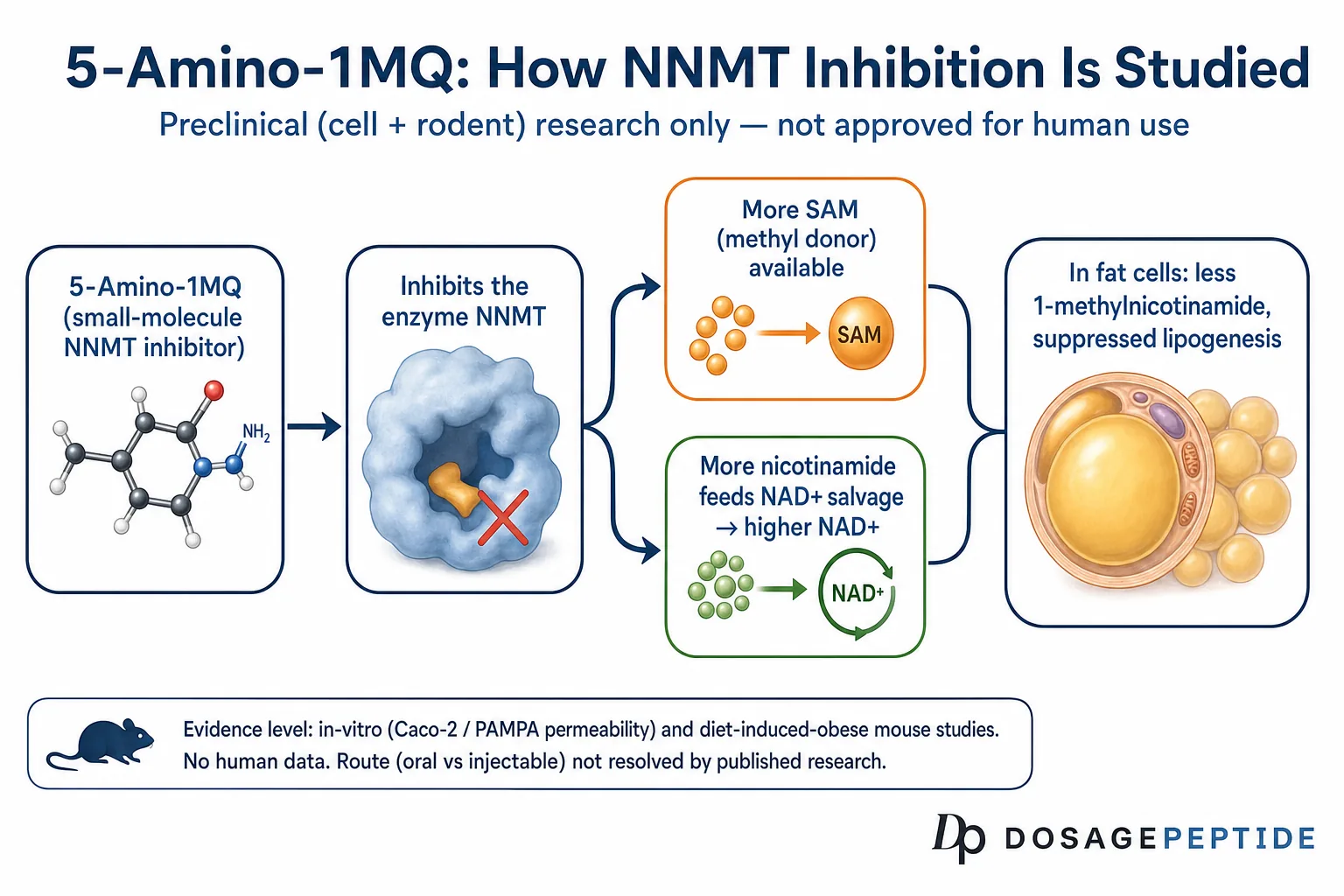
NNMT is over-expressed in the white adipose tissue and liver of obese, diabetic animals.[5] In a landmark 2014 study, knocking down NNMT in fat and liver protected mice against diet-induced obesity by increasing cellular energy expenditure, and raised adipose SAM and NAD⁺ levels.[5] Small-molecule NNMT inhibitors were then developed to reproduce that effect pharmacologically: in cultured adipocytes, 5-Amino-1MQ-type inhibitors lowered 1-methylnicotinamide, raised intracellular NAD⁺ and SAM, and suppressed lipogenesis.[1] Independent groups have since reported other chemical classes of NNMT inhibitor with metabolic effects in obese mice, reinforcing NNMT as a genuine metabolic target.[6][7] One study using 5-Amino-1MQ specifically, combined with a low-fat diet, reported normalization of body weight and adiposity toward lean-control levels in diet-induced obese mice.[9]
Because NNMT acts inside cells, an effective inhibitor has to get into cells throughout the body — which is exactly why absorption and route matter, and why the membrane-permeability finding was highlighted in the first place. The mechanism is well-motivated; the pharmacokinetics that would tell you how to deliver it optimally are the part that remains unpublished.
The injectable form: reconstitution and handling
When 5-Amino-1MQ is supplied as a lyophilized powder for the injectable route, it must be reconstituted with a suitable diluent (typically bacteriostatic water) before use in a research setting. The arithmetic — matching vial mass to diluent volume to reach a target concentration, then converting to insulin-syringe units — is identical to that used for peptides, even though 5-Amino-1MQ is a small molecule rather than a peptide. Our reconstitution guide and dosage calculator walk through that math, and the 5-Amino-1MQ 50 mg vial protocol gives the reference reconstitution for the common 50 mg vial.
The oral capsule form requires no reconstitution, which is part of its appeal to buyers. That convenience is real, but it is a practical convenience, not evidence of pharmacological equivalence to the injected route. For a sense of how research observations with this compound are typically framed over time, see the 5-Amino-1MQ results timeline. Readers comparing metabolic research tools may also find the overview of the exercise-mimetic AICAR and AMPK research a useful adjacent reference, since both compounds are studied for energy-metabolism pathways.
Safety and evidence level: what is and isn’t known
In the mouse obesity study, systemic administration of the NNMT inhibitor reduced body weight, white-adipose mass and plasma cholesterol without changing food intake and “without any observable adverse effects” over the study period.[1] That is a genuinely encouraging preclinical safety signal — but it is a short-duration observation in mice, not a toxicology program and not a human safety finding. A 2021 review examining NNMT as a drug target explicitly notes that NNMT-inhibitor drugs remain limited in clinical use and that the field is still working out selectivity and delivery.[4]
A search of ClinicalTrials.gov returns no registered human trials of 5-Amino-1MQ.[8] There is therefore no established human dose, no human safety profile, and no clinical evidence of benefit for any condition. The honest evidence tier for 5-Amino-1MQ is preclinical only (in-vitro and rodent), and its regulatory status is that of a research chemical.
Frequently Asked Questions
Is 5-Amino-1MQ better taken orally or by injection?
Published research does not answer this. In-vitro assays show the molecule is membrane-permeable, which supports the possibility of oral absorption, but the animal efficacy studies used injection, and no study has directly compared oral versus subcutaneous bioavailability. Claims that either route is superior go beyond the available data.
Is 5-Amino-1MQ orally bioavailable?
It has favorable in-vitro permeability (Caco-2 and PAMPA), which predicts that oral absorption is plausible. However, a measured oral bioavailability percentage in a living animal has not been published, so “orally bioavailable” is a reasonable expectation rather than an established fact.
What is the half-life of 5-Amino-1MQ?
No half-life has been published for 5-Amino-1MQ in any species or by any route. Animal studies report the doses given and the outcomes, but not the plasma pharmacokinetics. Any specific half-life number circulating online is not traceable to a primary study.
Is 5-Amino-1MQ a peptide?
No. Despite being sold alongside research peptides, 5-Amino-1MQ (5-amino-1-methylquinolinium) is a small organic molecule — a methylquinolinium NNMT inhibitor — not a peptide. Its reconstitution math for the injectable form happens to resemble that of peptides.
How does 5-Amino-1MQ work?
It inhibits the enzyme nicotinamide N-methyltransferase (NNMT). In preclinical models this raises intracellular NAD⁺ and SAM, lowers 1-methylnicotinamide, and suppresses fat-cell lipogenesis, which is the proposed basis for the weight and adiposity reductions seen in obese mice.
Is 5-Amino-1MQ approved or proven in humans?
No. There are no registered human clinical trials, no approved human indication, and no human efficacy or safety data. All existing evidence is from cell cultures and rodents, and the compound is classified as research-use-only.
Does the injectable form need to be reconstituted?
Yes. The injectable form is a lyophilized powder that must be reconstituted with a diluent such as bacteriostatic water before use in research. The oral capsule form does not require reconstitution.
Why is NNMT considered a metabolic target?
NNMT is over-expressed in fat and liver tissue in obese, diabetic animals, and genetic knockdown of NNMT protects mice against diet-induced obesity by increasing energy expenditure. Inhibiting the enzyme pharmacologically aims to reproduce that effect, which is why multiple independent NNMT inhibitors have been developed.
References
- Neelakantan H, Vance V, Wetzel MD, et al. Selective and membrane-permeable small molecule inhibitors of nicotinamide N-methyltransferase reverse high fat diet-induced obesity in mice. Biochem Pharmacol. 2018;147:141-152. doi:10.1016/j.bcp.2017.11.007 (PMID 29155147)
- Neelakantan H, Brightwell CR, Graber TG, et al. Small molecule nicotinamide N-methyltransferase inhibitor activates senescent muscle stem cells and improves regenerative capacity of aged skeletal muscle. Biochem Pharmacol. 2019;163:481-492. doi:10.1016/j.bcp.2019.02.008 (PMID 30753815)
- Pissios P. Nicotinamide N-Methyltransferase: More Than a Vitamin B3 Clearance Enzyme. Trends Endocrinol Metab. 2017;28(5):340-353. doi:10.1016/j.tem.2017.02.004 (PMID 28291578)
- Roberti A, Fernández AF, Fraga MF. Nicotinamide N-methyltransferase: At the crossroads between cellular metabolism and epigenetic regulation. Mol Metab. 2021;45:101165. doi:10.1016/j.molmet.2021.101165 (PMID 33453420)
- Kraus D, Yang Q, Kong D, et al. Nicotinamide N-methyltransferase knockdown protects against diet-induced obesity. Nature. 2014;508(7495):258-262. doi:10.1038/nature13198 (PMID 24717514)
- Kannt A, Rajagopal S, Kadnur SV, et al. A small molecule inhibitor of Nicotinamide N-methyltransferase for the treatment of metabolic disorders. Sci Rep. 2018;8(1):3660. doi:10.1038/s41598-018-22081-7 (PMID 29483571)
- Ruf S, Rajagopal S, Kadnur SV, et al. Novel tricyclic small molecule inhibitors of Nicotinamide N-methyltransferase for the treatment of metabolic disorders. Sci Rep. 2022;12(1):15440. doi:10.1038/s41598-022-19634-2 (PMID 36104373)
- U.S. National Library of Medicine. ClinicalTrials.gov search for “5-amino-1MQ” (no registered human trials as of 2026). clinicaltrials.gov
- Dimet-Wiley A, Wu Q, Wiley JT, et al. Reduced calorie diet combined with NNMT inhibition establishes a distinct microbiome in DIO mice. Sci Rep. 2022;12(1):484. doi:10.1038/s41598-021-03670-5 (PMID 35013352)
Disclaimer: This article is for educational and research purposes only. 5-Amino-1MQ is an investigational research chemical that has not been approved by the FDA or any regulatory agency for human use, and it is not a peptide, drug, or dietary supplement. Nothing here is medical advice or a recommendation for human consumption, dosing, or treatment of any condition. All findings described are from in-vitro or animal research.