For more than a decade the entire incretin class shared one inconvenient trait: it lived inside a needle. Semaglutide, tirzepatide, and the investigational triple agonist retatrutide are all peptides, and peptides are digested in the gut, so they have historically required subcutaneous injection to work. Orforglipron breaks that pattern. It is a non-peptide, orally bioavailable small molecule that activates the same GLP-1 receptor as those injectable drugs, and in late-stage trials it produced double-digit weight loss from a once-daily pill taken without regard to food, water, or time of day. This article compares orforglipron against three benchmark incretins across mechanism, efficacy, route, tolerability, and regulatory status, with a clear caveat that runs through the entire discussion: except for one direct head-to-head study, these are separate trials in different populations, and cross-trial numbers cannot be read as if they came from a single randomized comparison.
Where does orforglipron sit in the arc of incretin drug development?
Understanding why orforglipron generated so much attention requires a brief look at how the incretin class evolved. The story begins with the observation, decades ago, that oral glucose triggers far more insulin release than the same amount of glucose given intravenously — the “incretin effect” — which pointed to gut hormones (GLP-1 and GIP) as amplifiers of the insulin response to eating. Native GLP-1 is degraded within minutes by the enzyme DPP-4, so the first therapeutic generation worked around that fragility: DPP-4 inhibitors (which slow the breakdown of endogenous GLP-1) and short-acting injectable GLP-1 analogues engineered to resist degradation.
The second generation stretched the dosing interval and pushed potency: once-weekly injectable analogues, culminating in semaglutide, which delivered the first truly large weight-loss numbers for a GLP-1 mono-agonist. The third generation broadened the receptor target from one hormone to two and then three — tirzepatide’s GIP/GLP-1 dual agonism, then retatrutide’s GIP/GLP-1/glucagon triple agonism — raising the weight-loss ceiling further with each added receptor. Every one of these advances, however, kept the peptide-and-needle constraint.
Orforglipron represents a different kind of leap: not more receptors, but a different molecular class. It is the first oral small-molecule GLP-1 receptor agonist to reach the market, solving the delivery problem that had defined the class since its inception. In that sense the four drugs in this comparison are not simply competitors on a shelf; they are waypoints on two intersecting trajectories — one pushing receptor breadth (mono to triple), the other pushing convenience (injection to restriction-free pill). Orforglipron is the clearest expression yet of the convenience trajectory, which is why it is best understood alongside, not merely against, the peptide incretins.
What is orforglipron and how does it differ mechanistically?
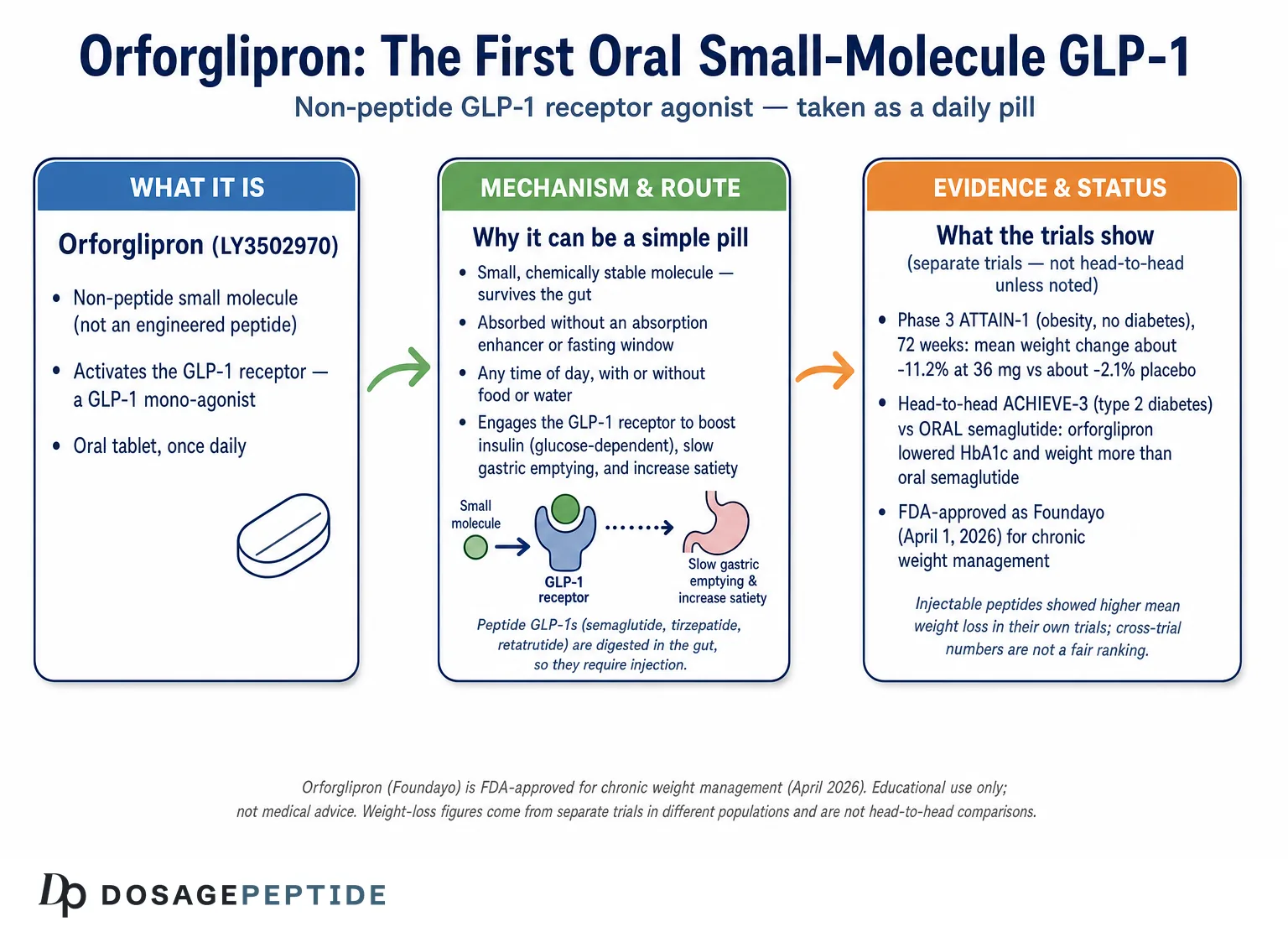
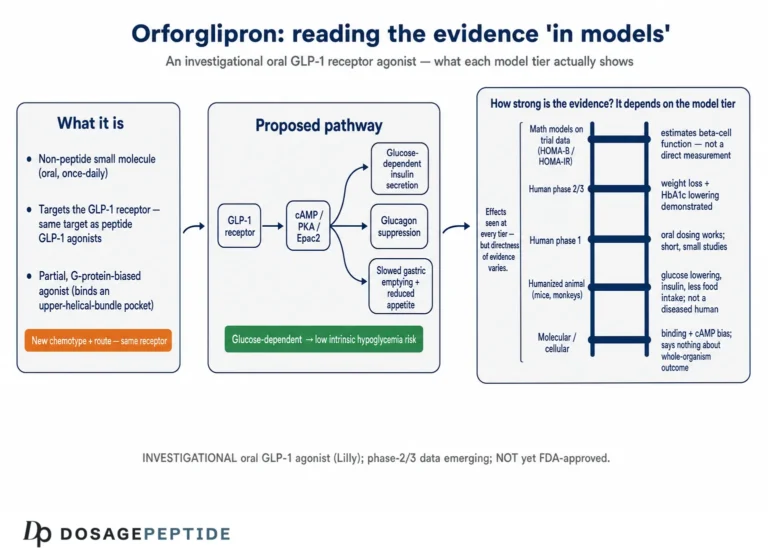
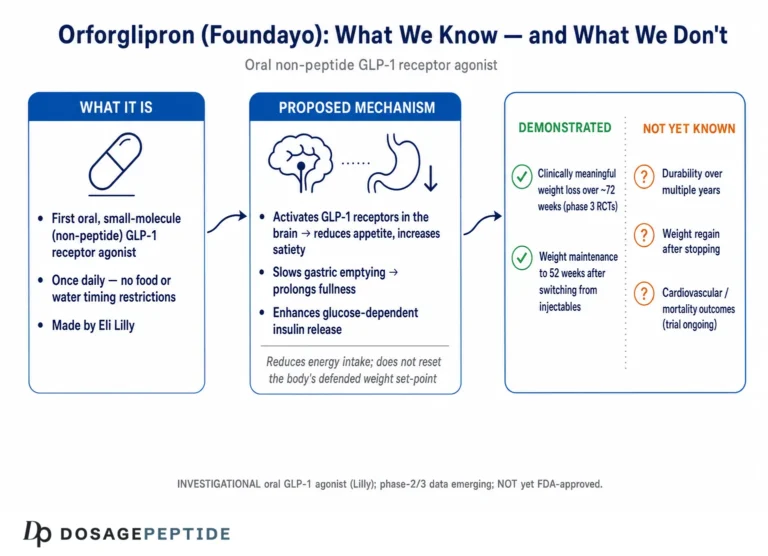
Orforglipron (developmental code LY3502970) is an oral, non-peptide, small-molecule glucagon-like peptide-1 receptor agonist (GLP-1 RA) developed by Eli Lilly.[1] The distinction between “peptide” and “non-peptide small molecule” is the single most important concept for understanding why orforglipron behaves differently from the other agents in this comparison, so it is worth unpacking before any efficacy numbers are discussed.
Semaglutide, tirzepatide, and retatrutide are all peptide-based. They are engineered analogues of naturally occurring incretin hormones — chains of amino acids that fold into a shape the receptor recognizes. Peptides are large, fragile molecules that the digestive tract treats as food: stomach acid and proteolytic enzymes break them apart before they can reach the bloodstream in useful quantities. That is why these drugs are injected, and why the one oral peptide on the market, oral semaglutide, must be co-formulated with an absorption enhancer (SNAC), taken on an empty stomach with a small sip of water, and followed by a mandatory 30-minute fast.
Orforglipron is a fundamentally different kind of molecule. It is not a shortened or modified peptide; it is a synthetic small molecule that happens to fit into and activate the GLP-1 receptor. Because it is small and chemically stable, it survives the gut, is absorbed across the intestinal wall, and reaches the circulation without needing an absorption enhancer or a fasting window.[2] If you are new to the vocabulary of incretin pharmacology, our research-peptide glossary defines terms such as GLP-1, GIP, receptor agonist, and half-life in plain language.
Mono-, dual-, and triple-agonism: how many receptors does each drug hit?
The four compounds also differ in how many hormone receptors they engage, and this axis is largely independent of the peptide/small-molecule axis.
- Orforglipron is a mono-agonist: it targets the GLP-1 receptor alone, with high selectivity and minimal off-target activity across a broad panel of receptors, ion channels, and enzymes.[1]
- Semaglutide is also a GLP-1 mono-agonist, but a peptide one.[3]
- Tirzepatide is a dual agonist of the GIP and GLP-1 receptors — a single peptide that activates two incretin pathways implicated in appetite and energy homeostasis.[4]
- Retatrutide is a triple agonist, sometimes called a “triple-G” or “GGG” agonist, engaging the GIP, GLP-1, and glucagon receptors simultaneously. The added glucagon-receptor activity is thought to increase energy expenditure on top of the appetite-suppressing incretin effects.[5]
A useful way to hold the full landscape in mind is a two-dimensional grid: one axis is molecular class (peptide vs non-peptide small molecule), the other is receptor breadth (mono vs dual vs triple). Orforglipron occupies a unique cell — the only non-peptide in the group — while the three peptides climb the receptor-breadth ladder from semaglutide (one) to tirzepatide (two) to retatrutide (three). Broadly, the peptides with more receptor targets have delivered larger weight-loss numbers in trials, but they have done so at the cost of the injection requirement that orforglipron avoids.
What the GLP-1 receptor actually does
To appreciate why a single receptor can drive both glucose control and weight loss, it helps to recall what GLP-1 signaling accomplishes physiologically. Endogenous glucagon-like peptide-1 is an incretin hormone released from intestinal L-cells in response to a meal. It acts in several places at once: it stimulates glucose-dependent insulin secretion from pancreatic beta cells (glucose-dependent means it works when blood sugar is high but tapers off as glucose normalizes, which is why GLP-1 agonists rarely cause hypoglycemia on their own), it suppresses inappropriate glucagon release from alpha cells, it slows gastric emptying so that nutrients enter the bloodstream more gradually, and it acts on appetite centers in the hypothalamus and hindbrain to increase satiety and reduce food intake. The net effect is lower post-meal glucose excursions and a downward pressure on caloric intake and body weight.
A drug that agonizes this receptor essentially amplifies and prolongs that meal-response signal continuously. Whether the drug is a peptide or a small molecule, and whether it hits one receptor or three, the GLP-1 arm of its activity produces this same constellation of effects. The differences among the four compounds are therefore differences of degree (how strongly and how long the signal is sustained), of route (how the molecule gets into the body), and of breadth (which additional receptors are engaged), rather than differences in the fundamental biology of the GLP-1 pathway itself.
What GIP and glucagon add
The dual and triple agonists layer additional incretin biology on top of the GLP-1 backbone. Glucose-dependent insulinotropic polypeptide (GIP) is the other major incretin hormone; co-activating GIP alongside GLP-1, as tirzepatide does, appears to enhance the insulinotropic and weight effects and may modulate the tolerability profile, though the precise contribution of GIP agonism remains an area of active investigation. Glucagon-receptor agonism, retatrutide’s third arm, is more counterintuitive: glucagon is classically the hormone that raises blood sugar, so adding it to a glucose-lowering drug seems paradoxical. The rationale is that glucagon-receptor activity increases energy expenditure and promotes hepatic fat mobilization, contributing to weight loss and potentially to benefits in fatty-liver disease, while the simultaneous GLP-1 and GIP agonism more than offset any glucose-raising tendency. This is why retatrutide is described as a “triple-G” or “GGG” agonist and why its weight-loss ceiling in early trials was so high — but also why it carries mechanism-specific considerations the pure GLP-1 agonists do not.
Pharmacokinetics that enable a convenient pill
Orforglipron’s practical advantages flow from its pharmacokinetics. Phase 1 characterization described a terminal half-life long enough to support comfortable once-daily dosing, and dedicated food-effect studies found that eating did not change exposure enough to matter clinically, which is why the phase 2 and phase 3 programs were run with no food or water restrictions.[2] That freedom is the crux of the entire orforglipron value proposition and separates it even from the existing oral peptide (oral semaglutide), which remains bound by strict fasting rules. Readers running reconstitution math for the injectable comparators can consult our peptide reconstitution guide; orforglipron itself, as a pill, requires none of that.
The half-life figures reported in the literature vary somewhat depending on the study and analysis, but they cluster in a range compatible with a stable once-daily plasma concentration — long enough that a single daily dose maintains meaningful receptor engagement across 24 hours without the sharp peaks and troughs that would come from a short-acting drug. Combined with reasonable oral bioavailability, this profile is what allowed Lilly to design the entire late-stage program around a simple “one tablet a day, whenever” instruction. It is worth stressing how unusual this is: making a small molecule that binds a receptor evolved to recognize a large peptide hormone, and doing so with enough potency and selectivity to reproduce injectable-grade efficacy, is a genuine medicinal-chemistry achievement. The receptor pharmacology work behind orforglipron showed that even relatively low receptor occupancy was sufficient to trigger a full biological response, and that the molecule engages the receptor through a distinct intracellular signaling profile compared with peptide agonists.[1]
Why the oral peptide (oral semaglutide) is not the same category
It is easy to conflate “oral orforglipron” with “oral semaglutide” and assume the two solved the same problem the same way. They did not. Oral semaglutide is still the peptide semaglutide; to get any of it across the gut wall, it is co-formulated with the absorption enhancer SNAC and must be taken on an empty stomach with no more than about half a glass of plain water, followed by a wait of roughly 30 minutes before eating, drinking, or taking other medicines. Even with that regimen, oral bioavailability is very low and variable, which is why the oral semaglutide dose is far higher in milligrams than the injectable equivalent. Orforglipron, being a purpose-built small molecule, needs none of this scaffolding. That distinction is exactly why the head-to-head ACHIEVE-3 trial — orforglipron versus oral semaglutide — is such an informative comparison: it pits the two oral strategies against each other on a level field.
How much weight loss did each drug achieve in its pivotal trial?
Weight-loss efficacy is where these agents are most often compared, and where the cross-trial caveat matters most. Each headline number below comes from a different trial with its own population, duration, dose ladder, and analysis method. Treat them as a map of the class, not as a ranked leaderboard.
Orforglipron — ATTAIN-1 (phase 3, obesity without diabetes)
ATTAIN-1 was a 72-week, phase 3, double-blind, placebo-controlled trial that randomized 3,127 adults with obesity (or overweight with weight-related complications) but without diabetes to orforglipron 6 mg, 12 mg, or 36 mg once daily, or placebo. Mean weight change at week 72 was −7.5% (6 mg), −8.4% (12 mg), and −11.2% (36 mg), versus −2.1% for placebo (all p<0.001).[6] At the top 36-mg dose, 55% of participants achieved at least 10% weight loss, 36% achieved at least 15%, and 19% achieved at least 20%, compared with 13%, 6%, and 3% respectively on placebo.[7]
The honest read on ~11.2% is that it is meaningfully less than the peptide comparators’ headline figures, but it was achieved with a pill — and it substantially exceeds the ~5% threshold generally regarded as clinically meaningful, while improving waist circumference, blood pressure, lipids, and glycemic markers. For starting-dose and titration specifics, see our orforglipron 6 mg dosage protocol.
Semaglutide — STEP 1 (phase 3, obesity without diabetes)
STEP 1 (Wilding et al., NEJM 2021) randomized 1,961 adults with overweight or obesity 2:1 to once-weekly subcutaneous semaglutide 2.4 mg or placebo, both with lifestyle intervention, over 68 weeks. Mean weight change was −14.9% with semaglutide versus −2.4% with placebo.[3] The proportions hitting each threshold were striking: 86.4% lost ≥5%, 69.1% lost ≥10%, and 50.5% lost ≥15%, versus 31.5%, 12.0%, and 4.9% on placebo, with roughly a third of the semaglutide group reaching ≥20%.[8] Semaglutide 2.4 mg for weight management is FDA-approved. Dosing details for the injectable form are covered in our semaglutide 5 mg vial dosage protocol.
Tirzepatide — SURMOUNT-1 (phase 3, obesity without diabetes)
SURMOUNT-1 (Jastreboff et al., NEJM 2022) was a 72-week phase 3 trial of once-weekly subcutaneous tirzepatide 5, 10, or 15 mg versus placebo in adults with obesity without diabetes. Mean weight reductions were 16.0%, 21.4%, and 22.5% at the three doses (a commonly cited figure of ~20.9% for 15 mg reflects the treatment-regimen estimand), versus roughly 3% on placebo.[4] At 15 mg, 63% of participants achieved ≥20% weight loss (55% at 10 mg, 32% at 5 mg), versus 1.3% on placebo.[9] Tirzepatide is FDA-approved for both type 2 diabetes and chronic weight management. See our tirzepatide 5 mg vial dosage protocol for the injectable titration schedule.
Retatrutide — phase 2 (Jastreboff et al., NEJM 2023)
Retatrutide’s headline number comes from a phase 2 (not phase 3) trial that enrolled 338 adults with obesity and followed them for 48 weeks on once-weekly subcutaneous retatrutide 1, 4, 8, or 12 mg versus placebo. Mean weight change was −8.7%, −17.1%, −22.8%, and −24.2% across the ascending doses, versus −2.1% on placebo; every participant on the 8-mg and 12-mg doses achieved at least 5% weight loss.[5] Two caveats deserve emphasis. First, ~24% is the largest figure in this article but it comes from a smaller, shorter, earlier-phase study, so it carries more uncertainty than the phase 3 numbers. Second, retatrutide remains investigational and is not approved for any indication. Our retatrutide 6 mg dosage protocol covers the research context in more depth.
Reading the comparison honestly
Laid side by side, the mean weight-loss figures span roughly 11% (orforglipron, oral) to 24% (retatrutide, injectable triple agonist). It is tempting to rank the drugs on that single number, but doing so ignores several confounders. STEP 1 ran 68 weeks; ATTAIN-1 and SURMOUNT-1 ran 72; retatrutide’s trial ran 48. Baseline BMI, sex distribution, diabetes status, and the statistical estimand used to handle treatment discontinuation all differ. A drug that looks “weaker” on a headline number may be tested in a harder population or analyzed more conservatively. The only rigorous way to rank two incretins is a head-to-head randomized trial — and for orforglipron, one such trial exists, discussed below.
The cross-trial trap, in detail
Because this article’s entire structure invites side-by-side comparison, it is worth being explicit about exactly why the numbers cannot simply be ranked. Several methodological factors move a headline percentage independent of a drug’s true potency:
- Trial duration. Incretin weight loss does not plateau quickly; curves are often still descending at 48 weeks and only flattening by 68–72 weeks. Retatrutide’s ~24% was measured at 48 weeks, meaning its curve may not have reached its own plateau, while the 72-week trials captured a more mature endpoint. Comparing a 48-week number to a 72-week number is comparing two different points on two different curves.
- Baseline population. Starting BMI, the proportion of women (who tend to lose a higher percentage of body weight on these agents), age, and whether participants had diabetes all shift the achievable percentage. People with type 2 diabetes generally lose less weight on incretins than people without diabetes at the same dose, which is why the same molecule posts different numbers in its obesity versus diabetes trials.
- Estimand and analysis. Modern trials report results under a specified “estimand” — essentially a rule for how to count participants who stop the drug or start a rescue medication. A “treatment-regimen” (or treatment-policy) estimand includes those interruptions and yields a more conservative number; an “efficacy” (on-treatment) estimand reflects the effect in those who stayed on the drug and yields a larger number. The same trial can headline two different figures depending on which estimand is quoted, which is exactly why tirzepatide’s 15-mg result is cited as both ~20.9% and ~22.5%.
- Dose ceiling and titration. The maximum dose studied caps the achievable weight loss. Different programs pushed to different ceilings, so a “top-dose” comparison is not comparing biologically equivalent exposures.
None of this means cross-trial numbers are useless — they are the best available map of where each drug sits — but they support statements like “retatrutide showed the highest weight loss in its trial,” not “retatrutide is X percentage points more effective than orforglipron.” That second kind of claim requires a head-to-head study, and the field has very few of them.
| Attribute | Orforglipron | Semaglutide | Tirzepatide | Retatrutide |
|---|---|---|---|---|
| Molecular class | Non-peptide small molecule | Peptide | Peptide | Peptide |
| Receptor target(s) | GLP-1 (mono) | GLP-1 (mono) | GIP + GLP-1 (dual) | GIP + GLP-1 + glucagon (triple) |
| Route | Oral, once daily | Subcutaneous, once weekly | Subcutaneous, once weekly | Subcutaneous, once weekly |
| Food/water restriction | None | N/A (injection) | N/A (injection) | N/A (injection) |
| Pivotal obesity trial | ATTAIN-1 (phase 3) | STEP 1 (phase 3) | SURMOUNT-1 (phase 3) | Phase 2 (NEJM 2023) |
| Trial duration | 72 weeks | 68 weeks | 72 weeks | 48 weeks |
| Mean weight loss (top dose) | ~11.2% (36 mg) | ~14.9% (2.4 mg) | ~22.5% (15 mg) | ~24.2% (12 mg) |
| ≥20% weight loss (top dose) | ~19% | ~one-third | ~63% | Not reported as such |
| Regulatory status (obesity) | FDA-approved (Foundayo, Apr 2026) | FDA-approved | FDA-approved | Investigational |
All figures are drawn from separate trials in different populations and are not head-to-head comparisons. Weight-loss values reflect the specific estimand and analysis reported by each study.
How do these drugs compare on glycemic control in type 2 diabetes?
Weight loss is only half the incretin story; glycemic control is the other, and it is where orforglipron produced its most competitive data — including the single genuine head-to-head trial in this comparison.
Orforglipron — ACHIEVE-1 (phase 3 monotherapy)
ACHIEVE-1 was a 40-week phase 3 trial of orforglipron 3, 12, and 36 mg as monotherapy versus placebo in 559 adults with early type 2 diabetes managed by diet and exercise alone. HbA1c fell by −1.24%, −1.47%, and −1.48% across the three doses, versus −0.41% on placebo, with reductions visible as early as week 4 and no severe hypoglycemia reported. Body weight fell −4.5%, −5.8%, and −7.6% versus −1.7% on placebo.[10]
The head-to-head that changes the conversation — ACHIEVE-3
Unlike every other comparison in this article, ACHIEVE-3 was a genuine head-to-head randomized trial. It enrolled 1,698 adults with type 2 diabetes inadequately controlled on metformin and randomized them, over 52 weeks, to orforglipron (12 or 36 mg) or oral semaglutide (7 or 14 mg). Orforglipron 36 mg lowered HbA1c by 2.2% versus 1.4% for oral semaglutide 14 mg, and produced 9.2% weight loss versus 5.3%, beating the peptide comparator on the primary endpoint and all key secondary endpoints.[11]
This result matters for two reasons. First, it is direct evidence — not cross-trial inference — that orforglipron can outperform an oral peptide GLP-1 on both glucose and weight. Second, it reframes the “orforglipron is the weaker drug” narrative that a naive reading of the obesity headline numbers might suggest: against the fairest comparator (another oral GLP-1), orforglipron won. It does not, however, tell us how orforglipron would fare against injectable tirzepatide or retatrutide, which have never been tested head-to-head against it.
Where the peptides stand on glycemic control
Semaglutide and tirzepatide both have extensive diabetes evidence and are approved for type 2 diabetes; tirzepatide’s SURPASS program in particular produced HbA1c reductions frequently exceeding 2% at higher doses, among the largest glycemic effects seen with any incretin. Semaglutide’s diabetes and cardiovascular datasets are among the deepest in the class, with years of accumulated real-world use. Retatrutide’s glucagon-receptor activity introduces a theoretical concern about glucose because glucagon raises blood sugar, yet in its phase 2 diabetes work the net incretin effect still lowered HbA1c — a reminder that receptor-level pharmacology does not always predict clinical outcome. Because these diabetes datasets come from distinct programs, the same cross-trial caution applies: use them to understand each drug, not to rank them.
What makes orforglipron’s glycemic story notable in this context is not that it lowered HbA1c — every drug here does — but that it did so from a convenient oral platform and, in the one head-to-head test available, out-performed the incumbent oral GLP-1. For a drug whose central selling point is convenience rather than raw potency, demonstrating competitive glucose lowering matters, because it means the convenience does not come at the price of efficacy against the most directly comparable alternative. Whether that competitiveness would hold against the injectable dual and triple agonists is, once again, untested and therefore unknown.
Why does the route of administration matter so much?
On paper, “pill versus injection” sounds like a minor convenience footnote. In practice it may be the most consequential difference in this entire comparison, because a drug only works if people actually take it.
Adherence and persistence
Real-world data on injectable GLP-1s consistently show that a large fraction of patients stop treatment within the first year. Injection burden — needle anxiety, cold-chain storage, the ritual of weekly self-injection, and injection-site reactions — is one of several contributors to discontinuation, alongside cost, side effects, and access. An oral agent removes the injection barrier entirely. Orforglipron goes a step further than the existing oral peptide by dropping the fasting-and-water ritual too: it can be taken at any time of day, with or without food, which lowers the cognitive and logistical load of daily adherence.[2]
There is a subtle counterpoint worth naming: a once-weekly injection is dosed 52 times a year, while a once-daily pill is dosed 365 times a year, so the oral route trades a needle for a higher frequency of remembering. For some individuals a weekly injection is easier to build a habit around than a daily tablet. The decisive advantage of orforglipron is therefore not simply “fewer doses” — it is “no needle, no cold chain, no fasting window, and any time of day,” which together address the specific barriers that surveys most often cite for injectable non-persistence. Whether the daily-dosing frequency offsets those gains will vary by person, and it is one of the questions real-world persistence data on orforglipron will eventually answer.
Manufacturing, scale, and access
There is also a supply-side dimension. Peptides are manufactured through complex, capacity-limited processes, and the injectable GLP-1 class has repeatedly faced shortages. A small-molecule pill is made by conventional chemical synthesis, which is generally cheaper and far more scalable, and it does not require the specialized fill-finish capacity or cold chain that injectables need. If orforglipron can be produced at large scale and lower cost, the practical access implications — for patients, health systems, and lower-resource settings — could be as important as any efficacy difference. At launch, orforglipron was offered through direct-to-patient channels at price points well below historical injectable list prices, signaling exactly this scale-and-access thesis.[12]
The trade-off
The route advantage is not free. In the obesity trials, the injectable peptides — especially the dual and triple agonists — produced larger mean weight loss than oral orforglipron. So the honest framing is a trade-off, not a free lunch: orforglipron offers convenience, scalability, and (against oral semaglutide) competitive-to-superior efficacy, while injectable tirzepatide and investigational retatrutide offer higher ceilings of weight loss for patients who can tolerate and access injections. The right choice in any individual research or clinical scenario depends on which axis matters most.
What about cardiometabolic and beyond-weight effects?
Framing these drugs purely as weight-loss or glucose-lowering agents undersells them. Incretins improve a cluster of cardiometabolic risk factors that travel with obesity and diabetes, and increasingly the class is being studied for outcomes that have nothing to do with the scale.
Cardiometabolic risk factors
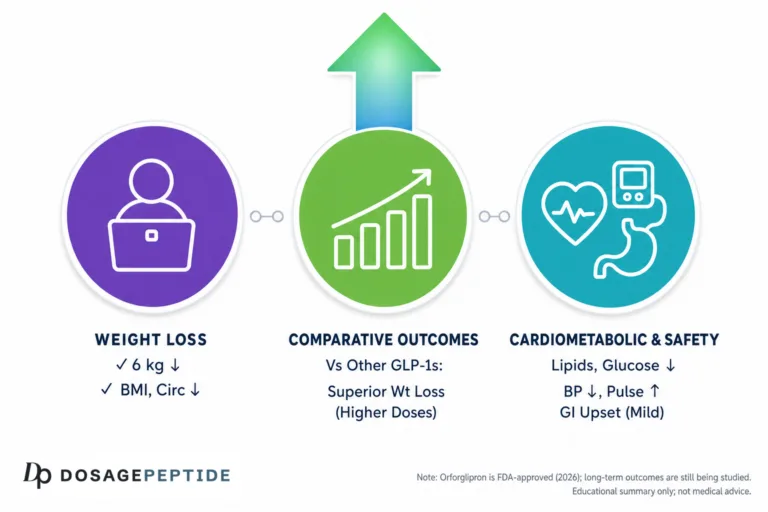
In ATTAIN-1, orforglipron significantly improved all measured cardiometabolic risk factors alongside weight — waist circumference, systolic blood pressure, and lipid and glycemic parameters.[7] The head-to-head ACHIEVE-3 trial likewise reported meaningful improvements from baseline in total cholesterol, triglycerides, and systolic blood pressure.[11] These are the same categories of improvement seen across the peptide incretins, and they matter because blood pressure, lipids, and central adiposity are themselves drivers of cardiovascular risk, independent of the weight number.
Body composition and the fat-versus-lean question
One recurring concern with rapid weight loss is that some of it is lean mass rather than fat. SURMOUNT-1 addressed this for tirzepatide with body-composition analysis, reporting roughly a three-fold greater reduction in fat mass than lean mass (about 33.9% fat-mass reduction versus 10.9% lean-mass reduction), indicating that the majority of weight lost was adipose tissue.[4] This is a favorable ratio, though preserving lean mass through adequate protein intake and resistance activity remains a general consideration with any substantial weight loss. Comparable detailed body-composition data are not uniformly reported across every trial, so this is another area where cross-drug comparison should be cautious.
Expanding indications
The incretin class has moved well beyond its original diabetes indication. Semaglutide has generated cardiovascular-outcome and other organ-protective data; tirzepatide has been studied in sleep apnea and heart failure with preserved ejection fraction; retatrutide’s glucagon arm has drawn interest for fatty-liver disease. Orforglipron’s development program similarly reaches into obstructive sleep apnea, hypertension, osteoarthritis-related knee pain, and peripheral artery disease, signaling that Lilly views it as a platform drug rather than a single-indication product.[12] For a research audience, the key takeaway is that “which drug is best for weight loss” is only one of several questions the class will ultimately answer, and the beyond-weight evidence base is still maturing for all four compounds.
How do the safety and tolerability profiles compare?
All GLP-1-based agents share a characteristic tolerability signature dominated by gastrointestinal effects, and the mechanism explains why: slowing gastric emptying and acting on central appetite circuits produces nausea, vomiting, diarrhea, and constipation, particularly during dose escalation.
Gastrointestinal effects across the class
In STEP 1, nausea affected 44.2% of semaglutide participants versus 17.4% on placebo, and diarrhea 31.5% versus 15.9%; discontinuation due to GI events was 4.5% versus 0.8%.[8] Orforglipron’s ATTAIN-1 profile was described as consistent with the injectable GLP-1 class: GI events were the most common adverse events, generally mild to moderate and concentrated during titration, with treatment discontinuation of roughly 5–10% across the orforglipron doses versus about 3% on placebo.[7] Retatrutide’s phase 2 GI events were likewise mostly mild to moderate and tied to dose escalation.[5]
A reasonable generalization is that GI tolerability scales with efficacy across the class: the agents and doses that drive the most weight loss also tend to drive the most nausea, which is why every drug here uses a slow dose-escalation (“start low, go slow”) schedule to let the gut adapt. Orforglipron’s mono-agonist, GLP-1-only mechanism does not appear to give it a dramatically gentler GI profile than the peptides; its differentiation is the route, not a fundamentally milder tolerability signature.
Why titration is central to tolerability
The single most important practical fact about GLP-1 tolerability is that most GI adverse events cluster in the dose-escalation window and then subside as the gut adapts. This is why every drug in this comparison — orforglipron included — is introduced at a low starting dose and stepped up gradually over weeks rather than started at the target dose. The escalation schedule is not a marketing formality; it is the primary tool for keeping nausea and vomiting manageable and for keeping people on therapy long enough to reach an effective dose. In the trials, discontinuations driven by GI events were a minority even at full dose precisely because the titration let tolerance develop first. Anyone comparing these agents should therefore compare them at matched points in their titration schedules, not compare a fully-titrated peptide against an orforglipron dose still being escalated. Orforglipron’s dose ladder (6 mg, 12 mg, 36 mg in the obesity program) mirrors this “start low, go slow” philosophy; the step-up details for the research context are outlined in our orforglipron 6 mg dosage protocol.
Mechanism-specific considerations
Retatrutide’s glucagon-receptor arm introduces distinct theoretical considerations — including modest increases in heart rate observed in trials and the aforementioned glucose question — that the pure GLP-1 mono-agonists do not raise. Tirzepatide’s GIP component and orforglipron’s high GLP-1 selectivity each shape their profiles differently. The class also carries a boxed warning for a theoretical risk of thyroid C-cell tumors based on rodent data, and standard GLP-1 precautions around pancreatitis, gallbladder events, and use with insulin or sulfonylureas apply. None of this is a reason to treat one agent as categorically “safe” and another as “risky”; it is a reminder that receptor breadth brings both efficacy and its own adverse-event fingerprint.
Weight regain after stopping
A tolerability discussion is incomplete without noting what happens on discontinuation. Across the class, stopping an incretin is followed by partial weight regain and a drift of cardiometabolic markers back toward baseline, because the drugs treat obesity as a chronic condition rather than curing it. The STEP 1 extension documented meaningful regain after semaglutide withdrawal, and the same pattern is expected for the other agents.[13] This is not a drug-specific flaw but a class characteristic tied to the underlying physiology of appetite regulation, and it applies equally to an oral small molecule and an injectable peptide. It reframes the “which drug” question as partly a “for how long” question, since durability of benefit depends on continued treatment.
What is the regulatory and research status of each drug?
Regulatory status is the single point on which this article most needs to be precise and current, because it has shifted recently.
- Orforglipron was approved by the FDA on April 1, 2026 under the brand name Foundayo for chronic weight management in adults with obesity, or overweight with at least one weight-related comorbidity, used alongside a reduced-calorie diet and increased physical activity. It is the first oral small-molecule GLP-1 receptor agonist to reach the market and the first GLP-1 pill that can be taken any time of day without food or water restrictions.[12] A separate regulatory pathway for a type 2 diabetes indication is being pursued on the strength of the ACHIEVE program.
- Semaglutide is FDA-approved for type 2 diabetes and, at the 2.4 mg dose, for chronic weight management, and is among the most widely used incretins in the world.[3]
- Tirzepatide is FDA-approved for both type 2 diabetes and chronic weight management.[4]
- Retatrutide remains investigational. Its most-cited weight-loss data come from a phase 2 trial, and it is progressing through phase 3 development but is not approved for any indication.[5]
Beyond obesity and diabetes, orforglipron is being studied across a range of indications including obstructive sleep apnea, hypertension, osteoarthritis-related knee pain, and peripheral artery disease, reflecting the broadening ambition for the incretin class as a whole.[12] For research and educational purposes, none of the information here constitutes medical advice, and approval status can and does change; always verify against primary regulatory sources before drawing conclusions.
Which drug is “best”? A framework rather than a verdict
The instinct to crown a winner is understandable but largely misguided given the data. A more useful approach is to match drug attributes to the priority that matters most in a given scenario.
- If maximal weight loss is the priority and injection is acceptable, the injectable dual and triple agonists (tirzepatide; investigational retatrutide) have shown the highest mean reductions in their respective trials — with the caveat that retatrutide is unapproved and its data are earlier-phase.
- If convenience, adherence, and scalability are the priority, orforglipron’s oral, restriction-free once-daily dosing is unique, and against the only fair comparator tested head-to-head (oral semaglutide) it delivered superior glucose and weight outcomes.
- If a long real-world track record matters, semaglutide and tirzepatide have the most accumulated clinical experience and the broadest approvals.
To run the reconstitution and supply-planning math for the injectable comparators, our dosage calculator handles concentration, volume, and per-dose calculations. Orforglipron, being an oral tablet, sidesteps that entire workflow — which is, in a sentence, the whole point of the molecule.
What the head-to-head evidence does and does not settle
It is worth restating the boundaries of what is actually known, because the temptation to over-read is strong. The field has exactly one relevant head-to-head trial for orforglipron: ACHIEVE-3, versus oral semaglutide, in type 2 diabetes. That trial establishes orforglipron’s superiority over an oral peptide GLP-1 on glucose and weight in that population. It does not establish anything about orforglipron versus injectable semaglutide 2.4 mg for obesity, versus tirzepatide, or versus retatrutide, none of which have been compared with it directly. Every statement in this article that reaches across those gaps is an inference from separate trials, appropriately hedged. As the phase 3 programs mature and, potentially, direct comparisons are run, some of these inferences will be confirmed and others revised — which is exactly why an honest comparison flags its evidence level at every step rather than presenting a tidy ranking.
A note on research and educational context
This article is written for a scientifically literate readership interested in the pharmacology and trial evidence of the incretin class. It is educational and does not constitute medical advice, dosing guidance, or a recommendation to use any compound. Approval status, labeling, and available evidence change over time; the details here reflect the trial and regulatory record as reported through the primary sources cited. Anyone evaluating these agents for any purpose should consult current regulatory labeling and the primary literature directly, and should treat investigational compounds such as retatrutide as exactly that — investigational, with an evidence base that is still being built.
Frequently Asked Questions
Is orforglipron a peptide like semaglutide and tirzepatide?
No. Orforglipron is a non-peptide, small-molecule GLP-1 receptor agonist, whereas semaglutide, tirzepatide, and retatrutide are all peptides. This chemical difference is why orforglipron can be taken as an oral tablet without an absorption enhancer or fasting requirement, while the peptides require injection (or, for oral semaglutide, strict fasting and water rules). It activates the same GLP-1 receptor despite the different molecular structure.
How much weight did orforglipron produce compared with the injectables?
In the phase 3 ATTAIN-1 trial, orforglipron 36 mg produced about 11.2% mean weight loss over 72 weeks. For comparison, semaglutide reached ~14.9% in STEP 1, tirzepatide ~22.5% in SURMOUNT-1, and investigational retatrutide ~24.2% in its phase 2 trial. These are separate trials in different populations, so the numbers describe the class rather than a fair head-to-head ranking.
Has orforglipron ever beaten another GLP-1 drug directly?
Yes. In ACHIEVE-3, a genuine head-to-head phase 3 trial in type 2 diabetes, orforglipron 36 mg lowered HbA1c by 2.2% versus 1.4% for oral semaglutide 14 mg, and produced 9.2% weight loss versus 5.3%. It beat oral semaglutide on the primary and all key secondary endpoints. It has not, however, been tested head-to-head against injectable tirzepatide or retatrutide.
Is orforglipron FDA-approved?
Yes. The FDA approved orforglipron (brand name Foundayo) on April 1, 2026 for chronic weight management in adults with obesity or overweight with weight-related comorbidities, used with diet and increased physical activity. It is the first oral small-molecule GLP-1 receptor agonist approved and the first GLP-1 pill with no food, water, or time-of-day restrictions. A type 2 diabetes indication is being pursued separately.
Why does taking a pill instead of an injection matter?
Route affects adherence, manufacturing, and access. Many patients discontinue injectable GLP-1s within a year, and needle burden is one contributor. An oral, restriction-free daily pill lowers that barrier. Small molecules are also cheaper and more scalable to manufacture than peptides, and require no cold chain, which could expand access — though the injectables still produced larger mean weight loss in trials, so route is a trade-off, not a pure advantage.
Is retatrutide available to prescribe?
No. Retatrutide remains investigational and is not approved for any indication. Its widely cited ~24% weight-loss figure comes from a phase 2 trial (Jastreboff et al., NEJM 2023) that enrolled 338 participants over 48 weeks — a smaller, shorter, earlier-phase study than the phase 3 trials of the approved drugs. It is advancing through phase 3 development but should be discussed only in a research and educational context.
Do these drugs differ in side effects?
They share the class-typical gastrointestinal profile — nausea, vomiting, diarrhea, and constipation, mostly during dose escalation. In general, the agents and doses that drive more weight loss also drive more GI effects, which is why all use slow titration. Retatrutide’s glucagon-receptor activity adds distinct considerations such as modest heart-rate increases. Orforglipron’s oral route does not appear to make its GI tolerability dramatically milder than the peptides.
Why can’t I just rank these drugs by their weight-loss percentages?
Because the numbers come from different trials with different durations (48–72 weeks), populations, baseline BMIs, diabetes status, dose ladders, and statistical estimands. A drug can look weaker simply because it was studied in a harder population or analyzed more conservatively. Only a head-to-head randomized trial — like ACHIEVE-3 for orforglipron versus oral semaglutide — supports a fair direct ranking of two incretins.
Does weight come back if you stop these drugs?
Yes, at least partially. Incretins treat obesity as a chronic condition rather than curing it, so stopping is generally followed by weight regain and a drift of blood pressure, lipids, and glucose back toward baseline. The STEP 1 extension documented this pattern after semaglutide withdrawal, and it is expected across the class, including for oral orforglipron. This is why durability of benefit depends on continued treatment rather than a fixed course, and it applies to pills and injections alike.
Why is orforglipron’s oral route considered such a big deal for access?
Peptides require complex, capacity-limited manufacturing, cold-chain storage, and specialized fill-finish for injectables, and the class has repeatedly faced shortages. A small-molecule pill is made by conventional chemical synthesis that is cheaper and far more scalable, with no cold chain. If orforglipron can be produced at large volume and lower cost, the practical implications for patients, health systems, and lower-resource settings could rival the efficacy differences in importance — a supply-side advantage the injectable peptides structurally cannot match.
References
- Orforglipron: A Comprehensive Review of an Oral Small-Molecule GLP-1 Receptor Agonist for Obesity and Type 2 Diabetes. Int J Mol Sci / PMC. https://pmc.ncbi.nlm.nih.gov/articles/PMC12898445/
- Effect of Food Consumption on the Pharmacokinetics, Safety, and Tolerability of Once-Daily Orally Administered Orforglipron (LY3502970). PMC. https://pmc.ncbi.nlm.nih.gov/articles/PMC10951152/
- Wilding JPH, et al. Once-Weekly Semaglutide in Adults with Overweight or Obesity (STEP 1). N Engl J Med 2021. https://www.nejm.org/doi/full/10.1056/NEJMoa2032183
- Jastreboff AM, et al. Tirzepatide Once Weekly for the Treatment of Obesity (SURMOUNT-1). N Engl J Med 2022. https://www.nejm.org/doi/full/10.1056/NEJMoa2206038
- Jastreboff AM, et al. Triple–Hormone-Receptor Agonist Retatrutide for Obesity — A Phase 2 Trial. N Engl J Med 2023. https://www.nejm.org/doi/full/10.1056/NEJMoa2301972
- Orforglipron, an Oral Small-Molecule GLP-1 Receptor Agonist for Obesity Treatment (ATTAIN-1). N Engl J Med 2025. https://www.nejm.org/doi/full/10.1056/NEJMoa2511774
- ATTAIN-1: Oral Orforglipron Significantly Reduces Weight, Cardiometabolic Risk. American College of Cardiology. https://www.acc.org/Latest-in-Cardiology/Journal-Scans/2025/09/24/16/48/ATTAIN-1
- Once-Weekly Semaglutide in Adults with Overweight or Obesity — EBGI summary. American College of Gastroenterology. https://gi.org/journals-publications/ebgi/once-weekly-semaglutide-in-adults-with-overweight-or-obesity/
- Lilly’s SURMOUNT-1 results published in NEJM show tirzepatide achieved between 16.0% and 22.5% weight loss. Eli Lilly. https://investor.lilly.com/news-releases/news-release-details/lillys-surmount-1-results-published-new-england-journal-medicine
- ACHIEVE-1: Oral GLP-1 Agonist Orforglipron Shows Strong HbA1c, Weight Reductions. HCPLive. https://www.hcplive.com/view/achieve-1-oral-glp-1-agonist-orforglipron-shows-strong-hba1c-weight-reductions
- Orforglipron delivered superior blood sugar control and weight loss vs oral semaglutide in head-to-head T2D trial (ACHIEVE-3), published in The Lancet. Eli Lilly. https://lilly.mediaroom.com/2026-02-26-Lillys-oral-GLP-1,-orforglipron,-delivered-superior-blood-sugar-control-and-weight-loss-compared-to-oral-semaglutide-in-head-to-head-type-2-diabetes-trial-published-in-The-Lancet
- FDA Approves Orforglipron (Foundayo), First GLP-1 Pill Without Time, Food, or Water Restrictions. Pharmacy Times. https://www.pharmacytimes.com/view/fda-approves-orforglipron-first-glp-1-pill-without-time-food-or-water-restrictions
- Wilding JPH, et al. Weight regain and cardiometabolic effects after withdrawal of semaglutide: The STEP 1 trial extension. Diabetes Obes Metab 2022 / PMC. https://pmc.ncbi.nlm.nih.gov/articles/PMC9542252/