The short answer is yes: GLP-1 hair loss is real, it is measurable, and it was in the FDA-approved labeling from the original 2021 approval — but it is uncommon, it is non-scarring, and the weight of the evidence points to weight-loss-driven telogen effluvium rather than any direct toxic effect of the drug on the hair follicle. In the pooled registrational trials, hair loss was reported by roughly 3–5 % of participants on semaglutide 2.4 mg or tirzepatide versus about 1 % on placebo, strongly concentrated in women. This page sets out exactly what those trials reported, what the FDA labels say today, what the newer observational and pharmacovigilance work adds, and where the evidence still runs out.
What the registrational trial data actually show
Every number in the table below is taken from an FDA-approved prescribing information document, which is the primary regulatory record of the registrational trial safety data. Rows are included only where the alopecia or hair-loss figure is explicitly reported in the label. Semaglutide and tirzepatide are FDA-approved: semaglutide as Wegovy (chronic weight management, cardiovascular risk reduction, and MASH with F2–F3 fibrosis under accelerated approval) and as Ozempic (type 2 diabetes); tirzepatide as Zepbound (chronic weight management and moderate-to-severe obstructive sleep apnea in adults with obesity) and as Mounjaro (type 2 diabetes).
| Trial pool (label designation) | Compound and dose | Duration | Drug arm: hair loss | Placebo arm: hair loss | Source |
|---|---|---|---|---|---|
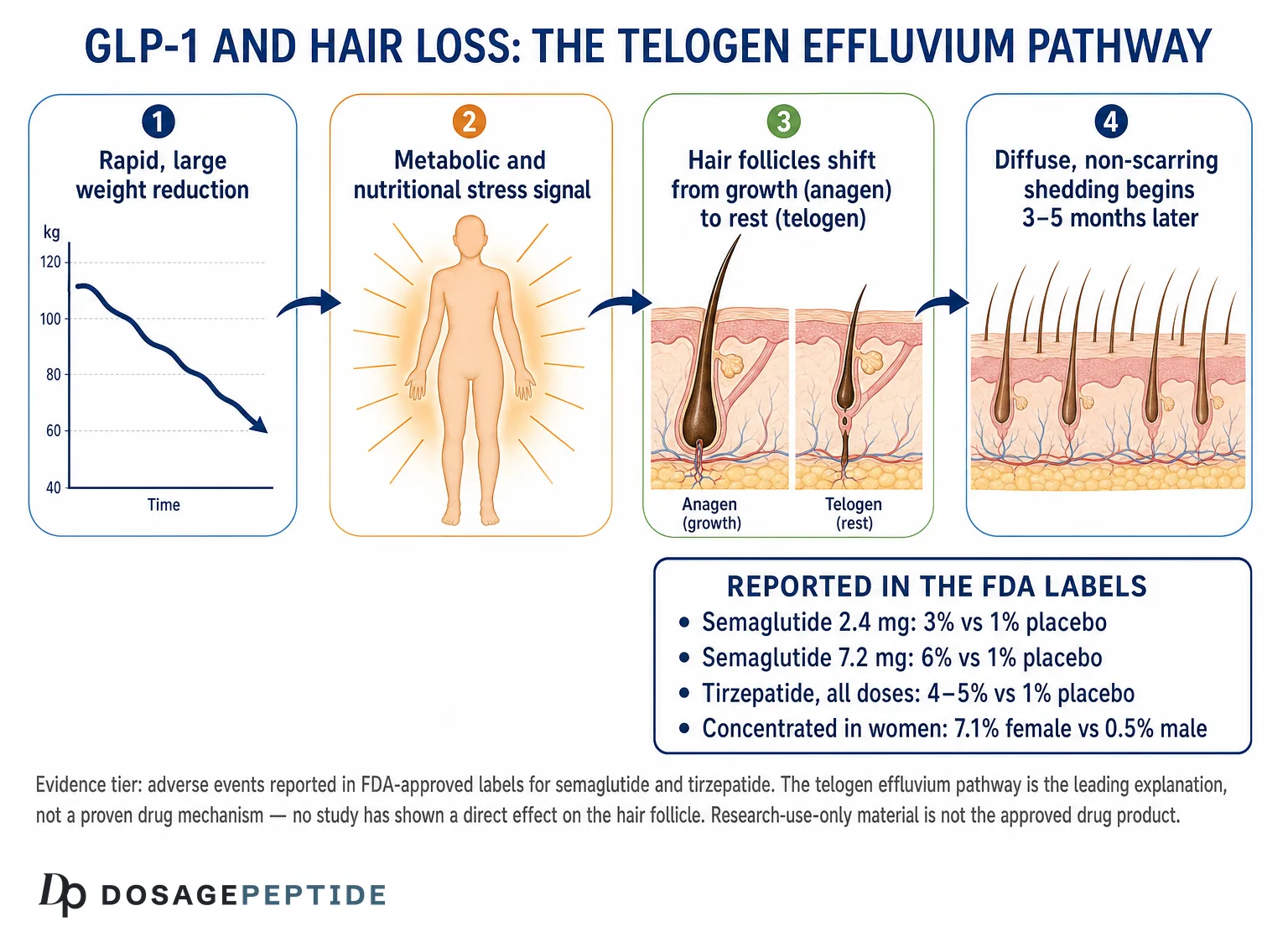
| Pool of 3 placebo-controlled weight-management trials in adults, Wegovy label Table 3 | Semaglutide 2.4 mg SC weekly (n=2,116) vs placebo (n=1,261) | Up to 68 weeks | 3 % | 1 % | Wegovy PI[1] |
| Pool of 2 placebo-controlled trials (Studies 8 and 9), Wegovy label Table 4 | Semaglutide 7.2 mg (n=1,311) vs 2.4 mg (n=304) vs placebo (n=303) | 72 weeks | 6 % (7.2 mg); 3 % (2.4 mg) | 1 % | Wegovy PI[1] |
| Pediatric trial, patients aged 12 years and older with obesity, Wegovy label Table 5 | Semaglutide 2.4 mg SC weekly (n=133) vs placebo (n=67) | 68 weeks | 4 % | 0 % | Wegovy PI[1] |
| Pool of Study 1 (adults without type 2 diabetes) and Study 2 (adults with type 2 diabetes) of the SURMOUNT program, Zepbound label Table 1 | Tirzepatide 5 mg (n=630), 10 mg (n=948), 15 mg (n=941) vs placebo (n=958) | Up to 72 weeks | 5 % (5 mg); 4 % (10 mg); 5 % (15 mg) | 1 % | Zepbound PI[2] |
| Same SURMOUNT pool, broken down by sex, Zepbound label section 6.1 | Tirzepatide (all doses) vs placebo | Up to 72 weeks | 7.1 % female; 0.5 % male | 1.3 % female; 0 % male | Zepbound PI[2] |
| Type 2 diabetes programs | Semaglutide (Ozempic); tirzepatide (Mounjaro) | — | No alopecia row in the clinical-trial adverse-reaction tables; alopecia is listed only under Postmarketing Experience, Skin and Subcutaneous Tissue | Ozempic PI[3]; Mounjaro PI[4] | |
The underlying trials are the largest obesity programs ever run for this class. STEP 1 randomized 1,961 adults to semaglutide 2.4 mg or placebo for 68 weeks and produced a mean weight change of −14.9 % versus −2.4 %.[5] SURMOUNT-1 randomized 2,539 adults to tirzepatide 5, 10 or 15 mg or placebo for 72 weeks, with mean weight reductions of 15.0 %, 19.5 % and 20.9 % by dose under the treatment-regimen estimand against 3.1 % on placebo (22.5 % at 15 mg under the efficacy estimand).[6] Those two trials contribute the bulk of the label pools tabulated above, and the scale of weight change they produced is central to interpreting the hair-loss numbers.
Two structural facts about that table matter more than the individual percentages. First, the split between the obesity labels and the diabetes labels is not a difference in molecule — semaglutide is semaglutide — it is a difference in dose, in the magnitude of weight loss achieved, and in the trial populations studied. Second, the tirzepatide figures are not dose-ordered: 5 mg, 10 mg and 15 mg produced 5 %, 4 % and 5 % respectively. That flatness is suggestive but not probative — these are rounded integers from roughly thirty events per arm, reported without confidence intervals, in a pool that was never powered to test dose response. The semaglutide figures run the other way, rising from 3 % at 2.4 mg to 6 % at 7.2 mg, and a 2026 systematic review of 24 studies reported that semaglutide-associated hair loss appeared dose-dependent, with weekly doses below 2 mg rarely implicated.[14] Dose and magnitude of weight loss rise together, so neither pattern separates the molecule from the weight change.
Was this a new signal, or was it there from the start?
For the two weight-management products, it was there from the start. The original Wegovy prescribing information, approved in June 2021, already contained the row “Hair Loss 1 3” in its adverse-reaction table — 1 % placebo, 3 % semaglutide 2.4 mg, out of the same 1,261 and 2,116 participants cited above. The original Zepbound prescribing information, approved in November 2023, contained the identical hair-loss row and the identical sex breakdown that appears in the current 2026 revision. Neither figure was added after the fact in response to patient reports.
The two type 2 diabetes labels are the opposite case. The Ozempic prescribing information revised 03/2022 contains no mention of alopecia anywhere in its 54 pages; alopecia was added subsequently to the Postmarketing Experience section of both the Ozempic and Mounjaro labels, which is by definition a post-approval addition built on voluntary reports rather than on trial data.[3][4]
What has changed is prominence rather than substance. In the current Wegovy label, hair loss now appears in the Highlights section among the most common adverse reactions occurring at an incidence of at least 5 %, which reflects the higher 7.2 mg dose reaching 6 % in the newer 72-week trials. The signal did not appear; the exposure did. Anyone reading the broader catalogue of documented semaglutide adverse effects or the equivalent tirzepatide adverse-effect record will find hair loss sitting well below the gastrointestinal reactions that dominate both programs.
Why the evidence points to telogen effluvium rather than follicular toxicity
Both weight-management labels carry the same finding in section 6.1. The Zepbound prescribing information states: “Hair loss adverse reactions in ZEPBOUND-treated patients were associated with weight reduction.”[2] The Wegovy prescribing information states the same of semaglutide: “Hair loss adverse reactions in WEGOVY® injection-treated patients were associated with weight reduction.”[1] Two manufacturers, two independent trial programs, the same reading.
That reading has limits worth stating plainly. Both sentences are statements of association drawn from the manufacturers’ own within-trial data and carried in FDA-approved labeling. They are consistent with a weight-mediated mechanism, but they are association statements, not causal analyses: neither label discloses a method, an effect estimate or a confidence interval, and neither excludes a contribution from the molecule itself.
How telogen effluvium works
Scalp hair cycles asynchronously. Under normal conditions roughly 90 % of scalp follicles are in the growth (anagen) phase and about 10 % are in the resting (telogen) phase, which ends in shedding. A systemic stressor can push an abnormally large fraction of anagen follicles into telogen at once. Because telogen lasts roughly three to five months before the hair is released, the visible shedding does not begin until two to three months after the trigger — a latency that reliably confuses cause and effect. Recognised triggers documented in the dermatology literature include chronic starvation and caloric restriction, and severe protein, essential fatty acid and zinc deficiency. Acute telogen effluvium is non-scarring: the follicle survives, and remission occurs in approximately 95 % of acute cases once the trigger resolves.[11]
The rate-of-loss argument
The clearest external control for this question is bariatric surgery, where large amounts of weight are lost rapidly with no GLP-1 receptor agonist involved at all. A 2025 systematic review and meta-analysis of 41 studies covering 7,044 patients found a pooled incidence of hair loss after metabolic and bariatric surgery of 47 %, with rates differing by procedure — highest after duodenal switch, higher after Roux-en-Y gastric bypass than after sleeve gastrectomy.[12] That is an order of magnitude above the GLP-1 trial figures, in a setting where no GLP-1 receptor agonist is involved. The two numbers are not directly comparable: the bariatric studies largely solicit hair loss through questionnaires, while the trial figures rest on spontaneously volunteered adverse events, which inflates the gap by an unknown amount. What survives that caveat is the direction. Rapid weight loss triggers shedding on its own, at rates that plausibly dominate anything documented for semaglutide or tirzepatide.
The nutrition and sex-distribution arguments
Sustained appetite suppression at trial doses produces substantial voluntary caloric restriction, and with it a reduced intake of protein, iron, zinc and essential fatty acids — the exact deficiencies that the telogen effluvium literature identifies as triggers. Review articles on semaglutide and alopecia converge on the same three candidate mechanisms: nutritional deficiency secondary to rapid weight loss, endocrine shifts including thyroid hormone fluctuation, and psychological stress, all acting through the telogen effluvium pathway rather than through direct follicular injury.[10] The sex distribution supports the same reading: in the SURMOUNT pool, hair loss was reported by 7.1 % of women on tirzepatide but 0.5 % of men, and the placebo arm showed the same directional split (1.3 % versus 0 %). The Wegovy label reports the same split independently: 4 % of women versus 0.9 % of men at 2.4 mg, and 8.4 % versus 0.2 % at 7.2 mg, against 1.5 % versus 0 % on placebo.[1] Telogen effluvium is both more common and more readily noticed in women; a direct pharmacological insult to the follicle would not be expected to discriminate this sharply by sex.
The same logic connects this topic to a related and better-studied question about body composition on these compounds, covered separately in the analysis of whether GLP-1 peptides cause muscle loss. In both cases the mechanism under discussion is a consequence of the magnitude and speed of weight reduction rather than a distinct pharmacological action, and in both cases that distinction changes how the data should be read.
What the pharmacovigilance and observational data do and do not establish
Randomized evidence
A 2026 systematic review and meta-analysis in Diabetes Research and Clinical Practice pooled nine interventional studies — seven randomized controlled trials and two non-randomized — covering 4,114 GLP-1 receptor agonist users. It reported a pooled risk ratio for hair loss of 3.252 (95 % CI 1.437–7.358), rising to 3.587 (95 % CI 2.100–6.124) when restricted to randomized trials in overweight and obese populations, with a single-arm event rate of 3.9 %.[7] This is the strongest tier of evidence available, because randomization removes the confounding that plagues everything below it. What it establishes is an association with treatment assignment. What it cannot separate, by design, is the drug from the weight loss the drug produces — there is no arm in which participants lost equivalent weight without the drug.
Cohort and target-trial-emulation evidence
The most methodologically serious observational work published to date is a 2026 BMJ target trial emulation using Penn Medicine electronic health records from January 2019 to September 2024, in adults with type 2 diabetes. Comparing 12,004 GLP-1 receptor agonist initiators with 15,221 SGLT-2 inhibitor initiators, and 11,964 GLP-1 initiators with 11,238 DPP-4 inhibitor initiators, it found hazard ratios for incident alopecia of 1.37 (95 % CI 1.08–1.73) versus SGLT-2 inhibitors and 1.68 (95 % CI 1.28–2.20) versus DPP-4 inhibitors. The association was specific to non-scarring alopecia: 1.53 (95 % CI 1.18–1.97) and 1.72 (95 % CI 1.28–2.31) respectively. The authors reported that the associations held across sensitivity and subgroup analyses but attenuated after negative control outcome calibration — the procedure that estimates residual unmeasured confounding — and concluded that the absolute risk is low.[8]
Two features of that result deserve emphasis. The restriction of the signal to non-scarring alopecia is mechanistically informative: scarring alopecias destroy the follicle permanently, non-scarring ones do not, and telogen effluvium is the archetypal non-scarring pattern. And the active comparators — SGLT-2 and DPP-4 inhibitors — are glucose-lowering agents that produce much less weight loss, which means the comparison remains partly a comparison of weight trajectories, not only of molecules.
Spontaneous reporting
More than 1,000 spontaneous alopecia cases associated with GLP-1 receptor agonists have accumulated in the FDA Adverse Event Reporting System, as catalogued in a 2025 scoping review in Cureus that screened nine studies including four randomized controlled trials, one prospective pilot study, three retrospective pharmacovigilance analyses and one cohort study.[9] Across those studies, female predominance ranged from 63 % to 78.6 % of reported cases, and only one study characterised the alopecia subtype clinically at all.
A larger 2026 systematic review, covering 24 studies drawn from 133 screened and registered in PROSPERO, reached the same broad conclusions from a wider base: semaglutide and tirzepatide showed the highest reported incidence and the most frequent signal detection in pharmacovigilance datasets, women were disproportionately affected, and rapid weight loss emerged as a candidate contributor. Liraglutide, dulaglutide, lixisenatide and exenatide were assessed in fewer studies and generally carried lower reported risk.[14]
Spontaneous reporting databases establish that reports exist and that they cluster. They do not establish incidence, because the denominator is unknown, and they do not establish causation, because reporting is voluntary, unverified, and heavily influenced by media attention — a particularly acute problem for a side effect that has been widely discussed online. Disproportionality statistics derived from them are hypothesis-generating signals, not risk estimates.
Has any study shown a direct effect of GLP-1 receptor agonists on the hair follicle?
No. As of this writing, no published study has demonstrated a direct pharmacological effect of semaglutide, tirzepatide, or any other GLP-1 receptor agonist on the human hair follicle. The 2025 Cureus scoping review describes the possibility of direct effects — for example, GLP-1 receptor expression in dermal fibroblasts altering cytokine production or oxidative stress — as speculative, and lists it after the two mechanisms it considers primary: rapid weight loss inducing acute metabolic stress and triggering telogen effluvium, and the possible unmasking of androgenetic alopecia in predisposed individuals through hormonal modulation.[9] Immunohistochemical or molecular profiling of GLP-1 receptor expression specifically in human hair follicles has not been reported. Claims that these compounds “attack the follicle” are not supported by any dataset currently in the literature.
This is a genuinely different situation from the compounds discussed in the survey of peptides studied in relation to hair growth, where the research question is a hypothesised direct action on follicular biology. Here the research question is whether an established metabolic intervention produces a well-characterised, weight-mediated dermatological consequence.
What remains unknown
- Whether the effect is drug-specific at all. No trial has compared GLP-1-mediated weight loss with equivalent weight loss achieved by another route while measuring hair outcomes as a prespecified endpoint. Until that exists, the drug and its effect on body weight cannot be disentangled.
- The true incidence. Trial figures rest on spontaneously volunteered adverse events, not on trichoscopy, hair-pull tests, or standardised photography. Mild shedding is almost certainly under-captured; conversely, background androgenetic alopecia may be over-attributed.
- The subtype distribution. Subtyping remains sparse but is no longer absent. The 2026 systematic review of 24 studies reported that, where alopecia was classified at all, androgenetic alopecia and telogen effluvium were the predominant subtypes, with tirzepatide — the agent producing the largest weight loss — most frequently linked to telogen effluvium.[14] Classification was still infrequent across the underlying studies, and coincidental alopecia areata cannot be separated out of the existing datasets.
- Time course and reversibility on continued exposure. The telogen effluvium literature predicts resolution once the trigger resolves, and non-scarring alopecia by definition leaves the follicle intact. But no dedicated longitudinal study has tracked hair density in GLP-1 users through weight-loss and weight-maintenance phases.
- Whether the newer higher doses change the picture. The 6 % figure at semaglutide 7.2 mg is higher than the 3 % at 2.4 mg, but those participants also lost more weight, so dose and weight change move together and cannot be separated from the label data alone.
- Whether it applies to newer investigational agents. Retatrutide, a triple GIP/GLP-1/glucagon receptor agonist, remains investigational and is not approved by the FDA for any indication. Its phase 2 trial produced a 24.2 % mean weight reduction at 48 weeks at the 12 mg dose,[13] and the phase 3 TRIUMPH-1 results reported in May 2026 in 2,339 adults described larger mean reductions over 80 weeks.[15] Hair loss has not been broken out as a distinct adverse reaction in the phase 3 results reported to date, and no registrational dermatological safety dataset exists for it.
What these figures do not describe
Every number on this page comes from a trial of a specific, characterised, manufactured drug product given under protocol at a known dose and purity. Material sold as research-grade semaglutide or tirzepatide is not that product, and the 3 % and 5 % figures set no expectation for uncharacterised material where content, contaminants and degradation products are unmeasured. Reference pages such as the semaglutide 10 mg vial reconstitution reference and the tirzepatide 10 mg vial reconstitution reference document laboratory handling arithmetic only. For background on the drug class, see the reference guide to what a GLP-1 receptor agonist is.
Frequently Asked Questions
Does semaglutide cause hair loss?
In the pooled registrational weight-management trials, hair loss was reported by 3 % of adults on semaglutide 2.4 mg (n=2,116) versus 1 % on placebo (n=1,261) over up to 68 weeks, and by 6 % at the 7.2 mg dose over 72 weeks. So there is a real excess over placebo. The available mechanistic evidence attributes it to rapid weight loss triggering telogen effluvium rather than to a direct drug effect on the follicle.
How common is hair loss with tirzepatide?
In the pooled SURMOUNT weight-management trials reported in the Zepbound label, hair loss occurred in 5 % at 5 mg, 4 % at 10 mg and 5 % at 15 mg versus 1 % on placebo, across roughly 72 weeks. The rate was 7.1 % in women and 0.5 % in men. The tirzepatide figures do not rise cleanly with dose, but the event counts are too small and the reporting too coarse to treat that as evidence of anything; the semaglutide figures do rise with dose. Neither pattern separates the drug from the weight loss it produces.
Is GLP-1 hair shedding permanent?
The largest observational analysis found the association was specific to non-scarring alopecia, meaning the follicle is not destroyed. Acute telogen effluvium, the leading candidate mechanism, remits in roughly 95 % of acute cases once the underlying trigger resolves. No longitudinal study has yet tracked hair density in GLP-1 users through weight-loss and maintenance phases, so the recovery timeline in this specific population is not established.
Why does the Ozempic label not list alopecia the way the Wegovy label does?
Ozempic and Mounjaro, the type 2 diabetes products, list alopecia only under Postmarketing Experience — voluntary reports of uncertain frequency — not in their clinical-trial adverse-reaction tables. Wegovy and Zepbound, the weight-management products, carry it as a tabulated trial adverse reaction. The difference tracks dose and the magnitude of weight loss studied, not a difference in molecule.
When does hair shedding typically begin after a major weight-loss trigger?
In telogen effluvium the shedding lags the trigger by roughly two to three months, because follicles pushed into the resting phase are not released until that phase completes. Drug-associated cases described in the dermatology literature often begin around twelve weeks after starting. That latency is why people frequently misattribute the timing to whatever changed most recently rather than to what happened a quarter earlier.
Do the trials prove the drug itself causes hair loss?
They prove an excess of reported hair loss in the drug arms. They do not isolate the drug from the weight loss it produces, because no arm achieved comparable weight reduction without the drug. Bariatric surgery, which involves no GLP-1 receptor agonist, is followed by hair loss in a pooled 47 % of patients across 41 studies — although those studies mostly solicit hair loss directly while the trial figures rest on spontaneous reports, so the two rates cannot be compared head-to-head.
Is the hair-loss signal stronger in women?
Yes, consistently. The Zepbound label reports 7.1 % in women versus 0.5 % in men on tirzepatide, with the same directional split in the placebo arm. The Wegovy label reports the same split independently: 4 % of women versus 0.9 % of men at 2.4 mg, and 8.4 % versus 0.2 % at 7.2 mg, against 1.5 % versus 0 % on placebo. Across pharmacovigilance studies compiled in a 2025 scoping review, female predominance ranged from 63 % to 78.6 % of cases. This pattern is characteristic of telogen effluvium and difficult to reconcile with direct follicular toxicity.
Has a regulator formally added a hair-loss warning to these products?
For the two weight-management products, no: hair loss has been in the tabulated adverse reactions of the Wegovy label since its original June 2021 approval and the Zepbound label since its original November 2023 approval. For the two diabetes products, yes: the Ozempic prescribing information revised 03/2022 contained no mention of alopecia, and alopecia was subsequently added to the Postmarketing Experience section of both the Ozempic and Mounjaro labels, which is by definition a post-approval addition based on voluntary reports. What changed for Wegovy is prominence rather than substance — the 06/2021 Highlights listed the adverse reactions occurring at an incidence of at least 5 % without hair loss, and the 06/2026 Highlights now includes it, reflecting the 5.8 % rate at the 7.2 mg dose.
What about retatrutide and other newer compounds?
Retatrutide is a triple GIP/GLP-1/glucagon receptor agonist that remains investigational and is not approved by the FDA for any indication. Its phase 2 trial in 338 adults reported a 24.2 % mean weight reduction at 48 weeks with the 12 mg dose, and the phase 3 TRIUMPH-1 trial in 2,339 adults reported larger mean reductions over 80 weeks in May 2026, without breaking out hair loss as a distinct adverse reaction. Because the leading mechanism for hair shedding in this class is weight-loss-mediated, larger weight reductions raise the question, but no registrational dermatological safety dataset yet exists for it.
References
- Novo Nordisk. WEGOVY (semaglutide) injection and tablets, full prescribing information. Sections 6.1, Tables 3–5. Revised 06/2026. FDA-approved prescribing information (PDF)
- Eli Lilly and Company. ZEPBOUND (tirzepatide) injection, full prescribing information. Section 6.1, Table 1 and “Hair Loss” subsection. Revised 04/2026. FDA-approved prescribing information (PDF)
- Novo Nordisk. OZEMPIC (semaglutide) injection, full prescribing information. Section 6.2 Postmarketing Experience. Revised 05/2026. FDA-approved prescribing information (PDF)
- Eli Lilly and Company. MOUNJARO (tirzepatide) injection, full prescribing information. Section 6.2 Postmarketing Experience. Revised 04/2026. FDA-approved prescribing information (PDF)
- Wilding JPH, Batterham RL, Calanna S, et al. Once-Weekly Semaglutide in Adults with Overweight or Obesity (STEP 1). N Engl J Med. 2021;384(11):989–1002. PMID 33567185
- Jastreboff AM, Aronne LJ, Ahmad NN, et al. Tirzepatide Once Weekly for the Treatment of Obesity (SURMOUNT-1). N Engl J Med. 2022;387(3):205–216. PMID 35658024
- Cheng PL, Chang HC. Glucagon-like peptide-1 receptor agonists and hair loss: A systematic review and meta-analysis. Diabetes Res Clin Pract. 2026;237:113333. PMID 42155605
- Tang H, Zhang B, Lu Y, et al. Risk of hair loss associated with glucagon-like peptide-1 receptor agonists in adults with type 2 diabetes: target trial emulation. BMJ. 2026;394:e100077. PMID 42486607
- Rojas Lopez RF, Lynett Barrera D, Amaya Muñoz MC, Saavedra Diaz MP. Alopecia as an Emerging Adverse Effect Associated With Glucagon-Like Peptide-1 (GLP-1) Receptor Agonists for Weight Loss: A Scoping Review. Cureus. 2025;17(8):e90021. PMID 40951222
- Haykal D. Alopecia and Semaglutide: Connecting the Dots for Patient Safety. J Cosmet Dermatol. 2025;24(3):e70125. PMID 40087997
- Asghar F, Shamim N, Farooque U, Sheikh H, Aqeel R. Telogen Effluvium: A Review of the Literature. Cureus. 2020;12(5):e8320. PMID 32607303
- Taghizadeh N, Salhab H, Alirezaei A, et al. Hair Loss and Metabolic and Bariatric Surgery: An Updated Systematic Review and Meta-analysis. Obes Surg. 2025;35(6):2370–2380. PMID 40388098
- Jastreboff AM, Kaplan LM, Frías JP, et al. Triple-Hormone-Receptor Agonist Retatrutide for Obesity — A Phase 2 Trial. N Engl J Med. 2023;389(6):514–526. PMID 37366315
- Gupta AK, Teasell EM, Economopoulos V, Mirmirani P. GLP-1 therapies and hair loss: A systematic review of current evidence and implications for counseling. Sci Prog. 2026;109(2):368504261444578. PMID 41998799
- Eli Lilly and Company. Lilly’s triple agonist, retatrutide, delivered powerful weight loss in pivotal Phase 3 obesity trial (TRIUMPH-1, NCT05929066). Press release, 21 May 2026. Company announcement
Research-use-only notice. This page is an independent scientific reference summary compiled from published clinical trial data, FDA-approved prescribing information and peer-reviewed literature. It is not medical advice, not a treatment recommendation, and not a dosing protocol for any person. Nothing here should be read as suggesting that any compound be administered to a human being. Semaglutide and tirzepatide are prescription drugs whose approved uses are defined by their FDA-approved labeling and whose administration is a matter for a licensed clinician; retatrutide is investigational and is not approved for any indication. Research-grade peptide material is not the approved drug product, is not verified for identity, purity or sterility, and is intended exclusively for laboratory research by qualified investigators, not for human or veterinary use.