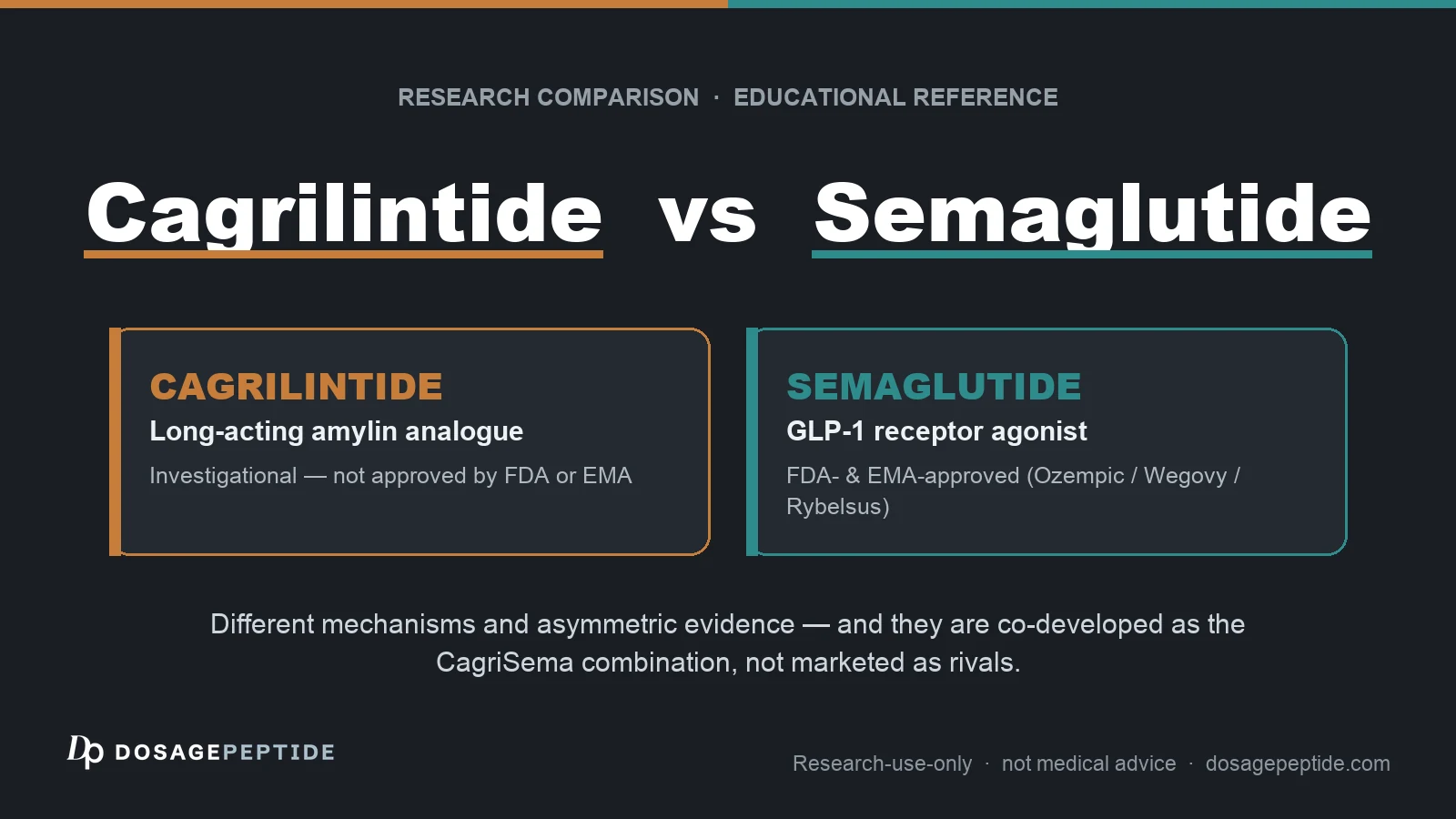
Search the weight-management and peptide forums for “Cagrilintide vs Semaglutide” and you will find the two treated as competing injectables — one framed as the “new amylin” challenger, the other as the established GLP-1 that made Ozempic and Wegovy household names. That framing is misleading in a specific way, and this article compares the pair the way the published evidence actually supports. The two molecules are not really rivals at all: they act through different receptors, sit on opposite ends of the regulatory ladder, and are being developed together as a single fixed-dose combination.
Two facts should anchor everything below. First, the comparison is defined by a stark asymmetry of approval and evidence: semaglutide is an FDA- and EMA-approved medicine backed by a large Phase 3 program, while cagrilintide is investigational, has never been approved anywhere, and has standalone human evidence that tops out at a single Phase 2 dose-finding trial.[2][1] Second, no trial was ever designed to pit cagrilintide monotherapy against semaglutide monotherapy as its primary question — although, unusually for this kind of pairing, one Phase 3 trial (REDEFINE 1) did randomize a cagrilintide-alone arm and a semaglutide-alone arm inside the same study, so a within-trial comparison exists even though it was not the trial’s headline.[4]
This is educational reference material that summarizes published research and regulatory status. It is not medical advice, not a therapeutic recommendation, and not instructions for human use. Any dosing figures cited describe clinical-trial protocols and approved product labels only; where a use is not approved, it is experimental, and nothing here should be read as a personal protocol.
Cagrilintide vs Semaglutide: The Honest Bottom Line
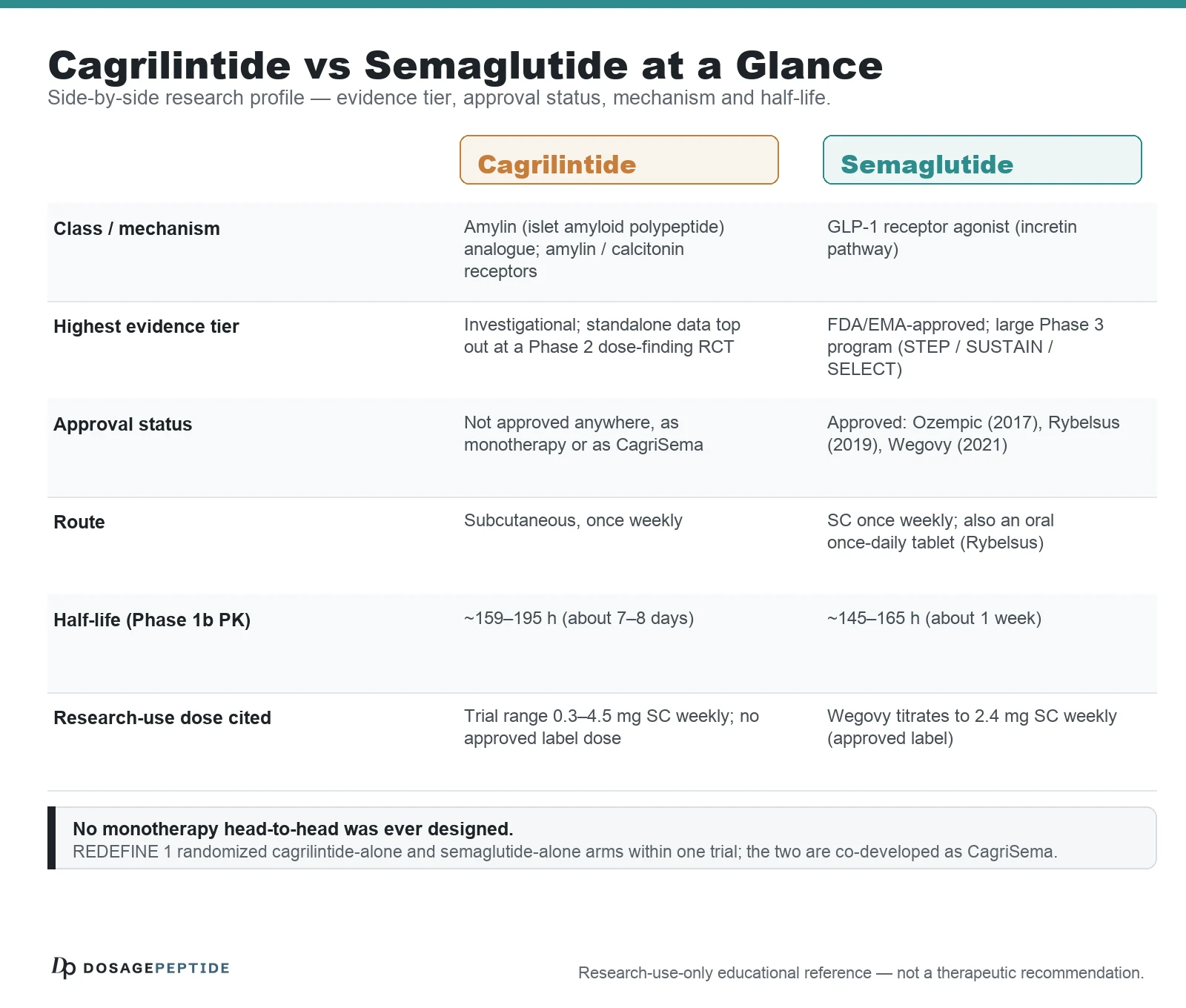
If you read only one section, read this one. Semaglutide is a GLP-1 receptor agonist with established, approved uses and thousands of participants across its pivotal trials; cagrilintide is a long-acting amylin analogue whose human record, as a standalone agent, is a single Phase 2 dose-finding study.[2][1] Because they hit complementary targets, the two are being co-developed as a fixed-dose combination known as CagriSema — which is why most of cagrilintide’s later human data appear only alongside semaglutide, not on its own.[3] The orientation table below is unpacked, with citations, in the sections that follow.
| Attribute | Cagrilintide | Semaglutide |
|---|---|---|
| Class / mechanism | Long-acting amylin (islet amyloid polypeptide) analogue; agonist at amylin/calcitonin receptors — a satiety pathway distinct from GLP-1 | Glucagon-like peptide-1 (GLP-1) receptor agonist; glucose-dependent insulin secretion, slowed gastric emptying, central appetite suppression |
| Primary research use | Weight management in overweight/obesity; studied mainly as the amylin component of CagriSema, with monotherapy limited to dose-finding | Chronic weight management (Wegovy) and type 2 diabetes (Ozempic/Rybelsus); also cardiovascular risk reduction |
| Highest evidence tier | Investigational. Standalone human data top out at a Phase 2 dose-finding RCT (n=706); later human data only as the combination[1] | FDA/EMA-approved with an extensive Phase 3 RCT program (STEP for obesity, SUSTAIN for T2D, SELECT for CV outcomes)[2] |
| Route | Subcutaneous injection, once weekly (all published trials) | Subcutaneous once weekly (Ozempic/Wegovy); also an approved oral once-daily tablet (Rybelsus) for T2D |
| Half-life | ~159–195 h (roughly 7–8 days) in the Phase 1b PK analysis[3] | ~145–165 h (roughly one week) in the same Phase 1b analysis; the label commonly cites about one week[3] |
| Approval status | Investigational; not approved by FDA or EMA as a standalone agent, nor (at the time of writing) as the CagriSema combination[4] | FDA-approved: Ozempic (2017, T2D), Rybelsus (2019, oral T2D), Wegovy (2021, weight management); also EMA-approved |
What Is Cagrilintide?
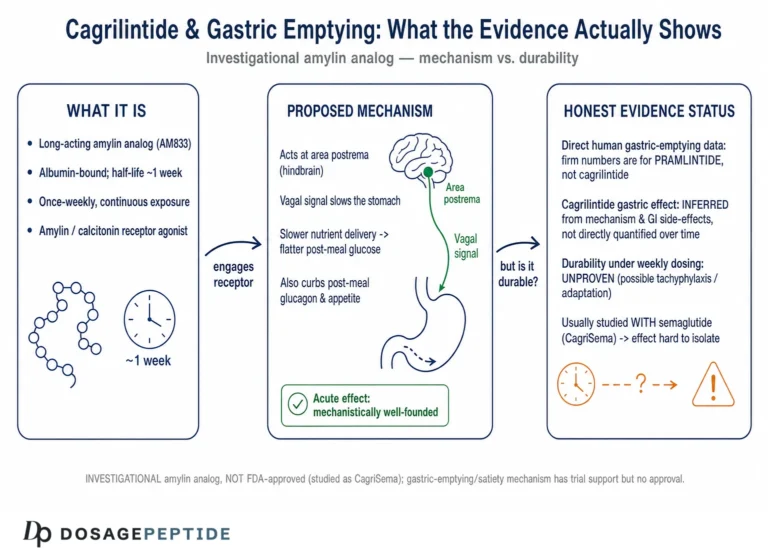
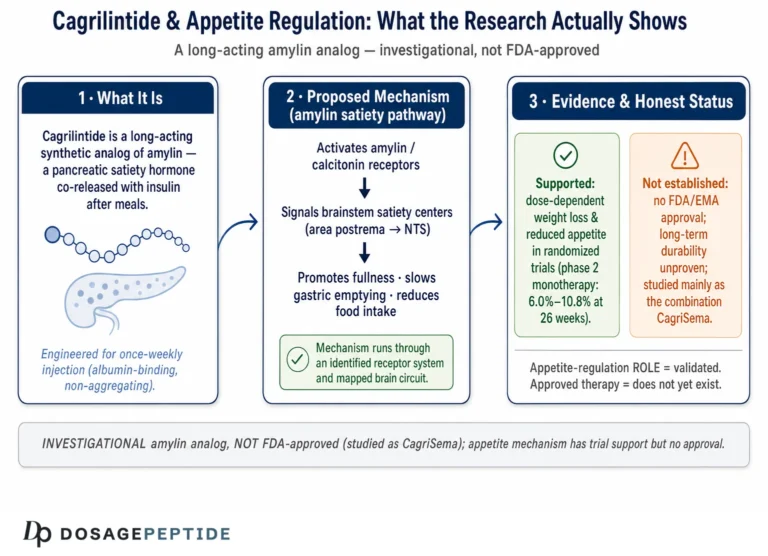
Cagrilintide is a long-acting synthetic analogue of amylin, a pancreatic hormone (also called islet amyloid polypeptide) that is co-secreted with insulin and signals satiety. It acts as an agonist at the amylin and calcitonin receptors, and in that role it promotes fullness, slows gastric emptying, and reduces food intake — a mechanism entirely separate from the incretin (GLP-1) system.[1] Structural fatty-acid modification gives it a multi-day half-life that supports once-weekly dosing.[3]
The important framing point is that cagrilintide is investigational: it has no approved indication anywhere, and its clinical story is dominated by its role as the amylin half of the CagriSema combination. For how the satiety mechanism is described in the research literature, see our references on cagrilintide’s role in appetite regulation and on how cagrilintide affects gastric emptying and postprandial metabolism. Because it targets a different receptor system than the GLP-1 drugs, it is not a “stronger Ozempic” — it is a different tool being tested for complementary effect.
What Is Semaglutide?
Semaglutide is a GLP-1 receptor agonist — a modified analogue of the incretin hormone glucagon-like peptide-1. By activating the GLP-1 receptor it enhances glucose-dependent insulin secretion, slows gastric emptying, and acts centrally to suppress appetite.[2] A key engineering detail — fatty-acid conjugation that binds albumin — extends its half-life to about a week and enables once-weekly injection, with a separate oral tablet formulation (Rybelsus) approved for type 2 diabetes. For a plain-language primer on the receptor class, see our guide to what a GLP-1 is, and for the mechanism as it is studied experimentally, how semaglutide activates GLP-1 receptors in metabolic research models.
Unlike cagrilintide, semaglutide is a fully marketed, approved medicine. It is sold as Ozempic (type 2 diabetes, approved 2017), Rybelsus (oral type 2 diabetes, 2019), and Wegovy (chronic weight management, 2021), and it carries the broadest approved evidence base of any agent in this comparison. That approval status is the single biggest difference between the two compounds, and it is worth keeping in view through every section that follows.
Do They Work the Same Way? Two Different Mechanisms
No — and this is the most common misconception about the pair. It is tempting to lump cagrilintide and semaglutide together as “appetite peptides,” but they engage different receptor systems. Semaglutide is a GLP-1 receptor agonist working through the incretin axis; cagrilintide is an amylin analogue working through amylin/calcitonin receptors.[2][1] Both converge on the same downstream themes — increased satiety, slowed gastric emptying, reduced intake — but they arrive there by separate routes.
That mechanistic separateness is precisely why the two are combined rather than compared. The scientific rationale for CagriSema is complementarity: pairing an amylin analogue with a GLP-1 analogue is a bet that two distinct satiety pathways can add to each other, not that one replaces the other.[3] Reading the pair as substitutes misunderstands the entire development program. For how these agents sit among the broader wave of metabolic peptides, our overview of how retatrutide, semaglutide and tirzepatide compare maps the incretin landscape, and Cagrilintide vs Retatrutide places the amylin approach beside a triple-agonist.
How We Got Here: From Monotherapies to CagriSema
The two molecules arrived from different lineages but converged on one program. Semaglutide grew out of Novo Nordisk’s long incretin franchise, advancing from type 2 diabetes (Ozempic, Rybelsus) into obesity (Wegovy) on the strength of the STEP Phase 3 trials.[2] Cagrilintide was developed as a next-generation amylin analogue and first showed its standalone dose-response in a Phase 2 trial before the strategic decision that has defined it since: combining it with semaglutide.[1]
That combination — CagriSema — moved from a Phase 1b safety-and-pharmacokinetics study, which co-administered the two agents and characterized the half-life of each, into the Phase 3 REDEFINE program.[3][4] The practical consequence for anyone comparing the pair: cagrilintide’s deepest human data exist because of semaglutide, not in isolation from it. Researchers looking at the combination framing can see how the site catalogues the pairing in the CagriSema combination research dosage reference and in our explainer on the cagrilintide-and-semaglutide combination in obesity-related liver disease.
Regulatory and Approval Reality
Stated plainly: semaglutide is approved and marketed; cagrilintide is not approved anywhere. Semaglutide holds FDA approvals as Ozempic (2017), Rybelsus (2019), and Wegovy (2021), plus EMA authorization, and is one of the most widely prescribed metabolic drugs in the world. Cagrilintide, by contrast, remains investigational as a standalone agent, and the CagriSema fixed-dose combination — although it completed its Phase 3 REDEFINE trials — was not an approved product at the time of writing.[4]
This asymmetry is not a minor footnote; it governs how each compound’s data should be read. Semaglutide’s efficacy and safety have been evaluated by regulators against large, long trials. Cagrilintide has no such regulatory determination behind it, which means claims about its long-term benefit or safety rest on a far thinner base — and any material sold outside an approved supply chain is research-use-only regardless of what a label says.
Cagrilintide: What the Human Evidence Shows
Cagrilintide’s standalone human evidence is real but narrow. The pivotal study is a multicentre, randomised, double-blind, placebo-controlled and active-controlled Phase 2 dose-finding trial in adults with overweight or obesity (without diabetes), conducted across 57 sites in ten countries.[1] Participants were randomized to once-weekly subcutaneous cagrilintide across a dose range of 0.3 to 4.5 mg, to once-daily liraglutide 3.0 mg as an active comparator, or to placebo, over a 26-week treatment period. The trial mapped a dose-dependent effect on body weight and characterized tolerability — genuine, well-designed human data, but at the dose-finding (Phase 2) tier and with an active comparator that was liraglutide, not semaglutide.
Beyond that single monotherapy study, cagrilintide’s human record is combination data. The Phase 1b trial co-administered cagrilintide with semaglutide 2.4 mg and reported safety, tolerability, and the pharmacokinetics used to estimate each agent’s half-life.[3] The Phase 3 REDEFINE trials then tested the combination at scale — REDEFINE 1 in overweight/obesity without diabetes, REDEFINE 2 in type 2 diabetes, and REDEFINE 5 as an active-controlled comparison of the combination against semaglutide alone.[4][5][6] The honest summary: cagrilintide has one standalone Phase 2 trial and a growing body of combination Phase 3 evidence, but nothing approaching semaglutide’s independent, approved base.
Semaglutide: What the Human Evidence Shows
Semaglutide’s human record is its defining strength. In the pivotal STEP 1 trial, 1,961 adults with overweight or obesity (without diabetes) were randomized 2:1 to once-weekly subcutaneous semaglutide 2.4 mg or placebo, plus lifestyle intervention, for 68 weeks. Mean body-weight change was −14.9% with semaglutide versus −2.4% with placebo — an estimated treatment difference of about 12.4 percentage points — with most of the semaglutide group reaching at least 5% or 10% weight loss and about half reaching 15%.[2]
STEP 1 is one trial in a much larger program: the STEP trials in obesity, the SUSTAIN trials in type 2 diabetes, and the SELECT cardiovascular-outcomes trial together comprise thousands of participants and underpin semaglutide’s approvals across three indications. This is the highest clinical evidence tier in the comparison, and it is why our reference on whether semaglutide provides a sustainable solution for long-term weight loss can discuss durability and cardiometabolic endpoints in a way that simply is not possible for cagrilintide yet. The contrast is not that semaglutide “wins” a contest — it is that only one of the two compounds has been measured this thoroughly.
Head-to-Head vs. Cross-Trial: The Only Fair Comparisons
This is the section that keeps the rest honest. No trial was designed with cagrilintide monotherapy versus semaglutide monotherapy as its primary comparison. When a source ranks one “above” the other on weight loss, it is usually stitching together STEP 1 (semaglutide) and the cagrilintide Phase 2 trial — different populations, comparators, durations, and endpoints — which is cross-trial inference, not a measured result.
What makes this pair unusual is that a within-trial randomized comparison does partly exist. REDEFINE 1 randomized participants across four arms — the cagrilintide–semaglutide combination, semaglutide 2.4 mg alone, cagrilintide 2.4 mg alone, and placebo — so the two monotherapies were assigned within one study, even though the trial’s primary comparison was the combination against placebo.[4] Separately, REDEFINE 5 is an active-controlled head-to-head — but of the combination against semaglutide alone, not of cagrilintide alone against semaglutide alone.[6] The grading table below lays out what each available comparison can and cannot establish.
| Comparison | Study design available | Evidence strength | What it actually shows |
|---|---|---|---|
| Cagrilintide-alone vs semaglutide-alone, as the primary question | None designed for this as the headline endpoint | No dedicated head-to-head; not established | Any monotherapy ranking is largely cross-trial inference |
| Cagrilintide-alone vs semaglutide-alone, within one trial | REDEFINE 1 randomized both monotherapy arms alongside the combination and placebo[4] | Human Phase 3a (secondary to the combination-vs-placebo endpoint) | The closest within-trial comparison, but not the trial’s primary contrast |
| Combination (CagriSema) vs semaglutide alone | REDEFINE 5, active-controlled Phase 3a[6] | Human RCT, head-to-head by design | Tests whether adding cagrilintide to semaglutide beats semaglutide alone — not a cagrilintide-alone question |
| Semaglutide for weight management | STEP 1 pivotal RCT (n=1961)[2] | Strong (Phase 3, pivotal); FDA/EMA-approved | −14.9% vs −2.4% placebo at 68 weeks |
| Cagrilintide monotherapy for weight management | Phase 2 dose-finding RCT (n=706), comparator liraglutide[1] | Moderate (Phase 2, dose-finding); investigational | Dose-dependent effect; hypothesis-advancing, not an approval-grade base |
Reading the Numbers Honestly: Half-Life and Duration
One number travels well between the two: both are once-weekly injectables with a roughly week-long half-life. The Phase 1b pharmacokinetic analysis that co-administered the pair estimated cagrilintide’s half-life at about 159–195 hours (roughly 7–8 days) and semaglutide’s at about 145–165 hours (roughly one week).[3] The full-specification table gathers the side-by-side detail; the half-life and dosing rows in particular should be read as trial and label references, not as a protocol.
| Property | Cagrilintide | Semaglutide |
|---|---|---|
| Molecular class | Long-acting amylin (IAPP) analogue | GLP-1 receptor agonist (incretin analogue) |
| Receptor target | Amylin / calcitonin receptors | GLP-1 receptor |
| Route | Subcutaneous, once weekly | Subcutaneous once weekly; oral once daily (Rybelsus, T2D) |
| Half-life | ~159–195 h (~7–8 days)[3] | ~145–165 h (~1 week)[3] |
| Highest human evidence tier | Phase 2 dose-finding RCT standalone; Phase 3 only as the combination[1] | Multiple pivotal Phase 3 RCTs; approved[2] |
| Dosing reference (research-use, NOT clinical guidance) | Trial range 0.3–4.5 mg SC weekly; 2.4 mg in CagriSema; no approved label dose[1] | Wegovy titrates to 2.4 mg SC weekly; Ozempic 1.0–2.0 mg weekly (approved labels) |
| Approval status | Investigational; not approved | FDA- and EMA-approved |
| Boxed warning | None assigned (no marketed label) | Thyroid C-cell tumour risk (rodent signal); contraindicated with MTC/MEN2 |
Research-Use Dosing Conventions (Research Settings Only)
The figures below are reported from published trials and approved product labels. They are provided to help interpret the literature, not as a protocol for human use; where a compound or use is not approved, the reference is experimental only.
- Cagrilintide — the Phase 2 trial administered once-weekly subcutaneous doses across a 0.3–4.5 mg range, and the CagriSema combination uses 2.4 mg; there is no approved label dose.[1] On dosagepeptide.com these are framed research-use-only. See the Cagrilintide 5 mg vial research dosage reference, the Cagrilintide 10 mg vial reference, and the cagrilintide weekly dosing chart.
- Semaglutide — for weight-management research the reference is the Wegovy titration to 2.4 mg subcutaneously weekly; for type 2 diabetes, Ozempic titrates to 1.0–2.0 mg weekly.[2] These are approved clinical labels, and any non-clinical handling is research-use only. See the Semaglutide 5 mg vial research dosage reference and the Semaglutide 10 mg vial reference.
Safety and Tolerability
Both compounds share a gastrointestinal-forward tolerability profile, but the depth of the safety record is very different. Semaglutide’s safety is characterized across large Phase 3 and cardiovascular-outcome trials; cagrilintide’s comes from a Phase 2 study and combination trials, with no marketed-drug pharmacovigilance record because it remains investigational.
| Safety dimension | Cagrilintide | Semaglutide |
|---|---|---|
| Most common adverse effects | Gastrointestinal (nausea, constipation, diarrhoea) and injection-site reactions; mostly mild-to-moderate and transient in trials[1] | Gastrointestinal (nausea, diarrhoea) most common, usually transient; well characterized from large trials[2] |
| Boxed warning / contraindications | None assigned — there is no marketed label | Boxed warning for thyroid C-cell tumours (rodent signal); contraindicated with personal/family history of medullary thyroid carcinoma or MEN2 |
| Monitored risks | Not formally established (investigational) | Monitored for pancreatitis and gallbladder events in the approved labels |
| Long-term safety data | Not established as a standalone agent | Characterized across multi-year Phase 3 and CV-outcome trials |
The takeaway is not that cagrilintide is “more dangerous” — its trial adverse events were mostly transient GI effects — but that its long-term safety is simply unestablished, whereas semaglutide’s risks (including the thyroid C-cell boxed warning) are defined precisely because it has been studied and regulated at scale.
Which Is Studied for What?
Mapping each compound to its actual research context prevents the “interchangeable weight-loss shot” error. Semaglutide is studied and approved for three things: type 2 diabetes (Ozempic/Rybelsus), chronic weight management (Wegovy), and cardiovascular risk reduction — the broadest indication set in this pair. Cagrilintide is studied almost entirely for weight management, and predominantly as the amylin component of CagriSema; its standalone footprint is a dose-finding study, while its scale-up data (REDEFINE 1, 2, and 5) are combination trials.[1][5] In short, semaglutide is a multi-indication, approved medicine, and cagrilintide is an investigational weight-management agent whose future is tied to a combination product.
What the Evidence Does NOT Show
Being explicit about the gaps is part of reading this pair honestly. The published evidence does not show any of the following:
- That cagrilintide monotherapy is superior or inferior to semaglutide monotherapy — no trial was designed with that as its primary comparison, and the within-trial REDEFINE 1 arms were secondary to the combination-versus-placebo endpoint.
- That cagrilintide is approved, or that removal of any regulatory hurdle equals approval — it remains investigational, standalone and as CagriSema, at the time of writing.
- That the two are interchangeable — they act on different receptors (amylin/calcitonin vs GLP-1) and are co-developed as a combination, not as substitutes.
- That cagrilintide’s long-term safety matches semaglutide’s — semaglutide has multi-year trial and pharmacovigilance data and a defined boxed warning; cagrilintide has no established long-term profile.
- That any research-market vial equals the trial drug — trial data describe a characterized study compound, not the contents of an arbitrary product.
Limitations of This Comparison
Several structural limitations constrain everything above, and honest readers should keep them in view:
- Evidence-depth asymmetry. Semaglutide has a mature Phase 3 base across three indications; cagrilintide has one standalone Phase 2 trial and combination-only Phase 3 data. The two are not on the same rung of the evidence ladder.
- No monotherapy head-to-head by design. The closest within-trial comparison (REDEFINE 1) was secondary to a combination endpoint, so a clean cagrilintide-alone-versus-semaglutide-alone conclusion is not available.
- Combination confound. Most of cagrilintide’s scale-up data come bundled with semaglutide, which makes isolating cagrilintide’s independent contribution difficult.
- Changing regulatory status. Approval status can change after any writing date; the CagriSema combination had completed Phase 3 but was not approved at the time of writing — always re-check current status.
- Research-chemical identity. Material sold research-use-only has unverified identity and purity; trial data are not product data.
Practical and Research Context
For readers using this material to interpret the literature rather than to guide any human use, a few practical anchors help. The reconstitution and concentration arithmetic is identical in principle for both once-weekly injectables — our peptide reconstitution guide and dosage calculator walk through converting a vial concentration into a measured volume, and the peptide research glossary defines terms such as amylin, GLP-1, incretin, and half-life used throughout this article. None of that is a recommendation for administration; it is how the compounds are characterized in research.
Because research-market material is sold outside any approved supply chain, its identity and purity are unverified — and this matters more, not less, when one compound in the pair is an approved drug and the other is investigational. Trial data describe a characterized study drug, so identity confirmation (for example by mass spectrometry and HPLC) plus a batch certificate of analysis is the minimum a rigorous research setting should require. Reference vials of these compounds are catalogued by research-grade peptide suppliers such as Prime Lab. Sourcing a tested material does not change the evidence picture described above — the approval asymmetry and the absence of a monotherapy head-to-head still stand, trial data do not transfer to any specific product, and nothing here is a therapeutic recommendation.
Common Misconceptions
“Cagrilintide is just a newer, stronger semaglutide.”
No. They act on different receptors — cagrilintide on amylin/calcitonin receptors, semaglutide on the GLP-1 receptor — and they are being co-developed as a combination, not positioned as substitutes. “Newer” is true; “stronger version of the same thing” is not, because it is not the same mechanism.
“There’s a trial proving one beats the other.”
Not as monotherapies. No trial was designed to compare cagrilintide alone against semaglutide alone as its primary endpoint. REDEFINE 1 did randomize both monotherapy arms within one study, and REDEFINE 5 compares the combination against semaglutide alone — but neither delivers a headline cagrilintide-alone-versus-semaglutide-alone verdict.
“Cagrilintide is basically approved because CagriSema finished Phase 3.”
Completing Phase 3 is not approval. At the time of writing, neither cagrilintide as a standalone agent nor the CagriSema combination was an approved product. Semaglutide, by contrast, is approved and marketed across multiple indications.
“Both are equally well understood for safety.”
They are not. Semaglutide’s safety is defined by large, long trials and a marketed label with a boxed warning and contraindications; cagrilintide’s trial adverse events were mostly transient gastrointestinal effects, but its long-term safety is unestablished because it remains investigational.
Key Takeaways
- Different mechanisms, not rivals. Cagrilintide is an amylin analogue; semaglutide is a GLP-1 receptor agonist. They are co-developed as the CagriSema combination.
- Approval is asymmetric. Semaglutide is FDA- and EMA-approved (Ozempic/Rybelsus/Wegovy); cagrilintide is investigational and not approved anywhere.
- Evidence depth is asymmetric. Semaglutide has a large Phase 3 program; cagrilintide’s standalone human data top out at a Phase 2 dose-finding trial, with Phase 3 data only as the combination.
- No monotherapy head-to-head by design. REDEFINE 1 randomized both monotherapy arms within one study, but as a secondary contrast; REDEFINE 5 compares the combination against semaglutide alone.
- Similar tolerability shape, different safety certainty. Both are GI-forward; only semaglutide has a defined long-term safety and boxed-warning profile.
- Research-market vials have unverified identity and purity. Trial data are not product data, and nothing here is medical advice.
Frequently Asked Questions
Is cagrilintide or semaglutide better?
No trial was designed to compare the two as monotherapies, so “better” cannot be established head-to-head. On evidence and regulatory status the difference is clear-cut: semaglutide is FDA/EMA-approved with a large Phase 3 base, while cagrilintide is investigational with standalone data limited to a Phase 2 dose-finding trial. Any monotherapy ranking is largely cross-trial inference.
Do cagrilintide and semaglutide work the same way?
No. Cagrilintide is an amylin analogue acting on amylin/calcitonin receptors, and semaglutide is a GLP-1 receptor agonist acting on the incretin pathway. Both increase satiety and slow gastric emptying, but through separate receptor systems — which is exactly why they are combined rather than substituted.
What is CagriSema?
CagriSema is the fixed-dose combination of cagrilintide and semaglutide (both at 2.4 mg), developed to pair two complementary satiety pathways. It was tested in the Phase 3 REDEFINE program. At the time of writing it had completed Phase 3 trials but was not an approved product.
Is cagrilintide FDA-approved?
No. Cagrilintide is investigational and not approved by the FDA or EMA, either as a standalone agent or as the CagriSema combination at the time of writing. It is research-use-only outside of clinical trials.
Is semaglutide FDA-approved?
Yes. Semaglutide is approved as Ozempic (type 2 diabetes, 2017), Rybelsus (oral type 2 diabetes, 2019), and Wegovy (chronic weight management, 2021), and it is also EMA-approved. It is a fully marketed medicine.
Has any trial compared cagrilintide and semaglutide directly?
Not as monotherapies with that as the primary question. REDEFINE 1 randomized a cagrilintide-alone arm and a semaglutide-alone arm within one study, but the trial’s primary comparison was the combination versus placebo. REDEFINE 5 is an active-controlled head-to-head of the combination against semaglutide alone, not of cagrilintide alone against semaglutide alone.
How long do cagrilintide and semaglutide last in the body?
Both are long-acting, once-weekly injectables. In the same Phase 1b pharmacokinetic analysis, cagrilintide’s half-life was estimated at about 159–195 hours (roughly 7–8 days) and semaglutide’s at about 145–165 hours (roughly one week). Duration is similar; it is not the same as clinical benefit.
What doses are used in research?
Cagrilintide’s Phase 2 trial used once-weekly subcutaneous doses across a 0.3–4.5 mg range, and the CagriSema combination uses 2.4 mg; there is no approved cagrilintide label dose. For semaglutide, Wegovy titrates to 2.4 mg weekly for weight management and Ozempic to 1.0–2.0 mg weekly for diabetes. These are trial and label references, not dosing guidance.
Are these safe to combine, and is any of this medical advice?
The cagrilintide–semaglutide combination is exactly what CagriSema is, and it was studied in the REDEFINE Phase 3 trials — but as an investigational product, not an approved one, and not as a self-directed protocol. This article is educational reference material summarizing published research and regulatory status; it is not medical advice, not a therapeutic recommendation, and not instructions for human use.
References
- Lau DCW, Erichsen L, Francisco AM, et al. Once-weekly cagrilintide for weight management in people with overweight and obesity: a multicentre, randomised, double-blind, placebo-controlled and active-controlled, dose-finding phase 2 trial. Lancet. 2021;398(10317):2160–2172. doi:10.1016/S0140-6736(21)01751-7. PMID 34798060.
- Wilding JPH, Batterham RL, Calanna S, et al. Once-weekly semaglutide in adults with overweight or obesity (STEP 1). N Engl J Med. 2021;384(11):989–1002. doi:10.1056/NEJMoa2032183. PMID 33567185.
- Enebo LB, Berthelsen KK, Kankam M, et al. Safety, tolerability, pharmacokinetics, and pharmacodynamics of concomitant administration of multiple doses of cagrilintide with semaglutide 2.4 mg for weight management: a randomised, controlled, phase 1b trial. Lancet. 2021;397(10286):1736–1748. doi:10.1016/S0140-6736(21)00845-X. PMID 33894838.
- Garvey WT, Blüher M, Osorto Contreras CK, et al. Coadministered cagrilintide and semaglutide in adults with overweight or obesity (REDEFINE 1). N Engl J Med. 2025;393(7):635–647. doi:10.1056/NEJMoa2502081. PMID 40544433.
- Davies MJ, Bajaj HS, Broholm C, et al. Cagrilintide–semaglutide in adults with overweight or obesity and type 2 diabetes (REDEFINE 2). N Engl J Med. 2025;393(7):648–659. doi:10.1056/NEJMoa2502082. PMID 40544432.
- Yamauchi T, Becker NP, Hagemann CA, et al. Efficacy and safety of co-administered cagrilintide and semaglutide versus semaglutide alone in adults with overweight or obesity with or without type 2 diabetes in Japan and Taiwan (REDEFINE 5): a multicentre, randomised, active-controlled, phase 3a trial. Lancet Diabetes Endocrinol. 2026;14(6):450–462. doi:10.1016/S2213-8587(25)00402-4. PMID 42009015.
Research-use disclaimer: This article is educational reference material summarizing published research and regulatory context. It is not medical advice, not a therapeutic recommendation, and not instructions for human use. Cagrilintide is investigational and not approved by any major regulator; semaglutide is an approved medicine but any non-clinical use of research-grade material is research-use only. Descriptions of dosing refer to clinical-trial protocols and approved product labels only. Always verify current clinical-trial and regulatory status through primary sources such as PubMed, ClinicalTrials.gov, and the FDA.