Semaglutide’s Mechanism of Action, in Plain Terms
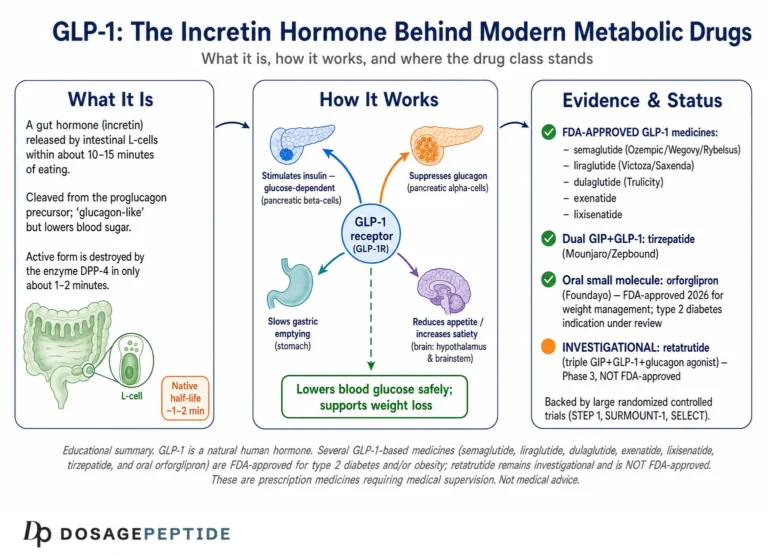
Semaglutide is a long-acting copy of GLP-1, a gut hormone your body releases after you eat. It binds the GLP-1 receptor and does four things at once: it tells the pancreas to release insulin only when blood glucose is high, it suppresses glucagon (the hormone that pushes glucose up), it slows how fast the stomach empties, and it acts on appetite centres in the brain so you feel full sooner and stay full longer.
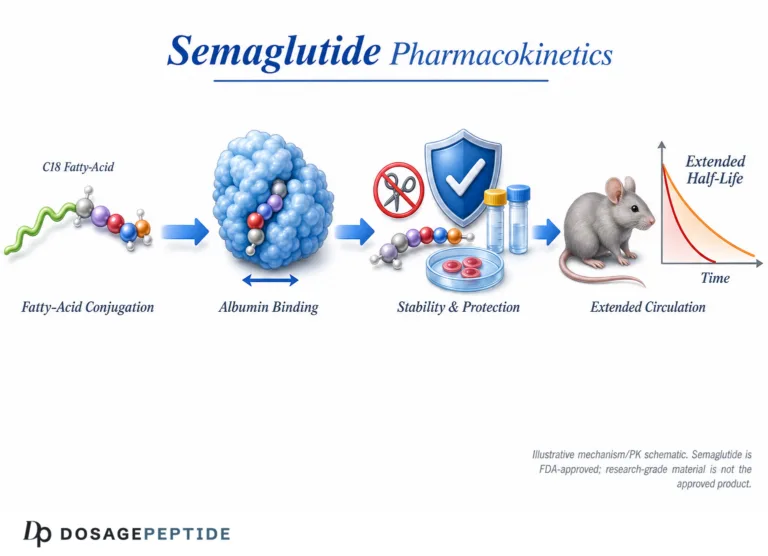
Two features explain almost everything downstream. The insulin effect is glucose-dependent, which is why it lowers blood sugar without the hypoglycaemia risk that comes with injected insulin. And a fatty-acid chain attached to the molecule makes it bind albumin in the blood, stretching its half-life to about a week — that is what turns a hormone lasting minutes into a once-weekly injection. Everything below is the detailed version of those two sentences: the receptor, the signalling cascade, the tissues involved, and where the open questions still are.
The question of how semaglutide activates GLP-1 receptors in metabolic research models is, refreshingly, one that can be answered with real data rather than speculation. Unlike many peptides discussed in this field, semaglutide is not an investigational curiosity: it is a fully approved medicine, marketed as Ozempic and Rybelsus for type 2 diabetes and as Wegovy for chronic weight management, and its mechanism has been dissected across structural biology, cell-based receptor assays, isolated islets, rodent models, and large human trials.1 That means we can trace a reasonably continuous chain from the atomic-level event — a peptide clasping a receptor — through intracellular second messengers, to whole-organism metabolic outcomes.
But the phrasing deserves a moment of scrutiny before we proceed, because “metabolic research models” is doing quiet work in the question. The molecular details of GLP-1 receptor activation come overwhelmingly from models: recombinant receptors in engineered cell lines, cryo-electron-microscopy structures of purified receptor–G-protein complexes, transfected islet preparations, and knockout or reporter rodents.34 These systems are powerful, but they are simplifications. A finding that semaglutide raises cyclic AMP in a HEK293 cell expressing a cloned human receptor tells us the molecule is a competent agonist; it does not, by itself, tell us which of those signals matters for a person’s blood glucose or appetite. Conversely, the human trials tell us the drug works clinically but cannot resolve the receptor-level events. Honest mechanistic writing keeps those layers distinct rather than collapsing “activates the receptor in a dish” into “this is why it works in patients.”
This article is written for researchers and scientifically literate readers who want an accurate map of the receptor-activation mechanism: what semaglutide is at the molecular level, how the GLP-1 receptor is built and engaged, the intracellular cascade that follows, why the beta-cell response is glucose-dependent, how the same receptor is read differently across tissues, and which research models have supplied which pieces of the picture. We will then connect that mechanism, carefully, to the approved clinical evidence — SUSTAIN, STEP, SELECT, and FLOW — without overstating how directly the molecular story explains the clinical one. Throughout, the aim is precision: semaglutide is a genuinely effective, approved drug, and precisely because that is true, it deserves description that neither inflates the mechanism nor smooths over its open questions.
From Native Incretin to a Once-Weekly Analogue
To understand how semaglutide activates the GLP-1 receptor, it helps to start with the molecule it was engineered from. Glucagon-like peptide-1 (GLP-1) is an incretin hormone: a 30- or 31-amino-acid peptide released from enteroendocrine L-cells in the distal gut in response to a meal. Its physiological job is to help the body handle an incoming nutrient load — it augments glucose-stimulated insulin secretion, suppresses glucagon, slows gastric emptying, and promotes satiety.1 The problem, from a drug-design standpoint, is that native GLP-1 is almost uselessly short-lived. The enzyme dipeptidyl peptidase-4 (DPP-4) clips the peptide at its second residue within minutes, and renal clearance finishes the job, giving native GLP-1 a circulating half-life on the order of one to two minutes.1 A hormone that vanishes that fast cannot be a once-weekly medicine.
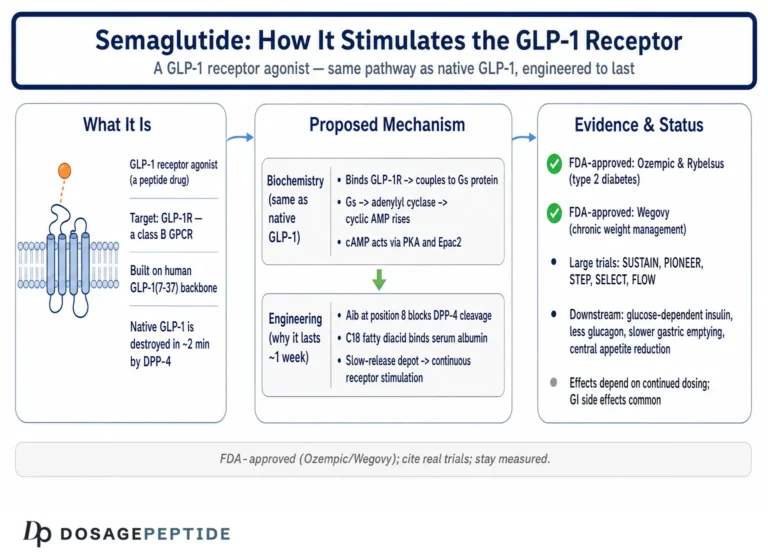
Semaglutide is the product of deliberately re-engineering that fragile hormone into a durable one while preserving its ability to switch on the receptor. It is an acylated GLP-1 analogue built on the human GLP-1(7–37) backbone with three purposeful modifications, described in the medicinal-chemistry work that produced it.2 First, the alanine at position 8 — the residue DPP-4 attacks — is replaced by the non-natural amino acid α-aminoisobutyric acid (Aib), which sterically blocks the enzyme. Second, the lysine at position 34 is swapped for arginine so that the acylation chemistry attaches at a single, defined site. Third, and most important for its longevity, the lysine at position 26 is acylated with a C-18 fatty diacid tethered through a short spacer.2 That fatty-acid appendage binds reversibly and tightly to circulating serum albumin, creating a slow-release depot that resists rapid clearance and shields the peptide from degradation. The net effect is a measured elimination half-life of roughly 165 hours — about one week — which is what makes once-weekly subcutaneous dosing possible.10
The following table lays out how each engineered change maps to a functional purpose. It is worth internalizing because a recurring confusion in popular writing is to treat semaglutide as simply “synthetic GLP-1,” when in fact it is a heavily modified analogue whose pharmacology diverges from the native hormone in duration, distribution, and receptor kinetics even as it targets the same receptor.
| Feature | Native GLP-1(7–37) | Semaglutide | Consequence |
|---|---|---|---|
| Position 8 residue | Alanine (DPP-4 substrate) | α-aminoisobutyric acid (Aib) | Resists DPP-4 cleavage2 |
| Position 34 residue | Lysine | Arginine | Directs acylation to a single lysine2 |
| Position 26 lysine | Unmodified | C-18 fatty diacid + spacer | Reversible albumin binding; depot effect2 |
| Plasma half-life | ~1–2 minutes | ~165 hours (~1 week) | Once-weekly dosing feasible10 |
| Primary target | GLP-1 receptor | GLP-1 receptor (selective) | Same receptor, sustained occupancy2 |
An oral formulation exists as well, and it solves a different problem. Peptides are normally destroyed in the gut, so oral semaglutide is co-formulated with the absorption enhancer salcaprozate sodium (SNAC), which locally raises gastric pH and promotes uptake across the stomach epithelium; this made Rybelsus the first orally available GLP-1 receptor agonist.11 The route of delivery changes the pharmacokinetics and bioavailability but not the fundamental receptor-activation event, which is what this article is chiefly about. Readers interested in how these design principles compare across the incretin class may find the site’s overview of what tirzepatide is and how it works a useful companion, since tirzepatide extends the same albumin-binding, DPP-4-resistant strategy to a dual receptor target.
The GLP-1 Receptor: A Class B GPCR
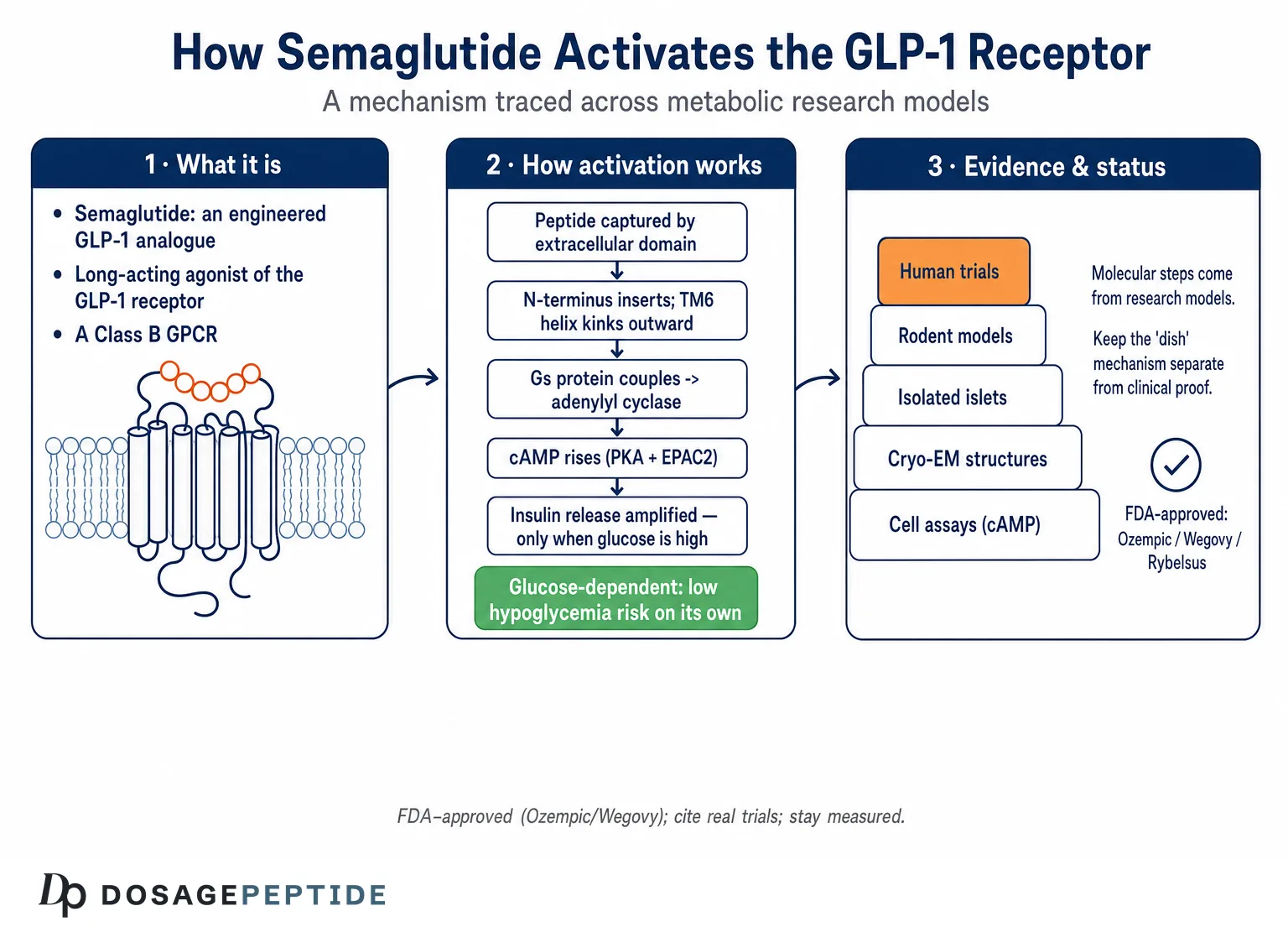
The target semaglutide acts on is the GLP-1 receptor (GLP-1R), a member of the class B (secretin-like) family of G-protein-coupled receptors. Understanding its architecture is central to understanding activation, because class B GPCRs bind their peptide agonists in a characteristic two-step fashion that differs from the small-molecule engagement seen in the more familiar class A receptors.
The GLP-1R has two functional modules: a relatively large extracellular domain (ECD) that projects away from the cell surface, and a seven-transmembrane helical bundle embedded in the membrane that constitutes the signaling core. The widely accepted “two-domain” model of activation holds that the C-terminal portion of the peptide agonist is first captured by the extracellular domain, which acts as an affinity trap; this tethering then positions the peptide’s N-terminus so it can insert into the transmembrane helical bundle, where it triggers the conformational changes that constitute activation.3 In other words, one end of the peptide provides binding energy and specificity, while the other end delivers the activating signal deep into the receptor core.
The decisive structural evidence came from cryo-electron microscopy. A landmark 2017 study resolved the full-length human GLP-1 receptor bound to a peptide agonist and coupled to its heterotrimeric Gs protein at near-atomic resolution — one of the first activated class B GPCR–G-protein complexes ever visualized.3 The structure showed the peptide clasped between the extracellular domain and the transmembrane core, and, critically, revealed a sharp kink in the middle of transmembrane helix 6 (TM6). This kink pivots the intracellular half of TM6 outward, opening a cavity on the cytoplasmic face of the receptor into which the α5 helix of the Gs protein’s Ras-like domain inserts.3 That outward swing of TM6 is the hallmark of class B GPCR activation and is the physical event that couples agonist binding to G-protein engagement. It is worth stressing that this structure was solved in a highly reductionist model system — purified, engineered receptor and G protein, stabilized for imaging — and that early structures often used a peptide agonist rather than semaglutide specifically; later work extended the approach to semaglutide-bound complexes. The mechanism it reveals is nonetheless the framework within which semaglutide activation is understood.
How does semaglutide fit into this? As an analogue of GLP-1 it engages the same two-domain mechanism: its sequence is close enough to native GLP-1 that it is captured by the extracellular domain and inserts into the transmembrane core, driving the TM6 movement and Gs coupling. The engineered modifications — the Aib at position 8, the arginine at 34, the acyl chain at 26 — were chosen to preserve receptor activation while conferring stability and albumin binding; they sit largely away from the critical activation-determining N-terminal residues. This is why semaglutide remains a potent, selective full agonist at the GLP-1R despite its extensive re-engineering.2 The albumin-binding fatty-acid chain does, however, have a kinetic consequence worth noting: because much of the circulating drug is sequestered on albumin, the free concentration available to bind receptor at any instant is buffered, which shapes the slow, sustained receptor occupancy characteristic of the molecule rather than the sharp peaks of the native hormone.
The Gs–cAMP Signaling Cascade
Once semaglutide has driven the receptor into its active conformation and the Gs protein is engaged, the downstream cascade follows the canonical stimulatory-G-protein logic. The activated receptor acts as a guanine-nucleotide exchange factor for Gsα, prompting it to release GDP and bind GTP; the GTP-loaded Gsα then dissociates and activates adenylyl cyclase at the plasma membrane. Adenylyl cyclase converts ATP into the second messenger cyclic AMP (cAMP), and the rise in intracellular cAMP is the central biochemical readout of GLP-1 receptor activation — the parameter most cell-based agonist assays actually measure.4
cAMP then acts through two principal effectors, and the distinction between them matters for the beta-cell physiology discussed below. The first is protein kinase A (PKA), the classic cAMP-dependent kinase, which phosphorylates a range of downstream substrates. The second is a family of guanine-nucleotide exchange factors known as EPACs (exchange proteins directly activated by cAMP), notably EPAC2, which mediate PKA-independent effects.4 In the pancreatic beta-cell, PKA and EPAC2 together modulate ion-channel activity, intracellular calcium handling, and the machinery of insulin-granule exocytosis. The net result is a potentiation of insulin secretion — but, crucially, a potentiation rather than an independent trigger, a point that becomes the defining feature of the whole system.
The table below summarizes the activation cascade as a sequence of discrete, experimentally accessible steps. Each step corresponds to something researchers can and do measure in metabolic research models — ligand binding by radioligand or fluorescence assays, cAMP accumulation by biosensor or immunoassay, G-protein coupling by structural and biochemical methods, and downstream calcium or exocytosis by imaging and electrophysiology.
| Step | Molecular event | Typical model / readout |
|---|---|---|
| 1. Capture | Peptide C-terminus binds receptor extracellular domain | Radioligand / fluorescence binding assays3 |
| 2. Insertion | Peptide N-terminus enters transmembrane core; TM6 kinks outward | Cryo-EM of receptor–G-protein complex3 |
| 3. G-protein coupling | Gsα exchanges GDP for GTP, dissociates | Structural + biochemical GTP-loading assays3 |
| 4. Second messenger | Adenylyl cyclase raises intracellular cAMP | cAMP biosensor / immunoassay in cell lines4 |
| 5. Effectors | PKA and EPAC2 activated | Kinase assays; EPAC-selective probes4 |
| 6. Functional output | Enhanced Ca²⁺ handling and insulin exocytosis | Islet/beta-cell Ca²⁺ imaging, secretion assays4 |
It is worth pausing on why cAMP is the readout that dominates the literature. cAMP is a diffusible, amplifiable second messenger: a single activated receptor can, over its lifetime, drive many turnovers of adenylyl cyclase, and each cyclase molecule makes many cAMP molecules, so a modest number of occupied receptors produces a disproportionately large intracellular signal. This amplification is what allows the low physiological concentrations of an incretin hormone — and the buffered, albumin-bound concentrations of semaglutide — to produce robust cellular responses. It is also why cAMP-based reporter assays are so sensitive and have become the standard currency for comparing agonist potency and efficacy across the GLP-1R agonist class. When a study reports an EC₅₀ for semaglutide at the human receptor, it is almost always this cAMP-accumulation readout that generated the number.
Two honest caveats attach to this tidy scheme. First, the GLP-1R, like most GPCRs, does not signal exclusively through Gs; it can recruit β-arrestins and engage other pathways, and the balance of these signals (the subject of “biased agonism” research) can differ between ligands. Semaglutide’s precise signaling “fingerprint” relative to native GLP-1 or to other analogues is an active area of study, not a closed book. Second, the cascade as drawn is a beta-cell-centric account; the same receptor in a neuron or a gastric neuron couples to the same G protein but produces entirely different functional outputs, a point we return to below.
Glucose Dependence: The Feature That Defines the Response
If there is one property of GLP-1 receptor activation that most deserves emphasis — both because it is mechanistically elegant and because it explains a key safety characteristic — it is glucose dependence. GLP-1 receptor agonists, including semaglutide, potentiate insulin secretion only when blood glucose is elevated; at normal or low glucose concentrations their insulinotropic effect largely falls away.4
The mechanism behind this is worth spelling out because it is genuinely a case of two signals converging. Insulin secretion from the beta-cell is fundamentally driven by glucose metabolism: glucose enters the cell, is metabolized to raise the ATP/ADP ratio, which closes ATP-sensitive potassium (KATP) channels, depolarizes the membrane, opens voltage-gated calcium channels, and triggers calcium-dependent exocytosis of insulin granules. GLP-1 receptor signaling — the cAMP/PKA/EPAC2 cascade — does not initiate this process; it amplifies it, by enhancing calcium handling, sensitizing the exocytotic machinery, and modulating the ion channels involved.4 Because the amplification is layered on top of a glucose-driven trigger, when glucose is low and the trigger is absent, there is little for the GLP-1 signal to amplify. The consequence is that semaglutide, acting through this pathway, carries an intrinsically low risk of causing hypoglycemia on its own — a marked contrast to insulin or sulfonylureas, which force insulin release regardless of glucose.4
This glucose-dependence is one of the clearest examples of why mechanistic detail matters for how a drug behaves. It also carries a practical corollary that researchers frequently overlook: because the insulinotropic effect scales with the prevailing glucose concentration, the same receptor-level activation produces a larger secretory response in a hyperglycemic diabetic islet than in a normoglycemic one. Effect size, in other words, is not a fixed property of the molecule but a joint function of receptor activation and the metabolic state of the tissue — a subtlety easily lost when the mechanism is compressed to “semaglutide increases insulin.” The more accurate formulation is that semaglutide increases the gain of the glucose-to-insulin coupling, which is precisely why its glycemic benefit is largest in those who are most hyperglycemic and why it does not drive insulin release in a fasting, euglycemic state. It is also a property established largely in isolated-islet and beta-cell-line models, where glucose concentration can be clamped and insulin output measured directly — a reminder that some of the most clinically important mechanistic insights come precisely from reductionist metabolic research models rather than from whole-organism studies. In parallel with potentiating insulin, GLP-1 receptor activation suppresses glucagon secretion from pancreatic alpha-cells, and this glucagon suppression is likewise glucose-dependent, being attenuated during hypoglycemia so that the counter-regulatory glucagon response is preserved.1 The dual action — more insulin, less glucagon, both gated by glucose — is the core of the drug’s glycemic mechanism.
Beyond the Beta Cell: One Receptor, Many Tissues
A common oversimplification is to picture semaglutide as a pancreatic drug. In fact GLP-1 receptors are expressed across a range of tissues — pancreatic islets, the gastrointestinal tract, the cardiovascular system, the kidney, and, importantly, multiple regions of the central nervous system — and the same Gs–cAMP activation event produces tissue-specific outputs.1 Appreciating this distribution is essential to understanding why the drug affects appetite, gastric motility, and cardiovascular endpoints, not merely blood sugar.
Gastrointestinal tract. GLP-1 receptor activation slows gastric emptying, a mechanism that blunts the post-meal glucose spike by delaying nutrient delivery to the intestine and that contributes to satiety.1 This effect is substantially mediated by neural circuits — vagal afferents relaying to the brainstem and back — rather than by a purely local action, and it is also the mechanistic basis for the most common adverse effects of the drug class: nausea, and, less often, vomiting and delayed gastric emptying with clinical relevance around anesthesia and procedures.12 The same mechanism that helps flatten glucose excursions is the one that makes patients feel full and occasionally queasy.
It is worth being explicit that this coupling of benefit and side effect is not incidental but mechanistically inseparable at our current level of understanding. The nausea associated with GLP-1 receptor agonists is thought to arise partly at the area postrema, a circumventricular structure in the brainstem that lies outside the blood-brain barrier and functions physiologically as a chemosensor for circulating signals of satiety and malaise. Because appetite suppression and nausea appear to share overlapping hindbrain substrates, a drug that engages those circuits strongly enough to curb food intake will, in many patients, also recruit the adjacent aversive pathways — which is precisely why the clinical dosing of semaglutide relies on slow, stepwise titration to let tolerance develop before the full dose is reached. This is an honest limitation rather than a footnote: the gastrointestinal adverse-effect burden documented in the STEP and SUSTAIN trials, and the treatment discontinuations it drove, are the direct behavioral expression of the same receptor activation that produces the therapeutic weight and glucose effects.7 Whether future agonists can pharmacologically separate the desirable appetite signal from the undesirable aversive one — through signaling bias, altered brain access, or receptor-subpopulation selectivity — is an open and actively pursued question, not a solved one.
Central nervous system. The appetite- and body-weight effects that make semaglutide a weight-management drug are, at their root, central. Here the research-model evidence is particularly instructive and deserves careful, non-overreaching description. In a detailed rodent study, semaglutide was shown to lower body weight through distributed neural pathways: labeled semaglutide accessed specific brain regions — the brainstem, septal nucleus, and hypothalamus — predominantly via the circumventricular organs and sites adjacent to the ventricles, rather than by broadly crossing the blood-brain barrier.5 It induced neuronal activation (measured by c-Fos) in around ten brain areas, including hindbrain regions it reached directly and secondary regions such as the lateral parabrachial nucleus that it did not contact directly, indicating a multi-node circuit.5 Functionally, in these rodents semaglutide reduced food intake and shifted food preference, lowering body weight without reducing energy expenditure.5 These are rodent findings in a controlled model; they map plausibly onto the human appetite effect but should not be recited as though the human brain circuitry has been directly imaged in the same way.
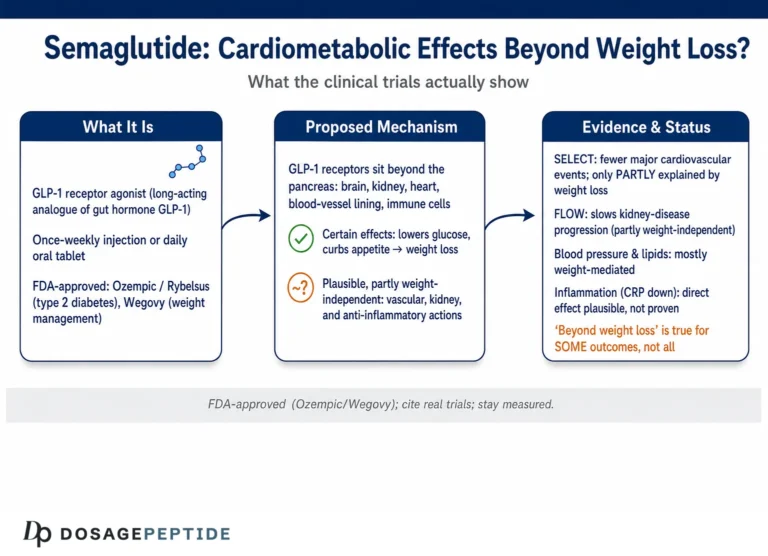
Cardiovascular and renal tissues. GLP-1 receptors are present in the cardiovascular system and kidney, and the drug’s benefits on these endpoints (discussed in the clinical section) likely reflect a mix of direct receptor-mediated effects and indirect consequences of improved glycemia, weight, blood pressure, and inflammation.1 The relative contribution of direct versus indirect mechanisms to cardiovascular protection remains incompletely resolved — an honest statement of the current science rather than a hedge. Anti-inflammatory effects are one plausible bridge: GLP-1 receptor signaling has been associated with reductions in markers such as C-reactive protein, and vascular endothelial and immune cells express the receptor, so a portion of the benefit may be inflammatory modulation rather than glucose or weight change alone. But separating these strands in humans is genuinely hard, because the drug simultaneously lowers weight, glucose, blood pressure, and inflammation, all of which independently affect cardiovascular risk. For a focused treatment of one such pathway, the site’s discussion of GLP-1 signaling mechanisms in arterial stiffness examines how receptor activation may act on the vasculature specifically.
The unifying point is that “how semaglutide activates the GLP-1 receptor” has one molecular answer — Gs coupling and cAMP elevation — but many physiological answers, because the receptor is read differently in different cells. A researcher who characterizes cAMP production in a pancreatic model has described the receptor’s activation faithfully but has captured only one of its many biological faces.
Research Models Used to Study Receptor Activation
Because the title asks specifically about “metabolic research models,” it is worth cataloguing the experimental systems that have actually produced the mechanistic knowledge, and being candid about what each can and cannot show. The evidence base is a layered pyramid, and confidence should scale with how directly a model addresses the question at hand.
Recombinant cell-based receptor assays. The workhorse of GLP-1R pharmacology is the transfected mammalian cell line — commonly HEK293 or CHO cells — engineered to express the human receptor. In these systems, agonist potency and efficacy are quantified by measuring cAMP accumulation, β-arrestin recruitment, or receptor internalization in response to graded ligand concentrations. Such assays establish that semaglutide is a potent, selective full agonist and allow direct comparison of signaling profiles between analogues. Their limitation is obvious but often forgotten: an engineered cell over-expressing a single receptor in isolation is a caricature of a real metabolic cell, and quantitative potencies measured this way do not translate one-to-one into clinical dose or effect. Receptor over-expression in particular can distort the apparent efficacy of a partial or biased agonist, because a large receptor reserve lets even weak signalers look like full agonists; this is one reason potency rankings can shift between assay formats and why cross-study comparisons of “how strongly” semaglutide activates the receptor must specify the exact system used. The value of these assays is comparative and mechanistic, not predictive of dose in a person.
Structural biology. Cryo-EM and, historically, crystallography have supplied the atomic-level picture of how the receptor is engaged and activated, including the pivotal visualization of the activated receptor–Gs complex.3 These structures are snapshots of purified, stabilized complexes; they define what activation looks like geometrically but are inherently static and stripped of cellular context.
Isolated islets and beta-cell lines. Perfused pancreatic islets and immortalized beta-cell lines allow the glucose-dependence of insulin secretion to be dissected with glucose concentration as a controlled variable, and are the source of much of what we know about the PKA/EPAC2 branch and calcium handling.4 They preserve the relevant cell type but lose whole-organ and systemic context.
Rodent models. Mice and rats — including diet-induced-obese models, diabetic strains, and genetic knockouts — connect receptor activation to whole-organism outcomes such as food intake, body weight, and glucose tolerance, and were essential to mapping the central appetite circuitry.5 They are the bridge between molecule and physiology, but species differences in receptor distribution, metabolism, and dosing mean rodent results inform rather than dictate human expectations.
Human clinical pharmacology and trials. Finally, human pharmacokinetic and pharmacodynamic studies and large randomized trials establish what the receptor activation actually accomplishes in people.678 These are the only models with direct clinical relevance, but they are “black boxes” at the molecular level: they cannot tell you which receptor conformation or second-messenger branch produced the outcome.
The methodological moral is that no single model answers the question alone. The confident, textbook account of semaglutide’s mechanism is a synthesis stitched together across all these layers, and its credibility rests on their convergence — structure predicting the activation motion, cell assays confirming agonism, islets explaining glucose-dependence, rodents linking to appetite, and humans validating the endpoints. Where the layers agree, confidence is warranted; where they have not yet been connected, the honest word is “inferred.” Researchers documenting handling and preparation of the peptide for laboratory work can consult the general peptide reconstitution guide for standard technique, and the peptide glossary for terminology used across these model systems.
From Receptor to Clinic: What Activation Accomplishes
Because semaglutide is approved and extensively trialed, we can state its clinical effects with more confidence than for most compounds discussed on this site — while still being careful not to imply that the molecular mechanism “explains” each outcome in a simple one-to-one way. The clinical program is the demonstration that receptor activation, sustained over months, produces meaningful metabolic change.
Glycemic control. The SUSTAIN program established semaglutide’s efficacy in type 2 diabetes, with once-weekly subcutaneous dosing producing substantial reductions in HbA1c and body weight relative to placebo and to several active comparators. This glycemic efficacy is the direct clinical expression of the glucose-dependent insulinotropic and glucagonostatic mechanism described above, and it earned Ozempic its 2017 U.S. approval for type 2 diabetes.12
Cardiovascular outcomes in diabetes. SUSTAIN-6, a pre-approval cardiovascular outcomes trial, randomized 3,297 patients with type 2 diabetes at high cardiovascular risk to semaglutide or placebo over 104 weeks. The primary composite outcome (cardiovascular death, nonfatal myocardial infarction, or nonfatal stroke) occurred in 6.6% of the semaglutide group versus 8.9% of placebo (hazard ratio 0.74; 95% CI 0.58–0.95), a reduction driven substantially by fewer nonfatal strokes.6 SUSTAIN-6 was designed and powered as a safety (non-inferiority) trial, and the superiority signal, while important, should be read with that design in mind rather than as a definitive efficacy result on its own.
Weight management. The STEP program tested the higher 2.4 mg weekly dose for chronic weight management. In STEP 1, 1,961 adults with overweight or obesity but without diabetes received semaglutide 2.4 mg or placebo for 68 weeks alongside lifestyle intervention; the semaglutide group lost a mean of 14.9% of body weight versus 2.4% with placebo, and 86% achieved at least 5% weight loss.7 These are large effects for a pharmacological weight-loss agent and underpinned Wegovy’s 2021 approval — but the same trials documented meaningfully higher rates of gastrointestinal adverse effects and treatment discontinuation than placebo, and weight regain after discontinuation is well described, points examined in the sibling article on whether semaglutide provides a sustainable solution for long-term weight loss.7
Cardiovascular outcomes without diabetes. The SELECT trial extended the cardiovascular question to people with obesity and established cardiovascular disease but without diabetes. Among 17,604 such adults, semaglutide 2.4 mg reduced the primary cardiovascular composite to 6.5% versus 8.0% with placebo over a mean 34 months (hazard ratio 0.80; 95% CI 0.72–0.90).8 This was a genuinely important result because it demonstrated cardiovascular benefit independent of glucose lowering, and it supported a 2024 label expansion for cardiovascular risk reduction. The absolute risk reduction, it should be noted, was modest (roughly 1.5 percentage points), even as the relative reduction was clinically meaningful.
Kidney outcomes. Most recently, the FLOW trial evaluated semaglutide 1.0 mg in 3,533 patients with type 2 diabetes and chronic kidney disease, reporting a 24% reduction in a composite of major kidney and cardiovascular outcomes over a median 3.4 years.9 FLOW was the first dedicated kidney-outcomes trial of a GLP-1 receptor agonist and broadened the evidence for end-organ benefit.
| Trial | Population | Dose | Key result |
|---|---|---|---|
| SUSTAIN-66 | T2D, high CV risk (n=3,297) | 0.5 / 1.0 mg weekly | CV composite 6.6% vs 8.9% (HR 0.74) |
| STEP 17 | Overweight/obesity, no diabetes (n=1,961) | 2.4 mg weekly | −14.9% vs −2.4% body weight |
| SELECT8 | Obesity + CVD, no diabetes (n=17,604) | 2.4 mg weekly | CV composite 6.5% vs 8.0% (HR 0.80) |
| FLOW9 | T2D + chronic kidney disease (n=3,533) | 1.0 mg weekly | 24% lower major kidney/CV outcome |
The intellectually honest connection between mechanism and these outcomes is a probabilistic one, not a deduction. Sustained GLP-1 receptor activation improves glycemia and drives weight loss through the pathways described; those changes, plus likely direct vascular and renal receptor effects, plausibly account for the cardiovascular and kidney benefits. But which fraction of the cardiovascular benefit is “direct” receptor signaling in vascular tissue versus “indirect” consequence of weight, glucose, blood pressure, and inflammation is not settled, and anyone who claims otherwise is overreading the data.1
How Semaglutide Compares With Related Incretin Agents
Placing semaglutide alongside its relatives clarifies what is specific to its mechanism and what is shared across the class. All these agents ultimately raise cAMP through a Gs-coupled incretin receptor; they differ in which receptors they hit and in the engineering that gives them durability.
| Agent | Receptor target(s) | Longevity strategy | Mechanistic note |
|---|---|---|---|
| Native GLP-1 | GLP-1R | None (rapid DPP-4 cleavage) | Reference physiology; ~1–2 min half-life1 |
| Semaglutide | GLP-1R (selective) | DPP-4-resistant + albumin binding | Once-weekly full agonist2 |
| Tirzepatide | GIP-R + GLP-1R (dual) | Albumin binding | Adds GIP-receptor agonism to GLP-1 mechanism |
| Retatrutide | GIP-R + GLP-1R + glucagon-R (triple) | Albumin binding | Investigational triple agonist |
The comparison highlights that semaglutide is the most “focused” of the modern incretin drugs: a single-receptor agent, in contrast to the dual and triple agonists that engage additional incretin and glucagon receptors to layer on further metabolic effects. This is not a hierarchy of quality — a selective agent has a cleaner, better-understood mechanism, while multi-receptor agents pursue larger effect sizes at the cost of added mechanistic complexity. A word of caution is warranted here, because the temptation to rank these agents by headline weight-loss percentages is strong and the comparison is treacherous: the trials that produced those numbers enrolled different populations, ran for different durations, used different titration schemes, and were not, for the most part, direct head-to-head studies. Cross-trial comparison of effect sizes is therefore a weak form of evidence, and any claim that one incretin agent is definitively “stronger” than another should specify whether it rests on a randomized head-to-head comparison or merely on juxtaposed single-arm results. At the mechanistic level the honest statement is narrower still: adding GIP-receptor or glucagon-receptor agonism changes the profile of downstream signaling and the tissues engaged, but exactly how those additional receptor activations translate into the incremental clinical effect — and whether the translation is additive, synergistic, or partly offsetting — is itself an area where the mechanistic accounting lags behind the clinical observations. Readers can explore those adjacent mechanisms in the discussions of how tirzepatide influences incretin pathways and retatrutide as a triple-receptor agonist. For semaglutide itself, the takeaway is that its clinical performance comes from doing one well-characterized thing — activating the GLP-1 receptor — with unusual persistence.
Biased Agonism, Internalization, and Open Questions
It would be a disservice to present GLP-1 receptor activation as a fully solved problem. Several genuinely unresolved questions sit right at the mechanistic core, and they are areas of active metabolic research rather than settled fact.
The first is biased agonism. GPCRs can be coaxed into favoring some downstream pathways over others depending on the ligand, and there is substantial interest in whether GLP-1R agonists that bias signaling toward cAMP production and away from β-arrestin-mediated receptor internalization might sustain insulin secretion more effectively or with fewer side effects. Different agonists — native GLP-1, exendin-based peptides, semaglutide, and others — show distinguishable signaling and internalization profiles in cell models, and the therapeutic significance of these differences is still being worked out. It is fair to say semaglutide is an effective agonist; it is not yet established that its particular signaling bias is optimal, or precisely how it compares.
The second is the relationship between receptor occupancy kinetics and effect. Semaglutide’s albumin buffering produces slow, sustained receptor exposure, and there is a plausible but incompletely proven idea that continuous versus pulsatile receptor activation shapes both efficacy and tolerance (for instance, the gradual dose escalation used clinically to mitigate nausea implicitly manages the pace of receptor engagement). How occupancy patterns map onto the desensitization and tachyphylaxis seen with some GPCR agonists is not fully characterized for semaglutide in humans. Related to this is receptor trafficking: after activation, GPCRs are typically internalized into endosomes, from which they may recycle to the surface or be degraded, and the extent to which a ligand promotes internalization versus sustained surface signaling can shape the durability of the response. Whether semaglutide’s trafficking profile contributes to its clinical durability, or whether that durability is purely a pharmacokinetic consequence of albumin binding, is not cleanly separable with current data. These are not academic quibbles — they bear directly on rational next-generation drug design, which increasingly aims to tune signaling bias and trafficking deliberately rather than simply maximizing potency.
The third is the direct-versus-indirect question for extra-pancreatic benefits, already flagged: cardiovascular and renal protection are real outcomes, but disentangling receptor signaling in cardiac, vascular, and kidney cells from the downstream effects of weight and glucose change is an ongoing effort.1 And the fourth is simply the human-brain gap: the appetite circuitry has been beautifully mapped in rodents,5 but the human central mechanism is inferred from animal models, imaging, and behavioral data rather than directly resolved. None of these open questions undermines the drug’s established efficacy; they simply mark the boundary between what is known and what is still being learned, which is exactly where honest scientific writing should linger rather than paper over.
Regulatory Status and Honest Framing
Semaglutide’s regulatory standing is unusually clear, and stating it precisely guards against two opposite errors: dismissing an approved medicine as “research only,” and inflating a research-model mechanism into clinical proof.
Semaglutide is approved by the U.S. Food and Drug Administration and comparable regulators in multiple formulations: Ozempic (subcutaneous, type 2 diabetes, approved 2017, with a later cardiovascular risk-reduction indication in diabetes), Rybelsus (oral, type 2 diabetes, approved 2019), and Wegovy (subcutaneous 2.4 mg, chronic weight management, approved 2021, with a subsequent cardiovascular risk-reduction indication in obesity following SELECT).812 These are real, evidence-based approvals resting on the large trials summarized above, and within their approved indications semaglutide is a legitimately effective therapy prescribed and monitored by clinicians.
Two honest boundaries nonetheless apply. First, the mechanistic detail of receptor activation — the cryo-EM structures, the cAMP assays, the rodent brain mapping — is research-model knowledge; it describes how the receptor is switched on and is not itself a clinical claim. When a title asks how semaglutide activates GLP-1 receptors “in metabolic research models,” the correct answer lives in that mechanistic layer and should be labeled as such. Second, material sold outside regulated pharmacy channels as “research” semaglutide is not the approved product: purity, identity, and sterility of such material are unverified, and none of the clinical efficacy or safety data transfer to it. The approved-drug evidence base is not a warrant for unsupervised or non-clinical human use of unregulated material.
The synthesis is straightforward. Semaglutide is a well-characterized, selective GLP-1 receptor agonist whose activation mechanism — two-domain receptor engagement, TM6-mediated Gs coupling, cAMP elevation, and glucose-dependent amplification of insulin secretion — is understood in unusual depth across converging research models, and whose clinical benefits in diabetes, weight management, cardiovascular disease, and kidney disease are established in large randomized trials. The mechanism is real and the efficacy is real; the discipline lies in keeping the molecular story and the clinical story in their proper places, being explicit about which model each claim rests on, and acknowledging the genuine open questions that still sit between the receptor and the patient.
Frequently Asked Questions
How does semaglutide activate the GLP-1 receptor at the molecular level?
It follows the two-domain mechanism characteristic of class B GPCRs. The C-terminal portion of the peptide is first captured by the receptor’s extracellular domain, which positions the N-terminus to insert into the transmembrane helical core. That insertion drives an outward kink of transmembrane helix 6, opening a cytoplasmic cavity that engages the stimulatory G protein (Gs). Gs then activates adenylyl cyclase, raising intracellular cyclic AMP.34 This picture comes largely from cryo-EM structures of the activated receptor–G-protein complex and from cell-based signaling assays.
Why doesn’t semaglutide cause hypoglycemia the way insulin does?
Because its effect on insulin secretion is glucose-dependent. GLP-1 receptor signaling amplifies glucose-stimulated insulin release rather than triggering release on its own; when blood glucose is normal or low, there is little glucose-driven secretion for the pathway to potentiate, so insulin output is not forced.4 Its suppression of glucagon is similarly glucose-dependent, sparing the counter-regulatory response during hypoglycemia. This is a mechanistic property established mainly in isolated-islet and beta-cell models.
What second messengers are involved after receptor activation?
The central one is cyclic AMP (cAMP), produced when the activated receptor couples to Gs and stimulates adenylyl cyclase. cAMP then acts through protein kinase A (PKA) and through EPAC2 (a cAMP-activated exchange protein), which together enhance calcium handling and the insulin-granule exocytosis machinery in the beta-cell.4 cAMP accumulation is the readout most cell-based agonist assays actually measure.
Which research models established this mechanism?
A layered set: recombinant cell lines (HEK293/CHO) expressing the human receptor for cAMP and binding assays; cryo-EM structural biology for the atomic activation picture;3 isolated islets and beta-cell lines for glucose-dependence;4 rodent models for appetite and body-weight circuitry;5 and human trials for clinical validation.678 The confident mechanism is a synthesis across all of them, and confidence is strongest where the layers converge.
How does semaglutide affect appetite if it mainly works on the pancreas?
It does not mainly work on the pancreas — GLP-1 receptors are widely distributed, including in the brain. In rodent studies, semaglutide accessed the brainstem, septal nucleus, and hypothalamus via circumventricular organs (rather than broadly crossing the blood-brain barrier) and activated a distributed network of brain regions, reducing food intake and altering food preference.5 The human appetite effect is inferred from these animal models plus clinical weight-loss data.
What makes semaglutide last a week when native GLP-1 lasts minutes?
Engineering. An α-aminoisobutyric-acid substitution at position 8 blocks DPP-4 cleavage, and a C-18 fatty-diacid chain at position 26 binds reversibly to serum albumin, creating a slow-release depot that resists clearance.2 Together these extend the half-life to roughly 165 hours, versus one to two minutes for native GLP-1.10
Is semaglutide FDA-approved, and for what?
Yes. It is approved as Ozempic (subcutaneous, type 2 diabetes, 2017, later with cardiovascular risk reduction in diabetes), Rybelsus (oral, type 2 diabetes, 2019), and Wegovy (subcutaneous 2.4 mg, chronic weight management, 2021, later with cardiovascular risk reduction in obesity).812 Its efficacy rests on large randomized trials including SUSTAIN, STEP, SELECT, and FLOW.6789
Does the receptor mechanism fully explain semaglutide’s cardiovascular and kidney benefits?
Not fully. Cardiovascular and renal benefits are demonstrated in trials (SELECT, FLOW),89 and GLP-1 receptors are present in those tissues, but how much of the benefit is direct receptor signaling versus an indirect consequence of weight loss, improved glycemia, lower blood pressure, and reduced inflammation is not settled.1 This remains an open research question.
Is “research-grade” semaglutide the same as the approved drug?
No. Material sold outside regulated pharmacy channels is not the approved product; its purity, identity, and sterility are unverified, and the clinical efficacy and safety data for Ozempic, Rybelsus, and Wegovy do not transfer to it. Mechanistic knowledge about receptor activation is research-model information and is not a warrant for unsupervised human use of unregulated material.
References
- Drucker DJ. Mechanisms of Action and Therapeutic Application of Glucagon-like Peptide-1. Cell Metab. 2018;27(4):740-756. PMID: 29617641. https://www.cell.com/cell-metabolism/fulltext/S1550-4131(18)30179-7
- Lau J, Bloch P, Schäffer L, et al. Discovery of the Once-Weekly Glucagon-Like Peptide-1 (GLP-1) Analogue Semaglutide. J Med Chem. 2015;58(18):7370-7380. PMID: 26308095. https://pubmed.ncbi.nlm.nih.gov/26308095/
- Zhang Y, Sun B, Feng D, et al. Cryo-EM structure of the activated GLP-1 receptor in complex with a G protein. Nature. 2017;546(7657):248-253. PMID: 28538729. https://pubmed.ncbi.nlm.nih.gov/28538729/
- Meloni AR, DeYoung MB, Lowe C, Parkes DG. GLP-1 receptor activated insulin secretion from pancreatic β-cells: mechanism and glucose dependence. Diabetes Obes Metab. 2013;15(1):15-27. PMID: 22776039. https://pubmed.ncbi.nlm.nih.gov/22776039/
- Gabery S, Salinas CG, Paulsen SJ, et al. Semaglutide lowers body weight in rodents via distributed neural pathways. JCI Insight. 2020;5(6):e133429. PMID: 32213703. https://pubmed.ncbi.nlm.nih.gov/32213703/
- Marso SP, Bain SC, Consoli A, et al. Semaglutide and Cardiovascular Outcomes in Patients with Type 2 Diabetes (SUSTAIN-6). N Engl J Med. 2016;375(19):1834-1844. PMID: 27633186. https://pubmed.ncbi.nlm.nih.gov/27633186/
- Wilding JPH, Batterham RL, Calanna S, et al. Once-Weekly Semaglutide in Adults with Overweight or Obesity (STEP 1). N Engl J Med. 2021;384(11):989-1002. PMID: 33567185. https://pubmed.ncbi.nlm.nih.gov/33567185/
- Lincoff AM, Brown-Frandsen K, Colhoun HM, et al. Semaglutide and Cardiovascular Outcomes in Obesity without Diabetes (SELECT). N Engl J Med. 2023;389(24):2221-2232. PMID: 37952131. https://pubmed.ncbi.nlm.nih.gov/37952131/
- Perkovic V, Tuttle KR, Rossing P, et al. Effects of Semaglutide on Chronic Kidney Disease in Patients with Type 2 Diabetes (FLOW). N Engl J Med. 2024;391(2):109-121. DOI: 10.1056/NEJMoa2403347. https://www.nejm.org/doi/full/10.1056/NEJMoa2403347
- Jensen L, Helleberg H, Roffel A, et al. Absorption, metabolism and excretion of the GLP-1 analogue semaglutide in humans and nonclinical species. Eur J Pharm Sci. 2017;104:31-41. PMID: 28323117. https://pubmed.ncbi.nlm.nih.gov/28323117/
- Aroda VR, Blonde L, Pratley RE. A new era for oral peptides: SNAC and the development of oral semaglutide for the treatment of type 2 diabetes. Rev Endocr Metab Disord. 2022;23(5):979-994. PMCID: PMC6969659. https://pmc.ncbi.nlm.nih.gov/articles/PMC6969659/
- U.S. Food and Drug Administration. OZEMPIC (semaglutide) and WEGOVY (semaglutide) Prescribing Information (Drugs@FDA labels). https://www.accessdata.fda.gov/drugsatfda_docs/label/2025/209637s025lbl.pdf
Educational and research-use disclaimer: This article is provided solely for scientific and educational purposes. Semaglutide is approved by the FDA and comparable regulators only for its specific indications — type 2 diabetes (Ozempic, Rybelsus), chronic weight management (Wegovy), and associated cardiovascular risk reduction — and should be used only as prescribed and supervised by a qualified clinician. The mechanistic descriptions here derive from cell-based, structural, and animal research models and do not constitute clinical claims. Material sold as “research” semaglutide outside regulated pharmacy channels is not the approved product, and the clinical evidence discussed does not transfer to such material. Nothing here is medical advice or a recommendation for unsupervised human use. Readers should consult qualified professionals and applicable regulations before making any decisions.