No study has ever tested whether Cagrilintide lowers stroke risk. As of 2026 there is no completed trial with stroke as an endpoint, and Cagrilintide is not approved by the FDA or the EMA as a standalone molecule for any indication.1 So the honest answer to the title question is: current research does not support it, because current research has not measured it.
What the literature does contain is real but indirect. Cagrilintide is a long-acting amylin analog that produces substantial weight loss, and weight loss lowers blood pressure, improves lipids and improves glycemic control — all of which sit upstream of stroke risk. One large cardiovascular outcomes trial, REDEFINE 3, is running in roughly 7,000 adults with established cardiovascular disease, but it studies CagriSema, the fixed combination of Cagrilintide with semaglutide, and it has not reported.7 Even when it does, it will not isolate what Cagrilintide contributes on its own.
This article separates surrogate markers from hard endpoints, sets out exactly what the trials measured, and explains what would have to be shown before any stroke claim could stand. Cagrilintide is an investigational compound; nothing here is medical advice or a recommendation for human use.
What Cagrilintide Is and Where It Came From
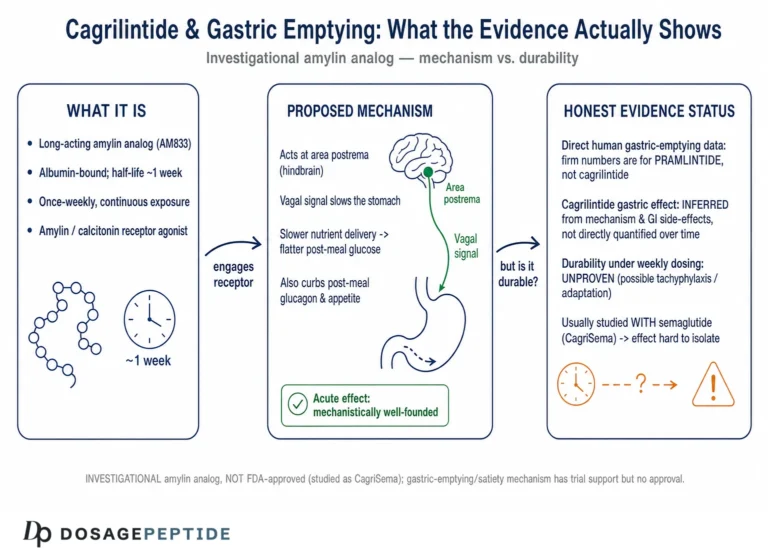
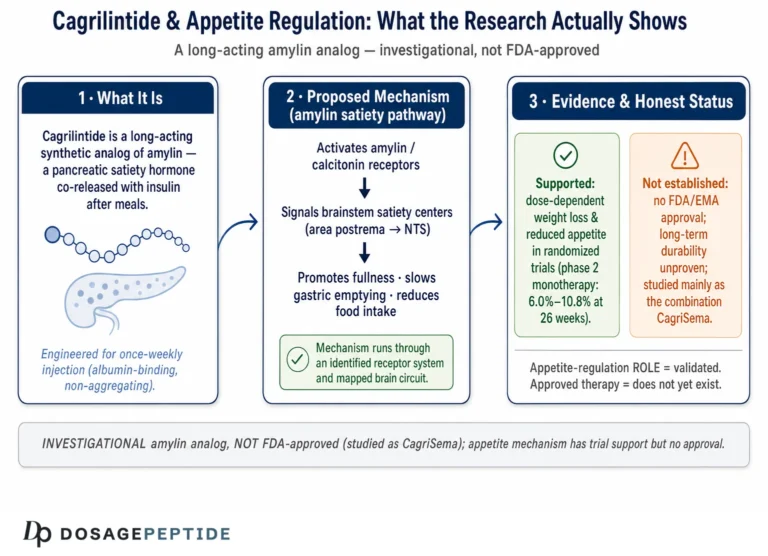
Cagrilintide (development codes AM833 and NNC0174-0833) is a synthetic, long-acting analog of human amylin, developed by Novo Nordisk.2 Amylin is a 37-amino-acid peptide hormone co-secreted with insulin from the beta-cells of the pancreatic islets in response to meals. Alongside insulin and glucagon, amylin is one of the body’s core regulators of nutrient handling, acting to slow gastric emptying, suppress post-meal glucagon secretion, and promote satiety through the central nervous system. The interest in turning amylin into a durable drug is decades old, but native amylin is a notoriously difficult starting point: it is highly prone to forming amyloid fibrils and aggregating in solution, and it is cleared from the body within minutes.2
The first amylin-based medicine to reach patients was pramlintide (marketed as Symlin), FDA-approved in 2005 as an adjunct to mealtime insulin in type 1 and type 2 diabetes. Pramlintide solved part of the aggregation problem by substituting three proline residues into the amylin sequence, but it retained a very short half-life of roughly 20 to 45 minutes, requiring injection with every meal.9 Pramlintide was never developed as a standalone obesity therapy, and its dosing burden limited broad uptake.
Cagrilintide represents a substantially different engineering approach. Its designers combined amino-acid substitutions that reduce enzymatic degradation and aggregation with a chemistry strategy borrowed from Novo Nordisk’s insulin and GLP-1 programs: acylation with a C20 fatty diacid side chain.2 This lipid moiety binds reversibly to serum albumin, which acts as a circulating reservoir and dramatically slows clearance. The result is a molecule with a reported elimination half-life on the order of seven to eight days (clinical estimates in the range of roughly 155 to 195 hours), suitable for once-weekly subcutaneous dosing.1,2 That is a nearly two-hundred-fold extension over pramlintide’s duration of action, and it is the single feature that made Cagrilintide practical as a modern metabolic agent.
Functionally, Cagrilintide is often described as a dual amylin and calcitonin receptor agonist (DACRA), reflecting the close structural relationship between the amylin and calcitonin receptor families. In clinical development it has been studied both as a monotherapy and, more prominently, as the amylin component of CagriSema, a fixed-dose combination with the GLP-1 receptor agonist semaglutide.4 It is this combination, not Cagrilintide alone, that has generated the headline weight-loss numbers and that anchors the ongoing cardiovascular research program. For readers comparing formulations used in research contexts, DosagePeptide maintains reference protocol pages for the Cagrilintide 5 mg vial and the Cagrilintide 10 mg vial, as well as a combined Cagrilintide + Semaglutide blend reference. These are educational documents, not treatment guidance.
It is also worth situating Cagrilintide within the broader amylin renaissance now underway. After more than a decade in which pramlintide was the only marketed amylin drug, the success of the fatty-acid acylation strategy has triggered a wave of next-generation amylin analogs from multiple developers, some designed for once-weekly and even less frequent dosing. Cagrilintide is the most clinically advanced of this cohort, which is part of why it attracts disproportionate attention and, occasionally, disproportionate claims. Being first-in-class in visibility does not, however, make it first-in-class in every category of evidence, and the cardiovascular-outcome column of its evidence ledger remains empty.1
The key origin-story takeaway for the stroke question is straightforward: Cagrilintide was purpose-built to control appetite and body weight, not to modify vascular disease. Its entire design brief, from the albumin-binding side chain to the aggregation-resistant substitutions, was oriented toward durable satiety signaling and convenient dosing. Nothing in the molecule’s engineering was aimed at plaque stabilization, endothelial function, coagulation, or cerebral perfusion. Any downstream cardiovascular effect would therefore be an indirect, hypothesized consequence of metabolic change rather than a designed-in pharmacological action, and hypotheses of that kind require dedicated outcome trials to confirm rather than mechanistic plausibility to assume.
The Molecular Mechanism: Amylin Receptors and the Brainstem
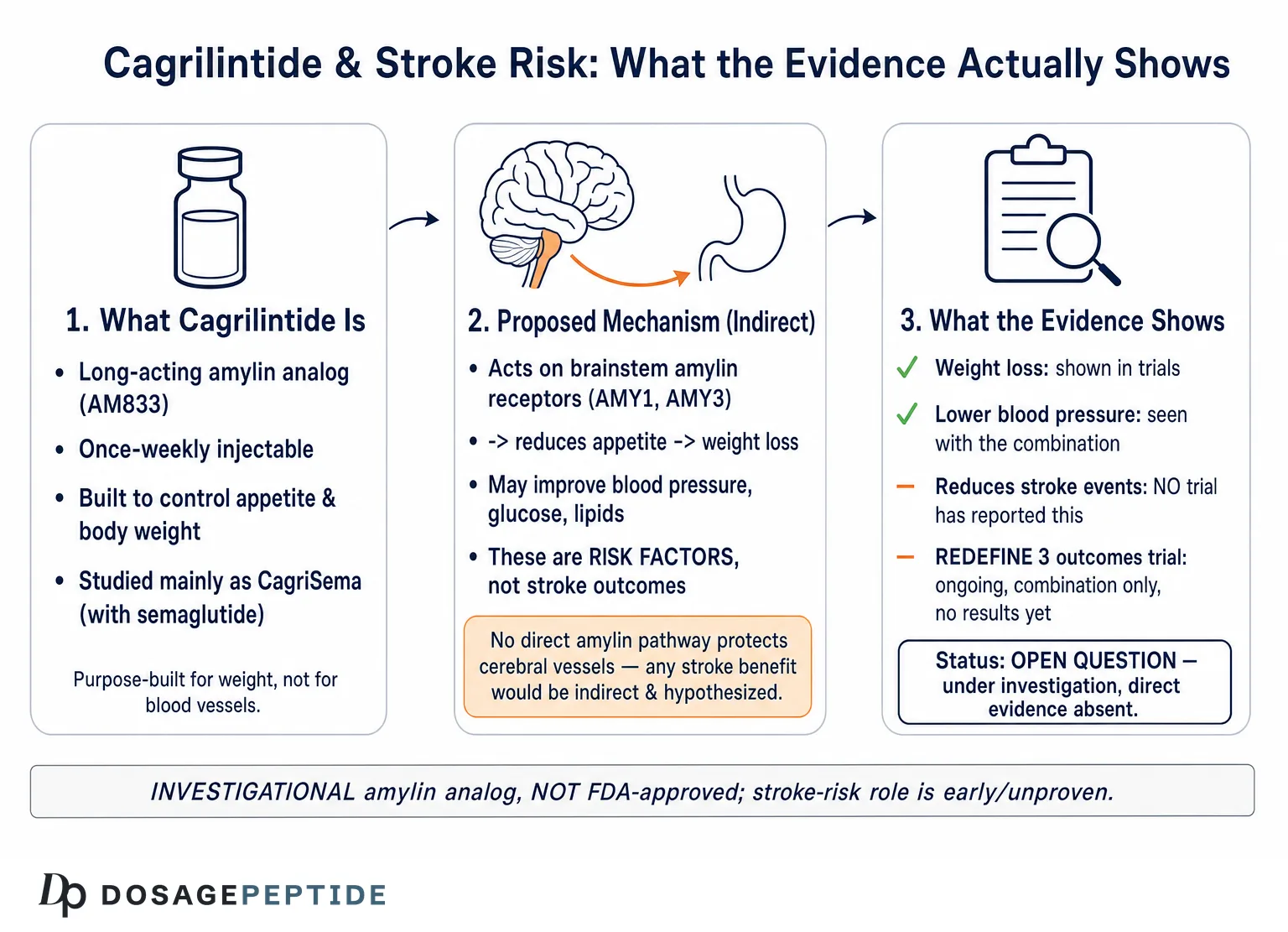
To evaluate whether Cagrilintide could plausibly influence stroke risk, it helps to understand precisely where and how it acts, because the mechanism is central rather than vascular. Amylin signaling depends on a family of receptors built from the calcitonin receptor (CTR, encoded by CALCR) combined with one of three receptor activity-modifying proteins (RAMP1, RAMP2, or RAMP3). The CTR-RAMP heterodimers are designated the amylin receptors AMY1 (CTR + RAMP1), AMY2 (CTR + RAMP2), and AMY3 (CTR + RAMP3).1 When an amylin agonist engages these receptors, it activates Gs-coupled signaling and raises intracellular cyclic AMP.
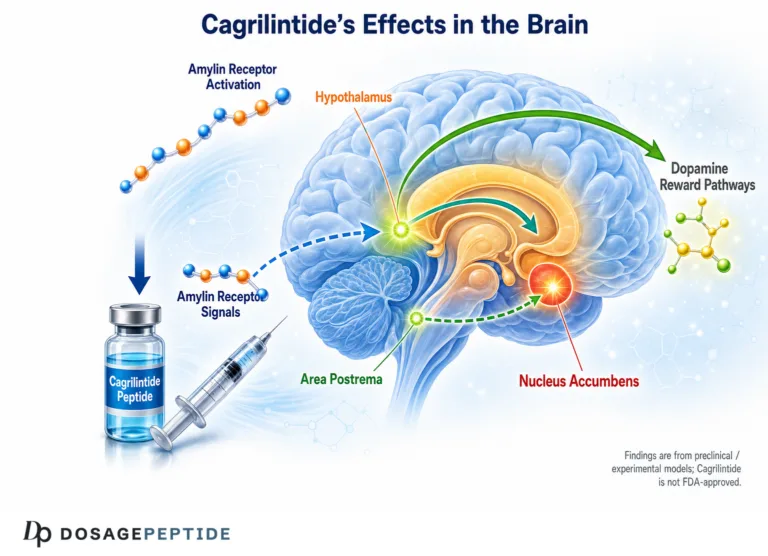
A 2025 mechanistic study published in eBioMedicine used receptor-knockout mouse models to isolate which subtypes actually drive Cagrilintide’s weight effect. The investigators reported that the body-weight-lowering action depends specifically on AMY1 and AMY3; eliminating either receptor subtype attenuated the response.3 These receptors are expressed in appetite-regulating regions of the hypothalamus and, critically, in the area postrema of the caudal brainstem. The area postrema is a circumventricular organ, meaning it sits outside the tight blood-brain barrier and can directly sample circulating hormones. From there, satiety signals propagate to the nucleus of the solitary tract and the lateral parabrachial nucleus, integrating with other appetite pathways.3
Complementary structural work using cryo-electron microscopy, published in 2025, has characterized how Cagrilintide physically engages AMY1, AMY2, AMY3, and the calcitonin receptor in their active, Gs-coupled conformations.12 This structural detail matters because it clarifies that Cagrilintide is a broad amylin/calcitonin receptor agonist rather than a narrowly selective ligand, which has implications both for efficacy and for the range of physiological systems it can touch.
The physiological consequences flow from this central engagement. By activating brainstem and hypothalamic amylin circuits, Cagrilintide reduces food intake and shifts energy balance, producing weight loss that preferentially reduces fat mass while relatively sparing lean mass in preclinical models.3 In the periphery, amylin agonism slows gastric emptying and suppresses postprandial glucagon, contributing to improved glycemic profiles.
The breadth of Cagrilintide’s receptor engagement deserves a closer look because it shapes both efficacy and the range of physiological systems potentially affected. Unlike a highly selective agonist that hits a single receptor subtype, Cagrilintide activates the amylin receptor family and the calcitonin receptor. Calcitonin receptors are found not only in the brain but also in bone, kidney, and other peripheral tissues, and there is active clinical interest in whether amylin-class agonists influence bone metabolism, reflected in dedicated trials examining that specific question. From a stroke-risk standpoint, this breadth is a double-edged consideration: it means the compound touches more physiological systems than a narrowly targeted drug, which enlarges both the potential for unanticipated benefits and the potential for off-target effects. Neither possibility has been mapped onto cerebrovascular outcomes, and the honest reading is that receptor breadth adds uncertainty rather than resolving it.
Now connect this to stroke. There is no established amylin receptor pathway that directly protects cerebral vasculature, stabilizes atherosclerotic plaque, or prevents thrombosis. The plausibility of any stroke benefit rests entirely on indirect mechanisms: if sustained weight loss lowers blood pressure, improves lipids, reduces visceral adiposity, and improves glycemic control, then the aggregate cardiometabolic risk profile could improve, and stroke is one of the outcomes that such improvements are associated with in the broader literature. But “associated with improvements in risk factors” is a very different statement from “demonstrated to reduce stroke events.” The mechanism gives us a reason to ask the question; it does not answer it. That distinction is the crux of everything that follows.
Untangling the Stroke Question: What “Stroke Risk” Actually Requires
Because the title poses a disease-outcome question, it is worth being explicit about what would count as evidence. In cardiovascular medicine, a claim that an intervention “lowers stroke risk” is a high bar. It generally requires a randomized controlled trial, powered for clinical events, in which participants are followed for years and the rate of adjudicated strokes (ischemic and hemorrhagic) is compared between the intervention and a control group. Stroke is frequently studied as a component of MACE, or major adverse cardiovascular events, a composite that typically bundles cardiovascular death, non-fatal myocardial infarction, and non-fatal stroke.8
Surrogate markers are not the same thing. A reduction in systolic blood pressure, a drop in LDL cholesterol, weight loss, or improved HbA1c are all risk factors whose improvement is statistically associated with fewer events at a population level. They are useful and biologically reasonable, but the history of cardiovascular pharmacology is littered with interventions that improved surrogates yet failed to reduce, or even worsened, hard outcomes. This is exactly why regulators and guideline committees insist on dedicated cardiovascular outcomes trials before endorsing any risk-reduction claim.
Against this standard, where does Cagrilintide stand? For Cagrilintide as a monotherapy, there is no cardiovascular outcomes trial at all. Its standalone development has been in phase 1 and phase 2 studies focused on weight loss, tolerability, pharmacokinetics, and cardiac-safety parameters such as QT interval, not on stroke or MACE.1 There is simply no dataset from which one could estimate a stroke effect for Cagrilintide by itself.
For the CagriSema combination, there is one relevant trial, REDEFINE 3, an event-driven phase 3 cardiovascular outcomes study of once-weekly CagriSema versus placebo in roughly 7,000 adults with established cardiovascular disease, with or without type 2 diabetes.7 This is precisely the kind of study that could, in principle, speak to stroke, because MACE composites include stroke. But two caveats are decisive. First, REDEFINE 3 is ongoing and has not reported results; as of this writing there are no published event data. Second, even when it reports, it will test the combination, so any benefit could be attributable to semaglutide, to Cagrilintide, or to their interaction. The trial design does not include a Cagrilintide-monotherapy arm, so it cannot isolate the amylin component’s independent contribution to stroke prevention.
The upshot is that the stroke question, as applied specifically to Cagrilintide, currently has no direct affirmative evidence. What exists is a plausible mechanistic rationale, a set of favorable surrogate changes, and an unfinished outcomes trial of a combination product. That is a legitimate research frontier, not a conclusion.
The Key Evidence: What Trials Have and Have Not Measured
Let us be concrete about the actual data, and honest about its level. The strongest efficacy evidence for the Cagrilintide program comes from the phase 3 REDEFINE trials of CagriSema, published and presented in 2025.
In REDEFINE 1, published in the New England Journal of Medicine, adults with overweight or obesity and without diabetes received CagriSema (cagrilintide 2.4 mg / semaglutide 2.4 mg), one of the individual components, or placebo for 68 weeks. Mean weight reduction reached approximately 22.7% with CagriSema, compared with about 16.1% for semaglutide alone, 11.8% for cagrilintide alone, and 2.3% for placebo.4 Among participants adhering to treatment, roughly 60% achieved at least 20% weight loss.4 REDEFINE 2, in adults with type 2 diabetes, reported mean weight reductions in the range of about 13.7% to 15.7% depending on the analysis population, again clearly superior to placebo.7
These are meaningful weight-loss results, and they establish Cagrilintide as an active metabolic agent. But note what these trials were designed to measure: body weight and glycemic endpoints, not stroke. Cardiovascular and blood-pressure findings in REDEFINE 1 were reported as secondary or exploratory analyses, not as event-based outcomes.
The blood-pressure data are worth stating precisely because they are the closest thing to a cardiovascular signal. A REDEFINE 1 analysis published in Hypertension reported systolic blood pressure reductions on the order of roughly 11 mmHg and diastolic reductions of about 5 mmHg with CagriSema 2.4/2.4 mg, and roughly 40% of participants on blood-pressure medication reduced or stopped it.5 The authors noted that such reductions are the kind that, at a population level, are likely to be associated with lower risk of cardiovascular complications including stroke.5 That is an appropriately hedged statement of association, not a demonstration of event reduction, and it applies to the combination product.
Here is the evidence hierarchy in plain terms:
| Question | Evidence for Cagrilintide | Level |
|---|---|---|
| Does it cause weight loss? | Phase 3 RCTs (REDEFINE 1/2), monotherapy phase 2 | Strong (for the studied populations) |
| Does it lower blood pressure? | Secondary analysis of REDEFINE 1 (combination) | Moderate, surrogate only |
| Does it improve lipids/glycemia? | Secondary endpoints, REDEFINE trials | Moderate, surrogate only |
| Does it reduce MACE? | REDEFINE 3 ongoing, no results; combination only | None yet |
| Does it lower stroke risk specifically? | No trial has reported a stroke endpoint for Cagrilintide | Absent |
It is instructive to compare this evidence structure to how a genuine stroke claim is built for an established therapy. Consider antihypertensive drugs or statins: their stroke-prevention labels rest on multiple large randomized trials, often tens of thousands of participants followed for several years, with independent adjudication committees classifying every suspected stroke as ischemic or hemorrhagic and confirming it against imaging. That machinery exists precisely because clinicians learned, sometimes painfully, that a drug can move a surrogate in the right direction and still fail to help patients. Cagrilintide has none of this stroke-specific apparatus behind it yet. Its evidence base is deep on weight and reasonable on short-term metabolic surrogates, but it has never been subjected to the event-adjudication process that a stroke claim demands. Recognizing that structural gap is more useful than parsing any single favorable number.
A further subtlety concerns the monotherapy weight figure. In REDEFINE 1, Cagrilintide alone produced roughly 11.8% weight loss, meaningfully less than the combination’s 22.7%.4 This matters for the stroke discussion because whatever indirect cardiovascular benefit might flow from weight loss and blood-pressure reduction would presumably scale with the magnitude of those changes. If the combination drives most of the metabolic improvement, and if semaglutide is independently responsible for a share of it, then the incremental cardiovascular contribution of the amylin component specifically becomes even harder to isolate and, on current data, impossible to quantify.
The bottom row is the direct answer to the article’s title. No trial has yet reported a stroke endpoint attributable to Cagrilintide. The compound demonstrably changes several stroke risk factors in a favorable direction when combined with semaglutide, but the leap from “improves risk factors” to “lowers stroke risk” is exactly the leap that responsible interpretation refuses to make without outcome data.
Comparisons: How Cagrilintide Sits Among Related Compounds
Placing Cagrilintide alongside neighboring molecules clarifies both its promise and the limits of the stroke inference. The comparison also explains why some readers assume a cardiovascular benefit that has not actually been shown for the amylin component.
The most important comparator is semaglutide, the GLP-1 receptor agonist that partners with Cagrilintide in CagriSema. Semaglutide has its own dedicated cardiovascular outcomes evidence. In the SELECT trial of more than 17,000 adults with overweight or obesity and established cardiovascular disease but without diabetes, semaglutide 2.4 mg reduced the primary MACE composite (cardiovascular death, non-fatal myocardial infarction, non-fatal stroke) by roughly 20% versus placebo.8 That is a genuine, adjudicated outcome result, and it is a large part of why the metabolic field associates this drug class with cardiovascular benefit. But SELECT tested semaglutide, not Cagrilintide. It would be a category error to transfer SELECT’s stroke-inclusive benefit onto the amylin component. If anything, semaglutide’s established profile complicates attribution: in any CagriSema outcome, semaglutide could be doing the cardiovascular work.
A second comparator is pramlintide, the only FDA-approved amylin analog. Pramlintide shares Cagrilintide’s core receptor pharmacology but differs enormously in duration (a 20-to-45-minute half-life versus roughly a week) and clinical positioning (mealtime adjunct to insulin, not a weight or cardiovascular agent).9 Critically, pramlintide has no cardiovascular outcomes trial demonstrating stroke reduction either. So the amylin class as a whole lacks direct hard-endpoint cardiovascular evidence; this is not a gap unique to Cagrilintide but a feature of the entire amylin lineage to date.
A third comparator is tirzepatide, a dual GIP/GLP-1 agonist that, like CagriSema, drives very large weight loss. Head-to-head data have emerged comparing CagriSema against tirzepatide on weight, and industry reporting in 2026 indicated tirzepatide outperformed CagriSema on weight loss in at least one direct comparison.10 That is relevant context for efficacy expectations, but again it concerns weight, not stroke.
| Compound | Class | Approved? | Dedicated stroke/MACE trial reporting a benefit? |
|---|---|---|---|
| Cagrilintide | Long-acting amylin analog | No | No (REDEFINE 3 ongoing, combination only) |
| Semaglutide 2.4 mg | GLP-1 receptor agonist | Yes (weight/diabetes) | Yes (SELECT, MACE including stroke) |
| Pramlintide | Short-acting amylin analog | Yes (diabetes adjunct) | No |
| Tirzepatide | GIP/GLP-1 agonist | Yes (weight/diabetes) | CV outcomes program maturing; not the same molecule |
There is a deeper lesson in the semaglutide comparison that is easy to miss. The SELECT analyses found that a meaningful portion of semaglutide’s cardiovascular benefit appeared to be at least partly independent of the amount of weight lost, suggesting mechanisms beyond adiposity reduction, such as direct vascular or anti-inflammatory effects of GLP-1 receptor activation.8 If a substantial share of the cardiovascular benefit in that class is weight-independent and GLP-1-specific, then one cannot simply assume that any weight-lowering agent, including an amylin analog, will reproduce the same stroke benefit. Weight loss is a plausible contributor to cardiovascular improvement, but it may not be the whole story, and the parts that are receptor-specific to GLP-1 would not automatically transfer to amylin pharmacology. This is a further reason that the amylin component needs its own outcome evidence rather than an inherited claim.
The comparative picture reinforces the core message. Among these agents, only semaglutide currently has published outcome evidence that includes stroke, and it is a different molecule. Cagrilintide’s cardiovascular narrative is borrowed and prospective, not earned and demonstrated. For readers exploring how these compounds are catalogued and combined in research settings, DosagePeptide’s dosage index and peptide stacks reference provide additional educational context on formulation categories.
Research Models and Methodology
Understanding how Cagrilintide has been studied helps explain why the evidence looks the way it does and why stroke conclusions are premature. The compound’s development has moved through a fairly conventional preclinical-to-clinical sequence, but with methodological features specific to metabolic peptides.
At the preclinical level, mechanistic work has relied heavily on rodent models. The 2025 eBioMedicine study used receptor-specific knockout mice to dissect which amylin receptor subtypes are necessary for the weight effect, an elegant design because it can establish causal necessity of AMY1 and AMY3 in a way human studies cannot.3 Separately, investigators have developed dedicated tool compounds to probe amylin analog mode-of-action in preclinical assays, allowing pharmacologists to characterize receptor engagement and downstream signaling with molecules optimized for laboratory use rather than therapy.11 Structural biology, particularly cryo-electron microscopy of the receptor complexes, has added atomic-level understanding of ligand binding.12 These models are excellent for mechanism but say nothing about cerebrovascular outcomes; no rodent obesity model is a validated predictor of human stroke event rates.
At the clinical pharmacology level, the program has included phase 1 studies of pharmacokinetics, dose escalation, hepatic-impairment effects, and cardiac safety. A notable example is the thorough QT study, a rigorous regulatory-grade design in which 105 healthy participants received Cagrilintide escalated to 4.5 mg or placebo, with time-matched QTcF measured after the final dose. The study was specifically powered to detect clinically relevant QT prolongation.6 This illustrates the methodology used to characterize discrete safety questions, but a QT study addresses arrhythmia risk, not stroke.
At the phase 2/3 efficacy level, the REDEFINE trials used randomized, double-blind, placebo-controlled designs over 68 weeks, with weight change as the primary endpoint and a hierarchy of secondary endpoints including glycemic and cardiovascular risk markers.4 These are strong designs for their stated questions. Their limitation for the stroke question is structural: 68 weeks is generally too short, and the populations and event rates too small, to accumulate enough adjudicated strokes to test a stroke hypothesis. That is exactly why a separate, larger, longer, event-driven design (REDEFINE 3) is required.7
Another methodological point specific to Cagrilintide concerns the challenge of studying a combination product. When two active agents are co-formulated, standard trial designs struggle to attribute effects to individual components unless the trial deliberately includes monotherapy arms of adequate size and duration. The REDEFINE efficacy trials did include cagrilintide-alone and semaglutide-alone arms, which is why we can compare weight-loss magnitudes across components.4 But the cardiovascular outcomes trial does not replicate that factorial structure for hard endpoints, so it is designed to answer “does CagriSema reduce events versus placebo,” not “how much of any benefit is the amylin’s doing.” Researchers reading future outcome data should keep this attribution limitation front of mind rather than crediting the amylin component by default.
The methodological lesson is that different questions demand different studies. Weight-loss efficacy, receptor mechanism, QT safety, and stroke prevention each need their own purpose-built design. Cagrilintide has robust data for the first three and no reported data for the last. Reading a stroke conclusion into a weight-loss trial would be a methodological overreach, precisely the kind of inference that outcome trials exist to prevent.
Safety and Tolerability Signals
Any discussion of a compound’s risk-benefit profile must include what is known about its tolerability, and here the data are more developed, though still tied largely to the combination product and to weight-focused trials.
The dominant tolerability signal for the amylin class, and for CagriSema, is gastrointestinal. In REDEFINE 1, gastrointestinal adverse events affected roughly 79.6% of the CagriSema group versus about 39.9% of placebo, comprising nausea, vomiting, diarrhea, constipation, and abdominal pain.4 These events were predominantly mild to moderate and transient, most pronounced during the early dose-escalation weeks and diminishing over time, and discontinuation rates attributable to adverse events remained relatively low.4 This pattern is consistent with the mechanism: slowed gastric emptying and central satiety signaling naturally produce nausea and related symptoms, particularly as doses increase. It is also a reminder that gastrointestinal effects are the practical, near-term tolerability concern, quite distinct from any long-term vascular consideration.
The mechanistic basis for these gastrointestinal effects is directly tied to how the drug works, which is a useful reminder that efficacy and side effects often share a root cause. Amylin agonism slows gastric emptying and acts on brainstem satiety circuits that overlap with nausea and emesis pathways; the area postrema, so central to the appetite-suppressing effect, is also a classic chemosensitive trigger zone for nausea.3 This is why careful dose escalation over weeks, rather than starting at a full dose, is a standard feature of the trial protocols: it gives the relevant neural circuits time to adapt and blunts the peak of gastrointestinal intolerance. From a research-interpretation standpoint, it also means that tolerability data are highly dependent on the escalation schedule used, and results from one titration design should not be assumed to hold for another.
On cardiac electrophysiology, the dedicated thorough QT study provides reassurance for one specific safety question. Cagrilintide escalated to 4.5 mg did not produce clinically relevant QTcF prolongation; the upper bounds of the 90% confidence intervals for placebo-adjusted change stayed below the 10 ms threshold of regulatory concern at all measured timepoints.6 The authors concluded there was no signal of increased risk of ventricular tachyarrhythmias from QT prolongation.6 This is a meaningful, well-designed piece of cardiac-safety evidence, but it addresses repolarization and arrhythmia, not ischemic or hemorrhagic stroke.
One physiological point deserves emphasis because it cuts against naive optimism. Amylin and GLP-1 agents in this class are commonly associated with a modest increase in resting heart rate. A small, sustained rise in heart rate is a nuance that outcome trials must weigh against the favorable blood-pressure and weight effects, and it underscores why net cardiovascular effect cannot be inferred from any single parameter. The direction of the aggregate cardiovascular effect, favorable, neutral, or mixed, is exactly what an outcomes trial is designed to resolve, and it is why surrogate improvements do not settle the stroke question.
It also bears repeating that the tolerability data above come overwhelmingly from the combination and from trial populations that were medically screened and monitored. Safety observations from supervised trials do not translate into any assurance of safety for unsupervised or non-clinical use, and there is no established human safety database for Cagrilintide used outside authorized studies. The compound remains investigational, and its long-term safety, including any cerebrovascular safety, is not yet fully characterized.
Handling and Reconstitution in a Research Context
Because Cagrilintide is frequently encountered as a lyophilized (freeze-dried) research material rather than a finished pharmaceutical product, a brief, strictly educational note on handling is warranted. This section describes general laboratory practices for peptide research materials; it is not instructions for human use, and nothing here should be read as endorsing self-administration of an unapproved compound.
Long-acting acylated peptides like Cagrilintide are typically supplied as a white lyophilized powder in a sealed vial, intended to be reconstituted with a suitable diluent before any laboratory measurement or in vitro work. In research settings, bacteriostatic water (water containing a small percentage of benzyl alcohol) or sterile water is the diluent most commonly referenced for reconstitution of peptide materials. The general principle is to introduce the diluent slowly down the inner wall of the vial rather than injecting it directly onto the powder cake, then to allow the peptide to dissolve without vigorous agitation. Peptides can be shear-sensitive and prone to aggregation, so swirling gently and avoiding foaming is standard practice, particularly relevant here given amylin’s well-documented tendency toward fibril formation.2
Concentration is simply a function of the mass of peptide in the vial and the volume of diluent added. For example, published educational reference protocols describe reconstituting a 5 mg vial with about 2 mL of diluent to yield roughly a 2.5 mg/mL solution, or a 10 mg vial with about 3 mL to yield roughly a 3.33 mg/mL solution; DosagePeptide’s 5 mg and 10 mg reference pages walk through the arithmetic. These figures are illustrations of the reconstitution math, not dosing recommendations.
Storage practices for research peptides generally emphasize keeping the lyophilized powder cold and desiccated prior to reconstitution and refrigerating the reconstituted solution, with protection from light and repeated freeze-thaw cycles, which can degrade peptide integrity. The albumin-binding fatty-acid modification that gives Cagrilintide its long circulating half-life in vivo does not exempt the raw material from ordinary peptide stability concerns in the vial. Accurate handling matters for reproducibility in any legitimate laboratory characterization.
None of this handling detail bears on the stroke question, and it is included only because readers researching Cagrilintide will inevitably encounter reconstitution material. The scientific and ethical point stands: reconstitution knowledge describes how to prepare a solution for laboratory purposes; it says nothing about whether the compound is safe or effective for any human outcome, and it certainly does not imply any cerebrovascular benefit.
Limitations and the Human-Evidence Gap
It is worth consolidating the specific reasons the stroke question cannot be answered affirmatively today, because each limitation is instructive about how metabolic pharmacology evidence is built.
No dedicated stroke endpoint has been reported. The single most important limitation is the absence of any completed trial reporting adjudicated stroke events for Cagrilintide. The only outcomes trial in the program, REDEFINE 3, is ongoing and unreported.7 Until it reads out, there is no direct human data point on stroke.
The combination confounds attribution. Even the forthcoming outcomes evidence will describe CagriSema, a two-drug combination. Because semaglutide independently reduces MACE including stroke,8 any cardiovascular benefit seen in a CagriSema outcomes trial could be driven partly or wholly by the GLP-1 component. The trial is not designed to isolate Cagrilintide’s independent contribution, so it cannot cleanly establish an amylin-specific stroke effect.
Surrogates are not outcomes. The favorable blood-pressure, weight, lipid, and glycemic changes are risk-factor improvements. They make a cardiovascular benefit plausible, but the field’s own history shows that surrogate improvement does not guarantee event reduction. Regulators require outcome trials for exactly this reason.
Trial populations are specific and monitored. The REDEFINE efficacy trials enrolled defined populations (overweight/obesity, with or without diabetes) under medical supervision.4 Findings from such populations do not automatically generalize to other groups, to different risk profiles, or to unsupervised use. Generalization of a stroke inference beyond the studied context would be unsupported.
Follow-up duration is short for vascular endpoints. The 68-week efficacy trials are far shorter than the multi-year follow-up typically needed to accrue enough strokes for a statistically meaningful comparison. Stroke is a relatively infrequent event even in higher-risk cohorts, so adequate power requires large samples and long observation, which is why the event-driven design exists.7
Net cardiovascular direction is unresolved. Favorable blood-pressure and weight effects coexist with a modest heart-rate increase characteristic of the class. The aggregate cardiovascular effect is an empirical question, not something derivable from the sign of any single surrogate.
Publication and reporting timing add uncertainty. Much of what is currently known about the cardiovascular-adjacent findings comes from secondary analyses, congress presentations, and company communications, with peer-reviewed primary publications continuing to appear. As additional analyses are published and eventually as outcome data emerge, the interpretation could shift in either direction. Basing a firm stroke conclusion on today’s partial, largely surrogate-based picture would be premature regardless of which way one expects it to resolve.
Taken together, these limitations define a clear human-evidence gap. Cagrilintide is a metabolically active compound with a coherent mechanism and encouraging surrogate data, but the specific claim in this article’s title, that current research supports a role in lowering stroke risk, is not supported by the current evidence base. The accurate status is “unknown and under investigation,” with the caveat that whatever the investigation ultimately shows will pertain principally to a combination product.
Regulatory Status
The regulatory picture reinforces every point above and provides the cleanest external check on the compound’s evidentiary maturity. As a standalone molecule, Cagrilintide is not approved by the FDA, the EMA, or, to the best available knowledge, any major regulator, for any indication.1 It remains investigational and, in the United States, is not a legally marketed drug for human treatment. Materials sold as Cagrilintide are typically offered for laboratory research use only, and that designation carries specific legal and safety implications that readers should take seriously.
The most advanced regulatory activity concerns the combination product. Novo Nordisk submitted a New Drug Application to the FDA for once-weekly CagriSema (cagrilintide 2.4 mg / semaglutide 2.4 mg) in December 2025, seeking an indication for reducing excess body weight and maintaining weight reduction in adults with obesity, or overweight with at least one weight-related comorbidity.7 Industry reporting anticipated an FDA decision by late 2026, and as of this writing CagriSema is not approved in the United States or the European Union.7 Crucially, the indication sought is weight management, not stroke prevention or cardiovascular risk reduction. Even in the best-case regulatory scenario for CagriSema, an initial approval would not carry a stroke-reduction claim, because that claim would require the outcome data from REDEFINE 3 that do not yet exist.7
This is the regulatory reality that most directly answers the title. A cardiovascular or stroke-prevention indication is a separate, higher regulatory hurdle that follows only from a successful dedicated outcomes trial, and even then it would attach to the combination, not necessarily to Cagrilintide alone. The label a product carries is, in effect, the regulator’s summary of what the evidence supports, and no label anywhere currently supports a stroke claim for Cagrilintide.
For anyone tracking the field, the sequence to watch is clear: first, an FDA decision on CagriSema for weight management, expected in the 2026 timeframe; second, the eventual readout of REDEFINE 3, which will be the first outcomes dataset capable of speaking to MACE and its stroke component for the combination; and third, any future dedicated study, if one is ever undertaken, that could isolate Cagrilintide’s independent cardiovascular contribution. Until those milestones are reached and reported in peer-reviewed detail, the responsible characterization of Cagrilintide and stroke is that the question is open, the mechanistic rationale is indirect, and the direct evidence is absent.
Frequently Asked Questions
Does Cagrilintide lower the risk of stroke?
Based on current evidence, this cannot be affirmed. No completed clinical trial has reported an adjudicated stroke endpoint for Cagrilintide, either alone or in combination.1,7 The compound improves several stroke-associated risk factors such as blood pressure and body weight when combined with semaglutide,5 but improvement in risk factors is not the same as a demonstrated reduction in stroke events. The honest status is that the question is unresolved and under investigation.
Is Cagrilintide FDA-approved?
No. Cagrilintide as a standalone molecule is not approved by the FDA, EMA, or other major regulators for any indication.1 The combination product CagriSema was submitted to the FDA in December 2025 for a weight-management indication, with a decision anticipated in the 2026 timeframe, but it was not approved as of this writing, and even that filing does not seek a stroke or cardiovascular claim.7
What is the difference between Cagrilintide and CagriSema?
Cagrilintide is a single long-acting amylin analog. CagriSema is a fixed-dose combination that pairs Cagrilintide with the GLP-1 receptor agonist semaglutide.4 Most of the large phase 3 efficacy data, and the ongoing cardiovascular outcomes trial, involve CagriSema rather than Cagrilintide alone, which is one reason it is difficult to isolate the amylin component’s independent effect on any hard outcome.
Why do people think an amylin drug might affect stroke risk?
The inference is indirect. Cagrilintide produces weight loss and, in combination, lowers blood pressure and improves lipid and glycemic markers,4,5 all of which are risk factors statistically associated with stroke at a population level. In addition, its partner drug semaglutide has a dedicated outcomes trial (SELECT) showing reduced MACE including stroke.8 People sometimes transfer that combination-partner benefit onto Cagrilintide, which is a logical error, because SELECT tested semaglutide, not the amylin analog.
What does REDEFINE 3 study, and when will it report?
REDEFINE 3 is an event-driven phase 3 cardiovascular outcomes trial of once-weekly CagriSema versus placebo in roughly 7,000 adults with established cardiovascular disease.7 As an event-driven design, it continues until enough cardiovascular events accrue for statistical analysis, so its readout timing depends on event accumulation rather than a fixed date. It had not reported results as of this writing, and it tests the combination rather than Cagrilintide alone.
Is Cagrilintide dangerous to the heart?
A dedicated thorough QT study found that Cagrilintide did not cause clinically relevant QT-interval prolongation, indicating no signal of increased arrhythmia risk from repolarization changes.6 However, the class is associated with a modest heart-rate increase, and gastrointestinal side effects are common.4 Its long-term cardiovascular safety, including any cerebrovascular effects, has not been fully characterized, because the relevant outcomes trial is still ongoing.7 None of this constitutes medical advice.
What are the most common side effects reported in trials?
In the REDEFINE 1 trial of CagriSema, gastrointestinal events, including nausea, vomiting, diarrhea, constipation, and abdominal pain, were the most frequent, affecting a large majority of the combination group but mostly mild to moderate and transient, concentrated in the early dose-escalation period.4 These are the practical near-term tolerability considerations documented in supervised trials and should not be generalized to unsupervised use.
Can I use Cagrilintide to prevent a stroke?
No responsible reading of the evidence supports that. Cagrilintide is an investigational compound not approved for any use, and there is no clinical evidence that it prevents stroke.1,7 This article is educational only. Any decision about stroke prevention should be made with a qualified healthcare professional using approved, evidence-based therapies, not an unapproved research compound.
References
- D’Ascanio AM, Mullally JA, et al. “Cagrilintide: A Long-Acting Amylin Analog for the Treatment of Obesity.” Cardiology in Review, 2024. PubMed ID 36883831. Available at: https://pubmed.ncbi.nlm.nih.gov/36883831/
- “Development of Cagrilintide, a Long-Acting Amylin Analogue.” Journal of Medicinal Chemistry, American Chemical Society. Available at: https://pubs.acs.org/doi/10.1021/acs.jmedchem.1c00565
- “Cagrilintide lowers bodyweight through brain amylin receptors 1 and 3.” eBioMedicine, 2025. PubMed ID 40609154 / PMC12270663. Available at: https://pmc.ncbi.nlm.nih.gov/articles/PMC12270663/
- “Coadministered Cagrilintide and Semaglutide in Adults with Overweight or Obesity” (REDEFINE 1). New England Journal of Medicine, 2025. NEJMoa2502081. Available at: https://www.nejm.org/doi/full/10.1056/NEJMoa2502081
- “CagriSema Reduces Blood Pressure in Adults With Overweight or Obesity: REDEFINE 1.” Hypertension (American Heart Association Journals), 2025. PubMed ID 41328546. Available at: https://www.ahajournals.org/doi/10.1161/HYPERTENSIONAHA.125.26055
- Gabe MBN, et al. “Cagrilintide is not associated with clinically relevant QTc prolongation: A thorough QT study in healthy participants.” Diabetes, Obesity and Metabolism, 2024. PubMed ID 39279639. Available at: https://dom-pubs.onlinelibrary.wiley.com/doi/10.1111/dom.15951
- “Novo Nordisk files for FDA approval of CagriSema” and REDEFINE program details, Novo Nordisk / PR Newswire, 2025; ClinicalTrials.gov REDEFINE 3 (cardiovascular outcomes). Available at: https://www.prnewswire.com/news-releases/novo-nordisk-files-for-fda-approval-of-cagrisema-the-first-once-weekly-combination-of-glp1-and-amylin-analogues-for-weight-management-302645862.html
- “Semaglutide and Cardiovascular Outcomes in Obesity without Diabetes” (SELECT trial), American College of Cardiology summary and Lancet prespecified analyses, 2023-2025. Available at: https://www.acc.org/Latest-in-Cardiology/Clinical-Trials/2023/11/09/15/04/select
- SYMLIN (pramlintide acetate) injection — FDA Prescribing Information (label), AstraZeneca. U.S. Food and Drug Administration. Available at: https://www.accessdata.fda.gov/drugsatfda_docs/label/2008/021332s015lbl.pdf
- “Novo Nordisk’s CagriSema bested by Lilly’s Zepbound in head-to-head trial.” Clinical Trials Arena, 2026. Available at: https://www.clinicaltrialsarena.com/news/novo-nordisks-cagrisema-bested-by-lillys-zepbound-in-head-to-head-trial/
- “Characterization of 0839 – A tool compound for pre-clinical mode-of-action studies of amylin analogues such as cagrilintide.” ScienceDirect, 2025. Available at: https://www.sciencedirect.com/science/article/pii/S0024320525004801
- “Structural and dynamic features of cagrilintide binding to calcitonin and amylin receptors.” Nature Communications, 2025. PubMed ID 40204768 / PMC11982234. DOI 10.1038/s41467-025-58680-y. Available at: https://pmc.ncbi.nlm.nih.gov/articles/PMC11982234/
Educational and research-use disclaimer: This article is provided solely for educational and informational purposes and describes preclinical and clinical research on an investigational compound. Cagrilintide is not approved by the FDA or EMA and is not a treatment for any condition. Nothing herein is medical advice, a diagnosis, a treatment recommendation, or an endorsement of human use. Statements about mechanisms, effects, or safety refer to findings in controlled research settings and should not be generalized to unsupervised use. Any product referenced is intended for laboratory research use only, not for human or veterinary consumption. Consult a qualified healthcare professional for any question about stroke prevention or cardiovascular health.