Short answer: it is not a fair three-way fight. Semaglutide (Ozempic, Wegovy) and tirzepatide (Mounjaro, Zepbound) are FDA-approved medicines with pivotal trials and, for semaglutide, a cardiovascular outcomes trial behind them. Retatrutide, as of 2026, is investigational: it has never completed a phase 3 program, and has a single published phase 2 obesity trial to its name.
That asymmetry is why lining up the three headline weight-loss percentages and crowning the biggest is misleading. The trials enrolled different people, ran for different lengths, and were never designed to be compared with one another. What follows sets out each mechanism, what each compound’s own trials showed, and where cross-trial comparison legitimately stops.
This article takes the showdown seriously without pretending the contestants are evenly matched. Semaglutide (marketed as Wegovy and Ozempic) and tirzepatide (Zepbound and Mounjaro) are approved by the U.S. Food and Drug Administration and other major regulators for chronic weight management and/or type 2 diabetes, and we will cite the actual pivotal trials — STEP, SUSTAIN, SURPASS, SURMOUNT, SELECT — that earned those approvals.4568 Retatrutide is not approved for anything, anywhere; its striking numbers come from phase 2 studies that are hypothesis-generating, not confirmatory.12 Along the way we will do something most “versus” content skips: explain why ranking these drugs by cross-trial percentages is weak evidence, and point to the two occasions where two of them were actually compared head-to-head in the same protocol.57
Three Molecules, Three Receptor Blueprints
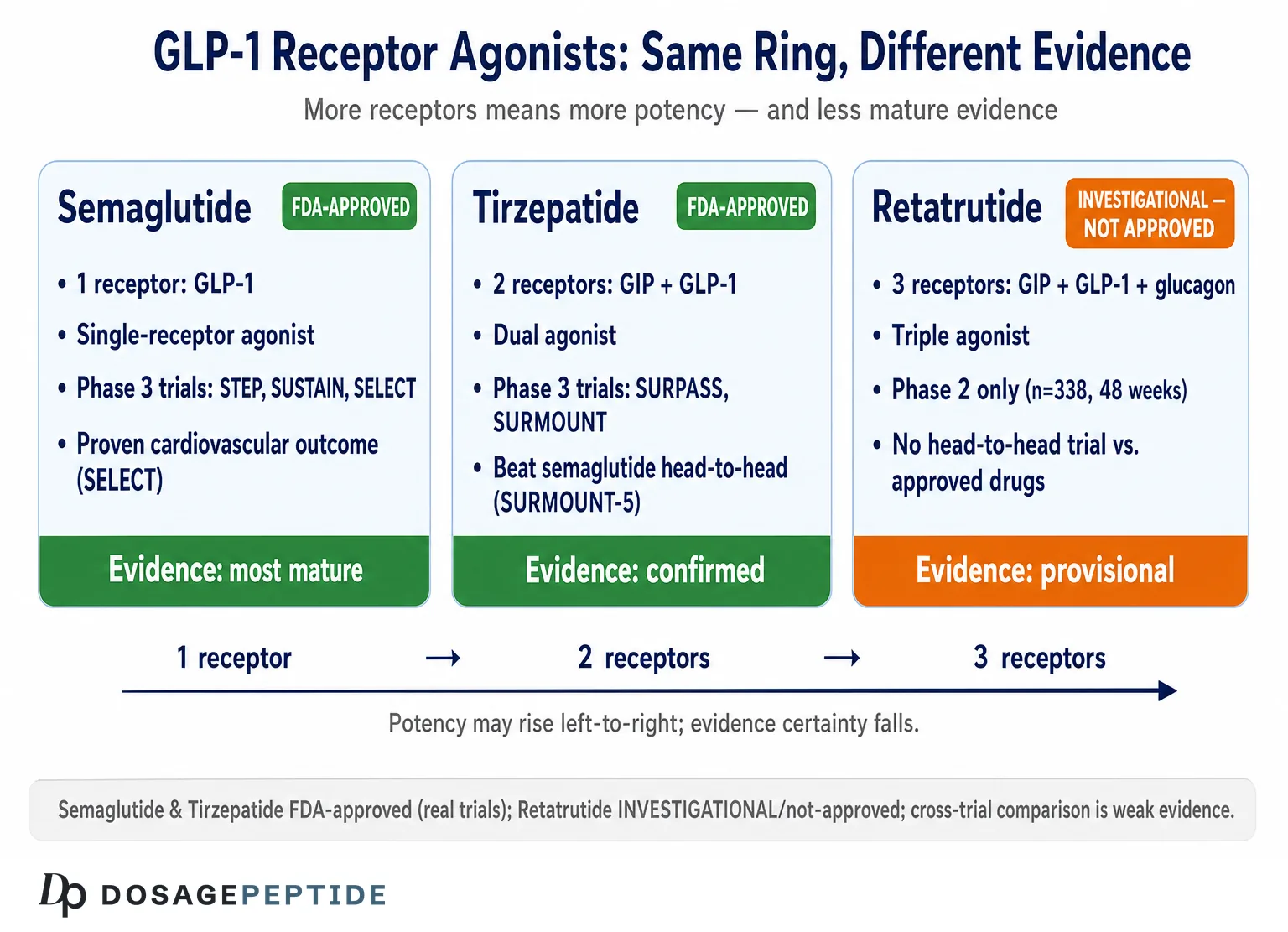
The cleanest way to understand why these drugs differ is to count receptors. All three belong to the incretin-and-glucagon family of gut- and pancreatic-hormone mimics, but each engages a different combination of the three relevant G-protein-coupled receptors: the glucagon-like peptide-1 receptor (GLP-1R), the glucose-dependent insulinotropic polypeptide receptor (GIPR), and the glucagon receptor (GCGR).
Semaglutide is a single-receptor agonist. It is a modified analogue of human GLP-1 that binds and activates the GLP-1 receptor alone. GLP-1 receptor activation slows gastric emptying, enhances glucose-dependent insulin secretion, suppresses inappropriate glucagon release, and — through receptors in the hypothalamus and hindbrain — reduces appetite and food intake. A fatty-acid side chain lets semaglutide bind albumin and resist enzymatic degradation, which is what makes once-weekly subcutaneous dosing possible.4 Its mechanism is the most thoroughly mapped of the three because it is the oldest, and readers who want the fuller signaling story can follow the site’s primer on semaglutide and long-term weight loss.
Tirzepatide is a dual agonist. A single engineered peptide activates both the GIP receptor and the GLP-1 receptor. GIP is itself an incretin — it augments insulin secretion after meals — but its role in body weight has been more contentious, and part of what made tirzepatide interesting was the finding that co-activating GIPR alongside GLP-1R produced weight and glycemic effects beyond what GLP-1 mono-agonism delivered. The pharmacology of that two-receptor engagement, and why it appears to matter for fat loss and insulin sensitivity, is explored in the site’s coverage of how tirzepatide influences incretin pathways and the broader tirzepatide mechanism explainer.
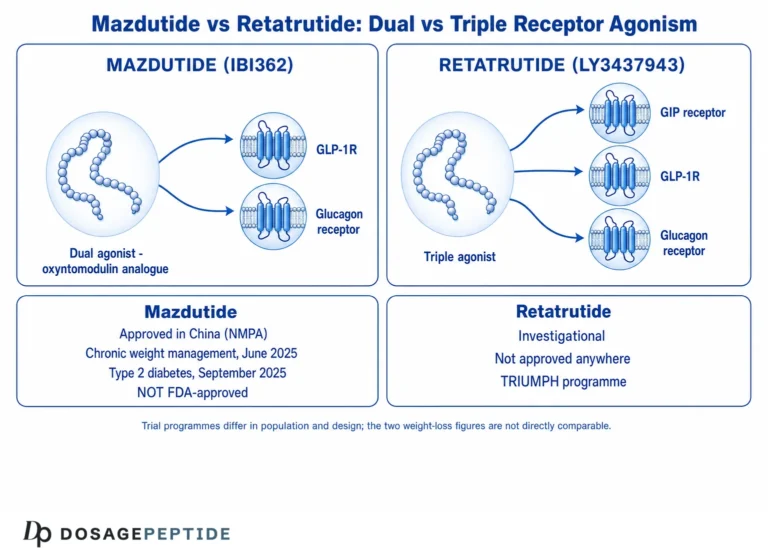
Retatrutide is a triple agonist. It activates GLP-1R and GIPR — like tirzepatide — and adds a third target, the glucagon receptor. This is the conceptually radical move. Glucagon is best known as the hormone that raises blood sugar, which sounds exactly wrong for a diabetes-adjacent drug. But glucagon receptor activation also increases energy expenditure and promotes hepatic fat oxidation, and the design bet behind retatrutide is that pairing controlled glucagon-receptor activity with strong GLP-1 and GIP activation lets you spend more energy and mobilize liver fat while the incretin arms keep appetite and glucose in check.11 The preclinical-to-clinical proof-of-concept work on this triple pharmacology is documented in the discovery literature for the molecule.11 The site’s pillar on retatrutide as a triple-receptor agonist lays out the rationale in more depth.
The escalation from one receptor to three is not merely additive marketing. Each added target changes the physiology, the side-effect profile, and — critically — the amount of evidence available. GLP-1 mono-agonism has the longest safety record; dual agonism has a shorter but robust one; triple agonism has the shortest and least mature record of all. Keeping that gradient of both potency and evidence maturity in mind is the single most useful habit for reading any comparison of the three.
How the Field Arrived at Three Receptors
The three-way showdown did not spring up overnight; it is the visible tip of roughly two decades of incretin science, and understanding that arc explains why the compounds differ the way they do. The story begins with the observation, established in the 1960s and refined for decades after, that an oral glucose load triggers far more insulin release than an equivalent intravenous one — the “incretin effect.” Two gut hormones were eventually credited with it: GIP, isolated first, and GLP-1, isolated later. GLP-1 proved the more druggable target because, unlike GIP, its insulinotropic action is largely preserved in type 2 diabetes and it independently suppresses appetite. Native GLP-1 is destroyed within minutes by the enzyme DPP-4, so the whole first generation of drugs was really an engineering problem: how to make a GLP-1 signal that lasts.
Exenatide and liraglutide were the early answers, and semaglutide was the refinement — a GLP-1 analogue engineered with amino-acid substitutions and a fatty-acid chain that binds albumin, extending its half-life enough for once-weekly dosing and, at higher doses, producing the appetite suppression that drives weight loss.4 For years, GLP-1 mono-agonism defined the ceiling of what incretin drugs could do. The obvious next question was whether adding a second hormone could raise that ceiling.
Tirzepatide answered it. GIP had long been dismissed as a weight-loss target — in some models GIP-receptor agonism and antagonism both seemed to help, a paradox still not fully resolved — but the empirical result was unambiguous: a single molecule co-activating GIP and GLP-1 receptors outperformed GLP-1 alone on both glucose and weight, and did so in confirmatory head-to-head trials.5 That validated the “more receptors, more effect” hypothesis and set the stage for the third step.
Retatrutide is that third step: keep the GIP and GLP-1 arms that tirzepatide proved, and add glucagon. Glucagon receptor agonism is the counterintuitive ingredient, because glucagon raises blood glucose — exactly the wrong direction for a metabolic drug in isolation. The insight, developed through oxyntomodulin and dual GLP-1/glucagon research before retatrutide, is that glucagon’s energy-expenditure and hepatic-fat-oxidation effects can be harnessed if a strong enough GLP-1 (and GIP) signal simultaneously restrains appetite and protects glucose control.11 The molecule is, in effect, a controlled experiment in whether you can borrow glucagon’s metabolic upside while cancelling its glycemic downside. The phase 2 data suggest the balance can be struck; whether it holds safely at scale and over years is the question phase 3 exists to answer.
The lesson embedded in this history is that each added receptor bought greater efficacy at the cost of a shorter track record. Semaglutide stands on twenty years of GLP-1 biology; tirzepatide on a decade of dual-agonist work now confirmed in phase 3; retatrutide on the newest and thinnest evidence of all. The escalation of potency and the escalation of uncertainty move together, and any honest comparison has to weigh both.
The Approval Reality: What Is Actually on the Market
Before comparing efficacy, it is worth stating the regulatory facts plainly, because they determine how much weight each number can bear.
Semaglutide is FDA-approved in multiple formulations: subcutaneous semaglutide for type 2 diabetes (Ozempic, approved 2017) and for chronic weight management at the 2.4 mg dose (Wegovy, approved 2021), plus an oral tablet (Rybelsus) for diabetes. In 2024 the Wegovy label was expanded to include reducing the risk of major cardiovascular events in adults with established cardiovascular disease and obesity, on the strength of the SELECT outcomes trial.8 This is a mature product with regulatory sign-off for efficacy, safety, and, now, a hard cardiovascular outcome.
Tirzepatide is FDA-approved as Mounjaro for type 2 diabetes (2022) and as Zepbound for chronic weight management (2023), with a later indication for moderate-to-severe obstructive sleep apnea in adults with obesity. It, too, cleared the full pivotal-trial gauntlet before reaching patients.6
Retatrutide is approved for nothing. It is an investigational compound (Eli Lilly’s LY3437943) that, as of this writing, has completed phase 2 studies and entered a phase 3 program (the TRIUMPH trials) whose confirmatory results were not yet fully reported. It has no FDA approval, no EMA approval, and no approval from any comparable regulator for obesity, diabetes, liver disease, or any other condition. Every retatrutide figure in this article — however impressive — comes from phase 2 data in a few hundred participants over 48 weeks, not from the large, long, confirmatory phase 3 trials that regulators require.12 Material sold as “retatrutide” outside a clinical trial is unapproved and, in the research-chemical market, of unverified identity and purity, and it should be treated strictly as an investigational research compound for exactly this reason.
Why belabor this? Because phase 2 trials are designed to find a signal and pick doses, not to prove a durable, safe benefit in the broad population who would eventually use a drug. Phase 2 populations are smaller and often healthier; follow-up is shorter; rare harms are invisible at that sample size; and dose-finding designs can flatter the best-performing arm. History is full of phase 2 winners that stumbled in phase 3. So when we place retatrutide’s 24% next to semaglutide’s 15% and tirzepatide’s 21%, we are not comparing three equally solid facts — we are comparing two confirmed results with one promising-but-provisional one.
Semaglutide: The Deepest Evidence Base
Semaglutide has the longest and richest trial record of the three, spanning diabetes (the SUSTAIN program), weight management (the STEP program), and cardiovascular outcomes (SELECT). That depth is itself a form of evidence: effects have been reproduced across many thousands of participants and multiple populations.
In obesity, the landmark was STEP 1, a 68-week randomized, double-blind, placebo-controlled trial of once-weekly semaglutide 2.4 mg plus lifestyle intervention in adults with overweight or obesity but without diabetes. Mean weight change was −14.9% with semaglutide versus −2.4% with placebo, and 86% of treated participants lost at least 5% of body weight.4 Those results, published in 2021, effectively opened the modern era of pharmacological weight management. In people with type 2 diabetes, weight loss tends to be somewhat smaller — STEP 2 reported roughly a 9.6% reduction at the 2.4 mg dose — a recurring pattern across this drug class that is worth remembering when comparing trials that enrolled different populations.9
On the diabetes side, the SUSTAIN trials established semaglutide’s glycemic efficacy, and SUSTAIN-6 demonstrated a cardiovascular safety-and-benefit signal in patients with type 2 diabetes at high cardiovascular risk.10 The capstone came in 2023 with SELECT, a cardiovascular outcomes trial of 17,604 adults with overweight or obesity and established cardiovascular disease but without diabetes. Semaglutide 2.4 mg reduced the primary composite of cardiovascular death, non-fatal myocardial infarction, or non-fatal stroke by about 20% relative to placebo over a mean follow-up of roughly three years.8 SELECT matters enormously for the honest comparison in this article: it is the only one of these three compounds with a completed, published hard-outcome trial showing that the weight-and-metabolic benefits translate into fewer heart attacks and strokes. Weight loss is a surrogate; SELECT reached an endpoint that patients actually feel.
Semaglutide’s standing within the GLP-1 class was itself established by a head-to-head trial. In STEP 8, once-weekly semaglutide 2.4 mg was compared directly against daily liraglutide 3.0 mg (the previous best-in-class GLP-1 agonist for weight management) in adults with overweight or obesity without diabetes; semaglutide produced roughly 15.8% weight loss versus about 6.4% for liraglutide over 68 weeks.12 That result is a useful reminder that not all GLP-1 mono-agonists are equal — semaglutide is the strong end of that category, which makes tirzepatide’s and retatrutide’s numbers, achieved against a formidable GLP-1 benchmark, all the more notable. It is also a model of the kind of direct evidence this field needs more of and, for retatrutide, still lacks entirely.
Semaglutide is not without limits. Weight regain after discontinuation is well documented — the STEP 1 extension showed that stopping the drug led participants to regain much of the lost weight, underscoring that these agents manage a chronic condition rather than curing it.4 Gastrointestinal side effects (nausea, vomiting, diarrhea, constipation) are common, usually mild-to-moderate, and concentrated during dose escalation. Still, in terms of evidence maturity, semaglutide sets the bar the others must clear.
Tirzepatide: Bigger Numbers, Strong Confirmation
Tirzepatide arrived with the advantage of a second receptor and, in trial after trial, posted larger average weight and glycemic effects than GLP-1 mono-agonists — and, importantly, it backed those numbers with a full phase 3 program.
In type 2 diabetes, the SURPASS trials tested tirzepatide at 5, 10, and 15 mg. The most quoted is SURPASS-2, a 40-week open-label trial in 1,879 adults with type 2 diabetes on metformin that compared tirzepatide head-to-head against semaglutide 1 mg — one of the only direct comparisons in this entire field. Tirzepatide was non-inferior and statistically superior on HbA1c reduction (up to −2.30% at 15 mg versus −1.86% for semaglutide) and produced substantially greater weight loss (roughly −11 to −12 kg at the top dose versus about −6 kg).5 We will return to SURPASS-2 in the head-to-head section, because it is one of the few places where a comparison rests on real randomization rather than cross-trial arithmetic.
In obesity, SURMOUNT-1 was the pivotal trial: 72 weeks, adults with obesity or overweight without diabetes. Mean weight reductions were 16.0%, 21.4%, and 22.5% at the 5, 10, and 15 mg doses respectively, versus about 2.4% with placebo, with the majority of participants at the top doses losing at least 20% of body weight.6 Those figures — roughly 21% to 22% at the higher doses — are the honest tirzepatide numbers to hold in mind, and they come from a large, confirmatory, placebo-controlled trial with a 72-week duration. The site’s review of how effective tirzepatide is according to recent clinical studies works through the full SURMOUNT and SURPASS dataset.
Two nuances keep the tirzepatide story honest. First, SURMOUNT-1 (obesity) enrolled a different, generally healthier population than SURPASS (diabetes), which is why its weight-loss numbers are larger — the same drug loses less weight in people with diabetes. This is precisely the confound that makes naive cross-trial comparison treacherous. Second, tirzepatide’s cardiovascular outcomes trial in the obesity population (SURMOUNT-MMO) was still ongoing at the time of writing; unlike semaglutide, tirzepatide did not yet have a completed dedicated hard-outcome obesity trial, though its diabetes cardiovascular data are reassuring. The larger weight number, in other words, does not automatically translate into a larger proven outcome benefit — not because it won’t, but because the trial that would prove it had not yet read out.
Retatrutide: The Investigational Contender
Now the newcomer — and the one demanding the most caution. Retatrutide’s phase 2 obesity data are, on their face, the most dramatic weight-loss figures published for any pharmacological agent to date. They are also the least mature.
The pivotal reference is the phase 2 obesity trial by Jastreboff and colleagues, published in the New England Journal of Medicine in 2023: a double-blind, randomized, placebo-controlled, dose-ranging study of 338 adults with obesity, or overweight with a weight-related condition, randomized to retatrutide (1, 4, 8, or 12 mg) or placebo. At 48 weeks, least-squares mean weight change was −8.7% at 1 mg, −17.1% at 4 mg, −22.8% at 8 mg, −24.2% at 12 mg, and −2.1% with placebo. At the top dose, 83% of participants lost at least 15% of body weight, and — a detail that generated real excitement — the weight-loss curves had not clearly plateaued by week 48, hinting at further loss with longer treatment.1
In type 2 diabetes, a separate phase 2 trial (Rosenstock and colleagues, published in The Lancet in 2023) randomized 281 adults with type 2 diabetes to retatrutide, the GLP-1 agonist dulaglutide as an active comparator, or placebo. Retatrutide produced dose-dependent HbA1c reductions and body-weight reductions of up to roughly 16.9% at 24 weeks — again, smaller than the obesity numbers, reflecting the diabetes-population pattern seen across the class.2 And in a phase 2a substudy in metabolic dysfunction-associated steatotic liver disease (MASLD), retatrutide reduced liver fat dramatically, with a large majority of participants at the higher doses reaching normal liver-fat content (below 5%) by 24 weeks — a promising but early signal, in a small sample, using imaging surrogates rather than clinical liver outcomes.3 The cardiovascular-risk-factor and metabolic changes seen in these phase 2 datasets are discussed further in the site’s coverage of how retatrutide influences cardiovascular risk factors.
Here is where honesty must be loudest. These are phase 2 results. The obesity trial enrolled 338 people; SURMOUNT-1 enrolled over 2,500 and SELECT over 17,000. Forty-eight weeks is short for a chronic-disease therapy. Dose-ranging trials are optimized to reveal the ceiling of efficacy, not to characterize real-world tolerability or rare harm. The glucagon-receptor arm that gives retatrutide its edge on energy expenditure also raised heart rate and, in the diabetes study, produced dose-dependent increases in heart rate and small changes in glycemic and other parameters that will need careful phase 3 scrutiny.12 Until the phase 3 TRIUMPH program reports durable efficacy and, ideally, cardiovascular safety in tens of thousands of patient-years, retatrutide’s 24% is a headline, not a verdict.
Head-to-Head vs. Cross-Trial: The Only Fair Comparisons
Almost every “retatrutide vs. semaglutide vs. tirzepatide” graphic you will see online commits the same sin: it lifts the top-dose weight-loss percentage from each drug’s separate trial and stacks the bars side by side. This is cross-trial comparison, and it is weak evidence — sometimes actively misleading — for reasons worth spelling out.
Different trials enroll different people. STEP 1 and SURMOUNT-1 studied adults without diabetes; SURPASS and the retatrutide diabetes trial studied people with type 2 diabetes, who reliably lose less weight on the same drug. Trial durations differ (68 weeks for STEP 1, 72 for SURMOUNT-1, 48 for the retatrutide phase 2). Background lifestyle interventions differ in intensity. Baseline body weight, sex distribution, and geography differ. Statistical estimands differ — a “treatment-policy” estimate that counts people who stopped the drug yields a smaller number than an “on-treatment” estimate that analyzes only adherent participants, and trials do not always report the same one. Placebo-group performance differs. Stack a 48-week dose-ranging phase 2 bar next to a 72-week phase 3 bar and you are not measuring the molecules; you are measuring the trials.
The antidote is a head-to-head trial: the same protocol, same population, same duration, randomized allocation. In this field there are only two that involve members of our trio, and both are worth their weight in gold.
The first is SURPASS-2, which randomized adults with type 2 diabetes directly to tirzepatide or to semaglutide 1 mg. Tirzepatide won on both HbA1c and weight.5 The caveat is that it used the 1 mg diabetes dose of semaglutide, not the 2.4 mg weight-management dose, so it does not settle the obesity comparison. The second, and more decisive for weight, is SURMOUNT-5, a 72-week open-label trial that randomized 751 adults with obesity but without diabetes directly to maximum-tolerated tirzepatide or maximum-tolerated semaglutide 2.4 mg. Tirzepatide produced a mean weight reduction of about 20.2% versus 13.7% for semaglutide — a genuine, randomized, head-to-head superiority for tirzepatide over semaglutide in obesity.7
Notice what is missing: there is no head-to-head trial of retatrutide against either approved drug. Every claim that retatrutide “beats” tirzepatide or semaglutide rests entirely on cross-trial comparison — the weakest kind of evidence — because the confirmatory, directly randomized data simply do not exist yet. That is the central honest fact of this whole showdown.
| Comparison | Design | Evidence strength | Result |
|---|---|---|---|
| Tirzepatide vs. semaglutide (diabetes) | SURPASS-2, randomized head-to-head, 40 wk5 | Strong (direct) | Tirzepatide superior on HbA1c & weight |
| Tirzepatide vs. semaglutide (obesity) | SURMOUNT-5, randomized head-to-head, 72 wk7 | Strong (direct) | Tirzepatide superior (~20.2% vs 13.7%) |
| Retatrutide vs. tirzepatide | None — separate trials only | Weak (cross-trial) | No direct data; not established |
| Retatrutide vs. semaglutide | None — separate trials only | Weak (cross-trial) | No direct data; not established |
Reading the Weight-Loss Numbers Honestly
With those caveats front-loaded, a comparison table is still useful — provided it is annotated with the evidence tier rather than presented as a clean leaderboard. The point of the table below is not to crown a winner but to show, side by side, how much confidence each number deserves.
| Compound | Receptors | Pivotal weight data (top dose) | Trial & population | Approval / evidence tier |
|---|---|---|---|---|
| Semaglutide 2.4 mg | GLP-1 | −14.9% at 68 wk4 | STEP 1; obesity, no diabetes; phase 3 | FDA-approved; hard CV outcome (SELECT)8 |
| Tirzepatide 15 mg | GIP + GLP-1 | −20.9% to −22.5% at 72 wk6 | SURMOUNT-1; obesity, no diabetes; phase 3 | FDA-approved; CV outcome trial ongoing |
| Retatrutide 12 mg | GIP + GLP-1 + glucagon | −24.2% at 48 wk1 | Phase 2 obesity (n=338); dose-ranging | Investigational; not approved anywhere |
Read across the rows and a fair picture emerges. On raw weight-loss magnitude, the ordering in these separate trials runs retatrutide > tirzepatide > semaglutide — and that ordering is at least mechanistically plausible, since it tracks the number of receptors engaged and the addition of a glucagon-driven energy-expenditure arm. But the confidence attached to each figure runs in exactly the opposite direction: semaglutide’s 15% is the most bulletproof (largest and longest evidence base, plus a proven cardiovascular benefit), tirzepatide’s ~22% is nearly as solid (confirmatory phase 3, head-to-head superiority over semaglutide), and retatrutide’s 24% is the most tentative (single phase 2, small sample, short duration, no head-to-head, no approval). A responsible reading holds both facts at once: the triple agonist may prove to be the most powerful, and we do not yet know that it is safe and durable enough to earn that title.
It is worth pausing on why the receptor count and the effect size line up so neatly, because the coincidence is instructive rather than accidental. Each additional receptor recruits a distinct physiological lever. GLP-1 alone works mostly through appetite suppression and slowed gastric emptying — you eat less. Adding GIP appears to improve the efficiency of that weight loss and its metabolic quality, including insulin sensitivity, which is part of why tirzepatide’s numbers exceed semaglutide’s. Adding glucagon introduces an entirely different lever — increased energy expenditure and fat oxidation — so retatrutide is not simply a stronger appetite suppressant but a drug that also nudges the “calories out” side of the ledger. That mechanistic layering makes the observed ordering biologically coherent, which is reassuring. What it does not do is convert a coherent story into proof: plausibility is not the same as a confirmed, head-to-head result, and the history of metabolism is littered with mechanistically elegant compounds that disappointed in large trials.
A related caution concerns responder distributions rather than averages. Mean weight loss is a single number that hides enormous individual variation; in every one of these trials, some participants lost far more than the average and some far less, and a minority barely responded at all. A drug with a slightly higher mean may not be the better choice for a given individual, and cross-trial means say nothing about how the response distributions overlap. This is another reason to resist reading the comparison table as a strict ranking of what any one person should expect.
A further subtlety often lost in the headline chase: the retatrutide curve had not plateaued at 48 weeks, while the tirzepatide and semaglutide obesity numbers come from trials run to 68–72 weeks, closer to their plateaus.16 If anything, this makes the retatrutide figure an under-estimate of its eventual ceiling — but it equally means we are comparing an unfinished curve to two finished ones, which is another reason the bars are not truly commensurable. The phase 3 program will settle the true plateau; until then, everyone is extrapolating.
Safety and Tolerability Across the Three
Efficacy is only half of any honest comparison; tolerability and safety are the other half, and here the three compounds share a family resemblance with some meaningful differences.
The dominant adverse effects across all three are gastrointestinal — nausea, vomiting, diarrhea, constipation — and they follow the same pattern in each: dose-dependent, most intense during titration, usually mild to moderate, and a leading cause of the discontinuations that do occur. This class effect flows directly from the shared GLP-1 mechanism (delayed gastric emptying and central appetite suppression). Gradual dose escalation and, for retatrutide, a lower starting dose were used specifically to blunt these effects.146
The differences track the extra receptors. Retatrutide’s glucagon-receptor arm was associated with dose-dependent increases in heart rate in the phase 2 studies, a signal that will require careful long-term cardiovascular monitoring in phase 3 — small heart-rate increases are a recognized feature of this class but are more pronounced when glucagon-receptor activity is added.12 Glucagon-receptor activation can also transiently affect glucose handling, which is one reason its diabetes development requires particular attention. Across the class, other labeled or studied concerns include gallbladder-related events, pancreatitis (rare), and, for the approved agents, a boxed warning derived from rodent thyroid C-cell tumors (a finding whose human relevance remains uncertain but which contraindicates use in people with a personal or family history of medullary thyroid carcinoma or MEN 2).
| Safety dimension | Semaglutide | Tirzepatide | Retatrutide |
|---|---|---|---|
| GI effects (nausea, etc.) | Common, dose-related4 | Common, dose-related6 | Common, dose-related1 |
| Heart-rate increase | Modest (class effect) | Modest (class effect) | More pronounced (glucagon arm)2 |
| Long-term safety data | Extensive (years, >17k in SELECT)8 | Substantial (phase 3 complete)6 | Limited (phase 2 only) |
| Hard CV outcome proven | Yes (SELECT, ~20% MACE reduction)8 | Outcome trial ongoing | None |
| Regulatory status | FDA-approved | FDA-approved | Investigational |
The honest safety summary: all three share a manageable, mostly gastrointestinal side-effect profile that is well characterized for the two approved drugs and only provisionally characterized for retatrutide. “Well tolerated in a 48-week phase 2 trial” is genuinely encouraging, but it is not the same as the multi-year, large-population safety reassurance that semaglutide and tirzepatide have accumulated. The rarest and most serious harms of any drug are, by definition, the ones a 338-person trial is least equipped to detect.
Beyond Weight: Cardiometabolic and Organ Effects
Weight loss is the headline, but these drugs are increasingly judged on what they do to the rest of the body — and this is where the evidence gap between approved and investigational status becomes most consequential.
Cardiovascular outcomes. Semaglutide is the only one of the three with a completed dedicated cardiovascular-outcomes trial in the weight-management population: SELECT showed a roughly 20% reduction in major adverse cardiovascular events in adults with obesity and established cardiovascular disease without diabetes.8 This is a category of evidence the other two do not yet have. Tirzepatide has reassuring cardiovascular data from its diabetes program and an ongoing obesity outcomes trial; retatrutide has only phase 2 changes in risk factors (blood pressure, lipids, glycemia), which are surrogates, not outcomes.
Glycemic control. All three improve glycemia, but the approved agents have the confirmatory data. Tirzepatide’s SURPASS program and its head-to-head superiority over semaglutide 1 mg in SURPASS-2 make it the most potent glucose-lowering agent of the group in diabetes.5 Retatrutide’s diabetes phase 2 showed strong HbA1c reductions, but the glucagon-receptor arm means its net glycemic effect required careful dose-finding, and confirmatory diabetes data are pending.2
Liver. The most intriguing retatrutide-specific signal is in MASLD: dramatic reductions in liver fat with most higher-dose participants reaching normal liver-fat content by 24 weeks.3 Tirzepatide and semaglutide have also shown benefit in steatotic liver disease (with tirzepatide and semaglutide both demonstrating histological improvement in dedicated MASH trials), so this is a class strength rather than a retatrutide monopoly — but retatrutide’s glucagon-driven hepatic fat oxidation gives it a plausible mechanistic edge that phase 3 liver trials will need to confirm on clinical, not just imaging, endpoints.
The pattern repeats at every turn: the approved drugs have converted mechanism and weight loss into proven or near-proven organ benefits, while retatrutide has converted mechanism into promising surrogates. Surrogates are where every successful drug starts, but they are not where the comparison should end.
What the Evidence Does NOT Show
A comparison this popular attracts confident claims that outrun the data. Here is a candid accounting of what these trials, taken together, do not establish.
They do not establish that retatrutide is the “best” of the three. There is no head-to-head trial of retatrutide against either approved drug. Its larger cross-trial weight number is a real and exciting signal, but ranking it above tirzepatide or semaglutide is an inference from non-comparable trials, not a finding. The only directly established ranking in this field is tirzepatide over semaglutide, from SURPASS-2 and SURMOUNT-5.57
They do not establish retatrutide’s long-term safety. A 338-person, 48-week phase 2 trial cannot detect rare serious harms, characterize multi-year risks, or confirm cardiovascular safety. The heart-rate signal from the glucagon-receptor arm specifically warrants phase 3 scrutiny.12
They do not establish a cardiovascular-outcome benefit for retatrutide or, in the obesity setting, for tirzepatide. Only semaglutide has a completed hard-outcome obesity trial (SELECT).8 Changes in risk factors are not the same as fewer heart attacks and strokes.
They do not establish durability or the consequences of stopping. Weight regain after discontinuation is well documented for semaglutide and expected as a class effect; none of these agents has shown that its benefits persist after the drug is withdrawn. They manage a chronic condition; they do not cure it.4
They do not license research-chemical use of retatrutide. An investigational compound’s promising trial data say nothing about the identity, purity, dosing, or safety of material sold outside a clinical trial. The trial results were generated with pharmaceutical-grade drug under medical supervision — conditions that do not transfer to unregulated products.
They do not make any of these a lifestyle-optional solution. Every pivotal trial paired the drug with lifestyle intervention, and the comparators improved on that background, not instead of it.46 Nutrition, physical activity, and clinical management of comorbidities remain the foundation; the drugs are powerful additions, not replacements.
Taken together, the honest bottom line of the showdown is a split decision, not a knockout. Between the two approved drugs, tirzepatide has directly outperformed semaglutide on weight in two randomized trials, while semaglutide holds the unique distinction of a proven reduction in cardiovascular events — so the “winner” genuinely depends on whether the priority is maximal weight loss or documented outcome protection.78 Retatrutide, meanwhile, is not a third finalist so much as a highly promising qualifier that has not yet run the final race. Its phase 2 numbers are the most exciting in the field and its mechanism is the most novel, but exciting phase 2 data and confirmed phase 3 medicine are different categories of knowledge, and conflating them is the single most common error in popular coverage of these three compounds. The scientifically defensible statement is narrow and worth memorizing: retatrutide may become the most powerful of the three, and we will not know until the confirmatory trials are done.
Practical and Research Context
For readers approaching these compounds from a research or educational standpoint rather than a clinical one, a few practical distinctions are worth drawing — with the firm caveat that retatrutide is investigational and none of this is a usage recommendation.
All three are peptides delivered by once-weekly subcutaneous injection and, in research settings, are handled as lyophilized material reconstituted with appropriate diluent, stored cold, protected from light and freeze-thaw, and dosed by the same reconstitution arithmetic that governs any peptide: a fixed mass in a chosen volume sets the concentration. The mechanics of that math are covered in the site’s peptide reconstitution guide, and unfamiliar terms across this article — incretin, estimand, MACE, surrogate endpoint — are defined in the peptide glossary.
The differences that matter for interpretation are not in the handling but in the evidence. Semaglutide and tirzepatide are pharmaceutical products with defined, approved dosing regimens established through titration studies; retatrutide’s dosing exists only within the phase 2 and ongoing phase 3 protocols, and its optimal maintenance dose is still being determined. Any figure attached to retatrutide should carry the mental asterisk “phase 2, not yet confirmed.” The most important research-context takeaway is the same one that runs through this entire article: distinguish, always, between the two approved drugs whose numbers are settled and the investigational one whose numbers are provisional.
Frequently Asked Questions
Which is strongest for weight loss — retatrutide, tirzepatide, or semaglutide?
In their separate trials, the top-dose weight-loss figures rank retatrutide (about 24% at 48 weeks, phase 2) above tirzepatide (about 21–22% at 72 weeks, phase 3) above semaglutide (about 15% at 68 weeks, phase 3).146 But those come from non-comparable trials, so the ranking is weak evidence. The only directly established comparison is that tirzepatide beat semaglutide head-to-head in both diabetes (SURPASS-2) and obesity (SURMOUNT-5).57 Retatrutide has never been tested head-to-head against either, so calling it “the strongest” is an inference, not a proven fact.
Is retatrutide FDA-approved?
No. Retatrutide is investigational (Eli Lilly’s LY3437943). It has completed phase 2 studies and entered phase 3 (the TRIUMPH program) but is not approved by the FDA, EMA, or any other major regulator for obesity, diabetes, liver disease, or any condition. Semaglutide and tirzepatide, by contrast, are both FDA-approved for weight management and type 2 diabetes.
Why can’t I just compare the weight-loss percentages from each trial?
Because the trials differ in population (diabetes vs. no diabetes), duration (48 vs. 68–72 weeks), dosing, lifestyle intervention, statistical estimand, and baseline characteristics. People with diabetes reliably lose less weight on the same drug, and a 48-week dose-ranging phase 2 curve that has not plateaued is not comparable to a finished 72-week phase 3 curve. Cross-trial comparison measures the trials as much as the molecules; only a head-to-head trial controls for these differences.
What is the difference between the three drugs’ mechanisms?
Semaglutide activates one receptor (GLP-1). Tirzepatide activates two (GIP and GLP-1). Retatrutide activates three (GIP, GLP-1, and glucagon).11 The added glucagon-receptor activity in retatrutide is thought to increase energy expenditure and hepatic fat oxidation, which may explain its large phase 2 weight and liver-fat effects — and also its more pronounced heart-rate increase.12
Do any of these reduce heart attacks and strokes?
Only semaglutide has proven it in the weight-management population. The SELECT trial in over 17,000 adults with obesity and cardiovascular disease (without diabetes) showed roughly a 20% reduction in major adverse cardiovascular events.8 Tirzepatide’s obesity cardiovascular-outcomes trial was still ongoing, and retatrutide has only phase 2 risk-factor data, which are surrogates rather than outcomes.
Are the side effects different among the three?
All three share the same dominant, dose-related gastrointestinal effects (nausea, vomiting, diarrhea, constipation), most intense during dose escalation.146 Retatrutide’s glucagon-receptor arm was associated with more pronounced heart-rate increases in phase 2, a signal that needs long-term evaluation.2 The two approved drugs have years of large-population safety data; retatrutide’s safety record is limited to phase 2.
Does more weight loss automatically mean a better drug?
Not necessarily. Magnitude of weight loss is one endpoint; durability, tolerability, rare-harm safety, and hard clinical outcomes (heart attacks, strokes, diabetes prevention, liver outcomes) matter as much or more. Semaglutide loses the weight-loss contest to tirzepatide yet is the only one with a proven cardiovascular-outcome benefit.78 The “best” drug depends on which outcome a given patient and clinician prioritize.
What happens if someone stops taking one of these?
Weight regain is expected. The best-documented example is the STEP 1 extension, in which participants regained much of the lost weight after semaglutide was withdrawn.4 These agents manage a chronic condition; their benefits depend on continued use alongside lifestyle measures, and none has shown lasting effect after discontinuation.
Is retatrutide sold as a research chemical the same as the trial drug?
No assurance of that exists. The phase 2 results were produced with pharmaceutical-grade retatrutide under medical supervision. Material sold outside clinical trials is unapproved and, in the research-chemical market, of unverified identity, purity, and dosing. Promising trial data say nothing about the quality or safety of such products.
References
- Jastreboff AM, Kaplan LM, Frías JP, et al. Triple–Hormone-Receptor Agonist Retatrutide for Obesity — A Phase 2 Trial. N Engl J Med. 2023;389(6):514-526. PMID 37366315. https://www.nejm.org/doi/full/10.1056/NEJMoa2301972
- Rosenstock J, Frías J, Jastreboff AM, et al. Retatrutide, a GIP, GLP-1 and glucagon receptor agonist, for people with type 2 diabetes: a randomised, double-blind, placebo and active-controlled, parallel-group, phase 2 trial. Lancet. 2023;402(10401):529-544. https://www.thelancet.com/journals/lancet/article/PIIS0140-6736(23)01053-X/abstract
- Sanyal AJ, Kaplan LM, Frías JP, et al. Triple hormone receptor agonist retatrutide for metabolic dysfunction-associated steatotic liver disease: a randomized phase 2a trial. Nat Med. 2024;30(7):2037-2048. PMCID PMC11271400. https://www.ncbi.nlm.nih.gov/pmc/articles/PMC11271400/
- Wilding JPH, Batterham RL, Calanna S, et al. Once-Weekly Semaglutide in Adults with Overweight or Obesity (STEP 1). N Engl J Med. 2021;384(11):989-1002. PMID 33567185. https://www.nejm.org/doi/full/10.1056/NEJMoa2032183
- Frías JP, Davies MJ, Rosenstock J, et al. Tirzepatide versus Semaglutide Once Weekly in Patients with Type 2 Diabetes (SURPASS-2). N Engl J Med. 2021;385(6):503-515. PMID 34170647. https://pubmed.ncbi.nlm.nih.gov/34170647/
- Jastreboff AM, Aronne LJ, Ahmad NN, et al. Tirzepatide Once Weekly for the Treatment of Obesity (SURMOUNT-1). N Engl J Med. 2022;387(3):205-216. PMID 35658024. https://www.nejm.org/doi/full/10.1056/NEJMoa2206038
- Aronne LJ, Horn DB, le Roux CW, et al. Tirzepatide as Compared with Semaglutide for the Treatment of Obesity (SURMOUNT-5). N Engl J Med. 2025;393(1):26-36. PMID 40353578. https://www.nejm.org/doi/full/10.1056/NEJMoa2416394
- Lincoff AM, Brown-Frandsen K, Colhoun HM, et al. Semaglutide and Cardiovascular Outcomes in Obesity without Diabetes (SELECT). N Engl J Med. 2023;389(24):2221-2232. PMID 37952131. https://www.nejm.org/doi/full/10.1056/NEJMoa2307563
- Davies M, Færch L, Jeppesen OK, et al. Semaglutide 2.4 mg once a week in adults with overweight or obesity, and type 2 diabetes (STEP 2). Lancet. 2021;397(10278):971-984. PMID 33667417. https://pubmed.ncbi.nlm.nih.gov/33667417/
- Marso SP, Bain SC, Consoli A, et al. Semaglutide and Cardiovascular Outcomes in Patients with Type 2 Diabetes (SUSTAIN-6). N Engl J Med. 2016;375(19):1834-1844. PMID 27633186. https://www.nejm.org/doi/full/10.1056/NEJMoa1607141
- Coskun T, Urva S, Roell WC, et al. LY3437943, a novel triple glucagon, GIP, and GLP-1 receptor agonist for glycemic control and weight loss: From discovery to clinical proof of concept. Cell Metab. 2022;34(9):1234-1247.e9. PMID 36044901. https://pubmed.ncbi.nlm.nih.gov/36044901/
- Rubino DM, Greenway FL, Khalid U, et al. Effect of Weekly Subcutaneous Semaglutide vs Daily Liraglutide on Body Weight in Adults With Overweight or Obesity Without Diabetes (STEP 8). JAMA. 2022;327(2):138-150. PMID 35015037. https://pubmed.ncbi.nlm.nih.gov/35015037/
Educational and research-use disclaimer: This article is provided solely for scientific and educational purposes and is not medical advice. Semaglutide and tirzepatide are FDA-approved medicines; retatrutide is an investigational compound that is not approved by the FDA, EMA, or any comparable regulator for the treatment, cure, or prevention of obesity, type 2 diabetes, liver disease, or any other condition, and its efficacy and safety have not been confirmed in phase 3 trials. Cross-trial comparisons of these agents are weak evidence and should not be read as establishing that any one compound is superior. Nothing here is a recommendation for human use of any unapproved product; material sold as “retatrutide” outside a clinical trial is of unverified identity and purity. Readers should consult qualified healthcare professionals and applicable regulations before making any decisions.