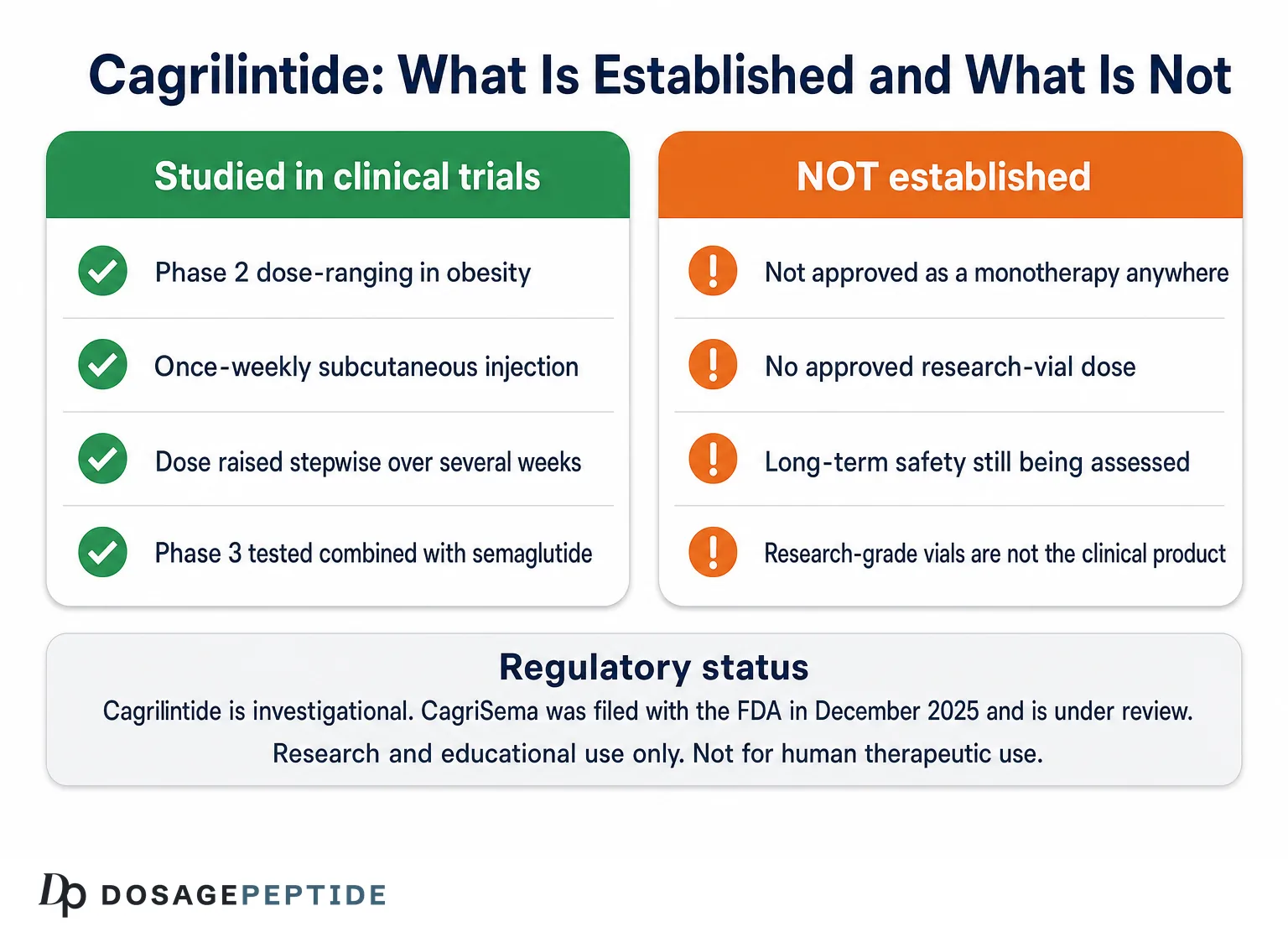
A researcher holding a 5 mg or 10 mg cagrilintide vial faces a deceptively simple question: how many milligrams per week, and how many units on the syringe? The honest answer requires separating two very different things — what the published clinical literature actually documents for a long-acting amylin analogue that no regulator has approved as a monotherapy anywhere in the world, and what a research-grade vial of unknown provenance can support. This article answers the arithmetic question exactly, and is equally exact about where the evidence runs out.
Research context: what is cagrilintide, and where does it sit in 2026?
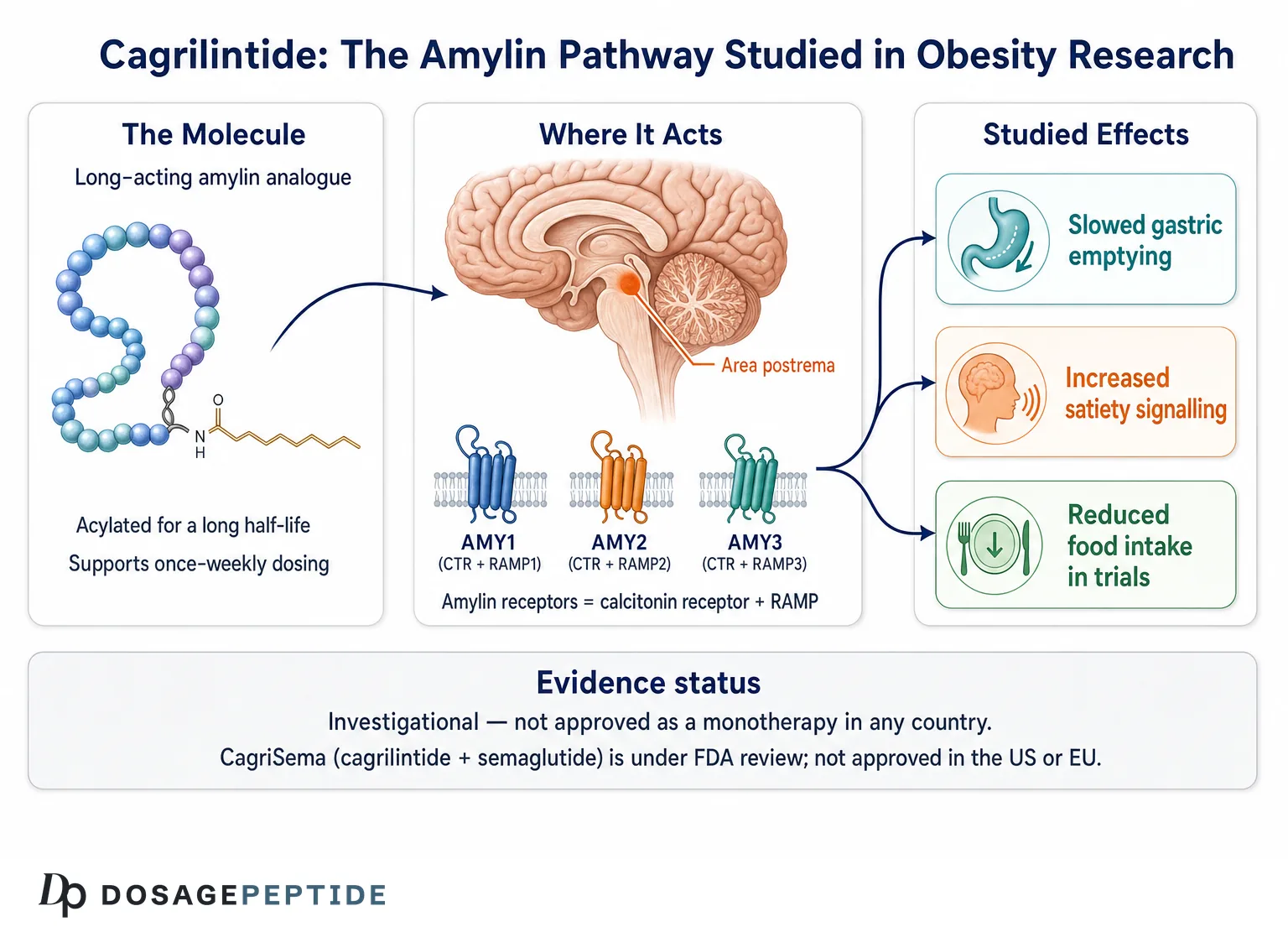
Cagrilintide (developmental code NNC0174-0833) is a lipidated, long-acting analogue of human amylin, developed by Novo Nordisk. Amylin is a 37–amino acid pancreatic hormone co-secreted with insulin from pancreatic beta cells in response to nutrient intake. In physiological terms, amylin is one of the body’s satiation signals: it acts alongside insulin to communicate that a meal has arrived and that ingestion should slow.
Native amylin is a poor drug candidate for a specific and well-characterised reason. It is highly amyloidogenic — it aggregates into amyloid fibrils, the same species found in the pancreatic islets of people with type 2 diabetes. This aggregation propensity makes formulation and storage genuinely difficult. The medicinal-chemistry programme that produced cagrilintide, described by Kruse and colleagues in the Journal of Medicinal Chemistry in 2021, addressed this by re-engineering the amylin backbone with structural elements borrowed from calcitonin (a related, non-aggregating peptide) and attaching a fatty-acid side chain that enables reversible binding to serum albumin[1].
That albumin-binding protraction strategy is the same principle used for semaglutide, and it is the reason cagrilintide is dosed once weekly rather than three times daily. The contrast with the one approved amylin analogue is instructive. Pramlintide (SYMLIN), approved by the FDA in 2005 as an adjunct to mealtime insulin, has a half-life in the region of 48 minutes and must be injected before each major meal[2]. In the only published human pharmacokinetic dataset for cagrilintide, the elimination half-life was 159–195 hours — roughly 6.5 to 8 days[3]. That single pharmacokinetic fact drives essentially every structural feature of how cagrilintide dosing is discussed: weekly administration, slow stepwise escalation, and a long lag before steady state.
Dosing is discussed at all because cagrilintide produced clinically meaningful weight reduction as a standalone agent in a phase 2 dose-finding trial, and because it is the amylin half of CagriSema — the fixed-dose cagrilintide/semaglutide combination that Novo Nordisk filed with the FDA in December 2025. The compound is real, the trials are real, and the dose-response relationship has been formally characterised. None of that makes it an approved medicine.
Precision about regulatory status matters more here than almost anywhere else in the peptide literature, because the surrounding commercial noise is loud and consistently overstates the position.
Cagrilintide monotherapy
Cagrilintide alone is investigational. It is not approved by the FDA, the EMA, the MHRA, or any other regulator, for any indication, in any country. There is no approved label, no approved dose, no approved indication, and no regulatory finding of safety or efficacy. Novo Nordisk has not filed cagrilintide as a monotherapy. Every dose figure discussed in this article is a trial dose or a figure constructed by this site’s protocol pages, not a therapeutic dose.
CagriSema (cagrilintide 2.4 mg + semaglutide 2.4 mg)
Novo Nordisk submitted a New Drug Application to the FDA for CagriSema for chronic weight management on 18 December 2025. The company’s own announcement states plainly that “the FDA is expected to review the CagriSema application in 2026”[4]. As of July 2026, that application remains under review, and CagriSema is not approved in the United States or the European Union. It does not appear in Drugs@FDA, the FDA’s own database of approved products. Under the standard review clock a decision would be anticipated during 2026, but a submission is not an approval, a review timeline is not a guarantee, and complete response letters are a routine outcome. It would be wrong to describe CagriSema as approved, and equally wrong to describe its approval as certain.
This point needs a specific warning, because the misinformation is active rather than hypothetical. At least one financial-news website has published an article asserting that the FDA “formally approved” CagriSema, and search-engine summaries have repeated that claim as fact. It cites no source, it is contradicted by the FDA’s own approval database, and Novo Nordisk — the party with the strongest possible incentive to announce an approval — has announced no such thing. A reader who encounters a confident approval claim for CagriSema in 2026 should check Drugs@FDA directly rather than trusting the summary.
Research-grade cagrilintide vials
The 5 mg and 10 mg lyophilised vials circulating in the research-chemical market are not the Novo Nordisk clinical product. They are not manufactured under the same controls, are not subject to regulatory inspection, and carry no assurance of identity, purity, peptide content, endotoxin level, or sterility. A vial labelled “cagrilintide 10 mg” is a claim, not a specification. This distinction is not pedantry: the entire dose-response literature discussed below was generated with a characterised clinical trial product, and the mapping from that literature onto an uncharacterised vial is an assumption, not a measurement. These materials are supplied for laboratory research use only and are not approved for human therapeutic use.
Mechanisms studied: how does cagrilintide act?
Amylin signalling is more architecturally interesting than most peptide pharmacology, and understanding it explains several otherwise puzzling features of the dosing schedule.
The amylin receptor is a composite
There is no single dedicated “amylin receptor” gene. Amylin receptors (AMY₁, AMY₂, AMY₃) are heterodimers formed when the calcitonin receptor (CTR) associates with one of three receptor activity-modifying proteins (RAMP1, RAMP2, RAMP3). The RAMP partner reshapes the ligand-binding pocket of the calcitonin receptor, converting a calcitonin-preferring receptor into an amylin-preferring one. Cagrilintide is described as a non-selective amylin analogue: it engages the amylin receptor subtypes and retains activity at the calcitonin receptor itself[1]. Whether that residual calcitonin-receptor activity contributes materially to the weight effect, or is simply tolerated, has not been resolved in humans.
Central satiation via the area postrema
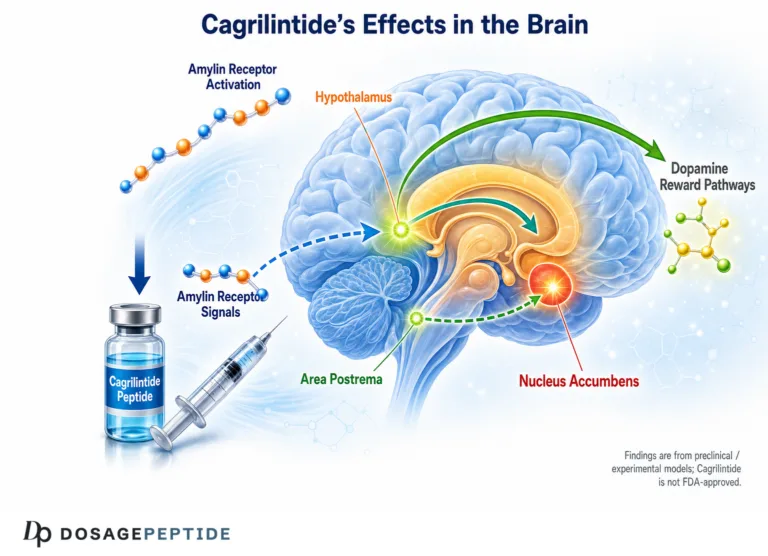
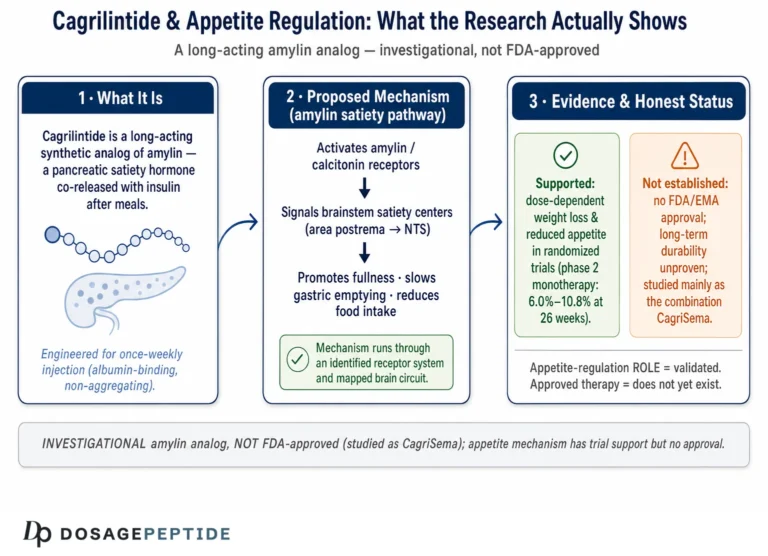
The principal site of amylin action studied in experimental models is the area postrema, a circumventricular organ in the brainstem that lies outside the blood–brain barrier and is therefore directly accessible to circulating peptides. Amylin receptor density is high there. In animal models, amylin signalling at the area postrema propagates to the nucleus of the solitary tract and onward to hypothalamic feeding circuits, reducing meal size and increasing the satiating effect of a given nutrient load. Preclinical work also suggests amylin signalling interacts with mesolimbic dopaminergic pathways implicated in the hedonic, reward-driven component of eating — a mechanism explored further in our overview of how cagrilintide influences brain satiety circuits and reward-driven eating. It is important to be clear that the circuit-level detail comes overwhelmingly from rodent work; the human evidence is at the level of outcomes (people ate less and lost weight), not mechanism.
Gastric emptying and postprandial handling
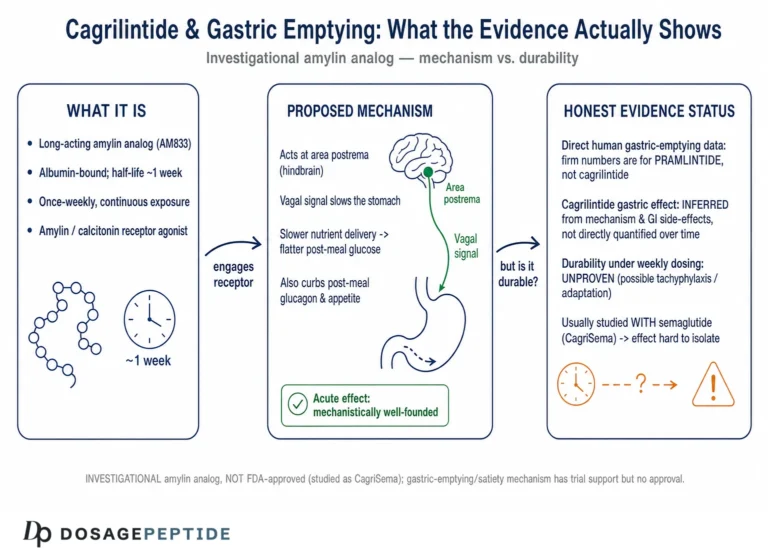
Amylin slows gastric emptying, which flattens the postprandial glucose excursion by metering nutrient delivery to the small intestine, and contributes to prolonged fullness. Amylin also suppresses inappropriate postprandial glucagon secretion. Both effects are well established for native amylin and for pramlintide, and are the pharmacological basis of pramlintide’s approved use as an insulin adjunct[2]. The extent to which a once-weekly, continuously present amylin analogue reproduces these meal-linked effects — as opposed to producing a tonic, non-pulsatile signal quite unlike physiological amylin — is a genuinely open question, discussed further in our review of how cagrilintide affects gastric emptying and postprandial metabolism.
The pulsatility problem
This deserves more attention than it usually receives, because it is the conceptual oddity at the centre of the entire compound. Endogenous amylin is a meal signal. It is co-secreted with insulin in response to eating, rises sharply after a meal, and clears within hours. Its information content is temporal: amylin high means nutrients are arriving now. Pramlintide, with its ~48-minute half-life and pre-meal injection schedule, deliberately reproduces that pulse[2].
Cagrilintide does the opposite. A half-life of roughly one week with weekly dosing produces a broad, comparatively flat concentration profile in which amylin receptor occupancy is continuous rather than episodic. The signal is no longer “a meal has arrived” but something closer to a persistent background tone. Whether continuous agonism at the amylin receptor achieves its effect through the same mechanism as physiological pulsatile signalling, or through a distinct one — and whether receptor desensitisation develops over months of uninterrupted occupancy — has not been resolved in humans. The clinical trials measured outcomes, not receptor dynamics, and 68 weeks is the longest anyone has looked.
This matters for dose interpretation in a specific way. If tolerance to the satiation effect develops while the dose-limiting nausea does not, the benefit–risk ratio of a given weekly dose would drift over time — and a titration schedule built on early-weeks tolerability would be calibrated to the wrong period. The available data neither demonstrate nor exclude this. It is simply unmeasured, and it is one of several reasons why extrapolating a 26-week dose-response curve to indefinite use is unwarranted.
Why the mechanism dictates slow titration
The area postrema is also the brain’s emetic trigger zone. The same anatomical access that produces satiation produces nausea. This is not an incidental side effect to be engineered away; it is mechanistically adjacent to the intended effect. Gradual dose escalation exists to allow that pathway to accommodate. This is the reason every cagrilintide schedule, in trials and in research-protocol references alike, steps the dose rather than starting at target.
What weekly cagrilintide dose does the literature actually document?
The primary monotherapy dose-ranging evidence is a single trial: Lau and colleagues, published in The Lancet in 2021 (ClinicalTrials.gov NCT03856047)[5]. This is the study that defines the 0.3–4.5 mg weekly range referenced throughout the research literature, and it is worth reporting accurately.
It was a multicentre, randomised, double-blind, placebo-controlled and active-controlled, dose-finding phase 2 trial at 57 sites in ten countries (Canada, Denmark, Finland, Ireland, Japan, Poland, Serbia, South Africa, the UK, and the USA). Eligible participants were adults without diabetes with a BMI of at least 30 kg/m², or at least 27 kg/m² with hypertension or dyslipidaemia. Between 1 March and 19 August 2019, 706 participants were randomised in total, in a 6:1 ratio: approximately 506 to once-weekly subcutaneous cagrilintide at 0.3, 0.6, 1.2, 2.4 or 4.5 mg (100–102 per dose group), 99 to once-daily liraglutide 3.0 mg, and 101 to volume-matched placebo. The treatment period was 26 weeks, including a dose-escalation period of up to 6 weeks, followed by a 6-week off-treatment follow-up[6].
That enrolment breakdown is worth stating carefully, because the trial’s own abstract phrases it in a way that is easy to misread: it says 706 participants were assigned “to cagrilintide 0.3–4.5 mg (100–102 per dose group), 99 to liraglutide 3.0 mg, and 101 to placebo.” Read literally, that would put the trial at over 900 people. It does not: five dose groups of 100–102 is roughly 506, and 506 + 99 + 101 = 706, which matches the registry’s recorded enrolment of 706 exactly[6]. Secondary write-ups of this trial circulate an inflated “n=906” derived from precisely this misreading.
Results, reported under the trial product estimand (the analysis that assumes all participants adhered to treatment):
| Arm (once weekly unless noted) | Mean weight change at week 26 | Absolute change |
|---|---|---|
| Cagrilintide 0.3–4.5 mg (range across the five arms) | −6.0% to −10.8% | −6.4 to −11.5 kg |
| Cagrilintide 4.5 mg (top dose) | −10.8% | −11.5 kg |
| Liraglutide 3.0 mg (once daily, active control) | −9.0% | −9.6 kg |
| Placebo | −3.0% | −3.3 kg |
All cagrilintide doses beat placebo, with an estimated treatment difference range of 3.0–7.8 percentage points (p<0.001). Cagrilintide 4.5 mg beat daily liraglutide 3.0 mg by an estimated 1.8 percentage points (p=0.03). Similar reductions were seen under the treatment policy estimand. Permanent treatment discontinuation occurred in 73 participants (10%), similarly across groups, mostly due to adverse events (30 participants, 4%); 29 participants (4%) withdrew from the trial entirely[5].
Three points deserve emphasis, because they are routinely lost in secondary write-ups.
First, 4.5 mg was the top dose studied, not the dose selected. Novo Nordisk carried 2.4 mg, not 4.5 mg, into phase 3. The published record does not state why. The dose-response data show a weight effect that flattens toward the top of the range alongside dose-dependent gastrointestinal adverse events, which is consistent with a tolerability-driven choice — but that reading is an inference drawn here, not a documented rationale, and Novo Nordisk has published no dose-selection statement. What is documented is the outcome: a research protocol that treats 4.5 mg as the “target” is going past the dose the sponsor advanced after seeing the complete phase 2 dataset.
Second, the dose-response curve is not steep at the top. Moving from the lowest to the highest dose — a fifteen-fold increase — bought roughly 4.8 percentage points of additional weight change, while gastrointestinal adverse events rose across the range. This is a flattening curve, not a linear one.
Third, this was 26 weeks in 706 people. It is a phase 2 dose-finding study, not a definitive efficacy trial, and it was not powered or designed to detect uncommon harms.
Cagrilintide dosage chart: weekly dose to syringe units
This is the arithmetic the question usually reduces to. Two facts do all the work:
- Concentration = mass ÷ volume. Milligrams of peptide in the vial, divided by millilitres of bacteriostatic water added.
- A U-100 insulin syringe is graduated so that 100 units = 1.0 mL. Therefore 1 unit = 0.01 mL. Units are a volume marking, not a dose — a “20-unit” draw means nothing until the concentration is specified.
The site’s documented reconstitutions give:
- 5 mg vial + 2.0 mL bacteriostatic water → 5 mg ÷ 2.0 mL = 2.5 mg/mL. At 2.5 mg/mL, 1 mg = 1 ÷ 2.5 = 0.40 mL = 40 units.
- 10 mg vial + 2.0 mL bacteriostatic water → 10 mg ÷ 2.0 mL = 5 mg/mL. At 5 mg/mL, 1 mg = 1 ÷ 5 = 0.20 mL = 20 units.
- Advanced: 10 mg vial + 1.0 mL → 10 mg/mL. 1 mg = 0.10 mL = 10 units.
The full chart across the documented 0.25–4.5 mg weekly range:
| Weekly dose | 5 mg vial @ 2.5 mg/mL | 10 mg vial @ 5 mg/mL | 10 mg vial @ 10 mg/mL |
|---|---|---|---|
| 0.25 mg | 0.10 mL — 10 units | 0.05 mL — 5 units | 0.025 mL — 2.5 units |
| 0.5 mg | 0.20 mL — 20 units | 0.10 mL — 10 units | 0.05 mL — 5 units |
| 0.75 mg | 0.30 mL — 30 units | 0.15 mL — 15 units | 0.075 mL — 7.5 units |
| 1.0 mg | 0.40 mL — 40 units | 0.20 mL — 20 units | 0.10 mL — 10 units |
| 1.2 mg (Lau arm) | 0.48 mL — 48 units | 0.24 mL — 24 units | 0.12 mL — 12 units |
| 1.5 mg | 0.60 mL — 60 units | 0.30 mL — 30 units | 0.15 mL — 15 units |
| 2.0 mg | 0.80 mL — 80 units | 0.40 mL — 40 units | 0.20 mL — 20 units |
| 2.4 mg (phase 3 dose) | 0.96 mL — 96 units | 0.48 mL — 48 units | 0.24 mL — 24 units |
| 3.0 mg | 1.20 mL — 120 units ⚠ | 0.60 mL — 60 units | 0.30 mL — 30 units |
| 4.5 mg (Lau top dose) | 1.80 mL — 180 units ⚠ | 0.90 mL — 90 units | 0.45 mL — 45 units |
⚠ Note the practical ceiling. A 1 mL U-100 syringe holds 100 units. At 2.5 mg/mL, any dose above 2.5 mg exceeds one syringe — 4.5 mg would require 1.8 mL, i.e. two separate draws, and 1.8 mL is nearly the entire reconstituted 5 mg vial in a single week. This is the concrete reason the 5 mg vial at 2.5 mg/mL is a low-and-mid-range presentation, and why the 10 mg vial is the more coherent choice for anyone working near the top of the documented range. Detailed per-vial working is set out on the cagrilintide 5 mg vial dosage protocol and the cagrilintide 10 mg vial dosage protocol, and any of these figures can be re-derived independently with the peptide dosage calculator.
How many weekly doses does a vial yield?
| Vial | At 2.4 mg/week | At 1.2 mg/week | At 4.5 mg/week |
|---|---|---|---|
| 5 mg | 5 ÷ 2.4 = 2.08 → 2 full doses | 5 ÷ 1.2 = 4.17 → 4 full doses | 1 dose (+ remainder) |
| 10 mg | 10 ÷ 2.4 = 4.17 → 4 full doses | 10 ÷ 1.2 = 8.33 → 8 full doses | 10 ÷ 4.5 = 2.22 → 2 full doses |
The residual fraction is real peptide but usually cannot be used, because a partial dose falls outside the schedule and because the reconstituted vial has a limited in-use window (below). Note the collision between vial yield and stability: a 10 mg vial at 2.4 mg/week yields four weekly doses, i.e. four weeks of use — right at the outer edge of the 2–4 week refrigerated window.
How is cagrilintide reconstituted and stored?
Reconstitution is where most avoidable error enters, and the errors are unforgiving because they are silent — a mis-reconstituted vial looks identical to a correct one.
The procedure
- Let the vial reach room temperature. Lyophilised peptide taken straight from cold storage can draw condensation.
- Sanitise both stoppers — the peptide vial and the bacteriostatic water vial — with 70% isopropyl alcohol and let them dry.
- Draw the exact water volume. For the 5 mg vial, 2.0 mL; for the 10 mg vial, 2.0 mL (or 1.0 mL for the concentrated preparation). A 3 mL syringe measures this far more accurately than a 1 mL insulin syringe used twice, and the volume accuracy here propagates directly into every subsequent dose.
- Direct the stream against the glass wall of the vial, not onto the lyophilised cake. Peptides are surface-active and shear-sensitive; a jet fired directly into the powder promotes denaturation and foaming.
- Do not shake. Swirl gently, or simply set the vial down and wait. Dissolution may take several minutes. Shaking generates an air–liquid interface that unfolds peptide.
- Inspect. The solution should be clear and free of particulates. Cloudiness, visible fibrils, or persistent undissolved material after a reasonable interval are grounds to discard — and given amylin’s documented aggregation tendency[1], this inspection step carries more weight for an amylin analogue than for most peptides.
- Label the vial with the concentration and the reconstitution date. Not with the dose — with the concentration. This is the single most useful thing on the label.
The general principles, including bacteriostatic versus sterile water and the surface-adsorption losses that matter at low concentrations, are covered in the peptide reconstitution guide.
How to reconstitute cagrilintide 10 mg: choosing the volume
The 10 mg vial admits a genuine choice, and it is a trade-off rather than a right answer.
2.0 mL → 5 mg/mL. This is the more forgiving option. Doses land on larger, easier-to-read volumes: 2.4 mg is 48 units, comfortably mid-barrel. Low titration steps remain measurable — 0.5 mg is 10 units. The cost is that 4.5 mg needs 90 units, close to the top of the syringe.
1.0 mL → 10 mg/mL. Every dose fits with room to spare (4.5 mg is only 45 units), and it requires a smaller injected volume. But the measurement error doubles for a given misread: at 10 mg/mL, being off by two units is 0.2 mg; at 5 mg/mL it is 0.1 mg. At the bottom of a titration schedule this becomes untenable — a 0.25 mg step is 2.5 units, which is not reliably measurable on a standard U-100 syringe with 1- or 2-unit graduations.
The operative principle: the concentration should be chosen so that the smallest dose in the schedule is still measurable, not merely so that the largest dose fits. Most titration schedules starting at 0.25 mg therefore favour the 5 mg/mL preparation.
Dead space, overfill, and why the last dose disappears
Two mechanical realities routinely break the tidy “10 mg ÷ 2.4 mg = 4 doses” arithmetic, and both are worth understanding before a schedule is built around a vial count.
Syringe dead space is the volume retained in the needle hub and needle after the plunger is fully depressed — liquid that was drawn but never delivered. On a fixed-needle insulin syringe (needle permanently bonded, no hub) dead space is minimal, on the order of a few microlitres. On a detachable-needle syringe it can approach 70–100 µL — which at 5 mg/mL represents roughly 0.35–0.5 mg of peptide left behind per draw. Across four draws from a 10 mg vial, that is potentially more than a milligram simply retained in hardware. This is the concrete reason fixed-needle U-100 syringes are standard for peptide work: not comfort, but recovery.
Vial overfill and adsorption push in opposite directions. Lyophilised vials are commonly filled with a slight excess to ensure the labelled quantity is recoverable, which helps. Working against it, peptides adsorb onto glass and plastic surfaces — a loss that is proportionally largest at low concentrations and small volumes, precisely where a titration schedule starts. The practical consequence: a vial should be treated as yielding whole doses, with the remainder written off. Attempting to scavenge a final partial dose from residual volume introduces more error than the peptide is worth.
Does the water fit the vial?
Both presentations are commonly supplied in 3 mL glass vials, in which 2.0 mL of bacteriostatic water sits comfortably, leaving headspace for the swirling that dissolution requires. But vial size is not standardised across suppliers, and it is not something this article can verify for any given vial — the research-chemical market has no specification to appeal to, which is the same argument made throughout this article applied to the glass rather than the contents. If a vial is smaller than the intended diluent volume, the reconstitution plan is wrong before it starts. Check the vial in hand, not the chart.
Storage after reconstitution
Lyophilised peptide is stable; reconstituted peptide is a countdown.
Before reconstitution, the lyophilised vial should be kept cold and protected from light, per the supplier’s documentation. Freeze-dried peptide is comparatively robust, which is why it ships as a powder.
After reconstitution, this site’s protocol pages specify storage at 2–8 °C (refrigerated) with use within 2–4 weeks. That window reflects general peptide-handling practice rather than stability data specific to cagrilintide, for which no published in-use stability study exists. Three constraints sit behind it: chemical degradation in solution; the finite preservative capacity of bacteriostatic water (0.9% benzyl alcohol), whose antimicrobial effectiveness is not indefinite across repeated stopper punctures; and, specific to this compound, amylin’s documented propensity to form amyloid fibrils in solution[1]. Cagrilintide was explicitly engineered to resist this — but “engineered to resist” is not “immune,” and it is a specific reason to visually inspect an amylin analogue at every draw rather than only at reconstitution.
Do not freeze reconstituted solution. Ice-crystal formation and freeze–thaw cycling denature peptide. Do not store in the refrigerator door, where temperature swings with every opening. Keep the vial in the body of the fridge.
The stability window interacts directly with the dosing schedule, and this is a practical planning point rather than a theoretical one: at 2.4 mg/week a 10 mg vial covers four weeks, which lands exactly at the outer edge of the in-use window. At lower titration doses, a single vial would cover far longer than the solution remains reliable — meaning peptide will be discarded, and a vial should not be sized to a schedule on milligram arithmetic alone.
How is the dose stepped up? The titration schedule
The protocol pages on this site set out a stepwise escalation from 0.25 mg to 4.5 mg once weekly over approximately 16 weeks. That schedule is a construction of those pages. It is not taken from any trial, and no published source documents it. The table below sets out that ramp with the exact syringe volume at each step and at each concentration — the arithmetic is exact, but the schedule itself is an interpolation, and the qualifications after the table matter more than the table.
| Week | Weekly dose | Units @ 2.5 mg/mL (5 mg vial) | Units @ 5 mg/mL (10 mg vial) |
|---|---|---|---|
| 1–2 | 0.25 mg | 10 units (0.10 mL) | 5 units (0.05 mL) |
| 3–4 | 0.5 mg | 20 units (0.20 mL) | 10 units (0.10 mL) |
| 5–6 | 1.0 mg | 40 units (0.40 mL) | 20 units (0.20 mL) |
| 7–8 | 1.5 mg | 60 units (0.60 mL) | 30 units (0.30 mL) |
| 9–10 | 2.0 mg | 80 units (0.80 mL) | 40 units (0.40 mL) |
| 11–12 | 2.4 mg | 96 units (0.96 mL) | 48 units (0.48 mL) |
| 13–14 | 3.0 mg | 120 units — two draws | 60 units (0.60 mL) |
| 15–16 | 4.5 mg | 180 units — two draws | 90 units (0.90 mL) |
Several honest qualifications belong with this table, and they are more important than the table itself.
This schedule is slower than the trial’s. Lau et al. escalated over up to 6 weeks, not 16[5]. A ~16-week ramp is a conservative construction, not a reproduction of the published trial. It has a defensible rationale — slower escalation of an area-postrema-active agent is the standard lever for gastrointestinal tolerability — but it should not be described as “the clinical titration schedule,” because it is not.
The 0.25 mg starting step was not an arm in the dose-finding trial. The lowest arm in Lau et al. was 0.3 mg. A 0.16 mg dose was administered to humans in the phase 1b trial[3], but only in combination with semaglutide 2.4 mg, so it does not establish 0.25 mg as an evidenced monotherapy step. As a monotherapy starting dose, 0.25 mg is an interpolation downward from 0.3 mg. It is a conservative interpolation, and low-dose extrapolation is safer than high-dose extrapolation, but it is not an evidenced dose.
Weeks 13–16 exceed the dose taken to phase 3. Everything above 2.4 mg goes beyond the dose Novo Nordisk advanced after seeing the complete phase 2 dataset. The 3.0 mg step, specifically, was never studied at all — it sits between the 2.4 and 4.5 mg arms and is an interpolation. There is no evidence base for the top third of this table beyond the single 4.5 mg arm.
Titration is not a schedule to be completed. In the trial, dose escalation was contingent on tolerability, and 4% of participants discontinued for adverse events. A ramp that is followed on calendar dates irrespective of what is observed defeats the entire purpose of ramping.
Pharmacokinetics: why once weekly, and what counts as a missed dose?
The half-life, and the one dataset it comes from
This deserves stating carefully, because the number is load-bearing for everything else on this page and its provenance is narrower than it usually appears.
The only published human pharmacokinetic study of cagrilintide is Enebo and colleagues’ phase 1b trial (Lancet, 2021; NCT03600480), in which 96 participants with a BMI of 27.0–39.9 kg/m² were randomised 3:1 to once-weekly subcutaneous cagrilintide (0.16, 0.30, 0.60, 1.2, 2.4 or 4.5 mg) or matched placebo, each in combination with once-weekly semaglutide 2.4 mg, across six sequential overlapping cohorts. In that trial, cagrilintide 0.16–4.5 mg had an elimination half-life of 159–195 hours — roughly 6.5 to 8 days — with a median time to peak concentration of 24–72 hours. Exposure was proportional to cagrilintide dose and did not affect semaglutide exposure or elimination[3].
Two caveats attach to that number and are almost always dropped. First, it was measured with cagrilintide co-administered with semaglutide, not as monotherapy; no monotherapy pharmacokinetic dataset has been published. The trial found no evidence that cagrilintide altered semaglutide handling, and there is no particular reason to expect the reverse, but the monotherapy figure is inferred rather than measured. Second, the protraction that produces this half-life is a direct consequence of the fatty-acid/albumin-binding design[1] — the mechanism is well understood even where the monotherapy measurement is absent.
Accumulation and steady state
Weekly dosing means the dosing interval is roughly one half-life. Drug therefore accumulates. Each dose is administered while roughly half of the previous dose is still present. Concentrations climb dose-over-dose until input equals elimination.
Steady state takes four to five half-lives — roughly four to six weeks at a constant dose. This is the pharmacological fact that most complicates rapid titration. If the dose is raised every two weeks, exposure at any given moment reflects not only the current dose but the unresolved accumulation from previous ones, and the schedule never dwells long enough at any step for the effect of that step to be observed. A researcher escalating on a fixed two-week cadence is, in effect, evaluating each dose before it has arrived. This is the strongest pharmacokinetic argument for longer dwell times at each step than the tables above show.
It also means adverse effects have long tails. Because clearance is slow, an intolerable dose cannot be reversed quickly — discontinuation does not produce prompt washout. Lau et al. included a 6-week off-treatment follow-up period[5][6] — a design choice consistent with, though not explained by, that slow washout. This asymmetry — slow in, slow out — is why front-loading a long-acting amylin analogue is a poor bet.
What did the trials treat as a missed or mistimed dose?
“What if a dose is late?” is one of the most common questions about any weekly peptide, and for once there is a precise, verifiable answer — not a recommendation, but a documented trial definition, which is considerably more informative than the guesswork usually offered.
The phase 2 trial record for NCT03856047 prespecifies exactly how timing deviations were handled. A participant was classified as treatment-adherent until the first point of non-adherence, which was defined as any of: not having been dosed with trial product within the prior 14 days; having received another weight-management drug or bariatric surgery; not having reached the target dose at a prespecified week; or, after the target-dose evaluation week, not having received the target dose ±10% within the prior 14 days. Separately, the on-treatment period for safety analysis excluded intervals triggered by at least six consecutive missed doses of cagrilintide[6].
Read carefully, those definitions encode the trial designers’ pharmacokinetic reasoning. The 14-day window — two dosing intervals, roughly two half-lives — is the span within which a participant was still considered meaningfully exposed. That is a direct consequence of a half-life of roughly one week: one missed weekly dose does not produce washout, because roughly half the prior dose remains. Concentrations sag rather than collapse.
The ±10% dose window is an analysis-population criterion rather than a statement of pharmacological equivalence — it defines who counted as adherent, not what counts as therapeutically interchangeable. It is still a useful benchmark: compare it against the measurement error of reading 2.5 units on a U-100 syringe, where a single unit misread at 10 mg/mL is a 40% error on a 0.25 mg step. The measurement precision available at the bottom of a titration schedule is considerably worse than the tolerance the trial itself enforced for its own analysis.
The general principle these definitions reflect is a pharmacokinetic property rather than a dosing instruction: with a half-life of roughly one week, exposure declines gradually rather than abruptly across a shifted or missed interval. Administering two doses in close succession, by contrast, stacks a full dose onto substantial residual drug and produces a transient exposure peak above anything the weekly schedule generates — at an agent whose principal dose-limiting effect is nausea. Nothing in the trial record addresses dose-doubling, and the pharmacokinetics argue directly against it.
What is the current evidence level for cagrilintide?
Stating this precisely is more useful than any dose chart.
| Claim | Evidence tier | Basis |
|---|---|---|
| Cagrilintide monotherapy reduces body weight vs placebo over 26 weeks | Phase 2 RCT (human) | Lau et al., Lancet 2021, n=706[5] |
| Cagrilintide 2.4 mg monotherapy reduces weight by ~11.5% over 68 weeks | Phase 3 RCT arm (human) | REDEFINE 1 cagrilintide-alone arm, n=302[7] |
| CagriSema reduces weight in obesity | Phase 3 RCT (human) | REDEFINE 1, NEJM 2025, n=3417[7] |
| CagriSema reduces weight and HbA1c in type 2 diabetes | Phase 3 RCT (human) | REDEFINE 2, NEJM 2025, n=1206[8] |
| Human pharmacokinetics (half-life, tmax) | Phase 1b (human, combination only) | Enebo et al., Lancet 2021, n=96[3] |
| Area postrema / reward-circuit mechanism detail | Preclinical (animal) | Rodent amylin literature; not demonstrated mechanistically in humans |
| Cagrilintide approved as monotherapy, anywhere | Does not exist | No filing, no approval |
| CagriSema approved (US or EU) | Not approved — under FDA review | NDA filed 18 Dec 2025[4] |
| Any validated dose for research-grade cagrilintide vials | Does not exist | Uncharacterised material; trial doses do not transfer |
| Long-term (>68 week) safety of cagrilintide | Not established | No trial has reported longer |
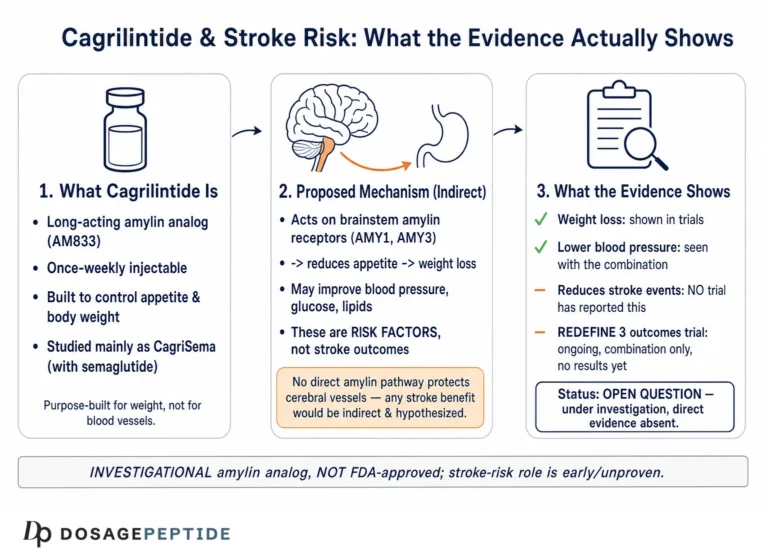
| Cardiovascular outcome benefit for cagrilintide | Not established | No CVOT reported |
Summarised plainly: the human evidence for cagrilintide is real and of good quality, but shallow in depth and narrow in scope. One phase 2 monotherapy dose-finding trial, plus a 302-participant monotherapy arm inside a phase 3 combination trial. That is a thin monotherapy evidence base for a compound this widely discussed.
It is about to get less thin, which is worth stating rather than leaving the picture stale. On 16 September 2025, presenting the REDEFINE 1 monotherapy sub-analysis at the EASD congress, Novo Nordisk announced that cagrilintide would advance into a dedicated phase 3 monotherapy programme, RENEW, due to start in Q4 2025[9]. No RENEW results have been reported, and no monotherapy filing has been made. Until RENEW reports, the remainder of the phase 3 evidence tests cagrilintide combined with semaglutide, which does not isolate the amylin contribution.
REDEFINE 1 (obesity, no diabetes)
A phase 3a, 68-week, multicentre, double-blind, placebo- and active-controlled trial (NCT05567796[10]) enrolling 3,417 adults without diabetes with BMI ≥30, or ≥27 with at least one obesity-related complication. Randomisation was 21:3:3:7 to cagrilintide–semaglutide 2.4/2.4 mg (n=2108), semaglutide 2.4 mg alone (n=302), cagrilintide 2.4 mg alone (n=302), or placebo (n=705), all with lifestyle intervention[7].
The headline number depends entirely on which estimand you quote, and the two figures are not interchangeable:
- −20.4% mean body-weight change at week 68 with CagriSema vs −3.0% with placebo (estimated difference −17.3 percentage points; 95% CI −18.1 to −16.6; p<0.001). This is the treatment-policy estimand — consistent with the intention-to-treat principle, counting everyone regardless of whether they stayed on drug. It is the primary analysis reported in the NEJM paper[7].
- −22.7% is the widely circulated figure, quoted against −2.3% with placebo (estimated difference −20.4 percentage points; 95% CI −21.1 to −19.7). This is the trial product estimand — the “if all participants had adhered to treatment” scenario[7].
The two figures are not a like-for-like pair, and the common gloss that “the 2.3-point gap is the adherence penalty” does not survive inspection. Each estimand carries its own placebo comparator — −2.3% under the trial product estimand, −3.0% under treatment policy — so the placebo arm moves in the opposite direction to the treatment arm between the two analyses. The estimated treatment difference is therefore −20.4 points under the trial product estimand and −17.3 under treatment policy: a gap of roughly 3.1 points on the effect estimate, not 2.3. The 2.3-point figure is merely the distance between the two CagriSema arm means. The gap reflects the different question each estimand asks, of which non-adherence is one component; it is not a clean measurement of an adherence penalty. Quoting 22.7% without saying which estimand it is means quoting a counterfactual as if it were an observation.
Gastrointestinal adverse events affected 79.6% of the CagriSema group versus 39.9% of placebo — mainly transient and mild-to-moderate, but that is four in five participants.
For dosing purposes the most informative arm is the small one: cagrilintide 2.4 mg alone, n=302, over 68 weeks. This is the longest monotherapy exposure on record and roughly the only thing anchoring cagrilintide monotherapy beyond 26 weeks — and on a page about monotherapy dosing, its result matters more than the combination’s. Under the treatment-policy estimand, cagrilintide 2.4 mg alone produced a −11.5% mean body-weight change at week 68, against −3.0% with placebo[7]. Under the trial product estimand the sponsor reports −11.8% (12.5 kg) versus −2.3% (2.5 kg) with placebo[9].
One technical caution on that arm, because it is easy to misreport. The trial’s prespecified confirmatory comparison for the cagrilintide arm was CagriSema versus cagrilintide — an estimated difference of −8.9 percentage points (95% CI −10.1 to −7.7; p<0.001), i.e. 20.4 minus 11.5[7]. That −8.9 is not a cagrilintide-versus-placebo treatment difference, and it should not be reported as one; the paper does not publish a cagrilintide-versus-placebo estimate with a confidence interval in that table. The plain reading is the useful one: cagrilintide alone delivered roughly 11.5%, and the combination roughly 20.4% — the amylin monotherapy is a little over half the combination’s effect. Participants reaching a weight reduction of 25% or more were 34.7% on CagriSema, 14.8% on semaglutide, and 6.5% on cagrilintide; for 30% or more, 19.3%, 8.7% and 1.6% respectively[7].
REDEFINE 2 (obesity with type 2 diabetes)
A phase 3a, 68-week, double-blind, placebo-controlled trial across 12 countries (NCT05394519[11]) in 1,206 adults with BMI ≥27, HbA1c 7–10%, and type 2 diabetes, randomised 3:1 to CagriSema 2.4/2.4 mg (n=904) or placebo (n=302). Mean body-weight change at week 68 was −13.7% with CagriSema vs −3.4% with placebo (difference −10.4 percentage points; 95% CI −11.2 to −9.5; p<0.001), treatment-policy estimand. HbA1c ≤6.5% was reached by 73.5% vs 15.9%. Gastrointestinal adverse events: 72.5% vs 34.4%[8]. The blunted weight effect in type 2 diabetes relative to REDEFINE 1 is a consistent finding across the incretin class, not a cagrilintide-specific quirk. Note that REDEFINE 2 has no cagrilintide-alone arm — it contributes nothing to the monotherapy question.
The phase 2 combination trial in type 2 diabetes
Frias et al. (Lancet 2023, NCT04982575[12]) randomised 92 adults with type 2 diabetes on metformin, with or without an SGLT2 inhibitor, 1:1:1 to CagriSema (n=31), semaglutide (n=31), or cagrilintide (n=30), all escalated to 2.4 mg, across 17 US sites over 32 weeks. Weight change at week 32 was −15.6% (CagriSema), −5.1% (semaglutide), and −8.1% (cagrilintide) — the combination beat both monotherapies (p<0.0001 for both). HbA1c change was −2.2, −1.8 and −0.9 percentage points respectively; CagriSema beat cagrilintide (estimated treatment difference −1.3 percentage points; 95% CI −1.7 to −0.8; p<0.0001) but not semaglutide (−0.4 percentage points; 95% CI −0.8 to 0.0; p=0.075)[13].
This 92-person trial is the closest thing to a head-to-head decomposition of the combination that exists, and its most interesting result is the negative one: on the primary glycaemic endpoint, adding cagrilintide to semaglutide did not produce a statistically significant improvement over semaglutide alone. The weight benefit of the combination was clear; the glycaemic benefit over semaglutide was not. Combination-specific volume arithmetic is handled separately on the cagrilintide/semaglutide 10 mg blend protocol, and the metabolic rationale is explored in our cagrilintide prediabetes research overview.
What adverse events are documented?
The adverse-event profile is dominated by one system, predictably and mechanistically.
Gastrointestinal effects. In Lau et al., gastrointestinal disorders occurred in 41–63% of cagrilintide participants (0.3–4.5 mg) versus 32% of placebo, primarily nausea at 20–47% versus 18%[5]. The dose-dependence is the point: nausea more than doubles across the studied range. Constipation and diarrhoea were also common. In the phase 3 combination setting the rates are higher still — 79.6% in REDEFINE 1[7] — though semaglutide contributes substantially there. In the phase 1b combination trial, 37% of all reported adverse events were gastrointestinal disorders[3].
Administration-site reactions were the other frequent category in Lau et al.[5], consistent with a weekly subcutaneous depot.
Anti-drug antibodies. NCT03856047 prespecified antibody occurrence against cagrilintide as a secondary endpoint, and excluded antibody follow-up time from the in-trial period[6]. Immunogenicity is a recognised consideration for engineered peptide analogues, and it is one of the things a research-grade vial of unverified purity cannot speak to at all — impurities and aggregates are themselves immunogenic risk factors.
Discontinuation. 10% of participants discontinued permanently, 4% for adverse events, distributed similarly across groups[5].
What is not known. Amylin analogues affect gastric emptying, so interactions with anything whose absorption is rate-limited by gastric emptying are plausible but uncharacterised for cagrilintide. Pramlintide’s label carries a boxed warning for severe hypoglycaemia when co-administered with insulin[2]; whether an analogous risk attends cagrilintide in insulin-treated populations has not been established, since the trials excluded or did not focus on that group. Notably, the Frias phase 2 trial in type 2 diabetes reported no level 2 or level 3 hypoglycaemia in any arm, but those participants were on metformin with or without an SGLT2 inhibitor — not insulin[13]. Effects beyond 68 weeks are simply unstudied.
Limitations
The limitations here are substantial enough that they should shape how every number above is read.
The monotherapy evidence base is one phase 2 trial plus one phase 3 arm. Lau et al. (n=706, 26 weeks) and the REDEFINE 1 cagrilintide-alone arm (n=302, 68 weeks). That is the totality of the controlled human monotherapy dose-response data. No independent group has replicated it; every trial cited here was funded by Novo Nordisk, the manufacturer, and Novo Nordisk employees are co-authors on each. This is normal for a compound at this stage, and it is still a limitation.
The human pharmacokinetics come from a combination trial. The half-life and tmax figures that justify weekly dosing were measured in 96 people receiving cagrilintide alongside semaglutide 2.4 mg[3]. No published monotherapy pharmacokinetic dataset exists.
No dose above 2.4 mg has been carried forward. The 4.5 mg arm exists in exactly one 26-week study of ~100 people. Any schedule targeting 4.5 mg rests on a single trial arm that the sponsor did not advance — and while the reason is undocumented, the fact of it is not.
Most of the titration table is constructed, not evidenced. Only 0.3, 0.6, 1.2, 2.4 and 4.5 mg are evidenced monotherapy doses. The 3.0 mg step was never studied; nor were 0.5, 1.0, 1.5 or 2.0 mg; and 0.25 mg was never studied as monotherapy. That means six of the eight rows in the titration table above are interpolations, and only the 2.4 and 4.5 mg steps correspond to a real trial arm. Readers should know which is which, and now they do.
Trial doses do not transfer to research-grade vials. This is the deepest limitation, and no arithmetic solves it. The dose-response curve was measured with a characterised, assayed, sterile clinical product of known peptide content. A research vial has none of those guarantees. If actual peptide content is 80% of label, every calculated dose is 20% low; if a vial contains a different amylin analogue, or aggregated material, the chart is meaningless. The units math in this article is exact. Its exactness says nothing about what is in the vial. Precision and accuracy are different things, and a chart delivers only the former.
No validated research-use dose exists. There is no dose of research-grade cagrilintide that anyone can honestly call correct, safe, or validated, because no regulator has evaluated the compound as a monotherapy and no trial has used this material. The figures here document what the literature records and what the protocol pages construct. They are not a recommendation, and no reading of them makes them one.
Long-term and outcome data are absent. Maximum reported exposure in any trial is 68 weeks. There are no cardiovascular outcome data, no data on weight regain after discontinuation of cagrilintide monotherapy beyond the 6-week off-treatment follow-up in Lau et al., and no data in adolescents, pregnancy, or renal or hepatic impairment.
Frequently Asked Questions
What is the cagrilintide dose per week?
The published phase 2 trial studied five once-weekly doses: 0.3, 0.6, 1.2, 2.4 and 4.5 mg. Novo Nordisk selected 2.4 mg once weekly for phase 3, and that is the dose used in REDEFINE 1 and REDEFINE 2. This site’s protocol pages construct a 0.25–4.5 mg weekly range reached by stepwise titration, which is not a schedule any trial used. No dose is approved for human use, and 2.4 mg is a trial dose, not a recommendation.
How many units is cagrilintide on an insulin syringe?
It depends entirely on concentration. A 5 mg vial reconstituted with 2.0 mL gives 2.5 mg/mL, where 1 mg = 0.40 mL = 40 units and 2.4 mg = 96 units. A 10 mg vial with 2.0 mL gives 5 mg/mL, where 1 mg = 0.20 mL = 20 units and 2.4 mg = 48 units. Units are volume markings (1 unit = 0.01 mL on a U-100 syringe), never doses.
How do you reconstitute cagrilintide 10 mg?
The protocol pages reference 2.0 mL of bacteriostatic water, giving 5 mg/mL (10 ÷ 2.0). Add the water slowly down the vial wall, swirl gently, never shake, and let it dissolve fully before inspecting for clarity. An advanced alternative uses 1.0 mL for 10 mg/mL, but that halves the measurement resolution and makes low titration steps like 0.25 mg (2.5 units) unmeasurable on a standard syringe.
Is cagrilintide approved by the FDA?
No. Cagrilintide is not approved anywhere in the world as a monotherapy, and no application has been filed for it as one. CagriSema — cagrilintide 2.4 mg plus semaglutide 2.4 mg — was submitted to the FDA on 18 December 2025 for chronic weight management, with the agency expected to review it during 2026. As of July 2026 it is not approved in the US or EU and does not appear in Drugs@FDA. Approval is not certain. Claims that CagriSema has already been approved are circulating online and are false.
Why is cagrilintide dosed only once a week?
Its elimination half-life is approximately 159–195 hours (roughly 6.5–8 days), achieved by a fatty-acid side chain that binds reversibly to serum albumin. This contrasts sharply with pramlintide, the one approved amylin analogue, whose half-life of roughly 48 minutes requires injection before every major meal. Weekly dosing also means the interval is about one half-life, so drug accumulates and steady state takes four to six weeks.
How much weight did cagrilintide alone produce in trials?
In the 26-week phase 2 trial, mean weight reduction across the 0.3–4.5 mg arms was 6.0–10.8% versus 3.0% for placebo; at 4.5 mg it was 10.8% (11.5 kg), versus 9.0% for once-daily liraglutide 3.0 mg. In REDEFINE 1, cagrilintide 2.4 mg alone over 68 weeks produced a −11.5% mean body-weight change versus −3.0% with placebo (treatment-policy estimand) — roughly half the combination’s 20.4%. These are trial findings in supervised populations, not expected outcomes.
Is CagriSema’s weight loss 20.4% or 22.7%?
Both, under different estimands. 20.4% (vs 3.0% placebo) is the treatment-policy estimand — intention-to-treat, everyone counted regardless of adherence — and is the primary result published in NEJM. 22.7% (vs 2.3% placebo) is the trial product estimand, modelling full adherence. Because each estimand has its own placebo comparator, the estimated treatment difference is −17.3 points versus −20.4 points respectively. Quoting 22.7% without naming the estimand presents a counterfactual as an observation.
How many doses are in a 5 mg or 10 mg vial?
At 2.4 mg weekly, a 5 mg vial yields 2 full doses (5 ÷ 2.4 = 2.08) and a 10 mg vial yields 4 (10 ÷ 2.4 = 4.17). At 1.2 mg weekly, those become 4 and 8 respectively. Note the constraint: four weekly doses from a 10 mg vial takes four weeks, which sits at the outer edge of the 2–4 week refrigerated in-use window for reconstituted solution.
Can a research-grade cagrilintide vial be dosed using the trial figures?
The arithmetic transfers; the assurance does not. Trial doses were established with a characterised, assayed, sterile clinical product. A research vial carries no verification of identity, purity, peptide content, or sterility, so mapping trial doses onto it assumes the vial matches its label. That assumption is untested. These materials are for laboratory research only and are not approved for human use.
References
- Kruse T, Hansen JL, Dahl K, et al. Development of Cagrilintide, a Long-Acting Amylin Analogue. J Med Chem. 2021;64(15):11183–11194. doi:10.1021/acs.jmedchem.1c00565
- SYMLIN (pramlintide acetate) injection — FDA Prescribing Information, NDA 021332. US Food and Drug Administration.
- Enebo LB, Berthelsen KK, Kankam M, et al. Safety, tolerability, pharmacokinetics, and pharmacodynamics of concomitant administration of multiple doses of cagrilintide with semaglutide 2.4 mg for weight management: a randomised, controlled, phase 1b trial. Lancet. 2021;397(10286):1736–1748. doi:10.1016/S0140-6736(21)00845-X. PMID 33894838.
- Novo Nordisk files for FDA approval of CagriSema, the first once-weekly combination of GLP-1 and amylin analogues for weight management. Novo Nordisk company announcement, 18 December 2025.
- Lau DCW, Erichsen L, Francisco AM, et al. Once-weekly cagrilintide for weight management in people with overweight and obesity: a multicentre, randomised, double-blind, placebo-controlled and active-controlled, dose-finding phase 2 trial. Lancet. 2021;398(10317):2160–2172. doi:10.1016/S0140-6736(21)01751-7. PMID 34798060.
- NCT03856047 — Investigation of Safety and Efficacy of NNC0174-0833 for Weight Management: a Dose Finding Trial. ClinicalTrials.gov.
- Garvey WT, Blüher M, Osorto Contreras CK, et al. Coadministered Cagrilintide and Semaglutide in Adults with Overweight or Obesity (REDEFINE 1). N Engl J Med. 2025;393(7):635–647. doi:10.1056/NEJMoa2502081
- Davies MJ, Bajaj HS, Broholm C, et al. Cagrilintide–Semaglutide in Adults with Overweight or Obesity and Type 2 Diabetes (REDEFINE 2). N Engl J Med. 2025;393(7):648–659. doi:10.1056/NEJMoa2502082
- Novo Nordisk presents phase 3 data for next-generation amylin cagrilintide, leading to advancement into dedicated clinical programme. Novo Nordisk company announcement, 16 September 2025.
- NCT05567796 — Efficacy and Safety of Cagrilintide s.c. 2.4 mg in Combination With Semaglutide s.c. 2.4 mg (CagriSema s.c. 2.4 mg/2.4 mg) Once-weekly in Participants With Overweight or Obesity (REDEFINE 1). ClinicalTrials.gov.
- NCT05394519 — Efficacy and Safety of Cagrilintide s.c. 2.4 mg in Combination With Semaglutide s.c. 2.4 mg (CagriSema s.c. 2.4 mg/2.4 mg) Once-weekly in Participants With Overweight or Obesity and Type 2 Diabetes (REDEFINE 2). ClinicalTrials.gov.
- NCT04982575 — Research Study to Look at How Well Cagrilintide Together With Semaglutide Works in People With Type 2 Diabetes. ClinicalTrials.gov.
- Frias JP, Deenadayalan S, Erichsen L, et al. Efficacy and safety of co-administered once-weekly cagrilintide 2.4 mg with once-weekly semaglutide 2.4 mg in type 2 diabetes: a multicentre, randomised, double-blind, active-controlled, phase 2 trial. Lancet. 2023;402(10403):720–730. doi:10.1016/S0140-6736(23)01163-7. PMID 37364590.
Research use only. This article is an educational summary of published research and is not medical advice. Cagrilintide is an investigational compound that is not approved by the FDA, the EMA, or any other regulatory authority for human therapeutic use as a monotherapy; CagriSema remains under FDA review and is not approved. Nothing here is a recommendation, protocol, or instruction to administer any substance to a human or an animal. All doses described are figures documented in the published literature or constructed by research-protocol references, reported for educational purposes only. Research-grade peptides are supplied for laboratory research use only and must not be used for diagnosis, treatment, or prevention of any disease. dosagepeptide.com is an independent research reference library and does not sell peptides.