Peptide bioregulators are very short peptides — usually two to four amino acids — that the Russian gerontologist Vladimir Khavinson’s group proposed act on one specific organ each, by influencing which genes are active inside that tissue. Do they work? The honest answer has two halves. The research programme is real: five decades old, with genuine laboratory data behind it. And its headline claims — organ targeting, direct DNA binding, longer lifespan — rest almost entirely on work from a single school, with very little independent replication and no regulatory approval anywhere in the West.
This page covers what they are, how they are supposed to work, which named compounds belong to the family, what is and is not known about their safety, and exactly where the evidence stops. Nothing here is a protocol or a recommendation.
The short answer, which the rest of this reference will unpack carefully, is that peptide bioregulators are a genuinely interesting scientific concept with a real, decades-long body of published work behind them — but one whose most exciting claims (tissue specificity, epigenetic gene regulation, telomerase activation, lifespan extension) rest heavily on studies from a single research school, with limited independent replication and very few rigorous double-blind randomized controlled trials. None of these compounds is an approved medicine in the United States, the European Union, or the United Kingdom. They are best understood as investigational research materials and a contested hypothesis, not as validated therapeutics.
What Are Peptide Bioregulators?
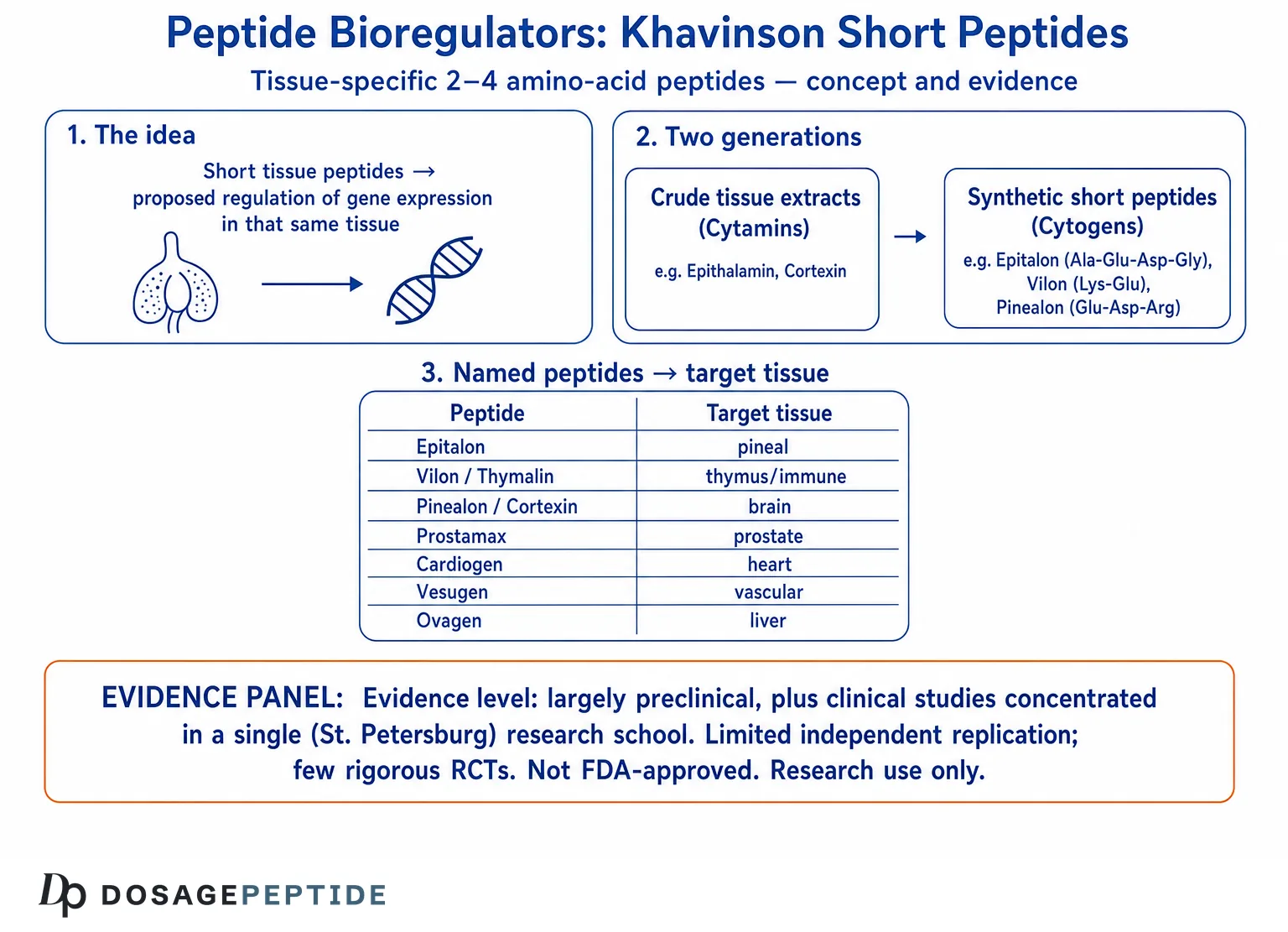
A peptide bioregulator is a very short peptide — typically two, three, or four amino acids long — that its proponents claim exerts a tissue-specific regulatory effect on the organ or tissue from which it was originally derived. The governing idea is that each tissue in the body maintains its own population of endogenous short peptides that help regulate cell division, differentiation, and gene expression within that tissue, and that supplying the corresponding synthetic peptide can, in theory, help restore normal function to an aged or stressed tissue.[1] It is important to be precise about the grammar of that sentence: every clause in it describes a hypothesis advanced by the compounds’ proponents, not a settled fact of human physiology. The existence of endogenous regulatory peptides is uncontroversial; the specific claim that supplying a synthetic two-to-four-residue analogue restores organ function in an intact, aging body is exactly what remains to be independently demonstrated.
This is a distinct concept from the better-known therapeutic peptides that dominate modern medicine. Insulin, GLP-1 agonists such as semaglutide, growth-hormone secretagogues, and most peptide drugs work as receptor ligands or hormone analogues: they bind a defined cell-surface receptor and trigger a signaling cascade whose pharmacology has been mapped in exhaustive detail and tested in large registration trials. The bioregulator hypothesis proposes something different and, frankly, more speculative — that these tiny peptides act partly at the level of the genome itself, entering the nucleus and interacting with DNA or chromatin to modulate transcription. Whether that mechanism is real and physiologically meaningful is precisely the open question at the heart of the field, and it is worth holding the two categories apart: the maturity of the evidence for a GLP-1 agonist is not transferable to a bioregulator merely because both are called “peptides.”
The two generations: tissue extracts and synthetic short peptides
To understand the category, it is essential to separate two chemically very different generations of products that are often lumped together under the loose label “Khavinson peptides.”
- Cytamins (peptide-tissue extracts, also called cytomax preparations). These are the original first-generation products: complex mixtures of low-molecular-weight peptides, nucleoproteins, and other fractions extracted from animal organs — classically the tissues of young calves. Examples include epithalamin (from the pineal gland), thymalin (from the thymus), and cortexin (from the cerebral cortex). Because they are extracts, they are heterogeneous mixtures, not single defined molecules.[2]
- Cytogens (synthetic short peptides). These are the second-generation products: chemically synthesized, single-sequence peptides intended to reproduce the “active core” of the extracts. Examples include Vilon (the dipeptide Lys-Glu), Epitalon/Epithalon (the tetrapeptide Ala-Glu-Asp-Gly), Pinealon (Glu-Asp-Arg), and Testagen (Lys-Glu-Asp-Gly). These defined sequences are what most people mean today when they discuss short-peptide bioregulators, and they are the compounds most commonly sold as research materials.[9]
This distinction matters enormously for evidence interpretation. Much of the earliest clinical and animal data was generated with the crude extracts (epithalamin, thymalin), whereas most of the mechanistic molecular work — nuclear penetration, DNA binding, gene-expression assays — was done with the defined synthetic peptides. When someone claims “bioregulators are clinically proven,” it is worth asking which generation, which specific compound, and in which study, because evidence collected on a heterogeneous calf-organ extract cannot automatically be transferred to a chemically defined tetrapeptide sold under a related trade name. You can explore the vocabulary of this field in more depth in the Dosage Peptide peptide research glossary, which defines many of the terms used throughout this article.
Research Context: Who Was Vladimir Khavinson and Where Did the Idea Originate?
The peptide-bioregulator concept is inseparable from the career of Vladimir Khatskelevich Khavinson (1946–2024), a physician and gerontologist who spent his career at what became the St. Petersburg Institute of Bioregulation and Gerontology, which he directed from 1992 until his death in early 2024.[13] Understanding the historical and institutional context is important, because it explains both the volume of the literature and one of its central weaknesses: its concentration within a single research lineage.
Origins in Soviet military medicine
According to biographical accounts and the histories published by Khavinson and colleagues, the research program began in the 1970s within the Soviet military-medical establishment, at the S.M. Kirov Military Medical Academy in Leningrad. The original brief was reportedly practical rather than gerontological: to find agents that could help maintain the health and performance of military personnel exposed to extreme conditions, radiation, and accelerated physiological stress, and to support recovery and immune function. Work on thymus-derived peptides (leading to thymalin) and pineal-derived peptides (leading to epithalamin) grew out of this program.[14]
Over subsequent decades the focus broadened from acute stress and immune correction toward aging itself. The reasoning was that if these tissue peptides could restore normal immune and endocrine function in stressed or irradiated organisms, they might also counteract the tissue-level dysregulation that accompanies aging. This reframing — from military medicine to gerontology and “bioregulator longevity research” — is what turned a specialized applied program into a broad anti-aging hypothesis. It is a reframing worth flagging explicitly, because a compound characterized in one context (radioprotection, immune correction after acute insult) does not automatically carry its evidence into a very different one (slowing the multifactorial process of normal aging), and much of the later marketing quietly relies on that leap.
A prolific but concentrated body of work
Khavinson and his collaborators were extraordinarily prolific, publishing hundreds of papers, reviews, and monographs over more than forty years, including a book-length supplement, Peptides and Ageing, in Neuroendocrinology Letters in 2002.[2] Several of the extract preparations (epithalamin, thymalin, cortexin, and others) were registered as medicines within Russia and used clinically there.
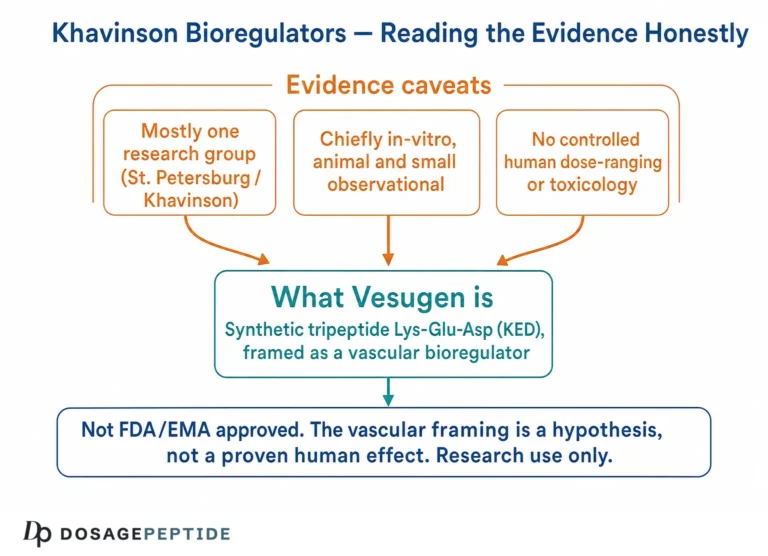
That productivity is a double-edged sword. On one hand, it means there is a large, internally consistent literature describing the compounds, their proposed mechanisms, and clinical experience. On the other hand, the overwhelming majority of that literature originates from Khavinson’s own institute and a tight network of affiliated authors, and much of it was published in a relatively narrow set of journals. Independent replication by unaffiliated laboratories — the gold standard for establishing that a finding is robust rather than lab-specific — has historically been sparse. This matters because science treats independent reproduction, not sheer publication volume, as the test of a real effect: a thousand papers from one lineage carry less epistemic weight than a handful of concordant results from laboratories with no shared reagents, methods, or institutional stake. This single-school concentration is one of the most important caveats to keep in mind throughout the rest of this article, and it is the reason the field is best described as “under-replicated” rather than either “proven” or “debunked.”
Cytamins Versus Cytogens: From Tissue Extracts to Designed Peptides
Because the two-generation distinction is so central, it is worth examining more closely how the field moved from crude extracts to defined sequences, and what that transition did and did not resolve.
First generation: the peptide-tissue extracts
The earliest bioregulators were prepared by acid extraction and fractionation of animal organs, yielding a mixture enriched in peptides below roughly 10 kilodaltons. Epithalamin (pineal) and thymalin (thymus) are the archetypes. In the proponents’ framework, each extract carried the “informational” peptide signal characteristic of its source organ. Thymalin, for instance, was positioned as an immunocorrector, used in Russia for conditions associated with immune dysfunction; a 2021 review in Biology Bulletin Reviews summarizes the claimed immunological activity and clinical use of thymalin, while also illustrating how much of that literature remains within the originating research tradition.[10]
The scientific limitation of extracts is obvious: as heterogeneous mixtures of unknown exact composition, they are difficult to standardize, difficult to characterize mechanistically, and difficult to reproduce precisely between batches or laboratories. If a favorable clinical result is obtained with a calf-thymus extract, it is genuinely unclear which molecular species produced it, at what concentration, or whether the next batch contains the same active fraction. They also raise the theoretical concerns that attend any animal-tissue-derived biological product, including batch-to-batch variability and the general regulatory disfavor toward unstandardized organ extracts in Western pharmacopeias. These constraints are part of what motivated the move to defined synthetic peptides.
Second generation: the synthetic Cytogens
The synthetic peptides were designed as short sequences intended to represent the biologically active portion of the extracts. The best-known are:
- Vilon — Lys-Glu (a dipeptide), associated in the literature with the thymus/immune line of research. Vilon is discussed in more detail in the dedicated explainer on the lysyl-glutamic acid peptide Vilon.
- Epitalon (Epithalon) — Ala-Glu-Asp-Gly (a tetrapeptide), the synthetic counterpart of the pineal extract epithalamin and the compound at the center of the telomerase claims. See the full Epithalon telomerase and aging research overview.
- Pinealon — Glu-Asp-Arg, studied in neuroprotection contexts and covered in the companion article on Pinealon as a neuroprotective research peptide.
- Livagen — Lys-Glu-Asp-Ala, a liver-associated peptide reviewed in the Livagen mechanism and research overview.
The synthetic transition solved the standardization problem — a defined sequence can be made reproducibly and characterized precisely by mass spectrometry and HPLC — but it did not, by itself, resolve the deeper questions of whether these peptides truly reach specific tissues, truly enter nuclei at physiologically relevant concentrations, and truly regulate genes in a way that produces meaningful clinical benefit. Those are empirical questions that require the kind of independent, well-powered testing that the field still largely lacks. Put differently, defining the molecule answered “what exactly is in the vial?” but left “does it do what is claimed in a living organism?” almost entirely open.
Mechanisms Being Studied: The Peptide-Gene Hypothesis
The most scientifically ambitious — and most contested — aspect of the bioregulator concept is its proposed mechanism of action. Unlike classical receptor-binding peptides, short-peptide bioregulators are hypothesized to act, at least in part, directly at the level of the genome. Proponents describe a chain of events sometimes summarized as the “peptide-gene” or “peptidergic regulation” hypothesis. It is important to state up front that different links in this chain rest on very different quality of evidence, and that a mechanistic story can be internally coherent at every step while still failing to describe what actually happens in a dosed animal or human.
Step one: cell and nuclear penetration
The first claim is that these small, relatively hydrophilic peptides can cross the cell membrane and reach the nucleus. Supporting this, Fedoreyeva and colleagues reported in 2011 that fluorescently labeled short peptides — including Epitalon (Ala-Glu-Asp-Gly), Pinealon (Glu-Asp-Arg), and Testagen (Lys-Glu-Asp-Gly) — accumulated in the cytoplasm, nucleus, and nucleolus of HeLa cells after incubation, indicating that such peptides can indeed penetrate an animal cell and reach nuclear compartments in vitro.[6] This is one of the more concrete pieces of mechanistic evidence, though several caveats attach to it: it is an in-vitro observation in an immortalized cancer cell line bathed in peptide, it uses a fluorescent label that itself alters the molecule’s properties, and it establishes only that the peptide can reach the nucleus — not what, if anything, it does once there, nor whether the same distribution occurs at low systemic doses in an intact body.
Step two: sequence-specific DNA binding
The second claim is that once in the nucleus, specific peptides bind specific DNA sequences, providing a structural basis for tissue-specific gene regulation. Encouragingly for the hypothesis, this idea has received support from at least one study published in a high-profile independent journal. In 2019, Kolchina, Khavinson, and colleagues used molecular docking and molecular dynamics simulations, published in Nucleic Acids Research, to systematically analyze how dipeptides could bind tetranucleotide sites within double-stranded B-form DNA, and identified structural motifs consistent with sequence-selective binding.[8] That the work appeared in a leading nucleic-acids journal lends it more weight than the in-house literature. Still, it is essential to read the study for what it is: computational docking demonstrates the plausibility of binding in a simulated system, not experimental proof that such binding occurs at biological concentrations, let alone that it drives gene regulation in living tissue. In-silico affinity is a hypothesis generator, not a clinical endpoint.
Step three: epigenetic and transcriptional modulation
The third claim is the payoff: that peptide binding alters gene transcription, potentially through epigenetic mechanisms such as changes in DNA methylation. Ashapkin, Linkova, Khavinson, and Vanyushin reported in 2015 that peptides such as KEDW and AEDL tissue-specifically affected gene expression in pancreatic and bronchial cell cultures, respectively, and that DNA-methylation patterns in certain gene promoter regions (including PDX1, PAX6, NKX2-1, and SCGB1A1) shifted with aging in correlation with expression changes.[7] A 2021 systematic review in Molecules by Khavinson and colleagues collated many such gene-expression findings across peptides and tissues.[9] Both of these are largely in-house products, so they establish that the effect is reported and internally consistent, not that it has been independently reproduced.
It is worth placing this in the broader scientific context that peptides can, in principle, act as epigenetic modulators. An independent 2019 review in Clinical Epigenetics by Janssens and colleagues discusses how peptides from various sources — endogenous, food-derived, environmental, and synthetic — can influence DNA methylation, histone modification, and non-coding RNA processing.[11] That review is not about Khavinson peptides specifically, but it establishes that “peptides influencing epigenetics” is a legitimate and researched idea in mainstream science — which makes the bioregulator hypothesis biologically conceivable, even if the specific tissue-specificity claims remain to be independently confirmed. Conceivability is a real and useful point in the hypothesis’s favor; it is not the same as confirmation, and the same independent review is candid about the pharmacokinetic obstacles (discussed below) that stand between a conceivable mechanism and a working therapy.
Putting the mechanism in perspective
Taken together, the mechanistic literature paints a picture that is internally coherent: short peptides penetrate cells, can plausibly bind DNA in a sequence-selective way, and are associated with tissue-specific gene-expression changes. What it does not yet provide is a fully independent, quantitative demonstration that, at the microgram doses used, these peptides reach specific tissues in an intact organism, occupy specific genomic sites in vivo, and thereby produce the clinical outcomes attributed to them. The mechanism is a well-developed hypothesis with supportive in-vitro and in-silico data — not a closed case. A useful way to hold this in mind is that each individual link (penetration, binding, expression change) has at least some support, but the field has not yet connected all the links into a single, independently verified causal chain running from an administered dose to a measured clinical benefit.
What Is the Tissue-Specificity Claim, and How Well Is It Supported?
The single most distinctive assertion of the bioregulator framework is tissue specificity: the idea that each peptide preferentially acts on the tissue from which it (or its parent extract) was derived. Epitalon acts on the pineal gland, Vilon on the thymus and immune system, Cardiogen on the heart, Vesugen on the vasculature, and so on. If true, this would be a remarkable property, because it would allow targeted regulation of individual organ systems using nothing more than a short amino-acid sequence — a degree of selectivity that most of pharmacology achieves, when it achieves it at all, only with far larger and more elaborately engineered molecules.
The proposed structural basis for specificity is the sequence-selective DNA-binding idea described above: different peptides, by binding different DNA motifs, would preferentially modulate genes that are transcriptionally active in different tissues.[8] Cell-culture experiments in which a given peptide altered expression in one tissue’s cells but not another’s are offered as functional support.[7]
The honest assessment is that tissue specificity is a plausible and partially supported hypothesis rather than an established fact. Several caveats deserve emphasis. First, most of the specificity data come from in-vitro systems, where a peptide is applied directly to one cell type; this does not model how a systemically administered peptide would distribute among the body’s tissues in vivo, where absorption, degradation, and clearance all intervene before any peptide reaches a target cell. Second, the specificity claims come predominantly from the originating research network, so independent confirmation is limited. Third, the effect sizes and dose-response relationships needed to judge biological relevance are often incompletely reported, which makes it hard to tell a robust, reproducible signal from a small effect at a single concentration. A reader encountering the confident organ-by-organ “map” of bioregulators should treat it as the proponents’ model, not as consensus physiology.
There is also a useful sanity check any reader can apply to specificity claims: ask what the comparison condition was. Genuine tissue specificity requires showing that a peptide changes gene expression in its target tissue and fails to change the same or comparable genes in several non-target tissues, ideally at matched concentrations and with a scrambled-sequence control peptide. Reports that show an effect in one cell type without that side-by-side non-target comparison demonstrate activity, which is a weaker claim than selectivity. Much of the accessible bioregulator literature is stronger on activity than on rigorously controlled selectivity, and distinguishing the two is central to judging whether the organ-map is a real property of the molecules or an artifact of which tissues happened to be tested.
The Main Named Bioregulators and Their Proposed Target Tissues
The bioregulator family is often presented as a near-complete “kit” with a peptide for almost every organ system. Below is a reference table of the most commonly discussed compounds, their sequences where publicly defined, and the tissue each is claimed to target. The word “claimed” is doing real work here: for most of these, the tissue association derives from the proponents’ framework and preclinical or extract-based data, not from independent clinical validation.
| Bioregulator | Type | Reported sequence | Claimed target tissue / system | Evidence character |
|---|---|---|---|---|
| Epithalamin | Extract (Cytamin) | Mixture | Pineal gland / neuroendocrine, aging | Animal + in-house clinical (extract) |
| Epitalon / Epithalon | Synthetic (Cytogen) | Ala-Glu-Asp-Gly | Pineal, telomere/aging | In-vitro, animal, small clinical |
| Thymalin | Extract (Cytamin) | Mixture | Thymus / immune system | In-house clinical (extract) |
| Vilon | Synthetic (Cytogen) | Lys-Glu | Thymus / immune | Preclinical, in-house |
| Cortexin | Extract (Cytamin) | Mixture | Cerebral cortex / brain | In-house clinical (extract) |
| Pinealon | Synthetic (Cytogen) | Glu-Asp-Arg | Brain / neuroprotection | Preclinical (animal/in-vitro) |
| Cardiogen | Synthetic (Cytogen) | Ala-Glu-Asp-Arg (reported) | Heart / myocardium | Preclinical, in-house |
| Vesugen | Synthetic (Cytogen) | Lys-Glu-Asp (reported) | Vascular wall / endothelium | Preclinical, in-house |
| Ovagen | Synthetic (Cytogen) | Glu-Asp-Leu (reported) | Liver / digestive | Preclinical, in-house |
| Livagen | Synthetic (Cytogen) | Lys-Glu-Asp-Ala | Liver | Preclinical, in-house |
| Prostamax / Libidon | Synthetic / extract | Reported short sequence | Prostate | Preclinical, in-house |
| Testagen | Synthetic (Cytogen) | Lys-Glu-Asp-Gly | Reproductive / thyroid | In-vitro, animal |
Sequence assignments marked “reported” should be treated cautiously: the exact sequences of some commercial synthetic bioregulators are described inconsistently across sources, and vendor listings are not authoritative. Where a defined sequence has been used in a peer-reviewed study (as with Epitalon, Pinealon, Vilon, and Testagen), that is noted in the primary literature cited elsewhere in this article. For the remainder, a “reported” sequence should be read as a vendor or secondary-source assertion that has not necessarily been tied to a specific characterized study batch.
The heart peptide: Cardiogen
Cardiogen is positioned within the bioregulator framework as the cardiac-tissue peptide, proposed to support myocardial cell function and cardiovascular resilience with aging. As with the other organ-specific synthetics, the supporting data are largely preclinical and originate from within the founding research tradition; there are no large independent randomized cardiovascular-outcome trials establishing clinical benefit in humans, which is the specific kind of evidence that would be required before any cardiac claim could be taken seriously in evidence-based cardiology. For those researching this specific compound, the detailed reconstitution and handling reference is the Cardiogen 20 mg vial dosage protocol, which frames the material strictly as a research-use-only item that is not an approved drug.
The vascular peptide: Vesugen
Vesugen is described as the vascular bioregulator, associated with endothelial and vessel-wall gene expression in the peptidergic-regulation literature. The proposed rationale connects to studies of peptide effects on vascular endothelial cell proliferation during aging, again performed chiefly in cell culture and within the originating group. A focused overview is available in the explainer on Vesugen, the vascular bioregulator peptide.
The liver peptides: Ovagen and Livagen
Two peptides are commonly linked to hepatic tissue. Ovagen is presented as a liver/digestive-system bioregulator; a dedicated overview appears in the article on Ovagen, the liver bioregulator peptide. Livagen (Lys-Glu-Asp-Ala) is a closely related liver-associated tetrapeptide, discussed in the Livagen mechanism overview. Both are supported by preclinical and in-house work rather than by independent clinical trials, and neither has an approved hepatological indication in any Western jurisdiction.
The prostate peptide: Prostamax
Prostamax is grouped with the prostate bioregulators (a category that historically includes the extract preparation prostatilen and the related peptide libidon). It is framed as supporting prostate-tissue function in aging males. A more detailed treatment is provided in the article on Prostamax, a prostate-health peptide. As with the rest of the family, the evidence tier is preclinical and in-house rather than independently clinically validated, and nothing in the literature supports using it in place of evaluated care for any prostate condition.
Epitalon, Telomerase, and the Longevity Claims: What the Evidence Actually Shows
No single bioregulator has attracted more attention — or more hype — than Epitalon, largely because of its association with telomerase activation. Telomerase is the enzyme that adds repetitive DNA to the ends of chromosomes (telomeres), which otherwise shorten with each cell division; telomere shortening is one recognized hallmark of cellular aging. The claim that a simple tetrapeptide could reactivate telomerase and lengthen telomeres is, understandably, headline-grabbing. Here it is essential to separate what has actually been shown from what has been extrapolated.
The original in-vitro finding
The foundational study is Khavinson, Bondarev, and Butyugov (2003), who reported that adding Epithalon to cultures of telomerase-negative human fetal fibroblasts induced expression of the telomerase catalytic subunit, restored telomerase enzymatic activity, and produced telomere elongation.[4] This is a genuine, citable result — but it is an in-vitro cell-culture finding, published as a short report, and it comes from the originating research group. It should be read as the seed of a hypothesis, not as evidence that the same thing happens in a person.
An independent replication — with nuance
More recently, an independent study published in Biogerontology in 2025 reported that Epitalon increased telomere length in human cell lines, and importantly dissected the mechanism by cell type: in normal cells (fibroblasts and mammary epithelial cells) it appeared to act through canonical hTERT/telomerase upregulation, whereas in certain breast-cancer cell lines it appeared to lengthen telomeres via the alternative lengthening of telomeres (ALT) pathway rather than through a genuine rise in telomerase enzyme activity.[12] This is valuable because it represents replication outside the founding lineage — the kind of independent scrutiny the field has largely lacked. But note the double-edged finding: the observation that a telomere-lengthening effect also occurs in cancer cell lines underscores a longstanding theoretical concern — telomerase reactivation and ALT are both features of most human cancers, and any agent that promotes telomere maintenance raises questions about oncological safety that remain unresolved for these peptides. An independent replication that simultaneously flags a safety signal is exactly why replication matters.
The animal-lifespan data are mixed, not triumphant
Proponents frequently cite animal experiments showing that pineal peptides slow aging biomarkers and reduce tumor incidence. The reality in the primary data is more measured. In a well-known study, Anisimov, Khavinson, and colleagues administered Epitalon to female Swiss-derived SHR mice from three months of age until natural death. The peptide slowed the age-related decline of estrous function and reduced chromosome aberrations in bone-marrow cells — but, critically, it did not increase mean lifespan in that particular experiment (it modestly raised the lifespan of the last 10% of survivors and the maximum lifespan, without shifting the mean).[5] Other reports from the group describe larger mean-lifespan increases with pineal peptides under different conditions and in different strains.[1] The honest summary is that the animal record is heterogeneous: some biomarkers move favorably in some strains and protocols, but a clean, reproducible, cross-laboratory lifespan-extension signal is not established, and the variability across experiments is itself a reason for caution rather than a footnote to be skipped.
The human data are limited and largely open-label
The most cited human evidence is the long-term follow-up work with the pineal extract epithalamin. Korkushko, Khavinson, Shatilo, and Antonyk-Sheglova reported a comparative study in elderly coronary patients in which those receiving repeated epithalamin courses in addition to standard therapy showed slower cardiovascular aging on several measures and lower mortality over the follow-up period.[3] This is often presented as proof that bioregulators extend human life. It should instead be read as suggestive but low-tier evidence: it used the crude extract rather than a defined synthetic peptide, the design was a small comparative study rather than a large blinded placebo-controlled trial (roughly 39 treated versus 40 control patients), sample sizes were modest, and the work again originates from the founding group. A single such study, however striking, does not meet the bar for a validated life-extension claim; it is a hypothesis-generating observation that would need independent, blinded, adequately powered confirmation before it could support any clinical conclusion.
The telomerase-hype context
It is worth stepping back to a general principle in longevity biology: telomerase activation is not synonymous with rejuvenation or life extension. Telomere shortening is one hallmark of aging among many (genomic instability, epigenetic drift, mitochondrial dysfunction, cellular senescence, loss of proteostasis, stem-cell exhaustion, and others), and the relationship between telomere length, telomerase activity, healthspan, and cancer risk is complex and bidirectional — in several mammalian settings, more telomerase means more, not less, cancer. Marketing narratives that equate “activates telomerase” with “reverses aging” substantially overstate what the science supports and quietly omit the oncological trade-off. The Epitalon telomerase story is best understood as an intriguing mechanistic observation that has been repeatedly amplified beyond its evidentiary weight — a point examined further in the dedicated Epithalon telomerase and aging research article.
Current Evidence Level: How Strong Is the Data Overall?
Having examined the strongest single case (Epitalon), we can now generalize about the evidence quality across the whole bioregulator category. The most useful way to do this is with the standard evidence hierarchy, from weakest to strongest, and to place bioregulator research honestly within it.
| Evidence tier | What it establishes | Bioregulator status |
|---|---|---|
| In-silico / computational | Plausibility of a mechanism | Present (e.g., DNA-docking studies) |
| In-vitro (cell culture) | Effect in isolated cells | Substantial (penetration, gene expression, telomerase) |
| Animal studies | Effect in a living organism | Substantial but mixed; mostly in-house |
| Small / open-label human studies | Preliminary human signal | Some, chiefly with extracts, from founding group |
| Independent double-blind RCTs | Reliable clinical efficacy | Largely absent |
| Meta-analysis / regulatory approval (West) | Established therapeutic value | None |
Where the strength lies
The bioregulator literature is genuinely rich at the lower and middle tiers of this pyramid. There is a coherent mechanistic story supported by computational and in-vitro work[8][6], a large body of animal data[1], and a systematic review consolidating gene-expression findings.[9] For a field working with unusual compounds, this is not trivial — it is more than many “research peptides” can claim, and it is the reason the honest verdict is “unproven and under-replicated” rather than “baseless.”
Where the strength runs out
The weakness is at the top of the pyramid, which is exactly where clinical claims must be justified. Independent, adequately powered, double-blind, placebo-controlled randomized trials of defined synthetic bioregulators — conducted by groups with no stake in the outcome and published in mainstream international journals — are essentially absent. Because so much of the supportive literature shares authorship, institutional origin, and publication venues, the field has not cleared the replication bar that mainstream evidence-based medicine requires before endorsing efficacy. This is the crux of the “contested, under-replicated” characterization: the problem is not that the data are fabricated or absent, but that they are concentrated, mostly preclinical, and insufficiently reproduced by outsiders. Until that changes, any statement that a bioregulator “works” for a human condition is running ahead of the evidence.
Are Peptide Bioregulators Safe? What Is and Is Not Known
This is the question most often asked and least well answered elsewhere. The claim repeated across commercial pages — that bioregulators are among the safest compounds available because they resemble the body’s own signalling molecules — is an argument from plausibility, not a finding. It should not be read as a safety result.
What the record actually contains:
- No independent safety database exists. Adverse-event reporting for these peptides comes almost entirely from the same St. Petersburg group that developed them, largely in open-label studies without independent adjudication. That is the weakest design for detecting harm.
- No FDA or EMA safety review has ever taken place. Nothing in this family has passed a Western regulator’s toxicology and pharmacovigilance assessment, so there is no authorised label listing contraindications, interactions, or reported adverse reactions.
- The reported tolerability is real but narrow. The published Russian trials generally describe no serious adverse events at the microgram amounts studied, over short courses, in the specific populations enrolled. That is a genuine observation, and it is not the same as an established safety profile across doses, durations, or people.
- Long-term data are essentially absent outside a small number of long-follow-up reports from the originating group, which have not been independently replicated.
- The material itself is the practical risk. Compounds sold under bioregulator names are research-use-only chemicals. There is no verified identity, purity, sterility, or endotoxin control behind them, and no regulator checking that the vial contains what the label says.
The accurate summary is not “safe” and not “dangerous”. It is unestablished: the small, non-independent human record reports few adverse events, and that record is too narrow to support any general safety claim.
Limitations and Open Questions
A fair reference on peptide bioregulators must be explicit about the limitations that constrain any strong conclusion. These are not minor footnotes; collectively they are the reason the category remains investigational rather than established.
Single-school concentration
The most consequential limitation is bibliographic: an unusually large share of the primary literature traces to Khavinson’s institute and its collaborators.[2] When findings are not independently reproduced by unaffiliated laboratories, it becomes difficult to distinguish robust biological effects from lab-specific methods, reagents, or interpretation. The 2019 Nucleic Acids Research docking study and the 2025 Biogerontology replication are welcome exceptions that point the way toward the independent validation the field needs.[8][12] Two exceptions across a forty-year literature, however, define the size of the problem as much as they relieve it.
Methodological limits
Many of the older clinical reports are small, are not rigorously randomized or blinded, and use surrogate biomarkers rather than hard clinical endpoints. Some foundational work is available primarily in Russian-language sources or in journals with limited international reach, complicating independent scrutiny and formal meta-analysis. Reporting of dose-response relationships, blinding, randomization, allocation concealment, and statistical pre-registration — standard expectations in modern trials — is often incomplete by contemporary standards. None of this proves the underlying observations wrong, but it does mean they cannot bear the weight of a confident efficacy claim.
The pharmacokinetic puzzle
A deep open question concerns basic pharmacology. Short peptides administered systemically are generally subject to rapid enzymatic degradation, low plasma stability, low oral bioavailability, and rapid renal clearance — limitations acknowledged even in the mainstream peptide-epigenetics literature.[11] How microgram doses of a rapidly cleared dipeptide or tetrapeptide reach a specific internal organ, accumulate in nuclei, and occupy specific genomic sites in vivo at physiologically meaningful levels is not fully resolved. In-vitro nuclear penetration in a dish, where the peptide is present continuously and at high concentration, does not automatically translate to targeted genomic action in a living body, where the same molecule may be degraded within minutes. This gap between the cell-culture result and the whole-organism claim is arguably the single most important unanswered question in the field.
Sequence and product ambiguity
For several commercial bioregulators, the exact amino-acid sequence cited by vendors is inconsistent across sources, and materials sold as research chemicals are not manufactured to pharmaceutical standards, verified for identity, or subject to independent quality control. This means that even where a peer-reviewed study used a defined peptide, a product sold under the same name may not be chemically identical to what was studied — it may differ in sequence, purity, counter-ion, or contamination profile. Any inference from the published literature to a purchased vial therefore carries an additional, often unquantified, uncertainty.
Safety data gaps
Long-term human safety data from rigorous trials are limited. The theoretical oncological concern associated with telomerase or ALT activation — highlighted rather than dispelled by the 2025 finding of telomere lengthening in cancer cell lines — remains an open question that has not been adequately addressed by long-term controlled human studies.[12] Absence of documented harm in small, short, unblinded series is not the same as demonstrated long-term safety, and the mechanistic rationale for these compounds — promoting telomere maintenance — is precisely the property that warrants careful oncological vigilance.
Open questions worth watching
- Can the tissue-specificity claim be confirmed by independent laboratories using modern in-vivo tracing and genomics?
- Do defined synthetic bioregulators produce reproducible clinical benefit in properly blinded, adequately powered, independently run RCTs?
- What are the true pharmacokinetics and tissue distribution of these peptides at the doses used?
- Is telomere maintenance induced by Epitalon oncologically safe over the long term?
- How much of the historical clinical benefit attributed to extracts reflects the peptides themselves versus non-specific or placebo effects in unblinded designs?
Regulatory and Research-Use Status
The regulatory picture is straightforward and important. In the United States, peptide bioregulators are not FDA-approved drugs for any indication, and they are not established dietary supplements either. In the European Union and the United Kingdom, they are likewise not approved medicines. The historical registration of some extract preparations (such as thymalin, epithalamin, and cortexin) within Russia does not constitute approval in Western regulatory systems, which apply far more stringent efficacy, manufacturing, and pharmacovigilance requirements before a product may be marketed for human use.
Materials sold internationally under bioregulator names — whether Cardiogen, Epitalon, Vesugen, Pinealon, or others — are, in Western markets, most accurately described as research-use-only compounds: not approved products, not verified for human use, and not manufactured to pharmaceutical quality standards. They are appropriate subjects for laboratory study and literature review, not for self-experimentation. Anyone encountering marketing that presents these peptides as proven anti-aging treatments, disease cures, or safe human therapeutics is encountering claims that outrun the evidence and, in most jurisdictions, the law. For readers using this site’s technical references — such as the reconstitution and handling notes in individual protocol pages — that framing applies throughout: these are educational resources about research materials, not medical advice, dosing recommendations, or an endorsement of human use.
It is also worth being precise about what “research-use-only” does and does not mean, because the phrase is sometimes used loosely in marketing. In its proper regulatory sense it designates a material that has not been reviewed or authorized for administration to humans, that is sold on the understanding it will be used for laboratory or analytical purposes, and that carries no assurance of the identity, purity, sterility, or safety that a licensed medicine must demonstrate. It is not a euphemism for “approved but not yet marketed,” nor a signal that human use is quietly sanctioned. A compound can be genuinely interesting scientifically — as the bioregulator hypothesis is — and still sit entirely outside the evidentiary and manufacturing framework that Western regulators require before a substance may be offered for human treatment. Holding those two facts together — scientific interest on one side, unproven and unapproved status on the other — is the honest posture this reference tries to model, and it is the posture any reader should keep when weighing enthusiastic claims made elsewhere about this class of peptides.
Explore individual bioregulators in this family: Cardiogen (cardiovascular), Crystagen (immune), and Testagen (reproductive) — each covered as strictly research-use-only, with honest notes on their thin, single-group evidence base.
Related research: Thymalin, a thymus-derived peptide bioregulator.
Frequently Asked Questions
What is a peptide bioregulator in simple terms?
A peptide bioregulator is a very short peptide, usually two to four amino acids long, that proponents claim acts specifically on the tissue it was derived from by influencing gene activity within that tissue. The concept was developed by Vladimir Khavinson’s St. Petersburg group. It is a hypothesis supported mainly by preclinical and in-house clinical work, not an approved class of medicines, and its strongest claims remain independently unconfirmed.
Are Khavinson peptides FDA-approved?
No. No peptide bioregulator is approved by the FDA for any indication, and none is an approved medicine in the EU or UK. Some first-generation extract preparations were registered for clinical use within Russia, but that does not equal Western regulatory approval. Compounds sold internationally under bioregulator names are properly regarded as research-use-only materials that are not verified or authorized for human use.
What is the difference between Cytamins and Cytogens?
Cytamins (cytomax preparations) are the original first-generation products — complex peptide mixtures extracted from animal organs, such as epithalamin from the pineal gland or thymalin from the thymus. Cytogens are the second-generation synthetic short peptides designed to reproduce the active core, such as Epitalon (Ala-Glu-Asp-Gly) or Vilon (Lys-Glu). Extracts are heterogeneous and hard to standardize; synthetic peptides are defined single sequences. Evidence gathered on one generation does not automatically transfer to the other.
Does Epitalon really activate telomerase and extend lifespan?
Epitalon has been reported to induce telomerase activity and lengthen telomeres in cultured human cells, including in a 2025 independent study. However, telomerase activation is not the same as proven lifespan extension, animal-lifespan results are mixed (one key mouse study found no increase in mean lifespan), and human data are limited and largely open-label. The telomere-lengthening effect also seen in cancer cell lines raises unresolved safety questions. The claim is intriguing but overstated in most marketing.
How are peptide bioregulators supposed to work?
The proposed “peptide-gene” mechanism has three steps: the short peptide penetrates the cell and reaches the nucleus, binds specific DNA sequences, and thereby modulates gene transcription, possibly through epigenetic changes like altered DNA methylation. In-vitro and computational studies support each step’s plausibility, but a full in-vivo demonstration that microgram doses reach target tissues and regulate specific genes is still lacking.
Why is the evidence considered contested?
The main issue is concentration: the great majority of supporting studies come from Khavinson’s institute and affiliated authors, with limited independent replication and few rigorous double-blind randomized controlled trials. Much of the data is preclinical or uses surrogate biomarkers. This does not mean the research is invalid, but it means the field has not met the reproducibility standard that mainstream evidence-based medicine requires before endorsing clinical efficacy.
Is Cardiogen a proven heart medicine?
No. Cardiogen is presented within the bioregulator framework as a cardiac-tissue peptide, but the supporting data are preclinical and originate largely from the founding research tradition. There are no large, independent, randomized cardiovascular-outcome trials establishing clinical benefit in humans. It is best regarded as a research-use-only compound, not an approved cardiac therapeutic, and it should not be used in place of evaluated cardiac care.
Are there real independent studies on these peptides?
Yes, a few. A 2019 study in Nucleic Acids Research examined peptide-DNA binding using molecular modeling, and a 2025 study in Biogerontology independently examined Epitalon’s effect on telomere length. A 2019 Clinical Epigenetics review also establishes that peptides can act as epigenetic modulators generally. These strengthen mechanistic plausibility but do not by themselves validate the clinical claims made for specific bioregulators.
Where can I learn about individual bioregulators?
This article is a hub that links to focused explainers on specific compounds, including Epithalon, Vilon, Pinealon, Vesugen, Ovagen, Livagen, and Prostamax, plus a technical protocol reference for Cardiogen. The Dosage Peptide glossary defines the specialized terminology. Each spoke article maintains the same evidence-honest framing: these are research materials and a contested hypothesis, not approved treatments.
References
- Anisimov VN, Khavinson VKh. Peptide bioregulation of aging: results and prospects. Biogerontology. 2010;11(2):139–149. https://link.springer.com/article/10.1007/s10522-009-9249-8
- Khavinson VKh. Peptides and Ageing. Neuroendocrinol Lett. 2002;23(Suppl 3):11–144. https://pubmed.ncbi.nlm.nih.gov/12374906/
- Korkushko OV, Khavinson VKh, Shatilo VB, Antonyk-Sheglova IA. Peptide geroprotector from the pituitary gland inhibits rapid aging of elderly people: results of 15-year follow-up. Bull Exp Biol Med. 2011;151(3):366–369. https://pubmed.ncbi.nlm.nih.gov/22451889/
- Khavinson VKh, Bondarev IE, Butyugov AA. Epithalon peptide induces telomerase activity and telomere elongation in human somatic cells. Bull Exp Biol Med. 2003;135(6):590–592. https://pubmed.ncbi.nlm.nih.gov/12937682/
- Anisimov VN, Khavinson VKh, Popovich IG, et al. Effect of Epitalon on biomarkers of aging, life span and spontaneous tumor incidence in female Swiss-derived SHR mice. Biogerontology. 2003;4(4):193–202. https://pubmed.ncbi.nlm.nih.gov/14501183/
- Fedoreyeva LI, Kireev II, Khavinson VKh, Vanyushin BF. Penetration of short fluorescence-labeled peptides into the nucleus in HeLa cells and in vitro specific interaction of the peptides with deoxyribooligonucleotides and DNA. Biochemistry (Mosc). 2011;76(11):1210–1219. https://pubmed.ncbi.nlm.nih.gov/22117547/
- Ashapkin VV, Linkova NS, Khavinson VKh, Vanyushin BF. Epigenetic mechanisms of peptidergic regulation of gene expression during aging of human cells. Biochemistry (Mosc). 2015;80(3):310–322. https://pubmed.ncbi.nlm.nih.gov/25761685/
- Kolchina N, Khavinson V, Linkova N, et al. Systematic search for structural motifs of peptide binding to double-stranded DNA. Nucleic Acids Res. 2019;47(20):10553–10563. https://pmc.ncbi.nlm.nih.gov/articles/PMC6847403/
- Khavinson VKh, Popovich IG, Linkova NS, Mironova ES, Ilina AR. Peptide Regulation of Gene Expression: A Systematic Review. Molecules. 2021;26(22):7053. https://www.mdpi.com/1420-3049/26/22/7053
- Khavinson VKh, Linkova NS, Chalisova NI, Ivko OM. The Use of Thymalin for Immunocorrection and Molecular Aspects of Biological Activity. Biol Bull Rev. 2021;11(4):377–382. https://pmc.ncbi.nlm.nih.gov/articles/PMC8365293/
- Janssens Y, Wynendaele E, Vanden Berghe W, De Spiegeleer B. Peptides as epigenetic modulators: therapeutic implications. Clin Epigenetics. 2019;11(1):101. https://pmc.ncbi.nlm.nih.gov/articles/PMC6624906/
- Al-dulaimi S, Thomas R, Matta S, Roberts T. Epitalon increases telomere length in human cell lines through telomerase upregulation or ALT activity. Biogerontology. 2025;26(5):178. https://pmc.ncbi.nlm.nih.gov/articles/PMC12411320/
- Vladimir Khavinson (biographical overview, 1946–2024). Wikipedia. https://en.wikipedia.org/wiki/Vladimir_Khavinson
- Khavinson VKh, Morozov VG. Peptides of pineal gland and thymus prolong human life. Neuroendocrinol Lett. 2003;24(3–4):233–240. https://pubmed.ncbi.nlm.nih.gov/14523363/
Research-use-only disclaimer: This article is an independent educational reference intended for scientific and informational purposes only. It is not medical advice, and it is not an endorsement, promotion, or dosing recommendation for any compound discussed. Peptide bioregulators are not approved by the FDA or comparable Western regulators for any use; materials sold under these names are research chemicals that are not verified or authorized for human consumption. Nothing here should be interpreted as a claim that any peptide can diagnose, treat, cure, or prevent any disease. Readers should consult qualified professionals and applicable laws before undertaking any research activity involving these substances.