Testagen is a short synthetic peptide — the tetrapeptide Lys–Glu–Asp–Gly, or “KEDG” — sold as a reproductive-tissue “bioregulator” and widely marketed as something that raises testosterone. On that last point the record is clear: no controlled human data show that it does. No published study has measured testosterone, LH or sperm parameters in people after Testagen, so every “testosterone booster” claim attached to it is an inference from an unvalidated hypothesis, not a measured result.
That does not make the compound uninteresting — it makes it early, and it makes the marketing around it worth reading carefully. This page separates the three things usually blurred together: what Testagen actually is, what its own thin (largely single-group, largely preclinical) evidence shows, and the far better-characterised biology it is positioned against — the hypothalamic–pituitary–gonadal (HPG) axis and testicular ageing. You will also find what convincing Testagen evidence would have to look like, how it compares with agents that genuinely have data, and where the honest limits sit.
Research-use context only. Everything below is educational and describes laboratory and preclinical research. Nothing here is a therapeutic claim, a dosing recommendation, or a suggestion that Testagen treats, cures, prevents, or improves any human condition. Testagen is not an approved drug anywhere.
What Is Testagen? Defining the Peptide
Testagen is a laboratory name for a very short synthetic peptide associated with the work of Vladimir Khavinson and colleagues at the St. Petersburg Institute of Bioregulation and Gerontology in Russia. Within that research programme, a large series of di-, tri- and tetrapeptides were designed and each was assigned a “target” tissue — a pineal peptide, a thymic peptide, a retinal peptide, a vascular peptide, and so on. Testagen sits in this scheme as the testagen bioregulator nominally associated with reproductive or testicular tissue. It is usually written as the testis short peptide Lys–Glu–Asp–Gly (single-letter KEDG), a four-amino-acid chain.
Two ideas are baked into that description, and it is important to separate them from the outset. The first is a chemical fact: Testagen is a defined synthetic tetrapeptide, easy to make and characterise. The second is a hypothesis: that this specific four-residue sequence carries “tissue-specific” regulatory information for the reproductive system. The chemistry is real and uncontroversial. The tissue-specificity hypothesis — the core of the entire peptide-bioregulator idea — is exactly the part that remains scientifically unvalidated outside its originating group. Throughout this article we keep those two things apart, because conflating them is how a modest laboratory reagent gets marketed as something it is not.
For readers new to this compound class, our pillar overview of peptide bioregulators (Khavinson short peptides) lays out the broader family and its shared assumptions; Testagen is best understood as one member of that family rather than as a standalone discovery.
Research Context: Where Does Testagen Come From?
The Testagen story begins not with a synthetic peptide but with tissue extracts. Beginning in the 1970s and 1980s, Soviet and later Russian researchers — Khavinson prominent among them — prepared complex peptide mixtures from animal organs (pineal gland, thymus, prostate, retina, and others) and studied their biological effects in cell and animal models. These extract preparations were termed cytomedines. A 2002 monograph-length review in Neuroendocrinology Letters summarises the philosophy of that programme: that ageing reflects changing gene expression and declining synthesis of tissue-specific regulatory peptides, and that supplying such peptides might normalise disturbed functions.[1] This is the “peptide theory of ageing,” and it is the intellectual soil from which Testagen grew.
The next step was to identify short amino-acid sequences within those extracts and to synthesise them directly — producing defined peptides (sometimes called cytogens) intended to reproduce the extract’s activity. The best-documented example is the pineal tetrapeptide Ala–Glu–Asp–Gly (AEDG, “Epitalon”), which the group later reported detecting by mass spectrometry inside the corresponding pineal polypeptide complex.[6] By analogy, Testagen (KEDG) is presented as the synthetic short-peptide counterpart of a testis-derived preparation. In this literature the corresponding extract preparation for the male reproductive system is sometimes referred to under names such as Testoluten; Testagen is the synthetic peptide framed as its active-fragment analogue. It is important to underline that this is an analogy, not a demonstrated identity: showing that an organ extract contains many short peptides does not establish that any single synthetic tetrapeptide reproduces the extract’s biology, and for the testis preparation that head-to-head demonstration is not available in the international literature.
It helps to keep the terminology straight, because suppliers often blur it. Within this research tradition, the original organ extracts (cytomedines, and the later purified low-molecular-weight preparations sometimes marketed as “cytamins” or under organ-specific trade names such as Testoluten for the testis) are complex mixtures of many peptides, amino acids, and other components. The synthesised short peptides (“cytogens” such as Vilon, Vesugen, Epitalon, and Testagen) are single defined molecules. These are not interchangeable: an extract may contain dozens of bioactive species, so any biological effect attributed to it cannot be assumed to reside in one particular tetrapeptide unless that peptide is isolated, synthesised, and tested on its own against a proper comparator. Much of the confusion around Testagen comes from treating results obtained with the mixed testis preparation as though they were results for the pure KEDG peptide, which is a category error rather than a nuance.
Two contextual facts define the evidence environment. First, the overwhelming majority of Testagen-relevant primary reports come from a single research network centred on St. Petersburg, frequently published in the Bulletin of Experimental Biology and Medicine or in Russian-language gerontology journals. Second, there is essentially no independent Western replication and no registered randomised controlled trial of Testagen for any reproductive outcome. That does not automatically make the underlying observations wrong, but it places Testagen firmly in the category of a hypothesis-generating, single-group, preclinical body of work rather than an established one. Readers should hold that framing in mind through every section that follows, because it is the single most important fact about the compound’s evidence base.
How Is Testagen Described Chemically?
Chemically, the Lys-Glu-Asp-Gly peptide is straightforward. It is a linear tetrapeptide built from four proteinogenic L-amino acids: lysine (K, basic/positively charged side chain), glutamic acid (E, acidic), aspartic acid (D, acidic), and glycine (G, the smallest amino acid). The combination gives a small, highly polar, water-soluble molecule with a low molecular weight (on the order of ~460 Da for the free acid). It carries no unusual modifications, no D-amino acids, and no cyclic structure in its standard description — which is precisely why it is inexpensive to synthesise by routine solid-phase methods and easy to reconstitute in aqueous buffer. Those same properties, however, raise an obvious pharmacological question: a small, charged, hydrophilic peptide is not the kind of molecule that ordinarily crosses cell membranes or the nuclear envelope unaided, which is directly relevant to the mechanistic claims discussed later.
A frequent point of confusion deserves a clear note. Much of the mechanistic Khavinson literature that people cite for Testagen actually tested closely related but distinct short peptides — in particular the dipeptide Lys–Glu (KE, “Vilon”) and the tripeptide Lys–Glu–Asp (KED, “Vesugen”), which share Testagen’s N-terminal residues but are one or two amino acids shorter.[3] Testagen (KEDG) is a different molecule from KE and KED. When you see a striking gene-expression result attributed to “the Khavinson peptides,” it is worth checking whether the specific peptide tested was actually KEDG or one of its shorter relatives. This article flags that distinction wherever it matters, because sequence identity is not a detail — a tetrapeptide and a dipeptide are simply not the same reagent, and evidence for one does not transfer to the other by assertion.
| Peptide (code) | Common name | Sequence | Length | Positioned toward |
|---|---|---|---|---|
| KEDG | Testagen | Lys-Glu-Asp-Gly | Tetrapeptide | Reproductive / testis |
| KED | Vesugen | Lys-Glu-Asp | Tripeptide | Vascular |
| KE | Vilon | Lys-Glu | Dipeptide | Immune / general |
| AEDG | Epitalon | Ala-Glu-Asp-Gly | Tetrapeptide | Pineal / retina |
| KEDP-type | Prostamax-associated | Lys-Glu-Asp-Pro (and complexes) | Short peptide | Prostate |
For anyone comparing family members, note how Testagen (KEDG) and Epitalon (AEDG) differ only at the first residue (Lys vs Ala) yet are assigned to completely different tissues. That single-residue “switch” carrying whole-tissue specificity is a strong claim, and it is one reason critics regard the tissue-assignment scheme as under-evidenced. Precise definitions for these terms are collected in our peptide glossary.
The HPG Axis: The Biology Testagen Is Positioned Against
To evaluate any “reproductive” peptide honestly, you need the well-established physiology it is being measured against. Male reproductive endocrinology is governed by the hypothalamic–pituitary–gonadal (HPG) axis, one of the best-characterised control systems in mammalian biology. This section is solidly grounded in mainstream endocrinology, and it is deliberately kept separate from Testagen’s own thin data.
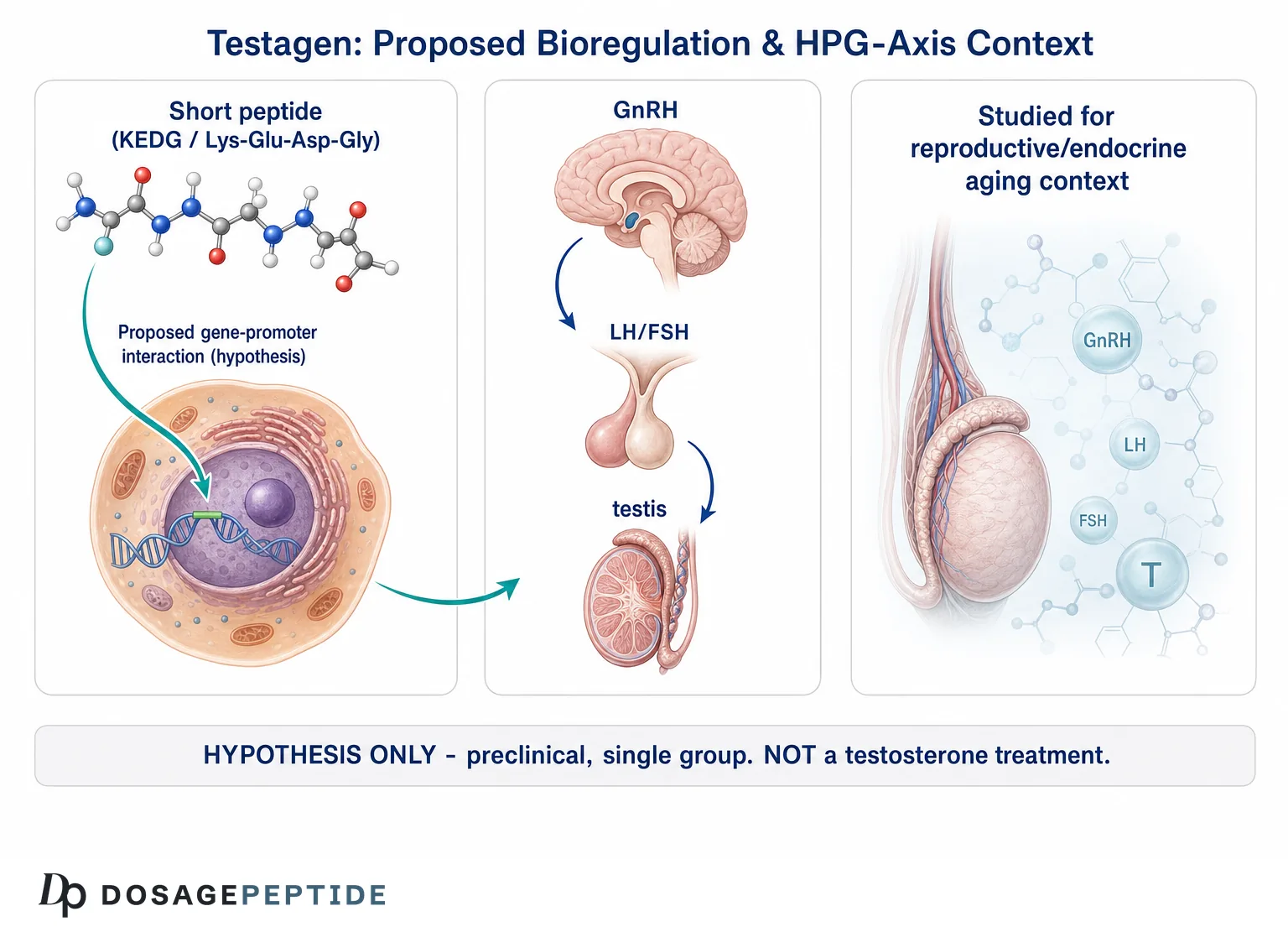
The three tiers of control
At the top, specialised hypothalamic neurons release gonadotropin-releasing hormone (GnRH) in discrete pulses into the hypophyseal portal system. Pulse frequency and amplitude are the master variables: they instruct the anterior pituitary, which responds by secreting two gonadotropins — luteinising hormone (LH) and follicle-stimulating hormone (FSH). In the testis, LH acts primarily on Leydig cells to drive testosterone biosynthesis (steroidogenesis), while FSH acts on Sertoli cells to support spermatogenesis. Testosterone and its metabolites, together with the Sertoli-cell hormone inhibin B, feed back negatively on the hypothalamus and pituitary to keep the whole loop in range. Because feedback operates at two levels at once, the system resists crude perturbation: nudging one node tends to be buffered by compensatory changes elsewhere, which is part of why claims of gentle, tissue-specific “normalisation” deserve particular scrutiny.
The clinical importance of pulsatility is not theoretical. Pulsatile GnRH delivery can restore gonadotropin secretion and fertility in people with hypothalamic GnRH deficiency, and comparative studies report meaningful ongoing-pregnancy rates when the axis is driven in this physiological, pulsed manner.[12] Continuous (non-pulsed) GnRH exposure, by contrast, paradoxically suppresses the axis — the principle exploited by GnRH-agonist drugs used to lower testosterone. The same molecule can switch the system on or off depending purely on timing, which is a vivid reminder that reproductive signalling is exquisitely dose- and pattern-dependent, and that “more signal” is not automatically “more function.”
Pulse generation and the germ-cell timeline
Two further features of the axis matter for judging any reproductive claim. First, the pulsatile GnRH signal is itself generated upstream: a network of hypothalamic neurons expressing kisspeptin, neurokinin B, and dynorphin (the so-called KNDy neurons) shapes the frequency and amplitude of GnRH release and integrates metabolic, stress, and sex-steroid inputs. That is why energy status, chronic stress, and body composition can all move the reproductive axis without any pharmacological intervention at all — the “set point” is under continuous physiological negotiation. Second, spermatogenesis is a slow, tightly staged process: in humans a full cycle from spermatogonial stem cell to mature spermatozoon takes on the order of ten to eleven weeks, with additional time for epididymal transit and maturation. Any intervention claimed to improve sperm output therefore cannot be assessed in days or weeks; it requires months of controlled observation with standardised semen analysis. These are practical reasons why credible reproductive claims demand time-resolved, controlled human data — and why single-time-point animal or explant assays cannot substitute for them.
The distinction between primary hypogonadism (a testicular problem, with high LH/FSH as the pituitary tries to compensate) and secondary hypogonadism (a hypothalamic or pituitary problem, with inappropriately low or normal LH/FSH) is also central. The two have different causes, different work-ups, and different appropriate management, and a marker panel that includes LH, FSH, testosterone, and where relevant INSL3 and inhibin B is how clinicians tell them apart. A compound that genuinely acted on the reproductive axis should produce an interpretable, reproducible signature across these markers; the absence of such a signature for Testagen is not a neutral gap but a substantive one.
Why this matters for a “testis peptide”
Because the HPG axis is a closed feedback loop, any compound claimed to “support” reproductive function has to specify where it acts: at GnRH neurons, at the pituitary gonadotropes, at Leydig or Sertoli cells, or somewhere downstream in gene regulation. A credible mechanism should predict measurable changes in LH, FSH, testosterone, INSL3, inhibin B, or sperm parameters — and, crucially, those predictions should be tested against a control group rather than asserted. As we discuss below, the direct Testagen literature does not offer robust, replicated human measurements of these axis endpoints — which is the single most important gap in the story. Our explainers on hCG, testosterone and fertility research and on Gonadorelin (GnRH) research describe agents that do have defined, measurable actions on this axis, and they provide a useful benchmark.
Testicular Ageing and the Rationale Researchers Cite
The rationale offered for studying a reproductive bioregulator like Testagen rests on a genuine and well-documented phenomenon: age-related decline in testicular endocrine capacity. This is worth stating carefully, because the phenomenon is real even if Testagen’s relevance to it is unproven.
With advancing age, many men show a gradual fall in total and free testosterone, driven partly by reduced Leydig-cell functional capacity and partly by changes higher in the axis. A useful, relatively specific marker here is insulin-like peptide 3 (INSL3), constitutively secreted by Leydig cells: cohort work indicates that INSL3 declines with age and tracks Leydig-cell insufficiency more stably than testosterone itself, because its secretion reflects the differentiation status and number of Leydig cells rather than the acute, homeostatically regulated output of testosterone.[7] At the cellular level, reviews of the ageing male reproductive system describe accumulating oxidative stress, DNA damage in germ cells, altered sperm microRNA profiles, and shifts in intercellular signalling (including via extracellular vesicles) as features of reproductive ageing.[10] The picture that emerges is one of a slow, multifactorial drift rather than a single switch that a lone peptide could plausibly reset.
Advancing paternal age is also associated with measurable changes in the germ line itself: declining semen volume and motility, rising sperm DNA fragmentation, and altered epigenetic and small-RNA cargo carried by sperm and by testicular extracellular vesicles.[10] These are the kinds of endpoints a genuine reproductive intervention would have to move, and they are exactly the endpoints for which no controlled Testagen data exist. It is worth stressing that identifying these age-related changes is descriptive work — it maps what happens, not what fixes it. The leap from “here is a quantifiable decline” to “here is a peptide that reverses it” is precisely the leap that has not been made in the peer-reviewed record for KEDG.
Reproductive decline is also strongly modifiable by non-peptide factors. Central obesity is independently associated with lower total and free testosterone and reduced sperm concentration, through mechanisms including reduced LH pulse amplitude and altered leptin signalling; importantly, weight loss can normalise testosterone in many obese men.[9] Leptin itself acts at multiple levels of the HPG axis, and leptin resistance is one route by which metabolic dysfunction becomes reproductive dysfunction.[8] These are important comparators because they are measured, mechanistically grounded, and reversible — exactly the qualities the Testagen literature lacks.
The honest takeaway: the biological problem that Testagen is marketed toward is real, quantifiable, and already has evidence-based levers (managing weight and metabolic health, treating identifiable endocrine disease). None of that established biology constitutes evidence that a KEDG tetrapeptide does anything useful about it. A real problem plus a plausible-sounding molecule is not the same as an effective intervention — a distinction that matters most precisely when the surrounding science sounds impressive.
Mechanisms Studied: The Peptide-Bioregulation Hypothesis
The proposed testagen mechanism is inseparable from the general Khavinson mechanistic hypothesis, so we describe that hypothesis and then state precisely what has and has not been shown for Testagen specifically.
The core claim: short peptides as gene-expression regulators
The central mechanistic proposal is that ultrashort peptides (2–7 residues) can enter cells, reach the nucleus, and interact directly with DNA, histones, and other nuclear components to modulate gene expression — effectively acting as epigenetic-type regulators rather than as classical receptor ligands. A systematic review by the originating group lays out this model in detail, arguing that short peptides can recognise DNA sequences (including promoter regions), influence DNA methylation status, and thereby switch tissue-relevant genes up or down.[2] Related reviews extend the same reasoning to neuroprotection, proposing peptide interactions with histones and non-coding RNA.[4] This is an internally coherent model, but it is largely elaborated by one research network, and independent structural biology confirming direct, sequence-specific DNA binding by these particular tetrapeptides at physiological concentrations is scarce.
What has actually been measured — and in which peptide
Concrete molecular data exist mainly for Testagen’s shorter relatives. For example, in human mesenchymal stem-cell ageing cultures, the peptides AED, KED, and KE modulated expression of several ageing-associated genes (including IGF1, FOXO1, TERT, TNKS2, and NF-κB) at nanomolar concentrations — with different, sometimes opposite, effects depending on the culture ageing model.[3] In retinal models, the group reports that short peptides bind promoter regions and exert “retinoprotective” gene-regulatory effects.[5] These are real in-vitro/preclinical findings — but they are (a) for peptides other than KEDG, (b) demonstrations of a gene-expression effect rather than proof of a clean, tissue-specific reproductive programme in the intact male, and (c) heavily dependent on the specific cell model, since the same peptide could move a gene in opposite directions across conditions.
The honest status of the mechanism
For Testagen specifically, a robust, independently replicated molecular mechanism — showing that KEDG enters testicular cells, binds defined targets, and produces reproducible changes in steroidogenic or spermatogenic gene expression with functional consequences — is not established in the peer-reviewed international literature. The direct-to-DNA regulatory model is best described as an interesting but unvalidated hypothesis that has attracted little independent biophysical scrutiny. Extraordinary mechanistic claims (a four-residue peptide carrying tissue-address information into the nucleus) require extraordinary, replicated evidence, and that bar has not been met for Testagen. Until unaffiliated laboratories reproduce the key steps, the mechanism should be treated as a proposal, not a finding.
There is also a plausibility asymmetry worth naming. The general observation that some short peptides can influence gene expression in cultured cells is not, in itself, controversial — many small molecules and peptides perturb transcription under the right conditions. The controversial part is the much stronger, marketing-friendly claim layered on top: that a specific four-residue sequence carries a clean, tissue-addressed instruction that selectively normalises reproductive function in an intact organism. The first claim is modest and partly supported for related peptides; the second is sweeping and unsupported for KEDG. Conflating the two — treating a generic in-vitro transcriptional effect as if it proved organ-specific therapeutic regulation — is the central rhetorical move that inflates this compound’s apparent evidence base, and recognising it is the key to reading Testagen claims critically.
What Does the Direct Testagen Evidence Actually Show?
Stripping away the surrounding family literature, the picture for KEDG itself is sparse. A structured search of the international biomedical literature (PubMed) returns essentially no primary randomised or controlled human studies indexed under “Testagen” for reproductive outcomes. What exists is largely:
- Single-group preclinical and cell-culture reports, frequently in the Bulletin of Experimental Biology and Medicine and Russian-language gerontology journals, often describing tissue-explant “outgrowth” assays or organ-specific effects rather than controlled reproductive endpoints.
- Extract-based work (on testis-derived polypeptide preparations) that is then extrapolated to the synthetic KEDG analogue by structural analogy rather than by head-to-head testing.
- Review and hypothesis articles from the same network that restate the peptide-bioregulation model and group Testagen with better-studied relatives such as Epitalon and Thymalin.[1]
Critically, there is no known registered randomised controlled trial on ClinicalTrials.gov evaluating Testagen for hypogonadism, male infertility, testosterone levels, or fertility, and there is no Western regulatory dossier. This is the decisive point for any reader: the compound’s direct human evidence base is not merely weak, it is largely absent. Where earlier bioregulator reviews report clinical benefit for other members of the family, those reports too come predominantly from the originating institutes and have not been reproduced in independent, blinded, adequately powered trials.[1] Applying that same skepticism to Testagen is not cynicism; it is standard evidence appraisal, and it is the posture any careful reader should adopt.
Readers who want to see how a specific vial is characterised for laboratory handling — concentration, reconstitution volume, and storage — can consult our reference page on the Testagen dosage and reconstitution protocol. That page documents research-handling parameters only; it is not, and should not be read as, a human-use instruction or a claim of efficacy.
What Would Convincing Testagen Evidence Look Like?
It is fair to ask what would actually move Testagen out of the “interesting hypothesis” category. Spelling this out is useful because it lets a reader judge marketing claims against a concrete standard rather than against a vague sense of “more research needed.”
At the mechanistic level, the field would want independent, unaffiliated laboratories to show that KEDG specifically — not a shorter relative — enters the relevant testicular cell types, engages a defined molecular target, and produces reproducible, dose-dependent changes in steroidogenic or spermatogenic gene expression, with appropriate controls and biophysical characterisation of any claimed DNA or chromatin interaction. Because the peptide is small, charged, and hydrophilic, part of that work would have to explain how it reaches an intracellular or nuclear target in the first place. Single-group reports, however internally consistent, do not clear this bar on their own; replication by parties with no stake in the outcome is what turns a claim into a finding.
At the whole-organism and human level, the relevant designs are well understood from the better-evidenced comparators. A credible programme would run placebo-controlled, randomised, adequately powered studies with pre-registered protocols, measuring the axis biomarkers that a reproductive agent should move — LH, FSH, total and free testosterone, INSL3, inhibin B — alongside standardised semen parameters assessed over a spermatogenesis-appropriate timescale of several months. Blinding and independent statistical analysis matter because reproductive endpoints are noisy and prone to regression-to-the-mean and placebo effects. Safety would be characterised in parallel, including effects on the axis itself and on long-term endpoints. None of this is exotic; it is simply the standard that hCG and gonadorelin have been held to and that Testagen has not. Until such data exist and are independently reproduced, the honest description of Testagen’s reproductive efficacy is not “early but promising” — it is “untested.”
Current Evidence Level
Assigning an honest evidence tier is the most useful thing this article can do. Different claims about Testagen sit at very different levels of support, and lumping them together is exactly how misinformation spreads. The table below separates them explicitly.
| Claim or context | Evidence tier | Honest status |
|---|---|---|
| The HPG axis controls male reproductive endocrinology (GnRH→LH/FSH→Leydig/Sertoli) | Established human physiology | Robust, textbook-level |
| Testosterone/INSL3 decline with age; obesity lowers testosterone | Human observational + mechanistic | Well supported[7][9] |
| Short Khavinson peptides (KE/KED/AED) alter gene expression in vitro | In-vitro / preclinical, single-network | Reported, limited replication[3] |
| Testagen (KEDG) “normalises” reproductive function in humans | None to very low | Not demonstrated in controlled human trials |
| Testagen raises testosterone / treats infertility / boosts fertility | None | Unsupported disease/efficacy claim — do not accept |
| Testagen is FDA-approved or a recognised medicine | N/A | False — not approved anywhere as a drug |
In plain terms: the surrounding biology is strong, the general peptide-gene-expression hypothesis is preclinical and mostly single-group, and the Testagen-specific reproductive claims are essentially unevidenced in humans. Testagen is best classified as a research-use experimental peptide, not an investigational drug in the regulatory sense (there is no active IND-style clinical programme in the public record), and certainly not an approved therapy. That classification is not a temporary status awaiting imminent approval; it reflects the near-total absence of the controlled human data that any approval pathway would require.
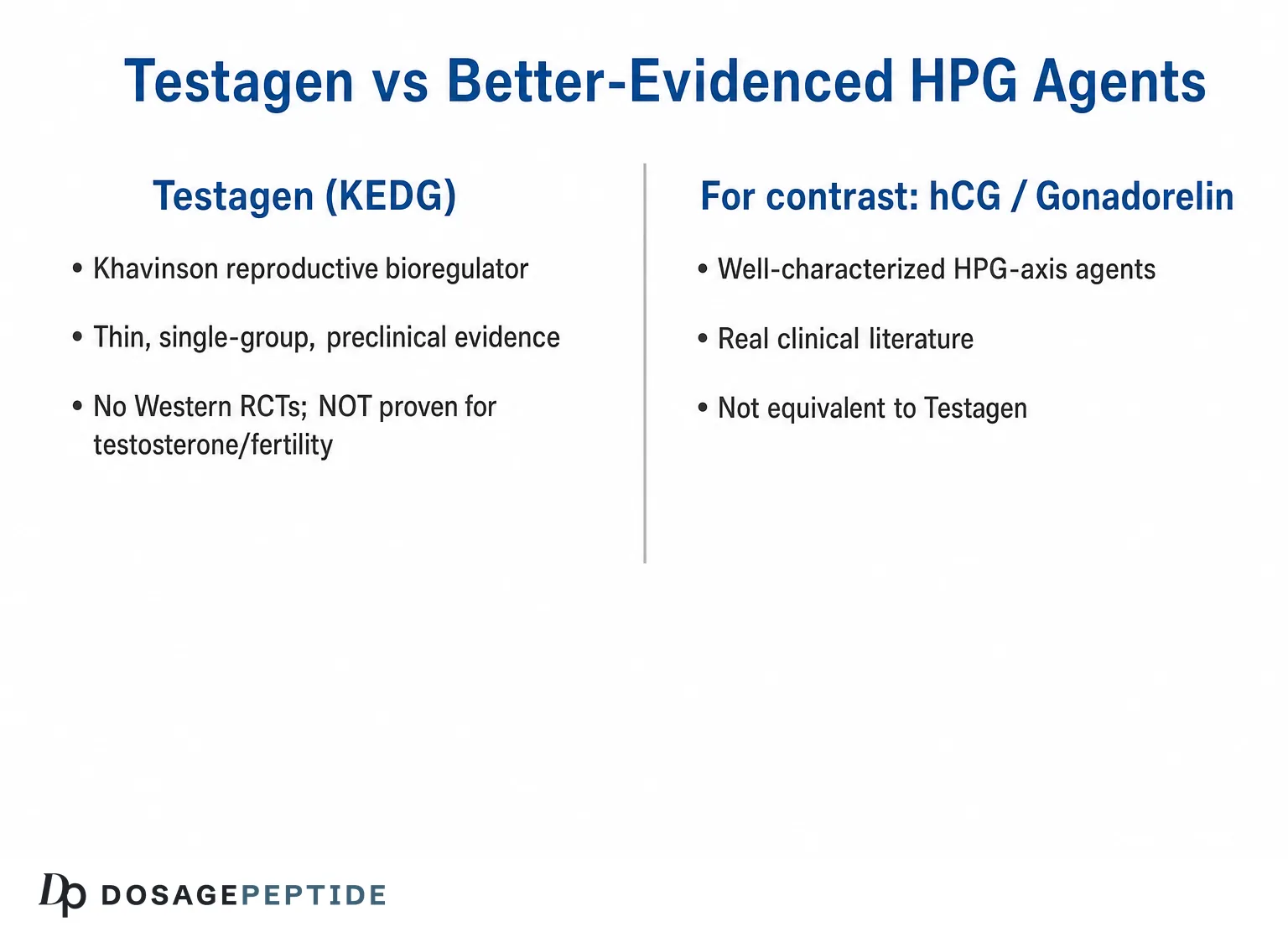
How Does Testagen Compare With Better-Evidenced HPG-Axis Agents?
A fair way to calibrate expectations is to contrast Testagen with compounds that do have measurable, replicated effects on the male reproductive axis. This is a contrast, not a claim of equivalence — the point is precisely that these agents occupy a different evidentiary universe, and neither is offered here as a recommendation for use.
Human chorionic gonadotropin (hCG)
hCG acts as an LH-receptor agonist, directly stimulating Leydig-cell testosterone production, and (usually combined with FSH) can induce spermatogenesis in men with gonadotropin deficiency. A meta-analysis of 41 studies and 1,673 patients found gonadotropin treatment induced measurable sperm production in most men with pathological gonadotropin deficiency, with combined hCG/FSH outperforming hCG alone on sperm output.[11] Whatever one’s view of hCG, it has a defined receptor, dose-response data, and quantitative reproductive endpoints — none of which Testagen has demonstrated. Crucially, the meta-analytic data for gonadotropin therapy come from multiple centres and are pooled across dozens of studies, which is precisely the independent, replicated evidence base that a single-network compound lacks. See our overview of hCG, testosterone and fertility research.
Gonadorelin / pulsatile GnRH
Gonadorelin is synthetic GnRH. Delivered in physiological pulses, it drives endogenous LH and FSH and can restore fertility in hypothalamic GnRH deficiency, with comparative cohort data reporting ongoing-pregnancy rates around one in five per initiated cycle.[12] Again, the contrast is instructive: gonadorelin has a known mechanism (GnRH-receptor agonism), a critical dependence on pulsatile timing, and measurable axis endpoints. Our Gonadorelin (GnRH) research page covers this in depth.
| Feature | Testagen (KEDG) | hCG | Gonadorelin (GnRH) |
|---|---|---|---|
| Defined molecular target | Proposed (DNA/gene regulation), unconfirmed | LH receptor (Leydig cells) | GnRH receptor (pituitary) |
| Human reproductive endpoint data | Absent / not replicated | Yes (sperm output, testosterone) | Yes (fertility, pregnancy) |
| Independent replication | Minimal | Extensive | Extensive |
| Regulatory status | None (research peptide) | Approved drug (defined indications) | Approved diagnostic/therapeutic use |
The comparison should not be read as ranking Testagen below hCG on a shared scale — they are not on the same scale at all. hCG and gonadorelin are characterised endocrine agents with regulatory histories and quantitative outcomes; Testagen is a research peptide whose reproductive effects in humans have not been demonstrated. Naming them side by side simply makes the size of the evidence gap concrete. For context on the wider short-peptide family, our Prostamax prostate peptide explainer walks through an analogous compound and the same evidentiary caveats.
Why Testagen Is Not a Testosterone Booster or an Infertility Treatment
This section states plainly what the evidence does not support, because these are the exact claims most likely to be encountered online.
Testagen is not a demonstrated testosterone booster. There are no replicated, controlled human data showing that KEDG raises serum testosterone. A compound that genuinely stimulated testosterone would be expected to move LH, testosterone, and INSL3 in measurable, reproducible ways; those data do not exist in the international literature for Testagen. Any source presenting Testagen as a testosterone enhancer is extrapolating from the peptide-bioregulator hypothesis, not reporting measured outcomes.
Testagen is not a treatment for hypogonadism. Hypogonadism is a defined clinical diagnosis requiring proper evaluation, and its evidence-based management — including when testosterone therapy is and is not appropriate — is set out in endocrine clinical-practice guidelines.[13] Testagen appears nowhere in those guidelines because it has no controlled evidence base for that condition.
Testagen is not a proven fertility treatment. Male-factor infertility has established, measurable pathways to management (from treating hypogonadotropic hypogonadism with gonadotropins to assisted reproduction). Testagen has no controlled fertility-outcome data — no sperm-parameter improvements, no pregnancy-rate data — that would justify placing it in that pathway.
Framing Testagen as any of these three things would be a disease/efficacy claim unsupported by evidence. The intellectually honest description is: a research peptide, hypothesised (within one scientific school) to have reproductive-tissue regulatory activity, whose direct human evidence is essentially absent. Anyone concerned about testosterone or fertility is far better served by evaluation from a qualified clinician than by an unvalidated research chemical.
Limitations
The limitations here are not marginal footnotes; they are central to understanding Testagen.
- Single-group evidence. Nearly all supportive data originate from one interconnected research network. Findings that are never independently reproduced by unaffiliated laboratories carry inherently limited weight, regardless of how internally consistent they appear.
- Preclinical and in-vitro emphasis. The strongest molecular data are cell-culture and animal results — and largely for shorter peptides (KE, KED, AED), not KEDG. Preclinical signals routinely fail to translate to humans, and cross-species, cross-model extrapolation is exactly where reproductive-peptide claims are most fragile.
- Publication and language concentration. A heavy reliance on one journal family and Russian-language sources limits access, peer scrutiny, and independent meta-analysis by the wider scientific community.
- Mechanistic implausibility not yet resolved. The proposed direct-to-DNA, tissue-specific action of a four-residue peptide is a strong claim that has not been corroborated by independent structural or cell-biology work at the level such a claim demands.
- No controlled human reproductive endpoints. There are no published randomised controlled trials measuring testosterone, LH/FSH, sperm parameters, or fertility outcomes for Testagen. Without these, efficacy is unknown — not “promising,” simply unknown.
- Safety data are correspondingly thin. Absence of large controlled trials also means the human safety profile (including long-term effects and effects on the HPG axis) is not well characterised. Absence of reported harm is not evidence of safety.
- Product-quality variability. As an unregulated research chemical, real-world material can vary in identity, purity, and endotoxin content between suppliers, adding a layer of uncertainty entirely separate from the underlying biology.
Taken together, these limitations mean the correct posture toward Testagen is curiosity paired with skepticism: it is a legitimate subject for basic research, and simultaneously a compound about which strong human claims are unjustified. Holding both of those ideas at once — genuine scientific interest without premature belief — is the most accurate stance the current evidence permits, and it is the stance this article has tried to model throughout.
Regulatory and Legal Status
Because regulatory status is where marketing most often overreaches, it is worth stating precisely. Testagen is not approved as a drug by the U.S. Food and Drug Administration, and there is no public evidence of approval as a medicine by the European Medicines Agency or other major Western regulators. There is no approved indication, no prescribing information, and no regulatory dossier establishing safety and efficacy for any reproductive or other use. In the United States it is not a lawful dietary-supplement ingredient either; synthetic peptides of this kind generally fall outside the dietary-supplement framework, and the FDA has taken the position that many research peptides are unapproved new drugs when marketed for human use.
What Testagen is, in practice, is a research chemical sold for laboratory use only, typically labelled “not for human consumption.” It is important not to misread the existence of related products in the compound’s country of origin as drug approval: within the Khavinson tradition, several organ-directed bioregulator preparations have been marketed as biologically active additives (supplements) rather than as registered pharmaceuticals, and supplement marketing is a fundamentally different, far lower evidentiary bar than drug registration. None of that constitutes the kind of controlled-trial evidence or regulatory review that the word “approved” implies to most readers.
The practical consequences follow directly. As an unregulated research material, Testagen is not subject to pharmaceutical-grade manufacturing oversight, so identity, purity, peptide content, and endotoxin levels can vary between suppliers and between batches. There is no authority verifying that a vial contains what its label claims, and no post-market safety surveillance of the kind that accompanies approved drugs. For anyone evaluating claims found online, the single most reliable statement is the simplest one: Testagen has no approved therapeutic status anywhere, and any presentation of it as a medicine, treatment, or clinically validated product is inaccurate.
Frequently Asked Questions
What is Testagen and what is it made of?
Testagen is a short synthetic peptide, most often described as the tetrapeptide Lys-Glu-Asp-Gly (KEDG), built from four standard amino acids. It belongs to the Khavinson family of “peptide bioregulators” and is positioned in that research literature as a reproductive- or testis-type short peptide. Chemically it is small, water-soluble, and easy to synthesise. It is a research compound, not an approved medicine.
Does Testagen increase testosterone?
There is no replicated, controlled human evidence that Testagen raises testosterone. A genuine testosterone stimulator would be expected to produce measurable, reproducible changes in LH, testosterone, and related markers, and such data do not exist for Testagen in the international literature. Claims that it “boosts testosterone” extrapolate from an unvalidated hypothesis rather than from measured human outcomes, so they should be treated with strong skepticism.
Is Testagen FDA-approved or a licensed drug?
No. Testagen is not approved by the FDA or, to public knowledge, by any major regulator as a therapeutic drug. It is sold and handled as a research chemical. There is no known registered randomised controlled trial and no regulatory dossier supporting a reproductive indication. Any presentation of Testagen as an approved or clinically validated treatment is inaccurate.
How is Testagen different from Epitalon and other Khavinson peptides?
Epitalon is Ala-Glu-Asp-Gly (AEDG), assigned to the pineal gland and retina, whereas Testagen is Lys-Glu-Asp-Gly (KEDG), assigned to reproductive tissue. They differ by a single N-terminal residue. Much of the mechanistic data people cite actually involves shorter relatives such as KE (Vilon) and KED (Vesugen). These are chemically distinct molecules, so evidence for one does not automatically transfer to Testagen.
What does the research actually show about Testagen?
The direct Testagen evidence is thin: mostly single-group, preclinical, and often extract-based work, with the stronger molecular findings coming from related peptides rather than KEDG itself. There are no controlled human reproductive-outcome studies. The surrounding biology (the HPG axis, testicular ageing) is well established, but that background does not constitute evidence that Testagen does anything useful in humans.
How does Testagen compare to hCG or gonadorelin?
hCG and gonadorelin have defined receptors, dose-response data, and measurable reproductive endpoints — hCG stimulates Leydig-cell testosterone and can support spermatogenesis, and pulsatile gonadorelin can restore fertility in GnRH deficiency. Testagen has none of these characterised, replicated outcomes. The comparison highlights that Testagen sits in a fundamentally different, much weaker evidence category, not merely a lower rung of the same ladder.
Is Testagen safe?
Its human safety profile is not well characterised. Because there are no large controlled trials, potential long-term effects, effects on the HPG axis, and interactions are essentially unstudied. As an unregulated research chemical, product purity and identity can also vary between suppliers. Absence of reported harm is not the same as demonstrated safety, and this uncertainty is itself an important limitation.
Why is Testagen described as a “bioregulator”?
“Bioregulator” reflects the Khavinson hypothesis that ultrashort peptides act as tissue-specific regulators of gene expression — supposedly interacting with DNA and chromatin to normalise organ function. It is a conceptual label from one research school, not an established pharmacological class. The gene-expression hypothesis is preclinical and mostly single-group, so the term describes a proposed mechanism rather than a proven one.
Can Testagen treat male infertility?
No controlled evidence supports using Testagen for male infertility. Infertility has established, measurable management pathways, and Testagen has no published data on sperm parameters, pregnancy rates, or other fertility endpoints. Presenting it as a fertility treatment would be an unsupported medical claim. Anyone with fertility concerns should seek evaluation from a qualified clinician rather than relying on research peptides.
What is the difference between Testagen and Testoluten?
They are two different kinds of product that get confused because both are sold under the Khavinson bioregulator banner. Testagen is a short synthetic peptide with a stated sequence, KEDG (Lys-Glu-Asp-Gly). Testoluten (A-13) is not a defined single sequence at all: it is a peptide extract from calf testicular tissue, sold in capsules at around 10 mg of peptide complex each. So one is a chemically specified molecule and the other is a tissue fraction. The more important similarity: neither has controlled human trial data showing an effect on testosterone in men.
What dose of Testagen is used in research?
There is no established dose, because no controlled human trial exists to establish one from. Figures circulate on vendor pages, but they trace back to marketing material and to the general bioregulator literature rather than to a Testagen study with a measured endpoint. Treating a circulating number as a validated dose means treating a seller’s figure as clinical evidence.
Is Testagen the same thing as a “testes bioregulator”?
That is how it is marketed. The bioregulator framework claims that short, tissue-specific peptides act on the organ they were designed for — and “testes bioregulator” is a description of that claim, not of a demonstrated activity. No published controlled study shows Testagen changing testicular function or testosterone in humans, so the label tells you what is being asserted about the molecule, not what has been measured.
References
- Khavinson VK. Peptides and Ageing. Neuro Endocrinol Lett. 2002;23 Suppl 3:11–144. PubMed 12374906.
- Khavinson VK, Popovich IG, Linkova NS, Mironova ES, Ilina AR. Peptide Regulation of Gene Expression: A Systematic Review. Molecules. 2021;26(22):7053. doi:10.3390/molecules26227053.
- Ashapkin V, Khavinson V, Shilovsky G, Linkova N, Vanuyshin B. Gene expression in human mesenchymal stem cell aging cultures: modulation by short peptides. Mol Biol Rep. 2020;47(6):4323–4329. doi:10.1007/s11033-020-05506-3.
- Ilina A, Khavinson V, Linkova N, Petukhov M. Neuroepigenetic Mechanisms of Action of Ultrashort Peptides in Alzheimer’s Disease. Int J Mol Sci. 2022;23(8):4259. doi:10.3390/ijms23084259.
- Khavinson V, Trofimova S, Trofimov A, Solomin I. Molecular-Physiological Aspects of Regulatory Effect of Peptide Retinoprotectors. Stem Cell Rev Rep. 2019;15(3):439–442. doi:10.1007/s12015-019-09882-7.
- Khavinson VK, Kopylov AT, Vaskovsky BV, Ryzhak GA, Lin’kova NS. Identification of Peptide AEDG in the Polypeptide Complex of the Pineal Gland. Bull Exp Biol Med. 2017;164(1):41–43. doi:10.1007/s10517-017-3922-8.
- Anand-Ivell R, et al. Insulin-like peptide 3 (INSL3) as an indicator of Leydig cell insufficiency (LCI) in middle-aged and older men with hypogonadism: reference range and threshold. Aging Male. 2024;27(1):2346322. doi:10.1080/13685538.2024.2346322.
- Landry D, Cloutier F, Martin LJ. Implications of leptin in neuroendocrine regulation of male reproduction. Reprod Biol. 2013;13(1):1–14. doi:10.1016/j.repbio.2012.12.001.
- Mah PM, Wittert GA. Obesity and testicular function. Mol Cell Endocrinol. 2010;316(2):180–186. doi:10.1016/j.mce.2009.06.007.
- Li W, Yu Z, Xu S, Li Z, Xia W. Extracellular Vesicles in the Aging Male Reproductive System: Progresses and Perspectives. Adv Exp Med Biol. 2025;1469:375–394. doi:10.1007/978-3-031-82990-1_16.
- Muir CA, Zhang T, Jayadev V, Conway AJ, Handelsman DJ. Efficacy of Gonadotropin Treatment for Induction of Spermatogenesis in Men With Pathologic Gonadotropin Deficiency: A Meta-Analysis. Clin Endocrinol (Oxf). 2025;102(2):167–177. doi:10.1111/cen.15151.
- Everaere H, Simon V, Bachelot A, et al. Pulsatile gonadotropin-releasing hormone therapy: comparison of efficacy between functional hypothalamic amenorrhea and congenital hypogonadotropic hypogonadism. Fertil Steril. 2025;123(2):270–279. doi:10.1016/j.fertnstert.2024.08.354.
- Bhasin S, Brito JP, Cunningham GR, et al. Testosterone Therapy in Men With Hypogonadism: An Endocrine Society Clinical Practice Guideline. J Clin Endocrinol Metab. 2018;103(5):1715–1744. doi:10.1210/jc.2018-00229.
Research-use-only disclaimer. This article is provided for educational and informational purposes only and describes laboratory and preclinical research. Testagen is an experimental research peptide; it is not an approved drug and is not intended for human use, self-administration, or the diagnosis, treatment, cure, or prevention of any disease. Nothing here is medical advice or a dosing recommendation. Individuals with concerns about testosterone, fertility, or reproductive health should consult a qualified, licensed healthcare professional.