Crystagen is a synthetic tripeptide — glutamic acid–aspartic acid–glycine (Glu-Asp-Gly, abbreviated EDG) — sold as an immune-system “bioregulator” in the Khavinson family of ultrashort peptides. Suppliers position it as supporting immune function in ageing, and research material is typically supplied as a 20 mg vial. The honest summary of the evidence, laid out in detail below: Crystagen’s own data are thin and come almost entirely from a single research group, even though the immune-ageing biology it is aimed at is genuinely well studied. This article separates what is claimed about Crystagen from what has actually been shown.
What Is Crystagen? Defining the EDG Immune Bioregulator
Crystagen is most commonly described in supplier monographs and bioregulator literature as a very short synthetic peptide — a tripeptide with the amino-acid sequence glutamic acid–aspartic acid–glycine (Glu-Asp-Gly), abbreviated EDG. It belongs to a family of “ultrashort” peptides (typically two to four amino-acid residues) developed at the St. Petersburg Institute of Bioregulation and Gerontology, each nominally assigned to a specific organ or tissue system. Within that scheme, Crystagen is presented as the immune/thymus-directed member, sitting alongside compounds directed at the pineal gland, vasculature, cartilage, liver and other tissues.
Two points deserve emphasis before going further. First, the EDG peptide identity itself — that “Crystagen” corresponds specifically to Glu-Asp-Gly — is drawn from vendor and monograph descriptions rather than from a body of peer-reviewed structural papers indexed in Western databases. When you search mainstream biomedical indexes for the trade name “Crystagen,” you find essentially no primary experimental literature under that exact name.[1] Second, and consequently, most of what is asserted about Crystagen is really an extrapolation from the broader “short peptide bioregulator” hypothesis promoted by the same group. Understanding Crystagen therefore means understanding that hypothesis — and understanding exactly where the claims outrun the data.
For readers who want the practical reference material, dosagepeptide.com maintains a separate Crystagen dosage and reconstitution protocol page for laboratory documentation purposes; that page is a research-use reference and is not a recommendation for human administration. This article, by contrast, is concerned strictly with the question of evidence: what is known, what is merely proposed, and what is unknown.
Where the name comes from
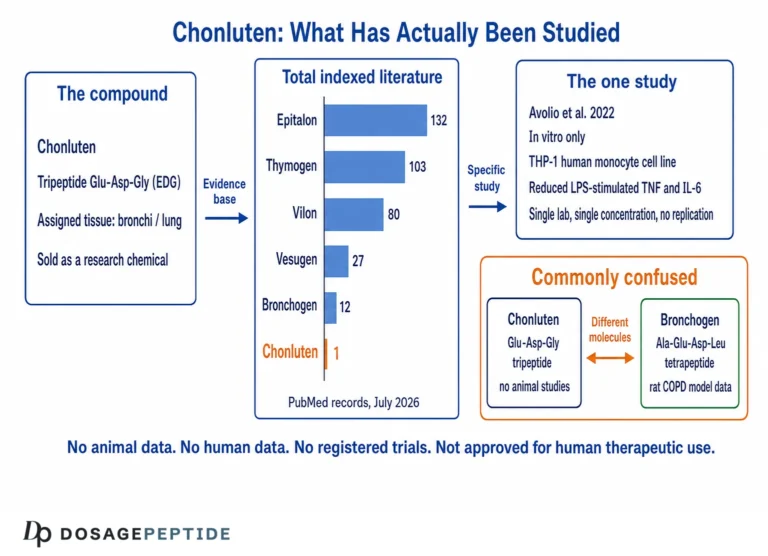
The naming convention across this peptide family (Cortagen, Cardiogen, Chonluten, Vesugen, Pinealon, Crystagen and others) follows a marketing-style pattern in which a trade name is paired with a short amino-acid sequence and an organ target. Crystagen’s pairing with the immune system reflects the group’s longstanding interest in thymic peptides and immunosenescence. But a trade name is not a mechanism, and an organ label is not a demonstrated tropism. Throughout this article, “Crystagen” and “the EDG peptide” are treated as the same proposed entity, with the caveat that the specific sequence assignment rests on secondary sources.
It is also worth being precise about scale. A tripeptide such as EDG contains just three amino-acid residues and a molecular weight on the order of a few hundred daltons — orders of magnitude smaller than antibodies, cytokines, or even the 28-residue thymosin alpha-1. That extreme brevity is exactly what makes the proposed mechanism so striking: conventional biology reserves sequence-specific gene targeting for large, precisely folded proteins with extensive DNA-contact surfaces. Asserting that a three-residue fragment performs an analogous, gene-selective job is not merely an incremental claim; it is a departure from the established rules of molecular recognition, and it is judged accordingly by the wider field. Keeping that sense of scale in mind is a useful anchor when weighing everything that follows.
Research Context: Where Crystagen Sits in the Khavinson Peptide-Bioregulator Program
To evaluate Crystagen fairly, it has to be placed inside the larger research program from which it emerged. Beginning in the late Soviet period, a group led by Vladimir Khavinson at what became the St. Petersburg (Saint Petersburg) Institute of Bioregulation and Gerontology pursued the idea that peptide fractions extracted from animal organs — and later, short synthetic peptides modeled on them — could act as tissue-specific regulators of gene expression and physiological function.[2] The earliest of these were complex peptide preparations from the thymus (thymalin) and pineal gland (epithalamin); the later generation comprised defined di-, tri- and tetrapeptides such as Vilon (Lys-Glu), Epitalon (Ala-Glu-Asp-Gly) and, by extension, the immune-directed Crystagen (Glu-Asp-Gly).
This is the intellectual home of the term crystagen bioregulator. The word “bioregulator” is used by the group to signal a claimed mode of action distinct from a classical drug: rather than binding a single receptor to trigger a defined pharmacological effect, the peptides are proposed to restore normal regulation of gene transcription in tissues where age or stress has disturbed it. It is a compelling narrative, and it maps onto real and important biology — the decline of immune function with age. But the narrative and the evidence must be kept strictly separate, and the reader should notice from the outset that nearly all of the primary Crystagen-relevant work traces back to this one institutional lineage.
A brief history: from cytomedines to synthetic short peptides
The program has a recognizable arc. In its first phase, researchers prepared “cytomedines” — peptide-containing extracts isolated from animal organs such as the thymus, pineal gland and vessels — and reported that each extract preferentially affected the organ it came from. Thymalin (a thymic preparation) and epithalamin (a pineal preparation) are the archetypes of this first generation, and they anchored the group’s founding claim that organ-derived peptide mixtures carry tissue-specific regulatory information. In its second phase, the group moved from crude extracts to defined synthetic short peptides, proposing that the biological activity of a whole extract could be distilled into a two-to-four-residue sequence: Vilon (Lys-Glu) as an immune/thymic representative, Epitalon (Ala-Glu-Asp-Gly) as the pineal one, and a growing catalogue of organ-labeled tripeptides and tetrapeptides — Crystagen among them.[6]
This history matters for interpreting Crystagen because it explains both the appeal and the fragility of the claims. The appeal is a tidy, unifying idea: short peptides as an ancient, evolutionarily conserved layer of gene regulation, one peptide per tissue. The fragility is that the entire edifice — from cytomedines to synthetic tripeptides — was built and is still largely maintained by the same institutional lineage, so the second-generation synthetic claims inherit rather than resolve the reproducibility questions raised by the first generation. Crystagen arrives at the end of this chain as one of the least individually characterized links.
A single-group evidence lineage
When you follow the citation trail for the immune and gene-regulatory claims attached to these short peptides, you repeatedly arrive at the same cluster of authors — Khavinson, Kuznik, Linkova and collaborators — publishing in a relatively narrow set of venues, prominently the Bulletin of Experimental Biology and Medicine, the journal Advances in Gerontology (Uspekhi Gerontologii), and, in the past decade, several open-access molecular-biology journals.[3] Much of the foundational work is in Russian-language literature. This is not, in itself, a criticism — important science is published in many languages and journals. It is, however, a structural fact about the evidence base that any honest reader must weigh: the great majority of supportive findings originate from a single group, with limited independent replication and no Western randomized controlled trials of Crystagen in humans.
Why does independent replication matter so much? Because science treats a finding as reliable not when it is published, but when it survives attempts by others — ideally skeptical others — to reproduce it under their own conditions. Replication guards against subtle methodological artifacts, unconscious bias in analysis, and the selective reporting of positive results. A hypothesis maintained largely within one group, however prolific, has not yet passed that test, and this is the central reason the mainstream community has neither adopted nor refuted the bioregulation model: it has simply not been subjected to the broad, independent scrutiny that would settle the matter either way. Crystagen sits squarely inside that unresolved space.
The broader field of Khavinson short-peptide research is summarized on our pillar overview of peptide bioregulators and the Khavinson short-peptide hypothesis, which situates Crystagen among its siblings and traces the history of the program in more depth.
The Peptide-Bioregulation Hypothesis — And Why It Remains Unvalidated
The core scientific claim underpinning every compound in this family, Crystagen included, is that ultrashort peptides can enter cells, reach the nucleus, and directly influence which genes are switched on or off. In a series of reviews, the St. Petersburg group has proposed that peptides of two to seven residues can penetrate both the plasma membrane and the nuclear envelope, interact with histone proteins and with specific short DNA sequences in gene promoters, and thereby modulate transcription — a putative form of epigenetic regulation.[2][4] Molecular-modeling papers from the group go further, proposing that particular peptides recognize particular promoter motifs; for example, work on the dipeptide KE (Vilon) describes computational docking to defined double-stranded DNA sequences found in the promoters of specific human genes.[5]
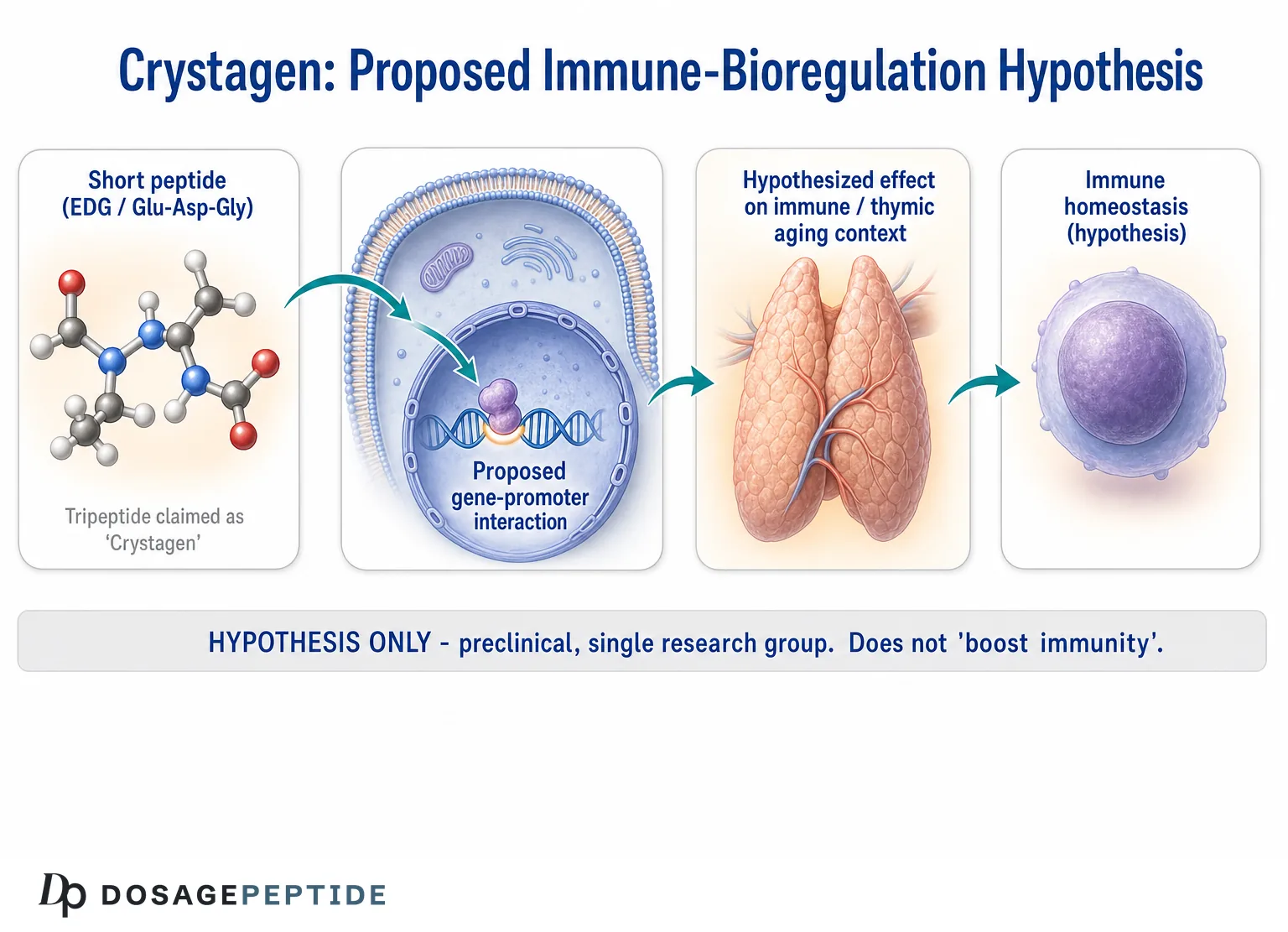
This is the proposed crystagen mechanism in miniature: a tissue-labeled short peptide that supposedly finds its way to immune-relevant genes and rebalances their expression. The hypothesis is internally coherent and has generated a substantial number of publications. What it has not generated is the kind of independent, adversarial validation that the mainstream molecular-biology community treats as decisive:
- Independent replication is scarce. The sequence-specific DNA-binding and nuclear-penetration claims have not been broadly reproduced by unaffiliated laboratories using standard biophysical and cell-biological techniques.
- The proposed biophysics is demanding. Sequence-specific recognition of double-stranded DNA by a bare tripeptide, at physiologically relevant concentrations and specificity, is a strong claim that the wider structural-biology community has not adopted, because such recognition normally requires much larger, folded protein domains.
- Effect sizes and dose–response data are frequently reported without the transparency (pre-registration, blinding, raw data) expected of high-tier evidence.
The correct way to state this is plainly: the peptide-bioregulation hypothesis is a proposed model, not an established mechanism. It remains unvalidated by the mainstream scientific community. Crystagen’s claimed effects inherit that uncertainty in full. Nothing in the paragraphs that follow should be read as endorsing the mechanism — only as accurately describing what has been proposed and, separately, what independent biology does support.
Mechanisms Studied: How Short Peptides Are Proposed to Reach Genes
Because the “how” is central to Crystagen’s identity, it is worth walking through the proposed mechanistic steps carefully — while labeling each one’s evidence tier. The following is a description of hypotheses advanced primarily by one research program; it is not a consensus account of peptide pharmacology.
Step 1: Cellular and nuclear entry
The group proposes that ultrashort peptides cross the cell membrane and enter the nucleus, a property they attribute to the peptides’ small size and charge.[6] Cell-penetrating peptides are a real and well-studied category in molecular biology — but the canonical examples are longer, cationic, arginine-rich sequences, and their nuclear delivery is an active area of study rather than a settled given. Extending “cell-penetrating” behavior to a neutral-to-acidic tripeptide such as EDG is a much stronger and less-supported claim. Evidence tier: proposed/preclinical, single-group; not independently established.
Step 2: Interaction with chromatin and DNA
Once inside the nucleus, the peptides are proposed to interact with histones and with specific promoter DNA sequences, altering chromatin accessibility and DNA methylation status and thereby changing transcription.[2] Systematic reviews from the group compile computational docking results and expression-change observations to support this idea.[4] Epigenetic regulation of ageing is unquestionably a real and important field; the specific claim that a defined tripeptide reproducibly targets defined promoter motifs is what remains unconfirmed outside the originating laboratories. Evidence tier: computational plus single-group experimental; not independently replicated.
Step 3: Downstream immune gene expression
For the immune-directed members of the family, the proposed downstream effect is normalization of the expression of genes governing lymphocyte differentiation, cytokine balance and thymic function — in effect, a partial reversal of the transcriptional signature of immune ageing. Related work from the group on the tetrapeptide Epitalon and the dipeptide Vilon reports changes in the expression of genes such as those encoding the ageing-associated markers CCL11 (eotaxin) and HMGB1.[7] Whether Crystagen specifically produces a coherent, reproducible immune-gene signature has not been demonstrated in independent, controlled human studies. Evidence tier: preclinical/associative, compound-adjacent rather than Crystagen-specific.
The established epigenetic biology the hypothesis borrows from
Part of what makes the peptide-bioregulation story persuasive is that it borrows the vocabulary of a genuinely revolutionary field. Epigenetic regulation — the control of gene activity by DNA methylation, histone modifications and non-coding RNAs without changes to the underlying DNA sequence — is real, central to development and ageing, and intensely studied worldwide. DNA methylation at promoter CpG sites can silence genes; histone acetylation and methylation reshape how tightly DNA is packaged and therefore how accessible it is to the transcription machinery; and the coordinated drift of these marks over a lifetime is measurable enough to underpin “epigenetic clocks” that estimate biological age. The Khavinson reviews explicitly frame short peptides as actors within this established system, proposing that peptides influence methylation status and histone–DNA interactions to switch genes on or off.[2]
The important analytical move is to separate the borrowed, well-supported background (epigenetics is real and important) from the novel, unsupported foreground (a specific tripeptide selectively drives specific promoters). The former is textbook biology; the latter is the extraordinary claim. Extraordinary claims require correspondingly strong, independent evidence — ideally structural data (for example, high-resolution studies showing a peptide bound to a defined DNA sequence), reproducible dose–response measurements from multiple laboratories, and pre-registered functional experiments with appropriate controls. For Crystagen specifically, that tier of evidence has not been produced. The reader should therefore treat the epigenetic framing as an analogy the proponents invoke, not as demonstrated mechanism.
What the group actually measures
In practice, the group’s experimental papers tend to report one of a few readouts: changes in the messenger-RNA or protein levels of selected target genes after peptide exposure in cultured cells or tissue explants; molecular-docking simulations proposing that a peptide can fit a particular DNA motif; and organism-level outcomes in ageing models. Recent examples on sibling peptides describe, for instance, KE (Vilon) altering expression of the sirtuin SIRT1 and the DNA-repair enzymes PARP1 and PARP2 in ageing human mesenchymal stem cells, together with docking to specified promoter sequences.[5] These are legitimate experimental formats. Their limitation, for our purposes, is threefold: they largely concern peptides other than Crystagen; they originate from the hypothesis’s proponents; and expression changes in a dish, even if real, are several inferential steps away from a clinically meaningful immune effect in a living human. Each step — dish to animal, animal to human, biomarker to outcome — is a place where promising signals routinely fail.
A note on what “studied” means here
It is important not to let the volume of publications be mistaken for the weight of evidence. A large number of papers from one program exploring a hypothesis is not equivalent to a smaller number of independent studies converging on a replicated result. When we say a mechanism has been “studied,” we mean investigators have proposed and probed it — not that it has survived the adversarial testing that turns a hypothesis into an accepted fact. Readers new to the terminology may find our peptide research glossary useful for terms such as bioregulator, epigenetic regulation, immunosenescence and cell-penetrating peptide.
Immunosenescence and Thymic Involution: The Biology Crystagen Targets
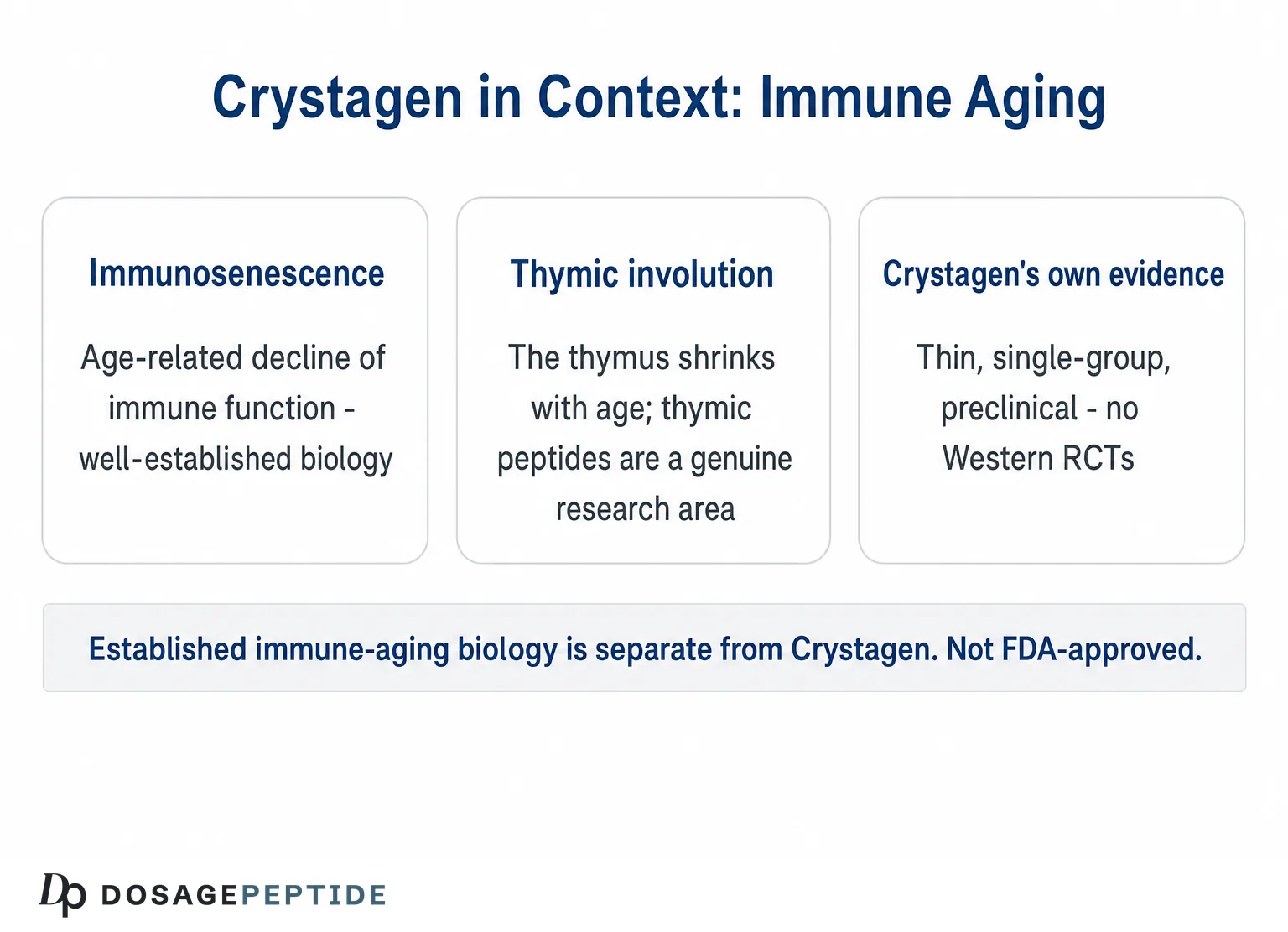
Here the ground becomes much firmer. Whatever one concludes about Crystagen, the problem it is nominally aimed at — the age-related decline of immune competence — is real, thoroughly documented, and the subject of a robust independent literature. Presenting this biology honestly, and clearly separated from Crystagen’s own thin data, is the most useful thing an educational article can do.
Immunosenescence is the umbrella term for the progressive, age-associated deterioration of both innate and adaptive immunity. In an authoritative review in Nature Immunology, Nikolich-Žugich describes how ageing reshapes lymphocyte populations, the soluble mediators that maintain them, and the lymphoid organs that coordinate immune responses, leaving older individuals more vulnerable to infection and less responsive to vaccination.[8] Goronzy and Weyand, also in Nature Immunology, focus on why the adaptive immune system in older adults fails to generate durable protective responses, tracing the defect to changes in T-cell generation, repertoire diversity and signaling.[9] These are mainstream, heavily cited syntheses — the kind of evidence that Crystagen’s own literature conspicuously lacks.
The involuting thymus
Central to immune ageing is thymic involution: the thymus, the organ where T lymphocytes mature, begins shrinking and being replaced by fat comparatively early in life, and its output of new (naïve) T cells declines steadily with age. A striking quantitative illustration comes from work by Palmer and colleagues, who noted that thymic volume and T-cell production roughly halve about every sixteen years, and showed that this decline tracks closely with the exponential rise in severe-outcome risk for certain infections across the lifespan.[10] The shrinking of the naïve T-cell pool narrows the repertoire available to respond to new pathogens and to mount effective responses to new vaccines — a mechanistic bridge between an ageing organ and clinically meaningful vulnerability.
This is exactly the target territory that thymic and immune peptides are marketed toward. The plausibility of the goal — supporting or partially restoring thymic and immune function in ageing — is genuine and grounded in this literature. The plausibility of Crystagen achieving that goal is a separate question, and one the independent evidence does not answer.
Inflammaging and the innate side of the decline
Immunosenescence is not only a story about T cells. A second, tightly linked phenomenon is inflammaging — a chronic, low-grade, sterile elevation of pro-inflammatory signaling that accumulates with age. It is paradoxical precisely because it coexists with weaker responses to real pathogens: the ageing immune system can be simultaneously over-activated at baseline and under-responsive on demand. Nikolich-Žugich’s review situates these soluble-mediator changes alongside the cellular ones, describing how the milieu that maintains and instructs lymphocytes itself shifts with age.[8] Innate cells — neutrophils, monocytes and macrophages, dendritic cells and natural killer cells — also change in number, phenotype and function, contributing both to the inflammatory tone and to impaired pathogen clearance.
The reason this matters for an article on Crystagen is that “immune bioregulation” marketing tends to collapse this complexity into a single axis of “stronger” versus “weaker” immunity. Real immune ageing is multidimensional and often involves rebalancing rather than simply boosting: dampening inappropriate baseline inflammation while restoring the capacity for a sharp, specific response. Any compound genuinely capable of favorably shifting that balance would need to be evaluated against multiple, carefully chosen endpoints — not a single “immune-boosting” slogan. The absence of such multidimensional evaluation for Crystagen is one more reason its claims remain unproven.
Why the naïve T-cell pool is so pivotal
The naïve T-cell compartment — cells that have matured in the thymus but not yet encountered their target antigen — is the immune system’s reservoir of adaptability. It is what allows the body to recognize genuinely novel pathogens and to be primed by new vaccines. As thymic output falls with age, this reservoir is replenished more slowly, and the peripheral repertoire increasingly relies on the expansion of pre-existing clones rather than the recruitment of fresh specificities.[9] Palmer and colleagues’ observation that the risk of severe outcomes for certain infections scales inversely with thymic T-cell output puts a quantitative frame on how consequential this reservoir is.[10] This is the biologically rational target that thymic peptides aim at — and it is why the field is scientifically interesting even where individual products are unproven.
Hallmarks of an ageing immune system
Drawing on the reviews above, the well-established features of immunosenescence include:
- Thymic involution and a falling output of naïve T cells.[10]
- Contraction of the naïve T-cell repertoire and accumulation of terminally differentiated, less flexible memory and effector cells.[9]
- “Inflammaging” — a low-grade, chronic elevation of pro-inflammatory mediators that paradoxically coexists with weaker responses to genuine threats.[8]
- Blunted vaccine responses and increased susceptibility to infection in older adults.[9]
These are the phenomena a credible immune bioregulator would have to influence. Documenting the target, however, says nothing about whether a given compound hits it — a distinction the marketing around this peptide class routinely blurs.
Thymic Peptides in the Wider Literature: Thymalin, Thymosin and Context
Crystagen is often discussed alongside better-studied thymic peptides, and it is fair to give that context — provided the boundary between the two is drawn sharply. Some thymus-derived or thymus-modeled peptides have accumulated real clinical data; Crystagen has not, and the association should not be allowed to transfer credibility it hasn’t earned.
Thymalin
Thymalin is a polypeptide preparation from the thymus that predates the ultrashort synthetic peptides and was itself developed within the St. Petersburg tradition. It has been studied as an immunomodulator, including a reported use as an adjunct in COVID-19 in which the authors describe reductions in inflammatory markers.[11] Even here, though, much of the work again originates from the same lineage, and the strongest independent immune-peptide evidence lies elsewhere — with thymosin.
Thymosin alpha-1
The most robustly studied thymic-type immune peptide is thymosin alpha-1 (Tα1), a synthetic 28-amino-acid peptide corresponding to a natural thymic factor. Unlike Crystagen, Tα1 has an extensive independent literature: it is approved in numerous countries for hepatitis B and C and as an immune adjuvant, and mechanistic reviews describe its interactions with Toll-like receptors and downstream effects on T cells, natural killer cells and cytokine production.[12] A review by Goldstein and Goldstein traces its path “from lab to bedside,” noting approval in more than thirty countries and clinical testing across a range of conditions.[13] Readers interested in that comparison can explore our overview of thymosin alpha-1 and immune-modulation research.
The instructive lesson is contrast, not equivalence. Tα1 shows what a genuinely developed immune peptide looks like: defined mechanism, multi-country regulatory review, independent trials, and a substantial multi-group literature. Crystagen has none of these. Grouping the two under “immune peptides” is descriptively convenient but should never be read as putting them on the same evidentiary footing.
| Compound | Type | Independent evidence base | Regulatory status |
|---|---|---|---|
| Crystagen (EDG) | Synthetic tripeptide, proposed immune bioregulator | Very limited; largely single-group, little/no indexed Crystagen-specific primary data | Not approved; research/experimental use only |
| Thymalin | Thymus-derived polypeptide preparation | Limited; substantial overlap with one research lineage | Historical clinical use in some regions; not a Western-approved drug |
| Thymosin alpha-1 | Synthetic 28-residue peptide | Extensive, multi-group, independent trials | Approved in many countries for specific indications |
Evidence tiers are approximate and are provided for orientation, not as clinical guidance. Inclusion in this table is not an endorsement of any compound for human use.
Current Evidence Level for Crystagen Specifically
Having surveyed the surrounding biology, we can now state the Crystagen-specific evidence position precisely — which is the single most important thing a reader should take away.
There are no Western randomized controlled trials of Crystagen. There is no substantial body of indexed, peer-reviewed, Crystagen-specific primary research under that trade name.[1] What exists falls into a few categories, each of which should be labeled honestly:
- Single-group and Russian-language reports on short immune peptides and organ-specific bioregulators, published predominantly in the Bulletin of Experimental Biology and Medicine and Advances in Gerontology. These are preclinical or small-scale, rarely blinded, and not independently replicated.[3]
- Mechanistic and computational reviews from the same program advancing the gene-regulation hypothesis for short peptides in general, not Crystagen specifically.[2][6]
- Extrapolation from related compounds (Vilon, Epitalon, thymalin), whose data are themselves limited and lineage-bound.[7]
On any conventional evidence hierarchy, this places Crystagen near the bottom: preclinical, single-group, unreplicated, with the specific compound largely uncharacterized in the independent literature. That is not a statement that Crystagen does nothing — it is a statement that the evidence required to know what it does, if anything, has not been generated and made public in a form the mainstream community can scrutinize.
| Evidence question | Honest status for Crystagen |
|---|---|
| FDA-approved for any indication? | No. |
| Any Western RCT? | None identified. |
| Independent replication of mechanism? | Not established. |
| Human safety database? | No systematic, published dataset. |
| Pharmacokinetics (absorption, half-life) characterized? | Not publicly, in a verifiable way. |
| Best available data type? | Preclinical / single-group / compound-adjacent. |
Why the gene-regulation reviews don’t rescue the claim
It might seem that the peer-reviewed, English-language systematic reviews on peptide gene regulation[2] lend Crystagen solid support. They do not, for two reasons. First, those reviews are authored by the same program that originated the hypothesis, so they document the internal case rather than provide external validation. Second, they concern short peptides in general and specific model peptides (KE, AEDG and others), not Crystagen/EDG specifically. Citing a review of the family as if it validated one uncharacterized member is precisely the kind of inference this article is written to prevent.
How Does Crystagen Compare to Other Bioregulators?
Within the Khavinson family, Crystagen is one of many organ-labeled peptides, and readers frequently ask how it relates to its better-known siblings. The comparison is useful mainly for understanding the structure of the claims, since the evidence limitations apply across the whole family.
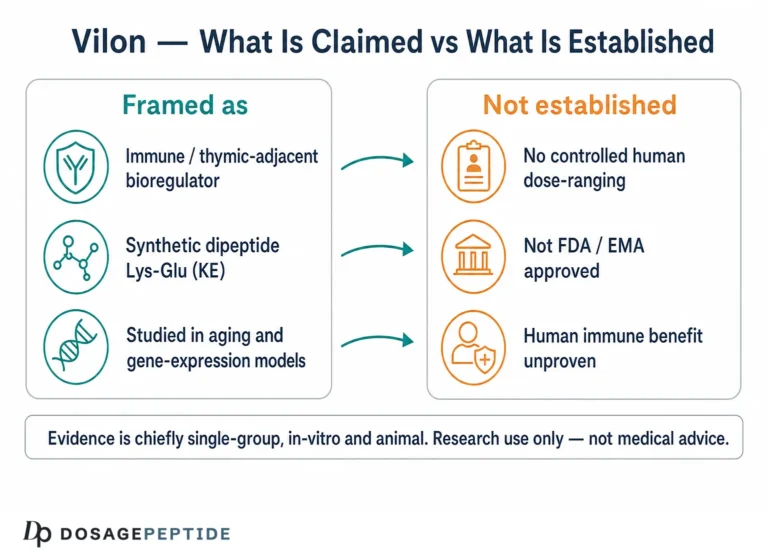
- Vilon (Lys-Glu, KE) — a dipeptide with the most-developed mechanistic modeling within the group, including DNA-docking and gene-expression studies. It is often described as immunomodulatory and geroprotective in the group’s own work, and it illustrates the family’s proposed mechanism in the most detail.[5] Our profile of Vilon, the lysyl-glutamic acid peptide covers it in depth.
- Epitalon (Ala-Glu-Asp-Gly, AEDG) — the pineal-directed tetrapeptide, the most-publicized member, associated in the group’s literature with telomere and circadian claims that are themselves heavily contested and not independently confirmed.
- Crystagen (Glu-Asp-Gly, EDG) — the immune-directed member, notably less characterized than either Vilon or Epitalon, with the thinnest compound-specific record of the three.
Note the near-overlap in sequence: Crystagen (EDG) and Epitalon (AEDG) differ by a single alanine residue, yet are assigned entirely different organ targets. Under a conventional pharmacological lens, attributing sharply different tissue-specific programs to peptides differing by one residue is a strong claim that would demand strong, independent evidence — evidence that has not been produced. This is one of the clearest illustrations of why the mainstream community regards the tissue-specificity narrative as unvalidated.
Beyond the Khavinson family: other immune-relevant peptides
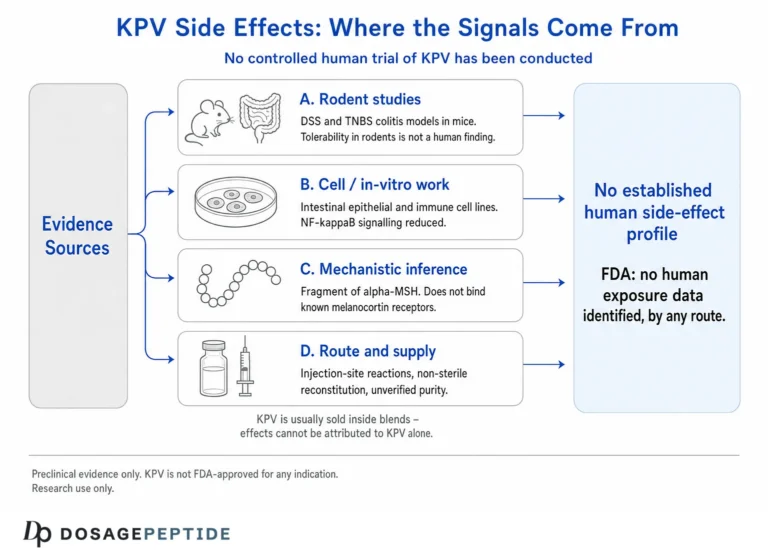
It is worth distinguishing Crystagen from small anti-inflammatory peptides studied in more conventional frameworks, such as KPV (the C-terminal tripeptide of α-MSH), which has a preclinical literature focused on anti-inflammatory signaling in gut and skin models. Our overview of KPV, the anti-inflammatory peptide discusses that separate line of research. KPV and Crystagen are sometimes lumped together as “immune peptides,” but they come from different research traditions and rest on different (and differently sized) evidence bases; readers should not treat membership in a loose category as equivalence of proof.
Safety, Regulatory Status and Research-Use Framing
Because Crystagen is discussed in communities interested in longevity and immune support, the safety and regulatory picture must be stated without ambiguity.
Crystagen is not an approved drug in the United States, the European Union, or other major jurisdictions. It has not been evaluated by the FDA for safety or efficacy for any indication, and it is not authorized for the diagnosis, treatment, cure or prevention of any disease. Material sold under this name is appropriately regarded as a research chemical for laboratory use only. There is no published, systematic human safety dataset, no established pharmacokinetic profile in the peer-reviewed literature, and no standardized purity or manufacturing oversight of the kind applied to approved medicines.
Several practical consequences follow from this evidence vacuum:
- Unknown safety profile. Absence of reported adverse events in a small, single-group literature is not evidence of safety; it reflects the absence of the large, controlled studies that would detect harms.
- Product-identity uncertainty. Because the compound is unregulated, what is actually present in a given vial — identity, purity, endotoxin content, contaminants — is not guaranteed by any independent authority.
- No basis for dosing recommendations. Any circulating “protocol” is extrapolated from analogy and anecdote, not from dose-finding trials. This article gives none, and the linked reference page is explicitly for laboratory documentation, not human use.
A further, often-overlooked point concerns the mismatch between marketing categories and regulatory reality. Compounds in this family are sometimes described interchangeably as “supplements,” “cosmetic peptides,” or “research chemicals” depending on the audience, but none of those labels confers the evidentiary standing of an approved drug. A substance can be freely sold in some channel while remaining entirely unproven for any physiological effect; availability is a commercial fact, not a scientific verdict. For Crystagen, the accurate category is the most cautious one: an unapproved experimental compound whose physiological effects in humans are unestablished.
The honest framing is therefore conservative: Crystagen is an investigational research compound with an unvalidated mechanism and a near-absent independent evidence base. It should be discussed as a subject of study, not used as a therapy.
What Would It Take to Validate Crystagen?
Rather than leaving the assessment at “the evidence is thin,” it is more constructive — and more honest to the reader — to specify what a credible validation of Crystagen would actually look like. This also arms readers to judge future claims for themselves. A serious evidence base for a short peptide immunity research candidate like this would need several independent pillars.
- Identity and purity, independently verified. Analytical confirmation (mass spectrometry, high-performance liquid chromatography) that a given preparation is in fact Glu-Asp-Gly at stated purity, performed by laboratories with no stake in the outcome. Without a verified identity, every downstream result is uninterpretable.
- Reproducible mechanism from unaffiliated labs. The nuclear-entry and sequence-specific DNA-binding claims should be tested by independent structural and cell-biology groups using standard methods, with pre-registered protocols and published raw data. Convergent positive results from labs outside the originating lineage would be the single most persuasive development.
- Pharmacokinetics. Basic absorption, distribution, metabolism and half-life data are essential; a peptide that is rapidly degraded by peptidases before reaching any target would be mechanistically implausible regardless of in-vitro findings. This information is currently not available in a verifiable, peer-reviewed form.
- Dose-ranging preclinical work with hard endpoints. Animal studies measuring defined immune outcomes — thymic output, naïve T-cell frequency, vaccine responses, infection resistance — with blinding, adequate group sizes and pre-specified analyses.
- Registered, controlled human trials. Ultimately, randomized, placebo-controlled, adequately powered trials with clinically meaningful endpoints and independent oversight, registered on a public trial registry before enrollment. This is the standard thymosin alpha-1 met on its path to approval in many countries,[13] and it is the standard Crystagen has not approached.
Until several of these pillars are in place, the intellectually honest verdict is not “Crystagen works” or “Crystagen doesn’t work” but rather “the studies that could answer the question have not been done and made independently verifiable.” That is a genuinely different, and more defensible, position than either enthusiasm or dismissal.
How to read vendor and forum claims critically
Because most public information about Crystagen circulates through supplier pages and enthusiast communities rather than the scientific literature, a few reading habits help. Treat organ-target labels as marketing conventions, not demonstrated tropisms. Treat “studies show” language as a prompt to check which studies, by whom, in what model, and whether anyone independent has reproduced them. Notice when evidence for the peptide family or for a different peptide is presented as if it were evidence for Crystagen specifically — a substitution this article has flagged repeatedly. And keep the target and the compound separate: the reality of immunosenescence is not evidence that any particular product corrects it.
Limitations
This article’s own conclusions are bounded by the state of the literature, and it is important to name those boundaries explicitly.
- Language and access limitations. A meaningful fraction of the primary work is in Russian-language journals that are not fully indexed or translated in Western databases. It is possible that findings exist that are not readily accessible; equally, limited indexing is itself part of why independent scrutiny has been minimal.
- Trade-name versus sequence. The identification of Crystagen with the specific sequence Glu-Asp-Gly rests on secondary (vendor/monograph) sources. If that identity is inexact, some inferences drawn by analogy to EDG-adjacent peptides would need revision.
- Single-group dependence. Because so much of the supportive evidence flows from one lineage, standard concerns about independent replication, publication bias and the file-drawer problem apply with unusual force. This is a structural limitation of the evidence, not a claim about any individual’s intent.
- Mechanistic plausibility is not proof. The surrounding biology of immunosenescence and thymic involution is well established,[8][10] and a compound that influenced it could in principle matter. But a plausible target does not make an unproven compound effective, and this article deliberately avoids letting the credibility of the target leak onto the compound.
- No efficacy or safety endpoints. Nothing here should be read as a quantitative claim about Crystagen’s effects, benefits, or risks, because the studies that would license such claims have not been done or made independently verifiable.
The net position is that the most defensible statement about Crystagen is a careful one: it is a short synthetic peptide embedded in an interesting but unvalidated hypothesis, aimed at a real biological problem, and lacking the independent evidence that would let anyone say with confidence what it does in a living immune system.
Frequently Asked Questions
What is the Crystagen peptide?
Crystagen is a short synthetic peptide, commonly described as the tripeptide Glu-Asp-Gly (EDG), within the Khavinson family of “peptide bioregulators” developed in St. Petersburg. It is marketed as an immune- or thymus-directed compound proposed to influence immune-related gene expression. Its specific mechanism and effects are hypothesized rather than independently proven, and it is a research-use-only compound, not an approved medicine.
Is Crystagen FDA-approved or clinically proven?
No. Crystagen is not approved by the FDA or comparable regulators for any indication, and there are no Western randomized controlled trials of it. It is not authorized to diagnose, treat, cure or prevent any disease. The available literature is preclinical, largely from a single research group, and does not meet the standard of “clinically proven.” It should be regarded strictly as an experimental research chemical.
What is a peptide bioregulator?
“Peptide bioregulator” is a term from the Khavinson research program for short peptides proposed to restore normal tissue function by regulating gene expression rather than acting on a single receptor. Each is assigned an organ target — Crystagen to the immune system, for example. The bioregulation concept is a hypothesis advanced primarily by one group and has not been validated by the mainstream scientific community.
How is Crystagen proposed to work?
The proposed crystagen mechanism is that the tripeptide enters cells and the nucleus, interacts with histones and specific promoter DNA sequences, and thereby modulates the expression of immune-related genes. Each step — nuclear entry, sequence-specific DNA binding, downstream gene normalization — comes from single-group experimental and computational work and has not been independently replicated, so the mechanism remains unconfirmed.
How does Crystagen differ from thymosin alpha-1?
They are very different in evidence terms. Thymosin alpha-1 is a 28-amino-acid peptide with an extensive, multi-group literature and regulatory approval in many countries for specific uses. Crystagen is a much shorter tripeptide with little independent, compound-specific data and no approvals. Both are discussed as “immune peptides,” but only thymosin alpha-1 has a substantial, independently scrutinized evidence base.
What is immunosenescence, and how does it relate to Crystagen?
Immunosenescence is the well-documented age-related decline of immune function, including thymic involution, a shrinking naïve T-cell pool, chronic low-grade inflammation and weaker vaccine responses. It is the genuine biological problem Crystagen is nominally aimed at. Crucially, the target being real does not mean Crystagen affects it — that link is unproven, and the two questions must be kept separate.
Is Crystagen safe to use?
There is no published, systematic human safety dataset for Crystagen, no established pharmacokinetic profile, and no regulatory oversight of products sold under this name. Because it is an unregulated research chemical, identity and purity are not independently guaranteed. Absence of reported harms in a small literature is not evidence of safety. It is not intended or recommended for human use; it is a research-use-only substance.
Why is the evidence for Crystagen considered “thin”?
Because nearly all supportive findings come from one research lineage, are often published in a narrow set of venues including Russian-language journals, are rarely blinded or pre-registered, and have not been independently replicated. There are no Western RCTs and little indexed primary research under the trade name itself. On any standard evidence hierarchy, that combination places Crystagen’s specific claims at a low, preclinical, unvalidated tier.
Where can I learn about related peptides?
For context, see our overview of peptide bioregulators and Khavinson short-peptide research, our profiles of Vilon and thymosin alpha-1, and the peptide glossary. These pages are educational and research-framed, not medical advice or usage recommendations.
References
- National Library of Medicine. PubMed search results for “crystagen” (illustrating the near-absence of indexed primary literature under the trade name). https://pubmed.ncbi.nlm.nih.gov/?term=crystagen
- Khavinson VK, Popovich IG, Linkova NS, Mironova ES, Ilina AR. Peptide Regulation of Gene Expression: A Systematic Review. Molecules. 2021;26(22):7053. https://doi.org/10.3390/molecules26227053
- Khavinson VKh. [Peptides, genome, aging]. Advances in Gerontology (Uspekhi Gerontologii). 2014;27(2):257–264. https://pubmed.ncbi.nlm.nih.gov/25306656/
- Ilina A, Khavinson V, Linkova N, Petukhov M. Neuroepigenetic Mechanisms of Action of Ultrashort Peptides in Alzheimer’s Disease. International Journal of Molecular Sciences. 2022;23(8):4259. https://doi.org/10.3390/ijms23084259
- Khavinson VK, Linkova NS, Ashapkin VV, et al. [KE peptide regulates SIRT1, PARP1, PARP2 gene expression and protein synthesis in human mesenchymal stem cell aging]. Advances in Gerontology. 2023;36(3):302–312. https://pubmed.ncbi.nlm.nih.gov/37782636/
- Khavinson V, Linkova N, Diatlova A, Trofimova S. Peptide Regulation of Cell Differentiation. Stem Cell Reviews and Reports. 2020;16(1):118–125. https://doi.org/10.1007/s12015-019-09938-8
- Khavinson VKh, Kuznik BI, Tarnovskaya SI, Linkova NS. [Peptides and CCL11 and HMGB1 as molecular markers of aging: literature review and own data]. Advances in Gerontology. 2014;27(3):399–406. https://pubmed.ncbi.nlm.nih.gov/25826983/
- Nikolich-Žugich J. The twilight of immunity: emerging concepts in aging of the immune system. Nature Immunology. 2018;19(1):10–19. https://doi.org/10.1038/s41590-017-0006-x
- Goronzy JJ, Weyand CM. Understanding immunosenescence to improve responses to vaccines. Nature Immunology. 2013;14(5):428–436. https://doi.org/10.1038/ni.2588
- Palmer S, Cunniffe N, Donnelly R. COVID-19 hospitalization rates rise exponentially with age, inversely proportional to thymic T-cell production. Journal of the Royal Society Interface. 2021;18(176):20200982. https://doi.org/10.1098/rsif.2020.0982
- Khavinson VKh, Kuznik BI, Trofimova SV, et al. Results and Prospects of Using Activator of Hematopoietic Stem Cell Differentiation (Thymalin) in Complex Therapy for Patients with COVID-19. Stem Cell Reviews and Reports. 2021;17(1):285–290. https://doi.org/10.1007/s12015-020-10087-6
- Tao N, Xu X, Ying Y, et al. Thymosin α1 and Its Role in Viral Infectious Diseases: The Mechanism and Clinical Application. Molecules. 2023;28(8):3539. https://doi.org/10.3390/molecules28083539
- Goldstein AL, Goldstein AL. From lab to bedside: emerging clinical applications of thymosin alpha 1. Expert Opinion on Biological Therapy. 2009;9(5):593–608. https://doi.org/10.1517/14712590902911412
Research-use-only / not medical advice. This article is an educational reference for scientific and laboratory audiences. Crystagen is an experimental research compound; it is not an approved drug and has not been shown safe or effective for any human use. Nothing here is a therapeutic claim, a treatment recommendation, or a suggestion to self-administer any substance. It is not a substitute for professional medical advice, diagnosis or treatment. Always consult a qualified healthcare professional regarding any health condition or decision.