The central question behind almost every search for vesugen dosage is deceptively simple: if a laboratory holds a 20 mg lyophilized vial of the KED tripeptide, how much bacteriostatic water goes in, what concentration results, and how does any reported microgram figure translate into a measurable volume on an insulin syringe? This reference answers the parts of that question that are genuinely answerable — the reconstitution arithmetic, the concentration mathematics, and the format differences — while being explicit about the part that is not: there is no controlled human dose-ranging study anywhere in the literature that validates any specific injectable Vesugen dose. Everything below is framed for research modeling and literature interpretation only, never as guidance for administration to a person.
What Is Vesugen, And Why Does Its Dosing Sit On Thin Evidence?
Vesugen is the trade name for a synthetic short peptide with the amino-acid sequence lysine–glutamic acid–aspartic acid, abbreviated KED. It is catalogued in PubChem as CID 87571363, with the molecular formula C15H26N4O8 and a molecular weight of roughly 390–391 Da — a genuinely tiny molecule by peptide standards, smaller than many single amino-acid derivatives used in metabolic research.[1] It belongs to the family of “peptide bioregulators” developed over several decades by Vladimir Khavinson and colleagues at the St. Petersburg Institute of Bioregulation and Gerontology, a body of work that spans hundreds of publications but originates overwhelmingly from a single Russian research lineage.[2]
Within that family, Vesugen is framed as the vascular bioregulator — the peptide notionally matched to blood-vessel and endothelial tissue, in the same way that Cardiogen is framed toward cardiac muscle, Vilon toward the thymus, and Pinealon toward the brain. That tissue-matching claim is central to how the compound is marketed and discussed, and it is a useful organizing idea, but it is important to understand from the outset that the framing rests on a mechanistic hypothesis rather than on approved-drug pharmacology. For the broader context of how this entire class is conceived, our overview of peptide bioregulators and Khavinson short-peptide research is the natural companion to this dosing-focused article.
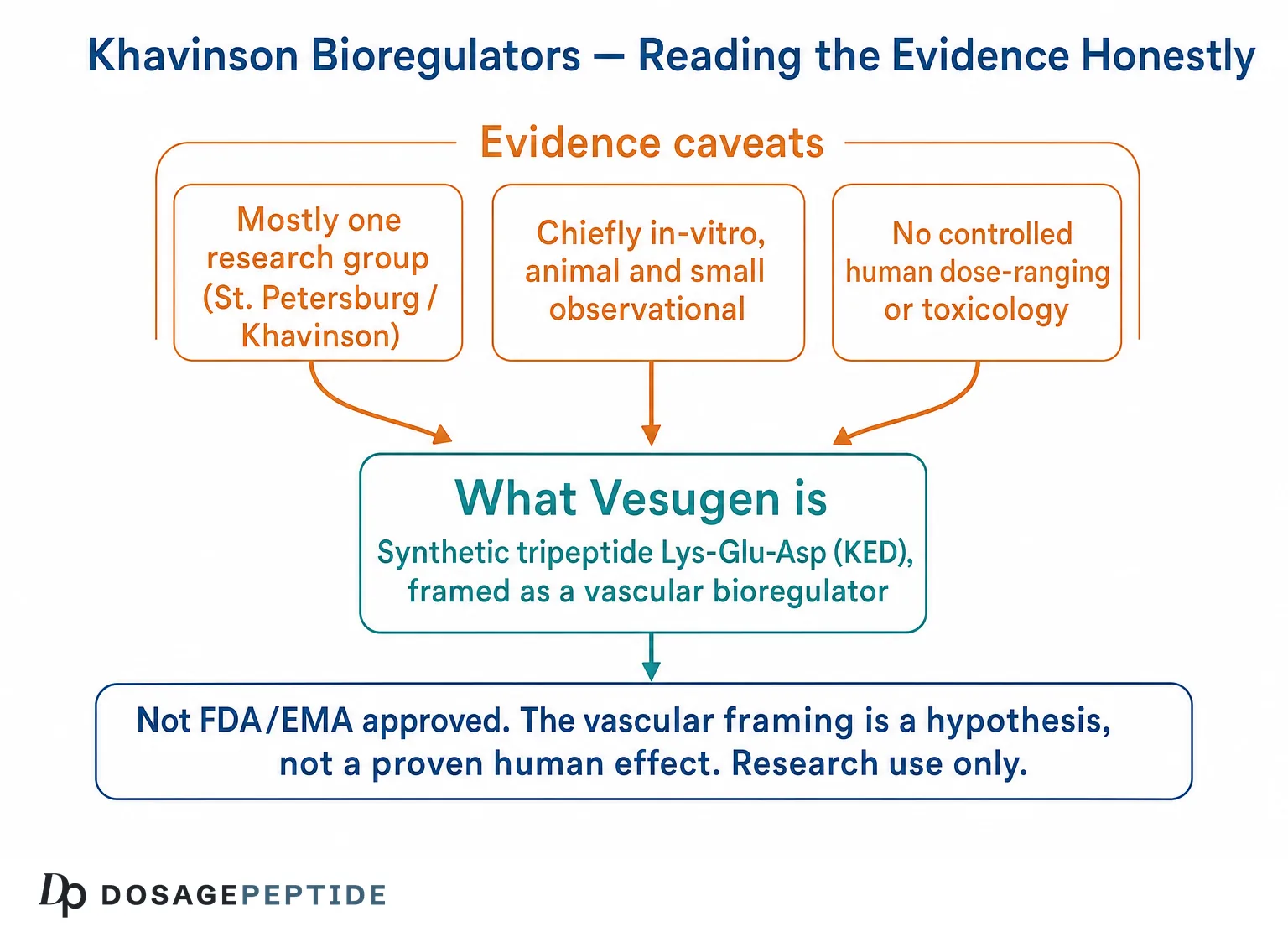
The reason “vesugen dosage” is a harder question than the tidy protocol pages circulating online suggest comes down to a single fact: Vesugen has never been through a controlled human dose-ranging trial, and there is no published human toxicology or pharmacokinetic dataset to anchor an injectable amount. The compound is not approved by the FDA or the EMA. Its evidence base is largely in-vitro cell-culture work, rodent studies, and small uncontrolled observational reports, a substantial fraction of it published in Russian-language journals by investigators affiliated with the originating institute.[3] That does not make the arithmetic of reconstitution any less precise — ten milligrams dissolved in one milliliter is ten milligrams per milliliter regardless of the biology — but it does mean that any “dose” you encounter is a convention, not a validated therapeutic quantity.
It is worth being blunt about the shape of the evidence pyramid here, because it is the single most misrepresented thing about this compound. At the base sits a large volume of in-vitro and rodent work; above it, a thinner layer of small, uncontrolled human observational reports, mostly from the originating institute; and at the apex — the level that would normally define a “dose” — there is essentially nothing: no randomized controlled trial, no phase I safety study, no published pharmacokinetic curve. Marketing language routinely borrows the vocabulary of the apex (“clinically studied,” “protocol,” “therapeutic dose”) to describe findings that live at the base. Keeping those layers separate is the entire discipline of reading this literature honestly.
How Vesugen Is Usually Sold
Historically, Vesugen and its sibling bioregulators were distributed as oral capsules intended for short courses, and the oral/sublingual capsule remains the more common commercial format worldwide. The lyophilized 20 mg injectable vial that drives most reconstitution questions is a newer, research-market presentation. This split matters enormously for interpreting dose figures: the oral courses studied in the original Russian work used very small quantities — on the order of micrograms to low milligrams per day over 10-to-30-day courses — whereas the injectable-vial conversation has migrated toward much larger numbers with far less to stand on. The Vesugen 20 mg vial dosage protocol reference collects the specific concentration figures for that vial size, and this article works through the underlying math so the numbers are transparent rather than taken on faith.
The reason this format split deserves emphasis rather than a footnote is that the two presentations are not simply the same compound in two wrappers. An oral capsule and a subcutaneous injection deliver the peptide to entirely different pharmacokinetic starting lines, and the numbers attached to one were never designed to describe the other. A researcher who copies a milligram figure from an oral-capsule discussion straight onto an injectable-vial worksheet has silently assumed a conversion factor that no study has ever measured. We return to this in detail later, but it is worth flagging here because it is the first place the “vesugen dosage” conversation quietly goes wrong.
The KED Sequence: Molecular Structure And Proposed Mechanism
To reason about dosing at all, it helps to understand what the molecule is claimed to do, because the proposed mechanism is unusual and directly shapes why the reported quantities are so small. KED is a tripeptide — three amino acids joined by two peptide bonds. Two of its three residues (glutamic acid and aspartic acid) carry negatively charged side chains at physiological pH, while lysine carries a positive charge. This concentration of opposite electrostatic charges on such a short backbone is the structural feature that the Khavinson hypothesis leans on: the peptides are described as short blocks of amino-acid residues with charged side groups and a high local density of opposite-sign charges, which the group argues lets them bind complementarily to specific short nucleotide sequences in DNA.[4]
A few structural facts follow directly from the sequence and are useful for handling. Because all three residues are ordinary proteinogenic amino acids with small, highly polar side chains, KED is strongly hydrophilic and dissolves readily in water — there is no hydrophobic core to keep it aggregated, which is why reconstitution is typically fast and complete. The same polarity is why the molecule is not expected to cross lipid membranes passively in the way a small lipophilic drug would; the group’s own model invokes active or facilitated entry into the cell and nucleus rather than simple diffusion.[2] None of this tells you a dose, but it does explain why the compound behaves predictably at the bench even as its biology remains contested.
The Proposed Epigenetic, Gene-Expression Mechanism
The core mechanistic claim — developed across the group’s systematic reviews and modeling papers — is that ultrashort peptides like KED can cross cell and nuclear membranes and bind directly into the minor groove of DNA at specific short nucleotide sequences, thereby modulating the transcription of particular genes without altering the DNA sequence itself.[2] In this model the peptide acts less like a classical receptor ligand and more like a sequence-selective epigenetic switch, nudging tissue-specific genes toward or away from expression, and the group has extended the same reasoning to interactions with histone proteins and single- and double-stranded DNA.[10] A recurring theme in the group’s writing is that age-related loss of genomic methylation exposes more of these short binding sites, which is offered as a rationale for why the peptides are proposed to matter more in aged than in young tissue.[12]
If a molecule genuinely acts at the level of DNA binding and transcriptional modulation, then the quantities required could in principle be extremely small, because the effect would be catalytic-like rather than stoichiometric with a large receptor pool. That logic is precisely why the original oral bioregulator courses used microgram-to-milligram amounts. It is also, however, an argument that cuts against the inflated injectable figures circulating today: nothing in the proposed mechanism supplies a reason to escalate into multi-milligram daily injections, and no dose-response curve has ever been published to justify one. A mechanism that predicts tiny effective quantities is, if anything, evidence against the large numbers that have drifted into community protocols.
It is equally important to note what this mechanism has not yet cleared. Direct, sequence-specific binding of a free tripeptide into the DNA minor groove at physiologically meaningful affinity is an extraordinary claim by the standards of molecular biology, and the supporting evidence comes largely from molecular modeling and from the same group that proposes it. Independent structural confirmation — a co-crystal structure, an orthogonal biophysical binding assay from an unaffiliated laboratory — is what would move this from “internally coherent hypothesis” to “established mechanism,” and that step has not happened in the indexed literature. A reader can find the mechanism plausible and still insist on holding it at the hypothesis tier; those two positions are not in tension.
What The Cell-Culture And Animal Work Actually Reports
The most specific vascular findings attributed to KED come from in-vitro endothelial studies by the originating group. In cultured endothelial models of atherosclerosis and restenosis, KED has been reported to normalize the expression of endothelin-1 (a potent vasoconstrictor that is characteristically elevated in atherosclerotic and restenotic tissue), to restore intercellular communication through connexin expression, and to increase expression of the longevity-associated deacetylase sirtuin-1, which the authors link to DNA repair.[5] Separate work in organotypic neuroimmunoendocrine cultures reports that the same Lys-Glu-Asp tripeptide stimulates proliferation and reduces apoptosis — lowering the apoptosis marker p53 and raising the proliferation marker Ki-67 — with the effect described as more pronounced in cultures from old animals than young ones.[6]
Parallel work in the group’s neurogenesis and fibroblast-aging models describes KED and its close relatives modulating cell-cycle, neurotrophic, and inflammatory gene expression. In a review of KED in Alzheimer’s-disease models, the peptide is reported to regulate cell-aging and apoptosis genes (p16, p21), neuronal-differentiation genes and proteins (NES/nestin, GAP43), and genes implicated in Alzheimer’s pathogenesis (SUMO, APOE, IGF1), and the same review notes that oral KED was associated with improved memory and attention in elderly individuals with functional CNS disorders — an uncontrolled observational claim from the originating group, not a controlled trial result.[7] In the closely related dipeptide/tetrapeptide fibroblast work, KE and AED peptides were reported to shift sirtuin-1, sirtuin-6, collagen I, and inflammatory markers (IL-1, NF-κB, TGF-β) during replicative aging of human skin fibroblasts.[8]
Two honest caveats belong right next to those findings. First, they are predominantly in-vitro results in specific cell lines and rodent tissue, or small uncontrolled human observations, not human clinical outcomes. Second, independent replication outside the originating research lineage — particularly Western laboratory confirmation of the proposed KED–DNA docking interaction — is essentially absent from the indexed literature.[2] A mechanism can be internally coherent and still remain unconfirmed by the wider field; that is the correct way to hold the KED mechanism today. For readers who want the mechanistic picture without the dosing focus, our companion explainer on what Vesugen is as a vascular bioregulator goes deeper into the biology.
Why “Vesugen Dosage” Cannot Be Answered The Way A Drug Label Answers It
When a compound is FDA- or EMA-approved, its dose comes from a regulated chain of evidence: phase I pharmacokinetics and tolerability, phase II dose-finding, phase III confirmation, and an approved label that states an amount, a route, and a frequency backed by that data. Vesugen has none of these. There is no approved label, no human pharmacokinetic curve describing how quickly KED is absorbed or cleared, and no maximum-tolerated-dose study. This is the single most important thing to understand about the phrase “vesugen dosage”: any number attached to it is a convention adopted by suppliers and research communities, not a figure derived from dose-ranging science.[3]
That is why this article deliberately separates two things that are usually blurred together. The reconstitution arithmetic is legitimate, exact, and genuinely useful: it is just chemistry, and getting it right prevents the gross concentration errors that are the most common and most avoidable mistakes in handling any lyophilized peptide. The dose figures are a different matter entirely: they are reported, circulated, and modeled, but they are not validated, and this reference will label them as such every time they appear. Treating a mathematically derivable “unit” number as if it were an endorsed dose is exactly the error to avoid.
A useful way to keep the two apart is to ask, of any number you encounter, “what kind of statement is this?” A concentration such as 10 mg/mL is a chemical fact: it is true or false and can be checked with a calculator. A statement like “use 1 mg per day” is a dosing convention: it may be popular, but there is no experiment that established it as correct, safe, or effective for any outcome in a person. This article will give you every chemical fact you could want and will convert the circulating conventions into the same units for transparency — but it will never let the second kind of statement borrow the certainty of the first.
How Do Researchers Reconstitute Vesugen? The Worked Arithmetic
Reconstitution is the process of dissolving the dry, lyophilized peptide back into a liquid so it can be measured by volume. For a research peptide the diluent is almost always Bacteriostatic Water for Injection (BWFI), USP — sterile water containing 0.9% (9 mg/mL) benzyl alcohol as a preservative, which is the standard reason a reconstituted multi-dose vial can be stored and re-accessed rather than used once and discarded.[14] The general procedure and solvent choices are covered in our peptide reconstitution guide; what follows is the arithmetic specific to a 20 mg Vesugen vial.
The One Equation That Governs Everything
Every reconstitution question reduces to a single relationship:
Concentration (mg/mL) = peptide mass in the vial (mg) ÷ volume of BAC water added (mL).
From the concentration, the volume needed to draw any target mass follows directly: volume (mL) = target mass (mg) ÷ concentration (mg/mL). The final translation step converts milliliters into insulin-syringe units. On a standard U-100 insulin syringe, 100 units equal 1 mL, so 1 unit = 0.01 mL. That fixed relationship — units equal milliliters times 100 — is what lets a research protocol be described in “units” regardless of the compound. These three equations are the whole of the mathematics; everything else on this page is an application of them.
Because the same three relationships recur constantly, it helps to internalize them as a chain: mass in the vial fixes nothing by itself; the diluent you add sets the concentration; the concentration sets how many milliliters a target mass occupies; and the syringe scale turns milliliters into readable units. Break the chain at any link — a mis-added diluent volume, a decimal slip in the division, a U-40 syringe misread as U-100 — and every downstream number is wrong even though the arithmetic “worked.” Most bench errors are not arithmetic mistakes; they are a wrong input silently propagated through correct arithmetic.
A Fully Worked Example: 20 mg + 2 mL
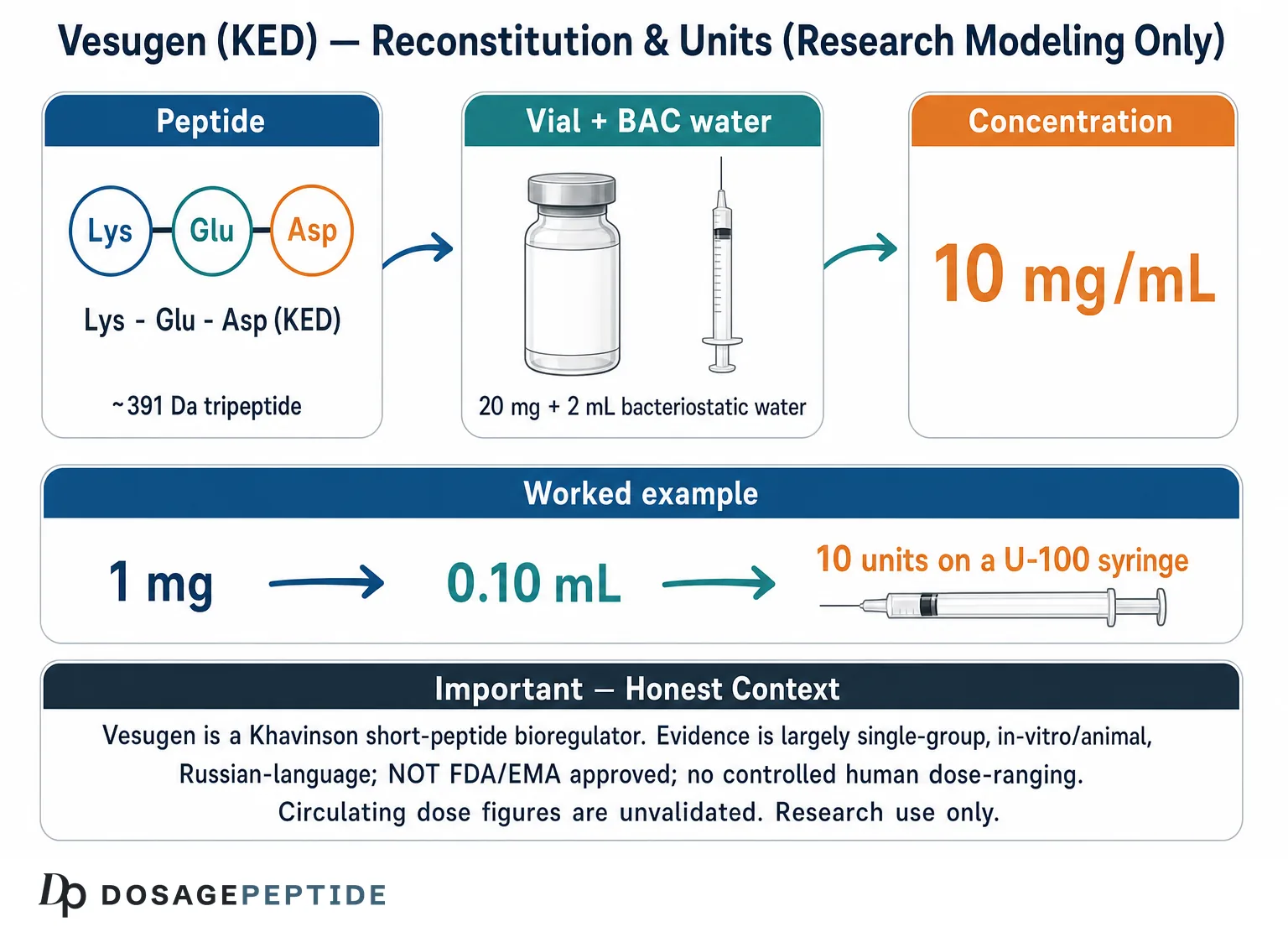
Take the most common reconstitution for a 20 mg vial: add 2 mL of bacteriostatic water.
- Concentration: 20 mg ÷ 2 mL = 10 mg/mL.
- Per-milligram volume: to model 1 mg, volume = 1 mg ÷ 10 mg/mL = 0.10 mL.
- In insulin units: 0.10 mL × 100 = 10 units on a U-100 syringe.
- Vial yield: a 20 mg vial modeled at 1 mg per draw contains 20 such draws.
So, at this concentration, 1 mg corresponds to 10 units, 500 mcg (0.5 mg) corresponds to 5 units, and 2 mg corresponds to 20 units. The clean 10 mg/mL figure is exactly why the 2 mL fill is the default many researchers choose: it makes the milligram-to-unit conversion a simple factor of ten. Our peptide dosage calculator automates this same computation for any vial size and fill volume, and it is worth cross-checking the manual number against it to catch decimal-place slips.
A Second Worked Example: 20 mg + 4 mL For Small Amounts
Now suppose the amounts you want to model are small — a few hundred micrograms — and you want each one to spread across enough syringe units to read cleanly. Add 4 mL of bacteriostatic water instead:
- Concentration: 20 mg ÷ 4 mL = 5 mg/mL.
- 250 mcg (0.25 mg): 0.25 ÷ 5 = 0.05 mL = 5 units.
- 500 mcg (0.5 mg): 0.5 ÷ 5 = 0.10 mL = 10 units.
- 1 mg: 1 ÷ 5 = 0.20 mL = 20 units.
Notice the trade-off directly: at 5 mg/mL, a 250 mcg amount occupies 5 whole units instead of the 2.5 units it would occupy at 10 mg/mL. The same physical mass is now stretched across twice as many gradations on the barrel, so a one-unit reading error costs half as much in fractional terms. The cost is a larger injection volume, which is rarely a practical constraint at these small masses. This is the entire logic of choosing a more dilute preparation when the quantities of interest are small — and it is a genuine methodological decision, not a biological one.
Reconstitution Matrix For A 20 mg Vesugen Vial
The table below shows how the concentration and the per-milligram volume change with the amount of bacteriostatic water added. These figures are pure chemistry and are correct regardless of any biological question. They are presented so a researcher can read a concentration off the vial they actually prepared — not as an endorsement of any particular amount.
| BAC water added | Concentration | Volume for 1 mg | Units for 1 mg (U-100) | Volume for 2 mg | Units for 2 mg |
|---|---|---|---|---|---|
| 1 mL | 20 mg/mL | 0.05 mL | 5 units | 0.10 mL | 10 units |
| 2 mL | 10 mg/mL | 0.10 mL | 10 units | 0.20 mL | 20 units |
| 3 mL | 6.67 mg/mL | 0.15 mL | 15 units | 0.30 mL | 30 units |
| 4 mL | 5 mg/mL | 0.20 mL | 20 units | 0.40 mL | 40 units |
| 5 mL | 4 mg/mL | 0.25 mL | 25 units | 0.50 mL | 50 units |
Two practical points fall out of this table. First, more diluent does not change how much peptide is in the vial — it only changes how many milliliters represent a given mass. A 20 mg vial always contains 20 mg whether it is dissolved in 1 mL or 5 mL. Second, there is a legibility trade-off: a more dilute preparation (say 4 mg/mL) spreads a small mass across more units and is easier to measure precisely for tiny amounts, while a concentrated preparation (20 mg/mL) keeps injection volumes small but makes each unit “worth” more peptide, so a one-unit slip is a larger fractional error. For a compound whose reported research amounts are small, many workers deliberately choose a mid-range dilution to keep the measurement inside the reliably readable part of the syringe.
A Note On Vial Vacuum And Technique
Bacteriostatic water should be added slowly down the inner wall of the vial rather than blasted directly onto the lyophilized pellet, and the vial should be swirled — not shaken — until the powder dissolves. Vigorous shaking can shear peptides and generate foam that makes accurate drawing difficult. Because KED is a very short, highly soluble peptide with no hydrophobic core, dissolution is typically fast and complete, and the reconstituted solution should be clear and colorless; visible cloudiness, particulates, or persistent foam are reasons to pause and inspect rather than proceed. The general handling principles, including how to think about total diluent volume, are laid out in our reference on how much bacteriostatic water to use for reconstitution.
Two technique details are easy to overlook and worth stating plainly. First, many lyophilized vials are sealed under slight vacuum, so when the diluent needle enters, liquid can be drawn in on its own; let the vacuum do the work rather than forcing the plunger, which reduces splashing onto the pellet. Second, the nominal volume you inject is not always the volume you can recover: a small amount of liquid is always lost to the vial walls, the stopper, and the syringe’s own dead space, so a vial reconstituted with exactly 2 mL will yield slightly less than 20 full 0.1 mL draws in practice. This is a handling reality, not an arithmetic error, but it is another reason to treat “draws per vial” as an upper bound rather than a guarantee.
Vesugen Dosage Figures: Reported In The Literature Versus Circulated In Communities
This is the section where honesty matters most, so it is worth stating the conclusion before the detail: the specific daily Vesugen numbers that circulate online — including the frequently repeated “500–3,000 mcg per day, stepped up over roughly twelve weeks” style figure — have no controlled human dose-ranging study behind them. That includes figures repeated across supplier protocol pages, and it applies to any such number this website presents as well: they are conventions and modeling references, not validated doses. No published trial establishes that 500 mcg is a threshold, that 3,000 mcg is a ceiling, or that a twelve-week escalation has any pharmacological basis.
What The Original Research Actually Used
The dose figures with the most legitimate provenance are the small ones from the original bioregulator work. The Khavinson group’s foundational studies — whether the animal life-span experiments or the early human observational courses — used peptides in short courses at low quantities, historically expressed in micrograms to low milligrams, delivered orally or by intramuscular injection over defined 10-to-30-day cycles rather than as open-ended daily regimens.[9] The rodent longevity work that underpins the entire field’s reputation reported mean life-span extension on the order of 20–40% from these small, cyclical exposures, not from large continuous dosing, and long-term clinical applications of the peptide preparations were reported over multi-year periods.[3] If any Vesugen figure deserves the phrase “used in experimental studies,” it is a small one on a short course — and even that traces to a single research lineage without independent replication.
There is a further subtlety that community protocols routinely erase: the original work often studied complex peptide preparations extracted from tissue, and only later the synthetic short peptides (dipeptides, tripeptides, tetrapeptides) designed to mimic them.[9] The dose and course conventions that circulate for synthetic KED today are downstream of a research program whose quantities were small, whose courses were bounded, and whose most-cited outcomes were in animals. None of that provenance survives when a number is copied onto a supplier page stripped of its route, its course length, and its species.
Converting The Circulated Figures To Volume (For Modeling Only)
Because researchers will encounter these circulated numbers regardless, the table below converts the commonly repeated daily amounts into volumes and units at the standard 10 mg/mL preparation, together with how long a single 20 mg vial would last at that amount. To be unambiguous: presenting a figure in this table is not a recommendation of it. It is a translation of an unvalidated community figure into the same arithmetic as the rest of this page, so that no one has to do the conversion in their head and make an error.
| Circulated daily figure | Mass | Volume at 10 mg/mL | Units (U-100) | Days from one 20 mg vial | Evidence status |
|---|---|---|---|---|---|
| 250 mcg | 0.25 mg | 0.025 mL | 2.5 units | 80 | Unvalidated |
| 500 mcg | 0.5 mg | 0.05 mL | 5 units | 40 | Unvalidated |
| 1,000 mcg | 1 mg | 0.10 mL | 10 units | 20 | Unvalidated |
| 1,500 mcg | 1.5 mg | 0.15 mL | 15 units | ~13 | Unvalidated |
| 2,000 mcg | 2 mg | 0.20 mL | 20 units | 10 | Unvalidated |
| 3,000 mcg | 3 mg | 0.30 mL | 30 units | ~6.7 | Unvalidated |
Notice how quickly a 20 mg vial is exhausted at the upper end of the circulated range: at 3 mg/day it lasts under a week. That economics is itself a quiet argument that the higher circulated figures drifted upward from the original microgram-scale science, since the compound was never studied at anything like continuous multi-milligram daily exposure. The safest interpretive stance is to treat the small end of the table as “closest to what was historically studied” and the large end as “community extrapolation with no dose-ranging support.”
Why The “Stepped Over 12 Weeks” Framing Should Be Read Skeptically
The escalating-course framing borrows the shape of a legitimate clinical titration — start low, increase over weeks — and applies it to a compound that has never been titrated in a controlled human study. A titration schedule is only meaningful if there is a dose-response relationship to climb; without published pharmacokinetics or a tolerability curve, a twelve-week escalation is a stylistic convention, not a science-based schedule. Researchers modeling the literature should record it as such and avoid importing the credibility of real clinical titration into a figure that has none.
There is also a quieter inconsistency in the escalating-course narrative. The original research emphasized short, bounded cycles — courses of roughly ten to thirty days — whereas the circulated twelve-week escalation implies a long, continuous, open-ended regimen.[9] So the popular framing does not merely add unsupported dose numbers; it also changes the duration structure away from the one feature of the original protocols that was at least consistently described. That is a second, independent reason to treat the twelve-week escalation as community construction rather than a faithful reflection of the source literature.
Oral And Sublingual Versus Injectable: Two Different Vesugen Conversations
One of the most common sources of confusion in the “vesugen dosage” search is that the injectable 20 mg vial and the oral/sublingual capsule are frequently discussed as if their numbers were interchangeable. They are not. The oral capsule — the format in which Vesugen has most often been sold historically — delivers the peptide through the gastrointestinal tract, where a short peptide faces digestive proteolysis and first-pass metabolism before any fraction reaches the bloodstream intact. The injectable route bypasses that entirely. These are pharmacokinetically distinct scenarios, and a milligram figure that means one thing orally cannot be assumed to mean the same thing by injection.
The original bioregulator courses that generated the field’s reputation were, in many cases, oral or intramuscular short courses at small quantities, and the group’s own reports of KED in older adults describe oral administration.[7] The injectable subcutaneous vial is a later research-market adaptation, and the migration of numbers from the oral courses into the injectable conversation happened without any bridging pharmacokinetic study to justify a conversion factor. In practical terms this means two things for anyone interpreting the literature: first, always note which format a reported figure came from; and second, never treat an oral capsule amount and an injectable-vial amount as equivalent simply because the milligram number looks similar. The absence of a validated oral-to-injectable conversion is itself an important honest fact about this compound.
The pharmacology behind that warning is not exotic. For most orally dosed peptides, only a small and variable fraction survives digestion to reach the circulation intact; injection delivers a far larger fraction of the administered mass to the bloodstream. If — hypothetically — an oral course delivered only a few percent of its labeled mass systemically, then copying that same milligram number to an injection could represent an order-of-magnitude change in systemic exposure. No one can put a precise figure on that gap for KED because the pharmacokinetic studies that would measure it have not been published; the honest conclusion is not a conversion factor but the acknowledgment that the two formats simply are not comparable on a milligram basis.
The Vesugen 20 mg Vial: Concentration Reference Tables
Because the 20 mg vial is the specific presentation behind most reconstitution questions, this section consolidates the concentration references for it. The first table restates the direct milligram-to-unit conversions at the three most common fills; the second frames the same information as “units on the syringe for a given target mass,” which is how many researchers actually read it at the bench.
Concentration Quick-Reference (20 mg Vial)
| Fill volume | Concentration | 1 mg equals | 0.5 mg equals | 0.25 mg equals |
|---|---|---|---|---|
| 1 mL | 20 mg/mL | 5 units | 2.5 units | 1.25 units |
| 2 mL | 10 mg/mL | 10 units | 5 units | 2.5 units |
| 4 mL | 5 mg/mL | 20 units | 10 units | 5 units |
The pattern to internalize is that the 2 mL fill gives the most human-readable numbers for milligram-scale modeling (a factor of ten), while the 4 mL fill is preferable when the amounts of interest are very small, because it spreads them across more units and reduces the fractional error of a one-unit misreading. The 1 mL fill keeps injection volumes tiny but makes each unit represent 0.2 mg, which is a coarse resolution for a compound studied at sub-milligram quantities.
Target-Mass-To-Units Reference (20 mg Vial)
The same information, inverted, so a researcher who has fixed a modeled target mass can read the units directly at each of the three common fills:
| Target mass | Units at 1 mL (20 mg/mL) | Units at 2 mL (10 mg/mL) | Units at 4 mL (5 mg/mL) |
|---|---|---|---|
| 100 mcg | 0.5 units | 1 unit | 2 units |
| 250 mcg | 1.25 units | 2.5 units | 5 units |
| 500 mcg | 2.5 units | 5 units | 10 units |
| 1 mg | 5 units | 10 units | 20 units |
| 2 mg | 10 units | 20 units | 40 units |
Reading across any row shows the same mass climbing into a more comfortable part of the syringe as the preparation gets more dilute. A 100 mcg amount is an essentially unreadable half-unit at 20 mg/mL, a barely readable single unit at 10 mg/mL, and a manageable two units at 5 mg/mL. This is why, for genuinely small modeled amounts, the dilution choice does more to protect accuracy than any amount of care at the plunger.
Measurement Precision And The Limits Of An Insulin Syringe
A standard U-100 insulin syringe is graduated in single units, and realistically a researcher can read to about half a unit. At 10 mg/mL, half a unit is 0.05 mg (50 mcg) — a meaningful fraction if the amount being modeled is only a few hundred micrograms. This is not a trivial point: at the low quantities that best match the original science, the syringe’s own resolution becomes a real source of variability, and a more dilute preparation is the straightforward way to keep the reading inside the reliable range. It is another reason the reconstitution choice is a genuine methodological decision rather than an afterthought, even though the biological dose question remains unresolved.
The resolution problem compounds with two others that are easy to forget. Syringe barrels are manufactured to a tolerance, so the printed graduations themselves carry a small error; and the smaller the volume drawn, the larger that fixed error looms as a percentage of the intended amount. Drawing 3 units to model a 300 mcg amount at 10 mg/mL leaves very little margin before a half-unit misread becomes a double-digit percentage error. Choosing a fill that pushes the same amount up to 6 or 10 units is the single most effective way to shrink that percentage — a purely mechanical benefit that has nothing to do with the unresolved biology and everything to do with honest measurement.
What Is The Current Evidence Level For Vesugen?
Stating the evidence tier precisely is essential, because the gap between how Vesugen is marketed and what has actually been demonstrated is wide. Here is the accurate classification:
- Regulatory status: Not FDA-approved and not EMA-approved for any indication. Vesugen is not a licensed medicine in the United States or the European Union; in the research market it is handled as a research chemical.
- Human clinical evidence: No randomized controlled trials, no published human pharmacokinetics, no dose-ranging, and no formal toxicology. The human data that exist are small, uncontrolled, observational reports, largely from the originating institute.[3]
- Preclinical evidence: The bulk of the specific mechanistic claims — endothelin-1 normalization, connexin support, SIRT1 upregulation, gene-expression modulation — come from in-vitro cell-culture and rodent studies.[5][7]
- Independent replication: Largely absent. The proposed peptide–DNA binding mechanism has not been robustly confirmed by laboratories outside the originating lineage.[2]
Set against that, the field does have some genuinely interesting signals: the broader class of Khavinson short peptides has repeatedly been reported to extend life span in rodent models and to modulate tissue-specific gene expression in cell culture, and those findings have been published in indexed journals over several decades, including work linking the short peptides to regulators such as irisin and to telomere biology.[11][10] The honest reading is that Vesugen sits at the preclinical/hypothesis-generating tier, with an internally consistent but externally unconfirmed mechanism and no clinical dose science. That is a legitimate place for a research compound to be — it simply must not be dressed up as clinical evidence.
It is also worth naming the specific ways a thin evidence base can look thicker than it is. A long publication list can create an impression of depth even when most entries are reviews and modeling papers that re-describe the same underlying experiments; a single research lineage can cite itself across dozens of papers without any of them constituting independent replication; and in-vitro gene-expression changes, however numerous, are not clinical outcomes. All three patterns are present in the KED literature. None of them is misconduct — they are ordinary features of an early, single-group research program — but each one is a way that a careful reader can overestimate the strength of the evidence if they count papers instead of weighing designs.
Placing Vesugen Among Its Siblings
Even within the bioregulator family, evidence density varies. Some siblings — the thymic peptides in particular, whose preparations have the longest history — have a larger and older literature; others, like the tissue-specific vascular and cardiac peptides, rest on thinner and more recent work.[9] Vesugen is often described as one of the better-documented vascular members by publication count, but “better documented” within this family still means preclinical and single-lineage. Readers comparing the cardiovascular members will find our explainer on Cardiogen, the cardiovascular bioregulator peptide, a useful side-by-side, since Cardiogen occupies the cardiac-muscle niche to Vesugen’s vascular one.
How Does Vesugen Compare To Other Khavinson Bioregulators?
Vesugen makes the most sense when seen as one node in a designed family of tissue-matched short peptides rather than as a standalone drug. The table below situates it among several of its better-known relatives. The “proposed target tissue” column reflects the framing used in the originating research, not a demonstrated clinical selectivity.
| Peptide | Sequence | Proposed target tissue | Common format |
|---|---|---|---|
| Vesugen | Lys-Glu-Asp (KED) | Vascular endothelium | Oral capsule; 20 mg injectable vial |
| Vilon | Lys-Glu (KE) | Thymus / immune | Oral capsule; injectable vial |
| Cardiogen | Ala-Glu-Asp-Gly (AEDG-type) | Cardiac muscle | Oral capsule; injectable vial |
| Pinealon | Glu-Asp-Arg (EDR) | Brain / neurons | Oral capsule; injectable vial |
| Prostamax | Lys-Glu-Asp-Pro (KEDP-type) | Prostate | Oral capsule |
The shared design logic is visible in the sequences: Vilon (KE) is the dipeptide core, and Vesugen (KED) extends it by one residue, while several other family members build on the same acidic-plus-basic charge motif. This is why the reconstitution mathematics is identical across the injectable members — the arithmetic does not care about the sequence — and it is also why the same honesty caveats apply across the board: none of these has controlled human dose-ranging. For the immune-oriented sibling that shares Vesugen’s KE core, see our guide to Vilon, the lysyl-glutamic-acid peptide. The broader life-span and gene-expression claims that unite the family are reviewed in the group’s systematic literature.[13]
One consequence of that shared design is worth drawing out, because it bears directly on how to read any single-peptide claim. When several of these peptides share a charge motif and are studied by the same group using the same in-vitro gene-expression assays, a finding reported for one is often echoed for another, and the family can come to look like a set of mutually corroborating results. But mutual similarity within one lineage is not the same as independent confirmation. The tissue-specificity that gives each peptide its marketing identity — vascular for Vesugen, thymic for Vilon, cardiac for Cardiogen — is a hypothesis about selectivity that would need to be demonstrated compound-by-compound in controlled settings, and it has not been in the sense a drug label would require.
Limitations, Unknowns, And Handling Considerations
A responsible dosing reference has to be as clear about what is unknown as about what is calculable. The following limitations are not incidental — they are central to interpreting any Vesugen figure.
The Dose Itself Is Unanchored
The most important limitation is the one this article has returned to throughout: there is no validated dose. Every microgram figure is a convention. The reconstitution math is exact, but the mass you choose to draw is not supported by dose-response data. Anyone modeling Vesugen should hold the “dose” as an explicitly provisional input to their model, not as a known quantity. In practical terms, a model that reports its dose input as a fixed assumption rather than an evidence-derived value is being honest about the state of the field; one that presents a specific microgram figure as “the dose” is not.
No Human Pharmacokinetics Or Half-Life Data
Without published human pharmacokinetics, basic questions — how fast KED is absorbed by a given route, how quickly it is cleared, whether it accumulates, what a steady-state exposure looks like — simply do not have literature answers. Half-life figures that appear on supplier pages are typically inferred from the general behavior of very short peptides (which tend to be cleared rapidly) rather than measured for KED specifically. Treat any stated Vesugen half-life as an estimate by analogy, not a measured value. The absence is not merely a missing convenience; it is the reason a dosing frequency cannot be derived either, since interval selection depends on a clearance curve that has never been published for this compound.
Purity, Identity, And Source Variability
Because Vesugen is handled as a research chemical rather than a pharmaceutical, there is no regulatory guarantee that a given vial contains what the label says at the stated mass and purity. Independent certificates of analysis (mass spectrometry for identity, HPLC for purity) are the only meaningful check, and even a perfect reconstitution calculation is meaningless if the vial’s actual peptide content differs from the label. This is a limitation of the supply chain, not of the arithmetic, but it directly affects whether the concentration you calculated is the concentration you actually have. A vial labeled 20 mg that in fact contains 16 mg of peptide plus fillers will read out at exactly the “right” concentration on your calculator and be 20% wrong in reality, and no bench technique can detect that gap without an independent assay.
Preservative And Storage Considerations
The benzyl alcohol in bacteriostatic water is what permits a reconstituted vial to be stored and re-accessed over a period commonly cited as up to about four weeks refrigerated, but preservative efficacy and peptide stability are separate questions.[14] Lyophilized KED is generally stored frozen and protected from light; once reconstituted it is kept refrigerated. There is no compound-specific published stability study establishing exactly how long reconstituted Vesugen retains full activity, so conservative cold storage and prompt use are the pragmatic defaults in a research setting. It is worth separating the two clocks explicitly: the preservative sets a microbiological limit on how long a multi-access vial can be considered safe from contamination, while chemical stability sets a separate, compound-specific limit on how long the peptide itself remains intact — and for KED the second clock has not been measured, so the conservative course is to let whichever limit is shorter and better-characterized govern.
Regulatory And Compliance Framing
Vesugen is not approved for human use in the United States or the European Union, and nothing in this article should be read as suggesting otherwise. The material is discussed here strictly as a research chemical for laboratory modeling. The reconstitution mathematics is provided because it is genuinely useful and frequently gotten wrong, not because a correct calculation implies any endorsement of administering the compound to a person or animal outside a properly authorized research context. Regulatory status can also differ by jurisdiction and can change over time, so anyone handling the material is responsible for confirming the current rules that apply to them rather than relying on a general statement here.
Frequently Asked Questions
What is the standard Vesugen dosage?
There is no standard dose in the regulated sense, because Vesugen has never been through controlled human dose-ranging. Figures circulated online — often 500 to 3,000 mcg per day — are unvalidated conventions, not validated doses. The original bioregulator research used small quantities on short cyclical courses. Any number should be treated as a research-modeling input, not as guidance for administration to a person.
How do I reconstitute a 20 mg Vesugen vial?
Add bacteriostatic water slowly down the vial wall and swirl gently until dissolved. Adding 2 mL to a 20 mg vial yields 10 mg/mL, so 1 mg equals 0.1 mL, which is 10 units on a U-100 insulin syringe. Adding 4 mL yields 5 mg/mL for finer measurement of small amounts. The vial mass never changes — only the volume representing each milligram does.
How many units is 1 mg of Vesugen?
It depends entirely on the concentration you prepared. At 10 mg/mL (20 mg in 2 mL), 1 mg is 0.1 mL, which is 10 units on a U-100 syringe. At 20 mg/mL it is 5 units, and at 5 mg/mL it is 20 units. The rule is: units equal milliliters times 100, and milliliters equal target mass divided by concentration.
Is Vesugen FDA-approved?
No. Vesugen is not approved by the FDA or the EMA for any indication, and there is no approved label defining a dose, route, or frequency. It is handled as a research chemical. Its evidence base is preclinical and largely from a single Russian research lineage, without independent Western replication of its proposed peptide–DNA mechanism or any human clinical trial.
What is the difference between oral and injectable Vesugen dosing?
They are pharmacokinetically distinct and their numbers are not interchangeable. Oral capsules pass through digestion and first-pass metabolism; injection bypasses both. The original bioregulator courses were often oral or intramuscular at small quantities, and no validated conversion factor exists between the oral capsule and the injectable vial. Always note which format a reported figure came from before interpreting it.
How is Vesugen proposed to work?
The Khavinson hypothesis is that the KED tripeptide can enter the cell nucleus and bind short, specific DNA sequences, modulating tissue-specific gene expression as an epigenetic-style switch rather than a classical receptor ligand. In endothelial cell culture it has been reported to normalize endothelin-1, support connexin signaling, and raise SIRT1. This mechanism is internally coherent but not independently confirmed outside the originating group.
How long does a 20 mg Vesugen vial last?
That is pure arithmetic once you fix a modeled amount. At a modeled 1 mg per draw, a 20 mg vial provides 20 draws; at 2 mg it provides 10; at 500 mcg it provides 40. Separately, preservative-based stability limits how long a reconstituted vial is typically kept — commonly cited as up to about four weeks refrigerated — so the vial may be discarded on time before the mass is exhausted.
What bacteriostatic water volume should be used for Vesugen?
Any volume works chemically; the choice is about measurement legibility. Two milliliters in a 20 mg vial gives a clean 10 mg/mL, making milligram-to-unit conversion a factor of ten. Four milliliters gives 5 mg/mL, which spreads small amounts across more syringe units and reduces the error of a one-unit misreading — useful because the amounts best matching the original research are small.
Is there human safety data for Vesugen?
No formal human toxicology, maximum-tolerated-dose study, or controlled safety trial has been published for Vesugen specifically. The available human reports are small and uncontrolled. Because it is an unapproved research chemical without a defined safety profile, no safety conclusions for human use can be drawn from the literature, and this reference does not make any.
References
- PubChem. Lys-Glu-Asp (KED), Compound CID 87571363 (C15H26N4O8, MW ≈390.4). National Center for Biotechnology Information.
- Khavinson VK, Popovich IG, Linkova NS, Mironova ES, Ilina AR. Peptide Regulation of Gene Expression: A Systematic Review. Molecules. 2021;26(22):7053. doi:10.3390/molecules26227053.
- Anisimov VN, Khavinson VKh. Peptide bioregulation of aging: results and prospects. Biogerontology. 2010;11(2):139-149. doi:10.1007/s10522-009-9249-8.
- Khavinson VKh, Solov’ev AYu, Zhilinskii DV, Shataeva LK, Vaniushin BF. [Epigenetic aspects of peptide regulation of aging]. Adv Gerontol (Uspekhi Gerontologii). 2012;25(1):11-22. Russian.
- Kozlov KL, Bolotov II, Linkova NS, Drobintseva AO, Khavinson VKh, et al. [Molecular aspects of vasoprotective peptide KED activity during atherosclerosis and restenosis]. Adv Gerontol (Uspekhi Gerontologii). 2016;29(4):646-650. Russian.
- Chalisova NI, Lopatina NG, Kamishev NG, Linkova NS, Khavinson VKh, et al. Effect of tripeptide Lys-Glu-Asp on physiological activity of neuroimmunoendocrine system cells. Bull Exp Biol Med. 2012;153(4):569-572. doi:10.1007/s10517-012-1768-7.
- Khavinson VKh, Lin’kova NS, Umnov RS. Peptide KED: Molecular-Genetic Aspects of Neurogenesis Regulation in Alzheimer’s Disease. Bull Exp Biol Med. 2021;171(2):190-193. doi:10.1007/s10517-021-05192-6.
- Fridman NV, Linkova NS, Kozhevnikova EO, Gutop EO, Khavinson VKh. Comparison of the Effects of KE and AED Peptides on Functional Activity of Human Skin Fibroblasts during Their Replicative Aging. Bull Exp Biol Med. 2020;170(1):154-157. doi:10.1007/s10517-020-05022-1.
- Khavinson VKh. Peptides and Ageing. Neuro Endocrinol Lett. 2002;23 Suppl 3:11-144.
- Ilina A, Khavinson V, Linkova N, Petukhov M. Neuroepigenetic Mechanisms of Action of Ultrashort Peptides in Alzheimer’s Disease. Int J Mol Sci. 2022;23(8):4259. doi:10.3390/ijms23084259.
- Khavinson VKh, Kuznik BI, Tarnovskaya SI, Lin’kova NS. Short Peptides and Telomere Length Regulator Hormone Irisin. Bull Exp Biol Med. 2016;160(3):347-349. doi:10.1007/s10517-016-3167-y.
- Vanyushin BF, Khavinson VKh. Short Biologically Active Peptides as Epigenetic Modulators of Gene Activity. In: Epigenetics – A Different Way of Looking at Genetics. Springer International Publishing; 2016:69-90. doi:10.1007/978-3-319-27186-6_5.
- Khavinson VKh. Peptides, genome, aging. Advances in Gerontology. 2014;4:337-345. doi:10.1134/S2079057014040134.
- U.S. FDA. Prescribing Information example of reconstitution with Bacteriostatic Water for Injection, USP (0.9% benzyl-alcohol preserved). Drugs@FDA label.
Research-use disclaimer: This article is an independent educational reference intended solely for laboratory research modeling and literature interpretation. It is not medical advice, not a protocol for human or veterinary use, and not a recommendation to administer any compound to any living subject. Vesugen (KED) is not approved by the FDA or EMA and is discussed here as a research chemical only. Every dose figure referenced is unvalidated and is presented for research modeling and honest literature interpretation, not as guidance. Reconstitution arithmetic is provided for accuracy in handling and does not constitute endorsement of any dose. Consult qualified professionals and applicable regulations before conducting any research.