Vilon is one of the smallest molecules that has ever been described as a “peptide bioregulator.” Chemically, it is nothing more than two amino acids joined together — L-lysine and L-glutamic acid — a dipeptide often written as Lys-Glu or, in single-letter code, KE. That extreme simplicity is precisely what makes Vilon interesting to researchers and, at the same time, what makes the sweeping claims attached to it so difficult to accept at face value. A molecule this small should, on paper, do very little. Yet the Russian gerontology group that synthesized it has published dozens of reports arguing that it influences immune-cell behavior, gene expression, and even chromatin structure in aging cells.
This article is written for readers who want to understand what Vilon actually is, where the idea came from, and — most importantly — how strong the underlying evidence really is. The honest short answer is that the evidence is thin, largely preclinical, and dominated by a single research collective. There are no registered Western randomized controlled trials, no FDA approval, and no independent large-scale replication of the headline findings.6 Vilon should be understood strictly as an experimental research compound, not a therapy.
Throughout, we will separate three things that marketing frequently blurs together: what the molecule is, what the published experiments observed, and what those observations mean for any real-world outcome. Keeping those categories distinct is the single most useful habit when reading about obscure bioregulator peptides, where the gap between a mechanistic in-vitro observation and a demonstrated benefit is usually enormous.
What Vilon Is and Where It Came From
Vilon belongs to a family of short synthetic peptides developed by Professor Vladimir Khavinson and colleagues at the St. Petersburg Institute of Bioregulation and Gerontology in Russia. The broader research program began decades earlier with tissue extracts rather than defined molecules. Two of the best known were Thymalin, a polypeptide fraction isolated from calf thymus, and later Cortexin, from brain tissue. These extracts were studied in the Soviet and post-Soviet medical systems as immunomodulators and general “regulators” of tissue function. The problem with an extract is that it is a complex, poorly defined mixture, which makes reproducible chemistry and clean mechanism studies almost impossible.
The conceptual leap behind Vilon was to ask which small, defined peptide fragments inside those extracts might carry the biological activity. From that line of work came a series of ultra-short synthetic peptides, each assigned to a tissue: Vilon (Lys-Glu) associated with thymus and immune tissue, Epithalon (Ala-Glu-Asp-Gly) with the pineal gland, Cortagen with brain, Livagen with liver, and several others. Vilon can be thought of as one purified, chemically defined piece of the older thymic preparation, offered as a single molecule instead of a crude mixture. Because Thymalin itself is a mixture that contains KE-type fragments alongside many others, marketers sometimes describe Vilon as “the active part” of Thymalin — a claim that is plausible in spirit but not rigorously established.
The word “bioregulator” deserves scrutiny, because it is not a standard pharmacological category. In the Khavinson framework, a peptide bioregulator is proposed to act not as a classic receptor-binding drug that switches a pathway fully on or off, but as a subtle modulator that nudges gene expression toward a tissue’s “normal” state, particularly in aged or stressed cells. This is an appealing narrative, and it is the intellectual engine behind the entire product line. It is also a hypothesis, not an established fact, and it is important to hold it at arm’s length while reading the primary literature.
For readers new to this category, Vilon is best understood as a case study in how a very old research tradition — Soviet-era immunology and gerontology — produced a set of compounds that never entered the mainstream Western drug-development pipeline. That history explains both the volume of publications (the group has been productive for forty years) and the narrowness of the evidence base (most of that output comes from the same institutional lineage). Neither fact alone proves the compound works or fails; together they define why independent verification matters so much here.
DosagePeptide.com maintains a companion reference page describing how Vilon is typically handled in a research setting, including vial sizes and storage, which readers can consult alongside this conceptual overview at the Vilon dosage protocol. That page is descriptive of laboratory handling conventions and is not medical guidance. The point to carry forward is that Vilon’s identity is genuinely simple and well defined at the chemical level; the uncertainty lives entirely in what, if anything, it does in a living organism.
Molecular Structure and the Proposed Mechanism
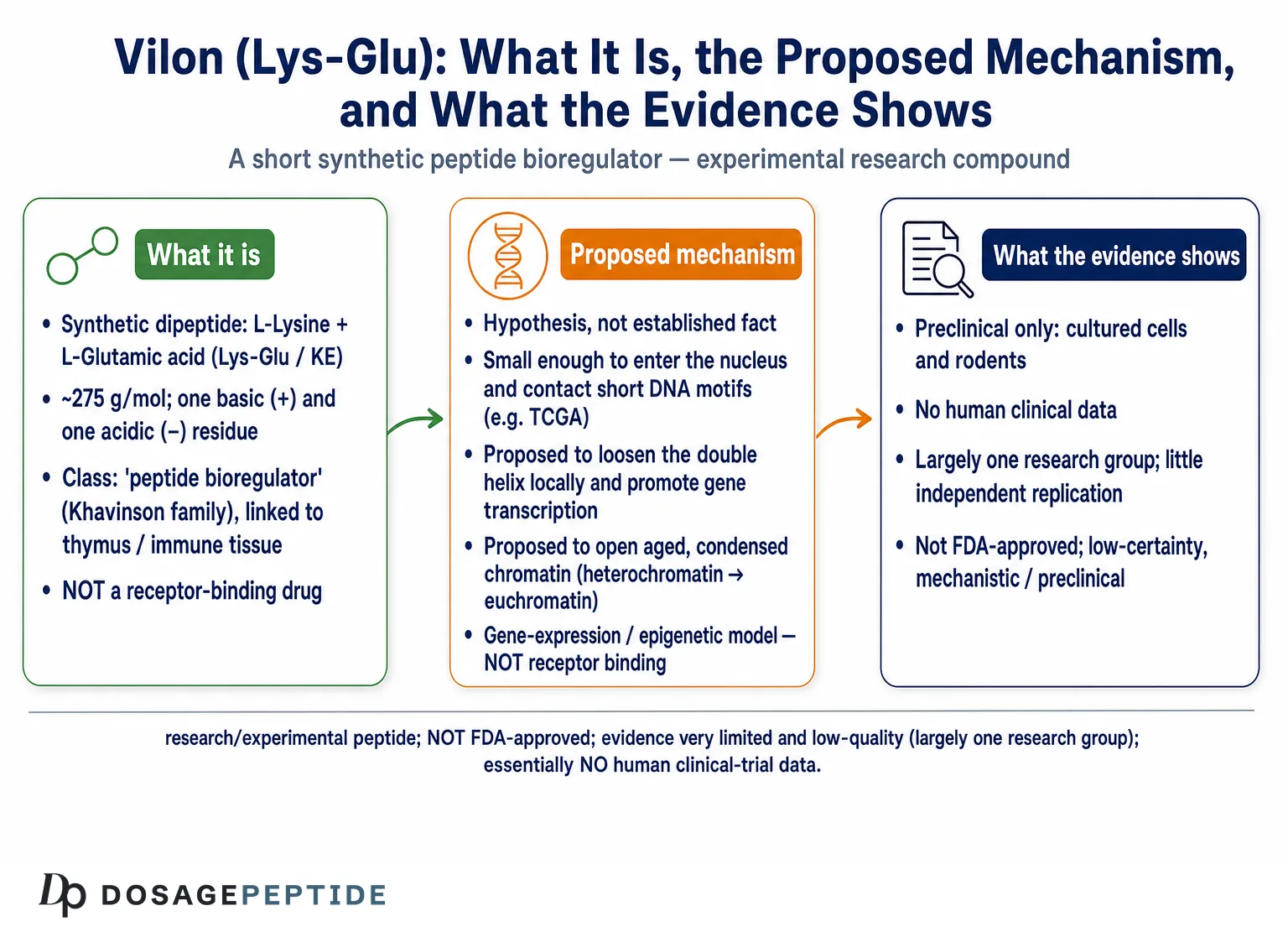
At the structural level, Vilon is unambiguous. It is a dipeptide of L-lysine and L-glutamic acid, with a molecular formula around C₁₁H₂₁N₃O₅ and a molar mass of roughly 275 g/mol. Lysine is a basic (positively charged) amino acid; glutamic acid is acidic (negatively charged). That pairing of one basic and one acidic residue is not incidental to the mechanistic story — it is central to it.
The proposed mechanism, advanced most fully in the group’s systematic reviews, is that short peptides of two to seven residues are small enough to cross the cytoplasmic and nuclear membranes and physically reach DNA.6 Once at the DNA, the argument goes, they interact directly with specific double-stranded sequences in gene promoter regions. The chemistry offered to justify this is that acidic residues such as glutamic acid can weaken the hydrogen bonds holding the two DNA strands together, while basic residues such as lysine strengthen strand interactions and anchor the peptide.6 The net effect proposed is a localized loosening of the double helix that could permit transcription of a previously silent gene.
For Vilon specifically, molecular-dynamics modeling in the systematic review literature reports that the KE peptide can bind a short deoxyribonucleotide motif — the TCGA sequence — found in the promoter of at least one gene (APG5L), and that KE’s constituent amino acids can make additional contacts with double-stranded DNA.6 This is presented as a form of sequence selectivity: the idea that different bioregulator peptides recognize different short motifs and therefore regulate different genes. It is a tidy hypothesis, but it rests heavily on computational modeling and on experiments from the originating group rather than on independent structural biology such as co-crystal structures.
A second, related mechanistic claim is epigenetic. Rather than changing the DNA sequence, Vilon is proposed to alter chromatin accessibility — specifically to promote “deheterochromatinization,” the unwinding of tightly packed, transcriptionally silent heterochromatin into more open, active euchromatin.48 In aging cells, more of the genome is thought to be locked away in heterochromatin, and the hypothesis is that peptides like Vilon can selectively reopen specific silenced regions, effectively “reactivating” genes that were active earlier in life. Some reports also invoke changes in DNA methylation as part of this epigenetic picture.
It is worth stating plainly what these mechanistic accounts do and do not establish. They describe a plausible physical route by which a tiny peptide could influence transcription, and they are supported by binding assays, modeling, and cytogenetic observations. They do not establish that this route produces any clinically meaningful outcome, nor have the key structural claims been widely reproduced by laboratories outside the originating tradition. When you encounter marketing that states flatly that Vilon “binds your DNA and switches your youth genes back on,” recognize that this is a confident retelling of a modestly supported, largely single-source hypothesis — not a settled mechanism.
One more nuance matters. Even if direct DNA binding occurs in a cuvette or a cell culture, an ingested or injected dipeptide in a whole organism faces peptidases that rapidly cleave it, and the concentration reaching any given cell nucleus is uncertain. Bridging “binds DNA in vitro” to “regulates genes in a living body at a tolerable dose” is exactly the kind of gap that rigorous pharmacology exists to test, and for Vilon that testing has largely not been done outside the originating program.
What the Key Evidence Actually Shows
The most cited Vilon experiments cluster around immune cells, gene expression, chromatin, and tumor/lifespan endpoints in rodents. Reviewing them in turn — and being explicit about the model and the level of evidence — is the fairest way to gauge the compound.
Interleukin-2 gene expression. A frequently referenced 2000 report found that Lys-Glu, applied in vitro to mouse spleen lymphocytes, stimulated expression of the interleukin-2 (IL-2) gene, with the effect depending on concentration and exposure time.1 IL-2 is a cytokine central to T-cell proliferation, so an increase in its expression is mechanistically interesting for an “immune bioregulator.” A companion study comparing several short peptides in splenocytes reported that Vilon and Epithalon were the most potent activators of IL-2 mRNA synthesis, while Cortagen had a weaker effect.2 These are the closest thing to a signature finding for Vilon, but both are in-vitro rodent-cell experiments, not demonstrations of improved immune function in an animal or a person.
Gene expression at scale. A 2002 study used DNA-microarray technology to survey gene expression in mouse heart tissue after exposure to Vilon and Epithalon.3 Of roughly 15,000 genes examined, about 300 changed expression more than two-fold; Vilon alone was associated with altered expression of 36 genes, activating up to a few dozen and suppressing a smaller number.3 This is often cited as proof that Vilon “regulates genes.” It does show measurable transcriptional changes in a tissue not obviously related to the thymus, which is intriguing — but microarray studies of this era are hypothesis-generating, sensitive to noise, and do not by themselves show that the changes are beneficial or reproducible.
Chromatin in aging lymphocytes. A line of cytogenetic work, much of it by Lezhava, Jokhadze, and colleagues, examined cultured lymphocytes from older donors (roughly 75–88 years) versus younger donors (20–40 years).4 Peptide bioregulators including Lys-Glu were reported to induce deheterochromatinization — unwinding of constitutive and facultative heterochromatin — and to shift patterns of sister-chromatid exchange.48 These observations underpin the “reactivating dormant genes in aged cells” narrative. They are real cytological measurements, but they are on cultured cells, from a small set of related studies, and their translation to any health outcome is entirely inferential.
Apoptosis and radiation. Another report found that peptide bioregulators including Vilon inhibited irradiation-induced apoptotic death of rat spleen lymphocytes, interpreted as a protective, anti-apoptotic effect.7 Again: rodent cells, single research lineage, mechanistic endpoint.
Tumors and lifespan. Perhaps the most eye-catching claim comes from a 2000 report stating that the synthetic dipeptide Vilon inhibited the growth of spontaneous tumors and increased the lifespan of female CBA mice.5 This is an in-vivo outcome, which is worth more than a cell-culture readout, and it is the kind of result that drives the “anti-aging” positioning. But a single-strain, single-group mouse study — without independent replication, dose-response transparency, or human data — cannot support any suggestion that Vilon prevents cancer or extends human life. Marketing that gestures at “increased lifespan” is leaning on exactly this narrow result.
To make the evidence level explicit rather than implied, the table below grades each headline finding by model type and strength. “Level” here is a plain-language judgment, not a formal grading scale, but it captures how much weight each result can honestly bear.
| Finding | Model | Endpoint type | Evidence level |
|---|---|---|---|
| Increased IL-2 gene expression1 | Mouse spleen lymphocytes, in vitro | Biomarker (mRNA) | Very low |
| Most potent IL-2 activator vs peers2 | Splenocytes, in vitro | Biomarker (mRNA) | Very low |
| ~36 genes altered on microarray3 | Mouse heart tissue | Biomarker (transcriptome) | Low, hypothesis-generating |
| Deheterochromatinization of aged chromatin4 | Human donor lymphocytes, cultured | Cytological marker | Very low |
| Reduced radiation-induced apoptosis7 | Rat spleen lymphocytes | Cellular endpoint | Very low |
| Fewer spontaneous tumors, longer lifespan5 | Female CBA mice, in vivo | Whole-organism outcome | Low, single-strain, unreplicated |
Taken together, the evidence forms a coherent internal story: a tiny peptide that touches DNA, nudges immune-relevant genes, loosens aged chromatin, and shows longevity signals in mice. What it conspicuously lacks is breadth of source, independent replication, dose-response rigor, and any human clinical trial. On a conventional evidence hierarchy, this sits near the bottom — mechanistic and preclinical, low certainty — and should be described that way.
How Vilon Compares With Related Compounds
Vilon is easiest to understand as one member of a family, so comparing it with its siblings clarifies both its claims and their limits. The table below summarizes the most commonly discussed short bioregulator peptides. Every “proposed focus” entry reflects the originating group’s hypotheses, not established therapeutic indications.
| Peptide | Sequence | Proposed tissue focus | Evidence character |
|---|---|---|---|
| Vilon | Lys-Glu (KE) | Thymus / immune cells | Preclinical, single-group |
| Livagen | Lys-Glu-Asp-Ala (KEDA) | Liver | Preclinical, single-group |
| Epithalon | Ala-Glu-Asp-Gly (AEDG) | Pineal / telomere biology | Preclinical, some small clinical claims |
| Thymalin | Thymus polypeptide mixture | Immune modulation | Older extract, mixed studies |
| Prostamax / Chonluten / Cardiogen | Short peptides | Prostate / lung / heart | Preclinical, single-group |
The most instructive comparison is with Livagen, the tetrapeptide Lys-Glu-Asp-Ala. Note that Livagen literally contains the Vilon sequence (Lys-Glu) as its first two residues, extended by aspartic acid and alanine. In the group’s framework, adding residues is what shifts the proposed sequence specificity and, therefore, the tissue target — Vilon toward immune tissue, Livagen toward liver. Whether such tiny extensions genuinely redirect biological activity in a whole organism is unproven, but it illustrates the core design logic: build short, defined peptides and assign each to a tissue. Readers exploring that logic can compare the handling notes for Vilon against the Livagen protocol and the conceptual overview in this explainer on Ovagen, another liver-associated bioregulator.
The comparison with Thymalin runs in the opposite direction — from complex to simple. Thymalin is the older, undefined thymic extract; Vilon is the attempt to distill a single defined molecule from that tradition. The advantage of Vilon is reproducible chemistry; the disadvantage is that a purified dipeptide may not reproduce whatever activity the full mixture had, since extracts contain many components that could act together. Claiming Vilon “is” the active ingredient of Thymalin overstates what has actually been demonstrated.
Epithalon is the sibling that receives the most attention because of its dramatic telomere and pineal claims, and it frequently appears alongside Vilon in the very same experiments — the IL-2, microarray, and apoptosis studies discussed earlier all tested both.137 That co-testing is a double-edged sword: it means Vilon rarely stands on independent evidence, and much of what is “known” about it comes from studies designed primarily around the peptide platform as a whole.
The other tissue-specific peptides — Prostamax, Chonluten (lung), Cardiogen (heart), Vesugen (vascular) — share Vilon’s evidentiary profile almost exactly: short synthetic sequences, tissue assignments derived from the same hypothesis, and a literature concentrated in one lineage. DosagePeptide.com catalogs handling references for many of these, such as the Prostamax protocol and Chonluten protocol, and the full list can be browsed on the dosages index. The practical takeaway from comparison is sobering: Vilon is not an outlier with unusually strong support, nor unusually weak — it is representative of a whole class whose promise rests on a coherent but narrowly sourced body of preclinical work.
Research Models and Methodology
Understanding how Vilon has been studied is as important as knowing what was found, because the methods define the ceiling on what can be concluded. Across the literature, four model types recur, and each carries characteristic strengths and blind spots.
Isolated-cell and culture models. Much of the foundational work uses lymphocytes or splenocytes in culture, either freshly isolated from rodents or, for the chromatin studies, from human donors of different ages.14 Cell culture is powerful for probing mechanism — you can add a precise peptide concentration and measure mRNA, chromatin state, or apoptosis directly. Its weakness is external validity: a peptide bathing cells in a dish encounters none of the peptidases, barriers, clearance, and competing signals of a living body. A robust effect in culture routinely fails to reproduce in vivo, so culture results should be read as “this is biologically possible,” never as “this happens in an organism.”
Molecular and computational assays. The DNA-binding claims lean on binding studies and molecular-dynamics simulations that model how KE contacts specific nucleotide motifs.6 Computational modeling is useful for generating mechanistic hypotheses, but it is not experimental proof of function. A simulation showing that a peptide can sit on a TCGA motif does not establish that it does so at physiological concentrations, or that the binding changes transcription meaningfully.
Whole-animal studies. The tumor and lifespan report is the most consequential because it uses a living, whole-organism endpoint.5 The microarray work also used mouse tissue.3 Whole-animal data outrank culture data, but the value depends entirely on design quality: strain diversity, blinding, randomization, adequate group sizes, dose-response characterization, and independent replication. The available Vilon animal work is typically single-strain and single-group, which sharply limits how far the results generalize.
Cytogenetic aging models. The heterochromatin studies represent a distinctive methodology: comparing chromatin condensation in cells from old versus young human donors and asking whether peptide exposure “rejuvenates” the chromatin picture.4 This is a clever proxy for cellular aging, but it measures a cytological marker, not health, function, or lifespan. The inferential leap from “chromatin looks younger under the microscope” to “the organism is healthier” is large and unvalidated.
A methodological theme cuts across all four: the near-absence of independent replication. In mature areas of pharmacology, a mechanism is trusted only after multiple unaffiliated laboratories reproduce it with different reagents and designs. The systematic review that consolidates the peptide-regulation hypothesis draws overwhelmingly on the originating collective’s own citations, and does not foreground the bias risk that concentration creates.6 That does not mean the findings are wrong — single groups can be correct — but it means the usual safeguard against error, self-deception, and publication bias has not operated here. When a compound’s entire evidentiary edifice rests on one lineage, uncertainty should be scored higher, not lower.
For a reader trying to weigh Vilon, the methodological summary is straightforward: the models used are appropriate for asking “could this molecule affect cells and genes?” and the answer they return is a qualified “possibly, in these systems.” They are not the models — controlled human trials, dose-ranging pharmacokinetics, independent replication — that could answer “does this help a person, and at what dose, and at what risk?” Those studies have not been done. Anyone presenting Vilon as if the second question were settled is misreading the methodology.
Safety and Tolerability: What Is and Isn’t Known
Safety is the area where honesty matters most and where the data are thinnest. It is common to see Vilon described as “well tolerated” or “non-toxic.” Those descriptions rest almost entirely on the same small preclinical literature and on the general observation that very short peptides made of ordinary amino acids are unlikely to be acutely poisonous. Neither of those is the same as an established human safety profile.
What can reasonably be said is limited. Vilon is composed of two naturally occurring amino acids, and short peptides of this kind are metabolized by ordinary peptidases into their constituent amino acids. On that basis, a catastrophic acute toxicity would be surprising, and the rodent studies did not report Vilon as overtly harmful — indeed, the lifespan study reported the opposite direction of effect.5 That is genuinely reassuring at the crudest level, but it is a very low bar, and “did not obviously harm one strain of mice in one lab” cannot be generalized into a human safety claim.
What is not known is far more extensive, and the list is what should drive caution. There are no published, registered human clinical trials characterizing Vilon’s adverse-event profile, no dose-ranging safety studies in people, and no long-term human data. Because a proposed mechanism of Vilon is to alter gene expression and reopen silenced chromatin,46 the theoretical risk landscape is precisely the kind that demands careful study rather than assurance: anything that genuinely modulates transcription or epigenetic state could, in principle, have effects that are unpredictable, tissue-dependent, or delayed. The reassuring “it’s just two amino acids” framing and the exciting “it reprograms your genes” framing cannot both be taken at full strength; if the second were true, the first would not guarantee safety.
Other unknowns compound the picture. Immunogenicity, interactions with medications, effects in people with autoimmune conditions or cancer, effects during pregnancy, and consequences of repeated long-term exposure have not been characterized in any rigorous human dataset. For a compound whose entire appeal is immune and “anti-aging” modulation, the absence of data in exactly the populations most likely to be interested — older adults, people with immune conditions — is a serious gap, not a footnote.
There is also a product-quality dimension to safety that is independent of the molecule itself. Vilon sold in the research-chemical market is not manufactured under pharmaceutical oversight. Purity, actual peptide content, endotoxin levels, and sterility vary by source and are frequently unverified. Many real-world adverse events associated with obscure research peptides trace not to the intended molecule but to contaminants, incorrect labeling, or non-sterile handling. This is why any serious discussion of a research peptide separates “what the pure molecule might do” from “what an unregulated vial from an unknown source might contain.”
The responsible bottom line is that Vilon’s tolerability in humans is effectively uncharacterized. The available signals are consistent with low acute toxicity in rodents, but that is not evidence of human safety, and it says nothing about long-term or population-specific risk. Descriptions of Vilon as “safe” are, at best, extrapolations well beyond the data. Nothing in this section should be read as encouragement to administer Vilon; it is provided so that readers can accurately gauge how much remains unknown.
Handling and Reconstitution in a Research Context
Because Vilon is distributed as a lyophilized (freeze-dried) research powder, questions about storage and reconstitution come up frequently. The information below describes conventions used when handling research peptides in a laboratory setting for in-vitro or preclinical study. It is presented for educational completeness only and is not instruction for human use, which would be inappropriate for an unapproved experimental compound.
Lyophilized short peptides are generally most stable as a dry powder kept cold and dry. Common laboratory practice is to store the sealed vial at roughly −20 °C for shorter-term storage and −80 °C for longer-term storage, protected from light and moisture. Because freeze-dried peptides are hygroscopic, letting a cold vial warm to room temperature before opening helps prevent condensation from drawing moisture into the powder. Once a peptide is reconstituted into solution, it is far less stable: refrigeration at 2–8 °C with use within roughly a week is typical, and dividing the solution into single-use aliquots that are frozen can extend usable life while avoiding repeated freeze-thaw cycles that degrade peptides.
Reconstitution in a research setting typically uses bacteriostatic or sterile water added slowly down the inside wall of the vial rather than jetted directly onto the powder, allowing the peptide to dissolve gently without foaming or mechanical shear. The general reconstitution arithmetic is simple: concentration equals the mass of peptide divided by the volume of solvent added. For example, dissolving a 20 mg vial in 2 mL of solvent yields 10 mg/mL. The Vilon dosage protocol page walks through this measurement math in more detail, and comparable handling notes for related bioregulators such as the Cardiogen protocol follow the same conventions.
A few handling realities are worth emphasizing precisely because they are easy to get wrong. First, sterility is not optional in any setting that involves biological material; non-sterile water, reused needles, or contaminated surfaces introduce microbial and endotoxin risk that has nothing to do with the peptide and everything to do with technique. Second, concentration errors are common and consequential: mis-measuring solvent volume changes the delivered amount proportionally, which is why careful arithmetic and labeled aliquots matter. Third, powder that has visibly clumped, discolored, or been exposed to humidity should be regarded as compromised, because degradation of short peptides can proceed without obvious visual change and definitely accelerates once moisture is present.
It also bears repeating that reconstitution knowledge does not confer safety. Being able to dissolve a compound cleanly says nothing about whether it is appropriate to introduce into a living system, and for Vilon there is no established human dose, no approved indication, and no clinical safety framework to anchor any such decision. The handling conventions above exist so that laboratory researchers can work reproducibly with the material; they are not a green light for self-experimentation. Readers who want the mechanical measurement details for study reference can find them on the linked protocol pages, but should keep the educational-only framing of this entire article firmly in view.
Why Vilon Attracts Interest Despite Thin Evidence
If the evidence is as limited as the preceding sections argue, it is fair to ask why Vilon continues to attract attention at all. Understanding the drivers of interest is useful, because it helps a reader separate genuine scientific signal from the momentum of a compelling story, and it explains why the same thin data set gets recycled into confident claims across many websites.
The first driver is the elegance of the hypothesis. The idea that a molecule as small as two amino acids could reach into the nucleus and selectively reactivate genes that fall silent with age is genuinely captivating. It offers a simple, mechanistic-sounding explanation for aging and a correspondingly simple intervention. Elegant hypotheses are seductive precisely because they feel explanatory, and the human mind tends to grant them more credibility than their evidence warrants. The Vilon narrative is a textbook example: internally coherent, mechanistically specific, and emotionally appealing, yet resting on a narrow, non-independent foundation.6
The second driver is the sheer volume of publications. Khavinson’s group has been active for roughly four decades and has produced a large body of papers spanning many peptides, tissues, and models. To a casual reader, a long reference list looks like strong evidence — “there are dozens of studies” sounds decisive. But volume is not the same as independence or quality. Fifty papers from one lineage, mostly on intermediate biomarkers and mostly without external replication, do not carry the evidentiary weight of even a handful of well-powered, independent, randomized human trials. The quantity of literature is real; its interpretation is where overreach happens.
The third driver is the longevity and biohacking market, which has a strong appetite for compounds that promise cellular “rejuvenation.” Vilon fits a template that sells: an exotic origin (Soviet-era science), a mechanistic hook (gene and chromatin regulation), a family of related products to explore, and a scarcity of regulatory approval that can be reframed as being “ahead of the mainstream” rather than simply unproven. Commercial incentives reward confident, benefit-forward framing, and they systematically underemphasize uncertainty. When you read glowing summaries of Vilon, it is worth remembering that many are produced by parties who benefit from interest in the compound.
The fourth driver is the association with Epithalon. Epithalon’s dramatic telomere and pineal claims generate outsized attention, and because Vilon is repeatedly co-tested alongside Epithalon in the primary literature, some of that attention spills over.37 Vilon benefits from proximity to a more famous sibling, even though its own independent evidence is no stronger. This halo effect is subtle but real, and it inflates the perceived credibility of the whole peptide family.
None of these drivers is illegitimate on its face — interesting hypotheses should attract study, and a productive research program is worth examining. The problem arises only when the drivers of interest are mistaken for drivers of evidence. A compound can be simultaneously fascinating and unproven; those states are not in tension. The correct response to Vilon’s appeal is not dismissal but disciplined skepticism: take the hypothesis seriously as a research question, and refuse to let its elegance, its publication count, its market energy, or its famous sibling substitute for the independent human data that do not yet exist. Readers who keep that discipline will find Vilon genuinely interesting to follow — and will avoid the common error of treating a good story as a settled fact.
Limitations and the Human-Evidence Gap
Every previous section has gestured at limitations; this one states them together, because the cumulative picture is the single most important thing to take away about Vilon. The gap between what has been observed and what people are told is large, and naming each component of that gap makes it harder for confident marketing to paper over it.
No human clinical trials. The foundational Vilon studies are in cultured cells and rodents.135 There is no body of registered, controlled human trials establishing that Vilon produces any benefit in people, at any dose, for any condition. Claims about immune enhancement, anti-aging, or recovery in humans are extrapolations across species and across the enormous distance between a mechanistic readout and a clinical outcome.
Single-source dominance. The great majority of primary Vilon evidence originates from Khavinson’s group and closely affiliated researchers, and even the consolidating systematic review draws chiefly on that lineage without foregrounding the resulting bias risk.6 Independent replication by unaffiliated laboratories — the ordinary mechanism by which science self-corrects — is largely missing. This is the difference between “widely confirmed” and “internally consistent within one program,” and Vilon is firmly in the latter category.
Mechanism-to-outcome leap. Even granting the mechanistic findings — DNA binding, IL-2 mRNA increases, chromatin unwinding — none of them is an outcome that matters to a person. Increased IL-2 expression in a dish is not a stronger immune system; deheterochromatinized lymphocytes under a microscope are not a longer, healthier life. The literature is rich in intermediate biomarkers and poor in endpoints anyone actually cares about.
Preclinical study quality. The in-vivo work that exists tends to be single-strain and single-lab, often without the dose-response transparency, blinding, and replication that modern preclinical standards expect.5 The microarray results are hypothesis-generating snapshots rather than validated regulatory maps.3 These are not disqualifying flaws for early science, but they are disqualifying for the confident conclusions frequently attached to them.
Publication and framing bias. A field driven by one group with a strong prior hypothesis is exactly the setting where positive results are more likely to be published and negative results less likely to appear. That does not prove distortion, but it means the visible literature probably overstates the effect, and readers should mentally discount accordingly.
Put together, these limitations place Vilon squarely in the category of “interesting experimental compound with a coherent hypothesis and thin, non-independent, preclinical support.” That is a legitimate and even intriguing scientific position — plenty of important drugs began exactly there — but it is a starting point for research, not an endpoint that justifies use. The intellectually honest stance is curiosity paired with heavy skepticism: the story is worth studying, and precisely because it is unproven, no one should present it as established. For readers building a broader picture of this compound class, browsing several profiles side by side on the dosages index makes the shared evidentiary pattern — and its shared limits — unmistakable.
Regulatory Status
Vilon’s regulatory position reinforces everything above. In the United States, Vilon is not approved by the FDA for any medical use. It has not gone through the investigational-new-drug and clinical-trial pathway that approval requires, and it is not available as a prescription medicine or an over-the-counter product. It is not a dietary supplement in any recognized sense either, and it is not manufactured under the quality systems that govern approved drugs.6
In practice, Vilon circulates in the United States and much of Europe only through the “research chemical” channel, where products are sold labeled strictly for laboratory research and explicitly not for human consumption. That labeling is a legal and regulatory reality, not a formality: it reflects the fact that no regulator has evaluated Vilon for safety or efficacy in humans. Products in this channel are not subject to the identity, purity, potency, and sterility controls of pharmaceutical manufacturing, which means buyers have no independent assurance that a vial contains what its label claims or that it is free of contaminants.
The compound’s history is rooted in the Russian and post-Soviet medical systems, where the broader bioregulator program and its parent extracts (such as Thymalin) were studied and, in some cases, used clinically under that system’s own frameworks. It is important not to over-read this. Regulatory acceptance within one country’s historical system, decades ago, is not equivalent to the kind of modern, independent, trial-based approval that agencies like the FDA or EMA require, and it does not transfer to other jurisdictions. Vilon is not approved for medical use in the United States or the European Union, and there are no registered Western randomized human trials underpinning such approval.6
For readers, the regulatory picture carries two concrete implications. First, legality of purchase in the research-chemical market should never be mistaken for evidence of safety or efficacy; those are entirely separate questions, and the “for research use only” label is a signal of how little has been established, not a technicality to be waved away. Second, the absence of manufacturing oversight means product-quality risk sits on top of the already-substantial biological uncertainty. Even a reader who found the mechanistic story compelling would still be confronting an unapproved compound of unverified provenance.
None of this is intended to editorialize about the science being “fake” — the underlying observations are real published experiments. It is intended to locate Vilon accurately: an experimental research compound, not a therapy; unapproved everywhere it is commonly discussed in Western markets; and available only through channels that provide no safety, efficacy, or quality guarantees. That is the correct frame for any further reading, and it is the frame this article has tried to hold throughout. Those curious about how these bioregulators are catalogued for study reference can review the broader set, including entries like the Vesugen protocol, but the regulatory reality is identical across the class.
Frequently Asked Questions
What is Vilon in simple terms?
Vilon is a synthetic dipeptide made of two amino acids, lysine and glutamic acid (Lys-Glu, or KE). It was developed by a Russian gerontology group as one of a family of ultra-short “peptide bioregulators” and is associated in that program’s hypotheses with thymus and immune tissue.1 It is an experimental research compound, not an approved medicine.
Does Vilon actually work?
The honest answer is that no one knows in any human-relevant sense. Published experiments show that Vilon can influence gene expression, chromatin, and immune-cell markers in cultured cells and rodents.134 But there are no controlled human clinical trials demonstrating a benefit, and the evidence comes largely from one research group without independent replication.6 That is low-certainty, preclinical evidence — interesting, but not proof of any effect in people.
Is Vilon FDA-approved or safe?
No. Vilon is not approved by the FDA or EMA for any use, and there are no registered Western human trials characterizing its safety.6 Rodent studies did not report overt toxicity, but that is a very low bar and does not establish human safety. Long-term effects, drug interactions, and population-specific risks are simply uncharacterized.
How is Vilon different from Epithalon or Livagen?
All three are short Khavinson-family peptides with different sequences and proposed tissue targets. Vilon is Lys-Glu (immune focus); Livagen is Lys-Glu-Asp-Ala, which contains the Vilon sequence plus two more residues and is assigned a liver focus; Epithalon is Ala-Glu-Asp-Gly, associated with the pineal gland and telomere claims. They frequently appear together in the same experiments, and all share the same thin, single-source evidence base.13
What is the proposed mechanism of Vilon?
The hypothesis is that Vilon is small enough to enter cell nuclei and interact directly with specific short DNA sequences (for example a TCGA motif), loosening the double helix locally and promoting transcription, and that it can shift aged, condensed chromatin toward a more open, active state.46 This is a plausible but modestly supported mechanism, resting heavily on modeling and single-group experiments rather than independent structural biology.
Why is the evidence for Vilon considered weak?
Three reasons. It is almost entirely preclinical — cultured cells and rodents, not people. It comes overwhelmingly from one research lineage, so it has not been independently reproduced.6 And even the positive findings are intermediate biomarkers (gene expression, chromatin state) rather than health outcomes, so a large inferential leap separates the data from any claimed benefit.
Can Vilon treat or prevent any disease?
No. There is no credible human evidence that Vilon treats, cures, or prevents any disease, and it is not approved for any medical condition. A single mouse study reported reduced spontaneous tumors and longer lifespan in one strain,5 but that cannot support any human disease claim and has not been independently replicated. Nothing in this article should be read as a treatment recommendation.
Why do research vials say “not for human consumption”?
Because Vilon is unapproved and sold only through the research-chemical channel, where products are labeled for laboratory use only. That label reflects the absence of regulatory evaluation and manufacturing oversight — purity, potency, and sterility are not independently guaranteed — and it is a genuine signal of how little has been established, not a technicality.
References
- Khavinson VK, Morozov VG, Malinin VV, Kazakova TB, Korneva EA. Effect of peptide Lys-Glu on interleukin-2 gene expression in lymphocytes. Bulletin of Experimental Biology and Medicine. 2000;130(9):898–899. PMID: 11177276. https://pubmed.ncbi.nlm.nih.gov/11177276/
- In vitro effect of short peptides on expression of the interleukin-2 gene in splenocytes. Bulletin of Experimental Biology and Medicine. 2002. PMID: 12447482. https://pubmed.ncbi.nlm.nih.gov/12447482/
- Anisimov SV, Bokheler KR, Khavinson VKh, Anisimov VN. Studies of the effects of Vilon and Epithalon on gene expression in mouse heart using DNA-microarray technology. Bulletin of Experimental Biology and Medicine. 2002. PMID: 12360356. https://pubmed.ncbi.nlm.nih.gov/12360356/
- Lezhava T, Jokhadze T, Monaselidze J, Buadze T, Gaiozishvili M, Sigua T. Epigenetic modification under the influence of peptide bioregulators on “aged” heterochromatin. Georgian Medical News. 2020. PMID: 33526740. https://pubmed.ncbi.nlm.nih.gov/33526740/
- Khavinson VKh, Anisimov VN. A synthetic dipeptide vilon (L-Lys-L-Glu) inhibits growth of spontaneous tumors and increases life span of mice. Doklady Biological Sciences. 2000. PMID: 10944717. https://pubmed.ncbi.nlm.nih.gov/10944717/
- Khavinson VKh, et al. Peptide Regulation of Gene Expression: A Systematic Review. Molecules. 2021;26(22):7053. PMC8619776. https://pmc.ncbi.nlm.nih.gov/articles/PMC8619776/
- Khavinson VK, Kvetnoi IM. Peptide bioregulators inhibit apoptosis. Bulletin of Experimental Biology and Medicine. 2000;130(12):1175–1176. PMID: 11276315. https://pubmed.ncbi.nlm.nih.gov/11276315/
- Lezhava T, et al. Epigenetic modification under the influence of peptide bioregulators on the “old” chromatin. Georgian Medical News. 2023. PMID: 37042594. https://pubmed.ncbi.nlm.nih.gov/37042594/
Educational and research-use disclaimer: This article is provided solely for general educational and informational purposes and describes an experimental research compound. Vilon is not approved by the FDA, EMA, or any comparable regulator for the treatment, cure, prevention, or diagnosis of any disease, and it is not a medicine or dietary supplement. The available evidence is limited, largely preclinical, and drawn predominantly from a single research group; nothing here should be interpreted as a claim of efficacy or safety, as medical advice, or as encouragement to obtain or administer this compound. Any laboratory handling references are descriptive of research conventions only and are not instructions for human use. Consult a qualified, licensed healthcare professional for any health-related decision.