The adverse effects most reliably documented for NAD+ are infusion reactions during intravenous administration — abdominal cramping, nausea, vomiting, flushing, chest pressure and increased heart rate. The two published human datasets are consistent with the rate of administration mattering more than the total dose, but neither was designed to test that, and in both, dose and rate move together. That evidence base is extremely thin: the published human record on injected NAD+ amounts to a handful of pilot studies and retrospective chart reviews involving fewer than twenty people combined. The oral precursors nicotinamide riboside (NR) and nicotinamide mononucleotide (NMN) are much better characterised, with multiple randomised placebo-controlled trials reporting adverse events similar in type, incidence and severity to placebo — but those findings do not transfer to an injectable route, and nothing in this literature establishes long-term safety.
First, an honest correction: NAD+ is not a peptide
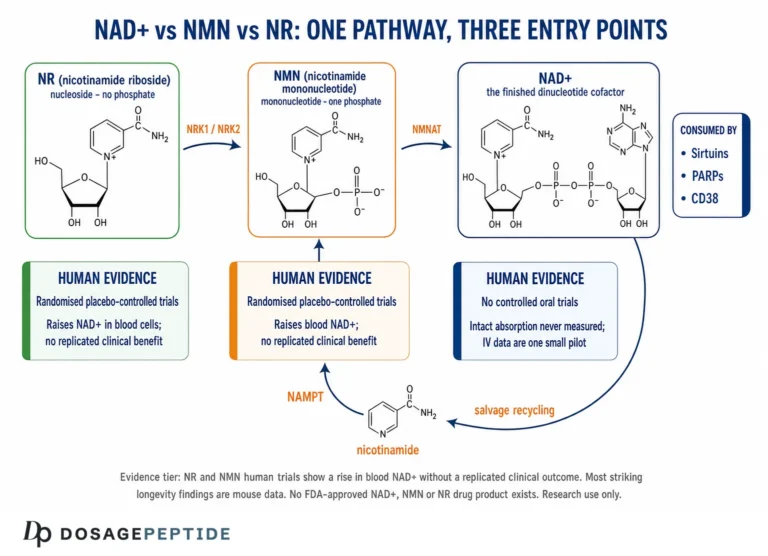
Nicotinamide adenine dinucleotide is a dinucleotide coenzyme — two nucleotides (one carrying nicotinamide, one carrying adenine) joined through a phosphate bridge. It has no amino acids and no peptide bonds. It is a redox cofactor and a substrate consumed by sirtuins, PARPs and CD38 during DNA repair, chromatin remodelling and calcium signalling.
This reference library covers NAD+ for one practical reason: it is sold, shipped, stored and reconstituted alongside research peptides, in the same lyophilised vials, with the same bacteriostatic water, using the same reconstitution arithmetic. The handling questions overlap almost completely. The biology does not. Any framing that treats NAD+ as “a peptide” is wrong, and it matters here because the peptide safety literature — which we cover separately in our overview of what is actually known about research peptide safety — tells you nothing about a nucleotide coenzyme.
What is the regulatory status of NAD+ and its precursors?
Getting this right changes how every safety claim should be read. The four molecules in this family sit in four different regulatory places.
NAD+ itself
NAD+ is not an FDA-approved drug for any indication. There is no approved product, no approved label, and therefore no agency-reviewed adverse-event section. IV NAD+ is administered in wellness clinics and prepared by compounding pharmacies; compounding is not approval.
The record is more pointed than “unapproved”, and this is the part most coverage misses. On FDA’s categorised list of bulk drug substances nominated for compounding under section 503A — last updated 14 May 2026 — “Nicotinamide Adenine Dinucleotide (NAD)” sits in Category 1, substances under evaluation: an interim posture under which FDA does not intend to act against a compounder using the substance while the agency decides. But FDA has already said where it expects to land. In a proposed rule published on 5 September 2019, the agency proposed not to place NAD on the 503A bulks list. Read the reasoning carefully, because its scope is easy to overstate in both directions. FDA evaluated NAD for the single indication it had been nominated for — fatigue in multiple sclerosis — and found that NAD “degrades substantially when exposed to light, moisture, alkaline pH, or standard room temperatures”; that non-clinical data in the literature were “inadequate to characterize the potential toxicity profile for NAD, particularly for use in a chronic disease such as MS”; and that it “did not find sufficient clinical data about NAD to evaluate whether it is safe for use in compounded drug products”. FDA’s Pharmacy Compounding Advisory Committee had voted not to include NAD on the list at its meeting of 8 May 2017. That rulemaking has never been finalised — no such provision appears in 21 CFR part 216 today — which is why NAD sits in Category 1 in the interim rather than on either final list[1]. And note what none of this says: FDA assessed NAD against one nominated indication, not against the wellness-clinic uses for which IV NAD+ is actually administered. Those uses have never been the subject of an agency safety review at all, which is a weaker position to argue from than a negative finding, not a stronger one.
So Category 1 is not an endorsement of safety. Taken as a whole the category means only that a substance was nominated with enough information for FDA to evaluate it and that the evaluation is unfinished — it holds several dozen substances at very different stages, and membership implies no agency view either way. What makes NAD’s position weaker than the label suggests is specific to NAD: here the evaluation has already produced a provisional negative from both the agency and its advisory committee, and the interim status persists only because the rulemaking was never completed. Separately, a specific salt form, beta-nicotinamide adenine dinucleotide disodium salt trihydrate, appears in Category 3 — substances nominated without adequate supporting information for FDA to evaluate them at all. That is a statement about the completeness of a nomination, not a safety finding, and it should not be read as a harsher verdict than Category 1[1].
Nicotinamide riboside (NR)
NR is marketed as a dietary supplement. FDA responded with a “no questions” letter, dated 3 August 2016, to GRAS Notice 635 for nicotinamide riboside chloride, covering its use as a source of vitamin B3 in specified foods and beverages[2]; the ingredient has also been the subject of two New Dietary Ingredient notifications[7]. GRAS status covers the specified food uses at specified levels; it is not a drug approval and says nothing about injected NR.
Nicotinamide mononucleotide (NMN) — status recently reversed
This is the one most articles still get wrong. In November 2022 FDA took the position that NMN was excluded from the dietary-supplement definition because it had been authorised for investigation as a new drug. That position was reversed: in two letters dated 29 September 2025, responding to citizen petitions, FDA concluded that NMN is not excluded, having accepted evidence that NMN was marketed as a dietary supplement in the United States before it was authorised for investigation as a new drug[3]. The consequence is visible in FDA’s own records: a beta-NMN New Dietary Ingredient notification (No. 1444, Effepharm Ltd.) was filed on 17 November 2025 and answered on 28 January 2026[2]. This does not make every NMN product lawful — NDI requirements still apply and the interpretation is untested in court — so treat it as evolving rather than settled.
Niacin (nicotinic acid) — the only approved anchor
Niacin is a distinct NAD precursor and is an approved drug. Extended-release niacin is indicated to reduce total cholesterol, LDL-C, apolipoprotein B and triglycerides and to raise HDL-C in primary hyperlipidaemia and mixed dyslipidaemia. Its label carries the best-characterised safety profile in this family: flushing as a very common effect that attenuates over weeks, and a hepatotoxicity warning, with severe hepatic toxicity reported when patients substituted sustained-release for immediate-release niacin at equivalent doses[4]. One currency note: the brand product whose label is cited here, NIASPAN under NDA 020381, is now listed as discontinued in Drugs@FDA, and its 2015 revision removed the combination-with-a-statin indication. Niacin extended-release itself remains an approved, marketed prescription drug through numerous generic applications, so the labelled safety profile still stands as the reference point. Niacin flushing is a prostaglandin-mediated GPR109A effect specific to nicotinic acid. It does not transfer to NAD+, NR or NMN — and indeed the large NR trial discussed below reported no flushing at all.
Which NAD+ side effects are documented, by route and evidence tier?
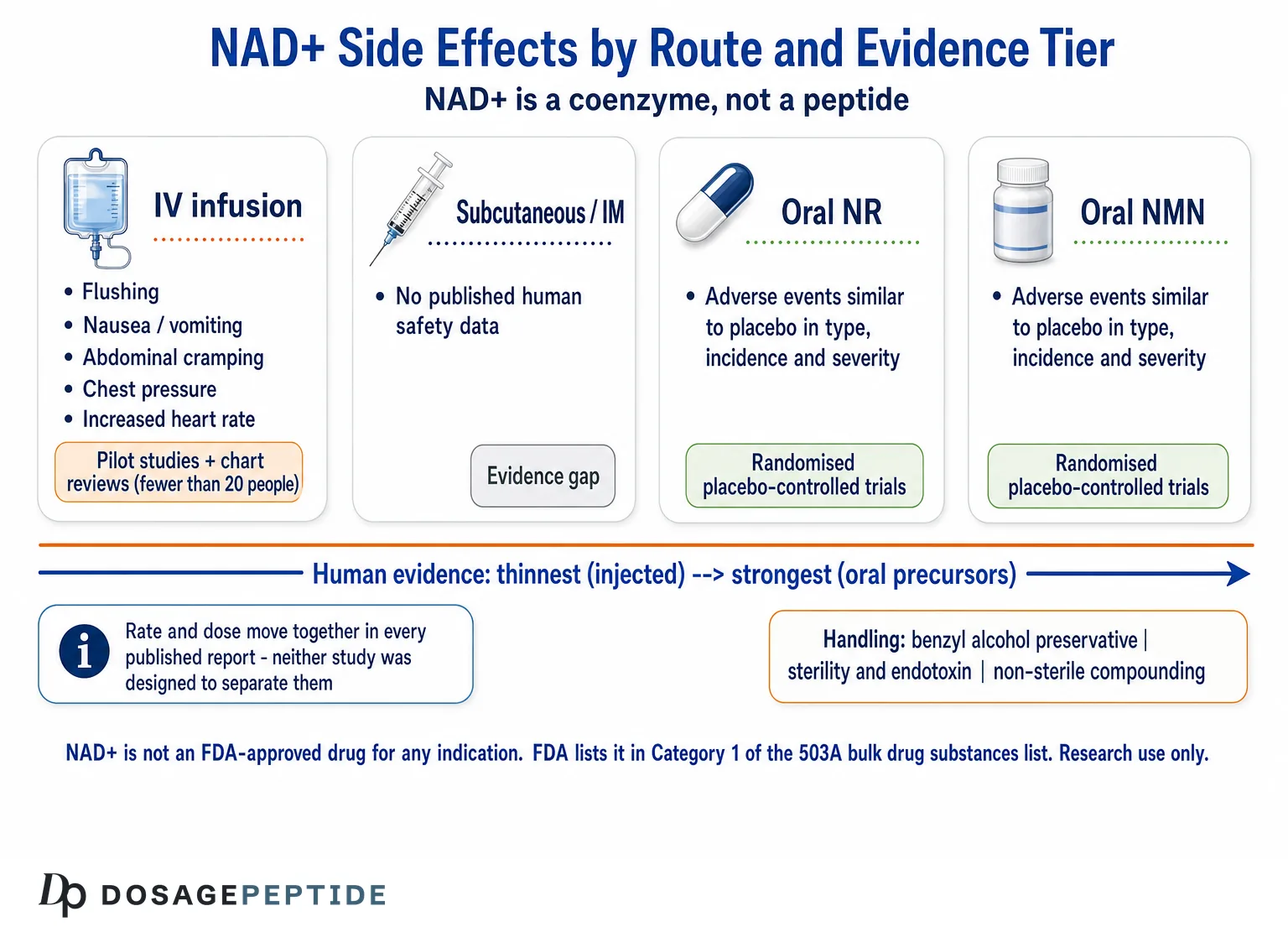
The table below is deliberately blunt about where the evidence is absent. Note the asymmetry: the route most people in this audience actually encounter — reconstituted vials for subcutaneous or intramuscular injection — has the thinnest human record of any entry.
| Route / form | Adverse effects actually documented | Evidence tier | Human sample size & duration |
|---|---|---|---|
| IV NAD+, slow infusion (~2 mg/min) | No adverse events observed during the infusion | Open-label pilot pharmacokinetic study, not blinded, healthy men only | 8 receiving NAD+ plus 3 saline controls; single 6-hour session |
| IV NAD+, client-controlled rate (~5 mg/min average) | Moderate to severe abdominal cramping, diarrhoea, nausea, vomiting, increased heart rate, throat pain, congestion, chest pressure; all resolved on completion | Retrospective chart review in a commercial wellness setting; no randomisation, no blinding, no placebo; symptoms themselves caused clients to slow the infusion | 6 clients; 500 mg/day for 4 consecutive days |
| IV nicotinamide riboside | Minor tongue, jaw and arm tingling; minor cramping during infusion (5 of 8) | Same retrospective chart review; comparator arm | 8 clients; 500 mg/day for 4 consecutive days |
| Subcutaneous / intramuscular NAD+ (research vials) | No controlled human trial data identified in PubMed; adverse effects for this route are anecdotal only | None — absence of published evidence, not evidence of absence of harm | None located |
| Oral NR | No serious adverse events; no flushing; AE type, incidence and severity similar to placebo; occasional mild nausea and muscle soreness judged possibly related | Randomised, double-blind, placebo-controlled | 140 adults; 100/300/1000 mg daily for 8 weeks |
| Oral NR, high dose | No moderate or severe adverse events reported | Randomised, double-blind, placebo-controlled phase I | 20 participants with Parkinson’s disease; 3000 mg daily for 4 weeks |
| Oral NMN | Safe and well tolerated at the doses studied; no dose-dependent safety signal | Randomised, multicentre, double-blind, placebo-controlled | 80 middle-aged adults; 300/600/900 mg daily for 60 days |
| Niacin, extended-release (contrast) | Flushing (very common), pruritus, GI distress; hepatotoxicity warning | FDA-approved drug label for dyslipidaemia; large post-approval database | Multi-year labelled clinical experience |
Why does IV NAD+ cause flushing, nausea and chest tightness?
Two published human data points frame this better than any amount of forum anecdote, and they point in opposite directions for an instructive reason.
In a 2019 pilot pharmacokinetic study, eleven men aged 30–55 (eight receiving NAD+, three receiving saline) were given 750 mg NAD+ in normal saline over six hours — an infusion rate of roughly 2 mg/min, equivalent to about 3 µmol/min. No adverse events were observed in either arm during the six-hour session. The pharmacokinetics were the striking part: plasma NAD+ and its metabolites showed no measurable increase for the first two hours, with increased urinary excretion of NAD+ and methylnicotinamide appearing by six hours. The authors noted the rate was chosen empirically to reflect common clinic practice rather than derived from dose-ranging work[5].
A 2026 retrospective review of electronic records from a commercial wellness clinic tells a different story. Six clients received IV NAD+ and eight received IV nicotinamide riboside, each 500 mg reconstituted in 500 mL of normal saline, daily for four consecutive days, with the infusion rate controlled by the client. Mean infusion time was 97 ± 56 minutes for NAD+ versus 37 ± 13 minutes for NR. All six NAD+ recipients reported moderate to severe abdominal cramping, diarrhoea, nausea, vomiting, increased heart rate, throat pain, congestion and chest pressure, all of which resolved once the infusion finished. In the NR arm, five of eight reported only minor tongue, jaw and arm tingling and minor cramping[6].
The arithmetic is worth doing, because it is smaller than the headlines suggest. Five hundred milligrams over a mean 97 minutes is about 5 mg/min — roughly two and a half times the 2 mg/min of the 2019 study, not an order of magnitude. And the direction of causation in the 2026 paper runs opposite to the intuitive reading: the authors are explicit that the adverse experiences caused clients to reduce their own infusion rate, which is why the NAD+ arm’s average infusion time was longer than the NR arm’s, not shorter. The 97 minutes is a consequence of the symptoms as much as a cause of them.
Both studies are small, and neither is randomised against placebo for tolerability: the 2019 study was open-label in healthy volunteers, the 2026 study a chart review with no blinding and subjective symptom reporting. What they jointly establish is narrower than “rate drives symptoms”: the same molecule produced zero recorded adverse events at roughly 2 mg/min in eight healthy men, and moderate-to-severe symptoms in all six clients infusing at roughly twice that rate. The populations, settings, doses and observers all differ too. No rate-controlled randomised trial of injected NAD+ has reported results.
Why dose and rate are confounded in nearly every report
Almost every anecdotal account of “NAD+ side effects” names a total dose — 250 mg, 500 mg, 1000 mg — and omits the rate, which makes the reports close to uninterpretable. An infusion delivering 500 mg over 30 minutes and one delivering 500 mg over 4 hours are pharmacologically different exposures despite the identical label. In the only two published human datasets, dose and rate moved together — and in one of them the rate was itself adjusted in response to symptoms — so neither can separate them. And the finding that plasma NAD+ does not rise for the first two hours of a slow infusion implies rapid extraction or extracellular degradation — meaning the plasma concentration transient, a rate phenomenon, is plausibly what drives symptoms rather than cumulative milligrams. Until a rate-controlled trial exists, any incidence percentage attached to a milligram figure should be treated as unsourced. We have deliberately not published one.
Are oral NAD+ precursors better characterised?
Considerably. This is the part of the field where randomised, placebo-controlled human data genuinely exist.
An 8-week randomised, double-blind, placebo-controlled trial randomised 140 overweight but otherwise healthy adults to placebo or 100, 300 or 1000 mg NR daily. Whole-blood NAD+ rose dose-dependently (22%, 51% and 142% respectively) within two weeks. On safety: there were no serious adverse events and no reports of flushing, and the type, incidence and severity of adverse events were similar across groups. Of 95 adverse events reported by 61 participants, seven across the three NR arms were judged possibly product-related — leg pain, elevated blood pressure, nausea, muscle pain, sore back and muscle soreness — all mild, against four judged possibly related in the placebo arm, one of them moderate. All adverse events resolved by end of study. The trial was funded by the ingredient manufacturer, which is disclosed in the paper and worth weighting[7].
A 12-week randomised placebo-controlled trial gave 40 obese, insulin-resistant men 1000 mg NR twice daily (2000 mg/day). No serious adverse events attributable to NR were observed and safety bloods were normal — but the trial also found no improvement in insulin sensitivity or whole-body glucose metabolism, a useful reminder that tolerability and benefit are separate questions[8]. At the top of the dose range, the NR-SAFE phase I trial randomised 20 people with Parkinson’s disease to 1500 mg NR twice daily (3000 mg/day) or placebo for four weeks and reported no moderate or severe adverse events, alongside a marked rise in the NAD metabolome; NR recipients showed a slight initial rise in serum homocysteine, but the integrity of the methyl-donor pool held[9].
For NMN, a randomised, multicentre, double-blind, placebo-controlled trial randomised 80 healthy middle-aged adults to placebo or 300, 600 or 900 mg NMN once daily for 60 days. All 80 completed without protocol violation; blood NAD rose significantly in all NMN groups, and the authors concluded NMN was safe and well tolerated up to 900 mg daily. As with the NR trial above, the industry tie should be weighted: the study was funded by the ingredient companies Aba Chemicals and Abinopharm, and the first author is an employee of one of them[10].
Three honest limits on all of the above. These are trials of oral precursors, not NAD+, and not injected. The longest is twelve weeks — there is no multi-year randomised safety dataset for any compound in this family. And a 2023 critical review of 25 published human NR studies concluded that oral NR has shown few clinically relevant effects and that the literature has a tendency to exaggerate the importance and robustness of what it reports[11]. Good tolerability in a trial is not evidence of benefit, and we cover the separate efficacy question in our review of what the evidence shows about NAD+ and cellular ageing.
What handling risks apply to reconstituted NAD+ research vials?
This section is about materials handling in a laboratory context, not about administering anything to a person. Several of the most-searched NAD+ safety questions are not pharmacology questions at all — they are contamination questions. Our own Search Console data shows people querying strings like “nad+” injection “benzyl alcohol”, so the preservative question is genuinely being asked, and it deserves a straight answer.
Benzyl alcohol
Bacteriostatic water contains benzyl alcohol, typically at 0.9%, as an antimicrobial preservative; sterile water does not. Benzyl alcohol is not inert: it is the agent implicated in the neonatal “gasping syndrome” — CNS depression, metabolic acidosis and gasping respiration in premature infants exposed to high amounts relative to body weight — first described in 1982[12], and which prompted warnings against benzyl alcohol–preserved products in newborns. That exposure is orders of magnitude above what a small reconstitution volume contains, and the relevance here is different: benzyl alcohol is a pharmacologically active excipient, it accumulates across repeated draws from a multi-use vial, and its presence changes the storage assumptions for a reconstituted solution. Which diluent a protocol specifies is a substantive variable, not a footnote — the mechanics are set out in our reconstitution guide for lyophilised research vials.
Sterility, endotoxin and non-sterile compounding
Research-grade material is sold for laboratory use and is not manufactured, tested or released as a sterile injectable. Two failure modes matter independently. Microbial contamination is the obvious one: the 2012 US outbreak traced to contaminated compounded methylprednisolone acetate produced fungal meningitis and spinal or paraspinal infections across multiple states, and remains the reference case for what non-sterile parenteral preparation can cause[13]. Bacterial endotoxin is the less obvious one: a heat-stable lipopolysaccharide fragment that survives sterile filtration, so a solution can be sterile and still pyrogenic. Neither risk is a property of the NAD+ molecule; both are properties of the supply chain and the handling, which is why a certificate of analysis covering identity, purity and endotoxin is more informative than any label claim.
Stability
Instability is not a marketing quibble here — it is the first thing FDA said about NAD when it evaluated the substance for compounding. The agency’s 2019 proposed rule states that NAD “degrades substantially when exposed to light, moisture, alkaline pH, or standard room temperatures” and would not be stable under ordinary storage conditions without multiple compensatory measures[1]. That is a statement about the molecule, and it applies whatever the intended use. Reconstituted material should be treated as a time-limited preparation and stored cold; the general principles, and where they do and do not apply, are covered in our note on refrigeration requirements for reconstituted research compounds.
What is not established about NAD+ safety?
Long-term exposure
There is no randomised controlled trial of any NAD+ precursor extending beyond a few months, and none at all for injected NAD+. Repeated-dose toxicology for parenteral NAD+ in humans has not been published. Anyone who tells you the long-term safety profile is known is describing something that has not been measured.
The cancer question — genuinely open, and preclinical
This has to be stated carefully, because both the alarmed and the reassuring versions circulating online overstate what exists. NAD+ is a substrate for DNA-repair and metabolic enzymes that proliferating tumour cells also depend on, and NAMPT — the rate-limiting enzyme of the NAD+ salvage pathway — has been pursued as an anti-cancer target precisely because depleting tumour NAD+ reduces cancer-cell viability in preclinical models. That programme has struggled to translate: phase I trials of the NAMPT inhibitors FK866 and CHS828 were stopped over significant toxicity, including thrombocytopenia and gastrointestinal symptoms, and toxicity remains the central obstacle for the class, though a newer candidate is in clinical trials[14]. The logical inverse — that supplying more NAD+ precursor might favour tumours — has direct experimental support in animals: a 2023 study using a bioluminescent NR-uptake probe reported that NR supplementation significantly increased cancer prevalence and brain metastasis in a triple-negative breast cancer mouse model[15].
What that is: a mouse study with a specific tumour model and a specific precursor. What it is not: evidence that NAD+ or its precursors cause cancer in humans. No human trial has been designed or powered to answer this, and none of the randomised precursor trials ran long enough for oncological endpoints to be meaningful. The correct statement is that this is an unresolved preclinical signal that has not been tested in people — neither dismissible nor established.
Interactions and specific populations
Drug–interaction studies for NAD+ have not been published. Pregnancy, lactation, renal impairment, hepatic impairment and paediatric use are all unstudied. The mechanistic literature on NAD+ in mitochondrial disease — summarised in our article on NAD+ homeostasis in mitochondrial myopathies — is about pathophysiology in defined disease states, not a safety dataset, and should not be read as one.
How is NAD+ material handled in research settings?
Because NAD+ arrives lyophilised in the same vial formats as research peptides, the practical arithmetic is identical: mass in the vial, diluent volume added, resulting concentration per unit volume. The two vial sizes this library sees most are documented in the NAD+ 500 mg / 10 mL vial protocol reference and the NAD+ 1000 mg vial protocol reference, which set out the concentration mathematics for each. Those pages describe how the material is prepared and quantified in research settings. They are not administration instructions, and nothing in this article should be read as a recommendation to administer NAD+ to a person by any route.
The honest summary is narrow. Rapid intravenous NAD+ produces self-limiting infusion reactions in the small published series that exist; slow infusion produced none in the one pilot study that measured it; oral precursors are well tolerated over weeks to months. Everything else is unmeasured.
Frequently Asked Questions
Is NAD+ a peptide?
No. NAD+ is a dinucleotide coenzyme built from a nicotinamide nucleotide and an adenine nucleotide joined by a phosphate bridge. It contains no amino acids and no peptide bonds. It appears in peptide reference libraries because it is supplied in the same lyophilised vials, stored under the same conditions and reconstituted using the same arithmetic — not because it is chemically related to peptides.
What are the most commonly reported NAD+ injection side effects?
In the published human record, the reported effects of intravenous NAD+ are abdominal cramping, nausea, vomiting, diarrhoea, increased heart rate, chest pressure, throat discomfort and flushing during the infusion, resolving when it ends. That description comes from a retrospective review of six clients in a commercial wellness setting — not a randomised trial. No controlled human safety data exist for subcutaneous or intramuscular NAD+.
Is NAD+ FDA-approved?
No. NAD+ is not an FDA-approved drug for any indication, and there is no approved label carrying an agency-reviewed adverse-event profile. It sits in Category 1 of FDA’s list of bulk drug substances nominated for compounding under section 503A, meaning it is still under evaluation. That is weaker than it sounds: FDA proposed in 2019 not to place NAD on the 503A bulks list, and its advisory committee voted the same way in 2017, though the rulemaking was never finalised. Availability from a compounding pharmacy or a wellness clinic is not FDA approval.
Does infusion rate matter more than dose?
The available evidence leans that way but cannot prove it. A slow infusion of 750 mg over six hours (about 2 mg/min) produced no observed adverse events in eight healthy men, while client-controlled infusions of 500 mg averaging about 5 mg/min produced moderate to severe symptoms in all six clients of a later chart review. Dose, rate, population and setting all varied together, and in the second study symptoms caused clients to slow the drip — so rate is as much an outcome there as a cause.
Are oral NR and NMN safer than injected NAD+?
They are far better studied, which is not the same claim. Randomised placebo-controlled trials of NR up to 3000 mg daily and NMN up to 900 mg daily have reported adverse-event profiles similar to placebo over four to twelve weeks. No comparable randomised safety data exist for any injected form of NAD+. Better-characterised tolerability over short trials does not establish long-term safety for either route.
Why does benzyl alcohol come up in NAD+ discussions?
Because bacteriostatic water — the diluent commonly specified for multi-use reconstitution — contains roughly 0.9% benzyl alcohol as a preservative, while sterile water does not. Benzyl alcohol is a pharmacologically active excipient with documented toxicity in neonates at high relative exposures, and it accumulates across repeated draws. Which diluent a protocol specifies therefore changes both the preservative content and the storage assumptions of the reconstituted solution.
Does NAD+ cause cancer?
There is no human evidence that it does, and no human trial has been designed to test it. What exists is a preclinical signal: NAD+ metabolism supports enzymes that proliferating tumour cells rely on, NAMPT inhibitors have been pursued as anti-cancer agents, and one mouse study reported that nicotinamide riboside supplementation increased tumour prevalence and brain metastasis in a triple-negative breast cancer model. That is animal and in-vitro data. It is an open research question, not a demonstrated human risk.
Is niacin flushing the same as NAD+ flushing?
No. Niacin (nicotinic acid) flushing is a specific prostaglandin-mediated effect at the GPR109A receptor, described in detail on the approved extended-release niacin labelling along with a hepatotoxicity warning. NAD+, NR and NMN do not act through that receptor. The largest randomised NR trial explicitly reported no flushing at any dose. Niacin’s well-characterised safety profile is a useful reference point, not a transferable one.
How long is reconstituted NAD+ stable?
No consensus stability figure exists for reconstituted NAD+ prepared from research-grade material, and stability depends on the diluent, temperature, light exposure and the number of vial punctures. FDA has stated that NAD degrades substantially on exposure to light, moisture, alkaline pH or ordinary room temperature, and would not be stable under normal storage without compensatory measures. Reconstituted material should be treated as a time-limited preparation and kept refrigerated, with any specific stability claim traced to a supplier’s own testing rather than assumed.
References
- US Food and Drug Administration. 503A bulk drug substances record for NAD: Bulk Drug Substances Used in Compounding Under Section 503A of the FD&C Act (categorised nominations list, updated 14 May 2026); and Amendments to the List of Bulk Drug Substances That Can Be Used to Compound Drug Products in Accordance with Section 503A, proposed rule, 84 FR 46688 (5 September 2019), item 21 (NAD) and proposed § 216.25.
- US Food and Drug Administration, food-program records for NAD+ precursors: Agency response letter to GRAS Notice GRN 000635, nicotinamide riboside chloride (no questions, 3 August 2016); and Submitted 75-Day Premarket Notifications for New Dietary Ingredients (NDI No. 1444, beta-nicotinamide mononucleotide, Effepharm Ltd.).
- Venable LLP. FDA Declares Nicotinamide Mononucleotide Is a Dietary Supplement (analysis of FDA’s 29 September 2025 citizen-petition response letters). October 2025. venable.com
- US Food and Drug Administration. NIASPAN (niacin extended-release tablets) full prescribing information, NDA 020381, revised 2015. accessdata.fda.gov
- Grant R, Berg J, Mestayer R, et al. A pilot study investigating changes in the human plasma and urine NAD+ metabolome during a 6 hour intravenous infusion of NAD+. Frontiers in Aging Neuroscience. 2019;11:257. PMID 31572171
- Reyna K, Heinzen G, Patel N, et al. Intravenous infusion of nicotinamide adenine dinucleotide (NAD+) versus nicotinamide riboside (NR): a retrospective tolerability pilot study in a real-world setting. Frontiers in Aging. 2026;7:1652582. PMID 41704678
- Conze D, Brenner C, Kruger CL. Safety and metabolism of long-term administration of NIAGEN (nicotinamide riboside chloride) in a randomized, double-blind, placebo-controlled clinical trial of healthy overweight adults. Scientific Reports. 2019;9:9772. PMID 31278280
- Dollerup OL, Christensen B, Svart M, et al. A randomized placebo-controlled clinical trial of nicotinamide riboside in obese men: safety, insulin-sensitivity, and lipid-mobilizing effects. American Journal of Clinical Nutrition. 2018;108(2):343–353. PMID 29992272
- Berven H, Kverneng S, Sheard E, et al. NR-SAFE: a randomized, double-blind safety trial of high dose nicotinamide riboside in Parkinson’s disease. Nature Communications. 2023;14(1):7793. PMID 38016950
- Yi L, Maier AB, Tao R, et al. The efficacy and safety of β-nicotinamide mononucleotide (NMN) supplementation in healthy middle-aged adults: a randomized, multicenter, double-blind, placebo-controlled, parallel-group, dose-dependent clinical trial. GeroScience. 2023;45(1):29–43. PMID 36482258
- Damgaard MV, Treebak JT. What is really known about the effects of nicotinamide riboside supplementation in humans. Science Advances. 2023;9(29):eadi4862. PMID 37478182
- Gershanik J, Boecler B, Ensley H, McCloskey S, George W. The gasping syndrome and benzyl alcohol poisoning. New England Journal of Medicine. 1982;307(22):1384–1388. PMID 7133084
- Centers for Disease Control and Prevention. Spinal and paraspinal infections associated with contaminated methylprednisolone acetate injections — Michigan, 2012–2013. MMWR Morbidity and Mortality Weekly Report. 2013;62(19):377–381. PMID 23677044
- Mogol AN, Kaminsky AZ, Dutton DJ, Madak Erdogan Z. Targeting NAD+ metabolism: preclinical insights into potential cancer therapy strategies. Endocrinology. 2024;165(5):bqae043. PMID 38565429
- Maric T, Bazhin A, Khodakivskyi P, et al. A bioluminescent-based probe for in vivo non-invasive monitoring of nicotinamide riboside uptake reveals a link between metastasis and NAD+ metabolism. Biosensors and Bioelectronics. 2023;220:114826. PMID 36371959
Research use only. This article is an educational summary of published literature and regulatory records prepared for a research audience. NAD+ is not an FDA-approved drug for any indication, and nothing here constitutes medical advice, a dosing recommendation, or an endorsement of administering NAD+ or any NAD+ precursor to humans or animals. Research-grade materials are intended for laboratory use only and are not manufactured, tested or released as sterile products for injection. Anyone with a health concern should consult a qualified clinician.