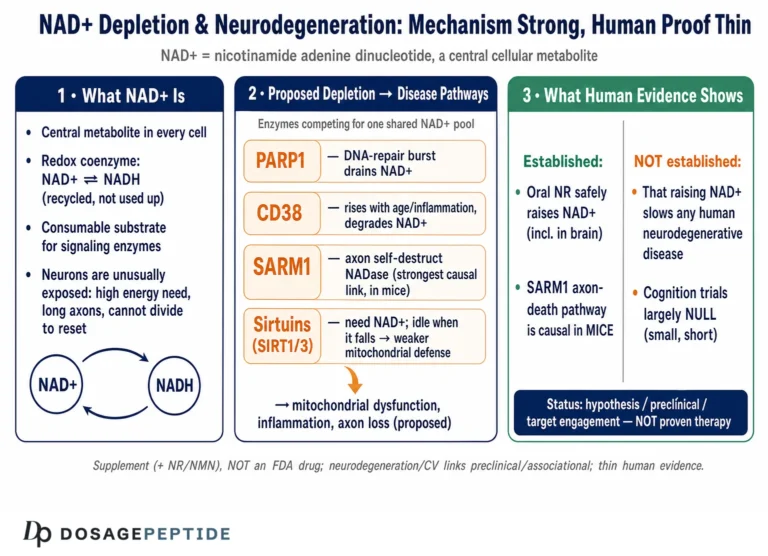
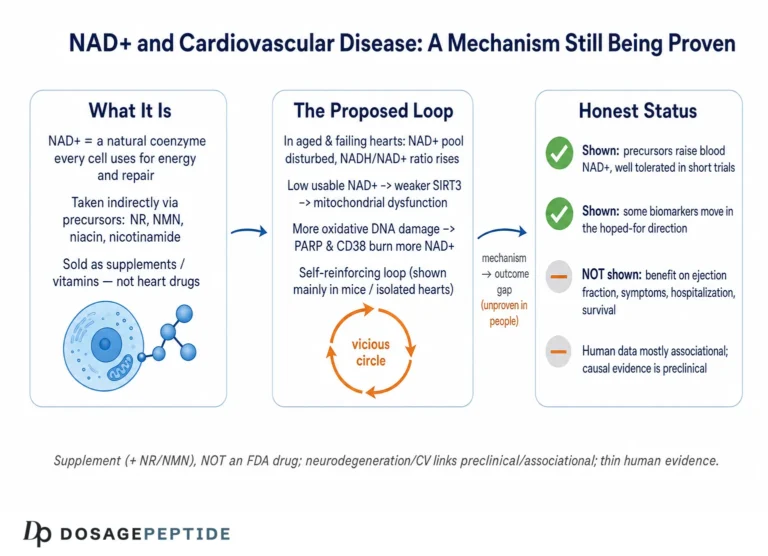
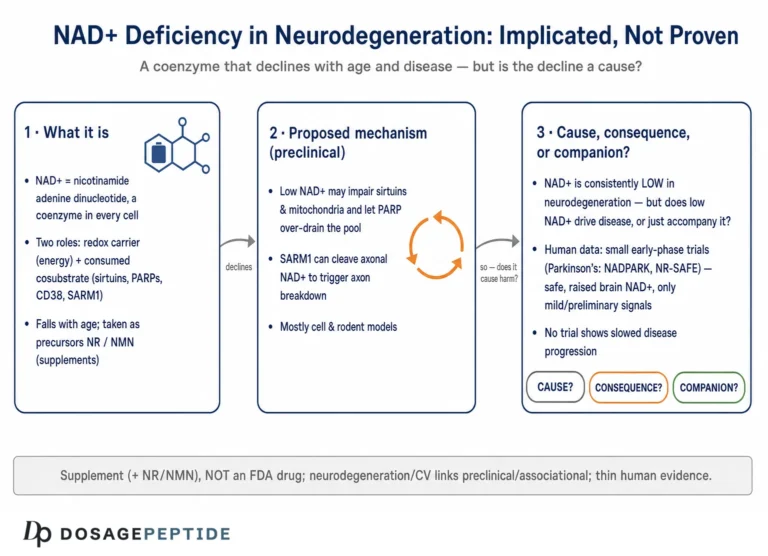
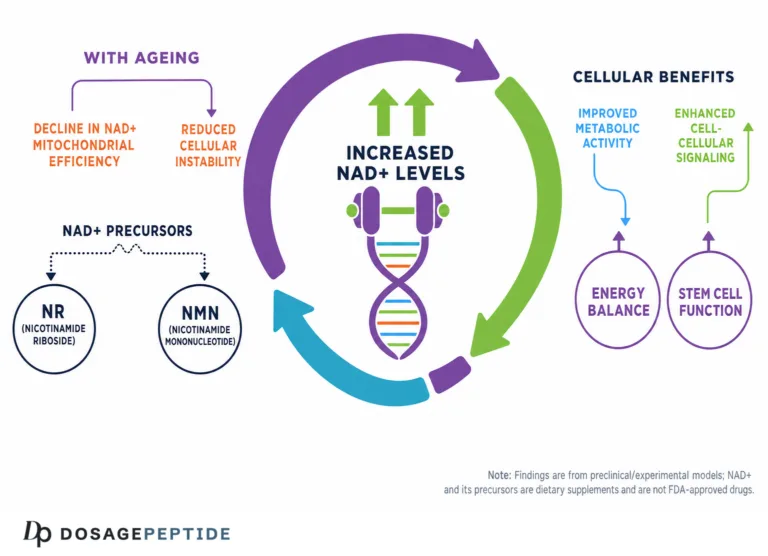
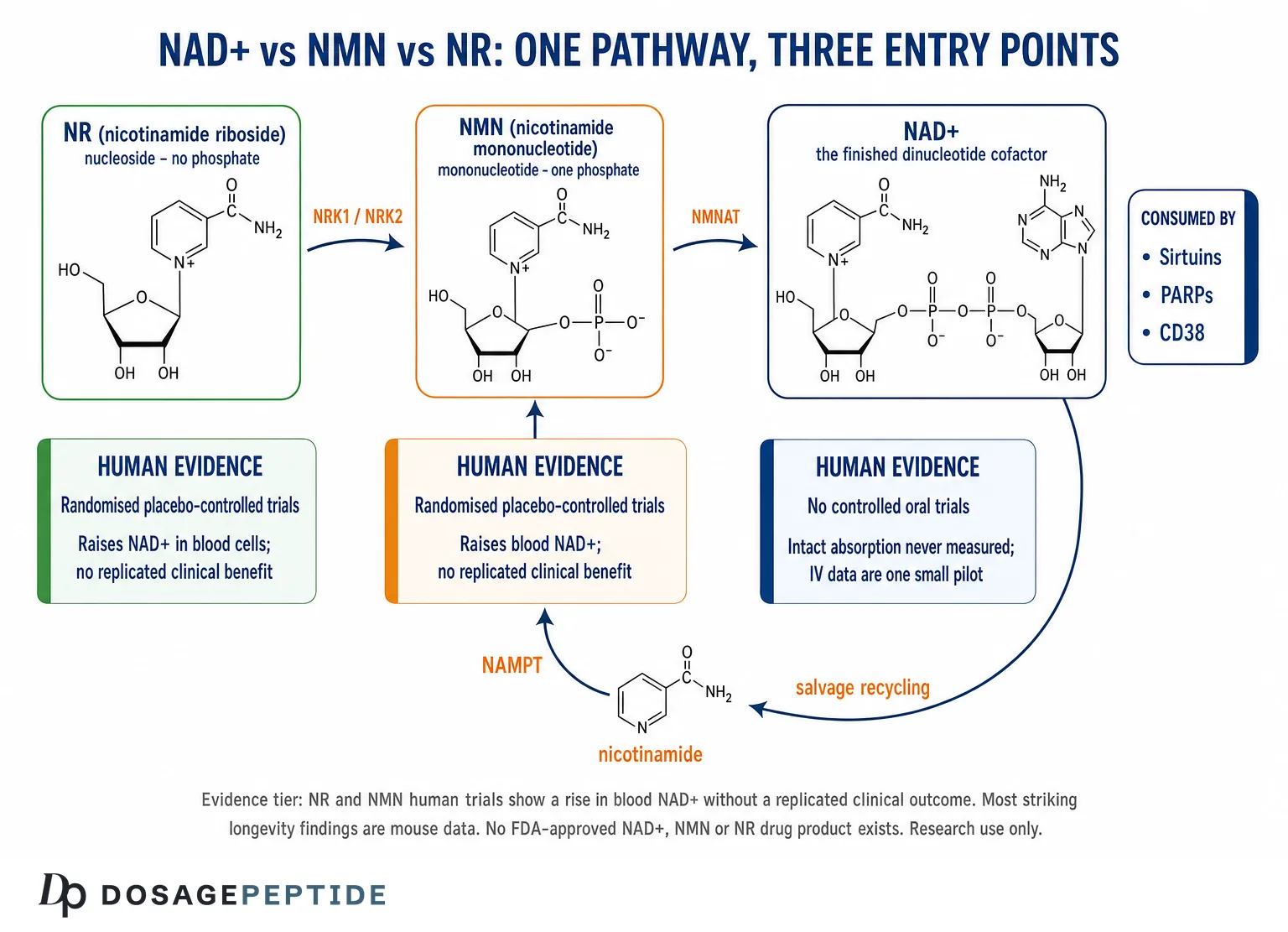
The short answer on NAD+ vs NMN is that they are not competing products but three different points on the same biochemical assembly line: NAD+ is the finished cofactor, NMN is the molecule one enzymatic step upstream of it, and nicotinamide riboside (NR) is one step upstream of NMN. In humans, the three differ far more in what has actually been measured than in what they theoretically do — oral NAD+ itself has essentially no controlled human evidence, while NMN and NR both have randomized trials that reliably raise blood NAD+ without yet demonstrating a clinical benefit that replicates.
Which one has the strongest case? On the evidence as it stands, NR has been characterised in humans the most, NMN has the newest trials, and oral NAD+ has almost none. All three move blood NAD+ far more reliably than they move any clinical endpoint. Every comparison below states its evidence tier.
Decision table: NAD+ vs NMN vs NR at a glance
| Attribute | NAD+ (nicotinamide adenine dinucleotide) | NMN (nicotinamide mononucleotide) | NR (nicotinamide riboside) |
|---|---|---|---|
| What the molecule is | The finished dinucleotide cofactor itself. Two nucleotides joined by a pyrophosphate bridge. | A mononucleotide: nicotinamide + ribose + one phosphate group. | A nucleoside: nicotinamide + ribose, no phosphate. |
| Position in the salvage pathway | End product. Consumed by sirtuins, PARPs and CD38, regenerating nicotinamide. | One step upstream. NMNAT enzymes convert NMN to NAD+. | Two steps upstream. NRK1/NRK2 phosphorylate NR to NMN, which is then converted to NAD+. |
| Molecular weight | 663.4 g/mol (free acid) | 334.2 g/mol | 255.3 g/mol as the free cation; ~290.7 g/mol as the chloride salt used commercially |
| Oral bioavailability evidence | No evidence the intact dinucleotide is absorbed, and no tracer study has tested oral NAD+ itself. Isotope-tracer work in mice shows that the smaller precursors NR and NMN are already degraded to nicotinamide in the liver when given orally[1], which makes intact absorption of the much larger dinucleotide implausible — but that is inference, not measurement. | Orally administered NMN is metabolised to nicotinamide in the liver in mice[1]; in cell systems extracellular NMN must first be dephosphorylated to NR before uptake[2]. | Same first-pass fate in mice[1], yet oral NR raises NAD+ in human peripheral blood mononuclear cells by roughly 60% at 1 g/day[3]. |
| Route studied in humans | Intravenous, in one small pilot infusion study with a 3-participant saline comparator[4]. No controlled oral trials. | Oral only, in randomized placebo-controlled trials[5]. | Oral only, in randomized placebo-controlled trials[3]. |
| US regulatory status (2026) | No FDA-approved NAD+ drug product for any indication. NAD+ does not appear on FDA’s 503B bulk drug substances list, so an injectable NAD+ product compounded by a registered outsourcing facility is not eligible for the section 503B exemptions; FDA issued a warning letter on exactly that basis in January 2026[6]. | Lawful as a dietary supplement again. FDA reversed its 2022 drug-preclusion exclusion in letters dated 29 September 2025, concluding NMN was marketed as a supplement before any IND authorization[7]. | Dietary-supplement ingredient throughout. NR chloride is the subject of New Dietary Ingredient notifications and an FDA GRAS notice that FDA closed with a no-questions response[8]. |
| Strength of human evidence | Very weak. One pilot study, 8 participants infused and 3 given saline, all men aged 30–55, no clinical endpoint[4]. | Moderate but thin. Several small RCTs of 8 to 10 weeks, largest n = 80[5][9]. | Strongest of the three. Multiple RCTs, longest 12 weeks, with muscle biopsies[10] and a hyperinsulinemic-euglycemic clamp[11], plus a 2 × 6-week crossover[3]. |
| What human trials actually measured | Plasma and urine NAD+ metabolite concentrations during a 6-hour infusion. Nothing else[4]. | Blood NAD+ concentration; muscle insulin sensitivity by clamp in one trial[5]; six-minute walk distance and questionnaire scores in another[9]. | Blood and muscle NAD+ metabolome, blood pressure, arterial stiffness, mitochondrial respirometry, muscle transcriptome, inflammatory cytokines[3][10]. |
The single most important pattern in that table: for the two precursors with controlled oral trials, the endpoint that moves consistently is a blood NAD+ concentration. Clinical endpoints — blood pressure, insulin sensitivity, walking distance, mitochondrial function — either did not move, moved in one trial and not another, or were never measured at all. That distinction is the whole argument, and it is examined in more depth in the review of what the evidence shows about NAD+ supplements and aging.
NAD+ itself: why the intact cofactor is the least studied option
NAD+ is a dinucleotide of 663.4 g/mol carrying two phosphate groups and a full adenine nucleotide. It is large, charged, and chemically fragile at the pyrophosphate bridge. There is no published evidence that the intact molecule crosses the intestinal epithelium in humans. Isotope-tracer flux work in mice showed that NR and NMN given orally were degraded to nicotinamide in the liver, while the same compounds given intravenously did reach multiple tissues intact[1]. That is a mouse result about two smaller molecules, not about NAD+ itself; it is the closest mechanistic evidence available, and the extension to oral NAD+ is an inference.
Human data on injected or infused NAD+ are extremely thin. The one published characterisation is a pilot study in which eight participants received a 6-hour intravenous NAD+ infusion at 3 µmol/min while three further participants received saline over the same period, with plasma and urine NAD+ metabolites tracked[4]. All eleven were men aged 30–55. The comparator arm was three people, the study was not blinded or powered for comparison, and no clinical outcome was measured. Its finding was pharmacokinetic and somewhat counterintuitive: plasma NAD+ did not rise for the first two hours, consistent with rapid extraction and breakdown by NAD+ glycohydrolase and pyrophosphatase activity. Everything else circulating in the wellness-clinic literature about IV NAD+ is uncontrolled case reporting.
Because injectable NAD+ is compounded from a bulk substance FDA does not treat as eligible for compounding under section 503B, formulation, concentration and endotoxin control vary widely between preparations. The January 2026 warning letter to a Florida outsourcing facility cited exactly this: the firm compounded with NAD+ although it is not on the 503B bulks list, and a single NAD+ lot was found to contain 3,360 EU/mL of bacterial endotoxin after three patients who received that vial developed low blood pressure, uncontrollable shaking and body aches and were sent to the emergency room[6]. The site’s reference pages on the 500 mg / 10 mL NAD+ vial format and the 1000 mg NAD+ vial format document what those research-grade presentations actually contain. Reported tolerability signals, most of them from uncontrolled settings, are collected separately under documented NAD+ side-effect reports.
NMN: the immediate precursor with the newest human trials
NMN sits one enzymatic step from NAD+: nicotinamide mononucleotide adenylyltransferases (NMNAT1–3) add the adenylyl group and the reaction is done. That proximity is the entire marketing premise for NMN, and it is biochemically real. Whether it translates into a pharmacokinetic advantage in a whole organism is a separate question, dealt with below.
The most cited efficacy trial is a 10-week, randomized, placebo-controlled, double-blind study of 250 mg/day oral NMN in postmenopausal women with prediabetes who were overweight or obese[5]. Insulin-stimulated glucose disposal measured by hyperinsulinemic-euglycemic clamp increased in the NMN group and did not change with placebo, alongside increased skeletal muscle AKT and mTOR phosphorylation. It is a genuine clinical endpoint measured by a gold-standard method. It is also a single trial in a narrow population, and the authors themselves noted that other parameters — body composition, intra-abdominal fat, liver fat, blood pressure and circulating glucose, insulin, lipids, adiponectin and leptin — did not change.
The largest NMN trial is a 60-day, multicentre, dose-ranging RCT in 80 healthy middle-aged adults[9]. Blood NAD+ rose significantly at 300, 600 and 900 mg/day, six-minute walk distance increased versus placebo (p<0.01 at days 30 and 60), and SF-36 self-reported health scores improved — while HOMA-IR showed no significant difference from placebo at day 60. Two of those three positive endpoints are subjective or effort-dependent, and the trial was funded by NMN commercial interests, with the lead author employed by one of the funders. That should temper how much weight the walking-distance result carries.
Separately, a pharmaceutical-grade microcrystalline NMN formulation (MIB-626) is being developed as an investigational drug, not a supplement, with registered phase 1 and phase 2 trials in indications such as diabetic kidney disease (ClinicalTrials.gov NCT05759468). No NMN product is FDA-approved for any indication.
NR: the most extensively characterised NAD+ precursor in humans
Nicotinamide riboside is the smallest of the three at 255.3 g/mol as the free cation, and it enters the salvage pathway through NRK1/NRK2 phosphorylation. Its human evidence base is the deepest, largely because it reached the supplement market earlier and attracted academic trial funding.
The reference trial is a 2 × 6-week randomized, double-blind, placebo-controlled crossover study of 1 g/day NR in healthy middle-aged and older adults[3]. NR was well tolerated and effectively stimulated NAD+ metabolism, raising NAD+ in peripheral blood mononuclear cells by roughly 60% versus placebo; NAD+ was undetectable in plasma and urine in that study, which is why the cellular compartment was used. On clinical endpoints the authors were careful: they described their blood-pressure and arterial-stiffness observations as an initial signal warranting further assessment, not as a demonstrated benefit. That framing is frequently dropped when the study is quoted second-hand.
A 21-day crossover trial gave 1 g/day NR to twelve aged men with muscle biopsies before and after[10]. NR raised the muscle NAD+ metabolome and lowered circulating inflammatory cytokines, but mitochondrial bioenergetics were unchanged and the muscle transcriptome showed downregulation of energy-metabolism and mitochondrial pathways — the opposite direction from the rodent narrative.
The most instructive result is a null one. A 12-week randomized, placebo-controlled, parallel-group trial gave 1000 mg NR twice daily to 40 obese, insulin-resistant men and assessed insulin sensitivity by hyperinsulinemic-euglycemic clamp, substrate metabolism by indirect calorimetry with labelled tracers, body composition by DXA and MRI, and intrahepatic lipid by MR spectroscopy[11]. Nothing improved. Insulin sensitivity, endogenous glucose production, glucose disposal and oxidation, resting energy expenditure, lipolysis, lipid oxidation and body composition were all unaffected; safety bloods were normal. A companion analysis in the same cohort found no change in skeletal muscle mitochondrial respiration, content or morphology, and no change in muscle NAD+ metabolite concentrations[11]. This is the longest NR trial with a hyperinsulinemic-euglycemic clamp endpoint, and it was negative.
Anyone comparing NAD+ vs NMN vs NR who cites the positive NMN clamp study[5] without also citing the negative NR clamp study[11] is presenting half the record. The disease-specific context where NAD+ availability is most clearly mechanistically relevant is reviewed separately under NAD+ homeostasis in mitochondrial myopathies.
How does NMN actually get into cells, and is the transporter real?
This is where the “NMN is closer to NAD+, so it must work better” argument runs into trouble. Work in mammalian cell systems using stable-isotope-labelled compounds showed that extracellular NMN is dephosphorylated to NR outside the cell, taken up as NR, and re-phosphorylated inside — with NRK1 necessary and rate-limiting for the use of both NMN and NR[2]. If that is the dominant route in vivo, NMN and NR converge on the same intracellular molecule and the “one step closer” advantage disappears.
The counter-claim is the reported identification of Slc12a8 as a specific NMN transporter, highly expressed in the murine small intestine, sodium-dependent, transporting NMN but not NR. That finding is contested and has never been settled: a formal rebuttal published in the same journal argued that the analytical methods, transport data and interpretation did not support NMN transport by Slc12a8, the original authors replied defending their assignment, and the original paper also carries an author correction[12]. Both the original claim and the rebuttal concern mouse tissue and cell systems. No human study has demonstrated a dedicated NMN uptake route.
The honest position, therefore, is that the mechanistic premise most often used to argue NMN is superior to NR remains unresolved at the preclinical level and untested in humans.
What the head-to-head evidence does and does not support
Until 2026 every NMN-versus-NR comparison in circulation was indirect: cross-trial inference between studies with different doses, durations, populations, assays and funding sources. Two 2026 trials changed that. A randomized, open-label, placebo-controlled study in 65 healthy adults gave nicotinamide, NR or NMN for 14 days and found that NR and NMN raised circulatory NAD+ comparably, while nicotinamide did not[13]. A phase 1 pharmacokinetic study then ran a randomized crossover in six healthy adults, giving each of them 1,200 mg/day of NR and of NMN in turn, before following twelve participants — six of them with Parkinson’s disease — on NR for four weeks with cerebral NAD+ measured by magnetic resonance spectroscopy; blood NAD+ rose slowly and plateaued at roughly two weeks, and cerebral NAD+ moved only after four weeks[14]. Both are small and both are pharmacokinetic — neither compared clinical endpoints, and no trial has yet placed intravenous NAD+ in the same comparison.
What the evidence does support
- Oral NR and oral NMN both raise circulatory NAD+ concentrations in humans, reproducibly, in placebo-controlled designs, and by a comparable amount when tested side by side in the same cohort[13].
- Both have been well tolerated in the trials conducted so far, at up to 2 g/day for NR over 12 weeks[11] and up to 900 mg/day for NMN over 60 days[9]. These are small, short studies; tolerability is not the same as long-term safety.
- NR reaches aged human skeletal muscle and alters the muscle NAD+ metabolome and inflammatory cytokine profile[10].
- In mice, 12 months of oral NMN mitigated multiple age-associated physiological changes — body weight gain, energy metabolism, insulin sensitivity, plasma lipids, eye function — without obvious toxicity[15]. This is the study that generated most of the public enthusiasm. It is a rodent study, and no human trial of comparable duration exists.
What the evidence does not support
- Any claim that one precursor produces a clinical benefit the other does not. The only direct human comparisons measured NAD+ concentrations, not clinical outcomes[13][14].
- Any claim that raising blood NAD+ produces a clinical benefit. The trial with the most tightly controlled hard metabolic endpoint was negative[11], and the trials that were positive measured different endpoints in different populations.
- Any claim that oral NAD+ delivers NAD+ to tissues. There is no human evidence of intact absorption, and the tracer evidence against it is preclinical and was generated with NR and NMN rather than NAD+[1].
- Any claim that IV NAD+ has demonstrated efficacy. The only published human infusion characterisation compared eight infused participants against three saline controls and measured no clinical endpoint[4].
- Any anti-aging or lifespan claim in humans. The most-cited supporting study is a 12-month healthspan study in mice, and it did not measure lifespan[15]. The same evidence-tier gap applies to most compounds studied under the longevity heading, including the telomerase and aging research literature around epithalon.
Regulatory status is not evidence of efficacy
It is worth separating two things that are routinely conflated. NR’s uninterrupted dietary-supplement status rests on New Dietary Ingredient notifications and a GRAS notice that FDA closed in August 2016 with a no-questions response[8] — these are safety and lawful-marketing determinations, not efficacy approvals. NMN’s return to lawful supplement status in the United States followed FDA’s reversal of its 2022 drug-preclusion position: in letters dated 29 September 2025 responding to citizen petitions, and again in letters dated 2 December 2025 to the two NDI notifiers concerned, SyncoZymes and Inner Mongolia Kingdomway Pharmaceutical, the agency concluded that NMN is not excluded from the dietary supplement definition because it had been marketed as a supplement before any investigational new drug authorization[7]. That determination is about statutory classification under 21 U.S.C. § 321(ff)(3)(B). It says nothing whatsoever about whether NMN works.
Frequently Asked Questions
Has anyone compared NMN and NR head-to-head in the same people?
Yes, as of 2026. A randomized, placebo-controlled trial in 65 healthy adults gave nicotinamide, NR or NMN for 14 days and found NR and NMN raised circulatory NAD+ comparably, while nicotinamide did not. A phase 1 pharmacokinetic study separately ran a crossover in six healthy adults who received 1,200 mg/day of NR and of NMN in turn. Both compared NAD+ concentrations rather than clinical outcomes, and neither included intravenous NAD+.
Is NMN better than NAD+ for raising NAD+ levels?
For oral administration, NMN has controlled human trials showing a rise in blood NAD+, and oral NAD+ has none. Preclinical tracer work indicates that even the smaller precursors are broken down before reaching tissues. So the comparison is not close on evidence quantity — but a rise in blood NAD+ is a biomarker, and no trial has shown that this biomarker change produces a clinical benefit.
What is the difference between NMN and NR chemically?
NR is a nucleoside: nicotinamide attached to ribose. NMN is that same structure with a phosphate group added, making it a mononucleotide of 334.2 g/mol versus 255.3 for the NR cation. NR is converted to NMN inside cells by nicotinamide riboside kinases, so NR is one enzymatic step further from NAD+ than NMN is.
Does NMN have a dedicated transporter into cells?
This is unresolved. A 2019 mouse study reported that Slc12a8 is a specific NMN transporter in the small intestine. A rebuttal in the same journal argued the data did not support that conclusion, and the original authors replied in defence. Separate cell-system work indicates extracellular NMN is dephosphorylated to NR before uptake. No human data exist either way.
Is NMN legal to sell as a dietary supplement in the US in 2026?
FDA reversed its 2022 exclusion of NMN under the drug-preclusion clause, concluding in letters dated 29 September 2025 that NMN is not excluded from the dietary supplement definition, and confirming this to two NDI notifiers on 2 December 2025. NMN remains a new dietary ingredient, so a marketer still needs a valid NDI notification on file or must source from a supplier that has one — the reversal removed a categorical bar, it did not create blanket permission. Sources still describing NMN as banned are reporting a superseded 2022-era position.
Why do some NAD+ precursor trials show benefits and others show nothing?
Because they measured different things in different people. The positive NMN clamp trial studied prediabetic postmenopausal women for 10 weeks; the negative NR clamp trial studied obese insulin-resistant men for 12 weeks. Different populations, different molecules, different doses. Small trials with many measured endpoints also generate positive results by chance, which is why replication matters more than any single result.
Does intravenous NAD+ have clinical trial evidence in humans?
Almost none. The one published pharmacokinetic characterisation was a pilot in eight men receiving a 6-hour infusion against three saline controls, with plasma and urine metabolites as the only outcomes. The control arm was three people and there was no clinical endpoint. Claims about IV NAD+ for addiction, fatigue or cognition rest on uncontrolled reports, not randomized trials.
Is any NAD+ precursor FDA-approved as a drug?
No. Neither NAD+, NMN nor NR is an FDA-approved drug product for any indication. NR and NMN are regulated as dietary supplement ingredients. NAD+ is not on FDA’s 503B list of bulk drug substances eligible for compounding by outsourcing facilities. A pharmaceutical-grade NMN formulation is in registered phase 1 and phase 2 investigational trials, which means it is under study, not approved.
How much does blood NAD+ actually rise in human trials?
In the crossover NR trial, 1 g/day for six weeks raised NAD+ in peripheral blood mononuclear cells by roughly 60% versus placebo; NAD+ was undetectable in plasma in that study. In the 60-day NMN dose-ranging trial, blood NAD+ rose significantly at 300, 600 and 900 mg/day, with the largest increases in the 600 mg and 900 mg arms. Magnitude varies with the compartment sampled and the assay method, which complicates cross-trial comparison.
References
- Liu L, Su X, Quinn WJ, et al. Quantitative Analysis of NAD Synthesis-Breakdown Fluxes. Cell Metabolism. 2018;27(5):1067-1080.e5. PMID 29685734
- Ratajczak J, Joffraud M, Trammell SAJ, et al. NRK1 controls nicotinamide mononucleotide and nicotinamide riboside metabolism in mammalian cells. Nature Communications. 2016;7:13103. PMID 27725675
- Martens CR, Denman BA, Mazzo MR, et al. Chronic nicotinamide riboside supplementation is well-tolerated and elevates NAD+ in healthy middle-aged and older adults. Nature Communications. 2018;9(1):1286. PMID 29599478
- Grant R, Berg J, Mestayer R, et al. A Pilot Study Investigating Changes in the Human Plasma and Urine NAD+ Metabolome During a 6 Hour Intravenous Infusion of NAD+. Frontiers in Aging Neuroscience. 2019;11:257. PMID 31572171
- Yoshino M, Yoshino J, Kayser BD, et al. Nicotinamide mononucleotide increases muscle insulin sensitivity in prediabetic women. Science. 2021;372(6547):1224-1229. PMID 33888596
- US Food and Drug Administration, Center for Drug Evaluation and Research. Warning Letter, GenoGenix LLC, MARCS-CMS 718739, 20 January 2026. fda.gov
- Venable LLP. FDA Declares Nicotinamide Mononucleotide Is a Dietary Supplement. October 2025. venable.com. Follow-up reporting on the 2 December 2025 letters to the two NDI notifiers: Daniells S. FDA reinstates NDI status of NMN with new letters to ingredient players. NutraIngredients-USA, 9 December 2025. nutraingredients.com
- US Food and Drug Administration. Agency Response Letter, GRAS Notice No. GRN 000635 (nicotinamide riboside chloride, ChromaDex Inc.), closed 3 August 2016 with no questions. fda.gov
- Yi L, Maier AB, Tao R, et al. The efficacy and safety of β-nicotinamide mononucleotide (NMN) supplementation in healthy middle-aged adults: a randomized, multicenter, double-blind, placebo-controlled, parallel-group, dose-dependent clinical trial. GeroScience. 2023;45(1):29-43. PMID 36482258
- Elhassan YS, Kluckova K, Fletcher RS, et al. Nicotinamide Riboside Augments the Aged Human Skeletal Muscle NAD+ Metabolome and Induces Transcriptomic and Anti-inflammatory Signatures. Cell Reports. 2019;28(7):1717-1728.e6. PMID 31412242
- Dollerup OL, Christensen B, Svart M, et al. A randomized placebo-controlled clinical trial of nicotinamide riboside in obese men: safety, insulin-sensitivity, and lipid-mobilizing effects. American Journal of Clinical Nutrition. 2018;108(2):343-353. PMID 29992272. Companion analysis in the same cohort: Dollerup OL, Chubanava S, Agerholm M, et al. Nicotinamide riboside does not alter mitochondrial respiration, content or morphology in skeletal muscle from obese and insulin-resistant men. Journal of Physiology. 2020;598(4):731-754. PMID 31710095
- Grozio A, Mills KF, Yoshino J, et al. Slc12a8 is a nicotinamide mononucleotide transporter. Nature Metabolism. 2019;1(1):47-57. PMID 31131364. Rebuttal: Schmidt MS, Brenner C. Absence of evidence that Slc12a8 encodes a nicotinamide mononucleotide transporter. Nature Metabolism. 2019;1(7):660-661. PMID 32694648
- Christen S, Redeuil K, Goulet L, et al. The differential impact of three different NAD+ boosters on circulatory NAD and microbial metabolism in humans. Nature Metabolism. 2026;8(1):62-73. PMID 41540253
- Berven H, Svensen M, Eikeland H, et al. The NAD-brain pharmacokinetic study of NAD augmentation in blood and brain using oral precursor supplementation. iScience. 2026;29(3):114764. PMID 41858901
- Mills KF, Yoshida S, Stein LR, et al. Long-Term Administration of Nicotinamide Mononucleotide Mitigates Age-Associated Physiological Decline in Mice. Cell Metabolism. 2016;24(6):795-806. PMID 28068222
This article is provided strictly for research and educational reference. NAD+, nicotinamide mononucleotide and nicotinamide riboside are discussed here as research compounds and, where applicable, as dietary-supplement ingredients; none is an FDA-approved drug for any indication, and nothing on this page is a treatment recommendation, a dosing protocol for human use, or a claim that any of these compounds diagnoses, treats, cures or prevents any disease. Dosagepeptide.com is an independent reference library and does not sell any compound discussed. Research-use-only materials are not for human or veterinary consumption.