Short answer: AOD-9604 has a coherent fat-burning mechanism and a disappointing human record. In rodent and cell studies the fragment increases fat breakdown and reduces fat storage without raising IGF-1 or disturbing glucose tolerance. In humans it was tested seriously — roughly six trials, more than 900 participants — and the pivotal one failed.
That distinction explains a figure you will see quoted everywhere. The often-repeated “2.6 kg more than placebo” comes from METAOD005, a 12-week Phase 2 study whose encouraging signal generated the press coverage. The trial that actually settled the question was METAOD006: 24 weeks, randomized, double-blind, placebo-controlled, around 500 obese adults on a diet-and-exercise background — and it showed no statistically significant weight-loss difference versus placebo at its primary endpoint. Metabolic Pharmaceuticals halted the obesity program in 2007. Anyone quoting the 12-week number without the 24-week result is quoting half the story.
This page explains the mechanism in real detail — how growth hormone drives lipolysis, which part of it AOD-9604 reproduces, and the β3-adrenergic question — then follows the evidence honestly from rodent fat cells to the human endpoints where it stopped working. Research use only: AOD-9604 is not an approved weight-loss drug.
What AOD-9604 Is: A Lipolytic Fragment by Design
To understand the mechanism, you first have to understand the molecule’s architecture, because the design encodes the intent. AOD-9604 corresponds to residues 177–191 of the C-terminal region of the 191-amino-acid human growth hormone molecule, with one deliberate modification: a tyrosine residue is added at the N-terminus to improve the fragment’s stability and handling.1 The resulting sequence carries a disulfide bridge between two cysteine residues that reproduces the small loop found in the parent hormone’s lipolytic domain — a structural detail that matters, because that loop was thought to carry much of growth hormone’s fat-mobilizing signal.
The compound originated at Monash University in Melbourne, Australia, and was developed commercially by Metabolic Pharmaceuticals Limited. The scientific logic was elegant and, on paper, compelling. Full-length growth hormone does many things at once: it drives longitudinal bone growth, raises circulating IGF-1, alters glucose handling, and, as a separable action, promotes the breakdown of stored triglyceride. Decades of endocrine research had localized much of the lipolytic activity to the C-terminal portion of the molecule. The hope was that a short peptide reproducing only that region could deliver the fat-burning signal while leaving behind the effects that make chronic growth-hormone exposure problematic — particularly the rise in IGF-1 and the deterioration in insulin sensitivity and glucose tolerance.1
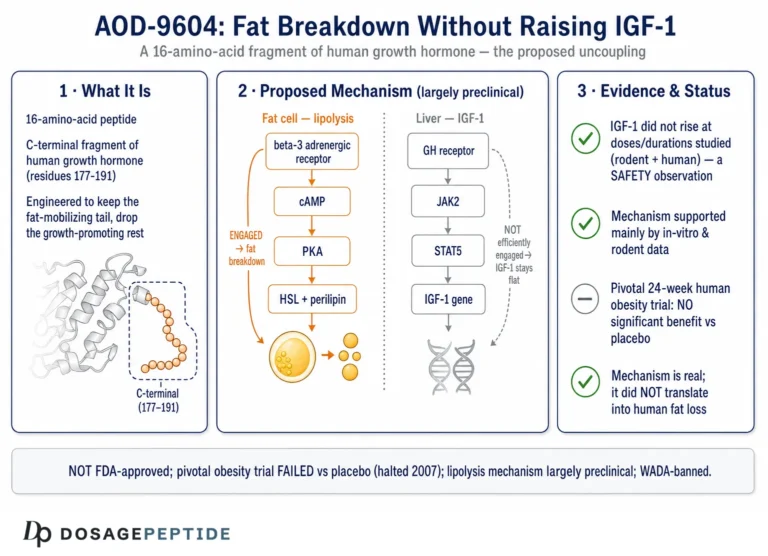
The earliest metabolic studies reported exactly that separation: AOD-9604 reproduced the lipolytic and fat-oxidizing actions of hGH in adipose tissue and in obese-rodent models without raising IGF-1 or impairing glucose tolerance.1 That selectivity became the compound’s defining feature. It is why educational protocol pages consistently frame AOD-9604 as a fat-metabolism research compound rather than an anabolic one, and it is the reason the lipolysis question sits at the center of everything written about it. For readers who want the clinical-outcomes companion to this mechanistic account, the site’s overview of what clinical trials indicate about the fat-burning potential of AOD-9604 covers the human efficacy record in more depth.
One habit of mind is worth adopting before we go further, because it prevents most of the confusion that surrounds this compound. Keep three levels of biology distinct: the parent hormone (full-length hGH, with broad endocrine effects), the lipolytic domain (the C-terminal region thought to carry the fat-mobilizing signal), and the engineered fragment (AOD-9604, a stabilized reproduction of that domain). Each step narrows the biology. When popular writing reasons from “growth hormone burns fat and builds tissue” straight to “this fragment does everything growth hormone does,” it collapses those three levels and ignores the deliberate narrowing that defines the molecule. AOD-9604 was built to isolate one action. Whether it succeeds at even that is the substance of this article.
How Growth Hormone Drives Lipolysis — the Biology AOD-9604 Borrows
Because AOD-9604 is a growth-hormone fragment, its proposed mechanism is best understood against the backdrop of how the intact hormone mobilizes fat. Growth hormone is one of the body’s principal lipolytic signals, and its effects on adipose tissue have been characterized in far more detail than anything specific to AOD-9604.2 Understanding that parent biology is what lets us judge which parts of the AOD-9604 story are well-founded and which are extrapolation.
At the level of the fat cell, lipolysis is the enzymatic dismantling of stored triglyceride into glycerol and free fatty acids. It proceeds through a sequential cascade of lipases: adipose triglyceride lipase (ATGL) performs the rate-limiting first cut, hormone-sensitive lipase (HSL) handles the second, and monoacylglycerol lipase completes the job.2 The classic acute trigger is catecholamine signaling through beta-adrenergic receptors, which raises intracellular cyclic AMP (cAMP), activates protein kinase A (PKA), and drives PKA to phosphorylate HSL — prompting its translocation to the lipid droplet where hydrolysis occurs. This cAMP–PKA–HSL axis is the textbook engine of stimulated lipolysis.
Growth hormone’s contribution is more layered and, importantly, slower. Rather than acting purely as an acute cAMP-raising stimulus, growth hormone appears to sensitize adipose tissue to lipolysis over hours, in part by increasing the expression of lipolytic machinery and by suppressing anti-lipolytic signals.2 More recent work has clarified one striking pathway: growth hormone signaling activates the MEK–ERK cascade, which phosphorylates and inactivates the transcription factor PPARγ, downregulating fat-specific protein 27 (FSP27, also called CIDEC). Because FSP27 normally restrains lipolysis by stabilizing the lipid droplet, its downregulation releases the brake and increases free-fatty-acid output.3 Growth hormone has also been reported to increase de novo expression of HSL. The net picture is of a hormone that both flips acute switches and remodels the fat cell’s lipolytic set-point over time.
It is worth pausing on the FSP27 pathway because it illustrates how much more complex growth-hormone lipolysis is than the simple “receptor raises cAMP” cartoon, and therefore how much a fragment might fail to reproduce. FSP27 (CIDEC) is a lipid-droplet-coating protein whose job is to promote unilocular lipid-droplet formation and to restrain lipolysis; when growth hormone downregulates it via the PPARγ route, the droplet becomes more accessible to lipases and free-fatty-acid release rises.3 This is a transcriptional, hours-to-days mechanism layered on top of the acute cAMP/PKA switch, and it depends on an intact growth-hormone receptor signaling apparatus. A 16-amino-acid fragment that, as we will see, does not engage the growth-hormone receptor in the classical way is unlikely to reproduce this transcriptional remodeling faithfully — which is one reason the fragment’s lipolytic effect, real as it appears in rodents, may be a partial and mechanistically distinct echo of the parent hormone’s rather than a full copy. The lesson is that “AOD-9604 does what growth hormone does to fat” is an overstatement even at the level of basic cell biology.
Two features of growth-hormone lipolysis matter for the AOD-9604 story. First, growth hormone’s fat-mobilizing effect is coupled, in the intact hormone, to metabolically costly side effects: the same signaling that liberates fatty acids also raises circulating IGF-1 and can worsen insulin sensitivity, which is precisely why chronic growth-hormone administration is not a benign way to lose fat. Second, growth-hormone lipolysis is not simple to reproduce experimentally — some studies find robust lipolytic effects in whole animals or in vivo that are harder to replicate in isolated adipocyte culture, hinting that part of the effect is indirect or requires an intact physiological context.2 Both features frame the central promise and the central difficulty of AOD-9604: the aspiration was to keep growth hormone’s lipolytic benefit while discarding its liabilities, but a fragment that captures only part of a complex, partly-indirect signal may capture only part of the effect.
The Proposed Lipolytic Mechanism of AOD-9604
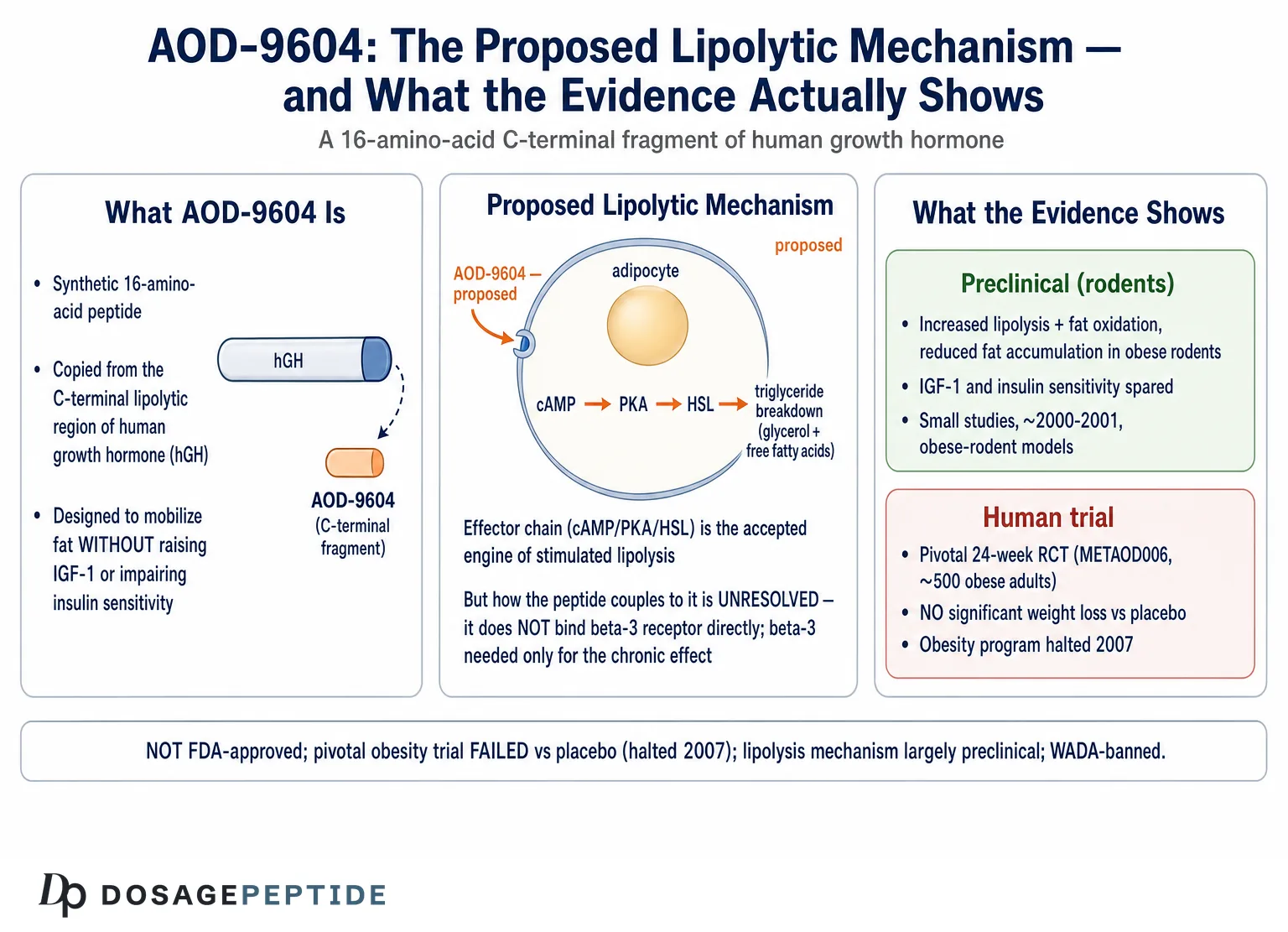
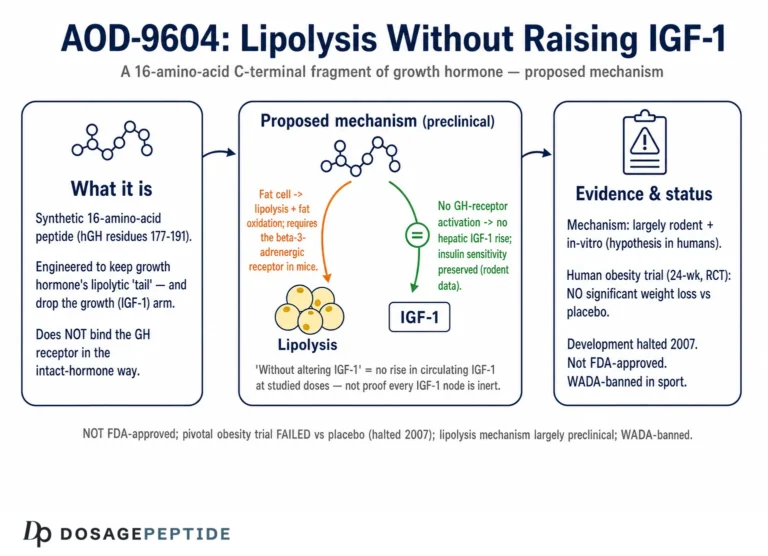
Now to the compound itself. The proposed mechanism of AOD-9604 centers on the adipocyte and can be stated in two linked claims. First, the peptide promotes lipolysis — the breakdown of stored triglyceride into free fatty acids and glycerol. Second, it dampens lipogenesis — the synthesis and storage of new fat. The net effect reported in rodent models was reduced fat accumulation and increased whole-body fat oxidation, achieved without the IGF-1 elevation that accompanies full growth-hormone administration.1 This dual push-pull on fat storage, decoupled from the anabolic arm of growth-hormone biology, is the essence of the compound’s design.
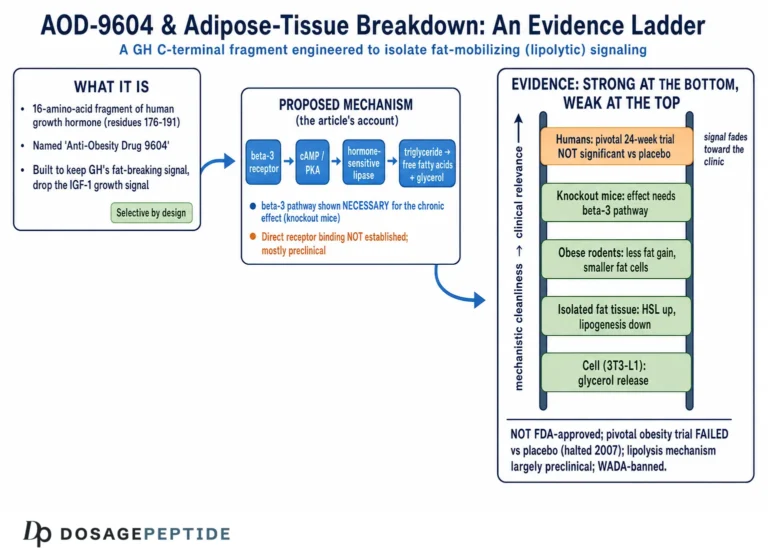
The molecular detail most often repeated online runs like this: AOD-9604 binds the beta-3 adrenergic receptor (β3-AR) on the fat-cell membrane, activating adenylyl cyclase, raising cAMP, activating PKA, and phosphorylating HSL to drive triglyceride hydrolysis. Some in vitro reports do describe elevated cAMP and increased HSL phosphorylation in adipocyte models following AOD-9604 exposure. But this tidy cascade must be handled with real care, because the primary evidence tells a more nuanced and less receptor-simple story than the marketing shorthand implies. The strongest genetic evidence — discussed in detail in the next section — actually indicates that AOD-9604’s lipolytic action is not mediated by direct binding to the β3-AR, even though β3-AR expression is involved in the chronic response.4 The confident “AOD-9604 binds β3” sentence that circulates on vendor pages is, at best, an oversimplification and, at worst, wrong about the direction of causation.
A more defensible way to state the mechanism is this. AOD-9604 appears to reproduce a portion of growth hormone’s lipolytic signaling in fat tissue — increasing lipolytic sensitivity, raising fat oxidation, and restoring suppressed β3-AR expression toward normal in obese animals — without engaging the growth-hormone receptor in the classical high-affinity way and without raising IGF-1.14 The intracellular cAMP/PKA/HSL machinery is almost certainly the effector arm, as it is for essentially all stimulated lipolysis, but exactly how the peptide couples to that machinery — which receptor or receptors it engages, whether the effect is direct on the adipocyte or partly systemic — is not resolved by the primary literature. Notably, one influential study found that AOD-9604 reduced body weight, increased fat oxidation, and raised plasma glycerol (an index of lipolysis) in obese mice despite not interacting with the growth-hormone receptor, which deepens rather than resolves the mechanistic mystery.4
The mechanistic honesty here cuts in a specific direction. There is enough primary data to say AOD-9604 does something to fat metabolism in rodents — the lipolytic and fat-oxidation readouts are real and reproduced across more than one study. What there is not, is a fully validated, receptor-level mechanism of the kind you could draw with confidence on a signaling diagram and defend from human data. Readers exploring how the same fragment has been proposed to act in entirely different tissues — the brain, for instance — can see a parallel example of preclinical-mechanism reasoning in the discussion of the molecular mechanisms proposed for AOD-9604 in obese phenotypes, where the same caution about extrapolating from limited data applies.
The Beta-3 Adrenergic Receptor Question: Necessary but Not the Whole Story
The single most informative mechanistic experiment on AOD-9604 is a knockout study, and it deserves careful reading because it is so often misquoted. Heffernan and colleagues treated obese wild-type mice and β3-AR knockout mice with human growth hormone and with AOD-9604, comparing the responses.4 The findings are worth separating into their component parts, because each part carries a different lesson.
In wild-type mice, both hGH and AOD-9604 induced weight loss and increased lipolytic sensitivity after chronic treatment. Both compounds also raised the suppressed levels of β3-AR messenger RNA in obese animals back toward the levels seen in lean mice — suggesting the peptide restores a lipolytic capacity that obesity had blunted.4 So far this looks like a β3-AR-centered story.
But the knockout arm complicates it. In β3-AR knockout mice, chronic hGH and AOD-9604 failed to produce the body-weight change and the increase in lipolysis seen in wild-type controls — establishing that the β3-AR is necessary for the sustained, chronic effect. Yet in an acute experiment, AOD-9604 still increased energy expenditure and fat oxidation in the very same knockout animals.4 The authors’ own conclusion is the one worth quoting in spirit: the lipolytic actions of hGH and AOD-9604 are not mediated directly through the β3-AR, even though both compounds increase β3-AR expression, which may in turn contribute to enhanced lipolytic sensitivity over time.
Read carefully, this dissolves the popular claim. AOD-9604 is not a β3-AR agonist in the way that, say, mirabegron is. The receptor is part of the machinery through which a chronic lipolytic phenotype is expressed — and its expression is upregulated by the peptide — but the peptide’s acute lipolytic and thermogenic effects can proceed without it. That leaves at least one β3-independent component of the acute response unexplained, and it means any signaling diagram showing AOD-9604 docking onto β3-AR as its primary target is not supported by the strongest available data. The correct mechanistic statement is subtler and less satisfying: the β3-AR is necessary for the chronic effect but is not the direct molecular target, and part of the acute effect is β3-independent through a route that has not been pinned down.
This is exactly the kind of nuance that gets sanded off in secondary sources. It is also a useful reminder that “mechanism” in the AOD-9604 literature means a partially-characterized set of associations in rodents, not a validated human pathway. For a working definition of terms like lipolysis, adrenergic receptor, and free fatty acid used throughout this discussion, the site’s peptide research glossary provides plain-language reference entries.
What the Preclinical Metabolic Studies Actually Showed
The preclinical record for AOD-9604 is small but internally consistent, and it is genuinely the strongest part of the compound’s evidence base. Three strands are worth knowing in detail.
The founding metabolic study (obese Zucker rats). Ng and colleagues characterized AOD-9604 as a synthetic analogue of the lipolytic domain of hGH and tested it in obese Zucker rats. Daily oral dosing at 500 µg/kg body weight for 19 days reduced body-weight gain by more than 50% relative to controls, and the adipose tissue of treated animals showed increased lipolytic activity.1 Critically, and in contrast to chronic treatment with intact hGH, AOD-9604 had no adverse effect on insulin sensitivity as measured by euglycemic clamp — the experimental result that anchors the compound’s central selling point of lipolysis-without-diabetogenic-cost.1
The fat-oxidation study (ob/ob and lean mice). Heffernan and colleagues examined the chronic effects of hGH and AOD-9604 on body weight, energy balance, and substrate oxidation in obese (ob/ob) and lean C57BL/6J mice. Both compounds significantly reduced body-weight gain in obese mice, an effect associated with increased in vivo fat oxidation and elevated plasma glycerol — a direct index of lipolysis. Both reduced body-weight gain, increased fat oxidation, and stimulated lipolysis, yet AOD-9604 did so without interacting with the growth-hormone receptor, and, unlike hGH, without inducing hyperglycemia or reducing insulin secretion.45 This is the study that most cleanly demonstrates the desired dissociation: fat mobilization on one hand, preserved glucose handling on the other.
In vitro metabolism and detection work. Later analytical work characterized the in vitro metabolism of AOD-9604 — how the peptide is broken down and what metabolites appear — primarily in the service of anti-doping detection methods rather than efficacy.6 This body of work is why AOD-9604 can be detected in testing contexts and underlies its status as a prohibited substance, but it speaks to pharmacokinetics and identification, not to whether the compound produces a clinically meaningful lipolytic effect.
Taken together, the preclinical studies converge on a reproducible signal: in obese rodents, AOD-9604 reduces fat accumulation, increases fat oxidation and lipolysis, and spares insulin sensitivity and IGF-1. That is a real and coherent finding. The honest caveats are equally important. These are small studies in obese-rodent models, concentrated in a narrow window around 2000–2001 and largely from the groups associated with the compound’s development. They establish plausibility and a direction of effect; they do not establish effect size, durability, or translation to humans — which is exactly where the story turns.
Lipolysis, Lipogenesis, and Fat Oxidation: Untangling the Endpoints
A great deal of confusion about AOD-9604 comes from treating “fat loss” as a single measurement when the metabolic studies actually track several distinct endpoints that do not automatically move together. Being precise about these is the difference between reading the literature accurately and being misled by it.
Lipolysis is the biochemical hydrolysis of stored triglyceride into glycerol and free fatty acids inside the fat cell. It is typically inferred from plasma glycerol (glycerol cannot be re-used by the adipocyte, so its release tracks true lipolysis) or free-fatty-acid levels, or measured directly in adipose tissue or isolated adipocytes. Crucially, lipolysis releases fat into the circulation; it does not, by itself, eliminate fat from the body.
Fat oxidation is the actual burning of those liberated fatty acids for energy, usually measured at the whole-body level by indirect calorimetry (the respiratory exchange ratio). Fat is only truly “lost” when it is oxidized or excreted; fatty acids that are liberated but not oxidized can be re-esterified and stored again.
Lipogenesis is the reverse process — the synthesis of new fatty acids and their storage as triglyceride. A compound can reduce fat mass either by increasing breakdown, decreasing synthesis, or both.
The reason this matters for AOD-9604 is that its rodent studies reported effects on all three — increased lipolysis (plasma glycerol), increased whole-body fat oxidation (calorimetry), and reduced fat accumulation — which is a stronger and more coherent claim than lipolysis alone. A compound that only raised plasma free fatty acids without increasing oxidation might simply be redistributing fat and raising cardiovascular-risk-associated lipids. The table below organizes these endpoints and what the AOD-9604 rodent literature reported for each.
| Metabolic endpoint | What it measures | Typical assay | AOD-9604 rodent finding |
|---|---|---|---|
| Lipolysis | Triglyceride breakdown to glycerol + free fatty acids | Plasma glycerol; FFA; adipose explant | Increased lipolytic activity / plasma glycerol14 |
| Fat oxidation | Actual burning of fatty acids for fuel | Indirect calorimetry (RER) | Increased whole-body fat oxidation4 |
| Lipogenesis | Synthesis/storage of new fat | Enzyme expression; tracer incorporation | Reported reduction in fat accumulation1 |
| Insulin sensitivity | Glucose disposal capacity | Euglycemic clamp | Preserved (unlike intact hGH)1 |
| IGF-1 | Anabolic/growth signaling | Plasma IGF-1 | Not elevated1 |
The pattern in the rodent data is internally consistent and points the same way: more breakdown, more burning, less storage, without the metabolic penalties of growth hormone. That is why the mechanism is described as plausible rather than speculative. But note what the table cannot show — a column for human efficacy — because that is where the coherent rodent story runs into trouble.
From Rodents to Humans: The Metabolic and Obesity Trials
The transition from rodent mechanism to human effect is where the AOD-9604 narrative demands the most honesty, because the human record is where the compound underdelivered. It is essential to state this plainly: the elegant preclinical lipolysis story did not translate into a robust weight-loss effect in the one adequately-powered human trial that tested it.
AOD-9604 was studied in a development program comprising roughly six human trials enrolling more than 900 participants in total. Early human work was encouraging. A safety and tolerability study established that the hexadecapeptide was well tolerated in humans at the doses tested.8 A 12-week Phase 2 study generated optimistic results and press coverage, with an early report suggesting that participants on the best-performing dose lost meaningfully more weight than placebo — the sort of signal that justifies advancing a candidate.7
Then came the pivotal test. METAOD006 was a 24-week, randomized, double-blind, placebo-controlled, multicenter Phase 2b study that enrolled around 500 clinically obese adults, randomized to daily oral doses of AOD-9604 (0.25, 0.5, or 1 mg) or placebo, on a background diet-and-exercise regimen. This trial — the single published randomized controlled trial on the compound — failed to demonstrate a statistically significant weight-loss difference between AOD-9604 and placebo at its primary endpoint.7 The promising signal from the shorter study faded against the longer, more rigorous design and the intensive lifestyle background; the peptide added no detectable benefit over diet and exercise alone. Metabolic Pharmaceuticals halted the formal obesity drug-development program in 2007.
| Aspect | What the human program showed |
|---|---|
| Total human exposure | ~6 trials, >900 participants7 |
| Safety/tolerability | Well tolerated at doses tested; no IGF-1 rise; glucose tolerance preserved18 |
| Early signal | Encouraging weight-loss signal in shorter Phase 2 study7 |
| Pivotal design | 24-week randomized, double-blind, placebo-controlled, multicenter; oral dosing7 |
| Primary endpoint | Did NOT reach statistical significance vs placebo7 |
| Against diet + exercise | No detectable added benefit over lifestyle alone7 |
| Program outcome | Obesity development halted, 20077 |
The interpretation that respects the data is this: in humans, AOD-9604 demonstrated an acceptable short-term safety profile but disappointing efficacy. The mechanism’s home-turf endpoint — fat loss in obese adults — was not robustly achieved. Anyone citing AOD-9604’s “proven fat-burning” is either unaware of METAOD006 or ignoring it. The most accurate summary is that AOD-9604 has a plausible, partly-validated lipolytic mechanism in rodents and a failed pivotal efficacy trial in humans, and both facts must be held together. For a broader look at how genuinely effective modern fat-loss pharmacology behaves in trials — a useful contrast — the analysis of how tirzepatide improves fat loss and insulin sensitivity in clinical research shows what a statistically decisive weight-loss result looks like by comparison.
Why the Mechanism Did Not Translate
A fair mechanistic article should not just report the human failure but try to understand it, because the gap between rodent lipolysis and human weight loss is instructive about the biology itself. Several non-exclusive explanations are worth weighing, none of which requires assuming the rodent data were wrong.
Effect size and physiological context. Growth-hormone lipolysis is partly indirect and context-dependent, harder to reproduce in isolated cells than in whole animals.2 A fragment reproducing only a slice of that signaling may produce a real but modest lipolytic nudge — enough to register as a statistically significant reduction in weight gain in a growing obese rodent, but too small to drive meaningful weight loss in a weight-stable human adult already dieting and exercising. The rodent readouts measured slowed accumulation; the human trial demanded net loss against a strong lifestyle background. Those are different bars.
Lipolysis is not the rate-limiting step for fat loss in humans. Liberating fatty acids into the circulation does not create an energy deficit. Unless the released fatty acids are actually oxidized — which requires an energy demand the body is not otherwise meeting — they are re-esterified and re-stored. In a human on a fixed diet, simply pushing lipolysis harder may accomplish little net fat loss, which is a general reason lipolytic agents have historically underperformed as weight-loss drugs. This is a mechanistic limitation, not a flaw unique to AOD-9604.
Route and bioavailability. The pivotal human trial used oral tablets. Peptides are notoriously poorly absorbed orally, and the systemic exposure achieved with an oral 16-amino-acid peptide is a legitimate question. It is possible the human trials never delivered enough intact peptide to the relevant tissue to reproduce the rodent effect, though this remains a hypothesis rather than a demonstrated cause of failure.
Species and model differences. Obese Zucker rats and ob/ob mice are genetic-obesity models with specific defects; humans with polygenic obesity are not simply scaled-up versions of them. The suppressed-β3-AR phenotype that AOD-9604 appeared to normalize in obese rodents may not carry the same weight in human adipose physiology.
There is also a subtler statistical point that the AOD-9604 story shares with many failed metabolic candidates. Early, shorter, smaller studies are more prone to regression-to-the-mean and to publication-friendly positive signals; larger, longer, more rigorous confirmatory trials routinely shrink effect sizes that looked impressive at first. The arc from an encouraging 12-week readout to a null 24-week pivotal result is a textbook example of that shrinkage, and it is a pattern seen across the metabolic-drug field, not a quirk of this peptide. When the early signal also happened to favor a lower dose over a higher one — an inverted dose-response that is a classic warning sign of noise rather than a true pharmacological effect — the case for genuine efficacy was already fragile before the pivotal trial delivered its verdict. A researcher reading the AOD-9604 literature should weight the single rigorous negative trial far more heavily than the cluster of smaller positive reports, because that is how evidence hierarchy works.
The honest synthesis is that the human failure is consistent with a real-but-modest mechanism running into the hard realities of human energy balance, oral peptide delivery, and species differences. It does not prove the rodent lipolysis findings were artifacts; it proves that a lipolytic signal, even a genuine one, is not sufficient for clinically meaningful weight loss. That distinction is the most important mechanistic lesson of the entire program.
Measuring Lipolysis: Research Models and Methodology
Understanding how lipolysis and metabolism are actually measured clarifies what the AOD-9604 studies can and cannot support, and it equips a reader to judge future claims. The methodology spans three tiers.
In vitro and ex vivo adipocyte work. The most direct way to study a proposed lipolytic agent is in isolated fat cells or adipose explants, measuring glycerol and free-fatty-acid release into the medium, cAMP accumulation, and the phosphorylation state of HSL. These assays can, in principle, establish whether a compound acts directly on the adipocyte and through which signaling steps. For AOD-9604, in vitro adipocyte data exist and are cited for elevated cAMP and HSL phosphorylation, but the cleanest mechanistic conclusions in the primary literature actually came from whole-animal and genetic experiments rather than from cell culture — a reflection of how partly-indirect growth-hormone-type lipolysis can be.2
Rodent metabolic models. The AOD-9604 evidence rests heavily on obese-rodent models: obese Zucker rats and ob/ob mice, with endpoints including body-weight gain, adipose lipolytic activity, plasma glycerol, whole-body fat oxidation by indirect calorimetry, IGF-1, and insulin sensitivity by euglycemic clamp.14 The β3-AR knockout comparison is the methodological high point, because a genetic knockout isolates the receptor’s causal contribution in a way pharmacology alone cannot.4 These are strong designs for their questions — but they are obesity and lipid-metabolism models in rodents, and their endpoints are metabolic, not clinical.
Human trials. The clinical methodology was appropriate for an obesity drug: randomized, double-blind, placebo-controlled, multicenter designs with body-weight and body-composition endpoints, supported by dedicated safety, tolerability, and pharmacokinetic studies.78 The decisive lesson is that human trials measure the endpoint that matters — net weight and fat change in real people — and at that bar the compound did not perform, regardless of how clean the upstream lipolysis readouts looked.
The methodological bottom line is that AOD-9604’s mechanistic architecture was built to answer a lipolysis question in rodents and answered it reasonably well, while the human architecture was built to answer an efficacy question and returned a negative. A researcher documenting the compound today should treat the lipolytic mechanism as a preclinical finding and the human efficacy as unproven-to-negative. Those handling the material in a laboratory context will find standard reconstitution and storage parameters catalogued through the site’s peptide reconstitution guide and the central dosages index, both organized for educational reference rather than as guidance for human use.
Safety, Tolerability, and Handling
Short-term safety is the one area where AOD-9604’s human record is relatively reassuring, and it should be stated with the same precision as everything else — because “well tolerated in obesity trials” is a narrow claim, not a general endorsement.
In the human obesity program, AOD-9604 was generally reported to be well tolerated over the studied durations, with a safety profile that avoided the endocrine concerns associated with full-length growth hormone. Specifically, it was reported not to elevate IGF-1 and not to impair glucose tolerance or insulin sensitivity — the very liabilities it was engineered to avoid.1 A dedicated human safety and tolerability evaluation supported an acceptable short-term profile at the doses tested,8 and later characterization framed the ingredient as having a favorable safety and metabolism profile in the sponsor’s view.9
Several caveats temper this picture and should travel with any statement about the compound’s safety:
- Duration and population. Safety was characterized over weeks to a few months in metabolically healthy-to-obese adults. Long-term safety, and safety in other populations, are not established.
- Route and formulation. The pivotal human work used oral dosing; research and non-clinical use of reconstituted material is typically subcutaneous, and safety data do not transfer automatically across routes.
- Product quality. Material sold outside regulated channels as “research chemical” varies in purity; impurities, endotoxin, and mislabeling are sourcing risks unrelated to the molecule’s intrinsic properties. This concern was echoed in regulatory review of the compound.
- Sport prohibition. AOD-9604 is prohibited in sport by the World Anti-Doping Agency; for athletes this is a regulatory hazard independent of pharmacology.12
On handling: AOD-9604 is most often encountered as a lyophilized (freeze-dried) powder in a sealed vial. In a strictly educational research context, lyophilized peptides are reconstituted with sterile or bacteriostatic water, with the diluent directed slowly against the vial wall and the vial gently swirled rather than shaken, because vigorous agitation can shear and denature the peptide. The chosen diluent volume simply sets concentration — a fixed mass in a larger volume yields a lower concentration per unit volume, which is the arithmetic behind any reconstitution chart. Lyophilized material is generally stored cool and dark with long-term stability favored by freezing; reconstituted material is refrigerated and used within a limited window; and repeated freeze-thaw cycles are avoided. None of this handling detail bears on the efficacy question — good technique preserves whatever activity the molecule has, but does not create clinical effect where the pivotal trial found none.
Regulatory Status and Related Research Directions
AOD-9604’s regulatory picture is layered and frequently misrepresented, so precision matters here as much as in the mechanism.
No therapeutic approval. AOD-9604 is not approved as a drug for obesity or any other condition by the U.S. Food and Drug Administration, the European Medicines Agency, or any comparable major regulator. Its pharmaceutical development for obesity was abandoned in 2007 after the pivotal trial failed to demonstrate significant benefit over placebo.7
Supplement/food-ingredient framing. After the drug program ended, the compound was repositioned by its sponsor as a metabolic-health ingredient, supported by a self-affirmed “generally recognized as safe” (GRAS) characterization and safety/metabolism publications.9 This is a crucial distinction to understand: GRAS is a food-law safety concept, self-affirmable by a sponsor, that addresses ingredient safety at defined exposure levels. It is emphatically not a finding of efficacy and not drug approval. A GRAS characterization tells you nothing about whether AOD-9604 produces a meaningful lipolytic effect in humans — and given METAOD006, the efficacy question was answered unfavorably.
U.S. compounding review. In 2024, AOD-9604 was among peptide substances considered by the FDA’s Pharmacy Compounding Advisory Committee for potential inclusion on the Section 503A bulk drug substances list. The committee’s review cited inadequate physicochemical characterization, immunogenicity and impurity concerns, and a lack of clinical effectiveness data — a clear signal of continued regulatory caution about compounded AOD-9604 products.11
Anti-doping prohibition. The World Anti-Doping Agency prohibits AOD-9604 in sport — WADA has stated that because the substance has never been approved for human therapeutic use it is caught by the “non-approved substances” (S0) category, and it is additionally treated among prohibited growth-hormone fragments and related growth factors; the in vitro metabolism and detection work discussed earlier exists precisely to support that testing.612 Athletes subject to WADA-compliant testing should assume use constitutes an anti-doping rule violation.
Beyond fat metabolism, the same fragment has been probed in unrelated tissues — most notably a rabbit osteoarthritis model, where weekly intra-articular injection of AOD-9604, alone or with hyaluronic acid, improved cartilage scores relative to saline.10 That is a genuine, peer-reviewed preclinical finding about joint cartilage under direct local injection, and it should not be borrowed to support systemic metabolic claims — it is a different tissue, route, and question. Readers interested in those other proposed directions can compare the metabolic story here with the site’s discussion of whether AOD-9604 could enhance healing in diabetic foot ulcers and wound repair and the honest examination of the compound in the context of muscle wasting in cachexia or sarcopenia — both of which, like the lipolysis question, ultimately turn on the difference between mechanistic plausibility and demonstrated human benefit.
The regulatory synthesis is straightforward: AOD-9604 occupies an ambiguous middle ground — not an approved drug, variously handled as a supplement ingredient, unsettled in U.S. compounding, and banned in sport — with no regulatory recognition of any therapeutic use, including the fat-loss indication its mechanism was designed for.
Related dosing reference: For the reconstitution math and reported dosing figures, see our AOD-9604 dosage chart & reconstitution.
Frequently Asked Questions
How does AOD-9604 work in lipolysis, in one sentence?
AOD-9604 is proposed to reproduce part of growth hormone’s lipolytic signaling in fat cells — increasing the breakdown of stored triglyceride and whole-body fat oxidation while sparing IGF-1 and insulin sensitivity — but this mechanism is established mainly in obese rodents, and it did not translate into significant weight loss in the one adequately-powered human trial.147
Does AOD-9604 bind the beta-3 adrenergic receptor?
Not directly, according to the strongest evidence. In beta-3 receptor knockout mice, AOD-9604’s chronic weight and lipolysis effects were lost, showing the receptor is necessary for the sustained effect — yet acute increases in energy expenditure and fat oxidation still occurred in those same knockout animals. The authors concluded the lipolytic action is not mediated directly through the beta-3 receptor, even though the peptide increases beta-3 receptor expression. The common claim that AOD-9604 “binds beta-3” oversimplifies this.4
What is the difference between lipolysis and fat loss?
Lipolysis is the breakdown of stored triglyceride into free fatty acids and glycerol, which releases fat into the bloodstream. Actual fat loss requires those fatty acids to be oxidized (burned) rather than re-stored, which depends on an overall energy deficit. This distinction is central to why a genuine lipolytic signal, like the one AOD-9604 shows in rodents, does not automatically produce weight loss in humans on a fixed diet.2
Did AOD-9604 work for weight loss in humans?
Not convincingly. Across roughly six trials in more than 900 participants, an early shorter study suggested a promising signal, but the pivotal 24-week randomized, double-blind, placebo-controlled trial (METAOD006) did not reach statistical significance versus placebo, and the peptide added no benefit over an intensive diet-and-exercise regimen. Obesity development was halted in 2007.7
Why did the rodent mechanism fail to translate to humans?
Likely a combination: the lipolytic effect may be real but modest; liberating fatty acids does not create an energy deficit unless they are oxidized; oral peptide bioavailability is poor and the pivotal trial used tablets; and genetic-obesity rodent models differ from human polygenic obesity. The failure shows a lipolytic signal is not sufficient for clinically meaningful weight loss.27
Does AOD-9604 raise IGF-1 or affect blood sugar?
In the studies reported, no. AOD-9604 was specifically engineered to isolate growth hormone’s lipolytic domain away from the IGF-1 axis, and it was repeatedly reported not to elevate IGF-1 or impair glucose tolerance/insulin sensitivity — in contrast to chronic full-length growth hormone. This IGF-1-sparing profile is the compound’s defining metabolic feature.1
Is AOD-9604 approved or legal?
It is not approved as a drug for any condition by the FDA, EMA, or other major regulators. It has been handled as a supplement/food-type ingredient via a self-affirmed GRAS characterization (a safety framing, not efficacy or drug approval), was reviewed unfavorably for the FDA’s 503A compounding bulks list in 2024, and is prohibited in sport by WADA.91112
What is the best-supported claim about AOD-9604’s metabolism?
That in obese rodents it increases lipolysis and fat oxidation and reduces fat accumulation without raising IGF-1 or harming insulin sensitivity — a coherent, reproduced preclinical finding.14 The weakest-supported claim is that this produces meaningful fat loss in humans, which the pivotal trial did not show.7
How is AOD-9604 handled in a research setting?
As a lyophilized powder, it is reconstituted with sterile or bacteriostatic water using gentle technique (swirl, do not shake), stored cool and dark, protected from repeated freeze-thaw cycles, and used within a limited window after reconstitution — standard research-peptide practice. Handling quality preserves activity but has no bearing on the compound’s unproven human efficacy.9
References
- Ng FM, Sun J, Sharma L, et al. Metabolic studies of a synthetic lipolytic domain (AOD9604) of human growth hormone. Horm Res. 2000;53(6):274-278. PMID: 11146367. https://pubmed.ncbi.nlm.nih.gov/11146367/
- Kopchick JJ, Berryman DE, Puri V, Lee KY, Jørgensen JOL. The effects of growth hormone on adipose tissue: old observations, new mechanisms. Nat Rev Endocrinol. 2020;16(3):135-146. PMID: 31780780; PMCID: PMC7180987. https://pmc.ncbi.nlm.nih.gov/articles/PMC7180987/
- Sharma R, Luong Q, Sharma VM, et al. Growth hormone acts along the PPARγ-FSP27 axis to stimulate lipolysis in human adipocytes. Am J Physiol Endocrinol Metab. 2019;316(1):E34-E42. PMID: 30601704. https://journals.physiology.org/doi/full/10.1152/ajpendo.00129.2018
- Heffernan MA, Summers RJ, Thorburn A, et al. The effects of human GH and its lipolytic fragment (AOD9604) on lipid metabolism following chronic treatment in obese mice and beta(3)-AR knock-out mice. Endocrinology. 2001;142(12):5182-5189. PMID: 11713213. https://pubmed.ncbi.nlm.nih.gov/11713213/
- Heffernan M, Summers RJ, Thorburn A, et al. Increase of fat oxidation and weight loss in obese mice caused by chronic treatment with human growth hormone or a modified C-terminal fragment. Int J Obes Relat Metab Disord. 2001;25(10):1442-1449. PMID: 11673763. https://pubmed.ncbi.nlm.nih.gov/11673763/
- Cox HD, Smeal SJ, Hughes CM, Cox JE, Eichner D. Detection and in vitro metabolism of AOD9604. Drug Test Anal. 2015;7(1):31-38. PMID: 25208511. https://pubmed.ncbi.nlm.nih.gov/25208511/
- Stringer DM, et al. The effect of AOD9604 on weight loss in obese adults: results of a randomized, double-blind, placebo-controlled, multicenter study (METAOD006; obesity development halted 2007). https://www.researchgate.net/publication/295313034
- Stier H, Vos E, Kenley D. Safety and Tolerability of the Hexadecapeptide AOD9604 in Humans. J Endocrinol Metab. 2013;3(1):7-15. https://www.jofem.org/index.php/jofem/article/view/157
- Moré MI, Kenley D. Safety and Metabolism of AOD9604, a Novel Nutraceutical Ingredient for Improved Metabolic Health. J Endocrinol Metab. 2014;4(3):64-77. https://jofem.org/index.php/jofem/article/view/213/278
- Kwon DR, Park GY. Effect of Intra-articular Injection of AOD9604 with or without Hyaluronic Acid in Rabbit Osteoarthritis Model. Ann Clin Lab Sci. 2015;45(4):426-433. PMID: 26275694. https://pubmed.ncbi.nlm.nih.gov/26275694/
- U.S. Food and Drug Administration. Pharmacy Compounding Advisory Committee (PCAC) Briefing Document, 2024 (AOD-9604 review for Section 503A bulk drug substances). https://www.fda.gov/media/183584/download
- World Anti-Doping Agency. WADA statement on substance AOD-9604. https://www.wada-ama.org/en/news/wada-statement-substance-aod-9604
Educational and research-use disclaimer: This article is provided solely for scientific and educational purposes. AOD-9604 is not approved by the FDA, EMA, or any comparable regulator for the treatment of obesity or any other disease, and its lipolytic mechanism is characterized primarily in preclinical (rodent and cell) studies; its one pivotal human obesity trial did not demonstrate significant weight loss versus placebo. Nothing here is medical advice or a recommendation for human use. AOD-9604 is prohibited in sport by WADA. Any legitimate investigation of this compound should occur within properly authorized preclinical or clinical research under appropriate oversight. Readers should consult qualified professionals and applicable regulations before making any decisions.