AOD-9604 was engineered to isolate the fat-burning signal of growth hormone, and in its decisive human trial it failed. A 12-week phase 2 study saw treated groups lose roughly 1.8 kg more than placebo, with the 1 mg arm performing best.9 The longer 24-week pivotal trial, run against a real diet-and-exercise programme, found no statistically significant difference from placebo, and development as an anti-obesity drug was terminated in 2007.9
Researchers nonetheless keep reaching for the fragment as a laboratory probe, because in a dish and in rodents it does exactly what it was designed to do: mobilize fat without the blood-sugar and IGF-1 consequences of full growth hormone. That gap — an elegant preclinical rationale attached to a disappointing human record — is what this article is about.
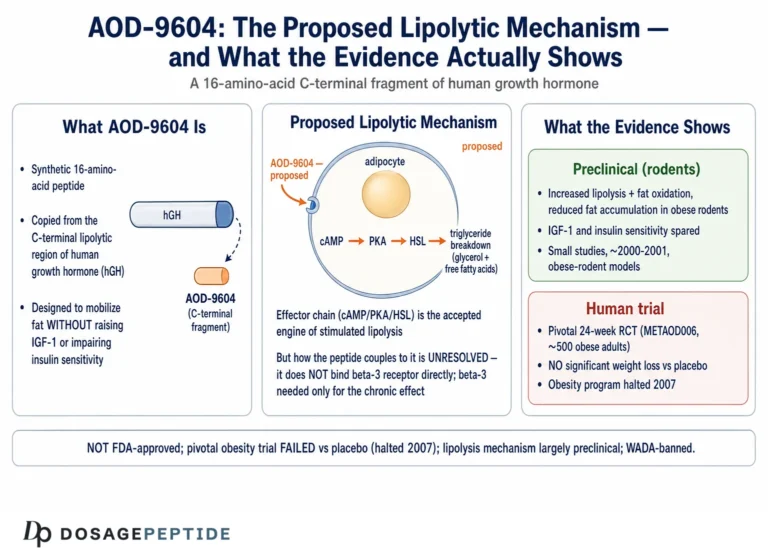
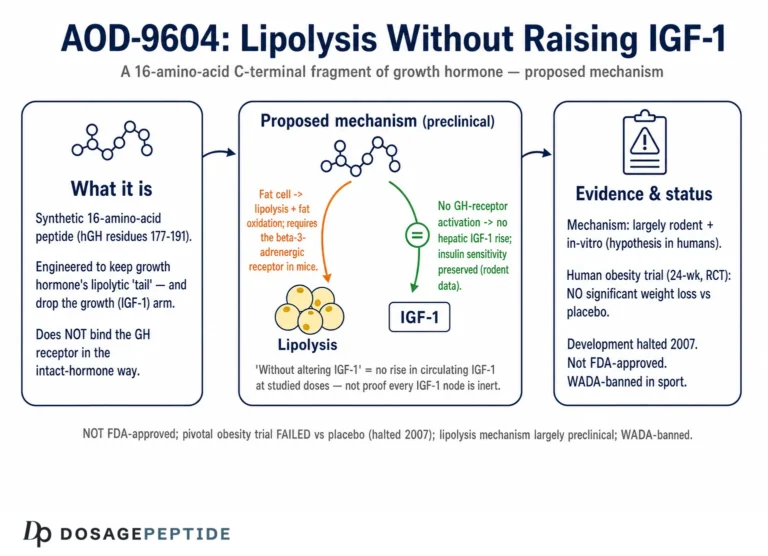
AOD-9604 is a synthetic 16-amino-acid peptide corresponding to the C-terminal region (residues 176–191) of human growth hormone (hGH), with a tyrosine added at the N-terminus for stability.1 The name is an abbreviation of “Anti-Obesity Drug 9604,” which tells you the entire intent behind its creation. It was designed to reproduce the lipolytic — fat-breaking — activity that had been localized to that portion of the growth-hormone molecule, while deliberately leaving behind the insulin-like-growth-factor-1 (IGF-1)-driven growth signaling that full-length hGH also carries.1 That design choice is the axis on which everything in this article turns: the molecule was built to act on adipocytes, and so it is naturally studied in adipocyte models.
Why the Question Starts With a Fragment, Not the Whole Hormone
To understand why AOD-9604 exists as a research tool at all, you have to start with a much older observation: full-length growth hormone breaks down fat. Clinicians and physiologists have known for decades that hGH is lipolytic — it mobilizes stored triglyceride, raises circulating free fatty acids, and shifts the body toward fat oxidation. The trouble is that growth hormone does a great many other things at the same time. It drives longitudinal bone growth, raises IGF-1, and, with chronic exposure, tends to impair glucose tolerance and promote insulin resistance.1 For a molecule you might want to give repeatedly to reduce body fat, that bundle of off-target endocrine effects is a serious liability.
The scientific bet behind AOD-9604 — made by researchers at Monash University in Melbourne and developed commercially by Metabolic Pharmaceuticals Limited — was that the fat-mobilizing action of growth hormone could be structurally separated from the rest of the hormone’s biology. Structure-function work had localized much of the lipolytic activity to the C-terminal tail of the molecule. If you could synthesize just that region as a short, stable peptide, the reasoning went, you might capture the fat signal while discarding the growth signal and the glucose problems.4 The earliest version of this idea was a fragment called AOD9401; AOD-9604 is the refined, tyrosine-stabilized successor.
This origin story matters for the research-models question because it explains the entire experimental program that follows. A molecule engineered to act on fat tissue is, by design, going to be validated in fat-tissue models. Every assay in the AOD-9604 literature — glycerol release from cultured adipocytes, lipogenic-enzyme activity in isolated fat, adipocyte cell-size measurements in obese rodents, body-composition endpoints in obese adults — is a variation on a single question: does this fragment reproduce growth hormone’s effect on adipose tissue without the baggage? The reason AOD-9604 is “studied for adipose tissue breakdown research models” is, at bottom, that adipose tissue breakdown is the only thing it was ever meant to do.
It is useful to hold three levels distinct, because popular writing routinely collapses them. There is the parent hormone (full-length hGH, a 191-residue protein with broad endocrine effects); the lipolytic domain (the C-terminal region thought to carry the fat-mobilizing signal); and the engineered fragment (AOD-9604, a stabilized reproduction of that domain). Each step narrows the biology. When someone reasons from “growth hormone melts fat and builds tissue” to “this fragment does everything growth hormone does,” they have erased the deliberate narrowing that defines the molecule. The fragment was specifically stripped of the IGF-1 arm, and the research models were chosen to prove exactly that selectivity.1 Readers interested in how the compound’s intended fat-metabolism identity is framed in an applied context can see the site’s discussion of the clinical fat-burning evidence for AOD-9604, which examines the human endpoints in more detail than we can here.
What “Adipose Tissue Breakdown” Actually Means in a Research Model
Before evaluating the models, it helps to be precise about what “adipose tissue breakdown” denotes at the biochemical level, because the phrase is looser in marketing than in the laboratory. In a research setting, breakdown of fat means lipolysis: the enzymatic hydrolysis of stored triacylglycerol within the adipocyte’s lipid droplet into free (nonesterified) fatty acids and glycerol, which are then released into the circulation for use by other tissues as fuel.11 This is a tightly regulated process, not a passive melting. It is governed by a small set of lipases — adipose triglyceride lipase (ATGL) initiates the first hydrolytic step, hormone-sensitive lipase (HSL) performs the rate-limiting middle step, and monoacylglycerol lipase completes the job — working in concert with lipid-droplet coat proteins such as perilipin that gate access to the stored fat.11
The reason this precision matters is that different research models measure different proxies for “breakdown,” and those proxies are not interchangeable. In a cell-culture dish, the standard readout is glycerol release into the medium, because glycerol cannot be re-used by the adipocyte and therefore reports net lipolysis cleanly. In isolated fat tissue, researchers may measure free-fatty-acid release, the activity of HSL, or the activity of lipogenic (fat-building) enzymes such as acetyl-CoA carboxylase. In whole animals, endpoints shift to body-weight gain, fat-pad mass, adipocyte diameter, and whole-body fat oxidation and energy expenditure. In humans, the questions become body weight, waist circumference, and fat mass by imaging. Each step up the ladder trades mechanistic cleanliness for physiological relevance — and, as we will see, AOD-9604’s signal was strongest at the bottom of the ladder and weakest at the top.
A second distinction worth drawing is between stimulating lipolysis and inhibiting lipogenesis. Net fat loss can come from breaking fat down faster, from building it more slowly, or from both. The AOD-9604 and AOD9401 literature reports both actions: increased lipolytic activity and reduced lipogenic-enzyme activity in adipose tissue.34 This dual profile is genuinely interesting mechanistically, but it also complicates interpretation, because a model that measures only glycerol release captures the lipolytic arm and misses the anti-lipogenic one entirely. Any honest reading of the “adipose breakdown” question has to specify which arm a given model is actually testing.
The Proposed Mechanism: β3-Adrenergic Signaling, cAMP, and Hormone-Sensitive Lipase
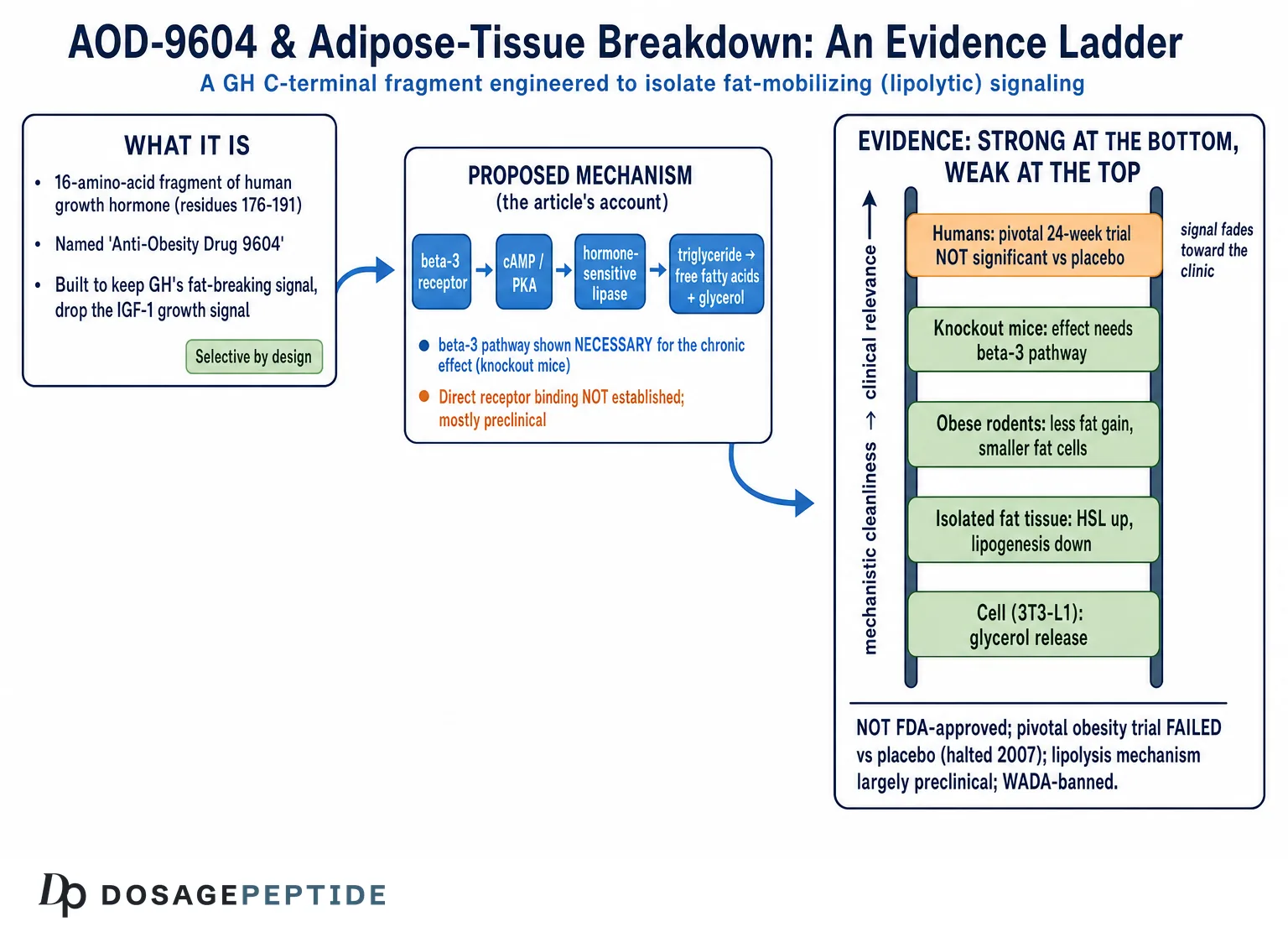
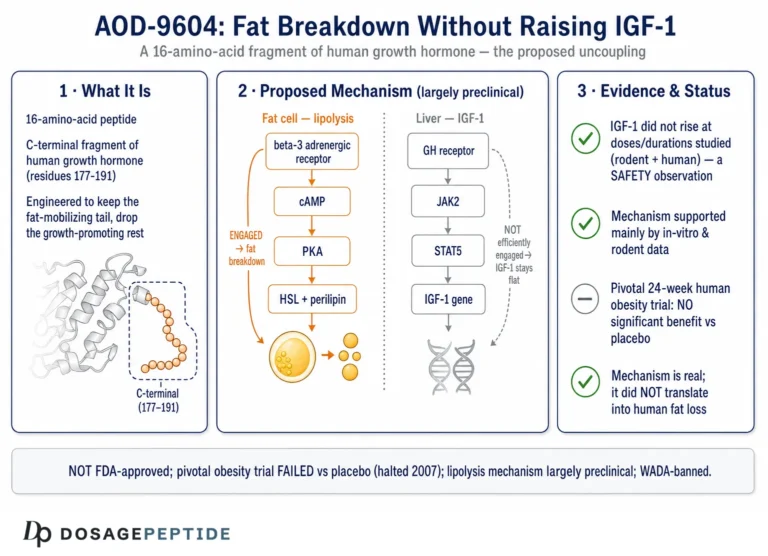
The most widely repeated account of how AOD-9604 breaks down fat runs through the beta-3 adrenergic receptor (β3-AR) on the adipocyte surface. In the canonical version, receptor engagement activates a stimulatory G protein, which activates adenylyl cyclase, raising intracellular cyclic AMP (cAMP); cAMP activates protein kinase A (PKA); and PKA phosphorylates both hormone-sensitive lipase and perilipin, unlocking the lipid droplet and accelerating triglyceride hydrolysis.11 This is the standard adrenergic lipolysis cascade, and it is well established for catecholamines. The interesting claim is that AOD-9604 engages it.
Here the evidence must be read carefully, because the strength of the mechanistic story is often overstated. The single most informative experiment is the β3-AR knockout study published in Endocrinology in 2001. In it, chronic treatment with both full-length hGH and AOD-9604 reduced body weight and increased lipolysis in wild-type obese mice, and both compounds restored the suppressed β3-AR messenger-RNA levels of obese mice toward those of lean controls. Crucially, when the same treatment was given to β3-AR knockout mice, the effects on body weight and lipolysis failed to appear.2 That is a clean genetic demonstration that the β3-adrenergic pathway is necessary for the compound’s chronic metabolic effect.
But necessary is not the same as “AOD-9604 binds the β3 receptor,” a claim that circulates widely and rests on thinner ground. The knockout study establishes pathway dependence, not direct receptor binding, and in the same body of work acute increases in energy expenditure and fat oxidation were still observed in knockout animals — implying at least one β3-independent component to the acute response.2 The most defensible summary is that AOD-9604 appears to increase expression of and signaling through the β3-AR/cAMP/HSL axis, that this axis is required for its sustained effect on fat, and that the precise molecular event by which the peptide initiates the cascade is not fully resolved. In vitro work in differentiated 3T3-L1 adipocytes is consistent with a cAMP-dependent route: inhibitors placed upstream of HSL attenuate the glycerol-release response, arguing for signaling through the pathway rather than a direct enzymatic action on the lipase itself.3
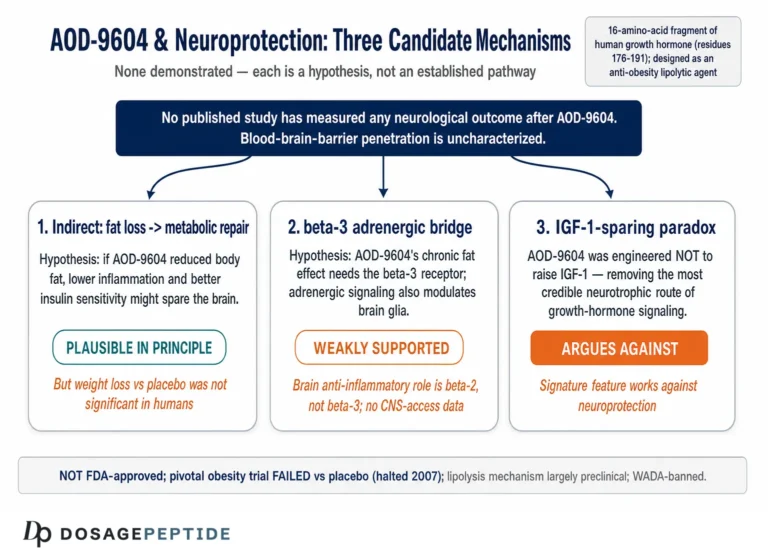
A subtlety that repays attention is the difference between the compound’s acute and chronic actions, because the two appear to run through partly different machinery. The acute response — a rapid bump in energy expenditure and fat oxidation observed shortly after dosing — persisted even in β3-AR knockout animals, implying a receptor-independent component to the immediate metabolic effect.2 The chronic response — the sustained reduction in body weight and fat over days to weeks — was the part that vanished without the β3 receptor. One reading that fits the data is that AOD-9604 does not simply flip an adrenergic switch but, over time, normalizes the expression of the β3-AR itself: obese animals show suppressed receptor levels, and treatment restored those levels toward the lean range.2 If correct, that would make the compound’s durable effect as much about resensitizing the lipolytic apparatus as about acutely driving it — a mechanistically richer picture than the “binds β3, burns fat” shorthand, and one that also helps explain why a chronic-dosing design is where any effect would be expected to show up.
Two features of this mechanism are worth flagging as the genuinely notable science. First, the effect is achieved without raising IGF-1, which is the property that distinguishes AOD-9604 from its parent hormone and the reason it draws research interest as a selective lipolytic probe.1 Second, in obese-rodent studies the fragment did not induce the insulin resistance and glucose intolerance associated with chronic growth-hormone exposure.4 If those two selectivity claims hold up, they make AOD-9604 a useful tool for dissecting the lipolytic arm of GH biology in isolation — which is a research value distinct from, and much better supported than, any therapeutic claim. For the broader mechanistic backdrop on how adipocytes regulate the enzymes involved, the review by Duncan and colleagues remains the standard reference.11
The Hierarchy of Research Models Used to Study Fat Breakdown
Adipose-tissue-breakdown research is organized as a ladder of models, each answering a narrower or broader question than its neighbors. Reading the AOD-9604 literature through this ladder is the clearest way to see where its evidence is solid and where it is thin. The table below lays out the tiers, what each measures, and what AOD-9604 data exist at each level.
| Model tier | Typical system | Primary readout for “breakdown” | AOD-9604 evidence at this tier |
|---|---|---|---|
| In vitro (cell) | Differentiated 3T3-L1 adipocytes; isolated adipocytes | Glycerol / free-fatty-acid release; HSL phosphorylation | Dose-dependent glycerol release; cAMP-dependent signaling3 |
| Ex vivo (tissue) | Isolated rat/mouse adipose tissue explants | Lipolytic vs. lipogenic enzyme activity | ↑ HSL activity, ↓ acetyl-CoA carboxylase; mimics intact hGH4 |
| Rodent — obesity | ob/ob mice; Zucker fatty rats; diet-induced obese mice | Body weight, fat-pad mass, adipocyte diameter, fat oxidation | Reduced weight gain; adipocyte size 110→80 µm; ↑ energy expenditure34 |
| Rodent — genetic | β3-adrenergic-receptor knockout mice | Loss/retention of effect in knockout vs. wild-type | Chronic effect abolished in knockout — pathway necessity2 |
| Human — clinical | Randomized controlled obesity trials (oral dosing) | Body weight, fat mass vs. placebo | Early signal in 12-week study; pivotal 24-week RCT not significant9 |
The shape of this table is the single most important thing to take from the article. AOD-9604’s evidence is strongest at the bottom of the ladder and weakest at the top. In the dish and the isolated-tissue preparation, the fragment behaves as advertised. In obese rodents, it reduces fat accumulation with a clean mechanistic anchor. But at the human level — the only tier that can establish therapeutic value — the effect failed to separate reliably from placebo. This is a common and instructive pattern in metabolic pharmacology: a mechanism that is real in a controlled system does not guarantee a clinically meaningful effect in a whole, free-living human being who is also dieting and exercising. The remaining sections work through each tier in turn.
In Vitro and Ex Vivo Adipocyte Models
The foundation of the AOD-9604 story is cell and tissue work, and it is here that the compound looks most convincing. The differentiated 3T3-L1 adipocyte — a mouse cell line that matures into a fat-laden, insulin-responsive adipocyte in culture — is the workhorse model for adipocyte lipid metabolism, and it is the standard system in which lipolytic agents are screened. The key readout is glycerol released into the culture medium, which reports triglyceride hydrolysis without the confound of fatty-acid re-esterification, since the adipocyte lacks the glycerol kinase needed to recycle glycerol efficiently. In this system, AOD-9604 has been reported to stimulate glycerol release in a dose-dependent fashion, consistent with genuine lipolytic activity, and the response is attenuated by inhibitors acting upstream of HSL — pointing to signaling through the cAMP/PKA cascade rather than a direct action on the lipase.3
The ex-vivo work — using isolated adipose tissue from rodents — adds the enzyme-level picture. In the foundational studies of the lipolytic domain, the fragment (as AOD9401, the immediate precursor of AOD-9604) stimulated hormone-sensitive lipase and inhibited acetyl-CoA carboxylase, a key lipogenic enzyme, in isolated rat adipose tissue, mirroring the actions of intact growth hormone.4 It also mimicked the parent hormone’s effect on diacylglycerol release in adipocytes.4 The combination is important: the fragment appears to push the tissue toward net fat breakdown from two directions at once, accelerating hydrolysis while restraining synthesis. These ex-vivo preparations are valuable precisely because they isolate the tissue from the confounding systemic hormones and neural inputs of a whole animal, letting researchers attribute the effect to the peptide acting on the fat itself.
What these models can and cannot establish is worth stating plainly. They can establish that AOD-9604 has intrinsic activity on adipocytes and can characterize the signaling pathway involved — and they do so credibly. They cannot establish that the compound produces meaningful fat loss in a living organism, let alone a human, because a cell in a dish is freed from every counter-regulatory system that opposes fat loss in vivo: appetite, re-esterification, compensatory changes in energy expenditure, and the hormonal defense of body-fat set point. A robust in-vitro lipolytic signal is a necessary but nowhere near sufficient condition for a useful anti-obesity effect. This is exactly why the ladder exists, and why no serious reader should treat a glycerol-release curve as evidence of clinical fat loss.
These lower-tier models also carry a design advantage that is easy to undervalue: they allow the peptide to be tested against clean genetic and pharmacological controls that would be impossible in humans. Comparing wild-type with knockout cells, or applying a specific pathway inhibitor and watching the response collapse, yields causal inference of a kind no human trial can match. That is why the cell and rodent data, for all their translational fragility, remain the backbone of what is actually known about how the fragment engages fat tissue. The clinic tells us whether the compound works as a drug; the models tell us how it works as a molecule, and only the latter question has a confident answer.
Rodent Obesity Models: ob/ob Mice, Zucker Rats, and Diet-Induced Obesity
The next rung introduces the whole organism, and here the AOD-9604 program used the standard genetic and dietary models of obesity. The ob/ob mouse (leptin-deficient, profoundly obese and hyperphagic) and the Zucker fatty rat (a leptin-receptor mutant with severe obesity) are the classic monogenic rodent obesity models; diet-induced-obese (DIO) mice, fattened on a high-fat diet, model the more common polygenic, environmentally driven obesity of humans. Each offers a different balance of tractability and translational relevance.
In these models, the fragment performed as the in-vitro data predicted. Chronic treatment of obese Zucker rats with the lipolytic domain for 20 days reduced body-weight gain, and the average diameter of the animals’ adipocytes fell from roughly 110 to 80 micrometers — a direct, measurable shrinkage of the fat cells that is one of the more compelling readouts in the whole literature, because adipocyte size is a physical correlate of stored triglyceride.4 Studies in obese mice similarly reported reduced fat accumulation, increased fat oxidation, and acute increases in energy expenditure and glucose and fat oxidation.3 Just as important as what happened is what did not: unlike intact growth hormone, the fragment did not induce insulin resistance or glucose intolerance after chronic treatment, and it did not raise IGF-1.14 That preserved metabolic cleanliness is the property the whole molecule was designed to deliver, and the rodent data are the clearest demonstration that it does.
The genetic-model tier deserves separate emphasis because it carries the mechanism. The β3-AR knockout mouse is not an obesity model per se but a mechanistic scalpel: by deleting a single receptor, researchers could ask whether AOD-9604’s chronic effect depends on that receptor. It did — the weight and lipolysis effects that appeared in wild-type animals were abolished in the knockouts.2 This is the kind of experiment that elevates a correlational mechanism (“the compound raises cAMP”) to a causal one (“the compound’s chronic metabolic effect requires the β3-adrenergic pathway”). It is, frankly, the strongest single piece of evidence in the AOD-9604 file, and it is a preclinical, rodent, genetic result — a reminder that the compound’s most rigorous evidence lives in animals, not humans.
The honest caveat that applies to this entire tier is the well-documented poor translation of rodent obesity pharmacology to humans. The graveyard of anti-obesity drugs is full of compounds that shrank fat pads in mice and did nothing useful, or worse, in people. Rodents differ from humans in the prominence of β3-adrenergic signaling in their fat (functional β3-AR is far more significant in rodent than in human adipose tissue), in their brown-fat thermogenesis, and in the physiology defending body weight. A mechanism that leans on β3-AR is exactly the kind of mechanism one would expect to translate poorly from mouse to human — a prediction, it turns out, that the clinical program went on to confirm.
It is also worth being explicit about what a shrinking adipocyte in a Zucker rat does and does not prove, because the 110-to-80-micrometer figure is among the most cited numbers in the entire AOD-9604 literature and is easily over-read. A reduction in adipocyte diameter is a genuine, physical readout of reduced stored triglyceride, and it is more informative than glycerol release alone because it reflects a net change in the fat cell over a chronic treatment period rather than a transient flux. But diameter is a single-tissue snapshot; it does not capture whether the liberated fatty acids were oxidized for energy, re-esterified elsewhere, or deposited ectopically in liver or muscle, nor whether whole-body fat mass fell proportionally. In a controlled rodent study these confounders are partly managed by the parallel measurements of energy expenditure and fat oxidation that accompanied the diameter data.3 In a free-living human they are not managed at all, which is one more reason the clean rodent readout did not carry through to the clinic.
What the Human Trials Added — and Where They Failed
The top of the ladder is the human clinical program, and this is where the honest account diverges most sharply from the marketing one. Because AOD-9604’s therapeutic ambition was obesity, the clinical work used obesity endpoints — body weight and fat mass against placebo — in metabolically healthy-to-obese adults. The program was conducted seriously and at reasonable scale, and it did not succeed.
Across its development, AOD-9604 was studied in roughly six randomized, placebo-controlled trials conducted between 2001 and 2006 — three single-dose escalation studies, a seven-day multiple-dose study, and two longer efficacy studies (METAOD005 and METAOD006) — enrolling on the order of 900 adult participants in total. That trial structure and participant tally are documented in a peer-reviewed safety review of the program; the pivotal efficacy outcomes, however, were reported chiefly through sponsor and conference summaries rather than a single full peer-reviewed outcomes paper, a gap worth flagging in itself.59 The encouraging early data came from a 12-week Phase 2 study (designated METAOD005) using oral once-daily dosing across several dose arms. In that shorter analysis, peptide-treated groups lost on the order of 1.8 kg more than placebo, with the 1 mg arm reported as the best performer — a result that generated optimistic coverage at the time.9 Oral bioavailability was itself a notable claim for a peptide, and earlier work in animals had explored oral administration of the fragment with reported effects on lipid metabolism.3
The decisive result came in the longer, more rigorous pivotal study: a 24-week randomized, double-blind, placebo-controlled, multicenter trial (METAOD006). At its primary and key secondary endpoints, the weight-loss difference between AOD-9604 and placebo was too small to reach statistical significance.9 The early signal from the 12-week study faded against the background of the intensive diet-and-exercise regimen built into the pivotal trial; against real lifestyle intervention, the peptide added no detectable benefit. Development as an anti-obesity drug was terminated in 2007.
| Aspect | What the human obesity program showed |
|---|---|
| Trials / participants | ~6 studies, >900 participants total9 |
| Pivotal design | 24-week randomized, double-blind, placebo-controlled, multicenter; oral dosing9 |
| Early signal (12-week) | ~1.8 kg greater loss vs placebo; 1 mg arm best9 |
| Pivotal primary endpoint | Difference from placebo NOT statistically significant9 |
| With diet + exercise | No detectable added benefit over lifestyle alone9 |
| Endocrine profile | No reported IGF-1 rise; no glucose-tolerance impairment1 |
| Outcome | Obesity drug development halted in 20079 |
Two conclusions follow, and both must be stated without hedging. First, the compound’s best-evidenced human effect — fat loss in obesity — was itself not robustly demonstrated; the pivotal trial is most accurately described as showing acceptable short-term safety with disappointing efficacy. Second, this failure is not a footnote to the mechanism story but its culmination: a molecule whose adipocyte-level lipolytic activity is real did not translate into meaningful clinical fat loss when tested properly in humans. Anyone citing the in-vitro glycerol curves or the shrinking mouse adipocytes as evidence that AOD-9604 “burns fat” in people is stopping the story two rungs short of where it actually ends. A fuller treatment of the clinical endpoints appears in the companion analysis of the clinical fat-burning trials for AOD-9604.
Why AOD-9604 Is Studied in These Models Rather Than Prescribed as a Therapy
Given a failed pivotal trial, why does AOD-9604 remain a compound researchers reach for in adipose-tissue-breakdown models at all? The answer is that its value as a research probe is separable from — and survives — its failure as a drug candidate. These are genuinely different questions, and conflating them is one of the most common errors in the popular literature.
As a probe, AOD-9604 has a specific and useful property: it appears to isolate the lipolytic arm of growth-hormone action from the IGF-1-mediated growth arm.1 For a physiologist trying to understand how growth hormone mobilizes fat — which structural region carries the signal, which receptors and enzymes it engages, whether the fat effect can be uncoupled from the glucose effect — a fragment that reproduces the lipolytic action alone is a valuable experimental instrument. The β3-AR knockout experiment is a perfect example: AOD-9604 was the tool that let researchers ask whether the fat-mobilizing signal of the GH C-terminus runs through the β3-adrenergic pathway.2 That is a legitimate, ongoing scientific use, and it does not require the compound to be an effective medicine.
As a therapy, by contrast, the compound falls short on the only evidence that matters — controlled human outcomes — and it is not approved for obesity or anything else. The gap between “useful in models” and “approved as treatment” is the gap the entire regulatory apparatus exists to enforce, and AOD-9604 sits squarely inside it. It is also worth noting that after the obesity program ended, the molecule was explored in unrelated directions — as a self-affirmed food ingredient and, in animal models, as an intra-articular agent for osteoarthritis, where weekly injections improved cartilage scores in a rabbit model.7 Those later chapters underline the point: AOD-9604 is a molecule in search of an indication, valuable in the laboratory but unproven in the clinic. Researchers cataloging its handling and metabolic profile alongside other compounds often reference the site’s work on AOD-9604’s molecular mechanisms in obese phenotypes and its relationship to muscle-wasting questions, both of which reinforce that the compound’s established biology is narrowly about fat, not the broader claims sometimes attached to it.
How AOD-9604 Compares With Other Approaches to Fat Breakdown
Placing AOD-9604 beside other agents studied for fat loss clarifies both its mechanistic niche and its evidentiary standing. The contrast is not a competition — AOD-9604 never reached the market — but it shows where a lipolytic GH fragment sits relative to the pathways that have actually moved fat mass in humans.
| Agent / class | Primary mechanism on fat | Level of human fat-loss evidence |
|---|---|---|
| AOD-9604 (GH C-terminal fragment) | β3-AR/cAMP/HSL lipolysis; anti-lipogenic; IGF-1-sparing | Pivotal 24-week RCT not significant; development halted 20079 |
| Full-length growth hormone | Direct lipolysis + IGF-1 signaling | Reduces fat mass but raises IGF-1 and impairs glucose tolerance12 |
| β3-adrenergic agonists (e.g., mirabegron) | Direct β3-AR activation; lipolysis + brown-fat thermogenesis | Activates human brown fat; modest metabolic effects, not an obesity drug11 |
| GLP-1 / dual-incretin agonists | Central appetite suppression; indirect fat loss | Large, robust weight loss in phase 3 trials (approved agents) |
| Catecholamines (endogenous) | β-adrenergic lipolysis via cAMP/PKA/HSL | Physiological reference for the lipolytic cascade11 |
The pattern is telling. The one class that has produced large, reproducible human fat loss — the incretin-based agents — works primarily through the brain and appetite, not through direct adipocyte lipolysis at all. The agents that act directly on the adipocyte’s lipolytic machinery, including β3-agonists and AOD-9604, have consistently produced strong preclinical signals and weak-to-null clinical fat-loss effects. This is a recurring lesson in metabolic pharmacology: directly forcing fat cells to release their contents is not, on its own, a reliable route to durable weight loss, in part because the liberated fatty acids can simply be re-oxidized or re-stored, and because the body defends its fat set point through appetite and energy-expenditure compensation. Readers comparing mechanisms may find the site’s coverage of how tirzepatide drives fat loss a useful contrast, since it illustrates the appetite-centered route that has actually cleared the clinical bar AOD-9604 could not.
Handling and Reconstitution in a Research Context
Because AOD-9604 is most often encountered as a lyophilized (freeze-dried) powder in a sealed vial, a brief and strictly educational note on laboratory handling is warranted — with the emphasis that this describes standard research-peptide practice, not a usage recommendation, and that AOD-9604 is not an approved therapeutic for any indication.
Lyophilized peptides are generally reconstituted with sterile or bacteriostatic water for laboratory purposes. The diluent is directed slowly against the inner wall of the vial rather than sprayed onto the powder, and the vial is swirled gently rather than shaken, because vigorous agitation can shear peptide bonds and denature the material. The volume of diluent chosen simply sets the concentration: a fixed mass of peptide in a larger volume yields a lower concentration per unit volume, which is the arithmetic behind any reconstitution chart. The mechanics of these calculations are laid out in the site’s peptide reconstitution guide, which is educational reference material rather than guidance for human use.
Stability and storage considerations that recur across the research-peptide literature are summarized below.
| Parameter | Typical research-context practice |
|---|---|
| Lyophilized storage | Cool, dark conditions; long-term stability favored by freezing |
| After reconstitution | Refrigerated; used within a limited window |
| Light and heat | Minimize exposure; both accelerate peptide degradation |
| Agitation | Swirl gently; avoid shaking or foaming |
| Freeze–thaw | Repeated cycles degrade peptides; avoid |
| Sterility | Aseptic technique; bacteriostatic water for multi-use practice |
It bears repeating that meticulous handling changes nothing about the evidence question. A perfectly reconstituted, high-purity vial of AOD-9604 is still a compound whose human fat-loss efficacy was not demonstrated in a controlled trial. Good technique preserves whatever biological activity the molecule has; it does not create clinical efficacy where none was shown. This is a particularly important point because much material sold outside regulated channels is offered as “research chemical” of uncertain purity, and impurities, endotoxin, and mislabeling are real risks that have nothing to do with the molecule’s intrinsic pharmacology and everything to do with sourcing. Terms used throughout this discussion — lipolysis, lyophilization, bacteriostatic water — are defined in the site’s peptide research glossary.
Limitations, the Translation Gap, and Regulatory Status
Pulling the threads together, the limitations that bear on the “adipose tissue breakdown” question are significant, and they compound one another rather than sitting in isolation.
The evidence is front-loaded onto preclinical models. The most rigorous AOD-9604 findings — the β3-AR knockout dependence, the dose-dependent glycerol release, the adipocyte shrinkage in Zucker rats — are all in cells and rodents.234 The one tier that can establish therapeutic value, the human RCT, returned a null result on its primary endpoint.9 A mechanism can be entirely real and still fail to produce a useful clinical effect, and that is precisely what happened here.
The mechanism translates poorly by its nature. A lipolytic effect leaning on the β3-adrenergic receptor is a mechanism one would expect to weaken from rodent to human, because functional β3-AR signaling is far more prominent in rodent adipose tissue than in human. The species gap is not incidental to AOD-9604; it sits at the heart of its proposed mechanism.
Directly forcing lipolysis is not the same as producing weight loss. Liberated fatty acids can be re-esterified or oxidized, and the body defends its fat mass through appetite and energy-expenditure compensation. This is why the agents that actually move human fat mass at scale act on appetite rather than on the adipocyte’s lipases — and why a pure adipocyte-lipolysis strategy is a difficult one on which to build an effective therapy.
Product quality and provenance. Because AOD-9604 is not an approved medicine, real-world material varies in purity, introducing confounders that make even informal observations unreliable.
On regulatory status, precision matters because this compound is frequently misrepresented. AOD-9604 is not approved as a drug for obesity or any other condition by the U.S. Food and Drug Administration, the European Medicines Agency, or any comparable regulator; its obesity development was abandoned in 2007 after the pivotal trial failed.9 After the drug program ended, the sponsor repositioned the compound as a metabolic-health ingredient supported by a self-affirmed “generally recognized as safe” (GRAS) characterization and safety/metabolism publications.56 It is essential to understand that GRAS addresses ingredient safety at supplement-level exposure — it is emphatically not a finding of efficacy and not drug approval. In 2024, the FDA’s Pharmacy Compounding Advisory Committee voted against adding AOD-9604 (both free base and acetate) to the Section 503A bulk drug substances list, citing inadequate characterization, immunogenicity and impurity concerns, and a lack of clinical effectiveness data — a clear signal of continued regulatory caution.8 Finally, AOD-9604 is prohibited in sport by the World Anti-Doping Agency; athletes subject to testing should assume that use constitutes an anti-doping rule violation.10
The synthesis is straightforward. AOD-9604 is studied in adipose-tissue-breakdown research models because it was engineered to act on fat and because, in those models, it does — cleanly and with a well-anchored mechanism. But the same body of work shows the effect fading as the model approaches human physiology, culminating in a failed pivotal trial. The right posture is to treat AOD-9604 as a genuinely useful laboratory probe of growth-hormone-linked lipolysis and simultaneously as an unproven, unapproved candidate for human fat loss. Both statements are true, and holding them together is what honest scientific communication about this compound requires. Researchers surveying where AOD-9604 sits relative to other metabolic research peptides can consult the site’s central dosages index, which catalogs these compounds by their intended metabolic profiles for educational reference.
Frequently Asked Questions
What does “adipose tissue breakdown” mean when researchers study AOD-9604?
It means lipolysis — the enzymatic hydrolysis of stored triglyceride inside fat cells into free fatty acids and glycerol, which are released for use as fuel. In the laboratory this is measured by proxies that differ by model: glycerol release in cultured cells, hormone-sensitive lipase activity in isolated tissue, adipocyte diameter and fat-pad mass in rodents, and body weight and fat mass in humans.3411 AOD-9604 is studied across these models because it was engineered to reproduce the fat-mobilizing action of growth hormone.
Why is AOD-9604 studied in fat models specifically rather than muscle or other tissues?
Because it was designed to. AOD-9604 is a fragment of the C-terminal region of human growth hormone that reproduces the hormone’s lipolytic activity while deliberately excluding the IGF-1-driven growth signaling.1 Its characterized biology points at adipocytes, so adipocyte and obesity models are the natural systems in which to test it. Claims that it builds muscle borrow the reputation of full-length growth hormone and are not supported by data on the fragment itself.
What is the strongest evidence that AOD-9604 actually breaks down fat?
The strongest mechanistic evidence is the β3-adrenergic-receptor knockout study, in which the compound’s chronic effects on body weight and lipolysis appeared in wild-type mice but were abolished in β3-AR knockouts — establishing that the effect requires that pathway.2 Supporting this are dose-dependent glycerol release in 3T3-L1 adipocytes, increased HSL and reduced lipogenic-enzyme activity in isolated tissue, and reduced adipocyte size in obese Zucker rats.34 All of this evidence is preclinical.
Did AOD-9604 produce fat loss in humans?
Not convincingly. Across roughly six trials in more than 900 participants, an early 12-week study suggested about 1.8 kg more loss than placebo, but the pivotal 24-week randomized, double-blind, placebo-controlled trial did not reach statistical significance at its primary endpoint, and the early signal disappeared against a background of diet and exercise.9 Development as an obesity drug was halted in 2007.
Does AOD-9604 raise IGF-1 or impair blood sugar like growth hormone?
According to the preclinical and early clinical characterization, no. The fragment was engineered to isolate the lipolytic domain away from IGF-1 signaling, and it was reported not to raise IGF-1 and not to induce the insulin resistance or glucose intolerance associated with chronic growth-hormone exposure.14 This selectivity is the compound’s defining feature and its main value as a research probe.
Why does a compound that works in a dish fail in people?
Because a cell in culture is freed from every system that opposes fat loss in a living organism: appetite, re-esterification of liberated fatty acids, and compensatory changes in energy expenditure that defend body-fat set point. A mechanism that leans on the β3-adrenergic receptor also translates poorly because that receptor is far more functionally prominent in rodent fat than in human fat. Strong in-vitro and rodent signals are necessary but not sufficient for a clinical effect — a pattern the AOD-9604 program illustrates well.
Is AOD-9604 approved or legal to use?
It is not approved as a drug for any condition by the FDA, EMA, or other major regulators. It has been handled as a supplement/food-type ingredient via a self-affirmed GRAS characterization (a safety framing, not efficacy or drug approval), was not recommended for the FDA’s Section 503A compounding bulks list in 2024, and is prohibited in sport by WADA.6810
How is AOD-9604 handled in a research setting?
As a lyophilized powder, it is reconstituted with sterile or bacteriostatic water using gentle technique (swirl, do not shake), stored cool and dark, and protected from repeated freeze–thaw cycles — standard research-peptide practice rather than anything specific to or validated for AOD-9604. Handling quality preserves whatever activity the molecule has but has no bearing on the absence of demonstrated human fat-loss efficacy.
References
- Ng FM, Sun J, Sharma L, et al. Metabolic studies of a synthetic lipolytic domain (AOD9604) of human growth hormone. Horm Res. 2000;53(6):274-278. PMID 11146367. https://pubmed.ncbi.nlm.nih.gov/11146367/
- Heffernan M, Summers RJ, Thorburn A, et al. The effects of human GH and its lipolytic fragment (AOD9604) on lipid metabolism following chronic treatment in obese mice and beta(3)-AR knock-out mice. Endocrinology. 2001;142(12):5182-5189. PMID 11713213. https://pubmed.ncbi.nlm.nih.gov/11713213/
- Heffernan MA, Jiang WJ, Thorburn AW, Ng FM. Effects of oral administration of a synthetic fragment of human growth hormone on lipid metabolism. Am J Physiol Endocrinol Metab. 2000;279(3):E501-E507. PMID 10862777. https://journals.physiology.org/doi/abs/10.1152/ajpendo.2000.279.3.E501
- Ng FM, Jiang WJ, Bowyer L, et al. Molecular and cellular actions of a structural domain of human growth hormone (AOD9401) on lipid metabolism in Zucker fatty rats. J Mol Endocrinol. 2000;25(3):287-298. PMID 11116208. https://pubmed.ncbi.nlm.nih.gov/11116208/
- Stier H, Vos E, Kenley D. Safety and Tolerability of the Hexadecapeptide AOD9604 in Humans. Journal of Endocrinology and Metabolism. 2013;3(1-2):7-15. https://www.jofem.org/index.php/jofem/article/view/157
- Moré MI, Kenley D. Safety and Metabolism of AOD9604, a Novel Nutraceutical Ingredient for Improved Metabolic Health. Journal of Endocrinology and Metabolism. 2014;4(3):64-77. https://jofem.org/index.php/jofem/article/view/213/278
- Kwon DR, Park GY. Effect of Intra-articular Injection of AOD9604 with or without Hyaluronic Acid in Rabbit Osteoarthritis Model. Ann Clin Lab Sci. 2015;45(4):426-433. PMID 26275694. https://pubmed.ncbi.nlm.nih.gov/26275694/
- U.S. Food and Drug Administration. Pharmacy Compounding Advisory Committee (PCAC) Briefing Document, 2024 (AOD-9604 review for Section 503A bulk drug substances). https://www.fda.gov/media/183584/download
- Metabolic Pharmaceuticals Ltd. The effect of AOD9604 on weight loss in obese adults: results of a randomized, double-blind, placebo-controlled, multicenter study (obesity clinical program METAOD005/METAOD006; development halted 2007). https://www.researchgate.net/publication/295313034
- World Anti-Doping Agency. WADA statement on substance AOD-9604. https://www.wada-ama.org/en/news/wada-statement-substance-aod-9604
- Duncan RE, Ahmadian M, Jaworski K, Sarkadi-Nagy E, Sul HS. Regulation of lipolysis in adipocytes. Annu Rev Nutr. 2007;27:79-101. PMID 17313320. PMCID PMC2885771. https://pubmed.ncbi.nlm.nih.gov/17313320/
- Vijayakumar A, Yakar S, LeRoith D. The intricate role of growth hormone in metabolism. Front Endocrinol (Lausanne). 2011;2:32. PMID 22654802. PMCID PMC3356038. https://www.frontiersin.org/journals/endocrinology/articles/10.3389/fendo.2011.00032/full
Educational and research-use disclaimer: This article is provided solely for scientific and educational purposes. AOD-9604 is not approved by the FDA, EMA, or any comparable regulator for the treatment, cure, or prevention of obesity or any other disease, and its pivotal human obesity trial did not demonstrate a statistically significant benefit over placebo. Its lipolytic mechanism is characterized primarily in preclinical (cell and rodent) models, and AOD-9604 is prohibited in sport by WADA. Nothing here is medical advice or a recommendation for human use. Any legitimate investigation of this compound should occur within properly authorized preclinical or clinical research under appropriate oversight. Readers should consult qualified professionals and applicable regulations before making any decisions.