A 5 mg AOD-9604 vial reconstituted with 2 mL of bacteriostatic water holds 2,500 mcg per mL, which puts 300 mcg at the 12-unit mark on a U-100 insulin syringe. That single conversion is what most searches for an “AOD-9604 dosage chart” are actually after. This article gives the full arithmetic for both the 2 mg and 5 mg vials, the reconstitution volumes that land on clean unit marks, and the storage and handling steps that keep a solution usable — then places those numbers in their proper evidentiary context. Every figure below is framed for research modeling only, not as guidance for administration to any human or animal.
The honest headline, stated up front so nothing that follows is misread: AOD-9604 failed its pivotal clinical development for obesity, it is not approved by the FDA for any indication, and the widely circulated “~300 mcg/day” figure is community-and-trial-era lore, not a validated therapeutic dose. The reconstitution math, by contrast, is real chemistry and genuinely useful for anyone modeling handling scenarios. We keep those two things clearly separated throughout.
What Is AOD-9604 and Why Does Its Reconstitution Attract Research Interest?
AOD-9604 is a synthetic peptide corresponding to the C-terminal fragment of human growth hormone, specifically residues 176–191 of hGH with an added N-terminal tyrosine — formally written Tyr-hGH177–191.[1] The abbreviation “AOD” stands for Anti-Obesity Drug, the label its developer applied during its clinical program. It is a hexadecapeptide (16 amino acids) with the sequence Tyr-Leu-Arg-Ile-Val-Gln-Cys-Arg-Ser-Val-Glu-Gly-Ser-Cys-Gly-Phe, stabilized by an intramolecular disulfide bond between the two cysteine residues, and a molecular weight of approximately 1,815 Da (molecular formula C78H123N23O23S2).[1] That molecular weight matters for reconstitution because it is what makes a milligram of powder correspond to a specific number of nanomoles — though, as we show below, the practical bench arithmetic works entirely in mass units (mg and mcg) and never requires the researcher to compute moles at all.
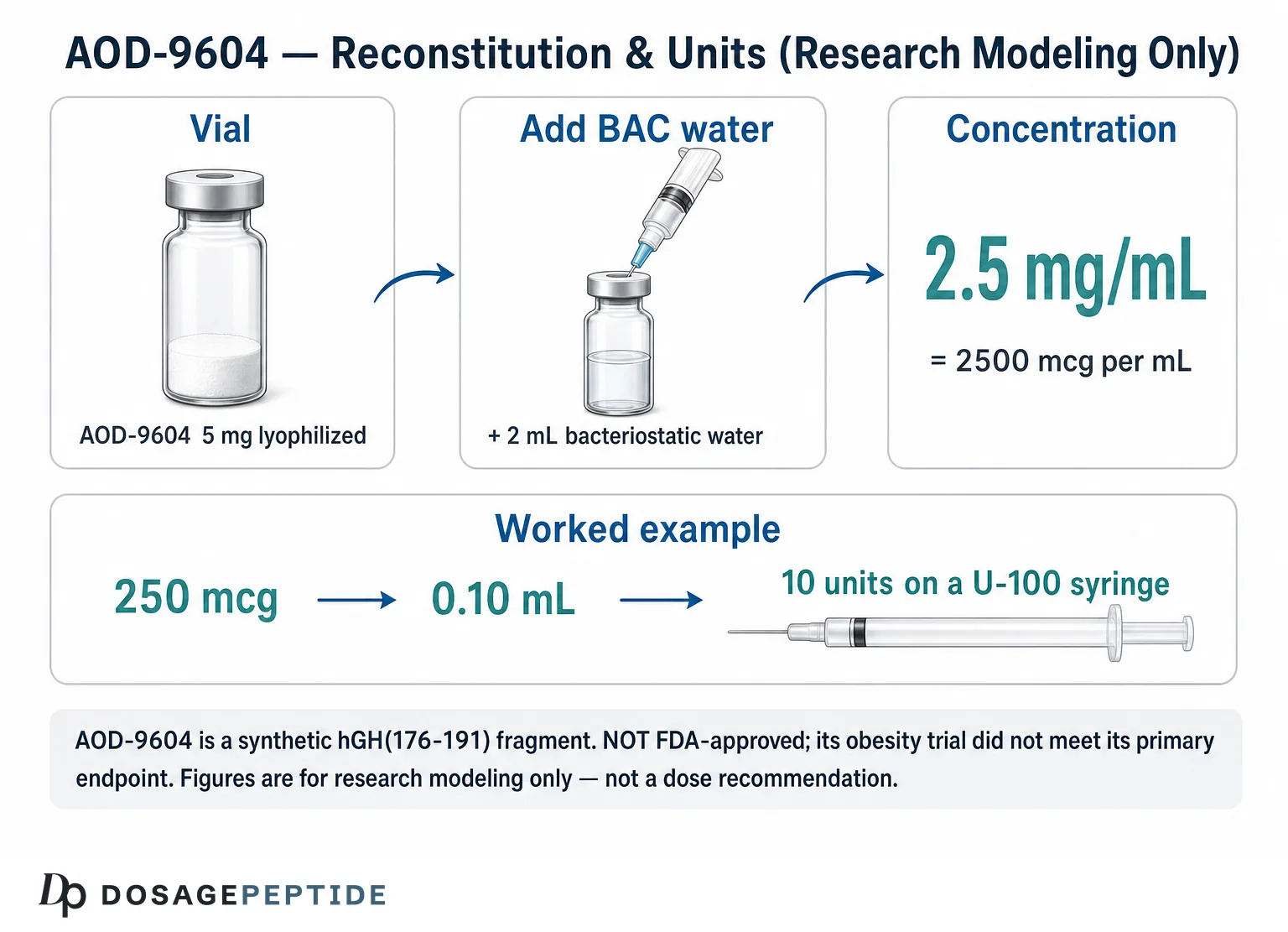
AOD-9604 was developed by Metabolic Pharmaceuticals, an Australian company spun out of Monash University, building on earlier work identifying the lipolytic domain of the intact growth-hormone molecule and its development into a candidate anti-obesity agent.[2][5] The compound is supplied for research as a lyophilized (freeze-dried) white powder, most commonly in 2 mg and 5 mg vials. Because it arrives dry, it cannot be measured by any syringe until it has been dissolved — and the choice of solvent volume is the single decision that fixes every downstream number. That is why reconstitution, not “dose,” is the real center of gravity for the search intent behind this topic. A researcher who understands that a 5 mg vial reconstituted with 2 mL of bacteriostatic water yields exactly 2.5 mg/mL — and that this makes 250 mcg equal to 10 units on a standard U-100 syringe — has answered the practical question completely.
It is worth being explicit about what “lyophilized” implies for the arithmetic. Freeze-drying removes water from a peptide solution under vacuum, leaving a fluffy solid whose mass is dominated by the peptide itself (plus, in many preparations, a small amount of bulking agent or residual buffer salts that were present when the vial was filled). The label mass — 2 mg or 5 mg — refers to the peptide content, and it is that figure the researcher trusts when computing concentration. This is also why the powder must never be measured by eye or by partial scooping: the entire vial is designed to be dissolved as a unit so that the known total mass distributes evenly through a known solvent volume. Attempting to use “part” of a dry vial destroys the one thing the calculation depends on, namely a defined mass in a defined volume. Every figure in this article assumes the whole labeled mass has been dissolved in the stated volume of bacteriostatic water and then thoroughly, gently mixed.
The interest is amplified by the fact that AOD-9604 sits in an unusual regulatory limbo. It is neither an approved drug nor a straightforward dietary supplement. It has been the subject of self-affirmed food-ingredient (GRAS) evaluations, of discontinued obesity trials, and of exploratory osteoarthritis research, while simultaneously having been nominated to the FDA’s interim 503A list of bulk drug substances of concern for pharmacy compounding — a nomination its sponsor later withdrew in 2024 — and having been placed on the World Anti-Doping Agency’s prohibited list.[10][12] That combination — a molecule with a real pharmacological history but no approved use — is exactly the profile that generates persistent, unresolved dosing questions in research communities. For a broader orientation to the compound’s biology, our companion overview of how AOD-9604 is studied in lipolysis and metabolic research pairs naturally with the reconstitution focus here.
Where AOD-9604 Sits Among Growth-Hormone-Derived Peptides
AOD-9604 is frequently discussed alongside “HGH Fragment 176-191,” and the two are closely related but not identical: AOD-9604 carries the extra N-terminal tyrosine that Fragment 176-191 lacks, a modification originally introduced to aid synthesis and radiolabeling.[5] The therapeutic use of such growth-hormone fragments has been the subject of dedicated patents describing their lipolytic applications.[14] Functionally, both are marketed on the same premise — that they reproduce the fat-metabolizing tail of growth hormone without the growth-promoting, IGF-1-raising activity of the full molecule. Unlike growth-hormone secretagogues such as ipamorelin or MK-677, which act upstream to stimulate the body’s own GH release, AOD-9604 is a direct fragment claimed to act peripherally on adipose tissue. Researchers comparing these classes often move between the ipamorelin literature and the AOD-9604 material, because the reconstitution logic is shared even where the pharmacology diverges sharply.
How Does AOD-9604 Work at the Molecular Level?
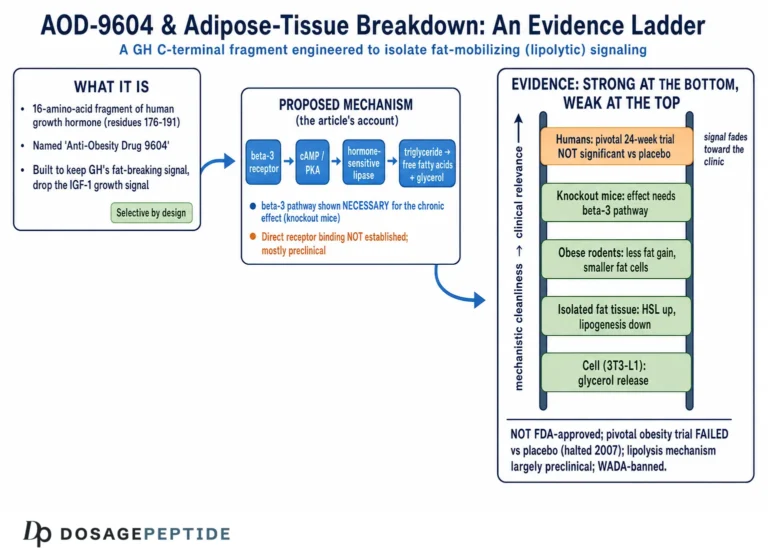
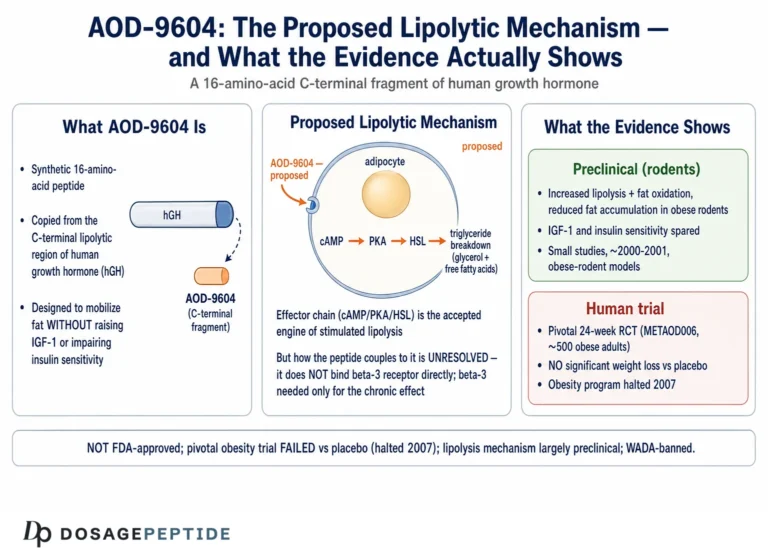
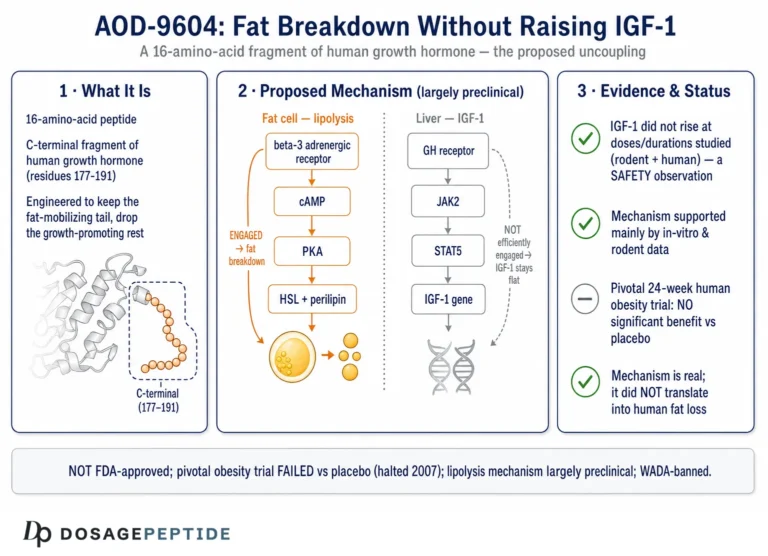
The proposed mechanism of AOD-9604 is the reason its dosing has ever been studied, so it deserves a precise, non-inflated description. The core claim, developed across the preclinical literature, is that AOD-9604 stimulates lipolysis (the breakdown of stored triglyceride in fat cells) and inhibits lipogenesis (the synthesis of new fat), while — critically — doing so without binding the growth-hormone receptor and without raising circulating insulin-like growth factor 1 (IGF-1).[2] This receptor-independence is the entire selling point: the intact growth-hormone molecule also promotes fat breakdown, but it simultaneously drives IGF-1 and can impair insulin sensitivity, whereas the fragment was hoped to isolate the lipolytic effect from the metabolic liabilities.[3]
The most mechanistically informative preclinical study was conducted in obese mice and in beta-3-adrenergic-receptor (β3-AR) knockout mice. Chronic treatment with AOD-9604 reduced body-weight gain and increased lipolytic sensitivity in normal obese mice, and both human growth hormone and AOD-9604 raised the depressed expression of β3-AR toward lean-animal levels; in animals genetically lacking the β3-adrenergic receptor, the chronic body-weight and lipolysis effect was lost.[3] Importantly, the authors themselves concluded that the acute lipolytic action of AOD-9604 is not mediated directly through the β3-AR — in an acute experiment the peptide still increased energy expenditure and fat oxidation in the knockout animals — but that the compound’s ability to raise β3-AR expression may contribute to enhanced lipolytic sensitivity over chronic dosing.[3] That nuance matters: it is evidence of a genuine adipocyte pathway rather than proof of a single clean receptor mechanism. In cellular and rodent adipose-tissue work, AOD peptides increased lipolysis and reduced lipogenesis without harming insulin sensitivity;[2] and in subsequent human safety evaluations the peptide did not raise circulating IGF-1.[6] Our sibling article on how AOD-9604 influences lipolysis without altering IGF-1 signaling unpacks that receptor-independence in greater depth.
Framed step by step, the proposed cascade runs as follows. AOD-9604 is thought to engage adipocyte signalling in a manner that increases lipolytic activity, promoting hydrolysis of stored triglyceride into free fatty acids and glycerol, while simultaneously suppressing the enzymatic steps of new fat synthesis. The β3-adrenergic receptor — abundant on adipose tissue and a classical driver of fat mobilization and thermogenesis — appears to be one node in that cascade, since its genetic absence abolishes the chronic weight effect in mice even though the acute lipolytic effect persists.[3] Because the fragment lacks the portion of the growth-hormone molecule that binds the GH receptor, it is not expected to trigger that receptor’s downstream induction of hepatic IGF-1 — the arm of GH signalling responsible for both its growth-promoting effects and much of its metabolic liability. This dissociation of the lipolytic “tail” of growth hormone from its receptor-binding “head” is the conceptual heart of the entire AOD program, and it is why the compound was pursued as a fat-specific agent rather than a growth-hormone substitute.
Why the Mechanism Does Not License a Human Dose
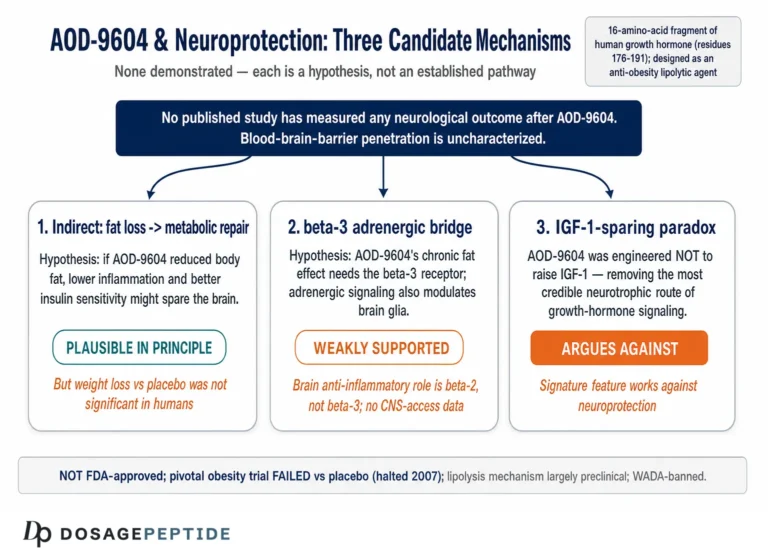
Here the honesty gate must be enforced firmly. A coherent, receptor-level mechanism demonstrated in mice and in isolated cells is not the same thing as demonstrated efficacy in humans, and it certainly does not establish an optimal human dose. The β3-AR pathway that appears to contribute to the effect in rodents is expressed differently in human adipose tissue, and the translation of β3-agonist-like effects from mouse to human has historically been unreliable across the whole class of fat-loss agents. So while the mechanism explains why researchers modeled particular quantities, it provides no basis for treating any milligram or microgram figure as a validated dose. The correct reading is: the mechanism is plausible and partly characterized preclinically; the human dose–response is not established; and every number in this article is a modeling convenience, not a recommendation.
What Is the Current Evidence Level for AOD-9604?
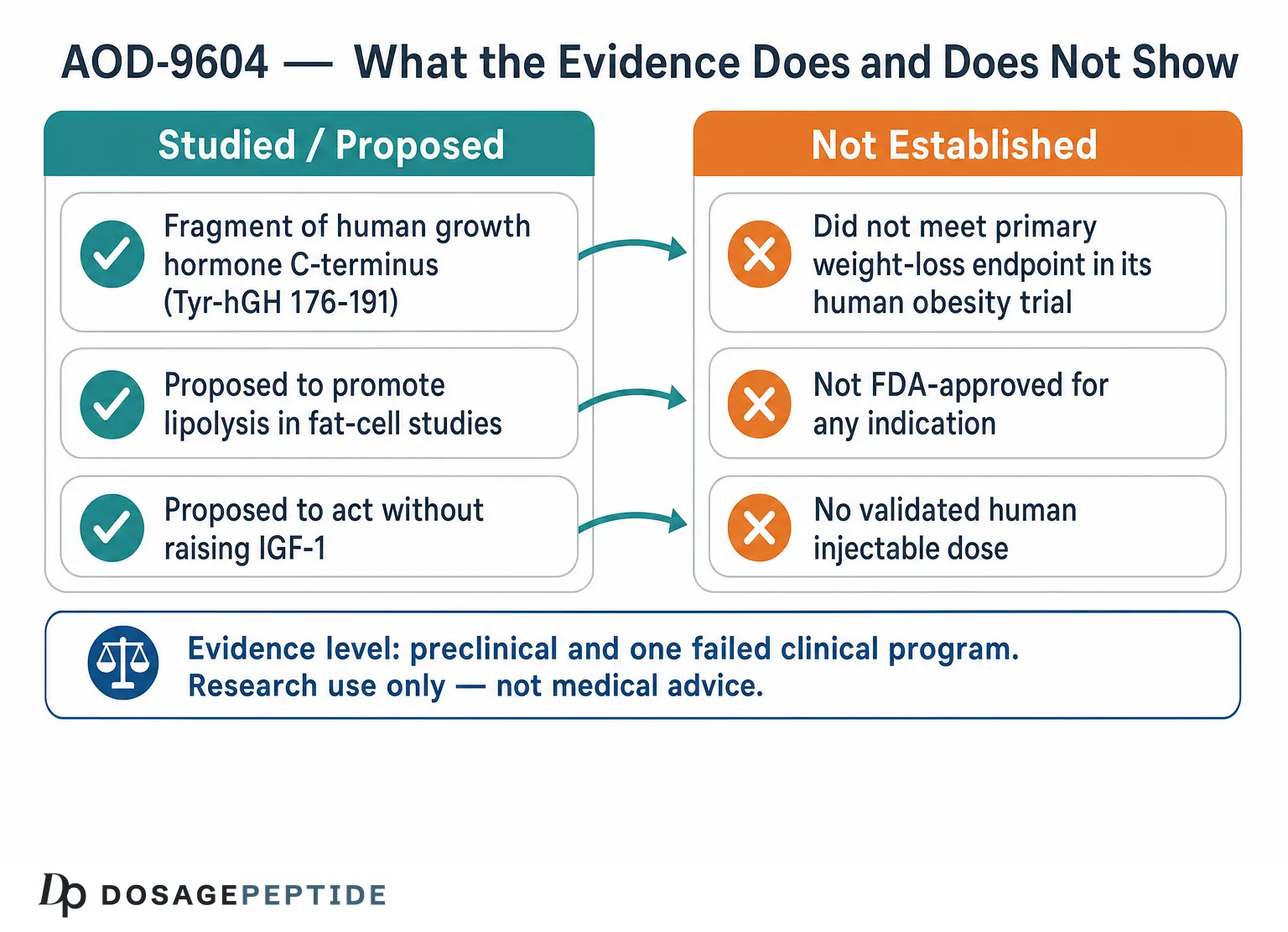
Precisely stating the evidence tier is the most important compliance obligation of any AOD-9604 dosing article, because the compound is routinely mis-described online as a “proven” fat-loss peptide. It is not. The accurate tier classification is as follows.
Preclinical (animal and in-vitro): moderate and supportive. Multiple rodent and cell studies from the Monash/Metabolic Pharmaceuticals program reported increased lipolysis, reduced lipogenesis, attenuated weight gain in obese animals, and — unlike intact growth hormone — no adverse effect on insulin sensitivity.[2][3] This is genuine, peer-reviewed preclinical support for the mechanism.
Clinical (human): the program failed its pivotal endpoint. This is the decisive fact. AOD-9604 advanced to a 24-week Phase IIb obesity trial that randomized several hundred obese subjects (on the order of 500) across multiple oral dose arms in the low-milligram range against placebo. The trial did not meet its primary weight-loss endpoint: no treatment arm produced a statistically significant weight reduction versus placebo, and the developer subsequently discontinued AOD-9604 as an anti-obesity drug in 2007. An earlier, smaller 12-week study had reported a modest weight difference favoring the peptide, but the larger, better-powered Phase IIb trial did not replicate it — the textbook pattern of an encouraging early signal that does not survive rigorous testing. Human safety and tolerability across the trials was reported as good and largely indistinguishable from placebo, but tolerability without efficacy does not constitute a successful drug.[6]
It is also worth recording what the human safety data did and did not establish, because “well-tolerated” is frequently mis-cited as if it were the same as “effective.” Across the randomized, placebo-controlled human evaluations, AOD-9604’s adverse-event profile was reported as clean and broadly indistinguishable from placebo, with no signal of the insulin-desensitizing effect that limits intact growth hormone and no rise in IGF-1.[6] Later work supporting a food-ingredient (nutraceutical) safety position reached similar tolerability conclusions.[7] A favorable safety readout is a necessary condition for a drug to advance, but it is not sufficient: a compound that is safe and inert is still a failed drug. The Phase IIb result places AOD-9604 much closer to the “safe but not shown to work” end of that spectrum than the “proven agent” framing used in much online marketing.
Regulatory: not approved anywhere as a drug. AOD-9604 has never received FDA approval for any indication. It was pursued along a food-ingredient/nutraceutical pathway, with published safety and metabolism evaluations supporting a GRAS-style self-affirmation for use as an ingredient,[7] and it has been explored via oral and intra-articular routes for osteoarthritis in animal models — again without any approved therapeutic use.[8] The osteoarthritis work is instructive about how to read this compound’s evidence: in a collagenase-induced knee-osteoarthritis model in rabbits, intra-articular AOD-9604 — particularly when combined with hyaluronic acid — was reported to improve gross and histological cartilage scores relative to controls.[8] That is a genuine preclinical signal in an entirely different tissue and via an entirely different route from the fat-loss injectable, and it emphatically does not transfer to the obesity question or to any subcutaneous fat-loss dosing; it is cited here only to characterize the breadth — and the consistently preclinical ceiling — of the compound’s exploration. The injectable research peptide sold in 2 mg and 5 mg vials is not an approved drug product. The FDA had placed AOD-9604 in Category 2 of the interim 503A bulks list — bulk drug substances that raise significant safety concerns for compounding; that specific nomination was later withdrawn (in 2024) and the substance is now under Pharmacy Compounding Advisory Committee review, but at no point has it been approved or affirmatively cleared for compounding.[11]
| Evidence domain | Status for AOD-9604 | What it does — and does not — support |
|---|---|---|
| In-vitro / cell adipocyte studies | Positive lipolysis & anti-lipogenesis signals | Supports the proposed mechanism; says nothing about human dose |
| Rodent studies (obese & β3-AR KO mice) | Reduced weight gain; β3-AR implicated in chronic effect | Supports mechanism & a plausible pathway; not human-translatable dosing |
| Human Phase IIa (12 weeks) | Modest early weight signal | Hypothesis-generating only; not replicated |
| Human Phase IIb (24 weeks) | Failed primary weight-loss endpoint | The decisive negative result; obesity development halted |
| Regulatory (drug) | Not FDA-approved for any indication | No validated therapeutic dose exists |
| Anti-doping | WADA-prohibited (S2, GH fragments) | Banned in sport regardless of efficacy debate |
The practical implication for a dosing article is stark and worth stating plainly: because the pivotal human trial failed, there is no clinically established effective dose of AOD-9604 for weight loss. Any dosage figure discussed below is therefore either (a) a quantity used in an experimental or trial-era protocol, described as historical fact, or (b) a number derivable purely from reconstitution arithmetic, described as a mathematical relationship. Neither is an endorsement. For readers who want the trial narrative in more detail, our summary of what clinical trials indicate about AOD-9604’s fat-burning potential examines the endpoints directly.
How Do Researchers Reconstitute AOD-9604? A Worked Example
Reconstitution is where the arithmetic becomes concrete and genuinely useful, so we work a full example step by step. The solvent used with lyophilized research peptides is almost always bacteriostatic water (sterile water containing roughly 0.9% benzyl alcohol as a preservative), chosen because the preservative allows a multi-day working window for a reconstituted vial under refrigeration. Our detailed primer on how much bacteriostatic water to use in peptide reconstitution covers solvent selection; here we focus on the numbers.
The governing relationship is simple and worth memorizing:
Concentration (mcg/mL) = total peptide mass (mcg) ÷ volume of bacteriostatic water added (mL).
Everything else follows from that one equation plus the fixed definition of a U-100 insulin syringe, on which 1 mL = 100 units (IU), so 1 unit = 0.01 mL.
Worked Example: 5 mg Vial + 2 mL Bacteriostatic Water
Take the most commonly modeled configuration — a 5 mg AOD-9604 vial reconstitution protocol with 2 mL of bacteriostatic water — and follow the arithmetic:
- Step 1 — convert the vial to micrograms. 5 mg = 5,000 mcg. Working in micrograms keeps every later number a whole or clean decimal.
- Step 2 — compute concentration. 5,000 mcg ÷ 2 mL = 2,500 mcg/mL, i.e. 2.5 mg/mL.
- Step 3 — find micrograms per insulin unit. Since 1 unit = 0.01 mL, each unit contains 2,500 mcg/mL × 0.01 mL = 25 mcg per unit.
- Step 4 — convert a target quantity to units. To model a 250 mcg quantity: 250 mcg ÷ 25 mcg/unit = 10 units, which is 0.10 mL on the syringe. A 300 mcg quantity = 12 units (0.12 mL); a 100 mcg quantity = 4 units (0.04 mL).
This is the clean, canonical result researchers reach for: 5 mg + 2 mL → 2.5 mg/mL → 250 mcg = 10 units on a U-100 syringe. The reason this configuration is popular is precisely its readability — the common modeling quantities land on whole-unit marks, minimizing measurement error at the syringe. You can reproduce any of these figures with our peptide dosage calculator, which automates the mass-to-units conversion for arbitrary vial sizes and solvent volumes.
It is worth pausing on why the four-step method is more valuable than any single memorized answer. Notice that Step 3 — micrograms per unit — is the pivot of the whole calculation, and it can be obtained in one move: divide the concentration in mcg/mL by 100, because a U-100 syringe has exactly 100 units per millilitre. From that single number, every quantity conversion is a one-line division. Once a researcher has written “25 mcg per unit” on the vial label, they never need to touch the concentration equation again for that preparation; they simply divide any target microgram figure by 25 to read the units. This is the reason experienced handlers annotate the vial with the mcg-per-unit figure rather than the concentration — it is the number the syringe actually speaks in.
A Third Worked Example: 2 mg Vial + 1 mL
To cement the method on the smaller presentation, work a 2 mg vial reconstituted with 1 mL of bacteriostatic water. Step 1: 2 mg = 2,000 mcg. Step 2: 2,000 mcg ÷ 1 mL = 2,000 mcg/mL (2 mg/mL). Step 3: 2,000 ÷ 100 = 20 mcg per unit. Step 4: a 100 mcg quantity is 5 units, a 200 mcg quantity is 10 units, a 300 mcg quantity is 15 units. This preparation is deliberately concentrated so that even small quantities remain measurable — a 100 mcg amount still occupies a readable 5 units rather than collapsing into a sliver of the barrel. The same 2 mg vial diluted into 2 mL would halve every mcg-per-unit figure and double every unit reading, illustrating once more that the water volume, not the vial label, is the lever that sets syringe readability.
The Same Vial at a Different Solvent Volume
Change only the water and every downstream number changes, which is the entire point of understanding the equation rather than memorizing a single answer. Reconstitute the same 5 mg vial with just 1 mL of bacteriostatic water and the concentration doubles to 5,000 mcg/mL (5 mg/mL); now each unit holds 50 mcg, so a 250 mcg quantity is only 5 units (0.05 mL). Reconstitute with 2.5 mL and the concentration falls to 2,000 mcg/mL; each unit holds 20 mcg, so a 250 mcg quantity becomes 12.5 units. The peptide mass in the vial never changed — only its dilution, and therefore only how many syringe marks represent a given mass. A more concentrated solution means fewer units per quantity (harder to measure small amounts precisely); a more dilute solution means more units per quantity (easier to read, but the vial empties in fewer draws). This trade-off, not any biological consideration, is what governs the solvent-volume choice in a modeling context.
AOD-9604 Dosage Chart: Reconstitution and mg-to-Units Reference
The following aod 9604 dosage chart consolidates the arithmetic across the common vial sizes and solvent volumes. Every cell is a direct output of the concentration equation above — no biology, no assumptions, just the mass-to-volume-to-units conversion. All “units” columns assume a standard U-100 insulin syringe (1 mL = 100 IU). Read the chart as: pick your vial and solvent volume on the left, read the resulting concentration and the units corresponding to a modeled microgram quantity across the row.
| Vial | BAC water | Concentration | mcg per IU (U-100) | 100 mcg | 150 mcg | 200 mcg | 250 mcg | 300 mcg |
|---|---|---|---|---|---|---|---|---|
| 5 mg | 1 mL | 5,000 mcg/mL | 50 mcg | 2 IU | 3 IU | 4 IU | 5 IU | 6 IU |
| 5 mg | 2 mL | 2,500 mcg/mL | 25 mcg | 4 IU | 6 IU | 8 IU | 10 IU | 12 IU |
| 5 mg | 2.5 mL | 2,000 mcg/mL | 20 mcg | 5 IU | 7.5 IU | 10 IU | 12.5 IU | 15 IU |
| 5 mg | 3 mL | 1,667 mcg/mL | 16.7 mcg | 6 IU | 9 IU | 12 IU | 15 IU | 18 IU |
| 2 mg | 1 mL | 2,000 mcg/mL | 20 mcg | 5 IU | 7.5 IU | 10 IU | 12.5 IU | 15 IU |
| 2 mg | 2 mL | 1,000 mcg/mL | 10 mcg | 10 IU | 15 IU | 20 IU | 25 IU | 30 IU |
Two structural facts jump out of the chart. First, notice that 5 mg + 2.5 mL and 2 mg + 1 mL produce the identical 2,000 mcg/mL concentration — the ratio of mass to volume is what matters, not the absolute vial size, so a smaller vial can be made to read exactly like a larger one by scaling the water down proportionally. Second, the more dilute you go, the more units a fixed quantity occupies: at 1,000 mcg/mL a 300 mcg quantity fills 30 units, nearly a third of the barrel, which is easy to read but consumes the vial quickly. The chart is a research-modeling tool: it tells you how the syringe will read for a given preparation, and nothing about whether any of these quantities is appropriate for any purpose. For the parallel treatment of the smaller vial, see our 2 mg AOD-9604 vial reconstitution protocol.
A Note on Why the Derivable Unit Figure Is Not an Endorsement
It is tempting to treat a clean chart entry — “250 mcg = 10 units” — as if the tidiness of the number implied it were the “right” amount. It does not. The arithmetic is agnostic: the same equation would just as cleanly tell you that 25 mcg = 1 unit or that 2,500 mcg = 100 units. The mathematics defines a mapping between mass and syringe marks; it makes no statement whatsoever about which point on that mapping is biologically reasonable. Because AOD-9604’s pivotal human trial failed, there is no evidence-based “correct” point on the chart at all. Treat the entire table as a unit-conversion reference for laboratory record-keeping, exactly as you would treat a milliliters-to-teaspoons conversion — useful, exact, and entirely silent on the question of how much of anything to use.
Dosing Figures Reported in the Literature Versus Community Lore
This section is the honesty core of the article, because it is where reported numbers and their real provenance must be separated cleanly. There are essentially two families of figures circulating for AOD-9604, and they come from very different places.
The Trial-Era and Literature Figures
The human clinical program used oral formulations, not injection, and tested daily quantities in the low-milligram range across its dose arms in the 24-week obesity study.[9] This is a point that community discussions frequently get wrong: the formal evidence base — such as it is — was built on oral dosing, whereas essentially all present-day research handling of the compound is as a reconstituted injectable. The published human safety and tolerability work similarly evaluated defined quantities under controlled conditions.[6] Preclinical rodent studies that are sometimes cited for “dose” used body-weight-scaled amounts — for example, oral administration on the order of hundreds of micrograms per kilogram of body weight per day in obese-rodent models — which cannot be back-translated into a fixed human quantity by any simple factor.[2] So the literature figures are real, but they are (a) mostly oral, (b) mostly from a program that did not demonstrate efficacy, and (c) in the animal case, weight-scaled and non-translatable.
The Community “~300 mcg/day Subcutaneous” Figure
The number most people actually encounter when they search this topic — a subcutaneous quantity in the neighborhood of 250–300 mcg per day, sometimes split into a morning and evening portion — does not come from the peer-reviewed clinical literature. It is community lore that appears to have crystallized from a mix of trial-era anecdote, the convenient reconstitution arithmetic (300 mcg being a round number that reads as a whole quantity of units in common preparations), and the general folk template borrowed from other GH-fragment peptides. We state this plainly, as the honesty brief for this compound requires: the circulated ~300 mcg/day subcutaneous figure is not a validated, trial-supported, or approved dose. No regulatory body has established it, no successful clinical trial supports it, and its ubiquity online reflects repetition, not evidence.
The “split” framing that often accompanies the community figure — dividing a daily quantity into two portions — is likewise arithmetic dressed as protocol. If a modeled 300 mcg daily quantity is halved, each portion is 150 mcg, which in a 5 mg + 2 mL preparation (25 mcg per unit) reads as 6 units, and in a 5 mg + 1 mL preparation (50 mcg per unit) reads as 3 units. The splitting changes nothing about the total and rests on a pharmacokinetic rationale — the peptide’s short circulating half-life — that was never validated for an effective outcome in the failed human program. So even the temporal structure of the community lore inherits the same problem as its magnitude: it is internally coherent as arithmetic and as folk pharmacology, but it is not anchored to any demonstrated human result.
The distinction matters for a practical reason beyond compliance. When a figure is derived from arithmetic convenience rather than a dose–response study, its apparent precision is illusory — there is no experimental basis for choosing 300 over 200 or 400 mcg, because the human study that would have identified an effective quantity returned a null result. A researcher modeling AOD-9604 should therefore treat community dose figures as historical or cultural artifacts to be documented, not as targets to be reproduced. The most defensible framing in any research note is: “community sources commonly cite ~X mcg; this figure has no validated clinical basis and is recorded here only as reported.”
| Figure you may encounter | Real provenance | Honest status |
|---|---|---|
| Low-milligram/day oral | Phase IIb 24-week obesity trial arms | Real, but from a trial that failed its endpoint |
| Hundreds of mcg/kg/day (rodents) | Preclinical obese-animal studies | Real but weight-scaled; not human-translatable |
| ~250–300 mcg/day subcutaneous | Community lore + reconstitution convenience | Not validated, approved, or trial-supported |
| “10 units” on a syringe | Pure arithmetic (5 mg + 2 mL preparation) | A unit-conversion fact, not a dose recommendation |
How Do Measurement Precision and Syringe Choice Affect the Numbers?
The reconstitution chart assumes a researcher can read and draw a given number of units accurately, but real syringes have finite resolution, and the concentration you choose interacts with that resolution in ways worth modeling explicitly. This is a genuinely useful, honesty-safe dimension of the topic because it concerns measurement science, not dosing recommendation.
A standard U-100 insulin syringe is graduated in whole units, with each unit equal to 0.01 mL. Smaller-barrel syringes (0.3 mL / 30-unit) often carry half-unit gradations, while larger barrels (0.5 mL and 1 mL) are typically marked in whole or two-unit steps. The finest quantity you can reliably measure is therefore roughly one gradation, and the mass that one gradation represents is set entirely by your concentration. In a 5 mg + 1 mL preparation (50 mcg per unit), a single-unit reading error shifts the measured mass by 50 mcg; in a 2 mg + 2 mL preparation (10 mcg per unit), the same one-unit error shifts it by only 10 mcg. This is the precision trade-off in a nutshell: dilute preparations make small quantities more precisely measurable, at the cost of consuming the vial faster and risking that large quantities overflow the barrel.
There is a practical corollary for modeling very small quantities. If a research protocol calls for tracking a 50 mcg quantity but the preparation delivers 50 mcg per unit, then that quantity is a single gradation — the least precise reading possible, where a half-unit slip is a 50% error. The disciplined fix is to reconstitute more dilutely so the same 50 mcg spans several gradations. A 5 mg vial in 5 mL, for instance, gives 1,000 mcg/mL and 10 mcg per unit, turning a 50 mcg quantity into a comfortable 5-unit reading. None of this changes what quantity is appropriate — it changes only how accurately a chosen quantity can be measured, which is a measurement-integrity question that sits entirely inside the arithmetic.
Dead Volume and Why the Vial Never Quite Empties
A subtler measurement fact is dead volume — the small residual of solution trapped in the syringe hub and needle after the plunger is fully depressed, and the unrecoverable film left clinging to the vial’s interior. For research record-keeping this means the number of full draws a vial yields is always slightly fewer than the naive total-volume-divided-by-draw-volume calculation predicts. A 5 mg vial reconstituted to 2 mL nominally contains twenty 0.1 mL draws, but in practice a fraction of a draw is lost to dead space and residue. When modeling how long a preparation lasts or how much total peptide a series of draws accounts for, subtracting a small dead-volume allowance keeps the arithmetic honest. Low-dead-space syringes minimize this, but never eliminate it.
How Do the 2 mg and 5 mg Vials Change the Arithmetic?
Because AOD-9604 is sold in both 2 mg and 5 mg presentations, a recurring practical question is how vial size affects a preparation. The answer is that vial size changes only the total amount available and, for a fixed solvent volume, the concentration — it does not change the underlying equation. Understanding this prevents the most common reconstitution error, which is applying a concentration memorized for one vial size to a different one.
Consider matching concentrations across vials. If a researcher has standardized their record-keeping around a 2,000 mcg/mL working solution, they can achieve it from a 5 mg vial with 2.5 mL of water or from a 2 mg vial with 1 mL of water — both give exactly 2,000 mcg/mL and therefore identical syringe readings for any modeled quantity. The 5 mg preparation simply contains 2.5× as many total draws before the vial is exhausted. Conversely, if a researcher thoughtlessly adds 2 mL to a 2 mg vial expecting the familiar 2.5 mg/mL of the 5 mg-plus-2 mL preparation, they will instead get 1,000 mcg/mL — a solution 2.5× more dilute, on which every modeled quantity occupies 2.5× as many units. That is not a rounding nuisance; it is a 250% discrepancy that would corrupt any experimental record built on the wrong assumption.
Choosing a Solvent Volume Deliberately
The sensible modeling discipline is to choose the solvent volume that makes the quantities you intend to record land on readable syringe marks, then document the concentration explicitly on the vial and in your notes. For a 5 mg vial, 2 mL is popular because it places round microgram quantities on whole-unit marks. For a 2 mg vial, 1 mL keeps the concentration high enough that small quantities remain measurable without vanishing into a fraction of a unit, while 2 mL trades that away for easier reading of larger quantities at the cost of faster depletion. None of these choices is “more correct” biologically; they are ergonomic decisions about syringe readability and vial longevity. Our general peptide reconstitution guide walks through this decision framework across compounds.
Handling, Storage, and Solution-Stability Considerations
Reconstitution arithmetic assumes the peptide in the vial actually corresponds to its labeled mass and remains intact in solution — assumptions that handling can quietly violate. Several stability considerations recur across the peptide literature and matter for the integrity of any concentration calculation.
Lyophilized versus reconstituted stability. As a freeze-dried powder kept cold and dark, AOD-9604 is relatively stable for extended periods; once reconstituted, it is a dilute aqueous peptide solution and its usable window shrinks to a matter of days to a few weeks under refrigeration, which is exactly why bacteriostatic (preserved) water is preferred over plain sterile water for multi-draw preparations. The preservative suppresses microbial growth over the working period; it does not indefinitely protect the peptide’s chemical integrity.
Temperature and mechanical handling. Peptides of this class are generally degraded by heat, repeated freeze–thaw cycling, and vigorous agitation. The conventional handling discipline is to introduce the solvent gently down the vial wall rather than jetting it directly onto the powder, to swirl rather than shake, and to avoid repeated warming. These practices are about preserving the peptide’s disulfide-bonded structure; a degraded peptide invalidates the concentration you calculated, because the labeled mass no longer reflects intact, active material.
Light and adsorption. Amber or shielded storage limits photodegradation, and researchers sometimes account for a small amount of peptide adsorbing to vial and syringe surfaces — a minor effect at these concentrations but a real one when modeling very small quantities. None of these considerations changes the reconstitution equation; they change how confident you can be that the solution in front of you still matches the number the equation produced. Our companion primer on bacteriostatic water and reconstitution volumes expands on solvent choice and its stability implications.
What Are the Limitations of the AOD-9604 Dosing Evidence?
A responsible dosing article must foreground the limitations of what can actually be said, and for AOD-9604 those limitations are unusually severe.
The pivotal efficacy question is answered in the negative. The single most important limitation is not a gap in the evidence but a definitive negative result: the well-powered 24-week Phase IIb obesity trial failed to separate any dose from placebo on its primary endpoint. A dosing framework cannot be built on a molecule that did not demonstrate a dose–response for its intended effect. Every dosing figure therefore inherits this fundamental limitation.
Route mismatch between evidence and practice. The human evidence base used oral administration, while contemporary research handling is overwhelmingly injectable. Oral and subcutaneous routes have entirely different bioavailability and pharmacokinetic profiles, so even the trial-era oral quantities cannot be carried across to an injectable preparation by any straightforward conversion. This route mismatch alone severs any link between the published human numbers and the reconstitution figures researchers actually work with.
Species and scaling limitations. The supportive mechanistic data are largely rodent and cell-based, and the β3-adrenergic pathway that appears to contribute in mice is expressed and regulated differently in human adipose tissue.[3] Body-weight-scaled animal quantities do not translate to fixed human amounts, and the historical failure of β3-agonist-class fat-loss agents to translate from rodent to human is a cautionary precedent that applies directly here.
Product-quality variability. Research-chemical AOD-9604 is not manufactured to pharmaceutical release standards, so labeled mass, purity, and peptide integrity can vary between suppliers and lots. Since the entire reconstitution calculation depends on the vial actually containing its stated mass of intact peptide, this variability is a limitation on the reliability of every number in the chart, independent of the arithmetic being correct. A vial that assays at, say, eighty percent of its labeled mass silently makes every computed concentration and every mcg-per-unit figure overstated by the same fraction, and no amount of careful syringe reading can recover accuracy that was lost before the water was ever added. Third-party analytical verification is the only remedy, and it is rarely performed in practice.
Regulatory and anti-doping constraints. AOD-9604 is prohibited in sport by WADA as a growth-hormone fragment,[13] and it is detectable in anti-doping testing through a characterized stable urinary metabolite.[4] It was also placed by the FDA on the interim 503A list of bulk substances of concern for compounding before that nomination was withdrawn in 2024.[11] These are not dosing limitations in the pharmacological sense, but they define the legal and ethical envelope within which any handling occurs and reinforce that no figure here should be read as clearance for use in a person or a competing athlete.
Frequently Asked Questions
What is the correct AOD-9604 dosage?
There is no clinically established “correct” dose. The pivotal 24-week Phase IIb obesity trial failed its primary weight-loss endpoint, so no effective human dose was ever validated, and AOD-9604 is not FDA-approved for any indication. Any specific figure you see — including the commonly circulated ~300 mcg/day — is community lore or a trial-era historical number, not evidence-based guidance. Numbers in this article are for research modeling only.
How do I reconstitute a 5 mg AOD-9604 vial?
Reconstitution is arithmetic, not advice. Adding 2 mL of bacteriostatic water to a 5 mg vial yields 2,500 mcg/mL (2.5 mg/mL). On a U-100 syringe, where 1 mL equals 100 units, each unit then contains 25 mcg, so a 250 mcg quantity corresponds to 10 units (0.10 mL). Changing the water volume changes the concentration proportionally, as the dosage chart above shows.
What does 250 mcg equal in insulin-syringe units?
It depends entirely on concentration. In a 5 mg + 2 mL preparation (2,500 mcg/mL), 250 mcg is 10 units. In a 5 mg + 1 mL preparation (5,000 mcg/mL), the same 250 mcg is only 5 units. In a 2 mg + 2 mL preparation (1,000 mcg/mL), it is 25 units. Always compute units from your specific concentration; never assume a fixed mapping.
Is AOD-9604 FDA-approved for weight loss?
No. AOD-9604 has never been approved by the FDA for weight loss or any other indication. Its clinical development for obesity was discontinued after the Phase IIb trial failed to beat placebo. It has been explored as a food ingredient and in animal osteoarthritis research, but the injectable research peptide is not an approved drug, and it is not affirmatively cleared for pharmacy compounding under section 503A.
Why did AOD-9604 fail its clinical trials?
The 24-week Phase IIb obesity trial, which randomized several hundred obese subjects across oral dose arms against placebo, did not show statistically significant weight loss in any treatment arm versus placebo. An earlier, smaller 12-week study had suggested a modest effect, but the larger, better-powered trial did not replicate it — a common pattern where a promising early signal disappears under rigorous testing. The developer then halted obesity development.
Does AOD-9604 raise IGF-1 like growth hormone does?
In the preclinical systems studied and in the reported human safety evaluations, AOD-9604 did not stimulate IGF-1 production, and it is proposed to act on adipose tissue without binding the growth-hormone receptor. That receptor-independence was the compound’s original rationale — isolating growth hormone’s fat-metabolizing activity from its IGF-1-raising and insulin effects. However, this mechanistic profile does not translate into demonstrated human efficacy, which the clinical trial did not establish.
What is the difference between AOD-9604 and HGH Fragment 176-191?
They are closely related C-terminal growth-hormone fragments. AOD-9604 is Tyr-hGH177–191 — it carries an added N-terminal tyrosine that HGH Fragment 176-191 does not, a modification introduced to assist synthesis and labeling. Both are marketed on the same lipolysis-without-IGF-1 premise, and both share the same reconstitution arithmetic. Neither is an approved drug, and neither has validated human efficacy for fat loss.
How should reconstituted AOD-9604 be stored?
As general peptide-handling practice, lyophilized powder is kept cold and dark, and reconstituted solution is refrigerated and used within a limited window — days to a few weeks — which is why preserved bacteriostatic water is used for multi-draw vials. Heat, repeated freeze–thaw cycles, and vigorous shaking can degrade the peptide and invalidate your calculated concentration. This is handling information for research context, not a directive for preparing anything for use.
Is AOD-9604 banned in sports?
Yes. The World Anti-Doping Agency prohibits AOD-9604 as a growth-hormone fragment under category S2 (peptide hormones, growth factors, and related substances). It is prohibited at all times regardless of the ongoing debate about whether it produces meaningful effects in humans, so its use by competing athletes constitutes an anti-doping rule violation.
References
- National Center for Biotechnology Information. PubChem Compound Summary: AOD-9604 (Tyr-hGH177–191), structure and molecular weight. PubChem
- Ng FM, Sun J, Sharma L, et al. Metabolic Studies of a Synthetic Lipolytic Domain (AOD9604) of Human Growth Hormone. Horm Res. 2000;53(6):274–278. doi:10.1159/000053183. Karger
- Heffernan M, Summers RJ, Thorburn A, et al. The effects of human GH and its lipolytic fragment (AOD9604) on lipid metabolism following chronic treatment in obese mice and β3-AR knock-out mice. Endocrinology. 2001;142(12):5182–5189. doi:10.1210/endo.142.12.8522. Oxford Academic
- Cox HD, Smeal SJ, Hughes CM, Cox JE, Eichner D. Detection and in vitro metabolism of AOD9604. Drug Test Anal. 2015;7(1):31–38. doi:10.1002/dta.1715. Drug Testing and Analysis
- Development of a Human Growth Hormone Peptide Analogue (AOD9604) into an Anti-Obesity Drug (conference volume chapter). Springer Nature Link
- Stier H, Vos E, Kenley D. Safety and Tolerability of the Hexadecapeptide AOD9604 in Humans. J Endocrinol Metab. 2013;3(1-2):7–15. Journal of Endocrinology and Metabolism
- Moré MI, Kenley D. Safety and Metabolism of AOD9604, a Novel Nutraceutical Ingredient for Improved Metabolic Health. J Endocrinol Metab. 2014;4(3):64–77. Journal of Endocrinology and Metabolism
- Kwon DR, Park GY. Effect of Intra-articular Injection of AOD9604 with or without Hyaluronic Acid in Rabbit Osteoarthritis Model. Ann Clin Lab Sci. 2015;45(4):426–432. Annals of Clinical & Laboratory Science
- Metabolic Pharmaceuticals. Phase 2B (OPTIONS) trial of AOD9604 in obesity — trial design and enrollment update, 2006. BioSpace
- U.S. Food & Drug Administration. Bulk Drug Substances Used in Compounding Under Section 503A of the FD&C Act. FDA
- U.S. Food & Drug Administration. Interim Policy on Compounding Using Bulk Drug Substances (Category listings). FDA (PDF)
- World Anti-Doping Agency. The Prohibited List (current edition). WADA
- WADA Prohibited List S2: Peptide Hormones, Growth Factors, Related Substances and Mimetics (reference summary). Drugs.com / WADA
- United States Patent and Trademark Office. Use of growth hormone fragments (patent document). USPTO
Research-use-only disclaimer: This article is an independent educational reference intended solely for laboratory and research-modeling purposes. It is not medical advice, and nothing in it is a recommendation to administer AOD-9604 to any human or animal. AOD-9604 is not approved by the FDA for any indication, failed its pivotal clinical trial for obesity, and is prohibited in sport by WADA. All reconstitution figures, concentrations, and unit conversions are presented as mathematical relationships for research record-keeping only and do not constitute dosing guidance. dosagepeptide.com does not sell peptides and does not endorse any use of this compound in people.