AOD-9604 is a synthetic fragment of human growth hormone (hGH) that was originally engineered to isolate the hormone’s fat-metabolizing signal from its growth-promoting and glucose-disrupting effects. Because it descends from a molecule with well-documented roles in tissue growth and repair, AOD-9604 is frequently discussed online in the context of healing, joint recovery, and even chronic wounds such as diabetic foot ulcers. The title of this article poses one of those questions directly: could AOD-9604 enhance healing in diabetic foot ulcers and wound repair?
The honest answer, stated plainly at the outset, is that this remains an open research question with essentially no supporting human data. There are no published clinical trials of AOD-9604 in diabetic foot ulcers, in surgical wounds, in burns, or in any dermatological wound-healing indication. The peptide’s most rigorous clinical testing was in obesity, where it repeatedly failed to outperform placebo on weight loss, and its development as a drug was discontinued in 2007.1 Everything written about AOD-9604 and “wound healing” is either extrapolation from its parent hormone, extrapolation from a single rabbit cartilage study, or unsupported marketing. None of it establishes that AOD-9604 heals wounds in humans.
This article approaches the wound-repair premise the way a cautious researcher would: it explains what AOD-9604 actually is, what mechanisms have and have not been demonstrated, what the real evidence base looks like and at what level, how it compares to compounds more commonly associated with tissue repair, and where the enormous gaps sit. The goal is education, not endorsement. AOD-9604 is not an approved treatment for any condition, and nothing here should be read as suggesting it can treat, prevent, or accelerate the healing of a diabetic foot ulcer or any other wound.
What AOD-9604 Is and Where It Came From
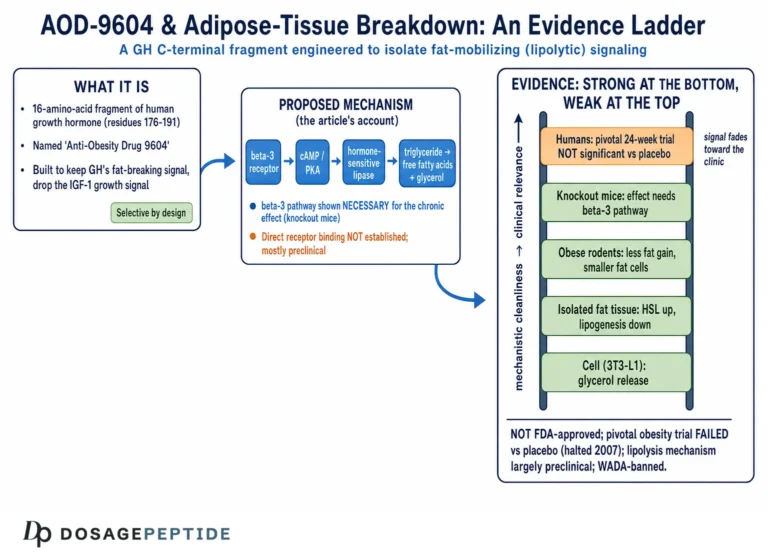
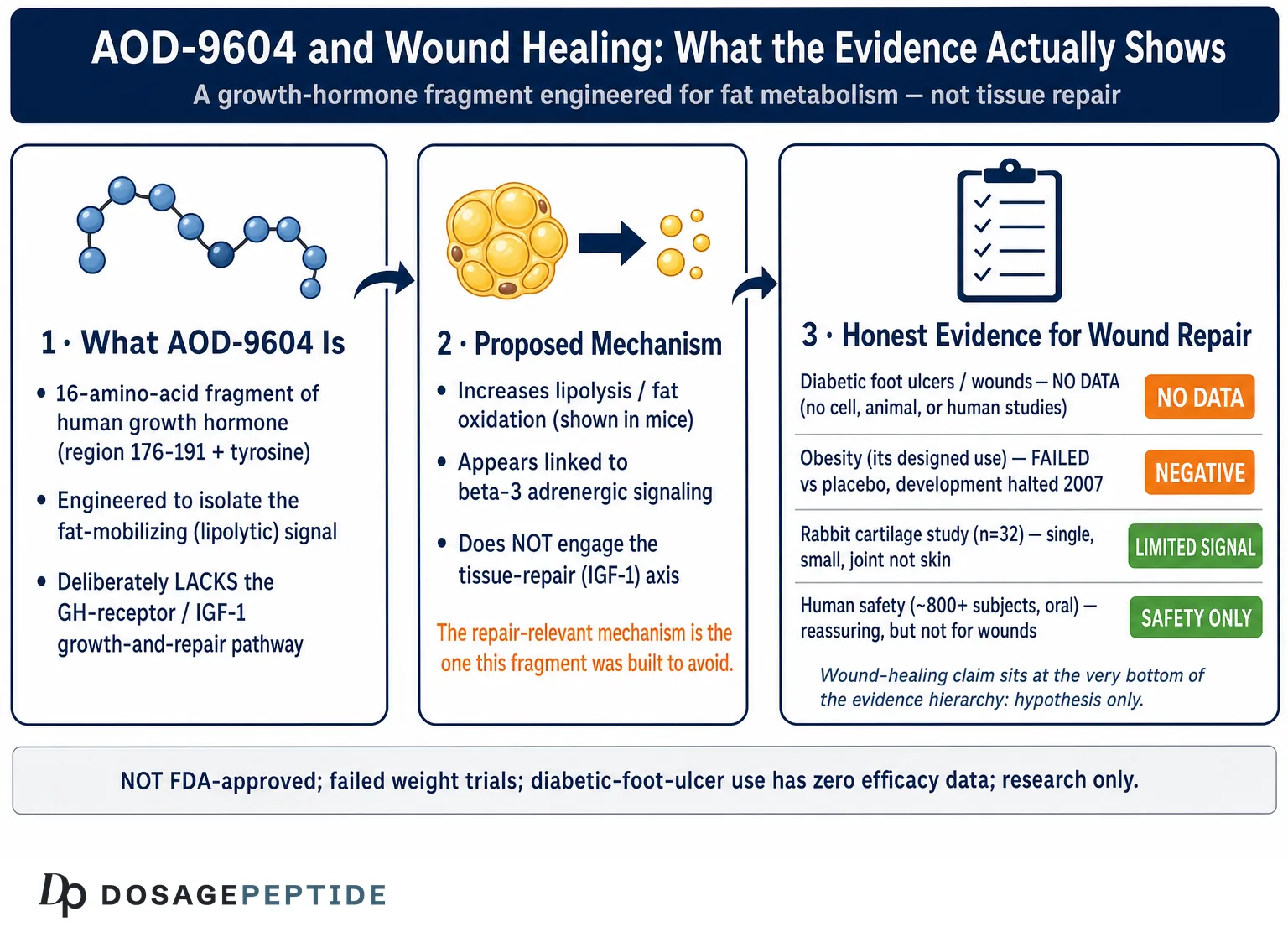
AOD-9604 (the “AOD” stands for Anti-Obesity Drug) is a short, synthetic peptide corresponding to the C-terminal region of human growth hormone. Human growth hormone is a 191-amino-acid protein secreted by the anterior pituitary, and decades of work at Monash University in Australia during the 1990s aimed to determine which part of that large molecule carried its lipolytic (fat-mobilizing) activity. Researchers led by Frank Ng and colleagues traced the fat-metabolizing signal to a small stretch near the tail end of the hormone, residues 176 to 191, a fragment commonly called hGH fragment 176-191.2
AOD-9604 is a slightly modified version of that natural fragment. The 15-residue 176-191 sequence is capped with an extra tyrosine at the N-terminus, producing a 16-amino-acid peptide (a hexadecapeptide) with the molecular formula C78H123N23O23S2 and a disulfide bridge that recreates a small loop found in the parent hormone. The added tyrosine was introduced largely for stability and to aid radiolabeling and detection during development, and it distinguishes AOD-9604 from the plain 176-191 fragment that is also sold in research-chemical channels.
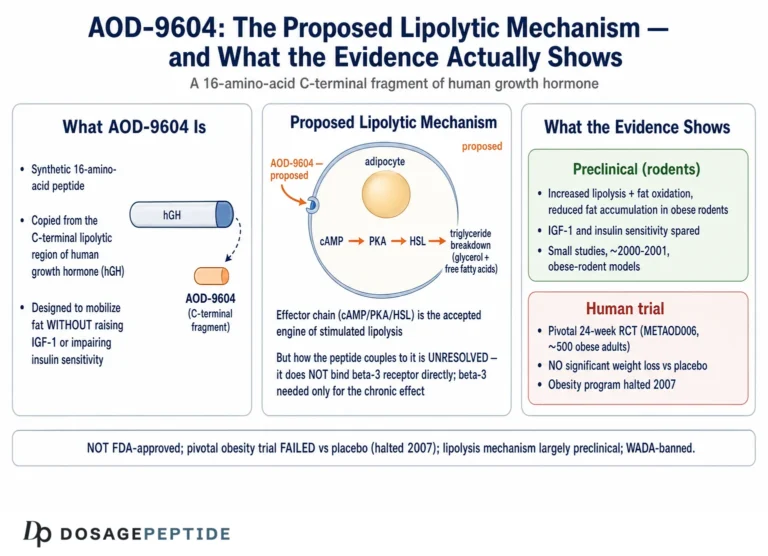
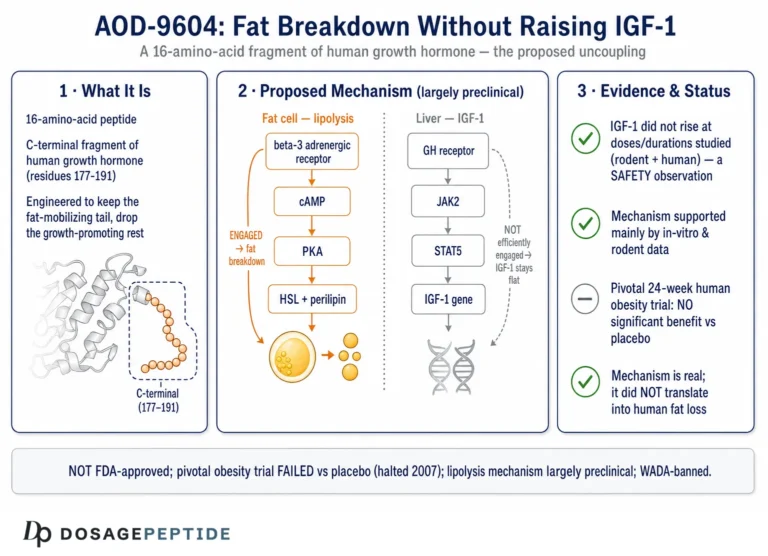
The design intent is worth emphasizing because it frames every reasonable expectation about the molecule. The team specifically wanted a compound that would reproduce growth hormone’s effect on fat metabolism without the rest of hGH’s biology. Full growth hormone raises insulin-like growth factor 1 (IGF-1), can impair glucose tolerance and promote insulin resistance, and drives systemic growth. By using only the C-terminal fragment, developers hoped to obtain the metabolic effect while avoiding IGF-1 elevation and the diabetogenic liability of the whole hormone. Published pharmacology supports the claim that AOD-9604 does not meaningfully raise IGF-1 or disturb glucose in the doses studied.3
Commercial development passed through several hands. Metabolic Pharmaceuticals Ltd of Australia advanced AOD-9604 through a full clinical program for obesity in the early-to-mid 2000s. After the pivotal obesity trial failed, rights and interest shifted; the compound was later explored for oral joint-health and osteoarthritis applications by other groups, and it eventually received a US FDA “Generally Recognized As Safe” (GRAS) self-affirmation as a food ingredient in 2014.4 That GRAS status is a food-additive concept and is categorically different from drug approval, a distinction covered in detail in the regulatory section below.
The choice to build a fragment rather than use the whole hormone was not arbitrary; it reflected a specific pharmacological philosophy that was popular in peptide research at the time. Large protein hormones like growth hormone are pleiotropic, meaning a single molecule triggers many different downstream effects through different receptors and tissues. That breadth is exactly what makes them problematic as drugs: the desired effect comes bundled with unwanted ones. The fragment strategy attempts to “dissect” the parent molecule, keeping the segment responsible for one desired activity and discarding the rest. AOD-9604 is a textbook example of that strategy applied to growth hormone’s metabolic actions. Understanding this framing is essential to reading any claim about the compound honestly, because it tells you that the molecule was intentionally narrowed, not broadened. A fragment engineered to do one thing is not a general-purpose growth-and-repair agent, and treating it as though it inherited all of growth hormone’s biology, including any wound-relevant biology, misunderstands the very reason it was made.
It is important to separate the origin story from the wound-healing question. The fact that AOD-9604 comes from growth hormone, a molecule with genuine roles in anabolism and tissue turnover, is exactly the kind of association that makes speculative claims sound plausible. But AOD-9604 was deliberately stripped of most of hGH’s receptor biology. It was never developed, tested, or optimized for skin, connective tissue, or wound closure. On DosagePeptide.com, the compound is catalogued strictly within a metabolic-research framing rather than a wound-care one, as seen in the AOD-9604 5mg vial research protocol and the companion 2mg vial protocol, both of which frame it as an educational, non-clinical resource. The origin is a metabolic story, not a healing story.
Molecular Structure and Proposed Mechanism of Action
Understanding the mechanism matters because the entire wound-healing hypothesis rests on whether AOD-9604’s molecular activity could plausibly touch the biology of tissue repair. Here the honest picture is that the mechanism is only partly characterized, and what is characterized points toward fat metabolism rather than wound closure.
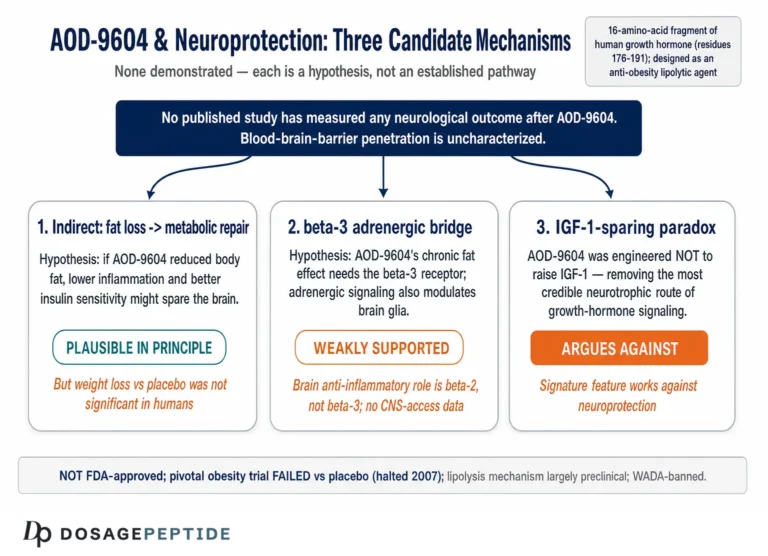
The best-supported mechanistic model comes from rodent work. In studies of obese mice and, importantly, beta-3-adrenergic receptor knockout mice, AOD-9604 increased lipolysis and fat oxidation in wild-type animals but showed a blunted effect in animals lacking the beta-3-adrenergic receptor pathway.2 This is the source of the widely repeated claim that AOD-9604 acts “through beta-3 adrenergic receptors.” A more precise reading is that the peptide’s lipolytic action appears to depend on or interact with beta-3-adrenergic signaling and downstream mediators. It is thought to increase intracellular cyclic AMP and stimulate hormone-sensitive lipase, the enzyme that hydrolyzes stored triglycerides into free fatty acids and glycerol, while also suppressing lipogenesis (new fat synthesis). Whether AOD-9604 binds beta-3-adrenergic receptors directly, or acts upstream/indirectly to modulate that pathway, has not been definitively resolved with a clean receptor-binding characterization.
Crucially, the published mechanism does not involve the classic growth-hormone receptor, and it does not proceed through IGF-1. That is the whole point of the molecule: it reproduces a metabolic effect of hGH without engaging the growth-and-repair axis that most people associate with the parent hormone. So the intuitive syllogism, “growth hormone helps tissue repair, AOD-9604 comes from growth hormone, therefore AOD-9604 helps tissue repair,” breaks down at the second step. AOD-9604 was engineered to lack the growth-signaling arm most relevant to wound anabolism.
What about the mechanisms invoked for its joint and cartilage speculation? In the single controlled animal cartilage study discussed later, authors proposed that AOD9604 might reduce degradation of the cartilage matrix and modulate local signaling, and secondary literature speculates about downregulation of inflammatory cytokines such as interleukin-1 beta (IL-1 beta) and tumor necrosis factor alpha (TNF-alpha).5 If AOD-9604 genuinely dampened those cytokines, one could construct a hypothesis for wound modulation, because IL-1 beta and TNF-alpha are central to the inflammatory phase of healing and to the chronic, stalled inflammation that characterizes diabetic foot ulcers. But this anti-inflammatory activity is itself hypothetical, inferred from tissue scores in one rabbit model rather than demonstrated at the molecular level in skin or wound tissue. There is no published mechanistic study of AOD-9604 in keratinocytes, dermal fibroblasts, endothelial cells, or any wound-relevant cell type.
The table below separates what is reasonably supported from what is speculative, which is the single most useful thing to hold in mind when evaluating wound-healing claims.
| Mechanistic claim | Evidence level | Relevance to wound repair |
|---|---|---|
| Stimulates lipolysis / fat oxidation | Animal in vivo + cell data | Low (metabolic, not reparative) |
| Effect linked to beta-3 adrenergic pathway | Knockout-mouse inference | Low |
| Does not raise IGF-1 or disrupt glucose | Human pharmacology | Neutral (removes the growth arm) |
| Reduces inflammatory cytokines (IL-1 beta, TNF-alpha) | Speculative / inferred | Hypothetical only |
| Promotes angiogenesis, collagen, re-epithelialization | No direct data | Unestablished |
In short, the mechanism that is actually documented is a fat-metabolism mechanism. The mechanisms that would be required for wound repair, angiogenesis, extracellular matrix deposition, fibroblast proliferation, keratinocyte migration, remain entirely unstudied for this compound. That is the honest mechanistic baseline for the rest of this discussion.
It is also worth being candid about how incomplete even the “known” mechanism is. Much of what is asserted confidently online, that AOD-9604 “binds beta-3 receptors,” “upregulates hormone-sensitive lipase,” and “increases cyclic AMP,” is a reasonable synthesis of animal and adipocyte data but has not been nailed down with a definitive receptor-binding and signaling study of the human peptide. The knockout-mouse experiments show dependence on the beta-3 pathway; they do not prove direct receptor engagement, and the possibility of indirect or upstream modulation remains open. This uncertainty matters for the wound question because a mechanism that is itself only partially resolved cannot be confidently extended to a completely different physiological process. You cannot reliably predict what a molecule will do in a healing wound when you do not yet fully understand what it does in the fat cell where it was actually studied. Honest mechanistic writing acknowledges these gaps rather than papering over them with a tidy, over-specified cartoon of receptor binding.
The Wound-Healing Question: Rationale Versus Reality
Diabetic foot ulcers (DFUs) are among the most difficult wounds in clinical medicine. They arise from a combination of peripheral neuropathy, peripheral arterial disease, repetitive pressure, and impaired immune and reparative responses under hyperglycemia. A defining feature is that the normal, orderly progression of healing, hemostasis, inflammation, proliferation, and remodeling, becomes stuck in a chronic inflammatory state with poor angiogenesis, deficient growth-factor signaling, and matrix that is degraded faster than it is rebuilt.6 Any compound proposed to help would need to demonstrably influence one or more of those failure points: improve perfusion, resolve pathological inflammation, drive granulation tissue, or accelerate re-epithelialization.
Why does anyone connect AOD-9604 to this problem at all? The rationale is entirely indirect and rests on three shaky pillars. First, growth hormone and IGF-1 have documented roles in tissue anabolism, and there is a small literature on systemic growth hormone in burns and wound healing, so a growth-hormone fragment “sounds” reparative. Second, the one controlled animal study in a musculoskeletal-injury model (cartilage) reported tissue benefit, which marketing has generalized into a broad “healing and recovery” narrative. Third, AOD-9604 is frequently co-marketed alongside genuinely repair-associated research peptides, so it inherits their reputation by association.
Each pillar collapses under scrutiny. The growth-hormone-in-wounds literature concerns the intact hormone acting through the GH receptor and IGF-1, precisely the pathway AOD-9604 was designed to bypass; you cannot borrow that mechanism for a fragment that lacks it. The cartilage study is a chondroprotection signal in rabbits, not a skin-wound or ulcer study, and cartilage repair biology differs profoundly from cutaneous wound healing. And guilt-by-association with other peptides is not evidence of anything.
Most decisively, when you search the primary literature and trial registries directly, there simply is nothing. There are no controlled preclinical wound-healing studies of AOD-9604 in diabetic or non-diabetic animal models, no published cell studies in wound-relevant human cells, and no registered or completed human trials in DFUs, chronic wounds, surgical incisions, or burns. This is not a case of “early but promising” evidence; it is a case of absent evidence. The wound-healing question exists as a hypothesis generated by online commentary, not as a research program with data behind it.
For readers thinking about the biology honestly, it is even reasonable to ask a skeptical question in the other direction: could a lipolytic peptide be neutral or unhelpful in a wound bed? Adipose tissue and local metabolic signaling do participate in repair, and a molecule tuned to mobilize fat is not obviously matched to the needs of a stalled, poorly perfused ulcer. The point is not that AOD-9604 would harm a wound, there is no evidence either way, but that the presumption of benefit has no scientific foundation. Framing it as an “enhancer of healing” affirms a premise that the data do not support.
A practical corollary: diabetic foot ulcers are medically serious wounds with a real risk of infection, hospitalization, and amputation. They require evaluation and management by qualified clinicians using evidence-based wound care, offloading, debridement, infection control, glycemic management, and vascular assessment. An unapproved research peptide with zero wound data is not a substitute for, or an adjunct to, that care, and this article should not be read as suggesting otherwise.
What the Key Evidence Actually Shows (Honest Level)
To evaluate AOD-9604 fairly, it helps to look at where the real evidence lives, understand its quality, and then map how far it is from the wound-repair question. The evidence base falls into three buckets: human obesity trials, animal metabolic and cartilage studies, and a pooled human safety analysis.
Human obesity trials (the strongest human data, and negative on efficacy). Metabolic Pharmaceuticals ran a full early-phase clinical program. An early Phase 2 study generated some optimism, with reports of roughly 2 kg greater weight loss than placebo over about 12 weeks. But the pivotal, larger Phase 2b dose-finding trial, enrolling on the order of 500 obese adults across multiple oral dose arms versus placebo, failed to meet its primary endpoint: no dose produced statistically significant weight loss relative to placebo at 24 weeks. On the strength (or weakness) of that result, the company terminated development of AOD-9604 as an anti-obesity drug in 2007.1 This is the highest-quality human evidence that exists for the molecule, and it is a negative efficacy result for the one indication it was actually built and tested for.
Animal metabolic studies (mechanistic, positive, but in mice). The rodent work described earlier established that AOD-9604 and the 176-191 fragment can increase lipolysis and reduce fat gain in obese mice, with the beta-3-adrenergic-receptor knockout experiments pointing to the pathway involved.2 These are legitimate mechanistic findings, but they are (a) in animals, (b) about fat metabolism, and (c) not always reproduced as clinically meaningful weight loss once tested in humans. They tell us the molecule is biologically active; they tell us nothing about wounds.
The cartilage study (the only “repair”-adjacent controlled study). The single most-cited piece of evidence used to support any “healing” narrative is Kwon and Park’s 2015 study in Annals of Clinical and Laboratory Science. In a collagenase-induced knee osteoarthritis model, 32 New Zealand white rabbits received weekly ultrasound-guided intra-articular injections of saline, hyaluronic acid (HA), AOD9604, or AOD9604 combined with HA. Gross-morphology and histopathology scores of cartilage degeneration were significantly worse in the saline group than in the treated groups, and the combined AOD9604-plus-HA group scored better than HA or AOD9604 alone, with a shorter lameness period.5 The authors concluded that intra-articular AOD9604 enhanced cartilage regeneration in this model.
This is a genuine, peer-reviewed positive study, and it should be neither dismissed nor oversold. Its limits are severe for the present question: it is a single small-animal study (n=32), in a joint model rather than a skin/ulcer model, using direct intra-articular delivery rather than systemic or topical wound application, measuring cartilage histology rather than wound closure, and it has not been replicated or advanced to controlled human joint trials, let alone wound trials. Extrapolating from “reduced cartilage degradation in a rabbit knee” to “enhances diabetic foot ulcer healing in humans” is not a small leap; it is an unsupported one.
Where wound healing sits on this map: nowhere. There is no bucket of evidence, not human, not animal, not in vitro, that addresses AOD-9604 in wound repair. Using a simple evidence hierarchy, the wound-healing claim is at the very bottom, “hypothesis / anecdote,” with no controlled data of any kind. The table makes the gap explicit.
| Indication | Best evidence available | Direction |
|---|---|---|
| Obesity / weight loss | Multiple human RCTs (Phase 2b, ~500 subjects) | Negative vs placebo |
| Fat metabolism (mechanism) | Mouse in vivo + adipocyte studies | Positive (animal) |
| Cartilage / osteoarthritis | One rabbit study (n=32) | Positive (single, small) |
| Safety / tolerability | Pooled analysis, 800+ humans | Reassuring |
| Diabetic foot ulcers / wound repair | None | No data |
The honest bottom line: AOD-9604 has real human safety data, negative human efficacy data in obesity, and a single encouraging animal cartilage signal. For wound healing specifically, the evidence level is zero.
One further point about evidence interpretation deserves emphasis, because it is where careful readers and marketing part ways. A negative pivotal trial is often more informative than it is given credit for. When a molecule is designed for a specific effect, tested in hundreds of humans under controlled conditions, and still cannot separate from placebo, that is meaningful information about the molecule’s real-world potency, not a mere failure of trial design or dosing. It does not prove AOD-9604 is biologically inert, the animal data show it is active, but it strongly cautions against assuming that its measurable activity in a petri dish or a mouse will translate into a clinically useful effect in a human being. Translation failure from animal models to humans is the norm, not the exception, across drug development, and it is especially common for effects that looked robust in rodents. Carrying that lesson into the wound-healing question means treating even a hypothetical future positive animal wound study with appropriate reservation. The default expectation for an untested repurposing of a molecule that already failed its designed human indication should be skepticism, and the burden of proof sits squarely on anyone claiming benefit.
How AOD-9604 Compares to Other Studied Compounds
Placing AOD-9604 alongside other peptides frequently discussed for repair helps calibrate expectations. This comparison is educational, it is not a recommendation to use any of these compounds, and it is not a claim that any of them is a proven wound therapy in humans. Most remain investigational.
BPC-157. This synthetic “body protection compound” fragment is the peptide most often associated online with tissue and wound healing, with a relatively large body of rodent literature reporting effects on tendon, muscle, gut, and skin-wound models, including some angiogenesis and granulation-tissue signals. Even so, BPC-157 has essentially no controlled human wound-healing trials and is likewise unapproved. The key contrast is that BPC-157 at least has a preclinical wound literature to argue about, whereas AOD-9604 has none. DosagePeptide.com catalogues such repair-associated peptides separately, for example the TB-500 and BPC-157 research stack protocol, and the difference in framing from AOD-9604 is deliberate.
TB-500 (thymosin beta-4 fragment). Thymosin beta-4 is an actin-regulating peptide with genuine preclinical interest in wound repair, corneal healing, and cardiac injury, and it has actually reached some human trials for pressure ulcers and other wounds in its parent-molecule form. That is a materially different evidence position from AOD-9604, which has never been tested for wounds at all. Again, none of this constitutes proof of efficacy, and TB-500-type peptides remain investigational and unapproved.
Intact growth hormone and IGF-1. Systemic recombinant growth hormone has been studied in severe burns and catabolic states, and IGF-1 biology is central to anabolic repair. This is the pathway that gives “growth-hormone fragment” its reparative aura, but it is exactly the arm AOD-9604 does not engage. So paradoxically, the compound AOD-9604 is named after has more of a wound-relevant mechanism than AOD-9604 itself.
Growth-hormone secretagogues (CJC-1295, ipamorelin). These stimulate endogenous GH/IGF-1 release and are sometimes combined with AOD-9604 in research blends, such as the AOD-9604 + CJC-1295 + ipamorelin blend research protocol. The rationale for combining them is metabolic and body-composition oriented, not wound-oriented, and importantly, raising systemic IGF-1 is generally something clinicians are cautious about in certain contexts. Combining compounds also compounds unknowns and is purely a research-context construct, not a validated therapy.
| Compound | Wound-relevant preclinical data | Human wound data | Approved for wounds? |
|---|---|---|---|
| AOD-9604 | None | None | No |
| BPC-157 | Rodent wound/tendon models | None controlled | No |
| Thymosin beta-4 / TB-500 | Multiple injury models | Some early trials | No |
| Recombinant hGH | Yes (GH/IGF-1 axis) | Burn/catabolic studies | Not for routine wounds |
The comparison drives home a single message: even within the world of speculative repair peptides, AOD-9604 is an outlier for having no wound-relevant evidence. It is the least-supported of a group that is itself largely unproven for wounds.
Research Models and Methodology for the Wound-Repair Question
Because there is no AOD-9604 wound literature to summarize, the useful thing to describe is how such a question would be investigated, and by extension, what a reader should demand before taking any “healing” claim seriously. This section is methodological, so that claims can be weighed against the standard of evidence they would actually require.
In vitro (cell-level) work. A credible program would begin with wound-relevant human cells: dermal fibroblasts (collagen and extracellular-matrix production), keratinocytes (re-epithelialization and migration in scratch-wound assays), and endothelial cells (angiogenesis and tube-formation assays). Under both normal and high-glucose “diabetic-like” conditions, researchers would measure proliferation, migration, and secretion of growth factors and matrix components. For AOD-9604, none of these experiments have been published. The absence of even basic cell data is telling; it means the hypothesis has not cleared the lowest, cheapest bar of preclinical testing.
Animal wound models. The standard preclinical models for diabetic wound healing include genetically diabetic mice (such as db/db mice), chemically induced diabetic rodents (streptozotocin), and full-thickness excisional or splinted wounds that control for the contraction that rodents (unlike humans) rely on. Endpoints include wound-closure rate, granulation-tissue formation, capillary density (angiogenesis), collagen deposition, and histological quality of the healed tissue.6 A serious AOD-9604 wound study would use such a model with appropriate controls, blinding, adequate sample size, and pre-registered endpoints. The Kwon cartilage study is a reasonable template for rigor in a different tissue, but no analogous wound study exists.
Route and formulation questions. Wound healing raises delivery problems that the obesity and cartilage work never addressed. Would AOD-9604 be applied topically to the wound bed, injected peri-wound, or given systemically? Each route has different pharmacokinetics and stability concerns for a peptide. AOD-9604 was studied orally (as a food-ingredient concept) and by intra-articular injection (in rabbits); neither tells us how, or whether, it would reach and act in a wound bed at a meaningful concentration. These are unsolved formulation questions, not minor details.
What good evidence would look like. Before any human wound trial, one would expect: reproducible positive cell data across multiple wound-cell types, then positive controlled data in at least one validated diabetic-wound animal model, ideally replicated by an independent lab, then dose-ranging and safety work specific to the wound route, and only then early-phase human studies. AOD-9604 is at step zero of this pipeline for wounds. Any source claiming it “enhances healing” is skipping the entire ladder.
Methodological literacy is the reader’s best defense here. When evaluating a peptide claim, ask: In what species? At what evidence level (cell, animal, human)? For what specific endpoint? Replicated or single study? For AOD-9604 and wounds, the answers are, respectively, none, none, none, and none, which is precisely why the title’s question must stay a question.
Safety and Tolerability
Safety is, ironically, the strongest part of AOD-9604’s human dossier, precisely because it was tested extensively as an obesity drug even though it failed on efficacy. This is worth presenting accurately, but with a clear caveat: safety data generated in obesity trials (oral dosing, non-wounded adults) do not automatically transfer to a hypothetical wound-care context (different route, different population, broken skin, possible infection).
The central safety reference is a pooled analysis by Stier and colleagues, published in 2013, that aggregated tolerability data across the clinical program, on the order of 800 to 900 participants exposed to AOD-9604 across multiple randomized, double-blind, placebo-controlled trials.3 The headline findings were reassuring: the adverse-event profile was broadly similar to placebo, there were no serious adverse events attributed to the peptide in these studies, no clinically meaningful effect on IGF-1, no impairment of glucose metabolism or insulin sensitivity, and no evidence of the peptide provoking anti-drug antibody formation at the doses tested. The lack of IGF-1 and glucose signals is consistent with the molecule’s design intent of separating fat metabolism from the growth and diabetogenic arms of full growth hormone.
Those are genuinely favorable findings, and they are the reason the compound could plausibly self-affirm GRAS status as a food ingredient in 2014. But several important qualifications keep this from being a blank check, especially for a wound-healing framing:
- Route mismatch. The human safety data are dominated by oral administration. Injectable use, subcutaneous, peri-wound, or intra-articular, was not the basis of the large safety pool, and injection introduces its own risks: injection-site reactions, and, critically for a wound context, infection and sterility hazards.
- Population mismatch. Trials enrolled generally healthy obese adults. People with diabetic foot ulcers have comorbidities, vascular disease, neuropathy, and infection risk that were never represented in AOD-9604 safety studies.
- Product-quality risk. AOD-9604 sold through research-chemical channels is not manufactured, tested, or labeled to pharmaceutical standards. Purity, sterility, endotoxin content, and actual peptide identity can vary widely. Applying an unverified, potentially non-sterile product near or into broken skin is a real infection hazard, entirely separate from the intrinsic pharmacology of the molecule.
- Long-term and interaction data are limited. The trials were of finite duration for one indication; chronic use, use in combination with other peptides, and use in medically complex patients are not well characterized.
So the correct summary is nuanced: in its tested context (oral, healthy obese adults, defined trial doses), AOD-9604 showed a benign, placebo-like tolerability profile and no signal of the metabolic harms associated with full growth hormone. That is a legitimate strength. It does not establish safety for injection, for wound application, for people with diabetes and ulcers, or for products of unknown quality, and it says nothing about efficacy for any of those uses. Good tolerability is not evidence of benefit.
Handling and Reconstitution in a Research Context
This section is included because AOD-9604 is distributed as a lyophilized (freeze-dried) research peptide and is handled in laboratory settings, and accurate handling information reduces error and contamination. It is provided strictly for educational and research-context understanding. It is not a use protocol, not medical guidance, and explicitly not instructions for treating a diabetic foot ulcer, a wound, or any human condition. AOD-9604 is not an approved therapy, and nothing below should be read as endorsing self-administration.
AOD-9604 typically ships as a white lyophilized powder in a sealed vial, most commonly in 2 mg or 5 mg quantities, and is intended to be reconstituted with a sterile diluent, usually bacteriostatic water (sterile water containing about 0.9 percent benzyl alcohol, which allows multi-use storage) or, for some workflows, sterile or sterile-saline water. General laboratory handling principles that apply to peptides of this class include:
- Cold storage. Lyophilized peptide is generally stored frozen or refrigerated and kept away from light and moisture; once reconstituted, it is typically refrigerated and used within a limited window because peptides in solution degrade faster than as dry powder.
- Gentle reconstitution. Diluent is usually added slowly down the inner wall of the vial rather than injected forcefully onto the powder, and the vial is swirled, not shaken, because vigorous agitation can shear and denature peptide chains.
- Accurate concentration math. The final concentration is a simple function of peptide mass divided by diluent volume, and small volume errors translate into large concentration errors with a milligram-scale peptide. Research-education resources such as the DosagePeptide.com 5mg vial reconstitution reference exist to illustrate this arithmetic in an educational frame, and the broader peptide dosage index catalogues these reference protocols across compounds.
- Sterility and contamination control. Vial stoppers are wiped with alcohol, single-use sterile syringes are used, and the reconstituted vial is protected from repeated non-sterile access. This is doubly important to emphasize precisely because the wound-healing premise would involve broken skin, where any contamination risk is amplified.
None of this handling detail should be misconstrued as legitimizing a wound-care application. The reason to understand it is that most real-world problems with research peptides are not exotic pharmacology, they are mundane errors in storage, dilution math, and sterility. And for a compound with zero wound-efficacy evidence, meticulous handling of an unproven substance still yields an unproven substance. Handling knowledge is harm-reduction context, not a bridge to clinical use.
Limitations and the Human-Evidence Gap
It is worth consolidating, in one place, the specific limitations that make the wound-healing question genuinely open, rather than merely “under-studied with a positive lean.” These limitations are not minor caveats; they are the whole story.
1. No wound data at any level. The most important limitation is the simplest: there are no in vitro, animal, or human studies of AOD-9604 in wound healing, diabetic or otherwise. The claim in the title is a hypothesis with no supporting experiments, not an evidence-backed possibility. This alone is disqualifying for any affirmative statement about efficacy.
2. The one human indication tested was negative. Where AOD-9604 was rigorously tested in humans, obesity, it failed to beat placebo in the pivotal Phase 2b trial, and its drug development was halted.1 A molecule that could not demonstrate its designed effect in well-powered human trials deserves heightened skepticism when repurposed, on no data, for an unrelated and harder problem.
3. The mechanism points away from wound repair. AOD-9604’s characterized activity is lipolytic and appears tied to beta-3-adrenergic signaling, while it was specifically engineered to avoid the GH-receptor/IGF-1 axis that underlies growth hormone’s anabolic, repair-relevant biology.2 The mechanism most associated with tissue repair is the one this fragment lacks.
4. The “healing” narrative rests on a single, tissue-mismatched animal study. The rabbit cartilage study is real and positive, but it is one small study, in cartilage, by intra-articular injection, measuring histology, not a wound study.5 Chondroprotection in a joint is not cutaneous wound closure, and one unreplicated animal result is a slender thread on which to hang a human wound claim.
5. Delivery to a wound is unsolved. Even if a benefit existed, how AOD-9604 would reach a wound bed, topical, peri-wound, or systemic, at an effective, stable concentration has never been studied. Route and formulation are not afterthoughts; they can make or break a peptide’s activity.
6. Product quality is uncontrolled. Research-channel AOD-9604 is not held to pharmaceutical purity, sterility, or labeling standards, adding a layer of uncertainty (and, near broken skin, infection risk) on top of the pharmacological unknowns.
7. Publication and marketing bias. Much of what circulates about AOD-9604 and “healing” originates from vendors and content marketing that generalize from weak or unrelated data. The gap between what studies show and what is claimed is wide, and it consistently runs in the direction of overstatement.
Taken together, these limitations mean the responsible characterization is not “promising but early.” It is “unstudied, mechanistically unlikely to be a wound-repair agent, and negative in its one rigorous human indication.” The human-evidence gap for wounds is total: there is no floor of data to build on. That is why the premise must be treated as an open question and, on current evidence, a doubtful one.
Regulatory and Anti-Doping Status
Regulatory status is where a great deal of confusion, some of it deliberate, surrounds AOD-9604, so precision matters. Several distinct facts are often blurred together to create a false impression of legitimacy.
Not FDA-approved as a drug, for anything. No regulatory agency, in the United States or elsewhere, has approved AOD-9604 as a drug for any therapeutic indication. It is not approved for obesity, joint disease, wound healing, or anything else. Its pivotal obesity program ended in a failed trial and discontinued development in 2007.1
GRAS is not drug approval. In 2014, AOD-9604 was self-affirmed as “Generally Recognized As Safe” (GRAS) for use as an oral food ingredient.4 GRAS is a food-additive safety concept under food law; it speaks to ingredient safety in food at certain levels, not to therapeutic efficacy, and it does not authorize marketing the compound as a treatment for any disease. Citing GRAS status to imply medical legitimacy is a category error that appears frequently in promotional material.
US compounding status. In the United States, AOD-9604 has been evaluated in the context of pharmacy compounding, and it has not been placed on the list of bulk drug substances eligible for compounding under the relevant FDA review; regulators have treated such peptides with considerable caution. In practice this means it is not a legitimately compoundable prescription therapy, and it is generally sold only labeled “for research use only, not for human consumption.”
Prohibited in sport. The World Anti-Doping Agency (WADA) explicitly prohibits AOD-9604. As a growth-hormone fragment it falls under Section S2 (Peptide Hormones, Growth Factors, Related Substances and Mimetics), and as an agent without approval for human therapeutic use it also falls under the S0 “non-approved substances” catch-all. It is banned at all times, both in and out of competition, and validated urine-detection methods for AOD-9604 metabolites have been described in the anti-doping literature.7 Any athlete in a WADA-compliant sport should treat use as a near-certain anti-doping rule violation.
What this means for the wound question. The regulatory picture reinforces the scientific one. A compound that is unapproved as a drug, failed its one rigorous human indication, is sold only “for research,” and is banned in sport is not a therapy waiting in the wings for diabetic foot ulcers. There is no regulatory pathway, and no clinical program, positioning it as a wound treatment. Readers can consult the broader educational context on the DosagePeptide.com research blog, but the regulatory bottom line is unambiguous: AOD-9604 is an investigational research chemical, not an approved or emerging wound therapy.
Frequently Asked Questions
Is AOD-9604 approved to treat diabetic foot ulcers or wounds?
No. AOD-9604 is not approved by the FDA or any other regulatory authority for diabetic foot ulcers, wounds, or any other medical condition. There are no clinical trials of AOD-9604 in wound healing, and there is no evidence that it heals or accelerates the healing of any wound. Diabetic foot ulcers are serious wounds that require professional medical care.
Does AOD-9604 actually work for fat loss?
In its largest, well-powered human trial (a Phase 2b obesity study), AOD-9604 did not produce statistically significant weight loss compared to placebo, and its development as an obesity drug was discontinued in 2007.1 Animal studies show lipolytic activity, but this did not translate into meaningful human weight loss in the pivotal trial. Claims of proven fat-loss efficacy in humans are not supported by the strongest evidence.
Where does the “healing” reputation come from if there’s no wound data?
It comes from three indirect sources: AOD-9604’s descent from growth hormone (a molecule with anabolic roles), a single positive rabbit study on cartilage rather than skin,5 and marketing that groups it with genuinely repair-associated peptides. None of these establishes wound-healing efficacy, and AOD-9604 was specifically engineered to lack the GH-receptor/IGF-1 pathway most relevant to tissue repair.
Is AOD-9604 safe?
In its tested context, oral dosing in generally healthy obese adults, pooled data from roughly 800 to 900 participants showed a tolerability profile similar to placebo, with no serious attributed adverse events and no adverse effect on IGF-1 or glucose.3 However, this does not establish safety for injection, for wound application, for people with diabetes and ulcers, or for research-channel products of unverified purity and sterility. Good tolerability is not the same as proven benefit or safety in these other contexts.
How is AOD-9604 different from HGH fragment 176-191?
AOD-9604 is essentially the 176-191 C-terminal fragment of growth hormone with an additional tyrosine added at the N-terminus, making it a 16-amino-acid peptide. The added residue was introduced largely for stability and detection during development. Both are lipolytic fragments derived from the same region of growth hormone; neither has demonstrated wound-healing efficacy in humans.
Is AOD-9604 legal, and is it banned in sports?
It is not an approved drug and is typically sold only “for research use only.” In sport, the World Anti-Doping Agency prohibits it under Section S2 (and S0 as a non-approved substance), banned both in and out of competition, with validated detection methods available.7 Athletes should assume use would cause an anti-doping rule violation.
Could AOD-9604 ever be useful for wounds in the future?
It cannot be ruled in or out because the basic research has never been done. There are no cell studies, no diabetic-wound animal studies, and no human wound trials. Before anyone could reasonably claim benefit, the compound would need to clear that entire preclinical ladder with replicated positive results. As of now it sits at step zero for wound healing, and its known mechanism points away from being a repair agent.
Should someone with a diabetic foot ulcer consider AOD-9604?
No. Diabetic foot ulcers carry real risks of infection, hospitalization, and amputation, and they require evidence-based care from qualified clinicians, including offloading, debridement, infection control, vascular assessment, and glycemic management. An unapproved research peptide with zero wound data is not a treatment and could introduce infection risk if applied near broken skin. Anyone with such a wound should seek prompt professional medical care.
References
- Metabolic Pharmaceuticals Ltd. Phase 2b clinical trial of AOD-9604 in obesity; program outcome and discontinuation (2007). Reported in BioWorld / BioSpace clinical coverage. biospace.com; bioworld.com
- Heffernan MA, Thorburn AW, Fam B, et al. The effects of human GH and its lipolytic fragment (AOD9604) on lipid metabolism following chronic treatment in obese mice and beta(3)-AR knock-out mice. Endocrinology. 2001;142(12):5182-5189. PubMed PMID 11713213. pubmed.ncbi.nlm.nih.gov/11713213
- Stier H, Vos E, Kenley D. Safety and Tolerability of the Hexadecapeptide AOD9604 in Humans (pooled analysis of randomized, double-blind, placebo-controlled trials). Journal of Endocrinology and Metabolism. 2013;3(1-2):7-15.
- US FDA. AOD-9604 Generally Recognized As Safe (GRAS) self-affirmation as a food ingredient (2014); regulatory context in FDA Pharmacy Compounding Advisory Committee briefing materials. fda.gov
- Kwon DR, Park GY. Effect of Intra-articular Injection of AOD9604 with or without Hyaluronic Acid in Rabbit Osteoarthritis Model. Annals of Clinical and Laboratory Science. 2015;45(4):426-432. PubMed PMID 26275694. pubmed.ncbi.nlm.nih.gov/26275694
- Du H, et al. Preclinical study of diabetic foot ulcers: From pathogenesis to in vivo/in vitro models and clinical therapeutic transformation. International Wound Journal. 2023. PMC10681512. pmc.ncbi.nlm.nih.gov/articles/PMC10681512
- World Anti-Doping Agency. The Prohibited List, Section S2 (Peptide Hormones, Growth Factors, Related Substances and Mimetics) and S0 (Non-Approved Substances); AOD-9604 classification and urine metabolite detection literature (Drug Testing and Analysis, 2015). wada-ama.org/en/prohibited-list
Educational and research-use disclaimer: This article is provided for educational and research-context information only. AOD-9604 is an unapproved, investigational research compound. It is not approved by the FDA or any regulatory authority to treat, cure, prevent, or diagnose any disease, and it has no demonstrated efficacy in wound healing or diabetic foot ulcers in humans. Nothing here is medical advice or a protocol for human use, and nothing here should be interpreted as recommending self-administration. Diabetic foot ulcers and other wounds are medically serious and require evaluation and treatment by qualified healthcare professionals. Always consult a licensed clinician regarding any medical condition.