The question in this article’s title contains a claim and a puzzle folded together, and it is worth separating them before going further. The claim is that AOD-9604 “stimulates fat breakdown.” The puzzle is that it supposedly does so “without altering IGF-1 pathways.” On the surface this sounds almost paradoxical: AOD-9604 is a fragment of human growth hormone, and growth hormone is famous both for mobilizing fat and for driving up insulin-like growth factor-1 (IGF-1). How could a piece of that same hormone keep one action and discard the other? The short answer is that the molecule was deliberately engineered to do exactly this — to reproduce the lipolytic (fat-mobilizing) tail of growth hormone while leaving behind the receptor engagement that raises IGF-1.1 The longer answer, which occupies most of this piece, is that the mechanism is genuinely interesting, largely preclinical, mechanistically plausible, and—crucially—never translated into a robust clinical fat-loss effect in humans.
So this is not a celebration of a proven fat-burning drug. It cannot be, because AOD-9604 is not one. Its pivotal human obesity trial failed to separate from placebo, and the development program was halted in 2007.2 What survives that failure is a mechanistic story worth understanding on its own terms: a clean case study in how the growth-hormone molecule can, in principle, be dissected into functionally separable domains, and how the lipolytic signal can be uncoupled from the somatotropic (growth-promoting, IGF-1-raising) one. That uncoupling is the real subject here. We will trace how growth hormone normally burns fat and simultaneously raises IGF-1, why those two effects travel through partly different molecular routes, what AOD-9604 is thought to do inside the fat cell, and—with appropriate skepticism—what the actual evidence says about whether IGF-1 truly stays flat.
Throughout, the framing is honest by design. Where the mechanism rests on rodent and in-vitro data, that will be stated. Where human evidence is thin or negative, that will be stated too. AOD-9604 is not approved by any major regulator for fat loss or any other disease, it is prohibited in sport, and nothing here is a recommendation for human use. The goal is to explain a mechanism accurately, not to sell an outcome.
What AOD-9604 Actually Is
AOD-9604 is a synthetic 16-amino-acid peptide whose name abbreviates “Anti-Obesity Drug 9604.” It corresponds to the C-terminal region of human growth hormone (hGH), specifically residues 177–191, with one engineered modification: a tyrosine residue is added at the N-terminus in place of the native sequence, a change intended to stabilize the fragment and improve its handling.1 The full sequence is H-Tyr-Leu-Arg-Ile-Val-Gln-Cys-Arg-Ser-Val-Glu-Gly-Ser-Cys-Gly-Phe-OH, and the two cysteine residues form a disulfide bridge that reproduces the small loop present in the parent hormone’s lipolytic domain. That loop matters: the fat-mobilizing activity of growth hormone had been localized experimentally to this C-terminal region, and the disulfide-constrained conformation is thought to be part of what preserves the activity in the isolated fragment.1
The compound emerged from work at Monash University in Melbourne, Australia, and was developed commercially by Metabolic Pharmaceuticals Limited. The design logic was reductionist in the best sense: full-length growth hormone is a 191-amino-acid protein that does many things at once—it promotes longitudinal bone growth, raises circulating IGF-1, alters glucose handling and can impair insulin sensitivity with chronic exposure, and, separately, drives the breakdown of stored fat. The researchers reasoned that if the lipolytic activity lived in a discrete part of the molecule, a short peptide reproducing only that part might deliver fat mobilization while shedding the growth-promoting and glucose-disrupting baggage.1 The very abbreviation in the name announces the intent: this was built to be an anti-obesity agent, nothing more.
It helps to hold three distinct entities separate in the mind, because popular writing constantly blurs them. First, the parent hormone: full-length hGH, with its broad endocrine reach. Second, the lipolytic domain: the C-terminal region carrying much of the fat-mobilizing signal. Third, the engineered fragment: AOD-9604 itself, a stabilized reproduction of that domain. Each step narrows the biology. When a marketing page reasons from “growth hormone raises IGF-1 and builds tissue” to “this fragment must do the same,” it is collapsing these three levels back into one and ignoring the deliberate narrowing that defines the molecule. Keeping them distinct is the single most useful habit for reading anything about AOD-9604, and it is the foundation for understanding how fat breakdown and IGF-1 can, in this compound, come apart. Readers who want the broader vocabulary of this field can consult the site’s peptide glossary, which defines terms such as lipolysis, somatotropic axis, and adipocyte in plain language.
How Growth Hormone Normally Burns Fat — and Raises IGF-1
To understand how AOD-9604 keeps one effect and drops the other, you first have to see that in the intact hormone these are two effects, not one, and that they are already partly separable at the level of tissue and pathway.
Growth hormone is one of the body’s most potent lipolytic signals. Acting on adipose tissue, it promotes the hydrolysis of stored triglycerides into free fatty acids and glycerol, increasing the flux of free fatty acids into the circulation and shifting the body toward fat oxidation as a fuel source.3 This is why growth hormone deficiency is associated with increased fat mass and why growth-hormone excess (as in acromegaly) is associated with a leaner, though metabolically disturbed, phenotype. The fat-mobilizing action of growth hormone is, importantly, considered to be substantially a direct effect on adipose tissue rather than one mediated by IGF-1.3 That distinction is the seed of everything that follows: if the lipolytic action does not require IGF-1 to occur, then in principle a molecule could deliver lipolysis without touching the IGF-1 arm at all.
The IGF-1 arm works differently. When growth hormone binds its receptor (GHR) — a single-pass transmembrane receptor most densely expressed in the liver — it triggers dimerization and activation of the receptor-associated tyrosine kinase JAK2. Activated JAK2 phosphorylates the transcription factor STAT5, which translocates to the nucleus and drives transcription of the IGF1 gene, among many others.4 Hepatic STAT5 activation is the principal source of circulating IGF-1, and IGF-1 in turn mediates most of growth hormone’s anabolic, growth-promoting effects on bone, cartilage, and muscle.4 So the IGF-1-raising action of growth hormone is fundamentally a GHR–JAK2–STAT5 transcriptional event, largely in the liver.
It is worth pausing on a subtlety that popular accounts routinely miss. Growth hormone’s lipolytic effect is not purely a matter of the hormone flipping a switch on the fat cell in isolation. A well-documented feature of growth-hormone action in adipose tissue is that it sensitizes the fat cell to the catecholamines—adrenaline and noradrenaline—that are the physiological drivers of lipolysis. In other words, growth hormone increases the responsiveness of the beta-adrenergic machinery rather than simply substituting for it.3 This detail is central to understanding AOD-9604, because if the lipolytic tail of the hormone works by tuning up the adrenergic system rather than by activating the growth-hormone receptor’s transcriptional cascade, then a fragment reproducing that tail would be expected to raise adrenergic sensitivity and lipolysis without engaging the IGF-1-generating program at all. The mechanism and the IGF-1-sparing property are, on this reading, two sides of the same coin: the fragment works precisely because it acts where growth hormone’s fat effect is exerted (the adrenergic–lipase axis) rather than where its growth effect is generated (the hepatic receptor–transcription axis).
Here is the pivotal point for this article: growth hormone’s many effects are not all funneled through one identical mechanism. The somatotropic, IGF-1-raising effect is a receptor-and-transcription story. The lipolytic effect on fat, while it can be initiated through the same receptor, is also strongly modulated at the adipocyte through the adrenergic signaling machinery and can be dissociated from the IGF-1 axis experimentally.3 Because these are partly separable, the door is open—at least in principle—for a fragment that engages the lipolytic machinery without efficiently driving the hepatic GHR–JAK2–STAT5–IGF-1 cascade. Whether AOD-9604 truly walks through that door cleanly is the question the rest of this article examines.
The Central Claim: Uncoupling Lipolysis From IGF-1
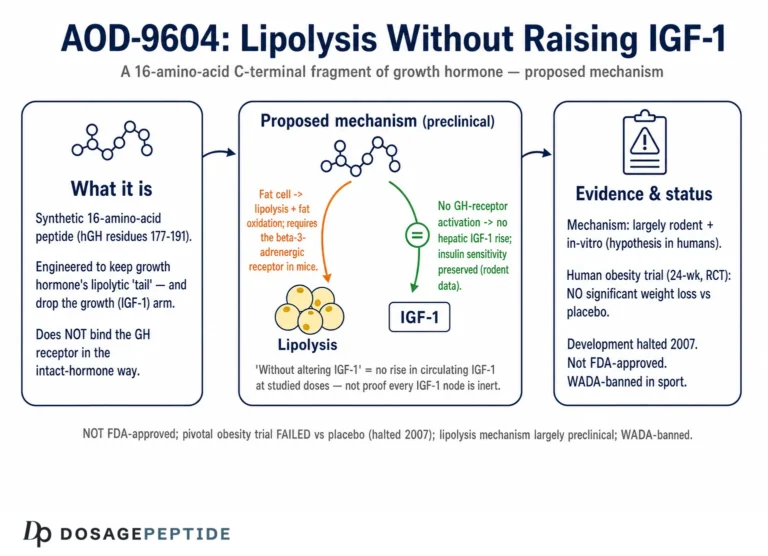
The defining assertion about AOD-9604—the one that gives this article its title—is that it reproduces the lipolytic and fat-oxidizing actions of growth hormone in adipose tissue without raising IGF-1 and without impairing glucose tolerance.1 This is not merely a marketing slogan; it is the explicit design goal and the finding reported in the foundational metabolic studies. In those studies, AOD-9604 reduced body-fat accumulation and increased lipolytic activity in adipose tissue in obese-rodent models, while measurements of IGF-1 did not show the elevation that accompanies full-length growth-hormone administration.1
How can a growth-hormone fragment do this? The most coherent mechanistic account rests on two ideas. First, the lipolytic domain of growth hormone appears able to signal to fat cells without the high-affinity, dimerizing engagement of the full growth-hormone receptor that is required to fire the JAK2–STAT5 cascade at the intensity needed to drive hepatic IGF-1 transcription. A short C-terminal fragment simply is not the full ligand; it lacks the surfaces required to productively cross-link and activate GHR the way intact hGH does, so it does not efficiently switch on the STAT5–IGF1 program.4 Second, the fragment’s lipolytic effect appears to route through the adipocyte’s own beta-adrenergic machinery, a pathway that raises intracellular cyclic AMP and activates the fat-splitting enzymes directly, independent of any transcriptional IGF-1 event.
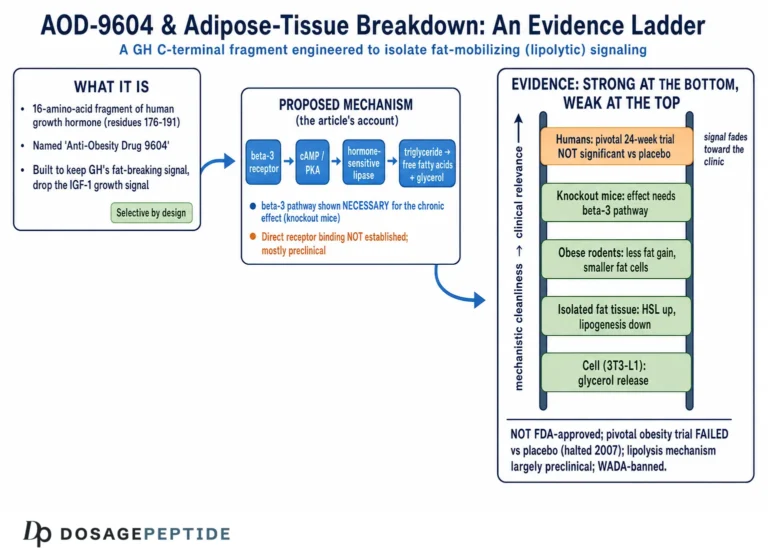
The strongest single piece of primary evidence for that second idea comes from a knockout study. When AOD-9604 (and, for comparison, full-length hGH) was administered chronically to mice lacking the beta-3 adrenergic receptor (β3-AR), the body-weight and lipolytic effects seen in wild-type animals were substantially blunted, whereas the compound worked in normal controls.5 This implicates the β3-adrenergic pathway as necessary for the compound’s sustained metabolic effect. Intriguingly, in the same body of work, certain acute increases in energy expenditure and fat oxidation still appeared in the knockout animals, suggesting at least one β3-independent component to the acute response.5 A crucial subtlety must be stated precisely, because it is easy to overstate: the investigators did not conclude that AOD-9604 works by directly agonizing the β3-receptor like a classic adrenergic drug. Their explicit conclusion was that the lipolytic actions of both hGH and the fragment are “not mediated directly through” β3-AR; rather, both compounds raised the (obesity-suppressed) expression of β3-AR back toward lean levels, and that receptor is in turn required for the sustained lipolytic response.5 The honest reading is therefore that β3-adrenergic signaling is necessary for—and central to—the chronic lipolytic action, most plausibly through a permissive, expression-raising and sensitizing role rather than direct receptor activation, and that the full molecular choreography is not completely resolved.
The crucial conceptual takeaway is this: the lipolytic effect and the IGF-1 effect travel through different molecular addresses. Fat breakdown is being driven, on the best available evidence, through the adrenergic–cyclic-AMP–lipase axis inside the fat cell; IGF-1 elevation would require robust hepatic GHR–JAK2–STAT5 transcription that the fragment does not efficiently produce. Because these addresses are distinct, hitting one need not ring the other—which is exactly the “without altering IGF-1 pathways” phenomenon the title asks about. For a companion perspective on how the same molecule is discussed in the context of its central-nervous-system and obese-phenotype research, the sibling article on the molecular mechanisms behind AOD-9604’s effects in obese phenotypes examines a different downstream question from the same mechanistic root.
Inside the Adipocyte: the Lipolytic Cascade in Detail
To make “fat breakdown through the adrenergic pathway” concrete, it is worth walking through the cascade step by step, because this is where the mechanism becomes legible rather than hand-waved.
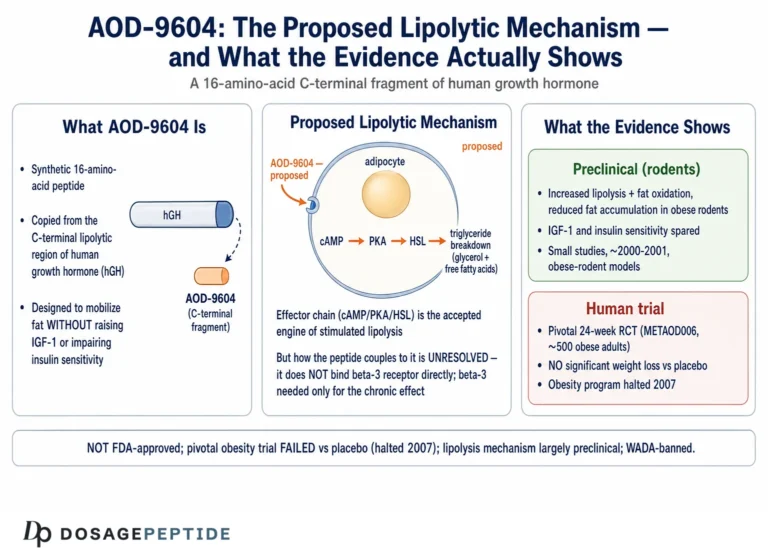
A mature white adipocyte stores energy as triglyceride packed into a large lipid droplet. That droplet is coated with structural proteins, chief among them perilipin, which under resting conditions acts as a barrier that shields the stored fat from lipases.6 Lipolysis—the controlled dismantling of that stored triglyceride—is governed by a signaling relay that begins at the cell surface. When a beta-adrenergic receptor (in rodent fat, prominently the β3 subtype) is activated, it couples through a stimulatory G protein to adenylyl cyclase, which converts ATP into cyclic AMP (cAMP). Rising cAMP activates protein kinase A (PKA).6
PKA is the hinge of the whole system. It phosphorylates two key substrates. It phosphorylates hormone-sensitive lipase (HSL), which increases the enzyme’s activity and promotes its translocation from the cytosol to the surface of the lipid droplet. And it phosphorylates perilipin, which causes the coat protein to change its conformation and release its protective grip on the droplet, granting the lipases access to the triglyceride substrate.6 The elegant detail, established in cell-biology work, is that phosphorylated HSL docks onto phosphorylated perilipin to reach the triglyceride and diacylglycerol substrates at the droplet surface; perilipin phosphorylation is not merely permissive but actively promotes HSL-mediated lipolysis.6 The net result is hydrolysis of stored triglyceride into free fatty acids and glycerol, which exit the cell—the free fatty acids then available for oxidation as fuel.
AOD-9604 is proposed to feed into this cascade by engaging or upregulating the β3-adrenergic arm, thereby raising cAMP and driving the PKA–HSL–perilipin machinery.15 Consistent with this, the compound has been reported not only to stimulate lipolysis but also to influence the expression of β3-adrenergic receptors and to suppress lipogenesis (the synthesis of new fat), tilting the adipocyte’s energy balance toward breakdown rather than storage.1 The β3-AR knockout result anchors the pathway’s necessity: remove the receptor, and the chronic lipolytic effect largely disappears.5
There is a second, complementary side to the adipocyte story that AOD-9604 is reported to influence: lipogenesis, the building of new fat. The fat cell is not a one-way vault; it constantly balances triglyceride synthesis against breakdown. Enzymes such as acetyl-CoA carboxylase and fatty-acid synthase drive the esterification of substrate into stored triglyceride, while insulin signaling promotes storage and suppresses lipolysis. A compound that simultaneously nudges lipolysis upward and dampens lipogenesis would tilt the adipocyte’s net energy balance toward depletion more effectively than one acting on breakdown alone. The foundational metabolic work reported exactly this dual signature for AOD-9604—increased lipolytic activity alongside reduced fat accumulation—which is consistent with a shift in the storage-versus-mobilization balance rather than a single-enzyme effect.1 This matters for the IGF-1 question because both halves of that balance are adipocyte-local metabolic events; neither requires the hepatic transcriptional machinery that produces circulating IGF-1.
A further point worth making explicit is the role of the β3-adrenergic receptor subtype specifically. In rodents, β3-AR is heavily expressed on white and brown adipose tissue and is a dominant driver of adipose lipolysis and thermogenesis; this is why the knockout result is so informative.5 Human adipose tissue relies more on the β1 and β2 subtypes, with β3 playing a smaller and more debated role—a species difference that is one plausible contributor to why a mechanism that looked clean in mice did not deliver comparable fat loss in people. The receptor biology that made the rodent story so tidy may simply be less operative in human fat, a caveat that any honest mechanistic account has to carry forward.
Notice what is conspicuously absent from this entire cascade: any step that requires IGF-1, any hepatic transcription event, any JAK2–STAT5 activation. The adrenergic–cAMP–PKA–HSL relay is a post-translational, enzyme-activation story that plays out inside the fat cell within minutes to hours. IGF-1 elevation is a transcriptional, largely hepatic story that unfolds over hours to days and depends on productive full-receptor signaling. This mechanistic separation is precisely why a lipolytic signal can be delivered without moving IGF-1—the two processes do not share the rate-limiting step.
The Evidence That IGF-1 Really Stays Flat
A mechanism that should leave IGF-1 untouched is only as good as the measurements confirming that it does. So what is the actual evidence that AOD-9604 does not raise IGF-1?
The foundational metabolic studies reported that, unlike full-length growth hormone, AOD-9604 did not elevate IGF-1 and did not impair glucose tolerance or insulin sensitivity in the models tested.1 In the rodent work, chronic AOD-9604 reduced fat accumulation without the insulin-desensitizing effect that chronic intact hGH produces—an important corollary, because the glucose-disrupting effect of growth hormone is itself partly tied to its somatotropic signaling and free-fatty-acid dynamics.13 The IGF-1-sparing and glucose-sparing findings tend to travel together, and both point to the same conclusion: the fragment is not firing the full growth-hormone program.
An independent and rather elegant line of evidence comes from anti-doping analytical chemistry. Investigators tested whether AOD-9604 would interfere with the World Anti-Doping Agency’s hGH isoform immunoassay—the test that detects a shifted ratio of growth-hormone isoforms after exogenous hGH administration. AOD-9604 did not influence that assay.7 While the practical purpose of that study was doping detection, it carries a mechanistic implication: the fragment does not behave like intact growth hormone in the endocrine readouts tied to the somatotropic axis. It is a distinct entity, not a stand-in for the whole hormone.
In the human program, the peptide was reported to be well tolerated and, consistent with the rodent data, was not associated with the endocrine disturbances characteristic of growth hormone; a dedicated human safety and tolerability evaluation supported an acceptable short-term profile at the doses studied.8 It is fair to say that across species, the IGF-1-sparing claim has held up reasonably well as a safety observation—the compound does not appear to switch on the growth axis. What has not held up is the hoped-for consequence, namely meaningful fat loss in humans. That gap between mechanism and outcome is the heart of the honest story, and it is the subject of the next section.
One caveat deserves emphasis. “IGF-1 did not rise” is a negative finding, and negative findings depend on the sensitivity and duration of the measurements. The studies were of limited duration and in specific populations; it would be an overstatement to declare categorically that AOD-9604 can never influence IGF-1 under any dose, route, or timeframe. The defensible claim is narrower and more accurate: at the doses and durations studied, AOD-9604 reproduced growth hormone’s lipolytic signature without the accompanying IGF-1 elevation.1 That is genuinely notable, and it is also genuinely limited.
Comparing the Two Pathways Side by Side
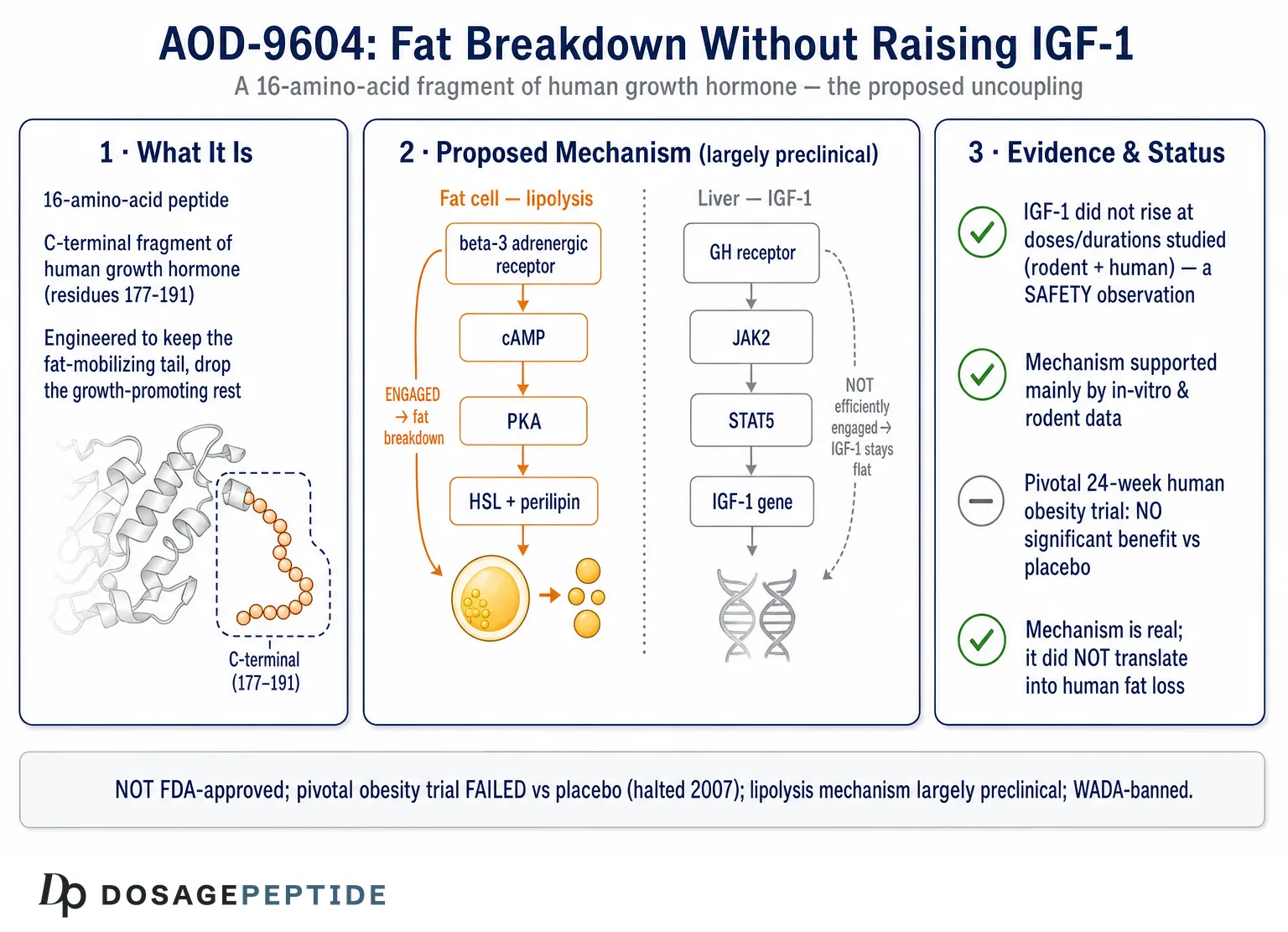
Because the entire argument turns on the separation of two molecular routes, a direct comparison clarifies why one can be engaged without the other.
| Feature | Lipolytic effect (fat breakdown) | IGF-1 effect (somatotropic) |
|---|---|---|
| Primary tissue | Adipose tissue (fat cells) | Liver (principal source of circulating IGF-1)4 |
| Key receptor | β3-adrenergic receptor on adipocytes5 | Growth-hormone receptor (GHR)4 |
| Core signaling | cAMP → PKA → HSL/perilipin phosphorylation6 | JAK2 → STAT5 → IGF1 transcription4 |
| Nature of the event | Post-translational enzyme activation | Gene transcription |
| Timescale | Minutes to hours | Hours to days |
| Output | Free fatty acids + glycerol released | Rise in circulating IGF-1; anabolic/growth signaling |
| Engaged by AOD-9604? | Yes (proposed; β3-dependent in rodents)15 | Not detectably, at studied doses1 |
The table makes the logic visible. The two effects share almost nothing at the level that matters—different tissues, different receptors, different signaling logic, different timescales, different molecular outputs. Full-length growth hormone can drive both because it is a complete ligand that productively engages GHR and, through downstream and parallel mechanisms, also mobilizes fat. AOD-9604, as a truncated C-terminal fragment, appears able to nudge the adipocyte’s adrenergic–lipase axis while failing to productively fire the hepatic transcriptional program. The uncoupling is therefore not magical; it is the predictable consequence of using a partial ligand that hits the more permissive of the two pathways.
Mechanism Is Not Outcome: What the Human Evidence Shows
This is the section that keeps the article honest, because a beautiful mechanism can still fail to produce a real-world effect—and here it largely did.
AOD-9604’s clinical record lives almost entirely in obesity. Across development it was studied in roughly six human trials enrolling more than 900 participants in total, a tally that derives from the sponsor’s development-program summary rather than any single paper.2 An early 12-week Phase 2 study (designated METAOD005), using oral once-daily dosing across several dose arms, produced encouraging data: the peptide-treated groups lost on the order of 1.8 kg more than placebo, with the 1 mg arm reported as the best performer.2 That signal generated optimistic press.
Then came the endpoints that mattered. The pivotal 24-week study (METAOD006), a randomized, double-blind, placebo-controlled, multicenter trial that is the single published RCT on the compound, incorporated an intensive diet-and-exercise regimen—and against that lifestyle background the difference between AOD-9604 and placebo at the primary and key secondary endpoints was too small to reach statistical significance.2 The early signal from the shorter study faded. Development as an obesity drug was terminated in 2007.2
| Aspect | What the obesity program showed |
|---|---|
| Human trials | ~6 studies, >900 participants total2 |
| Pivotal design | Randomized, double-blind, placebo-controlled, multicenter; oral dosing2 |
| Early signal | ~1.8 kg greater loss vs placebo in the 12-week analysis2 |
| Primary endpoint (pivotal) | Difference from placebo did NOT reach statistical significance2 |
| With diet + exercise | No detectable added benefit over lifestyle alone2 |
| Outcome | Obesity development halted in 20072 |
| Endocrine profile | No reported rise in IGF-1; no impairment of glucose tolerance1 |
Two honest conclusions follow. First, the mechanism — lipolysis without IGF-1 — appears to be real at the level of adipocyte biology and rodent physiology, and the IGF-1-sparing property held up as a safety observation across species. Second, that mechanism did not translate into a clinically meaningful fat-loss drug in humans; the pivotal trial is more accurately described as showing acceptable safety with disappointing efficacy. A working mechanism is a necessary but not sufficient condition for a useful therapy. Signaling to fat cells in a dish or in a mouse is a long way from producing durable, statistically robust weight loss in people who are also dieting and exercising. Readers who want the fuller clinical picture can consult the sibling analysis of what clinical trials indicate about AOD-9604’s fat-burning potential, which examines the trial data in more depth.
It is instructive to place this against agents where the fat-loss mechanism did translate. The incretin-based compounds — for instance, the agents discussed in the site’s coverage of how tirzepatide improves fat loss and insulin sensitivity in clinical research — produce large, reproducible, statistically unambiguous weight loss in rigorous trials, largely by acting on appetite and energy intake through central and gut pathways rather than by squeezing free fatty acids out of adipocytes. The contrast is not a knock on AOD-9604’s mechanistic elegance; it is a reminder that peripheral lipolysis, on its own, is a weak lever for whole-body fat loss, because the body has robust compensatory systems that re-esterify fatty acids and defend fat mass. Mobilizing fat from the cell is not the same as removing it from the body.
Why a Clean Lipolytic Signal Still Underperformed
If the adipocyte mechanism works, why did the drug not? This is a genuinely useful question, and the answer illuminates the limits of the “fat breakdown” framing.
The first reason is compensation. Lipolysis releases free fatty acids into the blood, but those fatty acids are only truly lost to the body if they are then oxidized rather than taken back up and re-esterified into triglyceride. In the absence of a sustained energy deficit—that is, without the diet and activity that create demand for that fuel—mobilized fatty acids are largely recycled. A peptide that opens the adipocyte’s taps does not by itself create the whole-body energy deficit that actually shrinks fat mass. In the pivotal trial, where all participants received intensive lifestyle intervention, the placebo group was already running an energy deficit, and the peptide added nothing detectable on top.2
The second reason is potency and pharmacokinetics. A short peptide delivered orally faces formidable obstacles—degradation in the gut, limited absorption, short half-life—and the signal it delivers to the β3-adrenergic axis may simply be modest compared with the physiological range of adrenergic tone the body experiences daily. The mechanism can be real and yet too weak, at tolerable exposures, to move the needle on a stubborn, homeostatically defended trait like body-fat mass.
A related and often-overlooked factor is the species gap in receptor biology already flagged above. The mechanistic case for AOD-9604 was built substantially on β3-adrenergic signaling, a pathway far more prominent in rodent adipose tissue than in human adipose tissue.5 If the human fat cell responds less vigorously through β3, then even a mechanism that reliably mobilized fat in mice could be attenuated in people—not because the biology is wrong, but because the specific receptor lever is weaker in the target species. Translational failures of this kind are common precisely when a mechanism is anchored to a pathway whose prominence differs between the model organism and humans.
The third reason is the redundancy of fat-mass regulation. Body-fat mass is defended by a network of signals spanning appetite, energy expenditure, thermogenesis, and substrate partitioning. Nudging one node—adipocyte lipolysis—invites compensatory adjustment elsewhere (reduced spontaneous activity, altered appetite, shifts in fuel use). This is the same reason that many mechanistically sound anti-obesity strategies have disappointed, and it is why the agents that succeed tend to act on the central appetite and energy-intake side of the equation rather than on peripheral fat mobilization alone.
None of this negates the mechanism. It reframes it. AOD-9604 is, on the evidence, a real—if modest—lipolytic signal that is genuinely uncoupled from IGF-1. That makes it a useful research probe for dissecting fat-cell biology and the somatotropic-versus-lipolytic separation. It does not make it an effective fat-loss therapy, and the human data are the reason we can say so plainly.
How the Mechanism Has Been Studied: Models and Methods
Understanding the tiers of evidence behind these claims guards against over-reading any single result.
In vitro and ex vivo adipose work. The foundational metabolic characterization examined lipolysis and lipogenesis in adipose tissue and isolated fat cells, measuring free-fatty-acid release, fat oxidation, and the expression of enzymes and receptors involved in fat handling.1 These assays are well suited to characterizing a lipolytic agent and to detecting whether a compound engages the cAMP–PKA–HSL axis. The perilipin/HSL docking biology that underlies the readout was worked out in separate, dedicated cell studies.6
Rodent models. The most methodologically informative animal work is the β3-AR knockout study, a clean genetic approach that isolated the receptor’s contribution by comparing knockout and wild-type mice under identical treatment.5 Obese-rodent models (including obese Zucker rats and ob/ob mice) were used to assess body-weight, fat-accumulation, and substrate-oxidation responses, along with insulin-sensitivity measures using clamp techniques that demonstrated the absence of the glucose impairment seen with intact hGH.1 These are metabolic and obesity models—appropriate for the fat question, and the reason the mechanistic story is strongest at this level.
Human trials. The clinical methodology suited an obesity drug: randomized, double-blind, placebo-controlled, multicenter designs with weight and body-composition endpoints, plus dedicated safety and pharmacokinetic evaluation.28 The human data confirmed tolerability and the IGF-1-sparing profile but did not confirm efficacy. Crucially, the human endpoints were body weight and composition, not direct molecular readouts of adipocyte lipolysis; the mechanistic claims about β3-AR and HSL rest on the preclinical work, while the human trials tell us about clinical outcomes.
The methodological bottom line: the mechanism of lipolysis-without-IGF-1 is best supported at the in-vitro and rodent levels, and the human trials neither confirmed a robust clinical effect nor contradicted the endocrine-sparing profile. Any confident statement that AOD-9604 “burns fat” in humans outruns the data; the defensible statement is that it engages a lipolytic pathway in preclinical models without raising IGF-1, and that this did not translate into significant human weight loss.
Safety, Handling, and Research Context
Short-term safety is the one area where AOD-9604’s record is relatively reassuring, and the IGF-1-sparing mechanism is part of why. Because the compound does not appear to fire the somatotropic axis, it sidesteps the endocrine concerns tied to chronic growth-hormone exposure—the IGF-1 elevation, the glucose intolerance, the tissue-growth signaling.1 In the human obesity program the peptide was generally well tolerated over the studied durations, and a dedicated safety and tolerability study supported an acceptable short-term profile at the doses tested.8 Later work reframed the ingredient as having a favorable safety and metabolism profile in the sponsor’s view.9 Beyond metabolism, AOD-9604 has also been probed in unrelated exploratory settings—for instance, intra-articular injection alongside hyaluronic acid in a collagenase-induced rabbit osteoarthritis model, where the combination outperformed either agent alone on cartilage-repair scores.10 That result is worth mentioning only to be clear about its limits: it is animal-only, uses a completely different route and indication, and provides no human evidence and no bearing on the fat-loss question this article addresses. It is a reminder that essentially all of the compound’s reported activities, across indications, remain at the preclinical or investigational stage.
Several caveats temper this. Safety was established over weeks to a few months, in metabolically healthy-to-obese adults, largely with oral dosing; it does not automatically transfer to long-term use, to other populations, or to the subcutaneous administration common in non-clinical settings. Much material sold outside regulated channels as “research chemical” is of variable purity, and impurities, endotoxin, and mislabeling are real risks unrelated to the molecule’s intrinsic properties. And the compound is prohibited in sport, a regulatory hazard for athletes regardless of pharmacology.12
On handling, a brief and strictly educational note: AOD-9604 is typically encountered as a lyophilized (freeze-dried) powder. In research practice, lyophilized peptides are reconstituted with sterile or bacteriostatic water directed slowly against the vial wall, with gentle swirling rather than shaking, because vigorous agitation can shear and denature the peptide. The chosen diluent volume simply sets the concentration—a fixed mass in a larger volume yields a lower concentration per unit—which is the arithmetic behind any reconstitution chart. General best practices for this step are laid out in the site’s peptide reconstitution guide. It bears repeating that meticulous handling preserves whatever activity the molecule has; it does not create clinical efficacy where the human trials did not demonstrate it.
| Parameter | Typical research-context practice |
|---|---|
| Lyophilized storage | Cool, dark conditions; freezing favors long-term stability |
| After reconstitution | Refrigerated; used within a limited window |
| Light and heat | Minimize exposure; both degrade peptides |
| Agitation | Swirl gently; avoid shaking or foaming |
| Freeze-thaw | Repeated cycles degrade peptides; avoid |
| Sterility | Aseptic technique; bacteriostatic water for multi-use practice |
For researchers cataloging AOD-9604 alongside other metabolic compounds, the site’s central dosages index organizes these agents for educational reference rather than as guidance for human use.
Limitations and the Honest Boundaries of the Claim
Pulling the threads together, several limitations bound what can responsibly be said about AOD-9604 and the “fat breakdown without IGF-1” claim.
The mechanism is largely preclinical. The detailed cascade—β3-AR engagement, cAMP, PKA, HSL and perilipin phosphorylation—is supported by in-vitro and rodent data plus general adipocyte biology, not by direct human molecular measurements of AOD-9604 action.156 The confident mechanistic language that circulates online frequently traces to commercial rather than primary sources.
The IGF-1-sparing claim is a bounded negative. “IGF-1 did not rise” was observed at specific doses and durations.1 It is well supported as a safety observation and reinforced by the finding that the fragment does not behave like intact hGH in endocrine assays,7 but it should not be inflated into an absolute law across all conditions.
The efficacy did not translate. The most important limitation is that the elegant mechanism failed to produce significant human weight loss in the pivotal trial.2 Mechanism is not outcome, and readers should resist the pull of a satisfying molecular story into believing a clinical result that the data do not support.
Peripheral lipolysis is a weak whole-body lever. Even granting the mechanism, mobilizing fatty acids from adipocytes does not equal net fat loss without an energy deficit and against the body’s compensatory defenses.
Product quality varies. Because AOD-9604 is not an approved medicine, real-world material differs in purity and provenance, confounding even informal observation.
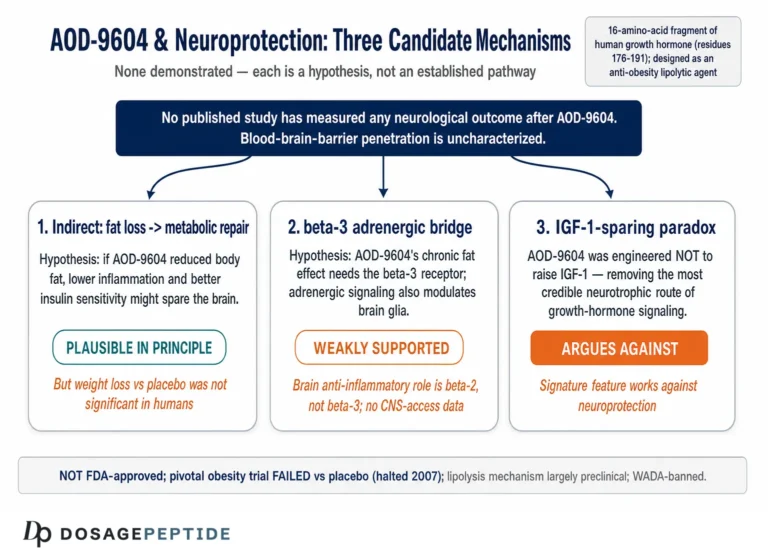
The honest synthesis is that AOD-9604 is a scientifically interesting demonstration that growth hormone’s lipolytic and somatotropic actions can be pulled apart—a fragment that speaks to fat cells through the adrenergic–lipase pathway while staying quiet on the hepatic IGF-1 program. That is a real and instructive piece of biology. It is not, on the human evidence, an effective fat-loss therapy. For readers interested in how the same preclinical caution applies to a very different downstream claim, the sibling analysis of what research links AOD-9604 to neuroprotection in obesity-related cognitive decline takes up a separate, equally investigational question from the same evidentiary standpoint.
Regulatory Status
AOD-9604’s regulatory picture is layered and frequently misrepresented, so precision matters.
No therapeutic approval, anywhere. AOD-9604 is not approved as a drug for obesity, fat loss, or any other condition by the U.S. Food and Drug Administration, the European Medicines Agency, or any comparable major regulator. Its pharmaceutical development for obesity was abandoned in 2007 after the pivotal trial failed to demonstrate a significant benefit over placebo.2
Supplement and food-ingredient framing. After the drug program ended, the compound was repositioned by its sponsor as a metabolic-health ingredient, supported by a self-affirmed “generally recognized as safe” (GRAS) characterization and safety/metabolism publications.9 It is essential to understand that a GRAS self-affirmation addresses ingredient safety at supplement-level exposure; it is emphatically not a finding of efficacy and not drug approval. Conflating “recognized as safe as a food ingredient” with “shown to work as a fat-loss medicine” is one of the most common errors in the marketing literature around this compound.
U.S. compounding review. In 2024, AOD-9604 was among peptide substances considered by the FDA’s Pharmacy Compounding Advisory Committee for potential inclusion on the Section 503A bulk drug substances list. The committee voted against placing the AOD-9604 free base and acetate on the list, citing inadequate physicochemical characterization, immunogenicity and impurity concerns, and a lack of clinical effectiveness data—a clear signal of continued regulatory caution about compounded peptide products.11
Anti-doping prohibition. The World Anti-Doping Agency prohibits AOD-9604 in sport under the categories covering growth factors and related substances; athletes subject to testing should assume that use constitutes an anti-doping rule violation.12 The doping-detection literature also confirms that, although AOD-9604 is a growth-hormone fragment, it does not interfere with the standard hGH isoform test—reinforcing, from a regulatory-science angle, that it is a distinct molecular entity.7
The regulatory synthesis is straightforward: AOD-9604 occupies an ambiguous middle ground—not an approved drug, variously handled as a supplement ingredient, unsettled in U.S. compounding, and banned in sport—with no regulatory recognition of any therapeutic fat-loss use. Any legitimate exploration of the compound belongs in formal preclinical and clinical research under appropriate oversight, not in off-label or informal use.
Frequently Asked Questions
How does AOD-9604 stimulate fat breakdown without raising IGF-1?
The two effects travel through different molecular routes. Fat breakdown is driven, on the best available evidence, through the adipocyte’s beta-3 adrenergic receptor, which raises cyclic AMP and activates protein kinase A to phosphorylate hormone-sensitive lipase and perilipin—a post-translational, enzyme-activation event inside the fat cell.56 Raising IGF-1, by contrast, requires robust growth-hormone-receptor signaling through JAK2 and STAT5 to transcribe the IGF1 gene, mainly in the liver.4 As a short C-terminal fragment, AOD-9604 does not efficiently fire that full receptor-and-transcription program, so it can nudge lipolysis while leaving IGF-1 essentially unchanged at the doses studied.1
Is the IGF-1-sparing effect actually proven?
It is well supported as a finding at the doses and durations studied, in rodents and in the human program, and it is reinforced by the observation that AOD-9604 does not behave like intact growth hormone in endocrine assays.17 But it is a negative finding, bounded by the sensitivity and length of those studies. The accurate claim is “IGF-1 did not rise under the conditions tested,” not “IGF-1 can never be affected under any circumstance.”
Does AOD-9604 actually cause meaningful fat loss in humans?
Not convincingly. Its pivotal 24-week randomized, placebo-controlled trial did not reach statistical significance at its primary endpoint, and the early signal from a shorter study faded once an intensive diet-and-exercise regimen was in place. Obesity development was halted in 2007.2 The lipolytic mechanism appears real in preclinical models, but it did not translate into a robust clinical fat-loss effect.
If the mechanism works, why did the drug fail?
Mobilizing fat from adipocytes is not the same as removing it from the body. Without a sustained energy deficit, released fatty acids are largely re-esterified rather than oxidized; the peptide’s signal may be too weak at tolerable exposures; and body-fat mass is defended by redundant appetite, expenditure, and substrate-partitioning systems. Peripheral lipolysis alone is a weak lever for whole-body fat loss.2
Why doesn’t the fragment raise IGF-1 the way growth hormone does?
Full-length growth hormone is a complete ligand that dimerizes and activates its receptor strongly enough to drive the hepatic JAK2–STAT5–IGF1 transcriptional program.4 A 16-amino-acid C-terminal fragment lacks the surfaces needed to productively engage the receptor at that intensity, so the transcriptional cascade that produces circulating IGF-1 is not efficiently switched on.1
What is the strongest evidence for the proposed mechanism?
The clearest primary evidence is the beta-3 adrenergic receptor knockout study: in mice lacking β3-AR, the chronic lipolytic and body-weight effects of AOD-9604 were substantially blunted compared with wild-type controls, implicating that pathway as necessary for the sustained effect.5 The adipocyte cAMP–PKA–HSL/perilipin cascade the compound is thought to engage is itself well characterized in cell biology.6
Does AOD-9604 build muscle since it comes from growth hormone?
No. The compound was specifically engineered to isolate growth hormone’s lipolytic tail and does not raise IGF-1, the principal route by which growth hormone builds muscle.1 Claims that it stimulates muscle protein synthesis borrow the reputation of full-length growth hormone and are not supported by primary data on AOD-9604. The sibling article on whether AOD-9604 can aid recovery from muscle wasting in cachexia or sarcopenia examines that question in detail.
Is AOD-9604 approved or legal?
It is not approved as a drug for any condition by the FDA, EMA, or other major regulators. It has been handled as a supplement/food-type ingredient via a self-affirmed GRAS characterization (a safety framing, not efficacy or drug approval), was not recommended for the FDA’s 503A compounding bulks list in 2024, and is prohibited in sport by WADA.91112
How is AOD-9604 handled in a research setting?
As a lyophilized powder, it is reconstituted with sterile or bacteriostatic water using gentle technique (swirl, do not shake), stored cool and dark, and protected from freeze-thaw cycles—standard research-peptide practice.9 Handling quality preserves activity but has no bearing on the modest human efficacy the trials actually showed.
References
- Ng FM, Sun J, Sharma L, et al. Metabolic studies of a synthetic lipolytic domain (AOD9604) of human growth hormone. Horm Res. 2000;53(6):274-278. PMID: 11146367. https://pubmed.ncbi.nlm.nih.gov/11146367/
- The effect of AOD9604 on weight loss in obese adults: results of a randomized, double-blind, placebo-controlled, multicenter study (obesity clinical program; development halted 2007). https://www.researchgate.net/publication/295313034
- Vijayakumar A, Novosyadlyy R, Wu Y, Yakar S, LeRoith D. Biological effects of growth hormone on carbohydrate and lipid metabolism. Growth Horm IGF Res. 2010;20(1):1-7. PMID: 19800274. https://pubmed.ncbi.nlm.nih.gov/19800274/
- Baik M, Yu JH, Hennighausen L. Growth hormone-STAT5 regulation of growth, hepatocellular carcinoma, and liver metabolism. Ann N Y Acad Sci. 2011;1229:29-37. PMID: 21793836. https://pubmed.ncbi.nlm.nih.gov/21793836/
- Heffernan MA, Thorburn AW, Fam B, et al. The effects of human GH and its lipolytic fragment (AOD9604) on lipid metabolism following chronic treatment in obese mice and beta(3)-AR knock-out mice. Endocrinology. 2001;142(12):5182-5189. PMID: 11713213. https://pubmed.ncbi.nlm.nih.gov/11713213/
- Miyoshi H, Souza SC, Zhang HH, et al. Perilipin promotes hormone-sensitive lipase-mediated adipocyte lipolysis via phosphorylation-dependent and -independent mechanisms. J Biol Chem. 2006;281(23):15837-15844. PMID: 16595669. https://pubmed.ncbi.nlm.nih.gov/16595669/
- Orlovius AK, Thomas A, Schänzer W, Thevis M. AOD-9604 does not influence the WADA hGH isoform immunoassay. Drug Test Anal. 2013;5(11-12):850-852. PMID: 24124087. https://doi.org/10.1002/dta.1557
- Stier H, Vos E, Kenley D. Safety and Tolerability of the Hexadecapeptide AOD9604 in Humans. Journal of Endocrinology and Metabolism. 2013;3(1):7-15. https://www.jofem.org/index.php/jofem/article/view/157
- Moré MI, Kenley D. Safety and Metabolism of AOD9604, a Novel Nutraceutical Ingredient for Improved Metabolic Health. Journal of Endocrinology and Metabolism. 2014;4(3):64-77. https://jofem.org/index.php/jofem/article/view/213/278
- Kwon DR, Park GY. Effect of Intra-articular Injection of AOD9604 with or without Hyaluronic Acid in Rabbit Osteoarthritis Model. Ann Clin Lab Sci. 2015;45(4):426-433. PMID: 26275694. https://pubmed.ncbi.nlm.nih.gov/26275694/
- U.S. Food and Drug Administration. Pharmacy Compounding Advisory Committee (PCAC) Briefing Document, 2024 (AOD-9604 review for Section 503A bulk drug substances). https://www.fda.gov/media/183584/download
- World Anti-Doping Agency. WADA statement on substance AOD-9604. https://www.wada-ama.org/en/news/wada-statement-substance-aod-9604
Educational and research-use disclaimer: This article is provided solely for scientific and educational purposes. AOD-9604 is not approved by the FDA, EMA, or any comparable regulator for fat loss, obesity, or the treatment, cure, or prevention of any disease, and its pivotal human obesity trial did not demonstrate a significant benefit over placebo. The lipolytic, IGF-1-sparing mechanism described here is supported largely by preclinical (in-vitro and rodent) data and did not translate into robust clinical efficacy. Nothing here is medical advice or a recommendation for human use. AOD-9604 is prohibited in sport by WADA. Any legitimate investigation of this compound should occur within properly authorized preclinical or clinical research under appropriate oversight. Readers should consult qualified professionals and applicable regulations before making any decisions.