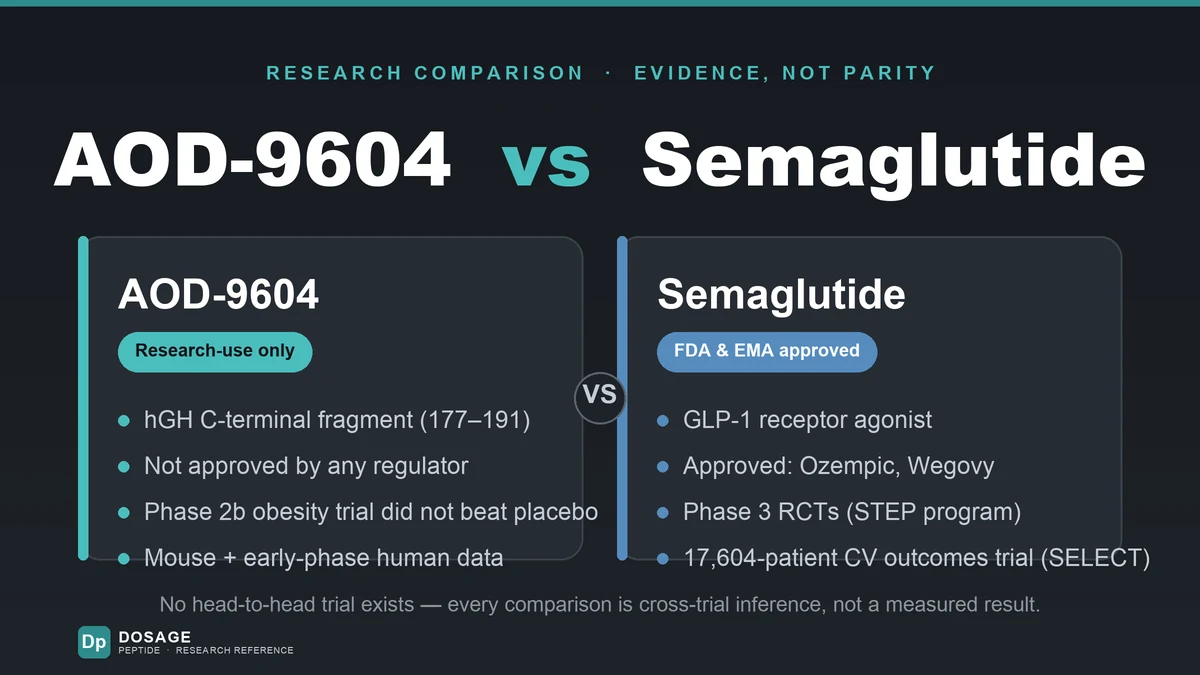
Search the fat-loss and peptide forums for “AOD-9604 vs Semaglutide” and you will find them lined up as if they were two entries in the same weight-loss bracket — one a “fat-burning” growth-hormone fragment, the other the blockbuster GLP-1 injection behind Ozempic and Wegovy. This article compares them the way the published evidence actually supports, and the honest headline is that the two are not remotely at the same stage of proof. The single most important fact to state at the outset is this: no head-to-head trial — human or animal — has ever compared AOD-9604 against semaglutide. Every ranking you read, including anything implied here, is cross-trial inference across different molecules, species, endpoints, and eras of research.[1][4]
Two facts should frame everything that follows. First, the evidence is profoundly asymmetric: semaglutide is an FDA- and EMA-approved medicine supported by large Phase 3 randomized controlled trials and a 17,604-patient cardiovascular-outcomes trial, whereas AOD-9604 has never been approved by any regulator, for any indication, and its human obesity program was discontinued after an efficacy failure.[2][5] Second, the two are structurally and mechanistically unrelated: AOD-9604 is a short C-terminal fragment of human growth hormone, while semaglutide is a long-acting analog of the gut hormone GLP-1. Treating them as interchangeable “fat-loss compounds” is the category error this comparison exists to correct.
This is educational reference material that summarizes published research and regulatory status. It is not medical advice, not a therapeutic recommendation, and not instructions for human use. AOD-9604 is a research-use-only peptide with no approved indication; semaglutide is a prescription drug that should only ever be used under a clinician’s supervision. Any dosing figures below describe laboratory research settings and approved-label protocols for interpretation only. With those guardrails set, here is how AOD-9604 and semaglutide genuinely compare.
AOD-9604 vs Semaglutide: The Honest Bottom Line
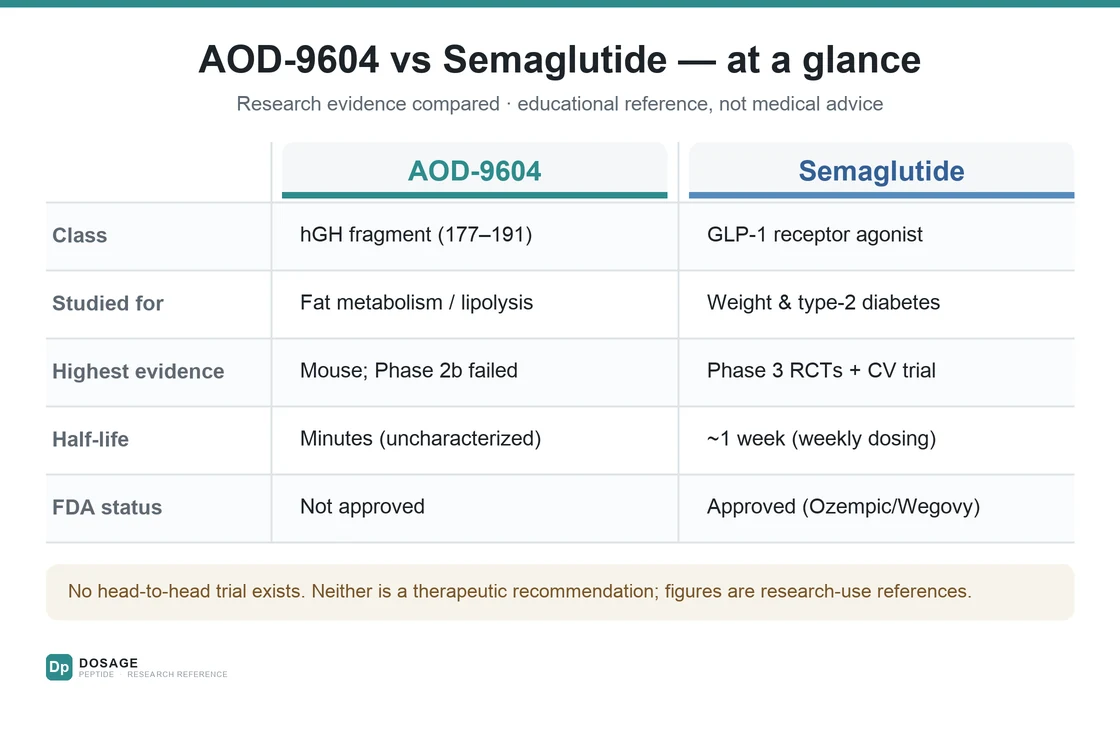
If you read only one section, read this one. AOD-9604 and semaglutide are discussed together because both are associated with fat loss, but the resemblance ends there. They act on entirely different receptors, sit on opposite ends of the evidence ladder, and carry opposite regulatory verdicts. The table below is the orientation; every row is unpacked, with citations, in the sections that follow.
| Attribute | AOD-9604 | Semaglutide |
|---|---|---|
| Class / molecule | Synthetic C-terminal fragment of human growth hormone (residues 177–191 plus an added N-terminal tyrosine); a peptide fragment, not a full hormone | Acylated glucagon-like peptide-1 (GLP-1) receptor agonist; a fully characterized long-acting analog of the gut incretin hormone |
| Studied mechanism | Reported to modulate fat metabolism and increase beta-3 adrenergic receptor expression in fat cells without raising IGF-1 or activating the GH receptor — largely from mouse and in-vitro work[4] | Activates the GLP-1 receptor to reduce appetite and energy intake and slow gastric emptying — demonstrated in large human trials[1] |
| Primary research use | Fat loss / obesity (later also explored for cartilage and joint models); no approved indication | Chronic weight management (Wegovy) and type-2 diabetes (Ozempic); also cardiovascular risk reduction |
| Highest evidence tier | Mouse + in-vitro plus early-phase human work. The Phase 2b obesity trial did not beat placebo and was never published; no positive human obesity RCT exists[5] | Multiple large Phase 3 RCTs + a cardiovascular-outcomes RCT. STEP program (~thousands of participants) and the 17,604-patient SELECT trial[1][2] |
| Approval status | Not approved by FDA, EMA, or any regulator, for any indication. Obesity development discontinued (~2007); research-use-only | FDA-approved: Ozempic (type-2 diabetes, 2017), Wegovy (chronic weight management, 2021), cardiovascular risk reduction (2024); EMA-approved |
| Half-life | Short (reported in the minutes range); no robust peer-reviewed human pharmacokinetic characterization | Approximately one week (≈7 days), which enables true once-weekly subcutaneous dosing |
What Is AOD-9604?
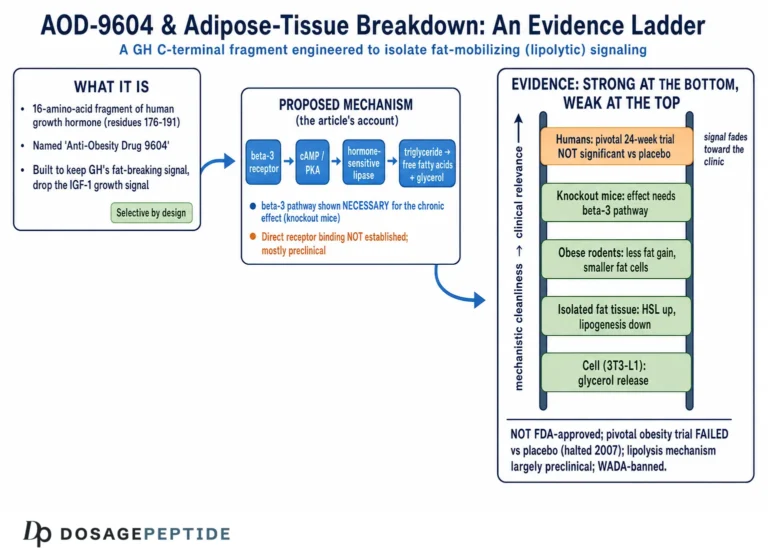
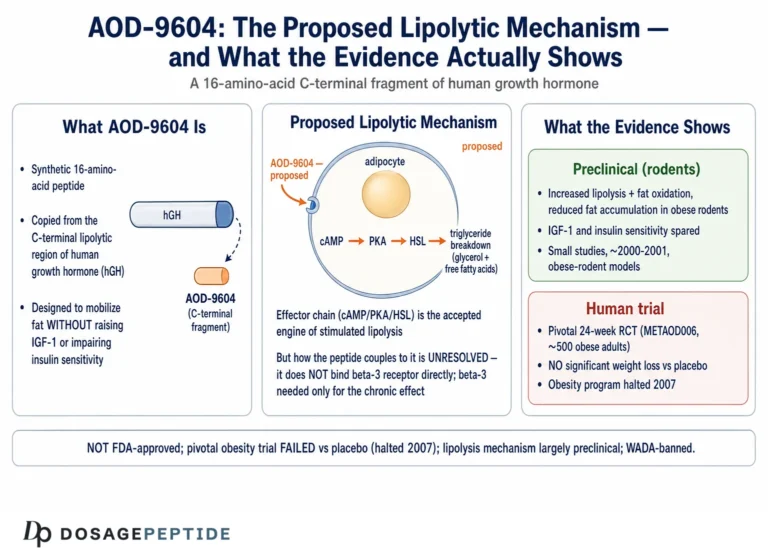
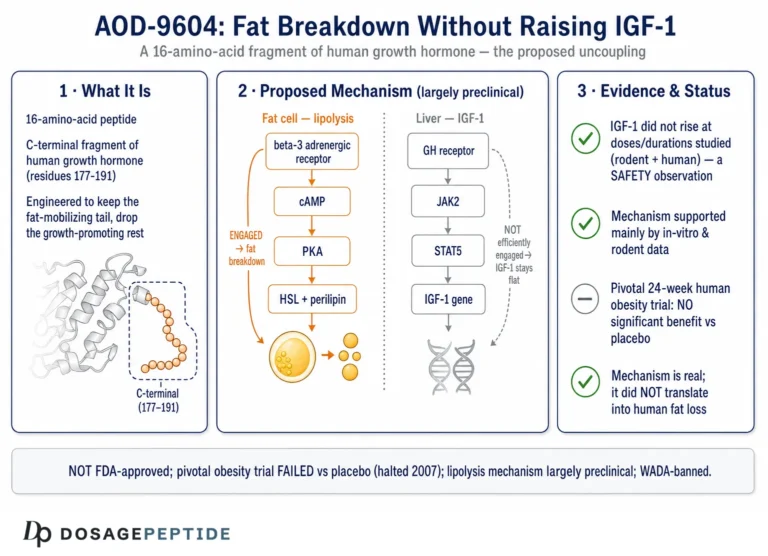
AOD-9604 is a synthetic peptide fragment of human growth hormone (hGH) — specifically the C-terminal region corresponding to residues 177–191, with an extra tyrosine added at the N-terminus to aid synthesis and stability. The name is a laboratory designation (“AOD” for anti-obesity drug), and the compound was engineered on a simple premise: isolate the part of the growth-hormone molecule associated with fat metabolism while leaving out the parts that drive growth signaling. In principle, that means a peptide that can influence lipid handling without the IGF-1 elevation, insulin resistance, or tissue-growth effects that accompany full growth hormone.
The mechanistic case for that idea comes almost entirely from animal and cell work. In obese mice, the lipolytic hGH fragment reproduced growth hormone’s effects on fat metabolism, and studies in beta-3 adrenergic-receptor knockout mice were used to probe how those effects are mediated, with reports that the fragment increases beta-3 adrenergic receptor expression in adipose tissue without raising IGF-1.[4] That “fat effect without the growth effect” profile is the entire scientific selling point of AOD-9604, and it is genuinely interesting — but it is a rodent and in-vitro story, not a human outcome. For a closer look at the proposed pathway, see our references on how AOD-9604 is studied in lipolysis and metabolic models and on how it is described as stimulating fat breakdown without altering IGF-1 signaling.
What Is Semaglutide?
Semaglutide is an acylated GLP-1 receptor agonist — a long-acting analog of glucagon-like peptide-1, one of the body’s incretin hormones. By binding and activating the GLP-1 receptor, it lowers blood glucose in a glucose-dependent way, reduces appetite and energy intake, and slows gastric emptying; over months, that combination produces substantial, measurable weight loss in controlled trials.[1] A fatty-acid chain attached to the peptide lets it bind albumin and resist enzymatic breakdown, extending its half-life to roughly a week and enabling once-weekly injection; an oral once-daily tablet formulation is also approved. Our primer on what a GLP-1 is explains the incretin system, and our reference on how semaglutide engages the GLP-1 receptor in metabolic studies details the signaling.
Unlike AOD-9604, semaglutide is not a research curiosity — it is a fully characterized, approved drug marketed as Ozempic (type-2 diabetes) and Wegovy (chronic weight management), with a defined manufacturing standard, label, and pharmacovigilance record. That difference in identity — a defined prescription medicine versus an unapproved research fragment — matters as much as any mechanistic detail when reading claims about either one. The way its fatty-acid chain shapes its long duration is covered in our reference on how fatty-acid conjugation shapes semaglutide’s pharmacokinetics.
Do They Work the Same Way? Two Different Mechanisms
Because both are associated with fat loss, it is tempting to assume AOD-9604 and semaglutide are variations on a theme. They are not; they do not share a receptor, a hormone system, or even an organ of primary action. This is the clearest point of divergence in the whole comparison.
AOD-9604 is built around growth-hormone biology. Its proposed action is peripheral and metabolic: influencing how fat cells store and release lipid, reportedly by up-regulating beta-3 adrenergic receptor expression in adipose tissue, and doing so without engaging the growth-hormone receptor or raising IGF-1.[4] The intended appeal is a lipolytic effect uncoupled from growth signaling — but the evidence for it is preclinical.
Semaglutide works through an entirely different axis: the incretin/appetite system. By activating GLP-1 receptors in the pancreas, brain, and gut, it enhances glucose-dependent insulin secretion, reduces appetite and caloric intake, and slows gastric emptying — a central and metabolic mechanism whose downstream effect on body weight has been measured directly in humans.[1] In short, AOD-9604 is a growth-hormone-derived peptide aimed at fat cells, and semaglutide is a gut-hormone analog aimed at appetite and glucose control. Any “which burns fat better” framing ignores that they are not doing the same thing, and that only one of them has been shown to change body weight in controlled human trials.
How We Got Here: Origins and Development Paths
The two compounds arrived from opposite directions and met opposite fates. AOD-9604 was developed as a candidate anti-obesity drug from growth-hormone research, advanced into early-phase clinical testing in the 2000s, and was reviewed at the time as a metabolic agent with Phase IIa trials underway.[5] It appeared in contemporary reviews of experimental agents being explored for obesity and metabolic risk.[6] But according to the developer’s own disclosures and secondary reporting — there is no peer-reviewed publication of the pivotal result — the Phase 2b obesity trial did not separate from placebo on its primary weight-loss endpoint, and development for obesity was discontinued around 2007. Later reviews of obesity pharmacotherapy continued to list it among experimental agents rather than approved options.[7]
Semaglutide traveled the full development pathway. Emerging from the same incretin research that produced earlier GLP-1 drugs, it accumulated a large Phase 3 evidence base, gained FDA approval for type-2 diabetes as Ozempic in 2017 and for chronic weight management as Wegovy in 2021, and later added a cardiovascular indication. It is now one of the most-studied metabolic drugs in modern medicine — the exact opposite trajectory to a candidate that stalled at Phase 2b. For where it sits among newer agents, see our comparison of how semaglutide compares with retatrutide and tirzepatide.
Regulatory and Approval Reality
Regulatory status is a hard fact that does not depend on mechanistic promise, and here it is as lopsided as it gets. Semaglutide is approved; AOD-9604 is not. Semaglutide holds FDA approvals as Ozempic for type-2 diabetes (2017), as Wegovy for chronic weight management (2021), and for reducing the risk of major cardiovascular events in eligible adults (2024), and it is authorized by the EMA in Europe. AOD-9604, by contrast, has never been approved by the FDA, the EMA, or any other regulator, for any indication; it exists only as an investigational, research-use-only peptide whose obesity program was abandoned after the Phase 2b failure.[5]
Two honest caveats sit on top of that. First, an approved drug and a research chemical are different objects: research-grade AOD-9604, and any research-grade “semaglutide” sold outside the licensed supply chain, are not the manufactured, quality-controlled products that were studied — trial data describe a characterized drug, not an arbitrary vial. Second, absence of approval is not the same as a safety verdict; AOD-9604 is not “banned” so much as simply unproven and undeveloped. Athletes subject to anti-doping rules should note that growth-hormone-related and metabolic-modulator compounds can fall under broad prohibited categories, and should verify current status directly with the World Anti-Doping Agency rather than assume clearance. Neither compound’s regulatory status is a shortcut around the evidence discussed below.
AOD-9604: What the Evidence Actually Shows
The honest summary of AOD-9604 is a wide gap between its “fat-burning peptide” reputation and its actual evidence base. The mechanistic weight-loss story is largely a mouse story. In obese-mouse and beta-3 adrenergic-receptor knockout models, the lipolytic hGH fragment influenced lipid metabolism in ways consistent with its intended design, and did so without raising IGF-1 — a genuinely interesting preclinical result, but a preclinical one.[4] Our reference on why AOD-9604 is studied for adipose-tissue breakdown in research models surveys that literature.
On the human side, the record is thin and, critically, negative where it matters most. AOD-9604 reached early-phase human testing and was described in reviews of the mid-2000s as having Phase IIa trials underway, with early reports of short-term tolerability and no IGF-1 elevation.[5] But the pivotal Phase 2b obesity trial did not beat placebo on its primary weight-loss endpoint, was never published in a peer-reviewed journal, and led to the discontinuation of the obesity program — which is why later obesity-pharmacotherapy reviews list AOD-9604 only as an experimental agent, not an effective one.[6][7] There is, in short, no positive human obesity RCT for AOD-9604. That single fact should anchor any comparison. A useful sibling comparison within the growth-hormone family is our piece on AOD-9604 vs tesamorelin, another hGH-derived research direction.
Semaglutide: What the Human Evidence Shows
Semaglutide’s evidence is the mirror image: large, controlled, human, and published. In the STEP 1 trial, adults with overweight or obesity given once-weekly semaglutide 2.4 mg alongside lifestyle intervention lost roughly 15% of body weight on average by 68 weeks, versus about 2% on placebo — a treatment difference on the order of 12 percentage points, a magnitude of pharmacological weight loss not previously seen outside surgery.[1] That result is not a one-off: the broader STEP program ran multiple large randomized trials across different populations and comparators, and the dose was deliberately titrated upward to a 2.4 mg maintenance level to balance efficacy and tolerability.[3]
The evidence then goes a step further than weight itself. In the SELECT trial — a cardiovascular-outcomes study of 17,604 adults with overweight or obesity and established cardiovascular disease but without diabetes — semaglutide significantly reduced the risk of major adverse cardiovascular events compared with placebo.[2] A hard-outcome trial of that size is the strongest tier of clinical evidence a metabolic drug can carry, and it is exactly the kind of data AOD-9604 does not have. Our review of what semaglutide trials show about cardiometabolic benefits beyond weight loss examines that record in more depth.
Head-to-Head vs. Cross-Trial: The Only Fair Comparisons
This is the section that keeps the rest honest. There is no study in which AOD-9604 and semaglutide were administered to comparable subjects and measured against each other. When a source implies AOD-9604 is a “natural” or “side-effect-free” alternative to semaglutide, it is not comparing measured results — it is placing a failed, unpublished obesity candidate next to a drug with Phase 3 and cardiovascular-outcomes data and inviting a false equivalence. Cross-trial inference can motivate a hypothesis; it cannot establish parity, because the two bodies of evidence are not even in the same league of design, size, or endpoint. The grading table below makes each reported role explicit.
| Reported research role | Strongest evidence tier | Honest interpretation |
|---|---|---|
| Semaglutide reduces body weight in adults with overweight/obesity | Multiple Phase 3 RCTs (STEP program), ~15% mean loss vs ~2% placebo at 68 weeks[1][3] | Well established for that population and endpoint; the basis of the Wegovy approval |
| Semaglutide reduces major cardiovascular events | 17,604-patient cardiovascular-outcomes RCT (SELECT)[2] | Hard-outcome evidence; the highest clinical tier in this comparison |
| AOD-9604 alters fat metabolism | Obese-mouse and beta-3-AR knockout models; in-vitro work[4] | Preclinical signal only; not demonstrated as human weight loss |
| AOD-9604 causes weight loss in humans | Phase 2b obesity trial — did not beat placebo, unpublished[5] | Not established; the pivotal human efficacy test was negative |
| AOD-9604 as an alternative or equivalent to semaglutide | No comparative data of any kind | Cannot be claimed; the two are not evidentiary peers |
| AOD-9604 “beats” semaglutide (or vice versa) | No head-to-head trial | Cross-trial inference only; not a measured result |
Reading the Numbers Honestly: Half-Life and Full Specification
With the evidence framed, here is the detailed side-by-side. One column carries a heavy caveat: for AOD-9604, half-life and dosing figures are research-community conventions, not validated human pharmacokinetics. For semaglutide, the same fields are defined by the approved label — a reminder that “we have a number” and “we have a validated clinical number” are different statements for these two compounds.
| Property | AOD-9604 | Semaglutide |
|---|---|---|
| Molecule | Synthetic C-terminal hGH fragment (residues 177–191 + N-terminal Tyr) | Acylated GLP-1 receptor agonist (long-acting incretin analog) |
| Target | Adipose fat metabolism; reported beta-3 adrenergic receptor up-regulation, no GH-receptor/IGF-1 activation[4] | GLP-1 receptor (appetite, insulin secretion, gastric emptying)[1] |
| Best-studied use | Fat loss / obesity (preclinical); joint/cartilage models explored later | Chronic weight management and type-2 diabetes; cardiovascular risk reduction |
| Route | Subcutaneous injection in research settings; oral and transdermal formulations explored in early development | Subcutaneous once-weekly injection; oral once-daily tablet also approved |
| Half-life | Short (reported in the minutes range); no robust peer-reviewed human PK | Approximately one week (≈7 days), enabling once-weekly dosing |
| Dosing (research-use vs clinical) | No validated human dose; research figures commonly cite roughly 300 mcg/day — a vendor/research convention only | Titrated per label from 0.25 mg up to 2.4 mg once weekly for weight management over ~16–20 weeks[3] |
| Highest human evidence tier | Discontinued Phase 2b (negative, unpublished)[5] | Phase 3 RCTs + cardiovascular-outcomes RCT[2] |
| Approval status | Not approved anywhere; research-use-only | FDA- and EMA-approved (Ozempic/Wegovy) |
Anyone converting these figures into vial concentrations should treat the AOD-9604 numbers strictly as laboratory reference points; our peptide reconstitution guide and dosage calculator explain the arithmetic without implying any human protocol, and the peptide research glossary defines terms like GLP-1, lipolysis, half-life, and IGF-1 used throughout this article.
Research-Use Dosing Conventions (Laboratory Settings Only)
The figures below are provided to help interpret the literature and product listings, not as a protocol for human use. The two are on completely different footings: one has an approved, titrated clinical dose; the other has no validated human dose at all.
- AOD-9604 — there is no established clinical dose, because no human efficacy trial succeeded. Research and vendor contexts commonly cite figures around 300 mcg/day by subcutaneous injection, but these are conventions, not validated pharmacology, and this article is not dosing guidance. On dosagepeptide.com they are framed research-use-only; see the AOD-9604 reconstitution and mg-to-units reference and the AOD-9604 2 mg vial research dosage reference.
- Semaglutide — by contrast, has a clinically defined, titrated dose. For weight management the approved label escalates from 0.25 mg to a 2.4 mg once-weekly maintenance dose over roughly 16–20 weeks, a schedule designed to limit gastrointestinal side effects.[3] That titration is a medical protocol used under supervision, reproduced here only for interpretation; see the semaglutide dosage and titration reference and the semaglutide 5 mg vial research dosage reference.
Safety and Tolerability
Safety is where the asymmetry becomes a matter of documentation as much as biology. Semaglutide has a large, well-characterized safety profile from thousands of trial participants; AOD-9604’s safety picture is limited to short-term tolerability in small early-phase work, with long-term safety simply uncharacterized because the program stopped.
| Safety dimension | AOD-9604 | Semaglutide |
|---|---|---|
| Reported adverse effects | Early human work reported good short-term tolerability, with no IGF-1 elevation and no adverse glucose signal noted[5] | Common gastrointestinal effects (nausea, diarrhea), usually transient; in STEP 1, 4.5% discontinued for GI events vs 0.8% on placebo[1] |
| Labeled warnings | None (no approved label exists) | Boxed warning for thyroid C-cell tumors (a rodent finding); monitored for pancreatitis and gallbladder events per label |
| Duration of human safety data | Short-term, early-phase only | Up to 68 weeks in STEP trials; multi-year exposure in the SELECT cardiovascular trial[2] |
| Long-term safety | Uncharacterized; obesity development discontinued | Characterized across large trials and post-marketing surveillance |
| Product-identity risk | Research-grade material of unverified identity and purity; trial data are not product data | Licensed product is quality-controlled; unlicensed “research” copies are not the studied drug |
The last row deserves emphasis: a favorable early tolerability note for AOD-9604 is not a long-term safety clearance, and a boxed warning on semaglutide does not make it “dangerous” relative to an unstudied compound — it reflects the depth of scrutiny an approved drug receives, scrutiny AOD-9604 never underwent.
Which Compound Is Studied for What?
Mapping each compound to its actual research context prevents the most common error — treating them as interchangeable weight-loss options. The table makes the pattern explicit: the strongest tier in nearly every human row belongs to semaglutide, while AOD-9604’s anchor points are preclinical.
| Research area | AOD-9604 evidence | Semaglutide evidence | Strongest tier in this pair |
|---|---|---|---|
| Weight loss / obesity | Obese-mouse mechanism; negative, unpublished Phase 2b in humans[4][5] | Phase 3 RCTs, ~15% mean loss vs ~2% placebo[1] | Human RCT (semaglutide) |
| Type-2 diabetes / glucose | No established data | Approved therapy (Ozempic), extensive trial base | Human RCT (semaglutide) |
| Cardiovascular outcomes | Listed among experimental metabolic-risk agents only[6] | 17,604-patient outcomes RCT (SELECT)[2] | Human outcomes RCT (semaglutide) |
| Fat-metabolism mechanism | Obese-mouse + in-vitro lipolysis signal[4] | Appetite/energy-intake mechanism (human)[1] | Different mechanisms; not comparable head-to-head |
| Joint / cartilage models | Explored in later preclinical work | Not a studied use | Preclinical only (AOD-9604) |
What the Evidence Does NOT Show
Because the marketing around AOD-9604 leans heavily on semaglutide’s reputation, it is worth stating explicitly what the published record does not establish:
- It does not show that AOD-9604 produces weight loss in humans. Its pivotal Phase 2b obesity trial did not beat placebo and was never published.
- It does not show that AOD-9604 is equivalent to, or a “natural alternative” to, semaglutide — no comparative or head-to-head study exists, and their evidence tiers are not close.
- It does not show that AOD-9604’s promising mouse lipolysis data translate to human fat loss; preclinical mechanism is not clinical outcome.
- It does not establish a validated human dose, half-life, or safety window for AOD-9604; the circulating figures are research-community conventions.
- It does not show that research-grade material of either compound equals the studied drug; identity and purity of unlicensed vials are unverified.
- It does not mean semaglutide is risk-free — its benefits are established, but it carries labeled warnings and requires medical supervision.
Limitations of This Comparison
Several structural limitations constrain everything above, and honest readers should keep them in view:
- No head-to-head data. With no study comparing the two directly, every juxtaposition stitches together separate literatures that differ in species, size, endpoint, and era.
- Species and stage gap. AOD-9604’s positive data are rodent/in-vitro; its human data are early-phase and negative. Semaglutide’s data are large, human, and late-stage. Comparing across those tiers is inherently unequal.
- Unpublished pivotal result. The AOD-9604 Phase 2b outcome is known from developer disclosures and secondary reporting rather than a peer-reviewed paper, which limits independent scrutiny of exactly why it failed.
- Research-chemical identity. Both are sold in research-use channels whose material is not manufactured to the identity, purity, or sterility standards of the studied drug.
- No approved indication for AOD-9604. There is no regulatory efficacy or safety determination to lean on for the fragment, so its risk/benefit is simply undetermined.
Practical and Research Context
For readers using this material to interpret the literature rather than to guide any human use, a few practical anchors help. The laboratory-handling parameters for a research peptide like AOD-9604 — reconstitution, storage, and concentration arithmetic — are covered generically in our reconstitution guide and dosage calculator, and the underlying vocabulary (GLP-1, incretin, lipolysis, IGF-1) is defined in our peptide research glossary. None of those tools imply a human protocol; they describe how a compound is characterized in a research setting.
Because research-grade material is sold outside any approved supply chain, its identity and purity are unverified — and that caveat is especially sharp for a discontinued compound like AOD-9604, where there is no reference product to compare against. Identity confirmation (for example by mass spectrometry and HPLC) and a batch certificate of analysis are the minimum a rigorous research setting would require before drawing any conclusion. One research-use-only vendor the site has reviewed is Prime Lab Peptides. Sourcing a tested material does not change the evidence picture described above — a negative human obesity trial stays negative regardless of vial quality, trial data still do not transfer to any specific product, and nothing here is a therapeutic recommendation or a protocol for use.
Common Misconceptions
“AOD-9604 is a natural, side-effect-free alternative to Ozempic.”
This framing fails on both halves. AOD-9604 is a synthetic hGH fragment, not “natural,” and its human obesity trial did not beat placebo — so it is not a proven alternative to anything. Semaglutide has documented efficacy and a documented side-effect profile; AOD-9604 has neither an efficacy result nor a long-term safety record, which is not the same as being “side-effect-free.”
“AOD-9604 burns fat as well as semaglutide, just more gently.”
There is no measured basis for this. Semaglutide produced roughly 15% mean body-weight loss versus about 2% on placebo in a Phase 3 trial; AOD-9604 has no positive human weight-loss trial at all. “Gentler” is not a demonstrated middle ground — it is an unproven compound placed next to a proven one.
“They’re both fat-loss peptides, so they work the same way.”
They work through entirely different systems. AOD-9604 is a growth-hormone-derived fragment aimed at fat-cell metabolism; semaglutide is a GLP-1 receptor agonist aimed at appetite and glucose control. Grouping them as one category obscures that only one has been shown to change body weight in humans.
“Because AOD-9604 doesn’t raise IGF-1, it must be safe.”
Not raising IGF-1 was a design goal and an interesting preclinical finding, but it is a mechanistic detail, not a safety verdict. Long-term human safety for AOD-9604 is uncharacterized because its development stopped; absence of one signal in short-term work is not evidence of overall safety.
Key Takeaways
- The evidence is profoundly asymmetric. Semaglutide is FDA- and EMA-approved with Phase 3 and cardiovascular-outcomes trials; AOD-9604 is unapproved, research-use-only, and its obesity program was discontinued.
- No head-to-head trial exists. Any ranking of the two is cross-trial inference across different molecules and evidence tiers, not a measured result.
- They are mechanistically unrelated. AOD-9604 is a growth-hormone fragment acting on fat metabolism; semaglutide is a GLP-1 receptor agonist acting on appetite and glucose.
- AOD-9604 has no positive human obesity RCT. Its pivotal Phase 2b trial did not beat placebo and was never published; the mechanism data are largely from mice.
- Semaglutide’s efficacy is measured and large. About 15% mean weight loss vs ~2% placebo in STEP 1, plus reduced cardiovascular events in the 17,604-patient SELECT trial.
- Research-market vials are not the studied drug. Identity and purity are unverified; everything here is educational reference material, not medical advice.
Frequently Asked Questions
Is AOD-9604 or semaglutide better for fat loss?
On the evidence, only semaglutide has demonstrated human fat loss — roughly 15% mean body-weight reduction versus about 2% on placebo in a Phase 3 trial. AOD-9604 has no positive human weight-loss trial; its pivotal Phase 2b obesity study did not beat placebo and was never published. There is also no head-to-head trial, so calling one “better” is cross-trial inference rather than a measured comparison.
Do AOD-9604 and semaglutide work the same way?
No. AOD-9604 is a fragment of human growth hormone studied for effects on fat-cell metabolism (reportedly via beta-3 adrenergic receptor expression, without raising IGF-1). Semaglutide is a GLP-1 receptor agonist that reduces appetite, slows gastric emptying, and improves glucose handling. They act on different receptors and hormone systems entirely.
Is AOD-9604 FDA-approved?
No. AOD-9604 has never been approved by the FDA, the EMA, or any other regulator, for any indication. Its obesity development was discontinued around 2007 after the Phase 2b trial failed to separate from placebo. It is an investigational, research-use-only peptide.
Is semaglutide FDA-approved?
Yes. Semaglutide is approved as Ozempic for type-2 diabetes (2017), as Wegovy for chronic weight management (2021), and for reducing major cardiovascular events in eligible adults (2024); it is also authorized by the EMA. It is a prescription drug that should be used only under medical supervision.
Did AOD-9604’s human obesity trial work?
No. According to the developer’s disclosures and secondary reporting, the Phase 2b obesity trial did not beat placebo on its primary weight-loss endpoint, and it was never published in a peer-reviewed journal. That negative result is why the obesity program was discontinued and why later reviews list AOD-9604 as an experimental, not effective, agent.
How much weight does semaglutide cause people to lose in trials?
In the STEP 1 trial, adults with overweight or obesity lost about 15% of body weight on average over 68 weeks on once-weekly semaglutide 2.4 mg, versus roughly 2% on placebo — a treatment difference of around 12 percentage points. Results varied across the STEP program, but the magnitude was consistently large relative to prior weight-loss drugs.
What is the half-life of each compound?
Semaglutide has a half-life of approximately one week (~7 days), which is what allows once-weekly dosing. AOD-9604’s half-life is reported to be short (in the minutes range) but is not robustly characterized in peer-reviewed human pharmacokinetic studies. Duration is not the same as benefit for either compound.
Is AOD-9604 safe?
Its long-term safety is uncharacterized. Early-phase human work reported short-term tolerability with no IGF-1 elevation, but the development program stopped before any long-term human safety data were generated. “No signal in short-term study” is not the same as established safety, and research-grade material carries unverified identity and purity. Nothing here is a recommendation for human use.
Is any of this a recommendation for human use?
No. This article is educational reference material summarizing published research and regulatory status. It is not medical advice, not a therapeutic recommendation, and not instructions for human use. AOD-9604 is research-use-only with no approved indication, and semaglutide is a prescription medicine that should be used only under a clinician’s supervision.
References
- Wilding JPH, Batterham RL, Calanna S, et al. Once-Weekly Semaglutide in Adults with Overweight or Obesity. N Engl J Med. 2021;384(11):989–1002. doi:10.1056/NEJMoa2032183. PMID 33567185.
- Lincoff AM, Brown-Frandsen K, Colhoun HM, et al. Semaglutide and Cardiovascular Outcomes in Obesity without Diabetes. N Engl J Med. 2023;389(24):2221–2232. doi:10.1056/NEJMoa2307563. PMID 37952131.
- Kushner RF, Calanna S, Davies M, et al. Semaglutide 2.4 mg for the Treatment of Obesity: Key Elements of the STEP Trials 1 to 5. Obesity (Silver Spring). 2020;28(6):1050–1061. doi:10.1002/oby.22794. PMID 32441473.
- Heffernan M, Summers RJ, Thorburn A, et al. The effects of human GH and its lipolytic fragment (AOD9604) on lipid metabolism following chronic treatment in obese mice and beta(3)-AR knock-out mice. Endocrinology. 2001;142(12):5182–5189. doi:10.1210/endo.142.12.8522. PMID 11713213.
- Wilding J. AOD-9604 Metabolic. Curr Opin Investig Drugs. 2004;5(4):436–440. PMID 15134286.
- Jensen MD. Potential role of new therapies in modifying cardiovascular risk in overweight patients with metabolic risk factors. Obesity (Silver Spring). 2006;14 Suppl 3:143S–149S. doi:10.1038/oby.2006.294. PMID 16931496.
- Khan A, Raza S, Khan Y, et al. Current updates in the medical management of obesity. Recent Pat Endocr Metab Immune Drug Discov. 2012;6(2):117–128. doi:10.2174/187221412800604644. PMID 22435392.
Research-use disclaimer: This article is educational reference material summarizing published research and regulatory context. It is not medical advice, not a therapeutic recommendation, and not instructions for human use. AOD-9604 is not approved by any regulator and is sold for laboratory research use only; semaglutide is a prescription medicine (Ozempic/Wegovy) that should be used only under a clinician’s supervision. Any dosing figures refer to laboratory research settings or approved-label protocols for interpretation only. Always verify current clinical-trial and regulatory status through primary sources such as PubMed, ClinicalTrials.gov, and the FDA.