The title of this article asks which molecular mechanisms allow AOD-9604 to provide neuroprotection in obese phenotypes — a phrasing that quietly assumes two things are already settled: that AOD-9604 does protect the brain, and that we simply need to identify the pathways responsible. Neither assumption survives contact with the primary literature. AOD-9604 is a fat-mobilizing fragment of human growth hormone that was engineered for one job, weight loss, and that failed to reliably do even that job in humans before its development was halted in 2007.4 There is, as of mid-2026, no published study — not one controlled trial, not one dedicated rodent model — that tested AOD-9604 as a neuroprotective agent in an obese brain and measured a neural outcome. So rather than hand the reader a tidy list of confirmed mechanisms, this piece does something more honest and, I think, more useful: it treats the question as open, reconstructs the mechanistic hypotheses that could in principle connect this peptide to brain protection, and then subjects each one to the evidence we actually have.
That distinction — between a demonstrated mechanism and a plausible-sounding one — is the whole game here. Obesity genuinely does injure the brain through a well-characterized cascade of neuroinflammation, insulin resistance, blood–brain-barrier breakdown, and microglial activation.56 It is entirely reasonable to hypothesize that any intervention which meaningfully reduces adiposity might, downstream, ease some of that neural burden. But “an intervention that reduces fat might indirectly help the brain” is a statement about the consequences of weight loss in general, not about a specific molecular action of AOD-9604 on neurons or glia. Confusing the two is the single most common error in the popular writing on this compound, and avoiding it is the organizing principle of what follows.
This article is written for researchers and scientifically literate readers who want an accurate map of the terrain: what AOD-9604 is, how obese phenotypes damage the brain, which neuroprotective mechanisms are genuinely established versus merely conjectured, what direct AOD-9604 neuro data exist (spoiler: essentially none), how the compound compares to agents that have actually been studied for brain protection, and what its safety and regulatory status really are. Throughout, the guiding posture is restraint. AOD-9604 is not approved by any major regulator for any indication, it is prohibited in sport, and nothing here should be read as suggesting it treats, cures, or prevents cognitive decline, dementia, or any neurological disease. For a companion treatment of the closely related cognitive-decline framing, see the site’s article on what research links AOD-9604 to neuroprotection in obesity-related cognitive decline; this piece focuses specifically on the molecular-mechanism layer of that same open question.
What AOD-9604 Actually Is, and Where the Neuroprotection Idea Comes From
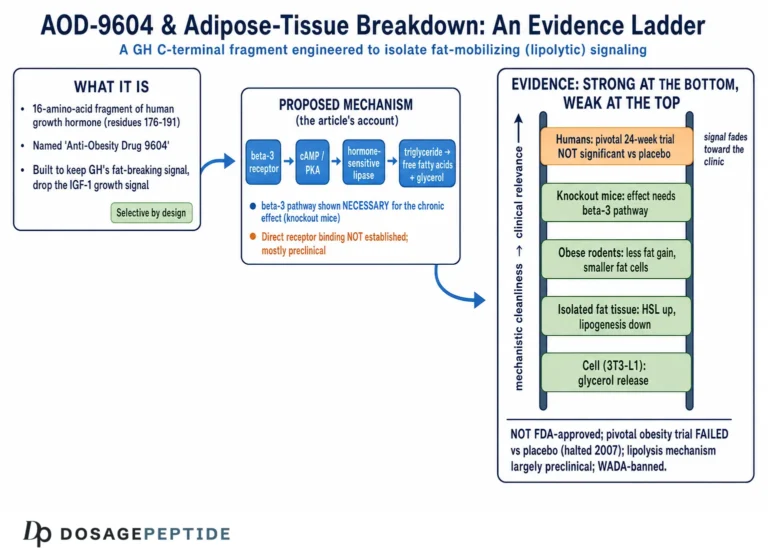
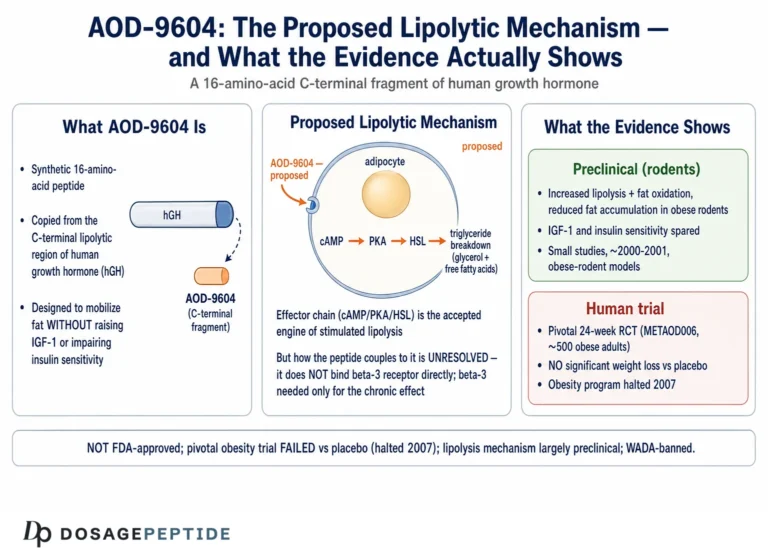
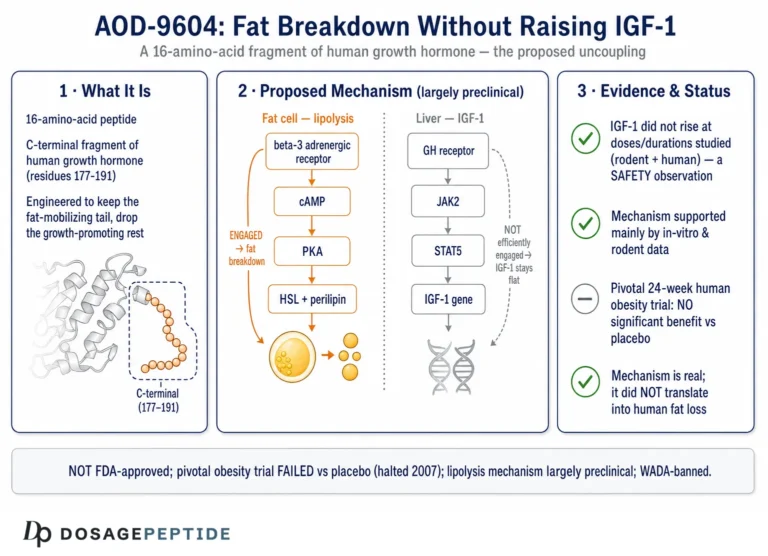
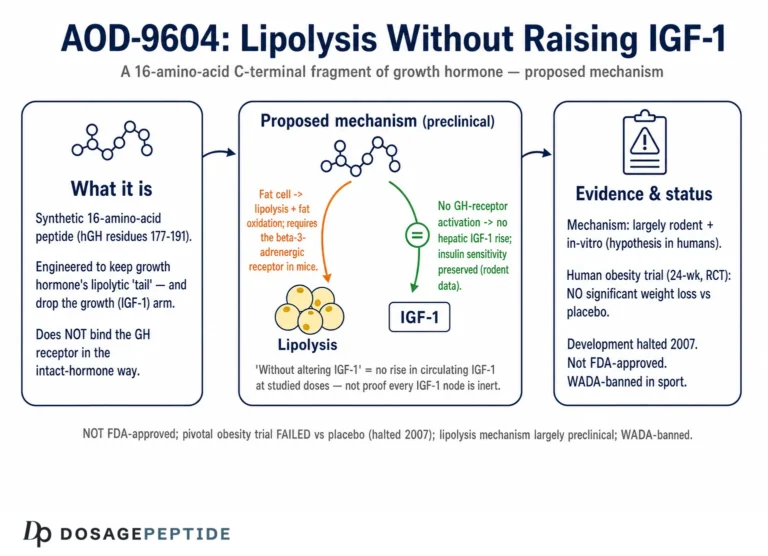
AOD-9604 is a synthetic 16-amino-acid peptide corresponding to residues 176–191 of the C-terminal region of human growth hormone (hGH), with a single deliberate modification: a tyrosine is added at the N-terminus in place of the native phenylalanine to improve stability.1 Its name is an abbreviation of “Anti-Obesity Drug 9604,” which tells you almost everything about the intent behind it. The molecule was designed at Monash University and developed by Metabolic Pharmaceuticals to reproduce the fat-mobilizing (lipolytic) tail of growth hormone while deliberately excluding the growth-promoting, insulin-like-growth-factor-1 (IGF-1)-driven arm of the parent hormone.1 Early metabolic work reported that it reproduced hGH’s lipolytic and fat-oxidizing actions in fat tissue and obese-rodent models without raising IGF-1 or impairing glucose tolerance.13 That selectivity is the compound’s defining feature, and — as we will see — it is also the reason its neuroprotective case is more complicated than it first appears.
So where does the brain enter the story at all? Not from any neurological pharmacology of AOD-9604 itself, but from a chain of inference that runs like this. First, obesity is now firmly established as a risk state for cognitive impairment and dementia; the mechanisms are metabolic and inflammatory.5 Second, AOD-9604 was built to reduce adiposity. Third — and this is the leap — if AOD-9604 reduced fat and improved metabolic health, then perhaps the downstream metabolic improvement would spare the brain the injury that obesity inflicts. The neuroprotection hypothesis is therefore a second-order inference layered on top of a metabolic effect that, crucially, was never robustly demonstrated in humans. The chain has a weak first link.
It helps to hold three distinct entities apart, because popular writing constantly collapses them. There is the parent hormone (full-length hGH, a 191-residue protein with broad endocrine effects, some of which are genuinely neuroactive via IGF-1). There is the lipolytic domain (the C-terminal region thought to carry the fat-mobilizing signal). And there is the engineered fragment (AOD-9604, a stabilized reproduction of that domain, intentionally stripped of IGF-1 signaling). When someone reasons from “growth hormone influences the brain” to “this GH fragment protects the brain,” they are collapsing all three levels and ignoring the deliberate narrowing that defines the molecule. Keeping these levels distinct is the most useful single habit for thinking clearly about any AOD-9604 claim, neurological or otherwise.
Historically, the obesity program was the entire clinical story. When the pivotal trial underperformed, drug development stopped in 2007.4 The molecule then reappeared in two unrelated guises: as a self-affirmed “generally recognized as safe” (GRAS) ingredient marketed for metabolic-health supplements, and as an experimental intra-articular agent for osteoarthritis in animal models.1112 Neither direction involved the central nervous system. The reader should sit with that fact: the compound’s documented biology spans fat cells, a rabbit knee, and human waistlines — and stops there. Everything about the brain is extrapolation. Readers wanting the parallel case in peripheral tissue can see how the same extrapolation problem plays out for AOD-9604 and diabetic foot-ulcer wound repair, where the tissue-regeneration claim likewise rests on cartilage data borrowed across an anatomical gap.
How Obese Phenotypes Injure the Brain: the Mechanistic Backdrop
To evaluate any neuroprotection claim, we first need a precise picture of what “obese phenotype” damage to the brain actually consists of, because this is the injury an effective agent would have to interrupt. The pathophysiology is genuinely well characterized, and it is worth laying out in some detail — not because AOD-9604 has been shown to touch any of it, but because it defines the target that the neuroprotection hypothesis is aiming at.
Chronic low-grade inflammation. Expanded, dysfunctional adipose tissue in obesity secretes pro-inflammatory adipokines and cytokines — tumor necrosis factor-α (TNF-α), interleukin-6 (IL-6), interleukin-1β — that raise systemic inflammatory tone. These peripheral signals reach the brain both humorally and via afferent pathways, priming the resident immune cells of the central nervous system.5 The hypothalamus is affected early, but the hippocampus and cortex — regions central to memory and executive function — are ultimately drawn in.
Microglial activation. Microglia, the brain’s resident macrophages, shift toward a reactive, pro-inflammatory phenotype in obese states. A representative mechanistic study in obese mice implicated a microglial fatty-acid-binding-protein-4–uncoupling-protein-2 (FABP4–UCP2) axis in driving neuroinflammation and cognitive decline, illustrating how lipid-handling machinery inside brain immune cells couples systemic adiposity to neural dysfunction.7 Reactive microglia release cytokines and reactive oxygen species, prune synapses inappropriately, and create a hostile microenvironment for neurons.
Blood–brain-barrier (BBB) breakdown. Peripheral insulin resistance and chronic inflammation degrade the integrity of the BBB, allowing inflammatory mediators and immune cells greater access to the neural parenchyma and further amplifying glial activation. Notably, BBB dysfunction and hippocampal-cortical neuroinflammation can appear early, before overt cognitive decline, which is why the barrier is considered a pivotal node in the obesity–dementia link.6
Central insulin resistance and mitochondrial dysfunction. The brain is an insulin-responsive organ; insulin supports neuronal glucose handling, synaptic plasticity, and neurotrophic signaling. In obesity, central insulin resistance blunts these supportive functions, and it travels with brain mitochondrial dysfunction and oxidative stress — a triad increasingly linked to neurodegenerative trajectories and sometimes described as a metabolic contributor to dementia risk.8
Suppressed neurotrophic support. Obesity is associated with reduced brain-derived neurotrophic factor (BDNF), a key molecule for hippocampal neurogenesis, synaptic plasticity, and memory. Falling BDNF is one plausible mediator through which metabolic dysfunction becomes cognitive dysfunction, and rising BDNF is one signature through which interventions such as caloric restriction and exercise appear to help.9
The table below organizes these mechanisms and, critically, flags what an agent would have to do to interrupt each one — the yardstick against which AOD-9604’s (absent) neuro data must be measured.
| Obesity-driven brain injury mechanism | What drives it | What a neuroprotective agent would need to do |
|---|---|---|
| Systemic inflammation reaching the CNS | Adipokines/cytokines (TNF-α, IL-6, IL-1β)5 | Lower inflammatory tone or block central signaling |
| Microglial activation | Reactive glial phenotype; lipid-handling axes (e.g., FABP4–UCP2)7 | Restrain microglial reactivity / normalize glial lipid handling |
| Blood–brain-barrier breakdown | Insulin resistance + inflammation degrading endothelium6 | Restore barrier integrity / reduce endothelial injury |
| Central insulin resistance + mitochondrial dysfunction | Impaired brain insulin signaling, oxidative stress8 | Improve central insulin sensitivity / mitochondrial function |
| Reduced neurotrophic support | Lower BDNF; impaired plasticity9 | Raise BDNF / support neurogenesis and plasticity |
It is worth dwelling on the temporal and regional structure of this cascade, because it shapes what a neuroprotective agent would have to accomplish and when. The hypothalamic response to overnutrition is relatively rapid, appearing within days of high-fat feeding in rodents and preceding measurable weight gain; the hippocampal and cortical involvement that underlies frank cognitive symptoms develops later, on the scale of weeks to months, as chronic inflammation and barrier compromise accumulate.5 This matters because it means there is, in principle, a window in which reversing metabolic stress could interrupt the progression before neuronal loss becomes fixed — the same rationale that motivates early lifestyle intervention. But it also means an effective agent would need either to act early or to reverse established glial and barrier changes, a considerably harder task. An agent whose only documented action is peripheral lipolysis offers no obvious purchase on either the early hypothalamic priming or the later hippocampal remodeling; it would have to work entirely through the slow, indirect normalization of systemic metabolism, and only if it produced that normalization in the first place.
Two things follow from this backdrop. First, the injury is multifactorial and centered on inflammation, barrier integrity, and insulin/neurotrophic signaling — not on fat oxidation per se. Second, the most consistently effective interventions against this cascade in the human literature are unglamorous: sustained weight loss, dietary quality, and physical exercise, which together lower inflammation, improve insulin sensitivity, and raise BDNF.9 Any pharmacological candidate is competing against, and would ideally be layered on top of, those foundations — a point we will return to when assessing whether AOD-9604 adds anything.
The Central Problem: No Direct Neuro Data Exist for AOD-9604
This section is deliberately short, because the honest answer is short. A search of the primary literature returns no studies in which AOD-9604 was administered and a neurological outcome was measured. There are no trials of cognition, no models of neurodegeneration, no ischemic-stroke or traumatic-brain-injury paradigms, no measurements of BBB integrity, microglial activation, hippocampal BDNF, neuronal survival, or synaptic markers following AOD-9604 exposure. The compound’s documented rodent work concerns body weight, fat oxidation, plasma glycerol, and the β3-adrenergic dependence of its chronic metabolic effect — all peripheral, metabolic endpoints.23 Its human work concerns weight and body composition in obese adults.4 Its one regenerative signal outside fat is in cartilage, from intra-articular injection in a rabbit osteoarthritis model — a different tissue, delivery route, and biological question entirely.12
So on the specific question the title poses — which molecular mechanisms allow AOD-9604 to provide neuroprotection — the accurate answer is that no mechanism has been demonstrated to provide it, because neuroprotection itself has never been demonstrated. This is not “weak evidence” or “mixed evidence”; it is the absence of evidence. The correct scientific posture toward such a gap is agnosticism paired with mechanistic scrutiny: rather than assert mechanisms for an unproven effect, we can only examine which hypothetical routes are biologically plausible, and how plausible each is given what the compound is known to do. That is the work of the next three sections. A parallel article on the site, what molecular mechanisms drive AOD-9604 neuroprotective effects in obese phenotypes, approaches the same territory; where that piece surveys the landscape, this one interrogates each candidate mechanism against the primary data and grades its plausibility.
Candidate Mechanism 1: Indirect Neuroprotection Through Fat Loss and Metabolic Repair
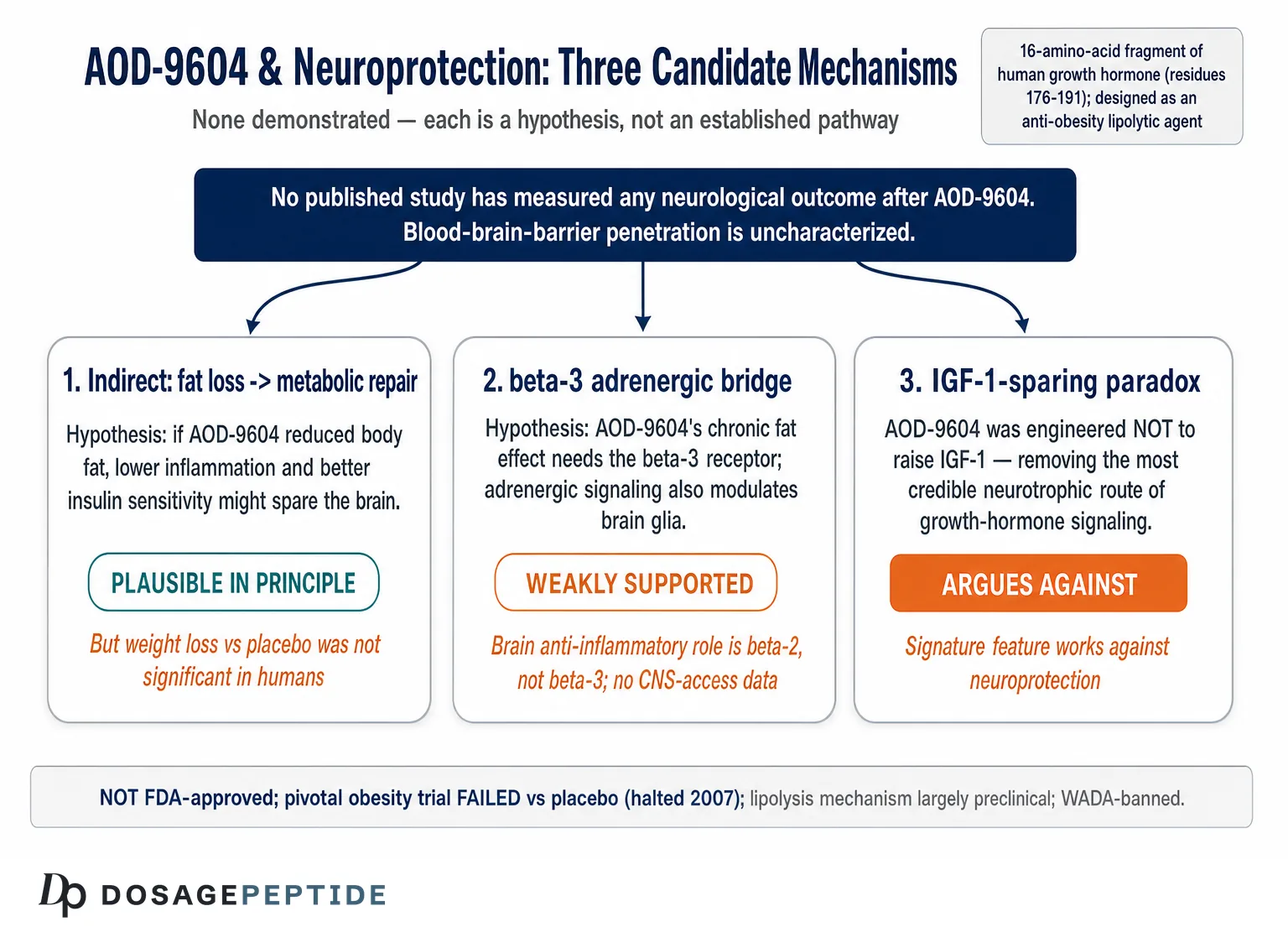
The strongest — and most honest — version of the neuroprotection hypothesis is indirect. It does not claim that AOD-9604 acts on neurons at all. It claims that if the peptide reduced adiposity and improved metabolic health, the resulting fall in systemic inflammation, improvement in insulin sensitivity, and easing of BBB stress would spare the brain the injury described above. This is mechanistically coherent, because the obesity–brain literature does support the idea that reversing metabolic dysfunction can partially reverse neural injury: weight-loss interventions in humans have been associated with improved cognitive outcomes and, in some studies, partial restoration of obesity-related hippocampal deterioration, with reduced inflammation, improved insulin sensitivity, and up-regulated BDNF proposed as the mediating molecular changes.9
But look carefully at what this mechanism actually requires of AOD-9604, and the case weakens at every step.
Step one requires meaningful fat loss. AOD-9604’s ability to produce clinically meaningful weight loss in humans was not established. In its pivotal 24-week, randomized, double-blind, placebo-controlled trial (METAOD006), the weight-loss difference from placebo did not reach statistical significance, and the early signal seen in a shorter study faded against a background of diet and exercise; development was halted in 2007.4 An indirect neuroprotective mechanism that depends on robust fat loss inherits this failure at its foundation. You cannot reap the downstream neural benefits of weight loss from a drug that did not reliably produce weight loss. The detailed clinical picture is examined in the site’s article on what clinical trials indicate about the fat-burning potential of AOD-9604, and the short version is that the fat-burning premise is itself contested.
Step two requires that this specific route of fat loss confers brain benefit. Even granting rodent fat oxidation, it does not follow that AOD-9604-mediated lipolysis reproduces the neural benefits of lifestyle-induced weight loss. Much of the cognitive benefit in human weight-loss studies is entangled with exercise and dietary quality — interventions that raise BDNF and improve insulin sensitivity through pathways only partly attributable to fat mass itself.9 A pharmacological lipolytic signal that mobilizes triglycerides is not the same stimulus as running or caloric restriction, and there is no basis for assuming equivalence.
Step three faces a mechanistic irony. Aggressive lipolysis raises circulating free fatty acids. In some contexts, elevated free fatty acids and lipid flux are themselves pro-inflammatory and can activate innate-immune signaling — the very kind of signaling implicated in obese-brain injury. It is at least conceivable that a purely lipolytic push, divorced from the broader metabolic remodeling of genuine weight loss, could be neutral or even unhelpful for neuroinflammation in the short term. This is speculation in the other direction, and no one has measured it — but it illustrates why “mobilizes fat” cannot be assumed to mean “protects brain.”
There is also a quantitative dimension that the indirect argument tends to gloss over. The cognitive benefits reported in human weight-loss studies generally accompany substantial, sustained reductions in body weight — often in the range of five to ten percent or more, maintained over many months, and typically achieved through combined dietary and behavioral programs.9 The magnitude of any weight change attributable to AOD-9604 in humans was, by contrast, small and statistically indistinguishable from placebo in the pivotal trial.4 Even if one accepts the indirect mechanism in full — that fat loss protects the brain — the dose of the “active ingredient” (weight reduction) that AOD-9604 could plausibly deliver appears far too small to expect a detectable neural signal. A mechanism can be real in principle yet irrelevant in practice if the upstream effect it depends on is negligible, and that is the most likely status of Mechanism 1 as applied to this particular compound. This is a different and more damning problem than mere absence of data: it is a reason to expect little even if the study were run.
The fair verdict on Mechanism 1 is that it is the most plausible route in principle and the least supported in practice. It is plausible because the obesity–brain axis is real and reversible; it is unsupported because AOD-9604’s foundational requirement — reliable fat loss in humans — was not met, and because no study has connected AOD-9604 to any neural endpoint. It belongs in the category of “reasonable hypothesis awaiting a first experiment,” not “established mechanism.”
Candidate Mechanism 2: the β3-Adrenergic Bridge
A more molecularly specific hypothesis leans on AOD-9604’s best-characterized mechanistic anchor: the β3-adrenergic receptor (β3-AR). The strongest primary evidence for β3-AR involvement comes from a 2001 study in which chronic treatment with hGH and with AOD-9604 failed to reduce body weight or increase lipolysis in β3-AR knockout mice, whereas it worked in wild-type controls — implicating the β3-adrenergic pathway in the compound’s chronic metabolic effects.2 Intriguingly, acute increases in energy expenditure and fat oxidation persisted in the knockouts, suggesting at least one β3-independent acute component.2 The tempting bridge to the brain is this: β-adrenergic receptors are expressed on central cells too, including astrocytes and microglia, where adrenergic signaling modulates neuroinflammation.15 If AOD-9604 engages β-adrenergic signaling, might it modulate glial inflammation centrally?
This bridge collapses under scrutiny, for several reasons that are worth spelling out because the β3 story is frequently invoked in marketing.
First, the central adrenergic neuroprotection literature overwhelmingly concerns the β2-adrenergic receptor, not β3. Microglia and astrocytes express β2-AR at high levels, and it is β2 signaling that has been most associated with restraining astrocytic TNF-α-driven inflammatory gene programs and modulating microglial surveillance.15 The receptor implicated in AOD-9604’s peripheral action is β3, whose central expression and neuroimmune role are far less prominent. Mapping a β3-linked peripheral effect onto a β2-dominated central phenomenon is a category slip.
Second, the knockout evidence shows that β3-AR is necessary for AOD-9604’s chronic effect in adipose tissue; it does not show that AOD-9604 directly binds and activates β3-AR, let alone that it does so in the brain.2 The molecular details of how the peptide engages the pathway remain unresolved, and much of the confident “binds the β3 receptor” language online traces to commercial rather than primary sources.
Third, and most fundamentally, there is a pharmacokinetic barrier: for a β3-adrenergic mechanism to protect neurons, AOD-9604 would need to reach the brain in a biologically active form. The compound’s central-nervous-system penetration has not been characterized in any peer-reviewed study I could find; there is no published blood–brain-barrier permeability data, no cerebrospinal-fluid pharmacokinetics, and no autoradiography localizing the peptide to neural tissue. A 16-residue peptide is not an obvious candidate for free BBB passage. Without that data, the entire premise that AOD-9604 could act on central β-adrenergic receptors is unsupported at the most basic level.
The verdict on Mechanism 2 is that it is superficially specific but scientifically thin. It borrows the credibility of a genuine peripheral finding (the β3-AR knockout study) and stretches it across two unproven gaps — receptor subtype (β3 vs the neuroprotective β2) and access (peripheral fat vs central parenchyma) — neither of which has been bridged by data. It is a hypothesis dressed in the language of a mechanism.
Candidate Mechanism 3: the IGF-1-Sparing Paradox
The third candidate mechanism is the most instructive, because here the compound’s defining feature works against the neuroprotection hypothesis rather than for it. Full-length growth hormone exerts many of its beneficial central effects through IGF-1, which is itself a well-studied neurotrophic and neuroprotective factor: IGF-1 supports neuronal survival, angiogenesis, and synaptic plasticity, and the GH/IGF-1 axis is one of the more credible endocrine routes by which growth-hormone-related signaling touches the brain. This is precisely the logic behind interest in growth-hormone secretagogues for cognition; see, for instance, the site’s discussion of whether sermorelin supports cognitive function in age-related neurodegeneration, where the proposed benefit runs squarely through GH/IGF-1 elevation.
Here is the paradox. AOD-9604 was engineered specifically not to raise IGF-1; that IGF-1-sparing profile is its central selling point and was reported consistently across its metabolic characterization.13 By removing the IGF-1 signal, the molecule removes the very arm of growth-hormone biology that carries the most plausible neurotrophic potential. In other words, if one were designing a growth-hormone-derived peptide to protect the brain, one might well want to keep the IGF-1 axis. AOD-9604 does the opposite. The same design choice that makes it metabolically “clean” (no IGF-1 elevation, no glucose impairment) also strips away its most credible route to a direct neurotrophic effect.
This has an important corollary for the popular claim — borrowed from full-length GH — that AOD-9604 should share GH’s neuroprotective or regenerative reputation. That inference is a category error identical to the one seen in muscle-growth marketing for this compound. An agent that does not elevate IGF-1 has, by that very property, foreclosed the principal pathway through which growth-hormone signaling would be expected to benefit neural tissue. You cannot claim GH’s IGF-1-mediated brain benefits for a fragment expressly designed to avoid raising IGF-1.
Could there be an IGF-1-independent neuroprotective route? In principle, yes — and this is where honest agnosticism matters. It is conceivable that the C-terminal domain has some direct action on neural cells unrelated to IGF-1, or that improved metabolic state (Mechanism 1) indirectly benefits the brain without any endocrine mediation. But “conceivable” is the operative word: no such IGF-1-independent neural action has been identified, measured, or even specifically hypothesized in the primary literature for AOD-9604. The IGF-1-sparing property does not merely fail to help the neuroprotection case; it actively subtracts the most obvious mechanism from the table.
The verdict on Mechanism 3 is that the compound’s signature feature is a liability, not an asset, for neuroprotection. This is the clearest example in the whole analysis of why one cannot reason from “growth hormone helps the brain” to “this GH fragment helps the brain.” The fragment was built to be the part of GH that does not do the IGF-1-dependent things.
What Genuine Evidence Would Require: Models and Methodology
If a research group wished to actually test whether AOD-9604 provides neuroprotection in obese phenotypes — converting the title’s premise from assumption into a testable claim — the methodology is well established and reveals, by contrast, how far the current evidence base falls short. It would proceed in tiers.
In vitro and cellular work. The starting point would be neuronal and glial cultures: primary hippocampal neurons or human iPSC-derived neurons for survival and synaptic markers; microglial lines (for example, BV2 or primary microglia) challenged with lipopolysaccharide or palmitate to model obese-state inflammation, with readouts of cytokine release, activation markers, and phagocytic behavior; and astrocyte cultures for inflammatory gene programs. One would measure whether AOD-9604 changes any of these under a metabolic-stress stimulus. Endothelial or transwell BBB models would test whether the peptide even crosses a barrier and whether it affects tight-junction integrity. None of these experiments has been reported for AOD-9604.
Rodent models of the obese brain. The relevant preclinical model is a diet-induced-obese (DIO) rodent — high-fat-fed mice or rats developing insulin resistance, neuroinflammation, and measurable cognitive deficits — in which AOD-9604 would be administered and neural endpoints assessed: hippocampal microglial activation, cytokine levels, BDNF, BBB permeability markers, and behavioral cognition (Morris water maze, novel-object recognition). The obese-mouse work that does exist for AOD-9604 measured body weight, fat oxidation, and plasma glycerol — peripheral metabolic endpoints — not a single neural or behavioral outcome.3 The existing FABP4–UCP2 obese-mouse study7 is exactly the kind of paradigm into which AOD-9604 could be dropped as an intervention, but no one has done so.
Pharmacokinetics and CNS access. Running in parallel, and arguably prerequisite, would be dedicated studies of whether AOD-9604 reaches the brain: plasma and cerebrospinal-fluid pharmacokinetics, BBB-permeability assays, and tissue distribution. Because any direct central mechanism (such as the β-adrenergic bridge of Mechanism 2) presupposes CNS penetration, the absence of this data is a foundational gap, not a detail.
Human studies. Only after coherent preclinical signals would controlled human trials in relevant populations (for example, adults with obesity and measurable cognitive concerns) be justified, with validated cognitive endpoints, neuroimaging markers of brain structure and inflammation, and circulating biomarkers. The existing human trials enrolled obese adults for weight outcomes and included no cognitive or neurological endpoints whatsoever.4
The methodological bottom line is stark: AOD-9604’s entire evidence architecture was built to answer a fat question, and even there it returned an inconclusive answer. To answer the brain question would require an essentially new research program that does not yet exist. Until that program produces data, every statement connecting AOD-9604 to neuroprotection — including the mechanisms this article has surveyed — is hypothesis, not finding. Researchers cataloging the compound’s parameters can consult the site’s peptide research glossary for standardized terminology, but should treat any neuro-related descriptor as provisional.
How AOD-9604 Compares With Agents Actually Studied for Neuroprotection
Placing AOD-9604 beside compounds that have genuinely been investigated for brain protection clarifies where it stands — not because it competes with them (it has never entered the arena) but because the contrast shows what a real neuroprotection candidate’s evidence looks like.
| Agent / class | Proposed neuroprotective mechanism | Level of neuro evidence |
|---|---|---|
| GLP-1 receptor agonists (e.g., semaglutide, liraglutide) | Central insulin/incretin signaling; reduced neuroinflammation; direct CNS receptor expression | Human cognitive/neurodegeneration trials underway; mechanistic and some clinical signals |
| Growth hormone / IGF-1 axis (e.g., via secretagogues) | IGF-1-mediated neurotrophic and plasticity support | Studied for cognition; effects modest and debated |
| β2-adrenergic agonists | Astrocytic/microglial anti-inflammatory signaling15 | Preclinical neuroprotection signals; not established therapy |
| Lifestyle: weight loss + exercise + diet | Lower inflammation, improved insulin sensitivity, raised BDNF9 | Human evidence for cognitive benefit; strongest of the group |
| AOD-9604 | Hypothesized indirect (fat loss); β3-adrenergic; IGF-1-sparing (a liability) | No neuro studies of any kind; no CNS-access data |
The pattern is unmistakable. Every serious neuroprotection candidate either acts on a central signaling axis with documented CNS receptor expression (GLP-1, adrenergic) or delivers a neurotrophic signal (IGF-1), and each has at least preclinical — often clinical — neural data. AOD-9604 has none, and its most specific proposed mechanism (IGF-1 sparing) points away from neurotrophic benefit rather than toward it. Notably, the GLP-1 class — which shares AOD-9604’s metabolic/weight-loss territory but succeeded where AOD-9604 failed — is now the focus of genuine neurodegeneration research precisely because it produces robust metabolic effects and has demonstrable central actions. That contrast underlines the point: a metabolic agent earns a neuroprotection hypothesis by first working metabolically and then showing central engagement. AOD-9604 has done neither in humans.
There is a further lesson embedded here. Even agents with real central mechanisms and strong metabolic effects have found neuroprotection difficult to prove; cognitive endpoints are notoriously hard to move, and biomarker changes frequently fail to translate into functional benefit. If purpose-built central agents struggle to clear that bar, a fat-mobilizing peptide with no neural data, uncertain CNS access, and an IGF-1-sparing design starts far behind — and would have to overcome, not merely match, the mechanistic headwinds this article has described.
None of this makes AOD-9604 uninteresting as a research object. As a selective lipolytic probe with an IGF-1-sparing profile, it remains a useful tool for dissecting adipose-tissue biology and the β3-adrenergic contribution to fat metabolism. But a compound’s value as a metabolic probe does not transfer to the brain by association. The honest placement of AOD-9604 on the neuroprotection map is not “promising candidate” or even “weak candidate” — it is “untested, with a mechanistic profile that gives little reason for optimism.” That is a legitimate scientific position, and stating it plainly serves readers better than manufacturing a mechanism list for an effect no one has observed.
Safety, Sourcing, and Why Handling Cannot Substitute for Evidence
Where AOD-9604’s record is relatively reassuring is short-term safety in the populations studied — a point that must be stated carefully, because “did not appear harmful in obesity trials” is not the same as “safe for chronic use in people with cognitive concerns,” and it is emphatically not evidence of benefit.
In the human obesity program, AOD-9604 was generally reported to be well tolerated over the studied durations, without the endocrine concerns associated with full-length growth hormone; specifically, it was reported not to elevate IGF-1 and not to impair glucose tolerance.1 A dedicated human safety and tolerability evaluation supported an acceptable short-term profile at the doses tested,10 and later characterization framed the ingredient as having a favorable safety and metabolism profile in the sponsor’s view.11 Several caveats temper this picture, and they matter especially for any hypothetical neurological use:
- Population and endpoint mismatch. Safety was established in metabolically healthy-to-obese adults over weeks to a few months, with metabolic endpoints. It says nothing about long-term administration, older adults with cognitive vulnerability, or neurological safety.
- No CNS data. Because the compound’s brain penetration and central effects are uncharacterized, there is no basis for assessing neurological safety at all — neither benefit nor harm has been measured centrally.
- Route and formulation. Pivotal human work used oral dosing; research and non-clinical use of reconstituted material is typically subcutaneous. Safety data do not transfer automatically across routes.
- Product quality. Much material circulating outside regulated channels is sold as “research chemical” of variable purity, with real risks of impurities, endotoxin, and mislabeling that are independent of the molecule’s intrinsic properties.
- Sport prohibition. AOD-9604 is prohibited in sport by the World Anti-Doping Agency, a regulatory hazard for athletes regardless of pharmacology.14
It bears emphasis that meticulous laboratory handling — proper reconstitution with sterile or bacteriostatic water, gentle swirling rather than shaking, cool and dark storage, avoidance of freeze–thaw cycles — changes nothing about the evidence question. A perfectly reconstituted, high-purity vial of AOD-9604 is still a compound with zero neuroprotection data. Good technique preserves whatever biological activity the molecule has; it cannot manufacture efficacy where none has been demonstrated. Researchers documenting such parameters can find related compounds cataloged through the site’s central dosage index, which is organized for educational reference rather than as guidance for human use.
Regulatory Status
AOD-9604’s regulatory picture is layered and frequently misrepresented, so precision matters — particularly because a supplement-adjacent framing is sometimes mistaken for therapeutic legitimacy.
No therapeutic approval, anywhere. AOD-9604 is not approved as a drug for obesity, cognitive decline, neurodegeneration, or any other condition by the U.S. Food and Drug Administration, the European Medicines Agency, or any comparable regulator. Its pharmaceutical development for obesity was abandoned in 2007 after the pivotal trial failed to demonstrate a significant benefit over placebo.4 There is, correspondingly, no approved indication of any kind, let alone a neurological one.
Supplement / food-ingredient framing. After the drug program ended, the compound was repositioned as a metabolic-health ingredient, supported by a self-affirmed GRAS characterization and safety/metabolism publications.11 A GRAS self-affirmation addresses ingredient safety at supplement-level exposure; it is not a finding of efficacy and not drug approval. Conflating “recognized as safe as a food ingredient” with “shown to work as a medicine” — still less “shown to protect the brain” — is one of the most common errors in the marketing literature around this compound.
U.S. compounding review. In 2024, AOD-9604 was among peptide substances considered by the FDA’s Pharmacy Compounding Advisory Committee for potential inclusion on the Section 503A bulk drug substances list. The committee voted against placing AOD-9604 on the list, citing inadequate physicochemical characterization, immunogenicity and impurity concerns, and a lack of clinical effectiveness data — a clear signal of continued regulatory caution about compounded peptide products.13
Anti-doping prohibition. The World Anti-Doping Agency has stated that AOD-9604 is prohibited in sport, falling under categories covering growth factors and related substances.14
The regulatory synthesis is straightforward: AOD-9604 occupies an ambiguous middle ground — not an approved drug, variously handled as a supplement ingredient, unsettled in U.S. compounding, and banned in sport — with no regulatory recognition of any therapeutic use, and certainly none in neurology. For any legitimate exploration of the compound’s neuroprotective potential, the appropriate path is formal preclinical and clinical investigation under regulatory oversight, not off-label or informal use. Readers tracking how the broader peptide evidence base evolves can follow the site’s research blog.
Frequently Asked Questions
Does AOD-9604 protect the brain in obesity?
There is no evidence that it does. No published study — human or controlled preclinical — has tested AOD-9604 for any neurological outcome, measured its effect on neuroinflammation, blood–brain-barrier integrity, BDNF, or cognition, or even characterized whether it reaches the brain. The neuroprotection idea is an untested hypothesis inferred from the (contested) premise that the peptide reduces fat, not a demonstrated effect. Obesity does injure the brain through inflammation, insulin resistance, and barrier breakdown,56 but the interventions with real human evidence against that injury are sustained weight loss, exercise, and dietary quality.9
Which molecular mechanisms are established for AOD-9604 and the brain?
None. The compound’s established mechanisms are peripheral and metabolic: a lipolytic action in adipose tissue whose chronic effect depends on the β3-adrenergic receptor, demonstrated in a knockout-mouse study.2 No central mechanism has been demonstrated. The three routes discussed in this article — indirect benefit via fat loss, a β-adrenergic bridge, and IGF-1-related signaling — are hypotheses, and the IGF-1 one actually argues against neuroprotection because AOD-9604 was designed not to raise IGF-1.1
If obesity harms the brain and AOD-9604 causes fat loss, doesn’t that mean it protects the brain?
That reasoning has two broken links. First, AOD-9604 did not reliably produce weight loss in humans; its pivotal trial missed statistical significance and development was halted in 2007.4 Second, even robust weight loss achieves brain benefit through reduced inflammation, improved insulin sensitivity, and raised BDNF — changes tied to diet and exercise as much as to fat mass itself.9 A pharmacological lipolytic signal cannot be assumed to reproduce those effects, and no one has measured whether it does.
Can AOD-9604 even cross the blood–brain barrier?
This has not been established. There are no published data on AOD-9604’s CNS penetration, cerebrospinal-fluid pharmacokinetics, or brain distribution. Since any direct central mechanism — such as acting on brain adrenergic receptors — presupposes that the peptide reaches neural tissue in active form, this unresolved question is a foundational gap, not a technicality.
Why does the IGF-1-sparing property matter for neuroprotection?
Because IGF-1 is one of the more credible neurotrophic routes by which growth-hormone-related signaling could benefit the brain. AOD-9604 was engineered specifically to isolate GH’s fat-mobilizing tail while avoiding IGF-1 elevation.1 Removing IGF-1 removes the most obvious neurotrophic mechanism, so the compound’s signature feature works against, not for, a neuroprotection hypothesis.
How does AOD-9604 compare to GLP-1 drugs being studied for the brain?
GLP-1 receptor agonists produce robust weight loss and have documented central receptor expression and neuroinflammatory effects, which is why they are under genuine investigation for neurodegeneration. AOD-9604 failed to reliably produce weight loss in humans and has no demonstrated central action or CNS-access data. The comparison highlights that a metabolic agent earns a neuroprotection hypothesis by first working metabolically and then showing brain engagement — steps AOD-9604 has not completed.
Is AOD-9604 approved or legal for cognitive or neurological use?
No. It is not approved as a drug for any condition by the FDA, EMA, or other major regulators, has been handled only as a supplement/food-type ingredient via self-affirmed GRAS (a safety framing, not efficacy),11 was not recommended for the FDA’s 503A compounding bulks list in 2024,13 and is prohibited in sport by WADA.14 There is no sanctioned neurological use.
Could AOD-9604 ever become a neuroprotective therapy?
It cannot be ruled out, but it would require an essentially new research program — glial and neuronal cell work, diet-induced-obese rodent models with neural and behavioral endpoints, blood–brain-barrier and pharmacokinetic characterization, and eventually controlled human trials — and it would have to overcome an IGF-1-sparing design that points away from neurotrophic benefit and a metabolic track record that did not reliably beat placebo.4 Realistically, starting from no neural data and against those headwinds, it is a long shot.
What is the responsible way to read online claims about AOD-9604 and the brain?
Treat any confident statement that AOD-9604 “is neuroprotective” or “reduces neuroinflammation” as marketing extrapolation until it cites a primary study with a neural endpoint — because no such study exists. Watch for three specific errors: borrowing full-length growth hormone’s reputation for a fragment designed to exclude IGF-1, citing GRAS status as if it meant efficacy, and treating rodent fat data as if it were brain data.
References
- Ng FM, Sun J, Sharma L, et al. Metabolic studies of a synthetic lipolytic domain (AOD9604) of human growth hormone. Horm Res. 2000;53(6):274-278. PMID 11146367. https://pubmed.ncbi.nlm.nih.gov/11146367/
- Heffernan MA, Thorburn AW, Fam B, et al. The effects of human GH and its lipolytic fragment (AOD9604) on lipid metabolism following chronic treatment in obese mice and beta(3)-AR knock-out mice. Endocrinology. 2001;142(12):5182-5189. PMID 11713213. https://pubmed.ncbi.nlm.nih.gov/11713213/
- Heffernan M, Summers RJ, Thorburn A, et al. Increase of fat oxidation and weight loss in obese mice caused by chronic treatment with human growth hormone or a modified C-terminal fragment. Int J Obes Relat Metab Disord. 2001;25(10):1442-1449. PMID 11673763. https://pubmed.ncbi.nlm.nih.gov/11673763/
- The effect of AOD9604 on weight loss in obese adults: results of a randomized, double-blind, placebo-controlled, multicenter study (obesity clinical program METAOD006; development halted 2007). https://www.researchgate.net/publication/295313034
- Zhang Q, Jin K, Chen B, et al. Overnutrition Induced Cognitive Impairment: Insulin Resistance, Gut-Brain Axis, and Neuroinflammation. Front Neurosci. 2022;16:884579. PMID 35873818. https://www.ncbi.nlm.nih.gov/pmc/articles/PMC9298971/
- Peripheral Inflammation and Insulin Resistance: Their Impact on Blood–Brain Barrier Integrity and Glia Activation in Alzheimer’s Disease. Int J Mol Sci. 2025;26(9):4209. PMCID PMC12072112. https://www.ncbi.nlm.nih.gov/pmc/articles/PMC12072112/
- Microglial FABP4-UCP2 Axis Modulates Neuroinflammation and Cognitive Decline in Obese Mice. Int J Mol Sci. 2022. PMCID PMC9032181. https://www.ncbi.nlm.nih.gov/pmc/articles/PMC9032181/
- Links Between Obesity-Induced Brain Insulin Resistance, Brain Mitochondrial Dysfunction, and Dementia. Front Endocrinol (Lausanne). 2018;9:496. https://www.frontiersin.org/journals/endocrinology/articles/10.3389/fendo.2018.00496/full
- The Effects of a 12-Month Weight Loss Intervention on Cognitive Outcomes in Adults with Overweight and Obesity. Nutrients. 2020;12(10):2988. PMCID PMC7600527. https://www.ncbi.nlm.nih.gov/pmc/articles/PMC7600527/
- Stier H, Vos E, Kenley D. Safety and Tolerability of the Hexadecapeptide AOD9604 in Humans. J Endocrinol Metab. 2013;3(1):7-15. https://www.jofem.org/index.php/jofem/article/view/157
- Moré MI, Kenley D. Safety and Metabolism of AOD9604, a Novel Nutraceutical Ingredient for Improved Metabolic Health. J Endocrinol Metab. 2014;4(3):64-77. https://jofem.org/index.php/jofem/article/view/213/278
- Kwon DR, Park GY. Effect of Intra-articular Injection of AOD9604 with or without Hyaluronic Acid in Rabbit Osteoarthritis Model. Ann Clin Lab Sci. 2015;45(4):426-433. PMID 26275694. https://pubmed.ncbi.nlm.nih.gov/26275694/
- U.S. Food and Drug Administration. Pharmacy Compounding Advisory Committee (PCAC) Briefing Document, 2024 (AOD-9604 review for Section 503A bulk drug substances). https://www.fda.gov/media/183584/download
- World Anti-Doping Agency. WADA statement on substance AOD-9604. https://www.wada-ama.org/en/news/wada-statement-substance-aod-9604
- Hertz L, Lovatt D, Goldman SA, Nedergaard M. Adrenoceptors in brain: cellular gene expression and effects on astrocytic metabolism and [Ca2+]i. Neurochem Int. 2010;57(4):411-420. PMCID PMC2934885. https://pmc.ncbi.nlm.nih.gov/articles/PMC2934885/
Educational and research-use disclaimer: This article is provided solely for scientific and educational purposes. AOD-9604 is not approved by the FDA, EMA, or any comparable regulator for the treatment, cure, or prevention of cognitive decline, neurodegeneration, obesity, or any other disease, and no neuroprotective effect in obese phenotypes or any other context has been demonstrated in humans or in controlled preclinical studies. The molecular mechanisms discussed here are hypotheses, not established findings. Nothing in this article is medical advice or a recommendation for human use. AOD-9604 is prohibited in sport by WADA. Any legitimate investigation of this compound should occur within properly authorized preclinical or clinical research under appropriate oversight. Readers should consult qualified professionals and applicable regulations before making any decisions.