Short answer: AOD-9604 is the fat-mobilising tail of growth hormone with the growth-promoting part cut away, and in rodents that separation genuinely holds. Whole growth hormone does two things at once: it mobilises fat, and it drives IGF-1, which brings insulin resistance, fluid retention and tissue growth with it. AOD-9604 keeps the first arm and drops the second — human safety studies of the fragment reported no rise in IGF-1 and preserved glucose tolerance, which is a real and unusual design achievement.
The catch is that the surviving signal is weak. The lipolytic effect is documented mostly in rodent fat tissue and cell work, where it appears to require a functioning β3-adrenergic receptor system without the peptide itself behaving as a classic β3 agonist. When that mechanism was finally put to a proper human test, the pivotal 24-week obesity trial failed to separate AOD-9604 from placebo, and the development program was halted in 2007. A clean mechanism is not the same as a useful drug.
This page traces both halves: how a 16-amino-acid fragment is thought to trigger fat breakdown, precisely what “without altering IGF-1 signalling” does and does not mean, and why the dissociation that makes it interesting also limits what it can do. Research use only — not approved as a medicine anywhere.
Two Arms of One Hormone: Why the Dissociation Matters
To understand what AOD-9604 is trying to accomplish, you first have to appreciate that growth hormone is not one signal but a bundle of them. Full-length hGH is a 191-amino-acid protein that binds the growth-hormone receptor (GHR) and sets off a cascade with strikingly diverse downstream effects. Some are “somatogenic” and largely indirect: GHR activation on hepatocytes drives production of IGF-1, and it is IGF-1, circulating and acting locally, that mediates much of the growth-promoting biology — longitudinal bone growth, tissue proliferation, and the anabolic signaling that builds and preserves skeletal muscle.6 Others are “metabolic” and more direct: GH acts on adipose tissue to stimulate lipolysis (the breakdown of stored triglyceride into free fatty acids and glycerol) and to blunt lipogenesis, shifting the body toward burning fat for fuel.4
These two arms are physiologically linked in the intact hormone but mechanistically separable. The lipolytic action of GH does not require IGF-1 as an intermediary; it proceeds through direct effects on the fat cell and, importantly, has a different time course and a different signaling logic from the IGF-1-mediated growth arm.4 That separability is the entire conceptual foundation of AOD-9604. If the fat-mobilizing signal lives in one region of the molecule and the IGF-1-inducing signal in another, then in principle you could build a fragment that carries only the first.
Why would anyone want to? Because the IGF-1 arm of GH biology carries baggage that makes chronic full-hormone administration undesirable for a metabolic indication. Sustained GH exposure raises IGF-1, can impair glucose tolerance and reduce insulin sensitivity, promotes fluid retention, and — through the same proliferative signaling that makes it anabolic — raises theoretical concerns about tissue overgrowth.6 A compound that reproduced GH’s fat-burning effect while sidestepping the IGF-1 rise would, on paper, offer the metabolic upside without the endocrine liabilities. That is the pitch AOD-9604 was built to deliver, and it is why the phrase “without altering IGF-1 signaling” is not a footnote but the central design goal.
It is worth being precise about what “without altering IGF-1 signaling” can and cannot mean. The strongest interpretation supported by data is narrow: chronic administration of AOD-9604 in rodents did not raise serum IGF-1 levels, and did not impair insulin sensitivity, in contrast to full-length hGH.1 That is a statement about a measured biomarker (circulating IGF-1) and a functional readout (euglycemic-clamp insulin sensitivity), not a comprehensive proof that every node of the sprawling IGF-1 signaling network is untouched. The honest version of the claim is therefore: at the doses studied, AOD-9604 mobilized fat without the IGF-1 elevation and insulin-sensitivity penalty that accompany the parent hormone. That is a real and useful finding. It is not the same as a molecular guarantee that IGF-1/PI3K/Akt/mTOR signaling is provably inert — a distinction that matters when reading vendor copy that treats the two as identical.
The Molecule: A Stabilized Copy of Growth Hormone’s Lipolytic Tail
AOD-9604 is a synthetic 16-amino-acid peptide. Its name abbreviates “Anti-Obesity Drug 9604,” which tells you the whole intent behind its creation. The sequence corresponds to residues 177–191 of the C-terminal region of hGH, with one deliberate modification: a tyrosine is added at the N-terminus in place of the native phenylalanine, a change made to improve the fragment’s stability and handling.1 The full sequence is H-Tyr-Leu-Arg-Ile-Val-Gln-Cys-Arg-Ser-Val-Glu-Gly-Ser-Cys-Gly-Phe-OH, and the two cysteine residues form a disulfide bridge that reproduces the small loop found in the parent hormone’s lipolytic domain. That loop is not incidental; it is the structural feature thought to be necessary for the fragment to reproduce GH’s fat-mobilizing activity.
The compound emerged from work at Monash University in Melbourne, Australia, and was developed commercially by Metabolic Pharmaceuticals Limited. The scientific logic was, as noted, to isolate the C-terminal lipolytic region from the rest of the hormone. Early metabolic studies reported success on exactly this axis: AOD-9604 reproduced the lipolytic and fat-oxidizing actions of hGH in fat tissue and in obese-rodent models, yet did so without raising IGF-1 or impairing glucose tolerance.1 That selectivity became the molecule’s defining property and is the reason educational protocols for it consistently frame it as a fat-metabolism research compound rather than a growth-promoting one.
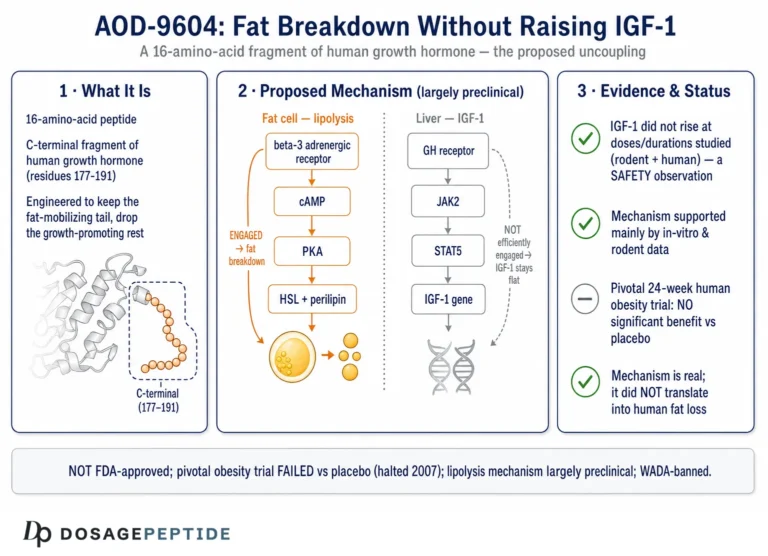
One structural fact reshapes the whole mechanistic discussion and is frequently glossed over in popular writing: AOD-9604 does not appear to bind the growth-hormone receptor in the way the intact hormone does. The chronic-treatment study in obese mice explicitly noted that the C-terminal fragment reduced body weight and stimulated lipolysis despite not interacting with the hGH receptor in the manner of full-length hGH.3 This is the mechanistic key to the IGF-1 question. Hepatic IGF-1 production is downstream of GHR activation; if AOD-9604 does not meaningfully engage GHR, it cannot drive the JAK2/STAT5-mediated induction of IGF-1 that full GH triggers. The IGF-1-sparing property, in other words, is not a lucky accident — it is a structural consequence of building a fragment that has shed the receptor-binding surfaces responsible for the somatogenic cascade while retaining whatever motif drives the lipolytic effect.
That same fact, however, opens a genuine puzzle that honest writing should not paper over. If AOD-9604 does not act through the classical GHR, then how does it stimulate lipolysis at all? The parent hormone’s direct lipolytic effect on adipocytes is itself GHR-dependent, working through STAT5 and downstream suppression of antilipolytic signals.45 A fragment that has abandoned GHR must be using a different route — and, as the next sections show, the evidence points toward the β3-adrenergic pathway rather than a faithful reproduction of GH’s own adipocyte signaling. The molecule may therefore mimic the outcome of GH’s lipolytic action while reaching it by a partly distinct mechanism, which is a subtler and more interesting story than “it’s just the fat-burning part of growth hormone.”
How Growth Hormone Itself Triggers Lipolysis — the Baseline
Because AOD-9604 is best understood against the biology it was carved from, it helps to lay out how full-length GH mobilizes fat. This is not a digression; the IGF-1 question only makes sense once you see which parts of GH’s lipolytic machinery are IGF-1-independent to begin with.
GH’s direct action on the adipocyte begins at the GHR, a cytokine-family receptor that, on ligand binding, activates the associated kinase JAK2 and recruits the transcription factor STAT5 (STAT5B being the dominant isoform in humans).4 Adipose-specific ablation of either JAK2 or STAT5 in mice decreases lipolysis, establishing that this axis is required for GH’s fat-mobilizing effect.4 Downstream, GH promotes lipolysis less by flooring the accelerator than by releasing the brake: acute GH exposure in human and mouse adipose tissue suppresses a set of antilipolytic signals — downregulating phosphodiesterase-3B (PDE3B), an insulin-dependent brake on lipolysis, and reducing the expression of antilipolytic proteins such as G0S2 — thereby lifting the tonic inhibition that insulin normally imposes on the fat cell.5 The net result is increased phosphorylation and activation of hormone-sensitive lipase (HSL) and adipose triglyceride lipase, the enzymes that dismantle stored triglyceride, and a rise in circulating free fatty acids.4
Crucially, none of this requires IGF-1. IGF-1 is generated downstream of GHR activation in the liver and mediates the growth arm; the lipolytic arm is a parallel, direct consequence of GHR signaling in fat. Indeed, IGF-1 and insulin tend to modulate (often oppose) GH’s lipolytic signaling rather than mediate it, which is why the two arms can be dissociated in the first place.46 This is the conceptual permission slip for a molecule like AOD-9604: because GH’s fat-mobilizing effect is not routed through IGF-1, it is at least coherent to imagine capturing the former without the latter.
There is a second lipolytic axis in the adipocyte that matters enormously for the AOD-9604 story: the β-adrenergic pathway. Catecholamines (adrenaline, noradrenaline) acting on β-adrenergic receptors — particularly the β3-adrenergic receptor (β3-AR), the dominant lipolytic receptor on fat cells — raise intracellular cyclic AMP, activate protein kinase A, and phosphorylate HSL, driving lipolysis through a classic G-protein-coupled-receptor route entirely separate from GHR/STAT5.4 Keep both axes in mind, because the evidence suggests AOD-9604 leans on the β3-adrenergic route more than on a faithful copy of GH’s own STAT5 signaling. For readers who want the parent-hormone contrast in more depth, the difference between a direct GH mimic and a secretagogue that raises endogenous GH and IGF-1 is explored in the discussion of sermorelin’s role in stimulating natural growth hormone.
The AOD-9604 Lipolysis Mechanism: the β3-Adrenergic Evidence
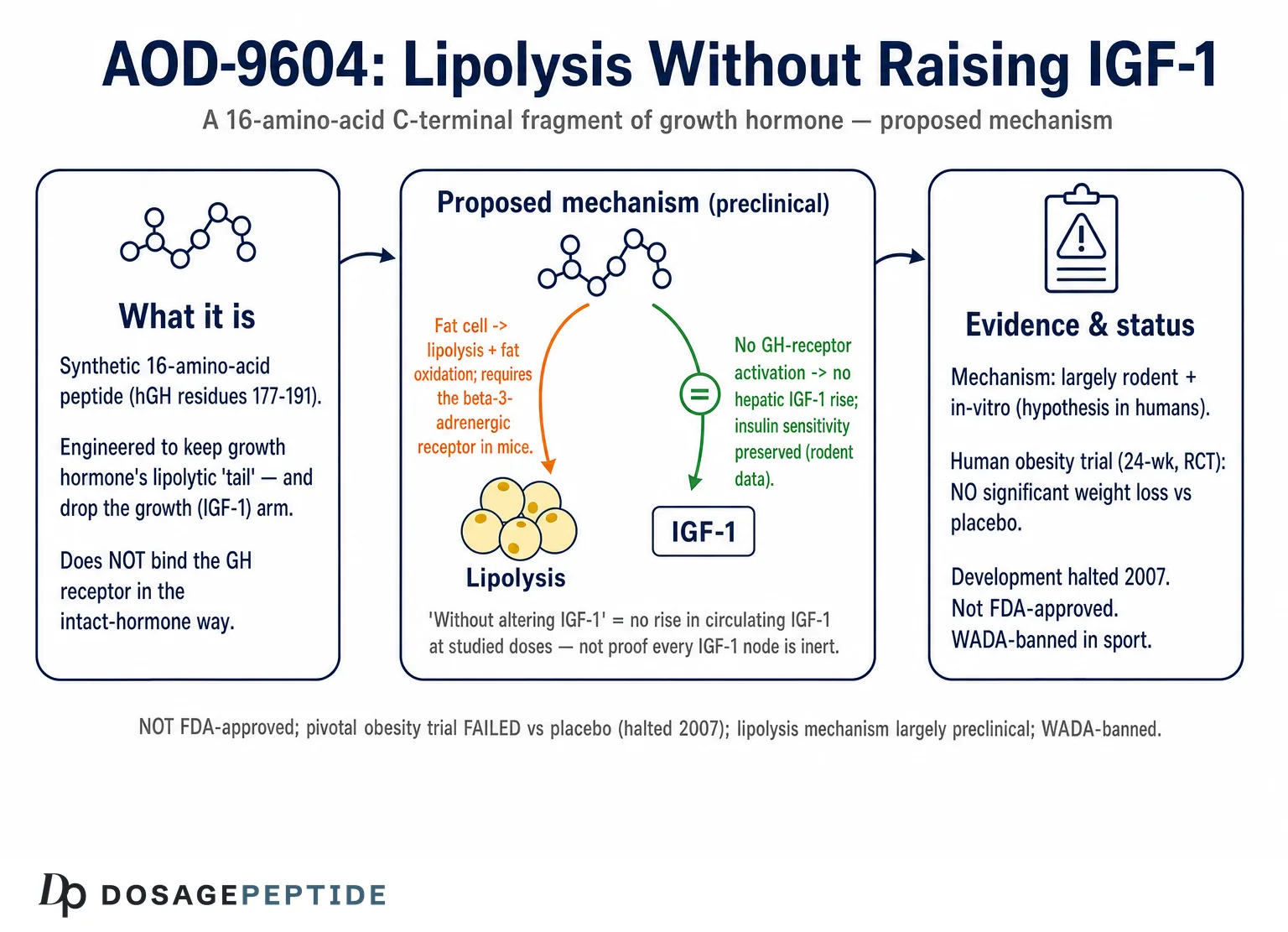
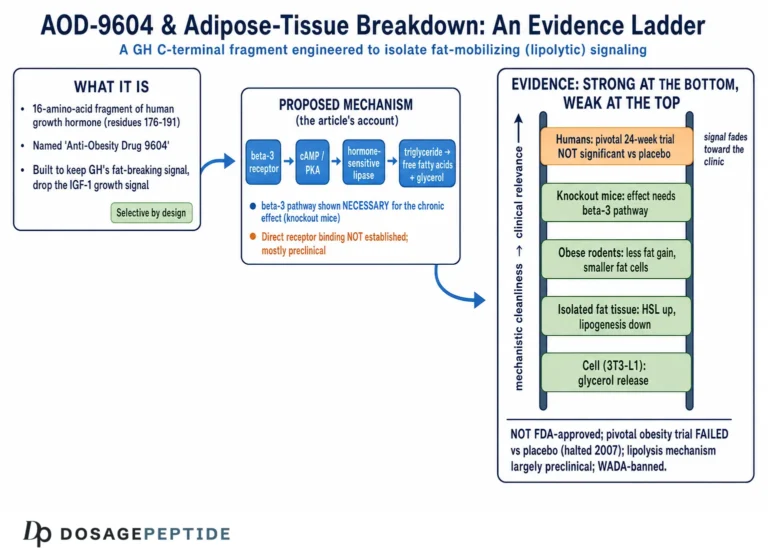
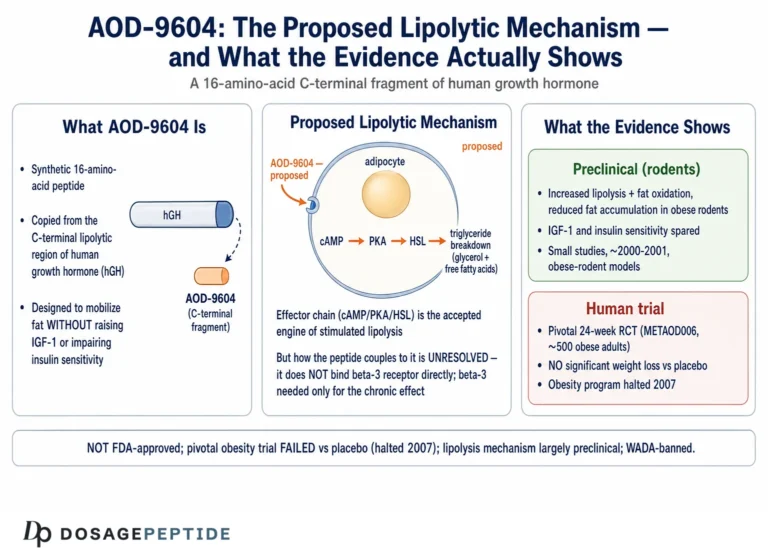
The proposed mechanism of AOD-9604 centers on adipocytes and, specifically, on the β3-adrenergic pathway. In simplified terms, the peptide is thought to reproduce the lipolytic signaling associated with growth hormone’s C-terminal domain — promoting the breakdown of stored triglyceride while dampening the conversion of substrate into new fat — and to do so in a way that depends on β3-AR function.12 The net effect in rodent models was reduced body-fat accumulation and increased fat oxidation, without the IGF-1 elevation that accompanies full GH.1
The strongest single piece of mechanistic evidence comes from a 2001 study in Endocrinology. Chronic treatment with hGH and with AOD-9604 reduced body weight and increased lipolytic sensitivity in obese wild-type mice, but this chronic effect was absent in β3-adrenergic-receptor knockout mice.2 The knockout animals were unresponsive to the sustained lipolytic action of the peptide, which is strong genetic evidence that the β3-AR is required for AOD-9604’s chronic fat-mobilizing effect. Complementing this, the same body of work reported that AOD-9604 treatment was associated with increased expression of β3-AR messenger RNA in adipose tissue — suggesting the peptide may act, at least in part, by upregulating the very receptor that dominates fat-cell lipolysis, rather than by directly and acutely occupying it like a catecholamine.2
That distinction is worth dwelling on, because the popular shorthand that AOD-9604 “binds the β3 receptor to burn fat” overstates a more nuanced and more interesting picture. The knockout data show the receptor is necessary for the chronic effect; the RNA data suggest the peptide increases receptor expression. Neither demonstrates that AOD-9604 is itself a β3 agonist in the pharmacological sense. And a further wrinkle complicates the tidy story: in an acute experiment, AOD-9604 still increased energy expenditure and fat oxidation in the β3-AR knockout mice, implying at least one β3-independent component to the acute response.2 So the fairest mechanistic summary is layered — the β3-adrenergic pathway appears essential for the sustained lipolytic and weight effects, likely via increased receptor expression, while an additional, less-defined mechanism contributes to the acute metabolic response. Much of the confident single-sentence mechanism circulating online collapses this layered picture into a slogan.
The lipolysis story is also supported by the earlier fat-oxidation work: chronic treatment of obese mice with either hGH or the modified C-terminal fragment reduced body-weight gain, increased fat oxidation, and stimulated lipolysis — and, again, the fragment achieved this despite not interacting with the hGH receptor in the manner of the intact hormone.3 Taken together, references 1 through 3 form a coherent rodent-level account: a GH C-terminal fragment that mobilizes and oxidizes fat, requires the β3-AR for its chronic action, upregulates that receptor, and does all of this without engaging GHR or raising IGF-1. That is a genuinely elegant dissociation — and it is almost entirely preclinical.
| Signaling node | Full-length hGH | AOD-9604 (per rodent/in-vitro data) |
|---|---|---|
| Growth-hormone receptor (GHR) | Binds and activates | Does not interact in the intact-hormone manner3 |
| JAK2 / STAT5 in adipocyte | Activated; required for GH lipolysis4 | Not established as the operative route |
| Hepatic IGF-1 induction | Raises circulating IGF-16 | No rise in serum IGF-1 reported1 |
| β3-adrenergic receptor | Interacts with β-adrenergic pathway2 | Required for chronic effect; β3-AR RNA upregulated2 |
| Hormone-sensitive lipase / lipolysis | Increased4 | Increased lipolytic activity in fat1 |
| Insulin sensitivity (chronic) | Impaired6 | Not impaired in rodent clamp studies1 |
The table makes the dissociation visible at a glance: AOD-9604 appears to reach a GH-like lipolytic outcome through a partly non-GH route, and in doing so bypasses the GHR-dependent steps that would otherwise raise IGF-1 and blunt insulin sensitivity. Researchers cataloging where this compound sits among fat-metabolism peptides can consult the site’s central dosages index, which organizes such compounds by their intended metabolic profiles for educational reference.
The IGF-1 Axis: What AOD-9604 Is Designed Not to Touch
To evaluate the “without altering IGF-1 signaling” half of the title, it helps to be concrete about what the IGF-1 pathway actually is and why leaving it alone is significant. IGF-1 is a peptide hormone produced largely by the liver in response to GHR activation, with additional local (autocrine/paracrine) production in many tissues. Circulating IGF-1 binds the IGF-1 receptor (IGF-1R), a receptor tyrosine kinase, which activates the PI3K/Akt/mTOR and Ras/MAPK cascades — the signaling that drives cell growth, protein synthesis, proliferation, and survival.6 In skeletal muscle this axis is the principal anabolic route; in bone it drives longitudinal growth; and across tissues it contributes to the mitogenic effects that make chronic GH/IGF-1 elevation something clinicians monitor carefully.
The relationship between GH and IGF-1 in controlling metabolism is intricate and, at points, opposing. Classic work dissecting the relative roles of GH and IGF-1 showed that the two hormones exert distinct — sometimes counterbalancing — effects on insulin sensitivity, with GH tending to antagonize insulin action while IGF-1 can improve it.6 This is precisely why an agent that raises IGF-1 as a byproduct of its metabolic action carries a complicated risk-benefit profile, and why a fat-mobilizing agent that leaves IGF-1 flat is, in principle, cleaner.
What is the actual evidence that AOD-9604 leaves this axis alone? It rests on three observations, in descending order of strength. First, and most directly, the foundational metabolic studies reported no rise in serum IGF-1 with chronic AOD-9604 treatment in rodents.1 Second, the same and related studies reported preserved insulin sensitivity by euglycemic clamp — the functional signature you would expect if the IGF-1/insulin-antagonism arm of GH biology were genuinely absent.1 Third, the structural/receptor evidence that the fragment does not engage GHR in the intact-hormone fashion provides a mechanistic reason to expect no IGF-1 induction, since hepatic IGF-1 production is GHR-dependent.3 Human safety work later characterized the peptide as not producing the endocrine disturbances associated with full GH, consistent with the rodent picture.7
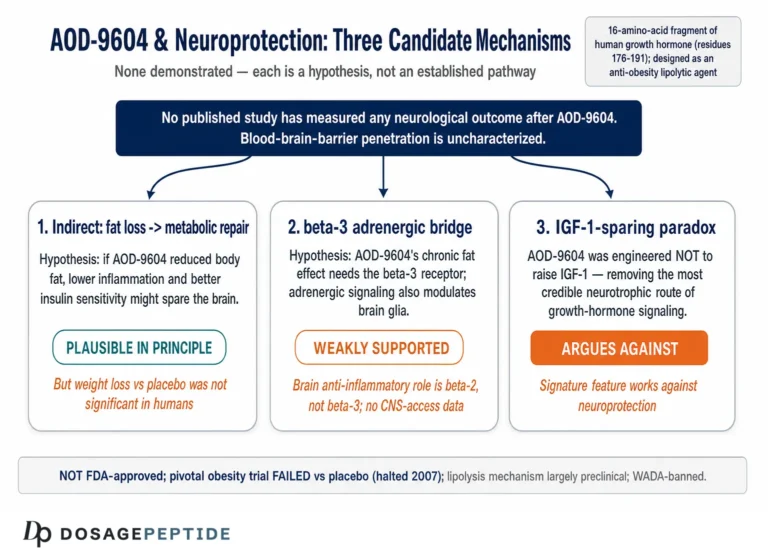
Here honesty requires two caveats. The first is a measurement caveat: “no rise in serum IGF-1” is a statement about a blood level under specific dosing conditions, not proof that local, tissue-level IGF-1 signaling is provably unchanged everywhere. The second is a scope caveat: the bulk of this evidence is rodent, supplemented by limited human safety data; there is no large, dedicated human pharmacodynamic program mapping AOD-9604’s effect on the full IGF-1 signaling network. So the defensible claim is that AOD-9604, at studied doses, did not elevate circulating IGF-1 or impair insulin sensitivity — a meaningful and repeatedly reported finding — rather than the stronger claim that it is molecularly guaranteed to be inert at every IGF-1 node. This IGF-1-sparing design is the same feature examined, from the muscle-tissue angle, in the analysis of whether AOD-9604 could aid recovery from muscle wasting in cachexia or sarcopenia — where, tellingly, the very absence of IGF-1 signaling that makes the peptide metabolically clean also removes the principal route by which GH builds muscle.
Lipogenesis, Fat Oxidation, and the Full Metabolic Picture
Lipolysis is only half of what a fat-mobilizing agent needs to do. Releasing free fatty acids from storage accomplishes little if those fatty acids are simply re-esterified back into triglyceride or if the body compensates by making new fat. The AOD-9604 rodent data suggest the peptide acts on both sides of the ledger: increasing lipolysis and fat oxidation while dampening lipogenesis, which is the more favorable combination for net fat reduction.1
The fat-oxidation dimension is important and often underappreciated. In the obese-mouse work, chronic treatment with either hGH or the C-terminal fragment increased whole-body fat oxidation — meaning the mobilized fatty acids were actually being combusted for energy rather than recirculated.3 This coupling of mobilization to oxidation is what distinguishes a potentially useful metabolic signal from mere lipid shuffling. Acutely, AOD-9604 raised energy expenditure and fat oxidation even in β3-AR knockout mice, reinforcing that the oxidative response has a component independent of the chronic β3-dependent lipolytic effect.2
On the lipogenic side, the peptide was reported to reduce the accumulation of new fat, an effect consistent with a shift in adipocyte metabolism away from storage.1 The mechanistic details of how a β3-linked, GHR-sparing fragment suppresses lipogenesis are not as well characterized as the lipolytic side, and this is an area where the primary literature is thinner than the marketing literature would suggest. It is reasonable to say AOD-9604 was reported to favor a lipolytic, fat-oxidizing metabolic state in rodents; it is not reasonable to present a detailed, validated lipogenesis-suppression pathway as established fact.
The whole metabolic picture, then, is of a compound that in rodents pushed adipose tissue toward net fat loss through a combination of increased lipolysis, increased oxidation of the liberated fatty acids, and reduced new-fat synthesis — all without the IGF-1 elevation and insulin-sensitivity cost of the parent hormone. That is a coherent and attractive profile. Whether it survives translation to human physiology is the question the clinical program was meant to answer, and the answer, as the next section shows, was disappointing. Readers comparing the mechanistic promise against the trial data can also see the site’s dedicated review of what clinical trials indicate about the fat-burning potential of AOD-9604.
From Mechanism to Humans: Where the Story Falters
A clean mechanism in mice is a hypothesis about humans, not a conclusion. The fairest way to judge whether AOD-9604’s lipolytic biology matters is to look at what happened when it was tested in people — and here the record is candidly underwhelming.
Across its development, AOD-9604 was studied in roughly six human clinical trials enrolling more than 900 participants in total, a tally that derives from the sponsor’s development-program summary rather than from any single peer-reviewed paper.9 The centerpiece early study was a 12-week Phase 2 evaluation in obese adults using oral administration once daily, with several dose arms. Its data were encouraging enough to generate optimistic coverage: the peptide-treated groups lost, on average, on the order of 1.8 kg more than placebo, with a low-dose arm reported as the best performer.9
The problem emerged at the endpoints that mattered. In the pivotal, longer, more rigorously controlled 24-week trial — a randomized, double-blind, placebo-controlled, multicenter study — the weight-loss difference between AOD-9604 and placebo at the primary and key secondary endpoints was too small to reach statistical significance.9 The early signal from the shorter study faded against a background of intensive diet-and-exercise counseling; against real lifestyle intervention, the peptide added no detectable benefit. Development as an obesity drug was terminated in 2007.
| Aspect | What the human obesity program showed |
|---|---|
| Trials / participants | ~6 studies, >900 participants total9 |
| Pivotal design | Randomized, double-blind, placebo-controlled, multicenter; oral9 |
| Early signal (12-week) | ~1.8 kg greater loss vs placebo9 |
| Primary endpoint (24-week) | Did NOT reach statistical significance vs placebo9 |
| With diet + exercise | No detectable added benefit9 |
| Outcome | Obesity development halted, 20079 |
| Endocrine profile | No IGF-1 rise; short-term tolerability acceptable17 |
It is worth naming why the gap between the 12-week and 24-week results is so instructive rather than treating it as a footnote. A short trial with a lighter lifestyle component leaves more room for a modest pharmacological signal to show through; a longer trial with intensive diet-and-exercise counseling raises the bar, because the comparator group is itself losing weight through behavior change. When a candidate’s early separation from placebo evaporates once real lifestyle intervention is layered in, the most parsimonious reading is that the drug effect was small relative to what diet and exercise achieve on their own. That pattern — promising short-term signal, null pivotal result — recurs across the history of anti-obesity pharmacology and is precisely why regulators insist on longer, adequately controlled trials before granting approval. AOD-9604’s trajectory fits the pattern rather than defying it, which is part of why its failure was not especially surprising to endocrinologists who had watched other peripherally acting fat-mobilizing strategies stall in the same way.
The lesson for the mechanism question is subtle but important. The trial failure does not necessarily mean the lipolytic mechanism is wrong; it may mean the effect size in humans is too small to matter clinically, that oral bioavailability limited exposure, that human adipose tissue responds differently from rodent, or that the β3-AR pathway — famously difficult to exploit therapeutically in humans, where selective β3 agonists have had a checkered development history — simply does not deliver meaningful whole-body fat loss when nudged by this peptide. What the failure does establish is that a real mechanism and a real drug are different things. AOD-9604’s best-evidenced effect — fat mobilization in rodents — did not translate into robust human weight loss. Any honest account of “how AOD-9604 influences lipolysis” has to sit alongside “and this influence did not produce a clinically effective obesity treatment.”
AOD-9604 Versus Other Ways to Drive Lipolysis
Placing AOD-9604 beside other lipolytic strategies clarifies both its logic and its limits. The point is not that these agents compete head-to-head — they occupy different regulatory and evidentiary tiers — but that the comparison shows what “driving lipolysis without touching IGF-1” looks like relative to the alternatives.
| Agent / class | Primary lipolytic route | Effect on IGF-1 | Human evidence for fat loss |
|---|---|---|---|
| Full-length hGH | GHR → JAK2/STAT5, direct adipocyte4 | Raises IGF-16 | Reduces fat mass but with endocrine costs |
| GH secretagogues (e.g., sermorelin, ipamorelin) | Raise endogenous GH → downstream lipolysis | Raise IGF-1 (that is the point) | Body-composition signals; not fat-loss drugs |
| β3-adrenergic agonists | Direct β3-AR → cAMP/PKA/HSL4 | No direct IGF-1 effect | Difficult human translation historically |
| GLP-1 / dual-incretin agents | Appetite/energy-intake reduction (not primarily lipolytic) | No direct IGF-1 effect | Robust, FDA-approved for obesity |
| AOD-9604 | β3-dependent (chronic); GHR-sparing23 | No IGF-1 rise reported1 | Failed pivotal RCT; not approved9 |
Two patterns stand out. First, AOD-9604 is genuinely distinctive in combining a lipolytic intent with an IGF-1-sparing profile — the GH-based approaches all raise IGF-1 (secretagogues do so deliberately), while the non-GH approaches (β3 agonists, incretins) simply have nothing to do with IGF-1. AOD-9604 is the unusual case of a molecule derived from GH that nonetheless leaves IGF-1 flat. That is the mechanistic novelty the title is pointing at, and it is real.
Second, distinctiveness of mechanism has not bought clinical success. The only lipolysis-adjacent strategy with robust, approved human efficacy for obesity is the incretin class, which works primarily by reducing energy intake rather than by directly mobilizing fat — a reminder that, in humans, controlling appetite has proven a more tractable lever than directly commanding adipocytes to release their contents. AOD-9604’s elegant peripheral mechanism did not clear the bar that the incretins cleared through a completely different route. Researchers interested in how the GH-secretagogue contrast plays out mechanistically can compare this profile with the receptor-level analysis of ipamorelin’s precision at the GHSR-1a receptor, an agent that works by raising the very GH/IGF-1 axis AOD-9604 avoids.
Research Models and the Limits of the Evidence
The evidentiary architecture behind the lipolysis-without-IGF-1 claim is worth examining directly, because it determines how much confidence the mechanism deserves. The work falls into three tiers, and the strength of the IGF-1-sparing claim is not uniform across them.
In vitro and ex vivo fat-tissue work. The foundational metabolic studies examined lipolysis and lipogenesis in adipose tissue and isolated fat cells, measuring free-fatty-acid release, fat oxidation, and receptor and enzyme expression.1 These assays are well suited to characterizing a lipolytic agent and to showing the absence of an IGF-1 rise at the tissue and serum level. They are the source of the cleanest “lipolysis up, IGF-1 flat” readouts.
Rodent models. The most methodologically informative animal work is the β3-AR knockout study, a clean genetic approach that isolated the receptor’s contribution by comparing knockout and wild-type mice under identical treatment.2 Obese-mouse and obese-rat models established the body-weight, fat-oxidation, and IGF-1/insulin-sensitivity profile.13 This tier carries the load for the mechanism: the β3-dependence, the receptor upregulation, the GHR-sparing lipolysis, and the absence of IGF-1 elevation are all rodent findings. They are consistent and reasonably well designed, but they are rodent findings.
Human trials. The clinical methodology was appropriate for an obesity drug — randomized, double-blind, placebo-controlled designs with weight and body-composition endpoints, plus dedicated safety and tolerability characterization.79 A human safety study specifically supported an acceptable short-term profile and the absence of GH-type endocrine disturbance.7 But the human program measured weight and safety, not a detailed pharmacodynamic dissection of lipolysis and IGF-1 signaling. There is no large human dataset mapping, for instance, adipose HSL activation or the fine structure of IGF-1 signaling under AOD-9604. The human evidence confirms tolerability and disconfirms clinically meaningful weight loss; it does not independently establish the lipolysis-without-IGF-1 mechanism at a molecular level.
The methodological bottom line is that the mechanism in the title is a rodent-and-in-vitro construct, corroborated by human safety data (no IGF-1 problem, well tolerated) but not confirmed by human efficacy. That is a legitimate evidence base for describing a hypothesized mechanism; it is not a basis for asserting a proven human physiological effect. A researcher documenting handling and study parameters for the compound — the kind of information organized in the peptide reconstitution guide — should treat the lipolytic mechanism as investigational throughout.
Safety, Tolerability, and the IGF-1-Sparing Advantage
If there is one area where AOD-9604’s record is relatively reassuring, it is short-term safety — and the IGF-1-sparing property is central to that story. The whole point of avoiding IGF-1 elevation is to avoid the endocrine liabilities of chronic GH exposure, and on that narrow measure the compound appears to deliver.
In the human obesity program, AOD-9604 was generally reported to be well tolerated over the studied durations, with a safety profile that did not raise the endocrine concerns associated with full-length GH: no reported IGF-1 elevation, and no impairment of glucose tolerance or insulin sensitivity in the studied settings.17 A dedicated human safety and tolerability evaluation supported an acceptable short-term profile at the doses tested.7 Later characterization framed the ingredient as having a favorable safety and metabolism profile, which was used to support a self-affirmed food-ingredient positioning after the drug program ended.8
Several caveats temper this picture, and they matter for anyone tempted to read “IGF-1-sparing” as “risk-free”:
- Absence of demonstrated harm is not demonstrated benefit. A clean short-term safety profile coexists here with a failed efficacy trial. The compound not hurting people in obesity studies says nothing about it helping them.
- Duration and population. Trials ran weeks to a few months in metabolically healthy-to-obese adults. Long-term safety, and safety in other populations, is uncharacterized.
- Route and formulation. The pivotal human work used oral dosing; research and non-clinical use of reconstituted material is typically subcutaneous. Safety and pharmacokinetics do not transfer automatically across routes.
- Product quality. Material sold outside regulated channels as “research chemical” varies in purity; impurities, endotoxin, and mislabeling are sourcing risks unrelated to the molecule’s intrinsic profile. The 2024 FDA compounding review explicitly cited inadequate characterization and impurity/immunogenicity concerns.10
- Sport prohibition. AOD-9604 is prohibited in sport by WADA; for athletes this is a regulatory hazard regardless of pharmacology.11
The reasonable reading is that the IGF-1-sparing design did what it was meant to do on the safety axis — it avoided the GH-type endocrine disturbances — and that this is a real point in the molecule’s favor. But safety without efficacy is not a therapy, and a favorable biomarker profile in short studies does not license claims about long-term use in unstudied populations.
Handling in a Research Context
Because AOD-9604 is most often encountered as a lyophilized (freeze-dried) powder in a sealed vial, a brief, strictly educational note on laboratory handling is warranted — with the emphasis that this is standard research-peptide practice, not a usage recommendation, and that AOD-9604 is not an approved therapeutic for any indication.
Lyophilized peptides are generally reconstituted with sterile or bacteriostatic water for laboratory purposes. The diluent is directed slowly against the inside wall of the vial rather than sprayed onto the powder, and the vial is gently swirled rather than shaken, because vigorous agitation can shear peptide bonds and denature the material. The volume of diluent chosen simply sets the concentration: a fixed mass of peptide dissolved in a larger volume yields a lower concentration per unit volume, which is the arithmetic underlying any reconstitution chart.
| Parameter | Typical research-context practice |
|---|---|
| Lyophilized storage | Cool, dark conditions; long-term stability favored by freezing |
| After reconstitution | Refrigerated; used within a limited window |
| Light and heat | Minimize exposure; both can degrade peptides |
| Agitation | Swirl gently; avoid shaking or foaming |
| Freeze-thaw | Repeated cycles degrade peptides; avoid |
| Sterility | Aseptic technique; bacteriostatic water for multi-use practice |
Meticulous handling changes nothing about the evidence question. A perfectly reconstituted, high-purity vial is still a compound whose lipolytic mechanism is largely preclinical and whose pivotal human trial failed. Good technique preserves whatever biological activity the molecule has; it does not create efficacy. For the underlying concentration arithmetic and unit conversions, the dosage calculator illustrates how such calculations are typically presented for educational reference, and unfamiliar terms are defined in the site’s peptide glossary.
Regulatory Status
AOD-9604’s regulatory picture is layered and frequently misrepresented, so precision matters — especially because the IGF-1-sparing safety profile is sometimes cited as though it conferred regulatory legitimacy. It does not.
No therapeutic approval, anywhere. AOD-9604 is not approved as a drug for obesity, fat loss, or any other condition by the FDA, the European Medicines Agency, or any comparable major regulator. Its pharmaceutical development for obesity was abandoned in 2007 after the pivotal trial failed to demonstrate a significant benefit over placebo.9
Supplement/food-ingredient framing. After the drug program ended, the compound was repositioned by its sponsor as a metabolic-health ingredient, supported by a self-affirmed “generally recognized as safe” (GRAS) characterization and safety/metabolism publications.8 A GRAS self-affirmation addresses ingredient safety at supplement-level exposure; it is emphatically not a finding of efficacy and not drug approval. Conflating “recognized as safe as a food ingredient” with “shown to work as a fat-loss drug” is one of the most common errors in the marketing literature around this compound.
U.S. compounding review. In 2024, AOD-9604 was among peptide substances considered by the FDA’s Pharmacy Compounding Advisory Committee for potential inclusion on the Section 503A bulk drug substances list. The committee’s review raised concerns about inadequate physicochemical characterization, immunogenicity and impurities, and a lack of clinical effectiveness data — a clear signal of continued regulatory caution about compounded peptide products.10 This underscores that, in the United States, AOD-9604 does not have a settled, sanctioned place even within the compounding framework.
Anti-doping prohibition. WADA prohibits AOD-9604 in sport; it falls under the categories covering growth factors and related substances. Athletes subject to WADA-compliant testing should assume that use will constitute an anti-doping rule violation.11
The regulatory synthesis is straightforward: AOD-9604 occupies an ambiguous middle ground — not an approved drug, variously handled as a supplement ingredient, unsettled in U.S. compounding, and banned in sport — with no regulatory recognition of any therapeutic use. Its favorable IGF-1-sparing safety profile did not, and does not, change that. For readers tracking how this and related compounds move through the regulatory and scientific literature, the site’s analysis of AOD-9604’s proposed molecular mechanisms in obese phenotypes follows adjacent lines of preclinical inquiry.
Frequently Asked Questions
How is AOD-9604 thought to trigger lipolysis?
In rodent studies, AOD-9604 mobilizes stored fat and increases fat oxidation, and this chronic effect requires the β3-adrenergic receptor: the peptide is ineffective in β3-receptor knockout mice, and it appears to upregulate β3-receptor expression in fat tissue.2 An additional, less-defined mechanism contributes to the acute rise in energy expenditure and fat oxidation, since that acute response persists even in the knockout animals.2 Importantly, the fragment reproduces a growth-hormone-like lipolytic outcome without engaging the growth-hormone receptor in the intact-hormone manner.3 This mechanism is largely preclinical.
Why does AOD-9604 not raise IGF-1 the way growth hormone does?
Circulating IGF-1 is produced downstream of growth-hormone-receptor (GHR) activation, chiefly in the liver. Because AOD-9604 does not appear to engage GHR in the way full-length growth hormone does, it lacks the upstream trigger for IGF-1 induction.3 Consistent with this, chronic AOD-9604 treatment in rodents did not raise serum IGF-1 and did not impair insulin sensitivity, unlike the parent hormone.1 The IGF-1-sparing property is thus a structural consequence of the fragment’s design, not a coincidence.
Does “without altering IGF-1 signaling” mean the pathway is completely untouched?
Not provably. The defensible claim is narrower: at the doses studied, AOD-9604 did not elevate circulating IGF-1 or impair insulin sensitivity.1 That is a statement about a measured blood biomarker and a functional readout, not a comprehensive demonstration that every node of the IGF-1/PI3K/Akt/mTOR network is inert. Most of this evidence is rodent, supported by human safety data; there is no large human program dissecting IGF-1 signaling under AOD-9604.
If the mechanism is so clean, why isn’t AOD-9604 an approved fat-loss drug?
Because a real mechanism and a real drug are different things. The pivotal 24-week randomized, double-blind, placebo-controlled trial did not reach statistical significance versus placebo, and against a background of diet and exercise the early signal disappeared. Development was halted in 2007.9 The lipolytic mechanism may be genuine yet too small, or poorly translated to humans, to produce clinically meaningful weight loss.
Is AOD-9604 a β3-adrenergic agonist?
Not in the strict pharmacological sense that the evidence supports. The β3-receptor is required for the chronic effect (shown by knockout studies), and AOD-9604 appears to increase β3-receptor expression, but this is not the same as demonstrating that the peptide directly and acutely activates the receptor like a catecholamine.2 The presence of a β3-independent acute component further complicates any simple “it’s a β3 agonist” label.
How does this differ from growth-hormone secretagogues like sermorelin or ipamorelin?
Fundamentally. Secretagogues raise the body’s own growth hormone and therefore raise IGF-1 — that is their intended action. AOD-9604 is derived from growth hormone but is engineered to do the opposite: mobilize fat while leaving IGF-1 flat.1 So the two approaches sit on opposite sides of the IGF-1 axis, which is exactly why they are studied for different purposes.
What is the single strongest piece of evidence for the mechanism?
The β3-adrenergic-receptor knockout study, which showed that the chronic lipolytic and weight effects of AOD-9604 are absent in mice lacking the receptor, establishing its necessity.2 Combined with the finding that the fragment mobilizes fat without engaging the growth-hormone receptor,3 this is the clearest mechanistic anchor. Both are rodent studies.
Is AOD-9604 legal or approved?
It is not approved as a drug for any condition by the FDA, EMA, or other major regulators. It has been handled as a self-affirmed GRAS food-type ingredient (a safety framing, not efficacy or drug approval), faced regulatory caution in the FDA’s 2024 compounding review, and is prohibited in sport by WADA.81011
How is AOD-9604 handled in a research setting?
As a lyophilized powder, it is reconstituted with sterile or bacteriostatic water using gentle technique (swirl, do not shake), stored cool and dark, and protected from freeze-thaw cycles — standard research-peptide practice.8 Handling quality preserves activity but has no bearing on the compound’s regulatory status or the fact that its lipolytic mechanism remains largely preclinical.
References
- Ng FM, Sun J, Sharma L, et al. Metabolic studies of a synthetic lipolytic domain (AOD9604) of human growth hormone. Horm Res. 2000;53(6):274-278. PMID: 11146367. https://pubmed.ncbi.nlm.nih.gov/11146367/
- Heffernan MA, Thorburn AW, Fam B, et al. The effects of human GH and its lipolytic fragment (AOD9604) on lipid metabolism following chronic treatment in obese mice and beta(3)-AR knock-out mice. Endocrinology. 2001;142(12):5182-5189. PMID: 11713213. https://pubmed.ncbi.nlm.nih.gov/11713213/
- Heffernan M, Summers RJ, Thorburn A, et al. Increase of fat oxidation and weight loss in obese mice caused by chronic treatment with human growth hormone or a modified C-terminal fragment. Int J Obes Relat Metab Disord. 2001;25(10):1442-1449. PMID: 11673763. https://pubmed.ncbi.nlm.nih.gov/11673763/
- Kopchick JJ, Berryman DE, Puri V, Lee KY, Jørgensen JOL. The effects of growth hormone on adipose tissue: old observations, new mechanisms. Nat Rev Endocrinol. 2020;16(3):135-146. PMID: 31780780. https://pubmed.ncbi.nlm.nih.gov/31780780/
- Høyer KL, Nielsen CH, Simó R, et al. The acute effects of growth hormone in adipose tissue is associated with suppression of antilipolytic signals. Physiol Rep. 2020;8(3):e14373. PMID: 32073221. https://pubmed.ncbi.nlm.nih.gov/32073221/
- Yakar S, Setser J, Zhao H, et al. Inhibition of growth hormone action improves insulin sensitivity in liver IGF-1-deficient mice. J Clin Invest. 2004;113(1):96-105. PMID: 14702113. https://www.jci.org/articles/view/17763
- Stier H, Vos E, Kenley D. Safety and Tolerability of the Hexadecapeptide AOD9604 in Humans. J Endocrinol Metab. 2013;3(1-2):7-15. https://www.jofem.org/index.php/jofem/article/view/157/194
- Moré MI, Kenley D. Safety and Metabolism of AOD9604, a Novel Nutraceutical Ingredient for Improved Metabolic Health. J Endocrinol Metab. 2014;4(3):64-77. https://jofem.org/index.php/jofem/article/view/213/278
- The effect of AOD9604 on weight loss in obese adults: results of a randomized, double-blind, placebo-controlled, multicenter study (Metabolic Pharmaceuticals obesity program; development halted 2007). https://www.researchgate.net/publication/295313034
- U.S. Food and Drug Administration. December 4, 2024 Meeting of the Pharmacy Compounding Advisory Committee (PCAC) — review of peptide bulk drug substances, including AOD-9604 (acetate and free base), nominated for the Section 503A list; the committee did not recommend AOD-9604 for inclusion. https://www.fda.gov/media/183641/download
- World Anti-Doping Agency. WADA statement on substance AOD-9604. https://www.wada-ama.org/en/news/wada-statement-substance-aod-9604
Educational and research-use disclaimer: This article is provided solely for scientific and educational purposes. AOD-9604 is not approved by the FDA, EMA, or any comparable regulator for the treatment of obesity, for fat loss, or for any other disease, and its pivotal human obesity trial failed to demonstrate a significant benefit over placebo. The lipolysis mechanism described here is derived largely from preclinical (rodent and in vitro) research; the IGF-1-sparing property, while repeatedly reported, is established at the level of circulating biomarkers and insulin-sensitivity readouts rather than proven inert across the entire IGF-1 signaling network. Nothing here is medical advice or a recommendation for human use. AOD-9604 is prohibited in sport by WADA. Any legitimate investigation of this compound should occur within properly authorized preclinical or clinical research under appropriate oversight. Readers should consult qualified professionals and applicable regulations before making any decisions.