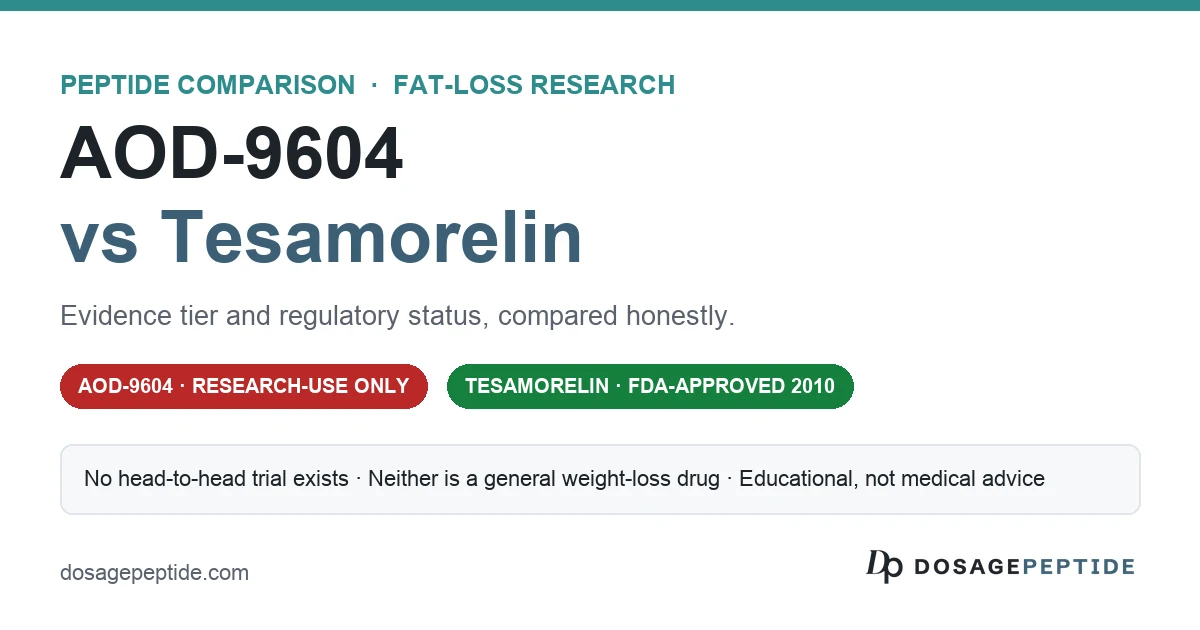
Line up AOD-9604 and tesamorelin as “fat-loss peptides” and it looks like a matchup between two comparable compounds. It is not. One of them — tesamorelin — carries two large placebo-controlled Phase 3 human trials and a 2010 U.S. Food and Drug Administration (FDA) approval behind its name.[1][3] The other — AOD-9604 — reached Phase 2 for obesity, failed to beat placebo, was abandoned as a weight-loss candidate in 2007, and has never been approved anywhere.[6][8] Treating them as interchangeable is the single most common error in this comparison, and the honest version of the story starts by naming that gap.
This reference article separates what is actually established in the peer-reviewed literature from what is merely claimed in supplier copy. It is written as educational material for people trying to read the science accurately — not as guidance for human use, and not as a recommendation to take anything. The two molecules are not even mechanistically equivalent: tesamorelin works upstream, as an analog of growth-hormone-releasing hormone (GHRH) that prompts the body to make its own growth hormone (GH);[3] AOD-9604 is a fragment of GH itself, claimed to act directly on fat cells without raising GH or IGF-1 at all.[5] And crucially, no head-to-head trial of AOD-9604 versus tesamorelin has ever been run, so any direct “A beats B” comparison is an inference across unrelated studies, not a measured result.
One framing to hold onto throughout: neither compound is an approved general or cosmetic weight-loss drug. Tesamorelin’s approval is narrow — reduction of excess visceral fat in HIV-associated lipodystrophy — and AOD-9604 has no approval at all.[3][8] Nothing below is medical advice.
Why does a matchup between such unequally evidenced compounds get written about at all? Partly because both are marketed to overlapping audiences in the peptide space, and partly because their shared connection to growth hormone makes them sound like variations on one theme. They are not. The value of comparing them is not to crown a winner — the evidence does not support ranking them on effect size — but to make the differences legible: different position on the hormonal axis, different route, different regulatory status, and, above all, different strength of proof. Read that way, the comparison is genuinely useful, and it is the version this article commits to.
AOD-9604 vs Tesamorelin: What Each Molecule Actually Is
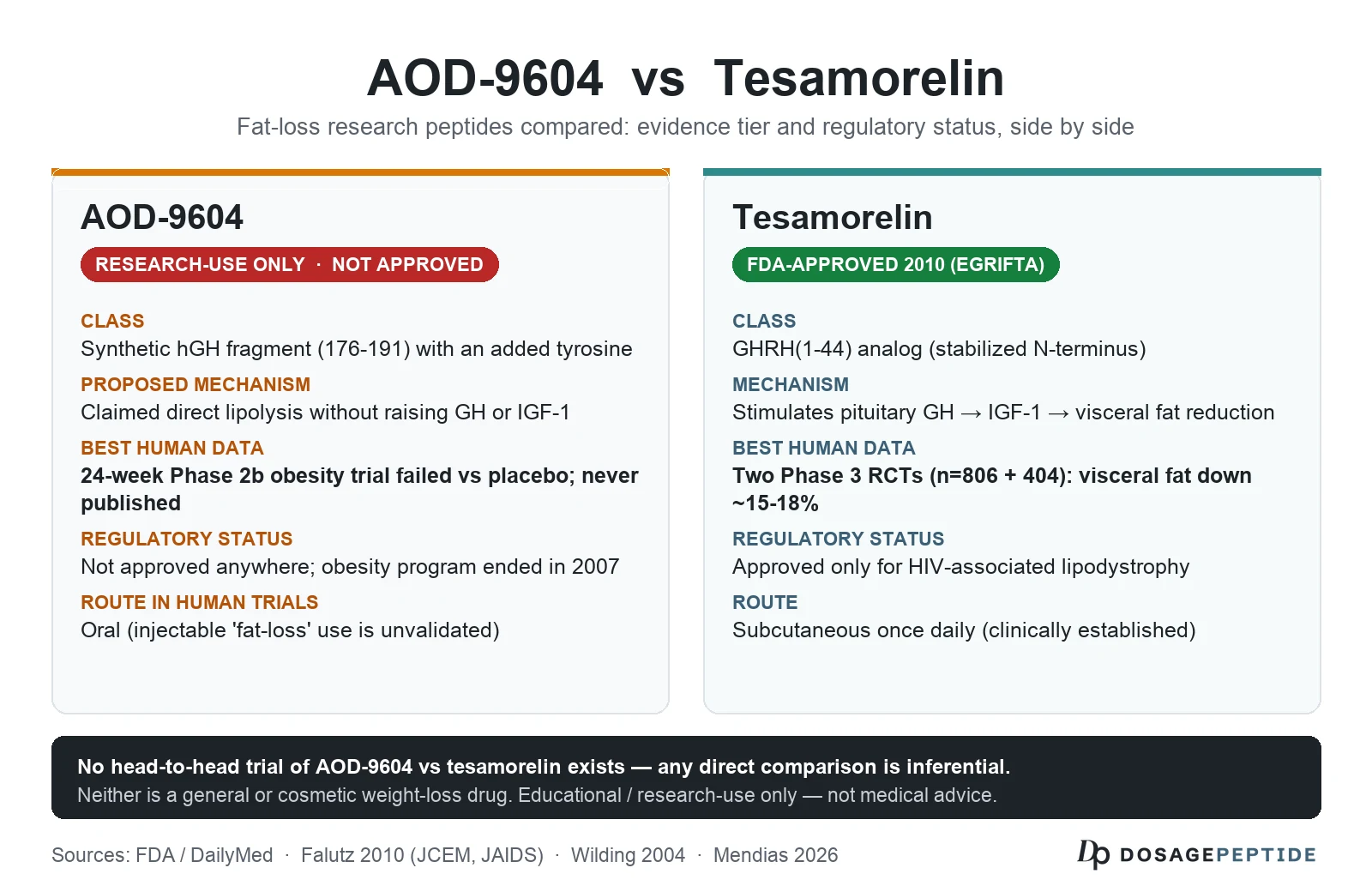
Tesamorelin is a synthetic analog of human GHRH — specifically the biologically active GHRH(1–44) sequence — modified with a trans-3-hexenoic acid group at the N-terminus to slow its breakdown. It is, in plain terms, a signal to the pituitary gland: it tells the pituitary to synthesize and release the body’s own growth hormone, which in turn raises insulin-like growth factor-1 (IGF-1) and drives a reduction in visceral (deep abdominal) fat.[3] It was the first — and, at approval, the only — treatment indicated for reducing excess abdominal fat in patients with HIV-associated lipodystrophy.[3]
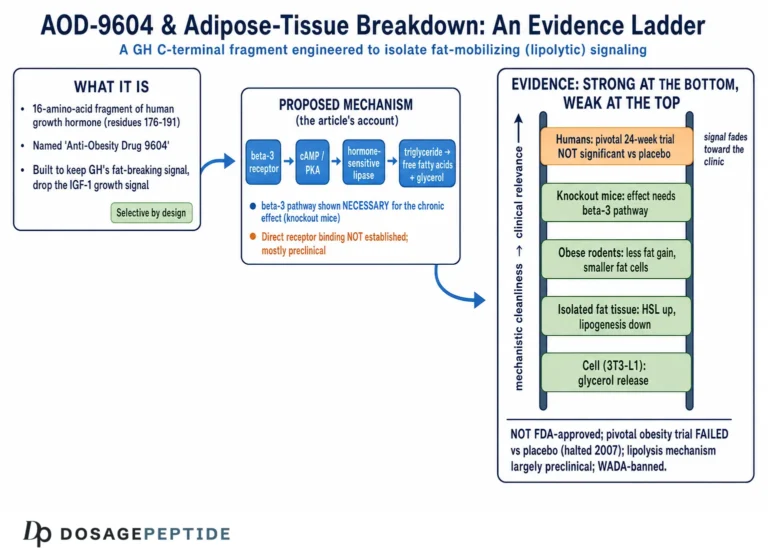
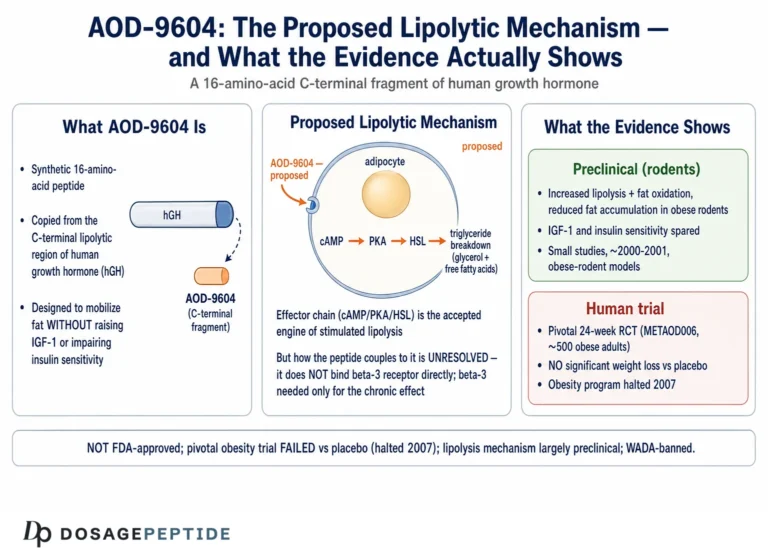
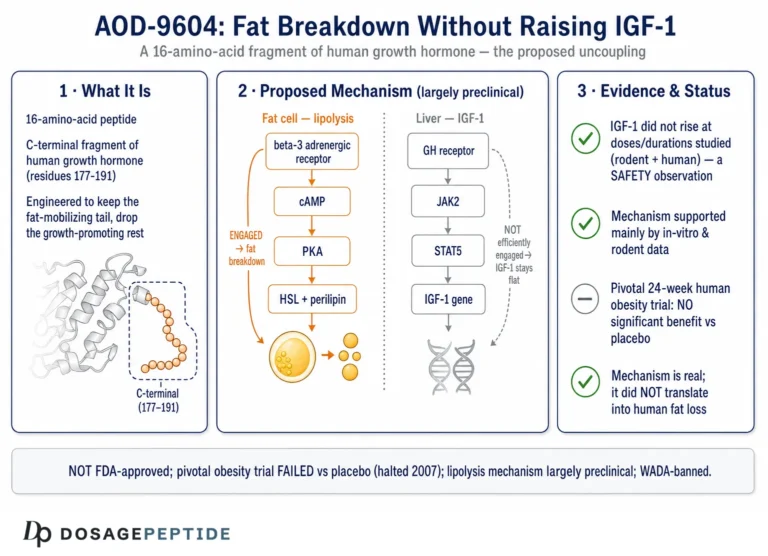
AOD-9604 is a different kind of molecule entirely. It is a synthetic peptide corresponding to the C-terminal fragment of human growth hormone (residues 176–191) with an extra tyrosine added at the N-terminus. It was engineered on the hypothesis that this tail region of GH carries the hormone’s fat-metabolizing (“lipolytic”) activity while leaving behind the parts of GH that raise blood sugar or IGF-1.[5] In other words, the marketing shorthand — “the fat-burning piece of growth hormone” — is a fair description of the design intent. Whether the molecule delivers on that intent in humans is the entire question, and the answer from the clinical record is unflattering.
The quick-reference table below frames the matchup by attribute. Read the “Human clinical evidence” and “Regulatory status” rows first — they carry most of the weight.
| Attribute | AOD-9604 (research-market compound) | Tesamorelin (FDA-approved drug) |
|---|---|---|
| Molecular class | C-terminal fragment of human GH (hGH 176–191) plus an N-terminal tyrosine | Analog of GHRH(1–44), stabilized with a trans-3-hexenoic acid moiety |
| Where it acts | Claimed to act directly on fat cells (lipolysis), without raising GH or IGF-1[5] | Acts upstream on the pituitary; raises the body’s own GH and IGF-1[3] |
| Original research goal | General obesity / fat loss | Reduction of excess visceral fat in HIV-associated lipodystrophy |
| Human clinical evidence | Weak / negative: reached Phase 2, a 24-week obesity trial did not beat placebo; the pivotal result was never published[6][8] | Strong: two multicenter, double-blind, placebo-controlled Phase 3 RCTs (pooled n=806; separate n=404)[1][2] |
| Regulatory status | Not approved anywhere as a weight-loss drug; obesity development ended in 2007[8] | FDA-approved in 2010 (Egrifta; reformulated as Egrifta SV), HIV-lipodystrophy only[3][4] |
| Route studied in humans | Oral (the injectable “fat-loss” use sold today has no clinical basis) | Subcutaneous injection, once daily[4] |
| Sport status | Prohibited (WADA) | Prohibited (WADA) |
How Do the Two Mechanisms Differ?
The mechanistic distinction is not a footnote — it is the reason the two cannot be treated as substitutes. They sit at opposite ends of the growth-hormone axis.
Tesamorelin: an upstream GHRH signal
Tesamorelin mimics GHRH, the hypothalamic hormone that normally instructs the pituitary to release GH in pulses. By providing a stabilized GHRH signal, tesamorelin increases the body’s own pulsatile GH secretion, which raises circulating IGF-1 and, downstream of that, reduces visceral adipose tissue.[3] Because the effect is carried by a genuine, physiological GH/IGF-1 pulse, tesamorelin’s own plasma half-life is almost irrelevant to how it works: the FDA label reports an elimination half-life of roughly 8–11 minutes after subcutaneous dosing, with absolute bioavailability under 4%.[4] The peptide clears in minutes; the biological consequence — a GH surge — outlasts it. Raising IGF-1 is also the source of tesamorelin’s characteristic side-effect profile, discussed below.
AOD-9604: a downstream fragment claimed to bypass the GH axis
AOD-9604 was designed to do the opposite of engaging the whole axis. As the C-terminal fragment of GH, it was proposed to reproduce GH’s lipolytic action directly at the fat cell — stimulating the breakdown of stored fat and inhibiting its formation — while specifically not raising circulating GH or IGF-1 and not disturbing glucose.[5] That “fat-selective without the GH baggage” concept is exactly what made it attractive as an anti-obesity candidate in the early 2000s.[6] The important honesty caveat is that much of the direct-lipolysis rationale rests on animal and in-vitro work; the human obesity program did not confirm a clinically meaningful weight-loss benefit.
The structural and pharmacological contrast is summarized below.
| Structural / PK feature | AOD-9604 | Tesamorelin |
|---|---|---|
| Parent molecule | Human growth hormone (a fragment of it) | Growth-hormone-releasing hormone (an analog of it) |
| Position on the GH axis | Downstream (GH fragment acting on tissue) | Upstream (drives pituitary GH release) |
| Effect on circulating GH / IGF-1 | Claimed to leave GH and IGF-1 unchanged[5] | Deliberately raises GH, and therefore IGF-1[1] |
| What carries the effect | The fragment itself (proposed direct fat-cell action) | The downstream GH/IGF-1 pulse, not sustained peptide levels[4] |
| Plasma half-life | Short (minutes); rapidly cleared, with a low-oral-bioavailability development problem | ~8–11 min after SC dosing; bioavailability <4%[4] |
Why Visceral Fat, and Why Does the GH Axis Move It?
To understand why tesamorelin’s effect is real but narrow, it helps to be precise about what fat it moves. Body fat is not one tissue. Subcutaneous adipose tissue (SAT) sits just under the skin; visceral adipose tissue (VAT) is the deep fat packed around the abdominal organs. VAT is the metabolically “noisier” depot — it is the fat most associated with unfavorable lipid profiles and metabolic risk — and it is also the depot most responsive to the growth-hormone axis. That distinction is exactly why tesamorelin’s pivotal trials measured VAT by CT scan rather than simply weighing patients: in the pooled Phase 3 analysis, tesamorelin reduced visceral fat while leaving subcutaneous abdominal fat essentially unchanged.[1] A drug that selectively trims the deep, organ-surrounding depot is a very different thing from a drug that lowers the number on a bathroom scale, and conflating the two is one of the ways this comparison gets distorted.
Growth hormone is lipolytic — it promotes the breakdown of stored triglyceride — and it preferentially mobilizes visceral fat. Tesamorelin exploits that established physiology indirectly: by restoring a more youthful, pulsatile GHRH signal to the pituitary, it nudges the body’s own GH secretion upward, and the downstream GH/IGF-1 activity does the metabolic work.[3] Because the signal is pulsatile and physiological rather than a flat, supraphysiological flood of exogenous GH, the approach was designed to capture GH’s fat-mobilizing benefit while limiting some of the liabilities of giving whole growth hormone. That is the mechanistic logic behind a GHRH analog, and it is why the molecule’s own vanishingly short half-life is beside the point.
AOD-9604’s design tried to reach the same lipolytic endpoint from the opposite direction — skip the hormonal cascade entirely and act on the fat cell directly, so that GH and IGF-1 never rise.[5] On paper that is elegant: all of the fat-burning, none of the growth-signaling. The problem is that elegance on paper is a hypothesis, not a result, and the human obesity data did not confirm the hypothesis. The mechanistic story remains a plausible rationale supported chiefly by preclinical work — which is a legitimate reason to keep studying a molecule, but not a reason to describe it as an effective fat-loss agent.
How the Field Got Here: Two Very Different Development Stories
The reason these molecules occupy such different tiers of evidence is historical, and the histories are worth telling because they explain why one has an approval and the other does not.
AOD-9604 emerged from growth-hormone-fragment research and entered clinical development as an anti-obesity candidate. By early 2002 it had reached Phase IIa testing.[5] A 2006 review of the anti-obesity pipeline still listed AOD-9604 as a growth-hormone fragment that increases the breakdown of adipose tissue — but tellingly noted that, of the drugs then in development, only rimonabant had progressed as far as completing Phase III.[6] AOD-9604 had not. According to development summaries and the company’s own disclosures, a subsequent 24-week Phase 2b obesity study enrolling on the order of 500–540 participants failed to separate from placebo on weight loss, obesity development was terminated in 2007, and an earlier, shorter study’s modest signal did not hold up. That pivotal Phase 2b result was never published in a peer-reviewed journal — a detail that matters, because it means the compound’s most important human data point exists in reviews and corporate communications rather than the primary literature. A later narrative review in Sports Medicine (2026) places AOD-9604 squarely in the “unapproved, gray-market” category with scarce human data.[8]
Notably, AOD-9604 did not vanish — it was repurposed. The same molecule was later advanced (under a different development code) into early-stage study for osteoarthritis and musculoskeletal pain rather than weight loss, and the joint-focused preclinical work is animal-based: for example, an intra-articular study in a rabbit osteoarthritis model reported cartilage effects.[7] The takeaway from that pivot is easy to miss but important: the obesity claim was not vindicated and quietly continued — it was set aside, and the molecule was pointed at a different problem.
It is worth pausing on why “never published” is such a damning detail rather than a bookkeeping footnote. When a positive result is withheld, that is a problem for science; when a negative pivotal result is withheld, the practical effect is that the compound’s failure never enters the searchable literature, so later marketing can keep gesturing at the early, favorable-sounding preclinical rationale as though the human question were still open. It is not open — the human obesity trial was run and it did not deliver — but because that trial lives in reviews and disclosures rather than a primary paper, a casual reader can be left with the impression that AOD-9604 is “promising but understudied” when the more accurate description is “studied and unsuccessful for its original purpose.”[8]
Tesamorelin’s history runs the other way. It was tested in two large, multicenter, double-blind, placebo-controlled Phase 3 trials in HIV patients with excess abdominal fat, completed the regulatory process, and was approved by the FDA in 2010 as Egrifta — later reformulated as Egrifta SV.[3][4] That is the difference between the two stories in one sentence: one program produced a confirmatory, published, regulator-reviewed evidence base; the other produced a negative Phase 2 result that never reached print.
The Regulatory Reality: FDA and WADA, Plainly
Stated without hedging: tesamorelin is FDA-approved; AOD-9604 is not. But the approval’s scope is just as important as its existence. Tesamorelin’s approval covers one indication — reduction of excess visceral abdominal fat in adults with HIV-associated lipodystrophy.[3][4] It is not approved for general obesity, cosmetic fat loss, bodybuilding, or “anti-aging.” A drug being approved for a narrow, well-defined population is not a licence to extrapolate it to everyone who wants to lose weight.
AOD-9604, by contrast, has no marketing approval as a weight-loss drug in any jurisdiction; its obesity indication was rejected/abandoned, and today it circulates only as a research chemical.[8] The ChEMBL database records it at a maximum development phase of 2 (never approved), whereas tesamorelin sits at maximum phase 4 (approved).
“Research chemical” is not a euphemism for “almost-approved.” It means a substance sold for laboratory use that has not been manufactured, tested, or labeled to the standards required of a medicine. For AOD-9604 specifically, that status carries two practical consequences: the identity and purity of any given vial are unverified, and there is no regulator-reviewed label defining a dose, a contraindication, or a warning.[8] The clinical trial data that do exist were generated on a defined study drug; they say nothing about what is inside a product bought on the gray market. This is a central reason the compound’s framing on this site — and throughout this article — is strictly research-use-only.
On the sport side, the picture is symmetric: both AOD-9604 and tesamorelin are prohibited by the World Anti-Doping Agency (WADA), and their presence in a competing athlete’s sample is an anti-doping rule violation regardless of the compound’s approval status. Approval for a medical indication and permission in sport are separate questions, and here they point the same way for both peptides.
AOD-9604: What the Human Evidence Actually Shows
This is the section where honesty does the most work, because the gap between what is claimed about AOD-9604 and what is shown is wide.
What is reasonably established: AOD-9604 is a GH C-terminal fragment; it was developed as an anti-obesity agent; it advanced to Phase 2; and its proposed mechanism — direct lipolysis without raising GH/IGF-1 — is coherent and is the reason it drew interest.[5][6] It was also generally well tolerated in trials, with no reported IGF-1 elevation and no adverse glucose changes — a genuinely favorable tolerability signal, though tolerability is not the same as efficacy.
What is not established: that it produces meaningful fat loss in humans. The decisive human study — a 24-week Phase 2b obesity trial — did not beat placebo, the obesity program was ended, and that result was never peer-reviewed and published.[8] The remaining support for a fat-loss role is largely animal and in-vitro. And the joint/cartilage direction the molecule was later pushed toward is likewise preclinical — the rabbit osteoarthritis study is an animal model, and it examined a joint injection, not weight loss.[7] In evidence-tier language: AOD-9604’s fat-loss story is a failed/absent human efficacy signal resting on preclinical rationale. That is a legitimate reason to study it further; it is not a basis to describe it as a working fat-loss compound.
A practical consequence of “never approved” is that any AOD-9604 sold today is a research chemical of unverified identity and purity, and any circulating “fat-loss dosing” for it is unvalidated. Educational protocol references such as the AOD-9604 5 mg reconstitution and handling reference and the AOD-9604 2 mg vial reference exist to describe how the material is handled in laboratory research settings — not to endorse human use.
Tesamorelin: What the Human Evidence Actually Shows
Tesamorelin’s evidence base is the mirror image: real, positive, and confirmatory, within a defined population.
The pooled analysis of the two Phase 3 trials (n=806 randomized 2:1 to tesamorelin 2 mg subcutaneously daily or placebo) reported a significant reduction in visceral adipose tissue (VAT) at week 26 — a treatment effect of roughly −15% versus placebo — while sparing subcutaneous fat, alongside improvements in triglycerides and body image; IGF-1 rose, and there were no clinically meaningful changes in glucose parameters at weeks 26 and 52.[1] A separate Phase 3 trial (n=404) found VAT fell about 11% at six months versus essentially no change on placebo, and about 18% in patients who continued tesamorelin for twelve months.[2] Together these are the numbers behind the commonly cited “~15–18% visceral-fat reduction.”
Two honest qualifiers belong next to those figures. First, the effect is conditional on continued dosing: when patients switched from tesamorelin to placebo, the visceral fat they had lost re-accumulated relatively quickly.[2][3] Second, the outcome measured was a body-composition surrogate (VAT on CT imaging) in a specific clinical population — HIV patients with lipodystrophy — not a general-obesity weight-loss endpoint and not a hard cardiovascular outcome. The data are strong for what they measured; they do not automatically generalize to cosmetic fat loss in an otherwise healthy person. Handling references such as the tesamorelin 5 mg vial reference, the tesamorelin 10 mg reference, and the tesamorelin 20 mg reference describe reconstitution and laboratory handling only; the genuine clinical regimen is a prescription decision made by a clinician, not a research protocol.
Head-to-Head vs. Cross-Trial: Why There Is No Fair Comparison
Here is the single most important methodological point in this article, and it deserves its own heading: AOD-9604 and tesamorelin have never been compared in the same trial. There is no randomized head-to-head study, no shared control group, no common endpoint, and no common population. Every “which is better for fat loss” claim you will read is therefore a cross-trial inference — taking a number from one study and setting it beside a number from a completely different study, run in a different population, with a different endpoint, by a different route.
Cross-trial comparisons are fragile even when both sides have good data. In this case the two sides are not even the same category of evidence: tesamorelin’s figures come from published Phase 3 RCTs in HIV-lipodystrophy patients measuring CT-quantified visceral fat;[1][2] AOD-9604’s figures come from an unpublished Phase 2b obesity trial that failed, plus preclinical work.[8] Put bluntly: you cannot fairly “compare” a confirmed positive with an unconfirmed negative and declare a winner on effect size. The honest comparison is about evidence tier, not about which percentage is larger.
| Comparison being attempted | What data actually exist | Evidence strength | Honest verdict |
|---|---|---|---|
| AOD-9604 vs tesamorelin, directly | No shared trial, no common endpoint or population | None (no direct data) | Not established; any ranking is inference, not measurement |
| Tesamorelin for visceral fat | Two Phase 3 RCTs (n=806; n=404), CT-measured VAT[1][2] | Strong (direct, confirmatory) | Real effect — but only in HIV-associated lipodystrophy |
| AOD-9604 for weight loss | Failed 24-week Phase 2b (unpublished) + animal/in-vitro[8] | Weak / negative | Not demonstrated in humans |
| AOD-9604 for joints/cartilage | Animal model (rabbit osteoarthritis, intra-articular)[7] | Animal only | Preclinical; not a human fat-loss claim at all |
Reading the Numbers Honestly
When a supplier page or forum thread frames this as “tesamorelin gives ~15–18%, AOD-9604 gives X%,” it is quietly committing several errors at once. It treats an unpublished/negative number as if it were an established one; it compares a visceral-fat surrogate in HIV patients against a general weight-loss figure as if they measured the same thing; and it ignores the route mismatch (oral in AOD-9604’s human trials versus subcutaneous for tesamorelin). Below is the same information re-expressed as an evidence-tier ledger — the format that actually answers “how much should I trust this?”
| Reported role | Strongest evidence tier that exists | Honest interpretation |
|---|---|---|
| Tesamorelin → reduces visceral fat | Phase 3 human RCTs, FDA-approved[1][4] | Established — but only for HIV-associated lipodystrophy, and only while dosing continues |
| Tesamorelin → general/cosmetic weight loss | No approval; not the population studied | Not established for that use |
| AOD-9604 → fat loss / weight loss | Failed Phase 2b (unpublished); preclinical rationale[8] | Not demonstrated in humans |
| AOD-9604 → “raises no GH/IGF-1, so it’s safe” | Favorable short-term tolerability in trials; long-term human safety unstudied | Well-tolerated ≠ proven safe long-term or effective |
| AOD-9604 → joint/cartilage repair | Animal model only[7] | Preclinical; unrelated to the fat-loss question |
Safety and Tolerability: What Is and Isn’t Known
Safety is one area where AOD-9604 arguably looks “cleaner” on the short-term trial data — but that impression is easy to over-read, because a compound that failed to show efficacy was never studied at the scale or duration of an approved drug. Tesamorelin, precisely because it works through the GH/IGF-1 axis, carries a defined and monitored side-effect profile.
| Safety dimension | AOD-9604 | Tesamorelin |
|---|---|---|
| Effect on IGF-1 | No reported IGF-1 elevation in trials | Raises IGF-1 by design (expected on-target effect)[1] |
| Glucose / metabolic | No adverse glucose changes reported in trials | Potential for glucose intolerance/hyperglycemia via the GH axis; glucose is monitored[4] |
| Common adverse events | Generally well tolerated in the trials that were run (short-term) | Injection-site reactions, arthralgia (joint pain), headache, peripheral edema[3] |
| Serious adverse events | Not well characterized (limited, short trials) | Occurred in <4% over 26 weeks in the pivotal program[3] |
| Key contraindications | None formally defined (no approval, no label) | Pregnancy, active malignancy, disruption of the hypothalamic-pituitary axis[4] |
| Product-quality risk | High — unregulated research-chemical supply of unverified identity/purity | Low for the approved product; a prescription drug with a defined label[4] |
The honest read of this table is not “AOD-9604 is safer.” It is: tesamorelin has a known risk profile because it was studied rigorously and is monitored in clinical use, while AOD-9604’s apparent cleanliness reflects short trials plus an absence of the long-term data that only an approval-scale program generates. Neither of those statements supports self-experimentation.
Beyond Visceral Fat: Tesamorelin’s Cardiometabolic Signals
A fair comparison should also acknowledge what tesamorelin’s trials found beyond the headline visceral-fat number, because the secondary endpoints are part of why the drug was approvable — and because they come with their own honesty caveats. In the pooled Phase 3 analysis, alongside the ~15% visceral-fat reduction at week 26, tesamorelin produced statistically significant improvements in triglycerides (a treatment effect of roughly −12% versus placebo) and in the total-cholesterol-to-HDL ratio, and it improved patient- and physician-rated measures of body image; IGF-1 rose substantially, as expected for a GH-axis drug.[1] The separate Phase 3 trial similarly reported improvements in trunk fat, waist circumference, and waist-to-hip ratio, with no change in limb or abdominal subcutaneous fat and no adverse shift in glucose parameters.[2]
Those are genuinely favorable metabolic signals — but they are surrogate endpoints (lipids, body composition, imaging), not hard outcomes. The trials did not demonstrate that tesamorelin reduces heart attacks, strokes, or death; a lipid or visceral-fat improvement is a reasonable hope for such benefits, not proof of them. This is a recurring theme in metabolic medicine: a drug can move a surrogate convincingly and still leave the hard-outcome question open. The honest summary is that tesamorelin has strong evidence for improving a cluster of metabolic surrogates in its approved population, and no evidence — for or against — on long-term cardiovascular events.
By contrast, there is no comparable body of secondary-endpoint data for AOD-9604 in humans, because the program that would have generated it was stopped after the primary weight-loss endpoint failed.[8] You cannot compare cardiometabolic effects between the two when only one has them measured. This asymmetry — rich secondary data on one side, essentially none on the other — is the entire comparison in miniature.
Research-Use Dosing Conventions (Labeled)
This section describes dosing conventions for context only. It is not a protocol to follow, and nothing here is a recommendation for human use.
Tesamorelin (clinical regimen, prescription drug): the established clinical dose is 2 mg subcutaneously once daily for the original Egrifta, with the Egrifta SV reformulation dosed at 1.4 mg subcutaneously once daily.[4] This is a physician-directed regimen for a defined indication, not a research convention.
AOD-9604 (research-use only, no validated regimen): there is no approved or clinically validated dosing schedule. Critically, the actual human trials used an oral formulation in the milligram range — whereas the subcutaneous “fat-loss” dosing circulated online has no clinical basis whatsoever.[8] The route mismatch alone should make anyone skeptical of copy-pasted injection protocols. Any figures encountered are properly treated as unvalidated laboratory-handling parameters, not doses.
Because reconstituting a lyophilized peptide accurately is itself a common source of error, the mechanics of that math are covered in the peptide reconstitution guide, and the arithmetic can be worked through with the peptide dosage calculator. Those tools are for research-setting accuracy; they are not an endorsement of administering either compound to a person.
Which Is Studied for What?
If the question is simply “what has each molecule actually been studied for, and with what result,” the answer is clean:
- Tesamorelin is studied for — and approved for — the reduction of excess visceral abdominal fat in HIV-associated lipodystrophy, backed by two Phase 3 RCTs.[1][2] Outside that indication, it is investigational/off-label at best.
- AOD-9604 was studied for general obesity/fat loss and did not succeed in humans;[8] it was subsequently redirected toward joint/musculoskeletal research, where the supporting data are animal-based.[7]
So for a reader specifically interested in fat loss: tesamorelin is the one with genuine human evidence and an approval (narrowly scoped), and AOD-9604 is a research-use-only compound whose human fat-loss efficacy was not demonstrated. Framing them as two equivalent options is the mistake this whole article is written to prevent.
What the Evidence Does NOT Show
To keep the honesty explicit, here is what the current record does not support:
- It does not show that AOD-9604 produces meaningful weight loss in humans — the pivotal human trial failed and was never published.[8]
- It does not show that tesamorelin is a general or cosmetic weight-loss drug — its approval and its trials are confined to HIV-associated lipodystrophy.[3]
- It does not show that one is superior to the other for fat loss — because no head-to-head trial exists, and the two evidence bases are not comparable in kind.
- It does not establish long-term human safety for AOD-9604, nor validate any injectable dosing for it.
- It does not demonstrate that tesamorelin’s visceral-fat effect reduces heart attacks, strokes, or mortality — the trials measured a body-composition surrogate, not hard cardiovascular outcomes.[1]
Practical and Research Context
For anyone reading the primary and secondary literature on these two peptides, a few practical cautions apply. First, product identity: material sold as “AOD-9604” on the research-chemical market is of unverified identity and purity, and trial data collected on a defined study drug do not transfer to an unverified vial. This is the standard research-chemical caveat, and it is not a technicality — it is the difference between what a paper tested and what is in the container. Terms used throughout this discussion — GHRH, IGF-1, visceral adipose tissue, lipolysis, Phase 2b versus Phase 3, surrogate endpoint — are defined in the site peptide research glossary for readers who want the precise meanings. Reference vials of both compounds are catalogued by research-grade peptide suppliers such as Prime Lab, where a batch certificate of analysis is the minimum a research setting should require; the figures on this page nonetheless describe published laboratory studies and historical clinical protocols only, not a protocol for use.
Second, framing: everything above is educational reference material about what has been studied and with what strength of evidence. It is explicitly not medical advice, not a protocol, and not a suggestion that any reader obtain or administer either compound. Tesamorelin is a prescription medicine whose use is a clinical decision; AOD-9604 is a research compound with no approved human use. The compliant reading of both is “laboratory research settings only.”
How to Read a Study That Says “AOD-9604” or “Tesamorelin”
A short checklist to evaluate any claim about either peptide:
- Identify the evidence tier. Is this a published Phase 3 RCT, a Phase 2 result, an animal study, an in-vitro assay, or a supplier’s marketing claim? These are not equal, and the tier caps how much a finding can support.
- Check whether it was published and peer-reviewed. AOD-9604’s pivotal obesity result was not — a decisive detail that a headline number hides.[8]
- Note the population. Tesamorelin’s numbers come from HIV-lipodystrophy patients, not general-obesity volunteers.[2]
- Note the endpoint. Visceral fat on a CT scan is a surrogate; it is not the same as total body-weight loss or a cardiovascular outcome.[1]
- Note the route. AOD-9604’s human data are oral; injectable claims are extrapolation.[8]
- Beware cross-trial arithmetic. If a “comparison” lifts a number from one study and sets it against a number from another, treat the ranking as inference, not evidence.
Common Misconceptions About AOD-9604 and Tesamorelin
“They’re both fat-loss peptides, so they’re basically interchangeable.”
They are not interchangeable in mechanism, evidence, route, or legal status. Tesamorelin is an FDA-approved GHRH analog with Phase 3 data; AOD-9604 is a research-use GH fragment whose human fat-loss efficacy was not shown.[3][8] The only thing they share is that both are prohibited in sport.
“AOD-9604 is the safe, GH-free version.”
Its trial tolerability was favorable and it did not raise IGF-1 or disturb glucose — but “well tolerated in short trials” is not “proven safe long-term,” and it is certainly not “effective.” A clean tolerability signal on a compound that failed its efficacy trial is not a selling point; it is an incomplete safety picture on a molecule that doesn’t do the advertised job.
“Tesamorelin is an FDA-approved weight-loss drug.”
It is FDA-approved, but for reducing excess visceral fat in HIV-associated lipodystrophy — not for general obesity or cosmetic weight loss.[3][4] The distinction is the whole point of the approval.
“There’s data showing AOD-9604 beats/loses to tesamorelin.”
There is not. No trial has ever compared them directly, so any such statement is a cross-trial guess dressed up as a result.
Key Takeaways
- Tesamorelin has real, published, confirmatory human evidence and an FDA approval — two Phase 3 RCTs showing roughly 15–18% visceral-fat reduction — but only for HIV-associated lipodystrophy.[1][2]
- AOD-9604 is research-use-only with failed/absent human efficacy: its 24-week Phase 2b obesity trial did not beat placebo, development ended in 2007, and the result was never published.[8]
- No head-to-head trial exists, so any “which wins” comparison is inference, not measurement.
- The mechanisms are opposite ends of the GH axis: tesamorelin raises the body’s own GH/IGF-1;[3] AOD-9604 is a GH fragment claimed to act directly on fat without doing so.[5]
- Route matters: AOD-9604’s human trials were oral; injectable “fat-loss” use is unvalidated. Tesamorelin’s 2 mg (or 1.4 mg SV) subcutaneous daily is a genuine clinical regimen.[4]
- Both are WADA-prohibited, and neither is an approved general weight-loss drug.
Frequently Asked Questions
Is AOD-9604 or tesamorelin better for fat loss?
There is no head-to-head trial, so no measured “better” exists. On evidence, tesamorelin is the only one with published human data and an FDA approval, and it reduced visceral fat by roughly 15–18% in two Phase 3 trials — but only in HIV-associated lipodystrophy.[1][2] AOD-9604’s human fat-loss efficacy was not demonstrated.[8]
Is AOD-9604 FDA-approved?
No. AOD-9604 is not approved anywhere as a weight-loss drug. Its obesity development reached Phase 2, failed to beat placebo, and was terminated in 2007; it is sold only as a research chemical.[8] Databases record it at a maximum development phase of 2 (never approved).
What is tesamorelin actually approved for?
Tesamorelin (Egrifta, reformulated as Egrifta SV) was FDA-approved in 2010 for the reduction of excess abdominal (visceral) fat in patients with HIV-associated lipodystrophy.[3][4] It is not approved for general obesity or cosmetic weight loss.
Do AOD-9604 and tesamorelin work the same way?
No. Tesamorelin is a GHRH analog that acts upstream, prompting the pituitary to release the body’s own growth hormone and raising IGF-1.[3] AOD-9604 is a fragment of growth hormone itself, claimed to act directly on fat cells without raising GH or IGF-1.[5] They sit at opposite ends of the same hormonal axis.
Why did AOD-9604 fail as a weight-loss drug?
Its 24-week Phase 2b obesity trial did not separate from placebo on weight loss, and an earlier, shorter study’s modest signal did not hold up. Development for obesity was ended in 2007, and the pivotal result was never published in a peer-reviewed journal, so most of its fat-loss rationale now rests on animal and in-vitro data.[8]
Does tesamorelin’s visceral-fat reduction last if you stop?
No — the effect depends on continued dosing. In the Phase 3 program, patients who switched from tesamorelin to placebo regained the visceral fat relatively quickly.[2][3]
Is AOD-9604 safer than tesamorelin because it doesn’t raise IGF-1?
In short trials AOD-9604 was well tolerated with no reported IGF-1 elevation and no adverse glucose changes, whereas tesamorelin raises IGF-1 by design and can cause injection-site reactions, arthralgia, and edema.[3] But favorable short-term tolerability is not the same as proven long-term safety, and AOD-9604’s unregulated supply adds an identity/purity risk that an approved drug does not carry.
What route and dose were actually used in the human studies?
Tesamorelin’s clinical regimen is subcutaneous injection, 2 mg once daily (Egrifta) or 1.4 mg once daily (Egrifta SV).[4] AOD-9604’s human obesity trials used an oral formulation; the subcutaneous “fat-loss” dosing sold today has no clinical validation.[8]
Are AOD-9604 and tesamorelin banned in sport?
Yes. Both are prohibited by the World Anti-Doping Agency, so their use by a competing athlete is an anti-doping rule violation regardless of either compound’s regulatory-approval status.
References
- Falutz J, Mamputu JC, Potvin D, et al. Effects of tesamorelin (TH9507), a growth hormone-releasing factor analog, in HIV-infected patients with excess abdominal fat: a pooled analysis of two multicenter, double-blind placebo-controlled phase 3 trials with safety extension data. J Clin Endocrinol Metab. 2010;95(9):4291-304. doi:10.1210/jc.2010-0490.
- Falutz J, Potvin D, Mamputu JC, et al. Effects of tesamorelin, a growth hormone-releasing factor, in HIV-infected patients with abdominal fat accumulation: a randomized placebo-controlled trial with a safety extension. J Acquir Immune Defic Syndr. 2010;53(3):311-22. doi:10.1097/QAI.0b013e3181cbdaff.
- Dhillon S. Spotlight on tesamorelin in HIV-associated lipodystrophy. BioDrugs. 2011;25(6):405-8. doi:10.2165/11208290-000000000-00000.
- EGRIFTA (tesamorelin acetate) prescribing information. DailyMed / U.S. FDA. FDA-approved 2010 for HIV-associated lipodystrophy.
- Wilding J. AOD-9604 Metabolic. Curr Opin Investig Drugs. 2004;5(4):436-40.
- Halford JCG. Obesity drugs in clinical development. Curr Opin Investig Drugs. 2006;7(4):312-8.
- Kwon DR, Park GY. Effect of intra-articular injection of AOD9604 with or without hyaluronic acid in rabbit osteoarthritis model. Ann Clin Lab Sci. 2015;45(4):426-32.
- Mendias CL, Awan TM. Safety and efficacy of approved and unapproved peptide therapies for musculoskeletal injuries and athletic performance. Sports Med. 2026. doi:10.1007/s40279-026-02437-0.
This article is educational reference material about peptide research and is not medical advice. AOD-9604 is a research-use-only compound with no approved human use; tesamorelin is a prescription medicine approved only for HIV-associated lipodystrophy. Nothing here recommends, endorses, or provides instructions for human use of either compound, and no dosing figure should be interpreted as a protocol. Discuss any medical decision with a qualified, licensed healthcare professional.