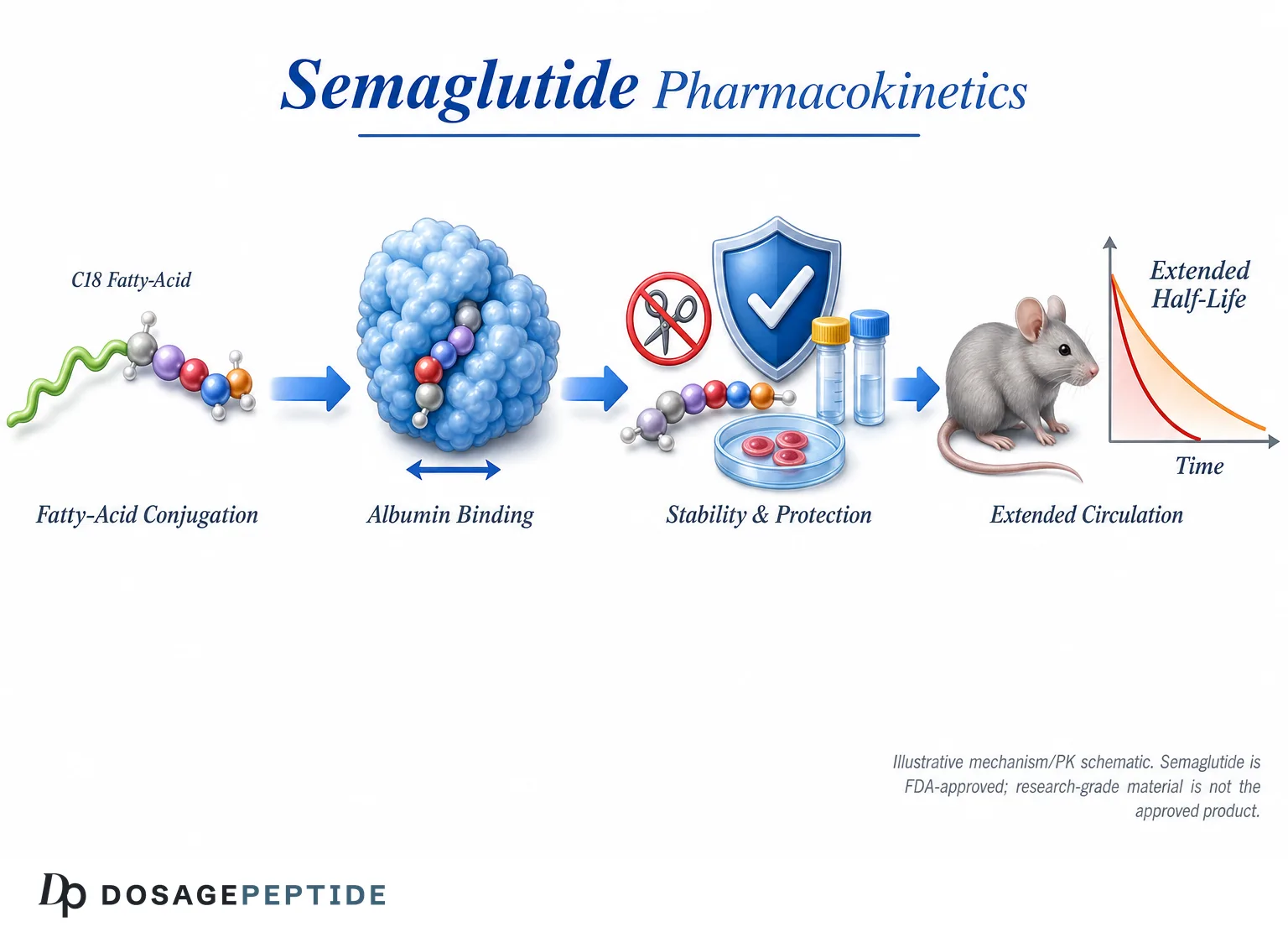
The pharmacology of semaglutide fatty acid conjugation, pharmacokinetics, and half-life is a case study in how a small chemical modification can transform a peptide with a two-minute lifespan into a once-weekly therapeutic. Native glucagon-like peptide-1 (GLP-1) is degraded almost instantly in circulation, yet semaglutide persists for roughly a week — a nearly five-thousand-fold extension driven chiefly by a C18 fatty diacid side chain that binds reversibly to serum albumin. This article examines, from the discovery and pharmacokinetic (PK) literature, exactly how that acylation chemistry shapes semaglutide’s absorption, distribution, metabolism, and elimination across the in-vitro, animal, and human models used to characterize it.
Semaglutide is FDA-approved and marketed as Ozempic and Rybelsus (type 2 diabetes) and Wegovy (chronic weight management). What follows is a mechanism-and-PK piece intended for educational and research context; it is not medical advice, and research-grade material supplied by peptide vendors is not the approved finished pharmaceutical product. Human dosing figures are presented to illustrate pharmacology, not to guide use. Readers looking for handling-oriented references can consult the practical companion pages, such as the Semaglutide 5 mg dosage protocol and how semaglutide activates GLP-1 receptors in metabolic research models.
Why does native GLP-1 need fatty-acid conjugation at all?
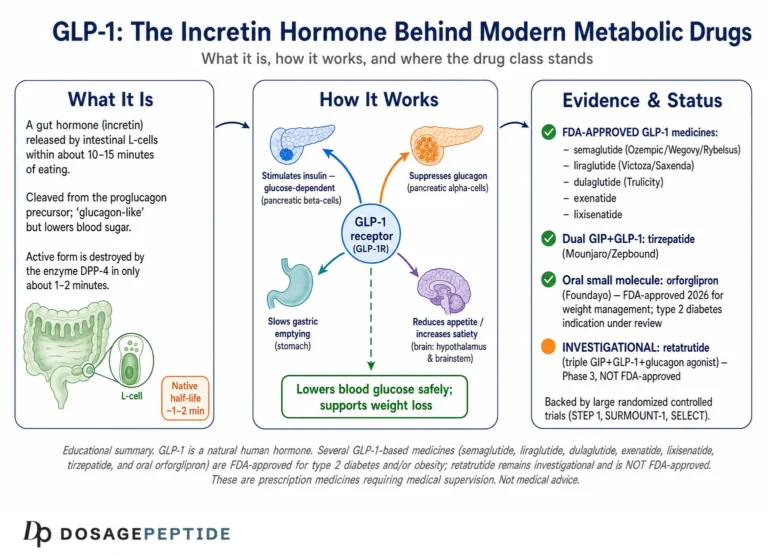
To understand why semaglutide is engineered the way it is, you first have to appreciate how fragile the parent molecule is. GLP-1 is an incretin hormone released from intestinal L-cells after a meal. In its active forms, GLP-1(7-37) and GLP-1(7-36)amide, it potentiates glucose-dependent insulin secretion, suppresses glucagon, slows gastric emptying, and reduces appetite through central and peripheral GLP-1 receptors (GLP-1R). Pharmacologically it is close to ideal — and almost useless as a drug in its native state, because it disappears from plasma faster than it can be dosed.
Two clearance mechanisms dominate. The first is enzymatic: dipeptidyl peptidase-4 (DPP-4) cleaves the peptide between His7 and Ala8, removing the N-terminal dipeptide and abolishing receptor activity. Because DPP-4 is abundant on endothelial surfaces and in plasma, this cleavage happens within minutes. The second is renal: at roughly 3.3 kDa the intact peptide is small enough to be filtered by the glomerulus and cleared by the kidney. The combined result is a plasma half-life on the order of one to two minutes for endogenous active GLP-1. A molecule that vanishes that quickly cannot be given as an injection more than a few times a day even by continuous infusion, which is impractical for a chronic metabolic condition.
The engineering problem, then, has three parts: block the DPP-4 cleavage, defeat rapid renal filtration, and do both without destroying the receptor pharmacology that makes GLP-1 valuable in the first place. Fatty-acid conjugation — the covalent attachment of a lipid side chain that binds circulating albumin — is the strategy Novo Nordisk used to solve the second problem, while a single amino-acid substitution solved the first. Semaglutide is the refined product of that program, building on lessons from its once-daily predecessor liraglutide.[2]
The albumin-binding principle
Human serum albumin is the most abundant protein in plasma, present at roughly 600 µM, with a long half-life of about three weeks because it is too large to be filtered by the kidney and is actively recycled by the neonatal Fc receptor. Albumin also carries a set of hydrophobic binding pockets that naturally transport fatty acids, bilirubin, and many drugs. If a peptide can be made to dock reversibly into those fatty-acid pockets, it effectively borrows albumin’s pharmacokinetic properties: while bound, the peptide is shielded from glomerular filtration and largely protected from proteases, and it is released slowly as free peptide to engage its receptor. This is the core of the acylation, or lipidation, strategy, and the fatty-acid side chain is the docking device that makes it work.
What does the molecular structure of semaglutide’s fatty-acid side chain look like?
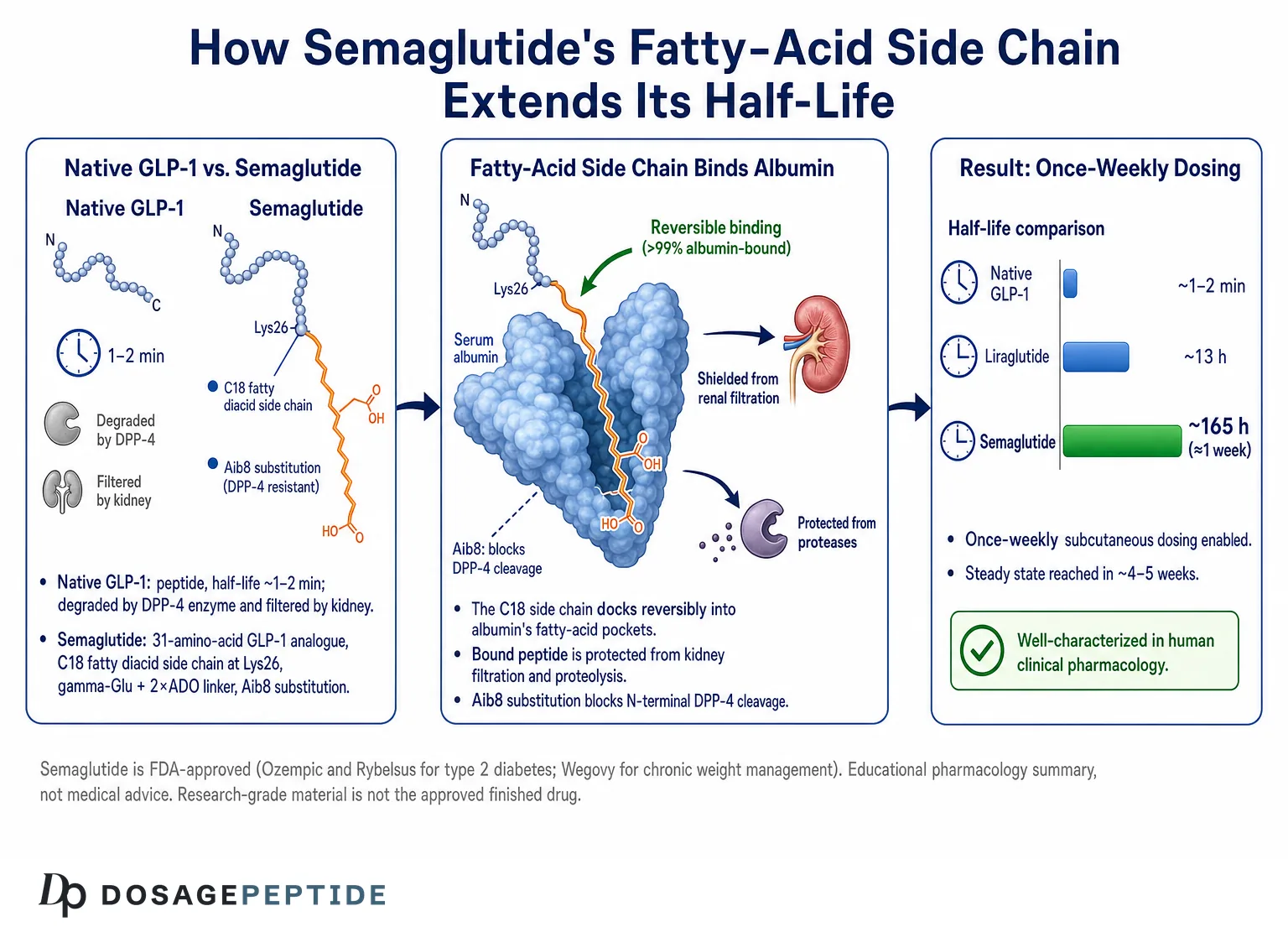
Semaglutide is a 31-amino-acid analogue of human GLP-1(7-37) with three deliberate modifications relative to the native sequence, each serving a distinct pharmacological purpose. Understanding the architecture is the key to understanding the pharmacokinetics, so it is worth taking the structure apart piece by piece.[1]
The three changes are:
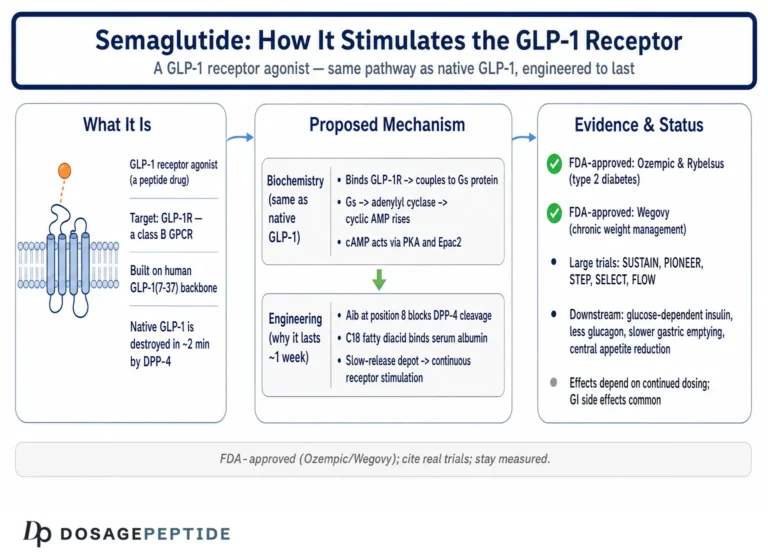
- Aib8 substitution. The alanine at position 8 — the exact residue DPP-4 cleaves — is replaced with 2-aminoisobutyric acid (Aib), a non-natural, α-methylated amino acid. The extra methyl group sterically blocks the protease from accessing the scissile bond, conferring DPP-4 resistance.
- Arg34 substitution. The lysine at position 34 is replaced with arginine. This removes a competing lysine so that the acylation chemistry attaches the fatty-acid side chain to a single defined position — Lys26 — rather than producing a mixture of isomers.
- Acylation at Lys26. The ε-amino group of Lys26 carries the engineered lipid side chain: a C18 fatty diacid (octadecanedioic acid, a stearic diacid) attached through a linker built from a γ-glutamic acid (γ-Glu) residue and two 8-amino-3,6-dioxaoctanoic acid (ADO, a short poly-ethylene-glycol-like) spacer units.
The composite side chain is often written as C18-diacid–γGlu–2×ADO–Lys26. Each element earns its place. The C18 diacid is the albumin anchor. Crucially it is a diacid, meaning it carries a free carboxylic acid at the distal end rather than a plain methyl terminus like liraglutide’s palmitoyl chain. That terminal negative charge tunes how deeply and how tightly the lipid inserts into albumin’s binding pocket, raising affinity. The γ-Glu residue provides an additional negative charge and a flexible connection point, and the two ADO spacers act as a hydrophilic tether that projects the fatty acid away from the peptide backbone, letting it reach into albumin without forcing the peptide to unfold or sacrifice receptor contacts.[1]
| Structural element | Chemistry | Primary pharmacological role |
|---|---|---|
| Position 8: Aib | 2-aminoisobutyric acid (α-methyl-alanine) | Blocks DPP-4 cleavage of the His7–Xaa8 bond; metabolic stabilization |
| Position 34: Arg | Lys34 → Arg | Eliminates competing lysine so acylation is site-specific at Lys26 |
| C18 diacid | Octadecanedioic (stearic) diacid, distal –COOH | Reversible high-affinity albumin binding; the main half-life driver |
| γ-Glu linker | γ-glutamic acid | Adds negative charge; tunes albumin affinity and orientation |
| 2 × ADO spacer | 8-amino-3,6-dioxaoctanoic acid (mini-PEG) | Hydrophilic tether projecting the lipid to albumin while preserving GLP-1R contacts |
| Peptide backbone | GLP-1(7-37) analogue, 31 residues | Retains the sequence that binds and activates the GLP-1 receptor |
One design tension is worth naming explicitly, because it recurs throughout the PK story. Making the lipid bind albumin more tightly extends the half-life but can also reduce the fraction of free peptide available to hit the receptor, and it modestly lowers intrinsic receptor affinity. In the discovery work, semaglutide’s GLP-1R affinity was measured at about 0.38 nM — roughly three-fold weaker than liraglutide — yet this was more than offset by dramatically higher and more sustained exposure, so the net pharmacodynamic effect over a dosing interval is greater.[1] The receptor-level consequences of this trade-off are explored further in the discussion of how semaglutide activates GLP-1 receptors in metabolic research models.
How does reversible albumin binding extend semaglutide’s half-life?
The single most important pharmacokinetic fact about semaglutide is that it circulates more than 99% bound to albumin. That binding is non-covalent and reversible — a rapid equilibrium in which the fatty-acid side chain docks into and releases from albumin’s lipid pockets many times over. The consequences of this equilibrium ripple through every PK parameter.
The depot and slow-release effect
Because the vast majority of the drug is bound at any instant, only a tiny free fraction is exposed to clearance mechanisms or receptor engagement at a given moment. Albumin therefore behaves as a large, mobile circulating reservoir. As free peptide is cleared or bound to receptors, more is released from albumin to restore equilibrium. This buffering flattens the concentration-time curve: it slows the apparent rate of decline, damps peak-to-trough swings, and produces the smooth, sustained exposure profile that makes once-weekly dosing feasible. The effect is analogous to a slow-release formulation, except the depot is molecular and travels in the bloodstream rather than sitting at the injection site.
Protection from renal filtration
Free semaglutide, at roughly 4.1 kDa, is in the size range where glomerular filtration matters. Bound to a 66.5 kDa albumin molecule, the complex is far too large to be filtered. Since only the small unbound fraction is available for filtration at any moment, renal elimination of intact peptide is minimized. This is a major reason semaglutide does not require dose adjustment in renal impairment and why the kidney is not a primary route of elimination for the intact molecule.
Steric protection from proteolysis
Sequestration inside albumin’s pockets also physically shields much of the peptide from circulating and endothelial proteases. This is complementary to, not a substitute for, the Aib8 substitution: Aib8 specifically defeats DPP-4 at the N-terminus, while albumin binding provides broader steric protection against neutral endopeptidase and other proteases that would otherwise nibble at the backbone. Together they explain why semaglutide’s metabolic clearance is slow and why its metabolism proceeds through a controlled, characterizable set of pathways rather than rapid nonspecific degradation.[3]
It is worth stressing that albumin binding is a means, not an end. The goal is prolonged exposure of active peptide; albumin is simply the vehicle. The reversibility is essential — an irreversibly bound peptide would never reach the receptor. The engineering achievement in semaglutide is finding the affinity that is high enough for a one-week half-life but loose enough that a functional free fraction is continuously regenerated.
How does the Aib8 substitution confer DPP-4 resistance?
Albumin binding solves renal and much of the proteolytic clearance, but it does not by itself stop DPP-4, which acts at the extreme N-terminus where the peptide must remain exposed to bind its receptor. DPP-4 is an exopeptidase that specifically removes N-terminal dipeptides when the second residue (position 8 in GLP-1 numbering) is an alanine or proline. In native GLP-1 that residue is Ala8, making it an ideal substrate.
Replacing Ala8 with 2-aminoisobutyric acid introduces a second methyl group on the α-carbon of that residue. This turns a normal chiral amino acid into a symmetric, sterically bulky one that no longer fits the DPP-4 active site geometry. The enzyme cannot productively bind and cleave the His7–Aib8 bond, so the intact, receptor-active N-terminus is preserved. Aib is a common tool in peptide medicinal chemistry precisely because it resists exopeptidase cleavage while minimally perturbing secondary structure. The same substitution appears in other stabilized GLP-1 and dual-agonist peptides for the same reason.
The division of labor is clean: Aib8 handles the site-specific enzymatic threat at the N-terminus, and the C18-diacid–albumin system handles renal filtration and general proteolysis. Neither modification alone would produce a once-weekly drug. Liraglutide, notably, does not carry an Aib substitution and relies more heavily on its fatty-acid binding and self-association for stability, which is part of why its half-life is around 13 hours rather than a week.[2]
How does semaglutide engage and signal through the GLP-1 receptor?
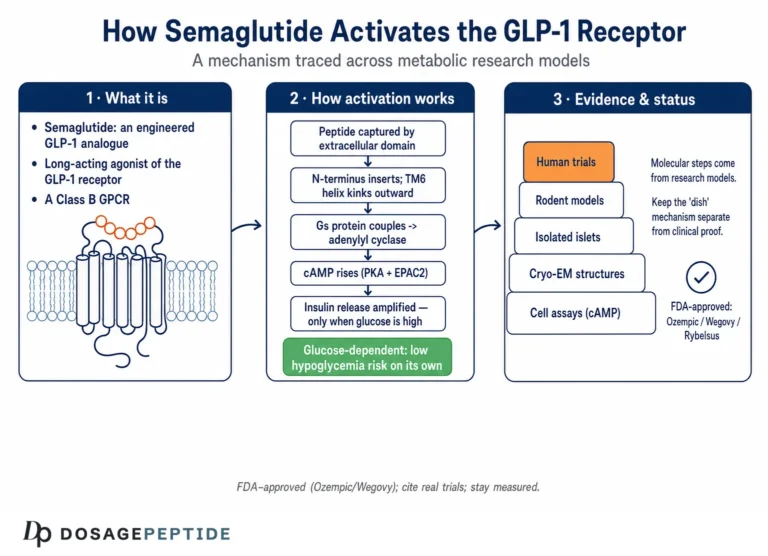
The pharmacokinetic story explains how much active peptide is present and for how long; the pharmacodynamic story is what that peptide does once a free molecule finds a receptor. Both matter, and the receptor biology is directly shaped by the same structural choices that govern the half-life. The GLP-1 receptor is a class B1 (secretin-family) G-protein-coupled receptor, a group characterized by a large extracellular domain (ECD) and a seven-transmembrane helical bundle. Peptide agonists engage it through a two-domain mechanism: the C-terminal half of the peptide is first captured by the ECD, which then positions the N-terminus so it can insert into the transmembrane core and trigger the conformational change that activates the receptor.[9]
This two-domain model is important for interpreting semaglutide’s design. The receptor reads the peptide backbone, particularly the exposed N-terminal residues around His7 and Aib8, while the bulky acyl side chain hangs off Lys26 in the middle of the sequence and projects outward rather than into the binding groove. That geometry is why the molecule can carry a large lipid decoration for albumin binding and still activate the receptor: the acylation site and the receptor-contact surfaces are largely separated. The measured ~0.38 nM affinity reflects a small penalty for the modifications, not an abolition of binding, and it is the residue-level reason the affinity-versus-half-life trade-off is manageable rather than fatal.[1]
Downstream signaling: Gs, cAMP, and insulin secretion
Once activated, the GLP-1 receptor couples predominantly to the stimulatory G protein Gαs. Gαs activates adenylyl cyclase, raising intracellular cyclic AMP (cAMP), which in turn engages both protein kinase A (PKA) and the guanine-nucleotide exchange factor Epac2. In the pancreatic β-cell this cascade amplifies glucose-stimulated insulin secretion in a glucose-dependent manner — the incretin effect — which is why GLP-1 agonism lowers glucose without the standalone hypoglycemia risk of insulin or sulfonylureas. The receptor is often described as functionally Gs-selective, meaning the cAMP arm dominates its physiology, although it can also recruit β-arrestin and engage other G proteins to a lesser degree.[9]
Internalization, β-arrestin, and the biased-agonism question
Beyond G-protein coupling, agonist binding can recruit β-arrestin, which both dampens signaling and drives receptor internalization — the cell pulling the receptor inside, where it is either recycled or degraded. Different agonists balance cAMP production against β-arrestin recruitment and internalization differently, a phenomenon called biased agonism. Cryo-electron microscopy has resolved the GLP-1 receptor bound to several ligands and shown that the conformation of the extracellular loop 3 (ECL3) and the TM6–TM7 region shifts with the agonist, and these conformational differences track with the degree of signaling bias. Whether an agonist that favors sustained cAMP signaling with reduced internalization is therapeutically advantageous is an active research question rather than a settled fact, and semaglutide’s exact position on that spectrum should be treated as a subject of ongoing structural pharmacology rather than a claimed selling point. What is well established is the core cascade: peptide → GLP-1R → Gs → cAMP → glucose-dependent insulin secretion, plus the central appetite-suppressing effects mediated by GLP-1 receptors in the brain.
What do experimental models reveal about semaglutide pharmacokinetics, by study type?
Honest evidence review means being clear about which claims rest on which kind of data. Semaglutide’s PK profile is unusually well characterized because it moved through a structured discovery program and then extensive clinical pharmacology. Here the evidence is organized by study type — in-vitro/biophysical, animal, and human — so the strength behind each parameter is transparent.
In-vitro and biophysical evidence
The foundational structure-activity work was done in binding and cell-based assays. Receptor affinity was measured by competition binding at the human GLP-1 receptor, giving the ~0.38 nM figure for semaglutide, and functional potency was assessed by cAMP accumulation in receptor-expressing cells. Albumin affinity was characterized biophysically during the optimization of the linker and fatty acid; the diacid plus dual-ADO spacer configuration was selected because it raised albumin binding relative to earlier candidates and to liraglutide’s C16 monoacid while maintaining acceptable receptor potency.[1] These experiments establish mechanism — that the side chain drives albumin binding and that binding trades off against intrinsic potency — but they cannot by themselves predict a human half-life. That requires animals and, ultimately, people.
Animal (nonclinical) evidence
The Göttingen mini-pig became the workhorse model for semaglutide PK because its albumin and physiology give translation to humans that is better than rodents for albumin-binding peptides. In mini-pigs, semaglutide showed a plasma half-life of about 46.1 hours after intravenous dosing and a mean residence time of roughly 63.6 hours after subcutaneous administration — already far longer than liraglutide in the same model, and the data that gave confidence a once-weekly human agent was achievable.[1] Rodent models (including diet-induced obese mice and rats) were used more for pharmacodynamics — food intake, body weight, glucose — than for predicting human half-life, since rodent clearance of albumin-bound peptides does not scale cleanly to humans. Nonclinical ADME studies in rats additionally traced distribution, metabolism, and excretion using labeled compound.[3]
Human evidence
Human pharmacokinetics is where the design target was confirmed. In people, subcutaneous semaglutide has a terminal half-life of approximately 165 hours — about one week — supporting once-weekly dosing. Absorption is slow, with peak plasma concentrations (tmax) reached around 1 to 3 days after a subcutaneous dose, and steady state is achieved after roughly 4 to 5 weeks of once-weekly administration. Exposure (AUC and Cmax) increases in proportion to dose across the therapeutic range, and inter-individual variability is relatively low for a peptide.[5] These human data are established, replicated across clinical pharmacology trials, and reflected in regulatory labeling — a genuinely clinical evidence level, in contrast to many research peptides where only animal or in-vitro data exist.
| Study type | Model / method | What it established | Evidence strength |
|---|---|---|---|
| In-vitro | GLP-1R competition binding, cAMP functional assay, albumin-affinity biophysics | Receptor affinity ~0.38 nM; side chain drives albumin binding; affinity-vs-potency trade-off | Mechanistic, not predictive of human PK |
| Animal | Göttingen mini-pig IV/SC PK; rodent ADME and PD | t½ ~46 h IV, MRT ~64 h SC in mini-pig; distribution and metabolite pathways | Strong translational bridge for albumin binders |
| Human | Clinical pharmacology trials; population PK modeling | t½ ~165 h; tmax 1–3 days SC; steady state 4–5 weeks; dose-proportional exposure | Established clinical (approved product) |
What are the key pharmacokinetic parameters of semaglutide?
Pulling the human numbers together gives a coherent picture of a slowly absorbed, highly protein-bound, slowly cleared peptide with a small volume of distribution — all hallmarks of successful albumin-binding design. A small volume of distribution is expected precisely because the drug is largely confined to the plasma and interstitial space by its albumin partner rather than distributing widely into tissues.
| Parameter | Approximate value (subcutaneous) | Interpretation |
|---|---|---|
| Terminal half-life (t½) | ~165 hours (~1 week) | Enables once-weekly dosing; driven by albumin binding |
| Time to peak (tmax) | ~1–3 days | Slow subcutaneous absorption; smooths peak exposure |
| Time to steady state | ~4–5 weeks | Long t½ means gradual accumulation; rationale for titration |
| Plasma protein (albumin) binding | >99% | Central mechanism for protection from clearance |
| Volume of distribution | ~12.5 L | Small; confined largely to plasma/interstitial space |
| Clearance | ~0.05 L/h | Low; slow proteolysis plus β-oxidation |
| Bioavailability (SC) | ~89% | High for a subcutaneous peptide |
| Bioavailability (oral, with SNAC) | ~1% (highly variable) | Requires absorption enhancer; fasting/water-dependent |
The long half-life is the reason clinical use begins at a low dose and escalates slowly. Because concentrations take about a month to plateau and gastrointestinal tolerability tracks exposure, gradual up-titration lets the body adapt as levels rise. That pharmacokinetic logic is the same one underlying the semaglutide dosage titration protocol, and it is worth appreciating that the titration schedule is a direct downstream consequence of the fatty-acid–driven half-life rather than an arbitrary convention.
The oral formulation twist
The same albumin-binding, protease-resistant molecule is also the active ingredient in oral semaglutide (Rybelsus), which is co-formulated with the absorption enhancer sodium N-(8-[2-hydroxybenzoyl]amino)caprylate (SNAC). SNAC transiently raises local gastric pH and promotes monomeric absorption across the gastric epithelium in a narrow window near the tablet. Even so, oral bioavailability is only around 1% and is sensitive to fasting state and the volume of water taken with the tablet, which is why the oral and injectable products are dosed on completely different milligram scales.[4] The fatty-acid engineering that produces the one-week half-life is shared across routes; the absorption problem is what differs, and it is solved formulation-side rather than through the peptide.
What does dose and exposure-response tell us about semaglutide?
Because exposure rises in proportion to dose and the half-life is long, semaglutide’s different approved products occupy very different milligram ranges even though they share one molecule. Laying out the label doses side by side makes the PK logic concrete: the injectable products are dosed in fractions of a milligram per week and titrated over weeks, while the oral product is dosed in whole milligrams per day to compensate for its ~1% bioavailability. The table below summarizes the approved dose ranges purely to illustrate this pharmacology; it is not a recommendation for use, and research-grade material is not any of these products.
| Product | Route / frequency | Approved indication | Approximate dose range |
|---|---|---|---|
| Ozempic | Subcutaneous, once weekly | Type 2 diabetes | 0.25 mg start → 0.5, 1.0, up to 2.0 mg |
| Wegovy | Subcutaneous, once weekly | Chronic weight management | 0.25 → 0.5 → 1.0 → 1.7 → 2.4 mg (titrated) |
| Rybelsus | Oral tablet, once daily | Type 2 diabetes | 3 mg start → 7 mg → 14 mg |
The staged escalation in every column is the pharmacokinetics showing through. Each dose step is held for about four weeks — roughly the time to approach steady state at the new level — before moving up, so that concentrations climb in controlled increments rather than jumping. Exposure-response analyses in the clinical pharmacology literature consistently find that greater exposure is associated with greater reductions in glycated hemoglobin (HbA1c) and body weight, which is the rationale for higher maintenance doses when a larger effect is sought, and also for capping the dose where the incremental benefit no longer justifies the exposure-related gastrointestinal burden.[5]
One nuance from population PK work deserves emphasis because it is genuinely a dose-response consideration: body weight is an inverse covariate on exposure. Heavier individuals tend to reach lower plasma concentrations at a given dose, which is one physiological reason weight-management dosing (Wegovy, up to 2.4 mg) reaches higher than the original diabetes dosing.[5] The precise weighting of that covariate and whether it should individualize dosing remains an area of study rather than a closed question.
How does semaglutide compare to liraglutide and native GLP-1?
The clearest way to see what the C18 diacid and Aib8 accomplish is to line semaglutide up against native GLP-1 and against liraglutide, the earlier once-daily acylated analogue from the same research lineage. All three share the GLP-1 pharmacophore; they differ in the stabilization chemistry, and those differences map directly onto their half-lives.[2]
| Feature | Native GLP-1 | Liraglutide | Semaglutide |
|---|---|---|---|
| Position 8 residue | Ala8 (DPP-4 substrate) | Ala8 (unmodified) | Aib8 (DPP-4 resistant) |
| Fatty acid | None | C16 monoacid (palmitoyl) | C18 diacid (stearic diacid) |
| Linker | None | Single γ-Glu | γ-Glu + 2 × ADO spacer |
| Distal charge on lipid | — | Neutral methyl terminus | Free carboxyl (higher albumin affinity) |
| Albumin binding | Negligible | >98% | >99% |
| Approx. half-life | 1–2 minutes | ~13 hours | ~165 hours (~1 week) |
| Dosing frequency | Not druggable as-is | Once daily | Once weekly |
The comparison highlights how incremental chemistry produced a step change in duration. Liraglutide’s C16 monoacid gives strong-but-not-maximal albumin binding and relies partly on reversible self-association at the injection site to slow absorption, yielding a roughly half-day half-life. Semaglutide’s longer C18 chain, the diacid’s extra terminal carboxyl, the hydrophilic ADO spacers, and the added metabolic protection from Aib8 combine to push albumin affinity higher and clearance lower, extending the half-life by more than an order of magnitude. The lesson from the discovery literature is that half-life in this class is exquisitely sensitive to the exact fatty-acid length, the number and nature of linker units, and the charge chemistry at the lipid terminus.[1]
How does semaglutide compare to tirzepatide and newer long-acting incretins?
The same albumin-binding playbook that produced semaglutide has been carried forward into newer once-weekly incretins, and the most prominent is tirzepatide (marketed as Mounjaro and Zepbound). Comparing the two is instructive because it shows that the fatty-acid strategy is now a platform, not a one-off, while the specifics still differ in ways that matter pharmacologically.
Tirzepatide is a single peptide that activates two receptors — it is a dual agonist of the glucose-dependent insulinotropic polypeptide (GIP) receptor and the GLP-1 receptor, whereas semaglutide is a selective GLP-1 receptor agonist. On the pharmacokinetic side, tirzepatide uses the same lipidation principle: it carries a C20 fatty diacid side chain that binds albumin, giving it a half-life of about five days and enabling once-weekly subcutaneous dosing, with steady state reached after roughly four weeks — the same qualitative pattern seen with semaglutide.[8] The slightly longer C20 chain versus semaglutide’s C18 is a reminder of how sensitive this class is to the exact lipid length, though the two half-lives land in the same once-weekly range.
| Feature | Semaglutide | Tirzepatide |
|---|---|---|
| Receptor target | GLP-1R (selective) | GIP-R + GLP-1R (dual agonist) |
| Half-life driver | C18 fatty diacid + albumin binding | C20 fatty diacid + albumin binding |
| Approx. half-life | ~165 hours (~7 days) | ~5 days |
| Dosing frequency | Once weekly (SC) or once daily (oral) | Once weekly (SC) |
| Time to steady state | ~4–5 weeks | ~4 weeks |
The takeaway is not that one molecule is uniformly superior but that the pharmacokinetic architecture has converged: attach a long fatty diacid through a spacer, borrow albumin’s longevity, and add exopeptidase-resistant residues to the backbone. What is being actively diversified now is the receptor pharmacology — adding GIP activity, exploring glucagon co-agonism, and tuning signaling bias — rather than the half-life strategy, which the semaglutide program essentially standardized for the field. It is worth being precise that head-to-head clinical superiority claims are a separate, evidence-heavy topic beyond this mechanism-focused article; the point here is strictly about how the two share, and slightly vary, the same lipidation-driven pharmacokinetics.
How is semaglutide metabolized and eliminated?
Because semaglutide is protected from both DPP-4 and rapid renal filtration, its elimination proceeds through a slower, more defined set of catabolic pathways that were mapped in human and nonclinical ADME studies using radiolabeled compound. Two complementary processes dominate.[3]
- Proteolytic cleavage of the peptide backbone. Over time, endogenous proteases gradually cleave the peptide into smaller fragments and amino acids. Because albumin binding shields much of the molecule, this proceeds slowly rather than in the near-instant fashion that dispatches native GLP-1.
- Sequential β-oxidation of the fatty-acid side chain. The C18 diacid is metabolized through the same β-oxidation machinery the body uses for endogenous fatty acids, trimming the lipid chain two carbons at a time. Degrading the fatty acid is significant because it removes the albumin anchor, so once the side chain is shortened the fragment loses its protection and is cleared more readily.
Both intact-peptide and fragment species are detectable in plasma, and the metabolites are excreted in urine and feces. Importantly, semaglutide is not a substrate for cytochrome P450 enzymes and does not meaningfully rely on CYP-mediated metabolism, which is one reason it carries a low potential for pharmacokinetic drug–drug interactions with CYP substrates, inhibitors, or inducers — a genuinely favorable property for patients on multiple medications.[3] Consistent with this metabolic profile and its albumin-driven distribution, clinical pharmacology studies have found that hepatic and renal impairment do not require dose adjustment, and formal hepatic-impairment PK work supports that conclusion.[6]
What research and experimental models are used to study semaglutide PK?
The methods behind the numbers matter for interpreting them. Semaglutide’s pharmacokinetics were built up from a layered set of models, each answering a different question, and knowing what each can and cannot show is part of reading the evidence honestly.
Receptor and cell-based assays
Human GLP-1 receptor binding was quantified by radioligand or fluorescence competition assays, and functional activation by cAMP accumulation in cells expressing the receptor. These assays fixed the intrinsic potency of each candidate and made the affinity-versus-half-life trade-off measurable during optimization.
Albumin-binding biophysics
Techniques such as equilibrium dialysis and surface- or solution-phase binding measurements characterized how tightly each side-chain variant associated with albumin. This is the assay layer that directly links a chemical change — chain length, spacer count, terminal charge — to the albumin affinity that ultimately governs half-life.
Nonclinical PK species
The Göttingen mini-pig was the primary PK species because its albumin handling translates reasonably to humans; IV dosing gave clearance and volume of distribution, and SC dosing gave absorption and mean residence time. Rats and mice supported ADME (with labeled compound to trace metabolites and excretion) and pharmacodynamic readouts in diet-induced obesity models. No single animal predicts the human half-life exactly, which is why the mini-pig data were treated as a bridge rather than a final answer.[1]
Human clinical pharmacology and population PK
In people, dedicated pharmacology trials measured absorption, dose-proportionality, food and formulation effects (especially for the oral product), and special-population behavior (renal, hepatic, elderly). Population pharmacokinetic modeling then integrated data across trials to describe absorption, distribution, and elimination and to identify covariates such as body weight that influence exposure. These modeling analyses are the source of the tidy human parameter estimates quoted above and of the observation that variability is modest for a peptide.[4][5]
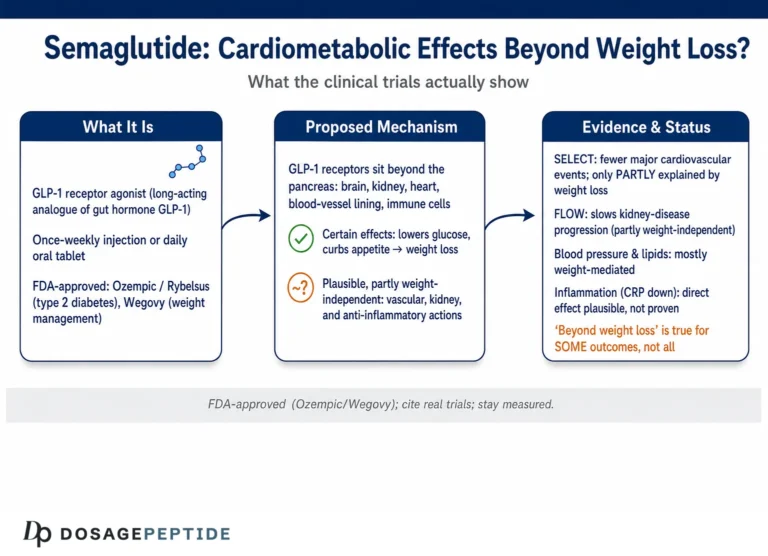
For readers building working vocabulary around terms like MRT, AUC, β-oxidation, and acylation, the peptide glossary defines these in plain language, and the broader clinical significance of the pharmacology is covered in the discussion of semaglutide cardiometabolic benefits beyond weight loss.
How do formulation, self-association, and injection-site behavior shape absorption?
The half-life describes what happens once the drug is in the systemic circulation, but a once-weekly profile also depends on how the peptide behaves at the injection site and in the vial. Several of semaglutide’s physicochemical properties, all traceable to the same amphipathic structure, govern this absorption phase and its formulation.
Semaglutide is amphipathic: a hydrophilic peptide carrying a long lipophilic diacid tail. Molecules of this kind tend to self-associate, forming reversible oligomers whose lipid tails cluster together away from water. At the subcutaneous injection site this self-association contributes to slow, sustained release — the depot dissolves and disperses into monomers gradually rather than flooding the circulation at once, which is part of why the time to peak concentration is on the order of one to three days rather than minutes. The engineered stability of the backbone also matters: unlike native GLP-1 and, to a degree, unlike earlier analogues, the stabilized sequence resists the pathological aggregation (amyloid-like fibrillation) that can plague peptide formulations, which supports a shelf-stable liquid product.
Why handling reflects the chemistry
The commercial injectable products are supplied as buffered aqueous solutions with a phenolic preservative and an isotonicity agent, formulated near neutral-to-slightly-basic pH where the peptide is most soluble and stable. The choice of pH is not incidental: the γ-Glu residue and the diacid’s free carboxyl carry pH-dependent charges, so solubility, the degree of self-association, and albumin affinity all shift with the surrounding acidity, and the formulation is tuned to keep the peptide in its most soluble, least aggregation-prone state throughout shelf life. This is also why the oral tablet, which must survive the acidic stomach, relies on the SNAC excipient to create a transient local micro-environment favorable to absorption rather than simply dissolving the peptide as-is. Research-grade material, by contrast, is usually shipped as a lyophilized (freeze-dried) powder that must be reconstituted before use. The practical consequences follow directly from the molecule’s surface activity and its susceptibility to hydrolysis and oxidation: diluent should be added gently rather than injected forcefully, the vial should be swirled rather than shaken to avoid foaming and denaturation, reconstituted material is kept cold and shielded from light, and repeated freeze–thaw cycling is avoided. None of this is arbitrary lab etiquette — each precaution maps onto a specific vulnerability of an amphipathic, protease-sensitive peptide.
What does fatty-acid conjugation mean for reconstitution and research handling?
The same molecular features that shape the pharmacokinetics also have practical implications for how research-grade semaglutide is handled, and it is useful to connect the chemistry to the bench. Semaglutide is typically supplied as a lyophilized (freeze-dried) powder that must be reconstituted, usually with bacteriostatic or sterile water, before it is used in a research setting.
A few chemistry-driven points follow directly from the structure. The amphipathic character of the molecule — a hydrophilic peptide bearing a long lipophilic tail — means the compound can be surface-active, so it should be dissolved by adding diluent gently down the vial wall and swirling rather than shaking vigorously, which can denature peptide and generate foam. The peptide backbone is susceptible to hydrolysis and oxidation over time, so reconstituted material is generally kept refrigerated and protected from light, and freeze-thaw cycling is avoided. Because the milligram scale differs so much between injectable and oral products, and because research vials are labeled by peptide mass rather than by dose, careful concentration math is essential; general handling procedure is described in the peptide reconstitution guide, and concentration and volume calculations can be worked through with the dosage calculator.
It bears repeating that reconstitution and handling notes here are educational context for research material and do not constitute instructions for human use. Research-grade vendor peptide is not the sterile, quality-controlled, approved finished product (Ozempic, Wegovy, or Rybelsus), and the two should never be conflated. Vial-specific handling context for common presentations is collected on pages such as the Semaglutide 10 mg dosage protocol.
What safety signals appear in the pharmacokinetic and research literature?
Although this is a mechanism-and-PK article rather than a clinical safety review, several PK-adjacent observations are worth noting because they follow from the pharmacology. The slow accumulation to steady state over four to five weeks is directly tied to the dominant tolerability issue in the class: gastrointestinal effects such as nausea, vomiting, and diarrhea, which are exposure-related and generally most prominent when concentrations are rising. This is precisely why exposure is built up gradually rather than started at a target level, and it is a clean illustration of pharmacokinetics informing a dosing strategy.
The long half-life also means that effects — therapeutic and adverse — persist for weeks after the last dose, because it takes roughly five half-lives (on the order of a month) for the drug to substantially wash out. Regulatory labeling for the class carries a boxed warning regarding thyroid C-cell tumors observed in rodents, the human relevance of which remains uncertain; that signal derives from rodent carcinogenicity studies, not from the PK program, and is included here only to be complete about where different safety data come from. From a drug-interaction standpoint, the pharmacokinetics are reassuring: minimal CYP involvement and high albumin binding without clinically meaningful displacement interactions give semaglutide a low PK interaction potential, though its slowing of gastric emptying can affect the absorption timing of co-administered oral drugs.[7]
What are the limitations and open questions?
A fair account of the evidence should be explicit about what is well established and what is not. The molecular pharmacology of semaglutide’s fatty-acid conjugation, its albumin-binding mechanism, and its human pharmacokinetics are strongly supported, replicated, and reflected in regulatory documentation. Several areas, however, remain more nuanced or less settled.
- Body weight and exposure. Population PK work indicates that body weight influences semaglutide exposure, with heavier individuals tending to have lower concentrations at a given dose, but the precise clinical importance of this relationship and whether it should inform dosing is not fully resolved and continues to be studied.[5]
- Oral absorption variability. The ~1% oral bioavailability with SNAC is highly variable and sensitive to fasting state and water volume. The precise cell-biology of SNAC-mediated uptake and the sources of variability are still incompletely characterized.[4]
- Free-fraction dynamics at the receptor. Exactly how the reversible albumin equilibrium translates into the effective free concentration available to tissue GLP-1 receptors — especially in the central nervous system regions relevant to appetite — is understood in principle but hard to measure directly in humans.
- Signaling bias. How semaglutide’s pattern of cAMP signaling versus β-arrestin recruitment and receptor internalization compares with native GLP-1 and other analogues, and whether any such differences carry therapeutic weight, is an open structural-pharmacology question rather than an established property.
- Research-grade material. Much informal discussion of semaglutide draws on research-grade product whose purity, actual peptide content, and endotoxin status are not guaranteed. Pharmacokinetic parameters derived from the approved product cannot be assumed to hold for uncharacterized material.
None of these caveats undercut the central, well-supported conclusion: the C18 fatty diacid side chain, working through reversible albumin binding and complemented by the Aib8 substitution’s DPP-4 resistance, is what converts a peptide with a one-to-two-minute half-life into a once-weekly agent with a roughly one-week half-life. That is established discovery-and-PK pharmacology, and it is the reason semaglutide can be dosed the way it is.[1]
Frequently Asked Questions
What is the half-life of semaglutide and what causes it?
Semaglutide has a plasma half-life of approximately 165 hours — about one week — in humans, which is what enables once-weekly subcutaneous dosing. The extended half-life is driven mainly by its C18 fatty diacid side chain, which binds reversibly and more than 99% to serum albumin. Albumin binding shields the peptide from kidney filtration and from proteases, so it is cleared slowly rather than in the one-to-two minutes that native GLP-1 lasts.
How does the fatty-acid side chain extend semaglutide’s duration of action?
The C18 diacid docks into albumin’s fatty-acid binding pockets, so the peptide travels through the bloodstream attached to a large, long-lived carrier protein. While bound, it cannot be filtered by the kidney and is largely protected from enzymatic breakdown. The binding is reversible, so a small free fraction is continuously released to activate GLP-1 receptors. This slow-release, protected-reservoir behavior is the core mechanism behind the once-weekly profile.
Why is 2-aminoisobutyric acid (Aib8) in semaglutide?
DPP-4, the enzyme that inactivates native GLP-1, cleaves the peptide at the alanine in position 8. Semaglutide replaces that alanine with 2-aminoisobutyric acid (Aib), whose extra methyl group sterically blocks DPP-4 from cutting. This makes the molecule resistant to the enzymatic degradation that destroys native GLP-1 within minutes. Aib8 handles the enzyme threat, while the fatty-acid–albumin binding handles slow renal and proteolytic clearance; both are needed for the long half-life.
How does semaglutide differ from liraglutide chemically?
Both are acylated GLP-1 analogues, but semaglutide uses a longer C18 fatty diacid with a free terminal carboxyl and a γ-Glu plus two ADO spacer linker, whereas liraglutide uses a shorter C16 monoacid on a single γ-Glu linker. Semaglutide also carries the Aib8 substitution for DPP-4 resistance, which liraglutide lacks. These differences give semaglutide higher albumin affinity and a roughly one-week half-life versus liraglutide’s ~13 hours, so semaglutide is dosed weekly and liraglutide daily.
Is semaglutide metabolized by the liver’s CYP enzymes?
No. Semaglutide is eliminated through proteolytic cleavage of its peptide backbone and sequential β-oxidation of its fatty-acid side chain, with metabolites excreted in urine and feces. It is not a substrate for cytochrome P450 enzymes, so CYP-mediated metabolism does not contribute meaningfully to its clearance. This gives it a low potential for pharmacokinetic drug–drug interactions, although its slowing of gastric emptying can affect the absorption timing of some co-administered oral medications.
Why does semaglutide take weeks to reach steady state?
Because the half-life is about a week, a drug given once weekly accumulates gradually, reaching steady-state concentrations only after roughly four to five weeks of dosing. This is a direct consequence of the fatty-acid–driven long half-life. It is also why clinical dosing is titrated upward slowly: gastrointestinal side effects track exposure, so building up levels gradually gives the body time to adapt as concentrations approach the plateau.
What animal models were used to study semaglutide pharmacokinetics?
The Göttingen mini-pig was the primary pharmacokinetic species because its albumin biology translates reasonably to humans; it showed a half-life of about 46 hours after IV dosing. Rodents (rats and diet-induced obese mice) were used more for ADME tracing and pharmacodynamic endpoints than for predicting human half-life. Human clinical pharmacology trials and population PK modeling then confirmed the ~165-hour half-life and the full parameter set in people.
How does semaglutide signal once it binds the GLP-1 receptor?
The GLP-1 receptor is a class B G-protein-coupled receptor. When semaglutide binds, the receptor couples mainly to the Gαs protein, which activates adenylyl cyclase and raises intracellular cyclic AMP (cAMP). Elevated cAMP engages PKA and Epac2, amplifying glucose-dependent insulin secretion from pancreatic β-cells, while GLP-1 receptors in the brain mediate appetite suppression. The bulky fatty-acid side chain sits on Lys26 in the middle of the peptide and projects away from the receptor-contact surfaces, which is why the molecule can carry a large albumin-binding tail and still activate the receptor.
How does semaglutide compare to tirzepatide pharmacokinetically?
Both use the same albumin-binding strategy: tirzepatide carries a C20 fatty diacid (versus semaglutide’s C18), binds albumin, and has a half-life of about five days, supporting once-weekly dosing much like semaglutide’s ~7 days. The main difference is receptor pharmacology, not PK: tirzepatide is a dual GIP and GLP-1 receptor agonist, whereas semaglutide is a selective GLP-1 receptor agonist. In other words, the lipidation-driven half-life approach is shared, while the receptor targeting differs.
Does research-grade semaglutide have the same pharmacokinetics as the approved drug?
The published pharmacokinetic parameters come from the FDA-approved products (Ozempic, Wegovy, Rybelsus), which are manufactured to defined purity and quality standards. Research-grade vendor material is not the approved finished product, and its actual peptide content, purity, and stability are not guaranteed. Parameters such as the one-week half-life should not be assumed to hold for uncharacterized material, and research peptide is not intended for human use.
References
- Lau J, Bloch P, Schäffer L, et al. Discovery of the Once-Weekly Glucagon-Like Peptide-1 (GLP-1) Analogue Semaglutide. J Med Chem. 2015;58(18):7370–7380. PMID 26308095. https://pubmed.ncbi.nlm.nih.gov/26308095/
- Knudsen LB, Lau J. The Discovery and Development of Liraglutide and Semaglutide. Front Endocrinol (Lausanne). 2019;10:155. https://www.frontiersin.org/journals/endocrinology/articles/10.3389/fendo.2019.00155/full
- Jensen L, Kupcova V, Arold G, et al. Absorption, metabolism and excretion of the GLP-1 analogue semaglutide in humans and nonclinical species. Eur J Pharm Sci. 2017;104:31–41. https://www.sciencedirect.com/science/article/pii/S0928098717301537
- Overgaard RV, Navarria A, Ingwersen SH, et al. Clinical Pharmacokinetics of Oral Semaglutide: Analyses of Data from Clinical Pharmacology Trials. Clin Pharmacokinet. 2021. https://pmc.ncbi.nlm.nih.gov/articles/PMC8505367/
- Clinical Pharmacokinetics of Semaglutide: A Systematic Review. Drug Des Devel Ther. 2024;18. PMID 38952487. https://pubmed.ncbi.nlm.nih.gov/38952487/
- Bækdal TA, Thomsen M, Kupčová V, et al. Pharmacokinetics, Safety, and Tolerability of Oral Semaglutide in Subjects With Hepatic Impairment. J Clin Pharmacol. 2018. https://accp1.onlinelibrary.wiley.com/doi/10.1002/jcph.1131
- Semaglutide. StatPearls. NCBI Bookshelf, NBK603723. https://www.ncbi.nlm.nih.gov/books/NBK603723/
- Tirzepatide: A Novel, Once-weekly Dual GIP and GLP-1 Receptor Agonist for the Treatment of Type 2 Diabetes. touchREVIEWS in Endocrinology. PMC9354517. https://pmc.ncbi.nlm.nih.gov/articles/PMC9354517/
- Zhang Y, Sun B, Feng D, et al. Cryo-EM structure of the activated GLP-1 receptor in complex with a G protein. Nature. 2017;546:248–253. PMID 28538729. https://www.ncbi.nlm.nih.gov/pmc/articles/PMC5587415/