- It is not a peptide. It is a small molecule — a quinolinium salt, about 159 g/mol — that inhibits the enzyme NNMT.
- No published human clinical trials. The entire evidence base is cultured cells and mice.
- No FDA approval for any indication, so there is no approved dose and no label.
- Every weight-loss figure you will see quoted is a rodent figure. None of it has been reproduced in humans.
- Identity and purity are a live problem for a compound sold as a research chemical, which is a separate risk from the molecule itself.
5-Amino-1MQ is a small-molecule inhibitor of the enzyme nicotinamide N-methyltransferase (NNMT), studied in cell culture and in rodents as a way to shift fat-tissue energy metabolism. Despite being sold and discussed alongside research peptides, it is not a peptide — it is a quinolinium salt whose active cation has a molecular weight of about 159 g/mol. As of this writing there are no published human clinical trials of 5-Amino-1MQ, it holds no FDA approval for any indication, and the entire evidence base is preclinical: cultured cells and mice.
Is 5-Amino-1MQ a peptide?
This is the single most common factual error made about this compound, and it is worth correcting before anything else. A peptide is a chain of amino acids joined by peptide (amide) bonds. 5-Amino-1MQ contains no amino acids and no peptide bonds. Its full chemical name is 5-amino-1-methylquinolinium; PubChem lists it under CID 950107 with the molecular formula C10H11N2+ and a molecular weight of 159.21 g/mol for the cation[1]. It is a permanently charged, N-methylated bicyclic aromatic heterocycle — structurally a close mimic of the enzyme’s own reaction product, which is precisely why it inhibits that enzyme.
For scale: MOTS-c, a genuine mitochondrial-derived peptide, is a 16-amino-acid chain encoded within the mitochondrial 12S rRNA[2], which gives it a calculated mass of roughly 2,175 Da. 5-Amino-1MQ is roughly one-fourteenth that mass. The two belong to different chemical universes, and calling 5-Amino-1MQ a “peptide” is not a harmless shorthand — it implies properties it does not have.
Why the classification changes the practical picture
- Stability and handling. Peptides are vulnerable to hydrolysis, oxidation and aggregation, which is why lyophilisation and cold-chain storage dominate peptide handling. A quinolinium salt is a comparatively robust organic salt. Assumptions carried over from the peptide reconstitution guide do not transfer automatically to a small-molecule salt, and researchers should not assume they do.
- Route. Most therapeutic peptides are destroyed by gut proteases, which is the standard argument for injection. That argument does not apply to a small molecule — a separate question, discussed below and in more depth in the article on oral versus injectable 5-Amino-1MQ.
- Salt form and mass. Research material is typically supplied as a salt — commonly the iodide. The counter-ion contributes mass that is not the active cation, so a “milligram” of supplied powder is not a milligram of 5-Amino-1MQ cation. Any quantitative work has to account for this.
What is NNMT, and what does inhibiting it actually do?
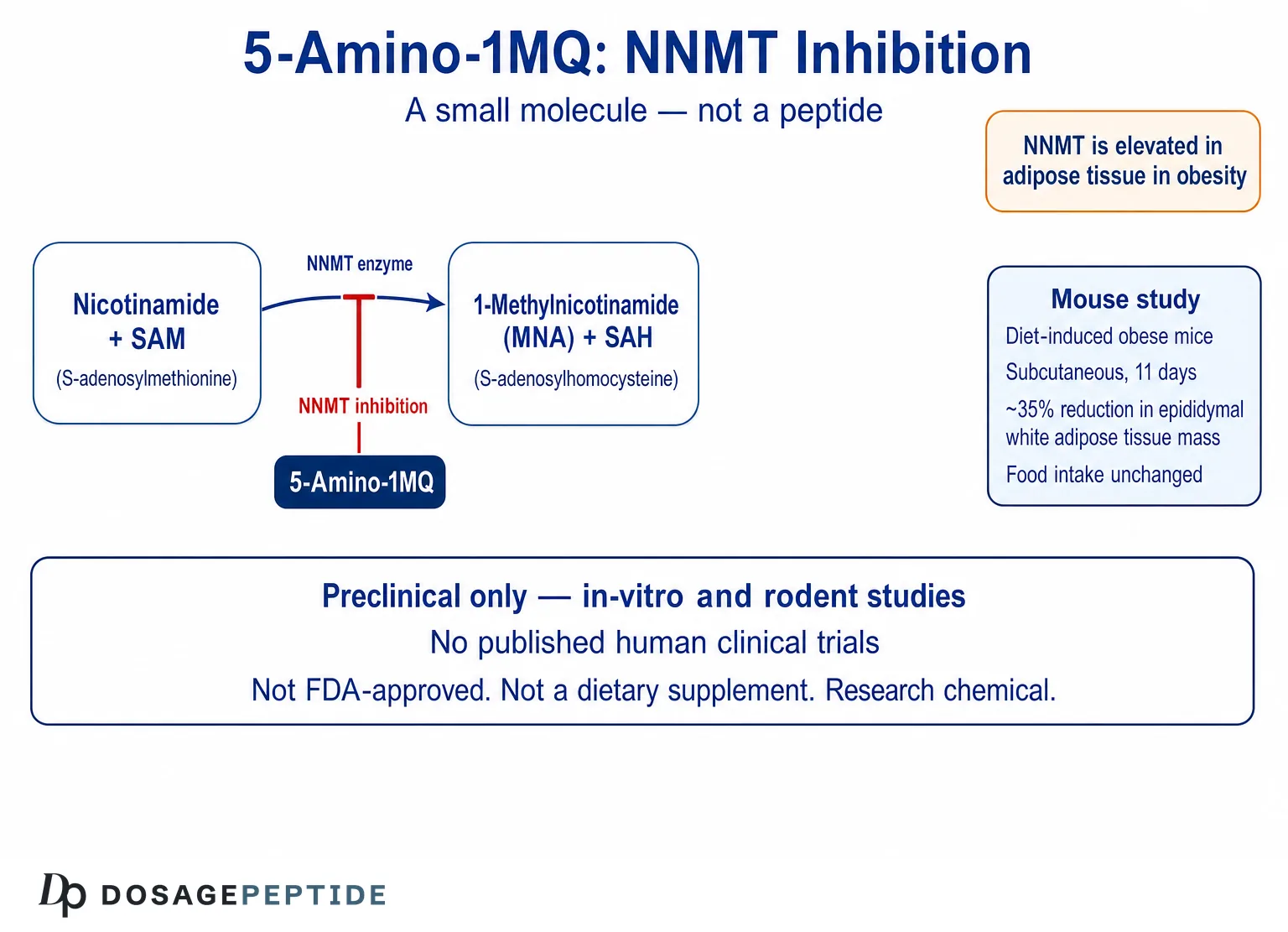
Nicotinamide N-methyltransferase is a cytosolic enzyme that transfers a methyl group from S-adenosylmethionine (SAM) onto nicotinamide (the amide form of vitamin B3). The reaction produces 1-methylnicotinamide (MNA, also written 1-MNA) and S-adenosylhomocysteine (SAH)[3]. Two consumable resources are therefore spent every time the enzyme fires: a methyl group from the cell’s universal methyl donor, and a molecule of nicotinamide.
Nicotinamide matters because it is a precursor in the NAD+ salvage pathway — the route by which cells recycle NAD+, the cofactor that sits at the centre of redox reactions, sirtuin signalling and mitochondrial energy handling. The proposed logic of NNMT inhibition is straightforward on paper: block the methylation reaction, and nicotinamide is spared for NAD+ resynthesis while SAM is spared for methylation reactions elsewhere. Kraus and colleagues, publishing in Nature in 2014, framed NNMT as a regulator of histone methylation, polyamine flux and NAD+-dependent SIRT1 signalling[4].
Why adipose tissue is the focus
NNMT expression is elevated in white adipose tissue and liver of obese and diabetic mice[4]. The observation is not confined to rodents. Kannt and colleagues, in Diabetologia (2015), reported that people with type 2 diabetes had roughly twofold higher NNMT expression in both omental and subcutaneous white adipose tissue than controls, and that plasma MNA correlated with adipose NNMT expression and with the degree of insulin resistance. Notably, interventions that improved insulin sensitivity — an exercise programme and bariatric surgery — were associated with reduced adipose NNMT expression[5]. That is a human association study, not a trial of any drug; it establishes that the biology is present in humans, nothing more.
MNA is not simply a waste product
An honest account has to note the complication: 1-methylnicotinamide, long assumed to be an inert disposal metabolite, has demonstrated biological activity of its own. In rats, MNA produced dose-dependent antithrombotic effects through a cyclooxygenase-2/prostacyclin mechanism[6]. Suppressing NNMT therefore does not only spare inputs — it also lowers the output of a metabolite with its own signalling role. What that trade-off means over months or years in a human being is simply not known.
What does the preclinical research on 5-Amino-1MQ actually show?
Genetic proof of concept came first
Before any small-molecule inhibitor, the target was validated genetically. Kraus and colleagues knocked down Nnmt in white adipose tissue and liver using antisense oligonucleotides in mice and found protection against diet-induced obesity, attributed to increased cellular energy expenditure. Adipose SAM and NAD+ rose; ornithine decarboxylase and spermidine-spermine N1-acetyltransferase activity increased; oxygen consumption in adipocytes went up[4]. This is mouse genetics, not pharmacology, and certainly not a human result — but it is why the pharmacology programme existed at all.
The core 5-Amino-1MQ mouse study
The foundational pharmacology paper is Neelakantan and colleagues, Biochemical Pharmacology, volume 147 (2018; published online November 2017)[7]. The work has three layers, and each deserves its own accuracy label:
- In vitro (artificial membranes and cell assays). Methylquinolinium scaffolds carrying a primary amine substituent showed high membrane permeability in parallel artificial membrane permeability assays and Caco-2 cell assays, by both passive and active transport. Selectivity screening found they did not inhibit related SAM-dependent methyltransferases or NAD+ salvage pathway enzymes.
- In cultured adipocytes. Treatment reduced intracellular 1-MNA, raised intracellular NAD+ and SAM, and suppressed lipid accumulation during differentiation. The reported NAD+ and SAM increases were modest — on the order of 1.2 to 1.6-fold — and reached statistical significance only at particular concentrations, which is worth holding in mind before treating “raises NAD+” as a headline.
- In diet-induced obese (DIO) mice. 5-Amino-1MQ was given by subcutaneous injection at 20 mg/kg per injection, three times daily, for 11 days, with nine mice per group — roughly 34 mg/kg per day of the parent compound once the counter-ion mass is subtracted. Treated DIO mice lost about 5.1% of body weight (roughly 2.0 g) while controls gained about 1.4%. Epididymal white adipose tissue mass fell by approximately 35%, adipocyte size by more than 30%, and plasma total cholesterol by around 30%. Total food intake was unchanged, and the authors reported no observable adverse effects over that 11-day window.
Note the specifics that marketing copy usually strips out: mice, not humans; subcutaneous injection, not oral capsules; eleven days, not a year; nine animals per arm; and a ~5% body-weight change. Those numbers are interesting scientific signals. They are not a human weight-loss result, and they cannot be converted into one. Readers looking at how such data are (and are not) extrapolated may find the discussion in the 5-Amino-1MQ results timeline useful for separating documented observations from expectation.
Follow-on rodent work
Two later studies extended the picture, both still entirely in animals or cells:
- Aged muscle regeneration. Neelakantan and colleagues (2019) treated 24-month-old mice with an NNMT inhibitor at 5 and 10 mg/kg after an induced tibialis anterior injury. Treated animals showed greater muscle stem cell proliferation and fusion, nearly two-fold greater regenerated myofiber cross-sectional area, and roughly 70% higher peak torque than controls[8]. This is an aged-mouse injury-recovery model. It says nothing verified about human muscle.
- Combination with dietary change. Dimet-Wiley and colleagues (2022, Scientific Reports) explicitly named 5-amino-1-methylquinolinium as the NNMT inhibitor and combined it with a switch to a low-fat diet in DIO mice, reporting rapid normalisation of adiposity toward age-matched lean animals and a distinct cecal microbiome signature in the treated group[9]. The authors describe this as a foundation for future investigation, not a conclusion.
Oncology work is a separate, unrelated thread
NNMT is also overexpressed in a number of tumours, and 5-amino-1-methylquinolinium has been used as a tool compound in cancer biology — showing concentration- and time-dependent antiproliferative activity against HeLa cervical cancer cells in vitro[10], and reducing tumour growth while enhancing the apoptotic effect of an anti-PD-L1 antibody in bladder cancer mouse models[11]. These are cell-culture and mouse-tumour findings in oncology research. They are not evidence about metabolism, and they are certainly not evidence of any therapeutic use in people.
Are there human clinical trials of 5-Amino-1MQ?
No. This needs to be stated without hedging, because a great deal of published material about this compound implies otherwise.
- Trial registry. Searching ClinicalTrials.gov for 5-Amino-1MQ, 5-amino-1-methylquinolinium and NNMT-inhibitor interventions returns no registered interventional study of the compound.
- Peer-reviewed literature. The 2024 Frontiers in Pharmacology review of NNMT as a metabolic-syndrome target states directly that clinical trials focusing on NNMT have not been documented, and that further investigation is warranted before targeted therapeutic interventions can be developed[3].
- Regulatory status. 5-Amino-1MQ is not an FDA-approved drug for any indication. Nor does it fit the statutory description of a dietary ingredient. Under the Federal Food, Drug, and Cosmetic Act, a dietary ingredient must be a vitamin, a mineral, an herb or other botanical, an amino acid, a dietary substance used by man to supplement the diet, or a concentrate, metabolite, constituent, extract or combination of those[12]. A synthetic quinolinium salt is none of those things. In practice it circulates as a research chemical, outside both the drug and the supplement frameworks.
The correct evidence tier is therefore: preclinical only — in-vitro and rodent. Not investigational (no registered trial), not approved, not a supplement.
What can honestly be said about 5-Amino-1MQ and weight loss?
What is documented: in diet-induced obese mice, an 11-day course of subcutaneous 5-Amino-1MQ was associated with loss of body weight and a marked reduction in white adipose mass and adipocyte size, without any change in food intake[7]. The food-intake finding is mechanistically interesting because it argues against simple appetite suppression as the explanation.
What is not documented: any weight change in a human being under controlled conditions. There is no dose-response curve in humans, no pharmacokinetic profile in humans, no measure of how much target engagement a given exposure produces in human adipose tissue, and no idea whether the mouse effect size scales, shrinks or disappears.
The history of obesity pharmacology is a long list of compounds that reduced adiposity in DIO mice and then failed in people. Rodent adipose thermogenesis differs substantially from human adipose biology, and short high-dose rodent courses are a poor guide to chronic human exposure. Treating a 5% eleven-day mouse result as a preview of human fat loss is an extrapolation the data do not support.
What is known about 5-Amino-1MQ side effects?
The honest answer is that the human safety profile is unknown, and any published list of “common side effects” for this compound is not derived from controlled human data, because none exists. There has been no Phase 1 tolerability study, no dose-escalation study, no defined maximum tolerated dose, and no long-term toxicology in humans.
What can be said accurately:
- Animal reports are limited and short. The 2018 DIO mouse study reported no observable adverse effects and no change in food intake over an 11-day course[7]. “No observable adverse effects over 11 days in nine mice” is a genuine observation and a very thin safety dataset. It is not a chronic toxicology programme.
- There are theoretical considerations worth naming as theoretical. NNMT sits at the junction of the methylation cycle and NAD+ metabolism. Its reaction consumes SAM and generates SAH, which is a precursor of homocysteine[3]. Perturbing an enzyme embedded in one-carbon metabolism and NAD+ handling could plausibly have effects on methylation-dependent processes, and suppressing MNA production removes a metabolite with documented vascular activity in rodents[6]. These are mechanistic hypotheses that human studies have not tested — in either direction.
- Anecdote is not a safety signal, and its absence is not safety. Self-reports circulating online are uncontrolled, unverified, unblinded, and frequently confounded by concurrent diets, stimulants and other compounds. They cannot establish either harm or safety.
Oral or injectable: what does the route evidence actually cover?
Because 5-Amino-1MQ is a small molecule rather than a peptide, oral administration is not automatically ruled out by gut proteolysis — the standard objection to oral peptides. The 2018 paper reported that methylquinolinium analogues with a primary amine crossed artificial membranes and Caco-2 monolayers well[7]. That is a permeability assay, not an oral bioavailability measurement, and the in-vivo obesity work used subcutaneous injection.
So the position is: permeability data are encouraging in vitro; route comparison data in animals are limited; and human oral or subcutaneous bioavailability has never been characterised. The compound is a permanently charged quaternary-type cation, which as a general medicinal-chemistry matter tends to complicate oral absorption and blood-brain barrier penetration — a reason to be cautious rather than confident about assumed equivalence between routes. The oral versus injectable comparison covers this trade-off in more detail without repeating the mechanism here.
How does 5-Amino-1MQ compare to metabolic research compounds like MOTS-c and AICAR?
These three are often grouped together as “metabolic peptides”, which is doubly wrong — only one of them is a peptide at all. The table below states each classification and evidence tier precisely.
| Compound | Molecule class | Primary molecular target | Strongest evidence tier | Human trial data? |
|---|---|---|---|---|
| 5-Amino-1MQ | Small molecule — quinolinium salt (~159 g/mol cation). Not a peptide. | NNMT (nicotinamide N-methyltransferase) enzyme inhibition | Preclinical: in vitro adipocytes plus short-course diet-induced obese mouse studies | No. No registered interventional trial; no published human study |
| MOTS-c | Peptide — 16 amino acids, mitochondrial-derived, encoded in 12S rRNA | Folate/one-carbon cycle and de novo purine synthesis, leading to AMPK activation | Preclinical for MOTS-c itself (mice); Phase 1 completed for the analogue CB4211 | Not for MOTS-c itself. A synthetic analogue (CB4211) completed a Phase 1a/1b study in 88 participants |
| AICAR (acadesine) | Small molecule — nucleoside analogue of AMP. Not a peptide. | AMPK activation via intracellular conversion to ZMP | Clinical: Phase 3 cardiac surgery trial, stopped early for futility with the primary endpoint not met | Yes — and the largest trial was negative. Not approved for any indication |
The comparison is instructive in an uncomfortable way. MOTS-c is a genuine mitochondrial-derived peptide that prevented diet-induced obesity and insulin resistance in mice[2]; its closest clinical relative, the analogue CB4211, completed a Phase 1a/1b study in 88 participants, registered as NCT03998514[13] — further than 5-Amino-1MQ has gone. AICAR, the AMPK-activating exercise-mimetic candidate, increased running endurance in sedentary mice by 44% in the well-known 2008 Cell study[14] — and then, in a randomised Phase 3 cardiac-surgery trial stopped for futility after 3,080 of a projected 7,500 patients had been randomised, produced a primary-outcome rate of 5.1% versus 5.0% on placebo[15]. AICAR is the cautionary case: striking mouse metabolic data, then a large negative human trial. It is the outcome 5-Amino-1MQ has not yet had the opportunity to have.
How do you know what is actually in the vial?
Because 5-Amino-1MQ has no approved drug status and no pharmacopeial monograph, nothing in the supply chain is subject to the identity and purity controls that apply to a licensed medicine. Material is manufactured and distributed as a research chemical, and there is no regulatory body verifying what is in the vial or bottle. Points that matter for laboratory work:
- Independent analytical verification. A batch-specific certificate of analysis from a third-party laboratory — not a vendor-issued document — with HPLC purity and mass spectrometry identity confirmation is the minimum for knowing what a sample actually contains. A COA that is undated, batch-less, or not traceable to an accredited lab is decorative.
- Salt form and mass accounting. As noted, the supplied material is usually a salt. The counter-ion contributes to gross mass. Concentration calculations that ignore this systematically overstate how much active cation is present.
- Solubility and vehicle. As an ionic salt rather than a lyophilised peptide, its dissolution behaviour differs from peptide handling conventions; documented vial-specific handling references such as the 5-Amino-1MQ 50 mg vial protocol and the corresponding 10 mg vial protocol exist to keep laboratory concentration arithmetic explicit and reproducible rather than improvised.
- No standardisation between suppliers. Two vials labelled identically from two sources may differ in salt form, purity and residual solvent content. Without analysis, they are not interchangeable inputs to an experiment.
What is still unanswered
The gaps here are large, and naming them is more useful than papering over them:
- What is the human pharmacokinetic profile — absorption, distribution, half-life, clearance — by any route? Nothing is published.
- Does NNMT inhibition produce measurable target engagement in human adipose tissue, and at what exposure? Plasma MNA is an obvious candidate biomarker[5], but it has never been used as a readout for this compound in humans.
- Is elevated adipose NNMT a driver of metabolic dysfunction or a consequence of it? The human data are correlational, and the causal direction has been established only in mice.
- What are the consequences of chronically suppressing MNA production, given MNA’s own vascular and anti-inflammatory activity in animal models?
- Does inhibition perturb the SAM/SAH ratio or homocysteine handling in a clinically meaningful way over long exposure?
- Is selectivity against other SAM-dependent methyltransferases, demonstrated in vitro, maintained at systemic exposures in a whole organism over months?
- Given NNMT’s roles in tumour biology, what does chronic systemic inhibition do in a healthy organism over years — a question no 11-day or 3-week rodent study can address.
Frequently Asked Questions
Is 5-Amino-1MQ a peptide?
No. It is a small molecule — specifically 5-amino-1-methylquinolinium, a quinolinium salt with the formula C10H11N2+ and a cation molecular weight near 159 g/mol. It contains no amino acids and no peptide bonds. It is frequently catalogued and marketed alongside research peptides, which is where the confusion originates, but chemically it belongs to an entirely different class.
What does 5-Amino-1MQ do at the molecular level?
It inhibits nicotinamide N-methyltransferase (NNMT), the enzyme that methylates nicotinamide using S-adenosylmethionine as the methyl donor, producing 1-methylnicotinamide and S-adenosylhomocysteine. In cultured adipocytes, inhibition lowered intracellular 1-methylnicotinamide and raised intracellular NAD+ and SAM while suppressing lipogenesis. These are cell-culture observations, not demonstrated effects in humans.
Are there any human clinical trials of 5-Amino-1MQ?
No. Searches of ClinicalTrials.gov return no registered interventional studies of 5-Amino-1MQ, and a 2024 peer-reviewed review of NNMT as a metabolic target stated that clinical trials focused on NNMT have not been documented. There is no published Phase 1 safety data, no human pharmacokinetics, and no human efficacy data of any kind.
Does 5-Amino-1MQ cause weight loss?
In diet-induced obese mice, an 11-day course of subcutaneous 5-Amino-1MQ was associated with roughly 5% body-weight loss and about a 35% reduction in epididymal white adipose mass, without a change in food intake. No equivalent result has been demonstrated in humans, in any study, at any dose. Rodent adiposity findings historically translate poorly to human obesity outcomes.
What are the side effects of 5-Amino-1MQ?
They are unknown in humans, because no controlled human safety study has been conducted. The short mouse study reported no observable adverse effects over 11 days, which is a genuine but extremely limited observation. Theoretical considerations relate to the compound’s position in one-carbon metabolism and NAD+ handling. Any specific side-effect list presented as established human data is not evidence-based.
Is 5-Amino-1MQ FDA-approved or a legal supplement?
Neither. It has no FDA approval for any indication and is not an approved dietary supplement ingredient — it is a synthetic small molecule without a history of use in the food supply, so it does not meet the definition of a dietary ingredient. It is distributed as a research chemical intended for laboratory investigation only, outside of any regulated pharmaceutical or supplement framework.
Is oral 5-Amino-1MQ as effective as injectable?
There is no human data comparing routes, so this cannot be answered. Because it is a small molecule rather than a peptide, oral administration is not automatically defeated by digestive enzymes, and cell-based permeability assays were favourable. However, the mouse obesity work used subcutaneous injection, and human oral bioavailability has never been measured. The permanent positive charge is a plausible barrier to absorption.
How is 5-Amino-1MQ different from MOTS-c or AICAR?
MOTS-c is a genuine 16-amino-acid mitochondrial-derived peptide acting upstream of AMPK. AICAR is a nucleoside AMP analogue that activates AMPK directly and, unlike the other two, has actually been tested in a large human Phase 3 trial — which failed its primary endpoint. 5-Amino-1MQ is a small-molecule enzyme inhibitor with a completely different target, NNMT, and the least clinical advancement of the three.
Why does a certificate of analysis matter for this compound?
Because no regulatory authority verifies research-chemical supply. Without a batch-specific third-party certificate showing HPLC purity and mass-spectrometry identity confirmation, there is no assurance a sample contains what the label claims, at what purity, or in which salt form. Salt form also affects mass calculations, since the counter-ion contributes weight that is not active compound.
References
- National Center for Biotechnology Information. PubChem Compound Summary for CID 950107, 5-Amino-1-methylquinolinium. https://pubchem.ncbi.nlm.nih.gov/compound/950107
- Lee C, Zeng J, Drew BG, et al. The mitochondrial-derived peptide MOTS-c promotes metabolic homeostasis and reduces obesity and insulin resistance. Cell Metabolism. 2015;21(3):443-454. https://pubmed.ncbi.nlm.nih.gov/25738459/
- Sun WD, Zhu XJ, Li JJ, Mei YZ, Li WS, Li JH. Nicotinamide N-methyltransferase (NNMT): a novel therapeutic target for metabolic syndrome. Frontiers in Pharmacology. 2024;15:1410479. https://pmc.ncbi.nlm.nih.gov/articles/PMC11196770/
- Kraus D, Yang Q, Kong D, et al. Nicotinamide N-methyltransferase knockdown protects against diet-induced obesity. Nature. 2014;508(7495):258-262. https://pubmed.ncbi.nlm.nih.gov/24717514/
- Kannt A, Pfenninger A, Teichert L, et al. Association of nicotinamide-N-methyltransferase mRNA expression in human adipose tissue and the plasma concentration of its product, 1-methylnicotinamide, with insulin resistance. Diabetologia. 2015;58(4):799-808. https://pubmed.ncbi.nlm.nih.gov/25596852/
- Chlopicki S, Swies J, Mogielnicki A, et al. 1-Methylnicotinamide (MNA), a primary metabolite of nicotinamide, exerts anti-thrombotic activity mediated by a cyclooxygenase-2/prostacyclin pathway. British Journal of Pharmacology. 2007;152(2):230-239. https://pubmed.ncbi.nlm.nih.gov/17641676/
- Neelakantan H, Vance V, Wetzel MD, et al. Selective and membrane-permeable small molecule inhibitors of nicotinamide N-methyltransferase reverse high fat diet-induced obesity in mice. Biochemical Pharmacology. 2018;147:141-152. https://pubmed.ncbi.nlm.nih.gov/29155147/
- Neelakantan H, Brightwell CR, Graber TG, et al. Small molecule nicotinamide N-methyltransferase inhibitor activates senescent muscle stem cells and improves regenerative capacity of aged skeletal muscle. Biochemical Pharmacology. 2019;163:481-492. https://pubmed.ncbi.nlm.nih.gov/30753815/
- Dimet-Wiley A, Wu Q, Wiley JT, et al. Reduced calorie diet combined with NNMT inhibition establishes a distinct microbiome in DIO mice. Scientific Reports. 2022;12(1):484. https://pubmed.ncbi.nlm.nih.gov/35013352/
- Akar S, Duran T, Azzawri AA, Koçak N, Çelik Ç, Yıldırım Hİ. Small molecule inhibitor of nicotinamide N-methyltransferase shows anti-proliferative activity in HeLa cells. Journal of Obstetrics and Gynaecology. 2021;41(8):1240-1245. https://pubmed.ncbi.nlm.nih.gov/33645410/
- Yang M, Wang B, Hou W, et al. NAD metabolism enzyme NNMT in cancer-associated fibroblasts drives tumor progression and resistance to immunotherapy by modulating macrophages in urothelial bladder cancer. Journal for ImmunoTherapy of Cancer. 2024;12(7):e009281. https://pubmed.ncbi.nlm.nih.gov/39067875/
- U.S. Food and Drug Administration. New Dietary Ingredients in Dietary Supplements — Background for Industry. https://www.fda.gov/food/new-dietary-ingredient-ndi-notification-process/new-dietary-ingredients-dietary-supplements-background-industry
- CohBar, Inc. A Phase 1a/1b Study of Safety, Tolerability, and Pharmacokinetics of CB4211 in Healthy Non-obese Subjects and Subjects With Nonalcoholic Fatty Liver Disease. ClinicalTrials.gov Identifier NCT03998514; 88 participants enrolled, status completed. https://clinicaltrials.gov/study/NCT03998514
- Narkar VA, Downes M, Yu RT, et al. AMPK and PPARdelta agonists are exercise mimetics. Cell. 2008;134(3):405-415. https://pubmed.ncbi.nlm.nih.gov/18674809/
- Newman MF, Ferguson TB, White JA, et al. Effect of adenosine-regulating agent acadesine on morbidity and mortality associated with coronary artery bypass grafting: the RED-CABG randomized controlled trial. JAMA. 2012;308(2):157-164. https://pubmed.ncbi.nlm.nih.gov/22782417/
Research use only. 5-Amino-1MQ is an unapproved research chemical intended solely for laboratory research. It is not a drug, not a dietary supplement, and not approved by the FDA or any comparable regulatory authority for the diagnosis, treatment, cure or prevention of any disease. This article is an educational summary of published scientific literature provided by an independent reference library; it is not medical advice, not a dosing recommendation, and not an endorsement of human administration. dosagepeptide.com does not sell any compound. Anyone with a health concern should consult a qualified, licensed healthcare professional.