Pramlintide is a synthetic 37-amino-acid analog of human amylin (islet amyloid polypeptide, IAPP), the second hormone that pancreatic beta cells release alongside insulin at every meal. It works by slowing gastric emptying, suppressing the inappropriate glucagon release that follows a meal in diabetes, and increasing satiety through the brainstem — not by stimulating insulin secretion. Under the brand name SYMLIN, it received FDA approval in 2005 for one narrow purpose only: as an adjunct to mealtime insulin in people with type 1 or insulin-using type 2 diabetes who have not reached their glucose targets despite optimal insulin therapy.[1] It is not approved for weight loss, and as of 2026 it is no longer commercially marketed in the United States.
What exactly is pramlintide as a molecule?
Amylin is co-packaged with insulin in the secretory granules of pancreatic beta cells and released with it in an approximately 1:100 molar ratio after eating. That co-secretion has a direct clinical consequence: in type 1 diabetes, autoimmune destruction of beta cells produces a deficiency of two hormones, not one. Conventional insulin replacement addresses only half of that deficit. Pramlintide was engineered to replace the other half at mealtimes.[2]
Structurally, pramlintide is identical to human amylin except at three positions. The FDA label states it plainly: pramlintide “differs in amino acid sequence from human amylin by replacement with proline at positions 25 (alanine), 28 (serine), and 29 (serine).”[1] Those three proline substitutions are the entire reason the drug exists. They were not chosen to improve potency or extend duration — they were chosen to stop the peptide from turning into amyloid in the vial.
Why native human amylin could never be a drug
Human amylin is the principal protein constituent of the islet amyloid deposits found in the pancreas of most people with long-standing type 2 diabetes. It is intrinsically amyloidogenic: in aqueous solution it self-assembles into insoluble beta-sheet fibrils. A peptide that aggregates on contact with water cannot be formulated, stored, or injected reliably.
The engineering solution came from comparative biology. Westermark and colleagues showed in 1990 that the amyloid-forming capacity of IAPP maps to a short decapeptide segment spanning residues 20–29. Peptides corresponding to that region from humans and cats — the two species that develop islet amyloid — formed fibrils in vitro, while the corresponding segments from three rodent species that do not develop islet amyloid did not. They identified the sequence at positions 25–29 as strongly amyloidogenic, and demonstrated that a proline-for-serine substitution at position 28, of the kind rodents naturally carry, almost completely inhibits fibril formation.[3]
Proline is the residue that breaks beta-sheets: its rigid ring geometry prevents the backbone hydrogen bonding that fibrils require. Pramlintide is, in effect, human amylin wearing the rodent solution to the aggregation problem — three prolines borrowed from a species that never accumulates islet amyloid. This is one of the cleaner worked examples of rational peptide engineering in the endocrine pharmacopoeia, and it is the reason the molecule is soluble enough to inject.
What is the pramlintide mechanism of action?
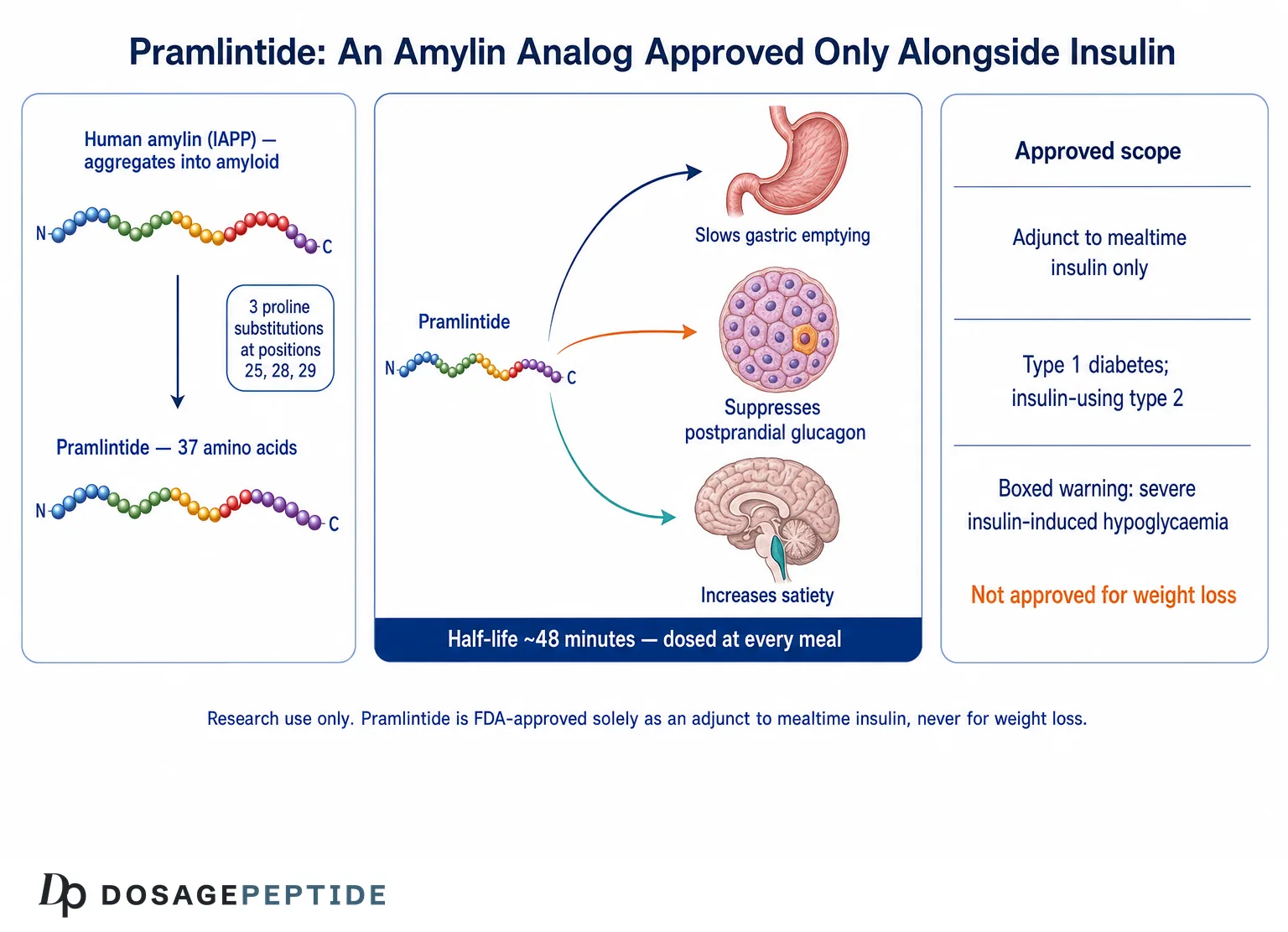
Pramlintide does not act on the insulin receptor and does not stimulate insulin release. It binds amylin receptors — heteromeric complexes formed when the calcitonin receptor associates with receptor activity-modifying proteins (RAMP1, RAMP2, RAMP3), producing the AMY1, AMY2 and AMY3 subtypes.[2] Its actions are concentrated in circumventricular organs of the brainstem, particularly the area postrema, which sits outside the blood–brain barrier and can therefore sense circulating peptide directly. Three effects are described in the approved labeling.[1]
1. Slowing of gastric emptying
This is the dominant contributor to the postprandial glucose effect. The label specifies that amylin slows the rate at which food is released from the stomach to the small intestine “without altering the overall absorption of nutrients” — the glucose still arrives, it simply arrives more gradually, which flattens the peak.[1] The mechanistic detail beneath that sentence comes from animal work, not from human trials, and should be read at that tier: in rodents the effect is centrally mediated rather than a direct action on gastric smooth muscle, with subdiaphragmatic vagotomy or ablation of the area postrema abolishing it, and amylin is more potent than GLP-1 or CCK-8 on a molar basis for this action in animal models.[4]
One detail deserves emphasis because it is frequently mangled online: the gastric-emptying brake is glucose-sensitive. Insulin-induced hypoglycaemia reverses it in animal models, which has been interpreted as a physiological fail-safe allowing rapidly ingested carbohydrate to pass through the stomach when blood glucose is low.[4] That is a rodent-derived mechanistic observation, not a safety guarantee in humans, and the FDA label does not treat it as one.
2. Suppression of inappropriate postprandial glucagon
In healthy physiology, glucagon secretion falls after a meal. In type 1 and advanced type 2 diabetes, alpha cells lose that restraint and continue to release glucagon postprandially, driving hepatic glucose output at precisely the wrong moment. The label states that pramlintide suppresses glucagon secretion, reducing hepatic glucose output.[1]
The magnitude is measurable, though the study establishing it was small and open to the usual limits of a four-week crossover. In 18 adults with type 1 diabetes on continuous subcutaneous insulin infusion (16 evaluable), the dose used in that published trial — 30 mcg three times daily at meals — reduced the incremental postprandial glucagon area under the curve by approximately 87%, alongside roughly 86% reduction in the postprandial glucose excursion and about 72% reduction in the triglyceride excursion. All three measures approached pretreatment values two weeks after treatment stopped.[5]
3. Increased satiety and reduced food intake
The label describes regulation of food intake through centrally-mediated modulation of appetite. Human data support a primary satiogenic action rather than an indirect one. In a randomised crossover study, a single 120 mcg dose of pramlintide reduced ad libitum energy intake at a buffet meal by 23% in insulin-treated men with type 2 diabetes and 16% in non-diabetic obese men, without changing meal duration, and hormonal profiling suggested the effect was independent of the other anorexigenic gut peptides measured — cholecystokinin, GLP-1 and peptide YY.[6] That distinction matters mechanistically: amylin agonism appears to recruit a satiation circuit of its own rather than amplifying the incretin axis, which is the pharmacological premise behind combining an amylin analog with a GLP-1 agonist.
If you are unfamiliar with terms like AUC, estimand, or receptor activity-modifying protein, our peptide research glossary defines the vocabulary used throughout this literature.
What is pramlintide approved for — and what it is not approved for
This is the single most misrepresented fact about the molecule, so it is worth quoting the label rather than paraphrasing it. The FDA-approved indication reads: “SYMLIN is indicated as an adjunctive treatment in patients with type 1 or type 2 diabetes who use mealtime insulin therapy and who have failed to achieve desired glucose control despite optimal insulin therapy.”[1]
Three constraints are built into that one sentence:
- Adjunctive only. It is never a replacement for insulin and was never studied as monotherapy for glycaemic control.
- Mealtime insulin users only. Type 2 diabetes without mealtime insulin is outside the indication. Obesity without diabetes is entirely outside the indication.
- Second-line only. The label restricts it to patients who have already failed to reach target on optimised insulin.
Pramlintide has never held an FDA indication for weight loss or for obesity. Weight change appears in the label and the trial record as a secondary observation in people with diabetes, not as an approved use. The weight-loss trials described later in this article were conducted, published, and then not carried through to an approved obesity indication. Any claim that pramlintide is “an approved weight-loss drug” is false.
The boxed warning
SYMLIN carries an FDA boxed warning — the agency’s most serious labeling requirement. The label states that SYMLIN use with insulin increases the risk of severe hypoglycaemia, particularly in patients with type 1 diabetes, and that when severe hypoglycaemia occurs it is seen within three hours following a SYMLIN injection.[1]
The pharmacological logic matters: pramlintide alone does not cause hypoglycaemia. The risk arises from the interaction. By blunting the postprandial glucose rise, it removes the substrate that a previously appropriate mealtime insulin dose was calculated against. Unless that insulin dose is reduced, the same injection is now an overdose relative to the flattened glucose curve.
Accordingly, the label instructs prescribers to reduce mealtime insulin doses, including premixed insulins, by 50% when initiating SYMLIN, and to titrate pramlintide upward stepwise with frequent pre- and post-meal glucose monitoring. Labeled starting doses are 15 mcg before major meals in type 1 diabetes (escalating in 15 mcg increments to a maximum of 60 mcg) and 60 mcg in insulin-using type 2 diabetes (to a maximum of 120 mcg).[1] These figures are stated here strictly as a description of what the regulatory document instructs licensed prescribers to do under medical supervision. They are not guidance, and nothing in this article should be read as a protocol for any individual.
The label also lists absolute contraindications: known hypersensitivity, hypoglycaemia unawareness, and confirmed gastroparesis. Both exclusions follow directly from the mechanism — a drug that delays gastric emptying is contraindicated in someone whose stomach already empties too slowly, and a drug that raises hypoglycaemia risk is contraindicated in someone who cannot detect it. Safety and effectiveness in paediatric patients were never established.[1]
Pramlintide half life: why it had to be dosed at every meal
The pharmacokinetics are the defining limitation of the molecule and the cleanest point of contrast with everything that came after it. According to the FDA label, pramlintide reaches peak plasma concentration about 19–21 minutes after subcutaneous injection across the 30–120 mcg dose range, has an absolute bioavailability of roughly 30–40%, is only about 60% protein-bound, and has a half-life of approximately 48 minutes in healthy individuals. Its principal metabolite, des-lys1-pramlintide (2-37 pramlintide), is described in the label as biologically active in vitro — a qualifier worth keeping, since the label does not extend that finding to activity in humans.[1]
One correction to a claim that circulates widely: the current label does not state that pramlintide is cleared primarily by the kidneys. What it reports is the opposite of what that claim would predict — in a single-dose study in type 1 diabetes, total and peak exposure showed no statistically significant differences across mild, moderate and severe renal impairment versus normal renal function, and labeled dosing is unchanged in those groups. Pramlintide has not been studied in end-stage renal disease.[1]
A 48-minute half-life means effectively complete clearance within about four hours. That is well matched to the physiology being replaced — endogenous amylin is a meal-associated signal, not a tonic one — but it dictates an injection before every major meal, three or more times daily, each requiring its own titration and its own insulin adjustment. Combined with a nausea rate of 48% in type 1 and 28% in type 2 diabetes trials (versus 17% and 12% on placebo),[1] that burden is the practical reason pramlintide never achieved wide adoption despite a genuinely novel mechanism. The entire modern amylin field is, in one sense, an engineering response to that 48-minute number.
What did the pramlintide trials actually show?
The evidence base is real, peer-reviewed, and modest in effect size. It should not be inflated.
Type 1 diabetes. In a 52-week double-blind trial of 651 adults (baseline HbA1c 8.9%), adding pramlintide 60 mcg three or four times daily to insulin reduced HbA1c by 0.29% and 0.34% respectively, versus 0.04% with placebo. Body weight fell 0.4 kg on pramlintide while rising 0.8 kg on placebo.[7] A later 29-week trial in 296 patients, designed around proactive mealtime insulin reduction, found HbA1c fell equally in both arms (−0.5%), but the pramlintide group achieved it with significantly reduced postprandial glucose excursions, a 28% reduction in insulin dose versus 4% on placebo, and 1.3 kg weight loss versus 1.2 kg gain on placebo. Nausea occurred in 63% versus 36%, and severe hypoglycaemia was more frequent on pramlintide (0.57 versus 0.30 events per patient-year).[8]
Type 2 diabetes. In a 52-week trial of 656 insulin-treated adults, pramlintide 120 mcg twice daily reduced HbA1c by 0.62% at week 52 versus placebo, with 1.4 kg weight loss compared with 0.7 kg gain, and no overall increase in severe hypoglycaemia rate.[9]
Obesity without insulin use — the investigational programme that stopped. A 16-week phase 2 study in 204 obese subjects (doses up to 240 mcg three times daily, no lifestyle intervention) produced a placebo-corrected weight reduction of 3.7% (3.6 kg), with 31% of participants losing at least 5% of body weight versus 2% on placebo. Notably, participants who did not report nausea lost as much weight as those who did (3.6% versus 3.9%), arguing that the weight effect was not simply a by-product of feeling unwell.[10] These are real published results. They are also, in 2026 terms, a fraction of what long-acting amylin analogs now produce — and critically, this programme never resulted in an approved obesity indication. Pramlintide’s obesity evidence tier is “investigational, discontinued,” not “approved.”
Is Symlin still available in the United States in 2026?
No. AstraZeneca discontinued manufacture of SymlinPen 60 and SymlinPen 120, with the discontinuation recorded in the FDA drug shortage database as of 27 October 2025 under the reason “discontinuation of the manufacture of the drug.”[11] With those presentations withdrawn, no pramlintide product remains commercially marketed in the US, and no generic has been approved.
Two points of precision here, because both get distorted. First, this was a manufacturing and commercial discontinuation, not a safety withdrawal and not a recall — the drug was not removed for adverse findings. Second, discontinuation of marketing does not retroactively change the evidence tier: the pharmacology, the trial record, and the approved indication all remain exactly as described above. What changed is availability, not science.
A practical consequence worth naming: because no marketed product exists, material sold under the name “pramlintide” today is by definition not the FDA-approved SYMLIN product. Research-grade lyophilised peptide from a supplier carries none of the identity, purity, sterility, or potency assurances that attach to an approved injectable, and none of the label’s safety architecture. Our overview of what is and is not known about peptide safety covers why that distinction is not a formality, and the pramlintide 5 mg vial reference page documents the concentrations and handling parameters reported in the research literature for laboratory work.
Pramlintide vs cagrilintide vs eloralintide: how the amylin class evolved
All three are amylin-receptor agonists. Only one has ever been FDA-approved, and it is the oldest. The other two are investigational — a word that must not be softened. One caution before the table: the weight figures below come from separate trials run decades apart, in different populations, over different durations, against different comparators. They have never been compared head-to-head, so the numbers sit side by side for orientation only and do not constitute a ranking.
| Attribute | Pramlintide (SYMLIN) | Cagrilintide | Eloralintide (LY3841136) |
|---|---|---|---|
| Regulatory status (Aug 2026) | FDA-approved 2005 as adjunct to mealtime insulin in type 1 / insulin-using type 2 diabetes. Discontinued from the US market Oct 2025 | Investigational — not approved. Dedicated phase 3 monotherapy trials ongoing; the fixed-dose combination with semaglutide (CagriSema) was filed with FDA in Dec 2025 and remains under review | Investigational — not approved. Phase 3 programme recruiting since Dec 2025 / Feb 2026 |
| Receptor profile | Non-selective amylin-receptor agonist (calcitonin receptor + RAMP complexes) | Long-acting dual amylin and calcitonin receptor agonist (DACRA) | Selective amylin receptor agonist (designed to minimise calcitonin-receptor engagement) |
| Dosing frequency | Before every major meal (3+ times daily) | Once weekly, subcutaneous | Once weekly, subcutaneous |
| Half-life | ~48 minutes[1] | Engineered for once-weekly exposure via lipidation / albumin binding | Engineered for once-weekly exposure |
| Best published weight data | Placebo-corrected 3.7% at 16 weeks in obesity phase 2; ~1–1.4 kg in diabetes trials[10] | −11.5% at 68 weeks as monotherapy vs −3.0% placebo in REDEFINE 1 (phase 3, treatment-policy estimand); CagriSema −20.4%[12] | Up to −20% at 48 weeks vs −0.4% placebo in phase 2 (n=263)[13] |
| Approved for weight loss? | No — never | No — under review, not approved | No — phase 3 in progress |
Cagrilintide: phase 3, filed, not approved
Cagrilintide is a long-acting amylin analog that also engages the calcitonin receptor, hence its classification as a DACRA. In the 3,417-participant phase 3 REDEFINE 1 trial, under the treatment-policy estimand, cagrilintide 2.4 mg alone produced −11.5% at 68 weeks and the fixed combination with semaglutide 2.4 mg produced −20.4%, versus −3.0% for placebo, with gastrointestinal adverse events in 79.6% of the combination arm versus 39.9% on placebo.[12] The higher figures sometimes quoted for this trial (−22.7% for the combination, −11.8% for cagrilintide alone) come from the trial-product estimand, which models adherence rather than intention to treat; mixing the two sets inflates the contrast, so this article uses the treatment-policy numbers throughout.
Novo Nordisk submitted CagriSema to the FDA in December 2025. As of August 2026 the application remains under review, and cagrilintide is not approved for any indication in any form. A dedicated phase 3 trial of cagrilintide as standalone therapy started in November 2025 and has completed enrolment, with primary completion scheduled for May 2027.[14] We cover the combination comparison in more detail in our analysis of cagrilintide versus semaglutide, and the published dosing schemes on the cagrilintide weekly dosage reference.
Eloralintide: the selectivity hypothesis, still in phase 3
Eloralintide is designed to activate amylin receptors while largely sparing the calcitonin receptor — a hypothesis that receptor selectivity may separate weight-loss efficacy from gastrointestinal intolerance. The 48-week phase 2 trial in 263 adults reported mean weight change from −9% at 1 mg to −20% at 9 mg, versus −0.4% on placebo — though nausea reached 64% in the 6 mg arm and only 33% in the 9 mg arm, a non-monotonic pattern that complicates the simple tolerability story.[13] That is phase 2 evidence in 263 people, not a phase 3 outcome. Phase 3 trials in obesity with type 2 diabetes (NCT07282600, started 15 December 2025), obesity without type 2 diabetes (NCT07321886, started February 2026), obstructive sleep apnoea and knee osteoarthritis are now recruiting, with primary completion dates from January 2028 onward.[15] Nothing in the eloralintide programme has been approved for any use. Our dedicated explainer on eloralintide as a selective amylin agonist goes further into the receptor pharmacology.
What pramlintide’s record tells us about reading the amylin class
Pramlintide is the class’s proof of concept and its cautionary tale in the same molecule. It established that amylin-receptor agonism does something clinically real in humans — it flattens postprandial glucose, suppresses glucagon, reduces food intake, and produces modest weight loss without stimulating insulin secretion. It also established that a mechanism working is not sufficient. A 48-minute half-life, three-times-daily injection, a labeled 50% insulin reduction at initiation, a boxed warning, and a 48% nausea rate together produced a drug that was approved, marketed for twenty years, and then discontinued by its manufacturer — a commercial decision, not a regulatory withdrawal.
Everything distinctive in the current amylin pipeline — lipidation, albumin binding, receptor selectivity, weekly dosing — is a direct engineering response to one or another of those constraints. The class did not begin working in the 2020s; it began working in 2005, inconveniently, and the work since has been about removing the inconvenience. What that lineage does not settle is whether the long-acting analogs carry forward pramlintide’s unresolved questions — long-term safety, durability after discontinuation, effects on lean mass. On present evidence those remain open, and no published trial of any amylin analog has yet answered them. For handling and stability parameters reported for lyophilised research peptides generally, see our peptide reconstitution reference.
Frequently Asked Questions
Is pramlintide FDA approved?
Yes. Pramlintide acetate was approved by the FDA in 2005 under the brand names SYMLIN and SymlinPen, indicated as an adjunctive treatment for patients with type 1 or type 2 diabetes who use mealtime insulin therapy and have not achieved desired glucose control despite optimal insulin therapy. However, the manufacturer discontinued US production in October 2025, so no pramlintide product is currently marketed in the United States and no generic exists.
Is pramlintide approved for weight loss?
No. Pramlintide has never held an FDA indication for obesity or weight management. Weight reduction appears in the approved labeling only as an observed effect in people with diabetes using mealtime insulin. An investigational obesity programme ran through phase 2 in the 2000s, producing placebo-corrected weight loss of roughly 3.7% over 16 weeks, but it was never carried through to an approved indication.
What is the pramlintide half life?
Approximately 48 minutes in healthy individuals, according to the FDA label. Peak plasma concentration is reached about 19–21 minutes after subcutaneous injection and absolute bioavailability is roughly 30–40%. The label does not describe elimination as primarily renal, and reports no statistically significant exposure differences across degrees of renal impairment. That short half-life is why the approved regimen required an injection before every major meal rather than once daily or once weekly, and it is the main pharmacokinetic contrast with cagrilintide and eloralintide.
Why does pramlintide have a boxed warning?
Because co-administration with insulin increases the risk of severe hypoglycaemia, particularly in type 1 diabetes, with events typically occurring within three hours of injection. Pramlintide alone does not cause hypoglycaemia; the risk arises because flattening the postprandial glucose rise makes a previously appropriate mealtime insulin dose excessive. The label therefore instructs prescribers to cut mealtime insulin by 50% at initiation.
How is pramlintide different from human amylin?
Pramlintide is a 37-amino-acid peptide identical to human amylin except that proline replaces alanine at position 25, serine at position 28, and serine at position 29. Native human amylin is intrinsically amyloidogenic and self-assembles into insoluble fibrils, making it impossible to formulate. The three prolines, borrowed from rodent amylin sequences that do not form islet amyloid, block that beta-sheet aggregation.
Is pramlintide the same as cagrilintide?
No. Both act at amylin receptors, but they differ fundamentally. Pramlintide is a short-acting, FDA-approved mealtime adjunct with a 48-minute half-life. Cagrilintide is an investigational long-acting dual amylin and calcitonin receptor agonist dosed once weekly. As of August 2026 it is not approved for any indication in the United States or the European Union, and the fixed-dose semaglutide combination (CagriSema) is still under FDA review following a December 2025 filing.
Who cannot use pramlintide according to the label?
The FDA label lists three contraindications: known hypersensitivity to pramlintide or its components, hypoglycaemia unawareness, and confirmed gastroparesis. The last two follow from the mechanism — delaying gastric emptying in someone whose stomach already empties too slowly, or increasing hypoglycaemia risk in someone unable to detect it, are both unacceptable. Safety and effectiveness in paediatric patients were never established.
Why was Symlin discontinued if it worked?
The FDA drug shortage record lists the reason as discontinuation of manufacture, effective 27 October 2025 — a commercial decision, not a safety withdrawal or recall. The practical explanation is uptake: three-plus daily injections, mandatory insulin re-titration, a boxed warning and nausea in nearly half of type 1 patients limited real-world adoption despite genuine glycaemic and weight effects.
How much weight loss did pramlintide produce in obesity trials?
In a 16-week phase 2 trial of 204 obese adults without lifestyle intervention, placebo-corrected weight reduction was 3.7% (3.6 kg), with 31% of participants losing at least 5% of body weight versus 2% on placebo. Weight loss was similar in participants who did and did not report nausea. In diabetes trials the effect was smaller, around 1–1.4 kg. No pramlintide result ever led to an approved obesity indication.
References
- SYMLIN / SymlinPen (pramlintide acetate) injection — full prescribing information, AstraZeneca Pharmaceuticals LP. DailyMed, US National Library of Medicine. Initial US approval 2005. View label
- Hay DL, Chen S, Lutz TA, Parkes DG, Roth JD. Amylin: pharmacology, physiology, and clinical potential. Pharmacological Reviews. 2015;67(3):564–600. PubMed
- Westermark P, Engström U, Johnson KH, Westermark GT, Betsholtz C. Islet amyloid polypeptide: pinpointing amino acid residues linked to amyloid fibril formation. PNAS. 1990;87(13):5036–5040. PubMed
- Young A. Inhibition of gastric emptying. Advances in Pharmacology. 2005;52:99–121. PubMed
- Levetan C, Want LL, Weyer C, et al. Impact of pramlintide on glucose fluctuations and postprandial glucose, glucagon, and triglyceride excursions among patients with type 1 diabetes intensively treated with insulin pumps. Diabetes Care. 2003;26(1):1–8. PubMed
- Chapman I, Parker B, Doran S, et al. Effect of pramlintide on satiety and food intake in obese subjects and subjects with type 2 diabetes. Diabetologia. 2005;48(5):838–848. PubMed
- Ratner RE, Dickey R, Fineman M, et al. Amylin replacement with pramlintide as an adjunct to insulin therapy improves long-term glycaemic and weight control in type 1 diabetes mellitus: a 1-year, randomized controlled trial. Diabetic Medicine. 2004;21(11):1204–1212. PubMed
- Edelman S, Garg S, Frias J, et al. A double-blind, placebo-controlled trial assessing pramlintide treatment in the setting of intensive insulin therapy in type 1 diabetes. Diabetes Care. 2006;29(10):2189–2195. PubMed
- Hollander PA, Levy P, Fineman MS, et al. Pramlintide as an adjunct to insulin therapy improves long-term glycemic and weight control in patients with type 2 diabetes: a 1-year randomized controlled trial. Diabetes Care. 2003;26(3):784–790. PubMed
- Aronne L, Fujioka K, Aroda V, et al. Progressive reduction in body weight after treatment with the amylin analog pramlintide in obese subjects: a phase 2, randomized, placebo-controlled, dose-escalation study. J Clin Endocrinol Metab. 2007;92(8):2977–2983. PubMed
- US Food and Drug Administration. FDA Drug Shortages database, searchable by active ingredient — record for pramlintide acetate injection (SymlinPen 60, SymlinPen 120), AstraZeneca; status updated 27 October 2025, reason given as discontinuation of the manufacture of the drug. FDA Drug Shortages database
- Garvey WT, Blüher M, Osorto Contreras CK, et al. Coadministered cagrilintide and semaglutide in adults with overweight or obesity (REDEFINE 1). New England Journal of Medicine. 2025;393(7):635–647. PubMed
- Billings LK, Hsia S, Bays H, et al. Eloralintide, a selective amylin receptor agonist for the treatment of obesity: a 48-week phase 2, multicentre, double-blind, randomised, placebo-controlled trial. The Lancet. 2025;406(10520):2631–2643. PubMed
- ClinicalTrials.gov. Weight Loss in People Living With Overweight or Obesity Following Treatment With Cagrilintide (NCT07220642), Novo Nordisk A/S, phase 3; start 5 November 2025, primary completion May 2027. Trial record
- ClinicalTrials.gov. A Study of Eloralintide (LY3841136) in Participants With Obesity or Overweight, and Type 2 Diabetes (NCT07282600), Eli Lilly and Company, phase 3; start 15 December 2025, primary completion January 2028. Sister phase 3 records: NCT07321886 (obesity without type 2 diabetes), NCT07369011 (obstructive sleep apnoea), NCT07353931 (osteoarthritis). Trial record
Research use only. Dosage Peptide is an independent reference library, not a seller, pharmacy, or medical provider. Nothing above is medical advice, a treatment recommendation, or a protocol for human use. Regulatory statements describe what the FDA label instructs licensed prescribers, and are reproduced for reference only. Investigational compounds discussed here are not approved for any use in humans outside authorised clinical trials. Consult a qualified clinician for any question about diabetes, obesity, or medication.