The question in the title is deceptively simple, and it hides two very different tasks. The first — “what is MOTS-c?” — is answerable with reasonable confidence: MOTS-c is a small peptide encoded within the mitochondrial genome, discovered in 2015, that behaves in laboratory and animal studies like a metabolic regulator. The second — “how is it classified within mitochondrial-derived peptides?” — sounds like a settled matter of taxonomy, but it is not. The category “mitochondrial-derived peptide” (MDP) is itself young, its membership is still being defined, and the criteria for what counts as one are actively debated. So this article treats the classification question honestly, as a piece of live biology rather than a fixed textbook fact.
That distinction matters because the popular framing of MOTS-c — as a proven “exercise-in-a-vial” longevity or fat-loss compound — runs far ahead of the evidence. The great majority of what is known about MOTS-c comes from cell culture and from mice. There is a small but genuine body of human observational data, principally showing that MOTS-c rises in muscle and blood after exercise, but there are no completed randomized controlled trials establishing that administering MOTS-c to people treats, prevents, or reverses any disease. MOTS-c is not approved by the U.S. Food and Drug Administration or any comparable regulator for any indication, and it is explicitly prohibited in sport.11 Keeping those facts in view is the only way to read the classification story without overstating what the molecule can do.
This piece is written for researchers and scientifically literate readers who want an accurate map. We will define MOTS-c precisely — its sequence, its origin, and the odd fact of its being written into the mitochondrial genome rather than the nuclear one. We will explain what “mitochondrial-derived peptide” means, where the concept came from, and how MOTS-c sits alongside its siblings humanin and the small humanin-like peptides. We will look honestly at the mechanism, the level of evidence, the genetic variation that has been used (and over-used) to link MOTS-c to human longevity, and the compound’s regulatory and anti-doping status. Throughout, the guiding principle is restraint: classifying a molecule is not the same as validating a therapy.
What MOTS-c Actually Is
MOTS-c is a 16-amino-acid peptide. Its name is an acronym: “Mitochondrial Open reading frame of the Twelve S rRNA type-c.” That mouthful encodes the single most important fact about the molecule — it is transcribed from a short stretch of the mitochondrial 12S ribosomal RNA gene (formally MT-RNR1), a gene whose primary, well-established job is to help build the small subunit of the mitochondrial ribosome.1 Hidden within that ribosomal-RNA gene is a short open reading frame (sORF) that, when translated, yields the MOTS-c peptide. Its amino-acid sequence is Met-Arg-Trp-Gln-Glu-Met-Gly-Tyr-Ile-Phe-Tyr-Pro-Arg-Lys-Leu-Arg (MRWQEMGYIFYPRKLR).
The peptide was first described by Changhan Lee and colleagues in the laboratory of Pinchas Cohen at the University of Southern California, in a 2015 paper in Cell Metabolism.1 The team performed an in silico search for potential short open reading frames within the human 12S rRNA and found one — a 51-base-pair stretch with a recognizable Kozak-like context — that could translate into a 16-residue peptide. They then confirmed that a corresponding peptide could be detected in cells, tissues, and circulation, and that administering synthetic MOTS-c to cells and to mice produced reproducible metabolic effects.1 That combination — a predicted coding sequence, a detectable endogenous peptide, and a measurable biological activity — is what elevated MOTS-c from a bioinformatic curiosity to a named molecule.
Three properties define MOTS-c and separate it from the far more familiar research peptides that dominate popular writing. First, it is mitochondrially encoded: its instructions live in the roughly 16,569-base-pair circular mitochondrial genome, not in the nuclear chromosomes. Second, it is nested inside a functional RNA gene, meaning the same stretch of DNA does double duty — part ribosomal-RNA machinery, part peptide blueprint. Third, its established biology points toward metabolic regulation and cellular stress adaptation rather than the tissue-repair or receptor-agonist roles associated with compounds such as BPC-157 or the GLP-1 class. These three features are exactly the features that place MOTS-c inside the MDP category, and we will return to each.
It is worth stating plainly what MOTS-c is not, because the surrounding marketing tends to blur the edges. It is not an approved medicine. It is not a hormone in the classical endocrine sense of a molecule with a well-mapped receptor and a validated physiological axis. It is not a growth-hormone secretagogue, an incretin mimetic, or an androgen. And it is not, on current evidence, a demonstrated human therapeutic for obesity, diabetes, aging, or athletic performance. It is an endogenous peptide with intriguing preclinical biology and a small human observational literature — a research molecule, in other words, whose classification we can discuss with more confidence than we can discuss its clinical utility.
One further structural feature deserves emphasis because it recurs throughout the discussion of the whole peptide family: the sequence is short and, at 16 residues, unusually compact for a signaling molecule. That brevity has practical consequences. Small peptides are generally more susceptible to rapid enzymatic degradation and renal clearance than larger proteins, which raises real questions about how much intact endogenous MOTS-c persists in circulation and for how long — questions that also complicate the interpretation of studies that measure “circulating MOTS-c,” since assay design and antibody specificity for such a small target are demanding. When you read that MOTS-c levels “decline with age” or “rise with exercise,” it is worth remembering that these are measurements of a tiny molecule made with immunoassays whose absolute accuracy is still being refined, even where the relative directions of change are reproducible. This measurement difficulty is not a reason to dismiss the findings, but it is a reason to treat precise numerical claims about MOTS-c concentrations with more caution than one would apply to a well-characterized protein hormone.
The Concept of a Mitochondrial-Derived Peptide
To classify MOTS-c, you first have to understand the category it belongs to, and that category upends a piece of textbook biology. For most of the twentieth century, mitochondria were taught as one-way recipients of instruction: the nucleus encodes the proteins, imports them into the mitochondrion, and the mitochondrion obediently generates ATP. The mitochondrial genome itself was regarded as a shrunken relic encoding only 13 proteins, all of them subunits of the oxidative-phosphorylation machinery, plus the RNAs needed to translate them.
Mitochondrial-derived peptides overturn that picture in two ways. First, they show that the mitochondrial genome encodes more than those 13 canonical proteins — that hidden short open reading frames within the ribosomal-RNA genes can yield bioactive peptides. Second, and more conceptually radical, several MDPs appear to signal outward and upward: from the mitochondrion to the rest of the cell, to the nucleus, and even into the bloodstream to act on distant tissues. This is the idea of mitochondrial retrograde signaling — the mitochondrion not merely obeying but communicating, reporting its metabolic state and instructing the cell to adapt.26 In the strongest framing, the mitochondrial genome starts to look like a miniature endocrine organ.
The lineage of the concept begins not with MOTS-c but with humanin, a 24-amino-acid peptide identified in 2001–2003 from the surviving neurons of an Alzheimer’s-disease brain and shown to protect cells against amyloid-beta toxicity. Humanin turned out to be encoded within the mitochondrial 16S ribosomal-RNA gene (MT-RNR2). It was the proof of principle: a peptide, written into a mitochondrial RNA gene, with real biological activity. Once researchers accepted that one such peptide existed, the natural question was whether there were others — and systematic in silico scanning of the mitochondrial rRNA genes for additional short open reading frames became a productive strategy. That strategy produced two further waves of discovery: the small humanin-like peptides (SHLP1 through SHLP6), reported by Cobb and colleagues in 2016, and MOTS-c, reported by Lee and colleagues in 2015.1313
So the defining features of an MDP, as the field currently uses the term, are roughly these: (1) the coding sequence resides in the mitochondrial genome, typically nested within one of the two ribosomal-RNA genes; (2) a corresponding endogenous peptide can be detected in cells or circulation; and (3) the peptide exhibits bioactivity, most often related to cellular stress resistance, metabolism, or survival. MOTS-c satisfies all three. But it is important to flag that these criteria are working conventions, not a formalized nomenclature ratified by a standards body. Questions such as where exactly these peptides are translated, how consistently they are produced, and how many more remain undiscovered are open. The category is real and useful, but it is a frontier, not a finished filing system — and any classification of MOTS-c inherits that provisionality.
It also helps to appreciate why the discovery of MDPs was surprising rather than expected. The dogma held that short open reading frames embedded within functional RNA genes were noise — incidental stretches that happened to look like coding sequences but were never translated into anything meaningful. The mitochondrial genome, with its extreme compactness and its dedicated role in oxidative phosphorylation, was the last place a molecular biologist would have gone looking for a hidden hormone-like peptide. MDPs therefore represent a genuine conceptual expansion: they suggest that the mitochondrial genome participates in cellular signaling and adaptation in ways that were not previously suspected, and that the boundary between “structural RNA gene” and “protein-coding gene” is blurrier than the textbooks implied. This is part of why MOTS-c attracts disproportionate attention relative to its still-modest clinical evidence: it is a poster child for an idea — the mitochondrion as an active communicator — that is scientifically important quite apart from whether any MDP ever becomes a drug.
That said, the field has its skeptics, and honest classification means acknowledging them. Some researchers have questioned whether the endogenous abundance of certain MDPs is high enough to support the signaling roles attributed to them, whether some reported activities are artifacts of the high concentrations of synthetic peptide used in experiments, and whether the term “MDP” is being applied too generously to any short mitochondrial ORF with a detectable product. These are legitimate scientific critiques, not fringe objections, and they apply with varying force across the family. MOTS-c is among the better-supported members, with independent replication of its metabolic and nuclear-signaling effects, but even for MOTS-c the gap between “this peptide does interesting things when we add it to cells and mice” and “endogenous MOTS-c is a physiologically decisive regulator in humans” has not been fully closed.
How MOTS-c Is Classified Within the MDP Family
With the category defined, MOTS-c’s place inside it becomes clear along two axes: where it is encoded and what it does. On the first axis, the MDP family splits cleanly by gene locus. Humanin and the six SHLPs are all encoded within the 16S ribosomal-RNA gene (MT-RNR2). MOTS-c stands apart as the only well-characterized member encoded within the 12S ribosomal-RNA gene (MT-RNR1).6 That single genomic fact is why MOTS-c is often described as its own subgroup within the MDP family rather than as another humanin variant: it does not share the 16S neighborhood, the sequence relationships, or the humanin-like structural motif that unites the other members.
On the second axis — function — the family also separates, though less crisply. Humanin’s signature is cytoprotection, especially neuroprotection and anti-apoptotic activity. The SHLPs are a mixed bag: in the original characterization, SHLP2 and SHLP3 enhanced cell survival and insulin sensitivity, SHLP4 promoted proliferation, and SHLP6 uniquely promoted apoptosis, illustrating that “MDP” is a structural-genomic category, not a functional one.3 MOTS-c’s signature, by contrast, is metabolic regulation: enhancing insulin sensitivity and glucose handling and activating the AMP-activated protein kinase (AMPK) energy-sensing pathway in preclinical models.1 The following table lays out the family as it is currently understood.
| MDP | Encoding gene | Approx. length | Signature activity (preclinical) | Year first described |
|---|---|---|---|---|
| Humanin | 16S rRNA (MT-RNR2) | 24 aa | Neuroprotection; anti-apoptotic; cytoprotection3 | 2001–2003 |
| SHLP1–6 | 16S rRNA (MT-RNR2) | ~20–38 aa | Variable: survival, insulin sensitivity, proliferation, or apoptosis by member3 | 2016 |
| MOTS-c | 12S rRNA (MT-RNR1) | 16 aa | Metabolic regulation; AMPK activation; insulin sensitivity1 | 2015 |
Two honest caveats belong beside this tidy table. First, the “signature activity” column reflects the dominant findings, not exclusive roles; MOTS-c, for instance, has also been studied in bone, cardiovascular, and inflammatory contexts, and humanin has metabolic effects too. The family members overlap functionally even as they separate genomically. Second, the evidentiary weight behind each entry is uneven. Humanin and MOTS-c have the largest literatures; several SHLPs have been studied only sparingly. So the classification is best read as a genomic map with functional annotations of varying confidence, not as a set of proven therapeutic profiles.
There is a deeper conceptual point in how MOTS-c is classified. Because it is encoded in the 12S rather than 16S gene and lacks structural kinship with humanin, MOTS-c is arguably the clearest demonstration that MDPs are a genuine class and not simply a family of humanin relatives. If every MDP were a 16S humanin variant, one could dismiss the category as a single lucky gene doing tricks. MOTS-c, emerging from a different ribosomal-RNA gene with a distinct sequence and a distinct metabolic function, is the evidence that the mitochondrial genome’s peptide-coding capacity is broader than any one locus — which is precisely why it occupies a foundational position in the field even though it was not the first MDP found.
The Genomic Puzzle: Where MOTS-c Is Encoded and How It Is Made
The most scientifically interesting — and most genuinely unresolved — aspect of MOTS-c’s classification concerns how a peptide gets translated from a gene sitting inside a mitochondrion. This is not a trivial detail; it bears on whether MOTS-c should be thought of as a mitochondrial product at all, and it is a place where honest writing has to separate the established from the contested.
The complication is the genetic code. Mitochondria use a slightly different codon table from the cytoplasm. Most famously, in the standard nuclear/cytoplasmic code the codon AGA specifies the amino acid arginine, whereas in the human mitochondrial code AGA functions as a stop signal. The MOTS-c reading frame contains codons whose reading depends on which code is applied. If the MOTS-c sORF were translated inside the mitochondrion using the mitochondrial code, the reading frame would terminate prematurely and the full 16-residue peptide would not be produced. For the complete MOTS-c sequence to be generated, the transcript would need to be exported to the cytoplasm and translated there by cytoplasmic ribosomes using the standard code.16
This leads to a widely held interpretation: although MOTS-c is encoded by mitochondrial DNA, the mature peptide is thought to be translated in the cytoplasm, which then allows it to be regulated by the cell’s cytoplasmic machinery and to translocate to the nucleus under stress.2 That interpretation is elegant and is the version most reviews present. But it should be held with appropriate tentativeness. The precise site of MOTS-c translation, the mechanism by which a mitochondrial transcript would reach cytoplasmic ribosomes, and the efficiency of the process are not fully nailed down, and detecting and quantifying such small endogenous peptides is technically difficult. Some skeptics have questioned how much full-length endogenous MOTS-c is actually produced versus how much of the biology is driven by the synthetic peptide administered in experiments. The reasonable position is that MOTS-c is a real, detectable, mitochondrially encoded peptide whose translational logistics remain an active research question rather than a closed case.
None of this uncertainty removes MOTS-c from the MDP category — the defining criterion is the mitochondrial origin of the coding sequence, which is not in doubt. But it does add a useful asterisk to the classification. MOTS-c is a mitochondrial-genome product that appears to complete its life cycle partly in the cytoplasm and partly in the nucleus, which is exactly what makes it such a striking example of retrograde communication. For readers who want to place MOTS-c among other longevity- and mitochondrial-metabolism-oriented research compounds, the site’s coverage of how NAD+ influences cellular repair and longevity offers a useful adjacent frame, since both intersect the biology of cellular energy status.
The Proposed Mechanism: AMPK, One-Carbon Metabolism, and the Nucleus
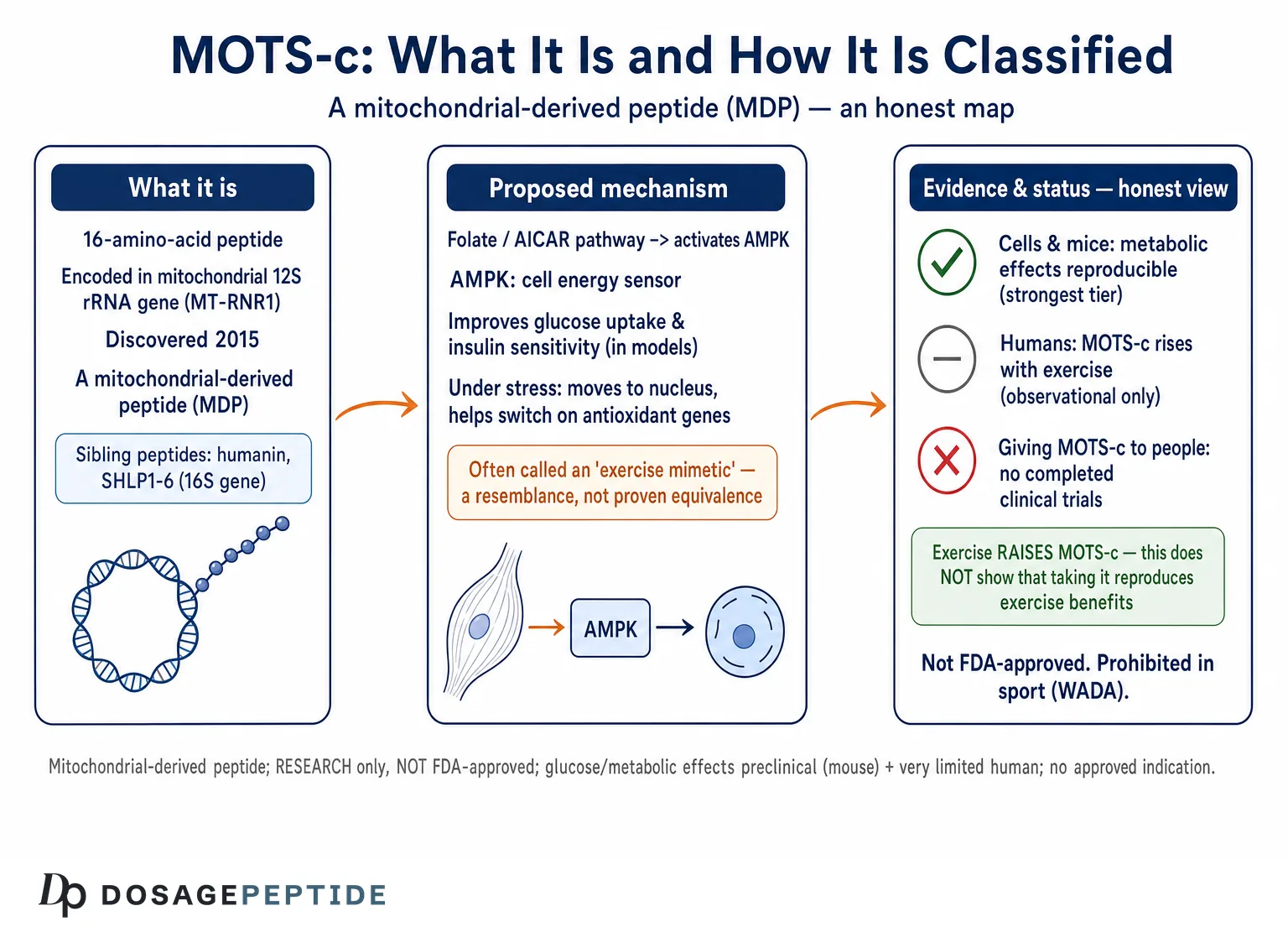
MOTS-c’s mechanism is where the classification “metabolic regulator” earns its keep, and it has two connected halves: a metabolic-signaling half and a transcriptional half.
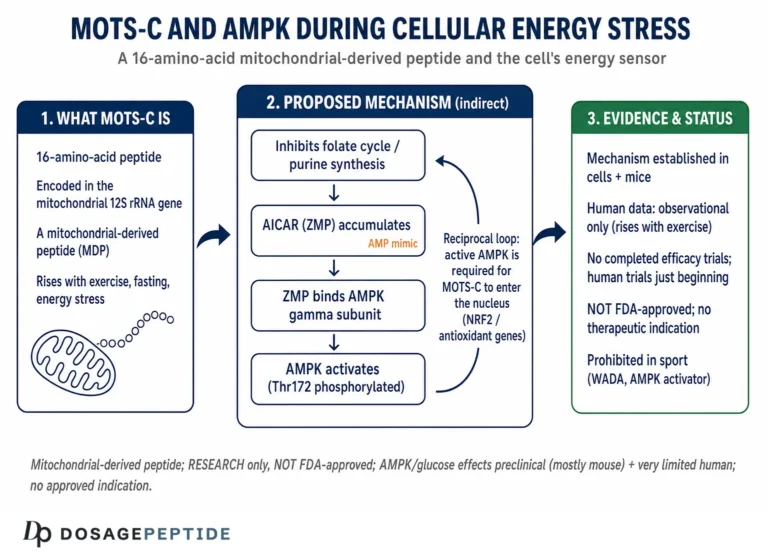
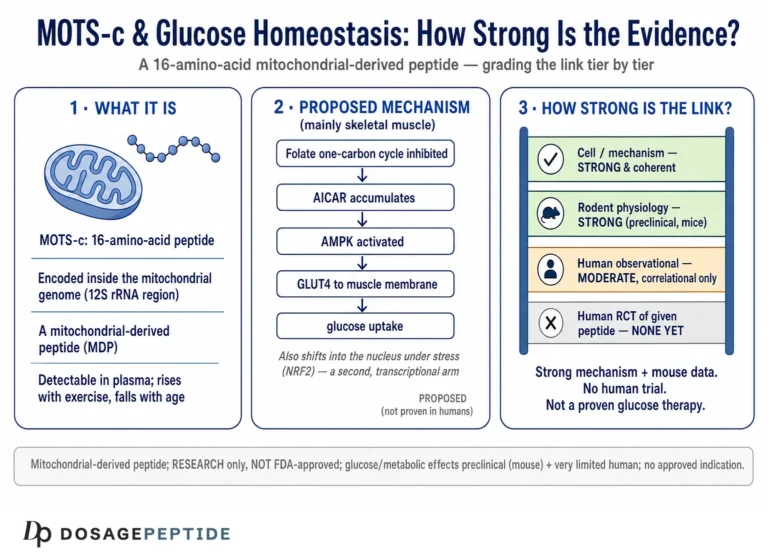
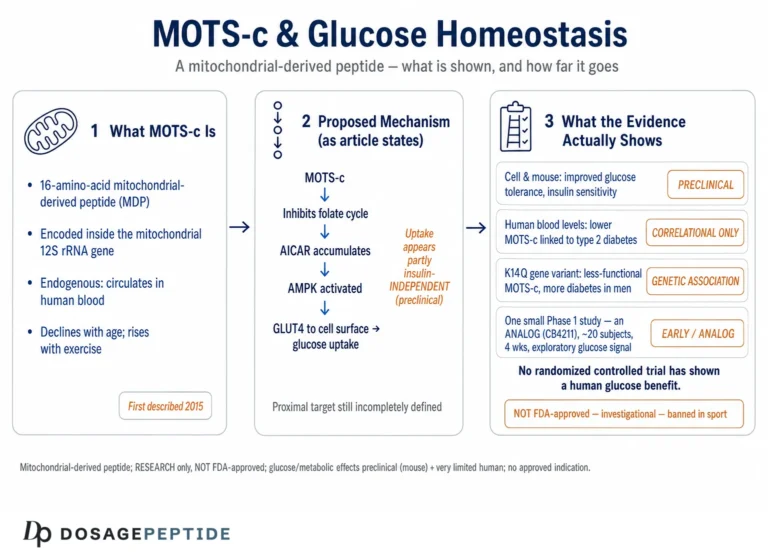
The metabolic half centers on AMPK, the cell’s master low-energy sensor. In the original characterization, MOTS-c’s primary target tissue appeared to be skeletal muscle, and its proposed action was to interfere with the folate one-carbon cycle and the de novo purine-synthesis pathway tethered to it. Inhibiting that pathway causes intracellular accumulation of the metabolite AICAR (5-aminoimidazole-4-carboxamide ribonucleotide), which is a potent endogenous activator of AMPK.1 Activated AMPK then does what it does throughout metabolic physiology: it promotes glucose uptake, shifts cells toward catabolism and fat oxidation, and dampens anabolic energy-consuming processes. This “Folate–AICAR–AMPK” axis is the most-cited mechanistic account of how MOTS-c improves glucose handling and insulin sensitivity in cell and rodent models.6 Because AMPK activation is also the pathway through which exercise and the drug metformin exert many of their metabolic effects, MOTS-c is frequently — and loosely — described as an “exercise mimetic,” a phrase that captures a mechanistic resemblance but overstates the proven equivalence.
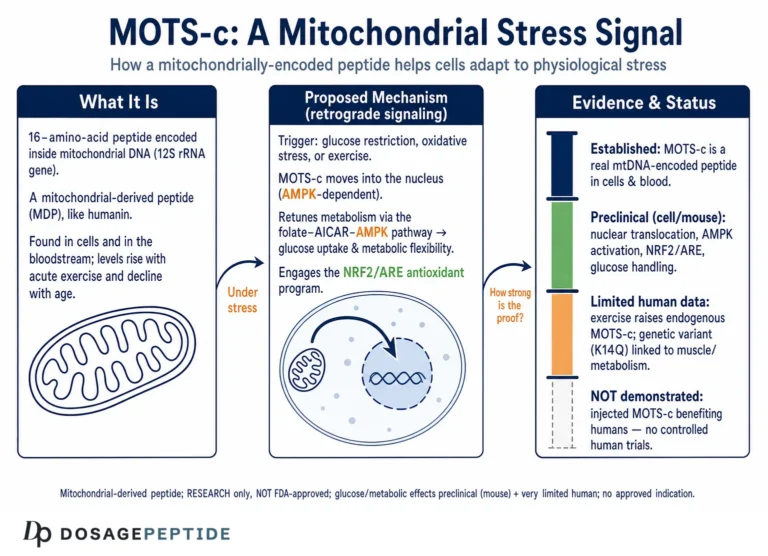
The transcriptional half is the more novel finding and the one that cements MOTS-c’s status as a retrograde signal. In a 2018 study, Kim and colleagues showed that under metabolic stress — glucose restriction, serum deprivation, or oxidative stress in cell culture — MOTS-c translocates from its usual location into the nucleus, and does so in an AMPK-dependent manner. Once in the nucleus, MOTS-c regulates a broad set of stress-responsive genes, including many that carry antioxidant response elements (AREs), and it interacts with the master antioxidant transcription factor NRF2 (NFE2L2).2 In other words, MOTS-c does not merely tweak a kinase in the cytoplasm; under duress it physically relocates to the nucleus and helps orchestrate the cell’s antioxidant and adaptive-stress program. More recent work has extended this nuclear, antioxidant-gene-activating role into other injury models, such as lung ischemia-reperfusion, reinforcing that the transcriptional arm is reproducible across contexts even though it remains preclinical.10
A useful way to hold the two halves together is to think of MOTS-c as a metabolic-state reporter. Under ordinary conditions it participates in the fine-tuning of glucose and energy handling through AMPK. When the cell is pushed — by fasting, by exercise, by oxidative insult — MOTS-c shifts gears, moving to the nucleus and helping to switch on the adaptive and antioxidant programs the cell needs to survive the stress. That dual role, a housekeeping metabolic function in calm times and an emergency transcriptional function under duress, is exactly what you would expect of a signal originating in the organelle that senses the cell’s energy status most directly. It is an elegant model, well-motivated by the data — but “elegant and well-motivated” describes a hypothesis worth pursuing, not an established human physiology.
Both halves come with the same honest qualification: they are established primarily in cells and mice. The AMPK and one-carbon-metabolism model is well-supported mechanistically in those systems, and the nuclear-translocation finding is a genuine and independently interesting result. But mechanism is not efficacy. Demonstrating that a molecule activates AMPK and modulates NRF2-linked genes in a dish or a mouse tells you how it might act; it does not tell you that administering it to humans safely improves any health outcome. The pathway is real; the clinical payoff is unproven. This is the same discipline required when reading about incretin biology in the metabolic-peptide space more broadly, as discussed in the site’s overview of how tirzepatide improves fat loss and insulin sensitivity in clinical research — the crucial difference being that tirzepatide’s metabolic claims rest on large completed human trials, whereas MOTS-c’s do not.
What the Evidence Actually Shows: Preclinical Strength, Human Thinness
An honest classification of MOTS-c has to include a classification of its evidence, because that is where enthusiasm most often outruns data. The evidence falls into three tiers of decreasing volume and increasing relevance to human health.
Tier one: cell and rodent metabolism. This is the deepest tier. In the founding 2015 work, MOTS-c increased glucose uptake in cultured muscle cells, and intraperitoneal administration to mice improved insulin sensitivity, reduced diet-induced obesity, and reversed age-dependent and high-fat-diet-induced insulin resistance.1 Subsequent rodent studies extended the metabolic story to exercise capacity, cardiac function in diabetic and exercise-trained animals, and bone and inflammatory endpoints.79 These are real, peer-reviewed findings, and collectively they justify classifying MOTS-c as a metabolically active peptide in animal models. They do not, individually or together, establish human efficacy.
Tier two: exercise-induced regulation in humans. The most translationally important human data come from a 2021 Nature Communications study by Reynolds and colleagues, which combined mouse experiments with human sampling. In mice, MOTS-c improved running capacity across young, middle-aged, and older animals. In humans, an acute bout of cycling in a small cohort of young men produced roughly a 12-fold increase in MOTS-c messenger RNA in skeletal muscle and about a 1.6-fold increase in circulating MOTS-c.4 Additional human observational work has reported that skeletal-muscle MOTS-c expression is actually higher in older and middle-aged men than in young men, and that resting plasma MOTS-c is positively associated with muscle quality (maximal leg-press load relative to thigh cross-sectional area) in older men.8 This tier is genuinely valuable: it shows that MOTS-c is an endogenous, exercise-responsive molecule in people, which supports its physiological relevance. But note carefully what it shows — that exercise raises MOTS-c, not that giving MOTS-c reproduces the benefits of exercise. The direction of that inference is the single most common error in popular coverage.
Tier three: administering MOTS-c to humans. This tier is essentially empty. There are no completed, published, adequately powered randomized controlled trials demonstrating that exogenous MOTS-c administration treats or prevents obesity, type 2 diabetes, sarcopenia, cardiovascular disease, or aging in humans. What circulates instead is a mixture of small observational studies, mechanistic reviews, and a large volume of commercial and anecdotal material. The gap between tiers two and three is the whole ballgame for anyone tempted to read MOTS-c as a validated therapy: the human data describe MOTS-c’s behavior as a natural signal, not its performance as a drug.
| Evidence tier | What it establishes | What it does NOT establish |
|---|---|---|
| Cell & rodent metabolism1 | MOTS-c activates AMPK, improves glucose handling and insulin sensitivity in models | Any human clinical benefit |
| Human observational studies48 | MOTS-c is endogenous, rises acutely with exercise, and its muscle expression / plasma level tracks age and muscle quality in people | That giving MOTS-c reproduces exercise benefits |
| Human administration trials | — (no completed RCTs) | Efficacy, dosing, or long-term safety of exogenous MOTS-c in humans |
There is a further pattern worth naming, because it recurs across the aging and longevity peptide literature: reported declines of MOTS-c with age. Several studies have observed that circulating MOTS-c, like several other MDPs, tends to be lower in older individuals and in some disease states, which has fueled the appealing narrative that “topping up” a declining youth-associated peptide might restore youthful function. This reasoning is intuitive and almost certainly too simple. Age-associated decline of a biomarker does not establish that the decline is causal, that it is harmful rather than adaptive, or that supplementation would reverse anything — the history of hormone-replacement enthusiasm is full of biomarkers that fell with age but whose replacement did not deliver the hoped-for rejuvenation and sometimes caused harm. An observed age-related decline in MOTS-c is a legitimate reason to study the peptide further; it is not, on its own, a rationale for administering it, and it should not be presented as one.
The fair summary is that MOTS-c has strong preclinical credentials as a metabolic and stress-adaptive peptide, meaningful human evidence that it is a real exercise-responsive signal, and no controlled human evidence that it works as an administered therapeutic. That is a legitimate and interesting scientific profile. It is simply not the profile of an approved or validated treatment, and it should never be described as one.
Genetic Variation and the Longevity Question
Because MOTS-c is encoded in mitochondrial DNA, it is subject to the same inherited sequence variation as the rest of the mitochondrial genome — and one particular variant has generated an outsized amount of both scientific interest and popular myth-making. Examining it carefully is a good stress test of how honestly the field handles its own claims.
The variant is a single-nucleotide polymorphism, m.1382A>C, which changes the 14th amino acid of MOTS-c from lysine to glutamine — the so-called K14Q variant. This polymorphism is found predominantly in Northeast Asian populations. An early and much-repeated hypothesis proposed that this variant might contribute to the exceptional longevity of Japanese populations, and the idea of a “longevity peptide variant” spread quickly.5 The subsequent, more careful work tells a more sober and more interesting story.
A 2021 analysis by Zempo, Fuku, and colleagues examined the K14Q variant across large cohorts and reached conclusions that cut against the simple longevity narrative. The expanded data indicated that the m.1382A>C variant does not straightforwardly extend lifespan. Instead, a meta-analysis across roughly 27,500 participants found that the C-allele was associated with a higher prevalence of type 2 diabetes in men but not women, and that this risk was concentrated in men with low physical activity — a gene-by-lifestyle (“kinesio-genomic”) interaction.5 Mechanistically, the K14Q form of the peptide appears to be less biologically active: high-fat-fed male mice given wild-type MOTS-c lost weight and improved their glucose tolerance, whereas mice given the K14Q variant did not.5 Separately, the K14Q polymorphism has been associated in human studies with muscle-fiber composition and muscular-performance traits, further linking MOTS-c genetics to metabolic and musculoskeletal biology.12
Two lessons follow, and both are about honesty. First, the polymorphism story reclassifies MOTS-c genetics away from a feel-good “longevity gene” and toward a more nuanced picture in which a less-active variant may carry metabolic risk that is modifiable by physical activity. That is a more scientifically credible and more useful finding than the longevity headline it replaced. Second, it is a cautionary tale about how fast a preliminary hypothesis can harden into a marketing claim: “the longevity peptide of Japanese centenarians” is a phrase that survives in commercial copy long after the underlying science moved on. Anyone classifying MOTS-c should classify its claims too — and this one belongs in the “initially proposed, subsequently complicated” bin.
MOTS-c Compared With Its MDP Siblings and With Metabolic Drug Classes
Classification is clarified by contrast, so it helps to place MOTS-c beside both its own family and the better-validated metabolic agents it is sometimes confused with. Within the MDP family, the useful distinctions are genomic locus and dominant function, already tabulated above. The sharper point is that MDPs share a conceptual identity — mitochondrially encoded retrograde signals — without sharing a single mechanism or a single therapeutic promise. Humanin is studied mostly for neuroprotection and cytoprotection; SHLP2 for insulin sensitization and, more recently, for protecting bone-forming cells against oxidative stress; MOTS-c for AMPK-linked metabolic regulation and exercise physiology.23 They are cousins by genome, not by job.
The contrast with approved or advanced metabolic drug classes is where honesty matters most, because MOTS-c is marketed in the same breath as compounds whose evidence base dwarfs its own. Consider the difference in kind, not merely degree:
| Agent / class | Core mechanism | Highest level of human evidence | Regulatory status |
|---|---|---|---|
| Incretin agonists (e.g., tirzepatide) | GLP-1 / GIP receptor agonism | Large phase 3 RCTs with weight and glycemic endpoints | FDA-approved for specified indications |
| Metformin | AMPK-linked; hepatic glucose output reduction | Decades of RCTs and outcome data | FDA-approved |
| Humanin (MDP) | Cytoprotection / anti-apoptosis | Preclinical; limited human observational | Not approved |
| MOTS-c (MDP) | Folate–AICAR–AMPK; nuclear NRF2 signaling | Preclinical + human exercise-response observation; no administration RCTs | Not approved; prohibited in sport |
The table makes the honest hierarchy visible. MOTS-c and metformin both touch AMPK, but one is a natural exercise-responsive peptide with no human efficacy trials and the other is a generic medicine with a half-century of outcome data. MOTS-c and tirzepatide are both discussed as “metabolic peptides,” but tirzepatide’s fat-loss and glycemic claims rest on large randomized trials, while MOTS-c’s rest on mice and mechanistic inference. Grouping them by superficial resemblance — “they all help metabolism” — is precisely the category error this article exists to prevent. For a sense of how much the fat-loss claims differ across the metabolic-peptide landscape, readers can compare MOTS-c’s thin human record with the more developed (though still not FDA-approved) picture for AOD-9604 in the site’s review of the clinical-trial evidence on AOD-9604’s fat-burning potential; the broader catalog of how these compounds are organized is available through the central dosages index.
None of this diminishes MOTS-c as a research object. As a probe of retrograde mitochondrial signaling and AMPK-linked metabolic adaptation, it is genuinely valuable and has opened a productive field. Its proper classification is as an endogenous signaling peptide of high scientific interest and unproven therapeutic value — a description that is both accurate and, for a careful reader, quite exciting on its own terms.
Handling and Reconstitution in a Research Context
Because MOTS-c is most often encountered as a lyophilized (freeze-dried) powder in a sealed vial, a brief and strictly educational note on laboratory handling is warranted — with the explicit caveat that this describes standard research-peptide practice and is not a usage recommendation, and that MOTS-c is not an approved therapeutic for any human indication.
Lyophilized peptides are generally reconstituted with sterile or bacteriostatic water for laboratory purposes. The diluent is directed slowly against the inner wall of the vial rather than sprayed onto the powder, and the vial is gently swirled rather than shaken, because vigorous agitation can shear peptide bonds and denature the material. The volume of diluent chosen simply sets the concentration: a fixed mass of peptide dissolved in a larger volume yields a lower concentration per unit volume, which is the arithmetic behind any reconstitution chart. General, compound-agnostic walkthroughs of this arithmetic appear in the site’s peptide reconstitution guide, which is provided for educational reference rather than as guidance for human use.
| Parameter | Typical research-context practice |
|---|---|
| Lyophilized storage | Cool, dark conditions; long-term stability favored by freezing |
| After reconstitution | Refrigerated; used within a limited window |
| Light and heat | Minimize exposure; both degrade peptides |
| Agitation | Swirl gently; avoid shaking or foaming |
| Freeze-thaw | Repeated cycles degrade peptides; avoid |
| Sterility | Aseptic technique; bacteriostatic water for multi-use practice |
It bears repeating that meticulous handling changes nothing about the evidence question. A perfectly reconstituted, high-purity vial of MOTS-c is still a compound without completed human efficacy trials, and good technique preserves whatever biological activity the molecule has without creating clinical validation where none exists. It is also worth naming a real practical hazard: because MOTS-c is sold outside regulated pharmaceutical channels as a “research chemical,” material varies in purity and provenance, and impurities, endotoxin, and mislabeling are genuine risks that have nothing to do with the molecule’s intrinsic biology and everything to do with sourcing. Definitions of the technical terms used throughout this article can be found in the site’s peptide glossary.
Regulatory and Anti-Doping Status
The regulatory classification of MOTS-c is unambiguous in a way that its scientific classification is not, and it is frequently misrepresented in marketing, so precision is essential.
No therapeutic approval, anywhere. MOTS-c is not approved as a drug for obesity, type 2 diabetes, sarcopenia, aging, cardiovascular disease, or any other condition by the U.S. Food and Drug Administration, the European Medicines Agency, or any comparable major regulator. It has not completed the clinical-trial process required for such approval. Any product presenting MOTS-c as a treatment for a disease is making a claim unsupported by regulatory review.
Prohibited in sport. The World Anti-Doping Agency (WADA) lists MOTS-c as a prohibited substance. It falls under Section S4 (Hormone and Metabolic Modulators), specifically as an activator of AMP-activated protein kinase (AMPK), and it is banned at all times — both in and out of competition. Anti-doping authorities have noted that because there is no approved medical use for MOTS-c, there is no basis for a therapeutic-use exemption.11 For any athlete subject to WADA-compliant testing, use should be assumed to constitute an anti-doping rule violation regardless of the underlying pharmacology.
The “exercise mimetic” framing and its regulatory shadow. Part of why MOTS-c is banned is precisely the property that makes it interesting: if it genuinely reproduced some of the metabolic effects of exercise, it would be attractive as a performance enhancer, which is exactly the use anti-doping rules exist to prevent. The regulatory posture is therefore a useful reality check on the science. Regulators treat MOTS-c as a potent, incompletely characterized metabolic modulator with no established safety-and-efficacy dossier — a stance consistent with the honest scientific picture of a compound rich in preclinical promise and poor in human trial data.
The synthesis is straightforward: MOTS-c occupies a regulatory limbo that mirrors its evidentiary one. It is not a medicine, not a supplement with recognized efficacy, and not permitted in competitive sport — it is an experimental substance. Legitimate investigation of MOTS-c belongs within properly authorized preclinical and clinical research under appropriate oversight, not in off-label or informal human use.
Frequently Asked Questions
What is MOTS-c in one sentence?
MOTS-c is a 16-amino-acid peptide encoded by a short open reading frame within the mitochondrial 12S ribosomal-RNA gene, discovered in 2015, that acts in cell and animal studies as a metabolic regulator via the AMPK energy-sensing pathway.1 It is an endogenous signaling molecule of high research interest, not an approved medicine.
What makes something a “mitochondrial-derived peptide,” and does MOTS-c qualify?
The working definition of an MDP is a peptide whose coding sequence lies in the mitochondrial genome (typically nested in a ribosomal-RNA gene), that can be detected as an endogenous peptide, and that shows biological activity related to stress resistance, metabolism, or survival.6 MOTS-c meets all three criteria, so it qualifies. Importantly, this is a working scientific convention on a young frontier, not a finalized, standards-body nomenclature.
How is MOTS-c classified relative to humanin and the SHLPs?
By genomic locus, MOTS-c stands apart: it is encoded in the 12S rRNA gene (MT-RNR1), whereas humanin and the six small humanin-like peptides (SHLP1–6) are all encoded in the 16S rRNA gene (MT-RNR2).6 By function, humanin is chiefly cytoprotective/neuroprotective, the SHLPs are functionally varied, and MOTS-c is chiefly a metabolic regulator.13 MOTS-c is therefore often treated as its own subgroup rather than a humanin relative.
Is MOTS-c really translated inside the mitochondrion?
Probably not in its full-length form. Because the mitochondrial genetic code reads certain codons differently (for example, AGA as a stop signal), the complete MOTS-c peptide is thought to require translation in the cytoplasm using the standard genetic code, even though the coding sequence is mitochondrial.1 The exact translation site and efficiency remain active research questions, but the mitochondrial origin of the gene — the defining MDP criterion — is not in dispute.
Does MOTS-c actually work in humans?
There is no completed randomized controlled trial showing that administering MOTS-c to people treats or prevents any disease. The strongest human data are observational: MOTS-c is an endogenous peptide that rises acutely in muscle and blood after exercise,4 and whose muscle expression and plasma level track age and muscle quality.8 That shows MOTS-c is a real exercise-responsive signal — it does not show that taking MOTS-c reproduces the benefits of exercise. The bulk of efficacy evidence remains preclinical (cells and mice).1
Is MOTS-c the “longevity peptide” of Japanese centenarians?
That claim reflects an early hypothesis that has since been complicated. The K14Q variant (from the m.1382A>C polymorphism) was initially linked to longevity, but larger analyses found it does not straightforwardly extend lifespan; instead the variant is a less active form associated with higher type 2 diabetes prevalence in physically inactive men.5 The “longevity peptide” label persists mainly in marketing, not in the current evidence.
Is MOTS-c legal or approved?
MOTS-c is not approved as a drug for any condition by the FDA, EMA, or other major regulators, and it is prohibited in sport by WADA as an AMPK-activating metabolic modulator (Section S4), banned in and out of competition with no therapeutic-use exemption available.11 It is best classified as an experimental research substance.
How does MOTS-c differ from metabolic drugs like tirzepatide or metformin?
They differ in evidence, not just mechanism. Metformin (an AMPK-linked agent) and tirzepatide (an incretin-receptor agonist) are FDA-approved medicines backed by large human trials and outcome data. MOTS-c shares AMPK biology with metformin but has no completed human administration trials and no approval.1 Grouping them as interchangeable “metabolic peptides” conflates a validated drug class with an experimental peptide.
How is MOTS-c handled in a research setting?
As a lyophilized powder, it is reconstituted with sterile or bacteriostatic water using gentle technique (swirl, do not shake), stored cool and dark, and protected from repeated freeze-thaw cycles — standard research-peptide practice.6 Handling quality preserves activity but has no bearing on the absence of human efficacy data, and material sold outside regulated channels varies in purity.
References
- Lee C, Zeng J, Drew BG, et al. The mitochondrial-derived peptide MOTS-c promotes metabolic homeostasis and reduces obesity and insulin resistance. Cell Metab. 2015;21(3):443-454. PMID 25738459. https://pubmed.ncbi.nlm.nih.gov/25738459/
- Kim KH, Son JM, Benayoun BA, Lee C. The mitochondrial-encoded peptide MOTS-c translocates to the nucleus to regulate nuclear gene expression in response to metabolic stress. Cell Metab. 2018;28(3):516-524.e7. PMID 29983246. https://pubmed.ncbi.nlm.nih.gov/29983246/
- Cobb LJ, Lee C, Xiao J, et al. Naturally occurring mitochondrial-derived peptides are age-dependent regulators of apoptosis, insulin sensitivity, and inflammatory markers. Aging (Albany NY). 2016;8(4):796-809. PMID 27070352. PMCID PMC4925829. https://pubmed.ncbi.nlm.nih.gov/27070352/
- Reynolds JC, Lai RW, Woodhead JST, et al. MOTS-c is an exercise-induced mitochondrial-encoded regulator of age-dependent physical decline and muscle homeostasis. Nat Commun. 2021;12(1):470. PMID 33473109. https://pubmed.ncbi.nlm.nih.gov/33473109/
- Zempo H, Kim SJ, Fuku N, et al. A pro-diabetogenic mtDNA polymorphism in the mitochondrial-derived peptide, MOTS-c. Aging (Albany NY). 2021;13(2):1692-1717. PMID 33468709. https://pubmed.ncbi.nlm.nih.gov/33468709/
- Wan W, Zhang L, Lin Y, et al. Mitochondria-derived peptide MOTS-c: effects and mechanisms related to stress, metabolism and aging. J Transl Med. 2023;21(1):36. PMID 36670490. PMCID PMC9854231. https://pmc.ncbi.nlm.nih.gov/articles/PMC9854231/
- Yuan J, Wang M, Pan Y, et al. The mitochondrial signaling peptide MOTS-c improves myocardial performance during exercise training in rats. Sci Rep. 2021. PMID 34635713. PMCID PMC8505603. https://pmc.ncbi.nlm.nih.gov/articles/PMC8505603/
- D’Souza RF, Woodhead JST, Hedges CP, et al. Increased expression of the mitochondrial derived peptide, MOTS-c, in skeletal muscle of healthy aging men is associated with myofiber composition. Aging (Albany NY). 2020;12(6):5244-5258. PMID 32182209. PMCID PMC7138593. https://pmc.ncbi.nlm.nih.gov/articles/PMC7138593/
- Zheng Y, Wei Z, Wang T. MOTS-c: a promising mitochondrial-derived peptide for therapeutic exploitation. Front Endocrinol (Lausanne). 2023. PMID 36761202. PMCID PMC9905433. https://pmc.ncbi.nlm.nih.gov/articles/PMC9905433/
- Li X, Zhan F, Qiu G, et al. MOTS-c attenuates lung ischemia-reperfusion injury via MYH9-dependent nuclear translocation and transcriptional activation of antioxidant genes. Redox Biol. 2025;84:103681. PMID 40403491. PMCID PMC12150175. https://pmc.ncbi.nlm.nih.gov/articles/PMC12150175/
- U.S. Anti-Doping Agency (USADA). What is the MOTS-c peptide? (Prohibited under WADA Section S4, AMPK activators.) https://www.usada.org/spirit-of-sport/what-is-mots-c-peptide/
- Kumagai H, Natsume T, Kim SJ, et al. The MOTS-c K14Q polymorphism in the mtDNA is associated with muscle fiber composition and muscular performance. Biochim Biophys Acta Gen Subj. 2021. PMID 34728329. PMCID PMC8741734. https://pmc.ncbi.nlm.nih.gov/articles/PMC8741734/
- Kal S, Mahata S, Jati S, Mahata SK. Mitochondrial-derived peptides: antidiabetic functions and evolutionary perspectives. Peptides. 2024. PMID 38160808. PMCID PMC10838678. https://pmc.ncbi.nlm.nih.gov/articles/PMC10838678/
Educational and research-use disclaimer: This article is provided solely for scientific and educational purposes. MOTS-c is an experimental, mitochondrially encoded peptide that is not approved by the FDA, EMA, or any comparable regulator for the treatment, cure, or prevention of obesity, type 2 diabetes, sarcopenia, aging, cardiovascular disease, or any other condition. Its metabolic and stress-adaptive effects are established primarily in cell and rodent studies; human data are largely observational (chiefly exercise-response studies), and no completed randomized controlled trials demonstrate efficacy of administered MOTS-c in people. MOTS-c is prohibited in sport by the World Anti-Doping Agency. Nothing here is medical advice or a recommendation for human use. Any legitimate investigation of this compound should occur within properly authorized preclinical or clinical research under appropriate oversight. Readers should consult qualified professionals and applicable regulations before making any decisions.