AICAR is not a peptide, despite being sold alongside them. It is a nucleoside analogue — a small molecule related to adenosine — that cells convert into ZMP, an AMP mimic that switches on AMP-activated protein kinase (AMPK), the enzyme a cell uses to sense that it is running low on energy.
Its reputation rests almost entirely on one 2008 mouse study in which sedentary animals given AICAR ran substantially farther than untreated controls. That is where the “exercise in a pill” headline came from, and no human trial has since reproduced that endurance benefit. AICAR is prohibited at all times under the WADA list, it is not approved for therapeutic use anywhere in the world, and a systematic review has shown that a large share of what it does in cells does not run through AMPK at all. What follows is the mechanism, what the evidence supports, and what it does not.
Research Context: What Is AICAR and Why Is It Studied?
AICAR is the common laboratory shorthand for 5-aminoimidazole-4-carboxamide-1-β-D-ribofuranoside, a small-molecule nucleoside analog. In the pharmacology and clinical-trials literature the same compound appears under the international nonproprietary name acadesine, and biochemists often refer to it as AICA riboside. All three names — AICAR, acadesine, and AICA riboside — describe one molecule. This naming tangle matters, because a reader who searches each term separately will find three literatures that are really one, spanning basic muscle physiology, oncology, and cardiac surgery.
The reason AICAR is studied at all is that it is one of the earliest and most widely used pharmacological tools for switching on AMP-activated protein kinase (AMPK), a master regulator of cellular energy balance. For roughly three decades, when a laboratory wanted to ask “what happens to a cell, a muscle, or a mouse when AMPK is activated?”, AICAR was a default reagent. That long history as a research tool is precisely why it accumulated a body of striking metabolic findings — and why those findings were later, and often inaccurately, repackaged as consumer promises.
The development history behind three names
The multiplicity of names is not merely academic; it reflects a genuine, decades-long pharmaceutical development history that most consumer discussion ignores entirely. Under the name acadesine (also carrying laboratory designations such as AICA riboside, ARA 100, arasine, and GP 1 110), the molecule was advanced by successive drug developers as an adenosine-regulating agent. Rights and data passed through several corporate hands over the years as the compound was pursued first for cardiovascular and cerebrovascular indications and later, separately, for B-cell chronic lymphocytic leukemia, for which it received orphan-drug status in the European Union.[13] The important takeaway for a lay reader is that the substantial clinical machinery ever built around this molecule was aimed at cardiac protection and hematologic malignancy — never at exercise performance, fat loss, or longevity. When a vendor implies that AICAR is “clinically studied,” that phrase quietly borrows credibility from a body of trials that were designed to answer completely different questions, and whose most rigorous results were negative or inconclusive.
Is AICAR a peptide?
No. This is the single most common factual error surrounding the compound. A peptide is a short chain of amino acids linked by peptide bonds; AICAR is a purine-biosynthesis intermediate — a ribonucleoside built from a modified imidazole base attached to a ribose sugar. It is chemically closer to the building blocks of DNA and ATP than to insulin or a growth-hormone secretagogue. It is grouped with “research peptides” only by the commercial channels that sell it, not by any pharmacological classification. Understanding that AICAR is a small-molecule AMP-mimetic rather than a peptide is essential to interpreting its mechanism, its pharmacokinetics, and its evidence base correctly. For readers building a working vocabulary of these compounds, our peptide and research-compound glossary lays out how nucleoside analogs, mitochondrial-derived peptides, and true peptides differ.
Where does the “exercise in a pill” framing come from?
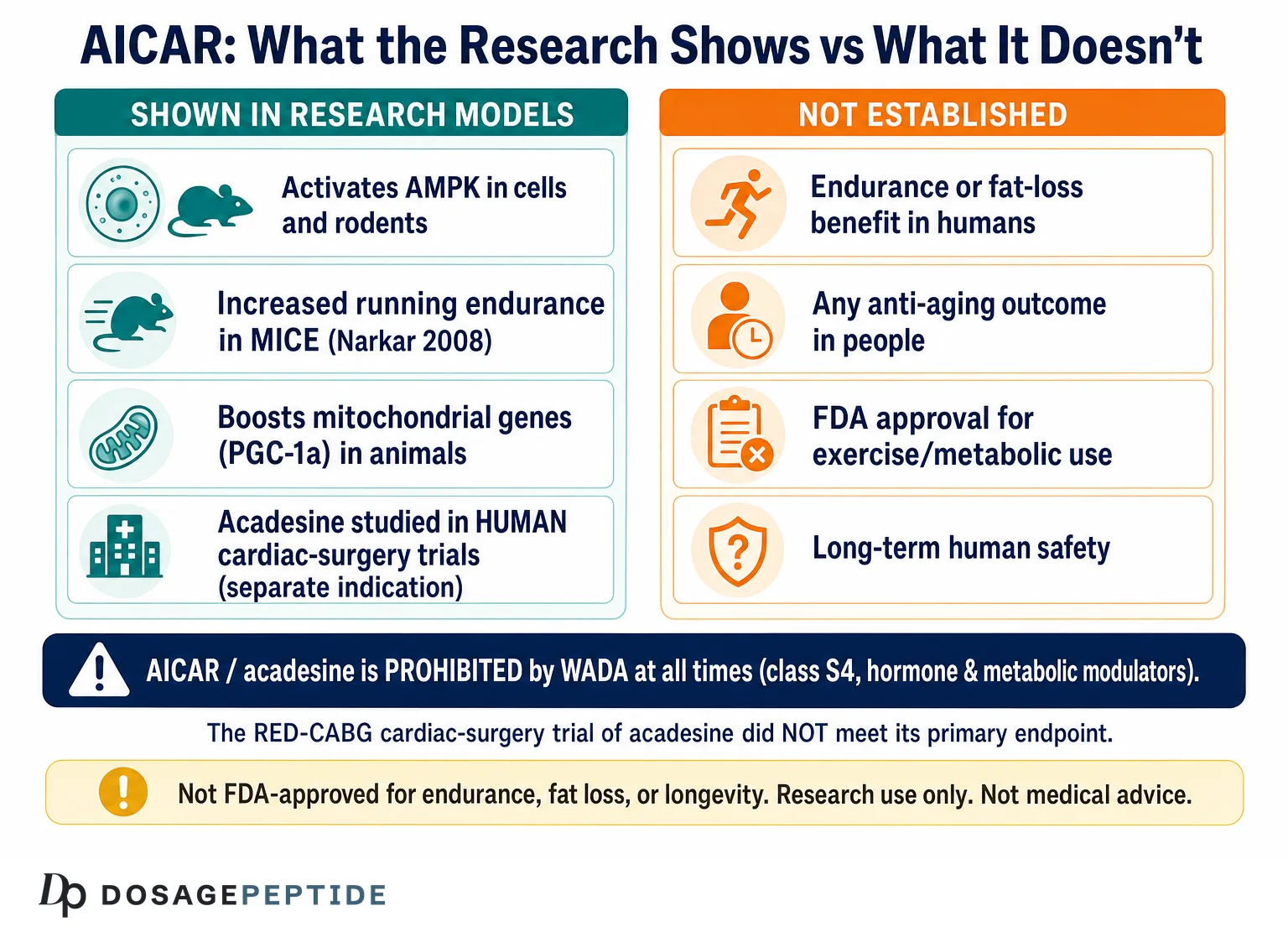
The phrase traces almost entirely to one paper: Narkar and colleagues, published in Cell in 2008, reported that four weeks of AICAR treatment increased treadmill running endurance in sedentary mice by approximately 44%, without any exercise training.[1] The popular science press compressed that result into “exercise in a pill,” and the research-chemical market has leaned on the framing ever since. The finding is real and was carefully done — but it was a rodent study, and, as we detail below, it has never been reproduced as a controlled endurance benefit in humans. The gap between “44% in sedentary mice” and “works in people” is the entire subject of the honesty discussion in this article.
Why the Cardiovascular & Longevity category?
AICAR sits in this category for two legitimate reasons and one aspirational one. Legitimately, AMPK is central to how cardiac and vascular tissue handles energy stress and ischemia, and acadesine was genuinely investigated in human cardiac-surgery trials as an adenosine-regulating agent meant to limit ischemia–reperfusion injury. Aspirationally, because AMPK activation overlaps mechanistically with the pathways engaged by caloric restriction and by longevity-associated compounds, AICAR is frequently discussed in anti-aging contexts. The first reason is evidence-based; the longevity framing is, at present, hypothesis and animal data only.
What Is the Molecular Identity and Chemistry of AICAR?
To interpret every downstream claim, it helps to be exact about what AICAR is and what it becomes inside a cell.
Structure and nomenclature
AICAR is the ribonucleoside form of an intermediate in the de novo purine biosynthesis pathway — the cellular assembly line that builds the adenine and guanine bases of nucleotides. Its aminoimidazole-carboxamide base carried on a ribose sugar makes it structurally recognizable to the enzymes that normally handle nucleotide precursors. Because a version of this intermediate is produced endogenously during purine synthesis, AICAR is not a wholly foreign chemical to the body; exogenous AICAR essentially floods a pathway the cell already operates.
ZMP: the active intracellular form
AICAR itself is relatively inert as a signaling molecule. Once transported into a cell (largely via adenosine transporters), it is phosphorylated by adenosine kinase to form ZMP (AICAR monophosphate). ZMP is the pharmacologically important species: it is a structural mimic of AMP (adenosine monophosphate), the nucleotide whose accumulation normally signals that a cell is running low on energy. Because ZMP looks enough like AMP to the regulatory machinery of AMPK, it can occupy AMP-sensing sites and switch the kinase on even when the cell’s true energy charge is normal.[3] This is the molecular heart of AICAR’s action: it is an AMP-mimetic that tricks a fuel gauge into reading “low.”
Endogenous versus exogenous AICAR
A consequence of AICAR being a natural metabolic intermediate is that low concentrations circulate in the body normally, and levels can rise with exercise. This creates a genuine complication for anti-doping science, discussed later: a foreign, orally or injected dose has to be distinguished analytically from the body’s own baseline. It also cautions against the intuition that “natural intermediate” equals “safe at pharmacological doses” — flooding a biosynthetic pathway well above physiological concentrations is a very different proposition from the trace amounts the body generates.
Specificity caveats of ZMP
An important nuance, recognized since the mid-1990s, is that ZMP does not act only on AMPK. Because ZMP is an AMP analog, it can influence other AMP-sensitive enzymes, and AICAR treatment therefore has effects that are not strictly “AMPK-mediated.” The original methodological paper introducing AICAR as an AMPK activator explicitly flagged this — the very title of Corton and colleagues’ 1995 study framed AICAR as “a specific method for activating AMP-activated protein kinase in intact cells?” with a deliberate question mark.[3] This is why modern mechanistic work rarely relies on AICAR alone and instead corroborates findings with genetic tools and newer, more selective AMPK activators.
Mechanisms Studied: How Does AICAR Activate AMPK and Its Downstream Targets?
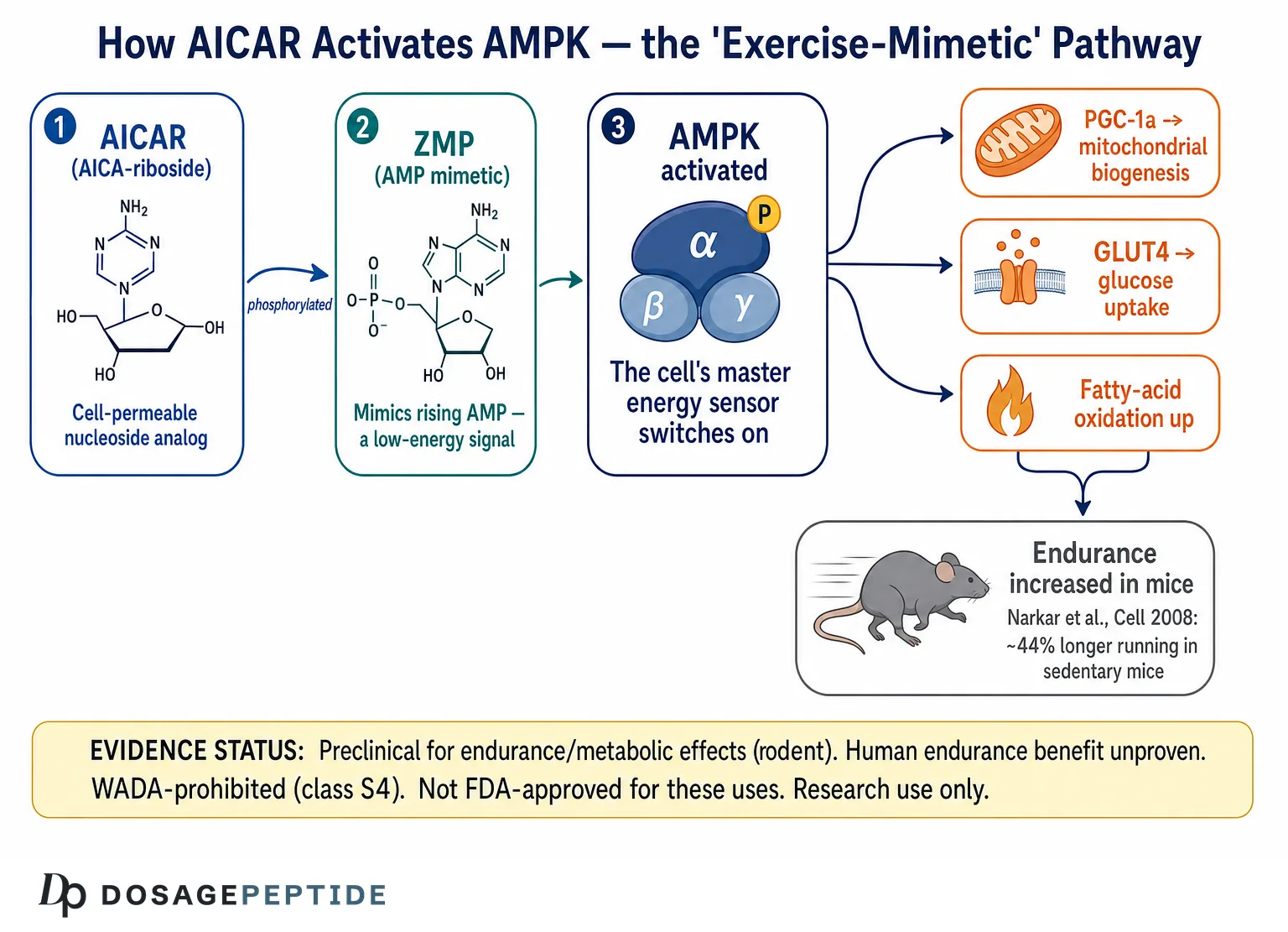
The mechanistic account below is well supported in cell and animal models. What follows is what has been demonstrated in experimental systems — not a description of guaranteed effects in humans taking the compound.
AMPK as the cellular energy sensor
AMPK is a heterotrimeric enzyme — a complex of a catalytic α subunit and regulatory β and γ subunits — that is conserved across essentially all eukaryotes. Its canonical job is to monitor the ratios of AMP, ADP, and ATP that bind competitively to the γ subunit. When energy runs low and AMP/ADP rise relative to ATP, AMPK is switched on; once active, it restores energy balance by turning on catabolic, ATP-generating pathways (glucose uptake, fatty-acid oxidation, mitochondrial biogenesis) and turning off ATP-consuming anabolic ones (fatty-acid, cholesterol, and protein synthesis).[5] Grahame Hardie and colleagues have emphasized that AMPK is more than a simple fuel gauge — it also responds to glucose availability through mechanisms that do not require changes in adenine nucleotides, and it contains a distinct allosteric drug-and-metabolite (ADaM) site where many synthetic activators bind.[5] Notably, AICAR/ZMP works through the AMP-sensing γ-subunit route, not the ADaM site.
The AMP-mimetic activation step
By generating ZMP intracellularly, AICAR produces allosteric activation of AMPK and also promotes the phosphorylation of AMPK’s activation loop (the threonine-172 residue on the catalytic α subunit) by upstream kinases. In muscle and most tissues the principal upstream kinase is the tumor-suppressor LKB1; a second, calcium-sensitive kinase (CaMKK2) can also phosphorylate the same site under different stimuli. Because ZMP binds the γ subunit and mimics AMP, it both directly nudges the enzyme into a more active conformation and makes that activating phosphorylation “stickier” by protecting it from removal by phosphatases — a two-pronged effect that explains why a modest intracellular ZMP concentration can produce a disproportionately large signaling output. The net result in treated muscle is a robust rise in AMPK activity that mirrors, in broad strokes, what contraction and energy stress produce naturally. Garcia and Shaw’s comprehensive review of AMPK signaling details how this activation cascades into dozens of downstream substrates coordinating metabolism, growth, and autophagy.[6] It is worth stressing that “more AMPK signaling” is not automatically desirable: the same pathway that promotes fat oxidation also restrains protein and cholesterol synthesis, so the physiological consequences depend heavily on tissue, dose, and duration.
ACC, malonyl-CoA, and fatty-acid oxidation
One of the earliest and most reproducible consequences of AICAR-driven AMPK activation is phosphorylation and inactivation of acetyl-CoA carboxylase (ACC). ACC produces malonyl-CoA, which normally inhibits the carnitine-palmitoyltransferase system that shuttles fatty acids into mitochondria for oxidation. When AMPK switches ACC off, malonyl-CoA falls, the brake on fat entry into mitochondria is released, and fatty-acid oxidation rises. In the classic perfused rat-hindlimb experiments of Merrill and colleagues, AICAR activated muscle AMPK, inactivated ACC, lowered malonyl-CoA, and produced a roughly 2.8-fold increase in fatty-acid oxidation together with increased glucose uptake.[2] Winder’s work situated this in the broader physiology of how contracting muscle regulates fuel selection.[4] A particularly telling follow-up showed how dominant this switch can be: in perfused rat hindlimb, insulin and elevated glucose normally suppress fatty-acid oxidation, but when AMPK was activated with AICAR, palmitate oxidation was maintained at an elevated level regardless of insulin concentration or the rate of glucose uptake — because AICAR held malonyl-CoA down and thereby kept the mitochondrial fat-entry gate open.[14] That experiment is a clean demonstration of the mechanism and, equally, of its limits as an inference about people: it is an isolated rodent muscle preparation under controlled perfusion, not a human eating, moving, and metabolizing across a day. This ACC–malonyl-CoA axis is the mechanistic basis for the “fat oxidation” interest in AICAR — demonstrated in isolated muscle and rodents, not established as a fat-loss therapy in people.
GLUT4 and insulin-independent glucose uptake
AMPK activation promotes translocation of the GLUT4 glucose transporter to the muscle-cell surface through a pathway partly independent of insulin signaling. This is why AICAR became a workhorse for studying “exercise-like” glucose uptake and insulin sensitization: contracting muscle and AICAR both increase glucose disposal without requiring insulin, which is conceptually attractive for insulin-resistant states in which the insulin-dependent route is impaired. The appeal is easy to see — a compound that opens a back door to glucose uptake could, in principle, help exactly the tissues that no longer respond well to insulin. But the same rodent and cell studies that establish this mechanism also show why it does not amount to a therapy: the effect requires pharmacological ZMP concentrations, it is entangled with the compound’s many other actions, and no controlled human trial has demonstrated durable improvement in glycemic control from AICAR administration. Again, this is a mechanism robustly shown in cells and rodents and used to model, not treat, metabolic disease.
PGC-1α and mitochondrial biogenesis
Chronic or repeated AMPK activation increases the expression and activity of PGC-1α (peroxisome proliferator-activated receptor-γ coactivator-1α), the transcriptional coactivator widely regarded as the master switch for mitochondrial biogenesis. Through PGC-1α, AICAR treatment in animal models drives expression of nuclear- and mitochondrial-encoded genes that expand mitochondrial content and oxidative capacity in skeletal muscle. This PGC-1α step is what links a short-term signaling event (AMPK activation) to a longer-term structural adaptation (more and better mitochondria) that resembles a training effect. It is also the node that connects AICAR to the mitochondrial-derived peptide literature, since compounds like MOTS-c converge on the same AMPK–PGC-1α axis. Our explainer on how MOTS-c regulates AMPK during cellular energy stress traces this shared signaling logic in detail.
The AMPK–PPARδ axis: the Narkar synthesis
The 2008 Narkar study’s conceptual contribution was to show that AMPK does not act alone but partners with the nuclear receptor PPARδ (PPARβ/δ) to reprogram muscle toward a more oxidative, endurance-adapted phenotype. In their experiments, a PPARδ agonist plus exercise synergistically increased oxidative myofibers and endurance; strikingly, the orally active AMPK agonist AICAR alone was sufficient to induce oxidative-metabolism genes and enhance endurance even without training.[1] The authors framed this as evidence that the AMPK–PPARδ pathway could be targeted pharmacologically to mimic aspects of training. That framing is scientifically defensible for mice; its extrapolation to human performance is not established.
What Did the Landmark Endurance Study Actually Show — and Not Show?
Because so much of AICAR’s reputation rests on a single experiment, it is worth stating precisely what that experiment did and did not demonstrate.
| Aspect of the 2008 Narkar study | What was actually shown |
|---|---|
| Model organism | Mice (C57BL/6), not humans |
| Key endurance result | ~44% increase in treadmill running endurance in sedentary mice after ~4 weeks of AICAR |
| Route | Orally active in mice; daily dosing over weeks |
| Mechanistic finding | Induction of oxidative-metabolism genes via AMPK–PPARδ; synergy of PPARδ agonist with training |
| What it did NOT show | Any human endurance benefit; any effect in trained (vs sedentary) animals of comparable magnitude; long-term safety |
The result is genuinely notable: a drug alone, with no exercise, shifted a whole-animal performance readout. But three caveats are load-bearing. First, the animals were sedentary; the incremental value of a drug is easiest to demonstrate against an untrained baseline, and it does not follow that an already-fit human would gain 44%. Second, rodent-to-human translation of metabolic drugs is notoriously unreliable, in part because of large differences in dose, pharmacokinetics, and body-surface scaling. Third, the study measured endurance capacity in a controlled treadmill test, not the multifactorial real-world outcomes (performance in sport, body composition over months, healthspan) that consumer messaging implies. The honest one-sentence summary is: AICAR increased endurance in sedentary mice through a plausible, well-mapped mechanism, and this has not been shown to translate to humans.
How Does AICAR Compare to Other AMPK-Activating Research Compounds?
AICAR is one of several distinct chemical strategies for engaging AMPK, and placing it alongside the others clarifies both its usefulness as a tool and its limits as a would-be therapeutic.
AICAR versus metformin
Metformin, the most widely prescribed type-2-diabetes drug, activates AMPK indirectly by mildly inhibiting mitochondrial complex I, which raises the cellular AMP/ATP ratio. Unlike AICAR, metformin has an enormous human safety and efficacy record — but for a licensed indication (glycemic control), not for endurance or longevity, where it is still under active investigation. The contrast is instructive: metformin shows that AMPK activation can be clinically useful and safe when the molecule has good pharmacokinetics and a defined indication, while also showing that decades of human data are what separate a medicine from a mechanism. It is also a caution against the intuitive leap that “AICAR and metformin both activate AMPK, therefore AICAR should share metformin’s benefits.” The two engage the pathway by entirely different routes — metformin indirectly, by raising the AMP/ATP ratio through complex-I inhibition; AICAR directly, through an AMP-mimetic metabolite — and they differ enormously in oral absorption, tissue distribution, and off-target profile. A shared node in a signaling diagram does not translate into a shared clinical outcome, and even metformin’s much-discussed longevity potential remains, for now, a hypothesis under formal investigation rather than an established effect. If a drug with metformin’s vast, reassuring human record is still considered unproven for anti-aging, a research chemical with no such record plainly cannot claim more.
AICAR versus direct/allosteric activators
Newer synthetic AMPK activators (such as the ADaM-site binders developed by several pharmaceutical programs) bind AMPK directly and selectively, avoiding the off-target AMP-mimetic effects of ZMP.[5] Their existence is part of why AICAR is increasingly a legacy tool rather than a drug candidate: if the goal is clean AMPK activation, better molecules now exist.
AICAR versus mitochondrial-derived peptides (MOTS-c)
Perhaps the most conceptually interesting comparison is with MOTS-c, a 16-amino-acid peptide encoded within mitochondrial DNA. Lee and colleagues showed that MOTS-c targets the folate cycle and de novo purine biosynthesis, leading to accumulation of AICAR itself and consequent AMPK activation.[9] In other words, one proposed mechanism of a natural mitochondrial peptide is to raise endogenous AICAR — a remarkable convergence. Later work reinforced that MOTS-c and exercise cooperate to regulate PGC-1α and glucose metabolism through AMPK.[10] This shared node is why researchers interested in AICAR often also study these peptides; our overview of what MOTS-c is and how it is classified among mitochondrial-derived peptides situates that relationship.
| Compound | How it engages AMPK | Human evidence status |
|---|---|---|
| AICAR / acadesine | Converted to ZMP, an AMP-mimetic at the γ subunit | Human trials only for cardiac surgery & oncology (different endpoints); no endurance/longevity trials |
| Metformin | Indirect (complex I inhibition → ↑AMP/ATP) | Approved for type-2 diabetes; longevity use investigational |
| ADaM-site activators | Direct allosteric binding | Preclinical / early clinical; investigational |
| MOTS-c | Raises endogenous AICAR via folate/purine cycle | Preclinical (animal/cell); no approved use |
Current Evidence Level: What Has and Hasn’t Been Tested in Humans?
This is the section where precision matters most, because the AICAR literature contains a genuine trap: the same molecule has been in large human trials, but for indications completely unrelated to the exercise and longevity uses that drive consumer interest. Conflating the two is the most common way AICAR is misrepresented.
The preclinical exercise/metabolic evidence
For endurance, fat oxidation, glucose uptake, mitochondrial biogenesis, and insulin sensitization, the AICAR evidence base is preclinical — isolated tissues, cell culture, and rodent studies.[1][2] This body of work is substantial and internally consistent, and it makes AICAR a legitimately important tool compound. But there are no controlled human trials demonstrating that AICAR improves athletic performance, reduces body fat, extends healthspan, or reverses insulin resistance as a treatment. Statements to that effect are not supported by human data.
The human clinical program — a different indication entirely
Acadesine (AICAR) genuinely reached large, rigorous human trials — as an adenosine-regulating agent intended to reduce ischemia–reperfusion injury during coronary-artery-bypass-graft (CABG) surgery. The pivotal study, the RED-CABG trial, was a randomized, double-blind, placebo-controlled evaluation across 300 sites in seven countries. Its primary composite endpoint was all-cause mortality, nonfatal stroke, or need for mechanical support for severe left-ventricular dysfunction through postoperative day 28. The trial was stopped for futility after 3,080 of a planned 7,500 patients: the primary outcome occurred in 5.0% of the placebo group and 5.1% of the acadesine group (odds ratio 1.01; 95% CI 0.73–1.41), with no difference in key secondary endpoints.[7] A subsequent analysis of the RED-CABG cohort examined predictors of surgical outcomes but did not resurrect an efficacy signal for the drug.[8] In plain terms: in its largest, best-designed human test, acadesine did not work for its intended cardiac-surgery indication.
Separately, acadesine has been investigated in hematologic-oncology settings, exploiting the observation that it can selectively trigger death of malignant B-cells while relatively sparing T-cells. This line of work advanced to a phase I/II clinical trial in patients with relapsed or refractory chronic lymphocytic leukemia, and in the EU the molecule was granted orphan-drug status for B-cell chronic lymphocytic leukemia.[13] Preclinical oncology research has continued to probe combinations — for instance, acadesine showed synergistic anti-tumor activity with the anti-CD20 antibody rituximab in cell-line and xenograft models of mantle cell lymphoma, with gene-expression analysis pointing to effects on metabolic stress, apoptosis, and inflammation.[15] Crucially, these are cancer-therapy investigations in seriously ill patients and disease models, with their own dose regimens, endpoints, and toxicity considerations. They are cited here only to complete the honest picture of what the molecule has actually been tested for — and they say nothing whatsoever in favor of endurance, fat-loss, or longevity use in healthy people. If anything, the fact that researchers deliberately harness AICAR’s ability to kill certain proliferating cells should temper any casual assumption that chronic exposure is benign.
Why the distinction is not pedantic
A reader could be told, truthfully, that “AICAR/acadesine has been studied in thousands of humans in controlled trials.” That statement is accurate and yet deeply misleading if it is used to imply human validation of the exercise-mimetic claims. The human trials tested a different endpoint (cardiac protection during surgery), used a controlled intravenous infusion in a hospital setting, and largely failed to meet their primary endpoint. None of that supports self-administration for fitness or anti-aging. The correct evidence grade for the popular uses of AICAR remains preclinical / animal-only, with no supportive human efficacy data.
| Claimed use | Highest evidence tier that exists |
|---|---|
| Increased endurance without training | Preclinical (mice); not tested in humans |
| Fat oxidation / fat loss | Preclinical (isolated muscle, rodents); no human trials |
| Insulin sensitization / glucose control | Preclinical; no approved human use |
| Mitochondrial biogenesis / “anti-aging” | Preclinical / mechanistic; no human longevity data |
| Cardiac protection in CABG surgery | Phase 3 human trial (RED-CABG) — did NOT meet primary endpoint |
| Hematologic malignancies | Investigational, early-stage; not approved |
What Is the Research Interest in Cardiovascular and Longevity Contexts?
Even without positive efficacy trials for fitness, there are coherent scientific reasons AICAR is discussed under cardiovascular and longevity headings — and it is worth understanding them without overstating them.
Ischemia–reperfusion and adenosine regulation
The original rationale for acadesine in cardiac surgery was elegant: during ischemia, breakdown of ATP produces adenosine, which is cardioprotective; acadesine was designed to selectively enhance adenosine availability in stressed, energy-depleted tissue. Earlier meta-analyses had suggested a reduction in perioperative cardiac events, which is precisely why the large RED-CABG confirmatory trial was mounted.[7] The mechanism was plausible and the earlier signals were real enough to justify a definitive trial — which then did not confirm benefit. This is a textbook example of why mechanistic plausibility and promising early data are not the same as proven clinical benefit.
AMPK, metabolic aging, and the caloric-restriction overlap
AMPK activation is one of the signaling hubs engaged by caloric restriction and exercise, both of which are associated with metabolic-health benefits in animal models. Because AICAR pharmacologically engages this hub, it is a natural probe for asking whether “turning on the exercise/fasting signal” can reproduce some benefits of those interventions. The mitochondrial-derived-peptide field reinforces the interest: MOTS-c not only activates AMPK but, in mice, prevented age-dependent and high-fat-diet-induced insulin resistance and obesity, and one arm of its mechanism runs through endogenous AICAR accumulation.[9] These are legitimate reasons for scientific curiosity. They are not, at this stage, evidence that AICAR extends human healthspan or lifespan.
The proliferation double-edge
A sober note belongs in any longevity discussion: because AICAR perturbs purine biosynthesis and AMPK signaling, and because AMPK activity can be either tumor-suppressive or, in some contexts, supportive of cancer-cell survival under stress, the compound’s effects on proliferating cells are context-dependent. This is one reason its long-term use in otherwise healthy people has never been characterized and why extrapolating “more mitochondria = healthier for longer” is premature.
What Is the Regulatory and Anti-Doping Status of AICAR?
Any responsible discussion of AICAR must foreground its regulatory reality, because it is unusually clear-cut.
No approval for exercise, fat loss, or longevity
AICAR/acadesine is not an approved drug for any performance, body-composition, or anti-aging indication in any major jurisdiction. It has no FDA approval as a medicine for these uses. Material sold in the research-chemical market is offered for laboratory research use only, not as a therapeutic product, and it has not undergone the manufacturing, purity, and safety oversight applied to approved drugs.
WADA prohibition
AICAR is explicitly prohibited by the World Anti-Doping Agency (WADA). It is classified among hormone and metabolic modulators (class S4) and is banned at all times — in and out of competition — for athletes subject to anti-doping rules. WADA added AICAR (along with the PPARδ agonist GW1516) to the Prohibited List specifically because of the sedentary-mouse performance data, treating these AMPK/PPARδ-targeting agents as metabolic modulators with performance-enhancing and gene-doping-adjacent potential.[11] For any competitive athlete, use of AICAR is a doping violation, full stop.
The endogenous-baseline detection problem
Because AICAR occurs naturally in the body and rises somewhat with exercise, anti-doping laboratories cannot simply detect its presence; they must distinguish exogenous administration from normal endogenous levels, typically via concentration thresholds and isotopic or metabolite approaches. This analytical complexity is itself a reminder that AICAR is a native metabolic intermediate being pushed to non-physiological levels when dosed — not an inert supplement.
Limitations and Open Questions
Even taking the preclinical data at face value, major gaps separate what is known from what would be needed to consider AICAR a validated intervention.
Pharmacokinetics and dosing translation
AICAR has generally poor oral bioavailability and a short half-life, and the doses used to produce metabolic effects in animals are large on a body-weight basis. The mouse endurance protocol involved weeks of daily dosing;[1] the human cardiac trials used controlled intravenous infusion in hospital.[7] There is no established, evidence-based human protocol for the exercise/longevity uses, and translating rodent doses to humans naively is exactly the kind of extrapolation that repeatedly fails in metabolic pharmacology.
Off-target and specificity concerns
As noted, ZMP is an AMP-mimetic and therefore can affect AMP-regulated processes beyond AMPK, meaning some AICAR effects are not attributable to AMPK activation per se.[3] Perturbing purine metabolism has its own potential consequences. Clean interpretation of “what AICAR does” requires corroboration with genetic and more selective pharmacological tools — a standard the popular claims do not meet.
Safety and long-term data
There is no long-term safety database for AICAR use in healthy people for fitness or longevity. The largest human safety experience comes from short-term perioperative infusion in cardiac-surgery patients, a very different context from chronic self-administration. The compound’s context-dependent effects on proliferating cells, its interaction with nucleotide metabolism, and its unknown chronic risk profile are all unresolved.
The reproducibility and translation gap
The signature endurance finding rests heavily on one landmark study in one species; the human clinical experience with the same molecule, in a different indication, was largely negative. This asymmetry — strong mechanistic and rodent data, absent or negative confirmatory human data — is the central open question. Until controlled human studies specifically test performance, metabolic, or longevity endpoints, the honest position is that these outcomes are hypothesized, not demonstrated.
The evidence-inflation pattern
AICAR is a near-perfect case study in how a legitimate laboratory finding becomes an inflated consumer claim, and naming the steps makes the distortion easier to spot with other compounds too. First, a real and carefully executed animal result is reported — here, a 44% endurance gain in sedentary mice. Second, a vivid metaphor is attached by science journalism — “exercise in a pill” — which is memorable precisely because it collapses the caveats. Third, the metaphor is quoted back as if it were the finding, so “a drug increased endurance in untrained mice under one protocol” becomes “AICAR boosts endurance.” Fourth, an unrelated but real human trial record (the acadesine cardiac-surgery and oncology programs) is invoked to supply the word “clinical,” even though those trials tested different endpoints and their most rigorous result was negative. Fifth, the regulatory reality — no approval for these uses and an explicit anti-doping ban — is quietly dropped. Each step is individually small and each borrows a grain of truth, which is what makes the cumulative claim persuasive and wrong. The corrective is not cynicism but specificity: ask which species, which endpoint, which dose and route, and whether any human study tested the claimed outcome. Applied to AICAR, those questions return the same answer every time — the popular uses rest on animal and mechanistic data, not on human efficacy evidence.
Product-quality uncertainty
Because AICAR in this market is a research chemical, purity, identity, and dose accuracy are not guaranteed by any regulatory body. Independent analyses across the research-chemical sector routinely find products that are mislabeled, underdosed, or contaminated. This adds a layer of uncertainty entirely separate from the pharmacology: even a reader who fully understood the biology could not be sure that the material in a given vial matches its label, which compounds every safety and interpretation concern already discussed.
How Do Researchers Handle and Reference AICAR in Experimental Settings?
For laboratory contexts, AICAR is typically supplied as a lyophilized powder that is reconstituted before use, and mechanistic studies emphasize careful control of concentration because of the specificity caveats discussed above. Reference material on preparation and concentration math — for example, our reconstitution and dosage calculator — is provided strictly as an educational tool for understanding how research solutions are prepared, not as guidance for human use. For a structured summary of how this specific compound is catalogued as a research item, including its handling profile, see our reference entry on the AICAR 50 mg vial research profile. None of these resources should be read as endorsing self-administration; they exist so that people evaluating the literature can interpret protocols and concentrations accurately.
The broader methodological lesson from the AICAR story is a useful one for reading any research-compound claim: identify the model system (cell, animal, human), identify the endpoint (a molecular marker, a physiological readout, a clinical outcome), and identify whether confirmatory studies exist. AICAR scores high on mechanistic clarity, moderate on animal-level physiology, and — for its popular uses — empty on human clinical confirmation. Holding those three tiers separate is the entire discipline of honest evidence appraisal. The compound is genuinely valuable: it helped map how AMPK links energy status to fat oxidation, glucose uptake, and mitochondrial adaptation, and it remains a useful reference point for understanding newer, more selective activators and the mitochondrial-derived peptides that converge on the same pathway. That genuine scientific value, however, is not the same thing as a proven human intervention. The most accurate summary is also the most useful one for a reader deciding what to believe: AICAR is a well-characterized research tool with a striking animal endurance result, a separate and largely negative human clinical history under the name acadesine, an explicit anti-doping prohibition, and no approved or evidence-based use for exercise, fat loss, or longevity in people.
How Do Researchers Measure AMPK Activation in the Laboratory?
Understanding how AMPK activation is actually detected in experiments clarifies why AICAR became such a durable tool — and why a positive molecular readout in a dish is a much smaller claim than “it works.” When a study reports that AICAR “activated AMPK,” that statement almost always rests on a specific, layered set of measurements rather than on any whole-organism outcome, and knowing what those measurements are helps a reader calibrate how far a given result can be pushed.
Phosphorylation of the activation loop
The most common single readout is the phosphorylation state of threonine-172 on the catalytic α subunit, detected by immunoblotting with phospho-specific antibodies. Because ZMP both nudges AMPK into an active conformation and shields that phosphorylation from removal by phosphatases, AICAR-treated tissue typically shows a clear rise in phospho-Thr172 relative to total AMPK.[6] This is a sensitive and reproducible marker, but it is a proxy: it reports that the kinase switch is flipped, not that any physiological benefit followed.
Downstream substrate phosphorylation and functional assays
Because the anti-phospho-Thr172 signal can be noisy, careful laboratories corroborate it by measuring a direct AMPK substrate — most often the phosphorylation of acetyl-CoA carboxylase (ACC) at its regulatory serine, which sits immediately downstream of AMPK and tracks its activity closely. Falling malonyl-CoA and rising fatty-acid oxidation, the readouts used in the classic perfused-hindlimb experiments, provide a further functional layer.[2] Glucose-uptake assays using labeled analogs, GLUT4-translocation imaging, and high-resolution respirometry (to quantify mitochondrial oxidative capacity) extend the picture from “the switch is on” toward “the cell’s metabolism changed.” Each added layer strengthens a mechanistic claim without, on its own, saying anything about people.
Genetic and pharmacological controls
The specificity caveat that Corton and colleagues raised in 1995 — that ZMP is an AMP-mimetic and can touch AMP-sensitive processes beyond AMPK — is the reason modern work rarely trusts AICAR alone.[3] To attribute an effect specifically to AMPK, researchers pair AICAR with genetic controls: AMPK-subunit knockout or dominant-negative cells and animals, in which a true AMPK-dependent effect should disappear, and kinase-dead or activation-loop mutants that cannot be switched on. Newer, more selective activators that bind the allosteric drug-and-metabolite (ADaM) site rather than the γ-subunit AMP site provide an orthogonal chemical check.[5] When a phenotype survives these controls, the inference that AMPK mediates it is far stronger — but the endpoint being explained is still, in the exercise literature, a cell or a mouse. This measurement hierarchy is exactly why the honest evidence grade for AICAR’s popular uses stays at the preclinical tier: the assays that establish “AMPK was activated” are robust, and the assays that would establish “this helps a human’s endurance, body composition, or lifespan” have never been run.
What Adverse Effects and Safety Signals Appear in the Research Record?
A frequent and misleading intuition is that because AICAR is a natural metabolic intermediate, it must be gentle. The research record does not support that assumption, and a responsible summary has to separate what is documented from what is simply unknown. Importantly, most of what exists is either mechanistic reasoning or safety experience from clinical programs aimed at other indications — there is no adverse-event database for the fitness or longevity uses that drive consumer interest.
Effects tied to perturbing nucleotide metabolism
Because AICAR is pushed to non-physiological levels well above the trace amounts the body makes, it floods purine and adenosine metabolism in ways that carry predictable liabilities. AICAR loading has been associated in experimental settings with disturbances in purine breakdown and with changes in circulating metabolites such as lactate and uric acid, reflecting how heavily it leans on adenosine and nucleotide pathways. These are mechanistic and preclinical observations, not a characterized human side-effect profile, but they undercut the “natural, therefore harmless” framing. Flooding a biosynthetic pathway is a fundamentally different exposure from the regulated, low-level flux the body normally sustains.
The proliferating-cell double-edge
The clearest cautionary signal comes, paradoxically, from the oncology literature. Researchers pursued acadesine against B-cell malignancies precisely because it can selectively trigger the death of certain proliferating cells while relatively sparing others.[13] Follow-up work showed acadesine driving metabolic stress and apoptosis in lymphoma models, including in combination with rituximab.[15] That a compound is deliberately used for its capacity to kill dividing cells should make anyone pause before assuming that chronic, unsupervised exposure in a healthy body is benign. AMPK signaling itself is context-dependent — tumor-suppressive in some settings, supportive of cell survival under stress in others — which is another reason the long-term consequences of sustained pharmacological activation are genuinely uncertain rather than reassuringly neutral.
What the human safety experience does and does not tell us
The largest body of human safety data comes from the acadesine cardiac-surgery program, where the drug was given as a controlled intravenous infusion to monitored, hospitalized patients over short perioperative windows. The pivotal RED-CABG trial, though it failed on efficacy, contributes the most rigorous human tolerability experience available for the molecule.[7] But that setting is almost the opposite of self-administration for fitness: a defined short-term dose, delivered intravenously under medical supervision, in a population whose baseline risks are already being managed. It says essentially nothing about the safety of repeated, self-directed exposure in otherwise healthy people over months or years. Combined with AICAR’s poor oral bioavailability, its off-target reach into AMP-sensitive processes,[3] and the product-quality uncertainty inherent to research-chemical sourcing, the honest safety verdict is not “safe” or “unsafe” but uncharacterized for the uses people actually pursue — and uncharacterized, given the signals above, is not a synonym for low-risk.
Frequently Asked Questions
Is AICAR a peptide?
No. AICAR (acadesine, AICA riboside) is a small-molecule nucleoside analog — an intermediate of purine biosynthesis — not a chain of amino acids. It is sold within the research-peptide market for commercial reasons, but pharmacologically it is an AMP-mimetic that activates AMP-activated protein kinase (AMPK). Classifying it correctly matters because its mechanism, pharmacokinetics, and evidence base differ fundamentally from those of true peptides.
Does AICAR actually work as an “exercise mimetic” in humans?
There is no controlled human evidence that AICAR improves endurance, performance, or fitness. The “exercise in a pill” idea comes from a 2008 study in which sedentary mice ran about 44% longer after weeks of AICAR. That finding is real in mice but has never been reproduced as a human performance benefit, and rodent metabolic results frequently fail to translate to people.
Has AICAR ever been tested in human clinical trials?
Yes, but for a different purpose. As acadesine, it was tested in large randomized trials to reduce cardiac injury during bypass surgery. The pivotal RED-CABG trial was stopped for futility — acadesine did not reduce death, stroke, or severe heart dysfunction versus placebo (5.1% vs 5.0%). It has also been explored in oncology. None of these trials tested or support endurance or longevity uses.
How does AICAR activate AMPK?
Inside cells, AICAR is phosphorylated to ZMP, a molecule that structurally mimics AMP — the nucleotide that signals low energy. ZMP occupies AMP-sensing sites on AMPK’s regulatory subunit and promotes its activation, switching on energy-generating processes such as fatty-acid oxidation, glucose uptake, and (with chronic activation) PGC-1α-driven mitochondrial biogenesis. This mechanism is well characterized in cells and animals.
Is AICAR banned in sports?
Yes. The World Anti-Doping Agency prohibits AICAR at all times, in and out of competition, classifying it among hormone and metabolic modulators (class S4). It was added to the Prohibited List specifically because of the sedentary-mouse endurance data. For any athlete subject to anti-doping rules, using AICAR is a doping violation, and its natural presence in the body complicates but does not prevent detection.
What is the difference between AICAR, acadesine, and AICA riboside?
They are three names for the same molecule. “AICAR” is the biochemical abbreviation, “acadesine” is the drug (nonproprietary) name used in clinical trials, and “AICA riboside” is another chemical descriptor. Searching each term surfaces different literatures — muscle physiology, cardiac-surgery trials, oncology — that all concern one compound, which is why its evidence base is so easily misrepresented.
How does AICAR relate to MOTS-c?
They converge on the same pathway. MOTS-c, a mitochondrial-derived peptide, activates AMPK partly by inhibiting the folate cycle and purine biosynthesis, which raises endogenous AICAR levels. Both then engage AMPK and PGC-1α to influence glucose metabolism and mitochondrial function. This shared node is why researchers studying AMPK often examine both, though MOTS-c evidence is likewise preclinical.
Is AICAR safe for long-term use?
There is no long-term safety data for AICAR in healthy people for fitness or longevity purposes. Human safety experience is limited mostly to short-term intravenous infusion in hospitalized cardiac-surgery patients. Its poor oral bioavailability, effects on nucleotide metabolism, context-dependent effects on proliferating cells, and unregulated research-chemical sourcing all represent unresolved risks. It is not an approved therapy for these uses.
Why is AICAR discussed under “longevity” if there’s no human proof?
Because AMPK is a signaling hub also engaged by caloric restriction and exercise, both linked to metabolic-health benefits in animals. Activating AMPK pharmacologically is therefore a reasonable research hypothesis for reproducing some of those benefits. That is scientific rationale, not demonstrated effect — no human trial has shown AICAR extends healthspan or lifespan.
References
- Narkar VA, Downes M, Yu RT, et al. AMPK and PPARδ agonists are exercise mimetics. Cell. 2008;134(3):405–415. PubMed 18674809
- Merrill GF, Kurth EJ, Hardie DG, Winder WW. AICA riboside increases AMP-activated protein kinase, fatty acid oxidation, and glucose uptake in rat muscle. Am J Physiol. 1997;273(6):E1107–E1112. PubMed 9435525
- Corton JM, Gillespie JG, Hawley SA, Hardie DG. 5-Aminoimidazole-4-carboxamide ribonucleoside: a specific method for activating AMP-activated protein kinase in intact cells? Eur J Biochem. 1995;229(2):558–565. PubMed 7744080
- Winder WW. Intramuscular mechanisms regulating fatty acid oxidation during exercise. Adv Exp Med Biol. 1998;441:239–248. PubMed 9781330
- Hardie DG, Lin SC. AMP-activated protein kinase — not just an energy sensor. F1000Research. 2017;6:1724. PubMed 29034085
- Garcia D, Shaw RJ. AMPK: mechanisms of cellular energy sensing and restoration of metabolic balance. Mol Cell. 2017;66(6):789–800. PubMed 28622524
- Newman MF, Ferguson TB, White JA, et al. Effect of adenosine-regulating agent acadesine on morbidity and mortality associated with coronary artery bypass grafting: the RED-CABG randomized controlled trial. JAMA. 2012;308(2):157–164. PubMed 22782417
- Weisel RD, Nussmeier N, Newman MF, et al. Predictors of contemporary coronary artery bypass grafting outcomes (RED-CABG cohort). J Thorac Cardiovasc Surg. 2014;148(6):2720–2726. PubMed 25218533
- Lee C, Zeng J, Drew BG, et al. The mitochondrial-derived peptide MOTS-c promotes metabolic homeostasis and reduces obesity and insulin resistance. Cell Metab. 2015;21(3):443–454. PubMed 25738459
- Yang B, Yu Q, Chang B, et al. MOTS-c interacts synergistically with exercise intervention to regulate PGC-1α expression, attenuate insulin resistance and enhance glucose metabolism via AMPK signaling. Biochim Biophys Acta Mol Basis Dis. 2021;1867(6):166126. PubMed 33722744
- Sanchis-Gomar F, Pareja-Galeano H, Martinez-Bello VE. PPARγ agonist pioglitazone does not enhance performance in mice (discussion of WADA prohibition of AICAR and GW1516 as metabolic modulators). Drug Test Anal. 2014;6(9):922–929. PubMed 24259440
- Reduction in Cardiovascular Events by Acadesine in Patients Undergoing CABG (RED-CABG). ClinicalTrials.gov Identifier NCT00872001. ClinicalTrials.gov NCT00872001
- Acadesine: AICA riboside, ARA 100, arasine, GP 1 110. Drugs R D. 2008;9(3):169–175. PubMed 18457469
- Winder WW, Holmes BF. Insulin stimulation of glucose uptake fails to decrease palmitate oxidation in muscle if AMPK is activated. J Appl Physiol. 2000;89(6):2430–2437. PubMed 11090599
- Montraveta A, Xargay-Torrent S, López-Guerra M, et al. Synergistic anti-tumor activity of acadesine (AICAR) in combination with rituximab in models of mantle cell lymphoma. Oncotarget. 2014;5(3):726–739. PubMed 24519895
Research and educational use only. This article summarizes preclinical and clinical literature for informational purposes and is not medical advice, a treatment recommendation, or an endorsement of human self-administration. AICAR is not an approved drug for exercise, fat-loss, or longevity use and is prohibited by anti-doping authorities. Consult a qualified, licensed healthcare professional for any medical decision.