Mazdutide and retatrutide are often filed together as “next-generation GLP-1 drugs,” but they are not the same class of molecule and they are not at the same point in their regulatory lives. Mazdutide (IBI362 / LY3305677) is an oxyntomodulin-derived dual agonist at the GLP-1 and glucagon receptors, and it is approved in China only, by the NMPA, for chronic weight management and separately for glycaemic control in type 2 diabetes.[3] Retatrutide (LY3437943) is a triple agonist at the GIP, GLP-1 and glucagon receptors, and it is investigational everywhere in the world — it has completed pivotal phase 3 trials but has not been approved by the FDA or any other regulator.[14] That receptor difference, and that regulatory gap, explain almost every other difference between them.
| Attribute | Mazdutide (IBI362 / LY3305677) | Retatrutide (LY3437943) |
|---|---|---|
| Receptor targets | GLP-1R + glucagon receptor (dual) | GIP receptor + GLP-1R + glucagon receptor (triple) |
| Molecular origin | Oxyntomodulin analogue (a natural gut peptide with intrinsic GLP-1 + glucagon activity) | Synthetic single-peptide triagonist engineered to activate all three receptors |
| Developers | Innovent Biologics (Greater China) under licence from Eli Lilly | Eli Lilly and Company |
| Regulatory status | Approved in China (NMPA): chronic weight management (June 2025) and type 2 diabetes (September 2025). Not FDA-approved. Not approved in the US, EU or UK.[3] | Investigational — not approved anywhere. Lilly has stated an intention to file a US BLA in Q1 2027.[14] |
| Pivotal weight-loss programme | GLORY-1 (n = 610) and GLORY-2 (n = 462), both conducted entirely in China | TRIUMPH-1 to TRIUMPH-4, >5,800 participants across multinational sites[11] |
| Largest reported mean weight reduction | −18.55% at week 60 (9 mg, GLORY-2); up to −20.08% in the subgroup without type 2 diabetes[5] | −28.3% at week 80 (12 mg, TRIUMPH-1, efficacy estimand); −30.3% at week 104 in an extension subgroup[13] |
| Doses studied in pivotal trials | 4 mg, 6 mg (GLORY-1); 9 mg (GLORY-2) | 4 mg, 9 mg, 12 mg |
| Discontinuation for adverse events | 0.5–1.5% in GLORY-1; ~2.9% in GLORY-2[1] | 4.1–11.3% in TRIUMPH-1[13]; up to 18.2% at 12 mg in TRIUMPH-4[15] |
| Distinctive reported adverse event | Gastrointestinal, mostly mild to moderate | Gastrointestinal plus dose-dependent dysesthesia (abnormal skin sensation)[13][15] and dose-dependent heart-rate increase[9] |
What is the actual receptor difference between mazdutide and retatrutide?
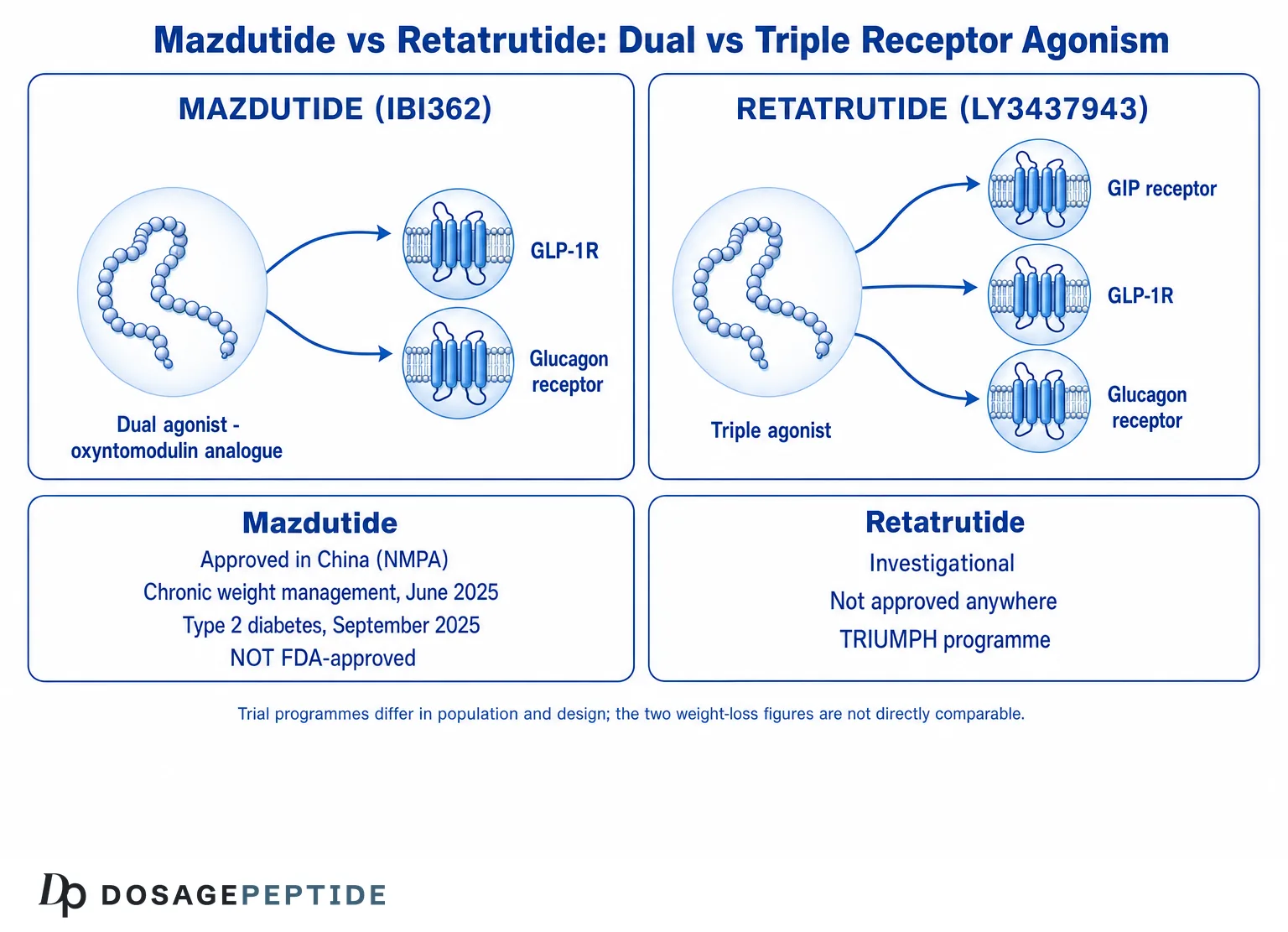
Both molecules are once-weekly subcutaneous peptides, and both include GLP-1 receptor and glucagon receptor agonism. The single structural difference that matters is the GIP receptor: retatrutide has it, mazdutide does not.
Mazdutide: an oxyntomodulin-derived dual agonist
Mazdutide is built from oxyntomodulin, a naturally occurring proglucagon-derived gut peptide that already has intrinsic activity at both the GLP-1 and glucagon receptors. The development programme — originating with Eli Lilly peptide design and later carried in Greater China by Innovent Biologics — layered fatty-acid modification and formulation work onto that oxyntomodulin scaffold to produce a once-weekly molecule.[3] If you want the mechanism explained at greater length, our reference page on what mazdutide is as a GLP-1 and glucagon dual agonist covers the pharmacology in isolation.
Retatrutide: one peptide, three receptors
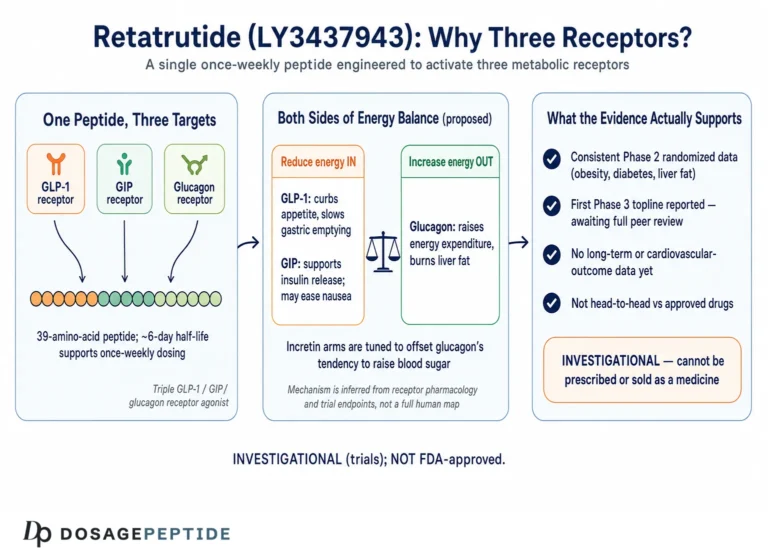
Retatrutide is a synthetic single-peptide agonist at the glucose-dependent insulinotropic polypeptide (GIP), GLP-1 and glucagon receptors.[9] The GIP arm is the same arm that distinguishes tirzepatide (FDA-approved as Mounjaro for type 2 diabetes and as Zepbound for chronic weight management) from pure GLP-1 agonists such as semaglutide. Retatrutide adds glucagon on top of that GIP/GLP-1 pairing. A separate comparison of retatrutide versus tirzepatide isolates what the glucagon arm appears to add over a dual GIP/GLP-1 agonist; the mirror-image question, what GIP adds over a GLP-1/glucagon dual, is exactly what a mazdutide versus tirzepatide comparison probes from the other side.
Why add a glucagon arm at all — and what does it cost?
Glucagon has an obvious problem as a metabolic drug target: on its own it raises blood glucose. The rationale for pairing it with GLP-1 is that the GLP-1 (and, for retatrutide, GIP) component is expected to offset the glycaemic effect, leaving the parts of glucagon signalling that researchers are interested in — increased energy expenditure and effects on hepatic lipid handling, including reduced hepatic fat synthesis and increased hepatic lipolysis.[4]
The trial data cited here are consistent with a liver-fat effect for mazdutide; no liver-fat endpoint from the retatrutide phase 3 programme is reported in the sources used on this page. In GLORY-1, participants with at least 10% liver fat content at baseline showed mean relative reductions in liver fat of 65.85% (4 mg) and 80.24% (6 mg) at week 48.[4] GLORY-2 reported a 71.9% mean relative reduction in liver fat content at 9 mg versus a 5.1% increase on placebo, again in participants whose baseline liver fat content was at least 10%.[5]
The trade-offs reported in trials are also real and should not be glossed over. In the retatrutide phase 2 obesity trial, heart rate increased in a dose-dependent manner, peaking at 24 weeks before declining.[9] In phase 3, dysesthesia — an abnormal or unpleasant skin sensation — appeared as a dose-related event that is not a signature of pure GLP-1 agonists: 5.1% at 4 mg, 12.3% at 9 mg and 12.5% at 12 mg versus 0.9% on placebo in TRIUMPH-1.[13] Hyperglycaemia was recorded as an adverse event in TRIUMPH-3, but less frequently on retatrutide than on placebo — 3.9% at 9 mg and 3.1% at 12 mg versus 13.4% on placebo — so in that trial it is not a signal against the glucagon arm.[14] None of this establishes a mechanism for those events; it establishes that they were observed and counted.
Where does each molecule stand with regulators right now?
This is the single most misreported part of the comparison, so it is worth stating with precision.
Mazdutide. China’s NMPA approved mazdutide on 27 June 2025 for long-term weight management in adults, as an adjunct to a reduced-calorie diet and increased physical activity, in adults with a BMI of at least 28 kg/m², or a BMI of at least 24 kg/m² together with at least one weight-related comorbidity.[3][4] A second Chinese approval followed in September 2025 for glycaemic control in adults with type 2 diabetes.[3] A supplementary application covering the higher 9 mg strength for adults with moderate-to-severe obesity was accepted for review by the NMPA’s Center for Drug Evaluation in November 2025.[6] Mazdutide is not FDA-approved and is not authorised in the United States, the European Union or the United Kingdom.
Retatrutide. No approval, anywhere. The TRIUMPH programme has reported positive topline results across four registrational trials, and Lilly has said it plans to submit a Biologics License Application to the FDA in the first quarter of 2027.[14] A planned filing is not an approval, and a positive topline press release is not a peer-reviewed publication.
What did the mazdutide phase 3 programme actually show?
GLORY-1: 610 Chinese adults, 4 mg and 6 mg, 48 weeks
GLORY-1 (NCT05607680)[2] was a phase 3, double-blind, placebo-controlled trial in China that randomised 610 adults aged 18–75 with a BMI of at least 28, or a BMI of 24 to under 28 plus at least one weight-related condition, in a 1:1:1 ratio to mazdutide 4 mg, mazdutide 6 mg or placebo for 48 weeks. Mean baseline body weight was 87.2 kg and mean baseline BMI was 31.1.[1]
Under the treatment-policy estimand reported in the New England Journal of Medicine, mean percentage change in body weight at week 32 was −10.09% (4 mg), −12.55% (6 mg) and +0.45% (placebo). At week 48 the corresponding figures were −11.00%, −14.01% and +0.30%, with 35.7%, 49.5% and 2.0% of participants respectively losing at least 15% of body weight (P < 0.001 for all comparisons with placebo).[1] The efficacy estimand quoted in Innovent’s regulatory communications gives slightly larger week-48 numbers of −12.0% and −14.8%[4] — the same trial, a different analytical convention. That distinction matters whenever two drugs are compared using numbers pulled from different estimands.
GLORY-2: 462 Chinese adults with obesity, 9 mg, 60 weeks
GLORY-2 tested the higher 9 mg dose against placebo in 462 Chinese adults with a BMI of at least 30 (about 16% of whom had type 2 diabetes), randomised 2:1 across a 60-week double-blind treatment period. Mean weight reduction at week 60 was 18.55% on mazdutide 9 mg versus 3.02% on placebo, with 44.0% of the mazdutide group losing at least 20% of body weight versus 2.6% on placebo. In participants without type 2 diabetes, mean reduction reached 20.08%, with 48.7% losing at least 20%. Discontinuation for adverse events was around 2.9%, and no new safety signals were reported.[5]
The diabetes arm: DREAMS-2 and DREAMS-3
DREAMS-2 randomised 731 Chinese adults with type 2 diabetes on background oral agents 1:1:1 to mazdutide 4 mg, mazdutide 6 mg or dulaglutide 1.5 mg for 28 weeks. Both mazdutide doses were non-inferior and then superior to dulaglutide on HbA1c change, with least-squares mean treatment differences of −0.24% (P = 0.0032) and −0.30% (P = 0.0003), and produced greater weight reduction, with treatment differences of −3.78% and −5.76% versus dulaglutide (both P < 0.0001). The most common treatment-emergent adverse events were diarrhoea, nausea and vomiting, and gastrointestinal events were more frequent with mazdutide than dulaglutide.[7] A separate head-to-head phase 3 study, DREAMS-3, compared mazdutide with semaglutide in Chinese adults with type 2 diabetes and obesity, reporting that 48.0% of the mazdutide group versus 21.0% of the semaglutide group reached the composite of HbA1c below 7.0% together with at least 10% body-weight reduction.[8]
What did the retatrutide TRIUMPH programme actually show?
Phase 2 groundwork
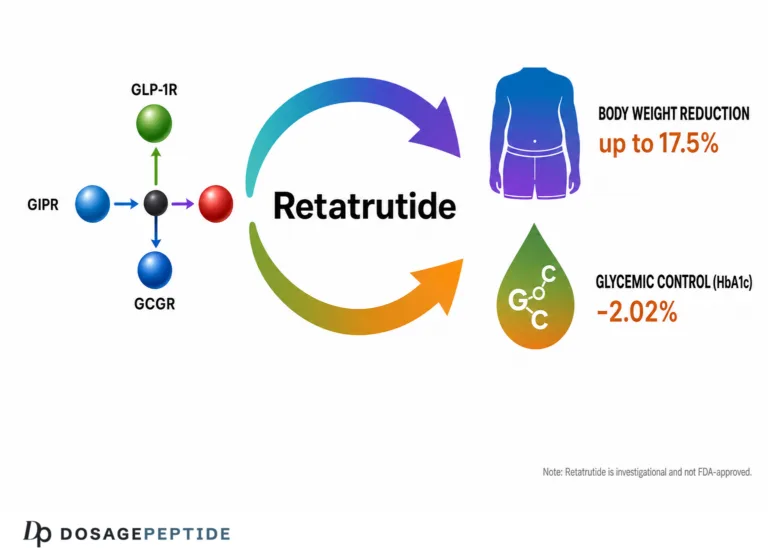
The phase 2 obesity trial (NCT04881760) enrolled 338 adults and ran 48 weeks across retatrutide doses of 1, 4, 8 and 12 mg versus placebo. Least-squares mean weight change at 48 weeks was −8.7% (1 mg), −17.1% (combined 4 mg), −22.8% (combined 8 mg) and −24.2% (12 mg) versus −2.1% on placebo. Gastrointestinal events were dose-related, mostly mild to moderate, and were partially mitigated by a lower starting dose of 2 mg rather than 4 mg.[9] That last observation is the reason dose-escalation schedules are studied as a variable in their own right; our reference page on how retatrutide doses were escalated in the published trials documents the schemes used by investigators, and the parallel mazdutide vial reference page does the same on the dual-agonist side. Neither is a recommendation to use anything.
A phase 2 type 2 diabetes trial (NCT04867785) in 281 US adults showed HbA1c reductions up to −2.02% at 24 weeks and body-weight reductions up to 16.94% at 36 weeks, with no severe hypoglycaemia and no deaths reported.[10]
TRIUMPH-1: 2,339 participants, 80 weeks
TRIUMPH-1 (NCT05929066)[12] randomised 2,339 participants 1:1:1:1 to retatrutide 4, 9 or 12 mg or placebo over 80 weeks. Under the efficacy estimand, mean weight change at week 80 was −19.0%, −25.9% and −28.3% versus −2.2% on placebo; under the treatment-regimen estimand the same comparisons were −17.6%, −23.7% and −25.0% versus −3.9%. At least 30% of body weight was lost by 15.3%, 37.9% and 45.3% of participants across the three doses versus 0.5% on placebo. A 532-participant extension in those with a baseline BMI of at least 35 reported up to −30.3% at week 104. The most common adverse events were nausea (28.6–42.4% versus 14.8% placebo), diarrhoea, and vomiting, and discontinuation for adverse events rose with dose: 4.1%, 6.9% and 11.3% versus 4.9% on placebo.[13]
TRIUMPH-2, TRIUMPH-3 and TRIUMPH-4
TRIUMPH-2 studied 1,152 adults with type 2 diabetes and obesity or overweight over 80 weeks, reporting mean weight reductions of 12.7%, 19.1% and 20.8% across the 4, 9 and 12 mg arms versus 4.0% on placebo, and HbA1c reductions up to 1.6% versus 0.2%. TRIUMPH-3 enrolled 1,949 adults with severe obesity and established cardiovascular disease, with or without type 2 diabetes, reporting 21.6% and 22.6% mean weight reduction at 9 and 12 mg versus 3.2% on placebo over 80 weeks, alongside changes in triglycerides, non-HDL cholesterol and systolic blood pressure. Discontinuation for adverse events in TRIUMPH-3 was 9.8% and 13.5% versus 4.8% on placebo.[14]
TRIUMPH-4 (NCT05931367) was a stand-alone knee-osteoarthritis trial in 445 adults with overweight or obesity, randomised 1:1:1 to retatrutide 9 mg, 12 mg or placebo for 68 weeks. Mean weight reduction under the efficacy estimand was 26.4% and 28.7% versus 2.1% on placebo (treatment-regimen estimand: −20.0%, −23.7% and −4.6%), alongside reductions in the WOMAC pain subscale. Discontinuation for adverse events reached 12.2% and 18.2% versus 4.0% on placebo, and dysesthesia was reported in 8.8% and 20.9% of retatrutide participants versus 0.7% on placebo.[15] Details of adverse events across the retatrutide programme are collected on our retatrutide safety and side-effect research page.
Can the two sets of weight-loss numbers be compared directly?
No. There has never been a head-to-head trial of mazdutide against retatrutide, and the two programmes differ on almost every axis that moves a weight-loss percentage:
- Population. GLORY-1 and GLORY-2 were conducted entirely in China, with mean baseline body weight of 87.2 kg in GLORY-1 and 94.0 kg (mean BMI 34.3) in GLORY-2. TRIUMPH recruited multinationally into a heavier population, including a dedicated severe-obesity-plus-cardiovascular-disease trial. Percentage weight loss is not independent of baseline adiposity.
- Duration. 48 weeks (GLORY-1) and 60 weeks (GLORY-2) versus 68–80 weeks in TRIUMPH, with a 104-week extension. Weight-loss curves in this class have not fully plateaued at one year.
- Dose ceiling studied. Mazdutide’s pivotal trials topped out at 9 mg; retatrutide’s at 12 mg. Neither ceiling is a statement about the molecules’ intrinsic potency.
- Estimand. Efficacy and treatment-regimen (or treatment-policy) estimands can differ by several percentage points within the same trial, as TRIUMPH-1 and GLORY-1 both show.
- Evidence tier. GLORY-1 and DREAMS-2 are peer-reviewed publications. Most of the TRIUMPH data and the GLORY-2 data currently exist as sponsor topline announcements and conference presentations pending full publication.
What is still unknown about both molecules?
Cardiovascular outcome data are the largest open question for retatrutide: TRIUMPH-Outcomes (NCT06383390), a 10,000-participant event-driven trial in people with a BMI of at least 27 and atherosclerotic cardiovascular disease and/or chronic kidney disease, has a primary completion date in 2029. TRIUMPH-3 reported pre-specified MACE analyses that were not powered to be definitive: MACE-5 hazard ratio 0.82 (95% CI 0.55–1.22) and MACE-3 hazard ratio 1.12 (95% CI 0.64–1.96), both confidence intervals crossing 1, with fewer events than anticipated in both arms.[14] A head-to-head phase 3 trial of retatrutide against tirzepatide (NCT06662383, 800 participants) is also under way.
For mazdutide, the open questions are geographic and indication-related: all pivotal efficacy data come from Chinese populations, so generalisability to other populations is untested, and there is no approval outside China. Trials in metabolic dysfunction-associated fatty liver disease, obstructive sleep apnoea and other indications remain under evaluation.[3] For both molecules, weight regain after discontinuation, long-term body-composition effects and durability past two years remain incompletely characterised.
One further point applies to anyone encountering either name outside a clinical setting. Material sold online as “research-grade” mazdutide or retatrutide is an unregulated research chemical. It is not the clinical product, it has not been through any regulatory quality review, its identity and purity are not guaranteed, and nothing in the trial data above describes it.
Frequently Asked Questions
Is mazdutide FDA-approved?
No. Mazdutide is approved by China’s National Medical Products Administration — in June 2025 for chronic weight management and in September 2025 for glycaemic control in type 2 diabetes — and it is the first dual glucagon/GLP-1 receptor agonist approved anywhere for weight management. It has no FDA approval and no marketing authorisation in the United States, European Union or United Kingdom.
Is retatrutide approved anywhere?
No. Retatrutide remains investigational worldwide. Its TRIUMPH phase 3 programme has reported positive topline results in obesity, type 2 diabetes, cardiovascular disease and knee osteoarthritis populations, and Eli Lilly has stated it intends to file a Biologics License Application with the FDA in the first quarter of 2027. A planned filing is not an approval.
What is the core mechanistic difference between mazdutide and retatrutide?
Mazdutide activates two receptors: GLP-1 and glucagon. Retatrutide activates three: GIP, GLP-1 and glucagon. Mazdutide is derived from the natural gut peptide oxyntomodulin, which already has intrinsic dual GLP-1/glucagon activity; retatrutide is a synthetic single peptide engineered to hit all three receptors. The GIP arm is the difference.
Has anyone run a head-to-head trial of mazdutide versus retatrutide?
No such trial has been registered or reported. Each has been compared against other agents — mazdutide against dulaglutide in DREAMS-2 and against semaglutide in DREAMS-3 (reported) and GLORY-3 (a second head-to-head against semaglutide 2.4 mg in adults with overweight or obesity and fatty liver disease, still under way and not yet reported), retatrutide against tirzepatide in TRIUMPH-5 (NCT06662383, active and not yet reported) — but never against each other. Any direct comparison of their reported weight-loss percentages is a cross-trial inference, not a measured result.
Why did retatrutide show larger weight reductions than mazdutide in trials?
The trials are not comparable enough to answer that mechanistically. Retatrutide’s pivotal trials ran 68–80 weeks at doses up to 12 mg in multinational, heavier populations; mazdutide’s ran 48–60 weeks at doses up to 9 mg in Chinese populations with mean baseline weights of 87.2 kg (GLORY-1) and 94.0 kg (GLORY-2). Duration, dose ceiling, baseline adiposity and estimand choice all differ, and each moves the headline percentage.
What does the glucagon receptor arm contribute?
The stated research rationale is increased energy expenditure plus effects on hepatic lipid handling — reduced hepatic fat synthesis and increased hepatic lipolysis. The trial data are consistent with a substantial liver-fat effect: GLORY-1 reported relative liver-fat reductions of 65.85% and 80.24% in participants with elevated baseline liver fat, and GLORY-2 reported a 71.9% mean relative reduction versus a 5.1% increase on placebo, again restricted to participants with baseline liver fat content of at least 10%. Whether that is attributable to glucagon signalling specifically or to weight loss has not been isolated.
What adverse events were reported most often with each?
Both programmes report gastrointestinal events — nausea, diarrhoea, vomiting, constipation, decreased appetite — as the dominant category, mostly mild to moderate and dose-related. Retatrutide additionally showed dose-dependent dysesthesia (up to 20.9% at 12 mg in TRIUMPH-4 versus 0.7% placebo) and a dose-dependent heart-rate increase in phase 2. Discontinuation rates for adverse events were also higher across the retatrutide trials than in GLORY-1 or GLORY-2.
Are the reported weight-loss figures from the same type of statistical analysis?
Not always, and this is a common source of confusion. GLORY-1’s NEJM publication reports a treatment-policy estimand (−11.00% and −14.01% at week 48), while Innovent’s regulatory communications quote an efficacy estimand (−12.0% and −14.8%). TRIUMPH-1 reported both: −28.3% at 12 mg under the efficacy estimand versus −25.0% under the treatment-regimen estimand. Always check which estimand a number comes from before comparing.
Which one has the stronger published evidence base?
They lead on different dimensions. Mazdutide has more peer-reviewed pivotal publications relative to its programme size — GLORY-1 in the New England Journal of Medicine and DREAMS-2 in Nature — plus an actual regulatory approval, though only in one country. Retatrutide has a far larger registrational dataset (over 5,800 participants across four phase 3 trials plus a 10,000-participant outcomes trial), but most of it currently exists as topline announcements pending full peer-reviewed publication.
References
- Ji L, Jiang H, Bi Y, et al. Once-Weekly Mazdutide in Chinese Adults with Obesity or Overweight (GLORY-1). N Engl J Med. 2025;392(22):2215–2225. PubMed 40421736
- ClinicalTrials.gov. A Study of IBI362 in Participants With Obesity or Overweight (GLORY-1), NCT05607680. clinicaltrials.gov/study/NCT05607680
- Shirley M. Mazdutide: First Approval. Drugs. 2025;85(12):1621–1627. PubMed 41028652
- Innovent Biologics. Innovent Announces Mazdutide, First Dual GCG/GLP-1 Receptor Agonist, Received Approval from China’s NMPA for Chronic Weight Management. 27 June 2025. Press release
- Innovent Biologics. Mazdutide 9 mg Achieves Up to 20.1% Weight Loss in Chinese Adults with Obesity: GLORY-2 Meets Primary and All Key Secondary Endpoints. 19 November 2025. Press release
- Innovent Biologics. Mazdutide 9 mg Supplementary Application Accepted for Review by China’s NMPA. 25 November 2025. Press release
- Guo L, Zhang B, Xue X, et al. Mazdutide versus dulaglutide in Chinese adults with type 2 diabetes (DREAMS-2). Nature. 2026;652(8108):181–188. PubMed 41407860
- Innovent Biologics. Innovent’s Mazdutide Shows Superiority in Glycemic Control with Weight Loss over Semaglutide in a Head-to-head Phase 3 Clinical Trial (DREAMS-3). 26 October 2025. Press release
- Jastreboff AM, Kaplan LM, Frías JP, et al. Triple-Hormone-Receptor Agonist Retatrutide for Obesity — A Phase 2 Trial. N Engl J Med. 2023;389(6):514–526. PubMed 37366315
- Rosenstock J, Frias J, Jastreboff AM, et al. Retatrutide, a GIP, GLP-1 and glucagon receptor agonist, for people with type 2 diabetes: a phase 2 trial. Lancet. 2023;402(10401):529–544. PubMed 37385280
- Giblin K, Kaplan LM, Somers VK, et al. Retatrutide for the treatment of obesity, obstructive sleep apnea and knee osteoarthritis: Rationale and design of the TRIUMPH registrational clinical trials. Diabetes Obes Metab. 2026;28(1):83–93. PubMed 41090431
- ClinicalTrials.gov. A Study of Retatrutide (LY3437943) in Participants Who Have Obesity or Overweight (TRIUMPH-1), NCT05929066. clinicaltrials.gov/study/NCT05929066
- Eli Lilly and Company. Lilly’s triple agonist, retatrutide, delivered powerful weight loss in pivotal Phase 3 obesity trial (TRIUMPH-1). 21 May 2026. Press release
- Eli Lilly and Company. Lilly’s triple agonist, retatrutide, successful in two additional Phase 3 obesity trials (TRIUMPH-2 and TRIUMPH-3). 23 July 2026. Press release
- Eli Lilly and Company. Lilly’s triple agonist, retatrutide, delivered weight loss along with substantial relief from osteoarthritis pain in first successful Phase 3 trial (TRIUMPH-4; ClinicalTrials.gov NCT05931367). 11 December 2025. Press release
Research use only. This page is an independent reference summary of published and publicly reported research on mazdutide and retatrutide. It is not medical advice, not a treatment recommendation, and not a dosing protocol for any person. Mazdutide is approved only in China, by the NMPA, for the indications stated above; retatrutide is investigational and is not approved by the FDA or any other regulator for any use. Nothing here should be read as suggesting that either compound is available, appropriate or safe for human use outside a supervised clinical trial or an approved prescription setting in a jurisdiction where such approval exists.