Search the phrase “5-Amino-1MQ results” and you will find timelines, before-and-after weight figures, and confident promises of “fat loss in weeks.” This article takes a different starting point, one demanded by the actual state of the science: 5-Amino-1MQ (5-amino-1-methylquinolinium, sometimes written 5A1MQ) is a small-molecule inhibitor of the enzyme nicotinamide N-methyltransferase, and it is a research chemical. It has not been approved by the U.S. Food and Drug Administration or any comparable regulator for any use. Crucially, every meaningful “result” attributed to it comes from preclinical work — cultured cells and, above all, mice. There are no completed human clinical trials of 5-Amino-1MQ for fat loss, metabolic health, or anything else. That single fact reshapes the entire question.
So when someone asks “what are the results, and on what timeline?” the honest answer has two layers. In the layer where real data exist — rodent obesity models — the results are genuinely interesting and reasonably well characterized, and the timelines are measured in days to weeks of mouse dosing. In the layer most readers actually care about — a human being taking this compound and seeing the scale move — there are no established results and no validated timeline at all, only anecdote and extrapolation from animals. This piece keeps those two layers rigorously separate, because conflating them is precisely how the internet turns a promising enzyme-biology story into an overstated weight-loss claim.
What follows is a careful map: what the enzyme does, what genetic and pharmacological studies actually showed, how fast those changes appeared in the animals that were studied, what the mouse data can and cannot tell you about people, how 5-Amino-1MQ stacks up against compounds that do have human fat-loss evidence, and what the evidence conspicuously does not show. The guiding principle throughout is restraint. 5-Amino-1MQ is a legitimate object of scientific interest and, for now, nothing more than that.
A word on why this framing matters practically. Research chemicals occupy a peculiar information ecosystem: the primary literature is thin and technical, while the secondary literature — vendor pages, forum threads, affiliate blogs — is thick and confident. When a compound has one or two real animal studies and no human trials, that imbalance produces a predictable distortion, in which a handful of genuine mouse findings get amplified, rounded up, and eventually restated as human fact. The single most valuable service an honest article can perform is to hold the line between the two: to report the real findings faithfully, cite them to their sources, and refuse to let the confident tone of the marketing borrow the credibility of the science. That is what this piece tries to do — not to dismiss 5-Amino-1MQ, which is a genuinely interesting compound, but to describe its evidence at exactly the resolution the data allow, no sharper.
What 5-Amino-1MQ Actually Is
5-Amino-1MQ is not a peptide, despite frequently being sold alongside research peptides and lumped in with them. It is a small organic molecule — a quinolinium-based compound — designed to fit into the active site of a specific human enzyme and block its function. Its full chemical name, 5-amino-1-methylquinolinium, describes that structure: a methylated quinolinium ring bearing an amino group at the 5-position. This matters for a practical reason: unlike peptides, which are chains of amino acids readily digested in the gut, a stable small molecule can in principle be formulated for oral or subcutaneous delivery, and the published mouse work has used both routes.13
The compound emerged from a targeted drug-discovery effort. Investigators at the University of Texas Medical Branch, building on earlier genetic evidence that the enzyme NNMT drives fat accumulation, set out to find a cell-permeable, selective inhibitor of that enzyme that could be tested in living animals. 5-Amino-1MQ was reported as a substrate-competitive, membrane-permeable NNMT inhibitor — meaning it competes with the enzyme’s natural substrate and can cross cell membranes to reach its intracellular target — and it became the tool compound used to ask whether pharmacologically shutting down NNMT would reproduce the striking metabolic benefits seen when the enzyme was silenced genetically.1
It is worth being blunt about the identity question up front, because the marketing landscape blurs it. 5-Amino-1MQ is not a hormone, not a growth factor, not a GLP-1 drug, and not a peptide analog of any natural signaling molecule. It is an enzyme inhibitor. Its entire proposed mechanism — and therefore its entire plausible “results” story — flows from what happens inside a cell when you turn down the activity of one methyltransferase. To understand the results, you first have to understand that enzyme, because everything else is downstream of it.
The Enzyme It Targets: NNMT, NAD+, and the Methylation Ledger
Nicotinamide N-methyltransferase (NNMT) sits at a genuinely important metabolic crossroads. Its job is chemically simple: it takes a methyl group from S-adenosylmethionine (SAM), the cell’s universal methyl donor, and attaches it to nicotinamide (NAM, a form of vitamin B3), producing two products — 1-methylnicotinamide (1-MNA) and S-adenosylhomocysteine (SAH).5 That one reaction touches two of the most consequential currencies in cell biology at the same time.
First, NAD+ supply. Nicotinamide is a key precursor that cells recycle back into NAD+ through the salvage pathway. NAD+ is indispensable for energy metabolism — glycolysis, the citric-acid cycle, fatty-acid oxidation — and it is the substrate that sirtuins and PARPs consume. When NNMT is highly active, it siphons off nicotinamide into the 1-MNA dead-end, potentially reducing the pool available for NAD+ resynthesis. Inhibiting NNMT is therefore hypothesized to preserve nicotinamide for NAD+ salvage, nudging cellular NAD+ upward.56 This is the conceptual bridge that connects 5-Amino-1MQ to the broader NAD+ field; readers exploring that adjacent area can see how NAD+ itself is studied on pages such as the discussion of NAD+, DNA repair, and cellular protection.
Second, the methylation ledger. Every methyl group NNMT spends comes from SAM, and every reaction it runs generates SAH, which is a feedback inhibitor of most other methyltransferases. High NNMT activity thus drains SAM and raises SAH, changing the cell’s overall “methylation potential” — its capacity to methylate DNA, histones, and other targets. In fat tissue and cancer, elevated NNMT has been proposed to act as a metabolic methylation sink that reshapes gene expression and energy handling.59 Reducing NNMT activity is hypothesized to restore SAM levels and normal methylation dynamics.
Why does any of this point toward fat loss? Because NNMT is expressed at high levels in white adipose tissue, and its expression rises in obesity, insulin resistance, and type 2 diabetes.68 The working hypothesis, assembled across roughly a decade of work, is that overactive NNMT in fat cells lowers NAD+, blunts energy expenditure, and promotes fat storage — and that blocking it should raise adipocyte energy metabolism and reduce fat mass. That hypothesis is coherent, mechanistically grounded, and supported by animal data. It is also, at the human level, still a hypothesis. A useful habit is to keep the enzyme biology and the human claim in separate mental columns; the enzyme story is strong, the human column is empty. Terms like NAD+, SAM, and methylation potential recur throughout the peptide and metabolic-research literature and are collected in the site’s research glossary for readers who want precise definitions.
It is worth spelling out the proposed “energy-expenditure” mechanism more concretely, because it is the crux of why NNMT inhibition might reduce fat without reducing appetite. In the original genetic work, silencing NNMT raised both NAD+ and SAM inside fat cells, and the investigators linked this to enhanced activity of energy-consuming metabolic cycles — sometimes described as “futile” cycles — in which substrates are broken down and rebuilt at the cost of ATP, dissipating energy as heat rather than storing it.25 Higher NAD+ also feeds sirtuin activity, a family of NAD+-dependent enzymes that regulate mitochondrial biogenesis and fat oxidation. The picture, in short, is of a fat cell nudged from a storage-favoring state toward an energy-burning one. This is an elegant hypothesis with real experimental support in rodents, and it is precisely the kind of mechanism that could, in principle, produce fat loss without hunger. But “could in principle” is the operative phrase: the entire causal chain — inhibit NNMT, raise NAD+/SAM, accelerate futile cycling, burn fat — has been demonstrated as a coherent narrative in mice, and not one link of it has been directly confirmed in a treated human being.
Two further nuances keep the mechanism honest. First, NNMT is not exclusive to fat; it is highly expressed in the liver, present in kidney, and upregulated in numerous cancers, so systemic inhibition touches many tissues at once, which is a double-edged property — potential benefits in liver fat (as the 2024 mouse data suggest) but also the reason broad safety questions cannot be waved away.39 Second, the NAD+ story here is subtractive rather than additive: NNMT inhibition is proposed to stop the loss of nicotinamide to a methylated dead-end, which is mechanistically different from supplementing an NAD+ precursor directly. That distinction matters when people casually group 5-Amino-1MQ with NAD+ boosters; they converge on the same currency from opposite directions, and the downstream consequences may not be identical.
The Genetic Proof of Concept: What Knocking Down NNMT Did in Mice
The intellectual foundation for every 5-Amino-1MQ “result” is a 2014 study published in Nature by Kraus and colleagues. Before anyone had a drug, these investigators asked a cleaner question: if you genetically silence NNMT in fat tissue, does it matter? Using antisense oligonucleotide knockdown of NNMT in the adipose tissue and liver of mice fed a high-fat diet, they found that the knockdown animals were protected against diet-induced obesity.2
The magnitude was substantial. NNMT silencing reduced adiposity markedly — on the order of a 40–50% reduction in relative fat mass in the reported experiments — and improved the metabolic consequences of the high-fat diet, including glucose tolerance and fatty liver, without the mice eating less.2 The proposed mechanism matched the enzyme biology: knocking down NNMT increased cellular NAD+ and SAM, boosting the “futile” energy-consuming cycles in fat cells and raising energy expenditure. In other words, the fat cells were burning more, not the animals eating less.
This is genuinely important, and it deserves to be stated as the strength it is: a genetic loss-of-function experiment in a respected journal established NNMT as a credible metabolic-disease target and showed that removing its activity in fat tissue reduces obesity in mice. That is the bedrock. But it is essential to note what this study was and was not. It was a genetic knockdown using antisense oligonucleotides in mice — not a drug, not 5-Amino-1MQ, and not a human. It proved the target was worth pursuing. It did not prove that any particular molecule could safely and effectively hit that target in a person. The distance between “this gene matters” and “this pill works in humans” is exactly where most promising drug programs die.
The Pharmacological Results: What 5-Amino-1MQ Did in Mice
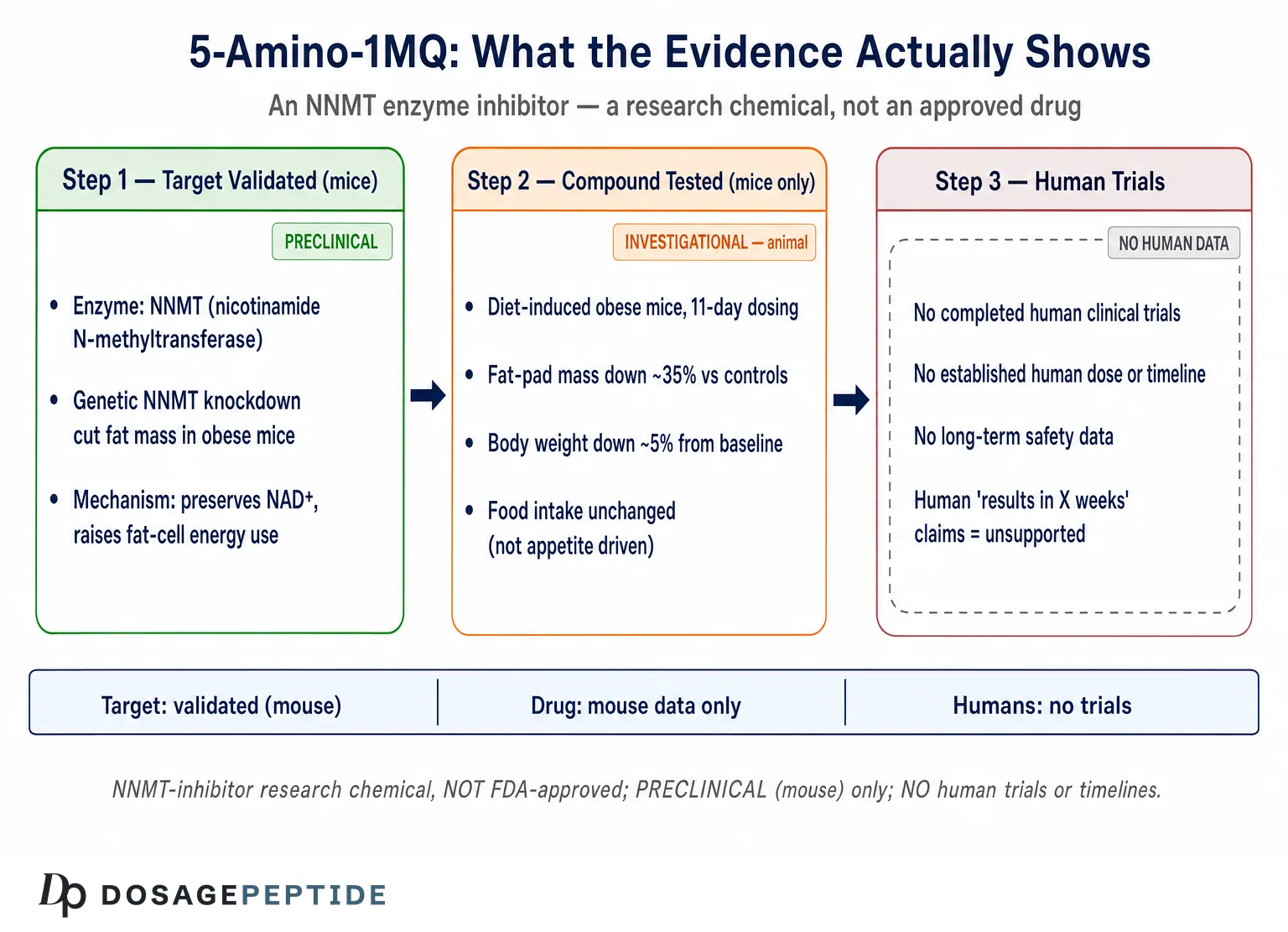
The pivotal pharmacological study — the one nearly every “5-Amino-1MQ results” claim ultimately traces back to — is Neelakantan and colleagues, published in Biochemical Pharmacology in 2018 (volume 147, pages 141–152).1 This is the paper that took the genetic proof of concept and asked the drug-discovery question: does a small-molecule NNMT inhibitor reproduce the effect?
The headline in-vivo experiment was a short, sub-chronic proof-of-concept study. Diet-induced obese (DIO) mice, made obese on a 60%-kcal-from-fat diet, received 5-Amino-1MQ by subcutaneous injection — 20 mg/kg per injection, three times daily, for a total of roughly 34 mg/kg per day — over an 11-day period.1 The results, precisely stated, were:
- Body weight: treated mice lost about 2.0 ± 0.6 g (roughly a 5% reduction from baseline) while control mice gained weight over the same window.1
- Fat mass: epididymal (white adipose) fat-pad mass fell by approximately 35% versus controls.1
- Adipocyte size: individual fat cells shrank, with more than a 30% decrease in adipocyte size.1
- Food intake: essentially unchanged between groups — the effect was not driven by appetite suppression.1
- Cholesterol: total plasma cholesterol was roughly 30% lower in treated animals.1
- Adverse effects: none observable over the short study, and the compound was reported selective for NNMT over related methyltransferases.1
A more recent study reinforced and extended these findings. Babula and colleagues, publishing in Diabetes, Obesity and Metabolism in 2024, again used 5-Amino-1MQ (here written 5A1MQ) in diet-induced obese mice and reported dose-dependent limitation of body-weight and fat-mass gain, improved oral glucose tolerance, reduced hyperinsulinemia, and a striking attenuation of hepatic steatosis (about a 73% reduction in microvesicular fatty change), along with lower liver inflammation and normalized serum markers such as ALT, AST, and triglycerides.3 Importantly, this study also characterized favorable pharmacokinetics for subcutaneous dosing — a step toward, but not the same as, human readiness.
Taken together, the pharmacological results are consistent and mechanistically coherent: in obese mice, a selective NNMT inhibitor reduces fat mass and improves metabolic markers, apparently by increasing adipocyte energy expenditure rather than by suppressing appetite. That is a legitimately encouraging preclinical signal. It is also, in every published instance, a mouse result. The following table lays out exactly what has and has not been demonstrated.
| Question | What the published evidence shows |
|---|---|
| Target validated? | Yes — genetic NNMT knockdown reduced adiposity ~40–50% in mice2 |
| Does the drug work in animals? | Yes — 5-Amino-1MQ reduced fat mass (~35%) and weight (~5%) in obese mice over 11 days1 |
| Reproduced? | Yes — a 2024 study showed dose-dependent fat/weight and metabolic benefits in obese mice3 |
| Mechanism | Increased NAD+/energy expenditure in fat cells; not appetite suppression12 |
| Human clinical trials? | None completed or published for fat loss or any indication |
| FDA approval? | No — research chemical, not an approved drug |
| Established human dose/timeline? | None — unestablished; human “timelines” are anecdotal |
On What Timeline? Reading the Preclinical Clock Honestly
The title asks specifically about timeline, and this is where honesty is most important, because the timeline question quietly assumes a human user. Let us answer it in the only setting where data exist, and then be explicit about why that answer does not transfer.
In the mouse studies, changes appeared quickly. The pivotal 2018 experiment ran only 11 days and still produced measurable weight loss, a ~35% drop in fat-pad mass, and visibly smaller adipocytes.1 The 2024 study likewise saw dose-dependent metabolic changes over its dosing window.3 So within the biology of a mouse, the NNMT-inhibition effect on fat is relatively rapid — days to a couple of weeks of frequent dosing. That is the real, citable “timeline.”
Now the caveats, and they are decisive. Mouse metabolism is not human metabolism. A mouse has a resting metabolic rate per gram many times higher than a person’s, a much shorter lifespan over which effects compress, and different fat-tissue distribution and thermogenic biology (mice rely heavily on brown-fat thermogenesis that is far less prominent in adult humans). The 11-day mouse window cannot be rescaled to “11 days in a person” or even to a fixed number of human weeks. Dose does not translate either: 34 mg/kg/day in a 25-gram mouse, given as three injections, is not a number you can convert into a human dose by simple body-weight scaling, and doing so is a common and dangerous error in the online literature.
There is a deeper problem than scaling. Because no human trial has ever been run, there is no measured human timeline of any length — not 4 weeks, not 12 weeks, not a year. When a vendor page states that “most users see results in 4 to 6 weeks,” that sentence is not derived from a clinical endpoint; it is either an extrapolation from mouse data or a summary of uncontrolled self-report, both of which are unreliable for a compound with no placebo-controlled human evidence and no standardized product. The intellectually honest position is: the animal timeline is short, the human timeline is unknown, and any specific week-by-week human schedule you encounter is unsupported. Readers who want to see what a genuine, human-validated fat-loss timeline looks like — with dose-titration schedules built from randomized trials — can compare against approved incretin agents such as the research summarized on tirzepatide effectiveness in clinical studies, where the contrast in evidence quality is stark.
It is also worth naming a subtle trap in how “timeline” questions are usually asked. The phrasing presumes a monotonic curve — start dosing, watch fat decline week by week, reach a plateau. Even in the animals, the picture is not that simple: the mouse effect on fat depended on frequent dosing (three times daily in the pivotal study) and a specific obese-on-high-fat-diet context, and whether the effect would persist, plateau, or rebound after stopping was not the question those short studies were built to answer.13 Durability — what happens after you stop — is one of the most important properties of any weight intervention, and it is entirely uncharacterized here even in mice. So the honest answer to “on what timeline?” is layered: short in mice under intensive dosing; unmeasured for onset, plateau, or rebound in humans; and completely unknown for maintenance. Anyone presenting a clean human timeline is filling that void with imagination, not data.
Research Models and Methodology: How These Results Were Actually Generated
Understanding how the 5-Amino-1MQ evidence was produced clarifies both what it can support and what it cannot. The methodology falls into three tiers, and each tier answers a narrower question than the marketing language implies.
Biochemical and cell-based work. Before any animal study, an NNMT inhibitor has to be shown to actually inhibit the enzyme and to reach it inside cells. For 5-Amino-1MQ, this meant enzymatic assays confirming substrate-competitive inhibition of NNMT, selectivity screens against related methyltransferases to rule out promiscuous activity, and cell-permeability testing to confirm the molecule crosses membranes to its intracellular target.1 These experiments establish that the compound is a bona fide tool for interrogating NNMT biology. They say nothing about whole-body fat loss; a molecule can be a flawless enzyme inhibitor in a test tube and still fail in a living organism for reasons of absorption, distribution, metabolism, or off-target effects.
Rodent models. The load-bearing evidence is the diet-induced obese (DIO) mouse. Mice are made obese on a 60%-kcal-from-fat diet, then dosed with the inhibitor while body weight, fat-pad mass, adipocyte histology, food intake, and blood chemistry are tracked.13 The genetic proof of concept used a complementary approach — antisense knockdown to remove NNMT rather than a drug to block it — which strengthens causal inference because two independent methods (genetic and pharmacological) converge on the same phenotype.2 This is good preclinical practice. But the DIO mouse is a model of diet-induced obesity in a small, short-lived, high-metabolic-rate animal, and it is a screening tool, not a stand-in for a human patient. Effects seen here justify moving forward; they do not predict the magnitude, or even the existence, of a human effect.
Human studies — the missing tier. The tier that would actually answer the “results and timeline” question — randomized, placebo-controlled human trials with body-composition endpoints measured by DXA, defined dosing, and safety monitoring — simply does not exist for 5-Amino-1MQ. The only human data are observational measurements of the NNMT enzyme and its biomarker in patient tissue and plasma,8 which belong to a different category of evidence entirely (association, not intervention). The methodological bottom line is that the compound’s evidence architecture was built to validate a target and screen a tool molecule, and it succeeded at that. It was never designed to, and does not, tell you what happens when a person takes it.
The Muscle and Aging Signal — Real, but Read Carefully
One of the more intriguing branches of NNMT research concerns skeletal muscle and aging, and it is often cited in 5-Amino-1MQ marketing to imply muscle-building or anti-aging “results.” The underlying science is real and worth understanding precisely so that it is not oversold.
NNMT is overexpressed in aged skeletal muscle, where it has been linked to impaired NAD+ salvage, dysregulated sirtuin-1 activity, and increased senescence of muscle stem cells (satellite cells) — the cells responsible for muscle repair. In a 2019 study, Neelakantan and colleagues treated aged mice with a small-molecule NNMT inhibitor and reported activation of senescent muscle stem cells, enhanced proliferation and fusion, nearly two-fold greater muscle-fiber cross-sectional area after injury, a shift toward larger fibers, and roughly a 70% increase in peak torque relative to untreated aged mice.4 Broader reviews have gathered NNMT’s emerging roles across aging and age-related conditions into a coherent, if still preclinical, picture.7
These are impressive findings, and they suggest NNMT inhibition may have regenerative relevance beyond fat. But three honesty checks apply. First, this is again aged-mouse data with an injury-and-regeneration model — not a demonstration that a person taking 5-Amino-1MQ will build muscle. Second, the 2019 study describes its compound generically as an NNMT inhibitor; readers should not assume the exact molecule, dose, or formulation matches whatever a given vendor sells as “5-Amino-1MQ.” Third, and most importantly, “improves regeneration after injury in old mice” is a narrow, specific claim that cannot be inflated into “builds muscle” or “reverses aging” in humans. The muscle signal strengthens the case that NNMT is a target worth studying; it does not add a single data point about human results or timelines.
What the Evidence Does NOT Show
This section is the counterweight to every optimistic paragraph above, and for a research chemical it is the most important part of the article. Here is what the current evidence base does not establish, stated plainly:
It does not show human fat loss. There is no completed, published, placebo-controlled human trial of 5-Amino-1MQ for weight or fat reduction. Not one. Every human “result” circulating online is anecdote, self-report, or extrapolation from mice. Absence of a trial is not a technicality; it means the effect size, the responder rate, the durability, and even the direction of net benefit in humans are all unknown.
It does not establish a human dose or schedule. Because no dose-ranging human study exists, there is no validated human dose, no titration schedule, and no defined treatment duration. The oral capsule doses commonly marketed (often in the tens of milligrams per day) are not derived from clinical pharmacology; they are conventions of the gray market.
It does not establish long-term safety. The mouse studies ran days to weeks. NNMT influences NAD+ and methylation biology — systems with wide reach, including epigenetic regulation and, in some contexts, cancer biology, where NNMT’s role is complex and can even be pro-tumorigenic in certain tissues.9 Chronically perturbing a methylation-controlling enzyme in humans is exactly the kind of intervention that requires long, careful safety study, none of which has been done.
It does not prove appetite, muscle, or longevity benefits in humans. The “no change in food intake” finding is a mouse observation about mechanism, not a human appetite claim. The muscle-regeneration data are aged-mouse injury models. The longevity framing rests on NAD+ theory, not on human outcome data.
It does not come with product standardization. Material sold as 5-Amino-1MQ is a research chemical of variable purity and provenance. Even if the molecule worked as hoped, an unverified product introduces confounders — wrong dose, impurities, mislabeling — that make individual “results” uninterpretable.
The correct scientific posture toward 5-Amino-1MQ is therefore genuine interest paired with genuine agnosticism about human effects. The target is validated; the animal pharmacology is encouraging; the human evidence is absent. All three statements are true at once, and responsible communication holds them together rather than letting the first two swallow the third.
There is one more thing the evidence does not show, and it is easy to miss: it does not show that the striking mouse fat-loss numbers would even be desirable at that magnitude in humans, or achievable without offsetting costs. A ~35% reduction in a fat pad over 11 days in a mouse is a dramatic perturbation of energy balance. In a small animal with enormous metabolic reserve and rapid turnover, such a swing may be tolerated; in a person, rapid mobilization of that much stored energy interacts with muscle preservation, gallbladder function, electrolyte balance, and hormonal adaptation in ways that only controlled human study can reveal. The absence of human data is not merely an absence of efficacy proof — it is an absence of the very information needed to know whether a mouse-magnitude effect would be a benefit or a problem in people. Extrapolating the number without extrapolating the risks is exactly the asymmetry that responsible reading has to resist.
How 5-Amino-1MQ Compares With Compounds That Have Human Data
A useful way to calibrate expectations is to place 5-Amino-1MQ beside agents in the same broad conversation — fat loss and metabolic health — and ask what level of human evidence each carries. The contrast is not meant to suggest these compounds are interchangeable; they act through entirely different mechanisms. It is meant to show what “results” backed by human trials look like versus results confined to mice.
| Compound / class | Mechanism | Best human evidence | Regulatory status |
|---|---|---|---|
| 5-Amino-1MQ | NNMT enzyme inhibition; raises NAD+/energy expenditure in fat cells | None — mouse data only13 | Research chemical; not approved |
| Tirzepatide (GIP/GLP-1) | Dual incretin receptor agonist; appetite + glycemic control | Large randomized Phase 3 trials with double-digit % weight loss | FDA-approved (obesity, T2D) |
| Retatrutide (triple agonist) | GIP/GLP-1/glucagon receptor agonist | Randomized Phase 2 trials; substantial weight loss | Investigational |
| AOD-9604 (GH fragment) | Proposed lipolytic GH-fragment | Human obesity trials — did not reliably beat placebo | Not approved; supplement/gray-market framing |
| NNMT knockdown (genetic) | Antisense silencing of NNMT in fat/liver | Mouse only — proof of concept, not a therapy | Research tool |
The pattern is instructive. The incretin drugs occupy the far end of the evidence spectrum: their fat-loss “results” and “timelines” are quantified in large randomized trials, which is why they carry approvals and specific dosing schedules. 5-Amino-1MQ sits at the opposite end — a validated target and promising animal pharmacology, but zero human trials. Even AOD-9604, another compound often marketed for fat loss, has more human data than 5-Amino-1MQ (several obesity trials), and that data was disappointing, a cautionary tale about how often mechanistically attractive fat-loss compounds fail to separate from placebo in people. Readers comparing metabolic research compounds can see how a different class is studied in the discussion of AOD-9604 research in obesity-related contexts, which illustrates the same gap between mechanism and proven human benefit.
The lesson is not that 5-Amino-1MQ will fail — no one knows — but that its position on the evidence ladder is near the bottom rung. A compound with only mouse data is not comparable, in results terms, to one with completed human trials, however elegant its mechanism.
The AOD-9604 comparison deserves a moment more, because it is the most instructive cautionary parallel. AOD-9604 was, like 5-Amino-1MQ, a mechanistically attractive fat-loss candidate with encouraging rodent data and a clean-looking safety story. Unlike 5-Amino-1MQ, it actually reached human trials — several of them, enrolling hundreds of participants — and in the pivotal, longer study it failed to separate meaningfully from placebo once diet and exercise were standardized. That trajectory is the single most common way promising fat-loss compounds end: not with a dramatic safety failure, but with a quiet inability to beat placebo in a properly controlled human setting. 5-Amino-1MQ has not yet faced that test. Its mouse results are more striking than AOD-9604’s in some respects, and its target is arguably better validated, but the history of the field counsels humility. Mechanistic elegance and rodent efficacy are the entry ticket to human testing, not a prediction of the outcome, and the graveyard of metabolism drugs is full of compounds that looked at least this good before a Phase 2 readout.
Human Signals That Exist — but Are Correlational, Not Interventional
To be fair to the compound, there is human data touching NNMT — just not interventional data on 5-Amino-1MQ. It is worth understanding this evidence precisely, because it is sometimes miscited as if it were a trial of the drug.
In a 2015 study in Diabetologia, Kannt and colleagues measured NNMT messenger RNA in the white adipose tissue of human volunteers and the plasma concentration of its product, 1-methylnicotinamide, across a large cohort.8 They found that adipose NNMT expression and circulating 1-MNA were associated with insulin resistance and type 2 diabetes — higher NNMT activity tracked with worse metabolic health. This is real human evidence, and it strengthens the biological rationale: NNMT is not just a mouse curiosity; its activity correlates with metabolic dysfunction in people.610
But note carefully what this is and is not. It is an observational, correlational study of the enzyme and its biomarker in humans. It shows association, not causation, and it involves no administration of 5-Amino-1MQ or any NNMT inhibitor to a single human being. It supports the hypothesis that inhibiting NNMT might help; it provides no evidence that doing so does help, and it says nothing about the safety or efficacy of the specific compound this article concerns. Correlation between a naturally varying enzyme level and disease is a reason to run a trial — not a substitute for one.
Reviews of NNMT as a metabolic-syndrome target consistently reach the same measured conclusion: the human data are associative and the interventional human data are absent, so NNMT inhibition remains a promising but unproven therapeutic strategy in people.610 That is the honest frame for the human column: suggestive biomarkers, no drug trials. Metabolic-marker relationships like these also appear in adjacent research areas such as the work summarized in the discussion of glucose and metabolic outcomes in tirzepatide research, where the same discipline of separating correlation from intervention applies.
Safety, Handling, and Sourcing in a Research Context
Because 5-Amino-1MQ is not an approved medicine and has no human safety database, this section is necessarily about what is unknown as much as what is known, and it is provided strictly for educational and laboratory context rather than as any guidance for human use.
What the animal data suggest. In the short mouse studies, 5-Amino-1MQ was reported to be well tolerated with no observable adverse effects and no reduction in food intake, and the inhibitor was characterized as selective for NNMT over related enzymes.13 That is reassuring at the level of an 11-day rodent experiment and no further. It says nothing about chronic human dosing.
Theoretical concerns that require study. NNMT sits on the NAD+/methylation axis, systems with broad downstream consequences. Manipulating methylation potential has, in principle, epigenetic implications, and NNMT’s biology intersects with cancer pathways in complex and tissue-dependent ways — in some cancers NNMT is overexpressed and pro-tumorigenic, which is a reason for caution rather than alarm, but a reason that can only be resolved by real safety studies.9 None of these questions has been answered in humans.
Handling as a research chemical. 5-Amino-1MQ is typically supplied as a powder (as a free base or acetate salt) or in capsule form for research use. As with any research compound, purity and provenance vary widely across suppliers, and mislabeling and contamination are real risks in unregulated channels. Investigators reconstituting or solubilizing research compounds generally follow standard laboratory practice — appropriate solvent selection, protection from light and heat, aseptic technique, and cold storage — the same general principles catalogued for research materials in the reconstitution guide and the broader dosage reference index. It bears repeating that meticulous handling changes nothing about the evidence question: a perfectly prepared, high-purity sample of 5-Amino-1MQ is still a compound with zero human efficacy data.
A further, often-overlooked point concerns drug interactions and individual variation, both of which are entirely unstudied for 5-Amino-1MQ in humans. Because the compound perturbs NAD+ and one-carbon (methylation) metabolism, it sits atop pathways that also handle B-vitamins, homocysteine, and numerous methylated metabolites and medications. How it would interact with common drugs, with folate or B12 status, or with the wide genetic variation in methylation-cycle enzymes across a human population is simply unknown. In a controlled trial these are the questions a monitoring plan is built to catch; outside one, they are blind spots. This is not a reason to assume danger, but it is a concrete reminder that “no adverse effects in an 11-day mouse study” and “characterized safety in humans” are separated by an enormous, unbridged distance.
The reasonable reading of the safety picture is symmetrical to the efficacy picture: no major short-term signals in the limited animal work, and no human safety characterization of any kind. Absence of demonstrated harm and absence of demonstrated benefit coexist here, and neither should be mistaken for its opposite.
Regulatory Status and the Honest Bottom Line
5-Amino-1MQ is not approved as a drug by the FDA, the European Medicines Agency, or any comparable regulator for obesity, metabolic disease, muscle wasting, aging, or any other condition. It has not completed the clinical-trial process that approval requires; indeed, it has not meaningfully entered it in the public record. It is sold and traded as a research chemical, a category that carries no assurance of purity, efficacy, or safety and no authorization for human use.
This regulatory reality is the frame within which the “results and timeline” question must finally be answered. The genuine, citable results are these: genetic silencing of NNMT reduced fat mass dramatically in mice;2 a selective small-molecule NNMT inhibitor, 5-Amino-1MQ, reduced fat mass and improved metabolic markers in obese mice over days to weeks, apparently by raising fat-cell energy expenditure rather than curbing appetite;13 the effect has been reproduced;3 and a related NNMT-inhibition strategy improved muscle regeneration in aged mice.4 Human biomarker data are consistent with the enzyme mattering metabolically in people.8
The genuine, honest limits are equally clear: there are no human clinical trials of 5-Amino-1MQ, so human results are unestablished and any human “timeline” is anecdotal or extrapolated, not measured; there is no validated human dose; long-term safety is uncharacterized; and the compound is an unapproved research chemical. If you strip away the marketing, what remains is a well-targeted, preclinically promising enzyme inhibitor whose human story has not yet been written. That is a legitimately exciting place for a research compound to be — and a completely inappropriate place from which to promise anyone a number on a scale by a certain week. For readers who want to follow how compounds progress from this stage toward real human evidence, the contrast with fully trialed agents like those covered in the latest clinical trials on tirzepatide is the clearest available yardstick.
Frequently Asked Questions
What results has 5-Amino-1MQ actually produced?
All documented results are preclinical. In diet-induced obese mice, 5-Amino-1MQ reduced body weight (~5% over 11 days), cut white-fat-pad mass by roughly 35%, shrank fat cells by over 30%, and lowered plasma cholesterol — without reducing food intake.1 A 2024 mouse study reproduced dose-dependent fat, weight, glucose, and liver-fat improvements.3 There are no human clinical trials, so there are no established human results — only anecdote and extrapolation.
On what timeline do results appear?
In mice, changes appeared within days to a couple of weeks of frequent dosing — the pivotal study lasted only 11 days.1 That mouse timeline cannot be converted into a human schedule: mouse and human metabolism differ profoundly, and no human trial of any duration has been run. Any specific human timeline you see quoted (“results in 4–6 weeks”) is unsupported by clinical data.
Is 5-Amino-1MQ a peptide?
No. It is a small organic molecule (a quinolinium compound) that inhibits the enzyme NNMT. It is often sold alongside research peptides, but chemically and mechanistically it is an enzyme inhibitor, not a peptide.
How does it supposedly cause fat loss?
By inhibiting NNMT, it is hypothesized to preserve nicotinamide for NAD+ synthesis and restore cellular methylation balance, increasing energy expenditure inside fat cells.125 The mouse data are consistent with a “burn more” rather than “eat less” mechanism — but this is demonstrated in animals, not humans.
Is there any human evidence at all?
There is human observational evidence that NNMT activity and its biomarker 1-methylnicotinamide correlate with insulin resistance and type 2 diabetes.8 That supports the target’s relevance in people but involves no administration of 5-Amino-1MQ and proves nothing about the drug’s effects or safety in humans.
Does it build muscle or reverse aging?
An NNMT inhibitor improved muscle-stem-cell function and regeneration after injury in aged mice.4 That is a specific, promising animal finding — not evidence that 5-Amino-1MQ builds muscle or reverses aging in humans, where no such studies exist.
Is 5-Amino-1MQ approved or legal to use?
It is not approved by the FDA, EMA, or any comparable regulator for any use. It is traded as a research chemical, which provides no assurance of purity, dose, efficacy, or safety and no authorization for human use.
Is it safe?
Short mouse studies reported no observable adverse effects,13 but there is no human safety data, no long-term data, and legitimate theoretical questions given NNMT’s roles in methylation and cancer biology.9 “No demonstrated harm in short animal studies” is not the same as “safe in humans.”
How does it compare to approved weight-loss drugs?
It doesn’t, in evidence terms. Drugs like tirzepatide have large randomized human trials quantifying their fat-loss results and timelines; 5-Amino-1MQ has mouse data only. They also work through entirely different mechanisms (incretin signaling versus NNMT inhibition).
References
- Neelakantan H, Vance V, Wetzel MD, et al. Selective and membrane-permeable small molecule inhibitors of nicotinamide N-methyltransferase reverse high fat diet-induced obesity in mice. Biochem Pharmacol. 2018;147:141-152. PMID: 29155147. PMCID: PMC5826726. https://pmc.ncbi.nlm.nih.gov/articles/PMC5826726/
- Kraus D, Yang Q, Kong D, et al. Nicotinamide N-methyltransferase knockdown protects against diet-induced obesity. Nature. 2014;508(7495):258-262. PMID: 24717514. https://pubmed.ncbi.nlm.nih.gov/24717514/
- Babula JJ, Bui D, Stevenson HL, Watowich SJ, Neelakantan H. Nicotinamide N-methyltransferase inhibition mitigates obesity-related metabolic dysfunctions. Diabetes Obes Metab. 2024;26(11):5272-5282. PMID: 39161060. PMCID: PMC11622326. https://pmc.ncbi.nlm.nih.gov/articles/PMC11622326/
- Neelakantan H, Brightwell CR, Graber TG, et al. Small molecule nicotinamide N-methyltransferase inhibitor activates senescent muscle stem cells and improves regenerative capacity of aged skeletal muscle. Biochem Pharmacol. 2019;163:481-492. PMID: 30753815. https://pubmed.ncbi.nlm.nih.gov/30753815/
- Roberti A, Fernández AF, Fraga MF. Nicotinamide N-methyltransferase: at the crossroads between cellular metabolism and epigenetic regulation. Mol Metab. 2021;45:101165. PMID: 33453420. PMCID: PMC7868988. https://pmc.ncbi.nlm.nih.gov/articles/PMC7868988/
- Sun WD, Zhu XJ, Li JJ, et al. Nicotinamide N-methyltransferase (NNMT): a novel therapeutic target for metabolic syndrome. Front Pharmacol. 2024;15:1410479. PMID: 38919254. PMCID: PMC11196770. https://pmc.ncbi.nlm.nih.gov/articles/PMC11196770/
- Li JJ, Sun WD, Zhu XJ, et al. Nicotinamide N-methyltransferase (NNMT): a new hope for treating aging and age-related conditions. Metabolites. 2024;14(6):343. PMID: 38921477. PMCID: PMC11205546. https://pmc.ncbi.nlm.nih.gov/articles/PMC11205546/
- Kannt A, Pfenninger A, Teichert L, et al. Association of nicotinamide-N-methyltransferase mRNA expression in human adipose tissue and the plasma concentration of its product, 1-methylnicotinamide, with insulin resistance. Diabetologia. 2015;58(4):799-808. PMID: 25596852. https://pubmed.ncbi.nlm.nih.gov/25596852/
- Wang W, Yang C, Wang T, Deng H. Complex roles of nicotinamide N-methyltransferase in cancer progression. Cell Death Dis. 2022;13(3):267. PMID: 35338115. PMCID: PMC8956669. https://pmc.ncbi.nlm.nih.gov/articles/PMC8956669/
- Liu Y, et al. Roles of nicotinamide N-methyltransferase in obesity and type 2 diabetes. Biomed Res Int. 2021;2021:9924314. https://onlinelibrary.wiley.com/doi/10.1155/2021/9924314
Educational and research-use disclaimer: This article is provided solely for scientific and educational purposes. 5-Amino-1MQ (5-amino-1-methylquinolinium) is a research chemical and is not approved by the FDA, EMA, or any comparable regulator for the treatment, cure, or prevention of obesity, metabolic disease, muscle wasting, aging, or any other condition. All efficacy data described here derive from preclinical (cell and mouse) studies; no human clinical trials have established results, dosing, timelines, or safety in people, and any human “results” are anecdotal or extrapolated. Nothing here is medical advice or a recommendation for human use. Any legitimate investigation of this compound should occur within properly authorized preclinical or clinical research under appropriate regulatory oversight. Readers should consult qualified professionals and applicable regulations before making any decisions.