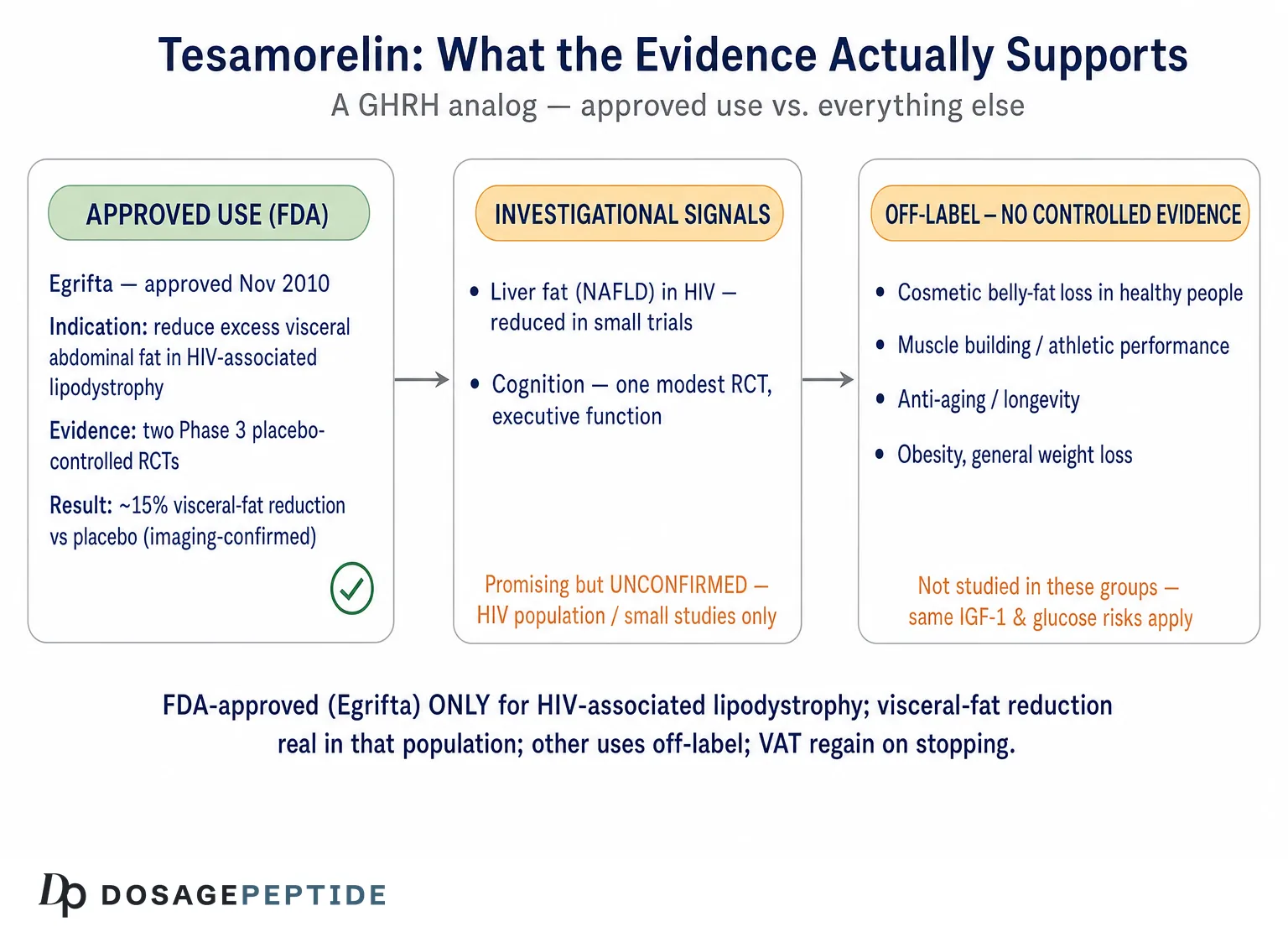
Tesamorelin is a GHRH analogue that signals the pituitary to release the body’s own growth hormone in its natural pulsatile pattern. It is one of very few peptides in this space with a genuine regulatory approval behind randomised, placebo-controlled human trials: cleared by the FDA in November 2010 as Egrifta, for reducing excess visceral abdominal fat in people with HIV-associated lipodystrophy. That indication, and no other.
In those trials it reduced visceral fat specifically rather than fat everywhere, lowered triglycerides on average, and reduced liver fat in the population studied. Three things matter just as much and usually get left out: the visceral fat comes back after discontinuation, IGF-1 rises and that is the central safety tension, and none of this evidence was generated in healthy adults using it cosmetically. Below: what it does, how much, how fast, what happens when you stop, and the safety signals worth knowing about.
The purpose of this piece is to give researchers and educated readers an accurate map of that terrain: what tesamorelin is, how a growth-hormone-releasing-hormone analog can selectively shrink the fat packed around the abdominal organs, exactly what the pivotal trials demonstrated (and did not), and the three caveats that any candid discussion must foreground — the elevation of insulin-like growth factor 1 (IGF-1), the drug’s effects on glucose metabolism, and the well-documented tendency of visceral fat to return once treatment stops. Throughout, the guiding discipline is to state the level of evidence precisely and never to let the reputation of the approved indication bleed into claims that have not been tested.
Visceral adipose tissue (VAT) is not merely a cosmetic concern. It is the metabolically active fat wrapped around the liver, intestines, and other viscera, and its excess is independently linked to insulin resistance, dyslipidemia, and cardiovascular risk. In the HIV population that tesamorelin was developed for, this fat accumulation is often disfiguring and physically uncomfortable, and it had no approved pharmacological treatment before Egrifta. Understanding how the drug addresses it — and where the story ends — is the work of the sections that follow.
What Tesamorelin Actually Is
Tesamorelin is a synthetic analog of human growth-hormone-releasing hormone (GHRH), the hypothalamic peptide that instructs the pituitary gland to secrete growth hormone (GH). Structurally, it reproduces the full 44-amino-acid sequence of native GHRH (specifically the biologically active GRF 1–44 form) with one deliberate modification: a trans-3-hexenoic acid group is attached to the N-terminal tyrosine residue.2 That small chemical addition is the entire point of the molecule’s design.
Native GHRH is a fragile signal. Once released, it is rapidly cleaved by the enzyme dipeptidyl peptidase-4 (DPP-4), which snips the peptide near its N-terminus and inactivates it within minutes. The trans-3-hexenoic acid cap on tesamorelin shields that vulnerable region from DPP-4 degradation, substantially extending the peptide’s half-life and its window of biological activity while preserving its ability to bind and activate the pituitary GHRH receptor.2 The result is a stabilized GHRH that can be given as a once-daily subcutaneous injection and still deliver a meaningful, sustained stimulus to the GH axis. The molecule was developed by Theratechnologies, a Canadian biopharmaceutical company, and the original commercial formulation required daily reconstitution of a lyophilized powder; later formulations (Egrifta SV and, more recently, the F8 formulation marketed as Egrifta WR) simplified handling and reduced injection volume.1
It is worth being clear about the family tree here, because tesamorelin is frequently confused with its cousins. It belongs to the class of GHRH analogs, which also includes sermorelin (a shorter GRF 1–29 fragment) and CJC-1295. These are fundamentally different from the growth-hormone secretagogues that act on the ghrelin receptor — peptides such as ipamorelin, GHRP-2, and GHRP-6 — which stimulate GH through an entirely separate receptor. Readers interested in how the GHRH-mimicking structure differs from these other GH-releasing tools may find the discussion of sermorelin’s structural features a useful companion. The key structural distinction of tesamorelin is that, alone among these compounds, it carries full FDA approval based on Phase 3 evidence — a status none of the others share.
Because tesamorelin works one step upstream of growth hormone itself, it does not flood the body with exogenous GH. Instead, it prompts the pituitary to release the patient’s own GH in a pattern that more closely resembles natural physiology. That distinction — between replacing a hormone and coaxing the gland to make more of it — is central to both the drug’s efficacy and its safety profile, and it is the subject of the next section.
The Mechanism: How a GHRH Analog Shrinks Visceral Fat
The chain of events by which tesamorelin reduces visceral fat is well characterized and follows the established endocrinology of the GH/IGF-1 axis. When tesamorelin binds the GHRH receptor on the anterior pituitary’s somatotroph cells, it triggers the synthesis and pulsatile release of endogenous growth hormone. That GH then acts on peripheral tissues — primarily the liver — to stimulate production of insulin-like growth factor 1 (IGF-1), the principal mediator of many of GH’s downstream effects. Growth hormone is also directly lipolytic: it promotes the breakdown of stored triglycerides in adipose tissue into free fatty acids, and visceral fat depots are particularly responsive to this signal.23
The elegance of the approach lies in the word pulsatile. Directly injecting recombinant human growth hormone produces supraphysiological spikes followed by a sustained, unnatural elevation of GH levels — a pattern associated with fluid retention, joint pain, carpal tunnel symptoms, and pronounced insulin resistance. Because tesamorelin works through the pituitary’s own regulatory machinery, the GH it releases still passes through the body’s negative-feedback controls: rising IGF-1 and somatostatin tone can dampen further secretion, so the resulting profile resembles the natural pulses of a healthy endocrine system more than the flat, high plateau of injected GH.3 This is the mechanistic argument for why tesamorelin was hoped to deliver GH’s fat-mobilizing benefit with a gentler side-effect burden. The molecular signaling that links tesamorelin stimulation to sustained IGF-1 elevation is the biochemical engine behind the visceral-fat effect, and it is also, as we will see, the source of the drug’s central safety tension.
Why does this preferentially target visceral rather than subcutaneous fat? Visceral adipose tissue is metabolically distinct: it has a higher density of GH and beta-adrenergic receptors, a higher lipolytic rate, and drains directly into the portal circulation. GH-driven lipolysis therefore acts more forcefully on this depot, which is one reason the trials consistently showed selective reduction of visceral fat with relative sparing of subcutaneous fat and, importantly, no meaningful loss of the beneficial subcutaneous fat in the limbs and face that HIV patients often struggle to retain.3 The compound’s relationship to broader lipid handling — how the mobilized fatty acids are processed and how the intervention reshapes the lipid profile — reflects a genuine endocrine crosstalk between the GH axis and lipid metabolism rather than a simple local fat-burning effect.
The mechanistic honest caveat is this: the same IGF-1 elevation that drives the benefit is not a free lunch. IGF-1 is a mitogenic, pro-proliferative signal, and raising it systemically carries theoretical and practical concerns that regulators took seriously. The mechanism that shrinks visceral fat and the mechanism that raises safety questions are one and the same. Any account of tesamorelin that celebrates the first while ignoring the second is incomplete.
Understanding Visceral Fat and HIV-Associated Lipodystrophy
To understand why tesamorelin was developed and approved for such a specific population, it helps to understand the problem it was built to solve. HIV-associated lipodystrophy is a disorder of abnormal fat distribution that emerged prominently in the era of combination antiretroviral therapy (ART). Some patients, particularly those exposed to older-generation antiretroviral drugs, developed a syndrome in which subcutaneous fat was lost from the face, limbs, and buttocks (lipoatrophy) while fat accumulated abnormally in the abdomen, the dorsocervical region (the so-called “buffalo hump”), and the breasts (lipohypertrophy).4 The visceral fat accumulation in particular was both disfiguring and metabolically dangerous.
Excess visceral adipose tissue is a well-established driver of cardiometabolic risk in any population. Unlike subcutaneous fat, VAT is highly lipolytically active and secretes a range of inflammatory adipokines and free fatty acids directly into the portal vein, promoting hepatic insulin resistance, atherogenic dyslipidemia, and low-grade systemic inflammation. In people with HIV — who already face elevated cardiovascular risk from chronic inflammation and the metabolic effects of long-term ART — a large visceral fat burden compounds an already precarious situation. Before tesamorelin, clinicians had essentially no approved pharmacological tool for it: diet and exercise helped modestly, low-dose recombinant GH reduced VAT but worsened glucose control and carried a heavy side-effect profile, and surgical options addressed only localized cosmetic problems.4
This is the clinical vacuum into which tesamorelin arrived. Its approval was not for “belly fat” in the general sense, nor for obesity, nor for cosmetic body recomposition. It was for a specific, medically recognized condition — excess visceral abdominal fat in HIV-infected patients with lipodystrophy — in which the risk-benefit calculation of raising GH and IGF-1 could be justified by the absence of alternatives and the seriousness of the metabolic threat. Keeping that context in view is essential, because it explains both why the drug earned approval and why extrapolating its use to healthy people chasing a leaner midsection is a leap the evidence does not license. The distinction between a disease-associated fat depot in a monitored patient and a cosmetic goal in a healthy person is not a technicality; it is the whole basis of the approval.
The Pivotal Evidence: What the Phase 3 Trials Showed
Tesamorelin’s approval rests on two large, well-conducted, randomized, double-blind, placebo-controlled Phase 3 trials, later combined in a pooled analysis. This is a genuinely strong evidence base by the standards of the peptide field, and it deserves to be described accurately rather than either inflated or dismissed.
The first pivotal trial, reported by Falutz and colleagues in the New England Journal of Medicine in 2007, randomized 412 HIV-infected patients with excess abdominal fat in a 2:1 ratio to receive tesamorelin 2 mg subcutaneously once daily or placebo for 26 weeks.5 The primary endpoint was the percentage change in visceral adipose tissue measured by CT scan at the L4–L5 level. The result was clear and statistically robust: visceral fat fell by approximately 15% in the tesamorelin group while it rose slightly in the placebo group, producing a highly significant between-group difference. Triglycerides and the total-cholesterol-to-HDL ratio improved, and — critically — the reduction was selective for visceral fat, with no significant loss of the subcutaneous fat these patients could ill afford to lose. IGF-1 rose substantially, roughly to the upper end of or somewhat above the young-adult reference range, consistent with the intended GH-axis stimulation.5
The second Phase 3 trial replicated this design, and in 2010 Falutz and colleagues published a pooled analysis of both studies in the Journal of Clinical Endocrinology & Metabolism, combining 806 ART-treated patients (543 on tesamorelin, 263 on placebo).6 The pooled results confirmed a mean visceral fat reduction on the order of 15% relative to baseline in the tesamorelin arm, versus a slight increase in the placebo arm — a net treatment effect that was consistent, statistically significant, and clinically meaningful. Across the two trials, the FDA’s review encompassed 816 patients, and it was this consistency across two independent studies that underpinned the 2010 approval.16
| Parameter | What the Phase 3 program showed |
|---|---|
| Design | Two randomized, double-blind, placebo-controlled multicenter trials; 2:1 tesamorelin:placebo56 |
| Population | ART-treated HIV patients with excess abdominal fat (lipodystrophy)5 |
| Dose / route | 2 mg subcutaneous once daily5 |
| Primary endpoint | Percent change in visceral adipose tissue (CT, L4–L5) at 26 weeks5 |
| VAT reduction | ~15% decrease vs slight increase on placebo; highly significant56 |
| Lipids | Triglycerides and total-cholesterol/HDL ratio improved5 |
| Selectivity | Visceral fat reduced; subcutaneous limb/face fat spared35 |
| IGF-1 | Rose substantially into/above young-adult range56 |
| Outcome | FDA approval (Egrifta), November 20101 |
Two honest framings should accompany these numbers. First, a ~15% reduction in visceral fat is a real, measured, imaging-confirmed effect — not a subjective impression or a surrogate biomarker. It is one of the more convincingly demonstrated body-composition effects in the entire peptide literature. Second, the endpoint was a change in fat quantity, not a hard clinical outcome. The trials were not powered or designed to show that tesamorelin reduces heart attacks, strokes, or deaths, and they did not attempt to. The approval was based on the reasonable premise that reducing a metabolically harmful fat depot is beneficial, but the leap from “shrinks visceral fat” to “prevents cardiovascular events” remains, to this day, an inference rather than a demonstrated fact. That distinction is exactly the kind that careful readers of the peptide literature learn to preserve.
Beyond Fat: Liver, Lipids, and Other Signals
The tesamorelin story did not end with visceral fat. Because VAT and ectopic liver fat are metabolically linked, investigators went on to ask whether the drug could address non-alcoholic fatty liver disease (NAFLD) — now often called metabolic dysfunction-associated steatotic liver disease — which is common and consequential in people with HIV. This line of research produced some of the most interesting and mechanistically important findings about the compound, though it, too, remains confined to the HIV population.
In a 2014 randomized clinical trial published in JAMA, Stanley and colleagues studied 50 antiretroviral-treated HIV-infected patients with abdominal fat accumulation and showed that tesamorelin 2 mg daily for six months reduced not only visceral fat (a net treatment difference of roughly 10 percentage points versus placebo) but also liver fat, with the hepatic lipid-to-water fraction falling significantly relative to placebo — a net treatment difference on the order of three percentage points.7 This established that the drug’s fat-mobilizing effect extended to ectopic hepatic depots, an important observation given the role of liver fat in metabolic disease.
A more ambitious follow-up, reported by Stanley and colleagues in Lancet HIV in 2019, enrolled 61 people with HIV and documented NAFLD (hepatic fat fraction of at least 5%) and treated them for a full 12 months.8 Tesamorelin again reduced liver fat significantly — an absolute reduction of about 4.1% in hepatic fat fraction, corresponding to roughly a 37% relative decline from baseline, with 35% of treated participants achieving a hepatic fat fraction below 5% versus just 4% on placebo — and, notably, the treated group showed less progression of liver fibrosis than placebo over the year. This was a meaningful signal because fibrosis progression, not fat content per se, is what drives long-term liver morbidity. Companion proteomic and transcriptomic work suggested tesamorelin downregulated hepatic gene programs involved in inflammation, tissue repair, and cell division.8
Supporting signals accumulated around the edges of the visceral-fat effect. A separate analysis found that the visceral fat reduction achieved with tesamorelin was associated with improved liver enzymes in HIV patients, adding biochemical corroboration to the imaging findings on hepatic fat.13 Investigators also examined the drug’s effect on muscle composition, reporting that tesamorelin decreased fat infiltration within muscle and increased muscle cross-sectional area in adults with HIV — changes best read as a systemic shift of stored lipid out of ectopic depots rather than a direct muscle-building action.12 These are worthwhile secondary observations, but they should be understood as coherent extensions of the same lipolytic mechanism within the HIV population, not as separate proven indications. None of them changes the drug’s regulatory status, and none has been replicated in people without HIV. The pattern across the entire post-approval research program is consistent: tesamorelin reliably redistributes and reduces ectopic and visceral fat in the population it was studied in, and the further one moves from that population, the more the label shifts from “demonstrated” to “plausible but untested.”
It is worth underlining how modest these studies were in absolute terms. The 2014 trial randomized just 50 participants and the 2019 trial 61, sample sizes that are perfectly adequate for a well-controlled imaging endpoint but far too small to detect rare harms, to establish histological reversal of disease, or to support any claim about long-term liver outcomes. The fibrosis signal in particular, while encouraging, rested on surrogate and non-invasive measures over a single year rather than on the paired liver-biopsy endpoints that hepatology regulators typically require before granting a NASH or NAFLD indication.
These liver findings are genuinely promising, but the honest boundaries must be stated plainly. Both trials were conducted exclusively in people with HIV; there is no comparable Phase 3 evidence that tesamorelin treats NAFLD or NASH in the far larger population of people without HIV. The drug is not approved for any liver indication. And the sample sizes, while adequate for the imaging endpoints, were small by the standards of hepatology outcome trials. What the liver research demonstrates is a plausible, biologically coherent benefit worth further study — not an established treatment. Labeling it anything stronger would overstate the case. It is a good example of a compound with a legitimate approved use generating investigational signals in adjacent conditions, signals that remain investigational until confirmed in the relevant populations.
The Discontinuation Caveat: Visceral Fat Comes Back
If there is one practical fact about tesamorelin that is most often glossed over in enthusiastic write-ups, it is this: the visceral fat reduction is not durable once the drug is stopped. This is not a minor footnote; it is a defining characteristic of how the compound behaves, and it was documented within the pivotal trial program itself.
Both Phase 3 trials included a 26-week extension phase after the initial 26-week treatment period, during which some patients who had received tesamorelin were re-randomized to placebo. The finding was consistent and unambiguous: patients who were switched from tesamorelin to placebo regained visceral fat, trending back toward their baseline values, while those who continued tesamorelin maintained their reduction.56 In other words, tesamorelin does not reset a set point or produce a lasting change in fat distribution. It exerts an ongoing pharmacological effect that persists only as long as the drug is administered. Remove the stimulus to the GH axis, and the underlying tendency toward visceral fat accumulation reasserts itself.
The implication is significant and frequently under-appreciated. Tesamorelin, in its approved use, is effectively a chronic therapy for a chronic condition — more analogous to a blood-pressure medication than to a short course that fixes a problem. Any benefit comes bundled with an indefinite commitment to daily injections, continued IGF-1 elevation, ongoing metabolic monitoring, and substantial cost. This reality reframes the risk-benefit calculation considerably. It is one thing to accept the safety trade-offs of IGF-1 elevation for a defined period; it is another to accept them for years on end. For anyone weighing the compound, the regain-on-discontinuation finding is arguably as important as the efficacy data itself, because it converts a one-time decision into a standing one. A compound that works only while you keep taking it, and whose principal action is to raise a mitogenic growth factor, sets a high bar for indefinite use outside a genuine medical need.
IGF-1 Elevation: The Central Safety Tension
The elevation of insulin-like growth factor 1 is simultaneously the mechanism of tesamorelin’s benefit and the focus of its most serious safety questions. The two cannot be separated, and any honest safety discussion has to hold them together.
In the pivotal trials, IGF-1 rose substantially during tesamorelin treatment, with a meaningful proportion of patients reaching levels above the upper limit of the age-adjusted normal range at some point.56 This is expected — it is, after all, the drug working as designed — but IGF-1 is a potent mitogen that promotes cell proliferation and inhibits apoptosis. Chronically elevated IGF-1 has been epidemiologically associated in the broader literature with increased risk of certain cancers, and the biology gives a plausible reason for concern. For this reason, the FDA labeling for tesamorelin carries specific warnings and contraindications tied directly to this axis.
The prescribing information contraindicates tesamorelin in patients with active malignancy, precisely because a mitogenic signal could theoretically accelerate an existing cancer, and advises that any active malignancy be evaluated and treated before starting the drug.9 It also contraindicates use in patients with disruption of the hypothalamic-pituitary axis from surgery, radiation, trauma, or tumor, and in pregnancy. The label recommends monitoring IGF-1 levels during treatment, with consideration of discontinuation if levels rise persistently and markedly above the normal range, and it flags the theoretical risk of promoting neoplasia as a class consideration for GH-axis stimulation.9 These are not abstract cautions; they define the population in whom the drug can responsibly be used.
The molecular biology of how tesamorelin drives this sustained IGF-1 signaling is genuinely interesting from a research standpoint, but the practical upshot is sobering: the very effect that gives the drug its therapeutic power is one that requires laboratory surveillance and careful patient selection to use safely. In the approved HIV-lipodystrophy setting, that surveillance is built into the treatment framework. Outside it — in unmonitored, off-label, or research-chemical use by people with no medical oversight and no IGF-1 testing — the same elevation proceeds unwatched. That is a fundamentally different risk situation from the one in which the drug was studied, and it is one of the strongest reasons the approved-versus-off-label distinction is not a formality but a safety boundary.
Glucose, Diabetes, and Other Safety Signals
Growth hormone is a counter-regulatory hormone that opposes insulin and can worsen glucose tolerance, so it was never a foregone conclusion that a GH-axis stimulant would leave glucose metabolism untouched. The tesamorelin data on this point are nuanced and deserve careful reading rather than a simple “safe” or “unsafe” verdict.
In the controlled trials, average measures of glucose and HbA1c did not deteriorate dramatically over 26 weeks, and this relative glycemic neutrality was cited as an advantage over recombinant GH, which reliably worsens insulin resistance.56 However, “no large average change” conceals meaningful individual-level risk. The FDA labeling reports an increased risk of developing diabetes (defined as HbA1c reaching 6.5% or higher) in tesamorelin-treated patients relative to placebo, with an intent-to-treat hazard ratio in the range of roughly 3, indicating a several-fold elevation in the risk of crossing that diagnostic threshold.9 Some patients experienced transient worsening of glucose parameters, particularly early in treatment as GH and IGF-1 rose. The label accordingly advises monitoring glucose status before and during treatment, with particular caution in patients who already have diabetes or risk factors for it.9
| Safety domain | What the evidence and label indicate |
|---|---|
| IGF-1 elevation | Expected and substantial; monitor levels; contraindicated in active malignancy9 |
| Glucose / diabetes | No large mean change, but several-fold higher risk of reaching HbA1c ≥6.5%; monitor glucose9 |
| Injection-site reactions | Common: erythema, pruritus, pain, irritation, hypertrophy at the site9 |
| Fluid retention / arthralgia | GH-class effects: edema, joint pain, myalgia, carpal-tunnel-type symptoms9 |
| Hypersensitivity | Reported; discontinue if serious reaction occurs9 |
| Contraindications | Active malignancy; pituitary/hypothalamic axis disruption; pregnancy9 |
| Durability | Visceral fat regained after discontinuation56 |
Beyond glucose, tesamorelin carries the expected constellation of GH-class side effects, generally milder than those of recombinant GH but real: fluid retention and edema, arthralgia and myalgia, and carpal-tunnel-type symptoms, along with common injection-site reactions such as redness, itching, pain, and local tissue changes.9 Hypersensitivity reactions have been reported. The overall safety picture from the trials is best summarized as “more favorable than direct GH, but not benign” — a drug whose tolerability was acceptable in a monitored trial population with a genuine medical need, which is a very different thing from being safe for casual or unsupervised use. As the LiverTox database and prescribing information both make clear, tesamorelin’s acceptable profile was established under conditions of medical supervision and laboratory monitoring that do not exist in off-label enhancement use.10
Off-Label and Cosmetic Use: What the Evidence Does NOT Show
Here the article must be at its most disciplined, because this is where the gap between what tesamorelin is approved for and how it is often discussed becomes widest. Tesamorelin is approved for exactly one thing: reducing excess visceral abdominal fat in HIV-associated lipodystrophy. Every other use — general weight loss, cosmetic abdominal fat reduction in people without HIV, anti-aging, athletic performance, muscle building, longevity — is off-label, and for most of these the honest evidence label is not “weak evidence” but “no controlled evidence in that population.”
Consider the most common off-label framing: a healthy or overweight person using tesamorelin to lose belly fat for cosmetic or general-health reasons. There is no Phase 3 trial — indeed, no adequately powered controlled trial of any kind — demonstrating that tesamorelin safely and effectively reduces visceral fat in people without HIV-associated lipodystrophy. The mechanism might plausibly transfer, since the GH/IGF-1 lipolytic pathway is not HIV-specific, but plausibility is not evidence, and the safety trade-offs (IGF-1 elevation, glucose risk) would apply in full to a person who does not have the serious medical indication that justified accepting them in the trials. In a healthy person, the risk-benefit arithmetic that supported approval simply does not hold, because the “benefit” side is cosmetic while the “risk” side is unchanged.
The one off-label area with genuine, if preliminary, controlled human data is cognition. In a randomized, placebo-controlled trial published in Archives of Neurology in 2012, Baker and colleagues gave GHRH (tesamorelin) to 152 older adults — both healthy individuals and those with mild cognitive impairment — for 20 weeks and found improvements in executive function and, to a lesser degree, verbal memory, alongside the expected rise in IGF-1.11 This is a real, peer-reviewed positive signal, and it is legitimately interesting. But it must be labeled precisely: it is a single, modest-sized, relatively short trial with cognitive test scores as endpoints, not a demonstration that tesamorelin treats, prevents, or slows any neurodegenerative disease. It supports the description “investigational for cognition,” nothing stronger. Readers exploring this angle may find the parallel discussion of whether a related GHRH analog supports cognitive function a useful frame for how tentative this whole area remains.
The bodybuilding and performance-enhancement framing deserves particular skepticism. Tesamorelin is sometimes marketed in enhancement circles as a fat-loss or physique tool, often stacked with GH secretagogues. There is no controlled evidence that it improves athletic performance, builds muscle, or produces cosmetically superior body composition in healthy trained individuals, and its use in this context is unstudied, unmonitored, and frequently involves research-chemical material of uncertain purity. The absence of muscle-building evidence is unsurprising mechanistically: tesamorelin’s documented body-composition effect is visceral fat reduction, not lean-mass accretion. Anyone reasoning from “raises GH and IGF-1” to “must build muscle” is extrapolating past the actual data. For comparison, the broader question of how fat-targeting peptides such as AOD-9604 influence lipolysis without touching the IGF-1 pathway illustrates just how differently these compounds are engineered, and how little any of them resemble a muscle-building agent.
It is worth stating, as plainly as possible, the list of things the evidence does not show, because vendors and enthusiasts routinely imply otherwise. The trials do not show that tesamorelin reduces cardiovascular events, heart attacks, or mortality — they measured fat quantity, not clinical outcomes. They do not show that it produces sustained fat loss after discontinuation; the opposite is documented. They do not show efficacy or safety in people without HIV-associated lipodystrophy, in whom the drug has never been adequately studied. They do not show that it treats obesity, metabolic syndrome, or type 2 diabetes as such. They do not show that it builds muscle or enhances athletic performance. And they do not show that its cognitive signal amounts to a treatment for Alzheimer’s disease or any other dementia. Each of these is either untested or actively contradicted by the data, and conflating “approved to shrink visceral fat in HIV lipodystrophy” with any of them is precisely the error a careful reader should refuse to make.
How Tesamorelin Compares With Other GH-Axis Peptides
Placing tesamorelin alongside related compounds clarifies both what makes it distinctive and where its evidentiary edge lies. The comparison is not about which peptide is “best” but about the very different levels of human evidence each carries.
| Compound | Class / mechanism | Regulatory & evidence status |
|---|---|---|
| Tesamorelin | Stabilized GHRH analog (GRF 1–44); pulsatile GH → IGF-1 → visceral lipolysis | FDA-approved for HIV lipodystrophy VAT; two Phase 3 RCTs156 |
| Recombinant human GH | Direct exogenous growth hormone | Approved for specific deficiencies/wasting; reduces VAT but worsens glucose; supraphysiologic profile4 |
| Sermorelin | GHRH analog (GRF 1–29 fragment) | Formerly marketed for GH-deficiency diagnosis; no VAT approval; limited modern trial data |
| CJC-1295 / ipamorelin | Long-acting GHRH analog / ghrelin-receptor secretagogue | Not FDA-approved; research-use; no controlled VAT outcome trials |
| AOD-9604 | GH fragment (176–191); lipolytic, IGF-1-sparing by design | Not approved; obesity trials did not beat placebo; no VAT-imaging efficacy |
The pattern is unmistakable. Tesamorelin is essentially alone in this group in carrying a full regulatory approval grounded in replicated Phase 3 imaging-endpoint trials. Recombinant GH reduces visceral fat too, but through a cruder, supraphysiological route that worsens glucose control — the specific problem tesamorelin’s pulsatile design was meant to mitigate. The other GHRH analogs and secretagogues, such as sermorelin, CJC-1295, and ipamorelin, share a family resemblance to tesamorelin but lack anything approaching its evidence base for visceral fat; readers can see how researchers compare ipamorelin with other growth-hormone peptides to appreciate how differently these tools are positioned. And AOD-9604, despite its superficial “fat-loss peptide” branding, was deliberately engineered to avoid IGF-1 elevation and failed to beat placebo in obesity trials — a reminder that mechanism and marketing are not evidence.
The lesson embedded in this table is that tesamorelin’s value as a reference point comes precisely from its rigorous evidence, and that this rigor is confined to one indication. It is the exception that proves the rule about how thin the human evidence is for most peptides in this space — and a caution against assuming that its approved-use credibility transfers to its off-label cousins or to its own off-label uses.
Research Handling, Formulations, and Regulatory Status
Tesamorelin is supplied, in both its pharmaceutical and research-chemical forms, as a lyophilized (freeze-dried) powder that requires reconstitution before use. The following note is strictly educational and describes standard peptide handling practice rather than any endorsement of unsupervised use; tesamorelin is a prescription drug in its approved formulation and is not a legal supplement.
Lyophilized peptides are generally reconstituted with sterile or bacteriostatic water, with the diluent directed slowly against the vial wall and the vial swirled gently rather than shaken, since vigorous agitation can shear peptide bonds and degrade the material. The chosen diluent volume sets the final concentration — a fixed mass of peptide in a larger volume yields a lower concentration — which is the arithmetic behind any reconstitution chart. General principles of this process are covered in the site’s peptide reconstitution guide, and definitions of the endocrine terms used throughout this article can be found in the peptide glossary. Reconstituted tesamorelin is typically refrigerated and protected from light and repeated freeze-thaw cycles, which degrade peptides. It bears emphasizing that meticulous handling preserves whatever activity the molecule has; it does not change the evidence or the regulatory facts, and a perfectly prepared vial used off-label is still off-label use of a mitogenic drug without medical monitoring.
On the regulatory front, the picture is comparatively clear for tesamorelin, which is a virtue relative to most peptides. It is an FDA-approved prescription drug — not a supplement, not a gray-market research chemical in its legitimate form — approved in November 2010 as Egrifta for the reduction of excess visceral abdominal fat in HIV-infected patients with lipodystrophy.1 Subsequent formulation updates were also approved: Egrifta SV simplified reconstitution and reduced injection volume, and more recently the F8 formulation marketed as Egrifta WR received FDA approval for the same indication, further easing administration.19 There is no approved indication beyond HIV-associated lipodystrophy in any major jurisdiction — not for general obesity, not for NAFLD in the non-HIV population, not for cognition, and not for cosmetic or performance use. Any use outside the labeled indication is off-label, and material sold as “research tesamorelin” outside the pharmaceutical supply chain carries the usual concerns about purity, sterility, and mislabeling that attend all such products.
The regulatory synthesis is therefore refreshingly unambiguous compared with the murk surrounding many peptides: tesamorelin is a real, approved drug with a real, replicated evidence base — for one specific condition. Everything outside that condition is investigational or unstudied, and the burden of proof for those uses has not been met. That clarity is itself valuable, because it lets a careful reader separate the well-supported core from the speculative periphery without ambiguity.
Frequently Asked Questions
Does tesamorelin actually reduce visceral fat?
Yes — in the population it was studied in. Two randomized, double-blind, placebo-controlled Phase 3 trials in HIV patients with lipodystrophy showed that tesamorelin 2 mg daily reduced CT-measured visceral adipose tissue by roughly 15% relative to placebo over 26 weeks, a highly statistically significant and imaging-confirmed effect.56 This is one of the better-documented body-composition effects in the peptide field. The important caveat is that this evidence is specific to HIV-associated lipodystrophy; there is no comparable controlled evidence in people without that condition.
Is tesamorelin FDA-approved?
Yes, but for a narrow indication. Tesamorelin (Egrifta, later Egrifta SV and Egrifta WR) was approved by the FDA in November 2010 solely for the reduction of excess visceral abdominal fat in HIV-infected patients with lipodystrophy.1 It is not approved for general weight loss, cosmetic fat reduction, anti-aging, muscle building, athletic performance, or NAFLD in people without HIV. All of those are off-label uses that lack Phase 3 support.
What happens to the fat if you stop taking it?
It comes back. In the extension phases of the pivotal trials, patients switched from tesamorelin to placebo regained visceral fat toward their baseline levels, while those who continued treatment maintained their reduction.56 Tesamorelin does not permanently reset fat distribution; its effect persists only while the drug is being taken, which effectively makes approved use a chronic, ongoing therapy rather than a short fix.
Why does raising IGF-1 matter for safety?
Tesamorelin works by stimulating the pituitary to release growth hormone, which raises IGF-1, a mitogenic growth factor that promotes cell proliferation.5 That same elevation is the source of its safety concerns. The FDA label contraindicates the drug in active malignancy, recommends monitoring IGF-1 during treatment, and flags a theoretical risk of promoting neoplasia.9 The benefit and the risk share one mechanism, which is why medical monitoring is built into approved use.
Does tesamorelin affect blood sugar or cause diabetes?
It can. Although average glucose and HbA1c did not change dramatically over 26 weeks in the trials, the FDA labeling documents a several-fold increased risk of reaching an HbA1c of 6.5% or higher (the diabetes threshold) relative to placebo, and some patients experienced transient glucose worsening early in treatment.9 Glucose monitoring before and during treatment is recommended, with extra caution in people who already have diabetes or its risk factors.
Is tesamorelin useful for cognition or anti-aging?
The evidence is preliminary, not established. A single randomized, placebo-controlled trial in older adults (including those with mild cognitive impairment) found that GHRH/tesamorelin over 20 weeks improved executive function and, modestly, verbal memory.11 That is a genuine but limited signal — it supports calling the cognitive use “investigational,” not a treatment for any neurodegenerative disease. There is no approval for cognitive or anti-aging indications.
Can healthy people use tesamorelin to lose belly fat?
There is no controlled evidence supporting this. Every efficacy and safety trial was conducted in HIV patients with lipodystrophy, a population with a serious medical indication that justified accepting the drug’s IGF-1 and glucose trade-offs. In a healthy person seeking cosmetic fat loss, those same risks apply while the medical justification does not, and the effect has never been demonstrated in that group. Using it this way is off-label, unstudied, and typically unmonitored.
How does tesamorelin differ from injecting growth hormone directly?
Tesamorelin acts one step upstream: it stimulates the pituitary to release the body’s own GH in a pulsatile pattern subject to normal feedback, rather than flooding the body with exogenous GH.3 This more physiologic profile is why it reduces visceral fat with less of the pronounced insulin resistance and side-effect burden seen with recombinant GH — though, as the safety data show, “less” is not “none.”
Is tesamorelin the same as sermorelin or CJC-1295?
They are relatives, not equivalents. All are GHRH analogs, but tesamorelin is the stabilized full-length GRF 1–44 with a trans-3-hexenoic acid modification that resists enzymatic breakdown, and it is the only one with FDA approval and replicated Phase 3 evidence for visceral fat.12 Sermorelin (a shorter GRF 1–29 fragment) and CJC-1295 lack that evidence base and approval for this use.
References
- U.S. Food and Drug Administration / Theratechnologies. FDA approval of EGRIFTA (tesamorelin for injection) for reduction of excess abdominal fat in HIV-infected patients with lipodystrophy, November 2010; subsequent EGRIFTA SV and EGRIFTA WR (F8) approvals. https://www.accessdata.fda.gov/drugsatfda_docs/label/2019/022505s012s013lbl.pdf
- Ferdinandi ES, Brazeau P, High K, et al. Non-clinical pharmacology and safety evaluation of TH9507, a human growth hormone-releasing factor analogue. Basic Clin Pharmacol Toxicol. 2007;100(1):49-58. PMID: 17214610. https://pubmed.ncbi.nlm.nih.gov/17214610/
- Stanley TL, Grinspoon SK. Effects of growth hormone-releasing hormone on visceral fat, metabolic, and cardiovascular indices in human studies. Growth Horm IGF Res. 2015;25(2):59-65. PMID: 25555516. https://pubmed.ncbi.nlm.nih.gov/25555516/
- Falutz J. Management of fat accumulation in patients with HIV infection. Curr HIV/AIDS Rep. 2011;8(3):200-208. PMID: 21732121. https://pubmed.ncbi.nlm.nih.gov/21732121/
- Falutz J, Allas S, Blot K, et al. Metabolic effects of a growth hormone-releasing factor in patients with HIV. N Engl J Med. 2007;357(23):2359-2370. PMID: 18057338. https://pubmed.ncbi.nlm.nih.gov/18057338/
- Falutz J, Mamputu JC, Potvin D, et al. Effects of tesamorelin (TH9507), a growth hormone-releasing factor analog, in HIV-infected patients with excess abdominal fat: a pooled analysis of two multicenter, double-blind placebo-controlled phase 3 trials with safety extension data. J Clin Endocrinol Metab. 2010;95(9):4291-4304. PMID: 20554713. https://pubmed.ncbi.nlm.nih.gov/20554713/
- Stanley TL, Feldpausch MN, Oh J, et al. Effect of tesamorelin on visceral fat and liver fat in HIV-infected patients with abdominal fat accumulation: a randomized clinical trial. JAMA. 2014;312(4):380-389. PMID: 25038357. https://pubmed.ncbi.nlm.nih.gov/25038357/
- Stanley TL, Fourman LT, Feldpausch MN, et al. Effects of tesamorelin on non-alcoholic fatty liver disease in HIV: a randomised, double-blind, multicentre trial. Lancet HIV. 2019;6(12):e821-e830. PMID: 31611038. https://pubmed.ncbi.nlm.nih.gov/31611038/
- EGRIFTA SV (tesamorelin for injection) Prescribing Information. Theratechnologies Inc. (contraindications, warnings, IGF-1 monitoring, diabetes risk, adverse reactions). https://www.accessdata.fda.gov/drugsatfda_docs/label/2019/022505s012s013lbl.pdf
- National Institute of Diabetes and Digestive and Kidney Diseases. Tesamorelin. LiverTox: Clinical and Research Information on Drug-Induced Liver Injury. NCBI Bookshelf, NBK548730. https://www.ncbi.nlm.nih.gov/books/NBK548730/
- Baker LD, Barsness SM, Borson S, et al. Effects of growth hormone-releasing hormone on cognitive function in adults with mild cognitive impairment and healthy older adults: results of a controlled trial. Arch Neurol. 2012;69(11):1420-1429. PMID: 22869065. https://pubmed.ncbi.nlm.nih.gov/22869065/
- Adrian S, Scherzinger A, Sanyal A, et al. The growth hormone releasing hormone analogue, tesamorelin, decreases muscle fat and increases muscle area in adults with HIV. J Frailty Aging. 2019;8(3):154-159. PMID: 31237318. https://pubmed.ncbi.nlm.nih.gov/31237318/
- Fourman LT, Czerwonka N, Feldpausch MN, et al. Visceral fat reduction with tesamorelin is associated with improved liver enzymes in HIV. AIDS. 2017;31(16):2253-2259. PMID: 28832410. https://pubmed.ncbi.nlm.nih.gov/28832410/
Educational and research-use disclaimer: This article is provided solely for scientific and educational purposes. Tesamorelin (Egrifta) is approved by the FDA only for the reduction of excess visceral abdominal fat in HIV-infected patients with lipodystrophy; it is not approved for general weight loss, cosmetic fat reduction, non-alcoholic fatty liver disease outside the HIV setting, cognition, anti-aging, muscle building, or athletic performance, and its use for any of those purposes is off-label and, for most, unsupported by controlled human evidence. Tesamorelin raises IGF-1 and can affect glucose metabolism; it is contraindicated in active malignancy and requires medical supervision and laboratory monitoring. Nothing here is medical advice or a recommendation for human use. Any legitimate investigation of this compound should occur within properly authorized clinical care or research under appropriate oversight. Readers should consult qualified healthcare professionals and applicable regulations before making any decisions.