Tesamorelin lowers visceral abdominal fat and liver fat, and it does so indirectly — by restoring pulsatile growth hormone release rather than acting on fat cells itself. That single mechanism is why its effects ripple through IGF-1, insulin, and glucocorticoid signalling at the same time, and why the lipid changes it produces are modest and context-dependent rather than dramatic. One boundary frames everything below: tesamorelin is a growth-hormone-releasing hormone (GHRH) analog approved by the U.S. Food and Drug Administration as Egrifta for exactly one indication — reducing excess visceral abdominal fat in people with HIV-associated lipodystrophy.1 Every other framing, including general “metabolic health” and weight-loss use, is off-label and rests on thinner evidence. Dosing conventions are set out in our tesamorelin 10 mg vial protocol.
So rather than treat the title as a settled fact to be illustrated, this piece treats it as a mechanistic hypothesis to be examined honestly. Tesamorelin does not act on lipids directly. It is not a lipase, a receptor ligand on the fat cell, or a lipoprotein modifier. It sits at the very top of an endocrine cascade — the hypothalamic-pituitary somatotropic axis — and its entire influence on lipid handling is downstream, indirect, and mediated by the hormones it coaxes the body into releasing. That is precisely why “endocrine crosstalk” is the right lens: the lipid effects that were measured in the pivotal HIV trials are the visible end of a chain that runs from GHRH receptor, to pulsatile growth hormone (GH) secretion, to hepatic insulin-like growth factor 1 (IGF-1), and then out into adipose tissue, liver, and the glucose-handling machinery, with feedback loops folding back on themselves at every step.
This article is written for researchers and scientifically literate readers who want an accurate map of that cascade — where the biology is solid, where it is inferred, and where the popular narrative outruns the data. We will trace the axis from the top down, examine what growth hormone actually does to a fat cell at the molecular level, follow the IGF-1 feedback arm, map the crosstalk with the glucocorticoid and insulin systems, and then hold all of that mechanism against what the human trials genuinely measured. Throughout, the discipline is the same one that should govern any honest account of an approved-but-narrow drug: state the approved efficacy plainly, cite the real pivotal trials, and refuse to let a clean mechanism story imply benefits that have not been demonstrated in the population reading about them.
The GHRH Axis: Where Tesamorelin Actually Acts
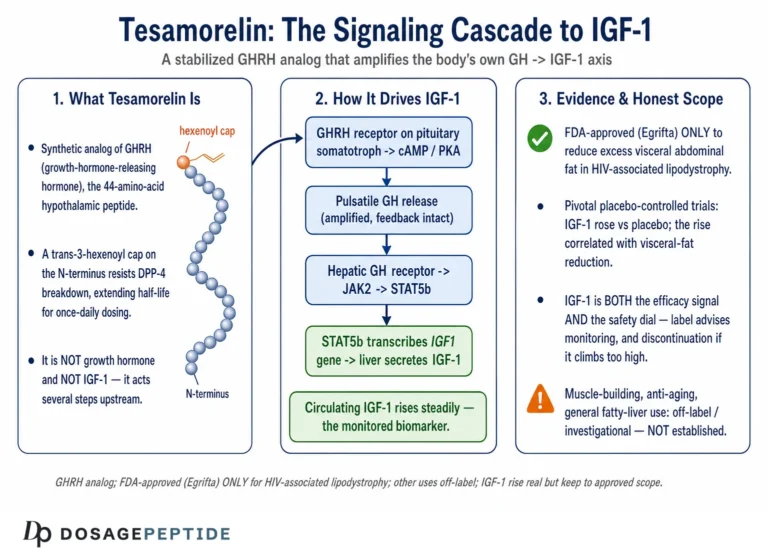
Tesamorelin is a synthetic analog of human GHRH, the 44-amino-acid hypothalamic peptide that instructs the anterior pituitary to release growth hormone. The native hormone is fragile; it is rapidly degraded in plasma, largely by dipeptidyl peptidase-4 (DPP-4) cleavage at its N-terminus. Tesamorelin’s design addresses that fragility directly: it is GHRH(1–44) with a trans-3-hexenoic acid group attached to the N-terminal tyrosine, a modification that stabilizes the molecule against enzymatic breakdown and extends its useful half-life while preserving its ability to bind and activate the pituitary GHRH receptor.1 The result is a molecule that speaks the pituitary’s own language but survives long enough to be given as a once-daily subcutaneous injection.
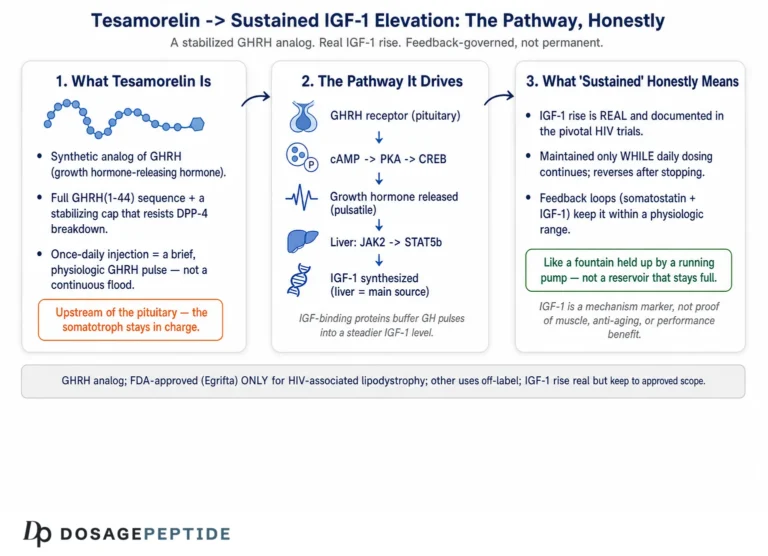
The critical point — the one that separates tesamorelin from exogenous growth hormone therapy — is that it does not supply GH. It stimulates the somatotroph cells of the pituitary to make and release the body’s own GH. This distinction is not cosmetic. When recombinant human GH is injected, it produces sustained, non-physiological elevations that override the body’s pulsatile rhythm and its feedback brakes. Tesamorelin instead amplifies the endogenous system, and that system retains its regulatory architecture: hypothalamic somatostatin still opposes GH release, and rising IGF-1 still feeds back to restrain both GHRH and GH output. In principle, this preserves a more physiological pattern of secretion and a built-in ceiling that pure hormone replacement lacks.2
It helps to picture the axis as a three-tier relay. At the top sits the hypothalamus, releasing GHRH (stimulatory) and somatostatin (inhibitory) in opposing rhythms. In the middle sits the pituitary somatotroph, integrating those signals and firing GH in discrete pulses, mostly overnight. At the bottom sits the liver and peripheral tissues, where GH acts both directly — on its own receptor — and indirectly, by driving hepatic production of IGF-1. Tesamorelin’s intervention is at the top of this relay. Everything the drug is credited with doing to lipids happens two and three tiers down, which is exactly why no account of its lipid effects can avoid the language of crosstalk. Readers wanting a companion example of a hypothalamic-releasing-hormone strategy can compare tesamorelin with the GHRH analog sermorelin, whose role in stimulating natural growth hormone follows the same top-of-axis logic through a different molecule.
One more design consequence deserves emphasis. Because tesamorelin works through the intact axis, its downstream signal is only as large as the pituitary’s own capacity to respond and only as sustained as the feedback loops allow. In a person whose somatotroph function is exhausted or whose IGF-1 is already high, the drug has little room to act. This ceiling is a feature, not a flaw, and it shapes both the efficacy and the safety profile discussed later: the crosstalk that produces the lipid effects also polices them.
Restoring the Pulse: Why Endogenous GH Secretion Shapes Lipid Handling
To understand why raising endogenous GH would touch lipids at all, it helps to recall that growth hormone is, among its many roles, one of the body’s principal fat-mobilizing hormones. The reason the HIV-lipodystrophy indication exists in the first place is that a subset of people on antiretroviral therapy develop a syndrome of accumulating visceral (intra-abdominal) fat, often accompanied by relative GH deficiency and a blunted GH response. Tesamorelin was developed on the logic that restoring a more normal GH secretory pattern would help reverse the abnormal fat distribution — and, because visceral fat is metabolically active, that reversing it would carry lipid and metabolic consequences with it.13
Growth hormone is secreted in pulses, predominantly during slow-wave sleep, with low troughs between peaks. This pulsatility is thought to matter: the pattern of exposure, not just the average concentration, influences how target tissues respond, including how genes governing lipid handling are switched on and off. A continuous, flat elevation (as with high-dose recombinant GH) and a restored pulsatile rhythm (the intended effect of a GHRH analog) are not metabolically equivalent, even at similar average levels. This is one reason the field has been interested in secretagogue strategies rather than simply giving more hormone.2 The distinction is imperfectly characterized in humans and should not be overstated, but it is a real part of the rationale.
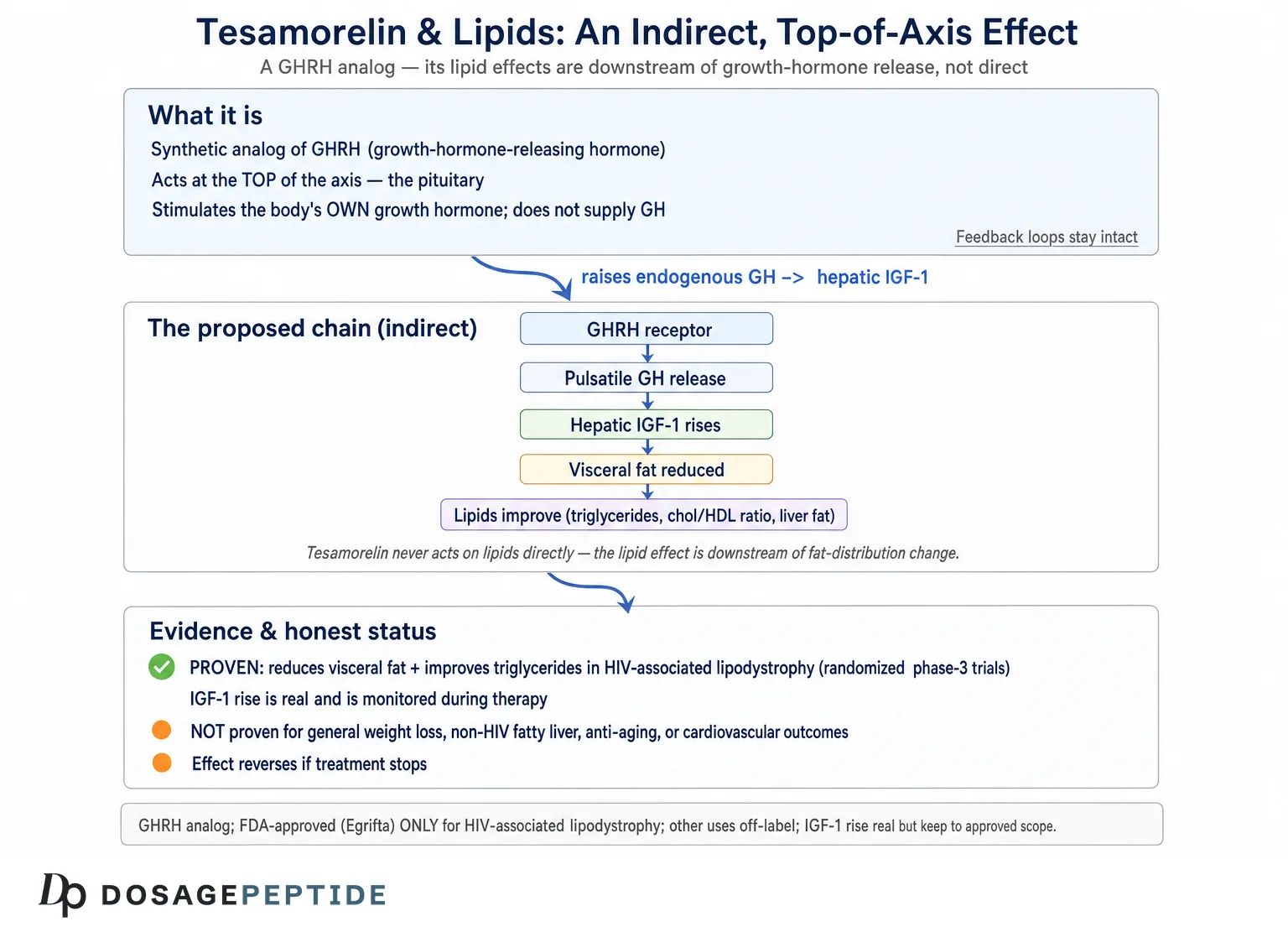
The lipid relevance flows from a simple physiological fact: adipose tissue is not an inert storage depot but an endocrine organ, and visceral adipose tissue in particular is a metabolically noisy one. It drains directly into the portal vein, so free fatty acids and inflammatory signals it releases reach the liver first and at high concentration. When visceral fat expands, the liver is bathed in a lipid-rich, inflammatory portal stream that drives hepatic triglyceride synthesis, worsens the circulating lipid profile, and promotes ectopic fat deposition in the liver itself. Shrinking that depot — which is what tesamorelin was shown to do — therefore has knock-on effects on triglycerides, on the cholesterol profile, and on liver fat, not because the drug touches those endpoints directly but because it changes the tissue that was driving them.45
The honest framing, then, is that tesamorelin’s lipid effects are a secondary consequence of a primary action on body-fat distribution, itself a downstream consequence of restored GH secretion. Each arrow in that sentence is a place where the effect can be amplified, blunted, or reversed by other signals — which is the essence of endocrine crosstalk and the subject of the sections that follow.
It is worth pausing on why the HIV-lipodystrophy context is so central to this rationale rather than incidental to it. Chronic HIV infection and certain antiretroviral regimens are associated with a characteristic redistribution of body fat — accumulation in the abdomen, the dorsocervical region, and sometimes the breasts, with loss in the limbs and face — alongside a blunted growth-hormone response that is thought to contribute to the visceral accumulation. That combination is what made a GH-restoring strategy biologically sensible in the first place: the axis being amplified was, in these patients, relatively under-active, and the fat depot being targeted was both expanded and metabolically toxic. When the same reasoning is transplanted to a person with a normal GH axis and ordinary central adiposity, the premise that motivated the drug no longer holds in the same way, which is precisely why the approved indication is drawn where it is and why extrapolation beyond it is more fragile than the clean mechanism narrative might suggest.
Growth Hormone and the Adipocyte: Direct Lipolytic Signaling
What does GH actually do when it reaches a fat cell? The classical observation, dating back decades and refined considerably in the last ten years, is that GH is lipolytic: it promotes the breakdown of stored triglyceride into free fatty acids and glycerol, which are then released into the circulation. In humans, a GH exposure produces a measurable rise in circulating free fatty acids after a lag of one to two hours, peaking at three to four hours — a delay that already tells us the effect is transcriptionally mediated rather than a fast, membrane-level switch.2
The molecular detail that has clarified this picture concerns a protein called FSP27 (fat-specific protein 27, also known as CIDEC), which normally coats lipid droplets and acts as a brake on lipolysis by stabilizing the droplet. Work in human adipocytes has shown that GH downregulates FSP27, and that it does so by impairing the transcriptional activity of PPARγ — the master regulator of the fat-cell program — through activation of the MEK/ERK signaling pathway.7 With less FSP27 restraining the lipid droplet, hormone-sensitive lipase and adipose triglyceride lipase can act more freely, and triglyceride breakdown accelerates. A parallel line of work confirmed the same PPARγ–FSP27 axis as a route by which GH stimulates lipolysis in human fat cells.8 This is a genuine, mechanistically specified pathway, not a hand-wave, and it is the clearest current answer to “how does the GH signal reach the triglyceride.”
Two features of this mechanism matter for the crosstalk story. First, it is depot-selective in its consequences. Visceral adipocytes express a higher density of GH receptors than subcutaneous ones and appear disproportionately responsive to GH-driven lipolysis, which is consistent with the clinical observation that tesamorelin preferentially shrinks the visceral depot while largely sparing subcutaneous fat.6 Second, the very same lipolytic signal that mobilizes fat also raises circulating free fatty acids, and elevated free fatty acids are a well-established driver of insulin resistance. The lipid-mobilizing action and the glucose-antagonizing action of GH are, at the molecular level, two faces of the same coin — a point we return to when discussing safety.
| Mechanistic node | What GH does there | Net effect on lipid handling |
|---|---|---|
| PPARγ / FSP27 axis in adipocyte | MEK/ERK activation impairs PPARγ; FSP27 (lipid-droplet brake) downregulated78 | Lipolysis released; triglyceride breakdown accelerates |
| GH receptor density (visceral vs subcutaneous) | Higher receptor density in visceral depot; greater responsiveness6 | Preferential loss of visceral fat |
| Free fatty acid flux | Mobilized FFA released to portal/systemic circulation6 | Substrate for oxidation; also antagonizes insulin action |
| Hepatic IGF-1 production | GH drives IGF-1 synthesis in liver2 | Feedback restraint on axis; anabolic/partitioning signal |
| 11β-HSD1 in adipose (proposed) | GH may downregulate local cortisol regeneration6 | Less local glucocorticoid amplification of fat storage |
The table makes the layered nature of the mechanism explicit. Only the first three rows are firmly established in human tissue; the IGF-1 arm is well established as biology but its net lipid contribution is harder to isolate, and the 11β-HSD1 row is a plausible, partially supported contributor rather than a proven driver. Keeping those confidence levels distinct is part of reading the evidence honestly.
The IGF-1 Arm and Its Feedback Loop
Growth hormone’s second major route of action is indirect: it travels to the liver and drives the production of IGF-1, the mediator through which many of GH’s growth-promoting and anabolic effects are executed. In the tesamorelin trials, IGF-1 rose reliably and in proportion to the GH stimulation — this elevation is real, expected, and central to both the drug’s effects and its monitoring.34 Any honest description of tesamorelin has to foreground the IGF-1 rise rather than minimize it, because it is the pivot around which the whole axis balances.
IGF-1 does several things relevant to lipid metabolism, but its most important role in this story is regulatory. IGF-1 is the axis’s primary negative-feedback signal: rising IGF-1 suppresses hypothalamic GHRH and stimulates somatostatin, throttling further GH release. This is the built-in ceiling mentioned earlier. It means that as tesamorelin drives GH and GH drives IGF-1, the IGF-1 itself begins to restrain the very GH pulses that produced it. The lipid effects therefore plateau rather than escalate indefinitely, and they depend on where an individual’s IGF-1 already sits. A person with high baseline IGF-1 has less headroom; the feedback loop is already partly engaged.2
In terms of energy partitioning, the GH/IGF-1 pair pushes the body toward using fat as fuel and preserving or building lean tissue — a shift away from lipid storage and toward lipid oxidation and protein anabolism. This is why the tesamorelin trials generally reported increases in lean body mass alongside the loss of visceral fat, a body-composition signature quite different from simple caloric restriction.14 The partitioning effect is genuine, but it is modest and should not be inflated into a claim that tesamorelin is a body-recomposition agent for the general population; the data supporting it come specifically from HIV-associated lipodystrophy.
The IGF-1 arm also has a darker edge that responsible writing cannot skip. Because IGF-1 is a growth factor, sustained elevation is theoretically relevant to cell proliferation, and prescribing information carries appropriate cautions; IGF-1 levels are monitored during therapy and the drug is not used in people with active malignancy. The same molecule that closes the feedback loop and helps partition energy toward lean tissue is one whose long-term elevation warrants surveillance. That tension — a beneficial signal and a monitored risk in the same hormone — is a defining feature of the endocrine crosstalk this article describes. Growth-hormone-secretagogue biology more broadly, including ghrelin-mimetic approaches that converge on the same GH pulse, is explored in the context of ipamorelin’s targeting of the GHSR-1a receptor, a complementary way of raising endogenous GH.
Crosstalk with the Glucocorticoid and Insulin Systems
If the GH/IGF-1 loop were the whole story, tesamorelin’s lipid effects would be simpler than they are. In reality, the somatotropic axis is entangled with at least two other systems that shape fat and lipid handling: the glucocorticoid system and the insulin system. This is where “crosstalk” stops being a metaphor and becomes the actual mechanism.
Consider glucocorticoids first. Cortisol promotes visceral fat accumulation, and much of cortisol’s local action in fat tissue depends not on circulating levels but on an enzyme inside the adipocyte — 11β-hydroxysteroid dehydrogenase type 1 (11β-HSD1) — that regenerates active cortisol from inactive cortisone right where it is needed. High local 11β-HSD1 activity amplifies glucocorticoid drive in visceral fat and favors storage. There is evidence that GH downregulates 11β-HSD1 in adipose tissue, which would reduce local cortisol regeneration and lift some of the glucocorticoid pressure toward visceral fat storage.6 If this contributes to tesamorelin’s action, then part of the drug’s visceral-fat effect runs through the glucocorticoid axis rather than through lipolysis alone — a second, parallel channel of crosstalk. This mechanism is biologically plausible and supported in principle, but its quantitative contribution in treated patients is not precisely established, and it should be presented as a contributing hypothesis rather than a settled fact.
The insulin axis is the more consequential and better-documented interaction, and it cuts in the opposite direction. As noted, GH-driven lipolysis raises circulating free fatty acids, and free fatty acids blunt insulin-stimulated glucose uptake in muscle and promote hepatic glucose output. GH also has more direct antagonistic effects on insulin signaling. The upshot is that raising GH tends to nudge glucose metabolism toward insulin resistance — the classic diabetogenic edge of growth hormone.9 The FSP27 work ties this together elegantly: the same GH-driven downregulation of FSP27 that releases lipolysis also contributes to insulin resistance, and blocking GH action (with a GH-receptor antagonist) blunts both.7 Lipid mobilization and glucose antagonism are mechanistically coupled.
This coupling is why the glucose data from tesamorelin trials are so important and why they are, on balance, reassuring within the studied populations. In the HIV-lipodystrophy program, tesamorelin’s expected GH-mediated pressure on glucose appears to have been substantially offset by the metabolic benefit of losing visceral fat — the visceral-fat reduction improves insulin sensitivity, counterbalancing the direct GH effect. In a dedicated randomized trial in people with type 2 diabetes, tesamorelin did not significantly worsen the primary measure of insulin response, glycated hemoglobin, or overall diabetes control over 12 weeks, and total and non-HDL cholesterol fell in the 2 mg group.10 The net glucose effect, in other words, reflects a tug-of-war between the direct diabetogenic push of GH and the indirect insulin-sensitizing pull of visceral-fat loss. That balance held acceptably in the studied groups but cannot be assumed to hold in every population or over longer horizons.
From Mechanism to Measured Lipids: What the Trials Actually Show
Mechanism is only as good as the endpoints it predicts, so it is worth grounding all of the above in what the human trials genuinely measured. Tesamorelin’s clinical evidence base is unusually solid for a peptide of this kind because it went through a proper FDA registration program, and the lipid findings are consistent across studies.
The pivotal work was two multicenter, randomized, double-blind, placebo-controlled phase 3 trials, later pooled, enrolling roughly 800 people with HIV and excess abdominal fat, randomized 2:1 to tesamorelin 2 mg subcutaneously daily or placebo, with a safety extension.4 The originating phase 2 and phase 3 reports had already established the core result: over 26 weeks, tesamorelin reduced visceral adipose tissue by roughly 15–18% relative to placebo, and this was accompanied by significant improvements in triglycerides and in the total-cholesterol-to-HDL ratio.3 The landmark New England Journal of Medicine trial in 412 patients reported the visceral-fat reduction alongside significantly greater declines in triglycerides in the tesamorelin arm than in placebo.3
Two details from these trials are essential for honest interpretation. First, the lipid improvements tracked the fat-loss response: patients who lost more visceral fat tended to show greater lipid improvement, which is exactly what the “lipids-follow-fat-distribution” mechanism predicts and is strong internal evidence that the lipid effect is a downstream consequence rather than a direct one. Second, the effect is dependent on continued treatment. In the extension, patients kept on tesamorelin maintained their week-26 gains, while those switched to placebo saw visceral fat and lipids drift back toward baseline — a reversal attributed to the fall in IGF-1 once the GH stimulus was withdrawn.4 The benefit is a maintained state, not a cure; stop the drug and the axis returns to its untreated setpoint.
| Trial (population) | Design | Key lipid / fat findings |
|---|---|---|
| Falutz et al., NEJM 2007 (HIV, abdominal fat; n=412) | Randomized, double-blind, placebo-controlled, 26 wk, 2 mg SC daily | ~15% visceral-fat reduction vs +5% placebo; significant triglyceride decline; IGF-1 rose3 |
| Falutz et al., pooled phase 3, JCEM 2010 (HIV; ~800) | Two RCTs pooled + safety extension | Visceral-fat reduction sustained to 52 wk on drug; reversal on switch to placebo; triglycerides improved4 |
| Stanley et al., JAMA 2014 (HIV; n=50) | Randomized, double-blind, placebo-controlled, 6 mo | Visceral fat −34 cm² vs +8 cm² placebo; liver fat −2.0% vs +0.9%5 |
| Stanley et al., Lancet HIV 2019 (HIV + NAFLD; n=61) | Randomized, double-blind, 12 mo | Reduced hepatic fat fraction; lower rate of fibrosis progression; reduced CRP11 |
| Clemmons et al., PLoS One 2017 (type 2 diabetes; n=53) | Randomized, placebo-controlled, 12 wk | No significant worsening of HbA1c/glucose control; total & non-HDL cholesterol fell in 2 mg arm10 |
The pattern across these studies is coherent and worth stating plainly: within HIV-associated lipodystrophy, tesamorelin produces a reproducible reduction in visceral and ectopic fat, an accompanying improvement in triglycerides and the cholesterol ratio, a rise in IGF-1, and a glucose profile that does not clearly worsen. That is a legitimate, FDA-recognized efficacy claim for that population. What the table does not license is any extension of these numbers to people without HIV lipodystrophy, to cosmetic weight loss, or to long-term cardiovascular-outcome benefit — none of which these trials were designed to test. For a sense of how a different hormonal system approaches the dyslipidemia problem, the parallel question of how GLP-1 pathways regulate lipid metabolism in atherogenic dyslipidemia offers an instructive contrast in mechanism and evidence maturity.
Visceral Fat, Liver Fat, and the Ectopic-Lipid Connection
One of the most scientifically compelling extensions of the tesamorelin story concerns the liver, and it deepens the crosstalk theme because it links adipose biology, hepatic lipid handling, and inflammation in a single causal chain. Because visceral fat drains to the liver and because the liver is where much of the body’s triglyceride traffic is managed, a drug that shrinks visceral fat might be expected to reduce liver fat as well — and that is what was found.
In a randomized, double-blind, placebo-controlled trial, tesamorelin reduced liver fat as well as visceral fat in people with HIV and abdominal adiposity, with liver fat falling by about 2 percentage points on the drug while rising slightly on placebo.5 This prompted a dedicated trial in people with HIV and diagnosed non-alcoholic fatty liver disease (NAFLD), in which tesamorelin over 12 months reduced hepatic fat fraction, was associated with a lower rate of fibrosis progression, and improved inflammatory markers such as C-reactive protein.11 These are meaningful findings — NAFLD in HIV is a real clinical problem — but they must be read with two boundaries firmly in place: the population was specifically people with HIV, and the trials measured fat content and histologic/biomarker signals rather than hard clinical outcomes like liver failure or mortality.
The mechanistic follow-up is where the crosstalk becomes vivid. Investigators examined the hepatic transcriptomic response to tesamorelin and found that treatment upregulated gene sets involved in oxidative phosphorylation — the mitochondrial machinery that burns fat — while downregulating gene sets tied to inflammation, tissue repair, and cell division.12 In other words, the GH signal that began at the pituitary reaches into the liver’s gene-expression program, shifting it toward lipid oxidation and away from the inflammatory, fibrogenic pattern that characterizes progressing fatty-liver disease. This is a satisfying demonstration that “endocrine crosstalk” is not just circulating-hormone accounting; the signal is being read at the level of hepatic transcription.
Even here, restraint is warranted. Transcriptomic shifts are mechanistic evidence, not clinical endpoints, and the fibrosis findings, while encouraging, come from a small, single-population trial. The appropriate summary is that tesamorelin has a credible, mechanism-supported effect on ectopic liver fat in people with HIV, that this effect is biologically continuous with its action on visceral fat and lipids, and that it is not established as a NAFLD therapy for the general (non-HIV) population, for whom no equivalent registration trials exist.
Reading the Crosstalk Correctly: Common Misinterpretations
Because the mechanism is genuinely elegant, it is unusually easy to over-read, and several recurring misinterpretations are worth naming directly.
“Tesamorelin burns fat” oversimplifies a distribution effect. The drug’s demonstrated action is a redistribution and reduction of a specific, metabolically harmful depot — visceral fat — in a specific population, with lipid improvements riding on that change. It is not a general adiposity solvent, and it did not, in its trials, function as a weight-loss drug in the way that term is usually meant. Subcutaneous fat and total body weight change little; the action is targeted, which is precisely why it is clinically interesting for lipodystrophy and precisely why it should not be marketed as a slimming agent.
“It raises GH, so it must be anabolic like GH doping” confuses amplitude with pattern. Tesamorelin raises endogenous GH within a feedback-regulated system that imposes a ceiling; it does not reproduce the supraphysiological, feedback-defeating exposures of GH abuse. The IGF-1 rise is real and monitored, but the regulatory architecture that distinguishes a secretagogue from hormone replacement is central to both its intended safety profile and its more modest effect size.
“Lipid improvement equals cardiovascular benefit” is an unproven leap. Improving triglycerides and the cholesterol ratio is a favorable surrogate, and reducing visceral and liver fat is mechanistically encouraging. But no tesamorelin trial was powered or designed to show reductions in heart attacks, strokes, or deaths, and the history of metabolism is full of agents that moved surrogates without moving outcomes. The honest statement is that tesamorelin improves lipid surrogates and fat distribution in HIV lipodystrophy; whether that translates into fewer cardiovascular events is untested.
“What works in HIV lipodystrophy works for anyone with belly fat” ignores the disease-specific rationale. The indication rests partly on the relative GH insufficiency and abnormal fat distribution that characterize the syndrome. A person with ordinary central obesity and a normal GH axis is a different physiological case, and extrapolating efficacy and safety across that gap is speculation, not evidence. This is the single most common error in the popular literature, and it is worth resisting explicitly whenever tesamorelin is discussed outside its approved context. The broader landscape of metabolic peptides and how they are catalogued for research reference is laid out in the site’s peptide glossary.
Comparison With Other Approaches to the Same Lipid Problem
Placing tesamorelin beside other strategies for improving lipids and fat distribution clarifies both what is distinctive about it and where its evidence sits relative to alternatives. The contrast is instructive because these agents act on entirely different axes, and the comparison highlights that tesamorelin’s niche is narrow and mechanism-specific rather than a general metabolic panacea.
| Approach | Primary axis / mechanism | Evidence relevant to lipids/fat |
|---|---|---|
| Tesamorelin (GHRH analog) | Top-of-axis: raises endogenous GH/IGF-1; lipolysis + visceral-fat reduction | FDA-approved for HIV lipodystrophy; RCTs show visceral/liver-fat and triglyceride improvement13 |
| GLP-1 receptor agonists | Incretin signaling; appetite/energy intake, insulin secretion, some direct lipid effects | Large outcome and weight-loss programs; robust dyslipidemia data in obesity/diabetes |
| Statins / fibrates (context) | Direct hepatic cholesterol synthesis / PPARα lipid handling | Established cardiovascular-outcome evidence; standard of care for dyslipidemia |
| Recombinant GH (exogenous) | Direct, non-pulsatile GH elevation | Reduces visceral fat but higher rates of glucose/fluid side effects; feedback bypassed |
| Other GH secretagogues (e.g., ghrelin mimetics) | GHSR-1a agonism; raises endogenous GH via a different receptor | Largely investigational for body composition; limited registration-grade lipid data |
Two lessons emerge. First, tesamorelin is the only agent in this list that is FDA-approved specifically for a fat-distribution indication via the GH axis, which gives its HIV-lipodystrophy evidence a solidity that most peptide-based metabolic claims lack. Second, that solidity is narrow: for general dyslipidemia and cardiovascular risk reduction, the agents with actual outcome data are the incretin drugs and the classical lipid-lowering therapies, not tesamorelin. A researcher interested in how a newer multi-receptor agent frames the same lipid target can compare the mechanistic reasoning in how retatrutide research informs the treatment of atherogenic dyslipidemia, which sits on the incretin side of this table.
Safety, Monitoring, and the Limits of the Crosstalk
The same crosstalk that produces tesamorelin’s benefits also defines its risks, and an honest mechanism article has to give the safety side equal weight. Because the drug works by raising GH and therefore IGF-1, its adverse-effect profile is essentially the profile of gently elevated GH activity, tempered by the feedback ceiling.
The most consistently reported adverse effects in trials were injection-site reactions, arthralgia (joint pain), myalgia (muscle pain), peripheral edema, and paresthesia — the fluid-retention and musculoskeletal complaints familiar from GH physiology.1 These are generally the manifestations of the same anabolic/fluid-shifting signaling that underlies the intended effect, which is why they cluster the way they do. Because IGF-1 rises, monitoring IGF-1 during therapy is part of standard use, and the drug is contraindicated in the presence of active malignancy given IGF-1’s role as a growth factor. It is also not to be used in pregnancy and is avoided where there is disruption of the hypothalamic-pituitary axis (for example, after certain pituitary surgeries or radiation), because the whole mechanism depends on an intact axis to act upon.1
The glucose question deserves a restatement here because it is the clearest example of the crosstalk cutting both ways. GH is diabetogenic in isolation, yet the trials did not show clinically meaningful worsening of glucose control, plausibly because visceral-fat loss improves insulin sensitivity enough to offset the direct GH effect.910 That offset is a net result observed in specific populations over specific durations; it is not a guarantee, and glucose monitoring remains sensible, particularly in anyone with pre-existing dysglycemia. A drug meta-analysis of the randomized trials concluded that tesamorelin improved body composition, hepatic fat, lean mass, and IGF-1 in HIV-associated lipodystrophy without serious safety signals or clear glucose perturbation.13
The limits worth emphasizing are three. Duration: most trials ran months to about a year, so very-long-term safety of sustained IGF-1 elevation is incompletely characterized. Population: safety was established in people with HIV (and a smaller type 2 diabetes study), not in healthy adults using the drug cosmetically, where the risk-benefit calculus is entirely different and unstudied. Product integrity: material obtained outside regulated pharmacy channels varies in purity and identity, and those sourcing risks are independent of the molecule’s intrinsic pharmacology. None of these limits contradict the approved-use safety record; they simply mark its edges.
Handling and Research Context
Tesamorelin is supplied as a lyophilized (freeze-dried) powder that is reconstituted before subcutaneous injection, and a brief, strictly educational note on handling is warranted — with the emphasis that this describes standard peptide practice and the approved product’s format, not a recommendation for unsupervised use.
Lyophilized peptides are reconstituted with an appropriate sterile diluent added slowly against the vial wall rather than sprayed onto the powder, after which the vial is swirled gently rather than shaken, because vigorous agitation can shear peptide bonds and denature material. The chosen diluent volume simply sets the concentration — a fixed mass in a larger volume yields a lower concentration per unit volume, the arithmetic behind any reconstitution chart. Because tesamorelin is peptide-based and heat- and light-sensitive, cold-chain storage of the unreconstituted product and prompt, refrigerated use after reconstitution are standard, and freeze-thaw cycling is avoided. General walkthroughs of these calculations and cold-chain principles appear in the site’s peptide reconstitution guide, and the broader catalog of compounds and formats is organized in the central dosages index for reference.
It bears repeating that meticulous handling changes nothing about the evidence boundaries. A perfectly reconstituted, authentic vial of tesamorelin is still a drug approved for one indication and studied primarily in one population. Good technique preserves the molecule’s activity; it does not extend the evidence to uses it has not been tested for. The appropriate posture for any research or clinical exploration beyond HIV lipodystrophy is formal study under regulatory and ethical oversight, not informal off-label experimentation.
Regulatory Status and Approved Scope
Tesamorelin’s regulatory picture is unusually clear compared with most research peptides, and precision here is the whole point of the honesty directive. Tesamorelin (Egrifta, later Egrifta SV) is approved by the U.S. FDA for one indication: reduction of excess visceral abdominal fat in HIV-infected patients with lipodystrophy.1 That is the beginning and end of its approved therapeutic scope in the United States.
Several clarifications follow from that single fact. The approval is not a general weight-loss indication, not an approval for NAFLD in the general population, not an approval for age-related body-composition change or “anti-aging,” and not an approval for athletic or cosmetic use. The NAFLD, cognition, and other studies that appear in the literature are investigations, some promising, that have not converted into new approved indications. Prescribing information also notes that tesamorelin has not been shown to improve compliance with antiretroviral therapy and that its long-term cardiovascular safety and benefit have not been established — a candid regulatory acknowledgment of exactly the surrogate-versus-outcome gap discussed earlier.1
For readers encountering tesamorelin in a research-chemical or wellness-marketing context, the key regulatory literacy point is that an FDA approval for a narrow indication does not sanction the broad uses often advertised. The drug’s mechanism is real and its HIV-lipodystrophy efficacy is genuine; neither of those facts extends its approved scope by a single millimeter. Any lipid or metabolic benefit outside that scope is, at present, an open research question rather than an established therapy — which is where this article began, and where the evidence honestly leaves it.
Frequently Asked Questions
Does tesamorelin directly lower cholesterol or triglycerides?
No — not directly. Tesamorelin does not act on lipids, lipases, or lipoproteins itself. It raises endogenous growth hormone and IGF-1, which reduce visceral (and liver) fat, and the lipid improvements — chiefly lower triglycerides and a better total-cholesterol-to-HDL ratio — follow from that change in fat distribution. In the pivotal HIV trials, the lipid improvements tracked the degree of visceral-fat loss, which is the clearest evidence that the effect is downstream and indirect.3
What is tesamorelin actually approved for?
It is FDA-approved for one indication only: reduction of excess visceral abdominal fat in people with HIV-associated lipodystrophy, marketed as Egrifta / Egrifta SV.1 It is not approved for general weight loss, for NAFLD in people without HIV, for anti-aging, or for athletic or cosmetic use. All of those are off-label and rest on much weaker or absent registration-grade evidence.
How does tesamorelin differ from just taking growth hormone?
Tesamorelin does not supply growth hormone; it stimulates the pituitary to release the body’s own GH through the intact GHRH-receptor pathway. That means the release stays subject to normal feedback — rising IGF-1 restrains further GH output, imposing a ceiling — and tends to preserve a more pulsatile pattern. Injected recombinant GH bypasses those brakes, producing sustained non-physiological levels and, generally, more glucose and fluid-related side effects.2
Does it raise IGF-1, and is that a concern?
Yes, IGF-1 rises reliably; that elevation is central to the drug’s effects and is expected, not a surprise.34 Because IGF-1 is a growth factor, therapy involves monitoring IGF-1 levels, and the drug is contraindicated in active malignancy. The same IGF-1 that closes the axis’s feedback loop is one whose sustained elevation warrants surveillance — a genuine risk-benefit tension rather than a purely benign effect.
Why does tesamorelin target visceral fat specifically?
Visceral adipocytes carry a higher density of GH receptors than subcutaneous fat cells and are more responsive to GH-driven lipolysis, so restoring GH secretion preferentially mobilizes the visceral depot.6 Because visceral fat drains to the liver and drives triglyceride production and liver-fat accumulation, shrinking it produces the observed lipid and hepatic benefits. Subcutaneous fat and total body weight change comparatively little.
Does tesamorelin cause diabetes or worsen blood sugar?
Growth hormone is diabetogenic in isolation, because GH-driven free-fatty-acid release and direct signaling both antagonize insulin.79 In the trials, however, this was largely offset by the insulin-sensitizing benefit of losing visceral fat, and a dedicated study in type 2 diabetes found no significant worsening of HbA1c or glucose control over 12 weeks.10 The net effect is a balance that held in the studied groups but is not guaranteed in every person or over the long term, so glucose monitoring remains prudent.
Can tesamorelin treat fatty liver disease?
In people with HIV and NAFLD, a randomized trial showed reduced liver fat, a lower rate of fibrosis progression, and improved inflammatory markers over 12 months, with supporting transcriptomic evidence of a shift toward hepatic fat oxidation.1112 These are encouraging, mechanism-consistent findings, but they are specific to the HIV population and measure fat content and biomarkers rather than hard clinical outcomes. Tesamorelin is not an approved NAFLD therapy for the general population.
Are the lipid benefits permanent?
No. The effects depend on continued treatment. In the extension studies, patients kept on tesamorelin maintained their gains, while those switched to placebo saw visceral fat and lipids return toward baseline — a reversal attributed to the fall in IGF-1 once the GH stimulus stops.4 The benefit is a maintained state, not a durable correction that persists after discontinuation.
Is tesamorelin a good general weight-loss or body-recomposition drug?
The evidence does not support that framing. Its action is a targeted reduction of visceral and ectopic fat in a specific disease population, with modest lean-mass preservation, not general weight loss; subcutaneous fat and total weight move little.1 Extrapolating its HIV-lipodystrophy results to healthy adults seeking cosmetic fat loss is speculation, and its safety in that setting is unstudied. For general dyslipidemia and weight management, agents with actual outcome data lie elsewhere.
References
- LiverTox: Clinical and Research Information on Drug-Induced Liver Injury. Tesamorelin. National Institute of Diabetes and Digestive and Kidney Diseases; 2018 (updated). Bookshelf NBK548730. https://www.ncbi.nlm.nih.gov/books/NBK548730/
- Kopchick JJ, Berryman DE, Puri V, Lee KY, Jørgensen JOL. The effects of growth hormone on adipose tissue: old observations, new mechanisms. Nat Rev Endocrinol. 2020;16(3):135-146. PMID 31780780. PMCID PMC7180987. https://pmc.ncbi.nlm.nih.gov/articles/PMC7180987/
- Falutz J, Allas S, Blot K, et al. Metabolic effects of a growth hormone-releasing factor in patients with HIV. N Engl J Med. 2007;357(23):2359-2370. PMID 18057338. https://www.nejm.org/doi/full/10.1056/NEJMoa072375
- Falutz J, Mamputu JC, Potvin D, et al. Effects of tesamorelin (TH9507), a growth hormone-releasing factor analog, in HIV-infected patients with excess abdominal fat: a pooled analysis of two multicenter, double-blind placebo-controlled phase 3 trials with safety extension data. J Clin Endocrinol Metab. 2010;95(9):4291-4304. PMID 20554712. https://academic.oup.com/jcem/article-abstract/95/9/4291/2835394
- Stanley TL, Feldpausch MN, Oh J, et al. Effect of tesamorelin on visceral fat and liver fat in HIV-infected patients with abdominal fat accumulation: a randomized clinical trial. JAMA. 2014;312(4):380-389. PMID 25038357. https://pubmed.ncbi.nlm.nih.gov/25038357/
- Fain JN, Cheema P, Tichansky DS, et al. Stimulation of human omental adipose tissue lipolysis by growth hormone plus dexamethasone. Mol Cell Endocrinol. 2008;295(1-2):101-105. PMID 18640775. https://pubmed.ncbi.nlm.nih.gov/18640775/
- Sharma R, Luong Q, Sharma VM, et al. Growth hormone controls lipolysis by regulation of FSP27 expression. J Endocrinol. 2018;239(3):289-301. PMID 30400015. PMCID PMC6226059. https://pmc.ncbi.nlm.nih.gov/articles/PMC6226059/
- Sharma VM, Vestergaard ET, Jessen N, et al. Growth hormone acts along the PPARγ-FSP27 axis to stimulate lipolysis in human adipocytes. Am J Physiol Endocrinol Metab. 2019;316(1):E34-E42. PMID 30325658. PMCID PMC6417689. https://pmc.ncbi.nlm.nih.gov/articles/PMC6417689/
- Kim SH, Park MJ. Effects of growth hormone on glucose metabolism and insulin resistance in human. Ann Pediatr Endocrinol Metab. 2017;22(3):145-152. PMID 29025199. PMCID PMC5642081. https://pmc.ncbi.nlm.nih.gov/articles/PMC5642081/
- Clemmons DR, Miller S, Mamputu JC. Safety and metabolic effects of tesamorelin, a growth hormone-releasing factor analogue, in patients with type 2 diabetes: A randomized, placebo-controlled trial. PLoS One. 2017;12(6):e0179538. PMID 28617838. PMCID PMC5472315. https://pmc.ncbi.nlm.nih.gov/articles/PMC5472315/
- Stanley TL, Fourman LT, Feldpausch MN, et al. Effects of tesamorelin on non-alcoholic fatty liver disease in HIV: a randomised, double-blind, multicentre trial. Lancet HIV. 2019;6(12):e821-e830. PMID 31611038. https://pubmed.ncbi.nlm.nih.gov/31611038/
- Fourman LT, Billingsley JM, Agyapong G, et al. Effects of tesamorelin on hepatic transcriptomic signatures in HIV-associated NAFLD. JCI Insight. 2020;5(16):e140134. PMID 32701508. PMCID PMC7455119. https://pmc.ncbi.nlm.nih.gov/articles/PMC7455119/
- Body composition, hepatic fat, metabolic, and safety outcomes of tesamorelin, a GHRH analogue, in HIV-associated lipodystrophy: a meta-analysis of randomized controlled trials. Obes Res Clin Pract. 2026. PMID 41545261. https://pubmed.ncbi.nlm.nih.gov/41545261/
Educational and research-use disclaimer: This article is provided solely for scientific and educational purposes. Tesamorelin (Egrifta / Egrifta SV) is approved by the U.S. FDA only for the reduction of excess visceral abdominal fat in patients with HIV-associated lipodystrophy; it is not approved for general weight loss, for non-alcoholic fatty liver disease in people without HIV, for anti-aging, athletic, or cosmetic use, or for the treatment, cure, or prevention of dyslipidemia or cardiovascular disease. The lipid and metabolic effects described here are, outside the approved indication, open research questions rather than established therapies, and long-term cardiovascular benefit has not been demonstrated. Nothing here is medical advice or a recommendation for human use. Any exploration of this compound beyond its approved indication should occur within properly authorized clinical research under appropriate medical and regulatory oversight. Readers should consult qualified healthcare professionals and applicable regulations before making any decisions.