The tesamorelin dose that dominates the literature is 2 mg subcutaneously, once daily, into the abdomen. Unusually for this category, that number is not forum folklore: it comes from a formal dose-ranging study, two phase-3 trials in 806 randomised participants, and the original FDA-approved label. The currently marketed approved formulations are dosed lower — 1.4 mg and 1.28 mg — for reasons this page works through.
What follows answers the practical questions in order: where the number came from and in which population, how to reconstitute a research-grade 5, 10 or 20 mg vial and what that means in insulin-syringe units, how long the studied cycles ran, how quickly anything was measurable, what happens on stopping, and which side effects showed up in the trials. Research-use-only reference material — not medical advice.
Research Context
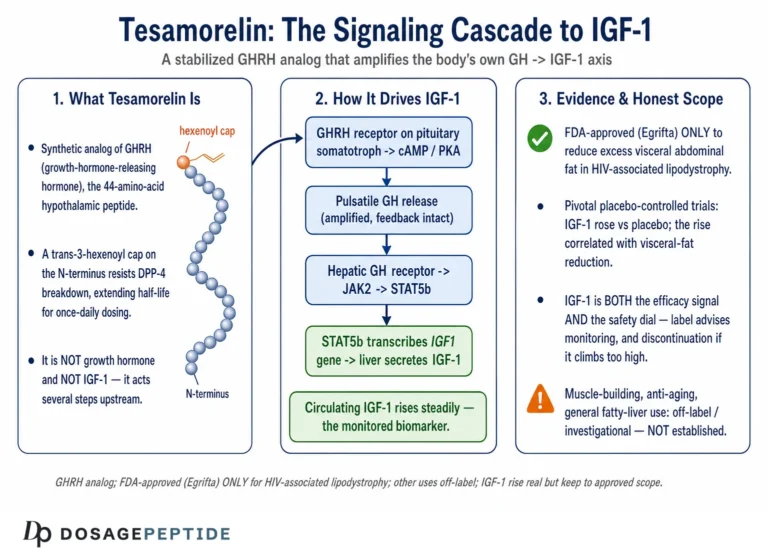
Tesamorelin is a synthetic analog of human growth hormone-releasing factor (GRF, also called GHRH). Structurally it is trans-3-hexenoyl-GHRH(1–44): the full 44-amino-acid sequence of human GRF with a hexenoyl moiety — a six-carbon chain carrying a double bond at position 3 — attached to the N-terminal tyrosine. That single modification is the entire point of the molecule. Native GHRH is degraded rapidly in plasma by dipeptidylpeptidase IV, which clips the N-terminal Tyr-Ala dipeptide to yield the largely inactive GHRH(3–44).[16] The hexenoyl cap is understood to obstruct that cleavage sterically. It is worth being exact about what this does and does not buy, because the point is routinely overstated: tesamorelin is still a short-lived molecule. Its labelled elimination half-life is 26–38 minutes.[12] Once-daily dosing works despite that brevity, not because the modification made the peptide long-acting — a brief GRF pulse is sufficient to provoke a pituitary GH pulse, and it is the downstream GH and IGF-1 response, not the residence time of tesamorelin itself, that carries the biology. The approved product label describes tesamorelin acetate as the 44-amino-acid human GRF sequence with a hexenoyl moiety — a C6 chain with a double bond at position 3 — attached to the N-terminal tyrosine, with a molecular formula of C221H366N72O67S • x C2H4O2 (x ≈ 7) and a free-base molecular weight of 5,135.9 daltons.[12]
Why This Compound Has Real Numbers Behind It
The reason tesamorelin has a defensible dose while most peptides in the same catalog category do not is historical. In the late 1990s and 2000s, people living with HIV on early antiretroviral regimens frequently developed a distinctive body-composition change: visceral adipose tissue (VAT) accumulated in the abdomen while subcutaneous fat in the limbs and face was lost. This VAT accumulation tracked with dyslipidaemia, insulin resistance and elevated cardiovascular risk. Recombinant human growth hormone reduced VAT in this population but at doses that produced substantial fluid retention and glucose intolerance. The rationale for a GRF analog was mechanistic and specific: rather than saturating the system with exogenous GH, stimulate the pituitary’s own somatotrophs so that GH is released in a physiological pulsatile pattern still subject to somatostatin negative feedback, in the hope of capturing the lipolytic effect on visceral fat while blunting the dose-limiting toxicities.
That hypothesis was tested with real money and real regulatory scrutiny, which is why an unusually complete dose-selection record exists. It is also why the numbers must be read with their population attached. Everything below describes what was measured in antiretroviral-treated adults with HIV-associated abdominal fat accumulation — not in healthy adults, not in athletes, and not in people seeking body-recomposition effects.
Regulatory Status: Read This Before the Numbers
This section is not boilerplate and it materially changes how the rest of the article should be interpreted.
Tesamorelin is FDA-approved. It was approved in 2010 under the brand name Egrifta, indicated for the reduction of excess abdominal fat in HIV-infected adult patients with lipodystrophy.[12] The original prescribing information carries a revision date of 11/2010.[15] That is the whole indication. The label carries explicit Limitations of Use stating that long-term cardiovascular safety has not been established, that the drug is not indicated for weight-loss management, and that there are no data supporting improved antiretroviral compliance.[14] There is no FDA approval for tesamorelin in general body composition, non-HIV visceral obesity, anti-aging, athletic performance, or bodybuilding. Those uses are unapproved, full stop.
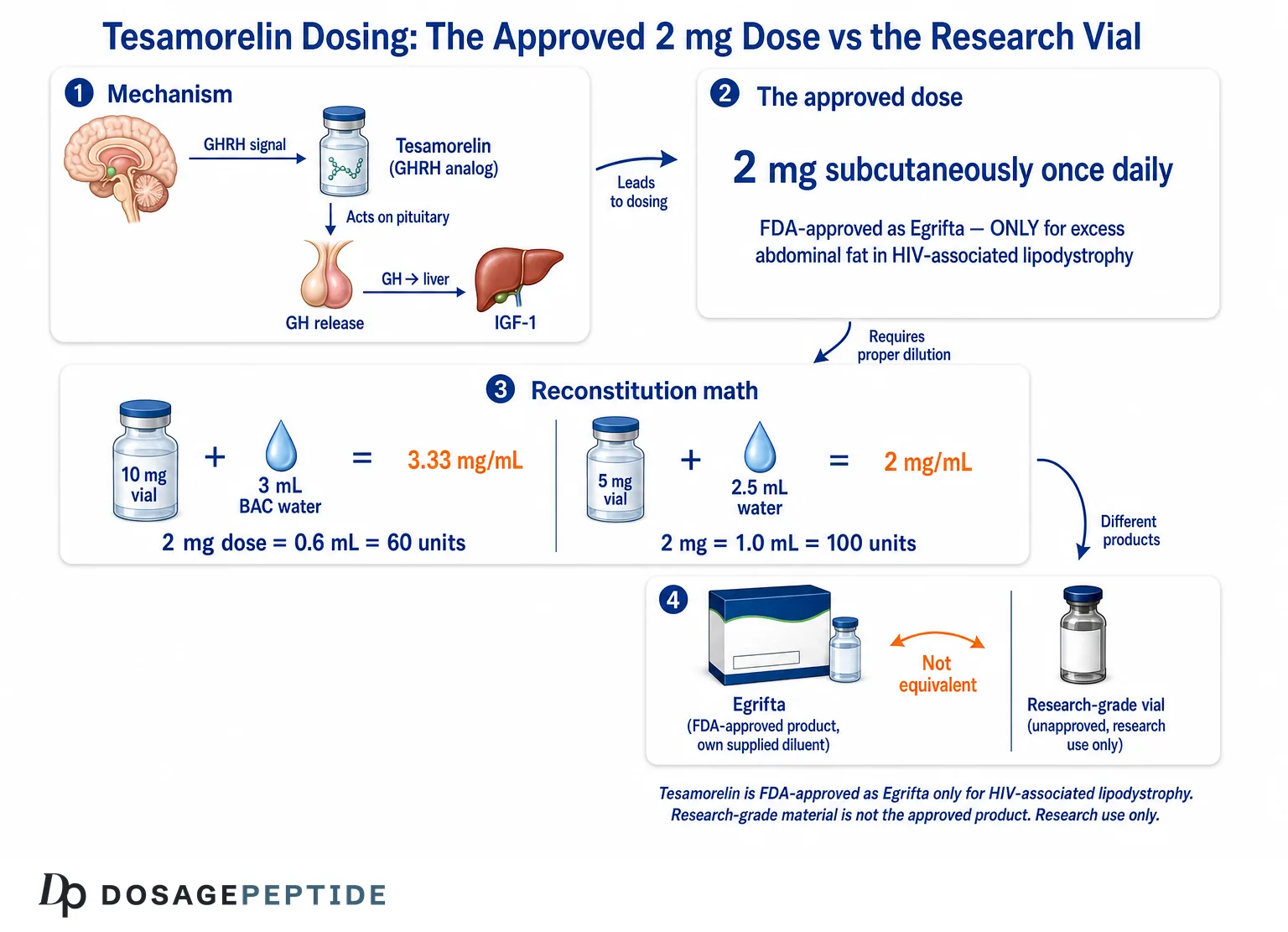
Research-grade tesamorelin is not Egrifta. A lyophilised vial labelled “tesamorelin 10 mg” from a research-chemical supplier is not the approved drug and is not equivalent to it in any regulatory or pharmaceutical sense. It has not been through FDA review of identity, purity, potency, sterility, endotoxin content, container-closure integrity or stability. It is also worth being precise about where this material sits in the regulatory architecture, because the point is frequently muddled. Tesamorelin is a component of an FDA-approved drug product, and section 503A permits a licensed pharmacy to compound from a bulk drug substance that is a component of an approved drug — so tesamorelin never needed nomination to FDA’s list of bulk substances evaluated for compounding, and it does not appear on that list.[19] None of that machinery touches a research-chemical vial in any case: it is not compounded by a licensed pharmacy, not dispensed against a prescription, and not made under the conditions any of these frameworks presuppose. It sits outside all of them. Everything this article says about doses refers to what was administered in clinical trials of a characterised pharmaceutical product; it does not transfer to a vial of unverified content, and it is not a recommendation for human use of any kind.
Mechanisms Studied
Tesamorelin’s pharmacology is the least controversial part of its file, because it was characterised in a registration programme rather than reconstructed from anecdote. For a broader treatment of the compound’s biology, our reference page on what tesamorelin is and how it works covers the mechanism in more depth; what follows is the version relevant to dose selection.
GRF Receptor Agonism and Pulsatile GH Release
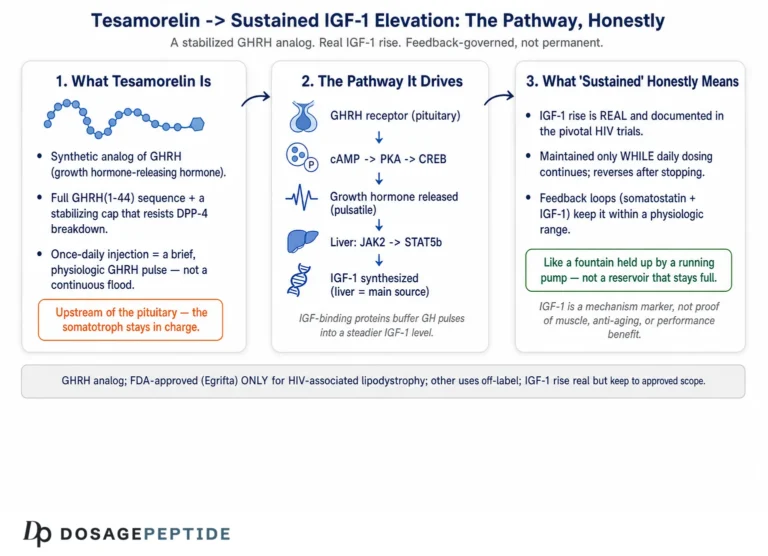
In vitro, tesamorelin binds and stimulates human GRF receptors with potency similar to endogenous GRF.[12] GRF is the hypothalamic peptide that acts on pituitary somatotroph cells to stimulate synthesis and pulsatile release of endogenous growth hormone. GH then acts on receptors across chondrocytes, osteoblasts, myocytes, hepatocytes and adipocytes; a substantial fraction of the downstream effect is mediated by insulin-like growth factor-1 (IGF-1) produced in the liver and peripheral tissues, though not all of it.[12]
The distinction between a GRF analog and exogenous GH matters for the dose–response argument. Because tesamorelin acts upstream at the pituitary, GH output remains subject to somatostatin-mediated negative feedback and to the pituitary’s own secretory capacity. This is the mechanistic basis for the claim that GRF analogs preserve pulsatility and produce a ceiling on GH exposure that exogenous GH does not. The claim needs its evidence label applied honestly: the feedback architecture is well established for GHRH physiology in general, but no tesamorelin trial ever measured GH exposure above 2 mg, so the ceiling is an untested inference for this molecule rather than a demonstrated finding. It is a plausible reason to doubt that a higher tesamorelin dose translates linearly into a higher GH effect — but the argument against “more must be better,” discussed later, rests on the measured IGF-1 data rather than on this inference.
The IGF-1 Readout
Tesamorelin stimulates GH secretion and consequently raises IGF-1 and IGFBP-3.[12] In the pooled phase-3 dataset, mean IGF-1 rose by 108 ± 112 ng/mL on tesamorelin 2 mg versus a fall of 7 ± 64 ng/mL on placebo (p<0.001).[5] In the NEJM pivotal trial, IGF-1 increased 81.0% on tesamorelin and decreased 5.0% on placebo (p<0.001).[2] IGF-1 is the pharmacodynamic marker of the axis being engaged; it is not itself the therapeutic endpoint, and the trials did not show that a larger IGF-1 rise produced a larger VAT reduction on an individual basis.
Notably, no clinically significant changes were observed in other pituitary hormones — TSH, LH, ACTH or prolactin — in the phase-3 programme.[12] That selectivity is one of the more genuinely informative findings in the file.
Why Visceral Fat Specifically
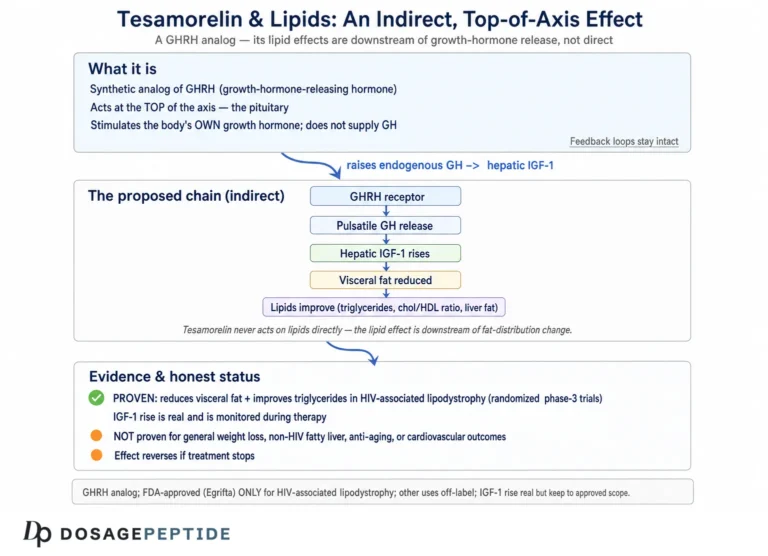
Growth hormone is lipolytic in human adipose tissue, and its lipolytic action is more pronounced in visceral (omental) than in subcutaneous depots.[17] That depot differential is the working explanation for the compartment-specific effect observed across every tesamorelin trial — though it should be read as the mechanistic hypothesis the field favours rather than something any tesamorelin trial set out to test directly: VAT falls, abdominal subcutaneous adipose tissue does not meaningfully change. In the pooled phase-3 analysis, VAT decreased by 24 ± 41 cm² on tesamorelin versus an increase of 2 ± 35 cm² on placebo (p<0.001; treatment effect −15.4%), while abdominal subcutaneous adipose tissue showed no significant difference (−2 ± 32 vs 2 ± 29 cm², p = 0.08; treatment effect −0.6%).[5] Our page on tesamorelin and visceral fat works through that compartment-selectivity evidence in detail.
Downstream Signals Beyond Fat
Mechanistic follow-on work has probed what else moves when VAT falls. In a 12-month randomised, double-blind, multicentre trial in 61 people with HIV and non-alcoholic fatty liver disease, tesamorelin 2 mg daily reduced hepatic fat fraction by an absolute −4.1% versus placebo (95% CI −7.6 to −0.7, p = 0.018), a relative reduction of −37% from baseline, with 35% of the tesamorelin group versus 4% of placebo reaching a hepatic fat fraction below 5% (p = 0.0069).[8] In a separate 12-month randomised trial in 39 obese adults with reduced GH secretion, as determined by GHRH-arginine stimulation testing, increases in IGF-1 on tesamorelin correlated with improvements in phosphocreatine recovery on 31P magnetic resonance spectroscopy, an index of mitochondrial function.[11] These are hypothesis-generating mechanistic signals in small samples, not efficacy claims.
Where Does the 2 mg Number Actually Come From?
This is the question that separates tesamorelin from its catalog neighbours, and it deserves a precise answer rather than a citation to “standard protocols.”
The Dose-Ranging Study (2005)
Before the pivotal trials, a randomised, double-blind, placebo-controlled dose-ranging study enrolled 61 people with HIV and central fat accumulation and assigned them to placebo, 1 mg, or 2 mg of TH9507 (the development code for tesamorelin) subcutaneously once daily for 12 weeks.[1] This is the single most important study for anyone asking why the dose is what it is, and its results are worth stating carefully:
- IGF-1 rose in a dose-related fashion: approximately +48% at 1 mg and +65% at 2 mg, both p<0.01 versus placebo.
- Trunk fat changed by +0.8%, −4.6% and −9.2% in the placebo, 1 mg and 2 mg groups respectively; only the 2 mg arm reached significance versus placebo (p = 0.014).
- Visceral fat changed by −5.4%, −3.6% and −15.7% respectively — numerically largest at 2 mg, but not statistically significant versus placebo at this sample size.
- Subcutaneous fat was preserved and did not change within or between groups.
- Triglycerides and the cholesterol:HDL ratio fell significantly in the 2 mg group versus placebo.
- Treatment was generally well tolerated without changes in glucose.
So the honest reading is this: the 2 mg dose was selected because it separated from placebo on trunk fat and lipids at 12 weeks where 1 mg did not, and because it produced a physiological rather than supraphysiological IGF-1 rise. It was not selected because a dose–response curve was mapped out to a plateau. Only two active doses were ever formally compared in humans. Doses above 2 mg were never taken into a controlled efficacy comparison. Anyone asserting that 3 mg or 4 mg is “more effective” is not extrapolating from data; there is no data to extrapolate from.
The Pivotal Phase-3 Trials
Two multicentre, randomised, double-blind, placebo-controlled trials then tested 2 mg subcutaneously daily against placebo, each with a 26-week main phase and a 26-week extension. Participants were randomised 2:1 to tesamorelin or placebo.
| Trial | n randomised | Studied dose | Primary endpoint result at 26 weeks |
|---|---|---|---|
| Falutz 2007, NEJM (NCT00123253)[2] | 412 | 2 mg SC daily | VAT −15.2% (tesamorelin) vs +5.0% (placebo), p<0.001 |
| Falutz 2010, JAIDS[4] | 404 | 2 mg SC daily | VAT −10.9% (−21 cm²) vs −0.6% (−1 cm²), p<0.0001 |
| Pooled analysis, JCEM 2010[5] | 806 (543 active / 263 placebo) | 2 mg SC daily | Treatment effect on VAT −15.4%, p<0.001 |
Two points deserve emphasis. First, the two trials did not produce identical effect sizes — −15.2% in one and −10.9% in the other at the same dose in the same population — which is a useful reminder of how much between-study variability exists even in well-run registration trials. Second, the frequently quoted “15–18% VAT reduction” figure is a composite: roughly −15% at 26 weeks in the pooled data, extending to approximately −17.5% to −18% at 52 weeks in participants who stayed on drug.[3][5]
The Label Dose Has Changed — and That Matters
Here is a fact that almost every peptide-vendor page gets wrong. The 2 mg figure is correct for the original Egrifta formulations, but the currently marketed approved products are dosed differently because they were reformulated to be more bioavailable and more concentrated.
| Approved product | Vial strength | Label dose (SC, once daily) | Diluent & volume | Reconstituted vial storage |
|---|---|---|---|---|
| Egrifta (original, 2010)[15] | 1 mg per vial | 2 mg (two vials per dose) | Sterile Water for Injection, supplied | Use immediately; discard remainder |
| Egrifta 2 mg/vial (reformulated single-vial presentation)[12] | 2 mg per vial | 2 mg (one vial per dose) | 2.1 mL Sterile Water for Injection | Use immediately; discard remainder |
| Egrifta SV[13] | 2 mg per vial | 1.4 mg (0.35 mL) | 0.5 mL Sterile Water for Injection | Use immediately; do not refrigerate or freeze |
| Egrifta WR[14] | 11.6 mg per vial | 1.28 mg (0.16 mL) | 1.3 mL Bacteriostatic Water for Injection (→ 8 mg/mL per label) | Room temperature 20–25 °C; discard after 7 days |
Read that table carefully, because it dismantles a common assumption. The approved daily dose today is 1.4 mg (Egrifta SV) or 1.28 mg (Egrifta WR) — not 2 mg. These are not dose reductions in the pharmacological sense; they are different formulations engineered to deliver comparable systemic exposure from a smaller injected mass, and the labels explicitly warn that the two formulations “have differences in the dosage, the number of vials required to prepare a dose, reconstitution instructions, and storage requirements.”[13] The practical consequence: 2 mg is the dose from the trials and the original label; it is not the dose on any currently marketed approved product. The literature-anchored number and the current-label number are two different things, and conflating them is one of the most common errors in the popular write-ups of this compound.
How Do You Reconstitute a 10 mg Tesamorelin Vial?
This is the search that brings most readers here, and it deserves arithmetic rather than a lookup table with no working shown. The general principles apply to any lyophilised peptide and are covered in our peptide reconstitution guide; what follows applies them to tesamorelin specifically, using the vial sizes and diluent volumes in this site’s catalog so that the numbers match the dosage calculator and the per-vial protocol pages.
The One Equation
Everything below is one division and one multiplication.
- Concentration (mg/mL) = total peptide mass in the vial (mg) ÷ volume of bacteriostatic water added (mL)
- Draw volume (mL) = target dose (mg) ÷ concentration (mg/mL)
- Insulin-syringe units = draw volume (mL) × 100 (on a U-100 syringe, where the barrel is graduated 0–100 units across 1.0 mL)
The third line is where most errors occur. A U-100 insulin syringe is calibrated in insulin units, not peptide milligrams. One “unit” on that barrel is simply 0.01 mL. The syringe has no idea what is in it. Reading “60 units” as anything other than “0.6 mL” is a well-known route to a ten-fold dosing error.
The 10 mg Vial with 3 mL of BAC Water
This is the catalog configuration for the 10 mg vial, and it is the arithmetic behind our tesamorelin 10 mg vial dosage protocol page.
Step 1 — concentration: 10 mg ÷ 3 mL = 3.333 mg/mL. Equivalently, each 0.1 mL (10 units) contains 0.333 mg, and each single unit contains 0.0333 mg.
Step 2 — draw volume for the studied 2 mg dose: 2 mg ÷ 3.333 mg/mL = 0.6 mL.
Step 3 — syringe units: 0.6 mL × 100 = 60 units on a U-100 insulin syringe.
Check the arithmetic backwards, which is the habit worth building: 60 units = 0.6 mL; 0.6 mL × 3.333 mg/mL = 2.0 mg. It closes.
| Dose (mg) | Calculation at 3.333 mg/mL | Draw volume | U-100 units |
|---|---|---|---|
| 0.5 | 0.5 ÷ 3.333 | 0.15 mL | 15 |
| 1.0 | 1.0 ÷ 3.333 | 0.30 mL | 30 |
| 1.5 | 1.5 ÷ 3.333 | 0.45 mL | 45 |
| 2.0 (phase-3 studied dose) | 2.0 ÷ 3.333 | 0.60 mL | 60 |
One caution about what this table is and is not. The Egrifta SV (1.4 mg) and Egrifta WR (1.28 mg) label doses are deliberately absent from it, and they are not reproducible from a research vial. Those masses are tied to their specific formulations — as the section above set out, they were engineered to deliver comparable systemic exposure from a smaller injected mass, which means the mass figure carries no meaning once detached from the formulation that generated it. Drawing 1.28 mg out of BAC-water-reconstituted research powder does not reproduce Egrifta WR’s exposure; it is simply 64% of the mass that was studied at 2 mg, with no exposure data of any kind behind it. Arithmetic can convert a milligram figure into a syringe reading, but it cannot transfer a dose across formulations, and a table that appeared to do so would be quietly asserting an equivalence that does not exist.
Note also the general precision constraint the table does expose: at 3.333 mg/mL a fractional milligram dose frequently lands between two graduation marks on a standard U-100 barrel. That is not a rounding curiosity. It is a real limitation that the approved products solve with a purpose-built concentration, and that a research vial reconstituted to an arbitrary volume does not solve at all.
What a 10 mg Vial Actually Supplies
Here is an arithmetic result that rarely appears in vendor copy. At the phase-3 studied dose of 2 mg once daily, a 10 mg vial contains five days of material (10 ÷ 2 = 5). The pivotal trials ran for 26 weeks — 182 days — before the extension phase even began. Reproducing the studied exposure duration at the studied dose would require roughly 36 vials of that size for the main phase alone, and about 73 vials to cover the 52-week period over which the durability data were collected.[3] That number is worth sitting with, because it quantifies the gap between what the literature describes and what a single vial represents.
The 5 mg Vial with 2.5 mL of BAC Water
The 5 mg configuration is arithmetically the cleanest of the three, which is why it is useful for checking your own understanding. It underpins our tesamorelin 5 mg vial dosage protocol page.
Concentration: 5 mg ÷ 2.5 mL = 2.0 mg/mL exactly. Draw volume for 2 mg: 2 ÷ 2 = 1.0 mL = 100 units — the entire barrel of a 1 mL U-100 insulin syringe.
| Dose (mg) | Calculation at 2.0 mg/mL | Draw volume | U-100 units |
|---|---|---|---|
| 0.5 | 0.5 ÷ 2.0 | 0.25 mL | 25 |
| 1.0 | 1.0 ÷ 2.0 | 0.50 mL | 50 |
| 1.5 | 1.5 ÷ 2.0 | 0.75 mL | 75 |
| 2.0 | 2.0 ÷ 2.0 | 1.00 mL | 100 |
A 5 mg vial at 2 mg/day supplies 2.5 days. The half-dose left in the vial on day three is not a rounding artefact — it is the arithmetic reality of a small vial against a 2 mg daily figure, and it is one of the reasons the 10 mg and 20 mg presentations exist.
Why 2.5 mL and Not 5 mL? The Vial Has to Hold It
A question that comes up constantly: if 5 mg ÷ 5 mL would give a tidy 1 mg/mL, why does the catalog specify 2.5 mL? Because the bacteriostatic water has to physically fit inside the vial.
Small lyophilised peptide vials are typically 2 mL, 3 mL or 5 mL nominal glass, and the nominal capacity is not the usable capacity. A vial must retain headspace for the lyophilised cake itself, for the vacuum, and for the air displaced as diluent enters. The approved product illustrates the constraint precisely: each 1 mg vial of the original Egrifta contained the peptide plus 50 mg of mannitol as a bulking agent,[15] and the later 2 mg presentation was reconstituted with 2.1 mL — a volume chosen to sit inside the vial, not to produce a round concentration.[12]
Egrifta WR goes further in the same direction, and the way it does so is worth pausing on, because it exposes something the one-equation method above quietly assumes. The label specifies 11.6 mg reconstituted with 1.3 mL of bacteriostatic water, and states the resulting concentration as 8 mg/mL with a 1.28 mg dose drawn as 0.16 mL.[14] Run that through the formula and it does not close: 11.6 ÷ 1.3 is 8.9 mg/mL, not 8. The label is not wrong — the discrepancy is real and instructive. The lyophilised cake, peptide plus mannitol, occupies physical volume of its own, so 1.3 mL of diluent yields roughly 1.45 mL of final solution (11.6 ÷ 8.0 = 1.45), and the label quotes the deliverable concentration after that displacement and the vial overfill that compensates for withdrawal loss.
The lesson generalises directly to a research vial. Stated mass ÷ diluent volume is a nominal figure, not a measured one. At the small peptide masses in a research vial the cake’s displacement is slight enough to ignore, which is why the arithmetic in these tables is still the right tool. But it is precisely why an approved product specifies a validated diluent volume and a deliverable concentration instead of leaving the user to divide — and it is one more thing nobody has characterised for unapproved material, where neither the true peptide mass nor the overfill is known.
The rule that follows is simple and worth stating plainly: choose the diluent volume that fits the vial, then do the arithmetic on whatever concentration results. Forcing 5 mL into a 3 mL vial to get a convenient number is how vials get over-pressurised, how stoppers get pushed out, and how material gets lost. The concentration is downstream of the container; it is not a free parameter.
The 20 mg Vial with 3 mL of BAC Water
Concentration: 20 mg ÷ 3 mL = 6.667 mg/mL. Draw volume for 2 mg: 2 ÷ 6.667 = 0.30 mL = 30 units.
| Dose (mg) | Calculation at 6.667 mg/mL | Draw volume | U-100 units |
|---|---|---|---|
| 0.5 | 0.5 ÷ 6.667 | 0.075 mL | 7.5 |
| 1.0 | 1.0 ÷ 6.667 | 0.15 mL | 15 |
| 1.5 | 1.5 ÷ 6.667 | 0.225 mL | 22.5 |
| 2.0 | 2.0 ÷ 6.667 | 0.30 mL | 30 |
The 20 mg vial is the most concentrated of the three and therefore the least forgiving. At 6.667 mg/mL, a single unit of syringe error is 0.067 mg — twice the error carried by one unit at the 10 mg/3 mL concentration and 3.3 times the error at 2 mg/mL. A 0.5 mg dose lands at 7.5 units, half a graduation. This is the general trade-off in reconstitution: higher concentration means smaller injection volume but coarser dose resolution.
All Three Configurations Side by Side
| Vial | BAC water | Concentration | mg per 10 units | 2 mg dose | Days at 2 mg/day |
|---|---|---|---|---|---|
| 5 mg | 2.5 mL | 2.0 mg/mL | 0.20 mg | 1.00 mL / 100 units | 2.5 |
| 10 mg | 3 mL | 3.333 mg/mL | 0.333 mg | 0.60 mL / 60 units | 5 |
| 20 mg | 3 mL | 6.667 mg/mL | 0.667 mg | 0.30 mL / 30 units | 10 |
Once reconstituted, the storage question becomes immediate and is genuinely non-trivial for this molecule; our note on storage guidance for reconstituted tesamorelin covers it. It is worth registering the contrast with the approved products: Egrifta and Egrifta SV are reconstituted with preservative-free Sterile Water and the label instructs immediate administration and disposal of the remainder, explicitly stating do not freeze or refrigerate.[13] Only Egrifta WR, which uses bacteriostatic water, supports multi-day use of a reconstituted vial — and its label caps that at 7 days at room temperature.[14] A research vial reconstituted with bacteriostatic water and held for weeks has no stability data behind it at all.
What Route and Timing Were Used in the Studies?
Route: Subcutaneous, Abdomen
Every controlled tesamorelin trial used subcutaneous administration. The approved labels specify injection into the skin of the abdomen with rotation of sites within that region, and explicitly instruct against injecting into scar tissue, bruises or the navel.[12] Injection site reactions are a labelled warning and were among the most commonly reported adverse reactions (>5%) in the phase-3 programme, alongside arthralgia, injection site erythema, injection site pruritus, pain in extremity, peripheral oedema and myalgia.[12] In the NAFLD trial, participants on tesamorelin experienced more localised injection-site complaints than placebo, though none were judged serious.[8]
No controlled trial has evaluated intramuscular tesamorelin, and no trial has evaluated any non-injectable route. The subcutaneous bioavailability figure in the label is itself striking: absolute bioavailability of a 2 mg subcutaneous dose was determined to be less than 4% in healthy adults.[12] That single number explains why the injected mass is measured in milligrams while the plasma concentrations are measured in picograms per millilitre, and why route substitution is not a trivial swap.
Pharmacokinetics: A Very Short-Lived Molecule
Tesamorelin’s pharmacokinetic profile is the mechanistic reason its dosing frequency looks the way it does. From the label, following subcutaneous administration of 2 mg:[12]
- Median Tmax was 0.15 hours (about 9 minutes) in both healthy subjects and people with HIV.
- Mean Cmax was 2,874.6 pg/mL (CV 43.9%) in healthy subjects and 2,822.3 pg/mL (CV 48.9%) in HIV-infected patients.
- Mean AUC was 634.6 pg·h/mL (CV 72.4%) and 852.8 pg·h/mL (CV 91.9%) respectively.
- Mean volume of distribution was 9.4 ± 3.1 L/kg in healthy subjects and 10.5 ± 6.1 L/kg in HIV-infected patients.
- Mean elimination half-life was 26 minutes in healthy subjects and 38 minutes in HIV-infected patients after 14 consecutive days of subcutaneous dosing.
A population pharmacokinetic analysis pooling 38 HIV-infected patients and healthy subjects receiving 1 mg or 2 mg daily for 14 consecutive days fitted an open one-compartment model with combined first-order and zero-order absorption and first-order elimination. Plasma clearance was estimated at 1,060 L/h (interindividual CV 33.6%) with a volume of distribution of 200 L (17.7%). Age, body-size measures, race and health status were not related to tesamorelin pharmacokinetics within the range studied — meaning no bodyweight-scaled dosing rationale emerged from the data. The fraction absorbed by a first-order process was 13.1% higher on day 14 than on day 1.[10]
That last finding is quietly important for anyone trying to reason about “mg per kilogram” tesamorelin dosing. There is no such scaling in the evidence. The studied dose was a flat 2 mg for every participant regardless of body mass, and the population PK analysis found no body-size covariate worth including in the model.[10] Any “mcg/kg” tesamorelin protocol circulating online was invented, not derived.
Timing Within the Day
The approved labels specify once-daily dosing without mandating a specific clock time.[13] The widespread claim that tesamorelin “must” be administered at bedtime, or fasted, or away from carbohydrate, is a mechanistic inference rather than a trial finding. The inference is not unreasonable — endogenous GH secretion is greatest in early slow-wave sleep,[18] and acute hyperglycaemia and elevated free fatty acids blunt the somatotroph response to GRF, which are well-established features of GH physiology in general. But no tesamorelin trial randomised administration timing, no trial compared fasted with fed dosing, and consequently there is no clinical evidence that any particular time of day improves the visceral fat endpoint. Presenting a bedtime-fasted rule as an evidence-based protocol overstates what is known. It is a defensible mechanistic guess and should be labelled as one.
How Long Were the Studied Cycles, and What Happens on Discontinuation?
The cycle-length question has an unusually clean answer for tesamorelin, and it is not the answer most peptide protocols assume.
The Studied Durations
The phase-3 programme was built as a 26-week main phase followed by a 26-week extension. In the extension, participants originally on tesamorelin were re-randomised either to continue tesamorelin (the T-T group) or to switch to placebo (T-P), while participants originally on placebo switched to tesamorelin (P-T).[3] This design is what makes the durability data interpretable, and it produced the single most consequential finding in the entire file.
The Effect Reverses on Discontinuation
In the T-T group, the VAT change was sustained at approximately −18% over 52 weeks of continuous treatment (p<0.001 versus baseline), as was the triglyceride reduction (−51 mg/dL, p<0.001).[3] The pooled analysis reported the corresponding week-52 figures as VAT −35 ± 50 cm² (−17.5 ± 23.3%), waist circumference −3.4 ± 6.0 cm, and triglycerides −48 ± 182 mg/dL, all p<0.001 versus original baseline.[5]
But in the T-P group — those who stopped — visceral adipose tissue reaccumulated. The authors of the 52-week extension paper stated the conclusion without hedging: “Though effects on VAT are sustained during treatment for 52 weeks, these effects do not last beyond the duration of treatment.”[3] The second phase-3 trial found the same thing, describing the initial six-month improvements as “rapidly lost” in those switched from tesamorelin to placebo.[4] Two independent trials, two independent re-randomisation arms, one answer.
This is the finding that most directly contradicts how tesamorelin is popularly framed. In the literature, tesamorelin is not a cycle. It is continuous suppressive therapy for as long as the indication persists, in the same conceptual category as an antihypertensive rather than a course of antibiotics. The concept of an “8-week tesamorelin cycle” followed by a washout has no counterpart in the trial evidence; the trials that studied cessation found that cessation undoes the effect. Any protocol built around a short cycle is, on the available data, a protocol designed to reproduce the discontinuation arm.
One interesting partial exception exists. In an analysis of participants with elevated baseline transaminases, VAT responders showed improvements in ALT and AST that persisted over 52 weeks even in those switched to placebo, despite partial VAT reaccumulation.[9] That hints at some downstream effects outlasting the fat-compartment change, but it is a post hoc analysis of a secondary biochemical endpoint and should not be read as evidence of durable benefit.
How Long Before Anything Was Measurable?
The timelines in the trials are longer than most expectations. Primary endpoints were assessed at 26 weeks in both pivotal trials, and the durability question required a further 26 weeks to answer.[5] The IGF-1 effect appears fast — elevations were detectable by 13 weeks of treatment[12] — but IGF-1 movement is the axis responding, not fat being lost. The gap between those two timescales is where a great deal of misplaced confidence lives.
Current Evidence Level
Precision here matters more than in most articles on this site, because tesamorelin sits in an unusual position: it has genuinely strong evidence for one thing and essentially none for everything it is popularly used for. Those tiers must not be blended.
| Application | Evidence tier | What exists |
|---|---|---|
| Reduction of excess abdominal fat in HIV-infected adults with lipodystrophy | FDA-approved | Two pivotal phase-3 RCTs (n = 806 pooled) plus 52-week extensions; approved 2010; currently marketed as Egrifta SV and Egrifta WR[5] |
| Liver fat / NAFLD in people with HIV | Investigational | One 50-participant RCT[7] and one 61-participant 12-month RCT[8]; authors explicitly call for further study; not an approved indication |
| Mitochondrial function in obesity with reduced GH secretion | Investigational, exploratory | One 39-participant 12-month RCT with a surrogate imaging endpoint[11] |
| Metabolic profile in VAT responders vs non-responders | Investigational, post hoc, non-randomised subgroups | Post hoc comparison of responders and non-responders within the phase-3 dataset; participants were not randomised to respond, so the association cannot establish cause[6] |
| Liver enzymes (ALT/AST) in HIV with abdominal obesity | Investigational, post hoc | Post hoc analysis of the phase-3 dataset restricted to participants with elevated baseline transaminases[9] |
| General/non-HIV visceral obesity, body recomposition, anti-aging, athletic use | No approval; no adequate controlled evidence | No phase-3 programme; the label explicitly states it is not indicated for weight-loss management[14] |
| Research-grade vendor tesamorelin, any use | Research chemical | Unapproved material of unverified identity and purity; no clinical data exist on any specific vendor product |
What the Responder Analysis Adds
A “responder” was defined a priori, per the trial’s statistical analysis plan, as a participant achieving at least an 8% reduction in VAT[6] — a threshold subsequently described as having been set a priori by the FDA.[9] Analysing the 402 participants initially randomised to tesamorelin, responders had significantly greater reductions in triglycerides than non-responders (at 52 weeks: −0.8 ± 1.8 vs 0.0 ± 1.1 mmol/L, p = 0.003) and attenuated changes in fasting glucose (−1 ± 14 vs 8 ± 17 mg/dL, p<0.001) and HbA1c (0.0 ± 0.3% vs 0.2 ± 0.5%, p = 0.003).[6] The existence of a formal responder definition is itself informative: it tells you that a meaningful fraction of trial participants, receiving the exact same 2 mg dose of the actual approved drug under supervision, did not achieve an 8% VAT reduction. Response was not universal at the studied dose in the studied population.
The responder framework also reframes what an average effect size means. A pooled treatment effect of −15.4% on VAT[5] is a group mean sitting on top of a wide distribution that includes people who responded substantially and people who did not respond at all. The trials could not prospectively identify, at the outset, who would fall into which group. Anyone reasoning about tesamorelin from the headline percentage is reasoning about an average that may not describe any particular individual.
What Was Monitored in the Trials?
Because tesamorelin has an approved label, the monitoring framework is documented rather than improvised. This section describes what was measured in supervised clinical settings. It is presented as evidence about the compound, not as a protocol for anyone to follow.
IGF-1
The label directs that IGF-1 be monitored closely, with careful consideration given to discontinuation in patients with persistent elevations — for example, above 3 standard deviation scores — particularly if the efficacy response is not robust.[12] The magnitude of the effect in the trials is worth quoting precisely, because it is larger than most people expect: among patients who received tesamorelin for 26 weeks, 47.4% had IGF-1 levels greater than 2 SDS and 35.6% had SDS above 3, an effect seen as early as 13 weeks. Among those who remained on drug for 52 weeks, 33.7% had IGF-1 SDS above 2 and 22.6% above 3 at end of treatment.[12]
Those figures deserve to be sat with. Roughly one in three participants at the studied dose exceeded 3 standard deviations above the reference mean for IGF-1 at 26 weeks. The label is explicit that the effects of prolonged IGF-1 elevation are unknown, and this uncertainty is the stated rationale for the monitoring requirement.[12] This is also the concrete reason the “more is better” instinct fails here: the axis was already being pushed well past the population reference range at 2 mg in a supervised programme.
Glucose
Glucose was the pre-specified primary safety endpoint in multiple trials, which tells you how central the concern was. The results are genuinely mixed and should not be flattened in either direction.
- In the pooled phase-3 data, no clinically meaningful differences were observed between groups in glucose parameters at weeks 26 and 52.[5]
- In the JAMA liver-fat trial, fasting glucose rose significantly in the tesamorelin group at 2 weeks (treatment effect 7 mg/dL, 95% CI 1–14, p = 0.03), but changes at 6 months in fasting glucose (p = 0.72) and 2-hour glucose (p = 0.53) were not significant.[7]
- In the 12-month NAFLD trial, changes in fasting glucose and HbA1c did not differ between groups at 12 months.[8]
- In the responder analysis, VAT non-responders showed adverse drift in fasting glucose (+8 ± 17 mg/dL at 52 weeks) and HbA1c (+0.2 ± 0.5%) while responders did not.[6]
The synthesis is nuanced, and the responder split needs its evidence tier stated plainly: participants were randomised to tesamorelin or placebo, but they were not randomised to respond. Comparing responders with non-responders is therefore a post hoc comparison of non-randomised subgroups, and it cannot establish cause — the source paper itself says only that visceral fat reduction is associated with an improved metabolic profile. One interpretation consistent with the data is that GH elevation exerts a counter-regulatory, insulin-antagonistic pressure on glucose while visceral fat loss exerts an opposing beneficial pressure, the two roughly cancelling in those who lost visceral fat and the counter-regulatory effect showing through in those who did not. But an equally consistent reading is that participants who responded simply differed metabolically at baseline from those who did not, and that this difference drove both the fat response and the glucose trajectory. The trials cannot separate these. Glucose intolerance and diabetes mellitus remain a labelled Warning, with instruction to evaluate glucose before and during therapy.[14] It is also worth noting that the phase-3 trials excluded people with type 1 diabetes, and type 2 diabetes if previously treated with insulin or oral hypoglycaemics, and required fasting blood glucose below 150 mg/dL for entry.[12] The reassuring glucose data were generated in a population selected to have relatively intact glucose handling.
Fluid Retention and the Contraindications
Fluid retention is a labelled warning, attributed to GH induction, manifesting as increased tissue turgor and musculoskeletal discomfort — oedema, arthralgia, carpal tunnel syndrome — which were either transient or resolved with discontinuation.[12] The approved label lists four contraindications: disruption of the hypothalamic-pituitary axis (from hypophysectomy, hypopituitarism, pituitary tumour or surgery, head irradiation or head trauma); active malignancy; known hypersensitivity to tesamorelin or excipients; and pregnancy.[14]
The malignancy contraindication is not a formality. It follows directly from the mechanism: a drug whose entire purpose is to raise a growth factor is contraindicated where a growth factor could accelerate something already present. The label instructs that pre-existing malignancy be inactive and its treatment complete before starting, and that treatment be discontinued on any evidence of recurrence.[14] Life-time carcinogenicity studies in rodents were never conducted with tesamorelin acetate, though a standard battery of mutagenicity tests — Ames, hamster CHOK1 gene mutation, and mouse bone-marrow chromosomal damage — revealed no mutagenic potential.[12] Increased mortality in patients with acute critical illness is a further labelled warning, extrapolated from the GH class.[14]
The Immunogenicity Finding Nobody Mentions
This one is remarkable and almost entirely absent from popular coverage. In the combined phase-3 trials, anti-tesamorelin IgG antibodies were detected in 49.5% of patients treated for 26 weeks and 47.4% of those treated for 52 weeks. Among patients who had hypersensitivity reactions, 85.2% were antibody-positive. Cross-reactivity to endogenous GHRH was observed in approximately 60% of patients who developed anti-tesamorelin antibodies. Neutralising antibodies to tesamorelin and to human GHRH were detected in vitro at week 52 in 10% and 5% of treated patients respectively.[12]
The reassuring part: patients with and without antibodies had similar mean VAT reductions and IGF-1 responses, suggesting the antibodies did not alter efficacy, and among antibody-positive patients re-assessed six months after stopping, 18% were still positive.[12] Still: roughly half of people who took a well-characterised, pharmaceutical-grade GHRH analog for six months developed antibodies against it, and a majority of those cross-reacted with their own endogenous hormone. That is what the immunogenicity of this molecule looks like when it is properly measured. What it looks like for a research-grade preparation with unverified impurity profile has never been measured by anyone.
Where Does Stacking Fit — and Why This Article Stops Here
Every controlled efficacy trial of tesamorelin studied it as monotherapy. The 2 mg figure, the −15% VAT effect, the IGF-1 rise, the glucose data, the immunogenicity rate — all of it was generated with tesamorelin alone against placebo. That is the boundary of this article by design.
The most commonly discussed pairing is with a ghrelin-receptor agonist such as ipamorelin, on the mechanistic rationale that GHRH-receptor and ghrelin-receptor agonism act through complementary pituitary pathways and may produce a greater GH pulse together than either alone. That rationale is real physiology. What does not exist is a randomised controlled trial of the combination with a visceral fat, body-composition or safety endpoint in humans. Reasoning about the combination therefore means reasoning about two separate evidence bases, one of which (tesamorelin monotherapy in HIV lipodystrophy) is a completed registration programme and the other of which is not. If that is the question you arrived with, our dedicated page on the tesamorelin and ipamorelin dosage protocol handles it properly, including what is and is not known about the pairing. Nothing on this page should be read as transferring to a combination.
Limitations
Tesamorelin’s evidence base is strong for its indication and thin-to-absent for everything else. The specific limitations that matter:
The Population Limitation
Every phase-3 participant was an antiretroviral-treated adult living with HIV who had abdominal lipohypertrophy. Entry required a waist circumference of at least 95 cm with a waist-to-hip ratio of at least 0.94 in men, or at least 94 cm and 0.88 in women, with BMI above 20 kg/m² and fasting glucose below 150 mg/dL; type 1 diabetes and insulin- or oral-agent-treated type 2 diabetes were excluded.[12] HIV-associated lipodystrophy is not simply “a lot of belly fat.” It is a specific pathophysiology involving antiretroviral effects on adipocyte biology, chronic inflammation and a partly disrupted GH axis. A metabolically healthy adult with garden-variety central adiposity is not a member of this population, and the efficacy estimate does not transfer to them.
The Dose-Ranging Limitation
Only 1 mg and 2 mg were ever formally compared in a controlled human study, in 61 participants over 12 weeks.[1] No dose above 2 mg has been tested against placebo for efficacy. There is no plateau, no ceiling, and no established dose–toxicity gradient above 2 mg. The reformulated approved products deliver 1.4 mg and 1.28 mg per day, which underscores that the relationship between injected mass and biological effect depends on the formulation and is not a simple function of milligrams.[13]
The Cardiovascular Limitation
The label states plainly that long-term cardiovascular safety has not been established.[14] The entire clinical rationale rests on the premise that reducing VAT reduces cardiometabolic risk — a premise supported by epidemiology but never demonstrated for tesamorelin with hard cardiovascular outcomes. Fifteen years after approval, that gap remains open. Reducing a risk marker is not the same as reducing risk.
The Duration Limitation
The longest randomised, controlled exposure is 52 weeks.[3] Given that the effect reverses on discontinuation, continuous use for years is the logical implication of the mechanism — but the effect of multi-year IGF-1 elevation on the development or progression of malignancy is explicitly stated as unknown.[12] The drug is therefore in the uncomfortable position of requiring indefinite use to maintain its effect while having no long-term data on indefinite use.
The Material Limitation
This is the one that swallows all the others. Every number in this article — the 15.2%, the 2 mg, the 26-minute half-life, the 49.5% antibody rate — was generated with a pharmaceutical product manufactured under FDA-inspected conditions, with verified identity, potency and sterility, and a defined excipient profile. A research-grade vial has none of that. Its actual peptide content is unverified. Its impurity and truncated-sequence profile is unknown, and for a 44-residue synthetic peptide that is a substantial synthesis challenge with real scope for deletion sequences. Its endotoxin load is unmeasured. Its stability after reconstitution has never been characterised. Applying trial-derived arithmetic to a vial of unknown content produces precise-looking numbers built on an unverified premise — and the arithmetic will look just as clean whether the vial contains 10 mg of tesamorelin or 6 mg of tesamorelin plus 4 mg of mannitol.
The Reversibility Limitation
Worth restating because it is so often omitted: the visceral fat reduction does not persist after stopping.[3][4] Whatever else tesamorelin is, in the studied population it is not a compound that produces a durable change and then gets discontinued.
Frequently Asked Questions
What is the tesamorelin dose used in research?
The dose studied throughout the pivotal programme was 2 mg subcutaneously once daily, established in a 61-participant dose-ranging study comparing 1 mg and 2 mg against placebo and carried into two phase-3 trials totalling 806 randomised participants.[1][5] That figure applies to antiretroviral-treated adults with HIV-associated abdominal lipohypertrophy and is not a recommendation for any other population or purpose. Currently marketed approved formulations deliver 1.4 mg or 1.28 mg daily instead.[13]
How much BAC water do you use to reconstitute tesamorelin 10 mg?
Using this site’s catalog configuration, a 10 mg vial takes 3 mL of bacteriostatic water, giving 10 ÷ 3 = 3.333 mg/mL. At that concentration the 2 mg studied dose is 2 ÷ 3.333 = 0.6 mL, which reads as 60 units on a U-100 insulin syringe. The 3 mL figure is chosen because the diluent must physically fit inside the vial with adequate headspace, not because it produces a convenient concentration. Full working is on the 10 mg vial protocol page.
Is tesamorelin FDA-approved?
Yes, but narrowly. Tesamorelin was approved in 2010 as Egrifta for the reduction of excess abdominal fat in HIV-infected adult patients with lipodystrophy, and is currently marketed as Egrifta SV and Egrifta WR.[14] That is the entire indication. The label explicitly states the drug is not indicated for weight-loss management and that long-term cardiovascular safety has not been established. Research-grade vendor tesamorelin is a different thing entirely: unapproved material of unverified identity and purity, never reviewed by any regulator.
How many units of tesamorelin is 2 mg?
It depends entirely on the concentration, which depends on your vial size and diluent volume. At 2 mg/mL (5 mg vial + 2.5 mL) a 2 mg dose is 100 units. At 3.333 mg/mL (10 mg vial + 3 mL) it is 60 units. At 6.667 mg/mL (20 mg vial + 3 mL) it is 30 units. A U-100 syringe measures volume only — one unit is always 0.01 mL and never a fixed mass of peptide. Treating “units” as a dose is a well-known route to ten-fold errors in this category.
How long is a tesamorelin cycle?
The trials do not support a cycle model. The visceral fat reduction was sustained at roughly −18% over 52 weeks of continuous administration but reaccumulated when participants were re-randomised to placebo; the authors concluded that the effects “do not last beyond the duration of treatment.”[3] The second pivotal trial found the same reversal.[4] In the literature, tesamorelin behaves as continuous therapy for an ongoing indication, not as a short course. The longest randomised controlled exposure on record is 52 weeks.
Do you have to take tesamorelin at night on an empty stomach?
No trial tested this. The approved labels specify once-daily subcutaneous injection into the abdomen without mandating a time of day.[13] The bedtime-and-fasted convention is a mechanistic inference from general GH physiology — endogenous GH peaks in slow-wave sleep, and hyperglycaemia blunts the somatotroph response to GRF — not a finding from any tesamorelin trial. It is a reasonable hypothesis presented, too often, as an established protocol.
Why is my research vial reconstituted differently from Egrifta?
Because they are different products solving different problems. Egrifta SV uses 0.5 mL of preservative-free Sterile Water in a 2 mg vial and instructs immediate administration with disposal of the remainder; only Egrifta WR — 11.6 mg reconstituted with 1.3 mL of bacteriostatic water, giving a deliverable 8 mg/mL per its label — supports multi-day use, capped at 7 days.[14] Approved reconstitution schemes are engineered around a specific formulation with stability data behind them. A research vial reconstituted to an arbitrary volume with bacteriostatic water has none of that supporting work. See our storage guidance for reconstituted tesamorelin.
Does a higher tesamorelin dose work better?
Nobody knows, because no dose above 2 mg has ever been compared against placebo for efficacy in a controlled trial. Only 1 mg and 2 mg were formally compared.[1] There are two reasons to doubt the intuition. First, tesamorelin acts upstream at the pituitary, so GH output remains subject to somatostatin feedback and to the pituitary’s own capacity — a mechanistic ceiling that is well established for GHRH physiology in general but was never directly tested for tesamorelin, since no trial measured GH exposure above 2 mg. Second, and on firmer evidential ground, at 2 mg roughly one in three trial participants already exceeded 3 standard deviation scores for IGF-1, and the label directs consideration of discontinuation at that level.[12]
How long does one tesamorelin vial last?
At the 2 mg studied dose, a 5 mg vial supplies 2.5 days, a 10 mg vial supplies 5 days, and a 20 mg vial supplies 10 days. That arithmetic is worth confronting: the 26-week main phase of the pivotal trials is 182 days, and the durability data cover 52 weeks.[3] A single vial represents a rounding error against the exposure duration over which the published effects were actually measured. You can check any configuration against our dosage calculator.
References
- Falutz J, Allas S, Kotler D, et al. A placebo-controlled, dose-ranging study of a growth hormone releasing factor in HIV-infected patients with abdominal fat accumulation. AIDS. 2005;19(12):1279–87. PubMed 16052083
- Falutz J, Allas S, Blot K, et al. Metabolic effects of a growth hormone-releasing factor in patients with HIV. N Engl J Med. 2007;357(23):2359–70. PubMed 18057338
- Falutz J, Allas S, Mamputu JC, et al. Long-term safety and effects of tesamorelin, a growth hormone-releasing factor analogue, in HIV patients with abdominal fat accumulation. AIDS. 2008;22(14):1719–28. PubMed 18690162
- Falutz J, Potvin D, Mamputu JC, et al. Effects of tesamorelin, a growth hormone-releasing factor, in HIV-infected patients with abdominal fat accumulation: a randomized placebo-controlled trial with a safety extension. J Acquir Immune Defic Syndr. 2010;53(3):311–22. PubMed 20101189
- Falutz J, Mamputu JC, Potvin D, et al. Effects of tesamorelin (TH9507), a growth hormone-releasing factor analog, in HIV-infected patients with excess abdominal fat: a pooled analysis of two multicenter, double-blind placebo-controlled phase 3 trials with safety extension data. J Clin Endocrinol Metab. 2010;95(9):4291–304. PubMed 20554713
- Stanley TL, Falutz J, Marsolais C, et al. Reduction in visceral adiposity is associated with an improved metabolic profile in HIV-infected patients receiving tesamorelin. Clin Infect Dis. 2012;54(11):1642–51. PubMed 22495074
- Stanley TL, Feldpausch MN, Oh J, et al. Effect of tesamorelin on visceral fat and liver fat in HIV-infected patients with abdominal fat accumulation: a randomized clinical trial. JAMA. 2014;312(4):380–9. PubMed 25038357
- Stanley TL, Fourman LT, Feldpausch MN, et al. Effects of tesamorelin on non-alcoholic fatty liver disease in HIV: a randomised, double-blind, multicentre trial. Lancet HIV. 2019;6(12):e821–e830. PubMed 31611038
- Fourman LT, Czerwonka N, Feldpausch MN, et al. Visceral fat reduction with tesamorelin is associated with improved liver enzymes in HIV. AIDS. 2017;31(16):2253–2259. PubMed 28832410
- González-Sales M, Barrière O, Tremblay PO, et al. Population pharmacokinetic analysis of tesamorelin in HIV-infected patients and healthy subjects. Clin Pharmacokinet. 2015;54(3):285–94. PubMed 25358450
- Makimura H, Murphy CA, Feldpausch MN, Grinspoon SK. The effects of tesamorelin on phosphocreatine recovery in obese subjects with reduced GH. J Clin Endocrinol Metab. 2014;99(1):338–43. PubMed 24178787
- US Food and Drug Administration. EGRIFTA (tesamorelin for injection) prescribing information, label 022505s004 (rev. 2011; posted 2013). accessdata.fda.gov — label 022505s004
- DailyMed / US National Library of Medicine. EGRIFTA SV (tesamorelin) kit — prescribing information. DailyMed label
- DailyMed / US National Library of Medicine. EGRIFTA WR (tesamorelin) kit — prescribing information. DailyMed label
- US Food and Drug Administration. EGRIFTA (tesamorelin for injection) full prescribing information, label 022505s000, Revised 11/2010. accessdata.fda.gov — label 022505s000
- Frohman LA, Downs TR, Heimer EP, Felix AM. Dipeptidylpeptidase IV and trypsin-like enzymatic degradation of human growth hormone-releasing hormone in plasma. J Clin Invest. 1989;83(5):1533–40. PubMed 2565342
- Ottosson M, Lönnroth P, Björntorp P, Edén S. Effects of cortisol and growth hormone on lipolysis in human adipose tissue. J Clin Endocrinol Metab. 2000;85(2):799–803. PubMed 10690893
- Van Cauter E, Latta F, Nedeltcheva A, et al. Reciprocal interactions between the GH axis and sleep. Growth Horm IGF Res. 2004;14 Suppl A:S10–7. PubMed 15135771
- US Food and Drug Administration. Bulk Drug Substances Nominated for Use in Compounding Under Section 503A of the FD&C Act (Categories 1, 2 and 3). fda.gov/media/94155
Research use only. This article is an educational summary of published research and regulatory documents, written for an audience of researchers and informed readers. It is not medical advice, it is not a protocol, and nothing in it recommends, endorses or instructs the use of tesamorelin or any other peptide in humans. Tesamorelin is FDA-approved solely as Egrifta, Egrifta SV and Egrifta WR for the reduction of excess abdominal fat in HIV-infected adult patients with lipodystrophy, under prescription and clinical supervision; every dose figure cited here was administered to a specific trial population in a controlled setting with a characterised pharmaceutical product. Research-grade tesamorelin is unapproved material of unverified identity, purity and potency, and is not equivalent to any approved product. Decisions about any therapy belong with a qualified clinician who knows the individual case.