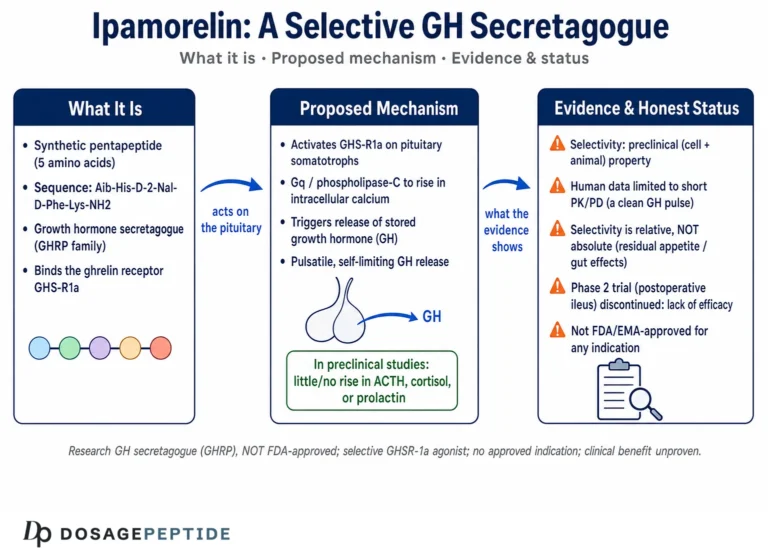
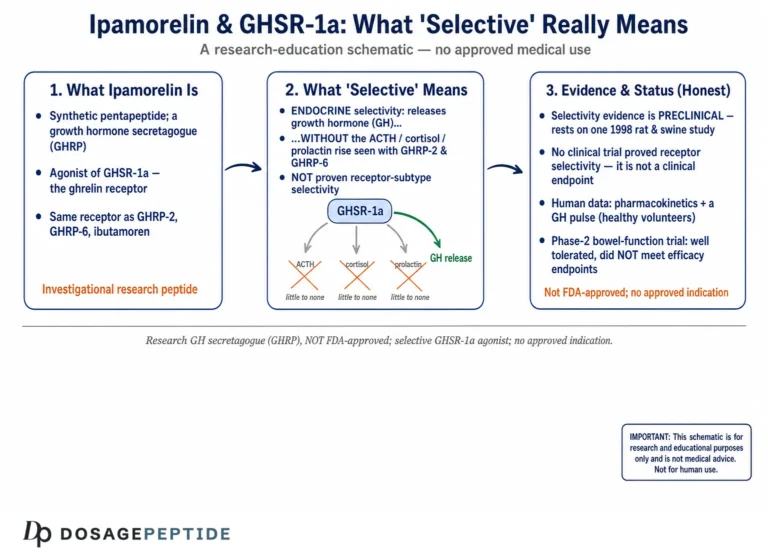
Ipamorelin’s distinction is selectivity, not results. It was designed to release growth hormone without the cortisol and prolactin spillover of the earlier GHRPs, and on that narrow pharmacological point the data hold up.1 On outcomes, the record is thinner than most writing about it admits: the one controlled human efficacy trial, in postoperative ileus, missed its primary endpoint and the programme was discontinued.4
That is why a fair comparison with sermorelin, CJC-1295, tesamorelin, GHRP-2, GHRP-6, hexarelin and MK-677 is not a leaderboard of effectiveness. These compounds sit at wildly different evidence tiers — one holds an FDA approval for a defined indication, another rests on rodent pharmacology alone. What follows maps each molecule by what it was designed to do, which receptor it hits, and how far it has actually travelled through the evidence pipeline.
The Growth Hormone Axis: Two Doors Into the Same Room
To compare growth hormone peptides intelligently, you first have to understand that the pituitary’s release of growth hormone (GH) is governed by a push-pull system with two accelerators and one brake. The two accelerators are growth hormone-releasing hormone (GHRH), secreted by the hypothalamus, and ghrelin, the acylated peptide discovered in 1999 that is produced mainly in the stomach and is the endogenous ligand for the growth hormone secretagogue receptor.8 The brake is somatostatin, which tonically suppresses GH release. Endogenous GH is not secreted in a steady trickle; it comes out in pulses, sculpted by the interplay of these three signals across the day and night.9
This matters because the peptides marketed as “GH peptides” fall into two mechanistically distinct families defined by which door they open. The first family, the GHRH analogs — sermorelin, CJC-1295, and tesamorelin — bind the GHRH receptor on pituitary somatotrophs and mimic the hypothalamic releasing signal. The second family, the growth hormone secretagogues (GHS) or ghrelin mimetics — ipamorelin, GHRP-2, GHRP-6, hexarelin, and the orally active MK-677 — bind the growth hormone secretagogue receptor, GHS-R1a, the same seven-transmembrane G-protein-coupled receptor that ghrelin activates.11 Ipamorelin belongs squarely to this second family. Its selectivity for the GHS-R1a receptor and its downstream signaling are the subject of a dedicated companion analysis on which studies demonstrate ipamorelin’s precision in targeting the GHSR-1a receptor, and understanding that receptor selectivity is the key to understanding why ipamorelin behaves differently from the other members of its own class.
The GHS-R1a agonists do something the GHRH analogs cannot: they can help initiate a GH pulse rather than merely amplifying an existing one, and they appear to work in part by functionally antagonizing somatostatin’s inhibitory tone while also acting directly on the somatotroph.9 Ghrelin and its mimetics act at both the hypothalamic and pituitary levels, and their full GH-releasing effect in vivo depends on an intact endogenous GHRH system — the two pathways are physiologically intertwined even though they are pharmacologically separate.9 This dual-door architecture is the single most important concept for the comparisons that follow, because it explains both why a GHRH analog and a GHRP are so often combined and why comparing ipamorelin to tesamorelin is a bit like comparing two keys that fit different locks in the same house.
It also helps to remember what GH itself is a proxy for. Most of GH’s durable anabolic and metabolic effects are mediated by insulin-like growth factor 1 (IGF-1), produced largely in the liver in response to GH and circulating with a far longer half-life than GH’s minutes-long pulses. IGF-1 is therefore the variable that sustained-action agents (CJC-1295 with DAC, MK-677) tend to push up around the clock, whereas short-acting pulse agents like ipamorelin, sermorelin, and tesamorelin produce sharper GH spikes that translate into more modest, less continuous IGF-1 elevation. This distinction — pulsatile versus tonic IGF-1 exposure — is one of the most consequential axes of difference among the peptides in this article, because it is IGF-1, not the transient GH pulse, that carries most of the theoretical benefit and most of the theoretical risk. A comparison that focuses only on “how much GH does it release” misses this deeper layer.
One more structural point deserves emphasis. Because all of these peptides work by coaxing the body’s own pituitary to release GH, they are inherently constrained by the pituitary’s capacity and by the negative-feedback loops that IGF-1 and somatostatin impose. This is frequently offered as a theoretical safety advantage over injecting recombinant GH directly, on the logic that a secretagogue-driven pulse should stay closer to physiological patterns and cannot easily push GH into the grossly supraphysiological range that an external injection can. It is a reasonable hypothesis, but it is important to flag that “more physiological in shape” is not the same as “proven safer or more effective over time,” and for ipamorelin specifically that long-term comparison has never been run in humans. The feedback ceiling is real, but a ceiling on GH release is not the same as a guarantee of safety, and it says nothing at all about efficacy.
What Makes Ipamorelin Distinctive: Selectivity by Design
Ipamorelin’s identity is best understood against the history of the compounds that came before it. The growth hormone-releasing peptide story began in the 1970s and 1980s with Cyril Bowers’ work on enkephalin-derived peptides that selectively promoted GH secretion, leading to GHRP-6 and later GHRP-2.7 These early GHRPs were potent GH releasers, but they carried a nuisance: at GH-releasing doses they also nudged up other pituitary hormones, notably adrenocorticotropic hormone (ACTH) and cortisol, and to varying degrees prolactin.1 That lack of specificity limited their appeal as clean research tools for isolating GH biology.
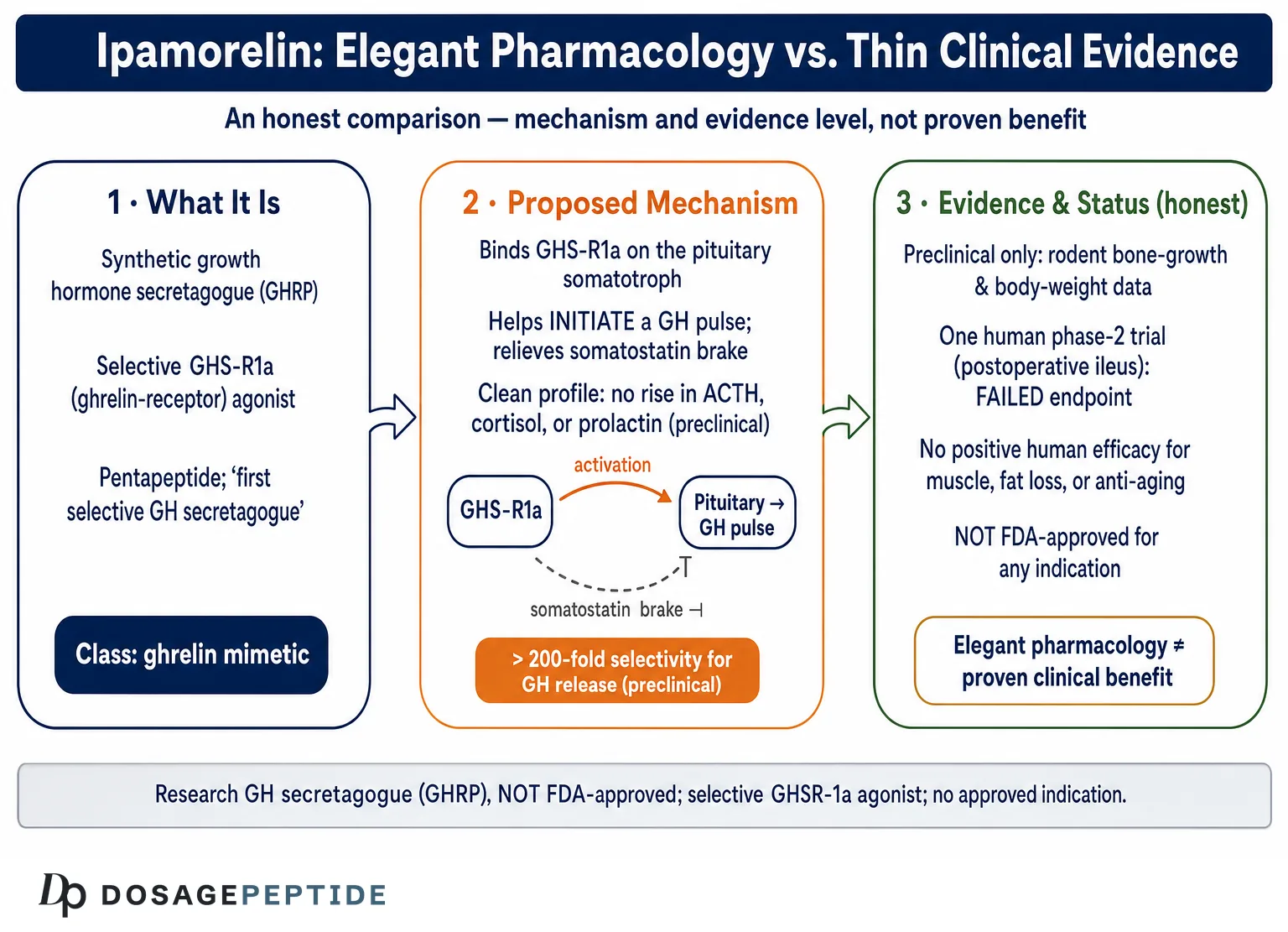
Ipamorelin was the answer to that problem. Described by Raun and colleagues at Novo Nordisk in 1998, it is a pentapeptide, Aib-His-D-2-Nal-D-Phe-Lys-NH₂, identified within a series of compounds built by removing the central Ala-Trp dipeptide of GHRP-1.1 In conscious swine, ipamorelin released GH with a potency and maximal effect closely matching GHRP-6 (ED₅₀ of roughly 2–4 nmol/kg for both), confirming it was a genuine, full-efficacy GH secretagogue.1 The breakthrough was what it did not do. Pharmacological profiling with GHRP and GHRH antagonists showed ipamorelin releases GH through a GHRP-like (ghrelin) receptor, yet it did not raise ACTH or cortisol above the levels seen with GHRH alone — and it did so with a selectivity margin exceeding 200-fold the ED₅₀ for GH release, a separation not previously reported for any GHRP-receptor agonist.1 None of the secretagogues tested altered FSH, LH, prolactin, or TSH, but only ipamorelin also spared ACTH and cortisol.1
That is the entire basis of the “selective” label, and it is worth stating precisely what it means and does not mean. It means that, in these preclinical assays, ipamorelin could drive a robust GH pulse without meaningfully co-stimulating the adrenal (cortisol) or lactotroph (prolactin) axes. It does not mean ipamorelin is more effective than other GHRPs at anything a patient would care about; both released comparable GH. Selectivity is a cleanliness property, prized because it makes ipamorelin a better probe for studying GH in isolation and, in principle, a candidate with fewer off-target endocrine effects. Whether that cleaner profile translates into any clinical advantage has never been established, because ipamorelin’s clinical program is essentially a single failed trial, discussed below. For readers cataloging where ipamorelin sits among related compounds, the site’s central dosage index organizes these secretagogues by class for educational reference.
The structure-activity story behind that selectivity is instructive. Ipamorelin was found within a series designed by stripping the central Ala-Trp dipeptide out of GHRP-1, a deliberate exploration of which residues drive GH release versus which drive the unwanted ACTH and prolactin co-stimulation.1 The resulting pentapeptide retained the GH-releasing pharmacophore while shedding the structural features that recruited the adrenal and lactotroph responses. This is a textbook example of rational medicinal chemistry — isolating a desired activity from an undesired one by editing the sequence — and it is why ipamorelin, rather than the more potent GHRP-2, became the canonical “selective” reference compound. It also explains a subtler practical point: ipamorelin’s comparatively modest appetite effect, relative to GHRP-6, follows from the same receptor engagement that ghrelin uses for hunger signaling, so even a “clean” GHS-R1a agonist cannot fully divorce GH release from the orexigenic character of the ghrelin system.
There is a useful mental model here. Think of the early GHRPs as a floodlight that illuminates the GH pathway but also leaks light onto the adrenal and lactotroph pathways. Ipamorelin was engineered to be a focused spotlight: same brightness on GH, far less spill. That is a genuine achievement of medicinal chemistry and the reason ipamorelin remains a favored research secretagogue. But a better spotlight is still just a light; it tells you nothing about whether shining it cures anything. The trap in the popular literature is to let the elegance of the spotlight stand in for evidence of a destination worth illuminating — to reason from “this is a well-designed molecule” to “this molecule must work.” Those are independent questions, and for ipamorelin they have very different answers.
Ipamorelin Within the GHRP Family: GHRP-2, GHRP-6, and Hexarelin
The fairest and most direct comparison is within ipamorelin’s own class, because these compounds share the GHS-R1a target and differ mainly in selectivity, potency, and secondary effects. All are ghrelin mimetics; all can initiate GH pulses; none is FDA-approved for a body-composition or anti-aging indication.
GHRP-6 is the archetype — potent at GH release but also a notable stimulator of appetite (a direct consequence of ghrelin-receptor agonism) and a mild inducer of cortisol and prolactin.1 GHRP-2 is more potent than GHRP-6 as a GH releaser but produces a similar, dose-dependent bump in ACTH and cortisol.1 Hexarelin is among the most potent of the group and has been studied for direct cardiovascular actions via CD36 and GHS receptors, but it too elevates cortisol and prolactin and is prone to receptor desensitization with repeated dosing. Against this backdrop, ipamorelin’s distinguishing feature is not raw potency — GHRP-2 and hexarelin can out-release it — but the clean endocrine profile documented by Raun and colleagues.1
| Compound | Target receptor | Relative GH potency | ACTH / cortisol effect | Notable secondary effects | Highest evidence tier |
|---|---|---|---|---|---|
| Ipamorelin | GHS-R1a (ghrelin) | Comparable to GHRP-61 | Not raised above GHRH-alone in preclinical work1 | Minimal prolactin change; modest appetite signal | One failed phase 2 human RCT (ileus)4 |
| GHRP-6 | GHS-R1a (ghrelin) | Reference potent GHRP1 | Mild increase1 | Strong appetite stimulation | Preclinical + human GH-provocation use |
| GHRP-2 | GHS-R1a (ghrelin) | Higher than GHRP-6 | Dose-dependent increase1 | Appetite; used as diagnostic GH stimulus | Human GH-stimulation testing (some regions) |
| Hexarelin | GHS-R1a + CD36 | Very high | Increase; also prolactin | Direct cardiac actions studied; tachyphylaxis | Preclinical + small human studies |
The pattern is clear. Ipamorelin trades a small amount of the raw punch that GHRP-2 or hexarelin offer for a much cleaner hormonal signature. For a researcher who wants to study GH pulsatility without confounding the picture with a cortisol surge, that trade is attractive; it is the reason ipamorelin is so frequently the GHRP of choice in mechanistic work and in the exploratory combination protocols catalogued under GH-peptide research. But it is essential to see the limit of the table’s rightmost column: not one of these compounds has a robust, positive, controlled human trial for muscle, fat loss, recovery, or longevity. Their “evidence tier” is dominated by animal pharmacology and, in a couple of cases, use as a short-term diagnostic GH-provocation agent — not as a therapy.
A second axis of difference within the family is the tendency toward receptor desensitization, or tachyphylaxis. Hexarelin in particular is known to blunt its own response with frequent repeated dosing, as the GHS-R1a receptor down-regulates — a property that complicates any sustained-use strategy. Ipamorelin and the other short-acting GHRPs are generally described as producing reproducible pulses when dosing is spaced, which is part of why pulsatile, spaced administration is the norm in research use rather than continuous exposure. This is a mechanistic distinction with practical implications for how each compound is studied, but it should not be over-read: reproducible GH pulses in a rodent or an isolated pituitary preparation are a pharmacology observation, not evidence that any dosing schedule produces a clinical benefit in a human.
This is also where a common piece of marketing logic collapses. Because GHRP-2 is more potent as a GH releaser, some sources imply it is “better,” while ipamorelin’s selectivity is sold as “safer for long-term use.” Both framings overreach. Higher acute GH release has never been shown to produce better long-term outcomes for any endpoint with these peptides, and ipamorelin’s cleaner short-term profile has never been tested over the durations that would matter for a safety claim. The honest comparison is that these are pharmacologically distinct tools with overlapping, and largely unproven, real-world profiles.
The Other Door: GHRH Analogs (Sermorelin, CJC-1295, Tesamorelin)
Comparing ipamorelin to the GHRH analogs is comparing across the two doors of the GH axis, and it produces the single most important asymmetry in this whole landscape: the GHRH-analog class contains the only FDA-approved member of the entire GH-peptide family, while the GHS class contains none.
Sermorelin is the native GHRH(1–29) fragment, the minimal sequence that retains full GHRH activity. It has a very short plasma half-life (on the order of minutes) and was historically marketed for diagnostic testing of GH secretion and for pediatric GH deficiency before being withdrawn in that branded form for commercial rather than safety reasons. It is now widely discussed as a research secretagogue; the evidence for its role in stimulating endogenous GH is reviewed in the site’s piece on what research says about sermorelin’s role in stimulating natural growth hormone, and its more speculative neurocognitive angle in the discussion of whether sermorelin supports cognitive function in age-related neurodegeneration.
CJC-1295 is a modified GHRH analog engineered for stability; in its DAC (drug affinity complex) form it binds albumin and extends the functional half-life dramatically, producing a sustained elevation in GH and IGF-1 rather than discrete pulses. This is pharmacologically interesting but introduces its own concern: a continuous, non-pulsatile IGF-1 elevation departs from normal physiology in a way that discrete-pulse agents like ipamorelin do not. CJC-1295 is not FDA-approved and its human evidence base is thin.
Tesamorelin is the outlier and the benchmark. It is a stabilized GHRH analog that the FDA approved in 2010 (brand name Egrifta) for one specific indication: reduction of excess visceral adipose tissue in adults with HIV-associated lipodystrophy. That approval rests on a genuine pivotal program — the phase 3 trial reported by Falutz and colleagues in the New England Journal of Medicine randomized 412 patients with HIV and abdominal fat accumulation to 2 mg daily tesamorelin or placebo for 26 weeks, and demonstrated a statistically significant, CT-measured reduction in visceral fat of roughly 15% versus placebo.5 That is real, regulator-grade evidence for a defined population and endpoint. It is also worth stating its limits plainly: the effect is specific to visceral fat in that population, it reverses on discontinuation, and it does not license claims about tesamorelin — let alone ipamorelin — for general fat loss, muscle building, or anti-aging.
| Compound | Class / door | Receptor | Pulsatile vs sustained | Regulatory status |
|---|---|---|---|---|
| Ipamorelin | GHS / ghrelin mimetic | GHS-R1a | Pulsatile (short action) | Not FDA-approved for any use1 |
| Sermorelin | GHRH analog | GHRH receptor | Pulsatile (very short) | Prior diagnostic/pediatric approval withdrawn; not currently approved as marketed drug |
| CJC-1295 (DAC) | GHRH analog | GHRH receptor | Sustained (long half-life) | Not FDA-approved |
| Tesamorelin | GHRH analog | GHRH receptor | Pulsatile (short) | FDA-approved for HIV-associated lipodystrophy5 |
| MK-677 (ibutamoren) | GHS / ghrelin mimetic | GHS-R1a | Sustained (oral, long action) | Not FDA-approved; investigational |
The comparison delivers a sobering perspective on ipamorelin. Within a family whose only approved member (tesamorelin) required a 412-patient randomized trial to earn a single narrow indication, ipamorelin has never completed a successful trial for any indication at all. That does not make ipamorelin worse than tesamorelin as a molecule — they are built for different receptors and different theoretical uses — but it precisely locates ipamorelin’s evidentiary altitude: far below the one peptide in this space that a regulator has actually endorsed.
MK-677 (Ibutamoren): The Oral Ghrelin Mimetic and Its Long-Term Data
MK-677, or ibutamoren, deserves separate treatment because it shares ipamorelin’s receptor (GHS-R1a) but differs in two consequential ways: it is orally active and non-peptidic, and it has a long duration of action that produces sustained rather than sharply pulsatile GH/IGF-1 elevation. Crucially, MK-677 also has something ipamorelin lacks — a substantial, long-duration randomized human trial.
Nass and colleagues conducted a two-year, double-blind, randomized, placebo-controlled trial of once-daily oral MK-677 (25 mg) in healthy older adults. The compound restored GH and IGF-1 levels toward those of healthy young adults, and increased fat-free mass by about 1.6 kg relative to placebo over the first year.6 That is a real, controlled human demonstration that a GHS-R1a agonist can shift body composition. But the same trial delivered the essential caveat: the increase in fat-free mass was attributable largely to intracellular water (body cell mass) rather than clearly demonstrated functional muscle gains, and some participants showed increased fasting glucose and reduced insulin sensitivity — a predictable consequence of sustained GH/IGF-1 elevation.6
It is worth dwelling on the “fat-free mass is mostly water” finding, because it is one of the most honest and most often ignored results in the entire GH-peptide literature. Fat-free mass measured by common methods includes intracellular and extracellular water, and GH/IGF-1 elevation is well known to cause fluid retention. When Nass and colleagues examined the composition of the gain, the increase tracked with body cell water rather than with an unambiguous rise in contractile muscle, and the trial did not show a corresponding improvement in the functional endpoints (such as strength or physical performance) that would confirm a meaningful muscle effect.6 This is the recurring lesson of GH-axis interventions across the board: a number on a body-composition scan can move without the outcome a person actually wants moving with it. Any comparison that cites “increased lean mass” for a GH peptide without asking whether that mass was water or function is repeating a half-truth.
The MK-677 data are the closest thing the ghrelin-mimetic class has to a rigorous long-term human read-out, and they are instructive precisely because they are mixed: a measurable body-composition signal accompanied by a metabolic cost and no demonstrated hard-outcome benefit. For ipamorelin, the implication is twofold. First, it is biologically plausible that ipamorelin could produce similar body-composition shifts, since it hits the same receptor. Second, and more importantly, that has not been shown for ipamorelin, and MK-677’s glucose signal is a caution that even within this class, activating the ghrelin receptor chronically is not consequence-free. Extrapolating MK-677’s human data onto ipamorelin is a hypothesis, not a finding — ipamorelin’s much shorter action and pulsatile profile could plausibly produce a different metabolic footprint, for better or worse, and no trial has measured it.
The Reference Standard: Full-Length Recombinant Human Growth Hormone
Every secretagogue in this article is, implicitly or explicitly, compared to the thing it aims to stimulate: growth hormone itself. Recombinant human GH (somatropin) is FDA-approved for genuine indications — pediatric and adult GH deficiency, Turner syndrome, chronic kidney disease in children, short bowel syndrome, and HIV-associated wasting, among others — and its efficacy in those settings is well established. It is the reference standard, and understanding it clarifies both the appeal and the limits of the peptide approach.
The theoretical argument for secretagogues over direct GH is physiological fidelity. Injecting recombinant GH produces a supraphysiological spike and bypasses the pituitary’s feedback control; a secretagogue like ipamorelin instead prompts the pituitary to release its own GH in a pulse shaped by the body’s remaining regulatory machinery, and it cannot override the negative feedback that IGF-1 and somatostatin impose.9 In principle this ceiling could translate into a lower risk of the classic GH excess effects — edema, joint pain, carpal tunnel, insulin resistance — that accompany exogenous GH. In principle.
The honest counterpoint is that “more physiological” has not been shown to mean “as effective” or even “clearly safer” for ipamorelin, because the comparative trials do not exist. Recombinant GH earns its indications through decades of controlled data; ipamorelin earns nothing comparable. A researcher exploring GH biology might reasonably prefer a secretagogue as a tool because it works with the body’s own release machinery, and the exploratory combination approaches often discussed in the context of the grow-H blend and whether it truly boosts strength and repair lean on exactly that rationale. But rationale is not proof, and the appropriate framing is that ipamorelin is a mechanistically interesting stimulator of endogenous GH whose clinical equivalence or superiority to approved GH therapy is entirely unestablished.
The Synergy Question: Why GHRH Analogs and GHRPs Are Combined
One of the most consistent findings across GH-secretagogue pharmacology — and one of the clearest ways ipamorelin is used in practice — is the synergy between the two doors. When a GHRH analog and a GHRP are given together, the combined GH release substantially exceeds the sum of each given alone, an observation traceable to Bowers’ classic work and reproduced across species.7 The mechanistic explanation follows directly from the axis architecture: the GHRH analog pushes on the GHRH receptor while the GHRP pushes on the GHS-R1a receptor and simultaneously relieves somatostatin’s brake, so two independent stimulatory inputs converge on the somatotroph while the inhibitory input is withdrawn.9
This is why ipamorelin is so frequently paired with a GHRH analog such as CJC-1295 in research protocols: the ghrelin-mimetic arm provides the pulse-initiating, somatostatin-antagonizing signal, and the GHRH arm amplifies it. Ipamorelin’s selectivity makes it a particularly logical partner, because it contributes its share of the GH stimulus without adding the cortisol and prolactin noise that GHRP-2 or hexarelin would bring to the same combination.1
It is worth making the mechanism concrete. Somatostatin sets the “trough” between GH pulses; GHRH sets the height of a pulse when the trough lifts. A ghrelin mimetic like ipamorelin does two things at once — it adds its own stimulatory drive at the somatotroph and it functionally opposes somatostatin’s suppression, effectively lowering the trough so a GHRH-driven pulse can rise higher.9 Give GHRH into a suppressed system and you get a modest pulse; give it into a system where somatostatin has been withdrawn by a GHRP, and the same GHRH signal produces a much larger pulse. That is the physiological logic of the observed better-than-additive response, and it is why the pairing recurs so consistently across the literature rather than being a quirk of one study.7
Two honesty caveats are essential here. First, the synergy is well demonstrated for the acute GH-release endpoint — put the two together and you measure more GH. It is not demonstrated that this larger GH pulse produces any superior clinical outcome, because those downstream trials have not been done for ipamorelin-containing combinations. Second, not all pairings are synergistic: combining two GHRH analogs, or in some cases layering a sustained-release ghrelin mimetic like MK-677 onto a GHRH analog, can produce competition or blunting rather than synergy, because they crowd the same receptor or drive the axis into feedback suppression. The clean synergy story applies specifically to the GHRH-plus-GHRP pairing, and even there it is a story about hormone levels in the blood, not about proven benefit in a body.
What the Human Evidence Actually Shows for Ipamorelin
Here the comparison must confront ipamorelin’s thinnest dimension directly. Despite two decades of enthusiastic secondary writing, ipamorelin’s own clinical record consists essentially of preclinical pharmacology plus a single, negative human efficacy trial.
The preclinical file is genuinely solid for what it is. Beyond the foundational selectivity work,1 ipamorelin was shown in rats to induce longitudinal bone growth — Johansen and colleagues demonstrated dose-dependent increases in bone growth rate and body weight with subcutaneous ipamorelin.2 Svensson and colleagues reported that ipamorelin, like GHRP-6, increased bone mineral content in adult female rats over a 12-week course.3 These are legitimate, peer-reviewed animal findings consistent with a functioning GH secretagogue. But they are rodent data on bone and body weight, not human data on any clinical outcome.
The one time ipamorelin entered a controlled human trial for a defined therapeutic endpoint, the result was negative. Beck, Sweeney, and McCarter, on behalf of the Ipamorelin 201 Study Group, ran a prospective, randomized, controlled phase 2 proof-of-concept study of intravenous ipamorelin for the management of postoperative ileus — the temporary gut paralysis after bowel-resection surgery — reasoning that a ghrelin mimetic might promote gastrointestinal motility.4 The trial did not meet its primary efficacy endpoint, and the ipamorelin development program for that indication was discontinued.4 This is the highest-quality human evidence that exists specifically for ipamorelin, and it is a null result.
The postoperative-ileus choice of indication is itself revealing about how these compounds reach the clinic. Ghrelin and its mimetics are prokinetic — they promote gastrointestinal motility — so testing ipamorelin in the post-surgical gut was a mechanistically reasonable bet, arguably more grounded than the body-composition claims that dominate popular discussion. That even a biologically sensible, properly randomized trial came back negative is a cautionary tale about the gap between plausible mechanism and demonstrated effect. It is the same lesson that recurs throughout translational medicine: a compound can do exactly what its pharmacology predicts at the level of receptors and hormones and still fail to move a clinical endpoint, because human physiology has more moving parts than any single pathway. Ipamorelin’s one clean shot on goal missed, and the program stopped there.4
The comparative takeaway is stark and should not be softened. Among the peptides in this article, ipamorelin has arguably the most elegant receptor pharmacology and one of the thinnest clinical records: strong rodent data, one failed human trial, and no controlled human evidence for the body-composition, recovery, or anti-aging uses for which it is popularly discussed. Contrast this with tesamorelin’s 412-patient approval trial5 and MK-677’s two-year randomized study,6 and ipamorelin’s position becomes clear: it is the class’s cleanest tool and one of its least clinically validated agents. For readers tracking terminology across these compounds, the site’s peptide glossary defines the receptor and axis terms used throughout this comparison.
A Comparative Evidence Scorecard
Pulling the strands together, it helps to score each compound on two independent axes that popular writing tends to conflate: mechanistic elegance (how clean and well-characterized its pharmacology is) and clinical evidence (how far it has traveled through controlled human testing). Ipamorelin scores high on the first and low on the second — a dissociation that is the central, honest message of any comparison.
| Compound | Mechanistic characterization | Best human evidence | Approved indication? | Key honest caveat |
|---|---|---|---|---|
| Ipamorelin | Excellent — defined selectivity, GHS-R1a agonist1 | One negative phase 2 trial (ileus)4 | No | Clean pharmacology, essentially no positive human efficacy data |
| GHRP-2 / GHRP-6 | Good — potent GHRPs, less selective1 | Used in GH-stimulation testing | No (varies by region) | Co-stimulate ACTH/cortisol; appetite effects |
| Hexarelin | Good — potent, dual GHS-R1a/CD36 | Small human studies | No | Tachyphylaxis; cortisol/prolactin |
| Sermorelin | Good — native GHRH(1–29) | Historical diagnostic/pediatric use | Withdrawn branded form | Very short half-life; limited modern trials |
| CJC-1295 (DAC) | Good — long-acting GHRH analog | Small PK/GH studies | No | Non-pulsatile IGF-1 elevation departs from physiology |
| Tesamorelin | Excellent — stabilized GHRH analog | Phase 3 RCT, n=4125 | Yes (HIV lipodystrophy) | Benefit narrow, visceral-fat-specific, reverses on stopping |
| MK-677 | Excellent — oral GHS-R1a agonist | 2-year RCT, older adults6 | No | FFM gain largely water; raises glucose/insulin resistance |
Read down the “approved indication” column and the landscape resolves into focus: one yes, everything else no. Read across ipamorelin’s row and the compound’s honest identity emerges: a beautifully characterized molecule that has never been shown to help a human with anything. Those two facts are not in tension; they are simply what the evidence says, and any comparison that lets the first fact imply the second has crossed from science into salesmanship.
Safety, Selectivity, and the Trade-offs Between Compounds
Comparative safety is where ipamorelin’s selectivity earns its most defensible — but still limited — distinction. Because ipamorelin does not meaningfully co-stimulate ACTH, cortisol, or prolactin in preclinical work,1 it avoids the specific off-target endocrine effects that make GHRP-2, GHRP-6, and hexarelin messier as research tools. In principle this narrower footprint could translate into fewer such effects in humans. In principle.
Several caveats keep this from becoming a clean safety claim. First, the selectivity data are preclinical; ipamorelin’s human safety over meaningful durations is uncharacterized, since its only controlled human exposure was short-term intravenous dosing in a surgical trial.4 Second, every GHS-R1a agonist shares the ghrelin receptor’s intrinsic effects — appetite stimulation and, with sustained activation, the potential for the glucose and insulin-sensitivity shifts seen clearly with MK-677.6 Ipamorelin’s short, pulsatile action may blunt those metabolic effects relative to long-acting MK-677, but this is inference, not measured fact. Third — and this applies across the entire class — any intervention that chronically elevates GH and IGF-1 raises the theoretical, unquantified questions that always attach to the GH/IGF-1 axis, including effects on glucose metabolism and on tissues sensitive to growth signaling. These concerns are not established harms for ipamorelin; they are open questions that the absence of long-term human data leaves unanswered.
A final, non-pharmacological safety dimension separates these compounds sharply and is easy to overlook: product provenance. Tesamorelin, as an approved drug, is manufactured to pharmaceutical standards. The research-grade GHRPs, ipamorelin included, circulate largely through channels that are not subject to that oversight, so purity, correct identity, and freedom from endotoxin vary and are frequently unverified. This is a risk that has nothing to do with the molecule’s intrinsic pharmacology and everything to do with sourcing, and it arguably dominates the practical safety comparison for the non-approved members of this family. Standard research handling — reconstitution technique, storage, and stability — is common across the peptide class and is covered in the general peptide reconstitution guide; careful handling preserves whatever activity a compound has but cannot compensate for uncertain source material or absent efficacy data.
Regulatory Status Across the GH-Peptide Landscape
Regulatory posture is the dimension where the comparison is least ambiguous, and it deserves a clear statement because marketing language routinely blurs it.
Ipamorelin is not approved by the FDA, the European Medicines Agency, or any comparable regulator for any therapeutic indication. Its development as a treatment for postoperative ileus was discontinued after the phase 2 trial did not demonstrate efficacy,4 and it has no other completed development program that reached approval. It exists today as a research chemical and as an ingredient in compounded and gray-market products, not as an approved medicine.
Across the family, only tesamorelin holds an active FDA approval, and that approval is narrowly scoped to reduction of excess visceral abdominal fat in adults with HIV-associated lipodystrophy.5 Sermorelin previously held approvals for diagnostic and pediatric use that were withdrawn from the market for commercial reasons rather than safety findings, leaving it without a current marketed-drug status in that form. CJC-1295, GHRP-2, GHRP-6, hexarelin, MK-677, and ipamorelin are all unapproved as therapeutics. Growth hormone secretagogues as a class are also prohibited in sport under the World Anti-Doping Agency’s S2 category (peptide hormones and their releasing factors), which means ipamorelin, the GHRPs, and MK-677 are all banned substances for tested athletes regardless of their pharmacology.10
The regulatory synthesis mirrors the evidence synthesis exactly, which is reassuring for the honesty of the whole picture: the one compound with a rigorous positive trial is the one compound with an approval, and ipamorelin — for all its pharmacological elegance — sits with the large unapproved majority. Any legitimate future for ipamorelin as a therapy would have to run the same gauntlet tesamorelin cleared: adequately powered, controlled human trials with defined clinical endpoints in a defined population, under regulatory oversight. Until such work exists, the accurate comparative statement is that ipamorelin is an investigational research secretagogue distinguished by receptor selectivity and characterized by an absence of positive human efficacy data.
Frequently Asked Questions
What makes ipamorelin different from other growth hormone peptides?
Its defining feature is selectivity. Ipamorelin is a ghrelin-receptor (GHS-R1a) agonist that, in preclinical work, released growth hormone with a potency comparable to GHRP-6 but without meaningfully raising ACTH, cortisol, or prolactin — a selectivity margin exceeding 200-fold the dose needed for GH release.1 That clean endocrine profile is why it was called “the first selective growth hormone secretagogue” and why it is favored as a research tool. Importantly, selectivity is a pharmacological property, not evidence of superior clinical benefit, which has never been demonstrated for ipamorelin.
Is ipamorelin more effective than GHRP-2 or GHRP-6?
Not in terms of GH release — GHRP-2 is actually more potent, and GHRP-6 is comparable to ipamorelin.1 Ipamorelin’s advantage is a cleaner profile (less cortisol, prolactin, and appetite stimulation), not greater GH output. And “effective” in any clinical sense cannot be answered for any of them, because none has positive controlled human trials for body composition, recovery, or anti-aging. Higher acute GH release has never been shown to translate into better real-world outcomes for these peptides.
How does ipamorelin compare to tesamorelin?
They work through different receptors: ipamorelin is a ghrelin mimetic (GHS-R1a), while tesamorelin is a GHRH analog that binds the GHRH receptor. The decisive difference is evidence and status. Tesamorelin is FDA-approved for reducing visceral fat in HIV-associated lipodystrophy on the basis of a 412-patient phase 3 trial,5 whereas ipamorelin is not approved for anything and has one failed human trial.4 Tesamorelin’s approval is narrow and does not extend to general fat loss or to ipamorelin.
Why are ipamorelin and CJC-1295 combined?
Because they open the two independent “doors” of the GH axis. CJC-1295 (a GHRH analog) stimulates the GHRH receptor while ipamorelin (a ghrelin mimetic) stimulates GHS-R1a and relieves somatostatin’s inhibitory tone, so together they produce more GH release than either alone.79 The synergy is well documented for GH levels in the blood; it has not been shown to produce any superior clinical outcome, which would require trials that do not exist.
Has ipamorelin been proven to build muscle or burn fat in humans?
No. There are no controlled human trials showing ipamorelin builds muscle, reduces fat, or improves recovery. Its supportive data are rodent studies on bone growth and body weight,23 and its only controlled human trial — for postoperative ileus — did not meet its endpoint.4 The related agent MK-677 did increase fat-free mass in a two-year human trial, but largely through water retention and with a cost to glucose metabolism,6 and those findings cannot simply be transferred to ipamorelin.
Is ipamorelin approved or legal?
Ipamorelin is not approved by the FDA, EMA, or any comparable regulator for any indication. Its development for postoperative ileus was discontinued after a failed phase 2 trial.4 It is also prohibited in sport by the World Anti-Doping Agency as a growth hormone secretagogue.10 It exists as a research chemical rather than an approved medicine.
Which growth hormone peptide has the strongest evidence?
By a clear margin, tesamorelin — the only FDA-approved member of the family, supported by a phase 3 randomized trial for a specific indication.5 MK-677 has the strongest long-term human data among the ghrelin mimetics (a two-year RCT),6 though with mixed results. Ipamorelin has the cleanest pharmacology but among the weakest clinical records, with no positive human efficacy trial.
Why do secretagogues get preferred over injecting growth hormone directly?
The theoretical rationale is physiological fidelity: secretagogues prompt the pituitary to release its own GH in a pulse constrained by normal feedback, rather than delivering a supraphysiological external dose.9 This could, in principle, reduce GH-excess effects. But “more physiological” has not been shown to mean “as effective” or “safer” for ipamorelin, because head-to-head trials against approved GH therapy do not exist. Recombinant GH remains the reference standard with decades of controlled data behind its approved uses.
References
- Raun K, Hansen BS, Johansen NL, et al. Ipamorelin, the first selective growth hormone secretagogue. Eur J Endocrinol. 1998;139(5):552-561. PMID 9849822. https://pubmed.ncbi.nlm.nih.gov/9849822/
- Johansen PB, Nowak J, Skjaerbæk C, et al. Ipamorelin, a new growth-hormone-releasing peptide, induces longitudinal bone growth in rats. Growth Horm IGF Res. 1999;9(2):106-113. PMID 10373343. https://pubmed.ncbi.nlm.nih.gov/10373343/
- Svensson J, Lall S, Dickson SL, et al. The GH secretagogues ipamorelin and GH-releasing peptide-6 increase bone mineral content in adult female rats. J Endocrinol. 2000;165(3):569-577. PMID 10828840. https://pubmed.ncbi.nlm.nih.gov/10828840/
- Beck DE, Sweeney WB, McCarter MD; Ipamorelin 201 Study Group. Prospective, randomized, controlled, proof-of-concept study of the ghrelin mimetic ipamorelin for the management of postoperative ileus in bowel resection patients. Int J Colorectal Dis. 2014;29(12):1527-1534. PMID 25331030. https://pubmed.ncbi.nlm.nih.gov/25331030/
- Falutz J, Allas S, Blot K, et al. Metabolic effects of a growth hormone-releasing factor in patients with HIV. N Engl J Med. 2007;357(23):2359-2370. PMID 18057338. https://pubmed.ncbi.nlm.nih.gov/18057338/
- Nass R, Pezzoli SS, Oliveri MC, et al. Effects of an oral ghrelin mimetic on body composition and clinical outcomes in healthy older adults: a randomized trial. Ann Intern Med. 2008;149(9):601-611. PMCID PMC2757071. https://pmc.ncbi.nlm.nih.gov/articles/PMC2757071/
- Ishida J, Saitoh M, Ebner N, et al. Growth hormone secretagogues: history, mechanism of action, and clinical development. JCSM Rapid Commun. 2020;3(1):25-37. https://onlinelibrary.wiley.com/doi/full/10.1002/rco2.9
- Kojima M, Hosoda H, Date Y, et al. Ghrelin is a growth-hormone-releasing acylated peptide from stomach. Nature. 1999;402(6762):656-660. PMID 10604470. https://pubmed.ncbi.nlm.nih.gov/10604470/
- Müller TD, Nogueiras R, Andermann ML, et al. Ghrelin. Mol Metab. 2015;4(6):437-460. PMID 26042199. https://pubmed.ncbi.nlm.nih.gov/26042199/
- World Anti-Doping Agency. The Prohibited List (Section S2: Peptide Hormones, Growth Factors, Related Substances and Mimetics). https://www.wada-ama.org/en/prohibited-list
- Sinha DK, Balasubramanian A, Tatem AJ, et al. Beyond the androgen receptor: the role of growth hormone secretagogues in the modern management of body composition in hypogonadal males. Transl Androl Urol. 2020;9(Suppl 2):S149-S159. PMCID PMC7108996. https://pmc.ncbi.nlm.nih.gov/articles/PMC7108996/
Educational and research-use disclaimer: This article is provided solely for scientific and educational purposes. Ipamorelin is not approved by the FDA, EMA, or any comparable regulator for the treatment, cure, or prevention of any disease, and no positive human efficacy has been demonstrated for the body-composition, recovery, or anti-aging uses for which it is popularly discussed; its only controlled human trial, in postoperative ileus, did not meet its endpoint. Comparisons with other growth hormone peptides in this article describe mechanism, selectivity, and evidence level, not proven clinical benefit. Ipamorelin and related growth hormone secretagogues are prohibited in sport by the World Anti-Doping Agency. Nothing here is medical advice or a recommendation for human use. Any legitimate investigation of these compounds should occur within properly authorized preclinical or clinical research under appropriate oversight, and readers should consult qualified professionals and applicable regulations before making any decisions.