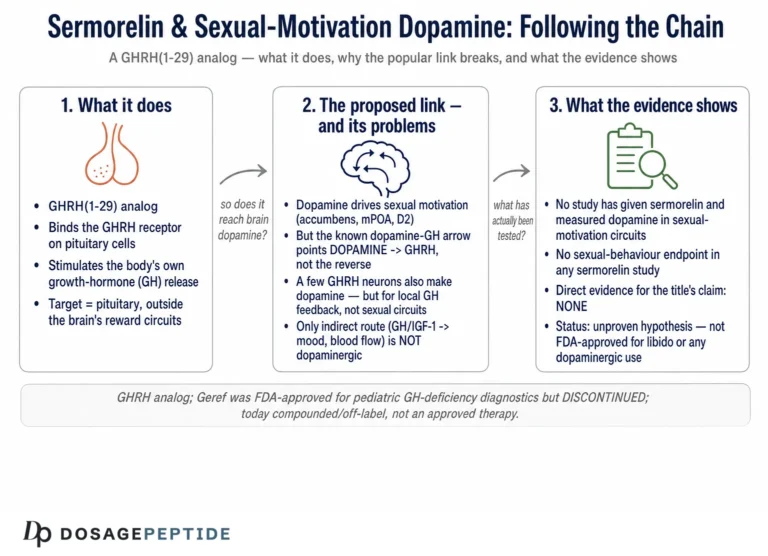
There is no human trial showing that sermorelin improves memory or slows neurodegeneration. The cognitive interest comes from one step removed: short trials of GHRH analogs in older adults and in people with mild cognitive impairment reported small gains on some cognitive measures, and sermorelin belongs to that class — it is a synthetic 29-amino-acid peptide reproducing the active N-terminal fragment of human growth hormone-releasing hormone (GHRH). Its original role was narrow, as the diagnostic and pediatric growth agent Geref; the aging and brain-health framing came later, from wellness marketing rather than from sermorelin-specific data. This article sets out what the human evidence shows, what the preclinical neurodegeneration work adds, and where the gap sits. Dosing conventions are collected in our sermorelin 5 mg vial protocol.
That is a compelling story, and pieces of it are grounded in real physiology. But the honest framing is important from the outset: there is no approved indication, and no completed clinical trial, showing that Sermorelin treats, prevents, or slows Alzheimer’s disease or any other neurodegenerative condition. The most cited human cognition data in this space did not even use Sermorelin — they used tesamorelin, a stabilized GHRH analog, in trials of 20 weeks or less. The preclinical neuroprotection signals are genuinely interesting, but they come from cell cultures and transgenic mice, often with different GHRH agonists entirely. So the correct posture is not “Sermorelin supports cognition” but rather “the GHRH pathway is a plausible, actively researched target, and Sermorelin is one imperfect probe of it.”
This article treats the title as an open research question. It walks through what Sermorelin is, how it acts at a molecular level, why anyone connected GHRH to the aging brain in the first place, what the human and animal evidence actually demonstrates (and its ceiling), how Sermorelin compares to related peptides, the methodology and safety data available, the practical handling considerations in a laboratory setting, and finally the substantial gap between the hypothesis and anything resembling a proven therapy. Everything here is educational and research‑oriented; nothing is medical advice.
What Sermorelin Is and Where It Came From
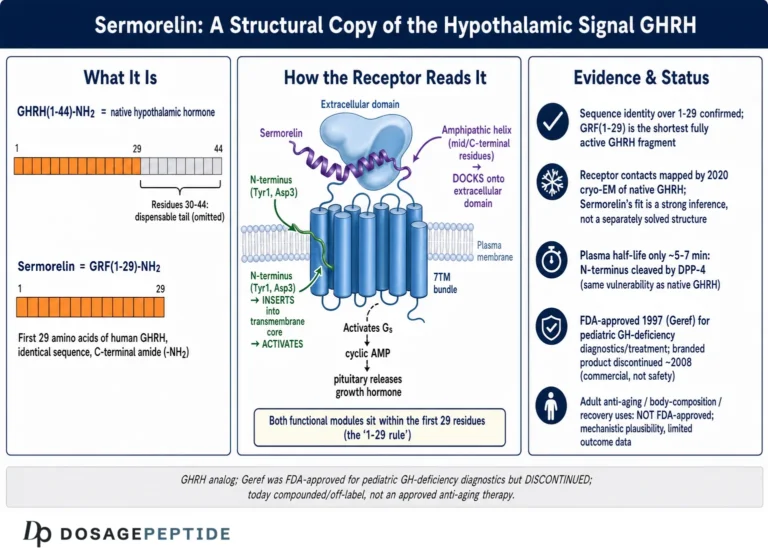
Sermorelin (sermorelin acetate) is the acetate salt of a peptide corresponding to amino acids 1 through 29 of human GHRH, sometimes written as GRF(1‑29) or GHRH(1‑29). Native human GHRH is a 44‑residue hypothalamic peptide, but decades of structure‑activity work established that the first 29 residues retain essentially the full intrinsic potency of the parent molecule at the GHRH receptor.4 That discovery is what made a short, synthesizable fragment clinically usable: you do not need the entire 44‑amino‑acid chain to trigger growth hormone release, only its active head.
The compound’s regulatory history is central to understanding it, and it is frequently misrepresented. Sermorelin was developed and approved in the United States as Geref. In its diagnostic formulation it was indicated for evaluating the ability of the pituitary somatotroph cells to secrete growth hormone, and a higher‑dose formulation was used in the treatment of growth hormone deficiency and growth failure in children. In a letter dated December 2, 2008, the manufacturer (EMD Serono) notified the FDA that it was discontinuing Geref and requested withdrawal of the New Drug Application.3 Critically, when the FDA later reviewed the matter, it formally determined that Geref (sermorelin acetate) injection was not withdrawn from sale for reasons of safety or effectiveness — the withdrawal was a commercial and business decision, not a regulatory sanction.3
This distinction matters enormously for how the compound circulates today. Because the branded product was discontinued rather than pulled for danger, and because the FDA acknowledged the withdrawal was not safety‑driven, sermorelin re‑entered availability primarily through compounding pharmacies and, separately, through the research‑chemical channel. In neither of those channels is there a current FDA‑approved finished drug product carrying an approved label. That is a very different situation from a peptide that has never been studied in humans, but it is equally different from an actively marketed, approved therapy. Sermorelin occupies an unusual middle ground: historically approved, extensively characterized pharmacologically, but presently without an approved commercial product.
Physically, sermorelin is supplied as a lyophilized (freeze‑dried) white powder requiring reconstitution before use, and it is chemically fragile in solution. Its most defining pharmacokinetic feature is a very short circulating half‑life — on the order of roughly 10 to 12 minutes — because, like native GHRH, it is rapidly cleaved by the enzyme dipeptidyl peptidase‑4 (DPP‑4) and cleared.4 This brevity is not an accident of poor design; it is the whole point. Sermorelin was intended to mimic a short, physiologic pulse of GHRH, prompting the pituitary to release a burst of its own stored growth hormone and then fall silent, rather than clamping the system into a sustained, artificial state. That pulsatile philosophy is what distinguishes it from the longer‑acting analogs discussed later, and it is also what makes framing it as a chronic “brain therapy” scientifically awkward.
Because this article situates Sermorelin among growth‑hormone secretagogues generally, readers exploring adjacent compounds may find the broader catalog of peptide dosage protocols useful context for how these molecules are categorized and studied in the research literature.
How Sermorelin Works: The Molecular Mechanism
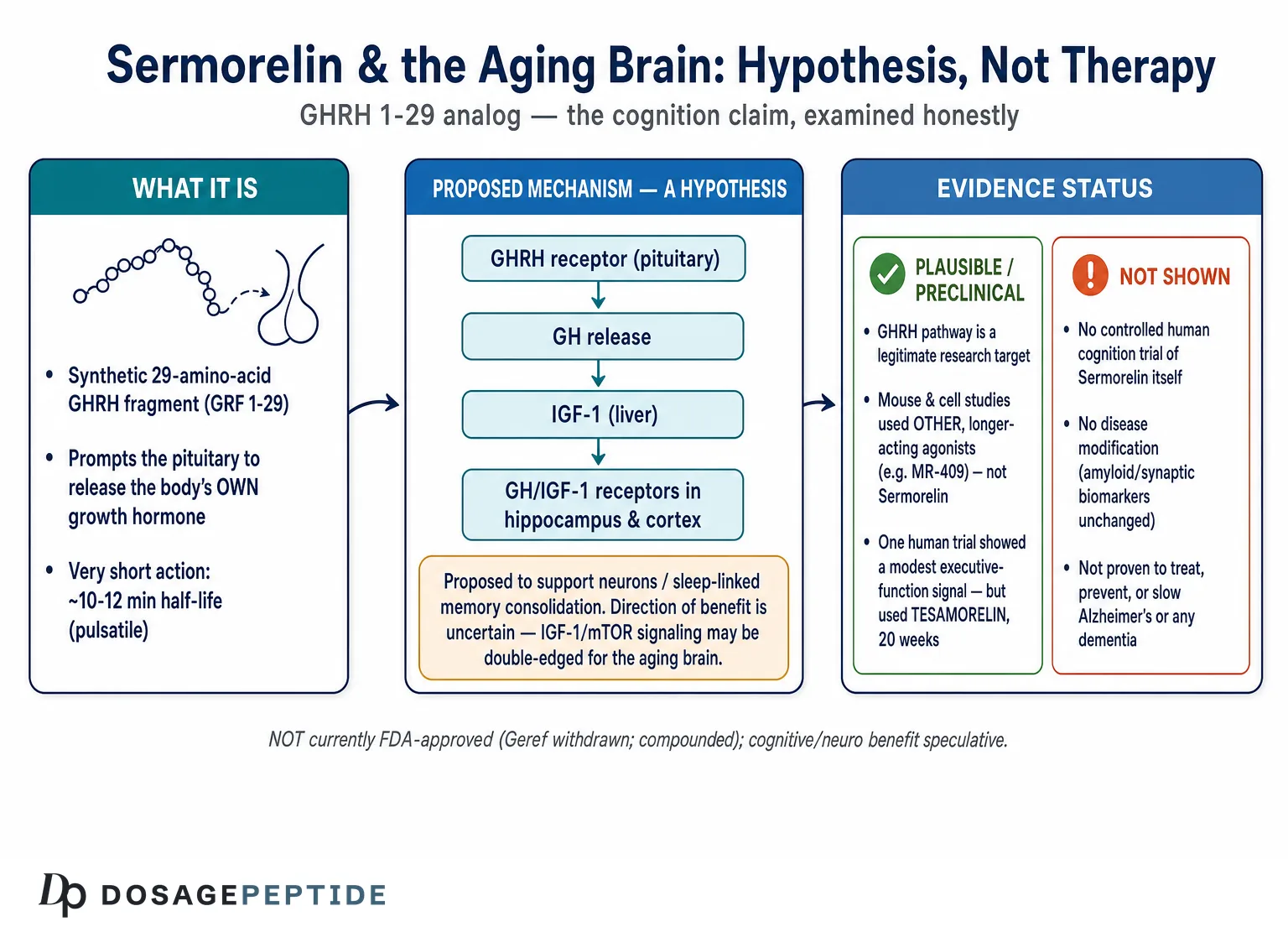
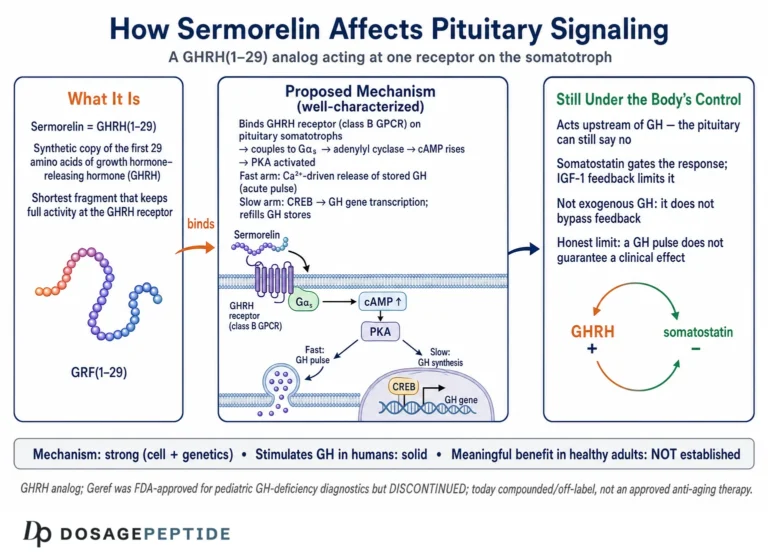
Sermorelin’s mechanism is best understood as one deliberate intervention at the top of a multi‑step endocrine cascade. The peptide binds the GHRH receptor (GHRHR), a G‑protein‑coupled receptor expressed densely on the somatotroph cells of the anterior pituitary. Receptor engagement activates the stimulatory G protein (Gαs), which in turn stimulates adenylate cyclase, raising intracellular cyclic AMP (cAMP). Elevated cAMP activates protein kinase A (PKA), and the downstream result is twofold: an immediate release of pre‑synthesized growth hormone from secretory granules, and, over longer timeframes, upregulation of GH gene transcription and somatotroph proliferation.4 In other words, Sermorelin does not supply growth hormone; it instructs the gland to manufacture and release its own.
This is a meaningful mechanistic contrast with recombinant human growth hormone (rhGH). Injecting rhGH forces circulating GH upward regardless of the body’s regulatory state. Sermorelin, by acting one level upstream, remains subject to the system’s native brakes. The most important brake is somatostatin, the hypothalamic peptide that opposes GHRH and suppresses GH release. Because somatostatin tone still operates, and because the pituitary can only release what it has, Sermorelin‑driven GH secretion tends to preserve the pulsatile, self‑limiting rhythm of endogenous GH rather than producing the flat, supraphysiologic elevations characteristic of exogenous hormone. Proponents describe this as a “more physiologic” intervention, and mechanistically that description is fair — though “more physiologic” is not the same as “proven safer over years,” a claim that lacks long‑term data.
The released GH then acts on peripheral tissues, most importantly the liver, stimulating the production and secretion of IGF‑1. IGF‑1 is the principal mediator of many of GH’s anabolic and trophic effects, and it also exerts negative feedback back onto both the hypothalamus and pituitary to restrain further GH release.4 This GH/IGF‑1 axis is the hinge on which every cognitive hypothesis about Sermorelin turns, because both GH and IGF‑1 receptors are expressed in the brain — including in the hippocampus and cortex, regions central to learning, memory, and executive function.6
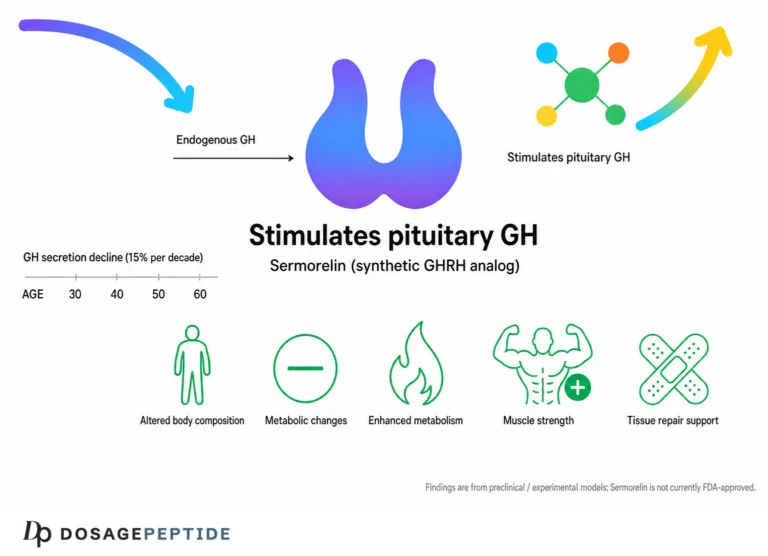
Here the mechanism becomes genuinely relevant to neurodegeneration, at least in theory. IGF‑1 crosses into the central nervous system and has been shown in preclinical work to support neuronal survival, synaptic plasticity, neurogenesis, and clearance mechanisms relevant to amyloid‑beta. Low circulating IGF‑1 has been associated with elevated brain amyloid burden in some models, a hallmark of Alzheimer’s pathology.6 The GH/IGF‑1 decline that accompanies aging (sometimes termed the “somatopause”) therefore offers a tidy narrative: if aging brains face a falling trophic signal, restoring some of that signal via GHRH stimulation might, in principle, buffer neuronal health.
But two mechanistic cautions are essential. First, the GHRH receptor is itself expressed in some extrapituitary tissues, and emerging preclinical data suggest GHRH analogs may exert direct effects on neural and other cells independent of the classical GH/IGF‑1 route — a pathway that is intriguing but poorly mapped in humans.7 Second, the IGF‑1 story is not uniformly pro‑cognitive. IGF‑1 signaling intersects with the same nutrient‑sensing pathways (such as mTOR) that longevity research often argues should be dampened, not amplified, for healthy aging. The brain may not simply want “more IGF‑1”; it may want the right IGF‑1 signaling at the right time. This tension is unresolved and is one reason the mechanism, however elegant on a slide, does not translate cleanly into “Sermorelin protects the aging brain.”
The GHRH–Cognition Hypothesis: Why the Brain Connection Was Made
The idea that stimulating the GH/IGF‑1 axis might help the aging brain did not originate with Sermorelin marketing. It grew out of legitimate observational and interventional research beginning in the 1990s and 2000s. The reasoning proceeded in steps, and understanding those steps clarifies why the hypothesis is taken seriously by researchers even as it remains unproven.
The first observation was epidemiological and physiological: GH and IGF‑1 levels decline substantially with age, and this decline roughly parallels age‑related changes in body composition, sleep architecture, and cognition. Correlation is not causation, but the co‑occurrence prompted the question of whether the endocrine decline contributes mechanistically to cognitive aging rather than merely accompanying it.
The second step was the recognition that GHRH and its downstream products influence sleep, and specifically slow‑wave (deep) sleep. GHRH is a known promoter of non‑REM sleep, and the largest natural GH pulse occurs during early‑night slow‑wave sleep. Slow‑wave sleep, in turn, has been increasingly implicated in memory consolidation and, more recently, in the glymphatic clearance of metabolic waste including amyloid‑beta. This created a second, sleep‑mediated pathway by which a GHRH analog might plausibly touch cognition — not through IGF‑1 trophic support alone, but by improving the quality of the sleep during which the brain performs maintenance. Indeed, some of the original human GHRH trials were framed partly around sleep in aging.8
The third step was direct interventional testing. Investigators at the University of Washington, led by Michael Vitiello and later Laura Baker, conducted controlled trials administering GHRH (in the form of the stabilized analog tesamorelin) to older adults, measuring cognition as an outcome. An earlier study reported that GHRH administration improved several cognitive measures in healthy older adults over roughly six months.2 This work generated the hypothesis that a GHRH intervention could produce measurable, domain‑specific cognitive change in aging humans — the empirical seed from which the entire “GHRH for cognition” literature grew.
It is worth stating plainly what the hypothesis is and what it is not. The hypothesis is that stimulating the GHRH–GH–IGF‑1 axis in aging or at‑risk brains may improve performance on specific cognitive domains, particularly executive function, possibly via combined trophic, metabolic, and sleep‑related mechanisms. The hypothesis is not that GHRH analogs reverse established neurodegenerative disease, clear plaques in humans, or alter the clinical trajectory of dementia. No completed human trial supports those stronger claims. The distinction between “measurable change on a cognitive test battery in a research setting” and “a disease‑modifying treatment” is the single most important idea in this entire topic, and it is precisely the distinction that wellness marketing tends to collapse.
Sermorelin’s specific position within this hypothesis is also worth flagging. Sermorelin is the shortest‑acting, most classically “physiologic” GHRH agonist, yet almost none of the human cognition data used Sermorelin itself. The evidence base was built on tesamorelin, a more metabolically stable analog better suited to once‑daily dosing over 20‑week trials. Extrapolating those tesamorelin findings to Sermorelin is an assumption, not a demonstrated equivalence.
What the Human Evidence Actually Shows
The centerpiece of the human evidence is a randomized, double‑blind, placebo‑controlled trial published by Baker and colleagues in Archives of Neurology in 2012.1 This is the study most often cited — frequently without attribution — whenever a vendor claims that “GHRH improves cognition.” Examining it closely is the best inoculation against overstatement, because the trial is simultaneously the strongest evidence in the field and a clear illustration of that evidence’s limits.
The trial enrolled 152 adults aged 55 to 87 (mean age about 68), of whom 66 had amnestic mild cognitive impairment (MCI) and the remainder were cognitively healthy. Participants self‑administered daily subcutaneous injections of 1 mg tesamorelin, a stabilized GHRH analog, or placebo, taken 30 minutes before bedtime for 20 weeks, followed by a washout.1 Note again: the drug was tesamorelin, not Sermorelin. The results were reported as favorable but modest. The primary positive finding was on executive function, which improved significantly with GHRH (reported at p = .005), with benefits on tasks such as set‑shifting and Stroop interference. Verbal memory showed a favorable trend that did not reach conventional significance (p = .08), and visual memory showed no treatment effect.1
The effect sizes reported for the executive and verbal composites were described as medium to large, but the improvement on any individual test was small — on the order of a quarter of a standard deviation.1 This is the crux of the interpretive problem. A statistically significant, medium composite effect over 20 weeks is a real and interesting signal. It is also entirely compatible with a change too small to be noticeable in a person’s daily functioning, and the trial was not designed to measure whether the cognitive changes translated into any functional or clinically meaningful benefit. The authors themselves were careful, calling for longer‑duration trials and describing the therapeutic potential as something to be established, not established.
| Feature | Baker et al. 2012 (GHRH/tesamorelin trial) |
|---|---|
| Design | Randomized, double‑blind, placebo‑controlled |
| Compound | Tesamorelin 1 mg/day SC (a GHRH analog — not Sermorelin) |
| Participants | 152 enrolled (66 with MCI); ~137 completed; ages 55–87 |
| Duration | 20 weeks treatment + washout |
| Executive function | Significant improvement (p = .005) |
| Verbal memory | Non‑significant favorable trend (p = .08) |
| Visual memory | No treatment effect |
| IGF‑1 | Increased ~117%, remaining within physiologic range |
| Clinical/functional benefit | Not demonstrated; not the trial’s endpoint |
A companion line of work examined biological mechanisms in the same population. Winston, Rissman, and colleagues analyzed plasma neuronal‑derived exosomes from trial participants and found that markers distinguishing MCI from healthy controls (elevated amyloid‑beta 1‑42, reduced synaptic proteins) were not significantly modulated by 20 weeks of GHRH, even though cognition improved.5 The authors interpreted this as evidence that GHRH’s cognitive effect is mechanistically distinct from altering these Alzheimer’s‑related protein signatures — in plainer terms, GHRH did not appear to be clearing amyloid or reversing synaptic pathology in these people. That is an important and under‑reported nuance: whatever benefit was seen was not accompanied by evidence of disease modification.
The honest bottom line on human evidence is therefore layered. Yes, controlled trials exist. Yes, they show a real, statistically significant effect on at least one cognitive domain. But the trials were short, used tesamorelin rather than Sermorelin, produced small per‑test effects of uncertain functional relevance, did not demonstrate disease modification, and have not been followed by the larger, longer confirmatory trials that would be required to call any GHRH analog a cognitive therapy. For Sermorelin specifically, direct controlled cognitive‑outcome data in humans are essentially absent. The evidence level for the title’s claim, applied to Sermorelin, is best described as preclinical‑to‑preliminary and indirect.
Preclinical Neurodegeneration Research: GHRH Agonists in Models
Where the human data thin out, the preclinical literature becomes more provocative — and it is the source of most of the mechanistic optimism, so it deserves careful, calibrated description. A body of work, much of it associated with the laboratory of Andrew Schally and collaborators, has tested synthetic GHRH agonists (compounds such as MR‑409 and MIA‑690, which are more potent and stable than Sermorelin) in cell‑culture and rodent models of Alzheimer’s disease and related pathology.
In transgenic mouse models such as the 5xFAD line, subcutaneous administration of a GHRH agonist has been reported to reduce amyloid‑beta deposition, decrease tau phosphorylation, attenuate gliosis and pro‑inflammatory cytokine expression, and improve performance on memory tasks — in at least some reports without raising systemic GH and IGF‑1, suggesting a direct central action rather than a purely endocrine one.7 In cortical cell cultures exposed to amyloid‑beta, GHRH agonists have shown antioxidant and neuroprotective properties, with proposed mechanisms including reduced apoptosis, suppression of GSK‑3β and downstream tau phosphorylation, restoration of β‑catenin signaling, and inhibition of NF‑κB‑driven inflammation.7 Independent work on GH and IGF‑1 in the brain reinforces the biological plausibility, documenting neuroprotective and pro‑plasticity roles for these signals after various injuries.6
Taken together, these findings sketch a coherent and attractive mechanistic picture: GHRH signaling may touch several of the core pathological axes of neurodegeneration — amyloid, tau, neuroinflammation, oxidative stress, and neurogenesis — through both endocrine and possibly direct central routes. If one were designing a research program to test whether the GHRH pathway is worth pursuing for brain aging, this is precisely the kind of convergent preclinical support one would want to see before committing to expensive human trials.
But the caveats here are not footnotes; they are load‑bearing. First, and most importantly, these studies overwhelmingly did not use Sermorelin. They used more potent, more stable GHRH agonists engineered specifically for sustained activity. Sermorelin’s ~10‑minute half‑life makes it a poor tool for producing the kind of continuous receptor engagement these agonists deliver, so the assumption that Sermorelin would reproduce their effects is unsupported and arguably unlikely. Second, mouse amyloid models are notorious in Alzheimer’s research for producing positive results that fail to replicate in humans; the “graveyard” of interventions that cured mice and did nothing for patients is large and well documented. Third, doses, routes, and timing in these models are not translatable to human research use in any straightforward way.
The correct reading of the preclinical literature is thus: it validates the GHRH pathway as a legitimate scientific target worthy of continued investigation, and it explains why researchers remain interested. It does not validate Sermorelin as a neuroprotective agent, and it certainly does not license any claim that Sermorelin slows or treats human neurodegeneration. Anyone citing 5xFAD mouse data to justify Sermorelin use for brain health is making an inferential leap across at least three unproven bridges: from a different molecule, in a different species, to an unproven human endpoint.
How Sermorelin Compares to Related Compounds
Sermorelin is one of several molecules that stimulate the GH axis, and its properties are best understood by contrast. The compounds fall into two mechanistic families: GHRH analogs (which act, like Sermorelin, at the GHRH receptor) and growth‑hormone secretagogue‑receptor agonists or “ghrelin mimetics” (which act at a different receptor). Understanding these distinctions clarifies why the cognition literature centers on certain molecules and not others.
| Compound | Class / receptor | Relative duration | Cognition‑specific human data? |
|---|---|---|---|
| Sermorelin (GHRH 1‑29) | GHRH analog / GHRHR | Very short (~10–12 min half‑life) | Essentially none direct |
| Tesamorelin | Stabilized GHRH analog / GHRHR | Longer; once‑daily dosing | Yes — the Baker 2012 trial1 |
| CJC‑1295 (no DAC / mod GRF) | GHRH analog / GHRHR | Short‑to‑moderate | No controlled cognitive trials |
| CJC‑1295 with DAC | GHRH analog + albumin binding / GHRHR | Long (days) | No controlled cognitive trials |
| Ipamorelin | Ghrelin mimetic / GHS‑R | Short | No controlled cognitive trials |
Tesamorelin is the most important comparator because it, not Sermorelin, generated the human cognition data. Tesamorelin is a GHRH analog modified for greater metabolic stability, which is why it was practical to give once daily for 20 weeks in the Baker trial.1 It is also the one GHRH‑family compound with a current approved indication (for HIV‑associated lipodystrophy), though that indication has nothing to do with cognition. Readers can explore its profile further through the site’s overview of what tesamorelin is and how it works and the corresponding tesamorelin research protocol.
CJC‑1295 exists in two forms. The “no DAC” version (essentially modified GRF 1‑29) is a short‑acting GHRH analog conceptually similar to Sermorelin but with amino‑acid substitutions that resist DPP‑4 cleavage. The “DAC” version adds a drug‑affinity complex that binds serum albumin, extending its half‑life to days and producing a sustained “bleed” of GH release rather than a pulse. Neither has controlled human cognitive‑outcome data. In research settings CJC‑1295 is frequently paired with a ghrelin mimetic; see, for example, the CJC‑1295 no‑DAC and ipamorelin blend protocol.
Ipamorelin is mechanistically distinct: it is a selective ghrelin‑receptor (GHS‑R) agonist, not a GHRH analog. It stimulates GH release through a parallel pathway and is often studied alongside a GHRH analog because the two mechanisms are synergistic — GHRH raises the ceiling on GH release while a ghrelin mimetic amplifies the pulse. Ipamorelin is prized in research contexts for its selectivity (relatively little effect on cortisol or prolactin). Its standalone research protocol illustrates the different dosing conventions of the ghrelin‑mimetic class. Crucially for this article, none of these companion compounds has cognitive‑outcome trials either.
The comparative takeaway is sobering for the Sermorelin‑for‑cognition thesis. Among the entire GH‑secretagogue family, exactly one member (tesamorelin) has controlled human cognition data, those data are modest and short‑term, and Sermorelin is not that member. Sermorelin’s distinguishing feature — its ultra‑short, pulsatile action — is arguably a liability for a chronic neuroprotection application, where sustained signaling of the kind delivered by tesamorelin or the long‑acting agonists may be what matters. Choosing Sermorelin specifically for a brain‑health rationale is therefore not obviously supported even within its own drug class.
Research Models and Methodology
Evaluating whether a compound “supports cognition” is methodologically demanding, and the quality of any answer depends entirely on the model system and the endpoints chosen. Understanding the methodological toolkit clarifies why current claims are weak and what stronger evidence would require.
At the cellular level, GHRH‑agonist neuroprotection has been probed in primary neuronal and cortical cultures, often challenged with amyloid‑beta to model a toxic insult. Readouts include cell viability and apoptosis assays, markers of oxidative stress, and signaling analyses (for example, GSK‑3β activity, tau phosphorylation state, β‑catenin localization, and NF‑κB activation).7 These systems are valuable for mechanism but are maximally reductive: a peptide that protects a dish of neurons from an acute amyloid bolus tells you almost nothing about a human brain aging over decades.
At the animal level, transgenic mouse lines such as 5xFAD or APP/PS1 that overexpress mutant amyloid‑precursor‑protein constructs are standard. Outcomes span histopathology (amyloid plaque load, tau, glial markers), biochemistry (cytokines, IGF‑1), and behavioral assays of learning and memory such as the Morris water maze or novel‑object recognition.7 These models are more informative than cell culture but carry the well‑known limitation that they model familial amyloid overproduction, not the sporadic, multifactorial disease that constitutes the vast majority of human Alzheimer’s. They are also short‑lived, telescoping “aging” into months.
At the human level, the gold standard is what the Baker trial exemplified: a randomized, double‑blind, placebo‑controlled design with a validated cognitive test battery, biochemical monitoring (IGF‑1, glucose, insulin), and adverse‑event tracking.1 Several methodological features of that trial are worth internalizing as a template for critical reading. It used a composite outcome across multiple tests per domain, which increases statistical power but can obscure whether any single ability changed. It included a washout period to check for persistence. It monitored metabolic safety parameters closely, because the GH/IGF‑1 axis directly affects glucose handling. And it was explicit about the gap between statistical and clinical significance — a distinction that separates careful science from marketing.1
What would methodologically stronger evidence for the title’s question look like? It would require, at minimum: trials using Sermorelin itself rather than surrogate analogs; larger samples than roughly 150 participants; durations of years rather than weeks (neurodegeneration unfolds over years, and a 20‑week window cannot capture disease trajectory); pre‑registered primary endpoints tied to functional outcomes (activities of daily living, progression to dementia) rather than test‑battery composites alone; biomarker confirmation of any disease‑modifying mechanism (which the exosome substudy notably failed to find for GHRH5); and independent replication. None of these exist for Sermorelin. This is not a case of one flawed study; it is a case of the relevant studies not having been done at all. Methodologically, the honest verdict is that the question remains genuinely open because the experiments capable of answering it have not been performed.
Safety and Tolerability Signals
Because Sermorelin acts upstream and preserves feedback, its theoretical safety profile is often described as gentler than exogenous GH. The available data are broadly reassuring for short‑term use, but they are limited in duration and were not collected with neurodegeneration populations in mind. This section summarizes what is documented, with appropriate caution.
In the Baker cognitive trial, the GHRH analog was generally well tolerated over 20 weeks, but adverse effects were clearly more common than placebo. Roughly 68% of GHRH‑treated participants reported mild adverse effects versus about 36% on placebo, the most common being local injection‑site skin reactions and increased joint pain (arthralgia).1 Dose reductions were required in about 17% of the GHRH group, more often in women.1 These are consistent with known GH‑axis effects: fluid retention, joint discomfort, and injection‑site reactions are recurring themes across the secretagogue class.
The metabolic findings deserve particular emphasis because they are directly relevant to any older population, which is exactly the population of interest for cognitive aging. IGF‑1 rose by about 117% with GHRH, though it remained within the physiologic range.1 Critically, in the MCI subgroup, fasting insulin increased by roughly 35%, indicating a measurable effect on glucose regulation, even though fasting glucose, HbA1c, and oral glucose tolerance test responses did not significantly change over the trial.1 The GH/IGF‑1 axis is inherently diabetogenic at the level of insulin sensitivity, and this signal — even if subclinical over 20 weeks — is exactly the kind of effect that could matter over the years‑long timescales relevant to neurodegeneration, and in older adults already at elevated risk of glucose dysregulation.
| Category | Reported signal (short‑term GHRH data) |
|---|---|
| Injection‑site reactions | Common (local redness, irritation) |
| Arthralgia / fluid retention | Increased vs placebo |
| IGF‑1 | Rose ~117%, stayed within physiologic range1 |
| Fasting insulin (MCI subgroup) | Increased ~35%1 |
| Fasting glucose / HbA1c / OGTT | No significant change over 20 weeks1 |
| Long‑term (years) safety | Not established |
Two broader safety considerations round out the picture. First, the theoretical concern that stimulating the GH/IGF‑1 axis could promote the growth of existing malignancies is a recurring caution across the entire GH‑secretagogue field; IGF‑1 is a mitogen, and while short trials have not demonstrated increased cancer risk, no long‑term Sermorelin data exist to address it. Second, and specific to the compounding and research‑chemical channels through which Sermorelin now circulates, product identity, purity, sterility, and correct concentration are not guaranteed the way they are for an approved, inspected drug product. Contamination, endotoxin, and mislabeling are real quality concerns for peptides obtained outside a regulated supply chain, and they represent a safety issue entirely separate from the pharmacology of the molecule itself. The reassuring short‑term clinical data were generated with pharmaceutical‑grade material under medical supervision — conditions that do not automatically transfer to other settings.
Handling and Reconstitution in a Research Context
Sermorelin’s physical chemistry imposes real handling constraints, and because this article is written for an educational and research audience, it is appropriate to describe them — while stressing that this is not a use guide and that no dosing recommendation for human self‑administration is being made. The compound is supplied lyophilized precisely because it is unstable in aqueous solution, and much of the practical knowledge around it concerns preserving that stability.
Reconstitution is typically performed with bacteriostatic water (sterile water containing a small percentage of benzyl alcohol as a preservative), which allows a multi‑dose vial to remain usable over a period of days in a laboratory setting; plain sterile water lacks preservative and is generally reserved for single‑use scenarios. The diluent is standardly introduced by directing it slowly against the inner glass wall of the vial rather than injecting it forcefully onto the lyophilized cake, because mechanical shear can damage the peptide’s structure. After adding diluent, the vial is left to stand and, if needed, gently swirled or rolled between the palms — never shaken. This “never shake” rule appears repeatedly in peptide handling literature for good reason: vigorous agitation introduces air‑water interface stress and foaming that can denature and aggregate peptides, degrading potency.
Storage is the other major consideration. Lyophilized Sermorelin is relatively stable when kept cold and protected from light, but once reconstituted its clock starts. Reconstituted peptide is kept refrigerated (commonly cited as roughly 2–8°C), shielded from light and heat, and used within a limited window; extended storage of solutions, and repeated warming and cooling, accelerate degradation. For longer‑term preservation of unreconstituted material, freezing is often used, though repeated freeze‑thaw cycles are themselves a source of degradation and are generally avoided. Because Sermorelin is cleaved rapidly by DPP‑4 in vivo, none of this handling care changes the fundamental pharmacokinetic reality that, once administered, its window of receptor activity is measured in minutes, not hours.4
The concentration and volume mathematics of reconstitution — how much diluent yields what concentration, and therefore what volume corresponds to a given quantity of peptide — are a frequent source of error and are the reason structured reconstitution references exist. Readers interested in how these calculations are formalized across compounds can consult the site’s general library of reconstitution and dosage protocols, which lay out the concentration‑versus‑volume relationships that apply generically to lyophilized research peptides. The purpose of citing this here is methodological completeness, not encouragement of use: accurate concentration accounting is a basic element of rigorous, reproducible laboratory work with any peptide.
A final handling caveat specific to the research‑channel context: the absence of an approved finished product means there is no manufacturer‑validated stability dossier standing behind any particular vial. Statements about how long reconstituted Sermorelin “lasts” are extrapolations from general peptide behavior and from the historical Geref product information, not guarantees about a given sample. This uncertainty is one more reason the material is properly regarded as a research reagent rather than a therapeutic product.
Limitations and the Human‑Evidence Gap
Having surveyed the mechanism, the hypothesis, and the data, it is worth consolidating the limitations explicitly, because they are collectively decisive for how the title’s question should be answered. The gap between the marketing claim and the evidence is not a matter of a few missing details; it is structural.
The first and largest limitation is the compound‑substitution problem. The human cognitive data rest on tesamorelin; the preclinical neuroprotection data rest on potent long‑acting agonists such as MR‑409 and MIA‑690. Sermorelin itself has essentially no controlled human cognitive‑outcome data. Every argument that “Sermorelin supports cognition” is therefore an inference from other molecules, and Sermorelin’s ultra‑short half‑life makes that inference weaker, not stronger, because it is the analog least able to sustain the receptor engagement the other molecules provide.
The second limitation is duration. The best human trial ran 20 weeks.1 Age‑related neurodegeneration develops over years to decades. A 20‑week improvement on a test battery, even if real, cannot speak to whether a compound alters the long‑term trajectory of a disease, and there is a long history in this field of short‑term signals evaporating over longer follow‑up.
The third limitation is the statistical‑versus‑clinical significance gap. The documented improvements were small at the level of individual tests (~0.25 SD) and were composite‑driven; the trial was not powered or designed to show functional benefit, and none was demonstrated.1 “Improved on a cognitive test” and “functions better in life” are not the same claim, and only the former has any support.
The fourth limitation is the absence of demonstrated disease modification. The exosome substudy found that GHRH did not significantly move the amyloid and synaptic biomarkers that characterize MCI, even as cognition improved.5 Whatever the cognitive effect represents, the available biomarker evidence argues against it being a reversal of underlying neurodegenerative pathology. This directly undercuts any framing of Sermorelin as something that “treats” neurodegeneration.
The fifth limitation is population and generalizability. The trial population was small, predominantly white, and highly educated, and it studied MCI and healthy aging — not established dementia.1 There is no evidence base for Sermorelin in Alzheimer’s disease, Parkinson’s disease, Lewy body dementia, frontotemporal dementia, or any specific neurodegenerative diagnosis, and it would be irresponsible to extrapolate a modest MCI‑and‑healthy‑aging signal to those conditions.
The sixth limitation concerns the competing‑pathway uncertainty in the biology itself. The longevity literature contains a real and unresolved tension: robust IGF‑1/mTOR signaling is associated in some models with accelerated aging and reduced lifespan, while trophic IGF‑1 support appears protective in others. Amplifying the GH/IGF‑1 axis is not self‑evidently good for a brain aging over decades, and the assumption that “more GH signaling equals better cognition” oversimplifies a genuinely double‑edged biology. In sum, the human‑evidence gap is not merely empty space awaiting confirmation; it includes principled reasons for uncertainty about whether the intervention is even net‑beneficial long term.
Regulatory Status
The regulatory picture is frequently distorted in both directions — some sources imply Sermorelin is an approved, legitimate anti‑aging drug, while others imply it was banned for danger. Neither is accurate, and precision here is part of responsible communication.
Sermorelin was an FDA‑approved product under the brand name Geref, used diagnostically to assess pituitary GH secretory capacity and, in a separate formulation, in the treatment of growth hormone deficiency and growth failure in children. The manufacturer discontinued it, notifying the FDA in a letter dated December 2, 2008 and requesting withdrawal of the NDA.3 When the FDA subsequently evaluated the withdrawal, it published a formal determination that Geref (sermorelin acetate) injection was not withdrawn from sale for reasons of safety or effectiveness.3 The practical consequence of that specific determination is administrative: it is the finding that can permit generic or compounded versions to proceed without the withdrawal being treated as a safety red flag. It is a statement about why the branded product left the market, not an endorsement of any current product or use.
As of this writing, there is no FDA‑approved finished Sermorelin drug product on the market. Sermorelin’s present availability runs through two channels. The first is pharmacy compounding, where licensed compounding pharmacies prepare it — a channel that has itself been subject to FDA scrutiny and shifting policy regarding which bulk substances compounders may use. The second is the research‑chemical channel, in which material is sold explicitly labeled “for research use only, not for human consumption.” Neither channel involves an FDA‑reviewed label, approved indication, or the manufacturing oversight that accompanies an approved drug. Importantly, no regulatory body anywhere has approved Sermorelin for any cognitive, neuroprotective, or anti‑dementia indication. Those uses are entirely investigational and, in the marketing context, off‑label at best and unsubstantiated at worst.
Two further regulatory notes matter for accuracy. First, tesamorelin — the GHRH analog that actually generated the cognition data — is FDA‑approved, but only for HIV‑associated lipodystrophy, not for cognition; its approval provides no regulatory cover for cognitive claims about any GHRH analog, Sermorelin included. Second, GHRH analogs including Sermorelin appear on the World Anti‑Doping Agency prohibited list as GH secretagogues, which is relevant context for any research involving athletes and underscores that these are pharmacologically active hormonal agents, not benign supplements.
The regulatory bottom line aligns with the scientific one. Sermorelin is a real, historically approved, well‑characterized peptide with a legitimate pharmacology and a genuine, actively researched mechanistic connection to the aging brain. It is also, at present, a compound without an approved product, without any approved cognitive indication, and without the human trial base that would justify describing it as a treatment for neurodegeneration. The gap between “interesting research target” and “cognitive therapy” is exactly where Sermorelin sits, and honest communication keeps those two categories distinct.
Frequently Asked Questions
Is Sermorelin FDA‑approved to treat cognitive decline or dementia?
No. Sermorelin has never been approved for any cognitive, neuroprotective, or dementia‑related indication anywhere. Its historical FDA approval (as Geref) was for diagnostic assessment of pituitary function and for pediatric growth hormone deficiency, and even that branded product was discontinued in 2008.3 There is no approved Sermorelin drug product on the market today, and any use for brain health is investigational and unproven.
Do human trials show Sermorelin improves memory?
Not Sermorelin specifically. The most‑cited controlled human trial showing a cognitive benefit used tesamorelin, a different, longer‑acting GHRH analog, over 20 weeks, and found a significant effect mainly on executive function with only a non‑significant trend for verbal memory.1 Direct controlled cognitive‑outcome trials of Sermorelin itself are essentially absent, so claims about Sermorelin and memory are extrapolations from a related molecule.
If the mechanism is plausible, why isn’t that enough?
Biological plausibility is a reason to run trials, not a substitute for them. Many interventions with elegant mechanisms and positive mouse data have failed in human neurodegeneration trials. The GH/IGF‑1 pathway is also double‑edged — more signaling is not self‑evidently better for a brain aging over decades — and the one human biomarker substudy found GHRH did not move the amyloid and synaptic markers of the disease.5 Mechanism supports the hypothesis; it does not confirm it.
How is Sermorelin different from tesamorelin and CJC‑1295?
All three are GHRH analogs acting at the same receptor, but they differ in stability and duration. Sermorelin is the shortest‑acting (~10–12 minute half‑life), tesamorelin is stabilized for once‑daily use and is the only one with human cognition data, and CJC‑1295 (especially the DAC form) is engineered for prolonged action.1,4 Sermorelin’s very short action makes it arguably the least suited among them to a chronic neuroprotection rationale.
What does the preclinical (animal) evidence actually show?
GHRH agonists — typically potent, long‑acting research compounds like MR‑409 and MIA‑690, not Sermorelin — have reduced amyloid deposition, tau phosphorylation, neuroinflammation, and oxidative stress and improved memory in Alzheimer’s mouse models and cell cultures.7 This validates the GHRH pathway as a research target. It does not demonstrate that Sermorelin produces the same effects, and mouse amyloid models frequently fail to translate to humans.
Is Sermorelin safe?
Short‑term data suggest reasonable tolerability, with the most common effects being injection‑site reactions, joint pain, and fluid retention; IGF‑1 rises and fasting insulin increased measurably in one at‑risk subgroup.1 However, long‑term (years‑long) safety is not established, theoretical concerns about IGF‑1 and cancer growth remain unaddressed by long trials, and product quality outside a regulated supply chain is an independent safety concern.
Could Sermorelin help through better sleep rather than directly?
Possibly, and this is part of why researchers found the pathway interesting. GHRH promotes slow‑wave sleep, during which the largest natural GH pulse occurs and during which the brain performs memory consolidation and metabolic waste clearance.8 A sleep‑mediated route is biologically plausible, but it remains a hypothesis; no trial has established that any cognitive effect of a GHRH analog is caused by improved sleep.
What would it take to actually answer the title’s question?
Large, multi‑year, randomized, placebo‑controlled trials using Sermorelin itself, with pre‑registered functional endpoints (such as progression to dementia or activities of daily living), biomarker confirmation of any disease‑modifying mechanism, and independent replication. None of these exist for Sermorelin, which is why the honest answer today is that the question is genuinely open and unresolved.
References
- Baker LD, Barsness SM, Borson S, et al. Effects of growth hormone–releasing hormone on cognitive function in adults with mild cognitive impairment and healthy older adults: results of a controlled trial. Arch Neurol. 2012;69(11):1420–1429. Available at: https://pmc.ncbi.nlm.nih.gov/articles/PMC3764914/ (PubMed 22869065)
- Vitiello MV, Moe KE, Merriam GR, Mazzoni G, Buchner DH, Schwartz RS. Growth hormone releasing hormone improves the cognition of healthy older adults. Neurobiol Aging. 2006;27(2):318–323. Available at: https://pubmed.ncbi.nlm.nih.gov/16399214/
- U.S. Food and Drug Administration / Federal Register. Determination That GEREF (Sermorelin Acetate) Injection Were Not Withdrawn From Sale for Reasons of Safety or Effectiveness. 78 FR 14104. March 4, 2013. Available at: https://www.federalregister.gov/documents/2013/03/04/2013-04827/
- Ishida J, Saitoh M, Ebner N, Springer J, Anker SD, von Haehling S. Growth hormone secretagogues: history, mechanism of action, and clinical development. JCSM Rapid Communications. 2020;3(1):25–37. doi:10.1002/rco2.9. Available at: https://onlinelibrary.wiley.com/doi/full/10.1002/rco2.9
- Winston CN, Goetzl EJ, Baker LD, Vitiello MV, Rissman RA. Growth Hormone‑Releasing Hormone Modulation of Neuronal Exosome Biomarkers in Mild Cognitive Impairment. J Alzheimers Dis. 2018;66(3):971–981. Available at: https://pmc.ncbi.nlm.nih.gov/articles/PMC6487872/
- Growth hormone and IGF‑1 actions in the brain and neuropsychiatric diseases. Physiology / American Physiological Society review. 2025. Available at: https://pmc.ncbi.nlm.nih.gov/articles/PMC12290765/
- Growth hormone‑releasing hormone attenuates amyloid deposition and neuroinflammation in Alzheimer’s disease models. Cell Death & Disease. 2026. Available at: https://www.nature.com/articles/s41419-026-08699-w
- Merriam GR, Vitiello MV, et al. Growth Hormone Releasing Hormone (GHRH) Treatment for Age‑Related Sleep Disturbances / SMART (Somatotrophics, Memory, and Aging Research Trial). ClinicalTrials.gov identifier NCT00000380. Available at: https://clinicaltrials.gov/study/NCT00000380
Educational and research‑use disclaimer: This article is provided strictly for educational and scientific‑information purposes and describes preclinical and preliminary research. It is not medical advice and is not a recommendation to use, purchase, or self‑administer Sermorelin or any related peptide. Sermorelin is not an FDA‑approved product for any cognitive, neuroprotective, or anti‑dementia indication, and its use for such purposes is unproven and investigational. Nothing here should be interpreted as a claim that Sermorelin treats, prevents, cures, or slows Alzheimer’s disease or any other neurodegenerative condition. Any research involving these compounds should be conducted only by qualified investigators in compliance with applicable laws, institutional oversight, and safety standards. Consult a licensed medical professional for any health‑related decision.