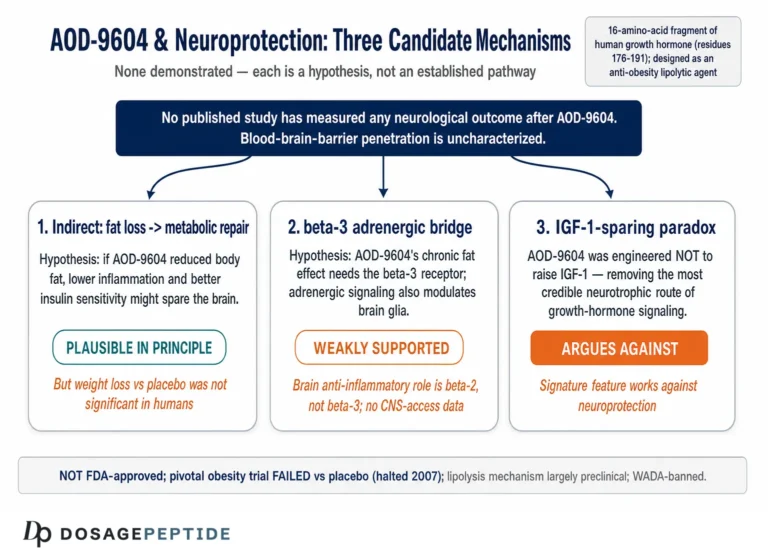
The title of this article poses a question, and the honest answer has to be given up front, before any of the biology that follows: at the time of writing, there is no published research that directly links AOD-9604 to neuroprotection in obesity-related cognitive decline. Not a single human trial, and not a dedicated preclinical model, has tested whether this peptide protects neurons, preserves memory, or slows cognitive aging in the context of obesity. The premise embedded in the question — that such a link is established — is not supported by the primary literature. What exists instead is a chain of separate, individually documented facts: AOD-9604 is a fragment of human growth hormone that was developed as an anti-obesity agent1; obesity is an independently recognized risk factor for cognitive decline through mechanisms like brain insulin resistance and neuroinflammation7; and growth-hormone biology intersects with the brain in ways that remain under active study. Connecting those dots into a neuroprotective claim is an act of speculation, not a report of evidence.
This matters because AOD-9604 is frequently marketed and discussed as though its history of clinical testing translates into proven benefit. It does not. The compound completed multiple human trials for weight loss and failed to beat placebo on its primary endpoint in its largest study4. It has never been approved as a drug by the FDA or any comparable regulator for any indication. Its uses beyond that failed obesity program — joint and cartilage research, metabolic support, and now the entirely hypothetical neuroprotection angle — are preclinical or purely theoretical. Reading a treatment story into this record inflates the evidence far beyond what the data can carry.
The rest of this article treats the question as what it actually is: an open research problem. We will look at what AOD-9604 is and where it came from, why obesity and cognitive decline are biologically linked, what mechanism the peptide is thought to use and why that mechanism points toward fat tissue rather than neurons, what the evidence base honestly contains, how the compound compares to related peptides, how it is studied, what is known about safety, how it is handled in a laboratory setting, where the human-evidence gaps lie, and what its regulatory and anti-doping status is. The goal is to give a serious researcher an accurate map of a mostly empty territory — not to fill that emptiness with wishful claims.
What AOD-9604 Is and Where It Came From
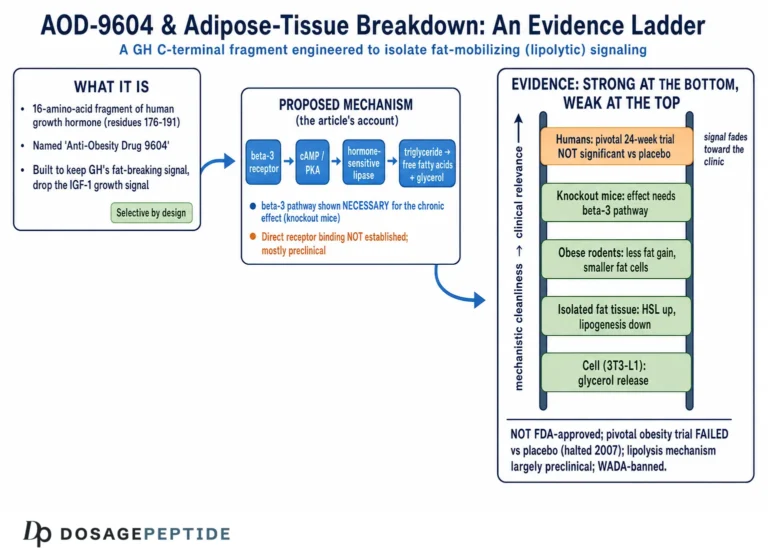
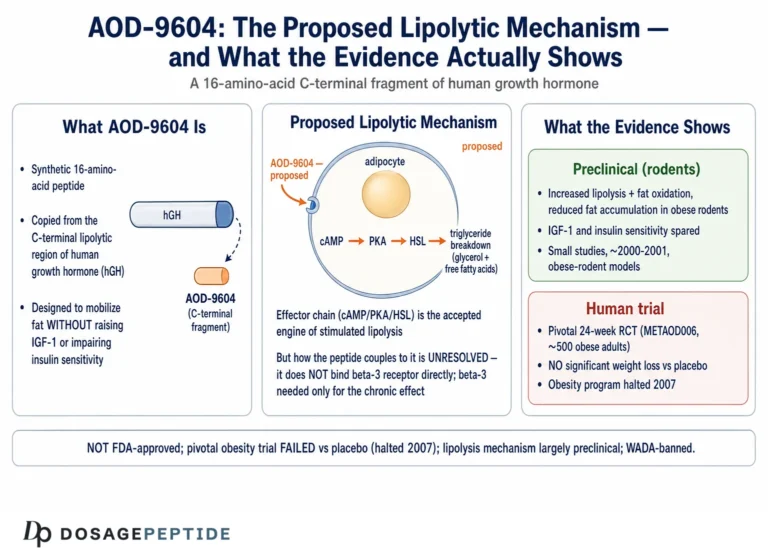
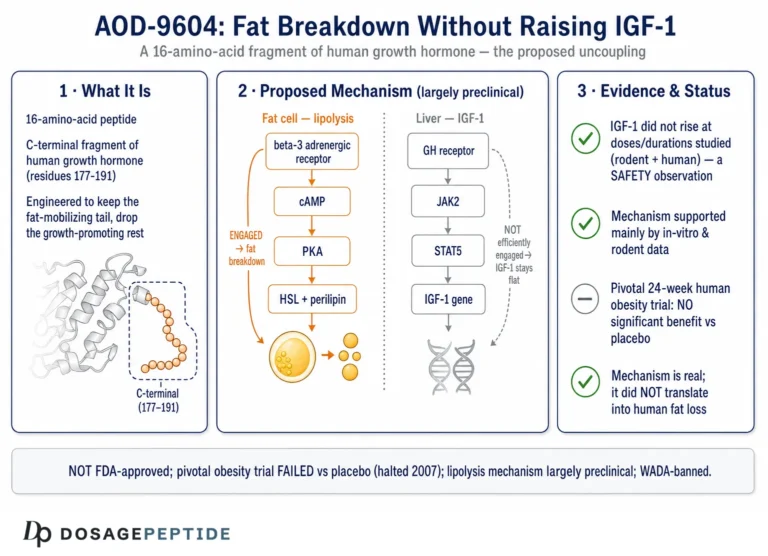
AOD-9604 — the initials stand for "Anti-Obesity Drug" — is a synthetic peptide derived from the C-terminal region of human growth hormone (hGH). Human growth hormone is a 191-amino-acid protein, and decades of endocrine research established that different regions of the molecule carry different biological activities. In particular, work in the 1980s and 1990s indicated that the fat-metabolizing (lipolytic) actions of growth hormone could be traced substantially to its C-terminal tail, roughly the segment spanning residues 176 to 191. AOD-9604 is built around that fragment. Structurally, it corresponds to hGH 177–191 with a tyrosine residue added at the N-terminus for stability and synthesis purposes, giving a compact hexadecapeptide (a 16-amino-acid chain) rather than the full hormone.1
The rationale behind the design is worth stating clearly because it is the peptide’s whole reason for existing. Full-length growth hormone does promote fat breakdown, but it also raises insulin-like growth factor 1 (IGF-1), promotes tissue growth, and tends to worsen glucose tolerance and insulin sensitivity. Those growth-promoting and diabetogenic effects make chronic hGH administration unattractive as an obesity therapy. The engineering hypothesis behind AOD-9604 was that you could isolate the lipolytic tail, keep the fat-mobilizing activity, and leave the growth-promoting, IGF-1-raising, insulin-antagonizing activity behind. The foundational rodent studies supported this separation: in obese Zucker rats given oral AOD9604 at 500 micrograms per kilogram daily for 19 days, body-weight gain was reduced by more than 50 percent compared with controls, and crucially, glucose-clamp measurements showed no adverse effect on insulin sensitivity — a sharp contrast with full growth hormone.1
The compound was developed principally by Metabolic Pharmaceuticals, an Australian company, in collaboration with researchers at Monash University in Melbourne. The names most associated with the early science are F. M. Ng and colleagues, whose 2000 paper in Hormone Research laid out the metabolic case for the fragment.1 Over the following years, the intellectual property changed hands several times — passing through Calzada Ltd, PolyNovo Biomaterials, and later Lateral Pharmaceuticals, where a related program was redesignated LAT8881 for non-obesity indications. This corporate history is relevant for anyone trying to trace the literature, because studies and patents appear under different sponsor names across two decades.
It is important to distinguish AOD-9604 from the closely related compound often sold as "HGH Fragment 176-191." The two are frequently conflated, and they share the same core growth-hormone-derived sequence, but AOD-9604 carries the added N-terminal tyrosine and is the version that actually went through formal pharmaceutical development and human testing. HGH Fragment 176-191, as sold in the research-chemical market, generally lacks that modification and has essentially no dedicated clinical literature of its own. When you read a claim attributed to "the fragment," it is worth checking which molecule the underlying study actually used. On DosagePeptide.com, both the 2 mg vial protocol and the 5 mg vial protocol pages describe AOD-9604 specifically as the growth-hormone fragment studied for fat metabolism, not as a neuroactive agent.
What AOD-9604 is not, at any point in its documented history, is a brain drug. It was conceived as a metabolic agent, tested as a metabolic agent, and abandoned as a metabolic agent. Any discussion of neuroprotection begins from a compound whose entire developmental identity was built around adipose tissue, not the central nervous system. That origin story is the first and most important context for evaluating the question this article asks.
Why Obesity Is Linked to Cognitive Decline
To understand why anyone would even pose the question of AOD-9604 and neuroprotection, you have to understand the well-supported half of the equation: the link between obesity and cognitive decline itself. This part of the story rests on a substantial and growing body of primary research, independent of any peptide. Epidemiological and mechanistic studies over the past two decades have converged on the view that midlife obesity is a modifiable risk factor for later cognitive impairment and dementia, including Alzheimer’s disease.7 The relationship is not simple — body weight late in life behaves differently, and there are confounders — but the biological plausibility is strong.
Several overlapping mechanisms are proposed. The most discussed is brain insulin resistance. Just as peripheral tissues in obesity become less responsive to insulin, neurons and glial cells in the brain can develop impaired insulin signaling. Because insulin signaling supports neuronal energy metabolism, synaptic plasticity, and the clearance of amyloid-beta, its impairment is thought to contribute to the accumulation of pathological proteins and to declining cognition.7 A 2018 review in Frontiers in Endocrinology laid out the links between obesity-induced brain insulin resistance, brain mitochondrial dysfunction, and dementia, describing a self-reinforcing cycle in which impaired insulin action worsens mitochondrial energy production, which in turn generates reactive oxygen species and further degrades signaling.7
A second mechanism is chronic low-grade neuroinflammation. Obesity produces a systemic inflammatory state, with elevated pro-inflammatory cytokines released from expanded adipose tissue. Over time this peripheral inflammation appears to propagate into the central nervous system, activating microglia — the brain’s resident immune cells — into states that can damage neurons rather than protect them. Preclinical work has been quite specific here. A 2022 study identified a microglial FABP4–UCP2 axis that modulates neuroinflammation and cognitive decline in obese mice, tying a fatty-acid-binding protein in microglia to memory deficits.8 Other reviews describe how overnutrition drives cognitive impairment through the combined action of insulin resistance, the gut–brain axis, and neuroinflammation.9
Additional contributors include oxidative stress, altered lipid homeostasis within the brain, cerebrovascular changes that reduce blood flow, disruption of the blood–brain barrier, and obesity-induced neuronal senescence. The common thread is that the metabolic derangements of obesity do not stay confined to fat, liver, and muscle; they reach the brain and create an environment less hospitable to neuronal health.7,9
Here is where the temptation toward AOD-9604 arises, and where it must be handled carefully. If obesity harms the brain partly through the metabolic consequences of excess adiposity, then in principle any intervention that genuinely reduces adiposity and improves metabolic health might, downstream, be associated with better cognitive outcomes. That is the logical bridge people implicitly build to arrive at the neuroprotection question. But notice how many conditional links that chain contains: the intervention would first have to reduce fat mass meaningfully in humans (AOD-9604 did not, in its trials4), then that fat reduction would have to translate into improved brain metabolism, and then that improvement would have to produce measurable cognitive benefit. Each step is a hypothesis. None has been tested for this peptide. The obesity–cognition link is real and well-studied; the leap from there to "AOD-9604 is neuroprotective" is entirely unsupported.
It is also worth noting that a metabolic intervention could, in theory, influence brain health through mechanisms that have nothing to do with weight loss per se — for example, by directly modulating inflammation. But again, for AOD-9604 specifically, no such direct central effect has been demonstrated. The obesity–cognition biology is the backdrop that makes the question askable; it is not evidence that the peptide answers it.
The Proposed Molecular Mechanism — and Why It Points Away From the Brain
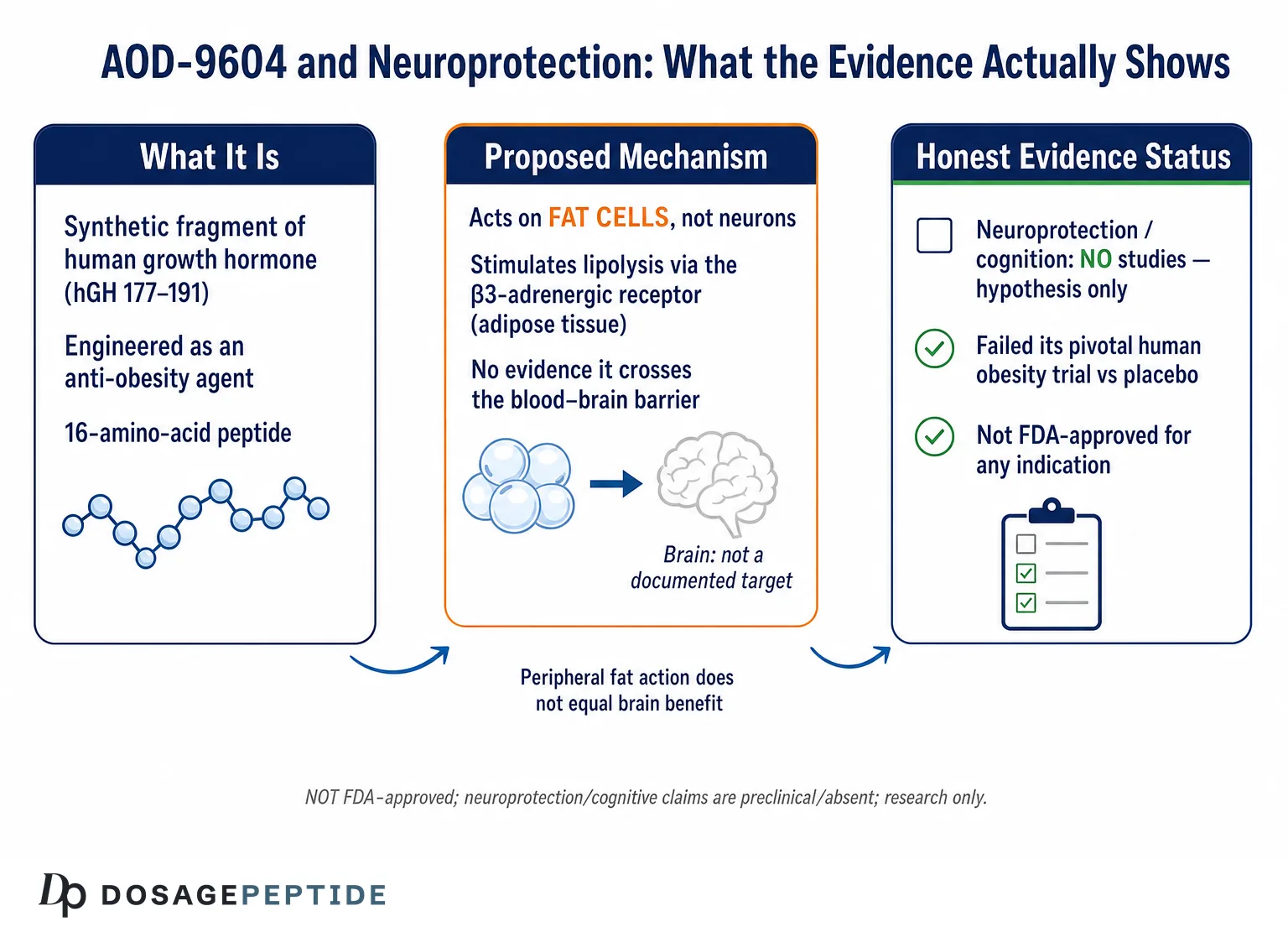
AOD-9604’s mechanism of action has been studied specifically in the context of fat metabolism, and understanding it clarifies why a neuroprotective role would be, at best, indirect. The peptide’s documented activity centers on adipocytes — fat cells — where it is reported to stimulate lipolysis (the breakdown of stored triglycerides into free fatty acids) and to inhibit lipogenesis (the synthesis and storage of new fat).1,2 These are peripheral metabolic actions, occurring in adipose tissue, not in the central nervous system.
The receptor-level explanation that emerged from the Monash work involves the beta-3 adrenergic receptor (β3-AR), a receptor subtype enriched in adipose tissue and involved in the sympathetic control of fat mobilization and thermogenesis. In a 2001 study published in Endocrinology, Heffernan and colleagues reported that both full-length hGH and AOD9604 increased β3-AR messenger RNA expression, protein levels, and functional activity in mouse and human cell lines, and that AOD9604 could restore suppressed β3-AR expression in obese mice toward the levels seen in lean controls.2 Critically, the same body of work reported that beta-3-adrenergic-receptor knockout mice were unresponsive to the lipolytic effects of AOD9604.2
That last finding deserves emphasis because it is often mis-stated in secondary sources. Marketing materials frequently claim that AOD-9604 works "independently" of established receptor pathways. The knockout data actually point the other way: if animals lacking the β3 receptor do not respond, then the β3-AR appears to be required for the lipolytic effect, not bypassed by it. What the fragment does not require is the full growth-hormone receptor signaling that drives IGF-1 production — and that distinction, not receptor-independence in general, is the genuinely interesting mechanistic point. The available preclinical data indicate that AOD-9604 produces its fat-metabolizing effects without significantly raising IGF-1 at lipolytic doses, which is the mechanistic basis for the claim that it separates fat metabolism from growth signaling.1,2
Now apply this to the brain. The β3-adrenergic receptor is expressed predominantly in adipose tissue, with only limited and specialized expression in the central nervous system. A mechanism built on β3-AR upregulation in fat cells does not obviously translate into a direct neuronal action. There is no published evidence that AOD-9604 crosses the blood–brain barrier in meaningful amounts, binds neuronal targets, modulates microglial activation, or alters brain insulin signaling. The molecular story we do have is a peripheral, adipose-centered story.
Could there be an indirect route? Conceptually, yes — and this is the only mechanistically honest way to connect AOD-9604 to brain health. If the peptide reduced adiposity and systemic inflammation, the resulting improvement in the metabolic milieu could, in theory, ease the neuroinflammatory and insulin-resistance pressures that obesity places on the brain. Free fatty acids and adipokine profiles influence central inflammation, so a peripheral metabolic shift is not irrelevant to the brain. But this is a downstream, systemic hypothesis, not a demonstrated central mechanism, and it depends entirely on the peptide first producing robust metabolic effects in humans — which the clinical record does not support.4
The mechanistic bottom line is that AOD-9604’s documented biology is peripheral and metabolic. Any neuroprotective effect would have to be secondary to metabolic improvement rather than a direct action on the brain, and even that secondary pathway is unverified. A researcher should treat "AOD-9604 neuroprotection mechanism" as a hypothesis to be designed and tested, not as a phenomenon to be explained.
What the Neuroprotection Evidence Actually Shows
This section is short by necessity, because the honest evidence level for AOD-9604 in neuroprotection is, functionally, zero. There is no clinical trial, no controlled human study, and no dedicated animal model that has tested AOD-9604 as a neuroprotective agent in obesity-related cognitive decline or in any neurodegenerative context. Systematic searching of the primary literature does not return AOD-9604 neurocognitive efficacy studies; the compound’s published research corpus is overwhelmingly about lipid metabolism, weight, and more recently cartilage.1,2 When search engines and vendor pages surface material connecting the peptide to the brain, that material almost invariably rests on the general obesity–cognition literature7,8,9 plus inference, not on data generated with the peptide itself.
It is useful to grade the evidence explicitly, because "there is research on X" and "research supports X" are very different statements. The table below applies a simple evidence hierarchy to the various claims made about AOD-9604.
| Claim about AOD-9604 | Best available evidence | Honest evidence level |
|---|---|---|
| Stimulates lipolysis / reduces fat gain in rodents | Ng 2000 (Zucker rats); Heffernan 2001 (obese mice) | Preclinical, replicated in animals |
| Does not raise IGF-1 or impair insulin sensitivity at lipolytic doses | Ng 2000 glucose-clamp data (animal) | Preclinical |
| Produces meaningful weight loss in humans | Pivotal Phase IIb "OPTIONS" trial, 536 patients (24 wk) | Tested and failed vs placebo |
| Supports cartilage / joint repair | In-vitro and animal studies only | Preclinical, no human trials |
| Neuroprotective in obesity-related cognitive decline | None specific to the compound | No evidence; hypothesis only |
The most that can be said in favor of the neuroprotection hypothesis is a syllogism, and it is a weak one: obesity contributes to cognitive decline; AOD-9604 was designed to combat obesity; therefore AOD-9604 might indirectly protect cognition. The fatal problem is the middle premise. AOD-9604 did not, in fact, produce clinically meaningful weight loss in humans.4 An anti-obesity peptide that does not reduce obesity in people cannot deliver the metabolic improvement that the indirect neuroprotection argument depends on. The syllogism collapses at its own load-bearing step.
There is a broader, adjacent literature on growth hormone, IGF-1, and brain aging that sometimes gets cited by association. Growth-hormone and IGF-1 signaling do have documented roles in neuronal survival, hippocampal function, and cognition, and there is legitimate scientific interest in these axes. But AOD-9604 was specifically engineered to avoid IGF-1 elevation and to not act through the growth-hormone receptor.1,2 So even the growth-hormone neurobiology literature, to the extent it is favorable, does not obviously transfer to a fragment designed to strip out exactly the signaling that literature implicates. Borrowing hGH’s neuro-credentials for AOD-9604 is not warranted by the pharmacology.
For a researcher, the practical takeaway is that this is greenfield territory. If someone wanted to genuinely investigate AOD-9604 and neuroprotection, they would be designing foundational experiments — blood–brain-barrier penetrance, effects on microglial activation markers, behavioral cognition tests in diet-induced-obese rodents — not confirming an established effect. Presenting the current state as anything more than an untested idea misrepresents the literature.
The Clinical Weight-Loss Record: What Human Trials Found
Because the entire indirect case for neuroprotection hinges on AOD-9604’s ability to improve metabolic health in humans, the clinical weight-loss record is not a side issue — it is central. And that record is one of the clearest examples in peptide research of early promise failing to survive rigorous testing. Metabolic Pharmaceuticals took AOD-9604 through a series of human trials in the 2000s, reportedly involving more than 900 participants across six studies. Two of these deserve to be separated carefully, because secondary write-ups — including earlier versions of this discussion — frequently merge them into a single "Phase IIb trial." They are, in fact, two different studies: an earlier, smaller, 12-week dose-ranging Phase IIa study in roughly 300 obese patients, and a later, larger, pivotal Phase IIb trial — the "OPTIONS" study — in 536 obese subjects over 24 weeks. The optimistic numbers usually quoted for AOD-9604 come from the first; the decisive failure came in the second.3,4
The earlier Phase IIa study is the source of the encouraging numbers most often quoted for AOD-9604. It enrolled roughly 300 obese patients across multiple sites, testing oral AOD-9604 once daily over 12 weeks at several doses — placebo, 1 mg, 5 mg, 10 mg, 20 mg, and 30 mg. Early and interim communications from the sponsor were positive; the 1 mg group was reported to have lost around 2.6 to 2.8 kg on average, roughly triple the approximately 0.8 kg lost in the placebo group.4 On its face that sounds encouraging, and it generated favorable press at the time. But a short dose-ranging study of this size is hypothesis-generating, not confirmatory — the point of it is to justify a larger, properly powered trial, not to establish efficacy.
The pivotal test came next, and it is the decisive data point. To confirm the early signal, Metabolic Pharmaceuticals ran the larger Phase IIb "OPTIONS" trial — a well-powered, randomized, placebo-controlled study of 536 obese subjects given oral AOD-9604 over 24 weeks. This larger, longer study failed to induce significant weight loss versus placebo: none of the treatment arms separated from placebo on the primary endpoint.4 The modest few-kilogram signal from the smaller Phase IIa study simply did not survive rigorous confirmation. In hindsight, a warning sign was already present in the earlier data: the effect did not scale with dose the way a genuine pharmacological response should, with the lowest dose appearing to do as well as or better than higher doses — a pattern that undermines confidence in a true drug effect. Following the OPTIONS failure, Metabolic Pharmaceuticals discontinued development of AOD-9604 as a pharmaceutical obesity treatment in 2007.4
This outcome has to be weighed honestly. It is not merely that AOD-9604 is "unapproved" in the passive sense of never having been submitted; it is that the compound was tested in the population it was designed for and did not work well enough to advance. That is a stronger negative than simple absence of data. Many research peptides can claim "human trials are still needed." AOD-9604 had its human trial for obesity, and the trial did not support the drug. Any framing that omits this — that presents AOD-9604 as a promising fat-loss agent whose efficacy is merely awaiting confirmation — is not consistent with the primary record.
The implication for the neuroprotection question follows directly. The indirect neuroprotection hypothesis requires AOD-9604 to meaningfully reduce adiposity and improve the obese metabolic state in humans. The Phase IIb data indicate it does not do the first of those things to a clinically meaningful degree. Without robust human fat loss, the downstream cascade to improved brain metabolism has no engine. This is why the clinical record, though it is about weight rather than cognition, is decisive for evaluating the article’s core question.
It is worth adding that a genuinely rigorous negative trial is scientifically valuable, not shameful — it saved patients from an ineffective therapy and redirected the compound’s developers toward other indications. But its value lies precisely in being taken seriously as a negative result. Educational and research-focused discussion of AOD-9604 should carry that result forward, not bury it. Researchers exploring the compound today, including anyone reviewing dosage frameworks such as those catalogued in the DosagePeptide dosages index, should do so with the failed obesity endpoint clearly in view.
How AOD-9604 Compares to Related Compounds
Placing AOD-9604 alongside its relatives helps calibrate expectations and prevents the common error of borrowing one compound’s evidence for another. The comparison also clarifies where AOD-9604 sits in the current landscape of metabolic and growth-hormone-adjacent peptides.
The nearest relative is HGH Fragment 176-191, discussed earlier. It shares AOD-9604’s core sequence but generally lacks the stabilizing N-terminal tyrosine and, more importantly, lacks AOD-9604’s clinical development history. In practice, claims made for HGH Fragment 176-191 are usually extrapolations from AOD-9604’s rodent data. Neither has any neuroprotection evidence. If anything, AOD-9604 is the better-characterized of the pair, precisely because it went through formal trials — trials that, as noted, produced a negative primary result.
A second comparison is to full-length growth hormone and growth-hormone secretagogues such as CJC-1295 and ipamorelin. These compounds raise growth hormone and, consequently, IGF-1, engaging the growth-hormone-receptor signaling that AOD-9604 was specifically designed to avoid. This is the crucial contrast for the neuroprotection question: whatever neurobiological interest attaches to the GH/IGF-1 axis attaches to these compounds, not to AOD-9604, which strips that axis out. Some research-oriented formulations combine AOD-9604 with secretagogues — for example the AOD-9604 + CJC-1295 + ipamorelin blend protocol — but such combinations reintroduce growth-hormone signaling from the other agents and should not be interpreted as evidence about AOD-9604’s own effects. Blending complicates rather than clarifies mechanism, and it means any observed effect cannot be attributed to the fragment alone.
A third and increasingly important comparison is to the modern GLP-1 and dual-incretin agonists — semaglutide, tirzepatide, and related drugs. These are the compounds that actually work for obesity in the way AOD-9604 was hoped to, producing double-digit percentage weight loss in rigorous trials, and they are the appropriate benchmark for what "clinically meaningful" metabolic efficacy looks like. Interestingly, the incretin class is itself now under genuine investigation for neuroprotective and cognitive effects, with mechanistic and early clinical rationale. That contrast is instructive: when a compound both produces robust metabolic effects and shows direct central activity, a neuroprotection hypothesis has legs. AOD-9604 has neither the robust human metabolic effect nor any demonstrated central action, which is exactly why its neuroprotection hypothesis remains empty.
| Compound | Primary mechanism | Raises IGF-1? | Human weight-loss evidence | Neuroprotection evidence |
|---|---|---|---|---|
| AOD-9604 | Peripheral lipolysis via β3-AR (adipose) | No (at lipolytic doses) | Failed Phase IIb primary endpoint | None |
| HGH Fragment 176-191 | Same core sequence, less characterized | No | No dedicated trials | None |
| CJC-1295 / ipamorelin | GH secretagogue → GH/IGF-1 | Yes | Not approved obesity drugs | Indirect GH/IGF-1 interest only |
| GLP-1 / dual agonists | Incretin receptor agonism (central + peripheral) | N/A | Robust, approved | Under active investigation |
The comparison drives home a single point. Among these compounds, AOD-9604 is distinguished by having been tested for its intended purpose and found wanting, and by having no central-nervous-system data at all. It is not the compound in this landscape most plausibly connected to brain protection; it is arguably the least. Any narrative that positions it as a neuroprotective frontrunner has the picture backwards.
Research Models and Methodology
Understanding how AOD-9604 has actually been studied, and how a neuroprotection question would have to be studied, helps a researcher gauge the distance between current data and the article’s premise. The existing methodology is almost entirely metabolic, and the models used were chosen to answer metabolic questions.
The foundational studies used genetically obese rodent models. Ng and colleagues worked with obese Zucker rats, a well-established model of genetic obesity and insulin resistance, administering AOD9604 orally and measuring body-weight gain, adipose-tissue metabolism, and — importantly — insulin sensitivity via hyperinsulinemic-euglycemic glucose clamp, the gold-standard method for quantifying insulin action.1 Heffernan and colleagues extended this to obese (ob/ob) mice and to β3-adrenergic-receptor knockout mice, the latter being a mechanistic tool: by removing the candidate receptor and observing loss of the lipolytic response, they could test whether the receptor was necessary for the effect.2 They also used mouse and human cell lines to measure β3-AR mRNA, protein, and function directly. This is sound, hypothesis-driven metabolic pharmacology.
The human methodology was likewise metabolic. The clinical program used oral dosing in obese adults, with body weight as the primary endpoint and safety parameters — vital signs, laboratory panels, electrocardiograms, IGF-1 levels, glucose measures — as secondary and safety endpoints.3,4 The Phase IIb trial’s randomized, placebo-controlled, dose-ranging design was appropriate and rigorous; its negative primary result is credible precisely because the methodology was sound.
Now contrast this with what a legitimate neuroprotection investigation would require, none of which has been done for AOD-9604. First, one would need pharmacokinetic and distribution studies establishing whether the peptide reaches the brain at all — blood–brain-barrier penetrance for a 16-amino-acid peptide is not to be assumed and would have to be measured, perhaps with labeled compound. Second, one would need mechanistic assays in neural tissue: effects on microglial activation states, on neuronal insulin signaling, on markers of oxidative stress and mitochondrial function, on amyloid or tau processing. Third, one would need behavioral cognition endpoints — Morris water maze, novel object recognition, or similar — in a relevant model such as diet-induced-obese mice, comparing AOD-9604-treated animals against vehicle controls, ideally with a positive-control comparator. Fourth, if animal data were encouraging, one would need dedicated human trials with validated cognitive instruments and, ideally, neuroimaging or fluid biomarkers of brain inflammation.
The gap between what exists and what would be needed is enormous. The current literature does not even establish step one — whether the compound reaches the brain in meaningful amounts. This is not a matter of a few missing confirmatory studies; it is the near-total absence of the entire experimental foundation on which a neuroprotection claim would rest. A methodologically literate reader should recognize that "research links AOD-9604 to neuroprotection" describes an experimental program that has not been conducted, not a body of findings that has been assembled.
For anyone genuinely interested in this space, the methodological point is also an opportunity: because the ground is unbroken, well-designed foundational studies would be genuinely novel contributions rather than incremental replication. But that framing — as a set of studies waiting to be done — is the accurate one.
Safety and Tolerability in the Available Record
Safety is one of the few areas where AOD-9604 has a reasonably documented human record, and it is important to characterize it accurately without letting a favorable safety profile be mistaken for evidence of efficacy or of any brain benefit. The two questions — "is it well tolerated?" and "does it do anything useful?" — are independent, and AOD-9604’s answers to them diverge.
The most cited safety summary is Stier, Vos, and Kenley’s 2013 paper in the Journal of Endocrinology and Metabolism, which reviewed safety and tolerability data across the human studies.3 According to that summary, across the presented studies there were no treatment-related withdrawals and no serious adverse events; no clinically significant changes in vital signs, safety laboratory tests, or electrocardiograms were observed; and daily intake of AOD9604 at 1 mg/day over 24 weeks was reported as safe and well tolerated.3 Consistent with the compound’s design, the human data did not show the IGF-1 elevation or glucose-tolerance impairment associated with full growth hormone.1,3
Taken at face value, this is a relatively clean short-to-medium-term safety picture for the oral formulation at the doses studied. That is genuinely notable and is part of why the compound retained interest for other indications after the obesity program ended. But several caveats are essential. First, these safety data pertain to the specific oral formulation, doses, and durations tested in the trials — not necessarily to the injectable, higher-dose, or long-duration regimens seen in the contemporary research-chemical and compounding markets. Extrapolating a favorable trial safety profile to different routes and doses is not justified. Second, "well tolerated" over weeks to months in monitored trial conditions says nothing about long-term or lifelong safety, which has never been studied. Third, and most importantly for this article, a good tolerability profile is not evidence of benefit. A compound can be perfectly safe and completely ineffective; AOD-9604’s obesity data suggest exactly that combination.4
There is also a critical distinction between the material studied in trials and material obtained on the open research market. The trial data were generated with pharmaceutical-grade compound under controlled conditions. Products sold for "research use" vary in purity, identity, and endotoxin content, and their safety cannot be assumed to match the clinical-trial material. Independent testing across the peptide market has repeatedly found products that are underdosed, contaminated, or misidentified. The favorable safety literature does not transfer to an arbitrary vial of unknown provenance.
Finally, none of the safety data address central-nervous-system effects, because no study looked at the brain. A clean cardiovascular and metabolic safety profile tells us nothing about neuronal safety, neuroinflammatory effects, or cognitive outcomes — whether protective or harmful. In the neuroprotection context specifically, AOD-9604 is neither established as beneficial nor established as safe for the brain; it is simply unstudied there. Readers should hold the reasonable metabolic safety record and the total absence of neuro data in mind simultaneously, without letting the former imply anything about the latter.
Handling and Reconstitution in a Research Context
Because AOD-9604 is handled in laboratory and research settings, a brief, strictly educational overview of handling and reconstitution is appropriate — framed entirely as information about a research reagent, not as instructions for use in humans, for which the compound is not approved. This section describes general peptide-handling principles as they apply to AOD-9604 as supplied, typically, as a lyophilized (freeze-dried) powder in sealed vials.
Lyophilized peptides are generally shipped and stored dry because they are far more stable in that state. As a solid, AOD-9604 is typically kept cold — refrigerated for shorter-term storage and frozen (for example at −20 °C) for longer-term storage — and protected from light, heat, and repeated temperature cycling, all of which can degrade peptide integrity. The vial should be brought to room temperature before opening to minimize condensation. These are standard practices for research peptides and are reflected in the storage guidance accompanying protocol references such as the AOD-9604 5 mg vial protocol page.
Reconstitution — dissolving the powder into a liquid — is typically done with bacteriostatic water (water containing a small amount of benzyl alcohol, which suppresses microbial growth and allows a multi-use vial to remain usable over a period of days to weeks) or, for single-use scenarios, sterile water. The diluent is added slowly down the inside wall of the vial rather than sprayed directly onto the peptide pellet, because peptides are shear-sensitive and harsh addition can fragment the molecule. The vial is then swirled gently, never shaken vigorously, until the powder dissolves. AOD-9604 generally goes into solution readily; a clear solution without visible particulates is expected.
Concentration and volume are matters of simple arithmetic that determine how a given measured amount corresponds to a mark on a research syringe. The total peptide mass in the vial divided by the volume of diluent added gives the concentration; from there, any desired mass corresponds to a calculable volume. Working through this arithmetic carefully matters because peptide masses are small — micrograms — and errors of a decimal place are easy to make. The general principle is that adding more diluent yields a more dilute solution requiring a larger measured volume per unit mass, and vice versa. This is reconstitution mathematics common to all research peptides, not anything specific to a neuroprotection application, which again does not exist for this compound.
Once reconstituted, the solution is refrigerated, kept out of light, and used within the stability window appropriate to the diluent; bacteriostatic preparations last longer than plain sterile-water preparations. Freeze–thaw cycling of the reconstituted solution should be avoided, as it degrades peptides. Aseptic technique — alcohol-swabbing the vial stopper, using clean equipment — reduces contamination risk in any laboratory handling.
All of this is offered as general reagent-handling literacy. It is emphatically not a protocol for human administration, and the presence of dosing and reconstitution information anywhere — here or on protocol pages — should not be read as endorsement of use in people. AOD-9604 is not an approved therapy, it failed its clinical efficacy test, and it has no established neuroprotective use. Handling information describes how a research chemical is managed in a laboratory, nothing more.
Limitations and the Human-Evidence Gap
It is worth consolidating the limitations of the AOD-9604 neuroprotection hypothesis in one place, because they are numerous and they compound on one another. Each individual gap would be enough to caution against strong claims; together they make the neuroprotection premise untenable as anything but a research question.
The direct-evidence gap. There is no study — human or animal — that tested AOD-9604 as a neuroprotective agent. Every claim in this space is inference from adjacent literature. This is the foundational limitation from which the others follow.
The failed-efficacy problem. The indirect neuroprotection argument depends on AOD-9604 improving metabolic health in humans, but the peptide failed to produce clinically meaningful weight loss in its Phase IIb trial.4 An anti-obesity agent that does not reduce obesity cannot deliver the downstream metabolic improvement that would supposedly protect the brain. The bridge collapses at its central span.
The brain-access gap. No data establish whether AOD-9604 crosses the blood–brain barrier in meaningful quantities. Without central bioavailability, a direct neuronal effect is not even possible, and this most basic pharmacokinetic question is unanswered.
The mechanism mismatch. AOD-9604’s documented mechanism is peripheral β3-adrenergic-receptor-associated lipolysis in adipose tissue.2 This receptor is minimally expressed in the brain, and the mechanism offers no obvious route to direct neuroprotection. Moreover, the compound was specifically designed to avoid the GH/IGF-1 signaling that carries most of the neurobiological interest in growth-hormone biology.
The extrapolation problem. Much of the favorable-sounding narrative borrows from the general obesity–cognition literature7,8,9 or from growth-hormone neurobiology, neither of which was generated with AOD-9604 and neither of which transfers cleanly to it. Borrowed evidence is not evidence for the specific compound.
The material-quality problem. Even the metabolic and safety data that do exist were generated with pharmaceutical-grade compound. Research-market material varies widely in purity and identity, so real-world reagents may not behave like the studied compound, further widening the gap between literature and practice.
The regulatory reality. AOD-9604 is not approved as a drug for any indication by the FDA or comparable regulators. It has no legal standing as a treatment, and no regulatory body has reviewed it as a neuroprotective or cognitive therapy.
The human-evidence gap, in short, is not a narrow crack awaiting a confirmatory study; it is the entire distance between an untested idea and a demonstrated therapy. Nothing about AOD-9604’s history — a fragment designed for fat metabolism, tested for obesity, and abandoned after a negative trial — positions it as a credible neuroprotective candidate today. This does not mean the question is uninteresting or that future research could not surprise us; open questions are the engine of science. It means that, as of now, the honest status is "unknown and untested," and any stronger statement misrepresents the literature.
Researchers and readers encountering enthusiastic claims about AOD-9604 for brain health, cognition, or neurodegeneration should treat those claims as marketing or speculation until a primary study exists to support them. The appropriate posture is curiosity paired with skepticism, not adoption of an unproven benefit. Broader educational coverage of peptide evidence standards, such as material collected on the DosagePeptide blog, can help contextualize how far a claim like this sits from established science.
Regulatory and Anti-Doping Status
The regulatory picture for AOD-9604 is important both for accuracy and for anyone weighing what the compound’s legal and competitive standing actually is. It is more nuanced than a simple "banned" or "approved," and the nuances are frequently misrepresented.
First and most importantly, AOD-9604 is not approved as a drug by the U.S. Food and Drug Administration, nor by the European Medicines Agency, nor by comparable regulators, for obesity or for any other medical indication. It never completed a successful development program, and no marketing authorization exists anywhere for it as a therapeutic. Any presentation of AOD-9604 as an approved or clinically validated treatment — for weight, joints, cognition, or anything else — is inaccurate.
A common source of confusion is the compound’s history in the dietary-supplement and food-ingredient space. At one point AOD-9604 was pursued for self-affirmed GRAS (Generally Recognized As Safe) status as a food ingredient. This is a categorically different regulatory pathway from drug approval. A GRAS determination concerns whether a substance is considered safe for a particular use as a food ingredient; it does not constitute FDA approval of the substance as a drug, does not authorize therapeutic claims, and does not validate efficacy for any medical purpose. Furthermore, the FDA has scrutinized peptides including AOD-9604 in the context of compounding, and regulatory positions have tightened; AOD-9604 has been reviewed by FDA advisory processes concerned with whether such peptides should be permitted in compounded preparations. In short, the food-ingredient and compounding threads do not amount to therapeutic approval and should never be cited as if they do.
Second, AOD-9604 is prohibited in sport. As a growth-hormone fragment, it falls under the World Anti-Doping Agency’s S2 category (peptide hormones, growth factors, related substances, and mimetics), which is banned at all times, in and out of competition. AOD-9604 is specifically recognized in this context alongside hGH 176-191, and anti-doping laboratories have developed methods to detect it — work described in the analytical literature, including a characterized urinary metabolite for detection.5,6 Any competitive athlete subject to testing should understand that use of AOD-9604 constitutes a doping violation regardless of dose or route, with no automatic therapeutic-use exemption.
Third, the compound’s practical availability is overwhelmingly through the research-chemical market, where products are sold labeled "for research use only, not for human consumption." That labeling is a legal and regulatory boundary, not a mere formality. It reflects that the compound has no approved human use, has not passed the efficacy bar for its intended indication, and is not manufactured or overseen to pharmaceutical standards in that channel. The gap between a research reagent and an approved medicine is precisely the gap that regulatory approval is designed to close, and for AOD-9604 that gap remains fully open.
Putting the regulatory status together with everything preceding it yields a coherent and sobering picture. AOD-9604 is an unapproved peptide that failed its pivotal human efficacy trial, whose mechanism is peripheral and metabolic, whose brain access and neuronal effects are entirely unstudied, whose favorable data are limited to short-term metabolic safety and animal lipolysis, and which is banned in sport. Against that backdrop, the notion that "research links AOD-9604 to neuroprotection in obesity-related cognitive decline" is best understood not as a finding but as a question — an interesting one, perhaps, but one for which the research has not been done and the answer is genuinely unknown.
Frequently Asked Questions
Does AOD-9604 protect the brain or improve cognition?
There is no published research showing that AOD-9604 protects neurons, improves cognition, or slows cognitive decline — in obesity or in any other setting. No human trial and no dedicated animal study has tested this. Claims linking the peptide to brain health are inferences drawn from the general obesity–cognition literature, not findings generated with the compound itself. The honest status is unknown and untested.1,7
If obesity harms the brain and AOD-9604 targets fat, wouldn’t it help indirectly?
That is the theoretical argument, but it fails at a critical step. The indirect case requires AOD-9604 to meaningfully reduce body fat and improve metabolic health in humans. In its Phase IIb clinical trial, AOD-9604 did not produce clinically meaningful weight loss and failed to beat placebo on its primary endpoint.4 An anti-obesity peptide that does not reduce obesity in people cannot deliver the downstream metabolic improvement the brain-benefit argument depends on.
Is AOD-9604 FDA-approved?
No. AOD-9604 is not approved by the FDA or comparable regulators as a drug for obesity or any other indication. It was explored for food-ingredient (GRAS) status at one point, but that is a different regulatory pathway that does not equal drug approval or authorize therapeutic claims. In practice it is sold only as a research chemical labeled "not for human consumption."4
What did AOD-9604’s clinical trials actually show?
Rodent studies showed reduced fat gain without the insulin-sensitivity or IGF-1 problems of full growth hormone.1 In humans, an earlier 12-week Phase IIa study of roughly 300 patients found only modest weight loss (about 2.6–2.8 kg vs 0.8 kg for placebo in the 1 mg group) that did not scale properly with dose, and the larger, pivotal Phase IIb "OPTIONS" trial of 536 subjects over 24 weeks then failed to beat placebo on its primary endpoint. Development as an obesity drug was subsequently discontinued in 2007.4
How is AOD-9604 thought to work?
Its documented mechanism is peripheral: it is associated with stimulating lipolysis and inhibiting fat storage in adipose tissue, apparently involving the beta-3 adrenergic receptor, without engaging the full growth-hormone receptor or raising IGF-1 at lipolytic doses.1,2 Because the beta-3 receptor is concentrated in fat tissue and minimally present in the brain, this mechanism offers no clear route to direct neuroprotection.
Is AOD-9604 safe?
Human trial data at the studied oral doses reported no serious adverse events and no clinically significant changes in vital signs, labs, or ECGs over the durations tested, and the compound did not raise IGF-1 like growth hormone does.3 However, that record reflects specific formulations and short-to-medium durations, does not address long-term or brain-related safety, and does not transfer to unregulated research-market material of uncertain purity. A clean short-term safety profile is not evidence of benefit.
Is AOD-9604 banned in sports?
Yes. As a growth-hormone fragment, AOD-9604 falls under the World Anti-Doping Agency’s S2 category and is prohibited at all times, in and out of competition, with detection methods available to anti-doping laboratories.5,6 Use by tested athletes constitutes a doping violation regardless of dose or route.
Should I use AOD-9604 for brain health or cognitive decline?
This article is educational and does not provide medical advice or endorse use. Given that there is no evidence of neuroprotective benefit, no demonstrated brain access, a failed obesity trial, and no regulatory approval, there is no scientific basis for using AOD-9604 for brain health or cognitive decline. Anyone considering any peptide should consult a qualified, licensed healthcare professional and rely on primary evidence rather than marketing claims.
References
- Ng FM, Sun J, Sharma L, Libinaka R, Jiang WJ, Gianello R. Metabolic studies of a synthetic lipolytic domain (AOD9604) of human growth hormone. Horm Res. 2000;53(6):274-278. PMID: 11146367. https://pubmed.ncbi.nlm.nih.gov/11146367/
- Heffernan M, Summers RJ, Thorburn A, Ogru E, Gianello R, Jiang WJ, Ng FM. The effects of human GH and its lipolytic fragment (AOD9604) on lipid metabolism following chronic treatment in obese mice and beta(3)-AR knock-out mice. Endocrinology. 2001;142(12):5182-5189. PMID: 11713213. https://pubmed.ncbi.nlm.nih.gov/11713213/
- Stier H, Vos E, Kenley D. Safety and Tolerability of the Hexadecapeptide AOD9604 in Humans. Journal of Endocrinology and Metabolism. 2013;3:7-15. https://www.jofem.org/index.php/jofem/article/view/157/194
- AOD-9604 obesity clinical program (two distinct trials). (a) Earlier 12-week dose-ranging Phase IIa study (~300 obese patients): the 1 mg group lost roughly 2.6–2.8 kg vs ~0.8 kg placebo — optimistic 2004 press coverage, News-Medical. https://www.news-medical.net/news/2004/12/16/6878.aspx (supports the 2.8-vs-0.8 kg figures only). (b) The larger pivotal Phase IIb "OPTIONS" trial (536 obese subjects, 24-week oral dosing) failed to induce significant weight loss versus placebo, and Metabolic Pharmaceuticals discontinued AOD-9604 development in 2007 — documented in Valentino MA, Lin JE, Waldman SA. Central and peripheral molecular targets for anti-obesity pharmacotherapy. Clin Pharmacol Ther. 2010;87(6):652-662. PMC3136748. https://pmc.ncbi.nlm.nih.gov/articles/PMC3136748/
- Cox HD, Smeal SJ, et al. Detection and in vitro metabolism of AOD9604. Drug Test Anal. 2015;7(1):31-38. doi:10.1002/dta.1715 (validated urinary detection, limit of detection 50 pg/mL; stable metabolite CRSVEGSCG). https://analyticalsciencejournals.onlinelibrary.wiley.com/doi/10.1002/dta.1715
- World Anti-Doping Agency. The Prohibited List (S2. Peptide Hormones, Growth Factors, Related Substances and Mimetics), 2026. https://www.wada-ama.org/en/prohibited-list
- Sripetchwandee J, Chattipakorn N, Chattipakorn SC. Links Between Obesity-Induced Brain Insulin Resistance, Brain Mitochondrial Dysfunction, and Dementia. Front Endocrinol (Lausanne). 2018;9:496. PMC6127253. https://www.ncbi.nlm.nih.gov/pmc/articles/PMC6127253/
- Microglial FABP4-UCP2 Axis Modulates Neuroinflammation and Cognitive Decline in Obese Mice. Int J Mol Sci / PMC, 2022. PMC9032181. https://www.ncbi.nlm.nih.gov/pmc/articles/PMC9032181/
- Overnutrition Induced Cognitive Impairment: Insulin Resistance, Gut-Brain Axis, and Neuroinflammation. Front Neurosci. 2022;16:884579. PMC9298971. https://www.ncbi.nlm.nih.gov/pmc/articles/PMC9298971/
- U.S. Food and Drug Administration. Briefing Document, Pharmacy Compounding Advisory Committee — review of peptide compounding including AOD-9604. FDA, 2024. https://www.fda.gov/media/183584/download
Educational and research-use disclaimer: This article is provided solely for educational and informational purposes to summarize the current state of published research. It is not medical advice, and nothing in it should be interpreted as recommending, endorsing, or providing instructions for the use of AOD-9604 in humans. AOD-9604 is not approved by the FDA or comparable regulators as a drug for any indication, it did not demonstrate clinically meaningful efficacy in its human obesity trial, and there is no evidence that it protects the brain or improves cognition. Any statements about mechanisms or possible effects describe unproven research hypotheses, not established benefits. Peptides sold as research chemicals are labeled "not for human consumption," and their purity and identity are not guaranteed. Always consult a qualified, licensed healthcare professional before making any health-related decision, and rely on primary scientific literature rather than marketing claims.