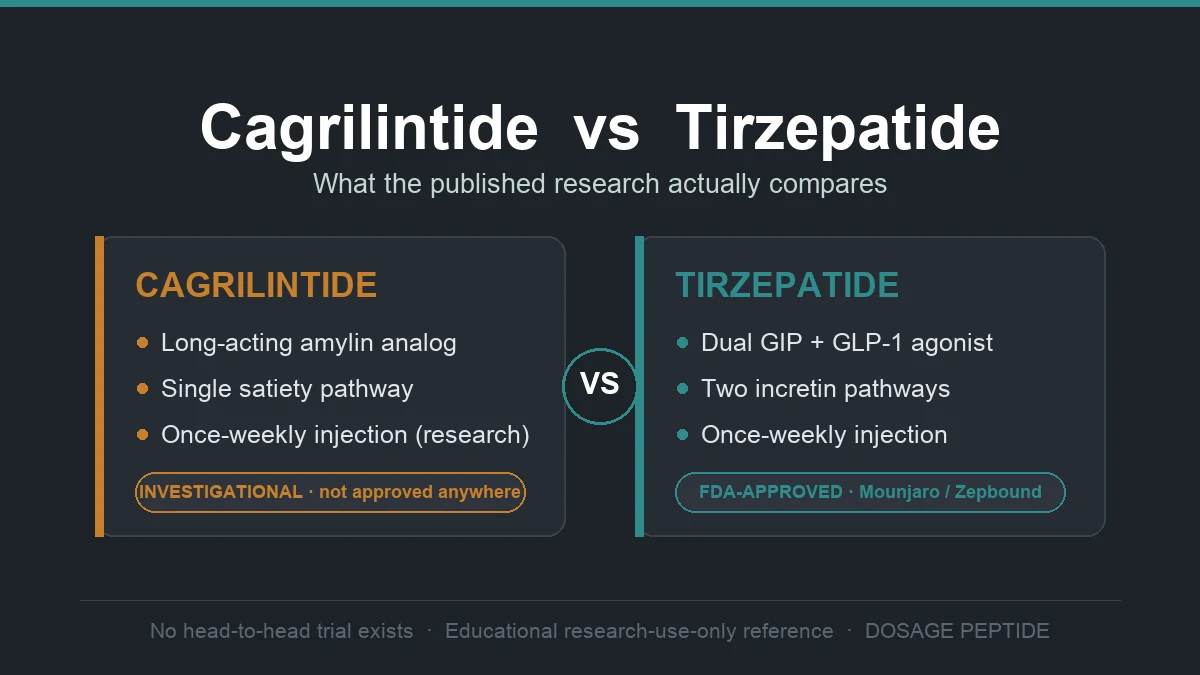
Short answer: they are not two versions of the same drug. Tirzepatide is a first-in-class dual GIP/GLP-1 receptor agonist and is FDA-approved; cagrilintide is a long-acting amylin analog and remains investigational. And the comparison people most want — which one works better — has never been tested: no head-to-head trial, human or animal, has compared them.
That single fact reframes everything else. Every ranking you read, including any number quoted on this page, is cross-trial inference rather than a measured difference between the two. What follows sets out each compound’s mechanism, the evidence tier it actually sits on, its regulatory status, and exactly where honest comparison stops.
This is educational reference material written to help readers interpret the science accurately. It is not medical advice, not a therapeutic recommendation, and not instructions for human use. Any dosing figures below describe clinical-trial protocols or, for cagrilintide, research conventions with no approved label — not a personal protocol. With those guardrails set, here is how cagrilintide and tirzepatide genuinely compare.
Cagrilintide vs. Tirzepatide: The Honest Bottom Line
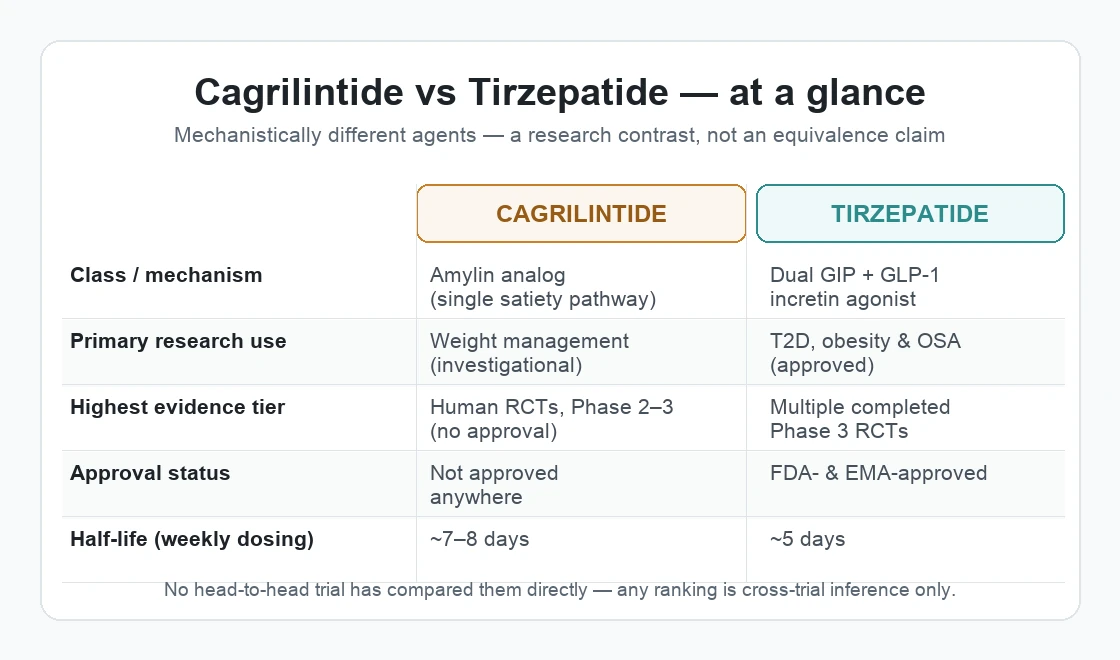
If you read only one section, read this one. Cagrilintide and tirzepatide are discussed together because both are once-weekly injectables that reduce appetite and bodyweight, and both slow gastric emptying as part of that effect. But they engage different receptor systems, sit at different evidence tiers, and carry very different regulatory status. The table below is the orientation; every row is unpacked, with citations, in the sections that follow.
| Attribute | Cagrilintide | Tirzepatide |
|---|---|---|
| Class / mechanism | Long-acting amylin (islet amyloid polypeptide) analog; agonist at amylin/calcitonin receptors that promotes satiety and slows gastric emptying — a single-hormone pathway[1] | First-in-class dual GIP + GLP-1 receptor agonist (“twincretin”); enhances glucose-dependent insulin secretion, promotes satiety, and delays gastric emptying — two incretin pathways[7] |
| Primary research use | Investigational weight management; strongest human data are as the fixed combination with semaglutide (CagriSema), less so as monotherapy[3] | Approved: type 2 diabetes (Mounjaro), chronic weight management (Zepbound), and moderate-to-severe obstructive sleep apnea[9] |
| Highest human evidence tier | Human RCTs, but investigational: monotherapy through Phase 2 dose-finding[1]; combination advanced to Phase 3[3] | FDA-approved; multiple completed Phase 3 RCTs (SURPASS diabetes and SURMOUNT obesity programs)[4][5] |
| Route / cadence | Subcutaneous injection, once weekly[1] | Subcutaneous injection, once weekly[4] |
| Half-life | ~7–8 days (≈159–195 h measured in Phase 1b PK)[2] | ~5 days (≈120 h), consistent with once-weekly dosing[9] |
| Approval status | Not approved anywhere; investigational (combination under regulatory review, still unapproved)[7] | FDA- and EMA-approved; boxed warning for thyroid C-cell tumors[8] |
What Is Cagrilintide?
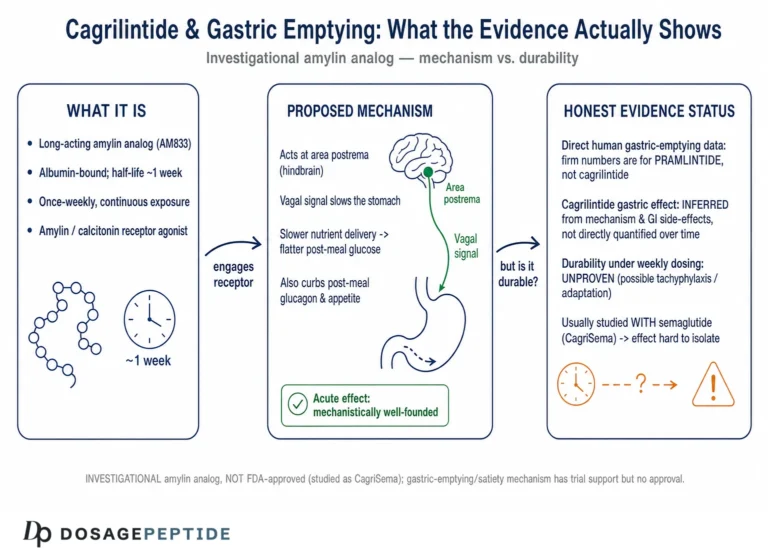
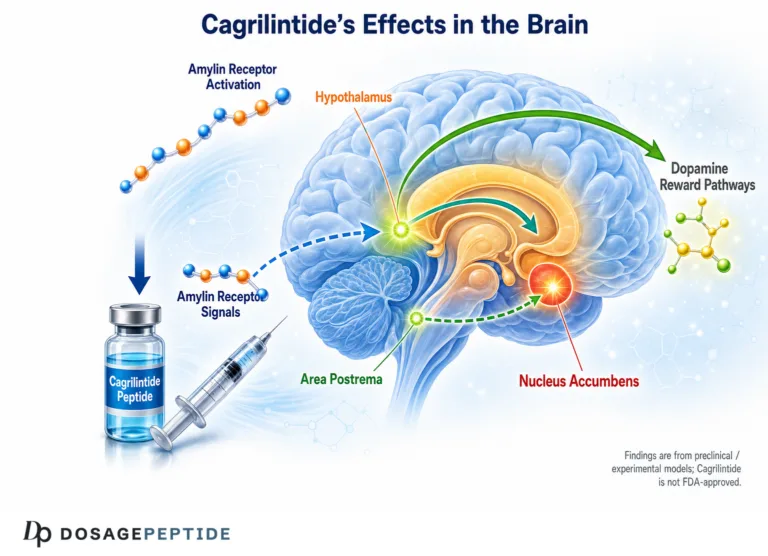
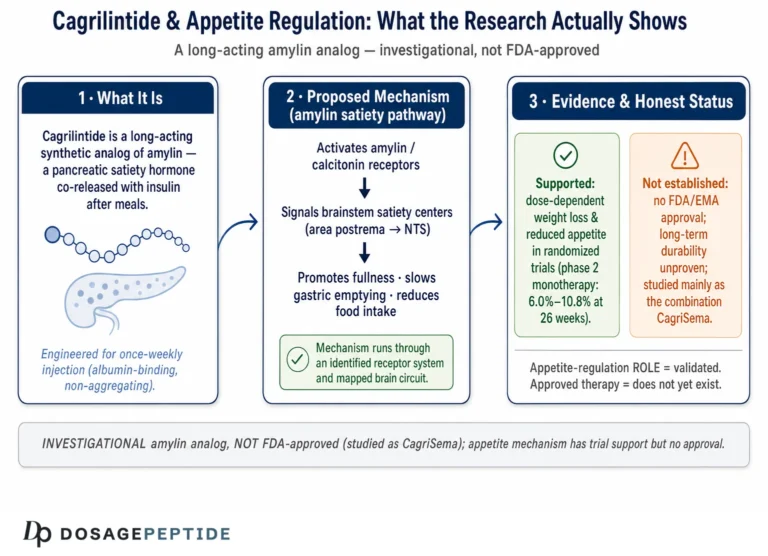
Cagrilintide is a long-acting analog of amylin (islet amyloid polypeptide), a pancreatic hormone co-secreted with insulin that induces satiety. As an agonist at amylin and calcitonin receptors, cagrilintide is being investigated for its effect on appetite, food intake, and bodyweight, and it is engineered for a duration that supports once-weekly subcutaneous dosing.[1] Mechanistically it works along a single hormonal pathway — the amylin system — which is what distinguishes it from the multi-receptor incretin agonists it is often compared with. For how amylin signaling intersects appetite, our references on how cagrilintide is studied in brain satiety circuits and how it affects gastric emptying and postprandial metabolism go deeper into the biology.
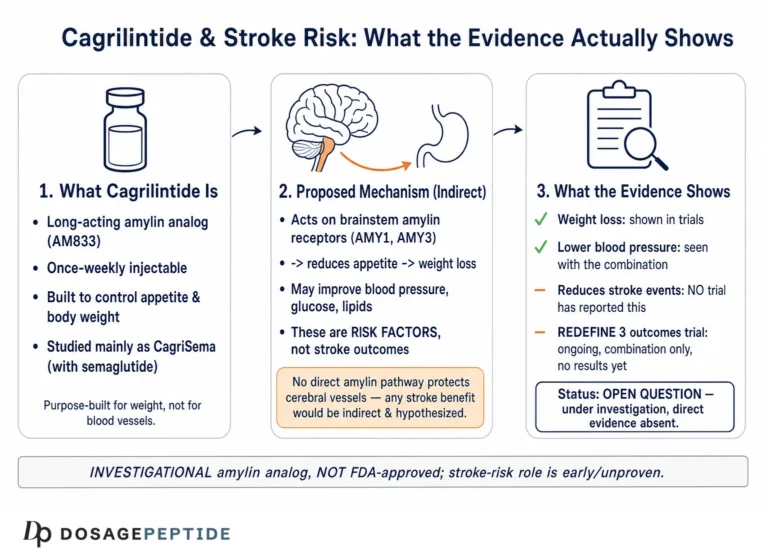
The critical framing point is evidentiary. Cagrilintide’s monotherapy evidence reaches only Phase 2: a dose-finding trial established a dose–response on bodyweight versus placebo and versus an active comparator.[1] Its Phase 3 evidence, by contrast, belongs to the fixed combination with semaglutide — marketed in trials as CagriSema — where any effect cannot be attributed to cagrilintide alone.[3] That distinction, developed below, is the single most-overlooked fact about cagrilintide.
What Is Tirzepatide?
Tirzepatide is a first-in-class dual incretin receptor agonist — a single molecule that activates both the GIP (glucose-dependent insulinotropic polypeptide) and the GLP-1 (glucagon-like peptide-1) receptors, which is why it is often nicknamed a “twincretin.”[7] By engaging two incretin pathways it enhances glucose-dependent insulin secretion, promotes satiety, and delays gastric emptying, producing large effects on both glycemic control and bodyweight. It is administered as a once-weekly subcutaneous injection with a defined dose-titration schedule.[4] Our primer on what tirzepatide (Mounjaro/Zepbound) is and how it works and the deeper explainer on how tirzepatide influences incretin pathways lay out the receptor pharmacology.
Unlike cagrilintide, tirzepatide has completed a large Phase 3 program and reached the market. The ChEMBL drug registry records tirzepatide at maximum phase 4 (approved), first approval 2022, parenteral, with a first-in-class GIP-agonist designation and a boxed-warning flag.[8] In other words, where cagrilintide is a research-stage candidate, tirzepatide is an approved medicine with the safety labeling that approval brings.
Do They Work the Same Way? Amylin vs. Dual Incretin
Because both compounds reduce appetite and bodyweight, it is easy to assume they share a mechanism. They do not, except at one downstream point of overlap. The shared theme is satiety and slowed gastric emptying: both dampen appetite and delay stomach emptying, which plausibly contributes to reduced food intake. Below that shared effect, the molecular stories diverge completely.
Cagrilintide acts through the amylin system — agonism at amylin/calcitonin receptors — a pathway entirely separate from the incretins.[1] Tirzepatide acts through two incretin receptors at once, GIP and GLP-1, adding a glucose-dependent insulin-secretion effect that an amylin analog does not have.[7] This is why the two are frequently studied as complementary rather than competing mechanisms: the entire rationale for the CagriSema combination is that pairing an amylin analog (cagrilintide) with a GLP-1 analog (semaglutide) engages two different hormone systems together.[6] Treating cagrilintide and tirzepatide as the “same kind of drug” misreads the biology: they touch appetite from different directions, and neither pathway makes one a substitute for the other.
How We Got Here: Development Paths and the CagriSema Caveat
The two molecules arrived from different programs. Tirzepatide was developed as a unimolecular dual agonist and moved through the SURPASS (type 2 diabetes) and SURMOUNT (obesity) Phase 3 programs to approval, becoming the first approved GLP-1/GIP dual agonist.[4][7] Its identity in the literature is a single, well-characterized molecule with a defined approval history.
Cagrilintide’s path is where the naming caveat lives. Cagrilintide as a stand-alone drug has been studied through Phase 2,[1] but most of the headline “cagrilintide” numbers people cite actually come from CagriSema — the fixed-dose combination of cagrilintide 2.4 mg with semaglutide 2.4 mg — which advanced into the Phase 3 REDEFINE program.[3] This matters enormously for interpretation: a result obtained with CagriSema describes cagrilintide plus a potent GLP-1 analog, and cannot be read as the effect of cagrilintide by itself. When a source quotes a large CagriSema weight-loss figure as though it were “cagrilintide,” it is attributing a combination result to a single component — the amylin-analog equivalent of the fragment-versus-protein confusion that dogs other peptide comparisons. Our reference on the cagrilintide-and-semaglutide combination in obesity research keeps the two apart.
Regulatory and Approval Reality
Regulatory status is a hard fact that does not depend on mechanistic promise, so it is worth stating plainly. Tirzepatide is approved; cagrilintide is not. Tirzepatide holds FDA approvals as Mounjaro for type 2 diabetes (2022) and as Zepbound for chronic weight management (2023) and for moderate-to-severe obstructive sleep apnea (2024), and it is EMA-approved as well.[9] Its approved status is also reflected in the ChEMBL registry at max phase 4.[8]
Cagrilintide, by contrast, is not approved for any indication anywhere. Cagrilintide monotherapy remains investigational, and the CagriSema combination — although it has been submitted for regulatory review — remained unapproved as of this writing.[7] It is essential not to read a pending submission as an approval: a filing under review is not a marketing authorization, and cagrilintide may not be prescribed, dispensed, or sold for human use. This is the sharpest single difference in the comparison, and it colors every downstream statement about dosing and safety.
Cagrilintide: What the Human Evidence Actually Shows
Cagrilintide’s human record is real but narrower than the hype implies, and it splits cleanly into monotherapy and combination. As monotherapy, a multicentre, randomised, double-blind, placebo-controlled and active-controlled Phase 2 dose-finding trial enrolled 706 adults with overweight or obesity (without diabetes) to once-weekly subcutaneous cagrilintide across doses of 0.3 to 4.5 mg over 26 weeks. Mean weight reductions were greater with all cagrilintide doses (roughly 6.0% to 10.8%) than with placebo (3.0%), and the top 4.5 mg dose modestly out-performed the active comparator, once-daily liraglutide 3.0 mg (10.8% vs 9.0%).[1] Note the comparator carefully: it was liraglutide, not tirzepatide. There is no monotherapy trial pitting cagrilintide against tirzepatide.
As a combination, the evidence is stronger but describes CagriSema rather than cagrilintide alone. A Phase 1b study first established that co-administering cagrilintide with semaglutide 2.4 mg was tolerable and characterized cagrilintide’s pharmacokinetics, including its multi-day half-life of roughly 159–195 hours.[2] The Phase 3a REDEFINE 2 trial then tested once-weekly CagriSema (cagrilintide 2.4 mg plus semaglutide 2.4 mg) against placebo in 1,206 adults with obesity and type 2 diabetes over 68 weeks, reporting a mean bodyweight change of −13.7% versus −3.4% for placebo.[3] That is a genuine Phase 3 result — but it belongs to the combination, and it was measured against placebo, not against tirzepatide. Our overview of cagrilintide in metabolic and prediabetes research situates these trials in context.
Tirzepatide: What the Human Evidence Actually Shows
Tirzepatide’s evidence base is the kind that supports an approval: large, completed, randomised Phase 3 trials with active and placebo comparators. In the SURPASS-2 diabetes trial, an open-label 40-week study randomised 1,879 patients with type 2 diabetes to tirzepatide 5, 10, or 15 mg or to semaglutide 1 mg; tirzepatide lowered HbA1c by 2.01 to 2.30 percentage points versus 1.86 for semaglutide, meeting non-inferiority and superiority, with greater weight loss as well.[4] In the SURMOUNT-1 obesity trial, a 72-week placebo-controlled study in 2,539 adults with obesity (without diabetes), mean weight change was −15.0%, −19.5%, and −20.9% at the 5, 10, and 15 mg doses versus −3.1% for placebo.[5]
Two honest caveats sit on top of those numbers. First, they come from different populations and trial designs than the cagrilintide studies — SURPASS-2 compared tirzepatide with semaglutide in diabetes; SURMOUNT-1 compared it with placebo in obesity — so none of them is a comparison with cagrilintide. Second, the strength of tirzepatide’s evidence is exactly what makes an apples-to-apples ranking against an investigational amylin analog impossible: you cannot fairly rank a fully-approved drug against a candidate whose stand-alone efficacy stops at Phase 2. Our reference on whether current evidence supports tirzepatide as a breakthrough diabetes therapy reviews this record in depth.
Head-to-Head vs. Cross-Trial: The Only Fair Comparisons
This is the honesty centerpiece of the entire comparison. Because no study has ever administered cagrilintide and tirzepatide to comparable subjects and measured them against each other, any statement that one is “stronger,” “better,” or “more effective” than the other is inference, not measurement. Cross-trial inference can motivate a hypothesis; it cannot establish superiority, because differences in population, comparator, endpoint, dose, and trial length confound any direct read. The table below grades what each reported role actually rests on.
| Reported research role | Strongest evidence tier | Honest interpretation |
|---|---|---|
| Cagrilintide monotherapy reduces bodyweight | Phase 2 dose-finding RCT vs placebo and liraglutide (n=706)[1] | Real dose-dependent effect; investigational, comparator was liraglutide — not tirzepatide |
| CagriSema (cagrilintide + semaglutide) reduces bodyweight | Phase 3a RCT vs placebo (n=1,206)[3] | Strong, but a combination result; cannot be attributed to cagrilintide alone |
| Tirzepatide improves glycemic control | Phase 3 RCT vs semaglutide (SURPASS-2, n=1,879)[4] | Well supported; basis of its diabetes approval |
| Tirzepatide reduces bodyweight in obesity | Phase 3 RCT vs placebo (SURMOUNT-1, n=2,539)[5] | Well supported; basis of its obesity approval |
| Cagrilintide “beats” tirzepatide (or vice versa) | No head-to-head trial | Cannot be claimed from the evidence; cross-trial inference only |
Notice that even the strongest cagrilintide row is a combination, and the only comparator ever run against cagrilintide monotherapy was liraglutide. The recurring trap of this comparison is that the two compounds have never shared a trial — so the honest answer to “which is better?” is that the evidence does not say.
Reading the Numbers Honestly: Half-Life and Specifications
With the evidence framed, here is the detailed side-by-side. Two rows carry heavy caveats: the cagrilintide dosing figures are research-stage, with no approved label, whereas tirzepatide’s titration is an actual clinical regimen.
| Property | Cagrilintide | Tirzepatide |
|---|---|---|
| Peptide class | Long-acting amylin (IAPP) analog | Dual GIP + GLP-1 receptor agonist |
| Receptor targets | Amylin / calcitonin receptors (single pathway) | GIP and GLP-1 receptors (two pathways) |
| Route / cadence | Subcutaneous, once weekly[1] | Subcutaneous, once weekly[4] |
| Half-life | ~7–8 days (≈159–195 h in Phase 1b PK)[2] | ~5 days (≈120 h)[9] |
| Doses studied / labeled | 0.3–4.5 mg weekly in Phase 2 monotherapy; 2.4 mg within CagriSema — research-use, no approved dose[1] | FDA-label titration: start 2.5 mg weekly, escalate by 2.5 mg at ≥4-week intervals to a maximum of 15 mg weekly[9] |
| Highest human evidence tier | Phase 2 monotherapy; Phase 3 combination (CagriSema)[3] | Multiple completed Phase 3 RCTs (SURPASS, SURMOUNT)[5] |
| Approval status | Not approved anywhere; investigational | FDA- and EMA-approved; boxed warning (thyroid C-cell tumors)[8] |
The half-life numbers illustrate a common misuse. Cagrilintide’s longer measured half-life (roughly 7–8 days versus about 5 days for tirzepatide) is a pharmacokinetic fact from its own study — not evidence of a better outcome. Both support once-weekly dosing, and a longer half-life says nothing about efficacy or safety on its own.
Research-Use Dosing Conventions (Not Clinical Guidance)
The figures below are reported from published studies and, for tirzepatide, its approved label. They are provided to help interpret the literature, not as a protocol for human use, and cagrilintide in particular has no approved dose for any application.
- Cagrilintide — the Phase 2 monotherapy trial studied once-weekly doses of 0.3, 0.6, 1.2, 2.4, and 4.5 mg with a dose-escalation period; CagriSema used cagrilintide 2.4 mg.[1][3] Because there is no approved label, these are research-use figures only, not a validated human dose. On dosagepeptide.com they are framed research-use-only — see the Cagrilintide 5 mg vial research dosage reference, the Cagrilintide 10 mg vial reference, and the cagrilintide weekly dosage chart.
- Tirzepatide — the FDA label directs initiation at 2.5 mg once weekly, with escalation in 2.5 mg steps at intervals of at least four weeks to a maximum of 15 mg weekly.[9] That is an actual clinical regimen, not a research convention. The site’s research-use references are the Tirzepatide 5 mg vial dosage reference and the Tirzepatide 10 mg vial reference, and the titration logic is covered in the tirzepatide dosage titration overview.
Safety and Tolerability
Safety is where the two are least symmetric, and it is often oversimplified. Both are dominated by gastrointestinal adverse events — nausea, constipation, diarrhea, vomiting — that are mostly mild-to-moderate and dose-related.[1][4] But the depth of the safety record, and the labeling attached to it, differs sharply.
| Safety dimension | Cagrilintide | Tirzepatide |
|---|---|---|
| Predominant adverse events | Gastrointestinal (nausea, constipation, diarrhea), mostly mild-to-moderate and dose-related[1] | Gastrointestinal (nausea, diarrhea, vomiting), mostly mild-to-moderate[4] |
| Boxed warning | None — but only because there is no approved label, not because long-term safety is proven | FDA boxed warning for thyroid C-cell tumors (rodent finding)[8] |
| Other labeled warnings | Not applicable (investigational) | Pancreatitis, gallbladder disease, and hypoglycemia when combined with insulin secretagogues[9] |
| Long-term human safety | Not established — still in trials | Characterized across the Phase 3 program and post-approval labeling[5] |
The boxed-warning row is the one most often misread. The absence of a boxed warning on cagrilintide reflects the absence of an approved label — not a demonstration that it is safer. Its long-term safety is simply not yet established, because it remains investigational.
Which Compound Is Studied for What?
Mapping each compound to its actual research context prevents the most common category error — treating them as interchangeable “fat-loss shots.” The table below shows that they anchor to different indications and different evidence tiers.
| Research area | Cagrilintide evidence | Tirzepatide evidence | Strongest tier in this pair |
|---|---|---|---|
| Weight management (obesity) | Phase 2 monotherapy; Phase 3 as CagriSema[1][3] | Phase 3 RCT, approved (SURMOUNT)[5] | Approved human RCT (tirzepatide) |
| Type 2 diabetes (glycemic control) | Studied only within the CagriSema combination[3] | Phase 3 RCT, approved (SURPASS)[4] | Approved human RCT (tirzepatide) |
| Obstructive sleep apnea | No direct data | Approved indication[9] | Approved (tirzepatide) |
| Single-hormone amylin biology | Its defining mechanism[1] | Not applicable (incretin agent) | Investigational (cagrilintide) |
The pattern is consistent: wherever there is an approved, completed human RCT in this pair, it belongs to tirzepatide; cagrilintide’s distinctive contribution is a different mechanism, studied at an earlier tier and most convincingly as part of a combination.
What the Evidence Does NOT Show
Because the marketing around these compounds is expansive, it is worth stating explicitly what the published record does not establish:
- It does not show that cagrilintide is superior, equal, or inferior to tirzepatide — no head-to-head trial exists, so any ranking is cross-trial inference.
- It does not show that cagrilintide monotherapy matches the CagriSema results — the Phase 3 data belong to the combination with semaglutide, not to cagrilintide alone.
- It does not show that cagrilintide is approved, prescribable, or safe long-term — it remains investigational, and a pending regulatory submission is not an approval.
- It does not show that the two are interchangeable “the same kind of drug” — one is a single-pathway amylin analog, the other a dual incretin agonist.
- It does not establish that cagrilintide’s longer half-life means a better outcome — half-life is pharmacokinetics, not efficacy.
- It does not show that a research-market vial’s label guarantees its contents — identity and purity of research-grade material are unverified (see below).
Limitations of This Comparison
Several structural limitations constrain everything above, and honest readers should keep them in view:
- No shared trial. With no head-to-head study, comparing the two requires stitching together trials that differ in population, comparator, endpoint, and duration — a chain with several weak links.
- Monotherapy-versus-combination asymmetry. Cagrilintide’s strongest evidence is CagriSema; attributing that to cagrilintide alone overstates the stand-alone case.
- Approval asymmetry. One agent is an approved medicine with a full label; the other is a candidate. That is not a like-for-like matchup.
- Different indications. Tirzepatide’s pivotal trials span diabetes, obesity, and sleep apnea; cagrilintide’s center on weight management — the endpoints do not line up.
- Research-market identity. Material sold research-use-only carries unverified identity and purity; trial data describe a characterized study drug, not the contents of a vial.
Practical and Research Context
For readers using this material to interpret the literature rather than to guide any human use, a few practical anchors help. The laboratory handling parameters — reconstitution, storage, and concentration arithmetic — are covered generically in our peptide reconstitution guide and dosage calculator, and the underlying vocabulary (amylin, incretin, GIP, GLP-1, half-life) is defined in our peptide research glossary. For a neighboring investigational contrast, our cagrilintide vs retatrutide comparison applies the same evidence-tier discipline.
Because research-market material is sold outside any approved supply chain, its identity and purity are unverified: published trial data describe a characterized study drug, not the contents of an arbitrary vial, so identity confirmation (for example by mass spectrometry and HPLC) and a batch certificate of analysis are the minimum a rigorous research setting should require. Reference vials of these compounds are catalogued by research-grade peptide suppliers such as Prime Lab; sourcing a tested material does not change the evidence picture described above — trial data still do not transfer to any specific product, the approval asymmetry is unchanged, and nothing here is a protocol for use or a therapeutic recommendation.
Common Misconceptions
“Cagrilintide and tirzepatide are basically the same kind of weight-loss shot.”
They are not. Cagrilintide is a single-pathway amylin analog; tirzepatide is a dual GIP/GLP-1 incretin agonist. They reduce appetite from different receptor systems, which is precisely why an amylin analog is studied alongside a GLP-1 analog in CagriSema rather than as a substitute for one.
“Cagrilintide gives 13–14% weight loss, similar to tirzepatide.”
That figure comes from CagriSema — cagrilintide plus semaglutide — not cagrilintide alone. Cagrilintide monotherapy reached roughly 6–11% in Phase 2. Quoting a combination result as though it were the single agent is one of the most common errors in this comparison.
“Cagrilintide has no boxed warning, so it’s safer than tirzepatide.”
No. Cagrilintide has no boxed warning because it has no approved label, not because its long-term safety has been demonstrated. Tirzepatide’s boxed warning and labeled warnings exist because it completed the review that produces such labeling; the absence of a label is not evidence of safety.
“A pending CagriSema submission means cagrilintide is basically approved.”
It does not. A regulatory filing under review is not a marketing authorization. As of this writing, neither cagrilintide monotherapy nor the CagriSema combination is approved for any indication anywhere, and it may not be prescribed or sold for human use.
Key Takeaways
- No head-to-head trial exists. Cagrilintide and tirzepatide have never shared a study, so “which is better” cannot be answered with data — only with cross-trial inference.
- They are mechanistically different. Cagrilintide is a single-pathway amylin analog; tirzepatide is a dual GIP/GLP-1 incretin agonist — a contrast, not an equivalence.
- The regulatory gap is the headline. Tirzepatide is FDA- and EMA-approved; cagrilintide is investigational and not approved anywhere.
- Cagrilintide’s best data are combination data. Its Phase 3 evidence belongs to CagriSema (with semaglutide), not to cagrilintide as monotherapy.
- Safety is not symmetric. Tirzepatide carries an FDA boxed warning and labeled warnings; cagrilintide’s long-term safety is simply not yet established.
- Everything here is research-use framing. Cagrilintide has no validated human dose; research-market vials carry unverified identity and purity; nothing on this page is medical advice.
Frequently Asked Questions
Is cagrilintide or tirzepatide better for weight loss?
There is no head-to-head trial, so “better” cannot be established from evidence. Tirzepatide is an FDA-approved drug with completed Phase 3 obesity trials, while cagrilintide is investigational, with monotherapy data only through Phase 2 and its strongest results coming from the CagriSema combination. Any claim that one outperforms the other is cross-trial inference, not a measured result.
Has anyone run a head-to-head trial of cagrilintide vs tirzepatide?
No. No randomized trial has compared cagrilintide against tirzepatide directly. The only active comparator ever used against cagrilintide monotherapy was liraglutide 3.0 mg in a Phase 2 study — not tirzepatide — so every ranking of the two is cross-trial inference across different populations and endpoints.
Is cagrilintide FDA-approved?
No. Cagrilintide is not approved for any indication anywhere. Cagrilintide monotherapy remains investigational, and the CagriSema combination has been submitted for regulatory review but remained unapproved as of this writing. A pending submission is not an approval, and cagrilintide may not be prescribed, dispensed, or sold for human use.
Is tirzepatide FDA-approved?
Yes. Tirzepatide is FDA-approved as Mounjaro for type 2 diabetes (2022) and as Zepbound for chronic weight management (2023) and for moderate-to-severe obstructive sleep apnea (2024), and it is EMA-approved as well. Its approved status is reflected in the ChEMBL registry at maximum phase 4.
What is the difference between cagrilintide and CagriSema?
Cagrilintide is the single amylin-analog molecule; CagriSema is a fixed-dose combination of cagrilintide 2.4 mg with semaglutide 2.4 mg. Most large “cagrilintide” weight-loss figures actually come from CagriSema, so they describe cagrilintide plus a GLP-1 analog together — not cagrilintide on its own.
Do cagrilintide and tirzepatide work the same way?
No. Both reduce appetite and slow gastric emptying, but through different receptor systems. Cagrilintide is an amylin (islet amyloid polypeptide) analog acting on amylin/calcitonin receptors; tirzepatide activates the GIP and GLP-1 incretin receptors and adds a glucose-dependent insulin-secretion effect that an amylin analog does not have.
How long does each one stay in the body?
Cagrilintide has a half-life of about 7–8 days (roughly 159–195 hours measured in a Phase 1b study), and tirzepatide about 5 days (approximately 120 hours). Both support once-weekly dosing. A longer half-life is a pharmacokinetic property, not evidence of a better or safer outcome.
Are the safety profiles the same?
Both are dominated by mostly mild-to-moderate gastrointestinal effects, but the labeling differs. Tirzepatide carries an FDA boxed warning for thyroid C-cell tumors plus warnings for pancreatitis, gallbladder disease, and hypoglycemia with insulin secretagogues. Cagrilintide has no boxed warning because it has no approved label — which reflects its investigational status, not proven long-term safety.
Is any of this a recommendation for human use?
No. This article is educational reference material summarizing published research and regulatory status. It is not medical advice, not a therapeutic recommendation, and not instructions for human use. Cagrilintide dosing figures describe research settings with no approved label, and tirzepatide’s label regimen is cited for interpretation only, not as guidance.
References
- Lau DCW, Erichsen L, Francisco AM, et al. Once-weekly cagrilintide for weight management in people with overweight and obesity: a multicentre, randomised, double-blind, placebo-controlled and active-controlled, dose-finding phase 2 trial. Lancet. 2021;398(10317):2160–2172. doi:10.1016/S0140-6736(21)01751-7. PMID 34798060.
- Enebo LB, Berthelsen KK, Kankam M, et al. Safety, tolerability, pharmacokinetics, and pharmacodynamics of concomitant administration of multiple doses of cagrilintide with semaglutide 2·4 mg for weight management: a randomised, controlled, phase 1b trial. Lancet. 2021;397(10286):1736–1748. doi:10.1016/S0140-6736(21)00845-X. PMID 33894838.
- Davies MJ, Bajaj HS, Broholm C, et al. Cagrilintide–Semaglutide in Adults with Overweight or Obesity and Type 2 Diabetes (REDEFINE 2). N Engl J Med. 2025;393(7):648–659. doi:10.1056/NEJMoa2502082. PMID 40544432.
- Frías JP, Davies MJ, Rosenstock J, et al. Tirzepatide versus Semaglutide Once Weekly in Patients with Type 2 Diabetes (SURPASS-2). N Engl J Med. 2021;385(6):503–515. doi:10.1056/NEJMoa2107519. PMID 34170647.
- Jastreboff AM, Aronne LJ, Ahmad NN, et al. Tirzepatide Once Weekly for the Treatment of Obesity (SURMOUNT-1). N Engl J Med. 2022;387(3):205–216. doi:10.1056/NEJMoa2206038. PMID 35658024.
- Bailey CJ, Flatt PR, Conlon JM. Multifunctional incretin peptides in therapies for type 2 diabetes, obesity and associated co-morbidities. Peptides. 2025;187:171380. doi:10.1016/j.peptides.2025.171380. PMID 40081498.
- Gogineni P, Melson E, Papamargaritis D, Davies M. Oral glucagon-like peptide-1 receptor agonists and combinations of entero-pancreatic hormones as treatments for adults with type 2 diabetes: where are we now? Expert Opin Pharmacother. 2024;25(7):801–818. doi:10.1080/14656566.2024.2356254. PMID 38753454.
- ChEMBL v34 compound record for TIRZEPATIDE (CHEMBL4297839): max_phase 4 (approved), first_approval 2022, parenteral, GIP receptor agonist, first-in-class, black-box warning flag. EMBL-EBI ChEMBL.
- U.S. FDA prescribing information, Mounjaro (tirzepatide) injection, BLA 215866: approved indications, once-weekly 2.5–15 mg titration, ~5-day half-life, boxed warning for thyroid C-cell tumors. Tirzepatide is also marketed as Zepbound (obesity, 2023; obstructive sleep apnea, 2024).
Research-use disclaimer: This article is educational reference material summarizing published research and regulatory context. It is not medical advice, not a therapeutic recommendation, and not instructions for human use. Tirzepatide is an FDA-approved drug cited here for interpretation only, and cagrilintide is an investigational compound not approved for any indication anywhere; any dosing figures describe clinical-trial or research settings, not a personal protocol. Always verify current clinical-trial and regulatory status through primary sources such as PubMed, ClinicalTrials.gov, and the FDA.