Mixing two peptides? First read: Can I combine peptides in the same syringe?
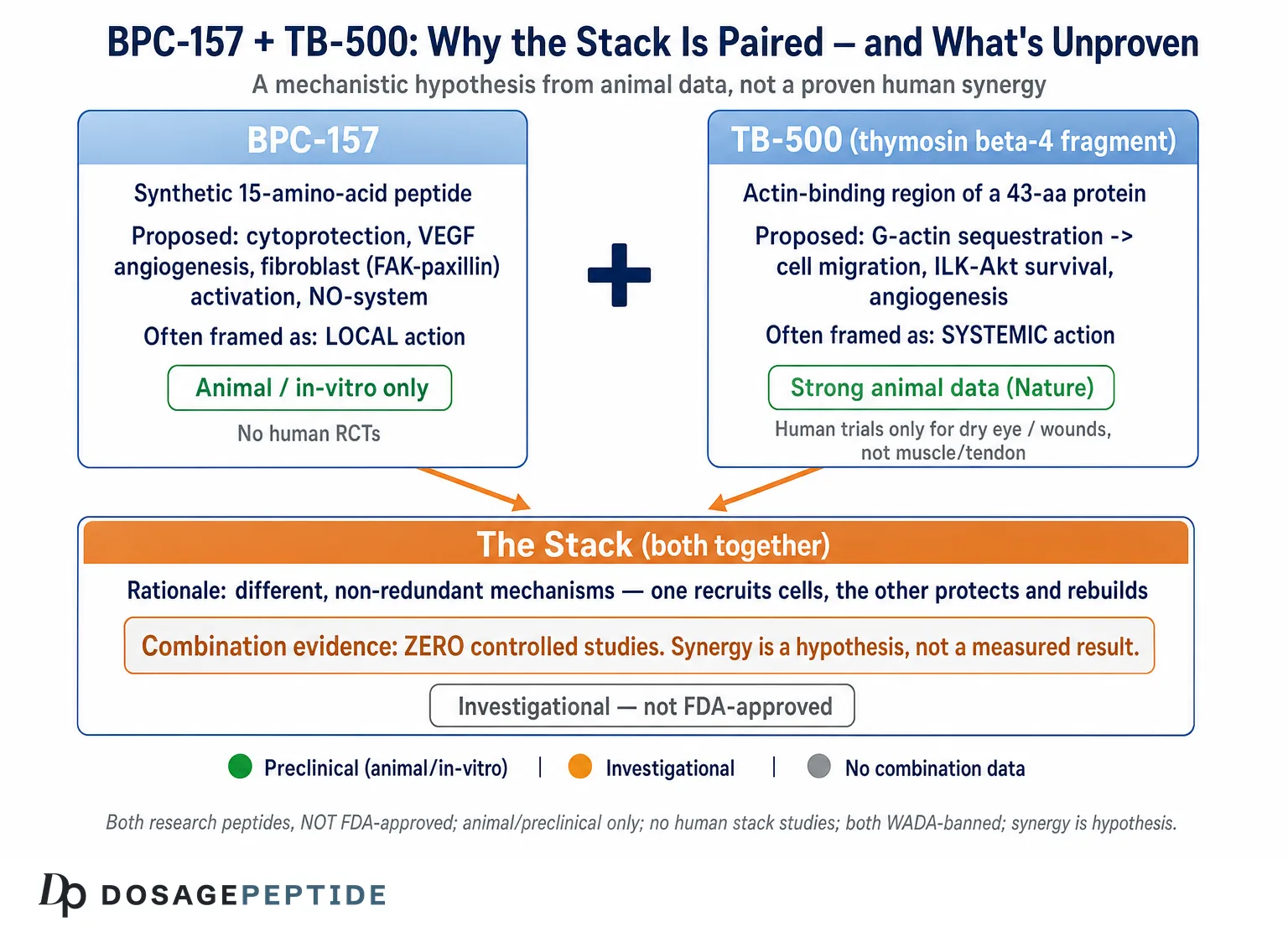
Short answer: researchers pair BPC-157 and TB-500 because, on paper, they repair tissue in two different ways — and because nobody has tested whether that actually adds up. BPC-157 is described as working where it is placed, driving blood-vessel growth and healing signals locally. TB-500 is described as systemic: it moves cells toward damaged tissue. Together they are supposed to cover the whole repair sequence.
That is the argument. Here is the part the marketing skips: there are zero published human studies of the two used in combination. The rationale is built on mechanism and animal work, not on a demonstrated synergy. Neither peptide is approved by the FDA, the EMA, or any comparable regulator for any condition, there are no randomized controlled trials of either for musculoskeletal recovery, and both are banned in sport at all times by WADA.
This page explains the mechanistic case for the stack in plain terms — what each peptide is thought to do, where the two arguments meet, and exactly which claims have no evidence behind them.
Related BPC-157 and TB-500 pages
Meet the Two Peptides: What BPC-157 and TB-500 Actually Are
Before the stacking logic makes sense, the two molecules need to be clearly distinguished, because they are frequently blurred into an undifferentiated “healing peptide” category despite having entirely different origins, structures, and proposed biology.
BPC-157 is a synthetic pentadecapeptide — a chain of fifteen amino acids. Its name is an abbreviation of “Body Protection Compound,” and its sequence corresponds to a partial fragment of a protein found in human gastric juice. Researchers, principally the group led by Predrag Sikirić at the University of Zagreb, isolated and stabilized this fragment and reported that it exhibited striking “cytoprotective” and healing-promoting effects across an enormous range of tissues in rodents.1 The word “stable” is doing real work in its usual designation, “stable gastric pentadecapeptide BPC 157”: unlike many peptides, it is reported to resist degradation in human gastric juice, which is part of why it has been studied via oral as well as injectable routes in animals.5 Its defining feature in the literature is breadth — the same molecule has been reported to accelerate healing in tendon, muscle, bone, gut, skin, nerve, and blood-vessel models. That breadth is simultaneously its most intriguing property and, as we will see, a reason for a measure of scientific skepticism.
TB-500 is a different kind of molecule with a different history. It is a synthetic version of a fragment of thymosin beta-4 (Tβ4), a naturally occurring 43-amino-acid protein that is one of the most abundant actin-binding proteins in mammalian cells.11 Strictly speaking, “TB-500” and “thymosin beta-4” are not identical — TB-500 is typically the short, actin-binding active region rather than the full-length protein — but in practice the research literature on the full molecule is what supplies TB-500’s scientific rationale, and vendors use the names interchangeably. This is an important nuance: nearly all of the genuine, high-quality science (including human trials) was done on full-length thymosin beta-4, not on the research-chemical “TB-500” sold online, and the two should not be assumed to be pharmacologically identical. Thymosin beta-4 is an endogenous molecule with a well-characterized cell-biological job, which gives TB-500 a more concrete mechanistic anchor than many research peptides enjoy. For an accessible primer on the parent compound’s healing biology, the site’s explainer on BPC-157 as a healing peptide pairs naturally with the tissue-repair literature on Tβ4.
The cleanest way to hold the pair in mind is by their proposed “character.” BPC-157 is cast as a broad cytoprotective and angiogenic agent with a notable relationship to the nitric oxide system and to growth-factor signaling in connective tissue. TB-500/Tβ4 is cast as a cytoskeletal regulator whose master function — sequestering monomeric actin — sits upstream of cell migration, and which secondarily promotes new blood-vessel formation and dampens inflammation. Both, in other words, are pitched as pro-repair molecules, but they are proposed to enter the repair process through different doors. That difference is the entire seed of the stacking argument, and it is worth understanding each door in detail before deciding whether opening both actually helps.
How BPC-157 Works — The Mechanistic Case
The proposed mechanism of BPC-157 is best described as a convergent story with one well-supported hub and several plausible spokes. The hub is the nitric oxide (NO) system. Across a large body of Sikirić-group work, BPC-157 has been reported to interact with NO signaling — counteracting the effects of NO-synthase blockade (L-NAME) and modulating the response to the NO precursor L-arginine — in a way that appears to stabilize vascular and endothelial function under stress.2 Because nitric oxide governs vasodilation, endothelial integrity, and blood flow, an agent that helps maintain NO homeostasis could, in principle, protect tissue during ischemic or inflammatory insult and support the perfusion that healing requires.
The most tangible and reproducible spoke is angiogenesis — the growth of new blood vessels. In injury models, BPC-157 has been associated with upregulation of vascular endothelial growth factor (VEGF) signaling and with accelerated formation of the microvasculature that carries oxygen and nutrients into a healing wound. A memorable descriptive phrase from the vascular literature casts BPC-157 as promoting a kind of rapid vascular “rerouting” around an occlusion, restoring flow through collateral pathways. In connective-tissue repair specifically, the most methodologically informative finding comes from tendon work: in a rat Achilles-tendon model paired with cultured tendon fibroblasts, BPC-157 accelerated the outgrowth of tendon explants and dose-dependently increased fibroblast migration and survival, effects linked to activation of the focal adhesion kinase (FAK)–paxillin signaling pathway that governs how cells attach, spread, and move.3 A companion study reported that BPC-157 increased expression of the growth hormone receptor in tendon fibroblasts, offering a possible route by which the peptide could sensitize repair cells to the body’s own anabolic signals.4
Beyond blood vessels and fibroblasts, BPC-157 has an unusually deep gastrointestinal literature. It has been reported to protect the gastric and intestinal lining, accelerate the healing of experimental ulcers and fistulas, and counteract the mucosal damage caused by NSAIDs and other agents.5 Sikirić and colleagues have extended this into a “brain-gut and gut-brain axis” framework, proposing that the peptide’s cytoprotection is systemic and interconnected rather than tissue-specific.1 The site’s discussion of whether BPC-157 addresses inflammation and joint pain surveys how these anti-inflammatory and angiogenic threads are theorized to converge on musculoskeletal recovery.
Here is where honesty has to intrude on an appealing narrative. Almost the entire BPC-157 mechanism rests on animal and in-vitro work, much of it from a single research group, and the sheer number of tissues in which the peptide reportedly “works” is itself a reason for caution: molecules that appear to fix everything have a poor historical track record of surviving rigorous, independent, controlled testing. Independent replication outside the originating laboratory remains limited. There are no published, peer-reviewed randomized controlled trials establishing efficacy or a mechanism in humans. Recent narrative and systematic reviews of BPC-157 in musculoskeletal medicine reach the same conclusion — the preclinical signal is genuinely interesting, but the clinical evidence base is effectively empty, and the field’s dominant need is well-designed human trials rather than more rodent studies.67 The correct posture, then, is that BPC-157 has a coherent and partially validated mechanistic hypothesis centered on NO signaling, angiogenesis, and fibroblast activation — and that this hypothesis has never been confirmed to translate into a clinically meaningful healing effect in a person.
How TB-500 (Thymosin Beta-4) Works — Actin, Migration, and Angiogenesis
TB-500’s mechanism is, in a sense, more elegant and better established than BPC-157’s, because its parent molecule has a defined and non-controversial cell-biological function. Thymosin beta-4 is the principal G-actin–sequestering peptide in mammalian cells. Actin, the protein that builds the cellular cytoskeleton, exists in two states: free monomers (G-actin) and assembled filaments (F-actin). Cell movement, shape change, and tissue remodeling all depend on cells being able to rapidly polymerize and depolymerize actin filaments. By binding and holding a reserve pool of monomeric G-actin, thymosin beta-4 acts as a buffer that keeps actin available for fast, controlled filament assembly wherever a cell needs to extend, crawl, or reorganize.11 This is the molecular root of everything else TB-500 is credited with.
Because migration is downstream of actin dynamics, thymosin beta-4 is a potent promoter of cell movement — keratinocytes and fibroblasts crawling across a wound bed, endothelial cells forming new capillaries, and progenitor cells traveling from reservoirs toward sites of damage. This directly underpins its most celebrated experimental result. In a landmark 2004 study in Nature, Bock-Marquette and colleagues showed that thymosin beta-4 forms a complex with PINCH and integrin-linked kinase (ILK), activating the survival kinase Akt; in mice, treatment after coronary artery ligation enhanced cardiomyocyte survival, promoted cell migration, and improved cardiac function after a heart attack.8 A 2007 follow-up, also in Nature, went further, reporting that thymosin beta-4 could mobilize dormant adult epicardial progenitor cells and induce new blood-vessel formation in the injured heart.9 These are serious, high-profile findings in a leading journal, and they establish that the molecule has real, mechanistically coherent regenerative activity in a demanding tissue.
The rest of the TB-500/Tβ4 repair profile follows from these core actions. It promotes angiogenesis through endothelial migration, tube formation, and endothelial-progenitor recruitment, often accompanied by VEGF upregulation. It exerts anti-inflammatory effects, in part by nudging macrophages toward a pro-resolution phenotype and modulating transforming growth factor-beta (TGF-β) signaling in a way that may influence scar quality. And its small size and mobility mean that, unlike the tightly localized picture painted for BPC-157, thymosin beta-4 is framed as a molecule that distributes and acts at a distance from where it enters. Scoping reviews of TB-500 and thymosin beta-4 in tissue healing and musculoskeletal repair catalog these overlapping activities — G-actin sequestration driving migration, ILK-Akt signaling promoting survival, multi-pathway angiogenesis, and macrophage polarization — as the mechanistic backbone of the peptide’s regenerative reputation.11 Readers interested in the cytoskeletal detail can follow the site’s treatment of how TB-500 affects cytoskeletal regulation and stem-cell migration.
The honesty caveat here has a different shape than it did for BPC-157. The mechanism is well characterized and the animal data are strong, including in prestigious journals. What is missing is the same thing that is missing everywhere in this space: confirmation that administering TB-500 to a person accelerates recovery from a musculoskeletal injury. Thymosin beta-4 has entered human clinical trials — but for indications like dry-eye disease, corneal wounds, pressure ulcers, and epidermolysis bullosa, not for tendons or muscles. In severe dry-eye disease, a small phase 2 randomized trial of thymosin beta-4 eye drops reported meaningful reductions in ocular discomfort and corneal staining versus placebo, a genuine but narrow human signal.10 Extrapolating from “helped a small number of dry eyes” and “protected mouse hearts” to “heals your torn tendon faster” is a large leap across tissues, doses, and delivery routes. The mechanism licenses the hypothesis; it does not confirm the outcome.
The Stacking Rationale — Why the Two Are Hypothesized to Complement Each Other
Now we arrive at the central question the title asks: given two pro-repair peptides, why do researchers put them together, and is the reasoning sound? The stacking argument rests on the claim that BPC-157 and TB-500 act through different, non-redundant, and potentially sequential mechanisms, so that combining them covers more of the healing cascade than either alone. Let us lay out that argument at its strongest, then subject it to scrutiny.
Different points of entry into the repair cascade. Tissue healing is not a single event; it is a choreographed sequence — hemostasis, inflammation, proliferation (with angiogenesis, fibroblast recruitment, and matrix deposition), and finally remodeling. The stacking hypothesis maps the two peptides onto complementary phases. TB-500, as a migration and progenitor-mobilization agent, is theorized to help populate the wound with the cells that do the rebuilding and to lay down new vasculature. BPC-157, as a cytoprotective and fibroblast-activating agent with a strong angiogenic and NO-stabilizing profile, is theorized to protect the tissue during the insult, support perfusion, and drive the connective-tissue proliferation that reconstructs tendon, ligament, or muscle. On paper, one recruits and the other protects and builds; the phases dovetail rather than duplicate.
Local versus systemic. The most-repeated version of the rationale contrasts a “localized” BPC-157 with a “systemic” TB-500. The idea is that BPC-157 exerts strong effects near the site where it is administered, while TB-500’s small, mobile thymosin beta-4 core distributes through tissue to reach injuries that are diffuse or hard to target directly. Combining them, the argument goes, gives both concentrated action at a known injury and broader coverage of the surrounding or systemic damage. This local/systemic dichotomy is a useful heuristic, though it is more of a simplification than a rigorously demonstrated pharmacological fact.
Convergent but distinct angiogenesis. Both peptides promote new blood-vessel growth, which at first looks redundant. Proponents argue it is instead reinforcing: BPC-157’s angiogenic effect is tied to VEGF and NO-system stabilization, while TB-500’s is tied to endothelial migration and progenitor recruitment via the actin-ILK-Akt axis. Two different upstream routes to the same essential downstream goal — getting blood supply into healing tissue — could, in theory, produce a more robust vascular response than either pathway alone.
That is the case for the stack, and it is genuinely coherent. Now the scrutiny, which is the part the marketing omits. Every clause above is a mechanistic inference, not an observed result. There is no study — not in humans, and not even a controlled head-to-head animal experiment in a musculoskeletal model — that administered BPC-157 and TB-500 together, compared the combination against each peptide alone and against placebo, and measured whether the pair heals faster or better. The “synergy” is assumed from the tidiness of the mechanistic map, but biology is full of tidy maps that fail to deliver additive or synergistic effects in practice. Two angiogenic agents might plateau at a ceiling rather than stack. Two anti-inflammatory signals might overshoot and impair the inflammatory phase that healing actually requires. Pushing cell migration and proliferation harder is not automatically better, and in some contexts — fibrosis, aberrant vessel growth — more is worse. None of these concerns has been studied for this combination, which is precisely the point: the stack is a plausible, untested hypothesis. A reasonable researcher can find the rationale interesting while insisting that “plausible” and “proven” are separated here by the entire clinical evidence base, which does not exist.
What the Evidence Actually Shows — Peptide by Peptide, Tissue by Tissue
Because there is no combination evidence, the fairest way to gauge the stack is to audit the evidence for each peptide separately and honestly, tissue by tissue and evidence tier by evidence tier. The pattern that emerges is consistent: real and often reproducible preclinical signals, a sliver of human data confined to unrelated indications for TB-500’s parent molecule, and nothing resembling a musculoskeletal clinical trial for either.
| Tissue / outcome | BPC-157 evidence | TB-500 / Tβ4 evidence | Highest tier reached |
|---|---|---|---|
| Tendon / ligament | Rat Achilles healing; fibroblast outgrowth, migration, survival via FAK-paxillin3 | Preclinical repair signals in scoping reviews; migration-driven11 | Animal / in vitro only |
| Muscle | Rodent crush and transection models; reported functional recovery7 | Actin-driven myoblast migration in cell/animal work11 | Animal / in vitro only |
| Blood vessels (angiogenesis) | VEGF upregulation; NO-system stabilization; collateral formation2 | Endothelial migration, tube formation, progenitor recruitment911 | Animal (Tβ4 in Nature) |
| Heart (post-infarct) | Limited cardiac cytoprotection reports in rodents1 | ILK-Akt survival + epicardial progenitor mobilization in mice89 | Animal only |
| Gastrointestinal | Extensive ulcer / fistula / NSAID-damage healing in rodents5 | Not a primary focus | Animal only |
| Eye / cornea / skin wound | Skin-wound healing reports in rodents7 | Phase 2 human trials: severe dry eye signal10 | Human (Tβ4, non-MSK) |
| Combination (both together) | No controlled study of any kind — zero data | None | |
Read the bottom row first, because it is the honest headline. On the specific question of whether the two peptides together outperform either alone, the evidence tier is not “weak” or “mixed” — it is empty. Above that row, the picture is more encouraging but still bounded. BPC-157’s tendon and gastrointestinal data are its strongest cards, reproducible enough within the originating literature to take seriously as hypotheses, but confined to animals and awaiting independent human confirmation.356 TB-500’s cardiac and angiogenesis data are arguably the highest-quality preclinical results in this entire discussion, appearing in top-tier journals, but they too are animal work, and the only human trials involve the full protein in eye and wound indications unrelated to the “recovery blend” use case.8910
There is a further subtlety worth flagging for anyone reading vendor summaries. Much of the online material collapses “thymosin beta-4” (the molecule in the real clinical trials) and “TB-500” (the research chemical) into one thing, and collapses “improved a marker in a mouse” into “heals humans.” Both collapses inflate the apparent evidence. The disciplined reading keeps the tissues, the molecules, and the evidence tiers separate, and doing so reveals that the recovery-blend concept sits atop a foundation of animal mechanism plus analogy — sturdy enough to justify research interest, nowhere near sturdy enough to justify claims of proven efficacy. For a focused look at one of the better-studied endpoints, the site’s review of the evidence on TB-500 in tendon and ligament repair walks through exactly where the animal-to-human gap lies.
What the Evidence Does NOT Show — The Combination Gap in Full
This section is deliberately blunt, because the gap between the confident marketing of the “ultimate recovery stack” and the actual state of knowledge is the single most important thing a reader should carry away. Here is a precise inventory of what has not been demonstrated.
No human efficacy for either peptide in musculoskeletal recovery. There is no published randomized controlled trial — not one — showing that BPC-157 or TB-500 accelerates the healing of a tendon, ligament, muscle, or bone injury in humans. The reproducible signals are in rodents. The human trials that exist (for thymosin beta-4) targeted the eye, the cornea, and chronic skin wounds, not the sports-injury use case that drives the stack’s popularity.10
No demonstrated synergy. The word “synergy” implies a measured effect in which the combination exceeds the sum of the parts. No experiment has ever measured this for BPC-157 plus TB-500. There is no factorial animal study isolating the individual and combined effects, no dose-response for the pairing, and obviously no human combination trial. Every claim of synergy is inference from mechanism, and mechanistic complementarity does not guarantee — and sometimes contradicts — real additive benefit.
No established human dosing, ratio, or duration. Because there are no combination trials, there is no evidence-based dose for either peptide alone in humans, let alone an evidence-based ratio or schedule for the two together. Popular protocols are conventions passed around communities, not findings from controlled research. The reconstitution and syringe arithmetic that circulate for these compounds — the sort explained on the site’s peptide reconstitution guide — describe how to prepare a solution, not what dose is safe or effective in a person.
No long-term safety data. The animal studies and the few human trials ran over short horizons. There is no characterization of what repeated, long-term administration of either peptide — much less both — does over months or years in humans. Angiogenesis, the very effect prized for healing, is a double-edged property: uncontrolled or unwanted new vessel growth is a concern in oncology and certain vascular conditions, and no one has studied whether chronic stacked pro-angiogenic signaling carries such risks in people.
No manufacturing or purity standardization. Neither peptide is an approved drug, so the material sold as “research chemical” is not subject to pharmaceutical quality control. Purity, correct sequence, endotoxin content, and accurate labeling vary between suppliers. This is not a theoretical footnote; it means that even the informal observations people report cannot be cleanly attributed to the peptides themselves rather than to impurities or mislabeled contents.
The takeaway is not that BPC-157 and TB-500 “don’t work” — absence of evidence is not evidence of absence, and the preclinical mechanisms are legitimately interesting. The takeaway is that the confident, product-page narrative of a validated recovery stack is unsupported. What exists is a well-articulated hypothesis awaiting the controlled human research that would either confirm or refute it. Anyone claiming more than that is filling the evidence gap with marketing.
BPC-157 vs TB-500: A Side-by-Side Comparison
Placing the two peptides in direct comparison clarifies both why they are paired and how they differ. The contrasts below are what the stacking rationale trades on; the shared bottom rows are what the marketing tends to skip.
| Attribute | BPC-157 | TB-500 (thymosin beta-4 fragment) |
|---|---|---|
| Origin | Synthetic 15-amino-acid fragment of a human gastric-juice protein1 | Synthetic actin-binding region of endogenous thymosin beta-4 (43-aa protein)11 |
| Core proposed mechanism | Cytoprotection; NO-system stabilization; VEGF-driven angiogenesis; fibroblast FAK-paxillin activation23 | G-actin sequestration → cell migration; ILK-Akt survival; angiogenesis; anti-inflammatory811 |
| Signature “character” | Broad, cytoprotective, often framed as localized | Migration/progenitor-mobilizing, often framed as systemic |
| Strongest tissue data | Tendon and gastrointestinal healing (rodent)35 | Cardiac repair and angiogenesis (rodent, Nature)89 |
| Human trial data | None published (no RCTs)6 | Phase 2 for dry eye / wounds (parent protein), not musculoskeletal10 |
| Independent replication | Limited; much from one research group | Broader, incl. major journals for parent molecule |
| Oral stability | Reported stable in gastric juice5 | Not the primary route; typically injectable in research |
| FDA approval | None (unapproved investigational) | None (unapproved investigational) |
| WADA status | Prohibited at all times (S0)12 | Prohibited (S2, peptide/growth factors)12 |
| Combination evidence | None — no controlled study of the two together | |
The comparison makes the stacking logic visible in one glance: different origins, different core mechanisms, different signature tissues, and only partial overlap in angiogenesis. That non-redundancy is exactly what a rational combination would want. But the bottom three rows are the reality check — neither is approved, both are banned in sport, and the pairing itself has never been studied. A researcher can appreciate the elegant complementarity in the top half of the table while refusing to let it obscure the empty cell at the bottom. The site’s companion pieces on whether evidence supports BPC-157 as a long-term tendonitis therapy and on whether TB-500 is a promising therapy for chronic inflammatory conditions each drill into one column of this table in more depth.
Research Models and How the Two Peptides Are Studied
Understanding the models behind the data is the best defense against over-reading them, because the choice of model determines exactly what a result can and cannot support. The two peptides have been studied through overlapping but distinct experimental architectures, and none of those architectures has yet included a controlled combination design.
In vitro and cell-culture work. For BPC-157, the most informative cell studies used tendon fibroblasts to measure outgrowth, migration, proliferation, and survival, along with the signaling pathways (FAK-paxillin) that explain those behaviors.3 For TB-500/Tβ4, cell work centers on actin binding, keratinocyte and fibroblast migration across scratch-wound assays, and endothelial tube-formation assays that model angiogenesis.11 These assays are excellent for establishing plausibility of mechanism — they show what a cell does when exposed to the peptide — but a migrating fibroblast in a dish is a long way from a healed tendon in a body.
Rodent injury models. BPC-157’s reputation was built primarily in rats and mice: Achilles-tendon transection, muscle crush and transection, ligament injury, bone-defect, gastric- and intestinal-ulcer, and skin-wound models, with endpoints such as histological healing scores, biomechanical strength, and functional recovery.7 TB-500/Tβ4 rodent work is anchored by the cardiac models — permanent coronary-artery ligation with measurement of scar size, cardiomyocyte survival, and cardiac function — as well as dermal wound and corneal models.89 These animal models are the appropriate next step above cell culture and are where the most persuasive evidence for each peptide lives. Their limitations are the usual ones: rodents are not humans, injury models are cleaner than real-world trauma, dosing is often supraphysiologic, and treatment is typically begun immediately at injury rather than days later as in clinical reality.
Human trials. This tier is where the asymmetry is starkest. BPC-157 has, to the available published literature, no completed peer-reviewed randomized controlled trial in any indication.6 Thymosin beta-4 has reached phase 2 in humans, but for dry-eye disease, corneal wound healing, pressure ulcers, and epidermolysis bullosa — wound and surface indications, with the dry-eye trial providing the clearest positive human signal.10 Crucially, no human trial of either compound has enrolled patients with tendon, ligament, or muscle injuries and measured recovery — the exact population the “recovery blend” is marketed to.
The missing design. To actually test the stacking hypothesis would require a study architecture that does not yet exist anywhere in the literature: a controlled experiment (ideally factorial) with four arms — placebo, BPC-157 alone, TB-500 alone, and the combination — in a validated musculoskeletal injury model, powered to detect whether the combination beats the better single agent on objective healing endpoints. Until such work is done, first in animals and eventually in humans, any statement that the two “work synergistically” is methodologically unsupported. The site’s broader dosage and compound index catalogs how these peptides are organized for educational reference, and it too frames them as research compounds rather than validated therapies.
Safety, Tolerability, and the Sourcing Problem
Safety deserves careful, layered treatment, because “appears well tolerated in short animal studies” is routinely inflated into “safe,” and the two are not the same statement.
In the preclinical literature, both peptides have generally been described as well tolerated at the doses studied, without dramatic acute toxicity signals in the rodent work. Thymosin beta-4 is an endogenous human molecule, which gives it a certain baseline plausibility of tolerability, and its human trials in eye and wound indications did not report the kind of safety catastrophes that halt development.10 BPC-157’s animal safety profile has likewise been described as favorable within the originating literature.1 Taken at face value, neither peptide has thrown up an obvious short-term toxicity flag in the settings studied.
Several caveats sharply limit how far that reassurance travels:
- Population and duration mismatch. Safety impressions come from short-duration studies in healthy animals and small, specific human trials. They say little about repeated, long-term administration in people, and nothing about the combination.
- The angiogenesis double-edge. The pro-angiogenic activity that makes both peptides attractive for healing is a genuine theoretical safety concern in the presence of occult malignancy or proliferative vascular disease, because tumors and some pathologies depend on new blood vessels. No study has evaluated this risk for either peptide, let alone the stack, over meaningful timeframes in humans.
- No regulatory oversight of the products sold. Because neither is an approved drug, material bought as “research chemical” is not manufactured to pharmaceutical standards. Variable purity, incorrect peptide sequences, bacterial endotoxin, and inaccurate labeling are documented realities in the gray-market peptide supply. A safety profile established for a pure, correctly synthesized peptide does not apply to an impure or mislabeled vial — and the buyer usually cannot tell the difference.
- Interaction unknowns. Whether the two peptides interact pharmacologically, or with other compounds a person might be using, is simply unstudied.
- Sport prohibition as a real-world hazard. For any tested athlete, both peptides are banned by WADA, so “safety” also encompasses the career and eligibility consequences of a positive test, independent of pharmacology.12
The reasonable synthesis is that neither peptide has produced alarming short-term toxicity in the limited contexts studied, that thymosin beta-4’s endogenous status and human trial exposure give TB-500 a modestly better-characterized safety backdrop, and that none of this constitutes a demonstration of long-term safety in humans — least of all for an unstudied combination sourced from unregulated suppliers. Absence of demonstrated harm and absence of demonstrated benefit coexist here, and both should be stated plainly.
Handling and Reconstitution in a Research Context
Both peptides are most often encountered as lyophilized (freeze-dried) powders in sealed vials, so a brief, strictly educational note on laboratory handling is warranted — with the emphasis that this describes standard research-peptide practice, not a usage recommendation, and that neither compound is an approved therapeutic for any purpose.
Lyophilized peptides are reconstituted for laboratory purposes with sterile or bacteriostatic water. The diluent is directed slowly down the inner wall of the vial rather than sprayed onto the powder, and the vial is swirled gently rather than shaken, because vigorous agitation can shear peptide bonds and denature the material. The volume of diluent chosen simply sets the concentration — a fixed mass of peptide in a larger volume yields a lower concentration per unit volume, which is the arithmetic behind any reconstitution chart. Because BPC-157 and TB-500 are frequently discussed as a pair, they are sometimes reconstituted separately and, in some research framings, combined; nothing about the mechanics of mixing two solutions, however, changes the fact that the combination has no efficacy or safety data behind it.
| Parameter | Typical research-context practice |
|---|---|
| Lyophilized storage | Cool, dark conditions; freezing favored for long-term stability |
| After reconstitution | Refrigerated; used within a limited window |
| Diluent | Sterile or bacteriostatic water, added slowly against the vial wall |
| Light and heat | Minimize exposure; both degrade peptides |
| Agitation | Swirl gently; avoid shaking or foaming |
| Freeze-thaw | Repeated cycles degrade peptides; avoid |
| Sterility | Aseptic technique throughout |
It bears repeating that meticulous handling changes nothing about the evidence question. A perfectly reconstituted, high-purity vial of either peptide — or of both mixed together — is still a research compound with no human musculoskeletal efficacy data and, for the combination, no controlled data of any kind. Good technique preserves whatever biological activity a molecule has; it does not manufacture efficacy where none has been demonstrated. Reconstitution walkthroughs and compound listings on the site are organized for educational reference, not as instructions for human use.
Regulatory Status and the WADA Ban
The regulatory picture for the “recovery blend” is often misrepresented, so precision matters on each axis.
No therapeutic approval, anywhere. Neither BPC-157 nor TB-500 is approved as a drug for any condition by the FDA, the EMA, or any comparable major regulator. Both remain unapproved investigational substances. In the United States, both have moved through the shifting landscape of peptide compounding review without gaining approved status: BPC-157 in particular has been the subject of FDA compounding-committee scrutiny and category reclassification, but reclassification within the compounding framework is emphatically not the same as drug approval, and the compound remains investigational.12 The practical reality is that products sold under these names are marketed for “research use only,” a designation that carries no assurance of efficacy, safety, or quality for human use.
Prohibited in sport. Both peptides are banned by the World Anti-Doping Agency. BPC-157 falls under WADA’s S0 category — non-approved substances — which prohibits any pharmacological substance not currently approved by a governmental regulatory health authority for human therapeutic use; it is banned at all times and is not eligible for a Therapeutic Use Exemption. TB-500, as a thymosin beta-4 derivative acting as a growth factor and peptide, falls under the peptide-hormones and growth-factors provisions (S2). For any athlete subject to WADA-compliant testing, use of either — and certainly the combination — constitutes an anti-doping rule violation carrying disqualification and potential multi-year sanctions.12
Why the “research chemical” framing matters. The combination of no approval, active sport prohibition, and an unregulated supply chain means that the “recovery blend” occupies a genuinely ambiguous and legally fraught space. It is not an approved medicine, it is banned for competitors, and the material itself is not quality-controlled. None of this speaks to whether the underlying mechanistic hypothesis is scientifically interesting — it is — but it does mean that any legitimate exploration of BPC-157, TB-500, or their combination belongs in formal preclinical and clinical research under appropriate oversight, not in informal or off-label use. The same point holds across every indication these peptides are marketed for: intriguing preclinical mechanism, no regulatory endorsement, and a firm line between hypothesis and proven use.
The regulatory synthesis is straightforward. On paper, the recovery blend is a compelling mechanistic idea. On the record, it is two unapproved, sport-banned, unstandardized research peptides whose combination has never been formally studied. Both facts are true at once, and honest communication holds them together rather than letting the appealing one crowd out the sober one.
Frequently Asked Questions
Why do researchers stack BPC-157 and TB-500 in the first place?
The rationale is mechanistic complementarity. BPC-157 is framed as a broadly cytoprotective, angiogenic, fibroblast-activating agent with a strong relationship to the nitric oxide system, often described as acting locally.23 TB-500 is framed as a cell-migration and progenitor-mobilization agent whose actin-sequestering core drives movement, survival, and new blood-vessel formation, often described as acting systemically.811 The idea is that one recruits and mobilizes the cells of repair while the other protects tissue and drives connective-tissue rebuilding, so together they cover more of the healing cascade than either alone. Importantly, this is a hypothesis derived from mechanism and animal data, not a synergy that has been demonstrated in any controlled study.
Is there any human evidence that the combination works?
No. There are no human trials of BPC-157 and TB-500 used together for recovery — none. In fact there are no completed, published randomized controlled trials of either peptide alone for tendon, ligament, or muscle healing in humans. The reproducible evidence is preclinical (cells and rodents), and the only human trials involving thymosin beta-4 (TB-500’s parent) were for unrelated indications such as dry-eye disease and skin wounds.10 The “recovery blend” is a mechanistic hypothesis, not a clinically validated therapy.
Are BPC-157 and TB-500 FDA-approved?
No. Neither is approved by the FDA, the EMA, or any comparable regulator for any condition. Both are unapproved investigational substances sold for “research use only,” a label that provides no assurance of efficacy, safety, or product quality for human use.12
What is the strongest genuine evidence behind each peptide?
For BPC-157, the most methodologically informative data are the tendon-healing studies showing accelerated fibroblast outgrowth, migration, and survival via FAK-paxillin signaling, plus a large gastrointestinal-healing literature — all in rodents.35 For TB-500/thymosin beta-4, the strongest results are the cardiac studies published in Nature, showing ILK-Akt–mediated cardiomyocyte survival and epicardial progenitor mobilization after myocardial infarction in mice, together with a positive phase 2 human signal in severe dry eye.8910 Both bodies of evidence are legitimately interesting and both stop short of proving human musculoskeletal efficacy.
Is TB-500 the same thing as thymosin beta-4?
Not exactly. Thymosin beta-4 is a naturally occurring 43-amino-acid protein; TB-500 is typically the shorter actin-binding active region of that protein, sold as a research chemical. Vendors often use the names interchangeably, but nearly all the high-quality science — including the human trials — was done on full-length thymosin beta-4, so extrapolating that evidence to the research-chemical “TB-500” involves an assumption of equivalence that has not been rigorously established.11
Are these peptides banned in sport?
Yes. Both are prohibited by the World Anti-Doping Agency. BPC-157 is banned at all times under the S0 non-approved-substances category and is not eligible for a Therapeutic Use Exemption; TB-500 falls under the peptide-hormones and growth-factors provisions (S2). Any tested athlete using either — or the combination — risks disqualification and multi-year sanctions.12
Could the stack ever become a proven recovery therapy?
It cannot be ruled out — the individual mechanisms are coherent and, in animals, real. But confirming it would require research that does not currently exist: controlled, ideally factorial studies comparing placebo, each peptide alone, and the combination in validated injury models, followed by properly designed human trials in patients with actual musculoskeletal injuries. Given how often mechanistically promising agents fail to translate into clinical benefit, and given the total absence of combination data, the honest status today is “interesting, unproven hypothesis” rather than “emerging therapy.”67
What actually has the best evidence for recovery from a soft-tissue injury?
Nothing in this article displaces the interventions that are genuinely evidence-based for musculoskeletal recovery: appropriate rest and progressive loading, physical therapy and structured rehabilitation, adequate protein and overall nutrition, sleep, and management of the underlying condition. No peptide, and certainly no unstudied peptide combination, has been shown to substitute for those foundations. BPC-157 and TB-500 are research compounds, and treating them as proven shortcuts overstates what is known.
References
- Sikirić P, Seiwerth S, Rucman R, et al. Brain-gut Axis and Pentadecapeptide BPC 157: Theoretical and Practical Implications. Curr Neuropharmacol. 2016;14(8):857-865. PMID 27138887. https://pubmed.ncbi.nlm.nih.gov/27138887/
- Sikirić P, Seiwerth S, Rucman R, et al. Stable gastric pentadecapeptide BPC 157-NO-system relation. Curr Pharm Des. 2014;20(7):1126-1135. PMID 23755725. https://pubmed.ncbi.nlm.nih.gov/23755725/
- Chang CH, Tsai WC, Lin MS, Hsu YH, Pang JHS. The promoting effect of pentadecapeptide BPC 157 on tendon healing involves tendon outgrowth, cell survival, and cell migration. J Appl Physiol. 2011;110(3):774-780. PMID 21030672. https://pubmed.ncbi.nlm.nih.gov/21030672/
- Chang CH, Tsai WC, Hsu YH, Pang JHS. Pentadecapeptide BPC 157 enhances the growth hormone receptor expression in tendon fibroblasts. Molecules. 2014;19(11):19066-19077. PMID 25415472. https://pubmed.ncbi.nlm.nih.gov/25415472/
- Sikirić P, Seiwerth S, Rucman R, et al. Stable gastric pentadecapeptide BPC 157: novel therapy in gastrointestinal tract. Curr Pharm Des. 2011;17(16):1612-1632. PMID 21548867. https://pubmed.ncbi.nlm.nih.gov/21548867/
- Vasireddi N, Hahamyan H, Salata MJ, Karns M, Calcei JG, Voos JE, Apostolakos JM. Emerging Use of BPC-157 in Orthopaedic Sports Medicine: A Systematic Review. HSS J. 2025;21(4). doi:10.1177/15563316251355551. https://journals.sagepub.com/doi/abs/10.1177/15563316251355551
- Regeneration or Risk? A Narrative Review of BPC-157 for Musculoskeletal Healing. PMC. 2025. PMC12446177. https://pmc.ncbi.nlm.nih.gov/articles/PMC12446177/
- Bock-Marquette I, Saxena A, White MD, Dimaio JM, Srivastava D. Thymosin β4 activates integrin-linked kinase and promotes cardiac cell migration, survival and cardiac repair. Nature. 2004;432(7016):466-472. PMID 15565145. https://pubmed.ncbi.nlm.nih.gov/15565145/
- Smart N, Risebro CA, Melville AAD, et al. Thymosin beta4 induces adult epicardial progenitor mobilization and neovascularization. Nature. 2007;445(7124):177-182. PMID 17108969. https://pubmed.ncbi.nlm.nih.gov/17108969/
- Sosne G, Dunn SP, Kim C. Thymosin β4 significantly improves signs and symptoms of severe dry eye in a phase 2 randomized trial. Cornea. 2015;34(5):491-496. PMID 25826322. https://pubmed.ncbi.nlm.nih.gov/25826322/
- Thymosin Beta-4 and TB-500 in Tissue Healing, Regeneration, and Musculoskeletal Repair: A Scoping Review. Appl Sci. 2026;16(12):6202. https://www.mdpi.com/2076-3417/16/12/6202
- Operation Supplement Safety (OPSS), U.S. Department of Defense. BPC-157: A prohibited peptide and an unapproved drug found in health and wellness products (WADA status; unapproved-drug status). https://www.opss.org/article/bpc-157-prohibited-peptide-and-unapproved-drug-found-health-and-wellness-products
Educational and research-use disclaimer: This article is provided solely for scientific and educational purposes. BPC-157 and TB-500 are unapproved research peptides; neither is approved by the FDA, EMA, or any comparable regulator for the treatment, cure, or prevention of any disease, and no human clinical trials have demonstrated efficacy for either peptide — individually or in combination — in musculoskeletal recovery. The rationale for stacking the two is a mechanistic hypothesis derived from preclinical and animal data, not a proven synergy. Both substances are prohibited in sport by the World Anti-Doping Agency. Nothing here is medical advice or a recommendation for human use. Any legitimate investigation of these compounds should occur within properly authorized preclinical or clinical research under appropriate oversight. Readers should consult qualified professionals and applicable regulations before making any decisions.