Short answer: sometimes — but far less often than the convenience suggests, and never by default. Whether two peptides can share a syringe comes down to four things: pH compatibility, the diluent each one sits in, solubility, and whether either degrades in the other’s presence. This guide covers which combinations are routinely co-reconstituted in research settings, which belong in separate syringes, how a compatibility problem shows itself (and why “it looked clear” is not proof of anything), and the sterility rules that apply the moment one syringe touches two vials. It is educational and describes research handling practice, not medical advice.
The material below is provided strictly for educational and research purposes. The peptides discussed are research chemicals, most are not approved for human use, and nothing here is medical advice or a protocol for self-administration. Where an FDA-approved drug is referenced (for example, semaglutide or tesamorelin), the compatibility guidance comes directly from its official labeling.
Why does “same syringe” even matter?
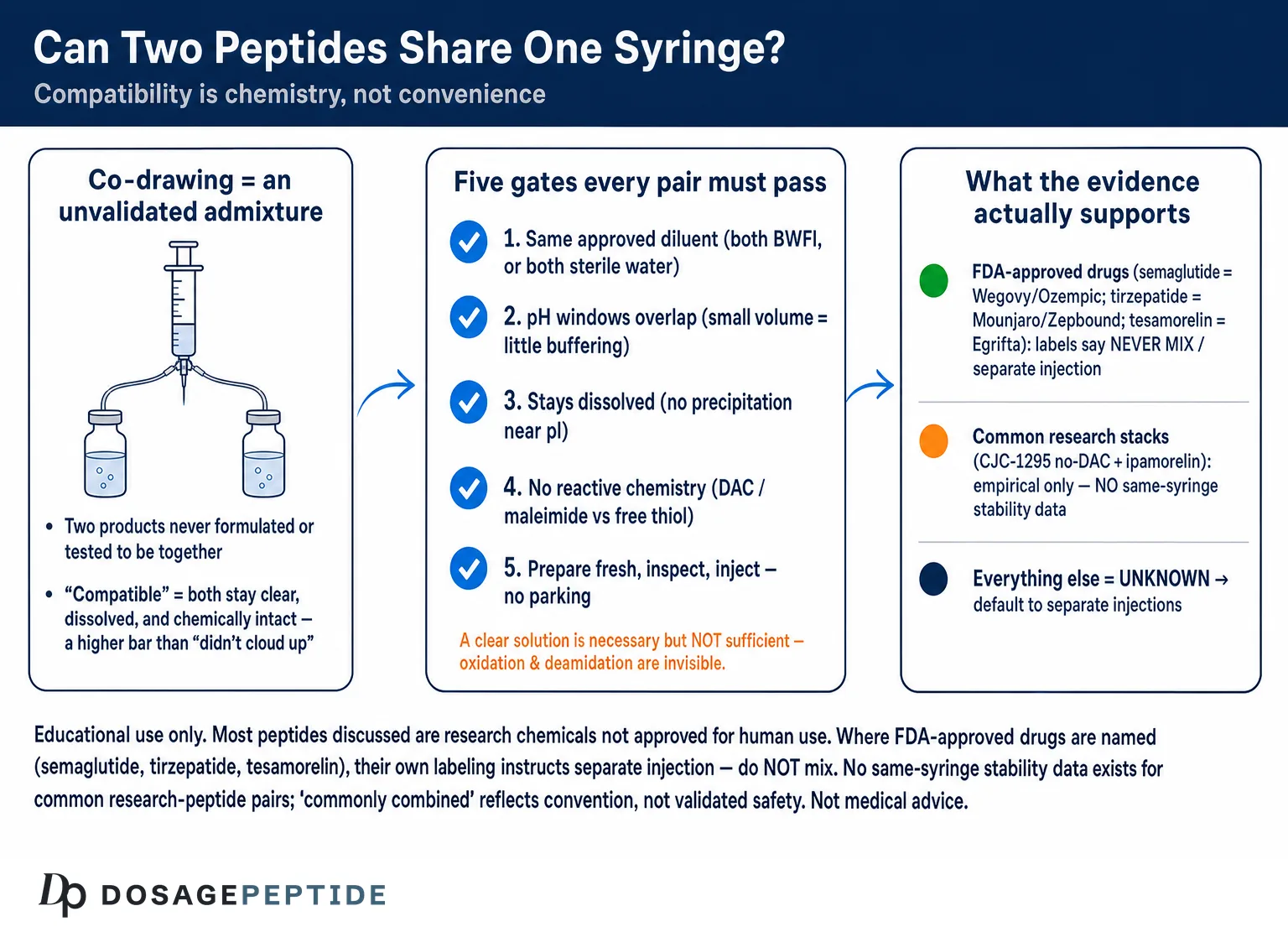
Combining two peptides in one syringe is a form of extemporaneous admixture—mixing two products at the point of use that were never formulated, tested, or packaged to be together. In hospital pharmacy, admixture compatibility is a formal discipline with published references, because the consequences of getting it wrong range from a subtle loss of potency to visible precipitation that can occlude a needle or, in an IV context, embolize. The classic pharmaceutical literature on parenteral admixtures established decades ago that incompatibilities may present as changes in color, pH, osmolality, or viscosity, the formation of gas, or precipitation—and, critically, that some reactions proceed with no visible sign at all.[1]
For research peptides the stakes are different from clinical IV therapy, but the underlying physical chemistry is identical. A peptide is a fragile molecule: a chain of amino acids held in a specific conformation, vulnerable to hydrolysis, oxidation, deamidation, and aggregation. Put two peptides—each with its own optimal pH and solubility window—into the same tiny, concentrated volume, and you create conditions the manufacturer never validated. The question is not merely “will it cloud up?” but “will each molecule remain intact and biologically representative of what I intended to study?”
It is worth being precise about what “compatible” means here. Compatibility is not merely that a mixture avoids visible precipitation; it is that both peptides remain clear, dissolved, chemically intact, and pharmacologically representative for the entire window they share the syringe. That is a substantially higher bar than “it did not cloud up,” and clearing it requires either data, a validated blend, or a defensible chemical rationale—never wishful thinking. Convenience alone is never a compatibility argument.
That is why this guide treats the syringe as a miniature, uncontrolled reaction vessel. Understanding what governs the reactions inside it is the only way to decide, case by case, whether co-drawing is defensible or reckless. If you want to first ground yourself in how peptides are properly prepared before any combining question arises, our peptide reconstitution guide covers the fundamentals of diluents, mixing technique, and storage.
What actually determines whether two peptides are compatible?
Compatibility is not a single property—it is the joint outcome of several independent variables, any one of which can sink a mixture. Think of it as a series of gates: a pair must pass through all of them, not just the most obvious one. The four dominant variables are pH, solubility, stability, and diluent/excipient match.
pH: the single most decisive variable
Peptides have a pH range in which they are both maximally soluble and maximally stable, and that range is narrow. The pharmaceutical formulation literature is explicit that pH is critical for peptide stability, with optimal windows frequently falling around pH 4.0–6.0 or 6.0–8.0 depending on the sequence, and that when two peptides with different optimal pH ranges are combined, neither may sit in its comfort zone.[1] Many peptides also have a pI (isoelectric point) near which their net charge approaches zero—and solubility hits a minimum. Mix a peptide that is happy at pH 4 with one buffered to pH 7, and the resulting compromise pH can push one of them toward its pI, triggering aggregation or frank precipitation.
Small volumes make this worse, not better. In a 1–2 mL syringe there is very little buffering capacity, so a small amount of an acidified or alkalinized solution can swing the combined pH sharply. This is the opposite of the intuition many people bring—that “a tiny bit won’t matter.” In a low-volume, low-buffer system, a tiny bit can matter a great deal.
Solubility and concentration
A peptide that is fully dissolved at its labeled concentration may fall out of solution when the local chemistry changes. Precipitation is a physical incompatibility, and it is one of the manifestations that admixture pharmacology explicitly flags: complexation, changes in ionic environment, and shifts in pH can all reduce solubility.[1] Concentrated stocks are more prone to this than dilute ones, because the molecules are already closer to their solubility ceiling. When you co-draw, you are also effectively concentrating two solutes into one bolus, and the sum can exceed what either would tolerate alone.
Chemical stability: the invisible failures
Even if a mixture stays perfectly clear, the individual peptides can be quietly degrading. The dominant chemical degradation pathways for peptides and proteins are deamidation, oxidation, hydrolysis, and aggregation, and each is sensitive to pH, temperature, and the redox environment.[2] Deamidation—the most common chemical degradation route—is strongly pH-dependent and accelerates outside a peptide’s stable window. Oxidation targets specific residues (methionine, cysteine, tryptophan, tyrosine, histidine) and can be catalyzed by trace metals or reactive oxygen species introduced through handling.[2] The uncomfortable implication for syringe mixing is that visual inspection cannot rule out chemical incompatibility. A clear solution is necessary but not sufficient evidence of compatibility.
Diluent and excipient match
Two peptides reconstituted in different vehicles should not be assumed compatible even before you consider the peptides themselves. The most common research diluent, bacteriostatic water for injection (BWFI), is sterile water containing 0.9% (9 mg/mL) benzyl alcohol as a preservative, with a pH of 5.7 (specified range 4.5–7.0).[3] Plain sterile water for injection has no preservative. Some products are formulated with specific excipients—buffers, tonicity agents, surfactants such as polysorbate, or pH-adjusting acids and bases—that are part of what keeps that particular molecule stable. Mixing across diluents or excipient systems introduces variables you did not choose and cannot see.
| Compatibility factor | What it governs | Failure mode if mismatched | Visible? |
|---|---|---|---|
| pH | Solubility and chemical stability window | Precipitation near pI; accelerated deamidation/hydrolysis | Sometimes |
| Solubility / concentration | Whether the peptide stays dissolved | Cloudiness, flakes, needle occlusion | Usually |
| Chemical stability | Molecular integrity over time | Oxidation, deamidation, aggregation, potency loss | Often invisible |
| Diluent / excipient | The vehicle each peptide was validated in | pH shift, surfactant interactions, preservative effects | Sometimes |
| Special chemistry | Reactive groups (e.g., maleimide, free thiols) | Covalent side-reactions, conjugation | Rarely |
Special reactive chemistry: the fifth gate
Beyond the four baseline factors, a minority of peptides carry a deliberately reactive functional group that changes the analysis entirely. The clearest example is the maleimide handle on DAC-modified peptides, engineered to form a covalent bond with a thiol. Reactive groups do not respect the boundary between “target” and “whatever else is in the syringe.” When either member of a pair carries such chemistry, matched diluent and neutral pH offer no protection, because the failure mode is a covalent side-reaction rather than a solubility or pH effect. This is why reactive chemistry is treated as its own screening gate rather than folded into the general stability discussion: it can sink an otherwise perfectly matched pair.
Which diluent am I using, and why does it matter for mixing?
Because the diluent is the medium every reaction happens in, matching diluents is a prerequisite before you even ask whether two peptides are compatible. The two workhorses in research reconstitution behave differently.
Bacteriostatic water (BWFI)
BWFI is the default for multi-dose vials because its benzyl alcohol content suppresses microbial growth across repeated needle entries. Its mildly acidic pH of 5.7 sits comfortably within the stable range for many peptides.[4] The benzyl alcohol is also a mild solubility aid for some sequences. The trade-off: benzyl alcohol is not inert to every molecule, and BWFI is explicitly contraindicated where preservative-free water is required (for example, neonatal use), which underscores that it is a formulated solution, not just “water.”[3]
Sterile water for injection
Preservative-free sterile water is used when a product’s labeling specifies it, or for single-use preparation. Because it lacks a bacteriostatic agent, a vial reconstituted with plain sterile water offers no protection against contamination on repeated entry—another reason not to pre-mix and park a loaded syringe.
The mixing rule for diluents
The practical principle is simple: if two peptides do not share the same approved diluent, do not co-draw them. If one product’s instructions call for sterile water and the other for BWFI, combining them means at least one peptide is now sitting in a vehicle it was never validated in. When the labels agree—both BWFI, or both sterile water—you have cleared the first gate, but only the first. Our reconstitution guide details how to select and add diluent cleanly, and the reconstitution and dosage calculator helps you plan concentrations so that a combined draw does not balloon past a comfortable injection volume.
How do temperature, time, and light change the mixing calculation?
The four factors above—pH, solubility, stability, and diluent—set the baseline, but three environmental variables act as accelerators that can turn a marginal mixture into a failed one. They matter more for admixtures than for single peptides, because a mixture already sits at compromised conditions and has less margin to spare.
Time in contact is the variable you control most directly
Almost every chemical degradation pathway is time-dependent: the longer two peptides share a solution outside their optimal conditions, the more deamidation, oxidation, or aggregation accumulates. This is the single strongest argument for the “no parking” rule. A mixture drawn and injected within a minute or two experiences a trivial amount of any slow reaction; the same mixture left in the barrel for hours—or, worse, refrigerated overnight for “convenience”—gives incompatibilities the one thing they need to become significant, which is time. Because the co-contact of an unvalidated pair has no established shelf life, minimizing contact time is the only defensible strategy.
Temperature cuts both ways
Higher temperatures speed up reaction kinetics, so a mixture handled at room temperature degrades faster than one kept cold—but you should not respond by pre-mixing and refrigerating, because cold storage of an unvalidated admixture still permits slow reactions while adding freeze-thaw and contamination concerns. The correct move is to keep source vials properly stored per their instructions, mix only at the moment of use, and never subject a loaded mixed syringe to a temperature cycle. Repeated warming and cooling is itself a documented stressor for peptide and protein solutions, promoting aggregation.[2]
Light and oxygen
Photo-oxidation and dissolved-oxygen exposure drive oxidation of susceptible residues (methionine, cysteine, tryptophan). Trace metal contamination can catalyze the same chemistry.[2] None of this is visible, which again is why appearance is a poor proxy for integrity. Minimizing headspace exposure, avoiding prolonged light, and using clean technique reduce—but do not eliminate—these routes. For an unfamiliar term in any of this, our peptide glossary defines the chemistry and handling vocabulary used throughout these guides.
Which peptide pairs are commonly co-reconstituted, and why?
In research practice, a handful of pairings are routinely prepared together because their chemistries are similar and their reconstitution vehicles overlap. Being “commonly combined” is a statement about convention and rough chemical similarity—not a validated compatibility claim. There are no formal same-syringe stability studies for most research-peptide pairs, so even the “routine” combinations rest on empirical practice, not published data.
CJC-1295 (no DAC) + Ipamorelin
This is the archetypal “stack.” CJC-1295 without DAC is a short-acting GHRH analog; ipamorelin is a selective ghrelin/GHSR (growth-hormone secretagogue receptor) agonist. Mechanistically they are studied as complementary—one nudging the GHRH arm, the other the ghrelin arm—and both are simple aqueous peptides typically reconstituted in BWFI. Because their vehicles match and neither carries an obvious reactive group, they are frequently co-reconstituted in research settings. The honest caveat: this rests on the absence of a known problem and shared diluent, not on stability data demonstrating the two remain intact together. Keep the volume modest and prepare immediately before use.
BPC-157 + TB-500
These two are frequently discussed together as a tissue-repair pairing—BPC-157 as a cytoprotective peptide and TB-500 as an actin-binding fragment related to thymosin β4. They are common enough as a conceptual pair that pre-blended research vials exist; our reference page on the BPC-157 & TB-500 10 mg blend vial dosage protocol documents how such a blend is handled. When they arrive already co-formulated in a single vial, the manufacturer has made the compatibility decision; when you have two separate vials, co-drawing them is an empirical choice with no published same-syringe stability data behind it. Both are pH- and oxidation-sensitive, so a matched diluent and immediate use are the minimum safeguards.
GHRP-2 or GHRP-6 + a GHRH analog
The growth-hormone-releasing peptides (GHRP-2, GHRP-6) are ghrelin-mimetics often studied alongside a GHRH analog such as CJC-1295 (no DAC) or sermorelin, again on the logic of hitting two secretagogue pathways. As simple aqueous BWFI peptides they are chemically similar, which is why they show up together—but the same “empirical, not validated” qualifier applies. Check clarity and inject immediately.
What about melanocortin peptides (Melanotan II, PT-141)?
Melanotan II (an MC1R/MC4R agonist) and bremelanotide/PT-141 (an MC4R agonist) belong to the melanocortin family and are sometimes grouped in discussion, but they illustrate two different cautions. Melanotan II is reconstituted in BWFI, yet its excipient content varies by source, so “another BWFI peptide” is not a safe assumption of compatibility—treat it as unknown against most partners. PT-141, by contrast, is an FDA-approved product supplied in a fixed-formulation, single-use autoinjector; it is a closed system that is neither reconstituted by the user nor designed for co-drawing. The melanocortins therefore land firmly in the “keep separate” column: one for unknown compatibility, the other for being a sealed drug-device combination.
| Peptide | Class | Typical diluent | Co-draw status (research context) |
|---|---|---|---|
| CJC-1295 (no DAC) | GHRH analog | BWFI | Commonly co-drawn with ipamorelin/GHRPs — empirical |
| CJC-1295 (with DAC) | GHRH analog + maleimide | BWFI | Keep separate — reactive maleimide chemistry |
| Ipamorelin | GHSR agonist | BWFI | Commonly co-drawn with CJC (no DAC) — empirical |
| GHRP-2 / GHRP-6 | GHSR agonist | BWFI | Empirical; check pH/clarity, inject promptly |
| Sermorelin | GHRH analog | BWFI | No published same-syringe data — treat as unknown |
| BPC-157 | Cytoprotective | BWFI / sterile water | Blend vials exist; separate vials = empirical only |
| TB-500 | Actin-binding fragment | BWFI / sterile water | Blend vials exist; separate vials = empirical only |
| Tesamorelin | GHRH analog (Rx) | Sterile water (per IFU) | Do not pre-mix — product-specific excipients |
| Semaglutide | GLP-1 agonist (Rx) | Per label | Never mix — label instructs separate injection |
| Tirzepatide | GIP/GLP-1 (Rx) | Per label | Never mix — label instructs separate injection |
Which peptides should be kept separate, and why?
Some compounds carry a specific reason to keep them out of a shared syringe—either a documented label prohibition, a reactive chemistry, or product-specific excipients. These are not judgment calls; they are hard stops.
GLP-1 and GIP/GLP-1 agonists (semaglutide, tirzepatide)
These are the clearest “never mix” category because the instruction comes straight from FDA-approved labeling, not from inference. Semaglutide’s prescribing information and clinical guidance are explicit that when it is used with insulin, the two must be administered as separate injections and never mixed; injecting them in the same body region is acceptable, but they must not be adjacent.[5] Tirzepatide’s labeling carries the identical instruction: when used with insulin, administer as separate injections and never mix, and do not inject adjacent to each other.[6] If the manufacturer prohibits mixing even with something as ubiquitous and well-characterized as insulin, there is no basis for mixing with a research peptide of unknown compatibility. These products also ship in pre-filled pens or fixed-formulation vials that are simply not designed for co-drawing.
DAC / maleimide peptides (CJC-1295 with DAC)
CJC-1295 with DAC (Drug Affinity Complex) is chemically distinct from its no-DAC counterpart in a way that matters enormously for mixing. The DAC modification adds a maleimide group that is engineered to react, via Michael addition, with the free thiol on cysteine-34 of circulating serum albumin, forming a stable covalent thioether bond. In healthy adults, this albumin-conjugation strategy extended the compound’s estimated half-life to roughly 5.8–8.1 days, sustaining growth-hormone elevations for six days or more after a single subcutaneous dose.[7] That reactivity is the whole point of the molecule—but a maleimide does not know the difference between albumin’s cysteine and any other free thiol in its vicinity. Co-drawing a maleimide-bearing peptide with a thiol-containing peptide creates a theoretical opportunity for off-target conjugation inside the syringe, consuming the reactive handle before it ever reaches its intended target. The risk is small for peptides that present no free cysteine, but it is non-zero and entirely avoidable by injecting separately. Note the sharp contrast: CJC-1295 no DAC is routinely co-drawn; CJC-1295 with DAC should not be.
Tesamorelin and other Rx products with specific excipients
Tesamorelin is an FDA-approved GHRH analog whose instructions for use specify reconstitution with sterile water and administration without pre-mixing. Its formulation includes product-specific excipients and a defined pH, and its labeling does not support co-mixing. Prescription products in general are formulated as closed systems; their compatibility with anything else has not been established, so the default is to inject them alone.
Anything with “unknown” compatibility
This is the broadest and most important category. For the large majority of research peptides there simply are no same-syringe compatibility studies. Absence of a published problem is not evidence of safety. When you cannot point to either a matched, simple, well-characterized chemistry or explicit guidance, the correct classification is “unknown,” and unknown defaults to separate. Evidence-based admixture practice holds that co-administration should be supported by data or sound chemical rationale—not convenience.[8]
How does pH incompatibility actually cause a mixture to fail?
It is worth walking through the mechanism, because understanding it turns an abstract warning into an intuition you can apply to new pairs. Every peptide carries ionizable groups; the balance of positive and negative charges at a given pH determines both its net charge and how strongly water molecules solvate it. Near the isoelectric point, net charge approaches zero, electrostatic repulsion between molecules collapses, and the peptides can associate—first as soluble aggregates, then as visible precipitate.
Now put two peptides together. Peptide A is stable and soluble at pH 4.5; peptide B at pH 7.2. Combine equal volumes and the mixture lands somewhere in between—say pH 5.8—which may be close enough to peptide A’s pI to start driving it out of solution, while simultaneously nudging peptide B toward faster deamidation. Neither peptide is in its happy zone. Because the syringe volume is small and poorly buffered, even a modest pH-adjusting component in one product can dominate the outcome. The general chemistry of injectable admixtures documents exactly this: pH shifts, acid-base character, and redox environment are principal drivers of both physical precipitation and chemical breakdown.[1]
The takeaway is that two peptides can each be perfectly stable in isolation and still be incompatible together purely because their optimal pH windows do not overlap. This is why “both are just peptides in BWFI” is a starting point for consideration, not a guarantee of compatibility.
Is a clear solution proof that mixing worked?
No—and this is the most consequential misconception in the whole topic. Visual clarity rules out gross physical incompatibility (precipitation, cloudiness, particulates), which is genuinely useful information. But chemical degradation frequently proceeds with no change in appearance whatsoever. Oxidation of a methionine residue, deamidation of an asparagine, or the covalent side-reaction of a maleimide with a stray thiol can all occur in a solution that remains water-clear.[2] The parenteral admixture literature makes the same point from the clinical side: incompatibilities can occur without any visible manifestation, which is precisely why compatibility is established through analytical testing, not eyeballing.[1]
So a clear draw is a necessary but not sufficient condition. If a mixture clouds, flakes, changes color, or forms a film, that is a definitive stop. But the converse—“it’s clear, therefore it’s fine”—does not hold. Treat clarity as a minimum bar you must clear, not as a certificate of compatibility.
What are the specific degradation reactions to worry about?
Naming the reactions makes the risk concrete and helps you reason about unfamiliar pairs. Four chemical pathways dominate peptide breakdown, and each behaves differently in a mixture.[2]
Deamidation
Deamidation is the most common chemical degradation route for peptides. Asparagine (and, more slowly, glutamine) residues lose their amide group, altering charge and often bioactivity. The rate is strongly pH-dependent—typically accelerating at higher pH—and sequence-dependent, so a pair whose combined pH drifts upward from one peptide’s optimum can quietly deamidate the other. Because the product is a subtly different molecule rather than a precipitate, deamidation is invisible to inspection.
Oxidation
Oxidation attacks methionine, cysteine, tryptophan, tyrosine, and histidine residues, driven by dissolved oxygen, light, or trace-metal catalysis.[2] In a mixture, one peptide can introduce trace contaminants or shift the redox environment in a way that promotes oxidation of the other. Cysteine oxidation is especially relevant because it also governs disulfide chemistry—and, as noted, free thiols are exactly what a maleimide-bearing DAC peptide will react with.
Hydrolysis
Hydrolysis cleaves the peptide backbone or side chains and is catalyzed at pH extremes. A mixture that pushes either peptide toward an acidic or basic edge accelerates this route. Since most research peptides are already in aqueous solution once reconstituted, hydrolysis is a constant slow background process that a poor pH match speeds up.
Aggregation and precipitation
Aggregation is the physical clustering of peptide molecules, often triggered by proximity to the isoelectric point, agitation, temperature cycling, or interface exposure. It can progress from invisible soluble aggregates to visible particulates and precipitate. Unlike the chemical routes, aggregation is often (eventually) visible—but by the time you see haze, soluble aggregates have usually already formed. This is why the presence of visible particulates is a definitive stop while their absence is not reassuring.
| Degradation route | Main trigger in a mixture | Residues / feature at risk | Detectable by eye? |
|---|---|---|---|
| Deamidation | pH drift (often higher pH) | Asparagine, glutamine | No |
| Oxidation | Oxygen, light, trace metals, redox shift | Met, Cys, Trp, Tyr, His | No |
| Hydrolysis | pH extremes; time in solution | Backbone / side chains | Rarely |
| Aggregation / precipitation | Proximity to pI, agitation, temp cycling | Whole molecule | Eventually |
What does an incompatible mixture actually look like—and what should you do?
Because appearance is only a partial guide, it helps to catalog what visible failure looks like and treat each sign as a hard stop, while remembering that a clean appearance is not an all-clear.
- Cloudiness or turbidity that does not clear on gentle inspection indicates precipitation or heavy aggregation—discard and inject separately.
- Visible particles, flakes, or fibrils mean solid material has come out of solution—never inject.
- Color change (yellowing, for example) can signal oxidation or a chemical reaction—discard.
- Gas or bubbles that persist beyond ordinary handling can indicate a chemical reaction generating gas—discard.
- A film, ring, or gel at the meniscus or on the barrel wall points to interfacial aggregation—discard.
The correct response to any of these is uniform: do not inject the mixture, discard it safely, and if the compounds are genuinely needed, prepare and administer them as separate injections instead. There is no rinsing, filtering, or waiting-it-out remedy for an incompatible admixture. And to restate the asymmetry one more time: the absence of all these signs does not prove the two peptides are chemically intact—it only rules out gross physical failure.[1]
What are the sterility and handling rules when combining peptides?
Any time you introduce a second product into a syringe you double the opportunities for contamination and error, so sterility discipline becomes more important, not less. The following principles apply to research handling regardless of which compounds are involved.
Prepare immediately before use—no parking
The single most important handling rule for mixtures is: draw immediately before injection, then discard any remainder. Do not pre-mix a syringe and store it for later. There are two reasons. First, contamination risk climbs the longer a loaded syringe sits, and a pre-drawn mixture is no longer protected by the vial’s preservative environment in the same way. Second, and more subtly, the same-syringe stability of an unvalidated peptide mixture is unknown—prolonged co-contact is exactly the condition under which slow chemical incompatibilities have time to progress. A mixture that is fine for the two minutes it takes to inject may not be fine after an hour in the barrel.
One vial, one clean needle entry
Wipe each vial septum with alcohol before entry, use a fresh sterile needle, and avoid touching the plunger shaft or needle. When co-drawing, draw from each vial in turn without back-injecting from the mixed syringe into a source vial—doing so would cross-contaminate one stock with the other. Inspect after each draw and again before injecting.
Inspect, then inject
Hold the syringe to the light and look for haze, flakes, color change, or bubbles that do not clear. Any of these is a reason to discard and start over with separate injections. Even when the solution looks perfect, remember the clarity caveat above.
Keep volume comfortable
Subcutaneous tissue tolerates only so much liquid per site before pain and back-leakage set in. A combined draw can quietly exceed a comfortable volume; the abdomen is generally the most forgiving site, but larger volumes still hurt more. If the total volume of a would-be mixture is uncomfortably large, that is itself an argument for splitting into two separate, smaller injections. Planning concentrations in advance—which the dosage calculator is built for—keeps you from being surprised at the point of use.
Not for human use
Bearing repeating because it frames everything above: research peptides are, with few exceptions, not approved for human administration. The sterility and handling principles here describe good laboratory practice for handling these materials, not an endorsement of self-injection. Where an approved drug is involved, its own labeling and a qualified prescriber govern its use.
A decision framework: should these two share a syringe?
Rather than memorize a list, it helps to run any candidate pair through the same ordered set of gates. If a pair fails any gate, the answer is separate injections. The gates are ordered from cheapest-to-check to most subtle.
- Same route and timing? Both intended for the same route (e.g., subcutaneous) and the same administration moment. Different routes or schedules are an immediate stop—there is no reason to mix compounds you would not give together anyway.
- Same approved diluent? Read both products’ instructions. If both specify BWFI, or both specify sterile water, proceed. If they differ, or one requires a specific device or vehicle, do not co-draw.
- Any label prohibition? GLP-1 and GIP/GLP-1 agents (semaglutide, tirzepatide) and Rx products such as tesamorelin carry explicit or product-specific “do not mix” guidance. A documented prohibition ends the analysis.
- Any reactive chemistry? Screen for maleimide/DAC peptides and free-thiol (cysteine) counterparts. If one is a DAC/maleimide compound, keep it separate from thiol-bearing peptides.
- pH and excipients compatible? If either product uses acid/base adjustment, surfactants such as polysorbate, or specialized carriers, treat compatibility as unknown—small syringe volumes magnify pH swings.
- Volume comfortable? Keep the combined subcutaneous volume within a tolerable range per site. If it is too large, split the injection.
- Draw → inspect → inject, no parking. If a pair clears every gate, prepare it immediately before use, inspect for clarity, inject, and discard the remainder. Never pre-mix and store.
The philosophy behind the framework is conservative by design: a pair earns a shared syringe only by affirmatively passing every gate. Absent that, the default is not “probably fine”—it is separate injections.
What are the alternatives to same-syringe mixing?
The entire motivation for co-drawing is convenience—fewer sticks, faster prep. It is worth recognizing that most of that convenience can be recovered without accepting compatibility risk, through approaches that keep each product in its validated environment.
Back-to-back separate injections
Two syringes prepared in the same sitting, injected at different sites, deliver both compounds at essentially the same time while preserving each product’s integrity and staying label-compliant. The only cost is a second needle stick. For anything classified as “unknown,” this is the correct default—you get the timing benefit of co-administration without the chemistry risk of co-formulation.
Validated blends and co-formulations
When two compounds arrive already blended in a single vial from the source, the compatibility decision has been made upstream: the products were combined and (ideally) tested together, so a single reconstitution and a single draw are appropriate. This is a fundamentally different situation from mixing two separate vials at the point of use, because you are no longer improvising an admixture—you are using a product as supplied. The BPC-157 & TB-500 blend vial protocol is an example of a pre-combined product handled as one unit.
Schedule consolidation
Often the real goal—fewer daily events—is better achieved by grouping administration times or rotating on alternate days than by physically combining compounds. “Separate but streamlined” captures most of the ergonomic benefit while sidestepping every compatibility question.
| Approach | Upside | Downside |
|---|---|---|
| Same-syringe co-draw | One stick; lowest total volume | Compatibility uncertainty; cannot store; narrow eligibility |
| Back-to-back separate | Preserves each product; label-compliant; timing preserved | Two sticks |
| Validated blend vial | Compatibility decided upstream; single draw | Depends on availability of a true blend product |
| Schedule consolidation | Fewer events; zero mixing risk | Requires planning |
Worked examples: applying the framework
CJC-1295 (no DAC) + Ipamorelin — commonly co-drawn
Run the gates: same route (SC) and timing, both reconstituted in BWFI, no label prohibition, neither is a DAC/maleimide compound, simple aqueous chemistry, modest combined volume. This pair clears every gate on shared, simple chemistry—which is why it is the canonical co-draw. The honest framing remains: this is empirical, resting on matched diluent and the absence of a known reaction, not on same-syringe stability data. If you were to substitute CJC-1295 with DAC, gate 4 fails immediately on the maleimide chemistry, and the answer flips to separate injections.
Semaglutide + anything — never mix
Gate 3 fails before you get anywhere else. Semaglutide’s labeling instructs separate injections even alongside insulin; there is no version of this analysis where mixing it with a research peptide is defensible.[5] Inject in the same body region if convenient, but as a separate, non-adjacent injection.
Tesamorelin + anything — inject alone
Gate 2 and gate 3 both fail: tesamorelin is reconstituted per its own IFU, carries product-specific excipients, and its labeling does not support pre-mixing. Prepare it per instructions and inject it by itself.
BPC-157 + TB-500 (two separate vials) — empirical, lean separate
If you hold a true blend vial, you handle it as one product. But with two separate vials, you are improvising an admixture with no published same-syringe stability data, and both peptides are pH- and oxidation-sensitive. This pair sits in the “unknown” bucket: if combined at all, treat matched diluent and immediate use as mandatory, and recognize that separate injections are the lower-risk choice. When in doubt, separate wins.
Why is “follow the product and preparation guidance” the governing rule?
If there is one principle that subsumes all the chemistry above, it is this: defer to the specific guidance that accompanies each product, and treat the absence of guidance as a reason for caution rather than a license to improvise. Manufacturers and formulators know things about their material that you cannot infer from the outside—the exact excipients, the buffer system, the validated diluent, the pH, and whether the product was ever intended to touch anything else. When a label says “reconstitute with sterile water” or “do not mix,” that instruction encodes formulation knowledge, not bureaucratic caution.
Hierarchy of evidence for a mixing decision
Not all bases for a decision are equal. In descending order of authority: an explicit label instruction (for approved drugs) outranks everything; a validated blend product supplied pre-combined is next; documented same-syringe stability data for a specific pair would be next, though it rarely exists for research peptides; a sound chemical rationale from matched diluent and simple, non-reactive chemistry comes after that; and at the bottom sits “other people do it,” which is not evidence at all. Evidence-based admixture practice is explicit that co-administration should rest on data or sound rationale rather than convenience or convention.[8]
Why “it’s just a peptide in water” understates the problem
The instinct that two lyophilized peptides reconstituted in the same water must be interchangeable ignores that lyophilized powders often contain their own bulking agents, buffers, and stabilizers built into the cake. Two vials that both “take BWFI” can still reconstitute into solutions with meaningfully different pH and excipient profiles. This is why matched diluent is a starting gate, not a conclusion, and why product-specific preparation guidance—where it exists—always wins over a general heuristic.
How should combining be documented in a research context?
Good research practice is reproducible research practice, and admixtures introduce variables that are easy to lose track of. If a study involves co-administered compounds, the record should capture enough that another researcher could reconstruct exactly what was in the syringe.
- Identity and source of each compound, including lot or batch where available, since excipients can vary by source.
- Diluent used for each (BWFI vs sterile water), and the reconstitution concentration.
- Order and ratio in which the two were drawn, and the total combined volume.
- Time from mixing to administration—the “contact time” that governs slow degradation.
- Visual inspection result at the point of use (clear / cloudy / particulate / discolored).
- Rationale for combining rather than injecting separately—matched diluent, blend product, or explicit guidance.
Recording these not only supports reproducibility but also builds the habit of examining each decision. If you cannot articulate a rationale for the combine field, that is itself a signal to separate the injections. Planning the concentrations and volumes in advance with the dosage calculator makes several of these fields fall out of the preparation math automatically.
How does this compare to insulin mixing, which people do combine?
A fair objection: diabetics have mixed certain insulins in one syringe for decades—so why the caution with peptides? The answer illustrates the whole principle. Specific insulin combinations (for example, certain short-acting plus intermediate-acting products) were studied, validated, and given explicit mixing instructions by their manufacturers, including the order of draw and the timing of injection after mixing. Where mixing is not validated—as with GLP-1 agonists and insulin—the labeling says separate injections, full stop.[6] The lesson for research peptides is direct: the insulins that get mixed do so because someone ran the compatibility and stability studies. For the overwhelming majority of research peptides, no one has—so the insulin precedent argues for more caution, not less.
Frequently Asked Questions
Can I mix semaglutide with BPC-157 in the same syringe?
No. Semaglutide’s prescribing information instructs that it be given as a separate injection and never mixed with other products in the same syringe—this holds even for insulin, a far better-characterized combination than any research peptide.[5] If a manufacturer prohibits mixing with insulin, there is no basis to mix with an unstudied peptide. Keep them separate.
What exactly is bacteriostatic water, and does the diluent affect mixing?
Bacteriostatic water for injection is sterile water containing 0.9% (9 mg/mL) benzyl alcohol as a preservative, with a pH of 5.7 (range 4.5–7.0).[3] The diluent matters greatly: mixing two peptides reconstituted in different vehicles introduces pH and excipient variables you did not choose. Matching diluents is a prerequisite, not a guarantee, of compatibility.
Is a clear solution proof that two peptides are compatible?
No. Clarity rules out gross precipitation but says nothing about chemical stability. Oxidation, deamidation, and covalent side-reactions can proceed in a perfectly clear solution,[2] and admixture pharmacology explicitly notes that incompatibilities can occur with no visible sign.[1] Treat clarity as a minimum bar, not a certificate.
Can I pre-draw a mixed syringe and use it later?
No. Prepare mixtures immediately before use and discard any remainder. A pre-drawn syringe carries a higher contamination risk and is no longer protected the way a preserved vial is. Just as important, the same-syringe stability of an unvalidated peptide mixture is unknown, and prolonged co-contact is exactly when slow incompatibilities have time to develop.
Why is CJC-1295 with DAC treated so differently from CJC-1295 without DAC?
The DAC version carries a maleimide group engineered to react covalently with a free thiol on serum albumin, extending its half-life to roughly 6–8 days in humans.[7] That same reactive group can react with any free thiol nearby, so co-drawing it with a cysteine-containing peptide risks off-target conjugation in the syringe. The no-DAC version has no such handle, which is why it is routinely co-drawn while the DAC version is kept separate.
How much liquid can go into one subcutaneous injection?
Comfort, not a hard limit, is the constraint. Subcutaneous sites tolerate only a modest volume before pain and back-leakage rise; the abdomen is generally most forgiving. If a combined draw pushes the total volume past what is comfortable, that alone is a reason to split it into two separate, smaller injections rather than force a single large bolus.
Are there any peptide pairs with formal same-syringe stability data?
For approved drugs, compatibility guidance comes from the label (which for GLP-1/GIP agents says do not mix). For the large majority of research peptides, there are no published same-syringe stability studies at all. “Commonly combined” reflects convention and rough chemical similarity, not validated data—which is why the honest default for anything uncertain is separate injections.[8]
Does mixing two peptides in one syringe change the dose of either?
No—combining does not alter the mass of peptide drawn, only the vehicle it travels in. What can change is the practicality: two concentrated stocks combined may exceed a comfortable subcutaneous volume, or two dilute stocks may push the total too high to inject at one site. Plan concentrations in advance so the combined volume stays reasonable; the dosage calculator makes this straightforward. The compatibility question is entirely separate from the dose question.
If a mixture looked fine last time, is it safe to keep doing?
Not necessarily. A single clear preparation tells you that particular draw did not grossly precipitate—it does not establish that the peptides remained chemically intact, nor that the next lot (with possibly different excipients) will behave the same way. Because slow chemical incompatibilities are invisible and lot-to-lot variation is real, “it worked before” is weak evidence. The conservative gates apply every time, not just the first time.
What is the single best rule of thumb?
When in doubt, keep them separate. Co-drawing trades one needle stick for compatibility uncertainty, and most of the convenience can be recovered by injecting back-to-back at different sites or by consolidating schedules. A pair should earn a shared syringe by affirmatively clearing every compatibility gate—matched route, matched diluent, no prohibitions, no reactive chemistry, compatible pH, comfortable volume, immediate use—not merely by looking clear.
References
- Physicochemical determinants of incompatibility and instability in injectable drug solutions and admixtures. PubMed. https://pubmed.ncbi.nlm.nih.gov/358828/
- Oxidation of Therapeutic Proteins and Peptides: Structural and Biological Consequences. Pharmaceutical Research. https://link.springer.com/article/10.1007/s11095-013-1199-9
- Bacteriostatic Water for Injection, USP — Label. DailyMed (NIH/NLM). https://dailymed.nlm.nih.gov/dailymed/lookup.cfm?setid=87d6e9dc-fe3b-4593-ac9a-d7493d1959c7
- Bacteriostatic Water for Injection, USP — Description. Pfizer Medical. https://www.pfizermedical.com/bacteriostatic-water/description
- Semaglutide (subcutaneous route) — Description and Brand Names. Mayo Clinic. https://www.mayoclinic.org/drugs-supplements/semaglutide-subcutaneous-route/description/drg-20406730
- Tirzepatide (subcutaneous route) — Description and Brand Names. Mayo Clinic. https://www.mayoclinic.org/drugs-supplements/tirzepatide-subcutaneous-route/description/drg-20534045
- Teichman SL, et al. Prolonged Stimulation of Growth Hormone (GH) and Insulin-Like Growth Factor I Secretion by CJC-1295, a Long-Acting Analog of GH-Releasing Hormone, in Healthy Adults. J Clin Endocrinol Metab. 2006;91(3):799–805 (PMID 16352683). https://academic.oup.com/jcem/article-abstract/91/3/799/2843281
- Boullata JI, et al. Parenteral nutrition compatibility and stability: A comprehensive review. JPEN J Parenter Enteral Nutr. https://aspenjournals.onlinelibrary.wiley.com/doi/10.1002/jpen.2306