Short answer: in animal studies, neither BPC-157 nor TB-500 has produced a lethal dose, organ damage, or a clear toxic signal — but that is a much weaker statement than “safe.” Only one formally structured toxicology package exists across the two compounds. There are no completed chronic-toxicity, cancer, or reproductive-toxicity studies, and no controlled human safety trial of either peptide as it is actually sold.
So the honest reading is this: the animal data show an absence of obvious harm in experiments that were mostly designed to measure healing, not harm. Absence of evidence is not evidence of safety. This page walks through exactly what was tested, at what doses, in which organs — and which questions nobody has answered yet. Everything here describes published research; neither compound is approved for human use anywhere.
Looking for one compound in particular?
What Are BPC-157 and TB-500, and Why Does Their Safety Warrant Separate Scrutiny?
BPC-157 (“body protection compound-157”) is a synthetic pentadecapeptide — a chain of fifteen amino acids — whose sequence corresponds to a partial fragment reportedly derived from a protein found in human gastric juice. It was first characterized in the early 1990s by a research group centered at the University of Zagreb, and the bulk of the primary literature on it originates from that group and its collaborators.[4] The peptide is investigated almost exclusively for tissue repair endpoints: gastrointestinal ulcer healing, tendon and ligament repair, muscle injury, and various models of organ protection.
TB-500 is frequently discussed alongside BPC-157 as its regenerative “partner,” but the two are biochemically unrelated, and one nuance is central to any honest safety discussion. TB-500 is a synthetic seven-amino-acid fragment (acetyl-Leu-Lys-Lys-Thr-Glu-Thr-Gln, or Ac-LKKTETQ) corresponding to the actin-binding domain of thymosin beta-4 (Tβ4), a naturally occurring 43-residue peptide present in essentially all human cells.[7] Much of the safety and efficacy data cited in the popular literature actually pertains to full-length thymosin beta-4 — the molecule that has been through formal human clinical trials — not to the abbreviated synthetic fragment marketed as TB-500. Conflating the two inflates the apparent evidence base. Where human data exist, they exist for Tβ4; the fragment sold as a research chemical has no dedicated clinical safety record of its own.
Both compounds are unapproved research substances. Neither has a United States Adopted Name, an established pharmacopeial monograph, or a completed regulatory safety dossier. That regulatory vacuum is the reason a toxicology-focused review is worth writing: in the absence of a formal safety package, the animal literature is doing all of the inferential work, and it is important to be precise about how much weight it can bear. Readers new to the terminology used below may find the site’s peptide research glossary useful for terms such as NOAEL, genotoxicity, and angiogenesis.
How Much Was Given Before Anything Went Wrong?
The single most-repeated safety claim about BPC-157 is that researchers have been unable to establish a lethal dose. In the terminology of classical toxicology, no reliable LD50 (the dose lethal to half of a test population) has been reported, and a comprehensive review from the originating research group states plainly that even a lethal dose 1 (LD1) “could not be obtained.”[4] Across published efficacy work, BPC-157 has been administered over an extraordinarily wide dose range — from micrograms per kilogram up into the milligram-per-kilogram range — by intragastric, intraperitoneal, intramuscular, and intravenous routes, without the acute mortality that would allow a median lethal dose to be calculated.
On its face this is reassuring: a compound with a very high acute margin is a compound unlikely to kill an animal outright at any plausible experimental dose. But three caveats must travel with that statement. First, an unobtainable LD50 is not unique to safe compounds; it simply means the tested doses did not reach a lethal threshold, which can also reflect solubility limits, injection-volume limits, or a decision not to push doses higher. Second, acute lethality is the crudest possible toxicology endpoint — it says nothing about organ injury, immunogenicity, carcinogenicity, or reproductive harm that emerges below the lethal ceiling or over longer exposure. Third, the absence of a lethal dose has largely been documented within efficacy experiments rather than in dedicated acute-toxicity studies conducted to a formal protocol. A high acute margin is a genuine data point, but it is the beginning of a safety assessment, not the conclusion of one.
It is also worth resisting a common quantitative leap. A wide gap between an effective dose and the highest dose tested does not straightforwardly translate into a wide human margin of safety, because interspecies scaling of peptides is not a simple body-weight multiplication. Differences in metabolism, plasma peptidase activity, immune recognition, and receptor-pathway sensitivity mean a dose harmless in a rat cannot be assumed harmless, on a per-kilogram basis, in a person. The unobtainable LD50 tells us the acute ceiling is high in the tested species; it does not license a numerical human safety factor, and any framing that converts “no lethal dose in rodents” into “very safe in humans” is smuggling in an inference the data do not support.
For TB-500 specifically, comparable dedicated acute-toxicity data are thinner still. The acute-tolerability inferences generally rest on full-length thymosin beta-4, which was reported to be well tolerated in early-phase human dosing (discussed below), rather than on the synthetic fragment. This is a recurring theme: the acute-safety story for the “TB-500” label borrows heavily from a different, better-studied molecule.
How Robust Is the Only Formal Toxicology Package on BPC-157?
The most important document in this entire discussion is a 2020 study by Xu and colleagues, published in Regulatory Toxicology and Pharmacology, which remains the closest thing to a structured preclinical safety evaluation that BPC-157 has ever received.[1] Because so much rests on this one paper, it deserves a careful, endpoint-by-endpoint reading rather than a one-line summary.
Species, doses, and repeated-dose findings
The evaluation spanned multiple species — mice (BALB/c and ICR strains), Sprague-Dawley rats, rabbits, and dogs — and included repeated-dose administration. In dogs receiving repeated dosing, the investigators reported that BPC-157 was well tolerated, with no meaningful differences between treated and solvent-control groups across the parameters examined. The one flagged finding was a decrease in serum creatinine at the highest dose tested (2 mg/kg) that was absent at lower doses. A decrease in creatinine is not a conventional signal of renal injury — the authors interpreted it in the context of the compound’s putative protective activity rather than as toxicity — but it is exactly the kind of dose-dependent biochemical change that a complete package would follow up with histopathology and mechanistic work.
Genotoxicity and embryo-fetal endpoints
The study reported that BPC-157 produced no genotoxicity in the standard battery and no embryo-fetal toxicity in the models used.[1] Genotoxicity testing conventionally comprises a bacterial reverse-mutation assay (the Ames test), an in-vitro chromosome-aberration assay, and an in-vivo micronucleus test; negative results across such a battery argue against direct DNA-damaging potential. Local-tolerance testing revealed only mild irritation at injection sites, and animals showed recovery after treatment-withdrawal periods.
What this package does — and does not — establish
Read fairly, the Xu study is a meaningfully positive signal: within its species, doses, and durations, BPC-157 did not produce serious organ toxicity, was not mutagenic in the assays run, and did not show embryo-fetal toxicity in the tested models. That is genuinely more than most gray-market peptides can claim. But it is critical not to over-read a single paper into an established safety profile. A regulatory-grade safety dossier for a drug intended for human use would ordinarily include long-duration (chronic, often 6- to 12-month) repeated-dose toxicity, a two-year rodent carcinogenicity bioassay, a full reproductive and developmental-toxicity program spanning fertility through pre- and post-natal development, dedicated immunogenicity characterization, and safety-pharmacology coverage of cardiovascular, respiratory, and central-nervous-system function. The published literature does not contain a completed set of these for BPC-157. One well-conducted multi-species study is a strong foundation; it is not a finished house.
What Does the Pharmacokinetic Profile Tell Us About Systemic Exposure and Safety?
Toxicology is meaningless without knowing how long a compound lingers and where it goes. A 2022 study by He and colleagues in Frontiers in Pharmacology provides the most detailed pharmacokinetic, distribution, metabolism, and excretion (ADME) characterization of BPC-157 in rats and dogs, and its findings reshape how the safety data should be interpreted.[2]
The headline result is that BPC-157 is cleared extremely rapidly. The elimination half-life of the intact peptide was reported as under 30 minutes in both species — on the order of roughly 15 minutes in rats and around 5 minutes in dogs following intravenous dosing. Peak plasma concentrations after intramuscular injection occurred within minutes, with absolute bioavailability of roughly 14–19% in rats and 45–51% in dogs. Metabolically, the peptide is broken down quickly into smaller peptide fragments and ultimately into free amino acids (including proline) that enter normal amino-acid metabolism. Tissue distribution studies showed the highest concentrations in kidney, liver, stomach wall, spleen, and thymus, with comparatively little accumulation in brain or fat, and elimination occurred mainly via urine and bile.
For a toxicology reading, rapid clearance and metabolism to endogenous building blocks cut in a reassuring direction: there is little basis for the peptide itself to bioaccumulate to toxic steady-state concentrations, and its degradation products are not exotic xenobiotics. But the same data raise a scientific puzzle that safety reviewers should not ignore. If the intact peptide is gone from circulation within minutes, the durable tissue-repair effects reported in efficacy studies must be driven by a brief pharmacological trigger, downstream signaling cascades, or a mechanism not fully captured by plasma kinetics — and any long-term biological consequences of repeatedly firing that trigger have not been mapped. Fast clearance reduces the accumulation hazard; it does not, by itself, guarantee that chronic intermittent stimulation of pro-repair, pro-angiogenic pathways is harmless.
Which Organ Systems Have Been Examined in the Animal Data, and Which Remain Blind Spots?
A safety conclusion is only as good as the breadth of the tissues actually inspected, so it is worth cataloguing where the animal literature has looked and where it has not. The observations available cluster heavily around a few systems and leave others essentially uncharacterized.
The gastrointestinal tract is by far the most examined system, because it is the setting for most BPC-157 efficacy work — gastric ulcer, colitis, and anastomotic-healing models — and the consistent report is protection and accelerated healing rather than injury. The liver and kidney were among the tissues with the highest measured drug concentration in the distribution study, and clinical-chemistry parameters in the formal multi-species evaluation did not show a pattern of hepatic or renal injury, aside from the isolated dose-dependent creatinine change noted earlier.[1][2] The vascular endothelium is well characterized at the mechanistic level, though mechanistic characterization is not the same as toxicological surveillance.
The blind spots are substantial. There is no systematic long-term histopathological survey of the cardiovascular system under chronic dosing, which is a notable gap for a compound that acts on nitric-oxide signaling and vasomotor tone. The central nervous system has been the subject of efficacy claims (the originating group has proposed gut-brain-axis and neuroprotective effects), but not of dedicated neurotoxicity or safety-pharmacology assessment. The immune system has essentially no dedicated immunotoxicity characterization despite immunogenicity being a named regulatory concern. And the reproductive system beyond a single embryo-fetal observation, plus any endocrine effects, remain largely unmapped. In short, the tissues that would be most reassuring to examine over months of exposure — heart, brain, immune, and reproductive organs under chronic conditions — are precisely the ones the current literature says least about.
How Do BPC-157 and TB-500 Work — and Where Do the Mechanistic Safety Signals Lie?
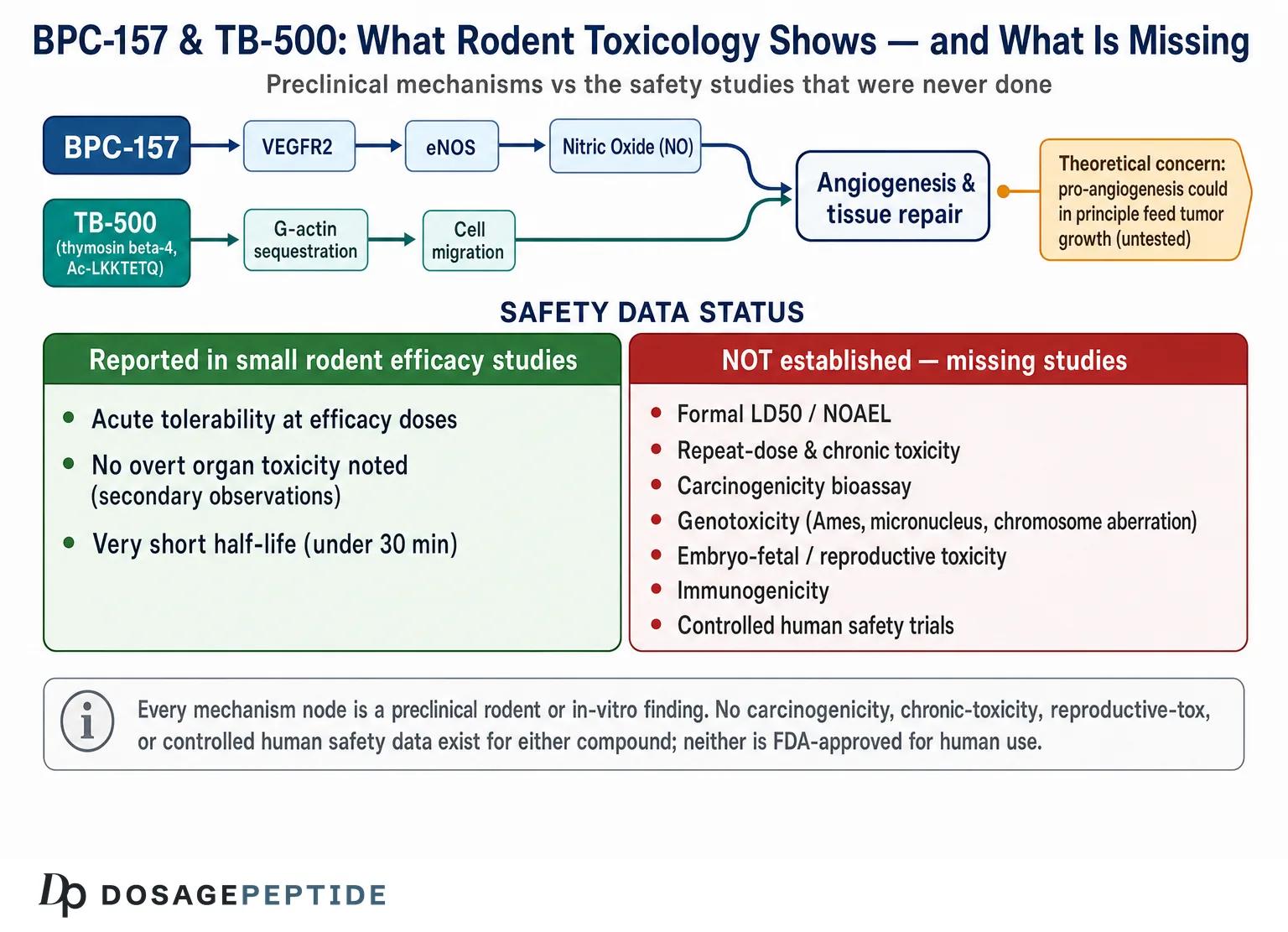
Understanding the mechanisms is not an academic detour; it is where the most credible theoretical safety concerns actually originate. Both compounds converge, from different molecular starting points, on the same biological theme: the promotion of new blood-vessel formation (angiogenesis) and cell migration.
BPC-157: nitric oxide and the VEGFR2–eNOS axis
The best-characterized molecular account of BPC-157 centers on the vascular endothelium. In a mechanistic study using isolated vessels and endothelial cells, BPC-157 was shown to enhance the expression and endocytosis of the vascular endothelial growth factor receptor 2 (VEGFR2) and to activate a downstream Src–Caveolin-1–endothelial nitric oxide synthase (eNOS) signaling pathway.[3] Mechanistically, activation of Src kinase phosphorylates Caveolin-1, which releases eNOS from an inhibitory interaction and thereby increases nitric-oxide (NO) production; the study reported a roughly 1.35-fold rise in nitric oxide at a defined peptide concentration, with corresponding vasodilation and endothelial-cell migration. This NO- and VEGFR2-dependent activity is the proposed engine behind the peptide’s angiogenic and cytoprotective effects, and it dovetails with the broader “NO-system” framework advanced by the originating research group.[4]
TB-500 / thymosin beta-4: actin sequestration and repair
TB-500’s parent molecule, thymosin beta-4, is the major intracellular G-actin–sequestering peptide in eukaryotic cells — it binds monomeric actin and regulates the dynamics of the cytoskeleton.[6] When tissue is injured, the same molecule is thought to “moonlight” extracellularly as a repair signal, promoting endothelial-cell migration, angiogenesis, and re-epithelialization. Crucially, the seven-residue actin-binding motif that defines TB-500 (LKKTETQ) has itself been shown to be sufficient to promote angiogenesis, which is precisely why the fragment is used as a research chemical.[7] In animal wound models, full-length thymosin beta-4 accelerated re-epithelialization and wound contraction and increased collagen deposition and angiogenesis.[5]
Cytoprotection and the broader signaling picture
Beyond angiogenesis, BPC-157 is described in the primary literature as a cytoprotective and “organoprotective” agent — that is, it appears to stabilize cells and tissues against a range of insults rather than acting on a single receptor. The originating research group frames much of this activity around modulation of the nitric-oxide system, interactions with growth-factor and vascular pathways, and effects on injured tissue that persist despite the peptide’s brief plasma presence.[4] Additional efficacy work has proposed effects on neurotransmitter systems and a gut-brain axis, but these are efficacy-oriented findings and have not been paired with safety-pharmacology studies of the same systems. From a toxicology standpoint, a pleiotropic, multi-pathway mechanism is a double-edged observation: it may explain the broad tissue tolerability seen so far, but it also widens the surface area of biology that a complete safety program would need to interrogate, because a molecule that touches many pathways has many pathways through which an unintended long-term effect could emerge.
For thymosin beta-4, the intracellular role in actin regulation is fundamental cell biology, and its extracellular repair signaling has been tied to angiogenesis, cell migration, anti-inflammatory activity, and even cardiac tissue effects that motivated the injectable myocardial-infarction program.[6] The very ubiquity of the parent molecule is part of why the fragment is interesting — and part of why its long-term exogenous administration is hard to reason about from first principles.
The shared theme and why it matters for safety
Both agents, then, are pro-angiogenic and pro-migratory. That is exactly what makes them attractive for wound and tendon repair, and it is also the mechanistic basis for the single most important theoretical safety question about them — the cancer question examined in the next section. A mechanism that recruits blood supply and encourages cell movement is, by definition, a mechanism that a tumor could exploit. Establishing that the intended repair effect can be cleanly separated from that hazard is a matter for long-term studies that have not been done.
Is There a Cancer Risk? What the Mechanism Suggests
This is the area where the honest answer is “unresolved,” and where the evidence points in more than one direction — which is itself the point. Because neither compound has been through a carcinogenicity bioassay, the cancer question is answered today only by mechanistic inference and scattered laboratory findings, not by data designed to settle it.
On the concerning side, the parent molecule of TB-500 has a documented association with tumor biology. Thymosin beta-4 is overexpressed in several human cancers, and in colorectal cancer models its overexpression has been shown to induce cancer-cell migration and to promote metastasis through an ILK/IQGAP1/Rac1 signaling pathway, with elevated expression correlating with worse clinical outcomes.[9] Because the actin-binding, pro-angiogenic motif that drives this behavior is the very sequence marketed as TB-500, the mechanistic worry is not speculative hand-waving — it is grounded in the biology of the fragment itself. In a subject already harboring an occult malignancy, chronically supplying a pro-migratory, pro-angiogenic signal is a theoretically unfavorable intervention, and no long-term animal study has been conducted to exclude that risk.
For BPC-157, the in-vitro picture is more ambiguous and, in one respect, points the other way. Early cell-culture work in a human melanoma line reported that BPC-157 actually inhibited cell growth and attenuated VEGF signaling by reducing ERK phosphorylation via the MAPK pathway — an anti-mitogenic rather than pro-tumor effect in that specific model. That finding, however, is a single, largely unreplicated in-vitro observation in one cell line, cannot establish anti-cancer activity in any clinical sense, and does not generalize into a safety guarantee for a compound whose dominant in-vivo action is pro-angiogenic. The intellectually honest summary is this: BPC-157 and TB-500 both act through pathways with plausible bidirectional relationships to cancer; no carcinogenicity or tumor-promotion study has been completed for either; and the absence of such a study is a genuine gap, not a clean bill of health. Anyone framing the missing data as evidence of safety has the logic backwards.
What Side Effects Have Been Reported in People?
Here the TB-500-versus-thymosin-beta-4 distinction becomes decisive, and it is where a great deal of popular writing quietly overstates the evidence.
Full-length thymosin beta-4 has, in fact, been studied in humans — principally by a pharmaceutical developer that advanced it as an ophthalmic and injectable candidate. An ophthalmic formulation was evaluated in a Phase 2 randomized trial for severe dry-eye disease and was reported to be safe and well tolerated over the treatment period, with significant improvements in ocular signs and symptoms versus vehicle.[8] An intravenous formulation was also registered and studied for acute myocardial infarction, evaluating the safety and tolerability of injectable thymosin beta-4 in that patient population.[15] These are real, registered human studies — but they tested full-length thymosin beta-4 under controlled, pharmaceutical-grade conditions, for defined indications, using defined formulations. They are not evidence for the safety of a self-administered gray-market LKKTETQ fragment of uncertain purity.
For BPC-157, the human picture is thinner. Reviews from the originating group refer to the peptide having been used in small early-stage human studies in inflammatory bowel disease and other settings “with no reported toxicity,” but these were limited in size and scope and do not constitute the kind of controlled safety-and-tolerability program (single- and multiple-ascending-dose Phase 1 studies with systematic adverse-event capture) that establishes a human safety profile.[4] The practical reality is that neither BPC-157 nor the TB-500 fragment has a completed, independently verifiable controlled human safety trial as the substances are actually sold and used.
How Should “No Reported Toxicity” Be Interpreted?
The phrase “no reported toxicity” recurs throughout the peptide literature, and it is worth dismantling carefully, because the gap between what it says and what readers assume it means is where most safety misjudgments happen.
First, most of the tolerability observations for these compounds are byproducts of efficacy experiments, not results of dedicated toxicology studies. An experiment designed to show that BPC-157 heals a tendon is optimized to detect healing, not to detect a subtle rise in liver enzymes, a low-frequency arrhythmia, or a delayed immune reaction. Absence of a reported adverse effect in such a study is weak evidence of true safety, because the study was neither powered nor instrumented to find harm.
Second, sample sizes in this literature are small — typically a handful of rodents per group — which means only relatively common adverse effects could ever be detected. Rare but serious events are statistically invisible at these group sizes. Third, exposure durations are short. A repair study running days to a few weeks cannot reveal toxicity that requires months of exposure to manifest, which is exactly the timescale over which carcinogenic, fibrotic, or cumulative organ effects tend to appear. Fourth, a genuine NOAEL (no-observed-adverse-effect level) is a defined regulatory quantity derived from studies specifically designed to find the dose below which no adverse effect occurs; casually observing “no adverse effect” in an efficacy study is not the same thing and should not be reported as if it were. Finally, publication and reporting patterns in a field dominated by a small number of enthusiastic laboratories can skew the visible record toward favorable findings.
There is one more subtle trap worth naming, specific to the thymosin-beta-4 side of the discussion. Because thymosin beta-4 is a naturally occurring peptide present in nearly every human cell, it is sometimes argued that supplementing a fragment of it must be inherently safe — “the body already makes it.” That reasoning does not hold. Endogenous concentrations are tightly regulated in space and time, whereas exogenous administration of a synthetic fragment delivers a pharmacological bolus that bypasses those controls, and the fragment’s distribution and immunogenicity need not mirror the parent molecule’s. Physiological presence at regulated levels is not evidence for the safety of supraphysiological, externally dosed exposure — and the parent molecule’s documented associations with tumor-cell migration are a reminder that “natural” and “harmless” are not synonyms.[9]
None of this means BPC-157 or TB-500 is toxic. It means the correct reading of the current record is “no toxicity has been demonstrated in a limited, mostly-efficacy-driven preclinical literature” — a statement about the limits of the evidence, not a positive finding of safety. Treating the two as equivalent is the central error this article exists to correct.
What Research Models Underlie These Findings, and How Do They Constrain Safety Inference?
The type of animal model used shapes what a study can and cannot say about safety, and the models behind the BPC-157 and TB-500 literature were overwhelmingly built to demonstrate repair, not to hunt for harm. Recognizing this is essential to weighting the evidence correctly.
The dominant designs are injury-and-recovery models: chemically or surgically induced gastric ulcers, transected or crushed tendons and muscles, experimental colitis, ligated vessels, and various organ-lesion preparations in rats and mice. In each case the peptide is given to a damaged animal and the readout is how much faster or more completely the lesion resolves. These are excellent for detecting a pro-healing signal, but they are structurally poor at detecting toxicity, for three reasons. First, the animals are already perturbed, so a healthy baseline against which to judge subtle systemic harm is often absent. Second, the endpoints and instrumentation are aimed at the target tissue, not at a comprehensive safety panel. Third, the observation window closes when healing is assessed — typically days to a few weeks — long before slow toxicities would surface.
Species and strain choices add further limits. Findings in mice, rats, rabbits, and dogs are a reasonable multi-species foundation, but rodents and dogs can differ from humans in metabolism, immune recognition of a foreign peptide, and susceptibility to particular toxicities; a peptide that is immunologically quiet in a rat is not guaranteed to be quiet in a human, whose immune system may recognize the sequence or its impurities differently. Dose-route diversity is a genuine strength of the BPC-157 record — oral, intraperitoneal, intramuscular, and intravenous administration have all been studied — yet route breadth does not compensate for duration and endpoint narrowness. The honest synthesis is that the research models were fit for their purpose (showing repair) and are simply the wrong instrument for the question this article asks (establishing safety). Using repair-model tolerability as a safety verdict is a category error, however tempting the clean results make it.
What Are the Real Risks Beyond the Molecule Itself?
Even if one accepted the most optimistic reading of the intrinsic-toxicity data, a separate and very real category of hazard would remain: the quality of the material itself. Research-grade peptides are not manufactured, tested, or released under the controls that govern approved medicines, and this introduces risks that have nothing to do with the peptide sequence and everything to do with what is actually in the vial.
- Sequence and identity errors. Independent testing of gray-market peptide products has repeatedly found vials whose contents do not match the label — incorrect sequences, truncated chains, or substantially lower peptide content than stated. A vial labeled BPC-157 or TB-500 is not guaranteed to contain what it claims.
- Synthesis impurities. Solid-phase peptide synthesis can leave behind truncated or deletion sequences, racemized residues, and residual solvents. Impurities can carry their own biological activity and toxicity independent of the intended peptide.
- Endotoxin and microbial contamination. Products not manufactured and tested to injectable standards may carry bacterial endotoxin above safe thresholds, a hazard entirely separate from the peptide’s pharmacology.
- Immunogenicity. Synthetic peptides and their impurities can provoke immune responses; the U.S. Food and Drug Administration has specifically cited unassessed immunogenicity as a concern for this class.[10]
- Reconstitution and dosing variability. Because these are lyophilized powders reconstituted by the end user, dose accuracy depends on correct reconstitution and measurement — a source of error independent of the compound. For the arithmetic behind reconstituting a lyophilized peptide, the site’s peptide reconstitution guide and dosage calculator are neutral educational references, and a compound-specific BPC-157 and TB-500 dosing reference documents how these figures appear in the research literature.
These are not fringe concerns. The FDA’s own actions on this class have cited impurities, insufficient safety characterization, and immunogenicity risk as reasons for caution.[10] In practical terms, product-quality hazards may pose a more immediate real-world risk than the intrinsic pharmacology of the peptides themselves.
How Does the Toxicology Data Landscape Compare Between the Two Compounds?
The table below summarizes the state of the preclinical and human safety record for each compound. It is deliberately framed around what has and has not been done, because the gaps are as informative as the findings.
| Safety domain | BPC-157 | TB-500 (LKKTETQ fragment) / thymosin β4 |
|---|---|---|
| Acute lethality (LD50) | No lethal dose established across wide dose ranges and routes; LD1 not obtainable | No dedicated fragment LD50 reported; acute tolerability inferred largely from full-length Tβ4 |
| Formal multi-species tox study | One structured study (mice, rats, rabbits, dogs), 2020 | No equivalent structured package for the synthetic fragment |
| Genotoxicity battery | Reported negative (Ames, chromosome aberration, micronucleus) | No dedicated fragment genotoxicity battery identified |
| Reproductive / embryo-fetal | No embryo-fetal toxicity in tested models; full DART program not completed | Not established for the fragment |
| Chronic toxicity (months) | Not completed | Not completed |
| Carcinogenicity bioassay | Not completed; mechanistic cancer question open | Not completed; parent molecule linked to tumor migration/metastasis in models |
| Pharmacokinetics / ADME | Characterized in rats and dogs (half-life <30 min; rapid metabolism) | Limited fragment-specific PK; parent Tβ4 better studied |
| Controlled human safety trials | Only small, limited early studies; no completed controlled Phase 1 program | Human trials exist for full-length Tβ4 (ophthalmic, IV), not the marketed fragment |
| Regulatory approval | None; unapproved drug | None; unapproved drug |
The comparison makes the central asymmetry visible. BPC-157 has more structured preclinical toxicology behind it than the TB-500 fragment does, but neither has the long-duration and carcinogenicity data that a safety conclusion would require, and the human evidence that does exist for the “TB-500” label actually belongs to a different, pharmaceutical-grade molecule.
What Is the Current Regulatory and Anti-Doping Status?
Regulatory posture is part of the safety picture because it reflects how expert agencies weigh the same evidence. The consistent message from regulators and anti-doping authorities is caution, not endorsement.
In the United States, neither BPC-157 nor TB-500/thymosin beta-4 is an approved drug, and both have been treated as substances of concern in the drug-compounding framework — but that framework has been in flux, and it is worth stating the current status precisely rather than repeating a snapshot that is now out of date. Beginning in 2023 the FDA placed BPC-157, along with TB-500 and a number of other peptides, into the interim “Category 2” of bulk drug substances that may present significant safety risks when used in compounding, citing incomplete safety information, potential impurities, and immunogenicity concerns.[10] In April 2026 the agency then removed BPC-157, TB-500, and roughly a dozen related peptides from that interim Category 2 list. It is essential not to misread that move: removal from the significant-risk category is not an approval, does not establish safety, and does not by itself authorize compounding — the agency framed it as a procedural step ahead of a formal advisory review, not as a safety endorsement. The separate, positive framework governing which bulk substances may lawfully be used in 503A compounding continues to be maintained by the agency and still does not include these peptides as approved entries.[11]
At its meeting on July 23–24, 2026, the Pharmacy Compounding Advisory Committee reviewed BPC-157, TB-500, and several other peptides for possible inclusion on the 503A bulk-substances list, and the agency’s own briefing documents proposed not adding them — citing that the substances are not well characterized, that there is little or no human evidence of effectiveness for the proposed routes, and that human safety data, including immunogenicity risk, are insufficient. Committee recommendations are advisory and non-binding, and any formal listing change would require notice-and-comment rulemaking, so the regulatory question is not fully settled. But the direction of expert opinion is unambiguous: as of this writing, neither peptide is an approved drug, neither sits on the positive 503A list, and the agency’s stated position is that the safety and effectiveness case has not been made.
In sport, both compounds are prohibited. The U.S. Anti-Doping Agency has explicitly warned that BPC-157 is an experimental, non-approved substance that is prohibited at all times for athletes, and both peptides appear as prohibited substances under the World Anti-Doping Agency framework — BPC-157 as a non-approved substance and thymosin beta-4/TB-500 within the peptide-hormone and growth-factor category.[12][13] Defense-affiliated consumer-safety programs have likewise flagged BPC-157 as a prohibited peptide and an unapproved drug appearing in wellness products.[14] None of this is a toxicology finding in itself, but it reflects a uniform expert judgment that the safety case has not been made.
What Is Still Missing Before Anyone Could Call This Safe
It is useful to name explicitly what is missing, because “more research is needed” is too vague to be actionable. For either compound to move from “no toxicity demonstrated” to “safety established” for a defined use, the following would ordinarily be required — and none of it is presently complete in the public record for these substances as sold:
- GLP-compliant repeated-dose toxicity of adequate duration — typically up to chronic (6- to 12-month) studies in a rodent and a non-rodent species, with full clinical pathology and histopathology, to detect cumulative organ effects.
- A two-year rodent carcinogenicity bioassay (or an accepted alternative program), which is the specific study type that the pro-angiogenic mechanism makes non-negotiable.
- A full reproductive and developmental toxicity (DART) program, covering fertility, embryo-fetal development, and pre-/post-natal development, rather than a single embryo-fetal observation.
- Dedicated safety-pharmacology studies covering cardiovascular (including hERG/QT), respiratory, and central-nervous-system function.
- Immunogenicity and immunotoxicity characterization, given that peptides and their impurities can provoke immune responses — a point regulators have specifically raised.
- Controlled human Phase 1 safety and tolerability trials (single- and multiple-ascending-dose) using pharmaceutical-grade material with systematic adverse-event capture — the step that would finally distinguish tolerability in rodents from safety in people.
- Chemistry, manufacturing, and controls (CMC) standardization, so that “BPC-157” or “TB-500” refers to a defined, consistent, purity-verified substance rather than a variable gray-market product.
Until that program exists, the accurate scientific statement is that BPC-157 and TB-500 have an encouraging but incomplete preclinical tolerability record, a mechanistically-grounded open question around cancer, and no established human safety profile — and that the material most people can actually obtain carries product-quality risks layered on top of the pharmacological unknowns.
Frequently Asked Questions
Is BPC-157 proven safe because researchers cannot find a lethal dose?
No. The inability to establish an LD50 or LD1 shows a high acute margin, but acute lethality is the crudest toxicology endpoint. It says nothing about organ injury below the lethal ceiling, immune reactions, or effects that require months to appear. A high acute margin is one reassuring data point, not a completed safety assessment, and it does not translate into demonstrated human safety.[4]
Has BPC-157 ever had a formal toxicology study?
Yes — one. A 2020 multi-species study in mice, rats, rabbits, and dogs reported that BPC-157 was well tolerated, was negative in the genotoxicity battery, and showed no embryo-fetal toxicity in the models used, with only a dose-dependent creatinine change flagged.[1] It is a genuine strength, but it does not include chronic-toxicity, carcinogenicity, or full reproductive-toxicity programs, so it cannot by itself establish safety.
Is TB-500 the same thing as thymosin beta-4?
No, and the difference matters for safety. TB-500 is a synthetic seven-amino-acid fragment (LKKTETQ) corresponding to the actin-binding region of thymosin beta-4, a natural 43-residue peptide.[7] Human clinical trials were conducted with full-length thymosin beta-4, not the marketed fragment, so safety data for one should not be assumed to transfer to the other.
Do BPC-157 or TB-500 cause cancer?
There is no completed carcinogenicity study for either, so the question is unresolved. The concern is mechanistic: both promote angiogenesis and cell migration, and thymosin beta-4 (the parent of TB-500) can induce cancer-cell migration and metastasis in colorectal models.[9] A single in-vitro study reported BPC-157 inhibiting melanoma-cell growth, but that does not establish anti-cancer or pro-cancer effects in living animals.
Are BPC-157 and TB-500 approved for human use?
No. Neither is approved by the FDA or comparable authorities, and both are treated as unapproved drugs. The FDA previously placed BPC-157 among bulk substances flagged as potentially presenting significant safety risks in compounding — citing incomplete safety data, possible impurities, and immunogenicity — and although it removed the peptide from that interim risk category in April 2026, its briefing documents for the July 2026 advisory review still proposed against listing it for 503A compounding, reiterating that its safety and effectiveness are not established.[10] Both are also prohibited in sport under anti-doping rules.
Why does product purity matter as much as the peptide itself?
Because research-grade peptides are not made or tested to medicine standards. Independent testing of gray-market products has found mislabeled sequences, synthesis impurities, and endotoxin above safe thresholds. These quality problems can pose risks entirely separate from the peptide’s pharmacology, which is one reason regulators cite impurities and immunogenicity as specific concerns for this class.[10]
What does the pharmacokinetic data add to the safety discussion?
BPC-157 is cleared from blood within minutes and is broken down into ordinary amino acids, with little tissue accumulation.[2] That argues against toxic bioaccumulation, which is reassuring. But it also means the durable effects seen in studies come from a brief signaling trigger whose long-term consequences of repeated activation have not been mapped — so fast clearance reduces one hazard without resolving the chronic-exposure question.
Is animal safety data enough to conclude these peptides are safe in people?
No. Rodent tolerability is a necessary early step, not a substitute for human safety data. Small group sizes miss rare events, short study durations miss delayed toxicity, and efficacy studies are not instrumented to detect harm. Establishing human safety would require controlled ascending-dose trials with systematic adverse-event capture, which have not been completed for either compound as sold.
References
- Xu C, Sun L, Ren F, et al. Preclinical safety evaluation of body protective compound-157, a potential drug for treating various wounds. Regul Toxicol Pharmacol. 2020;114:104665. https://pubmed.ncbi.nlm.nih.gov/32334036/
- He L, Feng D, Guo H, et al. Pharmacokinetics, distribution, metabolism, and excretion of body-protective compound 157, a potential drug for treating various wounds, in rats and dogs. Front Pharmacol. 2022;13:1026182. https://pmc.ncbi.nlm.nih.gov/articles/PMC9794587/
- Hsieh MJ, Lee CH, Chueh HY, et al. Modulatory effects of BPC 157 on vasomotor tone and the activation of Src-Caveolin-1-endothelial nitric oxide synthase pathway. Sci Rep. 2020;10:17078. https://pmc.ncbi.nlm.nih.gov/articles/PMC7555539/
- Seiwerth S, Milavic M, Vukojevic J, et al. Stable Gastric Pentadecapeptide BPC 157 and Wound Healing. Front Pharmacol. 2021;12:627533. https://pmc.ncbi.nlm.nih.gov/articles/PMC8275860/
- Malinda KM, Sidhu GS, Mani H, et al. Thymosin beta4 accelerates wound healing. J Invest Dermatol. 1999;113(3):364–368. https://pubmed.ncbi.nlm.nih.gov/10469335/
- Goldstein AL, Hannappel E, Kleinman HK. Thymosin beta4: actin-sequestering protein moonlights to repair injured tissues. Trends Mol Med. 2005;11(9):421–429. https://pubmed.ncbi.nlm.nih.gov/16099219/
- Philp D, Huff T, Gho YS, Hannappel E, Kleinman HK. The actin binding site on thymosin beta4 promotes angiogenesis. FASEB J. 2003;17(14):2103–2105. https://pubmed.ncbi.nlm.nih.gov/14500546/
- Sosne G, Dunn SP, Kim C. Thymosin β4 significantly improves signs and symptoms of severe dry eye in a phase 2 randomized trial. Cornea. 2015;34(5):491–496. https://pubmed.ncbi.nlm.nih.gov/25826322/
- Tang MC, Chan LC, Yeh YC, et al. Thymosin beta 4 induces colon cancer cell migration and clinical metastasis via enhancing ILK/IQGAP1/Rac1 signal transduction pathway. Cancer Lett. 2011;308(2):162–171. https://pubmed.ncbi.nlm.nih.gov/21621326/
- U.S. Food and Drug Administration. Certain Bulk Drug Substances for Use in Compounding That May Present Significant Safety Risks. https://www.fda.gov/drugs/human-drug-compounding/certain-bulk-drug-substances-use-compounding-may-present-significant-safety-risks
- U.S. Food and Drug Administration. Bulk Drug Substances Used in Compounding Under Section 503A of the FD&C Act. https://www.fda.gov/drugs/human-drug-compounding/bulk-drug-substances-used-compounding-under-section-503a-fdc-act
- U.S. Anti-Doping Agency. BPC-157: Experimental Peptide Creates Risk for Athletes. https://www.usada.org/spirit-of-sport/bpc-157-peptide-prohibited/
- World Anti-Doping Agency. The Prohibited List. https://www.wada-ama.org/en/prohibited-list
- Operation Supplement Safety (U.S. Department of Defense). BPC-157: A prohibited peptide and an unapproved drug found in health and wellness products. https://www.opss.org/article/bpc-157-prohibited-peptide-and-unapproved-drug-found-health-and-wellness-products
- ClinicalTrials.gov. A Study of the Safety and Efficacy of Injectable Thymosin Beta 4 for Treating Acute Myocardial Infarction (NCT01311518). https://clinicaltrials.gov/study/NCT01311518