No human trial has tested BPC-157 for tendonitis. Every result showing faster tendon healing comes from rats or from tendon cells in a dish, and as of 2026 the compound has no regulatory approval in any country for any indication.15 There is therefore no long-term human safety or efficacy dataset on which the phrase “long-term tendonitis therapy” could rest.
That does not make the preclinical work worthless. In rodent models BPC-157 improved tendon healing measures, and in cell culture it increased tendon fibroblast migration and survival and upregulated the growth hormone receptor. Those are reproducible findings with a plausible mechanism. But rodent surgical models mostly reproduce acute tendon transection, not the chronic, degenerative overuse condition people actually mean by tendonitis — and the first human trial of BPC-157 only began recruiting in 2025, in acute hamstring strain, a different injury again.8
Below: what BPC-157 is, the proposed repair mechanism, what each study level does and does not establish, how it compares with treatments that have human evidence, the safety picture, and its status in sport and regulation.
What BPC-157 Is and Where It Came From
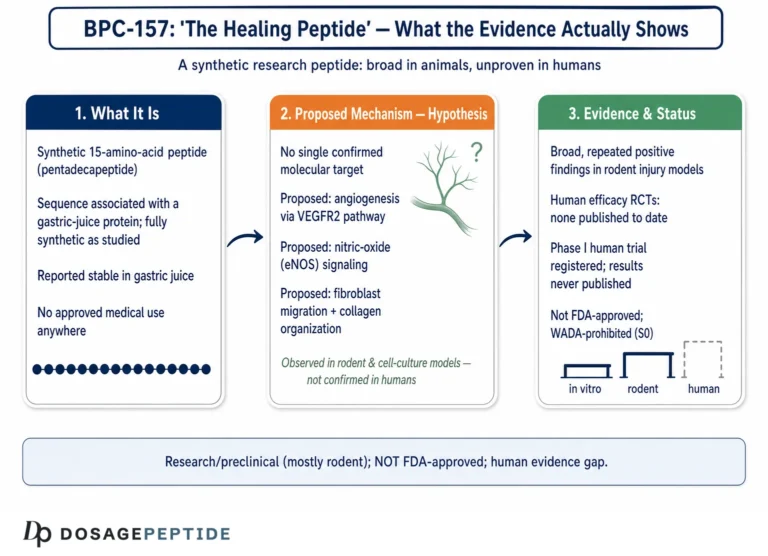
BPC-157 — the initials stand for “Body Protection Compound” — is a synthetic peptide fifteen amino acids long, which is why the literature almost always calls it a “stable gastric pentadecapeptide.” Its sequence (Gly-Glu-Pro-Pro-Pro-Gly-Lys-Pro-Ala-Asp-Asp-Ala-Gly-Leu-Val) was derived from a larger protein reportedly identified in human gastric juice, and it was first characterized and studied by the research group of Predrag Sikiric and colleagues in Croatia beginning in the early 1990s.56 It is important to be precise here: BPC-157 is not itself a natural human peptide that circulates in your body. It is a laboratory-synthesized fragment whose design was inspired by a gastric protein. That distinction matters because marketing copy frequently blurs it, implying that BPC-157 is simply “something your body already makes.”
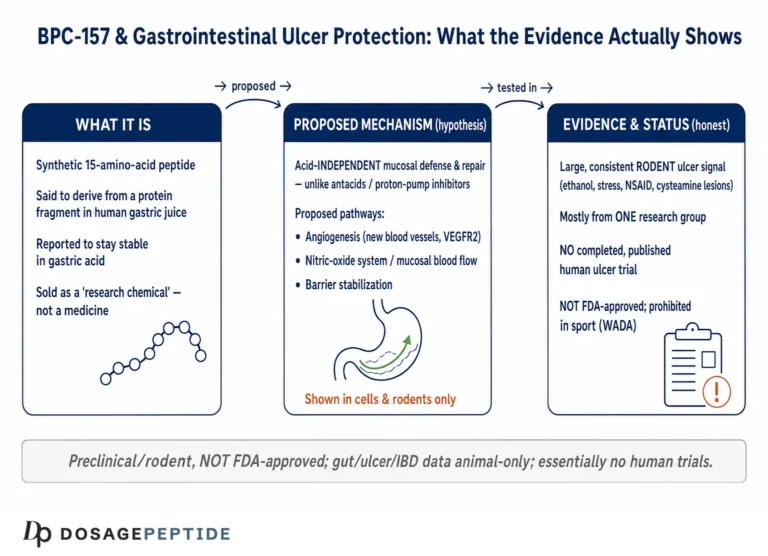
The feature that made BPC-157 unusual among research peptides is its reported stability. Most peptides are fragile — they are chopped apart quickly by digestive enzymes and by proteases in blood and tissue, which is why the majority of peptide drugs must be injected and cannot survive the stomach. BPC-157, by contrast, has been reported to remain intact in human gastric juice for extended periods, a property attributed in part to structural features of its proline-rich sequence that disrupt the geometry enzymes normally use to cleave peptide bonds.5 This claimed gastric stability is the origin of the frequent assertion that BPC-157 is orally active. That claim is grounded in rodent oral-dosing experiments, not in validated human pharmacokinetic studies, so its real-world relevance to a person remains unestablished.
Across roughly three decades, the Sikiric group and a smaller number of collaborators published a large volume of animal work reporting that BPC-157 accelerated healing in a striking range of tissues: gastric and intestinal ulcers, skin wounds, muscle, bone, ligament, nerve, and — central to our topic — tendon.5 A 2025 literature and patent review catalogued this breadth and framed BPC-157 as a “multifunctional” cytoprotective agent.5 The very breadth of reported effects is a double-edged observation. On one hand, a shared upstream mechanism (discussed below) could plausibly touch many tissues. On the other, a compound reported to help virtually every organ system through the same mechanism should invite scientific caution, because such universal claims are historically a warning sign that effect sizes may be model-dependent or that publication has been concentrated in a small number of labs.
It is also worth naming what BPC-157 is not. It is not a growth hormone, not an anabolic steroid, and not a corticosteroid. It does not appear in any pharmacopeia as an approved active ingredient. In practical terms, essentially every vial of BPC-157 available to consumers today is sold as a “research chemical,” produced outside the pharmaceutical quality systems that govern approved drugs. For readers who want the compound-level background and the way it is characterized on this site, our BPC-157 reference overview covers its research framing and formats. Understanding the origin story is the first guard against overinterpretation: a peptide with an interesting discovery narrative and decades of animal papers is still, in regulatory and clinical terms, an unapproved investigational substance.
The Molecular Mechanism Proposed for Tendon Repair
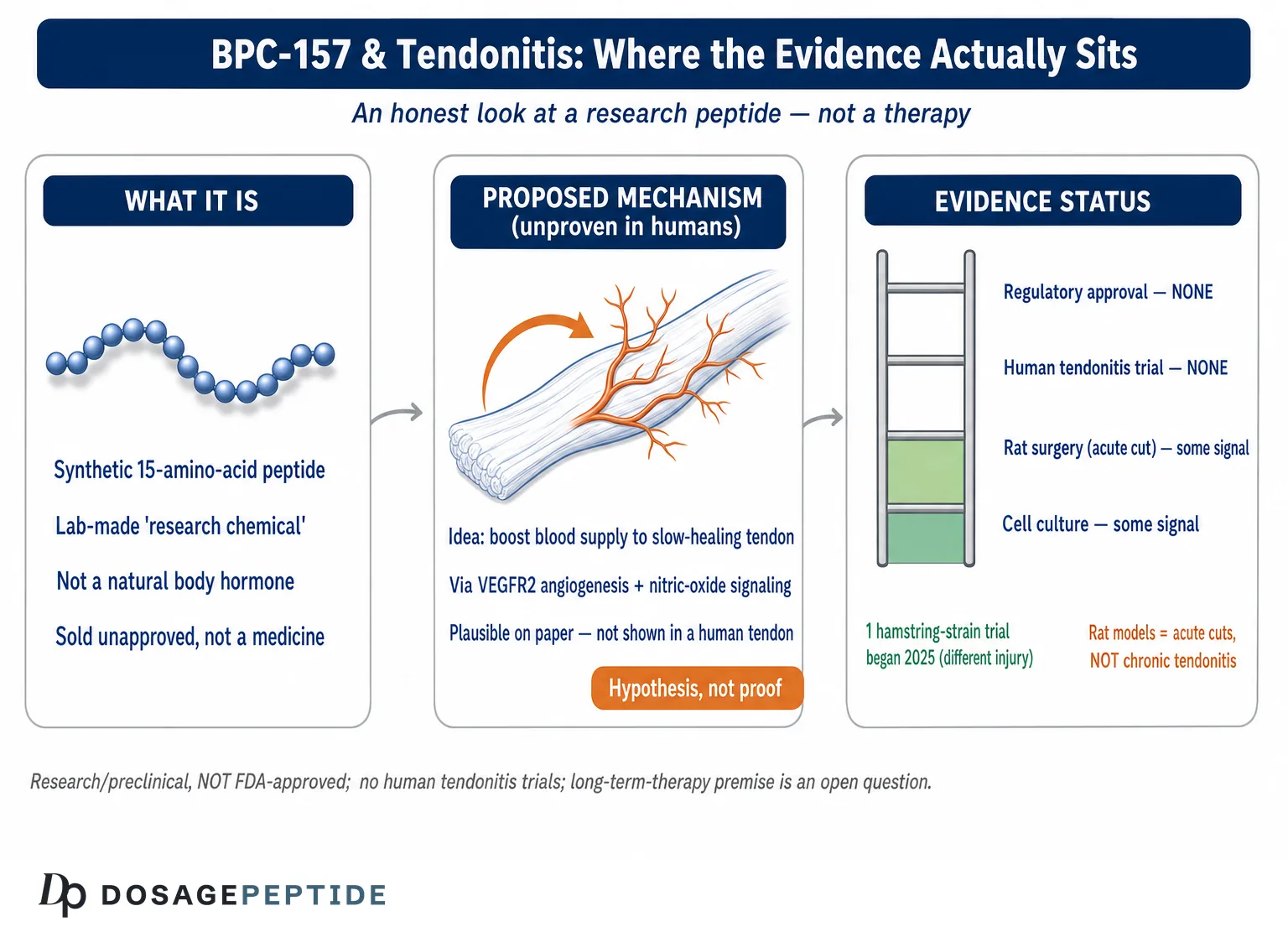
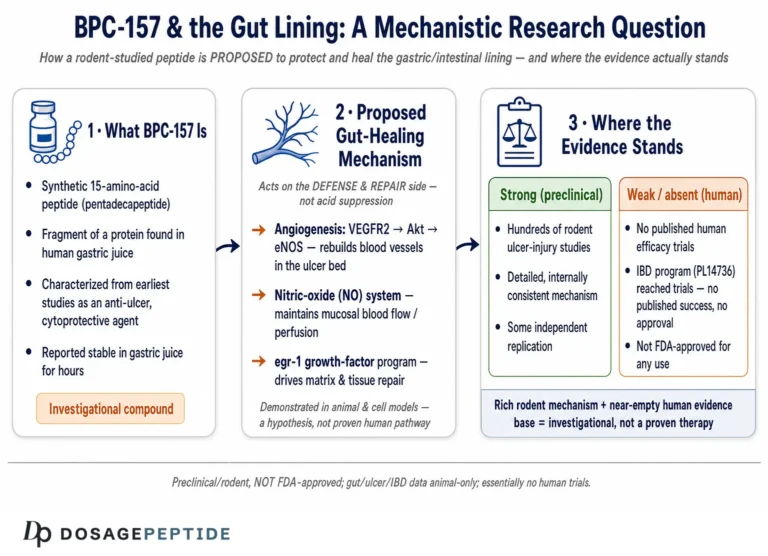
To evaluate whether BPC-157 could plausibly influence tendon tissue, it helps to understand the mechanisms researchers have proposed — while keeping in mind that a plausible mechanism is not the same as a demonstrated clinical effect. Many compounds with elegant proposed mechanisms fail when tested in humans. With that caveat, the preclinical mechanistic story for BPC-157 centers on angiogenesis, nitric oxide signaling, and growth-factor pathways.
The most frequently cited pathway is the vascular endothelial growth factor (VEGF) axis, specifically VEGF receptor 2 (VEGFR2). In cell and animal studies, BPC-157 has been reported to promote VEGFR2 activation and internalization in association with the VEGFR2–Akt–eNOS signaling cascade, apparently without requiring the usual external ligands or mechanical shear stress that normally trigger this pathway.6 Because VEGFR2 signaling drives the formation of new blood vessels (angiogenesis), the proposed narrative is that BPC-157 improves blood supply to injured tissue. Tendon is a notably poorly vascularized tissue, and inadequate blood flow is one classical reason tendons heal slowly and incompletely. A compound that enhanced local angiogenesis could, in theory, address part of that bottleneck — which is precisely why the mechanism is attractive on paper.
Closely linked is the nitric oxide (NO) system. Nitric oxide, generated by nitric oxide synthase (NOS) enzymes, regulates vasodilation, blood flow, and inflammatory signaling. Preclinical work describes BPC-157 as a modulator of the NO system that engages a self-reinforcing loop in which eNOS activation and VEGF transcription amplify one another, sustaining angiogenic signaling at an injury site.6 The 2025 mechanistic review from the originating research group frames this NO–angiogenesis interplay as the “special beneficial pleiotropic effect” underlying much of BPC-157’s reported activity.6
A third strand is specific to tendon cells. In vitro experiments on cultured tendon fibroblasts reported that BPC-157 upregulated the growth hormone receptor: growth hormone receptor emerged as one of the most abundantly increased genes, with dose- and time-dependent rises at both the mRNA and protein level.3 The practical consequence proposed is a form of sensitization — BPC-157–treated tendon fibroblasts became more responsive to growth hormone, which in turn increased their proliferation.3 Additional experiments reported that BPC-157 accelerated the outgrowth of tendon explants and improved cell survival under oxidative (hydrogen peroxide) stress, even though it did not directly increase the proliferation rate of already-healthy fibroblasts in standard assays.2 In other words, the in vitro signal looked less like a raw growth stimulant and more like a survival-and-migration effect that could matter during the stressful early phase of repair.
Other reported contributors include ERK1/2 signaling, effects on fibroblast migration, and anti-inflammatory actions. The honest synthesis is that BPC-157 is described as touching several overlapping repair pathways at once rather than acting through a single clean target. That multi-pathway picture is mechanistically interesting but also harder to validate, because it is difficult to isolate which pathway, if any, drives a given outcome. Crucially, all of this mechanistic work is preclinical — cell culture and rodents. None of it demonstrates that the same signaling occurs at meaningful levels in a human tendon, let alone in a chronically inflamed or degenerated one. Mechanism explains why researchers find the compound worth studying; it does not establish that it works.
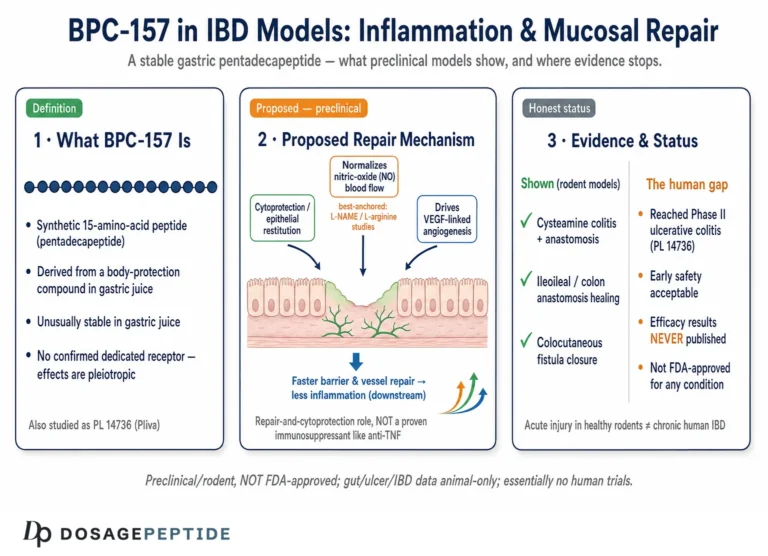
A further mechanistic wrinkle deserves attention because it is frequently glossed over in promotional material: BPC-157 has no confirmed cellular receptor. Unlike a hormone that docks onto a well-characterized, named receptor to trigger a defined cascade, BPC-157’s proposed effects are described as emerging from modulation of downstream signaling systems (the NO and VEGF pathways among them) rather than from binding a single identified target on the cell surface. This is not disqualifying — plenty of bioactive molecules act through indirect or pleiotropic means — but it does mean the mechanism is inferred from observed downstream changes rather than mapped from a receptor outward. When a compound’s mechanism is reconstructed backward from its effects rather than forward from a target, the risk of overfitting a tidy story to messy data rises, and independent mechanistic replication becomes even more important. Readers should therefore treat the mechanism section of any BPC-157 discussion, including this one, as a description of plausible and partially evidenced pathways, not as a validated map of how the compound would act in a human tendon.
It also matters that mechanistic strength and clinical strength are independent axes. The pharmaceutical graveyard is full of molecules with beautiful, well-understood mechanisms that failed in trials, and of approved drugs whose mechanisms remained murky for years. For a lay reader, the practical implication is that an elaborate, confident-sounding mechanistic narrative — VEGFR2 internalization, eNOS feedback loops, growth-hormone-receptor sensitization — can create an impression of scientific maturity that the clinical evidence does not match. The mechanism is arguably the strongest part of the BPC-157 story; the human outcomes are the weakest. Keeping those two facts side by side is the antidote to being oversold.
What the Tendon Evidence Actually Shows — and at What Level
This is the heart of the matter, so it deserves a blunt, honest accounting of the evidence hierarchy. Scientific evidence is not all equal. At the bottom sit cell-culture experiments; above them, animal studies; above those, small and then large human trials; and at the top, systematic reviews of high-quality randomized controlled trials. For BPC-157 and tendon, essentially all the supportive evidence lives in the bottom two tiers.
The tendon-specific preclinical record is real and reasonably consistent within its limits. In a 2008 rat study, surgical transection of the Achilles tendon-to-bone unit was followed by BPC-157 administration, and the peptide was reported to accelerate early functional recovery — measured by the Achilles functional index, myeloperoxidase activity, inflammatory cell influx, and vascular index — compared with saline and with methylprednisolone.1 A 2011 paper in the Journal of Applied Physiology reported that BPC-157 promoted tendon healing through tendon explant outgrowth, enhanced cell survival, and cell migration.2 A later study reported the growth-hormone-receptor upregulation mechanism described above.3 Additional rodent work extended similar findings to myotendinous junction and muscle-to-bone reattachment models.4 Taken together, these constitute a coherent preclinical signal that BPC-157 can influence tendon healing in rats and in cultured tendon cells.
But now the ceiling. A 2025 systematic review published in the American Journal of Sports Medicine set out to find every study of BPC-157 for orthopaedic sports-medicine applications. Of 544 articles screened, exactly one was a clinical study; the remaining included studies were animal models.7 The reviewers’ conclusion was that, despite BPC-157’s popularity and wide availability, human data are minimal.7 For tendonitis specifically, the count of controlled human trials is zero. There is no randomized, placebo-controlled human evidence that BPC-157 relieves tendon pain, improves tendon structure on imaging, or restores function in people with tendinopathy.
| Evidence tier | What exists for BPC-157 & tendon | Strength for a “therapy” claim |
|---|---|---|
| In vitro (cell culture) | Tendon fibroblast outgrowth, survival under stress, GH-receptor upregulation23 | Hypothesis-generating only |
| Animal (rodent surgery) | Achilles transection & myotendinous models report faster healing14 | Suggestive; poor human translation history |
| Human tendonitis RCT | None completed | Absent |
| Human trial (any indication) | 1 hamstring-strain RCT began recruiting 20258 | Not yet reported; different injury |
| Regulatory approval | None, anywhere9 | Absent |
There is one more subtlety worth flagging: much of the tendon literature comes from a small cluster of affiliated research groups, and independent replication in tendon-specific models by unrelated laboratories is thinner than the raw citation count suggests. Concentration of a literature within a few labs is not proof of error, but it is a recognized reason to withhold strong conclusions until independent groups reproduce the findings. The correct summary is therefore not “BPC-157 heals tendons” and not “BPC-157 does nothing.” It is: preclinical models generate a plausible, moderately consistent signal that has never been tested against the actual human condition this article’s title invokes.
Tendonitis Versus Tendon Rupture: What the Models Do and Don’t Represent
A frequently overlooked problem in the popular discussion of BPC-157 for “tendonitis” is that the animal evidence does not actually model tendonitis. This is not a pedantic distinction — it goes to the core of whether the preclinical data are even relevant to the titular question.
The rodent studies that report the most impressive results use acute surgical transection — the tendon is cut, and healing of a fresh, clean wound is measured over days.1 That is a model of acute traumatic injury and surgical repair. Tendonitis (more precisely, tendinopathy) is a different clinical entity: it is typically a chronic, overuse-driven condition characterized by degeneration of the tendon matrix, disorganized collagen, altered cell populations, neovascularization that is often maladaptive, and frequently little classical inflammation despite the “-itis” suffix. The pathology of a runner’s chronic Achilles tendinopathy or a climber’s finger pulley strain is biologically distinct from a scalpel cut healing in a laboratory rat.
Why does this matter for interpreting the evidence? Because a compound that accelerates the organized healing of an acute wound may behave very differently in chronically degenerated tissue. In fact, one of BPC-157’s headline mechanisms — promoting angiogenesis — could be a double-edged property in tendinopathy, where pathological neovascularization is itself considered part of the disease process and is sometimes a target for treatments that aim to reduce aberrant vessel and nerve ingrowth. It is entirely possible for a mechanism that helps an acute rupture to be neutral or even counterproductive in chronic tendinopathy. No study has resolved this question, because no study has applied BPC-157 to a validated chronic tendinopathy model with clinically relevant endpoints and reported it in the mainstream orthopaedic literature.
The distinction also affects how we read timelines. The rodent Achilles work measures outcomes over days to a few weeks — the acute healing window.1 The title of this article asks about long-term therapy. There is essentially no data addressing what happens to a tendon exposed to BPC-157 over months, whether any early benefit persists, whether tolerance develops, whether repeated angiogenic stimulation alters tendon architecture unfavorably over time, or whether chronic dosing carries risks that short studies cannot detect. The gap between “a peptide sped up a cut rat tendon over four days” and “a durable long-term human tendonitis therapy” spans multiple evidence tiers, a different disease process, and a different time horizon.
None of this means BPC-157 is irrelevant to tendon biology. It means that anyone citing the rodent transection studies as support for treating human tendonitis is making an inferential leap the data do not license. The models represent acute repair; the clinical target is chronic degeneration; and the two should not be silently equated. Honest evidence appraisal requires holding that mismatch in view.
How BPC-157 Compares to Established Approaches for Tendon Problems
Placing BPC-157 alongside the interventions that actually have human evidence helps calibrate expectations. Importantly, the comparison is not head-to-head — no trial has ever compared BPC-157 against these options in people — so this section contrasts evidence bases, not measured effectiveness.
The best-supported intervention for most tendinopathies is not a drug at all: it is structured, progressive loading exercise (eccentric and heavy-slow resistance protocols), supported by numerous randomized controlled trials and forming the backbone of physiotherapy guidelines. This is the standard against which any candidate therapy should ultimately be judged, and it is the standard BPC-157 has never been tested against. Notably, the one active human BPC-157 trial layers the peptide on top of a supervised rehabilitation protocol precisely because loading-based rehab is the accepted foundation of care.8
| Approach | Human evidence base | Regulatory standing |
|---|---|---|
| Progressive loading / eccentric exercise | Multiple RCTs; guideline-endorsed first line | Standard of care |
| NSAIDs | RCTs; short-term symptom relief, debated on healing | Approved |
| Corticosteroid injection | RCTs; short-term relief, possible worse long-term outcomes | Approved |
| Platelet-rich plasma (PRP) | Numerous RCTs; mixed/heterogeneous results | Procedure-regulated |
| Extracorporeal shockwave therapy | RCTs; moderate evidence in some tendinopathies | Cleared device |
| BPC-157 | Zero completed tendon trials; 1 ongoing hamstring RCT78 | Unapproved; removed from 503A Cat 2 in 2026, under PCAC review (not approved)14 |
The pattern is stark. Every established option in that table — even the imperfect ones like corticosteroid injection, which itself is associated with worse long-term tendon outcomes in some studies — sits on a foundation of human randomized data and regulatory clearance. BPC-157 sits on rodent surgery and cell culture. It is sometimes marketed as superior to these approaches, but there is no basis for a superiority claim because there is no comparative human data of any kind.
It is worth being fair to BPC-157 here as well, because the comparison cuts both ways. The established options are not uniformly impressive: corticosteroid injections can relieve pain short-term while potentially harming the tendon over the long run; NSAIDs are debated as to whether they help or hinder the actual healing process; and PRP, despite dozens of trials, has produced genuinely mixed and heterogeneous results that leave clinicians uncertain about when it helps. In other words, tendinopathy is a hard problem that even approved, evidence-backed interventions address imperfectly, which is precisely why the field keeps searching for better options and why a compound with a plausible pro-healing mechanism attracts interest. The legitimate takeaway is not that BPC-157 is worse than these alternatives — we cannot know that — but that it has not yet entered the arena where such comparisons are even possible. The established treatments have earned their place, imperfect as it is, by surviving human trials; BPC-157 has not yet been tested against a placebo in a tendon condition, let alone against an active comparator.
This also reframes what a reasonable person should want from the research. The interesting scientific question is not merely “does BPC-157 do anything?” but “does it add measurable benefit on top of the loading-based rehabilitation that already works?” That is exactly the design logic of the ongoing hamstring trial, which administers the peptide or placebo against a shared, supervised rehab backbone.8 A candidate therapy proves its worth not by helping in isolation but by beating placebo when both arms receive good standard care. Until BPC-157 clears that bar in a tendon-relevant human study, positioning it as an alternative or upgrade to established tendinopathy care is unsupported by evidence.
Within the research-peptide world, BPC-157 is frequently discussed alongside TB-500 (a fragment related to thymosin beta-4), and the two are often combined in research settings on the hypothesis that their mechanisms — angiogenesis and cell migration for BPC-157, actin regulation and cell motility for TB-500 — might be complementary. Readers curious about that pairing can review our explainer on the BPC-157 and TB-500 recovery blend and the corresponding BPC-157 + TB-500 10 mg blend dosage per day. It bears repeating that combining two unapproved research peptides does not multiply the evidence — it multiplies the uncertainty, since neither the individual compounds nor the combination has controlled human tendon data. The honest comparative takeaway is that BPC-157 is not a demonstrated alternative to established care; it is an unproven candidate at a much earlier stage of investigation than any option a clinician would actually recommend.
Research Models and Methodology: How These Studies Were Actually Run
Understanding how the supportive studies were conducted is essential to weighing them, because methodology determines how much a result can be trusted and generalized. The BPC-157 tendon literature has recognizable strengths and recognizable, consequential limitations.
On the design side, the flagship rodent studies used defined, reproducible injury models. In the 2008 Achilles study, seventy-two Wistar rats underwent standardized surgical transection of the Achilles tendon-to-bone area, with tissue harvested at set early timepoints and outcomes quantified through multiple methods — a functional index, an enzymatic marker of neutrophil activity (myeloperoxidase), histological scoring of inflammatory cell influx, and a vascular index.1 Comparators included saline and an active agent (methylprednisolone), which is more rigorous than a peptide-versus-nothing design. Dosing was intraperitoneal, once daily, at defined microgram-per-kilogram levels.1 The in vitro tendon work used cultured fibroblasts and explants with dose- and time-response characterization and molecular readouts (mRNA and protein), which is appropriate rigor for mechanism studies.23
Now the limitations, which are substantial. First, species and physiology: rats are not small humans. Rodent tendons heal faster and differently, and doses that work in a rat do not translate linearly to a person. Second, route and dose: much rodent work uses intraperitoneal injection at doses that, when naively scaled, bear little resemblance to what human users self-administer subcutaneously; the pharmacokinetics in humans are essentially uncharacterized in the peer-reviewed literature. Third, acute versus chronic: as detailed above, the models are acute-injury models, not chronic tendinopathy. Fourth, blinding and independence: a large share of positive tendon findings originates from a small network of affiliated investigators, and independent replication by unrelated groups — the mechanism by which science self-corrects — is limited. Fifth, publication and reporting: when a compound is reported to help nearly every tissue studied, and the negative or null results are hard to find in the literature, the possibility of publication bias must be taken seriously.
The single most important methodological development is that human testing has finally begun. The trial registered as NCT07437547 is a randomized, double-blind, placebo-controlled study of BPC-157 for acute grade II hamstring strain, planning to enroll roughly 120 participants randomized 1:1 to subcutaneous BPC-157 or matching placebo once daily for 14 days, layered on a standardized supervised rehabilitation protocol.8 Its co-primary endpoints are time to return to unrestricted sport and change in MRI-assessed injury volume at Day 14, with follow-up assessments out to several months for recurrence monitoring.8 This is exactly the kind of design the field has lacked. But note what it is and is not: it studies an acute muscle strain, not chronic tendonitis; it doses for two weeks, not long-term; and as of this writing its results have not been reported. Methodologically, then, BPC-157 is transitioning from a purely preclinical compound to one with a single early-phase human study underway — a meaningful step, but one that leaves the tendonitis question untouched.
Safety and Tolerability: What Is Known and What Isn’t
Safety discussions around BPC-157 are frequently distorted in both directions — boosters point to animal data suggesting a wide margin, while the absence of human safety trials means the true human risk profile is genuinely unknown. Both facts are true and must be held together.
On the reassuring side, rodent toxicology has struggled to find a lethal dose. Investigators reported administering BPC-157 at levels far exceeding standard research doses — into the milligram-per-kilogram range versus the usual microgram-per-kilogram — without producing fatalities, meaning a conventional LD50 was not established.5 Repeated-dosing rodent studies reported no clear signs of liver, kidney, or heart toxicity at research doses.5 Anecdotal reports from human users commonly describe mild, transient effects such as injection-site reactions, occasional nausea, lightheadedness, or headache. Taken at face value, the animal data suggest a wide acute margin.
On the sobering side, several caveats are decisive. First, animal safety is not human safety. A compound can be non-lethal in rats and still cause immunogenic, allergic, or idiosyncratic reactions in humans that only appear at population scale. The FDA specifically cited immunogenicity risk — the potential to trigger an immune response — as a concern for BPC-157.9 Second, angiogenesis cuts both ways. A compound that stimulates new blood-vessel growth raises a theoretical concern about effects on occult tumors or other pathological tissue that relies on angiogenesis; this has not been adequately studied in humans and cannot be dismissed. Third, and most immediately relevant, the actual product is often the biggest risk. Because consumer BPC-157 is sold as an unregulated research chemical, purity and identity are frequently poor: independent analyses of consumer-marketed research peptides have found substantial fractions with incorrect sequences and with endotoxin levels above safety thresholds.13 Regulatory and military supplement-safety programs have echoed these quality concerns.10 An impure or endotoxin-contaminated injectable is a real, present hazard independent of anything intrinsic to the peptide.
Finally, there is the total absence of long-term human safety data — which is exactly the timescale the title’s word “long-term” invokes. No published human study has followed people taking BPC-157 for months or years to detect delayed harms, cumulative effects, or interactions. The U.S. Department of Defense’s Operation Supplement Safety program lists BPC-157 as a prohibited peptide and an unapproved drug found in wellness products, explicitly warning service members against it.10 The intellectually honest safety summary is therefore layered: animal acute toxicity appears low; human safety is unstudied; product quality is a serious independent hazard; and long-term human safety is entirely unknown. “No lethal dose found in rats” is not a green light — it is one data point in a picture that is mostly blank where it matters most.
Handling and Reconstitution in a Research Context
Because BPC-157 exists legitimately only as a laboratory research material, it is worth describing how it is handled in that setting — strictly as context for understanding the literature and product forms, not as instructions for human use. Nothing in this section should be read as endorsing self-administration, which is not an approved or lawful medical use.
BPC-157 is typically supplied as a lyophilized (freeze-dried) white powder in a sealed vial, most commonly in 5 mg or 10 mg quantities. Lyophilization is used because the dry peptide is far more stable than a solution; in powder form and kept cold and dark, it can remain stable for extended periods. Reconstitution — dissolving the powder into a liquid — is performed in laboratory workflows using bacteriostatic water, added slowly against the vial wall rather than injected forcefully onto the powder, and the vial is swirled rather than shaken to avoid shearing the peptide. Once reconstituted, the solution is understood to be far less stable than the powder and is kept refrigerated. General storage guidance in research settings is to hold the lyophilized vial at roughly 2–8 °C (about 36–46 °F), protected from light, with longer-term storage sometimes at lower temperatures.
Concentration accounting is the part researchers treat most carefully, because it is where errors are easiest to make. The concentration of a reconstituted solution depends entirely on two numbers: the mass of peptide in the vial and the volume of diluent added. Adding 2 mL of bacteriostatic water to a 10 mg vial yields 5 mg/mL; adding 1 mL yields 10 mg/mL. Getting this arithmetic wrong by a factor of two or ten is a common laboratory error and is one reason careful documentation matters. For readers who want to see how these calculations are laid out conceptually, our general peptide reconstitution guide walks through the underlying math, and the dosage reference index catalogs how various research peptides are characterized by format.
| Parameter | Typical research-context handling |
|---|---|
| Physical form | Lyophilized white powder, sealed vial (commonly 5–10 mg) |
| Diluent used in labs | Bacteriostatic water, added slowly down the vial wall |
| Mixing | Gentle swirl, never vigorous shaking |
| Powder storage | ~2–8 °C, protected from light; colder for long term |
| Reconstituted storage | Refrigerated; markedly less stable than powder |
| Concentration | Mass in vial ÷ diluent volume added (document carefully) |
The essential caveat overrides all of the above: none of this handling knowledge changes the compound’s regulatory status or its lack of human efficacy evidence. A perfectly reconstituted, correctly stored, correctly calculated vial of a research chemical is still an unapproved substance with no established human tendonitis benefit. Handling competence is a laboratory skill, not a substitute for the clinical evidence that does not yet exist. Readers comparing product formats — for example single-peptide versus blended presentations such as TB-500 and BPC-157 combinations — should treat that entirely as characterization of research materials, not as guidance to use them.
Limitations and the Human-Evidence Gap
If this article makes one point, it is this: the distance between what has been shown and what is claimed for BPC-157 in tendonitis is enormous, and that gap is the whole story. It is worth naming the limitations explicitly and in aggregate, because each one alone might seem surmountable, but together they define why “long-term tendonitis therapy” is not a supportable description.
The wrong species. The supportive efficacy data are overwhelmingly rodent. History is full of compounds that healed rat tissue and did nothing in humans; the animal-to-human failure rate in translational medicine is high, and there is no reason to assume BPC-157 is exempt.
The wrong disease. As detailed earlier, the strongest animal models are acute surgical transections, not chronic tendinopathy. The clinical target implied by “tendonitis” is a degenerative overuse condition that the models do not reproduce, and whose biology may respond differently — or adversely — to BPC-157’s angiogenic mechanism.
The wrong timescale. Studies measure days to weeks; the title asks about long-term therapy. There is no data on months-long or years-long use in any species with tendon-relevant endpoints, and no long-term human safety follow-up at all.
No human efficacy data. The 2025 systematic review found a single clinical study among hundreds of BPC-157 orthopaedic papers, with the remainder being animal work.7 For tendonitis specifically, the number of completed controlled human trials is zero. The one active human trial studies acute hamstring strain, not tendonitis, and has not reported results.8
Concentrated, incompletely replicated literature. A large fraction of the positive tendon findings comes from a small set of affiliated groups. Independent replication in tendon models is thinner than the citation volume implies, and independent confirmation is the mechanism by which preliminary findings become reliable ones.
Product-quality confounding. Even setting aside biology, the consumer supply is an unregulated research-chemical market with documented rates of incorrect sequences and endotoxin contamination.1013 This means that even the anecdotal human experience circulating online is generated using products of unknown identity and purity, making it nearly worthless as evidence.
Put together, these limitations are not a list of minor asterisks — they are the reason the answer to the title’s question is, honestly, “the evidence does not support it, and cannot yet, because the necessary studies have not been done.” The appropriate posture is curiosity paired with restraint: the preclinical signal is real enough to justify the human trials now beginning, and nowhere near strong enough to justify calling BPC-157 a therapy. Anyone who tells you the science is settled — in either direction — is overreaching. It is an open question, and it should be described as one.
Regulatory Status: Unapproved, Restricted, and Prohibited in Sport
The regulatory picture is unusually clear and reinforces everything above. BPC-157 has no approved indication for human use in any major jurisdiction. It is not an FDA-approved drug, not an EMA-approved medicine, and not a dietary supplement ingredient lawfully marketed for a health claim. Legally and clinically, it is an investigational substance.
In the United States, the most consequential action came through the drug-compounding framework. Under Section 503A of the Federal Food, Drug, and Cosmetic Act, compounding pharmacies may prepare individualized medications from bulk drug substances that meet certain criteria. The regulatory history here has moved recently, and it is worth getting the sequence exactly right because it is widely misreported. Back in 2023, the FDA placed BPC-157 into “Category 2” of the 503A bulk-substances evaluation — the category for substances that present significant safety risks — citing concerns including immunogenicity, peptide-related impurities, and insufficient human safety data.9 The practical effect at that time was to keep BPC-157 out of legal compounding for human use. That 2023 placement, however, is now historical. Effective in April 2026, the FDA removed BPC-157 — along with a group of other peptides — from the 503A Category 2 list, and the compound was scheduled for review by the FDA’s Pharmacy Compounding Advisory Committee (PCAC) at its meeting on July 23–24, 2026.14 It is essential to read this development correctly, because it is easy to spin as vindication. Removal from Category 2 was a largely procedural step tied to a fresh review cycle; it is emphatically not an approval, and it does not place BPC-157 on the positive list of substances actually cleared for compounding. A PCAC review is an advisory committee weighing evidence and issuing a recommendation to the FDA — not a final rule, and not a marketing authorization.14 As of this writing (July 2026), the core fact remains exactly as it was before: there is no lawful, approved human therapeutic pathway for BPC-157 anywhere, and the compound sits in an unsettled, under-review status rather than a cleared one.
A recurring and legitimate question is why the definitive human trials have not been done, given decades of animal interest. Part of the answer is economic and structural: BPC-157 is a naturally-derived peptide sequence that is difficult to protect with strong composition-of-matter patents, which weakens the commercial incentive for a company to fund the expensive Phase 1–3 program required for approval.5 The absence of a well-funded development sponsor — not necessarily a hidden negative result — is a major reason the evidence base has stayed preclinical for so long. That is context, not exoneration; the practical status remains “unapproved.”
In sport, the status is unambiguous. BPC-157 is prohibited by the World Anti-Doping Agency, which lists it under class S0 (Non-Approved Substances) — a category banned at all times, both in and out of competition.11 Anti-doping authorities have specifically warned athletes against it, and it is treated as prohibited across organizations bound by WADA-aligned codes, including the NFL, UFC, and NCAA.12 Athletes subject to drug testing should understand that using BPC-157 risks sanctions regardless of the compound’s unsettled efficacy. Beyond sport, U.S. military guidance through the Operation Supplement Safety program flags BPC-157 as a prohibited, unapproved substance appearing in wellness products.10 The through-line across every regulatory and governing body is consistent: BPC-157 is treated as an unapproved research substance with recognized safety and quality concerns, not as an accepted therapy. That regulatory verdict is fully aligned with the scientific one this article has laid out — the evidence base is preliminary, and the compound has not earned the “therapy” label the title proposes.
Frequently Asked Questions
Is BPC-157 an FDA-approved treatment for tendonitis?
No. BPC-157 is not approved by the FDA for tendonitis or any other condition, in any form. In 2023 the FDA placed it in Category 2 of its 503A compounding evaluation — the tier for substances judged to present significant safety risks — citing immunogenicity, impurities, and inadequate human safety data.9 That placement was reversed in April 2026, when the FDA removed BPC-157 from Category 2 and scheduled it for Pharmacy Compounding Advisory Committee review on July 23–24, 2026.14 Crucially, that removal is a procedural step in an ongoing review — not an approval. BPC-157 remains an unapproved research substance, not a medicine.
Are there human clinical trials showing BPC-157 works for tendonitis?
No completed human tendonitis trials exist. A 2025 systematic review of BPC-157 in orthopaedic sports medicine found just one clinical study among hundreds of papers, with the rest being animal research.7 The first randomized, placebo-controlled human trial began recruiting in 2025, but it studies acute hamstring muscle strain — not chronic tendonitis — and has not reported results.8
What does the animal evidence actually show?
Rodent studies, mainly using surgically cut (transected) Achilles tendons, report that BPC-157 accelerated early functional recovery and reduced markers of inflammation, assessed through a functional index, myeloperoxidase activity, histological inflammatory-cell influx, and a vascular index.1 Cell studies report growth-hormone-receptor upregulation and improved tendon-cell survival and migration.23 This is a genuine preclinical signal, but it comes from acute-injury models in rats, which do not represent chronic human tendinopathy and have a poor track record of translating to people.
Does BPC-157’s mechanism make sense for tendons?
On paper, partly. The proposed mechanisms — VEGFR2-driven angiogenesis, nitric oxide signaling, and growth-factor sensitization — could plausibly address the poor blood supply that slows tendon healing.6 But a plausible mechanism is not proof of benefit, and in chronic tendinopathy, extra angiogenesis may not help and could even be counterproductive, since abnormal vessel ingrowth is part of that disease. Mechanism justifies studying the compound; it does not establish that it works.
Is BPC-157 safe to use long-term?
Unknown. Rodent toxicology failed to find a lethal dose even at very high levels, and animal studies reported no obvious organ toxicity at research doses.5 But there are no long-term human safety studies at all, the FDA flagged immunogenicity concerns,9 and the unregulated products sold to consumers frequently contain wrong sequences or unsafe endotoxin levels.10 “No lethal dose in rats” does not answer the long-term human safety question the word “long-term” implies.
Why haven’t proper human trials been done after 30 years?
Largely economics. BPC-157 is a naturally-derived peptide sequence that is hard to protect with strong patents, which removes much of the commercial incentive for a company to fund the expensive multi-phase trials needed for approval.5 The lack of a well-funded sponsor — rather than a hidden negative finding — is a major reason the evidence has remained preclinical, though that does not change its unapproved status.
Is BPC-157 allowed for competitive athletes?
No. BPC-157 is prohibited by the World Anti-Doping Agency under class S0 (Non-Approved Substances), banned at all times,11 and anti-doping authorities have warned athletes against it; it is treated as prohibited across organizations including the NFL, UFC, and NCAA.12 Athletes subject to testing risk sanctions from using it, independent of the unsettled question of whether it works.
So does the science support BPC-157 as a long-term tendonitis therapy?
No — and importantly, it cannot yet, because the necessary studies do not exist. There is a suggestive preclinical signal in rodents and cell culture, no completed human tendonitis trial, no long-term human data, no regulatory approval, and a real product-quality hazard.7910 The right description is an open research question at an early stage — not an established therapy.
References
- Krivic A, Anic T, Seiwerth S, et al. Modulation of early functional recovery of Achilles tendon to bone unit after transection by BPC 157 and methylprednisolone. Inflammation Research. 2008. PubMed ID 18594781. https://pubmed.ncbi.nlm.nih.gov/18594781/
- Chang CH, Tsai WC, Lin MS, Hsu YH, Pang JHS. The promoting effect of pentadecapeptide BPC 157 on tendon healing involves tendon outgrowth, cell survival, and cell migration. Journal of Applied Physiology. 2011. https://journals.physiology.org/doi/abs/10.1152/japplphysiol.00945.2010
- Chang CH, Tsai WC, Hsu YH, Pang JHS. Pentadecapeptide BPC 157 enhances the growth hormone receptor expression in tendon fibroblasts. PMC6271067. https://pmc.ncbi.nlm.nih.gov/articles/PMC6271067/
- Staresinic M, et al. Stable gastric pentadecapeptide BPC 157 as a therapy for the disabled myotendinous junctions in rats. PMC8615275. https://pmc.ncbi.nlm.nih.gov/articles/PMC8615275/
- Jozwiak M, et al. Multifunctionality and possible medical application of the BPC 157 peptide — literature and patent review. PMC11859134. https://www.ncbi.nlm.nih.gov/pmc/articles/PMC11859134/
- Sikiric P, et al. Stable gastric pentadecapeptide BPC 157 as a therapy and safety key: a special beneficial pleiotropic effect controlling and modulating angiogenesis and the NO-system. PMC12195719. https://pmc.ncbi.nlm.nih.gov/articles/PMC12195719/
- Vasireddi N, Hahamyan H, Salata MJ, Karns M, Calcei JG, Voos JE, Apostolakos JM. Emerging use of BPC-157 in orthopaedic sports medicine: a systematic review. 2025. https://journals.sagepub.com/doi/abs/10.1177/15563316251355551
- ClinicalTrials.gov. BPC 157 for Acute Hamstring Muscle Strain Repair. NCT07437547. https://clinicaltrials.gov/study/NCT07437547
- U.S. Food and Drug Administration. Certain Bulk Drug Substances for Use in Compounding That May Present Significant Safety Risks (503A Category 2). https://www.fda.gov/drugs/human-drug-compounding/certain-bulk-drug-substances-use-compounding-may-present-significant-safety-risks
- Operation Supplement Safety (U.S. Department of Defense). BPC-157: a prohibited peptide and an unapproved drug found in health and wellness products. https://www.opss.org/article/bpc-157-prohibited-peptide-and-unapproved-drug-found-health-and-wellness-products
- World Anti-Doping Agency. The Prohibited List — Section S0: Non-Approved Substances (BPC-157 prohibited at all times). https://www.wada-ama.org/en/prohibited-list
- U.S. Anti-Doping Agency (USADA). BPC-157: Experimental Peptide Creates Risk for Athletes. https://www.usada.org/spirit-of-sport/bpc-157-peptide-prohibited/
- Evaluation of Research Grade Peptides Marketed Directly to Consumers Reveals Extensive Variability in Purity and Measured Abundance. 2026 (peptide-purity analysis of consumer research peptides reporting incorrect sequences and endotoxin contamination). https://www.researchgate.net/publication/404218857
- U.S. Food and Drug Administration, Pharmacy Compounding Advisory Committee (PCAC). Meeting materials, review of peptide bulk substances for 503A eligibility, July 23–24, 2026 (BPC-157 removed from 503A Category 2 effective April 2026; removal is not an approval). https://www.fda.gov/advisory-committees/human-drug-advisory-committees/pharmacy-compounding-advisory-committee
Educational and research-use disclaimer: This article is provided strictly for educational and informational purposes and describes a compound used only in laboratory research. BPC-157 is an unapproved investigational substance. It is not approved by the FDA, EMA, or any comparable authority to diagnose, treat, cure, or prevent tendonitis or any other disease or condition in humans, and nothing here should be interpreted as medical advice or as encouragement to obtain or use it. Statements about handling, reconstitution, or research findings are descriptions of the scientific literature and laboratory practice, not usage instructions. Anyone with a tendon injury or other medical concern should consult a qualified, licensed healthcare professional. Use of research compounds outside an authorized, regulated setting may be unlawful and unsafe.